
Judge, 1924-01-19 · page 17 of 36
Judge — January 19, 1924 — page 17: what you’re looking at
What you’re looking at
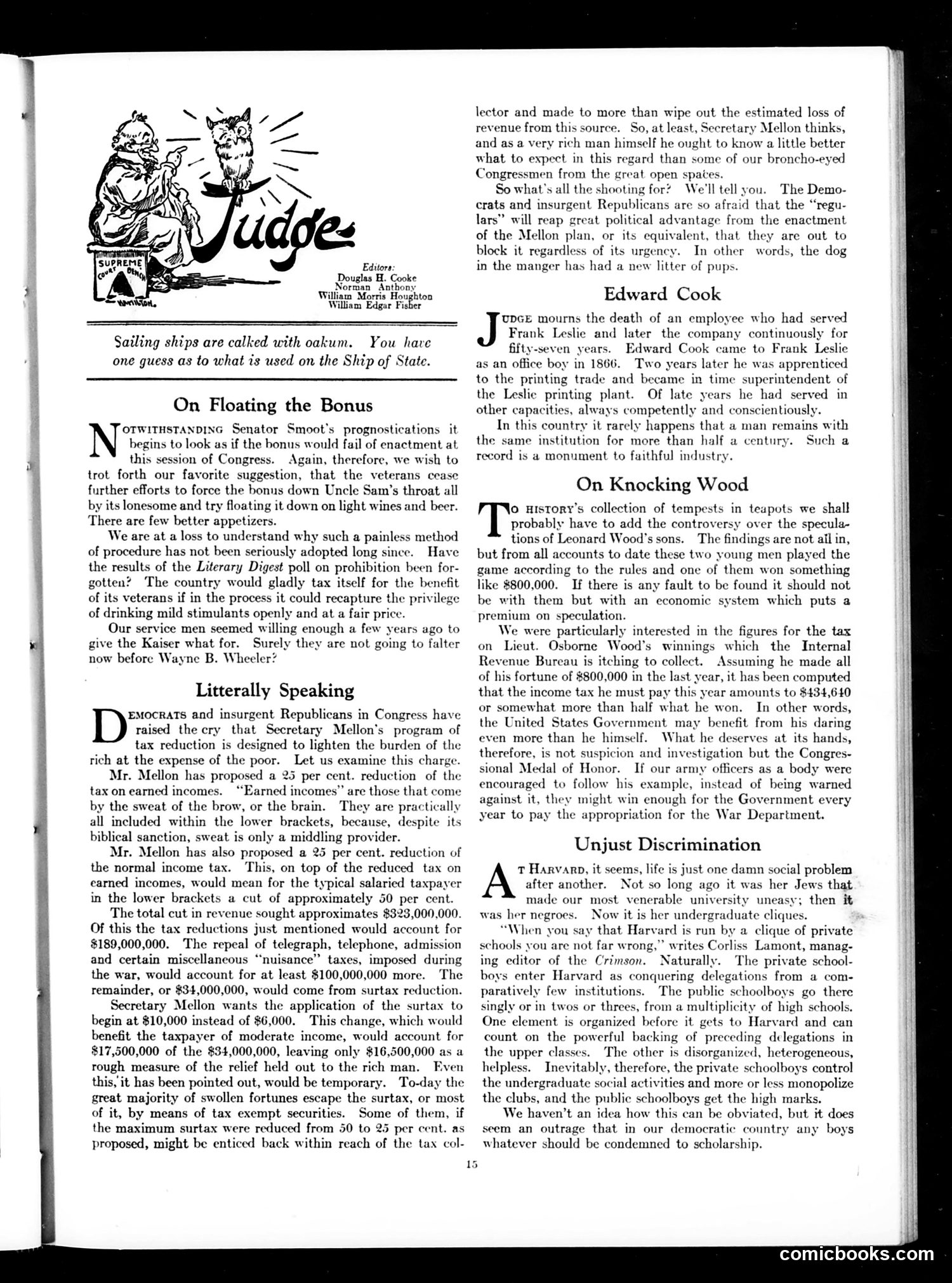
The masthead cartoon depicts a judge figure with an angry cat, likely satirizing contentious Congressional debate. The text uses sharp political commentary on Secretary Mellon's 1920s tax reduction proposal. **Key references:** - **Senator Smoot** and **Wayne B. Wheeler**: Real political figures debating the veterans' bonus and Prohibition - **Secretary Mellon**: Treasury Secretary proposing tax cuts that Democrats claim favor the wealthy - **"Dog in the manger"**: The closing metaphor accuses opposition politicians of blocking beneficial policy purely for partisan advantage, not principle **The satire's point**: Judge defends Mellon's tax plan by meticulously showing it actually benefits middle-class earners through reduced earned-income taxes, not the rich. The magazine characterizes Democratic and "insurgent Republican" opposition as cynical obstruction—they oppose good policy solely to prevent political credit flowing to rivals. The "new litter of pups" suggests petty, spiteful behavior unworthy of serious legislators. This represents conservative editorial positioning during the Harding administration's pro-business policies.
📄 Transcribed text from this page (OCR, searchable)
Machine-transcribed from the original scan — historical spelling and the odd misread are preserved.
= aS hai ache naan ementa Douglas H. Cooke Norman Anthony William Morris Houghton William Edgar Fisher Sailing ships are calked with oakum. You have one guess as to what is used on the Ship of State. On Floating the Bonus OTWITHSTANDING Senator Smoot’s prognostications it N begins to look as if the bonus would fail of enactment at this session of Congress. Again, therefore, we wish to trot forth our favorite suggestion, that the veterans cease further efforts to force the bonus down Uncle Sam’s throat all by its lonesome and try floating it down on light wines and beer. There are few better appetizers. We are at a loss to understand why such a painless method of procedure has not been seriously adopted long since. Have the results of the Literary Digest poll on prohibition been for- gotten? The country would gladly tax itself for the benefit of its veterans if in the process it could recapture the privilege of drinking mild stimulants openly and at a fair price. Our service men seemed willing enough a few years ago to give the Kaiser what for. Surely they are not going to falter now before Wayne B. Wheeler? Litterally Speaking EMocraTs and insurgent Republicans in Congress have D raised the cry that Secretary Mellon's program of tax reduction is designed to lighten the burden of the rich at the expense of the poor. Let us examine this charge. Mr. Mellon has proposed a 25 per cent. reduction of the tax on earned incomes. ‘Earned incomes” are those that come by the sweat of the brow, or the brain. They are practically all included within the lower brackets, because, despite its biblical sanction, sweat is only a middling provider. Mr. Mellon has also proposed a 25 per cent. reduction of the normal income tax. This, on top of the reduced tax on earned incomes, would mean for the typical salaried taxpayer in the lower brackets a cut of approximately 50 per cent. The total cut in revenue sought approximates $323,000,000. Of this the tax reductions just mentioned would account for $189,000,000. The repeal of telegraph, telephone, admission and certain miscellaneous “nuisance” taxes, imposed during the war, would account for at least $100,000,000 more. The remainder, or $34,000,000, would come from surtax reduction. Secretary Mellon wants the application of the surtax to begin at $10,000 instead of $6,000. This change, which would benefit the taxpayer of moderate income, would account for $17,500,000 of the $34,000,000, leaving only $16,500,000 as a rough measure of the relief held out to the rich man. Even this, it has been pointed out, would be temporary. To-day the great majority of swollen fortunes escape the surtax, or most of it, by means of tax exempt securities. Some of them, if the maximum surtax were reduced from 50 to 25 per cent. as proposed, might be enticed back within reach of the tax col- 15 lector and made to more than wipe out the estimated loss of revenue from this source. So, at least, Secretary Mellon thinks, and as a very rich man himself he ought to know a little better what to expect in this regard than some of our broncho-eyed Congressmen from the great open spaces. So what's all the shooting for? We'll tell you. The Demo- crats and insurgent Republicans are so afraid that the “regu- lars” will reap great political advantage from the enactment of the Mellon plan, or its equivalent, that they are out to block it regardless of its urgency. In other words, the dog in the manger has had a new litter of pups. Edward Cook UDGE mourns the death of an employee who had served J Frank Leslie and later the company continuously for fifty-seven years. Edward Cook came to Frank Leslie as an office boy in 1866. Two years later he was apprenticed to the printing trade and became in time superintendent of the Leslie printing plant. Of late years he had served in other capacities, always competently and conscientiously In this country it rarely happens that a man remains with the same institution for more than half a century. Such a record is a monument to faithful industry. On Knocking Wood r I History's collection of tempests in teapots we shall probably have to add the controversy over the specula- tions of Leonard Wood’s sons. The findings are not all in, but from all accounts to date these two young men played the game according to the rules and one of them won something like $800,000. If there is any fault to be found it should not be with them but with an economic system which puts a premium on speculation. We were particularly interested in the figures for the tax on Lieut. Osborne Wood’s winnings which the Internal Revenue Bureau is itching to collect. Assuming he made all of his fortune of $800,000 in the last year, it has been computed that the income tax he must pay this year amounts to $434,640 or somewhat more than half what he won. In other words, the United States Government may benefit from his daring even more than he himself. What he deserves at its hands, therefore, is not suspicion and investigation but the Congres- sional Medal of Honor. If our army officers as a body were encouraged to follow his example, instead of being warned against it, they might win enough for the Government every year to pay the appropriation for the War Department. Unjust Discrimination A tT Harvarp, it seems, life is just one damn social problem after another. Not so long ago it was her Jews that made our most venerable university uneasy; then it was her negroes. Now it is her undergraduate cliques. “When you say that Harvard is run by a clique of private schools you are not far wrong,” writes Corliss Lamont, manag- ing editor of the Crimson. Naturally. The private school- boys enter Harvard as conquering delegations from a com- paratively few institutions. The public schoolboys go there singly or in twos or threes, from a multiplicity of high schools. One element is organized before it gets to Harvard and can count on the powerful backing of preceding delegations in the upper classes. The other is disorganized, heterogeneous, helpless. Inevitably, therefore, the private schoolboys control the undergraduate sc activities and more or less monopolize the clubs, and the public schoolboys get the high marks. We haven’t an idea how this can be obviated, but it does seem an outrage that in our democratic country any boys whatever should be condemned to scholarship. comicbooks.com