
A complete issue · 36 pages · 1923
Judge — October 20, 1923
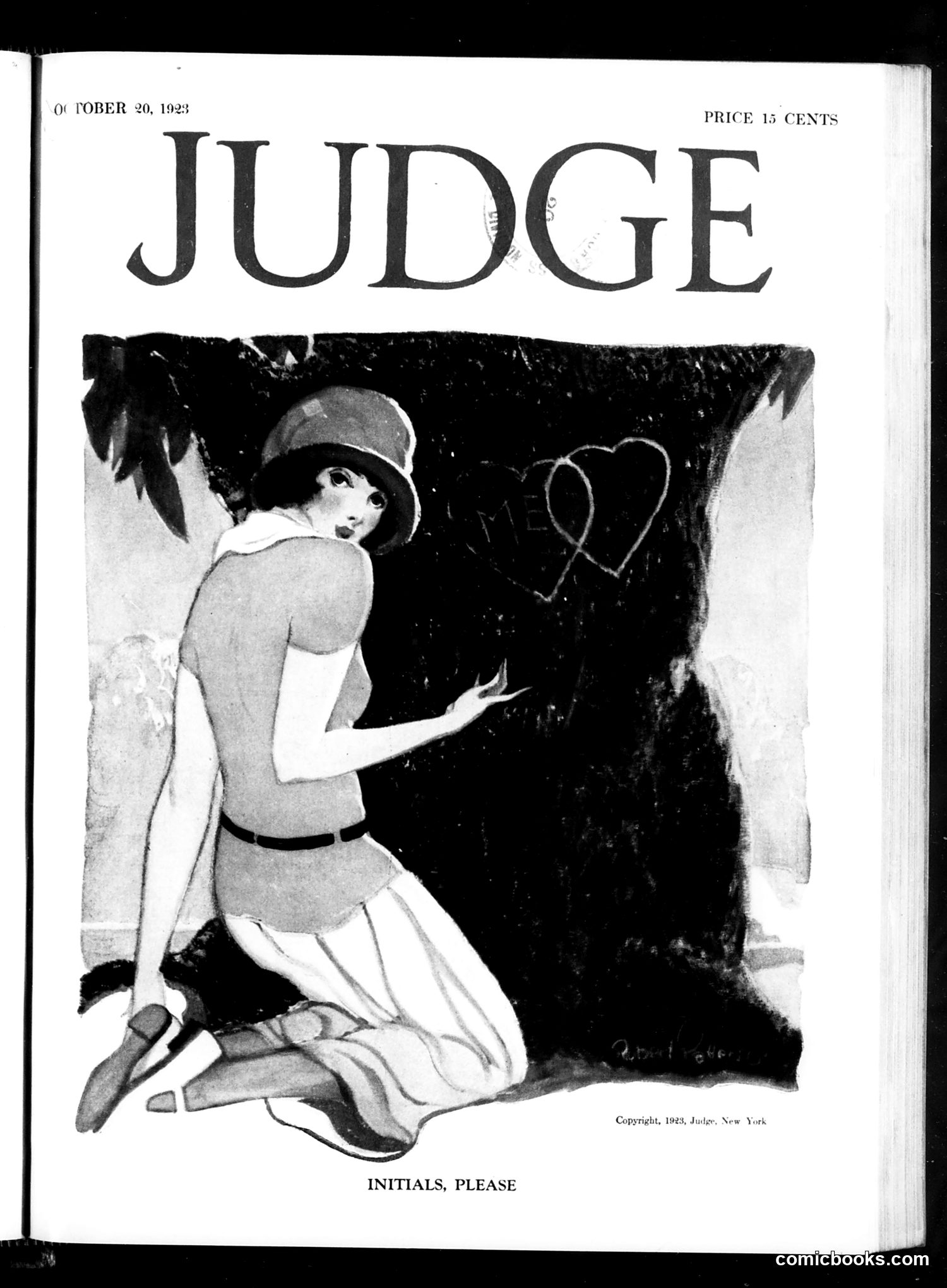
This cover depicts a flapper-era woman drawing hearts on what appears to be a wall or surface, with the caption "INITIALS, PLEASE." The illustration satirizes 1920s dating culture and romantic behavior during the Jazz Age. The woman's fashionable cloche hat, short hair, and exposed legs exemplify the "modern woman" stereotype that conservative society found provocative. The act of carving or drawing initials—a traditional courtship ritual—combined with her provocative pose and partial undressing suggests promiscuity or loose morality. Judge magazine, a conservative satirical publication, likely used this cover to mock the perceived moral decline represented by flappers and their dating freedoms, which challenged Victorian social norms regarding female behavior and sexuality.
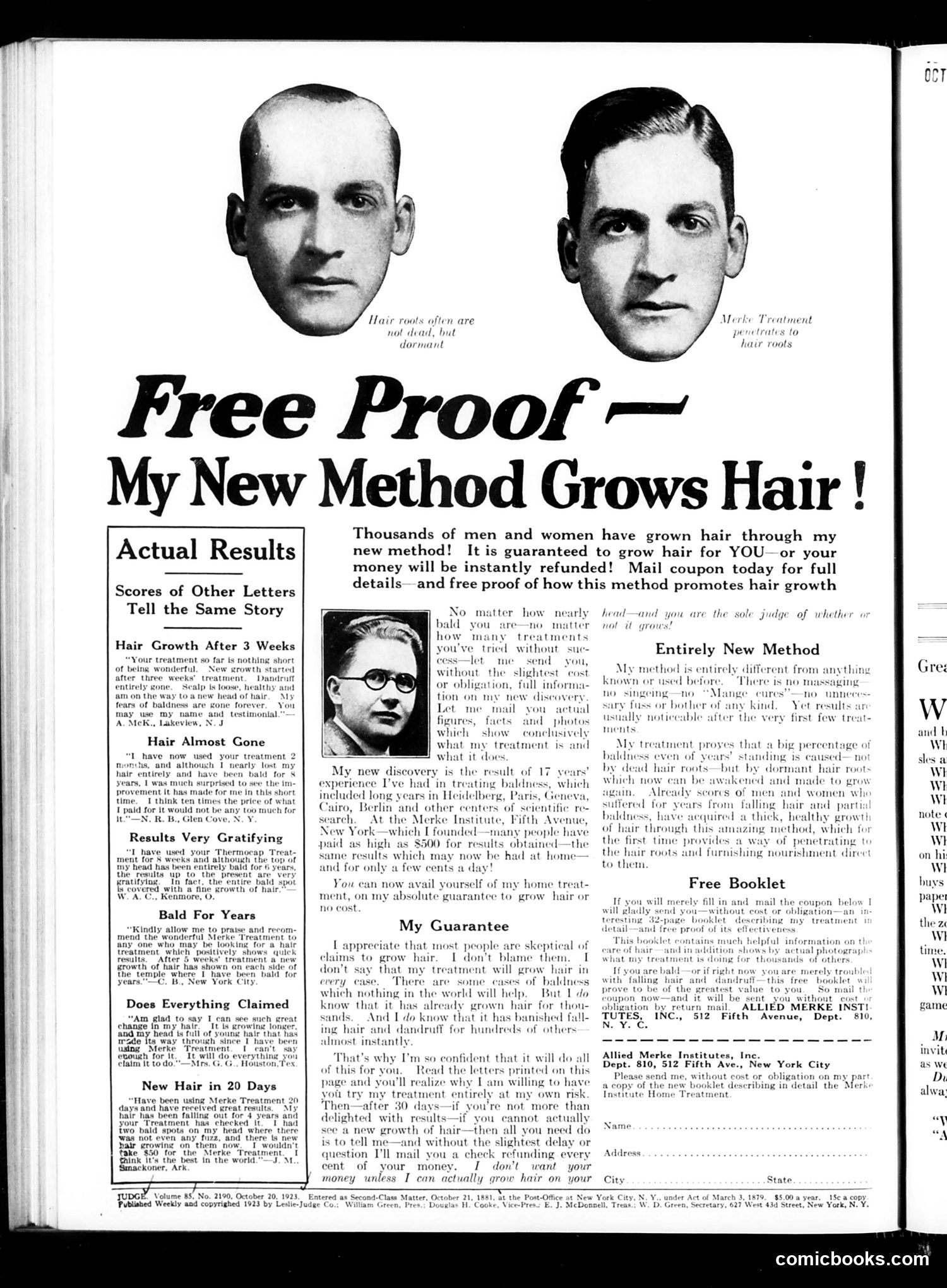
This page is **not satirical content** but rather a **commercial advertisement** for a hair-growth treatment called the "Merse Treatment," marketed by Allied Merke Institute in New York City. The layout presents before-and-after photographs of two men and includes testimonial letters claiming successful hair regrowth. The ad promises results within three weeks and offers a money-back guarantee. While Judge was primarily a satirical magazine, this appears to be a paid advertisement section—common in early 20th-century publications. The "free proof" offer and coupon are standard direct-mail marketing tactics of the era. There is no identifiable political satire or cartoon humor on this page; it's straightforward promotional material for a now-dubious medical treatment.
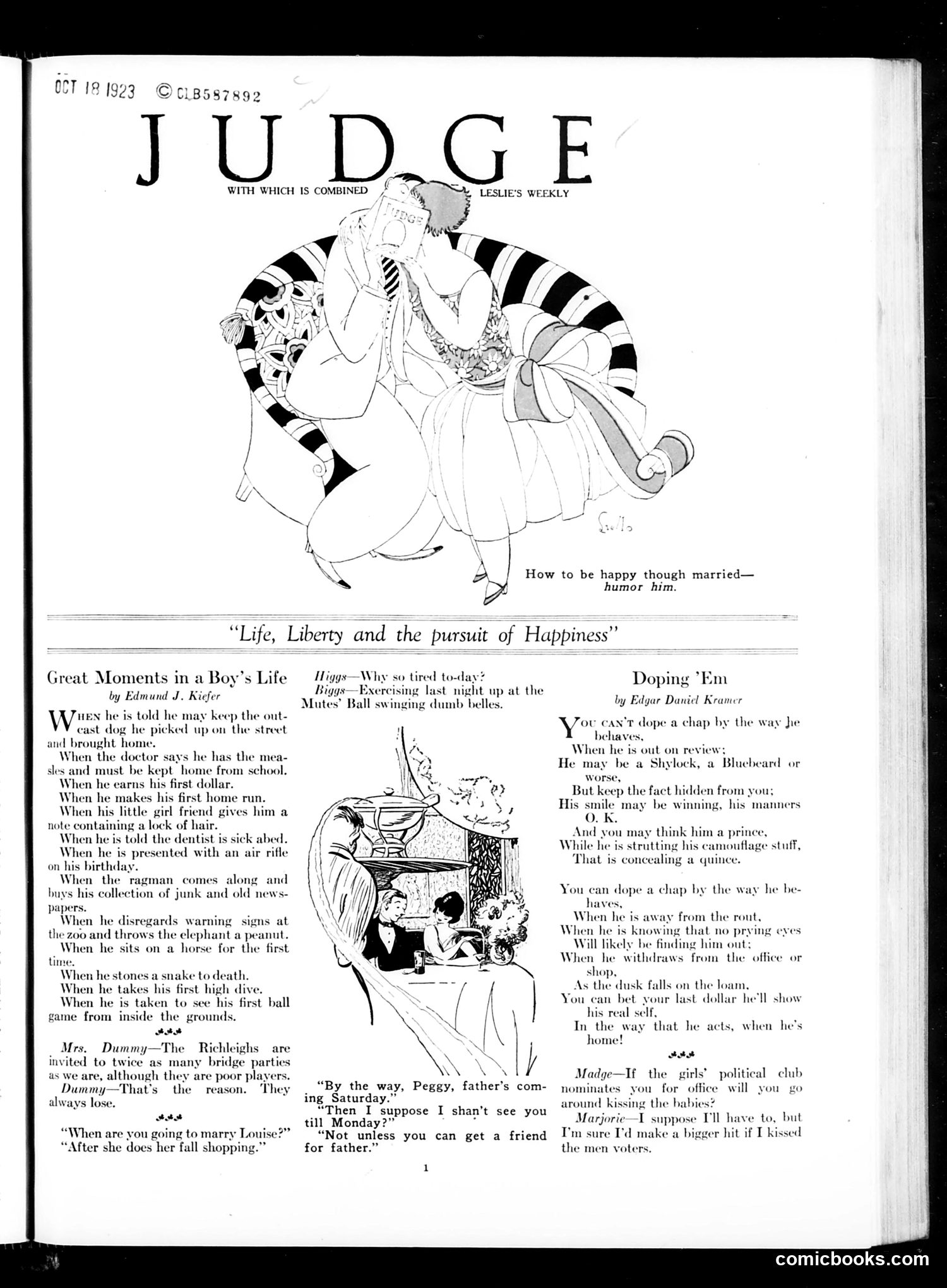
This page contains humorous columns and observations rather than political cartoons. The content includes: **"Great Moments in a Boy's Life"** — nostalgic humor about childhood milestones (first dollar, first girlfriend, first high dive). **"Doping 'Em"** — advice column by Edgar Daniel Kramer offering humorous tips for husbands to manage their wives' behavior discreetly, suggesting deception about infidelity and financial matters while maintaining domestic peace. **Social commentary** includes jokes about bridge parties, shopping habits, and marriage dynamics typical of 1920s upper-middle-class life. The illustration shows a domestic scene with what appears to be a couple and household activity. Overall, this reflects 1920s attitudes toward gender relations, marriage, and gender roles—presented as light satire but revealing period assumptions about marital dynamics and women's behavior management.
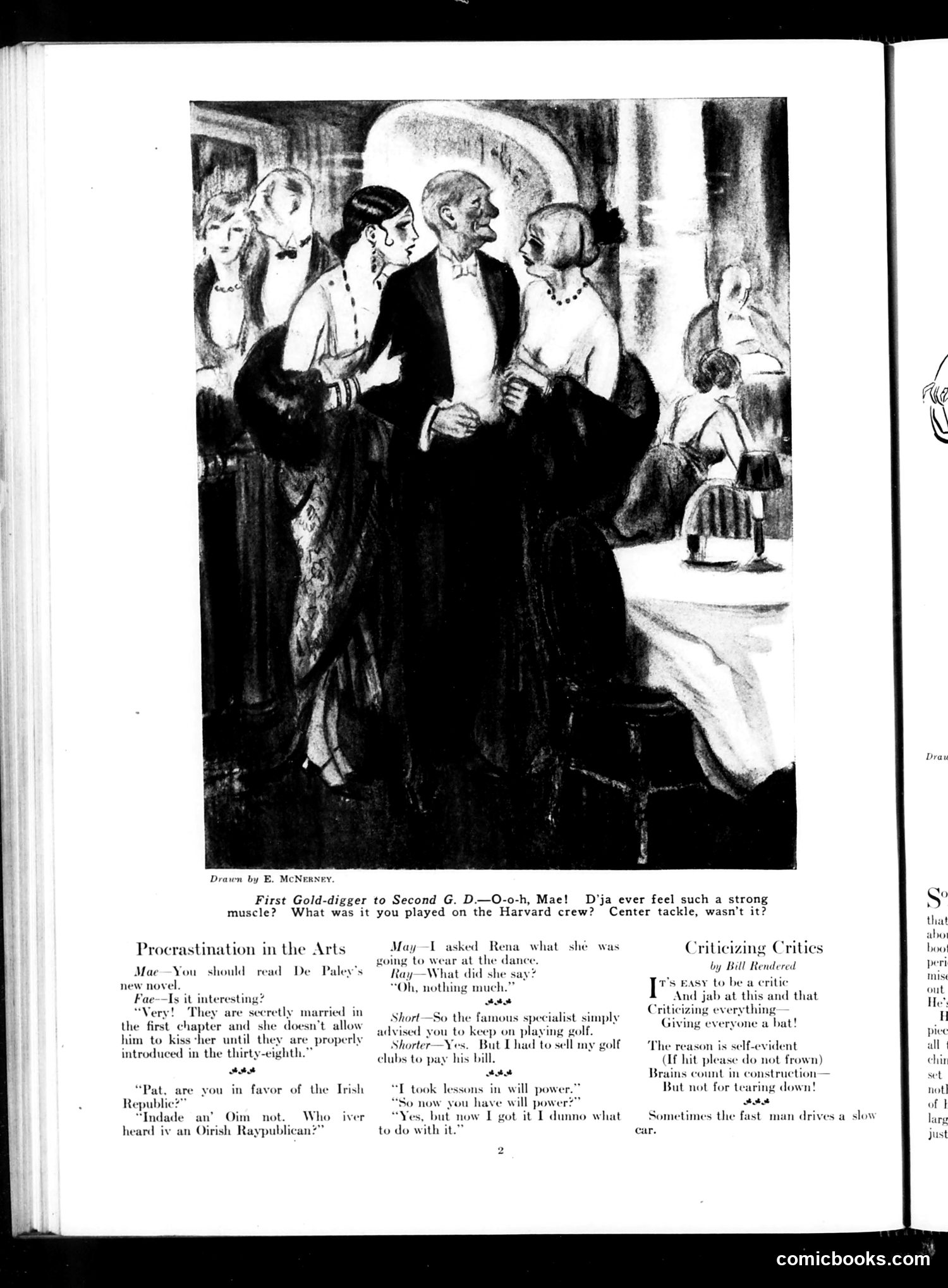
This page contains a satirical drawing by E. McKersey depicting a formal social gathering, likely at an elite venue. The cartoon's caption references "First Gold-digger to Second G.D." with dialogue about playing on the "Harvard crew," suggesting mockery of wealthy socialites and their romantic pursuits among the privileged class. Below are three separate joke sections addressing different topics: Irish Republican politics, golf, and literary criticism. The jokes are brief, punchy satirical quips typical of Judge's format—attacking pretension, hypocrisy, and contemporary social absurdities. The overall page exemplifies Judge's approach: combining visual satire of high society with written commentary on current events and cultural foibles, targeting educated, affluent readers familiar with references to Harvard, golf culture, and political debates of the era.
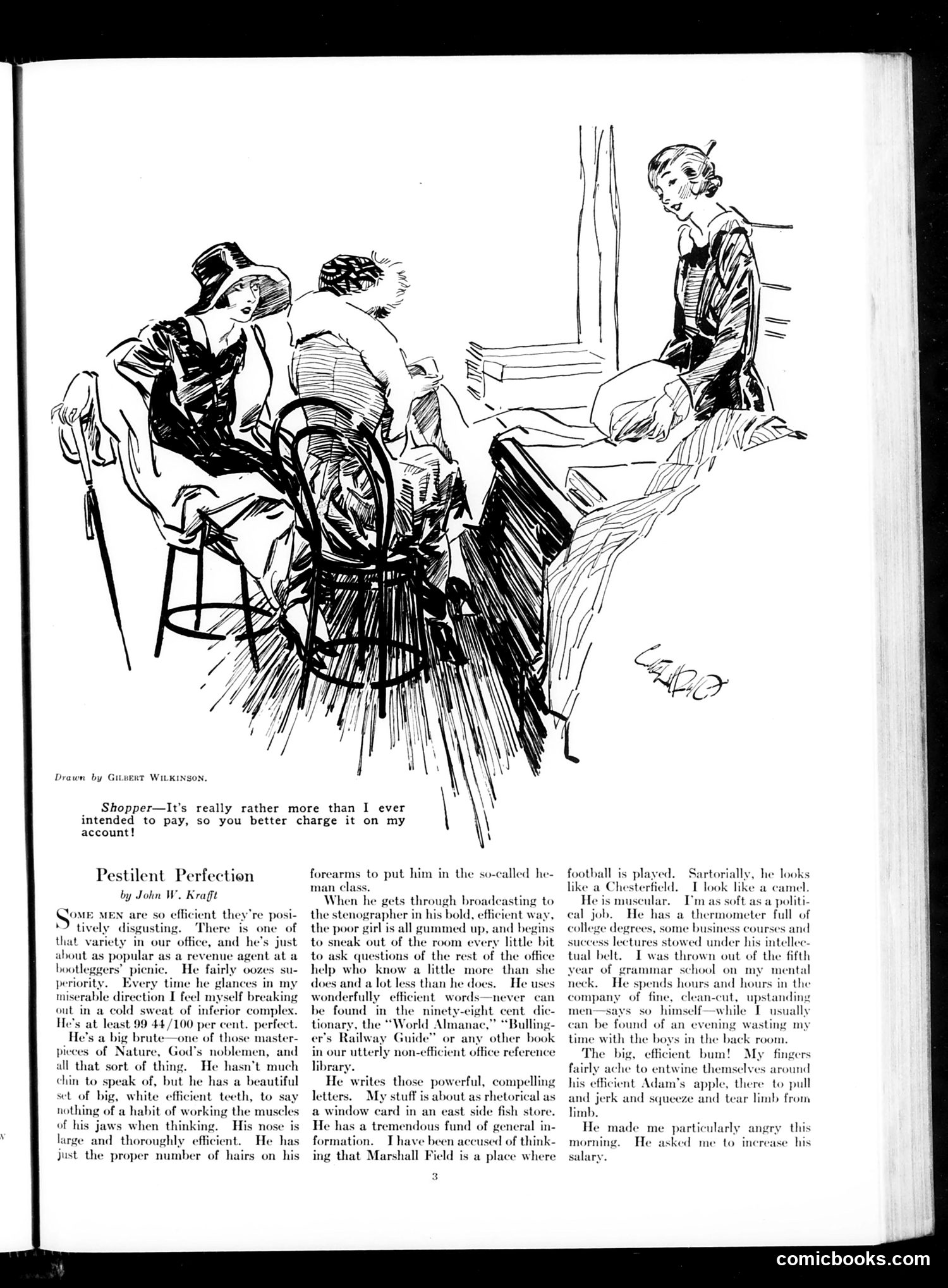
The cartoon illustrates "Pestilent Perfection" by John W. Kraft, a satirical piece about an insufferable office worker. The drawing shows three women in what appears to be an office setting, with one seated figure being the subject of the narrative. The satire targets a particular type of male colleague—described as "efficiently disgusting" and popular as a "revenge agent at a bridge." He's characterized as physically perfect (strong teeth, efficient nose and hair count) but professionally insufferable. His main flaw: he's an overly efficient office worker who uses impressive vocabulary unnecessarily and maintains excessive productivity. The complaint culminates in his demanding a salary increase after working long hours—the final aggravation that prompted his dismissal. The joke satirizes how technical competence and physical perfection don't excuse workplace arrogance and unreasonable demands.
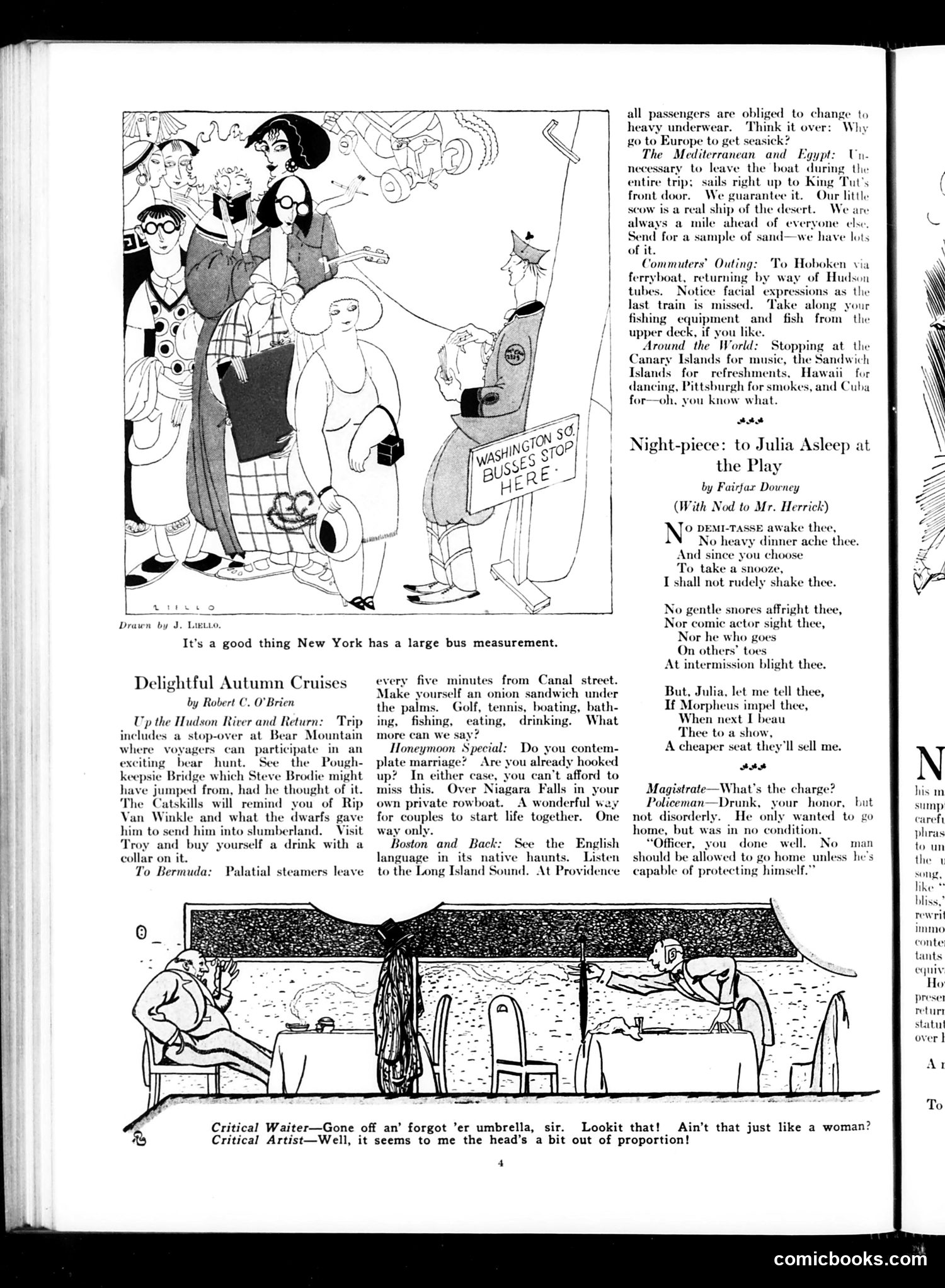
**Top Cartoon:** "It's a good thing New York has a large bus measurement" depicts a crowded bus stop at Washington Square with passengers of various sizes attempting to board. The joke satirizes NYC's overcrowding and the absurdity of bus capacity during peak travel times—the caption suggests only precise measurement could accommodate this chaos. **Middle Section:** "Delightful Autumn Cruises" advertises vacation trips (Hudson River, Bermuda, Niagara Falls, Boston) with humorous travel advice. This appears to be editorial content/advertisement rather than political satire. **Bottom Cartoon:** A waiter and artist debate a woman's proportions at a restaurant, with the waiter claiming her head looks "out of proportion." The humor plays on contemporary aesthetic standards and gender commentary typical of 1920s-era Judge magazine.
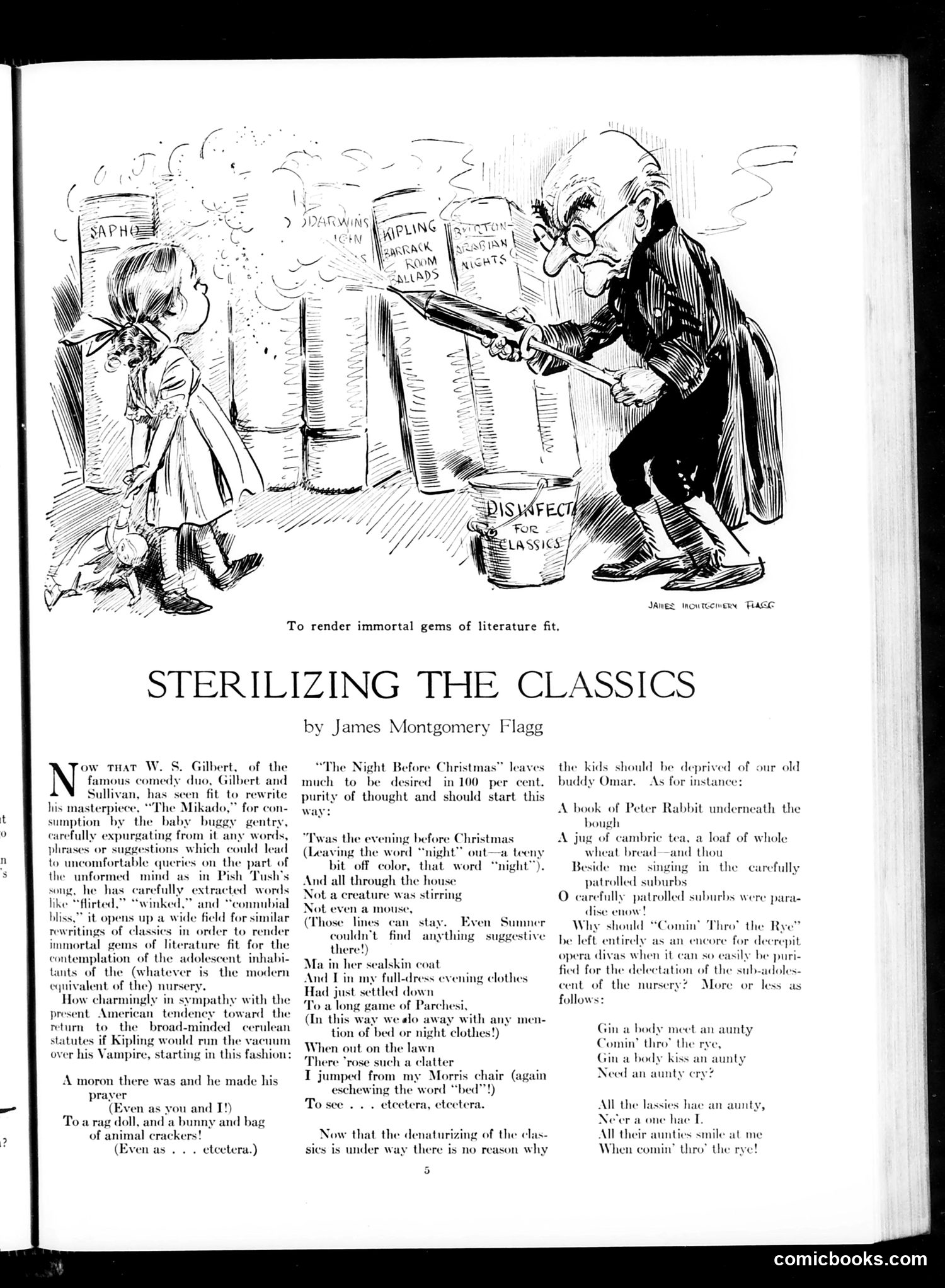
This satirical article by James Montgomery Flagg mocks the trend of expurgating classic literature to make it "safe" for children. The cartoon shows an older man (likely representing W.S. Gilbert, who recently rewrote "The Mikado" for young audiences) literally scrubbing books with disinfectant. Flagg's target: the overzealous censorship of beloved works. He parodies how sanitized rewrites eliminate any potentially suggestive content—removing words like "night," "bed," and "flirted" from classics like "The Night Before Christmas" and Robert Burns's "Comin' Thro' the Rye," replacing them with absurdly bland alternatives like "carefully patrolled suburbs." The satire argues this "denaturation" destroys the literature itself. Flagg suggests the American tendency toward protecting children from any adult thought has gone too far, rendering immortal masterpieces into meaningless pablum. The joke: such aggressive sanitization makes the classics completely unrecognizable and pointless.
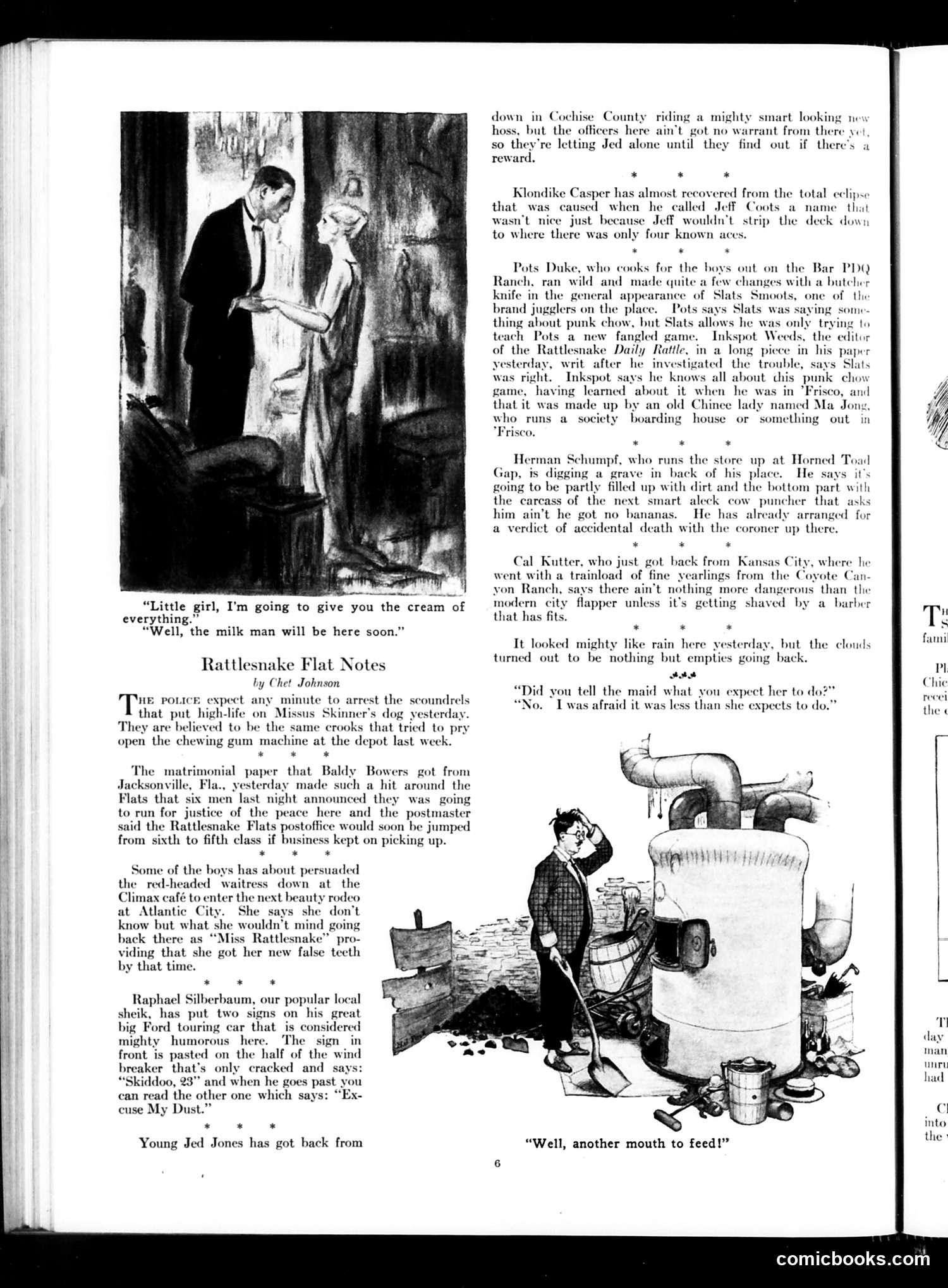
This page from *Judge* magazine contains humorous "notes" about a fictional rural Arizona community, written by Chet Johnson. The satire targets small-town Western life and its colorful characters. The sketches mock frontier stereotypes: crooked card games ("four known aces"), cowboy violence (Pots Duke's knife fight), suspicious lawmen, and rural ignorance (the running joke about bananas). There's also gentle mockery of urban pretension—a local sheik's Ford with wisecracks like "Skiddoo, 23" and "Excuse My Dust." The captioned illustrations satirize domesticity: one shows a flirtatious couple ("the milk man will be here soon"), another depicts a woman complaining to her maid about low expectations—poking fun at household management and servant relations. Overall, this is lighthearted rural humor typical of *Judge*'s early-twentieth-century sensibility, mocking backwoods life while celebrating it as authentically American.
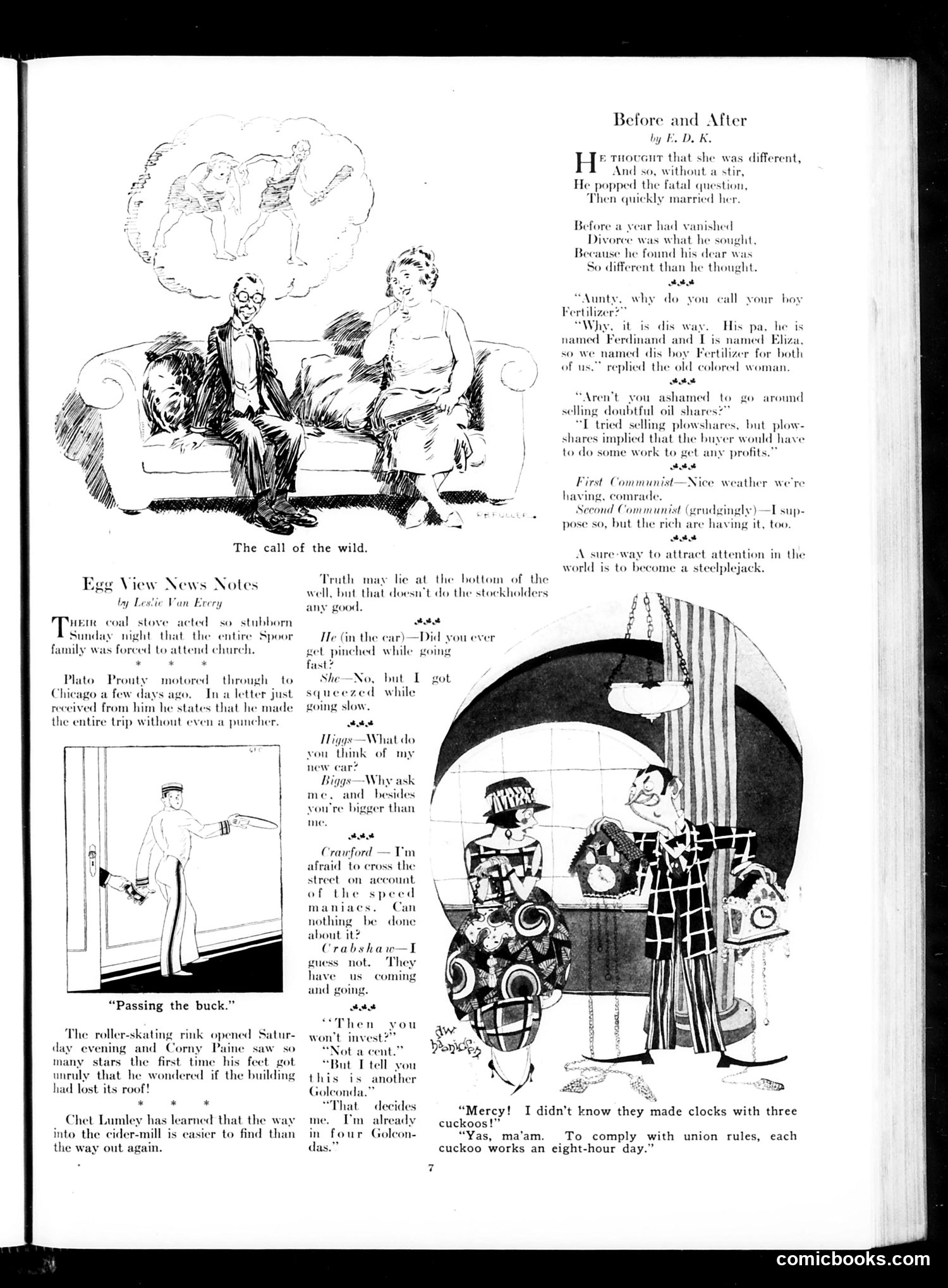
This page from Judge magazine contains several brief satirical pieces mocking American social pretensions and economic absurdities circa the 1910s-20s. **"Before and After"** (top right) jokes that marriage disappoints—he finds her "different" after the wedding, leading to quick divorce. It's commentary on romantic disillusionment. **The "Fertilizer" joke** mocks African American dialect while satirizing poor families naming children after their occupations or circumstances. **The Communist dialogue** ridicules communist ideology by showing even communists grudgingly acknowledge the wealthy enjoy better conditions—implying communism fails on its own promises. **The "three cuckoos" clock joke** satirizes labor unions by suggesting absurd work rules (each cuckoo requires its own eight-hour shift) that waste resources and inhibit productivity. **Various "News Notes"** mock small-town gossip and human folly—a speedway accident, roller-skating mishaps, investment schemes. The overall tone is urbane cynicism about American society's follies.
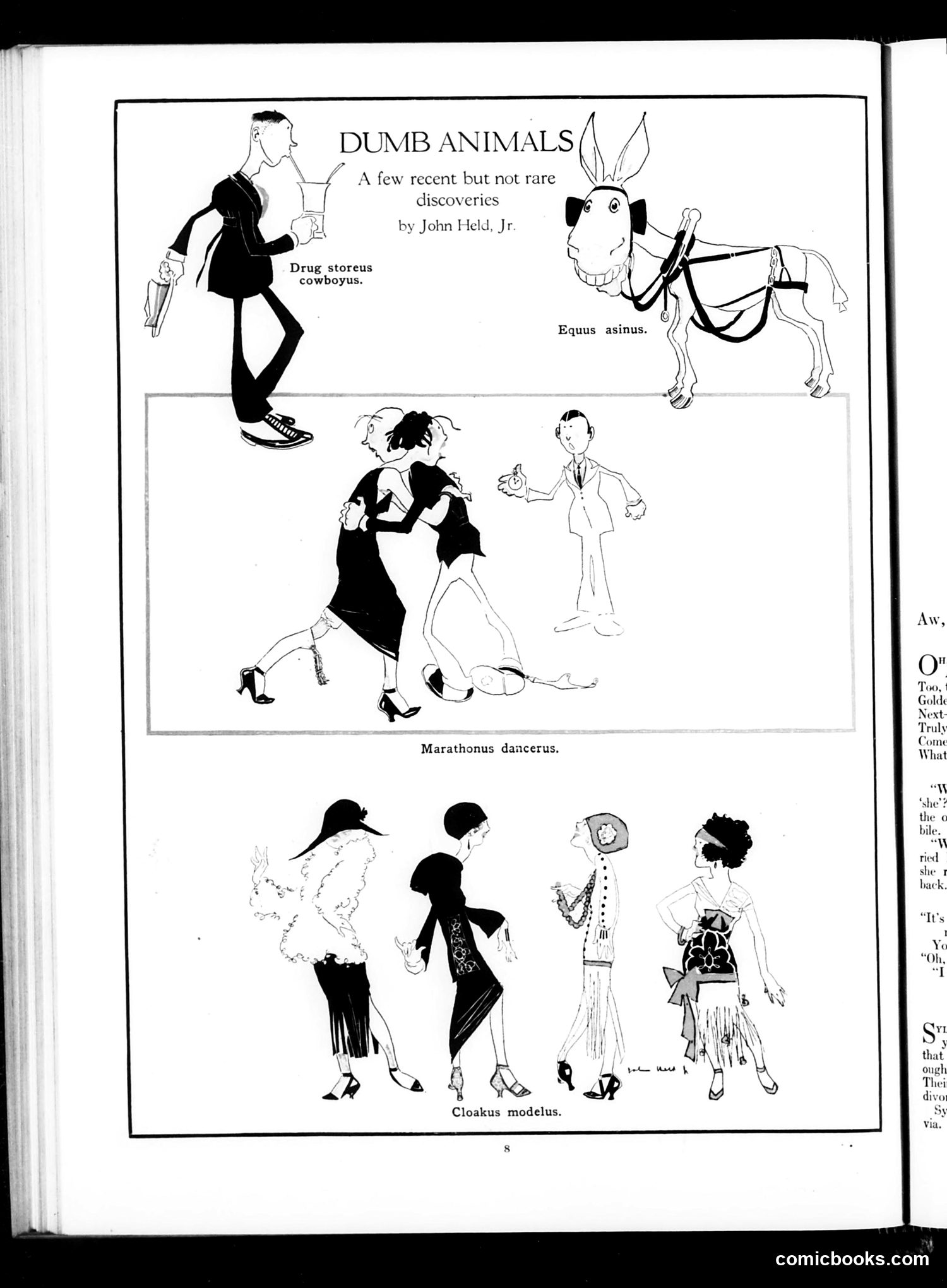
This satirical piece uses mock-Latin animal names to mock contemporary human behavior. "Drug storeus cowboyus" depicts a man in a drugstore acting like a cowboy with guns—mocking drugstore cowboys, a slang term for loitering young men who posed tough but were harmless. "Equus asinus" (literally "horse-ass") shows a donkey-headed man, a straightforward insult. "Marathonus dancerus" depicts people dancing wildly, mocking the marathon dancing craze popular in the 1920s. "Cloakus modelus" shows fashionably dressed women displaying cloaks, likely satirizing fashion models and the garment industry's absurdities. The satire targets contemporary social trends Held found ridiculous: affected youth behavior, fashion obsession, and fad dancing. The faux-scientific naming scheme mocks pseudo-intellectual humor popular in Judge magazine.
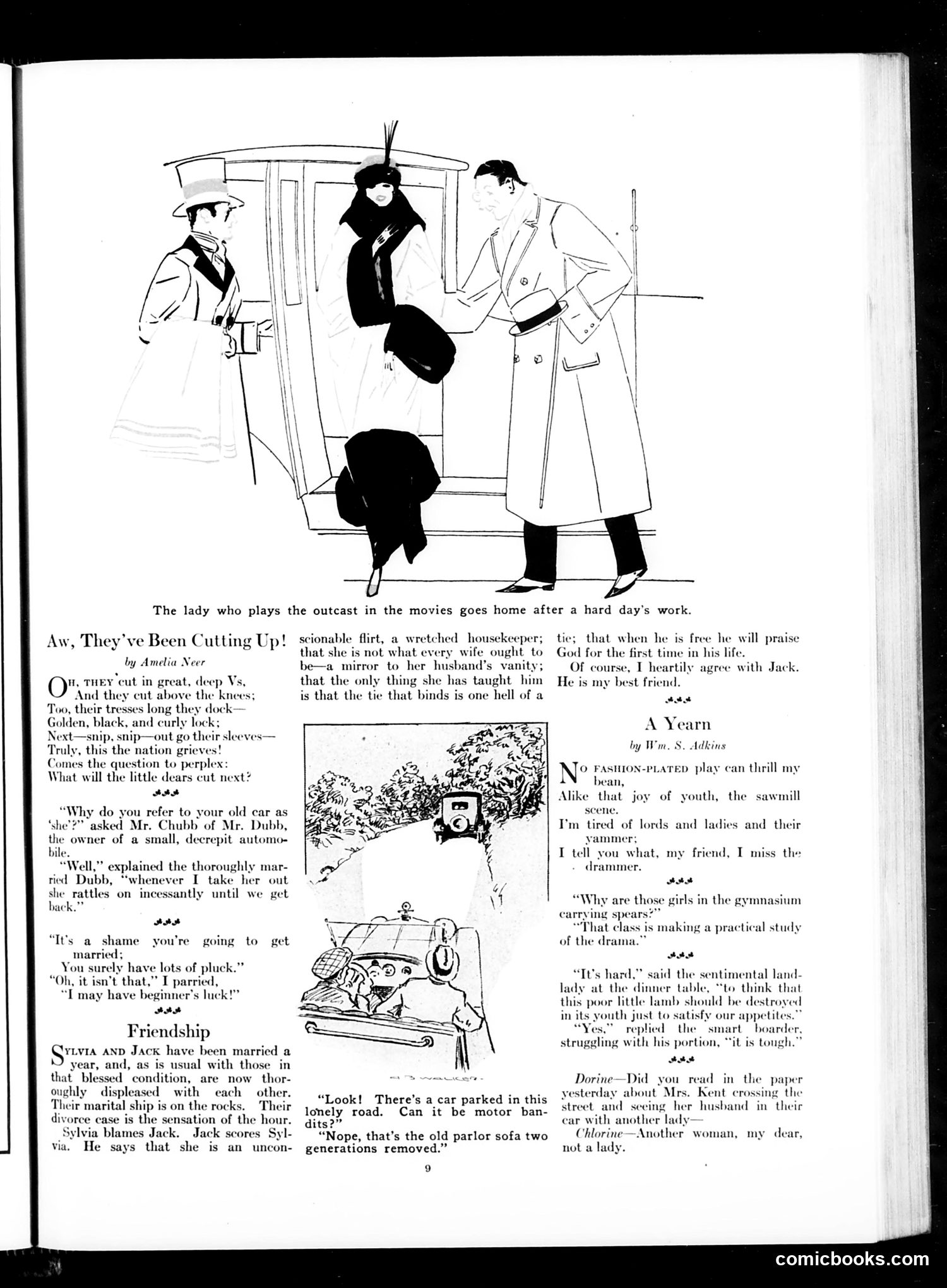
This page satirizes 1920s social changes through multiple short pieces: **"Aw, They've Been Cutting Up!"** mocks women's fashion modernization—the bobbed hair, shortened skirts, and sleeveless dresses that shocked conservatives. The poem's anxious refrain "What will the little dears cut next?" expresses moral panic about women's increasing autonomy and rejection of Victorian dress codes. **The car joke** uses gendered language to mock both automobiles and wives—comparing a rattling car to a nagging spouse, a common era trope. **"Friendship"** presents dark irony: a man whose marriage is failing praises his divorcing friend Jack while agreeing with Jack's harsh criticisms of Jack's wife—suggesting male loyalty supersedes fair judgment. The cartoons depict casual modern scenes: a movie actress arriving home by taxi, and a couple mistaking an old sofa for a bandit car in a deserted road. Overall, the page reflects 1920s anxieties about changing gender roles, modernization, and automobile culture while employing cynicism about marriage and relationships.
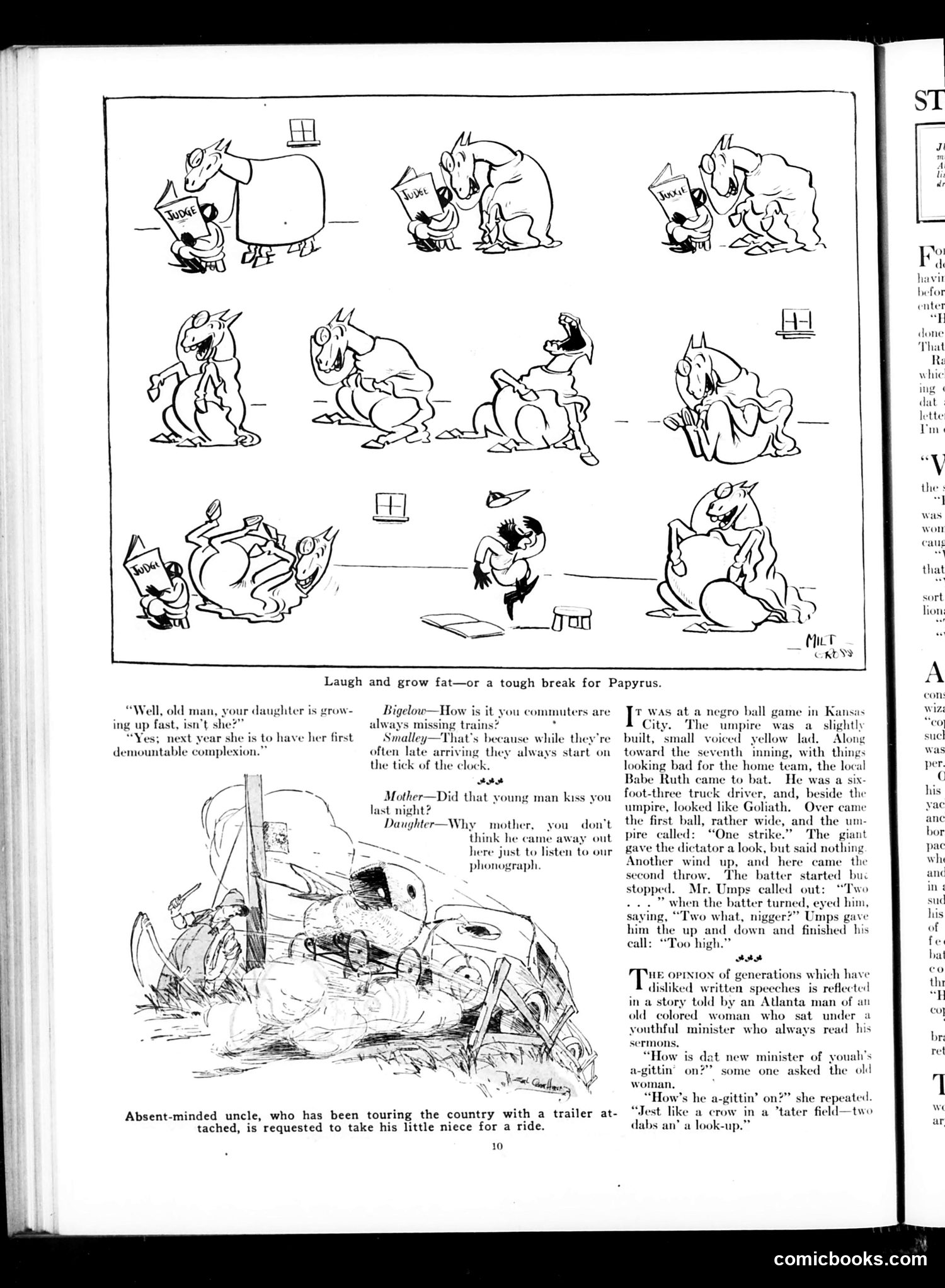
This page contains multiple satirical comics and jokes typical of early 20th-century American humor magazines. **Top cartoon**: Shows a man with a cow and "DIVORCE" papers, illustrating the caption about a daughter "growing up fast" and needing a "demountable complexion"—likely mocking either cosmetics or the idea of easily removable marriage prospects. **Other jokes** include commuter train humor, a flirtation scenario with a phonograph, and notably, **two jokes using racial slurs and stereotypes**: one about a baseball game with derogatory language toward a Black umpire, and another mocking Black dialect about a minister's sermons. **Bottom cartoon**: An absent-minded uncle with a trailer is asked to take his niece for a ride—playing on the period's novelty of automobile trailers. The page reflects Judge's era when such racial mockery was considered acceptable humor in mainstream publications. These jokes reveal the casual, normalized racism embedded in early 20th-century American popular culture, which modern readers would recognize as offensive rather than amusing.
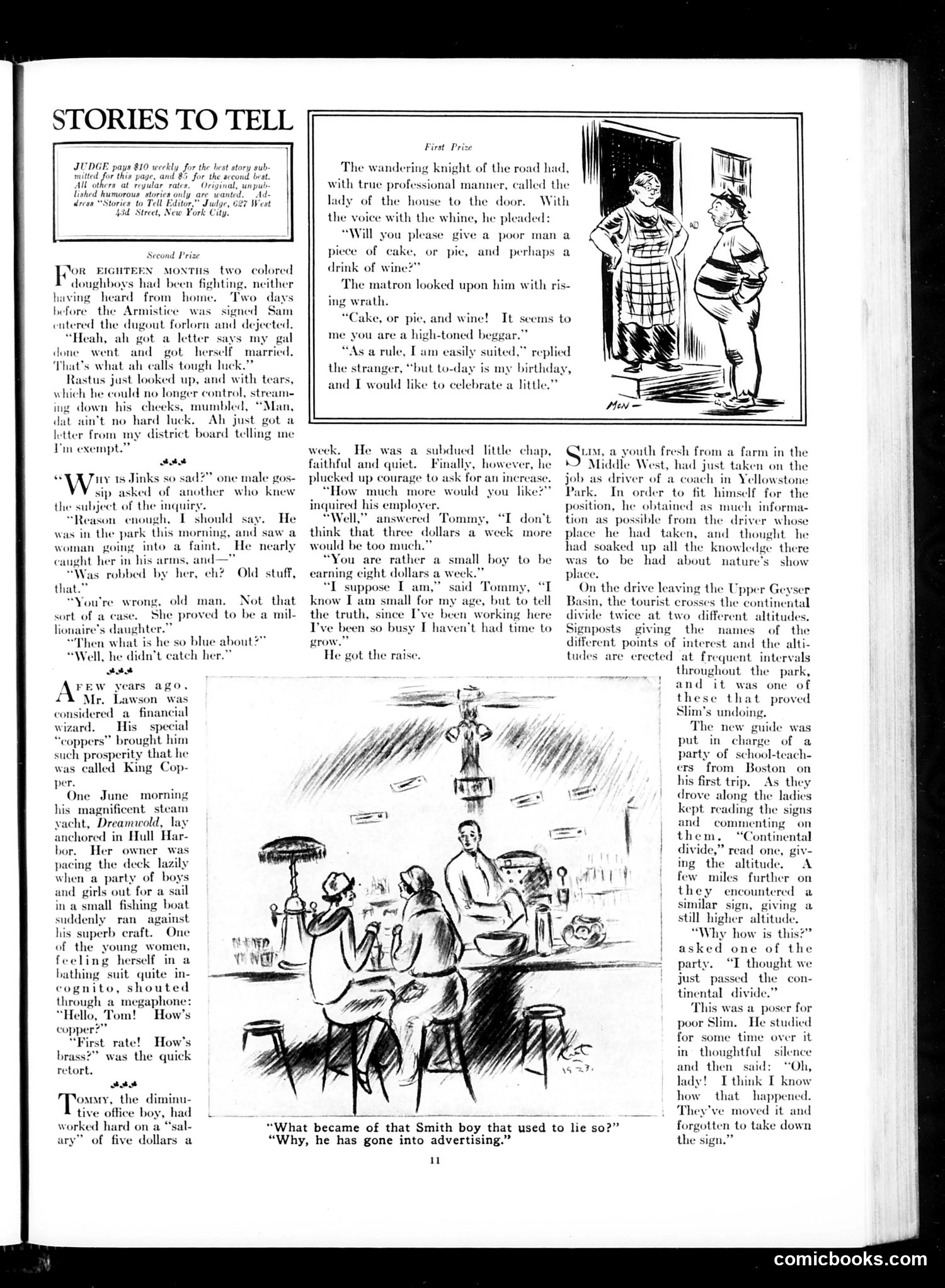
This page features a **collection of humorous short stories** rather than political cartoons. The content reflects early 20th-century American attitudes and social hierarchies: **Key Stories:** 1. **"First Prize"**: A beggar asks a wealthy woman for food and wine on his birthday—satire of class pretense and begging etiquette. 2. **"Second Prize"**: Two Black soldiers (called "doughboys," referencing WWI) discuss hardships; one finds his girlfriend married, the other received draft exemption—humor derived from their dialect and misfortunes. 3. **"Lawson"**: References "King Copper" (likely Thomas Lawson, a real financier), depicting wealthy yacht owners. 4. **"Tommy"**: Office boy negotiates a raise—a moral tale about modest ambition. 5. **"Slim"**: A farm boy guide misreads elevation signs at Yellowstone Park, creating comic confusion. **Modern Context**: The racial stereotyping and dialect humor reflect period attitudes. The stories emphasize class differences, humble persistence rewarded, and rural characters as sources of humor—typical Judge magazine fare.
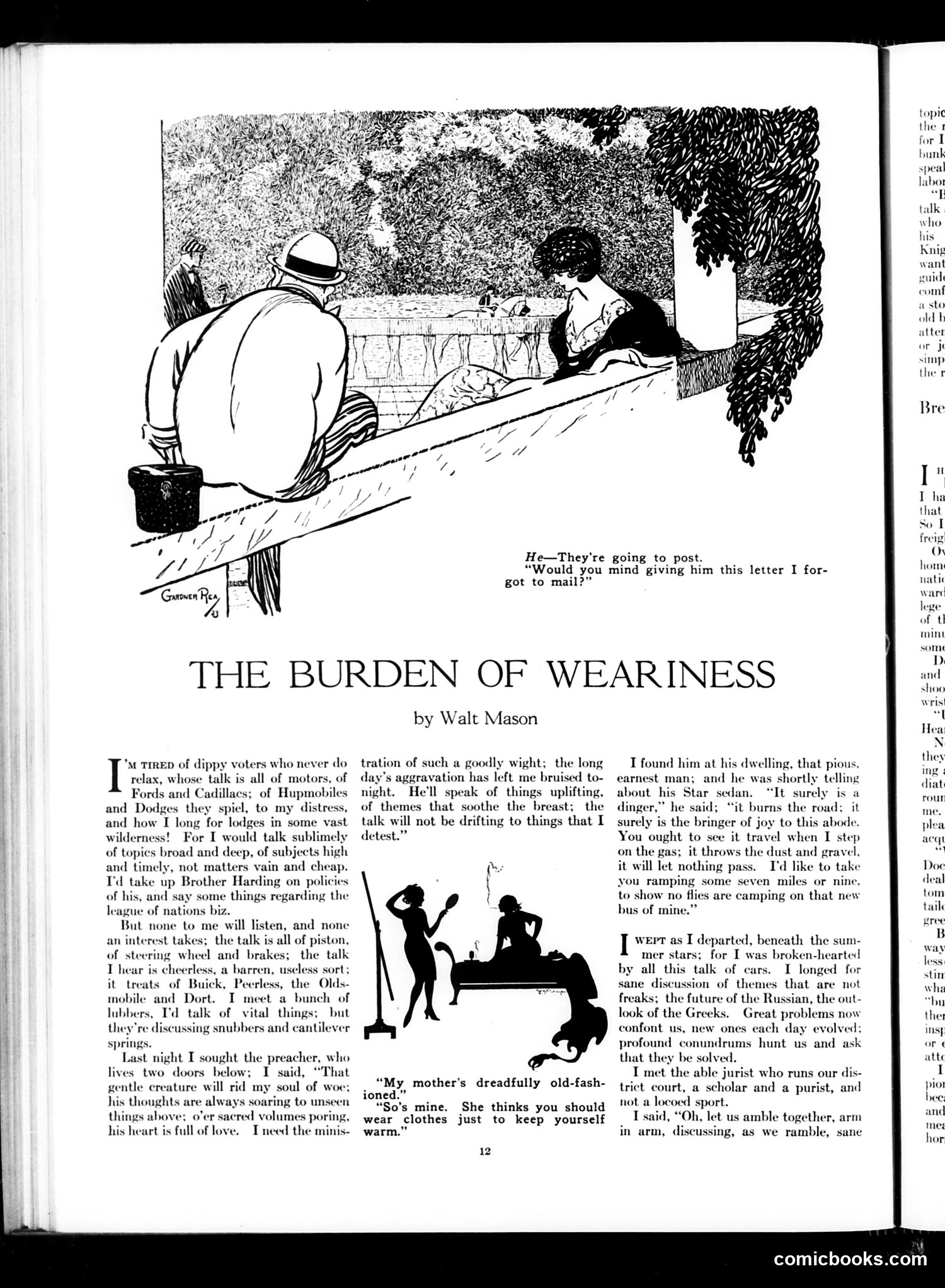
This satirical piece mocks early 1920s American culture's obsession with automobiles. The narrator—an intellectually-minded man—complains that everyone around him discusses only cars (Fords, Cadillacs, Hupmobiles, Dodges) and their mechanical details (pistons, steering wheels, brakes, cantilever springs), rather than substantive topics like politics, theology, or world affairs. The joke intensifies when he seeks conversation with a preacher, expecting philosophical discussion, only to find even the minister enthusiastically discussing his Star sedan. The cartoon illustration shows a man literally burdened by a car he carries—visualizing how automotive talk weighs on the protagonist. The accompanying jokes at page bottom reinforce the theme: parents criticized for "old-fashioned" values (wearing clothes for warmth rather than fashion) contrast with the car-obsessed modern era. The piece satirizes how consumer culture and mass-produced vehicles had fundamentally shifted American conversation away from traditional intellectual pursuits.
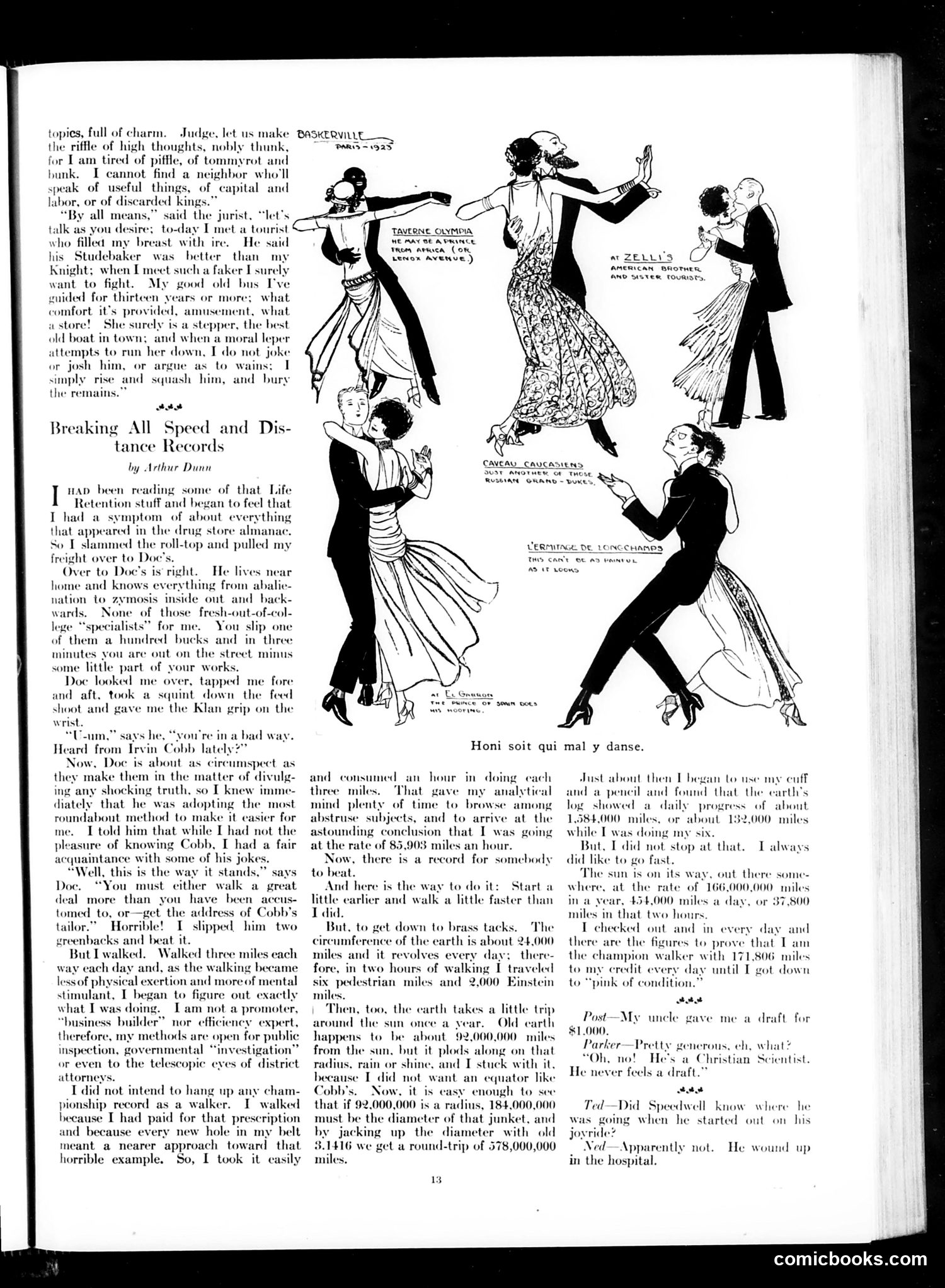
This page contains **two separate pieces** from Judge magazine (an American satirical publication): 1. **Top section**: A brief dialogue satirizing pretentious conversation. A character complains about neighbors discussing "high thoughts," but the "jurist" responds by bragging about his automobile—a Knight versus a Studebaker—and threatens violence against anyone who criticizes it. The satire mocks Americans who claim to want intellectual discourse but actually prefer boasting about consumer goods and cars. 2. **"Breaking All Speed and Distance Records"**: A humorous essay by Arthur Dunn. The narrator visits his doctor ("Doe") complaining of ailments from reading health columns. The doctor suggests walking more or seeing Cobb's tailor (implying Irvin Cobb was famously overweight). Walking three miles, the narrator calculates he's actually traveled 85,903 miles per hour when accounting for Earth's rotation—absurd mathematical play mocking pseudo-scientific thinking popular in the era. The illustrated figures show dancing couples, likely advertising entertainment venues like "Taverne Olympia" and "Zelli's" (real Parisian nightclubs of the 1920s-30s era).
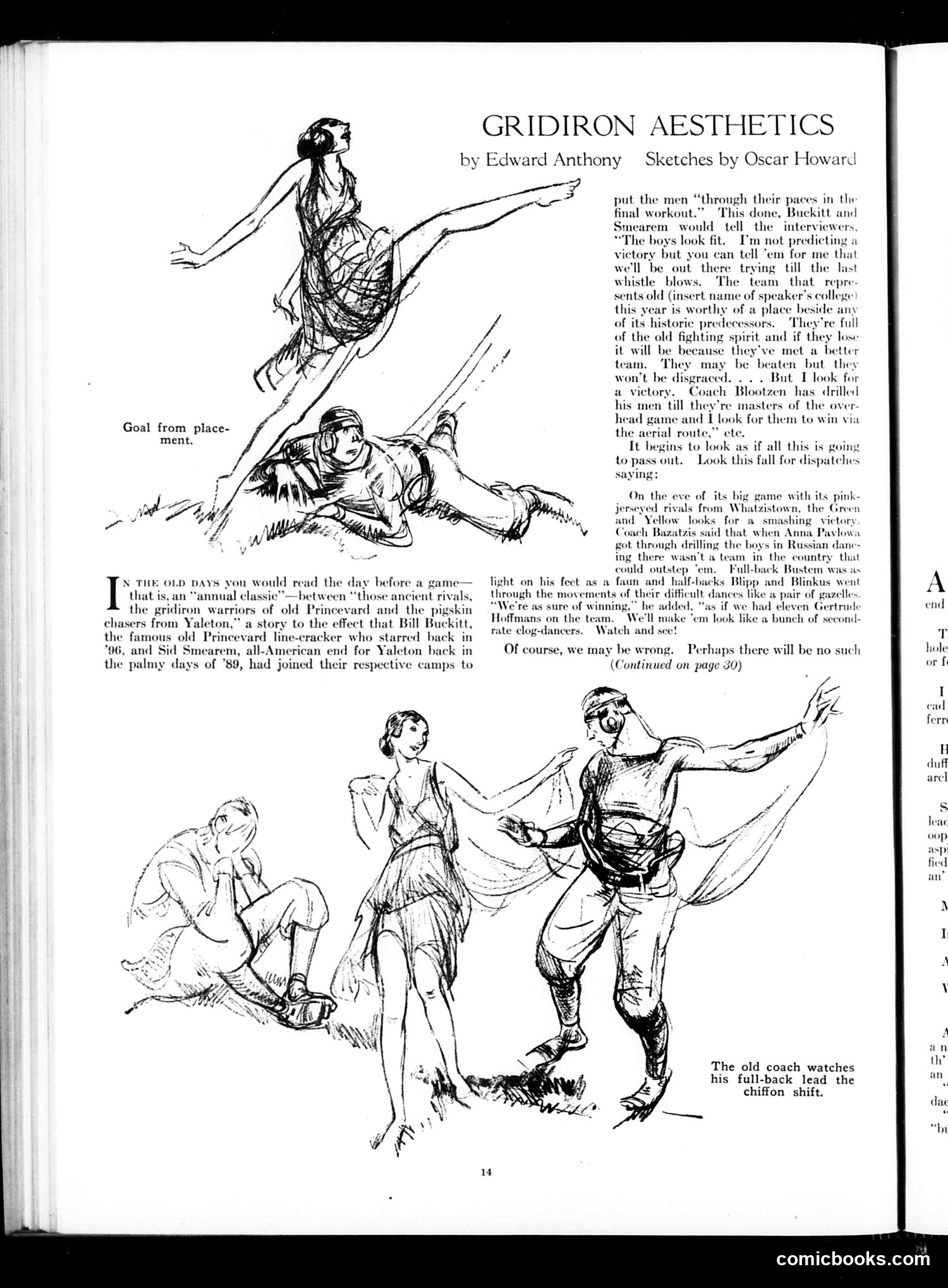
This article satirizes the pompous pre-game rhetoric of college football coaches. Edward Anthony mocks the clichéd interviews coaches give before "big games" between rival colleges—the predictable claims about team fitness, fighting spirit, and modest predictions of victory despite being well-prepared. The sketches by Oscar Howard illustrate the absurdist humor: they depict football players executing increasingly ridiculous, dance-like movements (including "Russian dancing" and "chiffon shifts"), suggesting coaches have abandoned actual football training for theatrical posturing. The satire targets the gap between coaches' grandiose language and the reality of their preparations. References to unnamed rivals like "Whatzistown" and generic college names emphasize how interchangeable these pre-game narratives are. The piece pokes fun at both the coaches' self-important pronouncements and sportswriters who dutifully record them, treating clichéd boilerplate as newsworthy content.
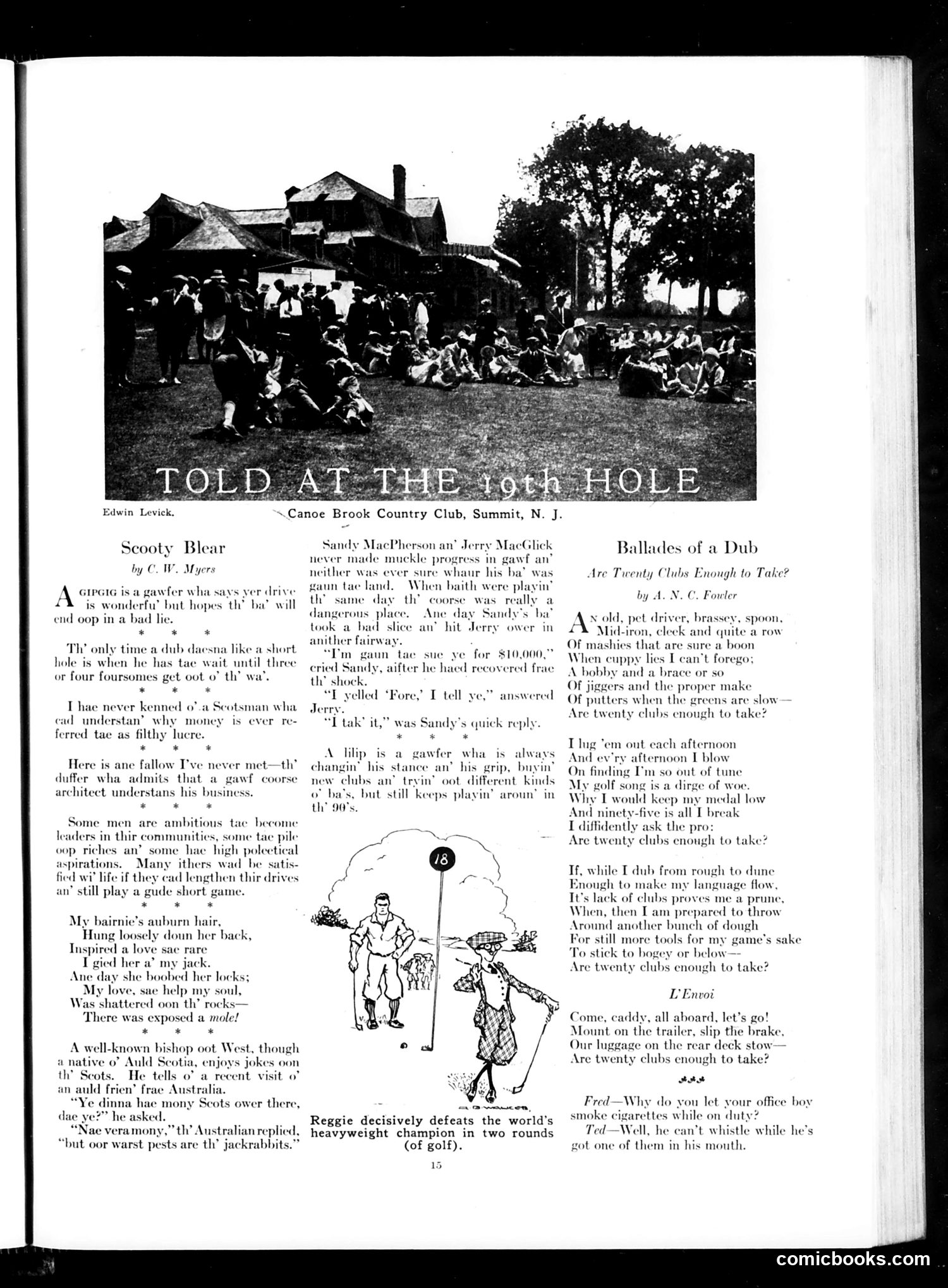
This page from *Judge* magazine contains Scottish golf humor and satirical verse about golfing culture. **Main Content:** The central cartoon shows "Reggie decisively defeats the world's heavyweight champion in two rounds (of golf)"—a visual gag where athletic prowess means nothing on the golf course. **"Scooty Blear"** (left column) is a humorous poem in Scottish dialect about golf and golfers. It mocks various types: the duffer who complains about course design, the superstitious player, the fidgety golfer constantly changing equipment. The bishop anecdote's punchline relies on Scottish stereotypes about immigration. **"Ballades of a Dub"** (right column) is verse lamenting whether twenty golf clubs suffice—satirizing golfers' endless equipment acquisition and excuses for poor play. The final joke about the office boy smoking to avoid whistling is unrelated workplace humor. **Context for modern readers:** This reflects early-20th-century golf's popularity among middle/upper-class men, Scottish cultural stereotypes common in American magazines, and the timeless golfer's complaint that equipment (not skill) causes failure.
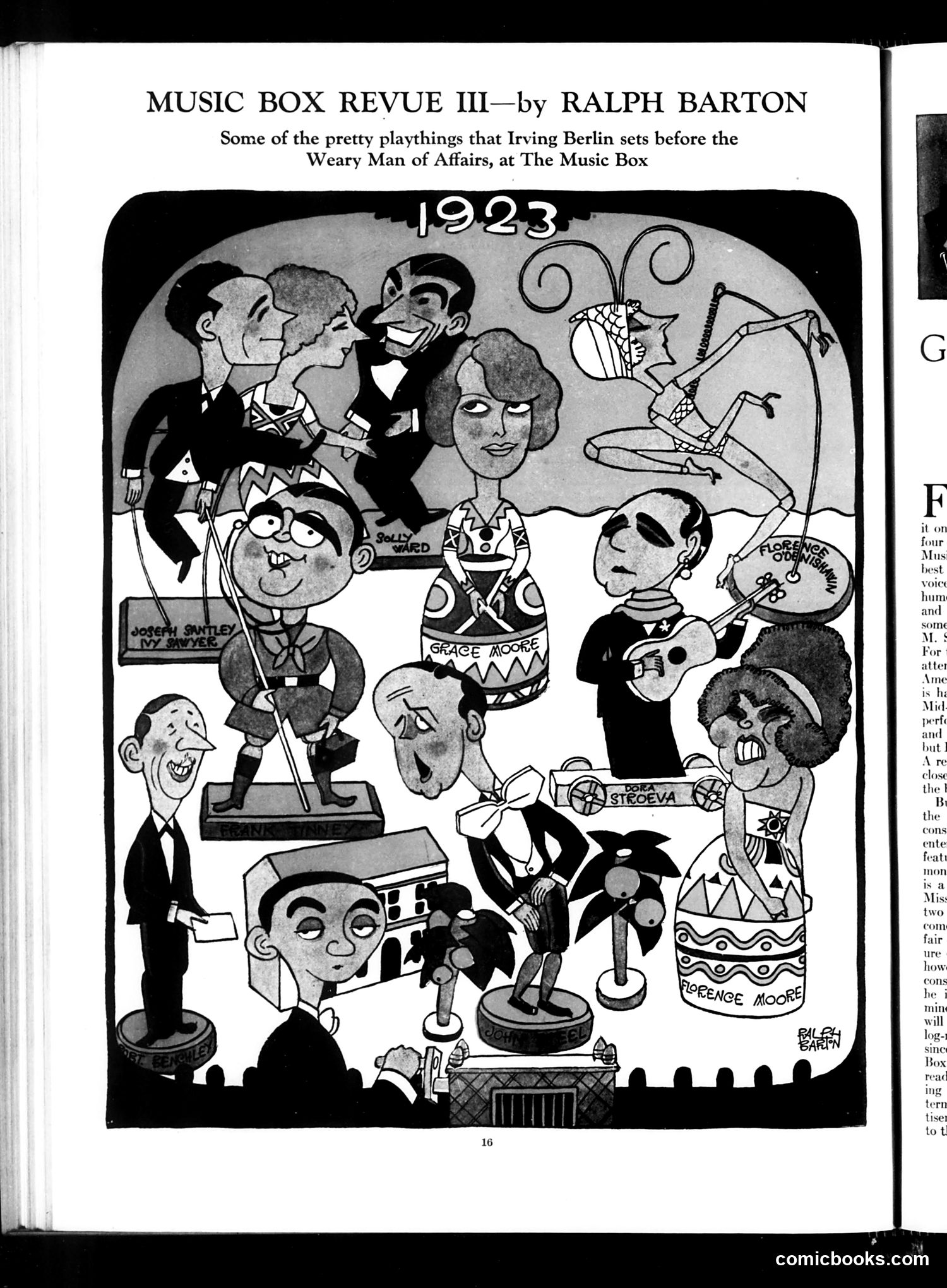
This is Ralph Barton's satirical illustration of Irving Berlin's *Music Box Revue III*, a Broadway theatrical revue. The cartoon depicts caricatured performers and entertainers of the 1923 production arranged around a music box stage set. Identifiable figures include Grace Moore (labeled, center) and Florence Moore (labeled, lower right), both performers in the revue. Joseph Santley appears labeled on the left. The cartoon exaggerates performers' features in typical 1920s caricature style—elongated faces, prominent noses, and comic proportions. The subtitle describes them as "pretty playthings" that Berlin presents before "the Weary Man of Affairs," suggesting satire of Broadway's commercial entertainment machine and how it caters to tired businessmen seeking escape. Barton's illustration mocks both the performers and the audience they entertained during the Jazz Age.
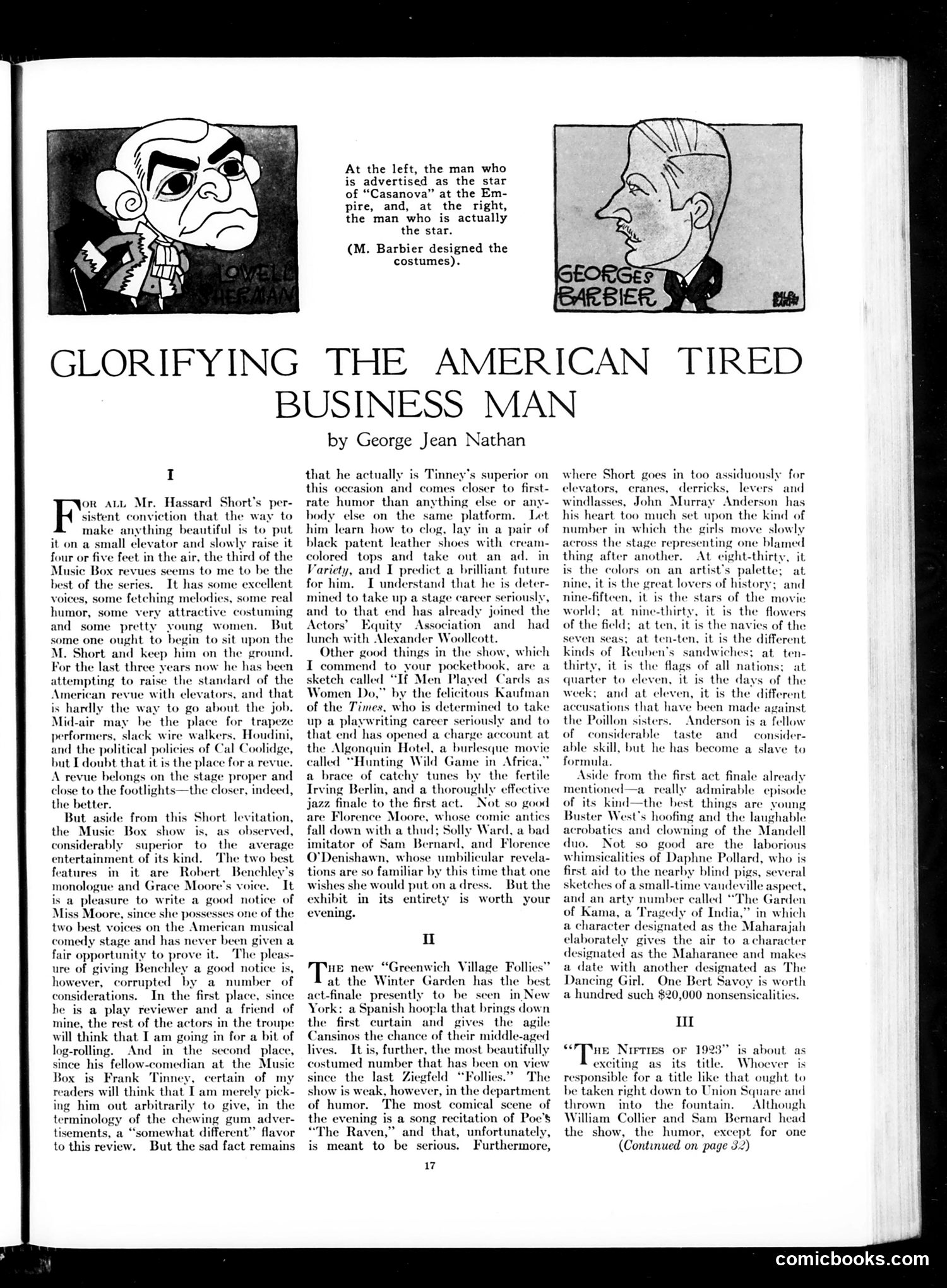
This page from Judge magazine features a satirical comparison cartoon and theater review. The top cartoon contrasts two men: the advertised "star" of the operetta "Casanova" at the Empire Theatre (left, shown as an ornate, theatrical figure with elaborate costume designed by M. Barbier) versus the actual star (right, identified as George Barbier himself—the costume designer, shown in profile as an ordinary man). The joke targets how costume design and theatrical artifice can transform an unremarkable person into a stage spectacle. It mocks both theatrical pretension and the deception inherent in entertainment marketing—the real "star" is merely the designer's creation, not any performer. Below, George Jean Nathan's theater review critiques the Music Box revue, praising some acts while criticizing director M. Short's excessive use of elevators to "raise the standard" of American revues, arguing that spectacle without genuine talent is hollow.
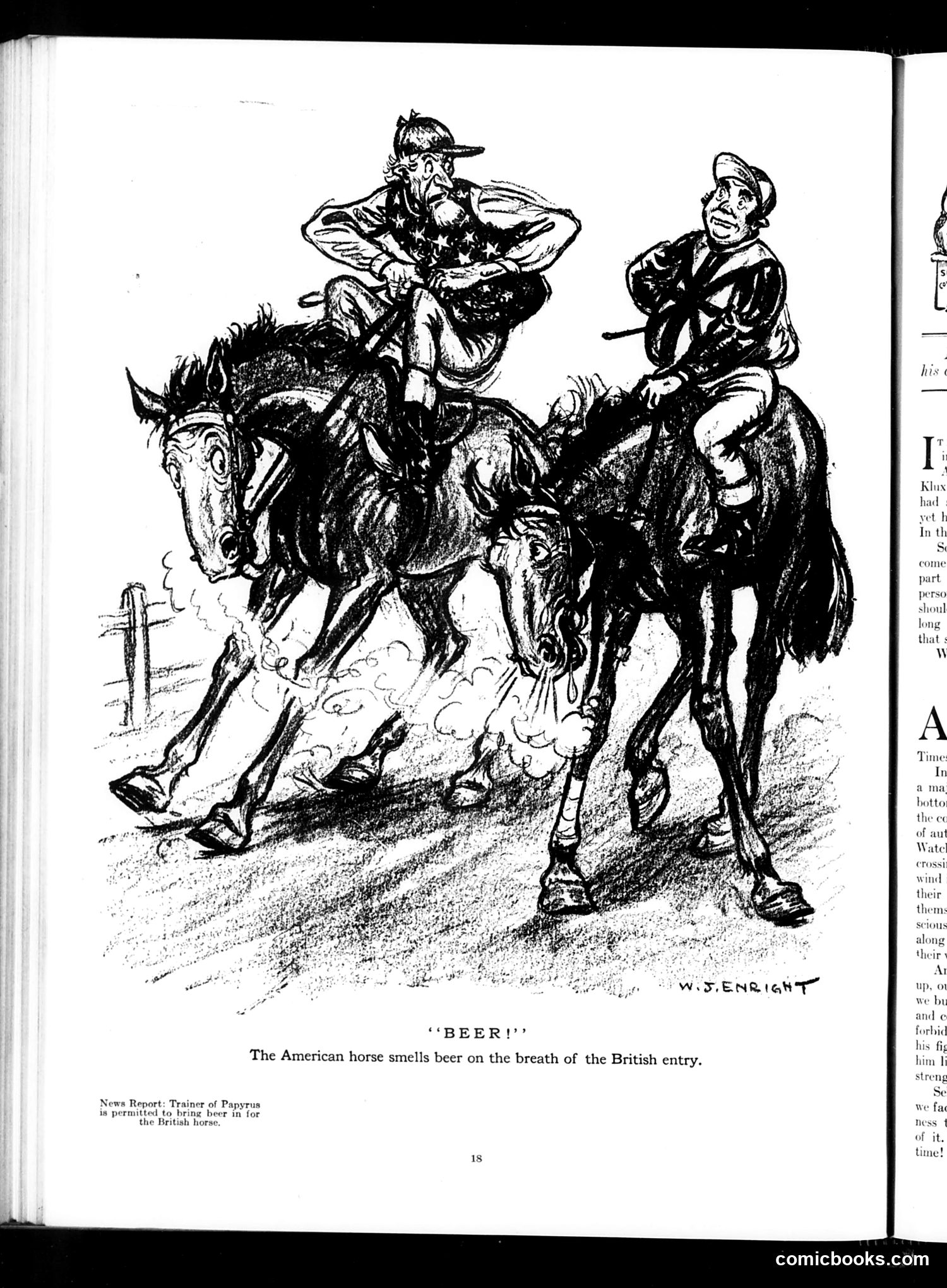
This cartoon satirizes the 1923 horse race between American horse Papyrus and a British entry. The caption references a news report that the British horse's trainer was permitted to bring beer for the animal. The joke: An American cavalry soldier mounted on his horse encounters a British soldier on horseback. The American horse, detecting beer on the British entry's breath, reacts with surprise or alarm—suggesting the British horse has been given alcohol, perhaps to enhance its performance or calm its nerves. The satire mocks both British sporting practices and the notion that artificial means (alcohol) might be needed to compete fairly. It also plays on American attitudes toward British pretension in equestrian sports. The cartoon reflects period skepticism about international competition integrity and the stereotype of British eccentricity in animal training.
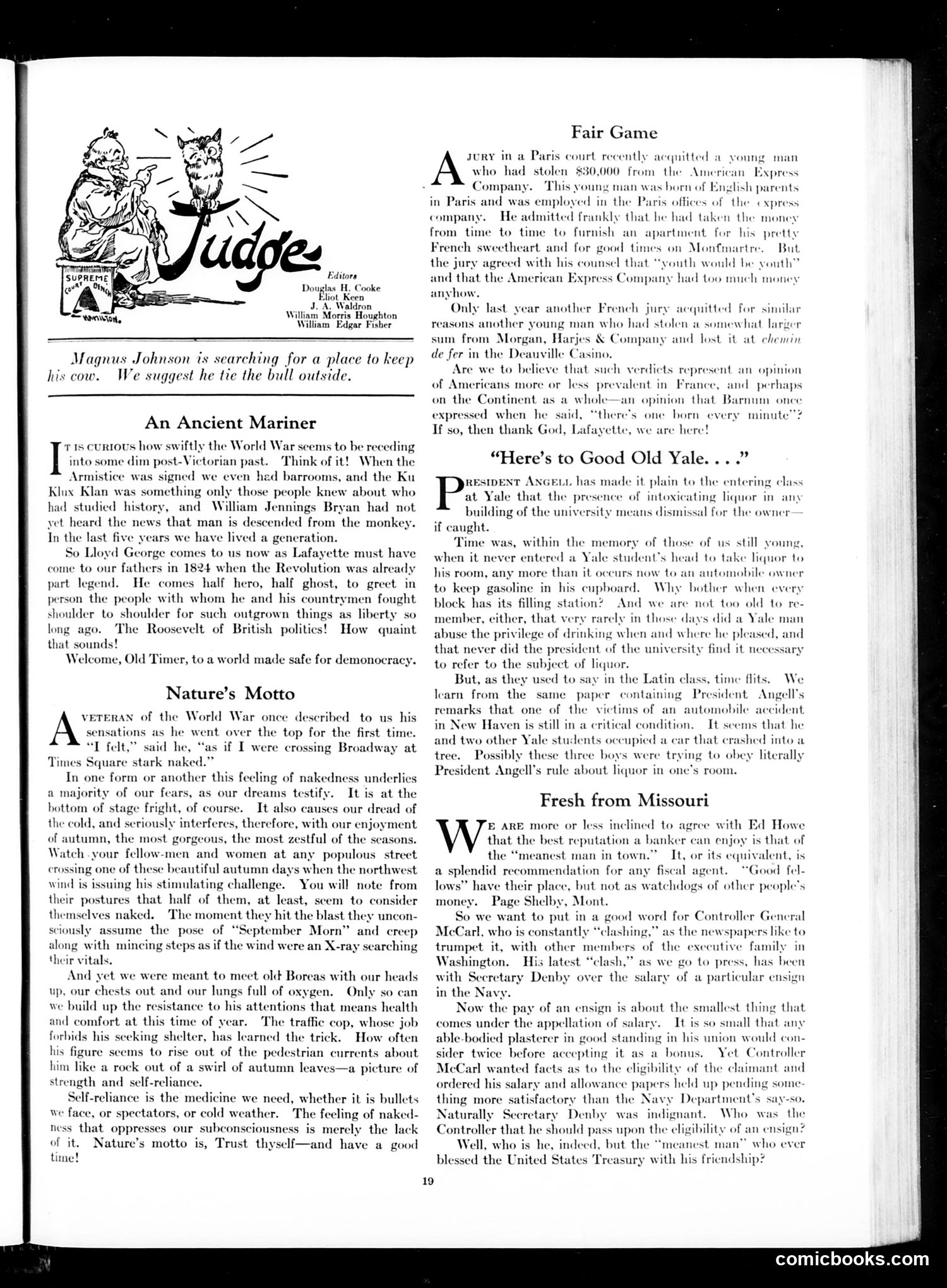
This page contains several satirical pieces targeting post-WWI American society: **"An Ancient Mariner"** celebrates Lloyd George's visit to America, comparing his arrival to Lafayette's return in 1824. The satire mocks how quickly Americans have forgotten WWI's ideals, noting the return of barrooms, the Ku Klux Klan's re-emergence, and outdated figures like William Jennings Bryan still making news. It's cynical about "democracy" being made safe. **"Nature's Motto"** uses autumn wind and public behavior as metaphor for facing life's challenges. It advocates stoicism and self-reliance over fear, using the traffic cop as exemplar. **"Fair Game"** criticizes French juries for acquitting young American thieves on grounds of youthful indiscretion. It questions whether such leniency reflects broader American attitudes toward wealthy companies, satirizing both French legal standards and assumptions about American character. The masthead cartoon (top) shows a judge with a cat, likely satirizing judicial inconsistency or folly.
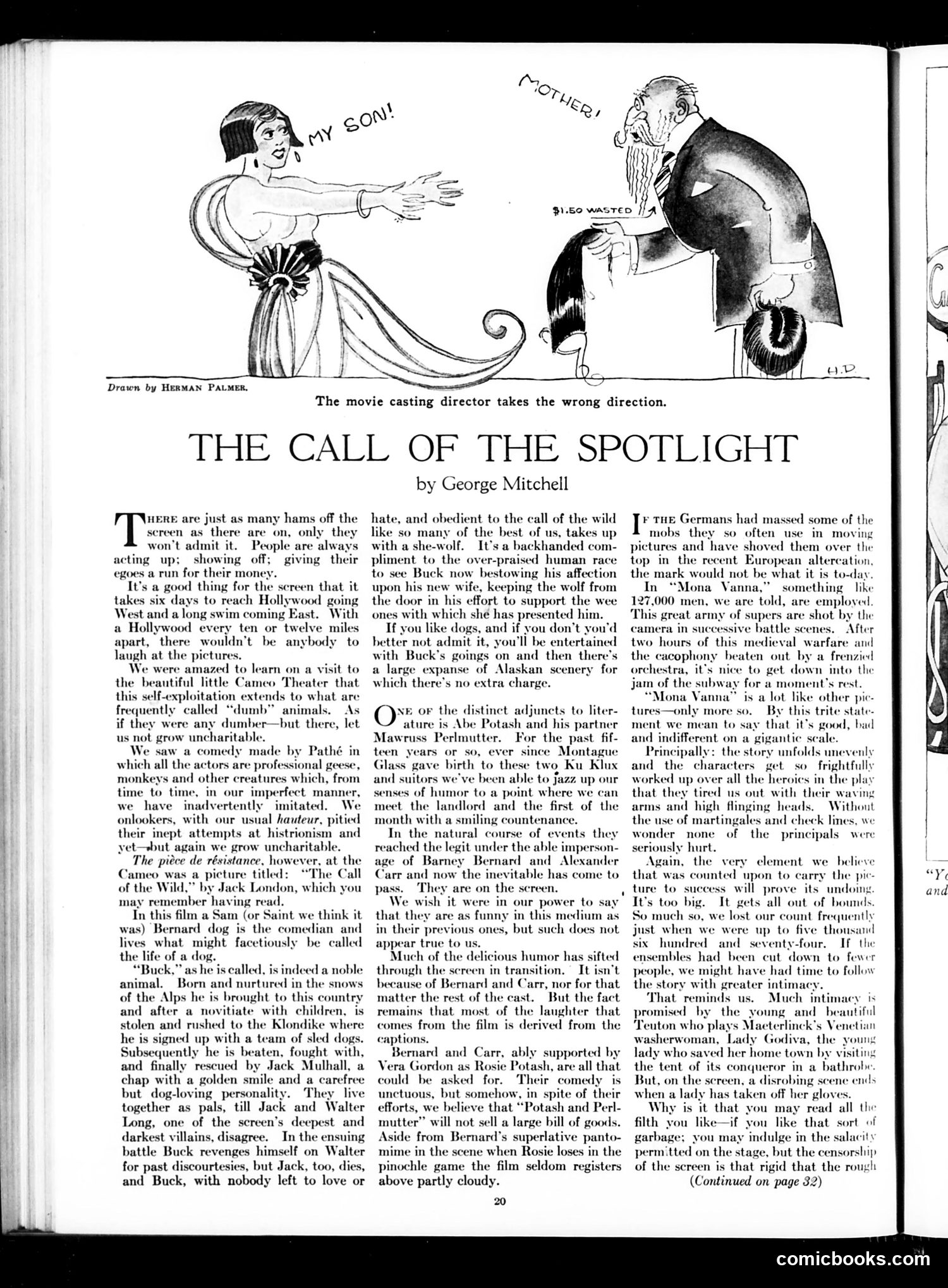
This single-panel cartoon by Herman Palmer satirizes Hollywood's tendency to cast unsuitable or absurd talent. The joke depicts a casting director choosing between two candidates: on the left, an elegant woman in an elaborate gown exclaiming "MY SON!" (suggesting maternal pride or theatrical ambition), and on the right, an elderly man labeled "$1.50 WASTED" dismissing her with a wave while saying "MOTHER!" The humor lies in the director's apparent indifference to either candidate's qualifications—he's literally turning away both applicants. Palmer is mocking how Hollywood casting often ignores legitimate talent or makes arbitrary, nonsensical decisions. The "$1.50 wasted" reference suggests the cost of admission to witness such poor judgment. The accompanying article discusses ham actors and animals in films, reinforcing the page's theme: entertainment industry's willingness to employ unqualified performers for profit.
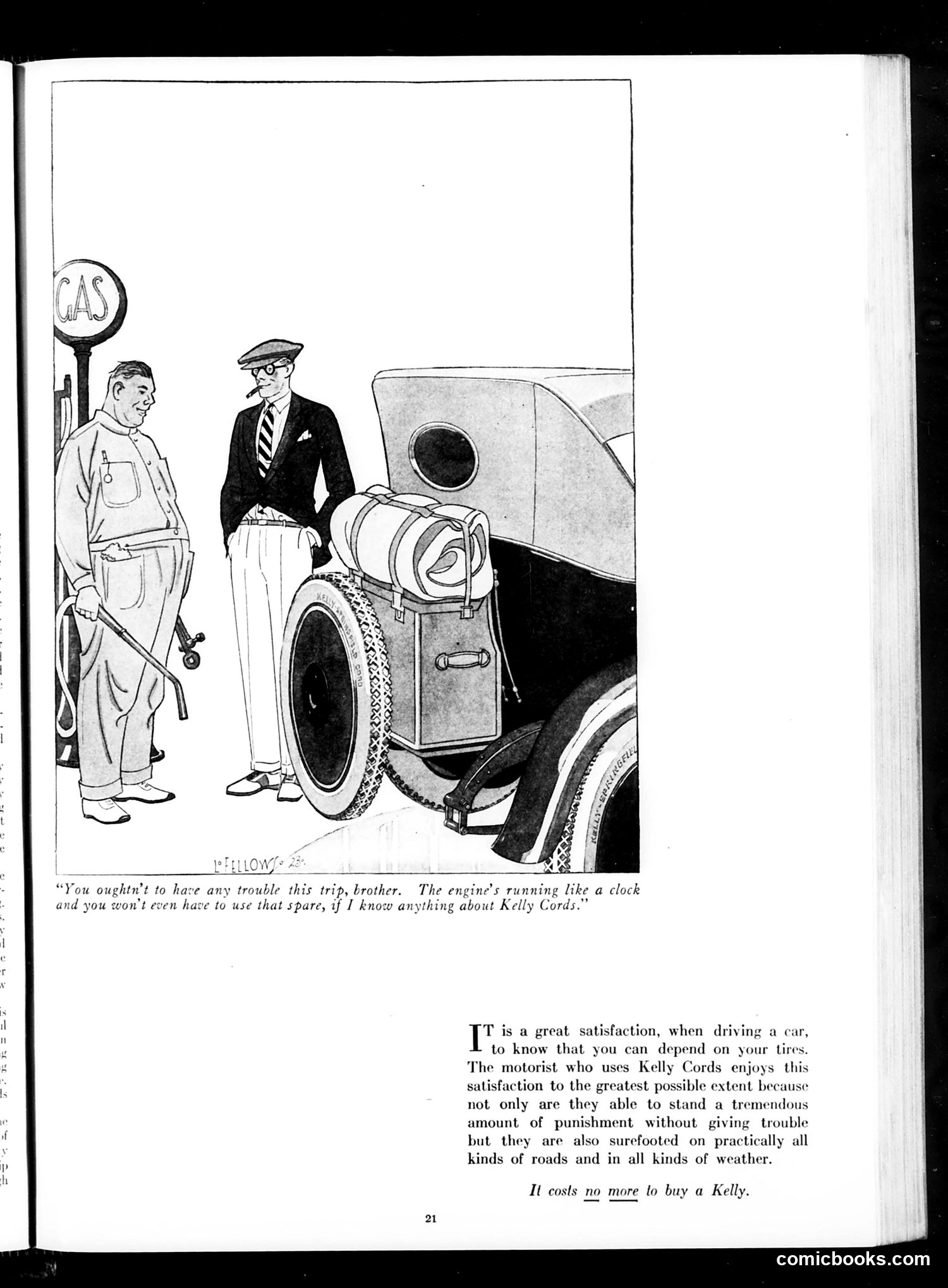
This is a **commercial advertisement**, not political satire. The cartoon shows two men at a gas station—a uniformed attendant and a well-dressed motorist—discussing an automobile equipped with Kelly Cords tires. The joke/sales pitch: The attendant confidently assures the driver he'll have trouble-free travel because Kelly Cords tires are so reliable he won't even need the spare tire. This was a common advertising strategy—using casual dialogue to make reliability claims seem credible through word-of-mouth recommendation rather than direct marketing. The underlying appeal targets early-20th-century motorists' genuine anxiety about tire failures on poor roads. Kelly Cords promises durability across varied weather and road conditions. The phrase "costs no more to buy a Kelly" positioned the brand as offering premium quality at competitive pricing.
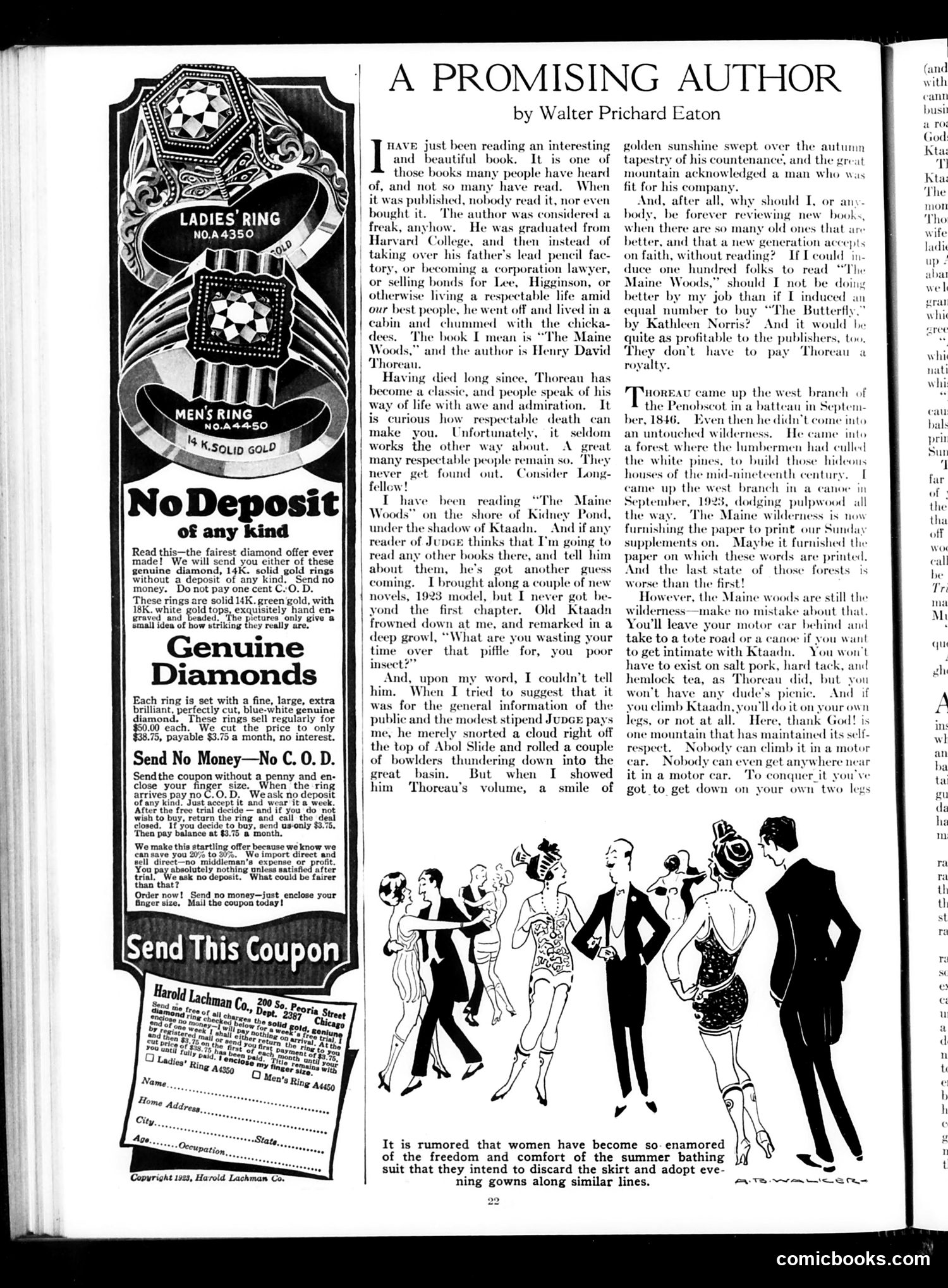
This page contains two distinct elements: **Left side:** A diamond ring advertisement—a classic mail-order pitch promising "no deposit" purchases with monthly payments. The "no money down" offer and trial period were common sales tactics in 1920s advertising. **Right side:** An essay by Walter Prichard Eaton praising Henry David Thoreau's *The Maine Woods*. The author argues that Thoreau, initially dismissed as a "freak" for rejecting respectable corporate life to live in a cabin, gained respectability only after death. Eaton satirizes how society posthumously canonizes rebels while ignoring contemporary worthy books. He describes reading Thoreau at Kidney Pond under Mt. Katahdin (Ktaadn), where the mountain itself allegedly approves—suggesting authentic nature endorses genuine literature over contemporary commercial "piffle." The juxtaposition of frivolous consumer goods against serious literary criticism is itself satirical commentary on American values.
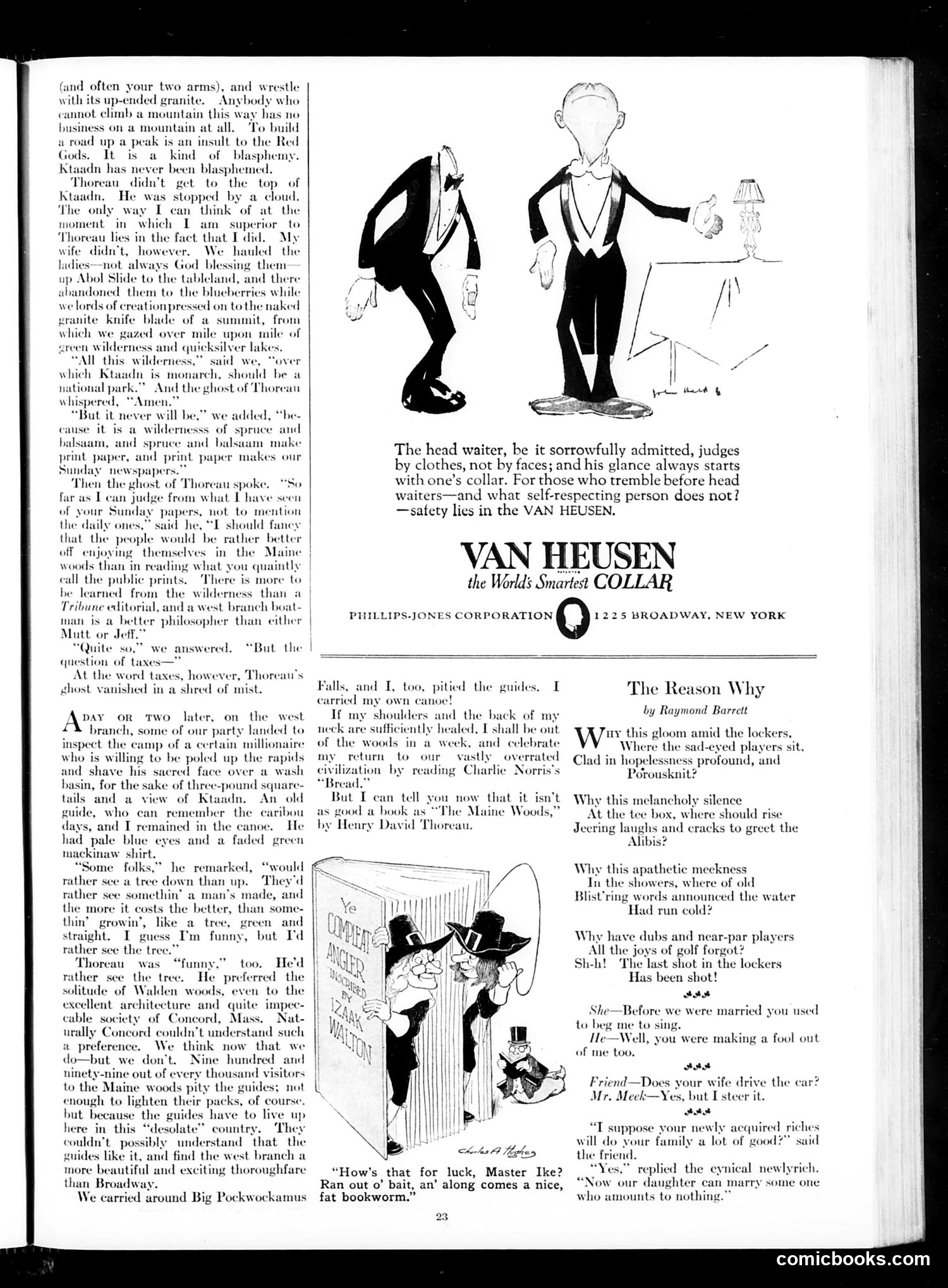
This page contains two distinct elements: a narrative essay about Mount Katahdin and Thoreau, and a Van Heusen Collar advertisement. **The Essay Section:** The text critiques American materialism and environmental exploitation. It contrasts Thoreau's philosophical reverence for wilderness with modern commercial interests—specifically, how spruce and balsam forests are harvested for paper to print newspapers rather than preserved. Thoreau's ghost appears as a voice of environmental and intellectual wisdom, disapproving of "progress" that commodifies nature. The essay celebrates guides and woodsmen who appreciate natural beauty for its own sake, not its development potential. **The Advertisement:** Two cartoon figures in formal wear illustrate that a quality collar (Van Heusen brand) matters more than one's face—it's how head waiters judge respectability. The joke relies on class anxiety about appearance and social acceptance in formal settings, suggesting the collar substitutes for genuine character or breeding.
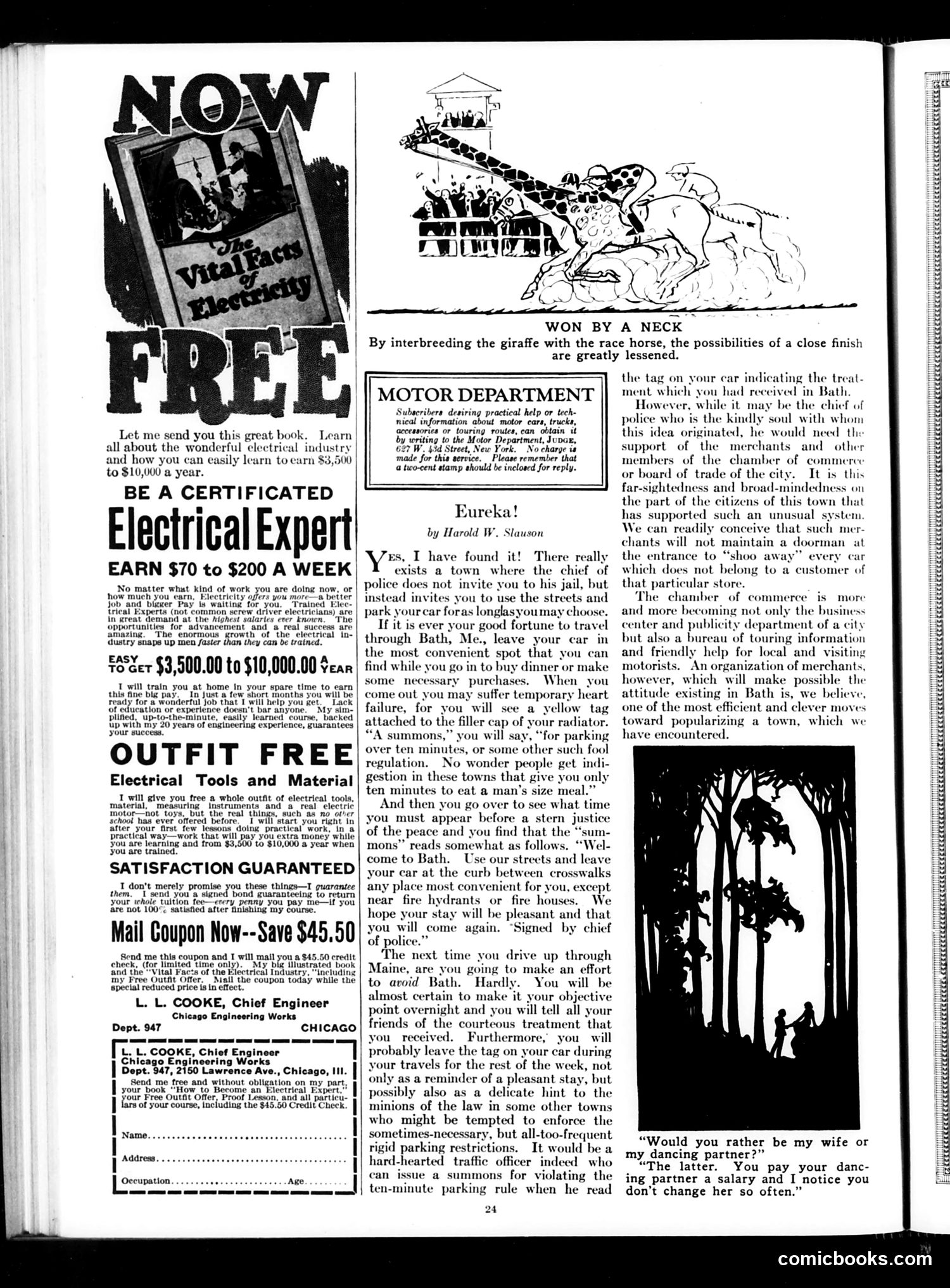
This page primarily features **advertisements** rather than political cartoons, though one satirical illustration appears. ## The Cartoon The top-right image titled "WON BY A NECK" depicts a horse race where a giraffe has been crossbred with a racehorse, creating an absurdly long-necked creature that wins by stretching its neck across the finish line. This is **visual satire on selective breeding** — the joke being that artificial genetic manipulation produces ridiculous, impractical results. It's a lighthearted jab at scientific enthusiasm during this era. ## The Content The page is dominated by **employment advertising** — particularly a correspondence school promising readers can become "Electrical Experts" earning $3,500-$10,000 yearly. This reflects early 20th-century optimism about technical trades and mail-order education. The "Eureka!" story satirizes small-town parking regulations in Bath, Maine, mocking overly strict municipal enforcement of parking rules — a humorous critique of bureaucratic overreach. **Overall**: This appears to be a typical Judge magazine page blending satirical humor with period advertising.
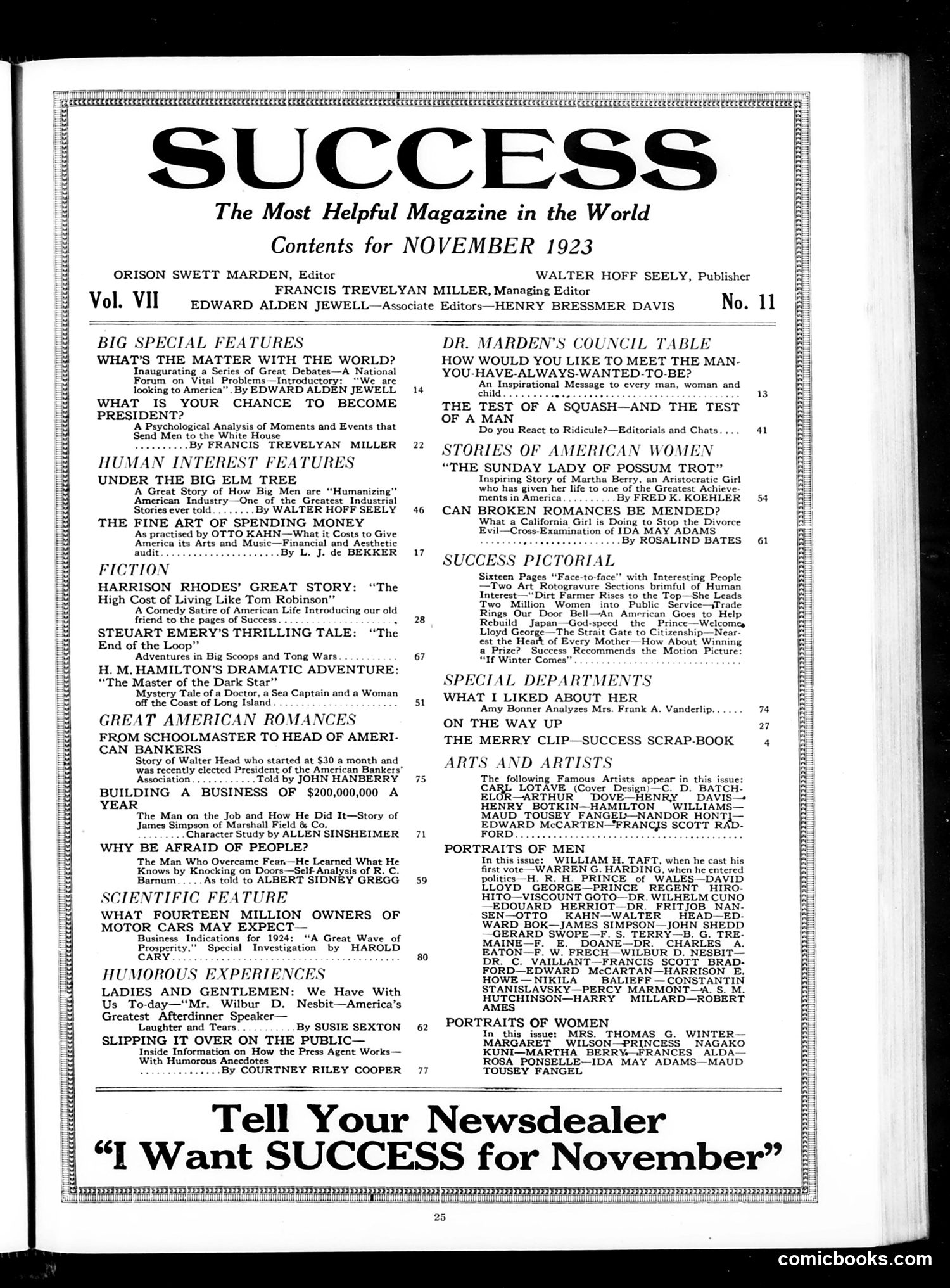
This is a **title/contents page from Success magazine (November 1923)**, not a political cartoon or comics page. The page lists editorial staff and article contents for the November issue. It features inspirational and business-focused pieces typical of the era's "self-help" magazines—articles on becoming president, building million-dollar businesses, overcoming fear, and profiles of successful Americans. There are also fictional stories and features on art, automobiles, and women's achievements. **No cartoons or satirical content appear on this page.** The only visual element is the magazine's masthead and decorative border. This was a mainstream inspirational publication, quite different from *Judge* magazine, which was indeed satirical. The instruction premise appears to contain an error about the source material.
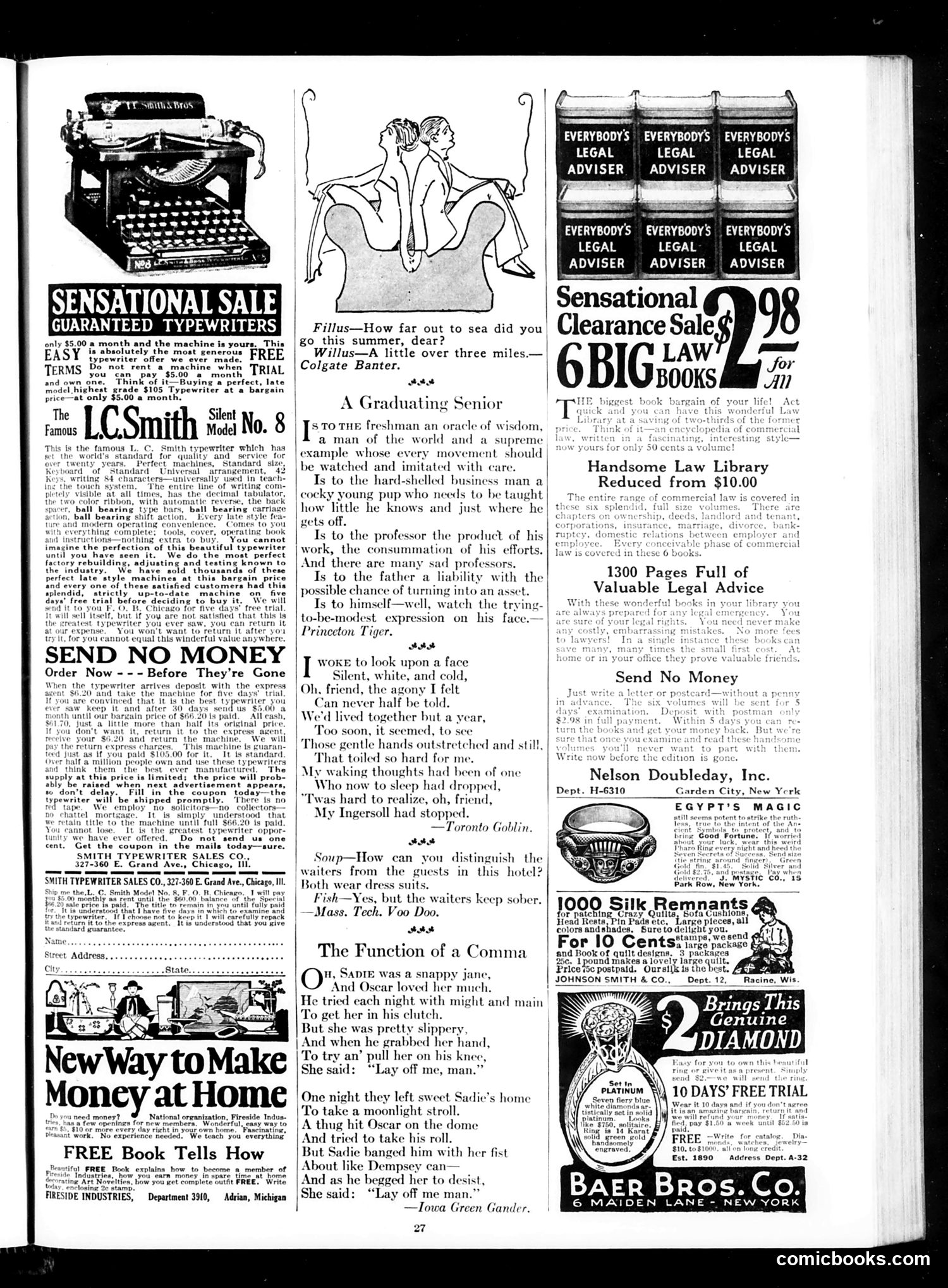
This page is primarily **advertisements and light humor**, not political satire. The content includes: **Advertisements:** Typewriter sales (L.C. Smith), home work schemes, law books, silk remnants, and Egyptian magic rings dominate the page. **Cartoons/Humor:** Several short, unrelated jokes appear: - A couple discussing summer beach trips - A piece about how a "graduating senior" is perceived differently by freshmen (role model), businessmen (clueless youth), professors (their legacy), and fathers (financial burden) - A poem about someone's Ingersoll watch stopping (playing on the name/double meaning) - Restaurant humor about distinguishing waiters from guests - "The Function of a Comma"—a narrative poem about "Sadie" and "Oscar" where Sadie repeatedly says "lay off me, man," with the comma presumably marking where she should pause **Context:** Judge was a humor magazine featuring light domestic comedy, often with mild sexual innuendo. Nothing here references specific political events or figures—it's generic Roaring Twenties entertainment designed to fill space between paid advertisements.
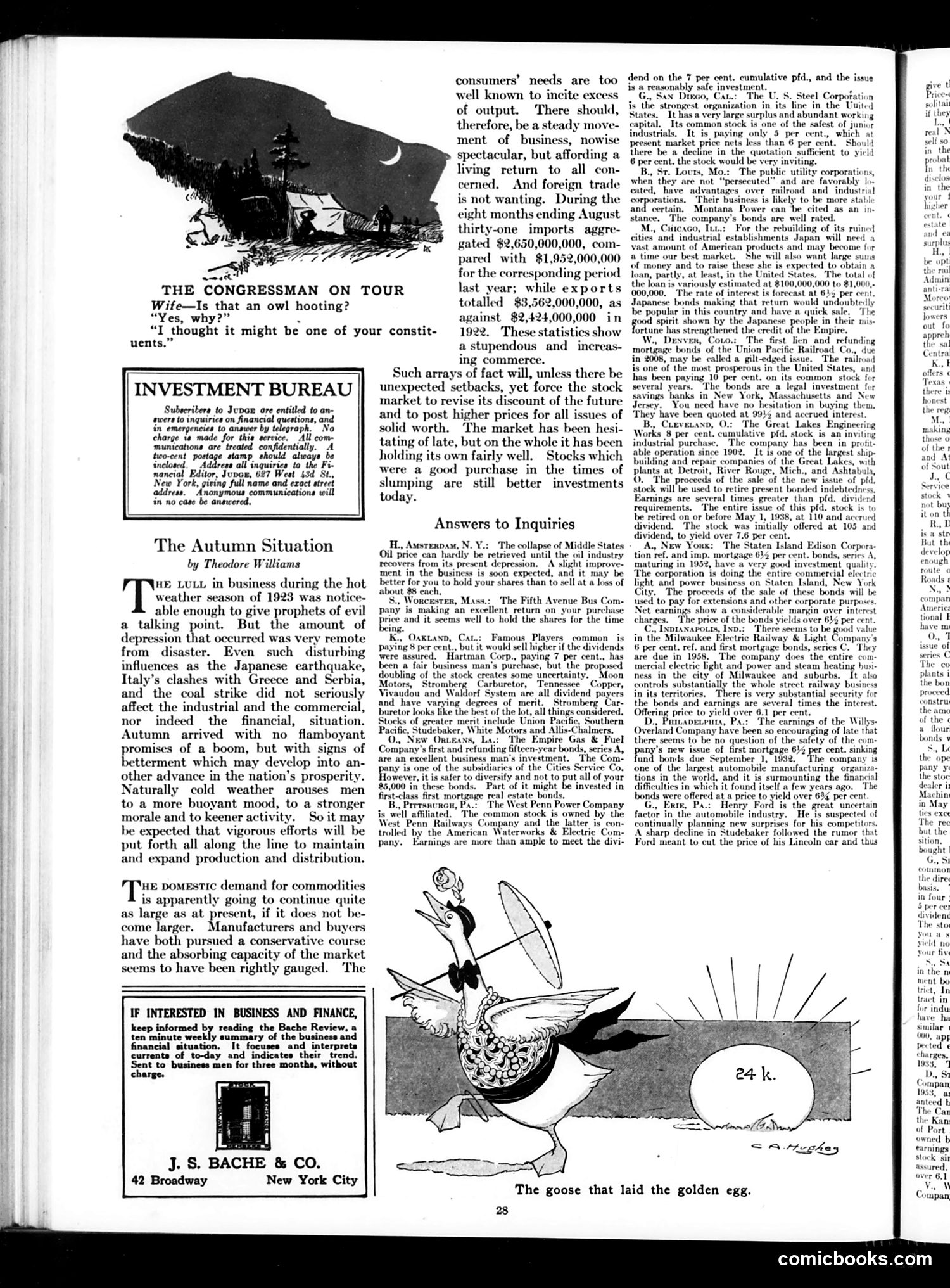
**The Main Cartoon: "The Congressman on Tour"** This is a joke about a congressman's responsiveness to constituents. The setup: a wife hears an owl hooting and asks her husband if that's one of his constituents. The implication is that the congressman is so remote or unavailable—perhaps away on tour—that he barely interacts with the people he represents. The joke sarcastically suggests only an owl would be hooting at his house, implying constituents never visit because he's never home. **Context for Modern Readers:** In the 1920s, congressmen frequently traveled for speaking tours and personal business. This cartoon satirizes the perception that elected representatives were out of touch with or neglectful of their districts. It's a straightforward critique of political absenteeism—the congressman prioritizes his own activities over constituent service, a recurring complaint about elected officials then and now. The page's other content focuses on financial advice and economic commentary from the magazine's "Investment Bureau" section.
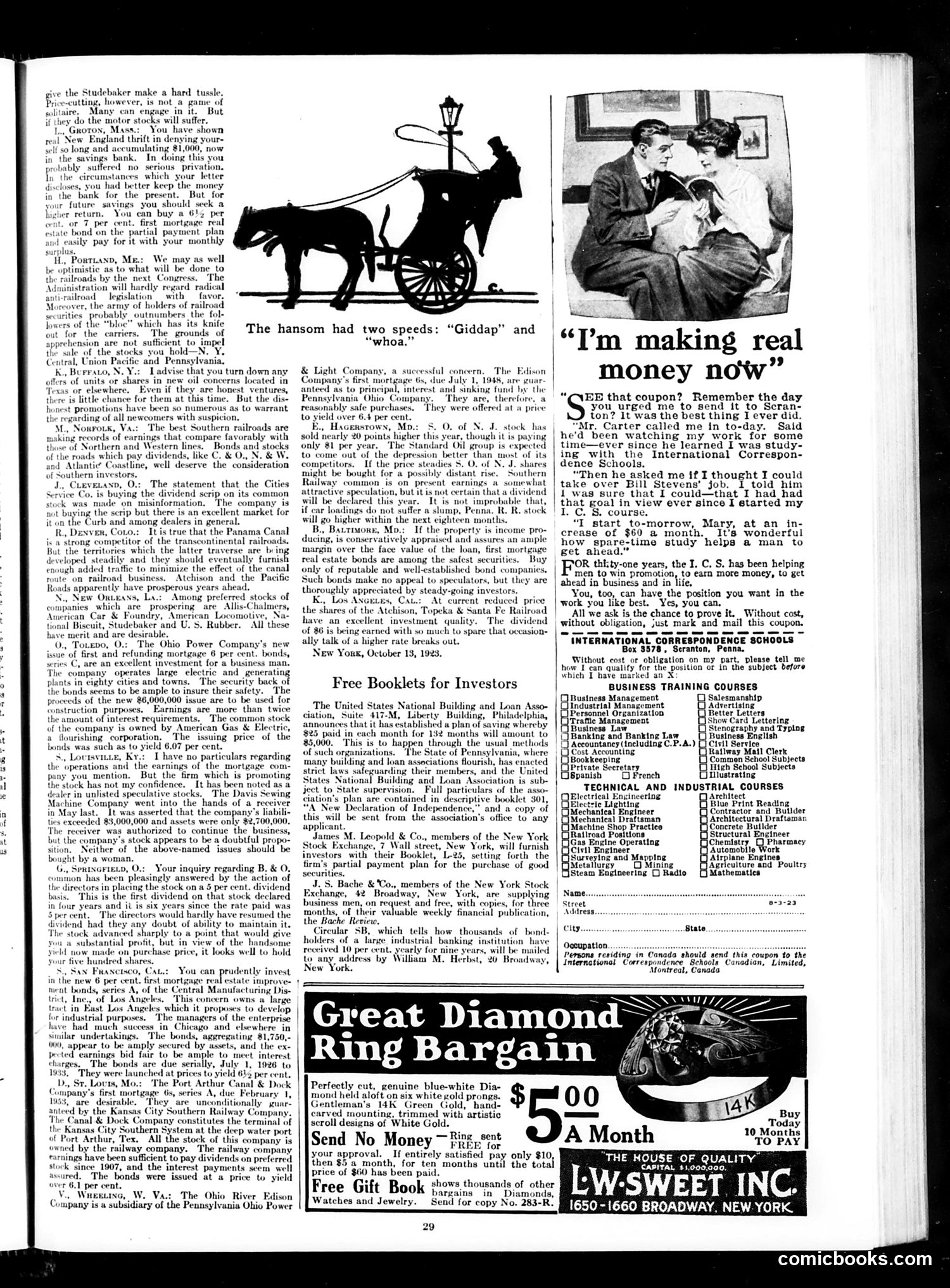
This page is primarily **financial advice and investment advertising** rather than political satire. It consists of: **Main Content:** A Q&A advice column addressing investors' financial concerns, likely from 1923 (date visible: "October 15, 1923"). Readers ask about bonds, railroad stocks, and dividend safety during uncertain economic times. **The Small Cartoon:** A silhouette illustration of a hansom cab with caption "The hansom had two speeds: 'Giddap' and 'whoa.'" This is a **light joke about slow transportation**, likely mocking outdated modes of travel. **The Advertisement Story:** A testimonial titled "I'm making real money now" describes someone earning income through International Correspondence Schools business training courses. **The Advertisement**: A diamond ring promotion from "L.W. Sweet Inc." offering payment plans ($5/month). **Historical Context:** This reflects post-WWI economic uncertainty and the emerging consumer credit/installment payment system. The page shows how financial anxiety drove both serious investment advice columns and get-rich-quick advertising schemes targeting ordinary Americans.
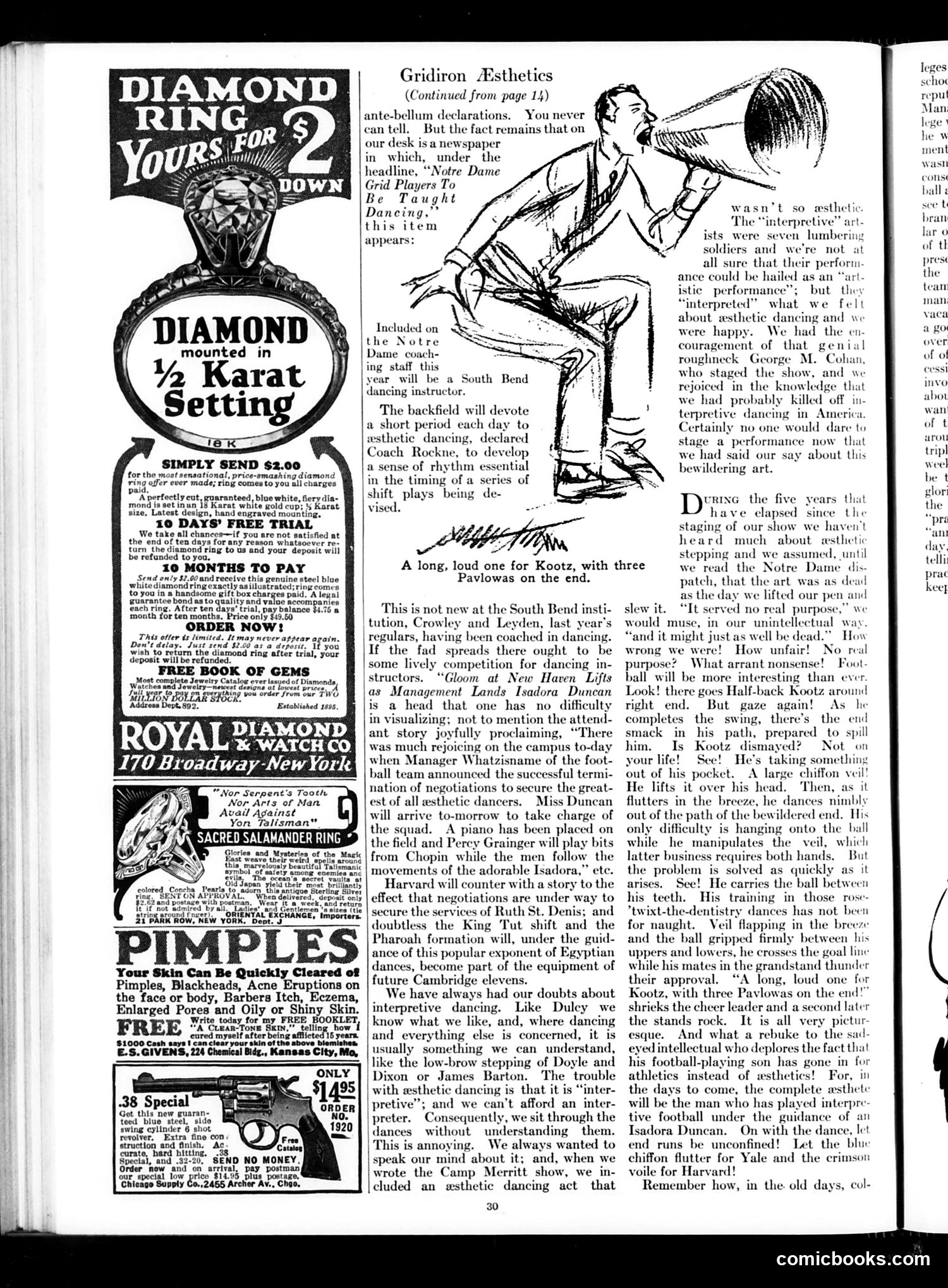
This article mocks the trend of elite universities—particularly Notre Dame—hiring dance instructors to teach football players "aesthetic dancing" for rhythm and timing. The satire targets the pretentious adoption of high-art practices in athletics. The piece ridicules what it calls "interpretive" dancing, contrasting it unfavorably with straightforward, comprehensible movement. It suggests that if Notre Dame succeeds, rival schools like Yale and Harvard will absurdly compete to hire famous dancers like Isadora Duncan or Ruth St. Denis, potentially incorporating Egyptian-themed formations into plays. The joke: American universities are applying avant-garde "artistic" sensibilities to practical sport, creating absurd competition between schools over fashionable but impractical cultural affectations. The author presents himself as preferring clear, unpretentious athletic movement over intellectual or aesthetic posturing—a populist stance against elite cultural pretension in the 1920s.
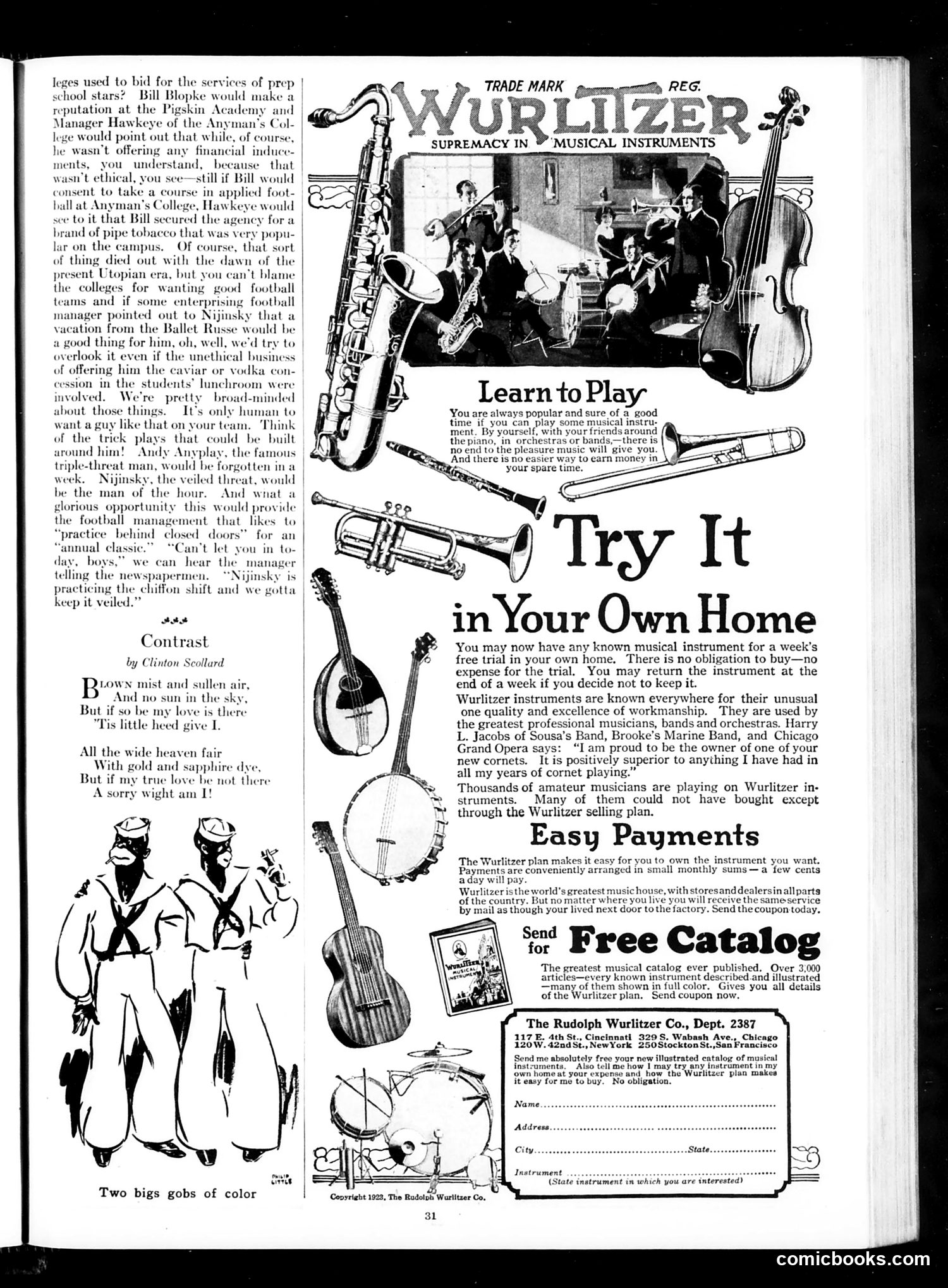
This page is primarily a **Wurlitzer musical instruments advertisement** rather than political satire. However, it opens with editorial text discussing college football recruitment ethics. The text criticizes how colleges "bid for the services of prep school stars" by offering financial inducements (like tobacco concessions) to recruit athletes like "Bill Blopke." It satirizes the hypocrisy of managers claiming ethical standards while actually bribing players. The piece then makes a humorous comparison: if colleges can ethically overlook such arrangements, perhaps offering famous dancer Nijinsky a caviar concession to leave the Ballet Russe would be acceptable too. The satire targets **early 1900s college football corruption**—a real scandal where institutions competed fiercely for athletic talent through under-the-table deals, violating amateurism rules while publicly denying wrongdoing. The accompanying poem by Clinton Scollard and illustration of two sailors are unrelated; the page is largely commercial advertising promoting Wurlitzer instruments with testimonials from professional musicians and an easy payment plan.
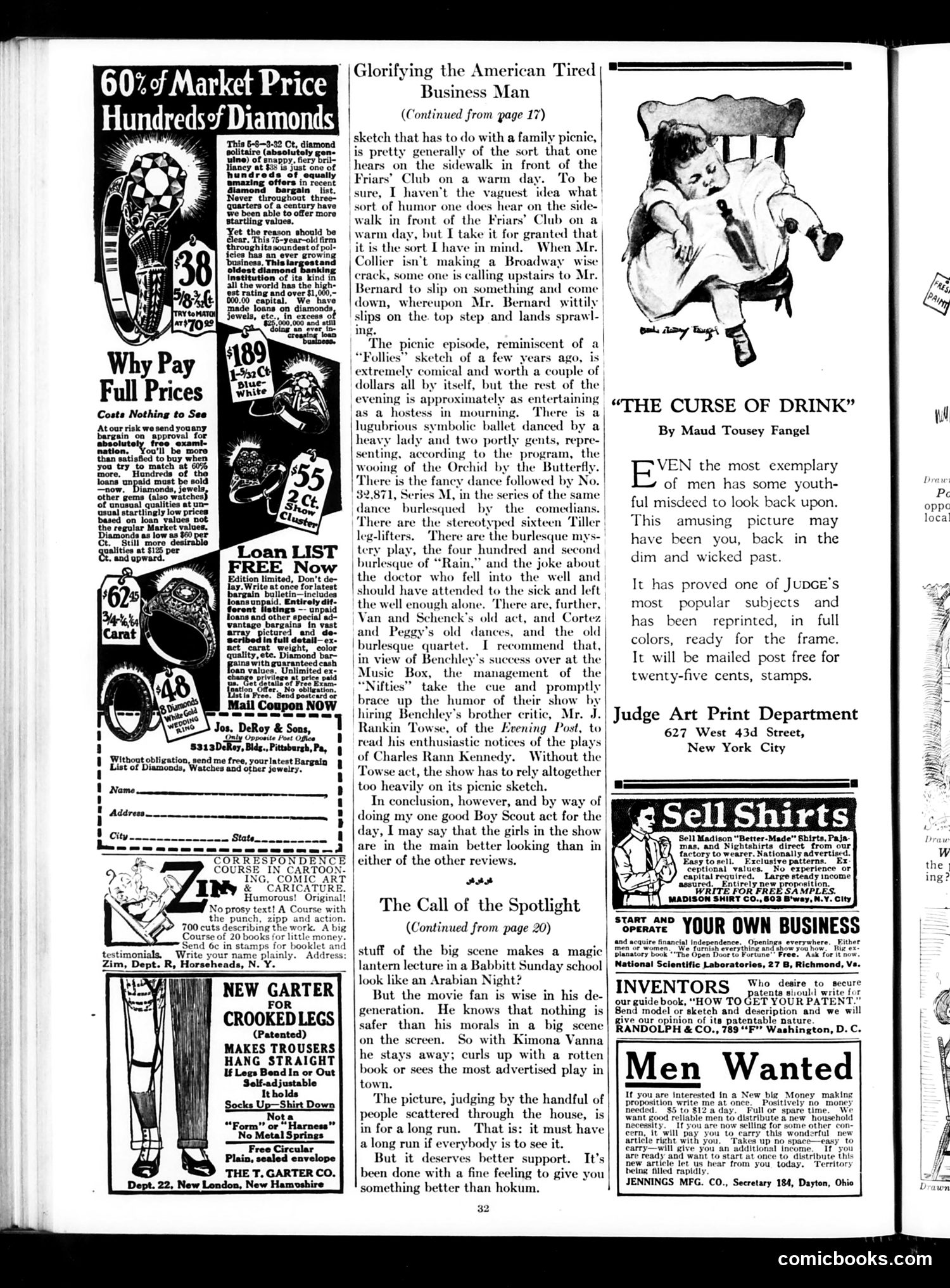
This page consists primarily of **advertisements and classifieds** rather than political satire. The main content includes: **Diamond/Jewelry Ads**: "Jos. DeRoy & Sons" advertises diamonds at allegedly discounted prices—a common mail-order scheme of the era. **Product Advertisements**: Garters for crooked legs, shirt sales, and a cartooning correspondence course appear as typical period classifieds. **Editorial Content**: The substantive text discusses theater reviews—"Glorifying the American Tired Business Man" and "The Call of the Spotlight" critique Broadway productions, apparently discussing a show with dance numbers and comedic sketches. The critic mentions the "Follies," burlesque acts, and performers like Van and Schenck. **Illustration**: A small cartoon shows a woman with dogs, captioned "The Curse of Drink" by Maud Tousey Fangel—a moralistic piece about alcohol's effects. The page reflects **early-20th-century Judge magazine's mix of satire, entertainment criticism, and commercial advertising** rather than focused political cartooning.
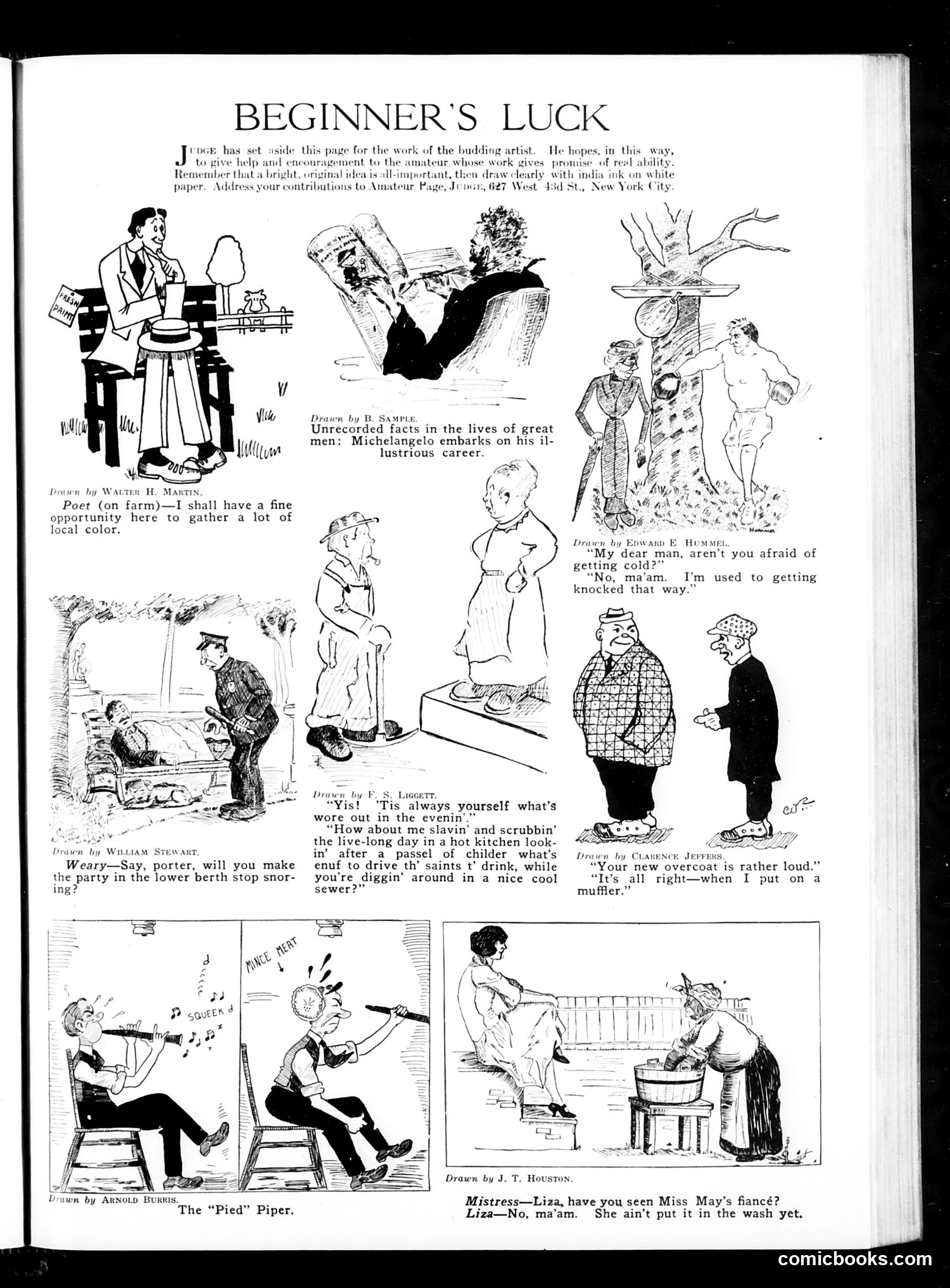
This is Judge magazine's submission page for amateur cartoonists and humorists. The header explains that Judge publishes promising amateur work to encourage developing artists. The page contains multiple single-panel gag cartoons on everyday topics: - A poet visiting a farm expecting inspiration - A woman asking a man about cold; he replies he's used to being "knocked that way" (beaten down by life) - Domestic complaints between spouses about housework - A train passenger asking a porter to stop snoring from the lower berth - A "Pied Piper" musician playing while people dance involuntarily - An employer asking a maid if she's seen the employer's daughter's fiancé; the maid jokes she hasn't "put it in the wash yet" (suggesting the engagement isn't secured/finalized) The humor relies on working-class situations, marital discord, servants' witty comebacks, and puns. These represent typical Judge magazine fare—gentle satirizing of domestic life and social hierarchy rather than political commentary.
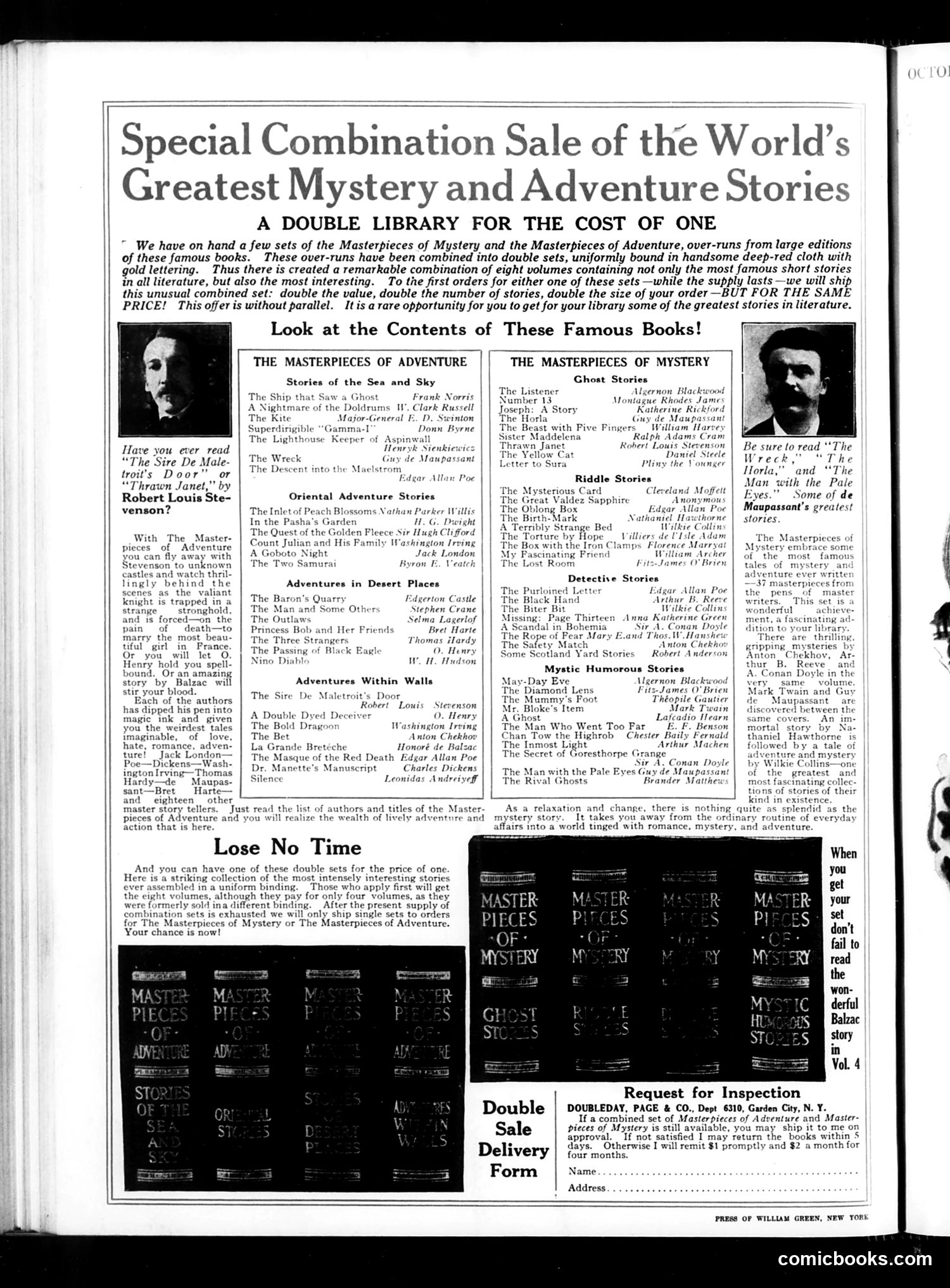
This page is primarily a **book advertisement**, not political satire or editorial cartooning. It promotes a two-for-one offer on bound collections of classic mystery and adventure stories—*Masterpieces of Mystery* and *Masterpieces of Adventure*. The page lists the contents of these volumes, featuring famous short stories by authors like Edgar Allan Poe, Guy de Maupassant, Wilkie Collins, and Arthur Conan Doyle. It includes portraits of what appear to be notable authors (likely Poe and Maupassant based on the context). The marketing pitch emphasizes getting "double the value, double the number of stories" for the same price—a common advertising strategy. A form at bottom invites readers to request inspection copies. While appearing in *Judge* magazine (known for satire), this particular page contains **no discernible satirical content**—it's straightforward commercial advertising positioned within the publication's pages.