
Judge, 1923-10-20 · page 19 of 36
Judge — October 20, 1923 — page 19: what you’re looking at
What you’re looking at
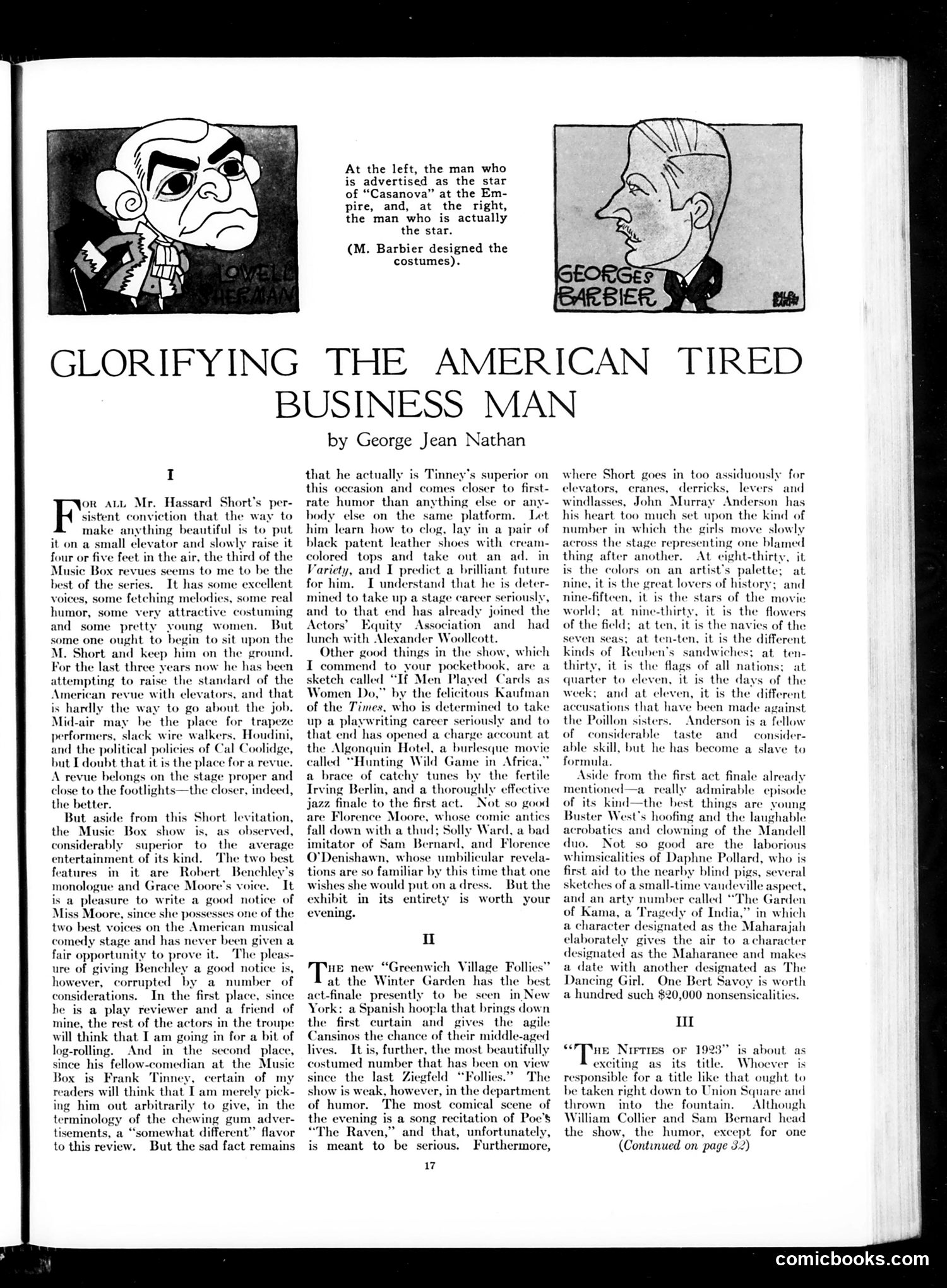
This page from Judge magazine features a satirical comparison cartoon and theater review. The top cartoon contrasts two men: the advertised "star" of the operetta "Casanova" at the Empire Theatre (left, shown as an ornate, theatrical figure with elaborate costume designed by M. Barbier) versus the actual star (right, identified as George Barbier himself—the costume designer, shown in profile as an ordinary man). The joke targets how costume design and theatrical artifice can transform an unremarkable person into a stage spectacle. It mocks both theatrical pretension and the deception inherent in entertainment marketing—the real "star" is merely the designer's creation, not any performer. Below, George Jean Nathan's theater review critiques the Music Box revue, praising some acts while criticizing director M. Short's excessive use of elevators to "raise the standard" of American revues, arguing that spectacle without genuine talent is hollow.
📄 Transcribed text from this page (OCR, searchable)
Machine-transcribed from the original scan — historical spelling and the odd misread are preserved.
At the left, the man who is advertised as the star of “Casanova” at the Em- pire, and, at the right, the man who is actually the star. (M. Barbier designed the costumes). GLORIFYING THE AMERICAN TIRED BUSINESS MAN I or aut Mr. Hassard Short’s per- F stent conviction that the way to make anything beautiful is to put it on a small elevator and slowly raise it four or five feet in the air, the third of the Music Box revues seems to me to be the best of the series. It has some excellent voices, some fetching melodies, some real humor, some very attractive costuming and some pretty young women. But some one ought to begin to sit upon the M. Short and keep him on the ground, For the last three years now he has been attempting to raise the standard of the American revue with elevators, and t is hardly the way to go about the job. Mid-air may be the place for trape performers, slack wire walkers, Houdini, and the political policies of Cal Coolidge, but I doubt that it is the place for a revue. A revue belongs on the stage proper and close to the footlights—the closer, indeed, the better. But aside from this Short levitation, the Music Box show is, as observed considerably superior to the average entertainment of its kind. The two best features in it are Robert Benchley’s monologue and Grace Moore's v is a pleasure to write a good notice of Miss Moore, since she possesses one of the two best voices on the American musical comedy stage and has never been given a fair opportunity to prove it. The ple ure of giving Benchley a good notice is, howe’ corrupted by a number of ions. In the first place, since a play reviewer and a friend of mine, the rest of the actors in the troupe will think that Iam going in for a bit of log-rolling. And in the second place, since his fellow-comedian at the Music Box is Frank Tinney, certain of nm readers will think that Iam merely pick- ing him out arbitrarily to give, in the terminology of the chewing gum adver- tisements, a “somewhat different” flavor to this review. But the sad fact remains by George Jean Nathan that he actually is Tinney’s superior on this occasion and comes closer to first- rate humor than anything else or any- else on the same platform. I him learn how to clog, lay in a pair of black patent leather shoes with cream- colored tops and take out an ad. in Variety, and I predict a brilliant future for him. I understand that he is deter- mined to take up a stage career seriously, and to that end has already joined the Actors’ Equity Association and had lunch with Alexander Woollcott. Other good things in the show, which I commend to your pocketbook, are a sketch called “If Men Played Cards as Women Do,” by the felicitous Kaufman of the Times, who is determined to take up a playwriting career seriously and to that end has opened a charge account at the Algonquin Hotel, a burlesque movie called “Hunting Wild Game in Africa,” a brace of catchy tunes by the fertile Irving Berlin, and a thoroughly effective z finale to the first act. Not so good re Florence Moore, whose comic anties fall down with a thud; Solly Ward, a bad imitator of Sam Bernard, and Florence O'Denishawn, whose umbilicular revela- tions are so familiar by this time that one she would put on adress. But the in its entirety is worth your evening. body Il Te new “Greenwich Village Follies” t the Winter den has the best act-finale presently to be seen in New York: a Spanish hoorla that brings down the first curtain and gives the i nsinos the chance of their middle lives. It is, further, the most beautifully costumed number that h: nh on view since the last Ziegfeld “Follies.” The show is weak, however, in the department of humor. The most comical scene of the evening is a song recitation of Poe's “The Raven. nd that, unfortunately is meant to be serious. Furthermore, 17 where Short goes in too assiduously for elevators, cranes, derricks, levers and i es, John Murray Anderson has rt too much set upon the kind of number in which the girls move slowly across the stage representing one blamed thing after another. At cight-thirt is the colors on an artist's palette; nine, it is the great lovers of history; nine-fifteen, it is the stars of the movie world; at nine-thirty, it is the flowers of the field; at ten, it is the navies of the seven seas; at ten-ten, it is the different kinds of Reuben’s sandwiches; at ten- thirty, it is the flags of all rter to cleven, it is the ¢ and at cleven, it is the different ions that have been made against the Poillon sisters. Anderson is a fellow of considerable taste and — consider- able skill, but he has become a slave to formula. Aside from the first act finale already mentioned—a really admirable episode of its kind—the best things are young Buster West's hoofing and the laughable acrobatics and clowning of the Mandell duo. Not so good are the laborious whimsicalities of Daphne Pollard, who is first aid to the nearby blind pigs, several sketches of a small-time vaudeville aspect, and an arty number called “The Garden of Kama, a Tragedy of India,” in which a character designated as the ¥ arajah rorately gives the air to acharacter designated as the Maharanee and makes a date with another designated as The Dancing Girl. One Bert Savoy is worth a hundred such $20,000 nonsensic and ations: * is about as f - Whoever is responsible for a title like that ought to be taken right down to Union Square and thrown into the fountain. Although William Collier and Sam Bernard head ihe! show, the Nimor, except for one (Continued on page 3.2) comicbooks.com