
Judge, 1923-10-20 · page 22 of 36
Judge — October 20, 1923 — page 22: what you’re looking at
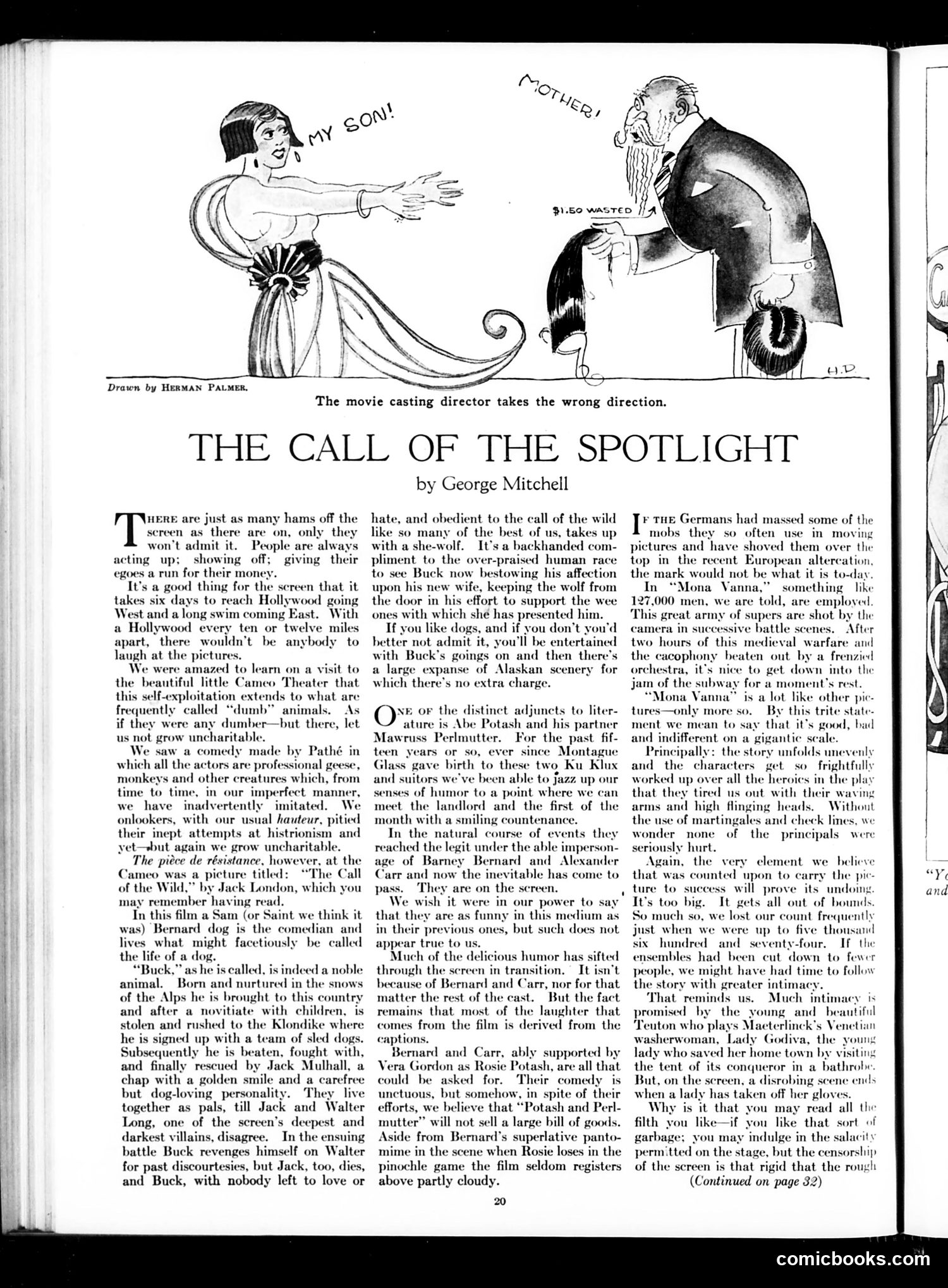
What you’re looking at
This single-panel cartoon by Herman Palmer satirizes Hollywood's tendency to cast unsuitable or absurd talent. The joke depicts a casting director choosing between two candidates: on the left, an elegant woman in an elaborate gown exclaiming "MY SON!" (suggesting maternal pride or theatrical ambition), and on the right, an elderly man labeled "$1.50 WASTED" dismissing her with a wave while saying "MOTHER!" The humor lies in the director's apparent indifference to either candidate's qualifications—he's literally turning away both applicants. Palmer is mocking how Hollywood casting often ignores legitimate talent or makes arbitrary, nonsensical decisions. The "$1.50 wasted" reference suggests the cost of admission to witness such poor judgment. The accompanying article discusses ham actors and animals in films, reinforcing the page's theme: entertainment industry's willingness to employ unqualified performers for profit.
📄 Transcribed text from this page (OCR, searchable)
Machine-transcribed from the original scan — historical spelling and the odd misread are preserved.
Drawn by HERMAN PALMER, The movie casting director takes the wrong direction. THE CALL OF THE SPOTLIGHT by George Mitchell HERE are just as many hams off the | creen as there are on, only they won't admit it. People are always acting up; showing off; giving their egoes a run for their mone It’s a good thing for the screen that it takes six days to reach Hollywood going West and a long swim coming East. With a Hollywood every ten or twelve miles apart, there wouldn't be anybody to laugh at the pictures. We were amazed to learn on a visit to the beautiful little Cameo Theater that this self-exploitation extends to what are ntly called umb” animals. As , were any dumber—but there, let us not grow uncharitable. We saw a comedy made by Pathé in which all the actors are professional geese, monkeys and other creatures which, from time to time, in our imperfect manner, ve have inadvertently imitated. We lookers, with our usual hauteur, pitied r inept attempts at histrionism and yet—sbut again we grow uncharitable. The piece de résistance, however, at the Cameo wi a picture titled: “The Call of the V Jack London, which you In this film a Sam (or hink it was) Bernard dog is the comedian and lives what might facetiously be called the life of a dog “Buck,” as he is called, is indeed a noble animal. Born and nurtured in the snows of the Alps he is brought to this country and after a novitiate with children, stolen and rushed to the Klondike where he is signed up with a team of sled dogs. Subsequently he is beaten, fought tiie and finally rescued by Jack Mulhall, chap with a golden smile and a care! sree but dog-loving persona together as pals, till Jack and Walter Long, one of the screen’s deepest and darkest villains, disagree. In the ensuing battle Buck revenges himself on Walter for past discourtesies, but Jack, too, dies, and Buck, with nobody left to love or hate, and obedient to the call of the wild like so many of the best of us, takes up ith a she-wolf. It's a backhanded com- pliment to the over-praised human race to see Buck now bestowing his affection upon his new wife, keeping the wolf from the door in his effort to support the wee ones with which she has presented him. If you like dogs, and if you don’t you'd better not admit it, you'll be entertained with Buck's goings on and then there's a large expanse of Alaskan scenery for which there's no extra charge. Ou oF the distinct adjuncts to liter- ure is Abe Potash and his partner Mawruss Perlmutter. For the past fif- teen years or so, ever since Mon Glass gave birth to these two Ku Klux and suitors we've been able to Jazz up our senses of humor to a point where we can meet the landlord and the first of the month with a smiling countenance In the natural course of ¢ they reached the legit under the able imperson- age of Barney Bernard and Alexander Carr and now the inevitable has come to pass. They are on the screen. We wish it were in our power to say’ that they are as funny in this medium as in their previous ones, but such does not appear true to us. Much of the delicious humor has sifted through the screen in transition, It isn’t because of Bernard and Carr, nor for that matter the rest of the cast. But the fact remains that most of the laughter that comes from the film is derived from the captions. Bernard and Carr, ably supported by Vera Gordon as Rosie Potash, are all that could be asked for. Their comedy is unctuous, but somehow, in spite of their efforts, we believe that “Potash and Perl- mutter” will not sell a large bill of goods. Aside from Bernard’s superlative panto- mime in the scene when Rosie loses in the pinochle game the film seldom registers above partly cloudy. 20 I tHE Germans had massed some of the mobs they so often use in moving pictures and have shoved them over the top in the recent European alterc the mark would not be what it is to- In “Mona Vanna,” something | 127,000 men, we are told, are employed. This great army of supers are shot by thi camera in successive battle scenes. After two hours of this medieval warfare and the cacophony beaten out by a frenzied orchestra, it's nice to get down into the jam of the subway for a moment's rest. “Mona Vanna” is a lot like other pic- tures—only more so. By this trite state- ment we mean to say that it’s good, bad and indifferent on a gigantic se: Principally: the story unfolds 1 and the characters get so frightfully worked up over all the heroies in the play tired us out with their waving arms and high flinging heads. Without the use of martingales and check lines, we wonder none of the principals were seriously hurt. the very element we believe that was counted’ upon to carry the pie ture to success will prove its. undoing It’s too big. It gets all out of bounds So much so, we lost our count frequently just when we were up to five thousand six hundred and seventy-four, If the ensembles had been cut down to fewer people, we might have had time to follow the story with greater intim at reminds us. Much intima promised by the young ‘Teuton who plays Macterl washerwoma! ady Godiva, the lady who d her home town by visiting the tent of its conqueror in a bathrolx But, on the screen, a disrobing scene ends when a lady has taken off her gloves. Why is it that you may read all the filth you like—if you like that sort of you may indulge in the salacit\ permitted on the stage, but the censorship of the screen is that rigid that the rougli (Continued on page 32) tion, k's Venetian oun , Xee— SS” and comicbooks.com