
Judge, 1923-10-20 · page 11 of 36
Judge — October 20, 1923 — page 11: what you’re looking at
What you’re looking at
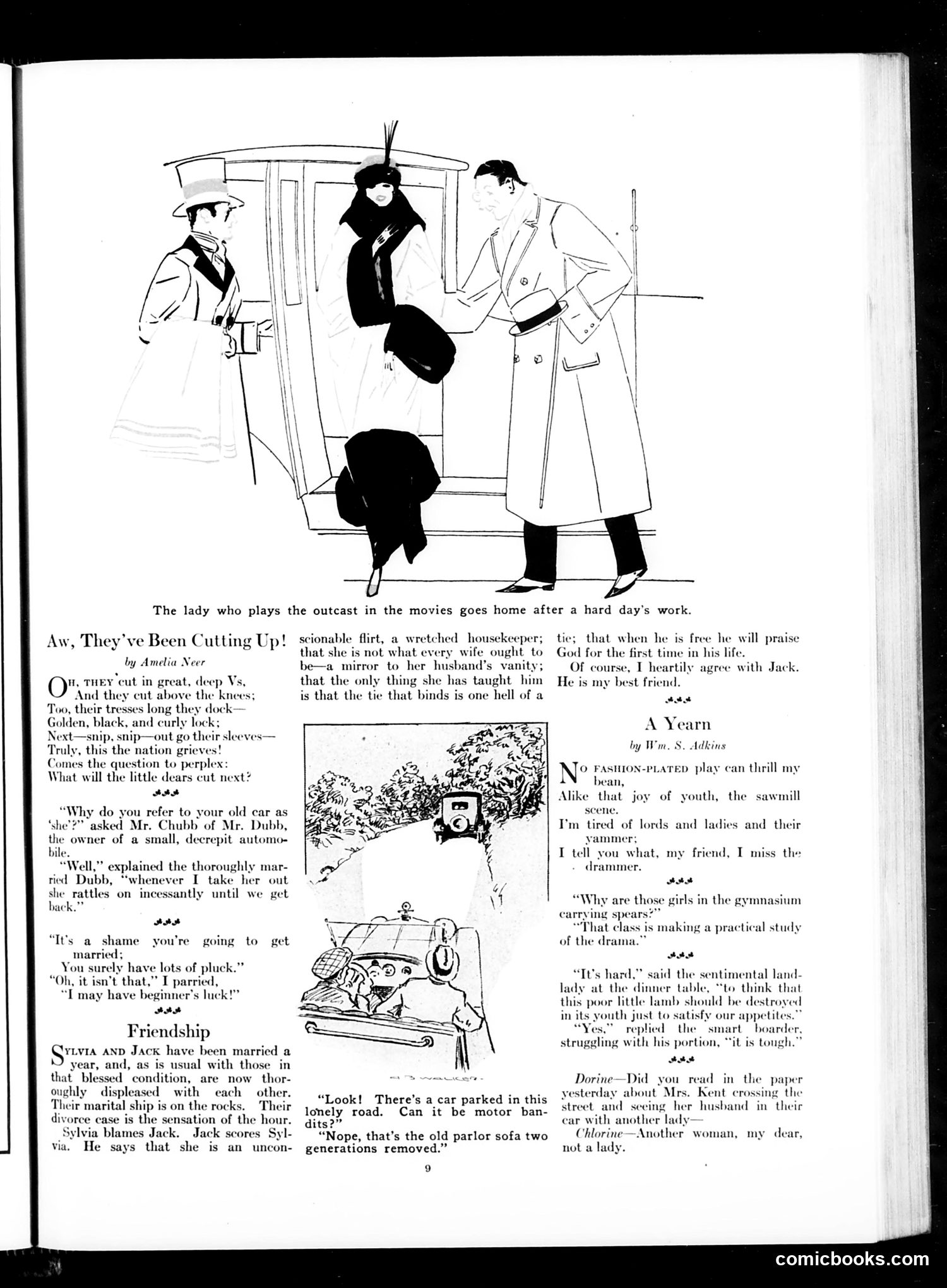
This page satirizes 1920s social changes through multiple short pieces: **"Aw, They've Been Cutting Up!"** mocks women's fashion modernization—the bobbed hair, shortened skirts, and sleeveless dresses that shocked conservatives. The poem's anxious refrain "What will the little dears cut next?" expresses moral panic about women's increasing autonomy and rejection of Victorian dress codes. **The car joke** uses gendered language to mock both automobiles and wives—comparing a rattling car to a nagging spouse, a common era trope. **"Friendship"** presents dark irony: a man whose marriage is failing praises his divorcing friend Jack while agreeing with Jack's harsh criticisms of Jack's wife—suggesting male loyalty supersedes fair judgment. The cartoons depict casual modern scenes: a movie actress arriving home by taxi, and a couple mistaking an old sofa for a bandit car in a deserted road. Overall, the page reflects 1920s anxieties about changing gender roles, modernization, and automobile culture while employing cynicism about marriage and relationships.
📄 Transcribed text from this page (OCR, searchable)
Machine-transcribed from the original scan — historical spelling and the odd misread are preserved.
The lady who plays the outcast in the movies goes home after a hard day’s work. Aw, They've Been Cutting Up! by Amelia Neer O": THEY cut in great, deep Vs, And they cut above the knees; Too, their tresses long they dock Golden, black, and curly lock; Next—snip, snip—out go their sleeves— Truly, this the nation grieves! Comes the question to perplex: What will the little dears cut next? FBS “Why do you refer to your old car as ‘she’? asked Mr. Chubb of Mr. Dubb, the owner of a small, decrepit automo- bile. “Well,” explained the thoroughly mar- ried Dubb, “whenever I take her out she rattles on incessantly until we get back.” Rad “It's a shame married; You surely have lots of pluck.” “Oh, it isn’t that,” I parried, “IT may have beginner's luck!” tas you're going to get Friendship Sma AND Jack have been married a Y year is usual with those in that blessed condition, are now oughly displeased with each other. Their marital ship is on the rocks. Their divorce case is the sensation of the hour. Sylvia blames Jack. Jack scores Syl- thor- scionable flirt, a wretched housekeeper; that she is not what every wife ought to be—a mirror to her husband's vanity; that the only thing she has taught him is that the tie that binds is one hell of a “Look! There’s a car parked in this lonely road. Can it be motor ban- dits?” “Nope, that’s the old parlor sofa two generations removed.” 9 tie; that when he is free he will praise God for the first time in his life. Of course, I heartily agree with Jack. He is my best friend. ttt A Yearn by Win. 8. Adkins N° fastuos-rearen play can thrill my 4 bean, Alike that joy of youth, the sawmill scene, I'm tired of lords and ladies and their yammer; I tell you what, my friend, I miss the drammer. lad “Why are those girls in the gymnasium carrying sp 3?” “That class is making a practical study of the drama.” ee “Tt’s hard,” said the sentimental land- lady at the dinner table, “to think that this poor little lamb should be destroy in its youth just to satisfy our appetite “Yes,” replied the smart —boar« struggling with his portion, “it is tough. Rd Dorine—Did you read in the paper yesterday about’ Mrs. Kent crossing. the Street. and. seeing her husband in their car with another lady- Chlorine—Another woman, my dear, not a lady. comicbooks.com