
A complete issue · 36 pages · 1923
Judge — October 13, 1923
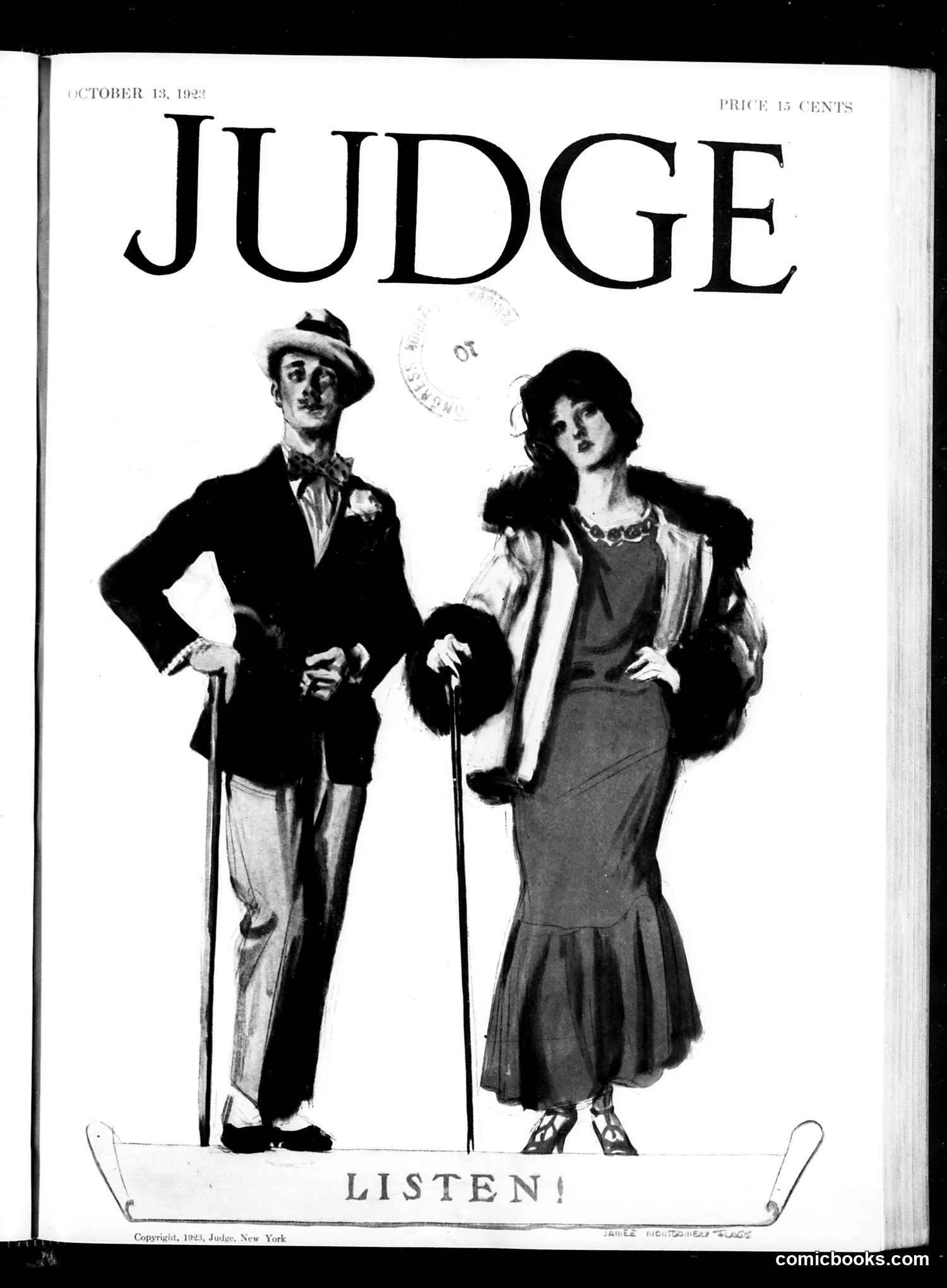
**October 13, 1923** This cover depicts two fashionably dressed figures holding canes with the caption "LISTEN!" The illustration appears to satirize 1920s social attitudes, likely about courtship or gender relations during the Jazz Age. The man on the left wears formal attire with a hat; the woman on the right displays the flapper style popular in that era—dropped waistline, shorter skirt, and fur stole. The "Listen!" caption suggests commentary on communication or romantic dynamics between young men and women. Without additional context, the precise satirical target remains unclear, though it likely comments on evolving social conventions and dating practices of the Roaring Twenties. The image exemplifies Judge's use of fashion and body language to convey social commentary.
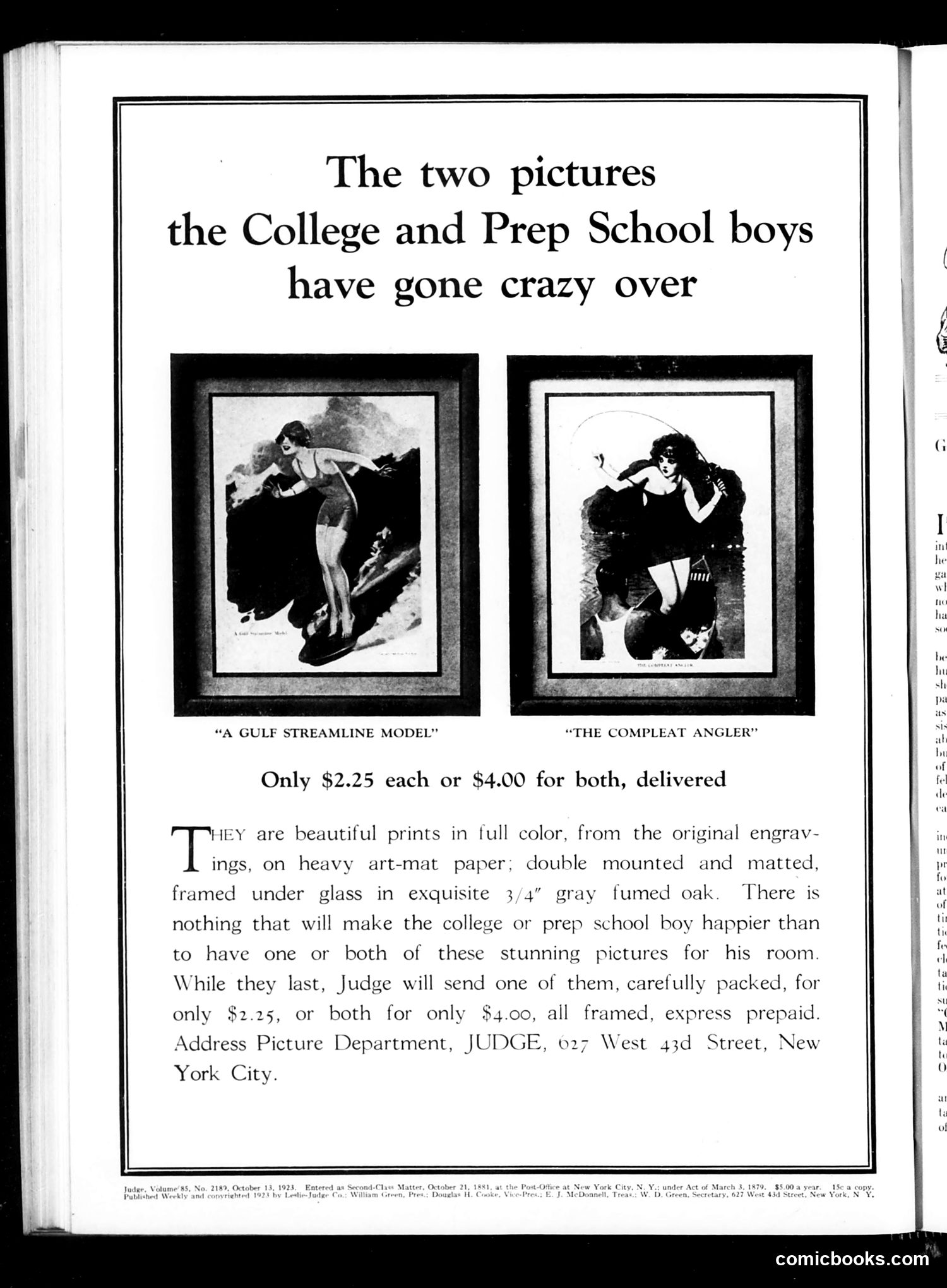
This is primarily **advertising content**, not satirical editorial material. Judge magazine is promoting two framed art prints titled "A Gulf Streamline Model" and "The Compleat Angler"—both appear to be stylized illustrations of women in fashionable poses. The ad targets college and prep school boys, marketing these pictures as desirable room decoration. The headline joke ("have gone crazy over") is mild wordplay suggesting the prints are wildly popular with this demographic. The actual satirical point—if any exists—appears to be gentle mockery of young men's enthusiasm for decorative prints of attractive women, a common advertising demographic in the 1920s era. The pricing ($2.25 each or $4.00 for both) and delivery details indicate this is straightforward commercial advertisement rather than social commentary.
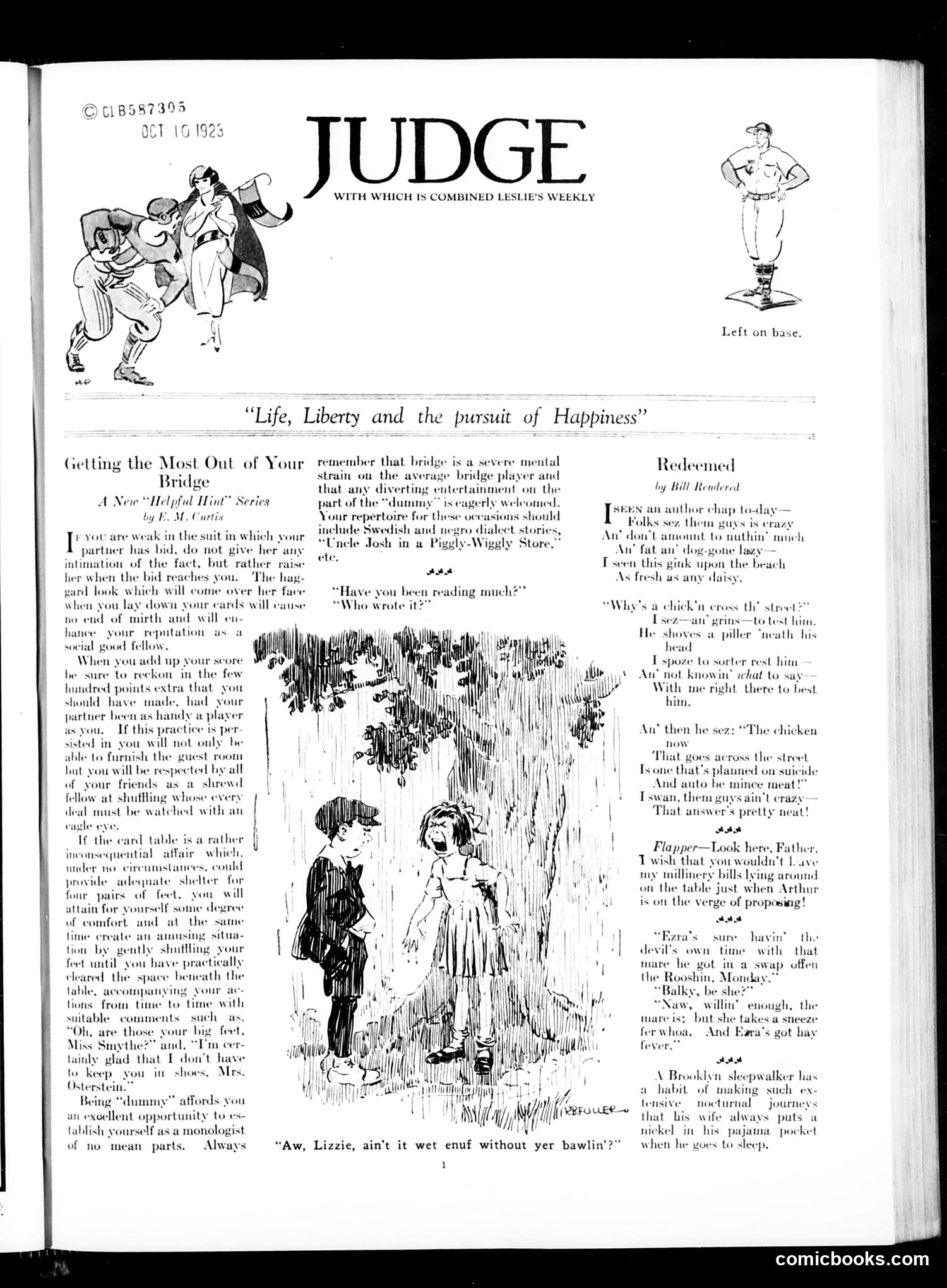
This page contains humor articles rather than political cartoons. The main content includes: **"Getting the Most Out of Your Bridge"** — advice for bridge card players on maintaining composure and social grace when playing poorly, suggesting one should blame external factors (like a "dummy" partner) rather than oneself. **"Redeemed" by Bill Renderod** — a humorous poem about a man confronting his girlfriend over her reckless behavior, using exaggerated dialogue to create comedy. **"Aw, Lizzie, ain't it wet enuf without yer bawlin'?"** — an illustration with caption depicting a domestic scene, likely poking fun at marital disagreements during rainy weather. The page reflects 1920s American leisure culture, social conventions, and domestic humor aimed at middle-class readers.
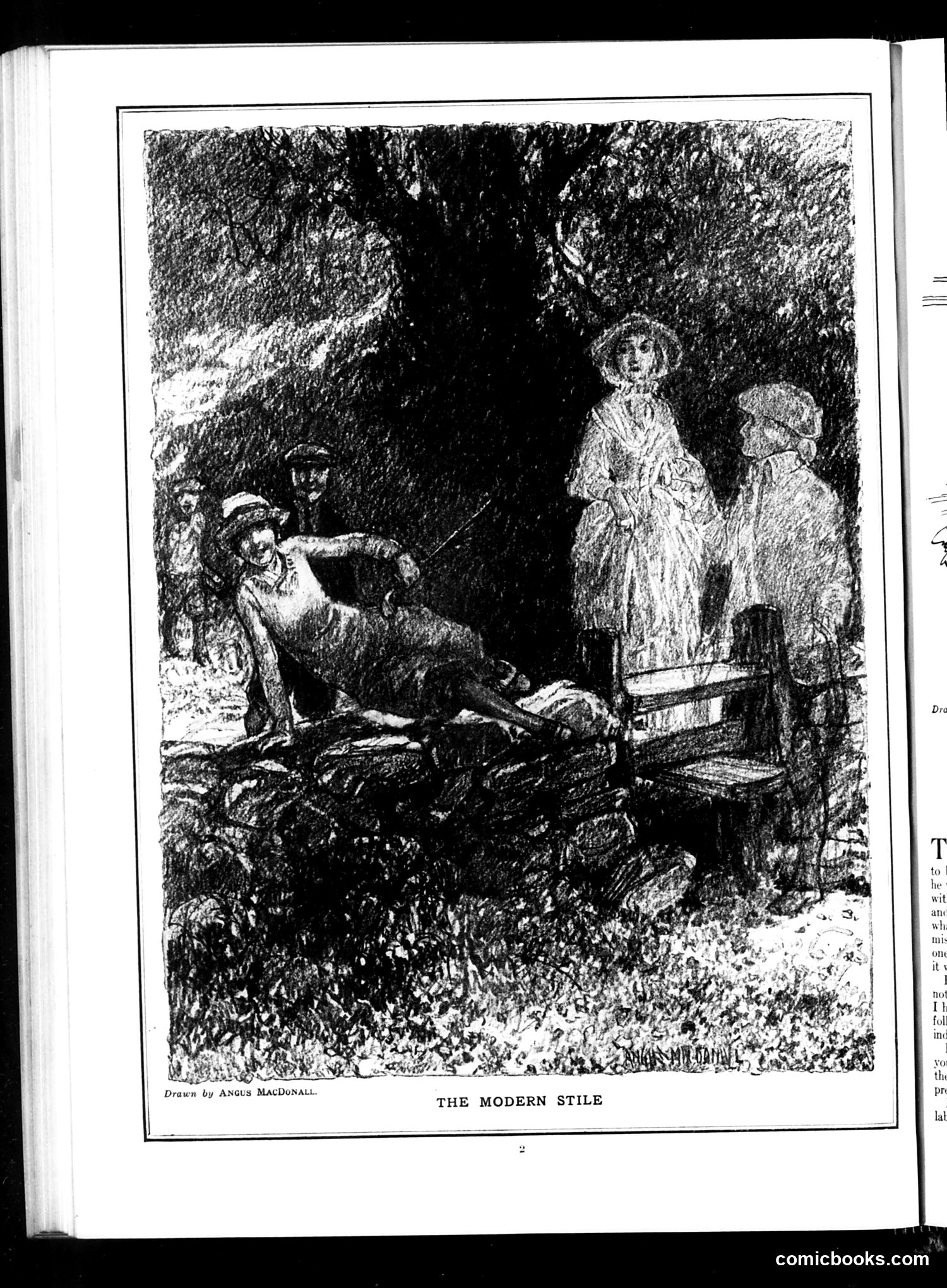
This sketch depicts a romantic or flirtatious encounter at a rural fence stile—a common crossing point in countryside settings. The title "The Modern Stile" suggests the cartoon satirizes contemporary courtship customs. The composition shows a woman seated on the stile while a man assists or attends to her, with other figures observing nearby. The satire likely comments on evolving gender relations and modern dating practices of the era—possibly mocking either the elaborate assistance men provided women, or conversely, women's growing independence. Without additional context from Judge magazine's publication date, the specific social critique remains unclear, though the rural setting contrasts "modern" behavior with traditional countryside life.
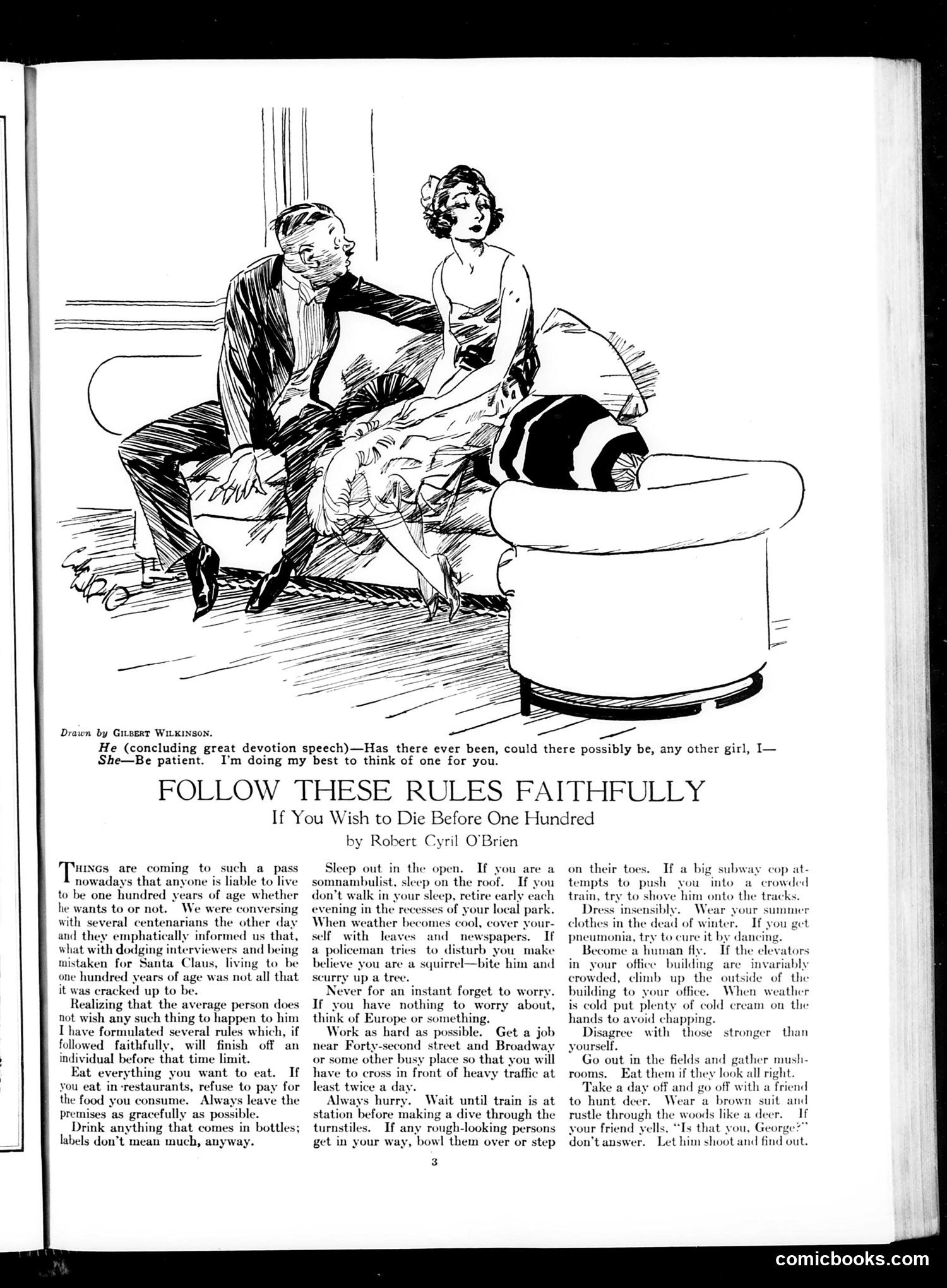
The cartoon depicts a man earnestly counseling a woman on a sofa, concluding a "great devotion speech" where he asks if there could be "any other girl" for him. The woman, unimpressed, replies "Be patient. I'm doing my best to think of one for you." The humor works on two levels: the man's romantic desperation contrasts sharply with the woman's complete lack of interest—she's literally trying to imagine alternative romantic prospects for him rather than reciprocating his feelings. This satirizes overwrought male sentimentality and rejection. Below this is an unrelated article titled "Follow These Rules Faithfully If You Wish to Die Before One Hundred" by Robert Cyril O'Brien, offering humorous mock-advice about dangerous or unhealthy behaviors (sleeping on roofs, ignoring traffic, etc.). The satire inverts typical health guidance by promoting self-destructive activities.
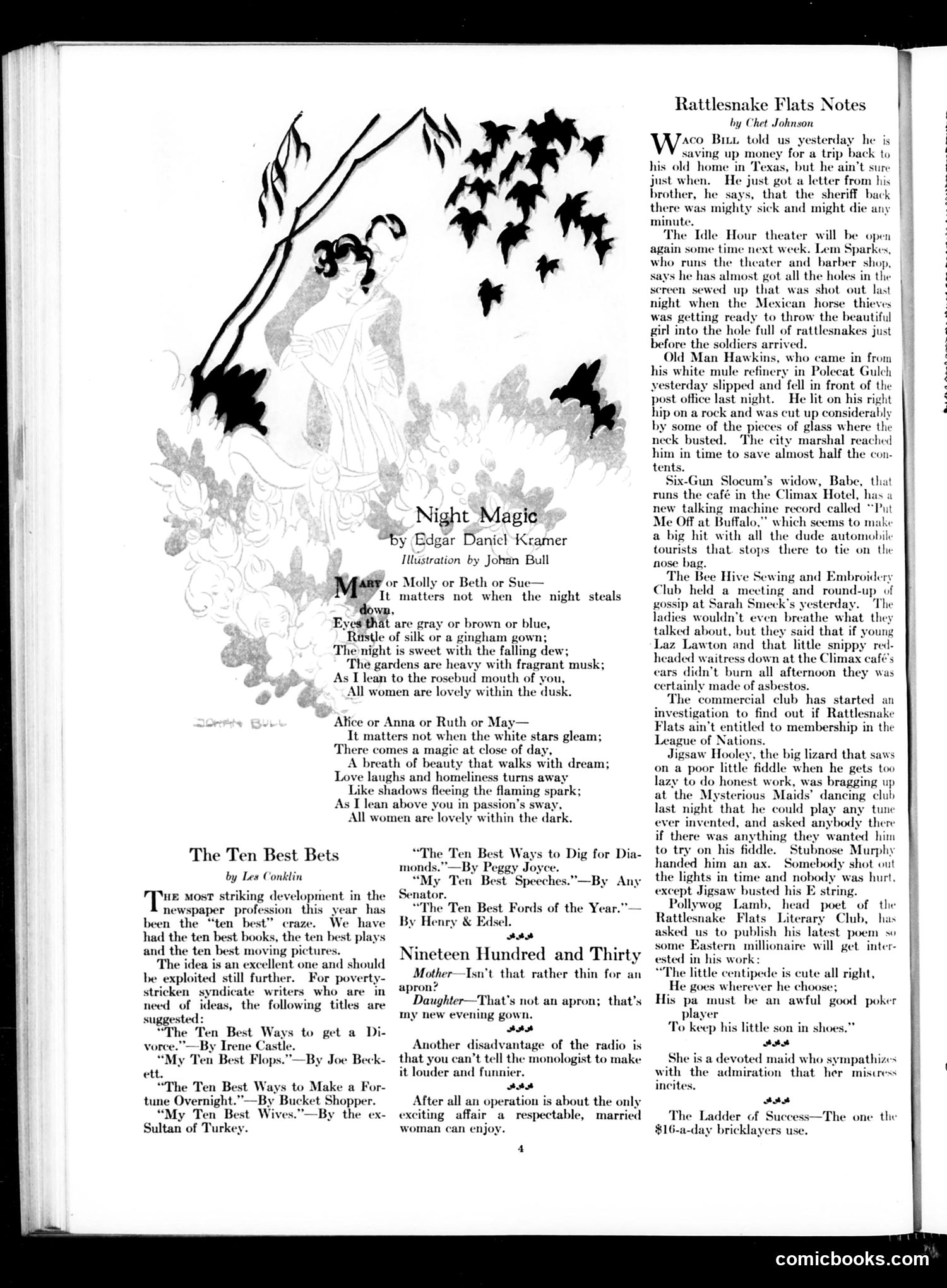
This page features **"Night Magic,"** a poem by Edgar Daniel Kramer illustrated by John Bull. The artwork depicts a romantic couple embracing beneath moonlight and foliage, with the illustration rendered in soft, dreamy style. The poem celebrates nocturnal romance, addressing women by various names (Alice, Anna, Ruth, May) and emphasizing how "night" transforms perception—"All women are lovely within the dark." It's sentimental Victorian-era verse romanticizing female beauty and desire under cover of darkness. The right column contains **"Rattlesnake Flats Notes,"** gossip about a small town, and **"The Ten Best Bets,"** which lists humorous article titles from the magazine itself—typical Judge filler content mixing local humor with self-promotion.
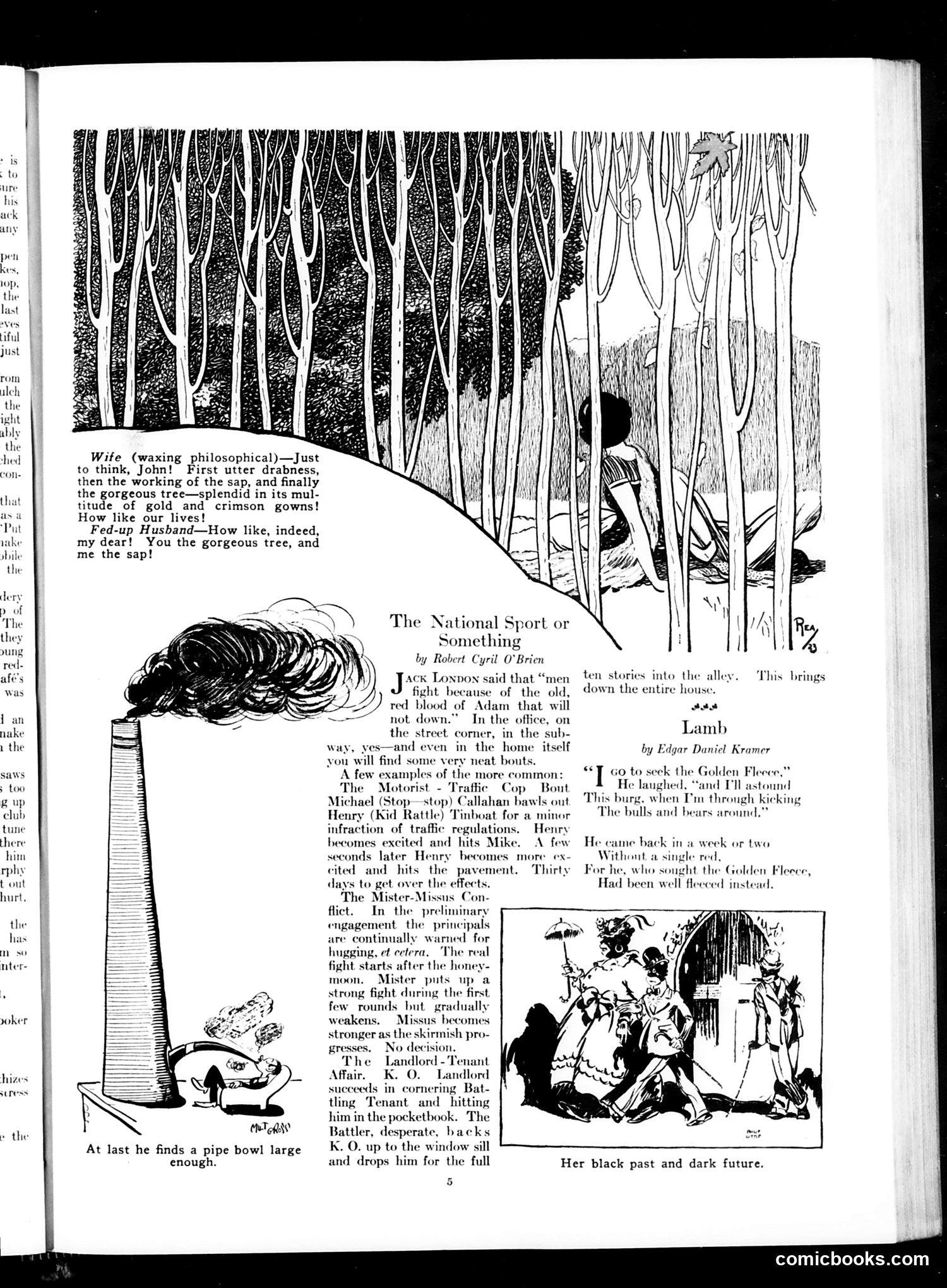
This page contains three distinct satirical pieces typical of Judge's humor: **Top cartoon**: A domestic joke where a wife waxes philosophical about autumn trees' transformation, comparing it to human life. The husband sardonically agrees—but reverses her metaphor, calling himself "the sap" while she's "the gorgeous tree," a cutting insult suggesting she's showy while he's drained of vitality. **"The National Sport or Something"**: Robert Cyril O'Brien's humorous essay catalogs commonplace fights in American life: motorist-cop altercations, marital disputes ("Mister-Missus Conflict"), and landlord-tenant conflicts. Each is described in boxing terminology, satirizing how Americans resolve disputes through violence rather than reason—connecting to Jack London's comment about mankind's inherited aggression. **"Lamb" poem**: A cautionary tale about a naive young man seeking fortune ("Golden Fleece") in the city, only to be swindled—he returns "well fleeced instead" of enriched. The accompanying illustration shows his romantic downfall. The page satirizes American combativeness, domestic discord, and urban deception through humor and irony.
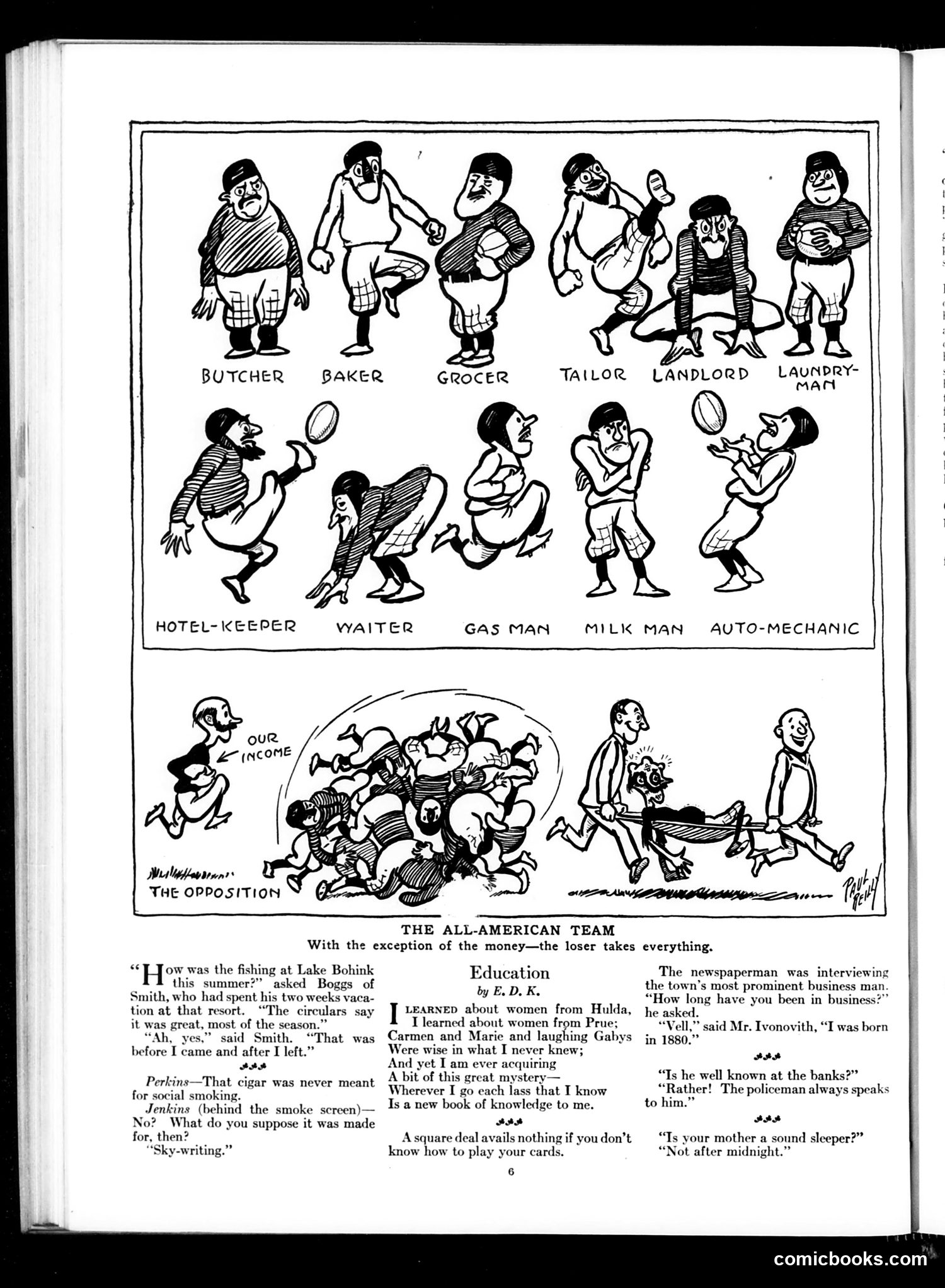
This page satirizes working-class American occupations through caricature. The top section depicts eleven tradesmen (butcher, baker, grocer, tailor, landlord, laundry operator, hotel-keeper, waiter, gas man, milk man, and auto-mechanic) as cartoonish figures with exaggerated features. The caption's joke—"With the exception of the money—the loser takes everything"—suggests these workers are portrayed as a sports "team" where all lose except financially. The lower panel labeled "THE OPPOSITION" appears to show competing forces (likely wealth/management) winning against this working-class lineup. This reflects early-20th-century class tensions in America. The satire mocks both the workers themselves through crude caricature and, implicitly, a system where laborers remain economically disadvantaged despite their essential roles. The accompanying humorous vignettes about education, business success, and social climbing reinforce themes of social mobility and class consciousness typical of Judge's satirical commentary on American society.
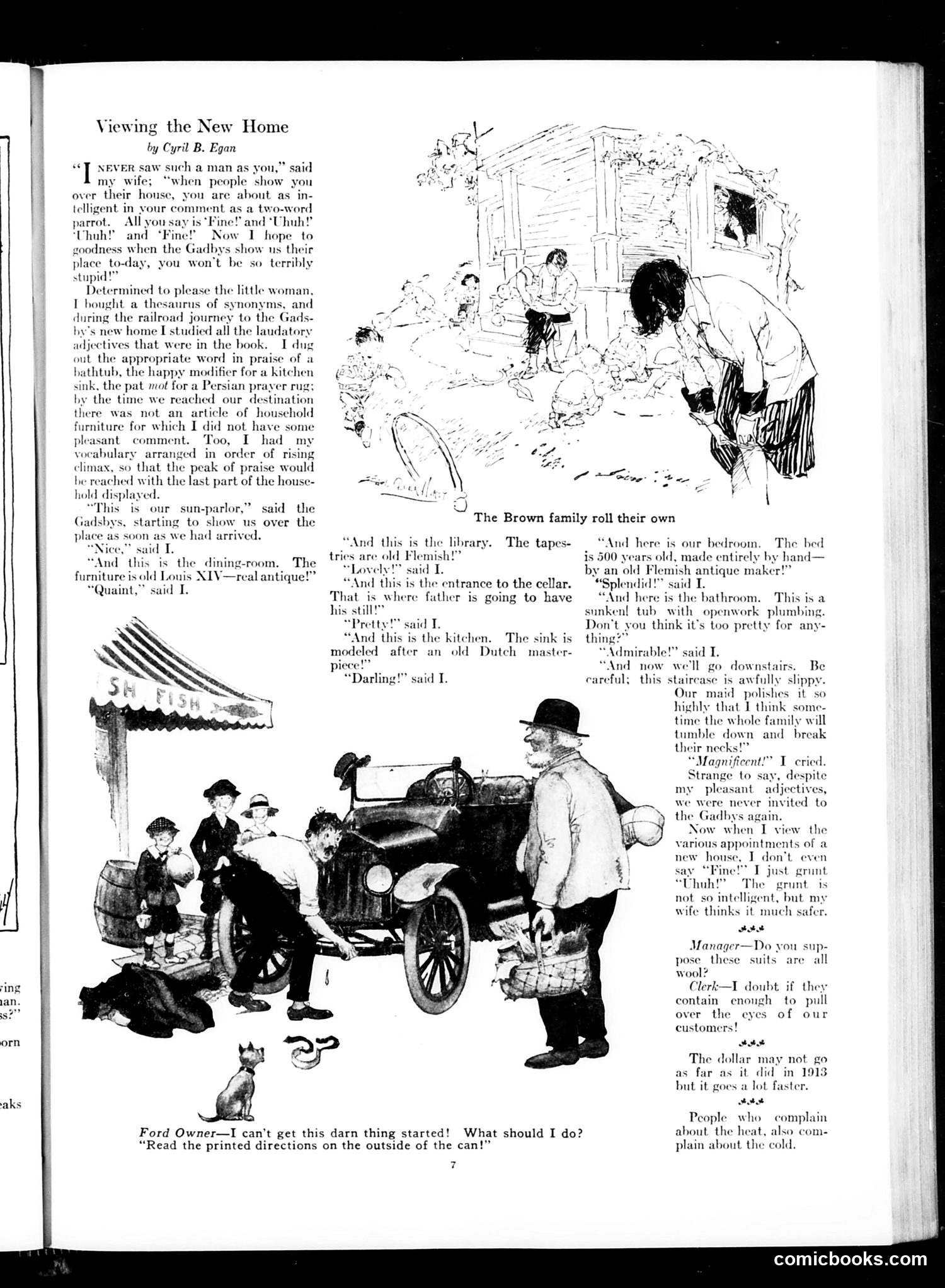
This humorous short story satirizes social pretension and the awkwardness of home tours. The narrator's wife criticizes his conversational incompetence during house visits, so he memorizes synonyms to impress their hosts, the Gadbys. The joke: his escalating praise becomes absurdly excessive—calling a sunken bathtub "Magnificent!" and a dangerously slippery staircase the same. The satire targets both nouveau riche homeowners who flaunt possessions (antique beds, "old Flemish" items) and the social anxiety of guests expected to perform enthusiasm they don't feel. The lower cartoon mocks a Ford owner unable to start his car, contrasting with "the Brown family roll their own"—a joke about home-brewed alcohol during Prohibition (illegal alcohol production). The sidebar quips reference 1920s concerns: inflation, Prohibition, and consumer goods quality—typical Judge magazine commentary on contemporary life.
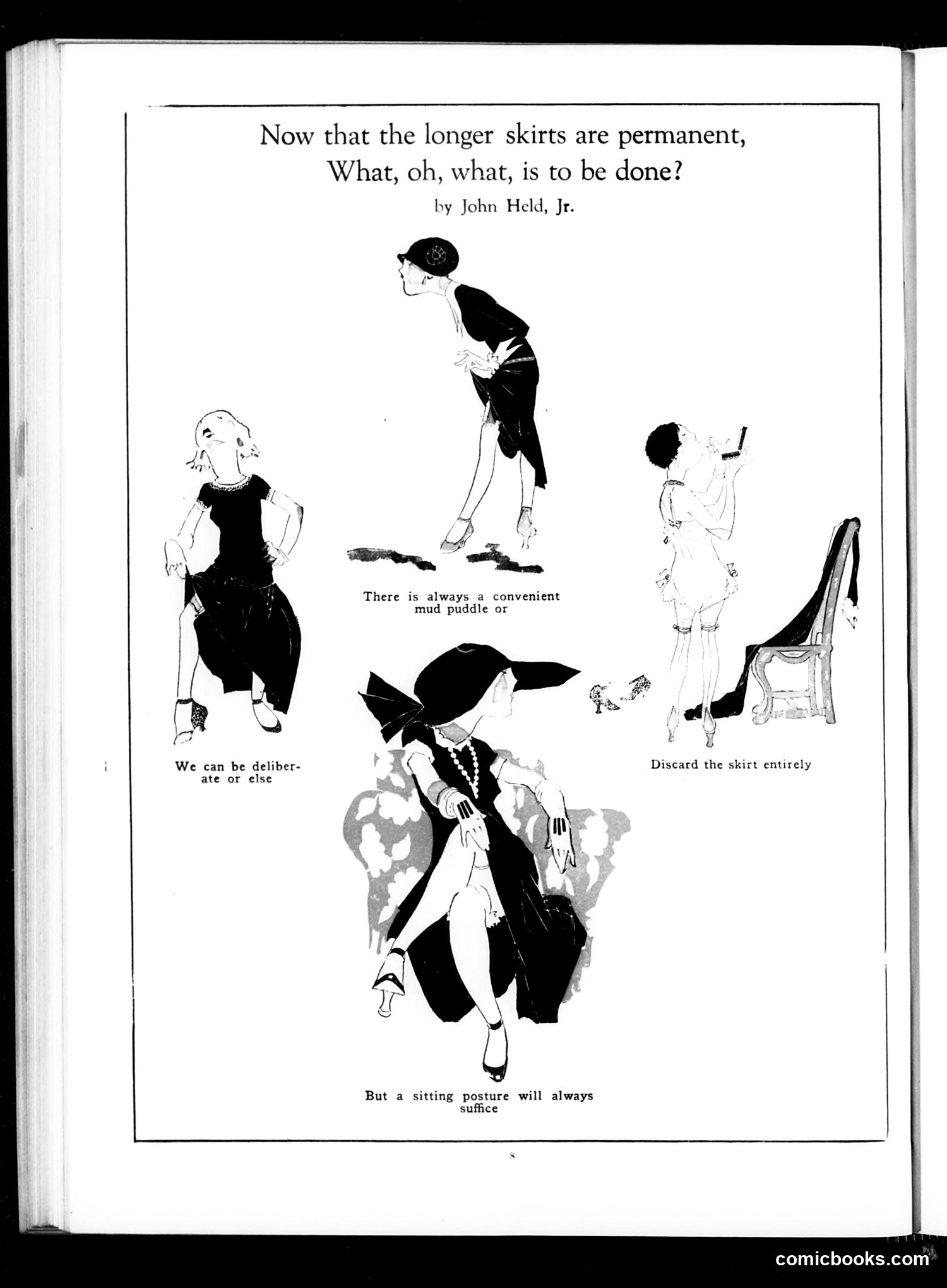
This 1920s cartoon by John Held Jr. satirizes women's fashion debates. The piece mocks anxieties about the newly lengthened hemlines that had become standard after the shorter "flapper" skirts of the early Jazz Age. The cartoon suggests solutions to the "problem" of longer skirts: deliberately stepping in mud puddles to soil them, discarding skirts entirely, or adopting a sitting posture to minimize visibility of legs. The humor lies in the exaggerated desperation—treating modest hemlines as a crisis requiring absurd workarounds. This reflects real contemporary tension between traditionalists who approved of longer skirts as more proper, and younger women who resisted returning to pre-1920s fashion restrictions. Held's satire gently mocks both the moral panic over women's clothing and the notion that hemline length was genuinely catastrophic.
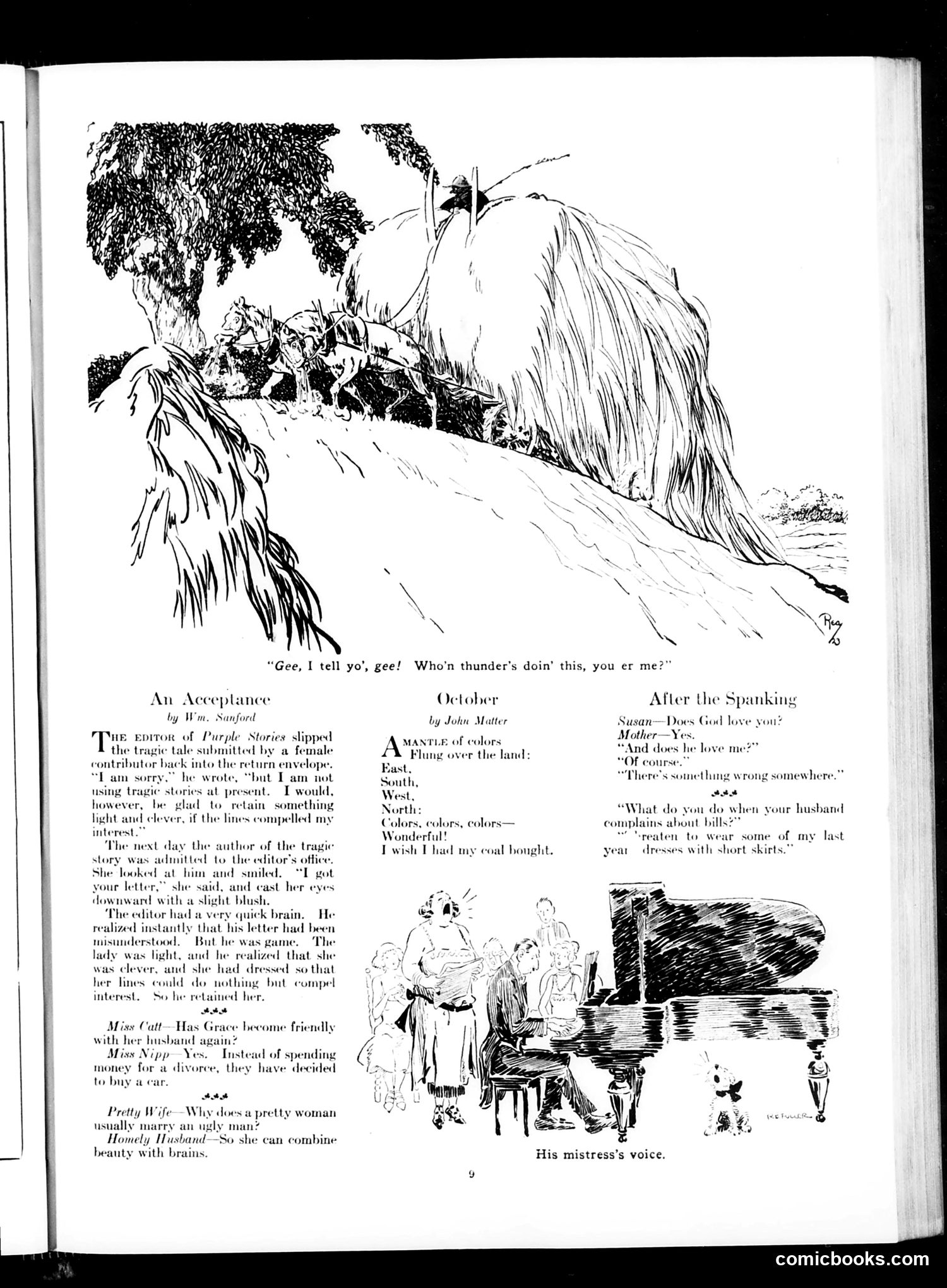
This page from the satirical magazine Judge contains several short humor pieces typical of early 20th-century American comedy: **Main Cartoon (top):** Shows a donkey being beaten with the caption "Who's doin' this, you er me?" — a visual pun playing on the expression "beating a dead horse." **"An Acceptance":** A story about a female magazine contributor whose rejection letter is misinterpreted as acceptance. She arrives at the editor's office dressed attractively, and the editor, realizing her mistake but charmed by her appearance and wit, decides to publish her work anyway. The satire mocks both editorial standards and the power of feminine appeal over professional judgment. **Shorter jokes** include wordplay about marriage, divorce, and gender relations — common themes in period humor that often relied on stereotypes about pretty women, ugly men, and domestic life. **"His mistress's voice":** An illustration (bottom right) accompanying a joke, though context is unclear from the visible text. The overall tone reflects turn-of-the-century American attitudes toward women, editors, and marriage.
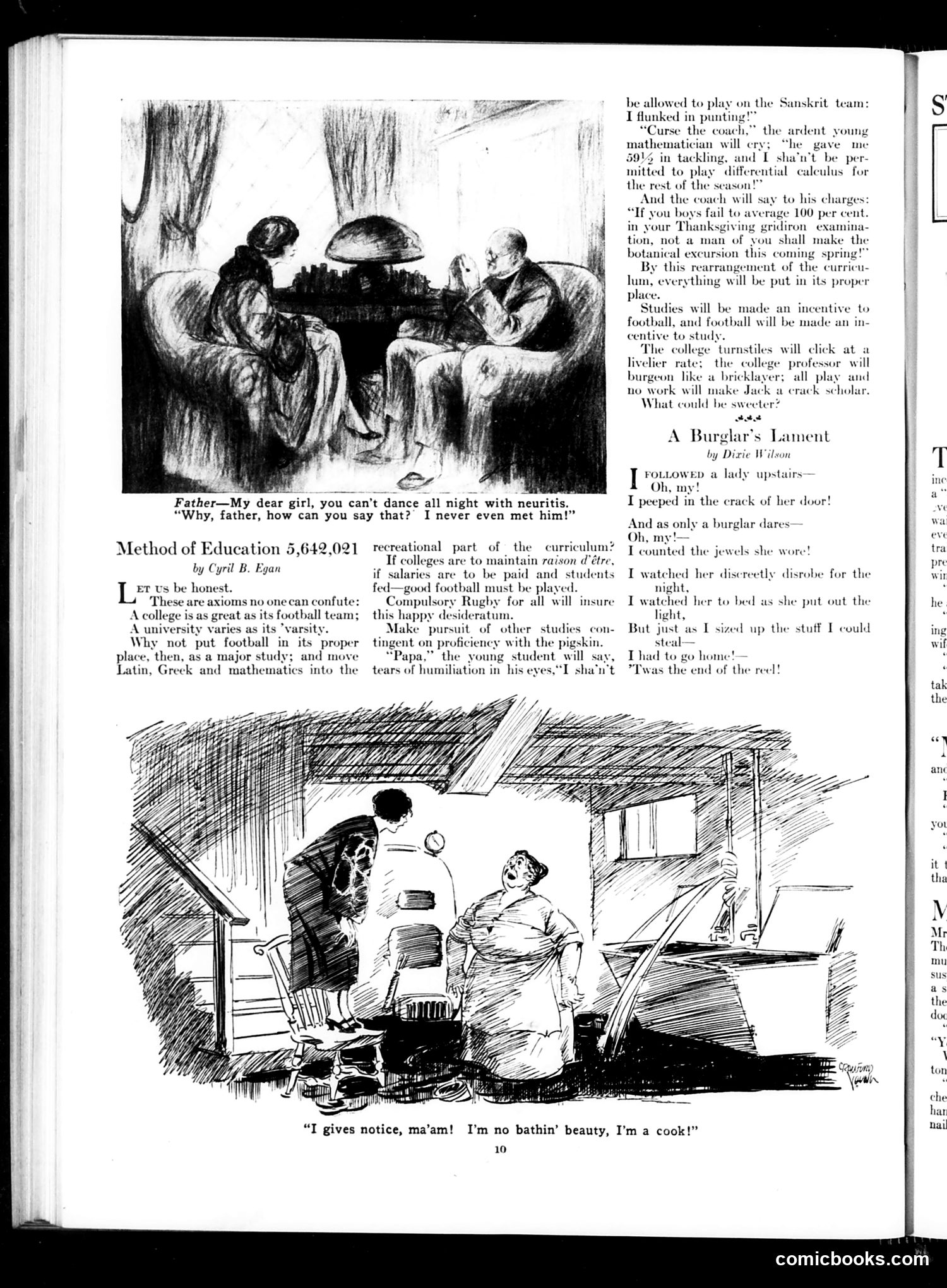
**Top Cartoon:** A father confronts his daughter about dancing all night with "neuritis." The joke relies on a misunderstanding: the father thinks "neuritis" (nerve inflammation) is a person's name, implying his daughter danced with someone all evening. The satire mocks both paternal concern over courtship and the absurdity of the mix-up. **"Method of Education" Article:** This satirical piece by Cyril B. Egan critiques American colleges' obsession with football. The author argues colleges prioritize athletics over academics—proposing a darkly comic "solution": make football mandatory and condition academic study on football proficiency. Students would fail Sanskrit or calculus if they underperform in "the pigskin." The satire attacks how institutional prestige depends on winning teams rather than scholarly excellence. **Bottom Cartoon:** A domestic servant announces she's a cook, not a "bathin' beauty"—likely rejecting assumptions about her appearance or role, asserting professional identity. These pieces satirize early 20th-century American education priorities and social class assumptions.
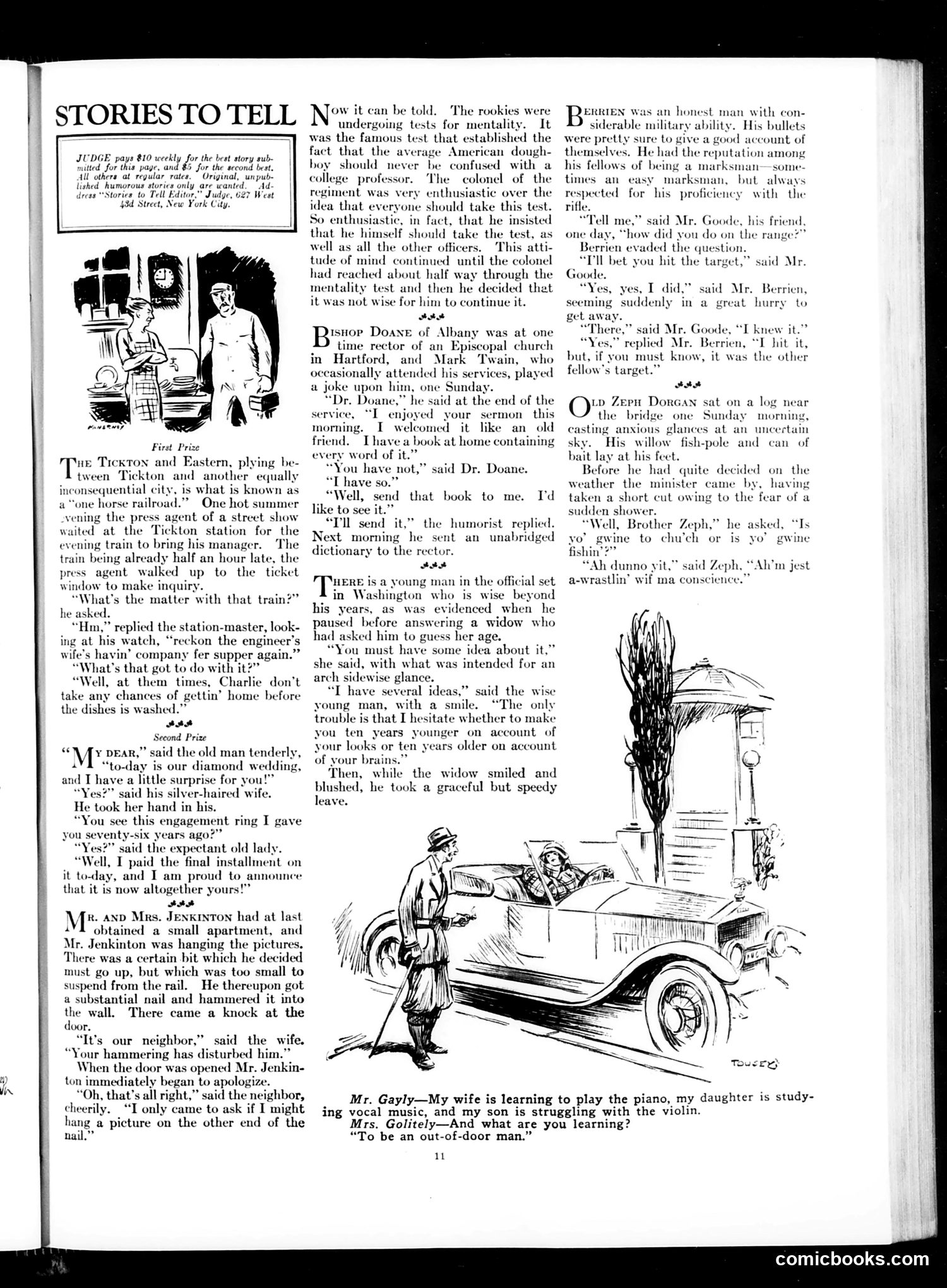
This is a humor page featuring three short comic stories typical of Judge magazine's satirical offerings. The jokes target early-20th-century American social conventions and absurdities: 1. **"One-Horse Railroad"**: Mocks small-town inefficiency—a train is late because the engineer won't leave his wife's dinner party, prioritizing domestic obligations over employment. 2. **"Diamond Wedding"**: A gentle joke about marital practicality—an elderly husband presents an engagement ring, but it's merely the final installment payment on a ring given decades earlier, undercutting romantic sentiment with financial reality. 3. **"The Neighbor's Nail"**: Absurdist humor about shared apartment living where a neighbor asks to use the same nail for his picture—a joke about close quarters and communal awkwardness. The fourth story references Mark Twain (clearly identified) pranking a clergyman by sending a dictionary instead of a sermon book, and a Washington bureaucrat's witty deflection of a widow's age question. All employ understated, dry humor characteristic of early-century American satire.
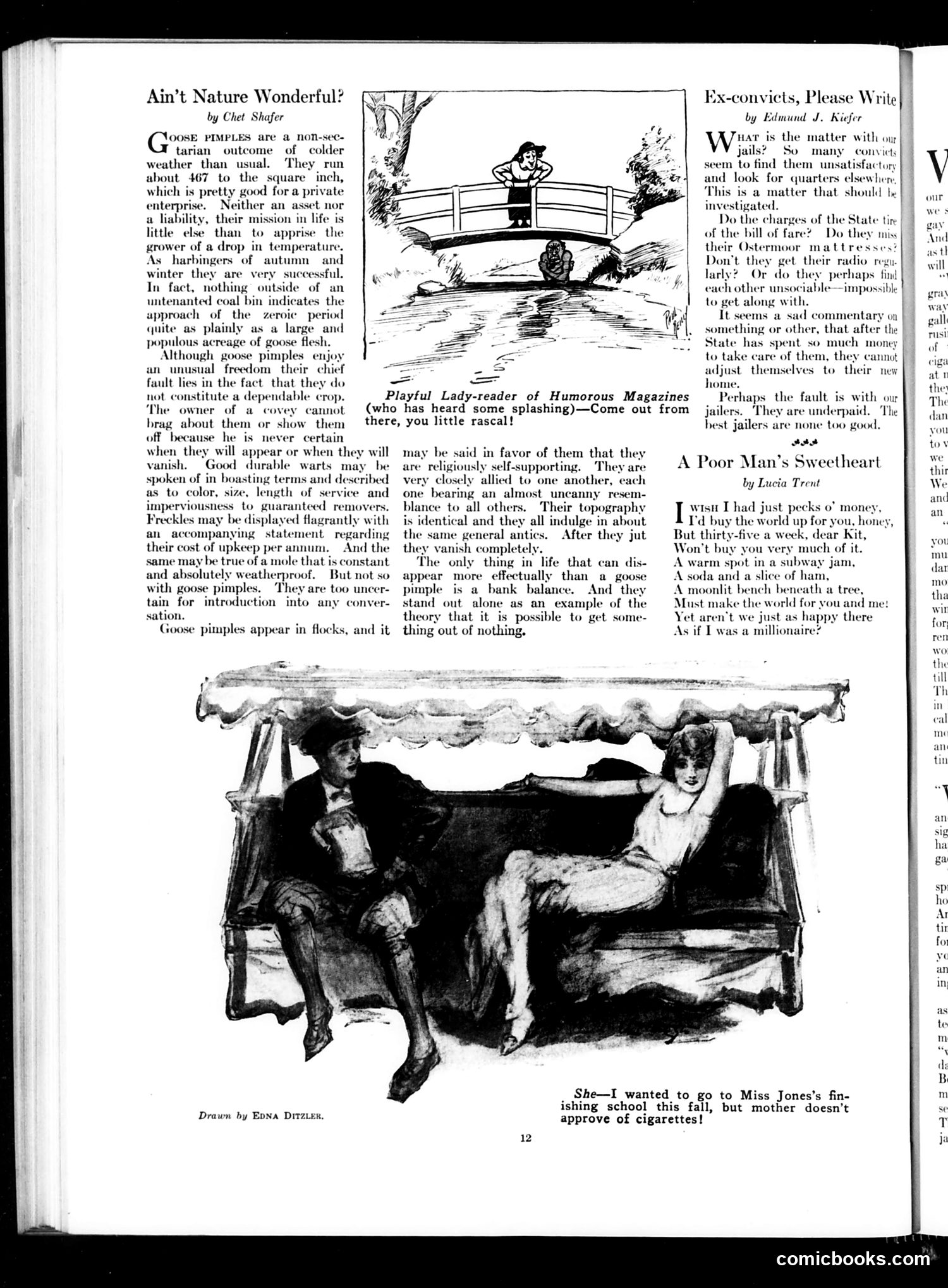
This page contains three distinct pieces of satirical content: **"Ain't Nature Wonderful?"** (Shafer/Ditzler): A humorous essay comparing goose pimples to other bodily features, arguing goose pimples are unreliable and unpredictable—unlike warts or moles that can be "boasted" about. The satire targets human vanity and our obsession with cataloging even trivial physical traits. The illustration shows a woman on a bridge startling what appears to be a beaver or similar creature. **"Playful Lady-reader"**: A brief joke about a woman calling out to something splashing in water, likely a beaver. The humor relies on double entendre or misunderstanding about what's actually in the water. **"Ex-convicts, Please Write"** (Kiefer): Social satire criticizing poor prison conditions and underpaid jailers, suggesting convicts leave because accommodations and treatment are inadequate. It's mildly critical of the state's prison system. **"A Poor Man's Sweetheart"** (Trent): Romantic poetry about accepting modest circumstances—subway rides and cheap food—with a woman's mother disapproving of cigarettes. Social commentary on class and modest romance.
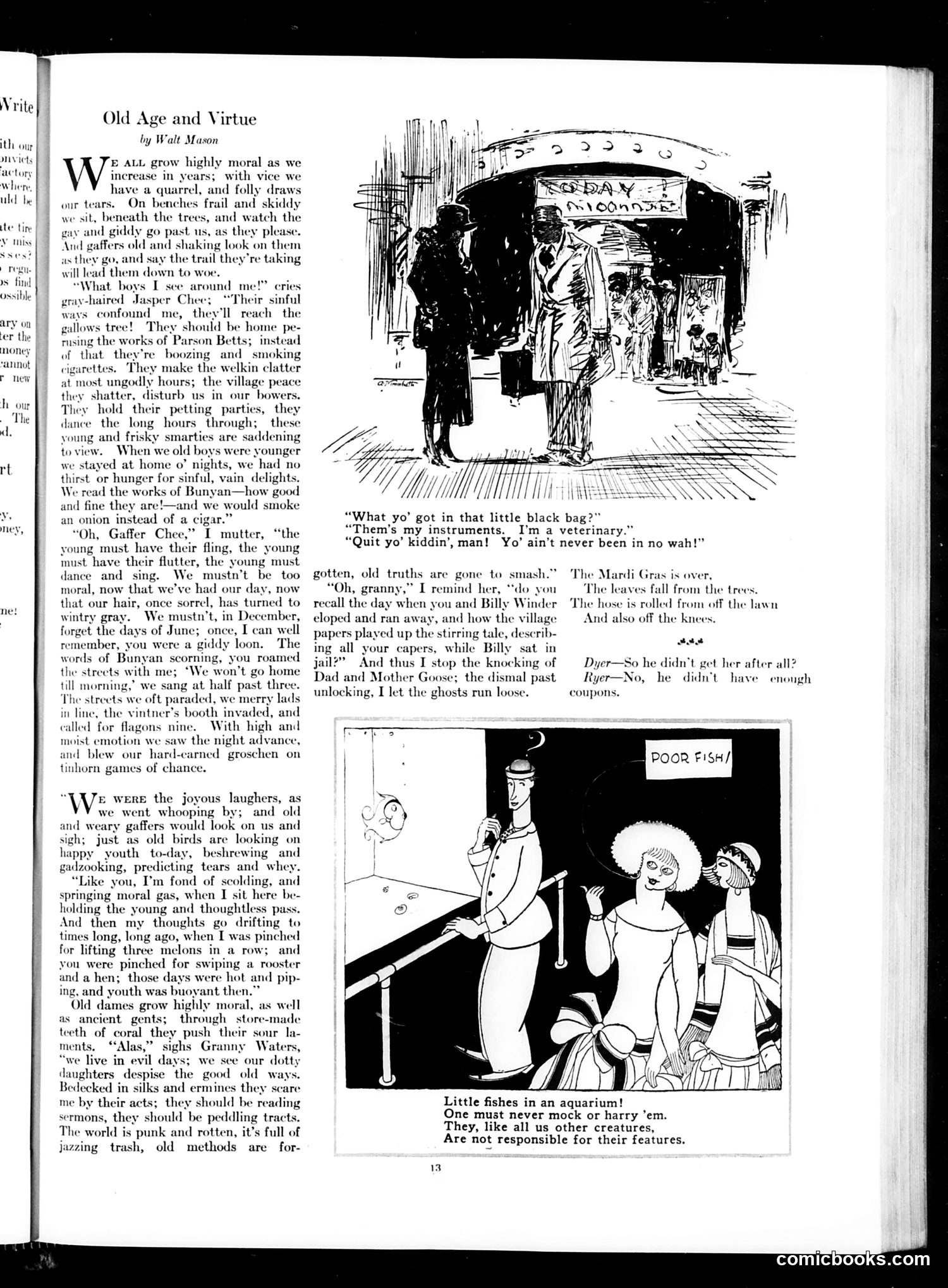
This page contains Walt Mason's essay-poem "Old Age and Virtue," which satirizes elderly people's moral hypocrisy. Mason's narrator confronts "Gaffer Chee" and "Granny Waters," who condemn modern youth for drinking, smoking, and carousing—yet the narrator reminds them they engaged in identical behavior when young (stealing melons, eloping, boozing). The satire mocks how the elderly conveniently forget their own youthful indiscretions while becoming stern moralists. The accompanying cartoons are separate gags: one shows a street encounter where a man claims his "black bag" contains veterinary instruments, and another jokes about failed romance requiring "coupons" (possibly a reference to wartime rationing or promotional schemes). The "Poor Fish" cartoon below illustrates Mason's closing moral: even small creatures deserve respect and shouldn't be mocked for their nature—paralleling the essay's theme about human character.
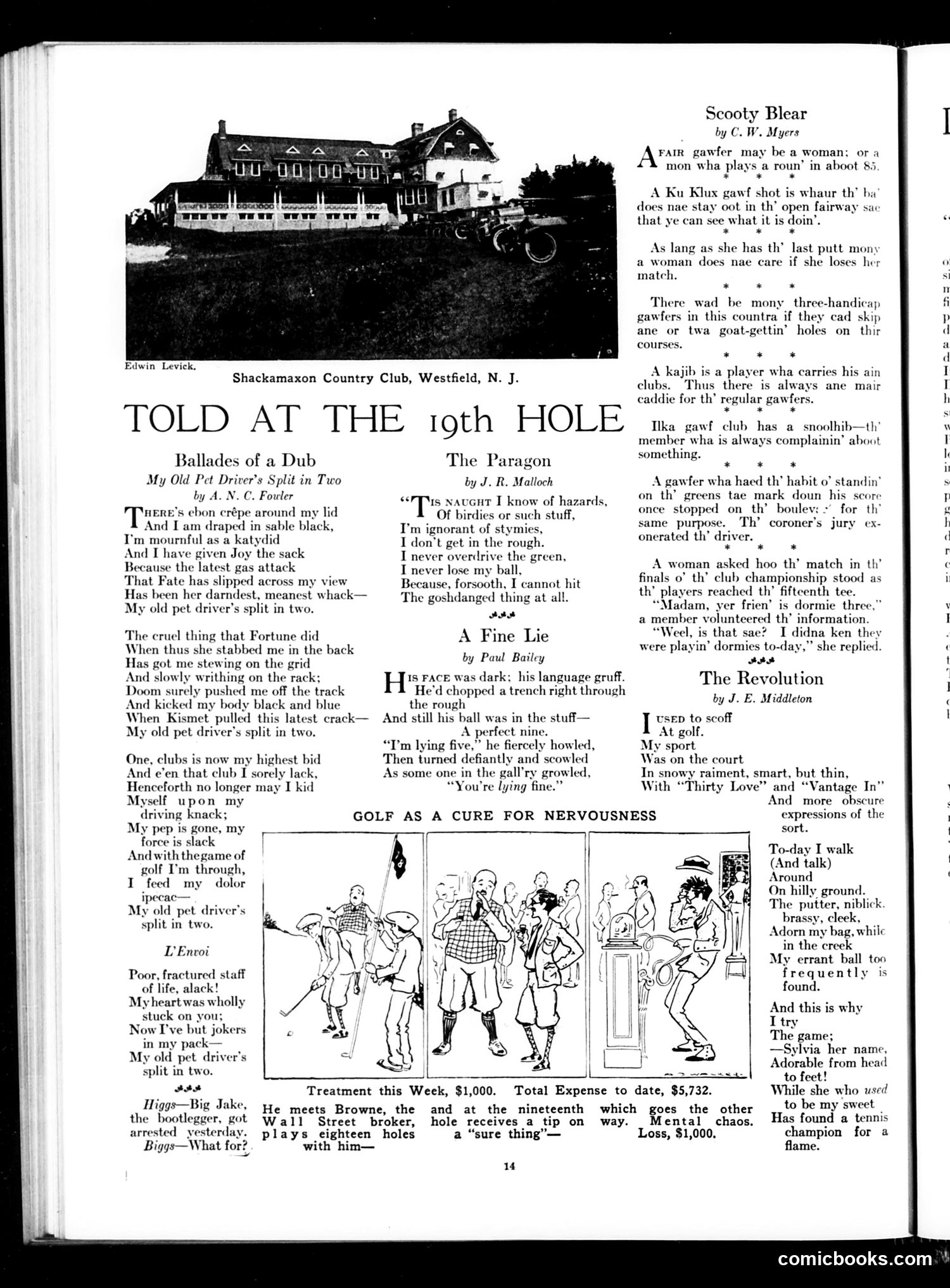
This page from *Judge* magazine features golf-themed humor and poetry. The main cartoon, "Golf as a Cure for Nervousness," shows people playing golf and socializing, satirizing the contemporary belief that golf could treat nervous disorders—a common medical claim of the early 20th century. The poems and short pieces mock amateur golfers ("dubs") and golf culture. "Ballades of a Dub" humorously laments a broken golf driver as life tragedy. "The Paragon" jokes about a golfer so incompetent he can't even hit the ball properly. "A Fine Lie" puns on a player's dishonest score-reporting. "Scooty Blear" (in Scottish dialect) offers golf definitions and observations about players' behavior. The bottom caption mentions "Wall Street broker" meeting "Browne" at the nineteenth hole—likely satirizing wealthy businessmen's leisure pursuits and possibly hinting at insider trading tips disguised as casual golf conversation. Overall, the page reflects early 1900s upper-class golf culture while mocking both the sport's pretensions and players' incompetence.
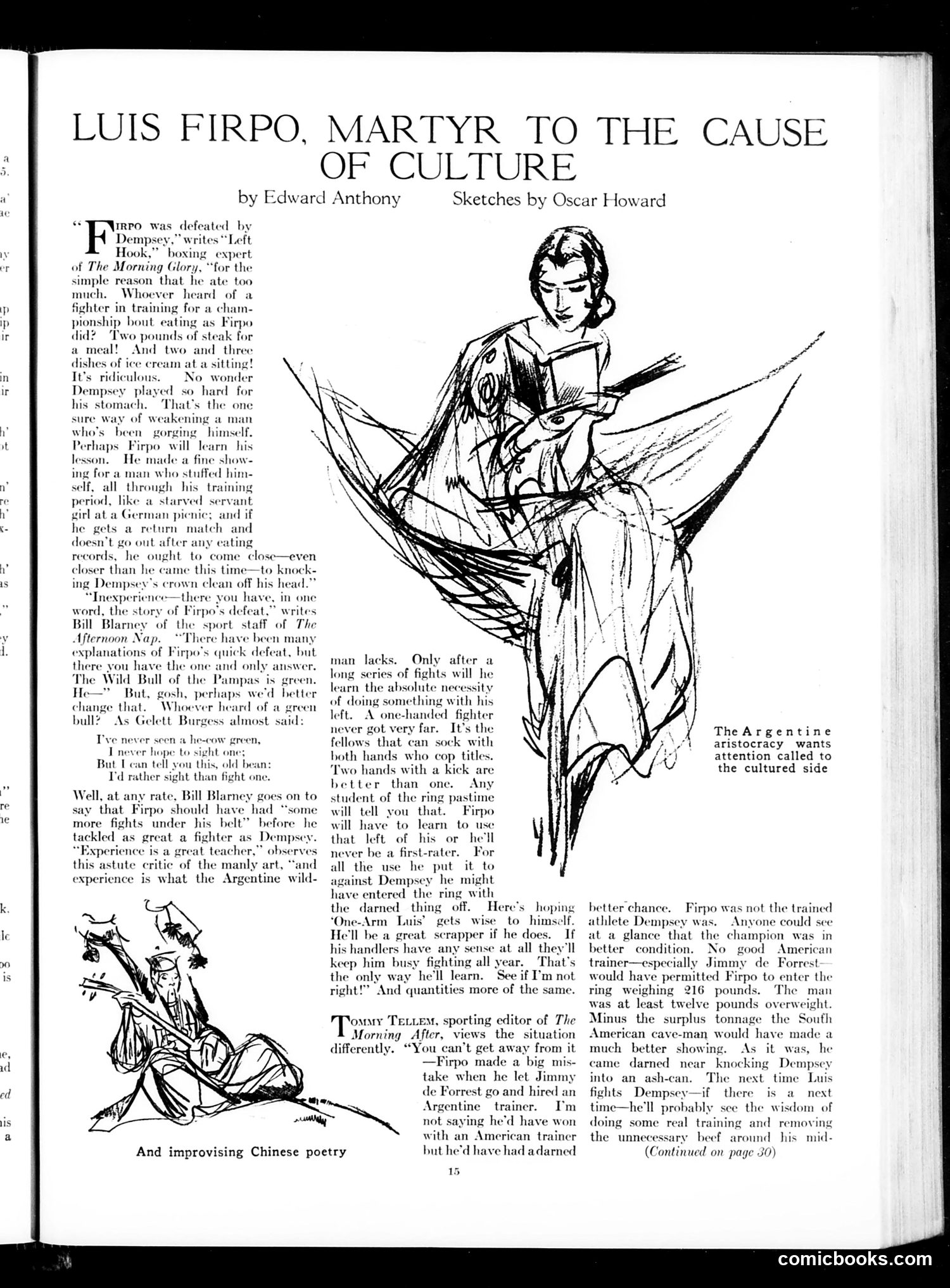
This article satirizes reactions to boxer Luis Firpo's defeat by heavyweight champion Jack Dempsey. Firpo, an Argentine fighter, lost despite nearly knocking Dempsey down—but sportswriters blamed his loss on poor training habits rather than Dempsey's superiority. The satire targets multiple explanations offered by sports columnists: one blamed Firpo's overeating (two pounds of steak, multiple ice creams), another his inexperience and failure to use his left hand effectively, and a third faulted his Argentine trainer instead of his previous American trainer Jimmy de Forrest. The Oscar Howard sketch shows a woman's attention being drawn to "the cultured side" of Argentine aristocracy—sarcastically contrasting Firpo's supposed refinement with his crude boxing performance. The piece mocks how American sportswriters scrambled to explain an underdog's near-victory through everything except acknowledging Dempsey's actual skill.
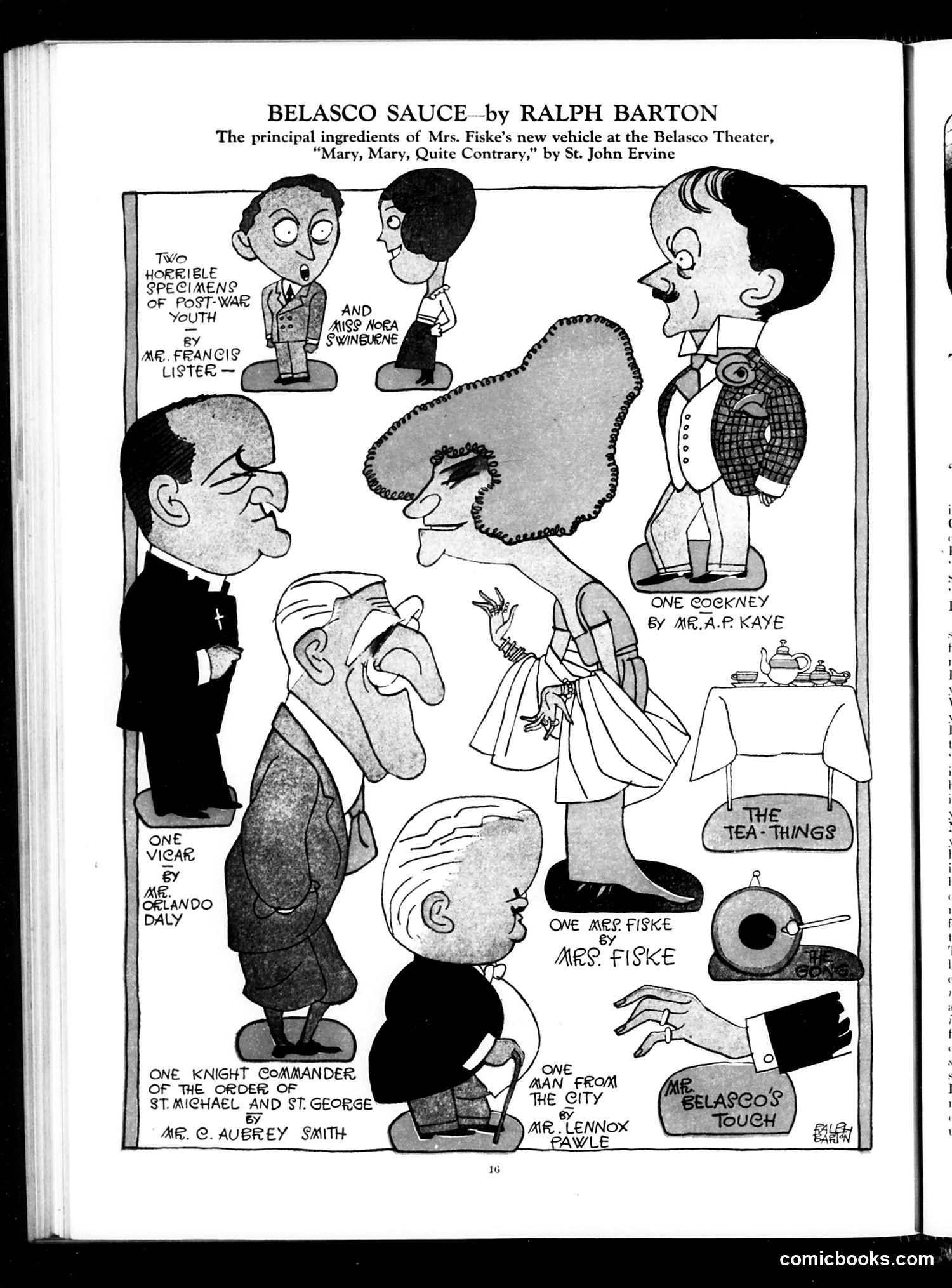
This is a theatrical satire by cartoonist Ralph Barton analyzing the "ingredients" of a Broadway play. The cartoon deconstructs *"Mary, Mary, Quite Contrary"* at the Belasco Theater, featuring Mrs. Fiske (a prominent actress of the era), by identifying the play's character types as social commentary. The caricatures represent stock character archetypes: post-war youth specimens, a pompous British knight, Mrs. Fiske herself, a cockney character, and a city man. The labeled "recipe" format—listing named actors and character types with attributions to playwrights—mocks how contemporary theater relied on predictable character formulas and famous performers rather than original storytelling. "Belasco's touch" references David Belasco, the theater's namesake producer known for theatrical spectacle. The satire suggests the play assembles familiar theatrical ingredients mechanically rather than creating something genuinely fresh or meaningful for post-war audiences.
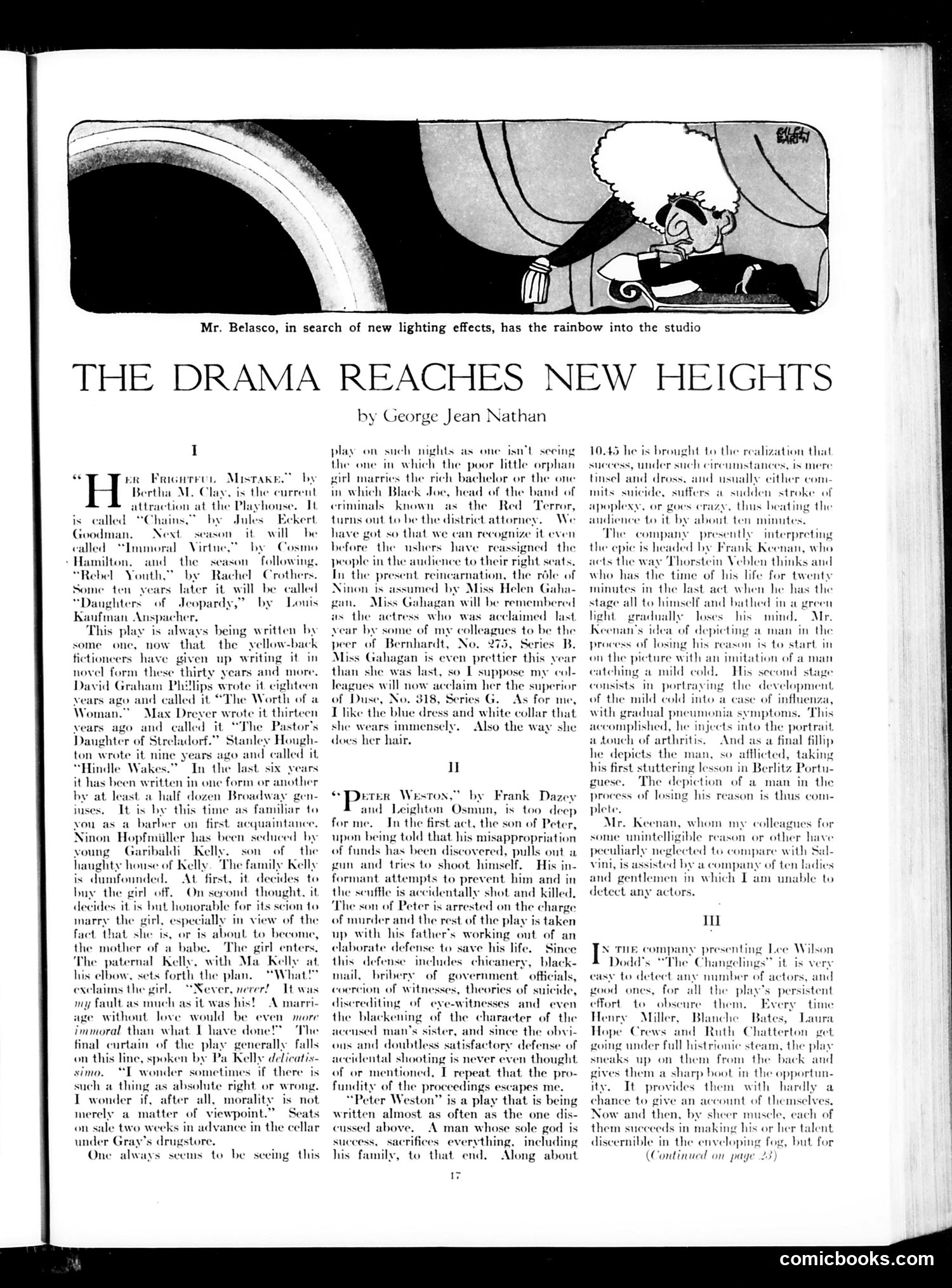
The top cartoon depicts David Belasco, a famous theatrical producer and director known for elaborate stage effects, literally bringing a rainbow into his studio—a visual joke about his obsessive pursuit of ever-more-spectacular lighting innovations. The main text is theater criticism by George Jean Nathan reviewing current Broadway plays. Nathan mocks the repetitive plot structure appearing in numerous dramas: a poor girl seduced by a wealthy man's son faces pressure to marry him, but refuses on moral grounds. Nathan notes this plot has been recycled for decades across multiple playwrights, appearing so frequently that audiences recognize it instantly "even before the ushers have reassigned the people." He reviews specific productions, including one starring Helen Gahagan, and critiques "Peter Weston," noting its morally dubious defense tactics (bribery, witness coercion, blackmail) that strain credibility. The satire targets theatrical cliché and the industry's endless recycling of tired storylines and melodramatic scenarios.
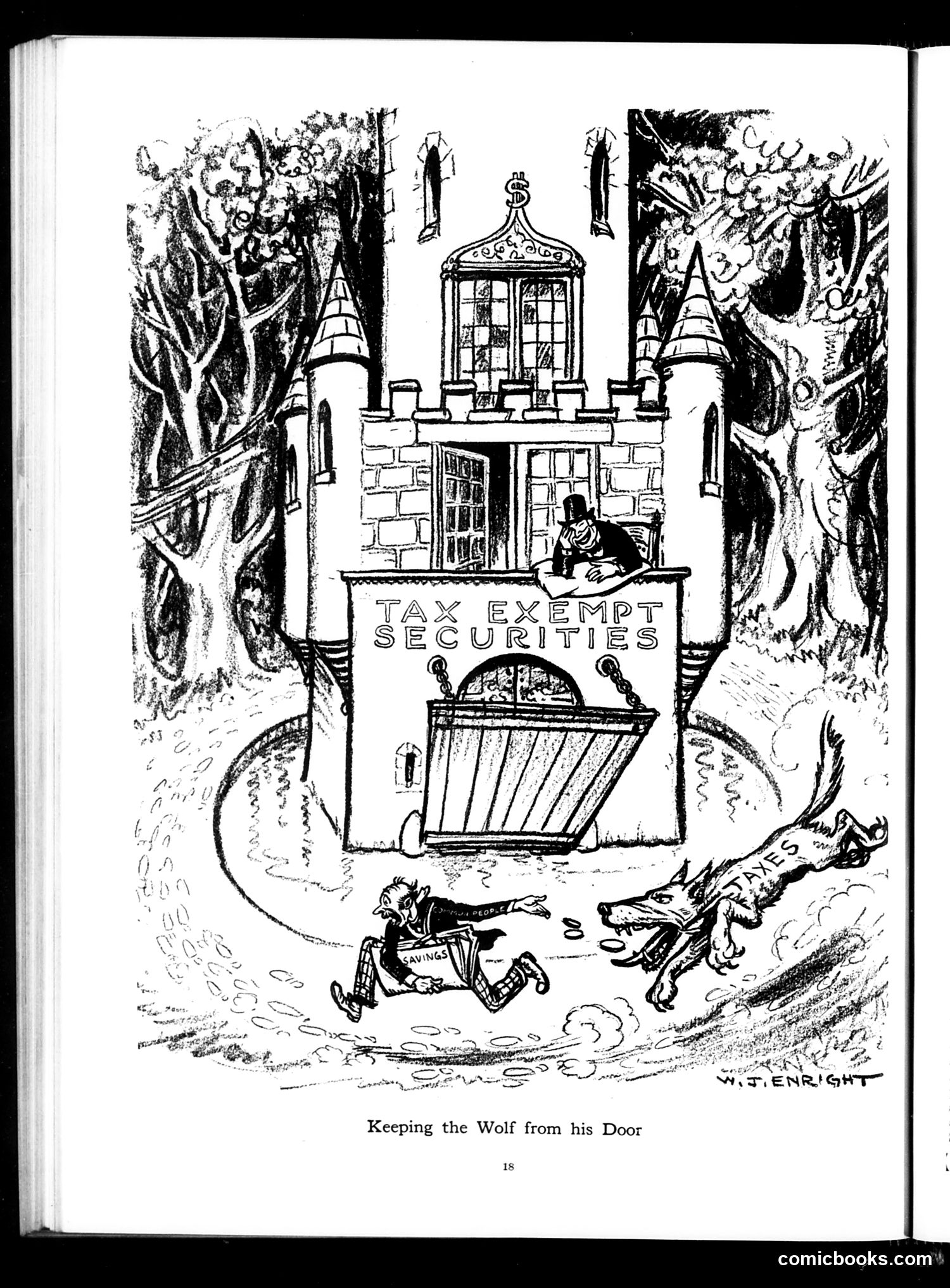
This political cartoon uses the metaphor "keeping the wolf from the door"—a common phrase meaning to ward off poverty or financial hardship. The illustration shows a fortified tower labeled "TAX EXEMPT SECURITIES" defended by a figure at the top. Below, a man labeled "SAVINGS" flees from a wolf-like creature labeled "HARD TIMES." The tower represents tax-exempt bonds as financial protection during economic difficulty. The satire critiques how wealthy individuals or institutions use tax-exempt securities to shield their wealth while ordinary people (represented by the panicked "Savings" figure) struggle against economic hardship. The cartoon suggests this system creates inequality—the privileged enjoy governmental protection through tax breaks while common citizens face financial wolves undefended. The cartoonist is W.T. Enright, signed at bottom right.
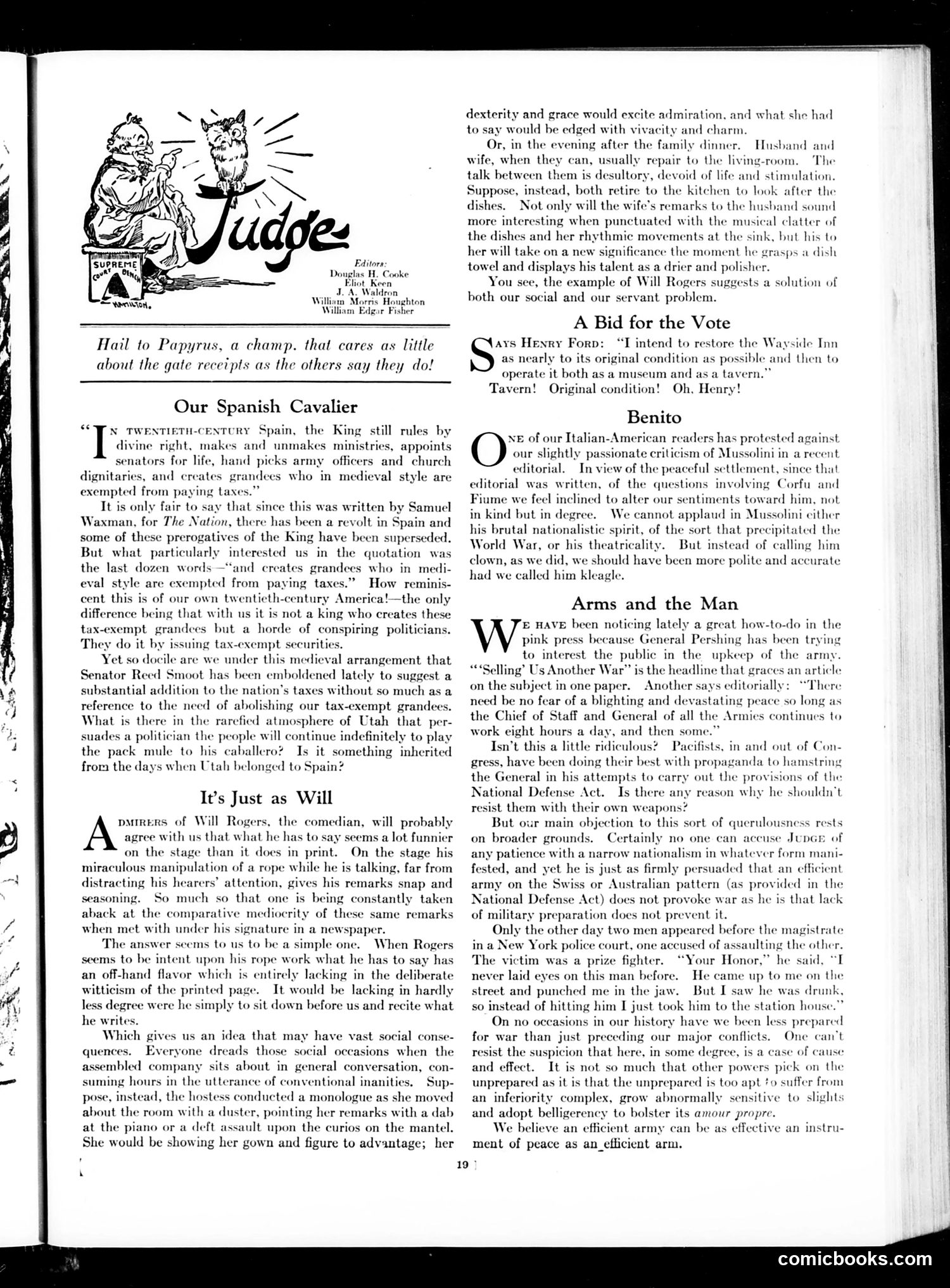
The page features three distinct pieces of satire: **"Our Spanish Cavalier"** critiques tax-exempt securities issued by American politicians. Drawing a parallel to medieval Spain's king-granted exemptions, it attacks Senator Reed Smoot's proposal to raise taxes without eliminating tax-exempt bonds—essentially creating a modern "aristocracy" of privileged investors. The satire asks why Americans tolerate this medieval arrangement. **"It's Just as Will"** humorously argues that Will Rogers—the famous comedian-philosopher—seems funnier performing with his rope tricks on stage than reading his printed observations. The author suggests that adding physical activity to conversation (mimicking Rogers's stage manner) would enliven dull domestic exchanges between spouses and solve both social tedium and servant-hiring problems. **The Judge masthead illustration** shows the magazine's mascot with comedic energy. The page reflects 1920s-era concerns: wealth inequality through financial instruments, and the cultural prominence of Will Rogers as entertainment and social commentator.
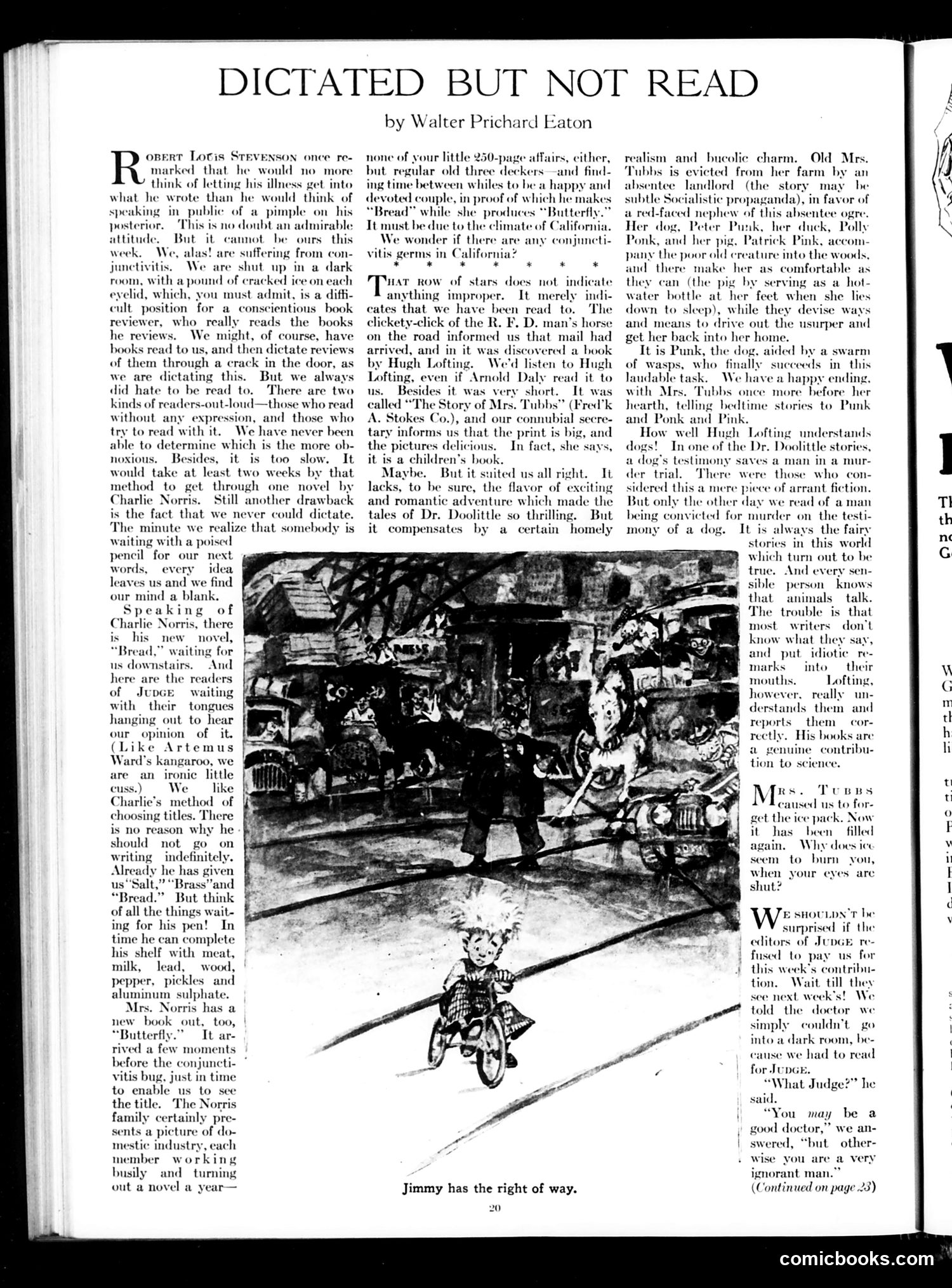
This is Walter Prichard Eaton's humorous column about being incapacitated with conjunctivitis (eye inflammation), forcing him to have books read aloud—which he despises. The irony is that he must dictate his book reviews while unable to read himself. The column reviews two recent novels: Charles Norris's *Bread* and his wife Kathleen Norris's *Butterfly*. Eaton jokes about Norris's habit of naming novels after simple materials ("Salt," "Brass," "Bread") and humorously suggests future titles like "Meat" and "Pickles." He also reviews Hugh Lofting's *The Story of Mrs. Tubbs*, a children's book about an evicted farm woman and her animal companions. The accompanying illustration shows a child on a tricycle with the caption "Jimmy has the right of way"—a contemporary traffic safety message, unrelated to the main article text.
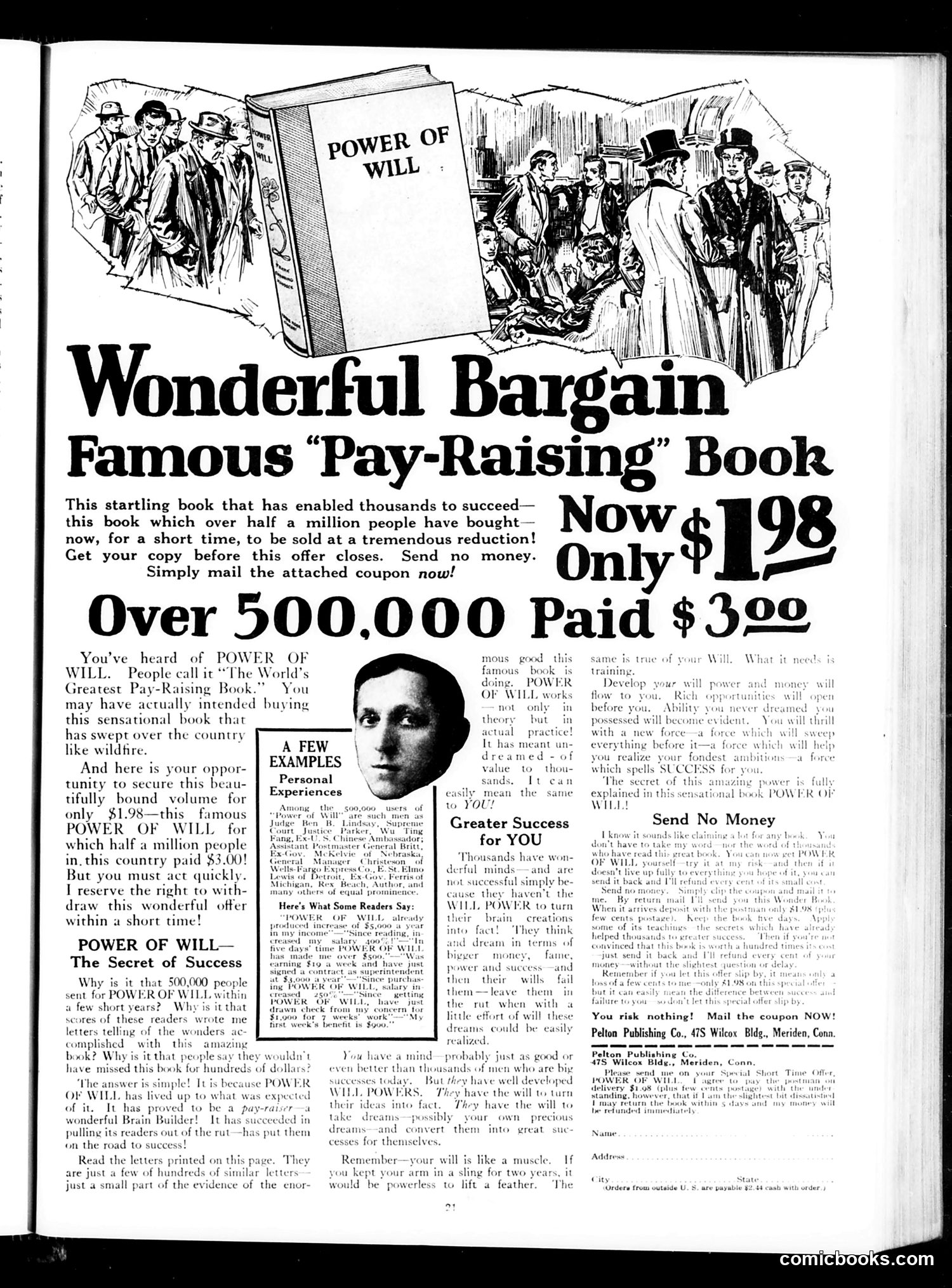
This page is primarily a **mail-order advertisement**, not political satire. It promotes a self-help book titled "Power of Will" claiming to teach readers how to achieve financial and personal success through willpower and mental discipline. The pitch targets working-class readers with promises that 500,000 people have purchased it and achieved "pay raises." The advertisement uses testimonial letters and claims about readers' success as social proof. It offers the book at $1.98 (reduced from $3.00) with "send no money" ordering. The illustrations show men in formal dress and working-class figures, apparently representing the book's diverse customer base and promised outcomes. While not explicitly satirical, the page reflects early-20th-century American optimism about self-improvement through individual will and effort—and the era's active market for such motivational literature.
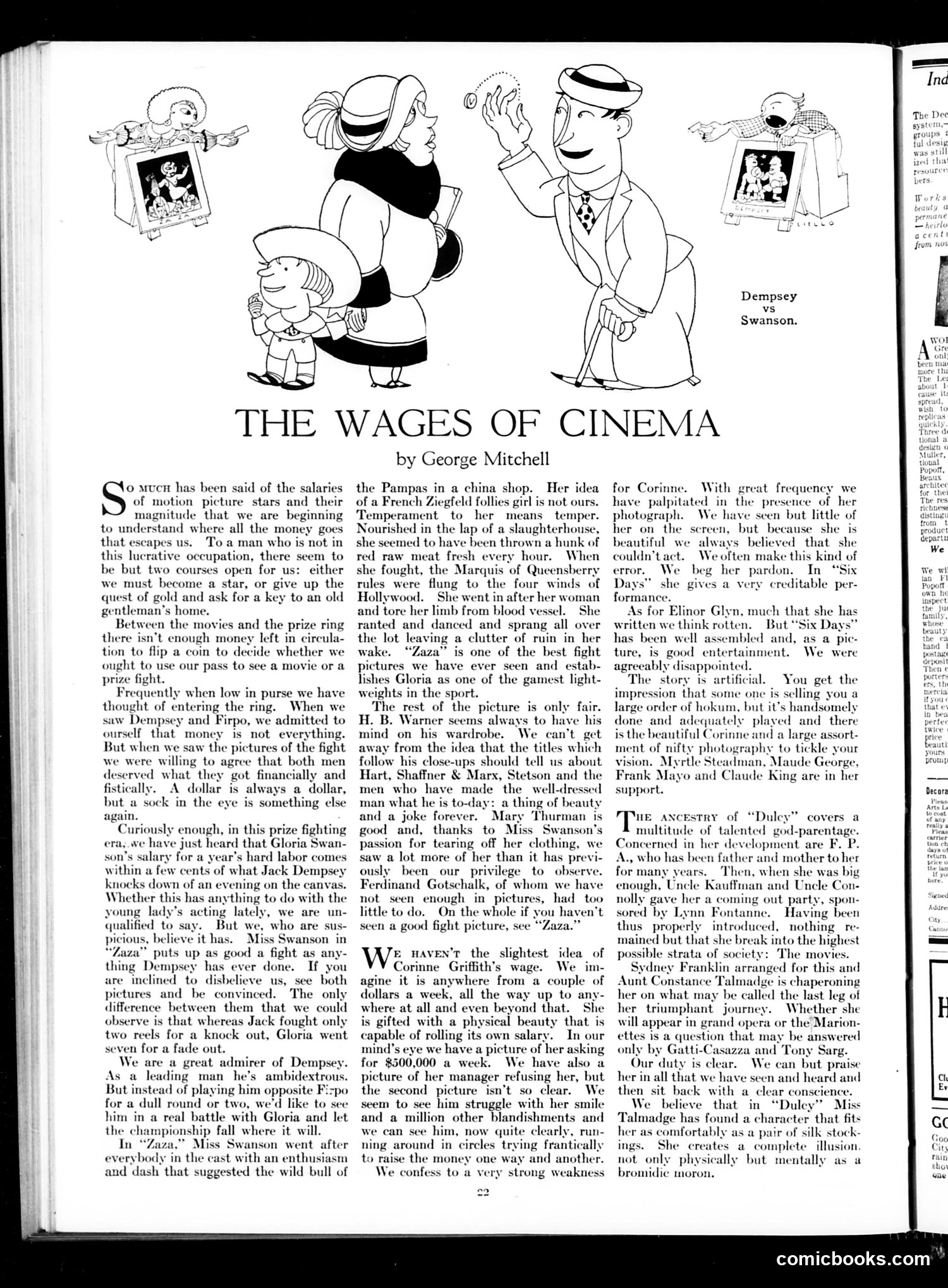
This satirical article compares the astronomical salaries of 1920s movie stars to prize fighters, using Gloria Swanson and Jack Dempsey as examples. The cartoons at top show entertainment figures (likely Dempsey and Swanson) displayed in boxes like commodities. Mitchell's point: both Swanson and Dempsey earn enormous sums, yet the public can barely afford to see either perform. The article mocks Swanson's acting in the film "Zaza," describing her performance as overly aggressive—comparing her dramatic style unfavorably to an actual boxing match. He suggests she fought "seven reels for a fade out" while Dempsey only needed "two reels for a knock out." The satire criticizes both inflated celebrity wages and Swanson's particular acting choices, while expressing bewilderment at how much money flows to entertainers during this era. The "Dempsey vs. Swanson" headline frames their salary comparison as a competition.
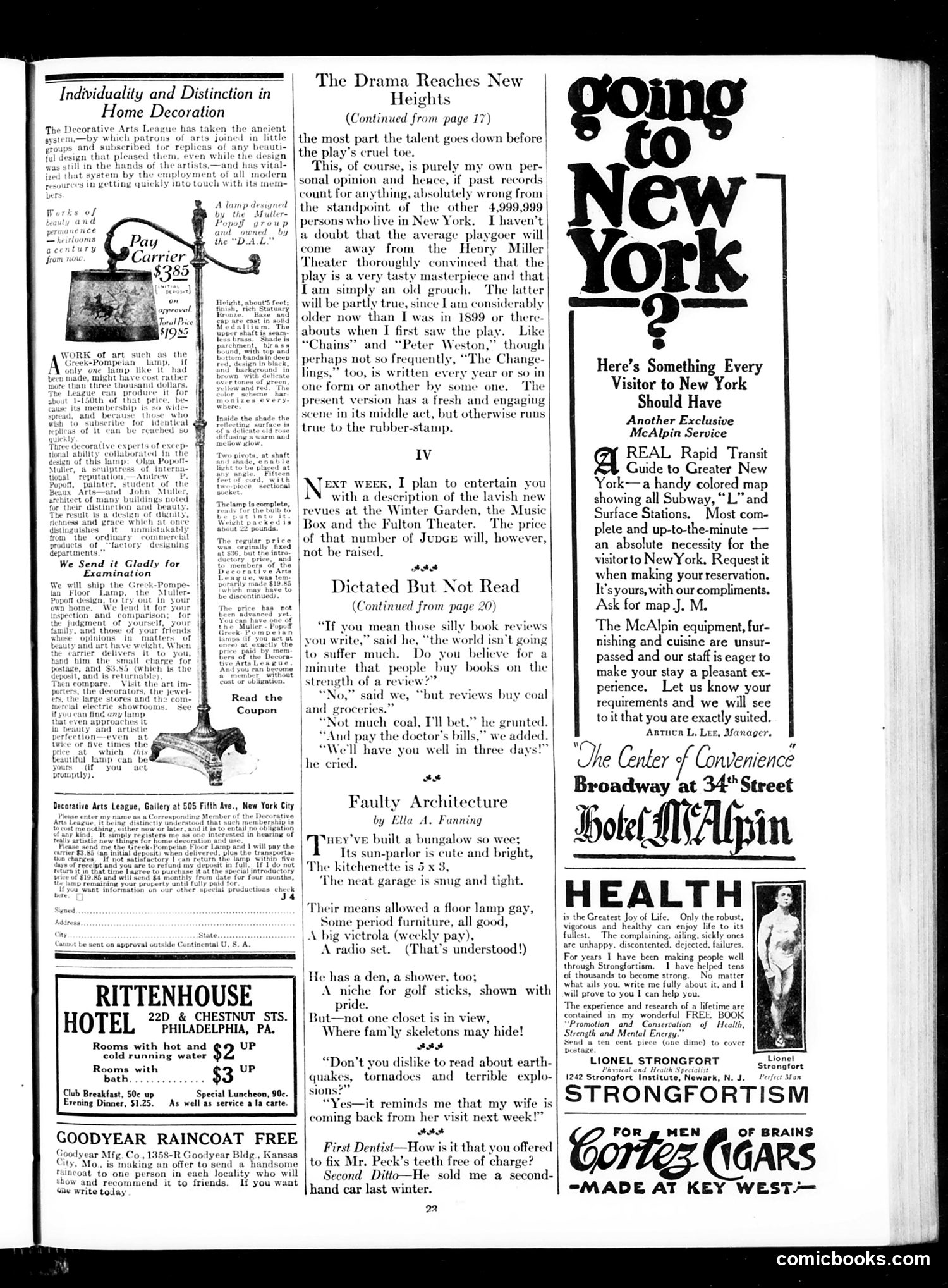
This page is primarily **advertising and miscellaneous content** rather than political satire. The main elements are: **Editorial Content:** - Theater criticism continuing from page 17, discussing a play's mediocre quality - A column titled "Dictated But Not Read" (humorously suggesting the author's reviews don't influence book sales) - A light poem "Faulty Architecture" satirizing modern bungalows with all amenities *except* closets for hiding "family skeletons" (marital secrets) - A two-panel joke about dentistry as revenge **Advertisements:** The page is dominated by ads for hotels (Rittenhouse Hotel, Hotel McAlpin), a Goodyear raincoat offer, Strongfortism (bodybuilding), and Cortez Cigars. **The Cartoons:** There appear to be small illustrations, including what looks like a decorative lamp design and a figure labeled "Pay Carrier," but they're minor design elements rather than substantive political cartoons. The page reflects 1920s consumer culture and light domestic humor rather than serious political commentary.
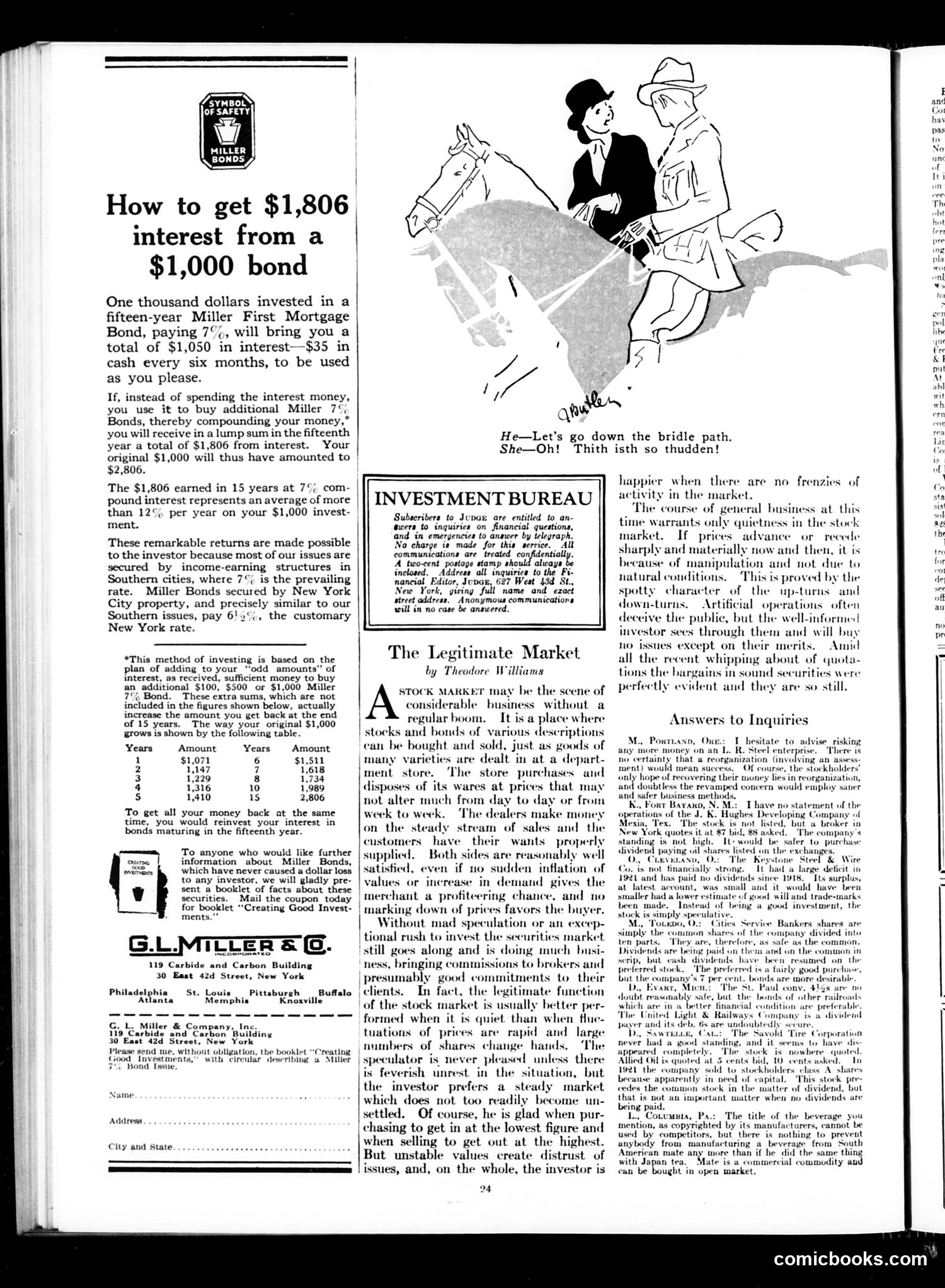
This page is primarily **advertising for Miller Bonds**, a financial investment product. The main cartoon depicts a couple on horseback with the caption "He—Let's go down the bridle path. She—Oh! Thrift isn't so sudden!" The joke suggests that financial prudence and wealth-building are slow, unglamorous processes—contrasting the woman's enthusiasm for a romantic ride with the implied lesson that steady investment is less exciting but worthwhile. The accompanying article promotes Miller First Mortgage Bonds paying 7% interest, claiming that $1,000 invested over 15 years could yield $2,806 total through compound interest. The "Investment Bureau" section answers reader inquiries about securities. The page reflects early-20th-century financial advertising emphasizing compound growth and the virtue of thrift—common themes in Judge's satirical commentary on American economic life and consumer behavior.
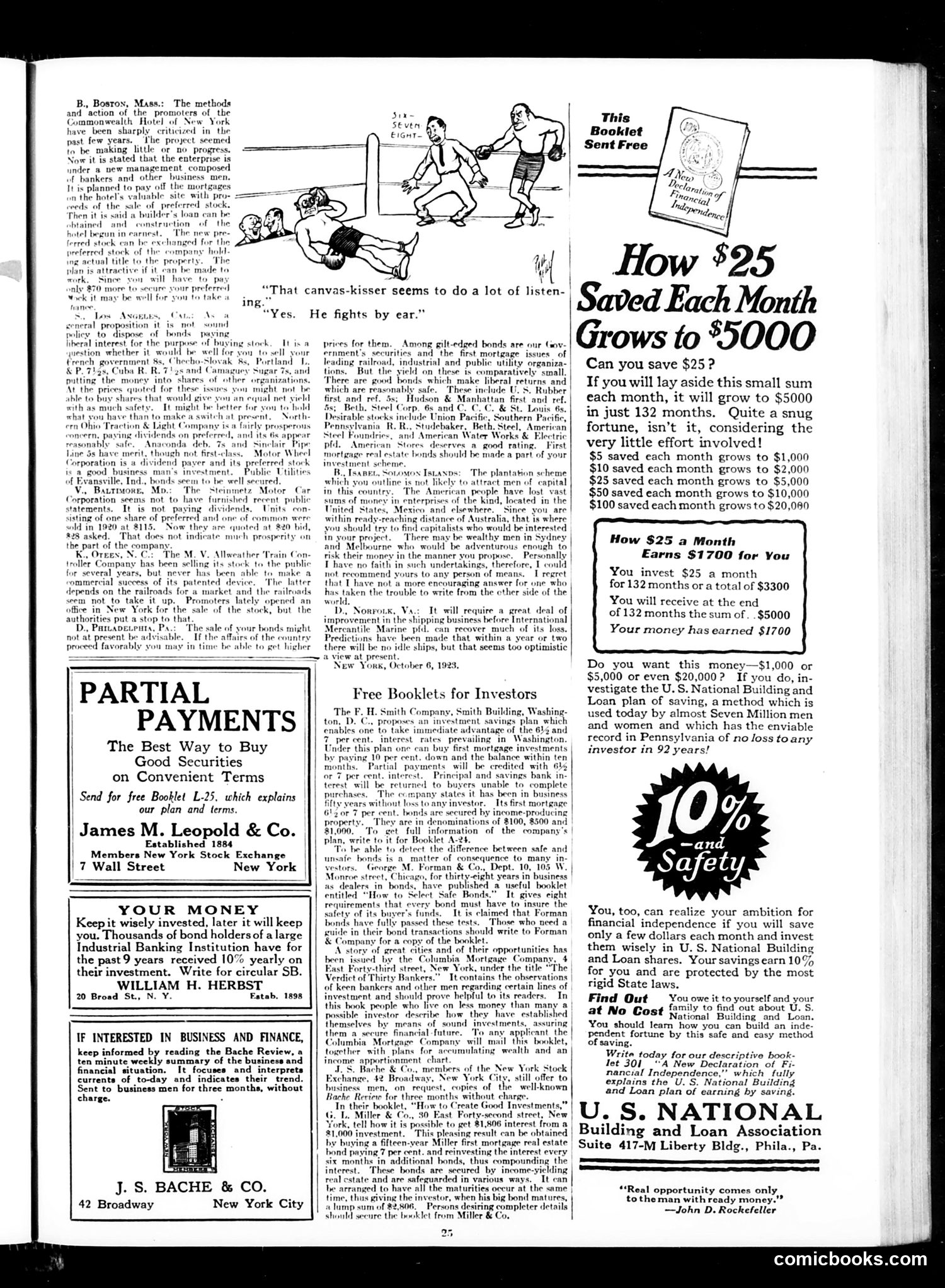
This is primarily a **financial advice and investment advertising page** from Judge magazine, likely from the 1920s. The small cartoon at the top depicts a boxing match and contains the joke: "That canvas-kisser seems to do a lot of listening—Yes. He fights by ear." This is a pun about a boxer who fights "by ear" (instinctively/by sound) rather than by sight. The bulk of the page consists of **investment advice columns** answering readers' questions about stocks, bonds, and real estate schemes—particularly the troubled Commonwealth Hotel project in New York. Financial firms like James M. Leopold & Co. and William H. Herbst advertise their services, promising safe returns (10% yearly) on bonds. The context: this reflects the **pre-1929 investment boom** when average Americans were encouraged to invest their savings in securities. The advice is cautious, warning against speculative ventures and foreign plantation schemes while promoting established industrial bonds and railroad stocks.
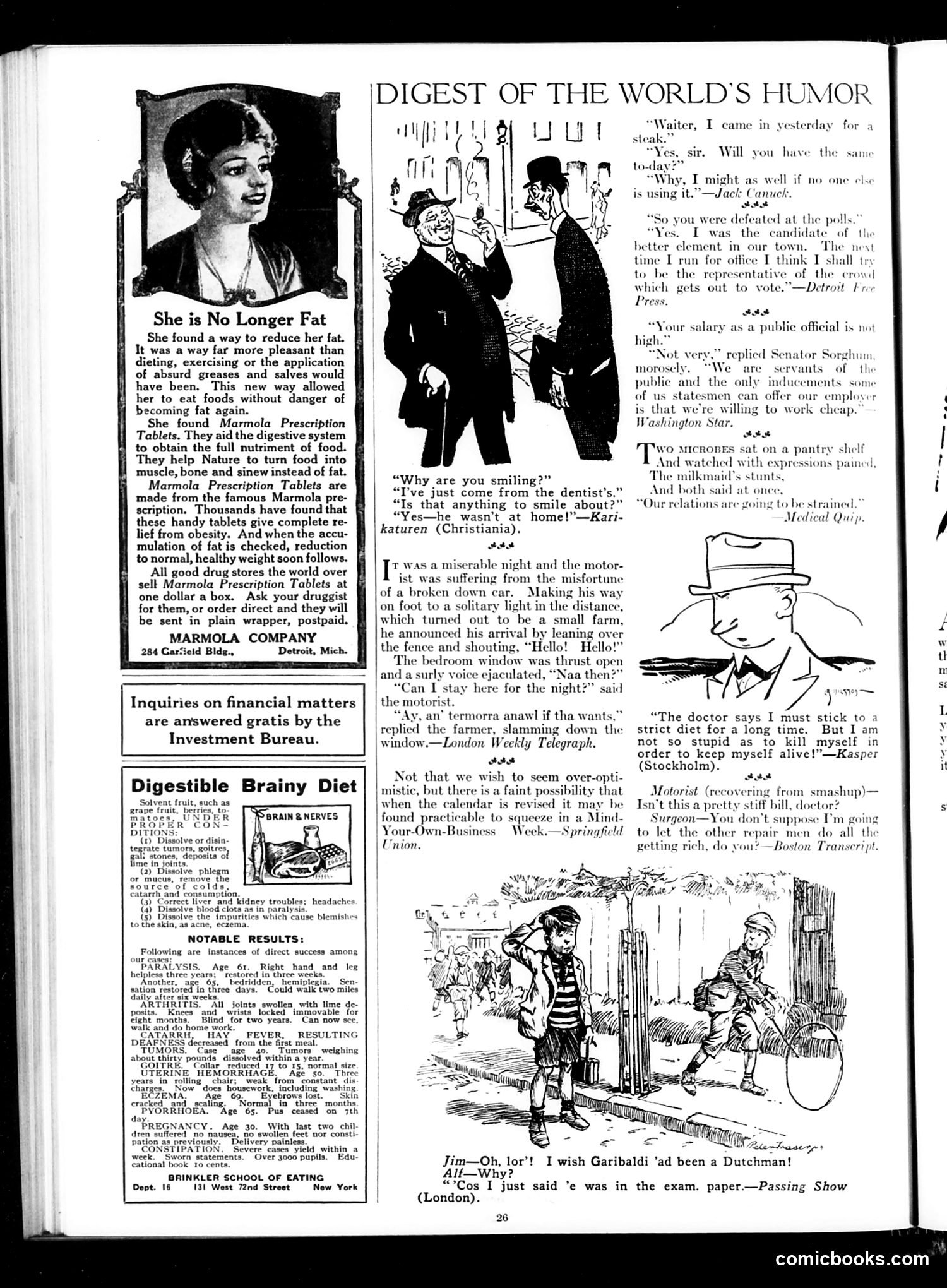
This page from the satirical magazine **Judge** combines advertisements with humorous anecdotes typical of early 20th-century American humor. **Advertisements:** The left side promotes "Marmola Prescription Tablets" for weight loss and a "Digestible Brainy Diet" claiming to cure various ailments—reflecting the era's proliferation of dubious patent medicines and diet schemes marketed without FDA regulation. **Humor Sections:** The right side contains brief jokes and anecdotes: - A dentist joke playing on the relief of finding him absent - A farmer refusing a motorist shelter, suggesting a rustic/working-class character type - Political humor about electoral defeat—the joke being that appealing to the "better element" lost, implying common voters hold actual power - A waiter joke about reusing yesterday's food **Context for modern readers:** These represent period conventions: reliance on unregulated medical quackery, class-based humor stereotyping rural/working people, and cynical commentary on democratic politics. The overall tone is lighthearted rather than biting satire.
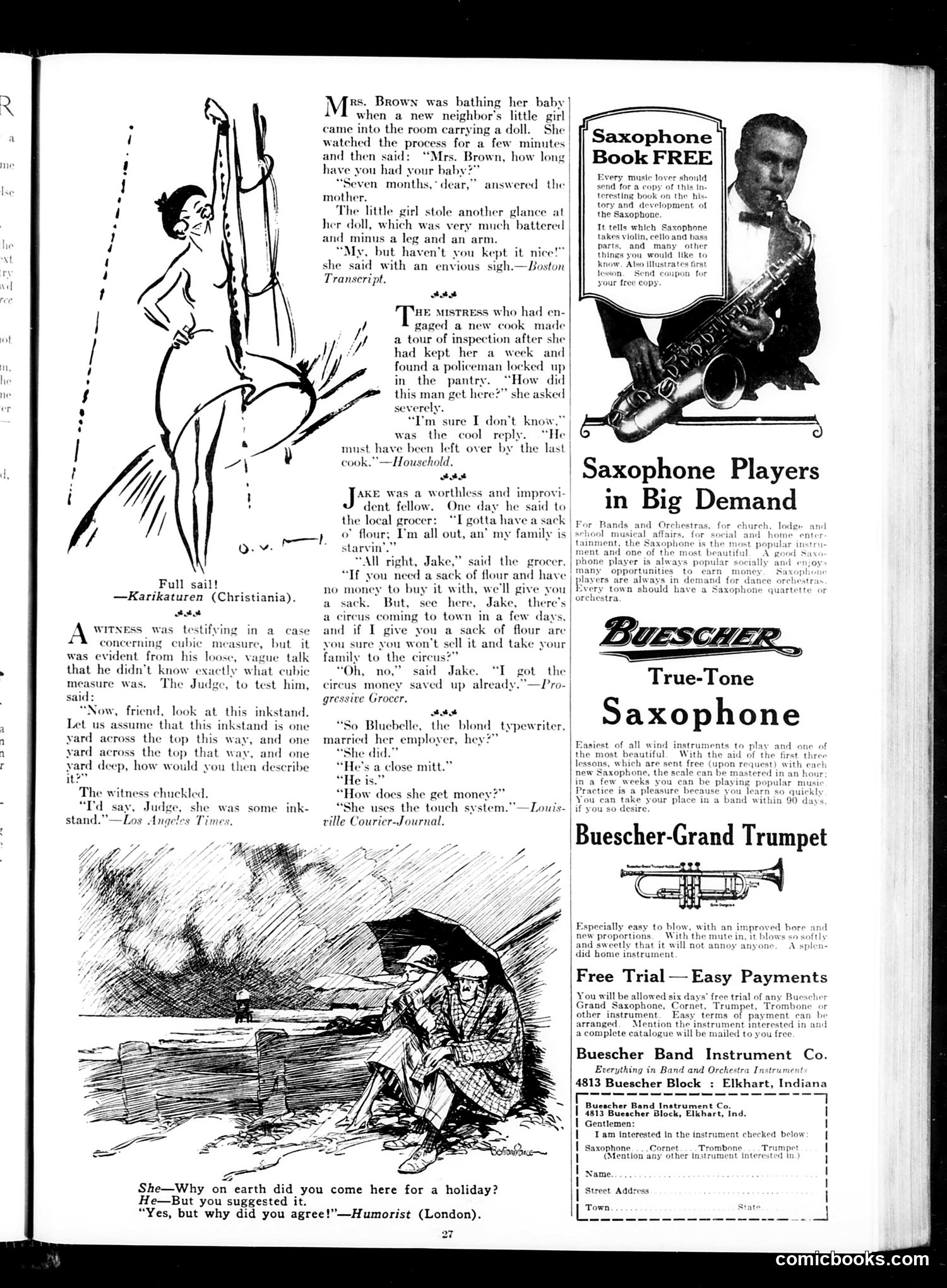
This page combines **humor anecdotes** with **musical instrument advertising**, typical of early 20th-century American magazines. ## The Cartoons/Anecdotes: The sketches illustrate brief humorous stories—a common Judge format. They include domestic comedy (Mrs. Brown's baby versus a worn doll), workplace absurdity (a policeman in the pantry), and immigrant humor (Jake the grocer scene). These represent genteel, family-friendly satire of everyday situations rather than political commentary. The bottom cartoon depicts poverty—a figure in heavy rain—accompanying a London magazine joke about holiday misery, illustrating class-based humor. ## The Advertising: The right side features **Buescher Band Instruments**—saxophone and trumpet ads targeting amateur musicians. The "Saxophone Players in Big Demand" pitch reflects the 1920s jazz era boom, when saxophones became newly popular in American culture. **Overall context:** This page shows Judge balancing traditional domestic humor anecdotes with advertisements capitalizing on contemporary musical trends—nothing deeply political, primarily entertainment and commerce for middle-class readers.
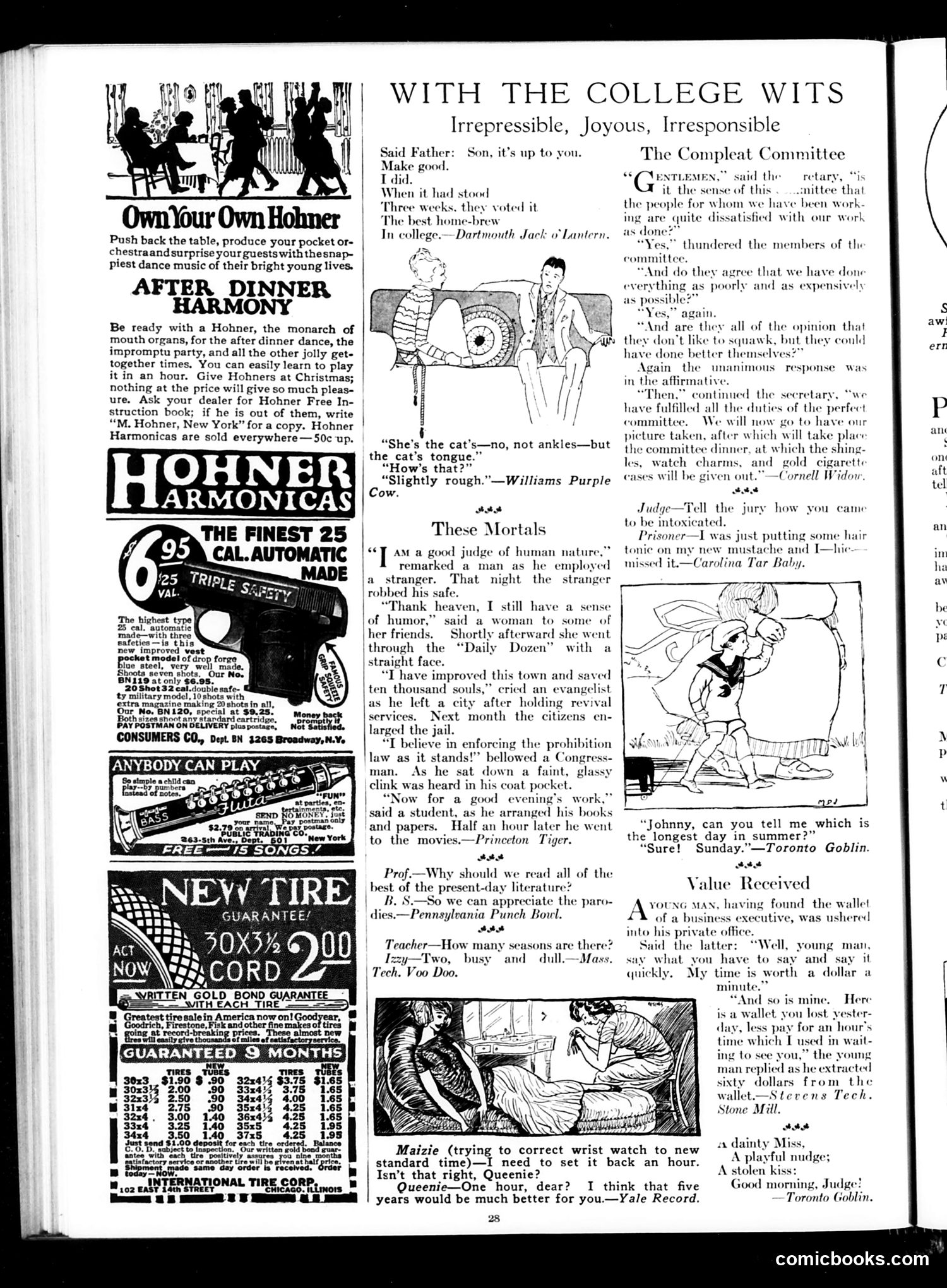
This page from *Judge* magazine (a satirical publication) contains primarily **humorous college-themed jokes and advertisements** rather than political cartoons. The "College Wits" section features brief comic anecdotes satirizing student hypocrisy and adult pretension. Examples include: - A student who claims to be a "good judge of human nature" but gets robbed by someone he hired - A congressman loudly supporting Prohibition while a liquor bottle clinks in his pocket - Committee members admitting they've done everything "as poorly and as expensively as possible" yet plan a celebratory dinner with expensive gifts These jokes mock **the gap between stated principles and actual behavior**—a common satirical target. The humor relies on readers recognizing the irony of hypocrites being caught red-handed. The page also includes vintage advertisements (Hohner harmonicas, tires, firearms) typical of 1920s magazines. **No specific political figures or events are referenced**—the satire targets universal human weaknesses rather than contemporary politics.
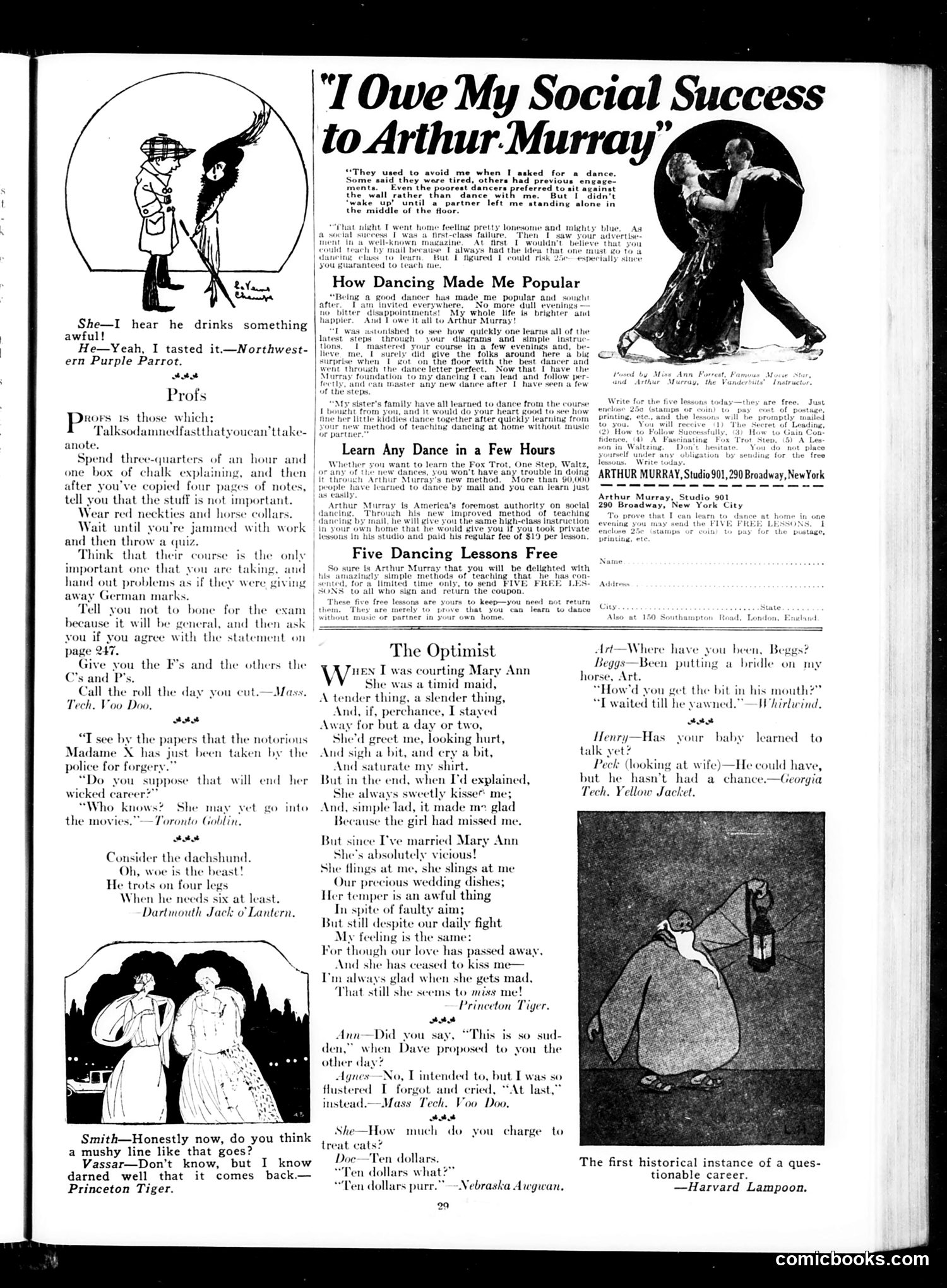
This page contains advertisements and humor columns typical of Judge magazine. The dominant content is an **Arthur Murray dancing school advertisement** featuring testimonials about social success through dance lessons—a relevant pitch for 1920s-30s audiences when dance was a primary social activity. The cartoons are college humor reprints (from *Mass. Tech*, *Princeton Tiger*, etc.) featuring: - **Jokes about professorial incompetence** (speaking too fast, assigning busywork, unfair grading) - **"The Optimist"**: A poem about a man whose wife now fights with him constantly after marriage, yet he's glad she still seems to care enough to be angry—dark romantic humor - **"Consider the dachshund"**: Wordplay on the breed's short legs - **Minor puns** about a veterinarian ("ten dollars purr") The bottom illustration appears to show a woman in a questionable profession, captioned as "the first historical instance of a questionable career"—likely a period joke about women's changing social roles. The overall tone is lighthearted collegiate satire with no evident political content.
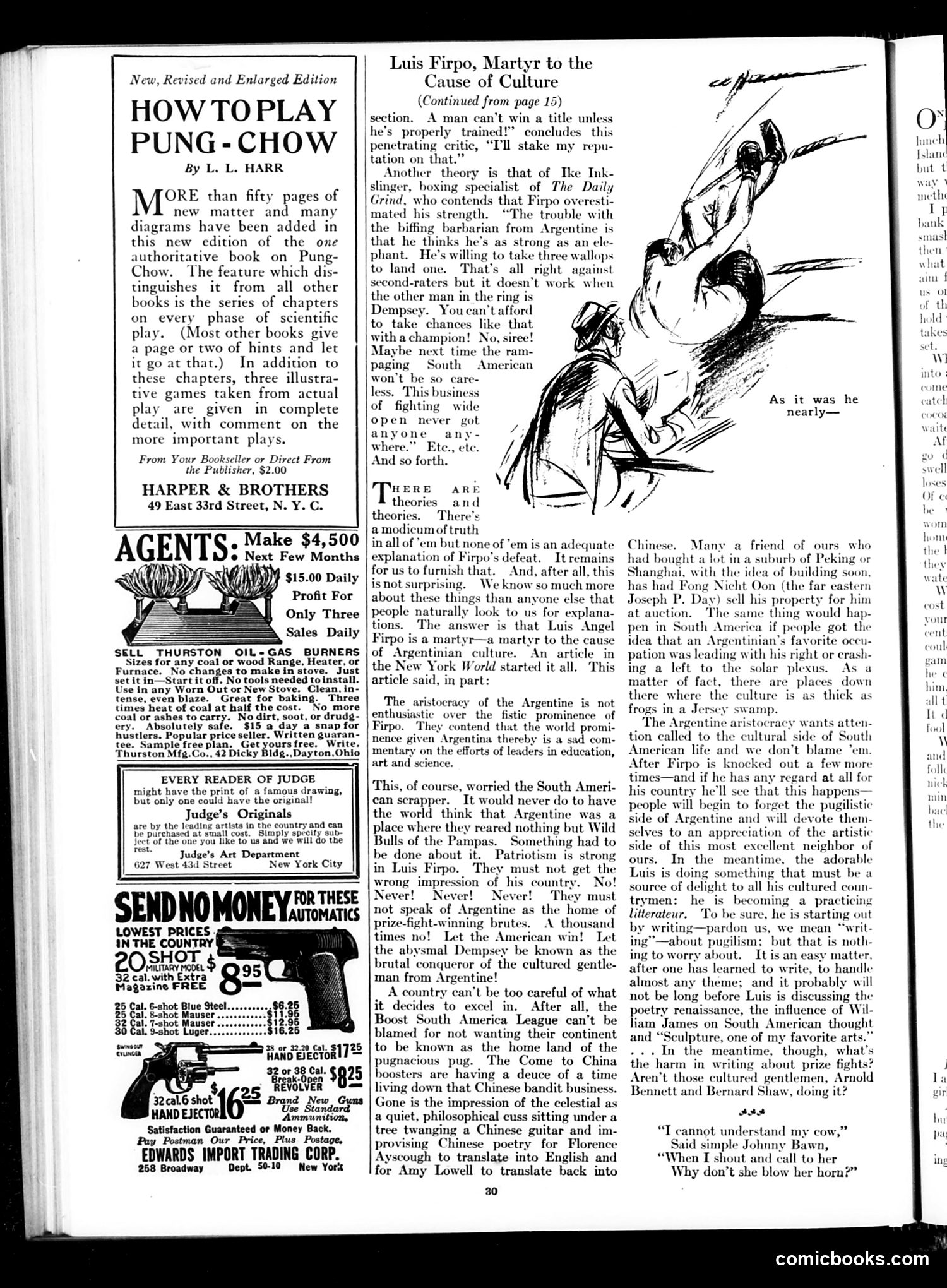
This satirical article mocks Argentine boxer Luis Firpo's recent defeat (likely to Jack Dempsey). The piece ridicules various sportswriters' explanations for his loss, then reveals the "true" reason: Firpo fought to restore Argentina's cultural prestige. The satire works on multiple levels. Argentine intellectuals reportedly complained that Firpo's prominence represented their nation poorly—that boxing success overshadowed achievements in education and art. Firpo, the article suggests, became obsessed with proving Argentina's worth through victory, making him reckless rather than strategic. The cartoon (showing a boxer being knocked down) illustrates this theme. The joke is that Firpo became a tragic figure—a "martyr"—sacrificed to national vanity. The piece gently mocks both Argentine cultural anxiety and American sportswriters' pseudo-intellectual analyses of boxing, suggesting everyone missed the real psychological motivation driving the fighter's defeat.
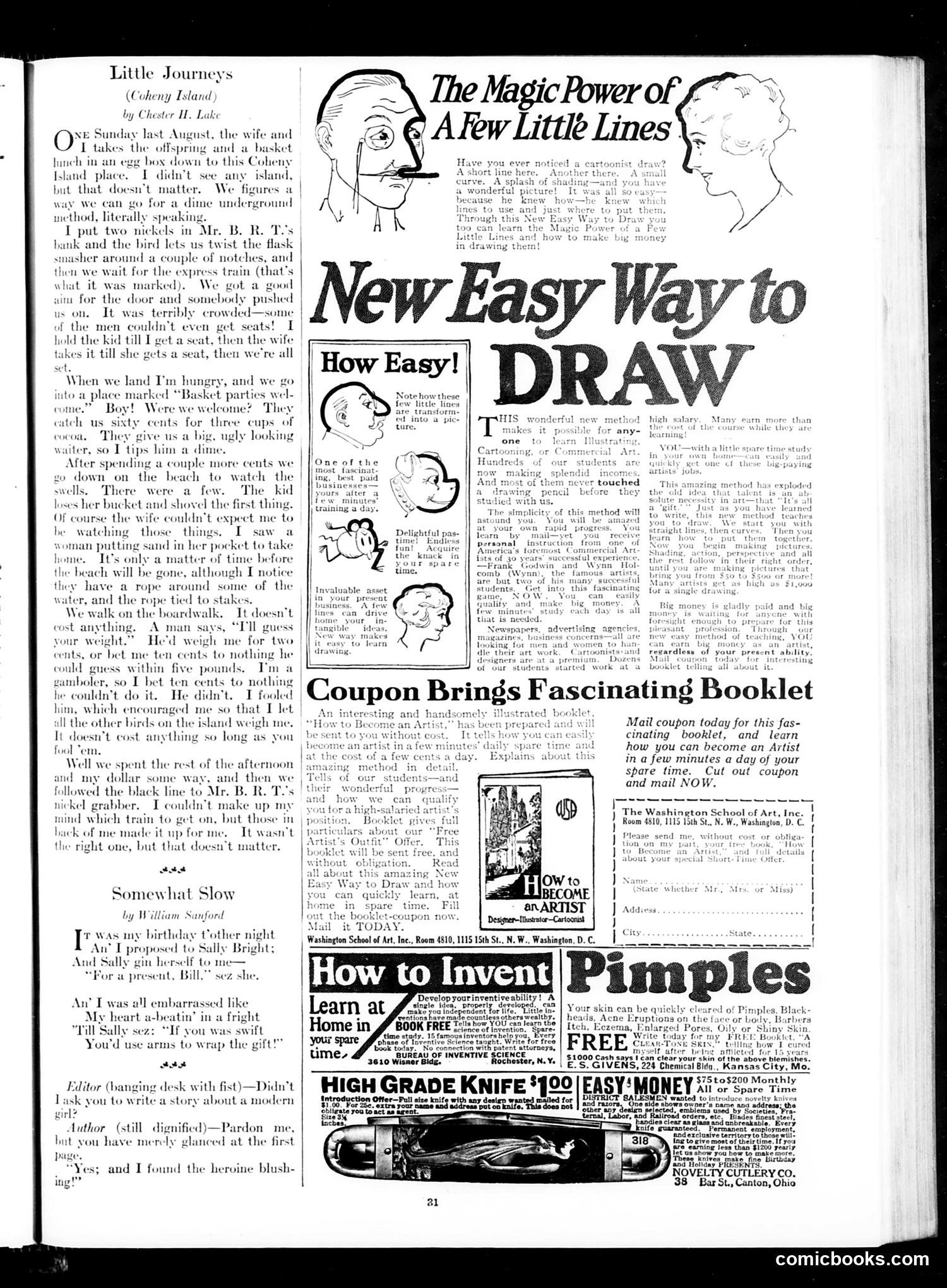
This page is primarily **advertising and miscellaneous content** rather than political cartoons. The main elements include: **"Little Journeys" (Coney Island)** by Chester H. Lake is a humorous personal essay about a crowded day trip to Coney Island—describing subway crowds, overpriced refreshments, and boardwalk hustlers. It's social commentary on commercialized leisure, not political satire. **"The Magic Power of a Few Little Lines"** is an instructional article promoting a drawing correspondence course. **Multiple advertisements** dominate the lower half: drawing courses, knife sales, pimple remedies, and "inventive ability" courses. **Minor verse content** ("Somewhat Slow" by William Sanford) describes a marriage proposal. The page contains **no identifiable political figures or satirical commentary**. It reflects 1920s-era consumer culture through its heavy advertising and lightweight humor about everyday middle-class experiences. The satire, such as it is, targets generic commercial exploitation (weight-guessing games, overpriced food) rather than specific political targets.
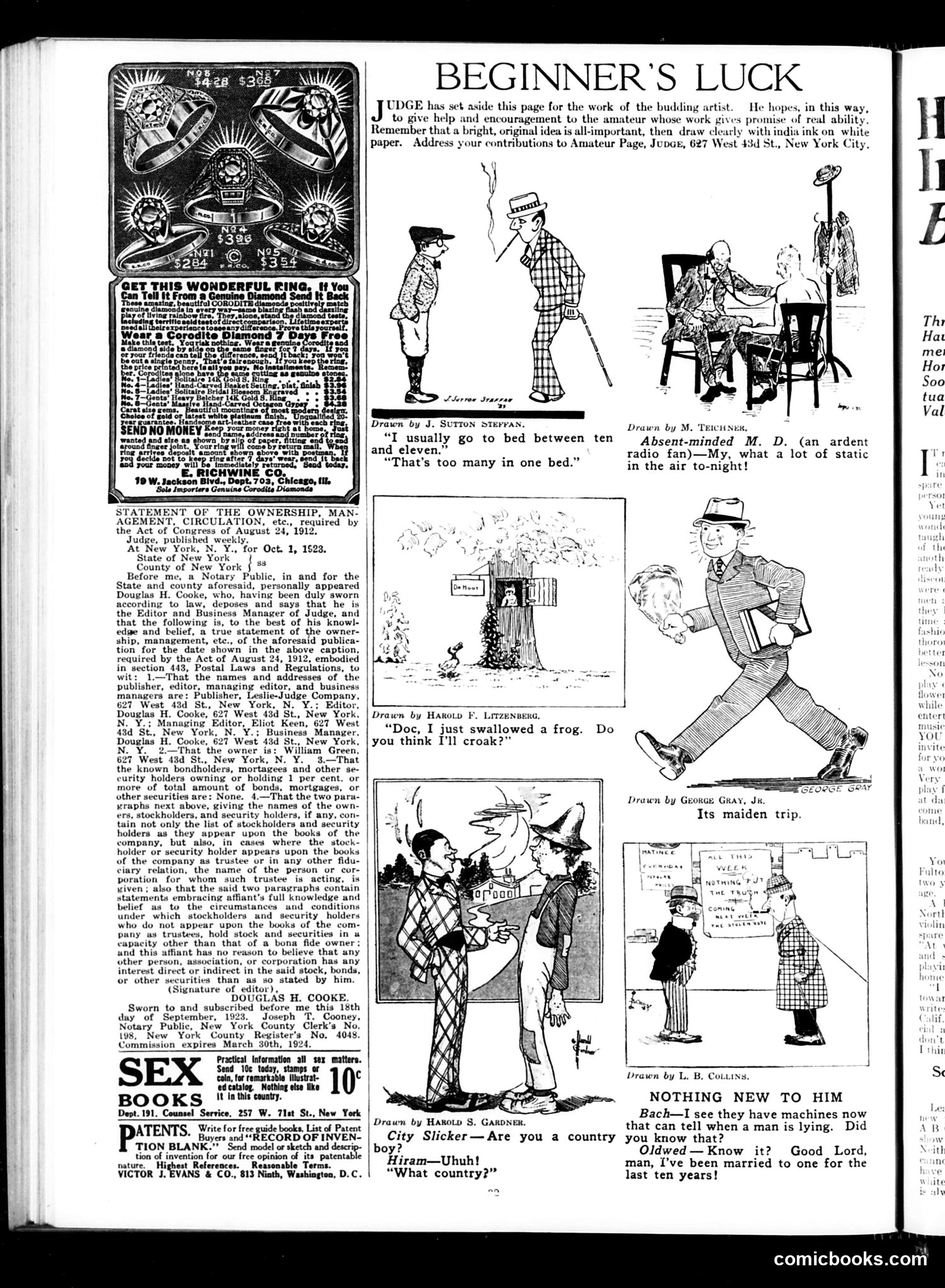
This page showcases amateur cartoons submitted to *Judge* magazine's "Beginner's Luck" section, which solicited work from aspiring artists showing promise. The comics present simple domestic humor typical of 1920s popular entertainment: 1. **J. Sutton Stevan's cartoon** depicts a couple discussing sleeping arrangements—a joke about overcrowded beds. 2. **M. Teichner's cartoon** shows an absent-minded doctor (radio fan) experiencing static interference during a radio broadcast. 3. **Harold F. Littenberg's cartoon** features a man who swallowed a frog joking about croaking—a pun-based gag. 4. **Harold S. Gardener's cartoon** shows a city slicker asking a country boy about his nationality, appearing to misunderstand. 5. **L. B. Collins' cartoon** titled "Nothing New to Him" features dialogue about detecting lies through machines—likely referencing emerging lie-detector technology. The cartoons emphasize wordplay, domestic situations, and emerging technologies, representing accessible humor for general audiences. The page also includes publication ownership statements and advertisements for books and patent services.
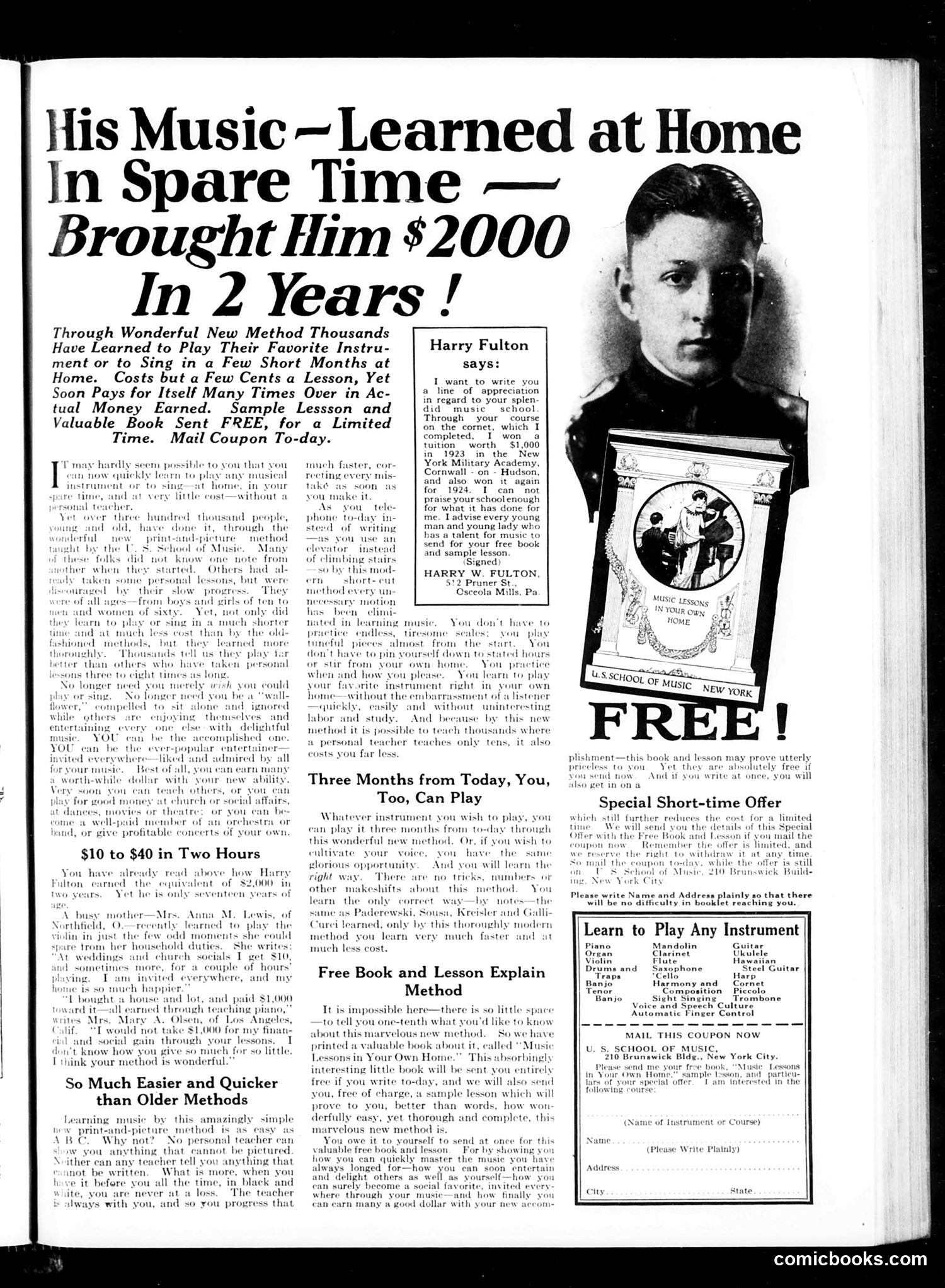
This page is primarily **advertising, not satire or political commentary**. It's a full-page advertisement for the U.S. School of Music's correspondence course in music instruction. The content features testimonials from students (Harry Fulton, Mrs. Anna M. Lewis, Mrs. Mary A. Olsen) claiming they learned instruments quickly at home and earned significant money—up to $2,000 in two years. The advertisement emphasizes the superiority of their "print-and-picture method" over traditional in-person lessons. For modern context: This reflects early 20th-century direct-mail marketing before radio/TV advertising dominated. The claims—learn instruments in months, earn substantial income quickly—are typical of mail-order product advertising of that era, employing testimonials and urgency ("limited time offer"). The page also includes a coupon for a free lesson book, a standard promotional technique of the period. This is not satirical commentary but rather a commercial appeal.
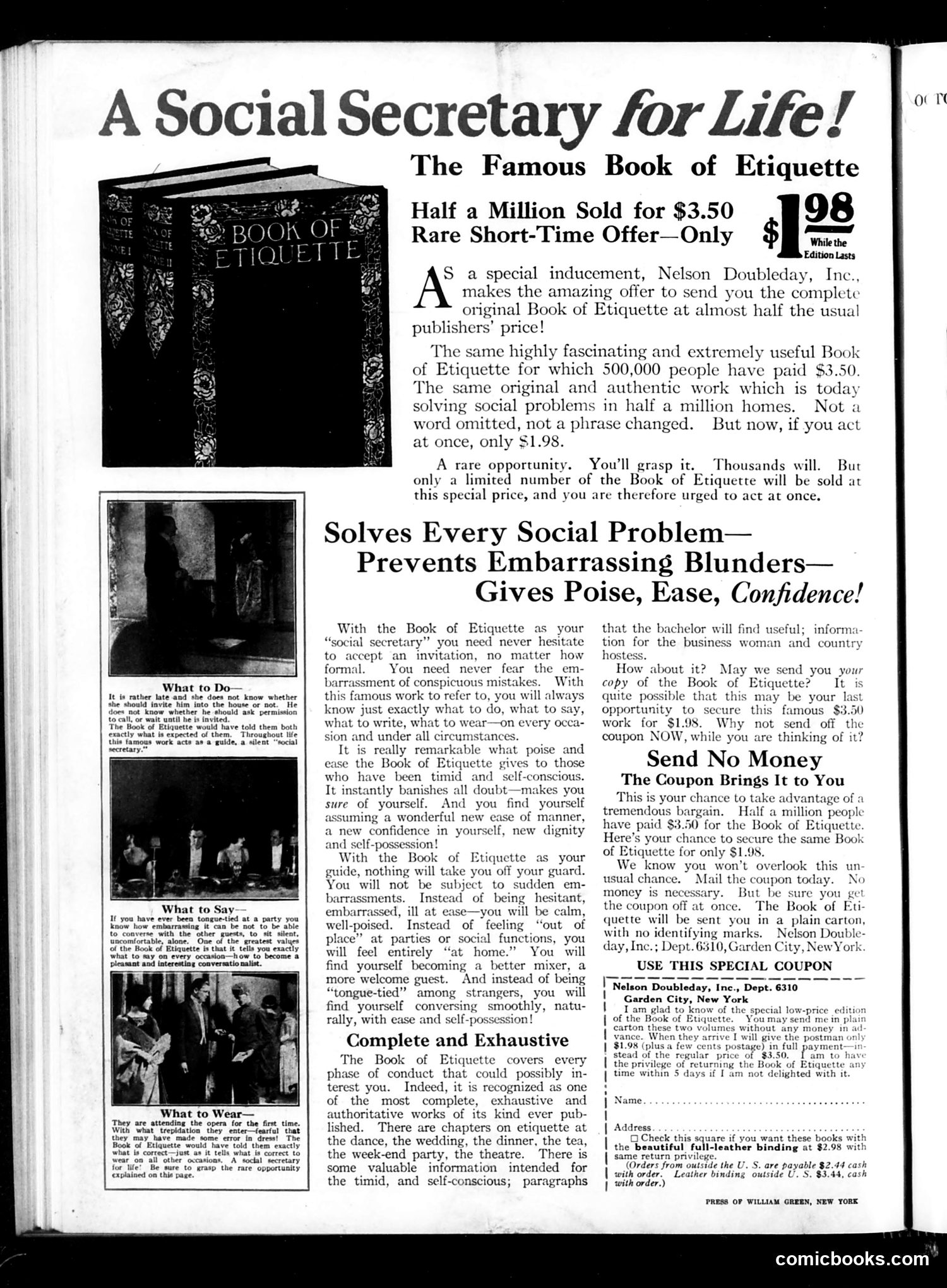
This page is primarily **advertising**, not a political cartoon. It promotes Nelson Doubleday's *Book of Etiquette* at a discounted price ($1.98 instead of $3.50). The accompanying illustrations show relatable social anxieties of the era: a young couple uncertain about courtship protocol ("What to Do"), guests tongue-tied at parties ("What to Say"), and people worried about wearing the wrong outfit to formal events ("What to Wear"). The satire is gentle—the book sells itself by highlighting common embarrassments and social insecurities. The appeal is that etiquette knowledge provides confidence and poise in uncertain situations. This reflects early-20th-century American aspirations toward refinement and proper conduct, particularly among the middle class navigating an increasingly formal social landscape. The marketing angle emphasizes that 500,000 copies have sold at full price, creating urgency to purchase before this "limited" discounted offer expires.