
Judge, 1923-10-13 · page 21 of 36
Judge — October 13, 1923 — page 21: what you’re looking at
What you’re looking at
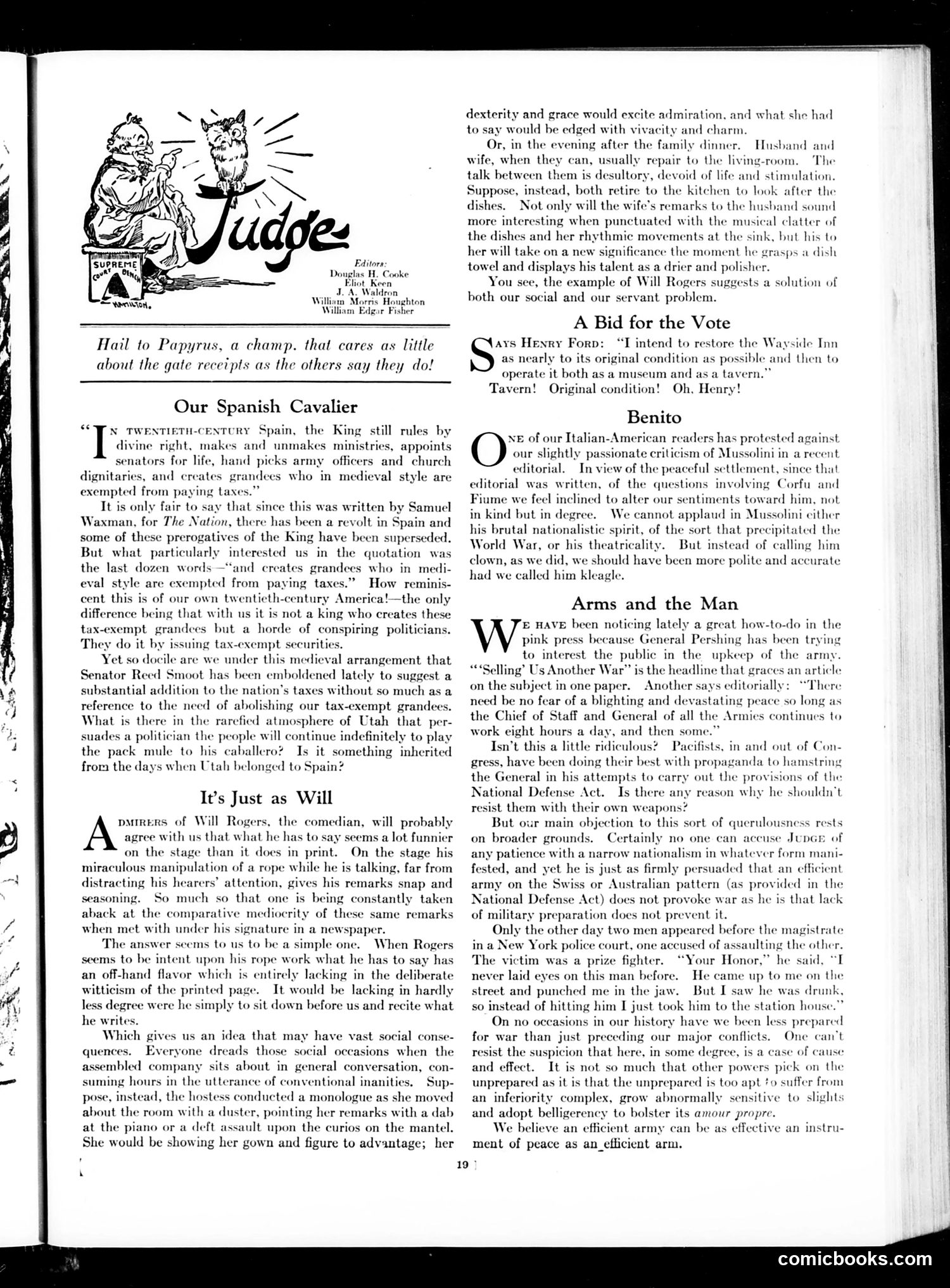
The page features three distinct pieces of satire: **"Our Spanish Cavalier"** critiques tax-exempt securities issued by American politicians. Drawing a parallel to medieval Spain's king-granted exemptions, it attacks Senator Reed Smoot's proposal to raise taxes without eliminating tax-exempt bonds—essentially creating a modern "aristocracy" of privileged investors. The satire asks why Americans tolerate this medieval arrangement. **"It's Just as Will"** humorously argues that Will Rogers—the famous comedian-philosopher—seems funnier performing with his rope tricks on stage than reading his printed observations. The author suggests that adding physical activity to conversation (mimicking Rogers's stage manner) would enliven dull domestic exchanges between spouses and solve both social tedium and servant-hiring problems. **The Judge masthead illustration** shows the magazine's mascot with comedic energy. The page reflects 1920s-era concerns: wealth inequality through financial instruments, and the cultural prominence of Will Rogers as entertainment and social commentator.
📄 Transcribed text from this page (OCR, searchable)
Machine-transcribed from the original scan — historical spelling and the odd misread are preserved.
Editors ot Ki aldron Morris Houghton 7 William Edgar F Hail to Papyrus, a champ. that cares as little about the gate receipts as the others say they do! Our Spanish Cavalier ©FN twestiern-centery Spain, the King still rules by divine right, makes and unmakes ministries, appoints senators for life, hand picks army officers and church dignitaries, and creates grandces who in medieval style are exempted from paying taxes.” a It is only fair to say that since this was written by Samuel Waxman, for The Nation, there has been a revolt in Spain and some of these prerogatives of the King have been superseded, But what particularly interested us in the quotation was the last dozen words eval st “and creates grandees who in medi- le are exempted from paying ta How reminis- cent this is of our own twentieth-century America!—the only difference being that with us it is not a king who creates the tax-exempt grandees but a horde of conspiring politicians. They do it by issuing tax-exempt securiti Yet so docile are we under this medieval arrangement that Senator Reed Smoot has been emboldened lately to suggest a substantial addition to the nation’s taxes without so much as a reference to the need of abolishing our tax-exempt grandees. What is there in the areficd atmosphere of Utah that per- suades a polit n the people will continue indefinitely to play the pack mule to his caballero? Is it something inherited from the days when Utah belonged to Spain? It’s Just as Will parrers of Will Rogers, the comedian, will probably A agree with us that what he has to say seems a lot funnier on the stage than it does in print. On the stage his miraculous manipulation of a rope while he is talking, far from distracting his hearers’ attention, gives his remarks snap and seasoning. So much so that one is being constantly taken aback at the comparative mediocrity of these same remarks when met with under his signature in a newspaper. The simple one. When Rogers seems to be intent upon his rope work what he has to say has an off-hand flavor which is entirely lacking in the deliberate witticism of the printed page. It would be lacking in hardly less degree were he simply to sit down before us and recite what he writ Which gives us an idea that may have quences. E iswer seems to us to be cial conse- 1 occasions when the assembled company sits about in general conversation, con- suming hours in the utterance of conventional inanit yone dreads those s¢ Sup- pose, instead, the hostess conducted a monologue as she moved about the room with a duster, pointing her remarks with a dab at the piano or a deft assault upon the curios on the mantel. She would be showing her gown and figure to advantage; her dexterity and grace would excite admiration, and what she had to say would be edged with vivacity and charm. Or, in the evening after the family dinner. Husband and wife, when they can, usually repair to the living-room. The talk between them is desultory, devoid of life and stimulation. Suppose, instead, both retire to the kitchen to look after the dishes. Not only will the wife’s remarks to the husband sound more interesting when punctuated with the musical clatter of the dishes and her rhythmic movements at the sink, but his to her will take on a new significance the moment he grasps a dish towel and displays his talent as a drier and polisher. You see, the example of Will Rogers suggests a solution of both our social and our servant problem. A Bid for the Vote ays Henry Forp: “I intend to restore the Wayside Inn rly to its original condition as possible and then to ¢ it both as a museum and as a tavern.” Original condition! Oh, Henry! Benito NE of our Italian-American readers has protested against our slightly passionate criticism of Mussolini in a recent editori In view of the peaceful settlement, since that editorial written, of the questions involving Corfu and Fiume we feel inclined to alter our sentiments toward him, not in kind but in degree. We cannot applaud in Mussolini either his brutal nationalistic spirit, of the sort that precipitated the World War, or his theatricality. But instead of calling him clown, as we did, we should have been more polite and accurate had we called him kleagle. Arms and the Man E HAVE been noticing lately a great how-to-do in the V V pink press bec al Pershing has been trying to interest the public in the upkeep of the army. “Selling’ Us Another War” is the headline that graces an < on the subject in one paper. Another says editor: need be no fear of a blighting and devastating peace so long as the Chief of Staff and General of all the Armies continues to work eight hours a day, and then some.” Isn’t this a little ridiculous? Pacifists, in and out of Con- gress, have been doing their best with propaganda to hamstriv the General in his attempts to carry out the provisions of the National Defense Act. Is there any reason why he shouldn't resist them with their own weapons? But our main objection to this sort of querulousness rests on broader grounds. Certainly no one can accuse JupcE of any patience with a narrow nationalism in whatever form mani- fested, and yet he is just as firmly persuaded that an efficient on the Swiss or Australian pattern (as provided in the National Defense Act) does not provoke war as he is that lack of military preparation does not prevent it. Only the other day two men appeared before the magistrate in a New York police court, one accused of assaulting the other. The victim a prize fighter. never laid eyes on this man before. He came up to me on the street and punched me in the jaw. But I saw he was drunk, so instead of hitting him I just took him to the station house.” On no occasions in our history have we been less prepared for war than just preceding our major conflicts. One can’t resist the suspicion that here, in some degree, is a case of cause and effect. It is not so much that other powers pick on the unprepared as it is that the unpre] an inferiority complex, grow abnormally sensitive to. slights and adopt belligerency to bolster its amour propre. We believe an efficient army can be as effective an instru- ment of peace as an_efficient arm. Your Honor,” he said, ed is too apt fo suffer from comicbooks.com