
Judge, 1923-10-13 · page 26 of 36
Judge — October 13, 1923 — page 26: what you’re looking at
What you’re looking at
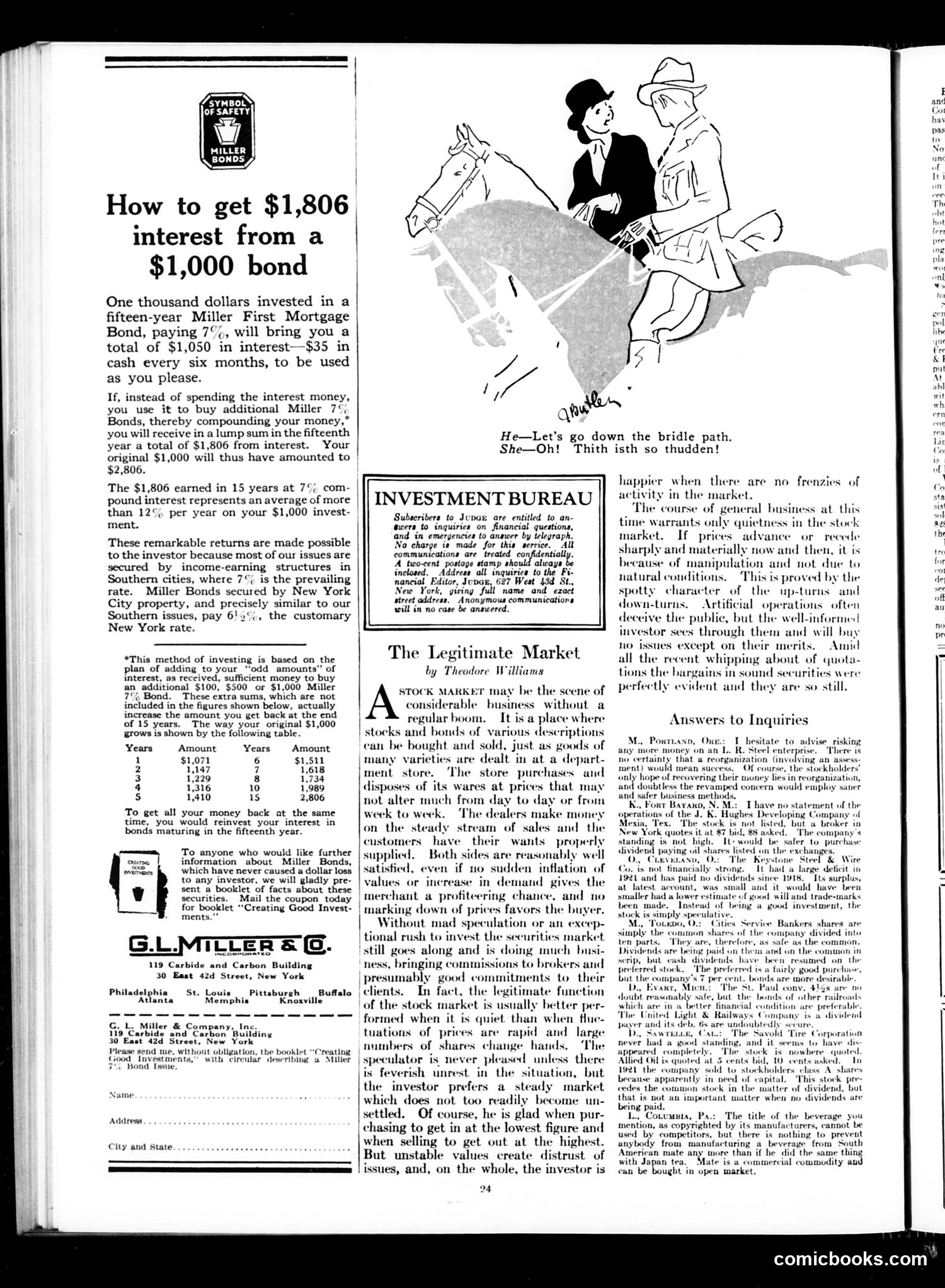
This page is primarily **advertising for Miller Bonds**, a financial investment product. The main cartoon depicts a couple on horseback with the caption "He—Let's go down the bridle path. She—Oh! Thrift isn't so sudden!" The joke suggests that financial prudence and wealth-building are slow, unglamorous processes—contrasting the woman's enthusiasm for a romantic ride with the implied lesson that steady investment is less exciting but worthwhile. The accompanying article promotes Miller First Mortgage Bonds paying 7% interest, claiming that $1,000 invested over 15 years could yield $2,806 total through compound interest. The "Investment Bureau" section answers reader inquiries about securities. The page reflects early-20th-century financial advertising emphasizing compound growth and the virtue of thrift—common themes in Judge's satirical commentary on American economic life and consumer behavior.
📄 Transcribed text from this page (OCR, searchable)
Machine-transcribed from the original scan — historical spelling and the odd misread are preserved.
MILLER \ BONDS 7 How to get $1,806 interest from a $1,000 bond One thousand dollars invested in a fifteen-year Miller First Mortgage Bond, paying 7°%, will bring you a total of $1,050 in interest—$35 in cash every six months, to be used as you please. If, instead of spending the interest money, you use it to buy additional Miller 7% Bonds, thereby compounding your money," you will receive in a lump sum in the fifteenth year a total of $1,806 from interest. Your original $1,000 will thus have amounted to $2,806. The $1,806 earned in 15 years at 7; com- pound interest represents an average of more than 12% per year on your $1,000 invest- ment. These remarkable returns are made possible to the investor because most of our issues are secured by income-earning structures in Southern cities, where 7% is the prevailing rate. Miller Bonds secured by New York City property, and precisely similar to our Southern issues, pay 6!»‘;, the customary New York rate. *This method of investing is based on the plan of adding to your “odd amounts” of interest, as received, sufficient money to buy an additional $100, $500 or $1,000 Miller 7% Bond. These extra sums, which are not included in the figures shown below, actually increase the amount you get back at the end of 15 years. The way your original $1,000 ‘grows is shown by the following table. Years Amount Years Amount 1 6 $1,511 2 7 1,618 3 12 8 1,734 4 10 1,989 5 15 2,806 To get all your money back at the same time, you would reinvest your interest in bonds maturing in the fifteenth year. To anyone who would like further information about Miller Bonds, which have never caused a dollar loss to any investor, we will gladly pre- sent a booklet of facts about these | securities. Mail the coupon. toda: for booklet “Creating Good Invest- ments.” G.L. 119 Carbide and Carbon Building 30 East 42d Street, New York TILLER & GC. St. Louie Pittsburgh Buffalo Memphi . Atlanta Knoxville Miller & Company, Inc. N19 Carbide and Carbon Building 30 East 42d Street, New York ithout obligation, nts, oklet “Creating with circular deseribing Miller City and State. | ment He—Let's go down the bridle path. She—Oh! INVESTMENT BUREAU Subscribers to Jvvax are entitled to an- tera to inguirics on financial questions, Gnd in emergencies to anawer by telegraph. No charge is made for this service. All Communications are ‘trealed conf A tiwo-cent postage stamp shor always incloued. | Addregs all inguirice tothe F nancial Editor, Jopax, 627 West 43d 5 7 ‘Anonymous communications will in no case be answered. The Legitimate Market by Theodore Williams TOCK MARKET may be the scene of considerable business without a regular boom. — It is a place where stocks and bonds of various descriptions can be bought and sold, just as goods of varieties are dealt in at a depart- store. ‘The store purchases and disposes of its wares at prices that may not alter much from day to day or from week to week. ‘The dealers make money on the steady stream of sales and the customers have their wants properly supplied. Both sides are reasonably well satisfied, even if no sudden inflation of values or increase in demand gives the merchant a profiteering chance, and no. king down of prices favors the buyer. hout mad speculation or an excep- tional rush to invest the securities market still goes along and is doing much busi- ness, bringing commissions to brokers and presumably good commitments to their clients. In fact, the legitimate function of the stock market is usually better per- formed when it is quiet than when fluc- tuations of prices are rapid and large numbers of shares change hands. ‘The speculator is never pleased unless there is feverish unrest. in the situation, but the investor prefers a steady market which does not too readily become un- settled. Of course, he is glad when pur- chasing to get in at the lowest figure and when selling to get out at the highest. But unstable values create distrust of issues, and, on the whole, the investor is 4 Thith isth so thudden! happier when there are no frenzies of activity in the market. The course of gener time warrants only quietness in the stock market. If prices advance or recede sharply and materially now and then, it is because of manipulation and not due to natural conditions. This is proved by the spotty character of the up-turns” and down-turns. Artificial operations often leceive the public, but the well-informed investor sees through them and will buy no issues except.on their merits. Amid all the recent whipping about of quota- tions the bargains in sound securities were perfectly evident and they are so still. I business at this Answers to Inquiries ig an aan . the stockholders’ ly ecovering their money lies in reorganization, and doubtless the revamped concern would employ sanet and safer business methods, K., Fort Bayauo, N. Mt [have no statement of the e J. K. Hughes Developing Company of stock is not listed, but a broker in New York quotes it at $7 bid, $8 asked. ‘The company’s ing is not high. It would be safer to purchase nd paying oil shares listed on the exchanges. » CLEVELAND, On: ‘The Keystone Steel & Wire Co. is not financially strong. IU had a large deficit in 1921 and has paid no dividends since 1018, Its surplus, at latest nt, was stall it, would have been had w lower estimate of good will and trade-tarks been ma stead of being a good investment, the stock is simply speculative. ‘ 2.0.2 Cities Serview B: on shares of thi . therefore shares are undoubtedly ‘The Savold ‘T appea quoted. Allied Oil is qu 10 cents asked. ders pital ter of divide ted at 5 cents bid, ny sold to stockh tly in need of stock in them Covumpra, Pa. ‘The title of the beverage you mention, as copyrighte y its manufacturers, cannot be used by’ com ¢ is nothing to prev anybody from manufacturing a be from South American mate any more than if he did the same thing with Japan tea. Mate is a commercial commodity and ean be bought in open market. comicbooks.com