
Judge, 1923-10-13 · page 19 of 36
Judge — October 13, 1923 — page 19: what you’re looking at
What you’re looking at
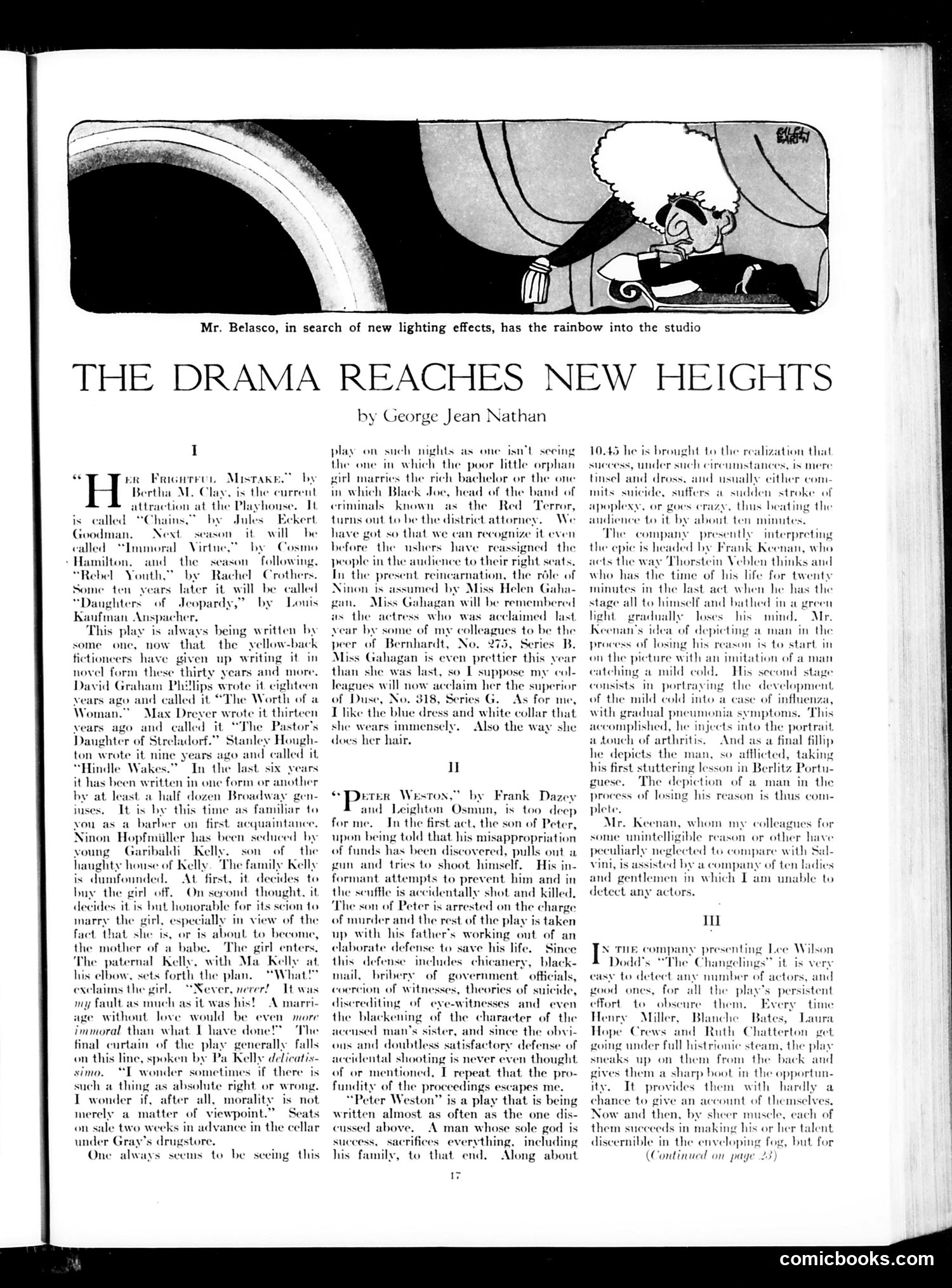
The top cartoon depicts David Belasco, a famous theatrical producer and director known for elaborate stage effects, literally bringing a rainbow into his studio—a visual joke about his obsessive pursuit of ever-more-spectacular lighting innovations. The main text is theater criticism by George Jean Nathan reviewing current Broadway plays. Nathan mocks the repetitive plot structure appearing in numerous dramas: a poor girl seduced by a wealthy man's son faces pressure to marry him, but refuses on moral grounds. Nathan notes this plot has been recycled for decades across multiple playwrights, appearing so frequently that audiences recognize it instantly "even before the ushers have reassigned the people." He reviews specific productions, including one starring Helen Gahagan, and critiques "Peter Weston," noting its morally dubious defense tactics (bribery, witness coercion, blackmail) that strain credibility. The satire targets theatrical cliché and the industry's endless recycling of tired storylines and melodramatic scenarios.
📄 Transcribed text from this page (OCR, searchable)
Machine-transcribed from the original scan — historical spelling and the odd misread are preserved.
Mr. Belasco, in search of new lighting effects, has the rainbow into the studio THE DRAMA REACHES NEW HEIGHTS I ss br Fricuteur Mistake.” by Bertha M. Clay, is the current attraction at the Playhouse. IH is called Eckert Goodman. will he called “Immoral Cosmo amilton, and the season following. “Rebel Youth.” by Rachel Crothers. Some ten years later it: will be 1 “Daughters of Jeopardy,” by 1 Kaufman Anspacher. This play is always being written by some one, now t the yellow-back fictioncers have given up writing it in novel form these thirty years and more. avid Graham Philips wrote it cighteen Years ago and called it “The Worth o Woman.” Max Dreyer wrote it thirteen years ago and called it “The Pastor's Daughter of Streladorf.” Stanley Hough- ton wrote it nine years ago and called it “Hindle Wakes.” In the last six years it has been written in one form or another by at least a half dozen Broadway gen- It is by this time as familiar to you as a barber on first: acquaintance. Ninon Hopfmiiller has been seduced by young Garibaldi Kelly. the haughty house of Kelly. The family Kelly is dumfounded. At first, it decides to buy the girl off. On second thought, it decides it is but honorable for its scion to marry the girl, especially in view of the fact that she is, or is about to become, the mother of a babe. The girl enters, The paternal Kelly, with Ma Kelly at his elbow, sets forth the plan. What!" exclaims the girl. “Never. never! Tt was my fault. as much as it was his! A marri- without: love would be even more immoral than what I have done! The final curtain of the play generally falls on this line, spoken by Pa Kelly delica “T wonder sometimes if there is such a thing as absolute right or wrong. I wonder if, after all, morality is not merely a matter of viewpoint. ’ on sale two weeks in advance in the under *s drugstore, One always seems to be seeing this “Chains.” by Jules Next se: it Virtue.” by nis iuses. son of age simo. by George Jean Nathan play on such nights as one isn’t seeing the one in which the poor little orphan girl marries the rich bachelor or the one in which Black Joe, head of the band of criminals known as the Red Terror, turns out to be the district attorney. We have got so that we can recognize it even before the ushers have reassigned the people in the audience to their right seats. Tn the present reincarnation, the role of Ninon is assumed by Miss Helen G gan. Miss Gahagan will be remembered as the actress who was ai imed 1 year by some of my col »s to be the peer of Bernhardt, No. . Series B. Miss Gahagan is even prettier this year than she was last, so L suppose my col- leagues will now acclaim her the superior of Duse, No. 318, Series G. As for me, I like the blue dress and white collar that she wears immensely. Also the way she does her hair. Il © Peter Westos,” by Leighton Osmun, is too de In the first act, the son of Peter, upon being told that his misappropriation of funds has been discovered, pulls out a gun and tries to shoot himself. His in- formant attempts to prevent him and in the seufle is accidentally shot and killed, The son of Peter is arrested on the charge of murder and the rest of the play is taken up with his father’s working out of an elaborate defense to save his life. Since this defense includes chicanery, black- mail, bribery of government’ offic coercion of witnesses, theories of suicide, discrediting of eve-witnesses and even the bl the character of the wccused man’s sister, and since the obyi- ous and doubtless satisfactory defense of dental shooting is never even thought or mentioned, I repeat that the pro- fundity of the proceedings escapes me. “Peter Weston” is a play that is being written almost as often as the one dis- cussed abo: A man whose sole god is saeri erything, including his family, to that end, Along about nd for me. success, 10.45 he is brought to the realization that shecess, under such circumstances, is merc tinsel and dross, and usually either com mits suicide, suffers a sudden stroke of apoplexy, or goes crazy, thus heating the audience to it by about ten minutes. The company presently interpreting the epic is headed by Frank Keenan, who aets the way Thorstein Veblen thinks and who has the time of his life for twenty minutes in the last act when he has the stage all to himself and bathed in a green light dually mi Mr. “a of depicting a man in the process of losing his reason is to start in on the picture with an imitation of a man catching a mild cold. consists in portraying the development of the mild cold into a case of influenza, with gradual pneumonia symptoms. This accomplished, he injects into the portrait a touch of arthritis. And as a final fillip he depicts the man, so afflicted, taking his first stuttering lesson in Berlitz Portu- guese. The depiction of a man in the process of losing his reason is thus com- plete. Mr. Keenan, whom my colleagues for some unintelligible reason or other have peculiarly neglected to compare with Si vini, is assisted by a company of ten lad and gentlemen in which Iam unable to detect any actors. loses his His second stage Iu I THE company presenting Lee Wilson Dodd's “The Changelings” it is very easy to detect any number of actors, and good ones, for all the play’s persistent effort, to obscure them. Every time Henry Miller, Blanche Bates, Laura Hope Crews and Ruth Chatterton get going under full histrionic steam, the play sneaks up on them from the back and gives them a sharp boot in the opportun- ity. It provides them with hardly a chance to give an account of themselves. Now and then, by sheer muscle, each of them sueceeds in making his or her talent discernible in the enveloping fog, but for (Continued on page 2 comicbooks.com