
A complete issue · 36 pages · 1923
Judge — September 8, 1923
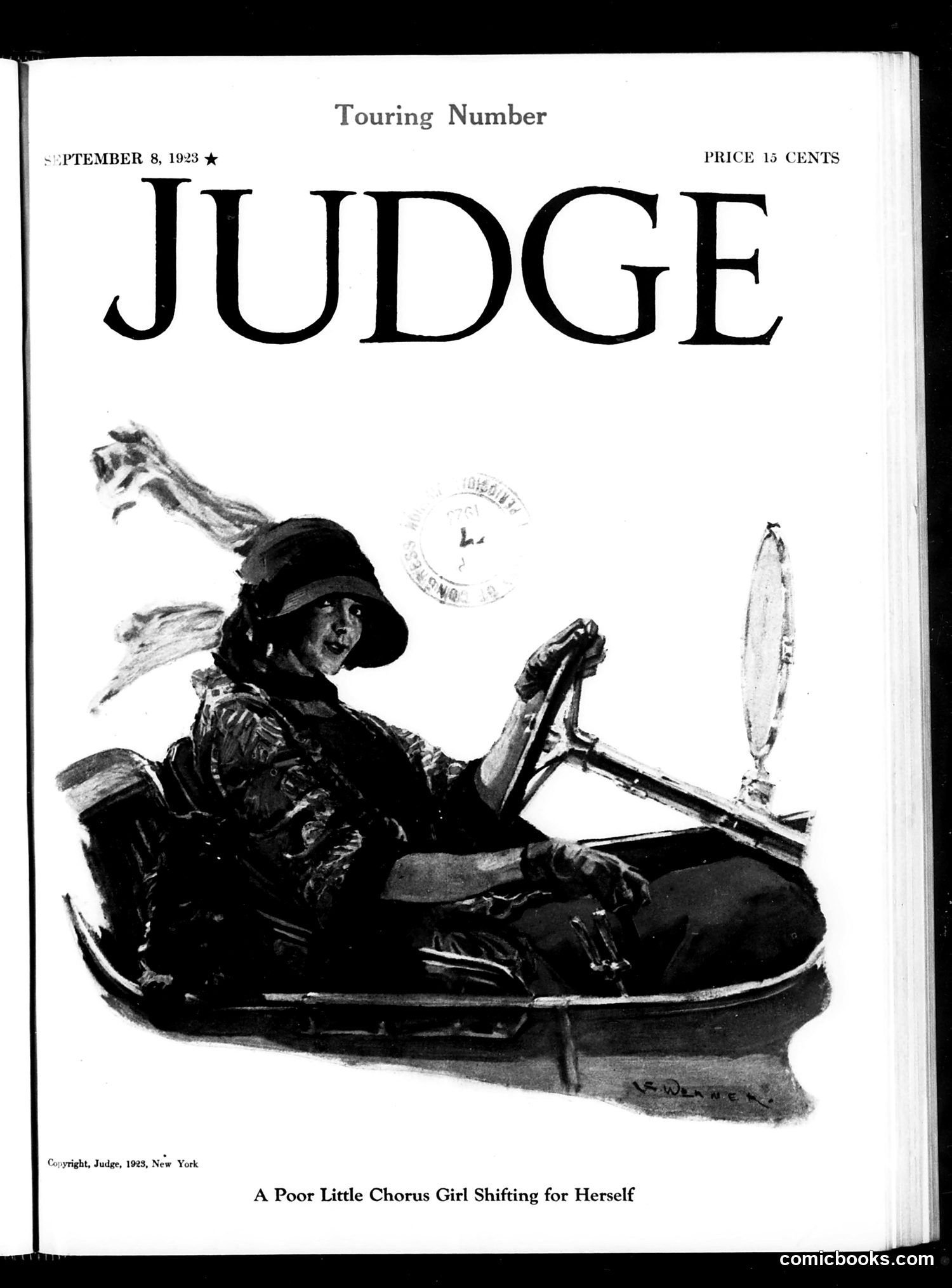
This is the cover of Judge magazine from September 8, 1923, priced at 15 cents. The illustration shows a woman in a motorboat steering a car's steering wheel, with the caption "A Poor Little Chorus Girl Shifting for Herself." The satire appears to comment on women's economic independence and changing social roles in the 1920s. The "chorus girl" — a common figure in Jazz Age entertainment — is depicted humorously attempting to navigate modern life (represented by the automobile steering apparatus) while operating a boat. The joke likely mocks women's struggles with self-sufficiency or satirizes the flapper era's contradictions: women gaining freedoms while still facing economic precarity. The absurdist image of using car controls in a boat underscores the satirical intent.
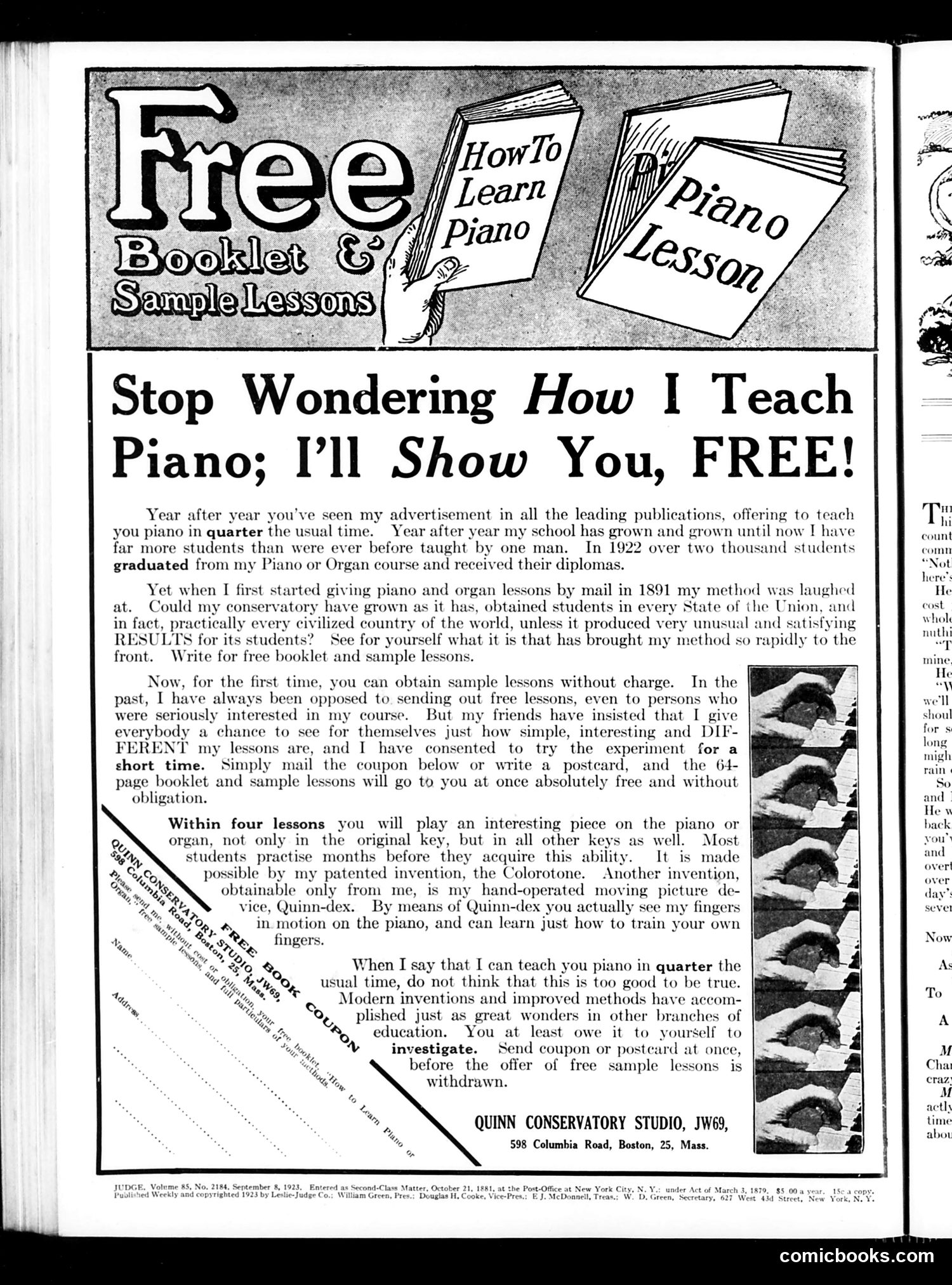
This page is **primarily an advertisement**, not satire or political commentary. It promotes the Quinn Conservatory Studio's piano lessons offered by mail. The ad claims revolutionary teaching methods allow students to play piano pieces "in quarter the usual time" through patented inventions like the "Colortone" (a visual learning aid) and "Quinn-dex" (a device showing finger positioning). The images on the right show hands on piano keys, presumably demonstrating proper technique. The advertisement plays on early 20th-century enthusiasm for new technologies and "scientific" self-improvement methods. The repeated emphasis on being "FREE" and learning faster than competitors suggests this was a competitive market for correspondence-based music instruction. There is **no political satire present** on this page.
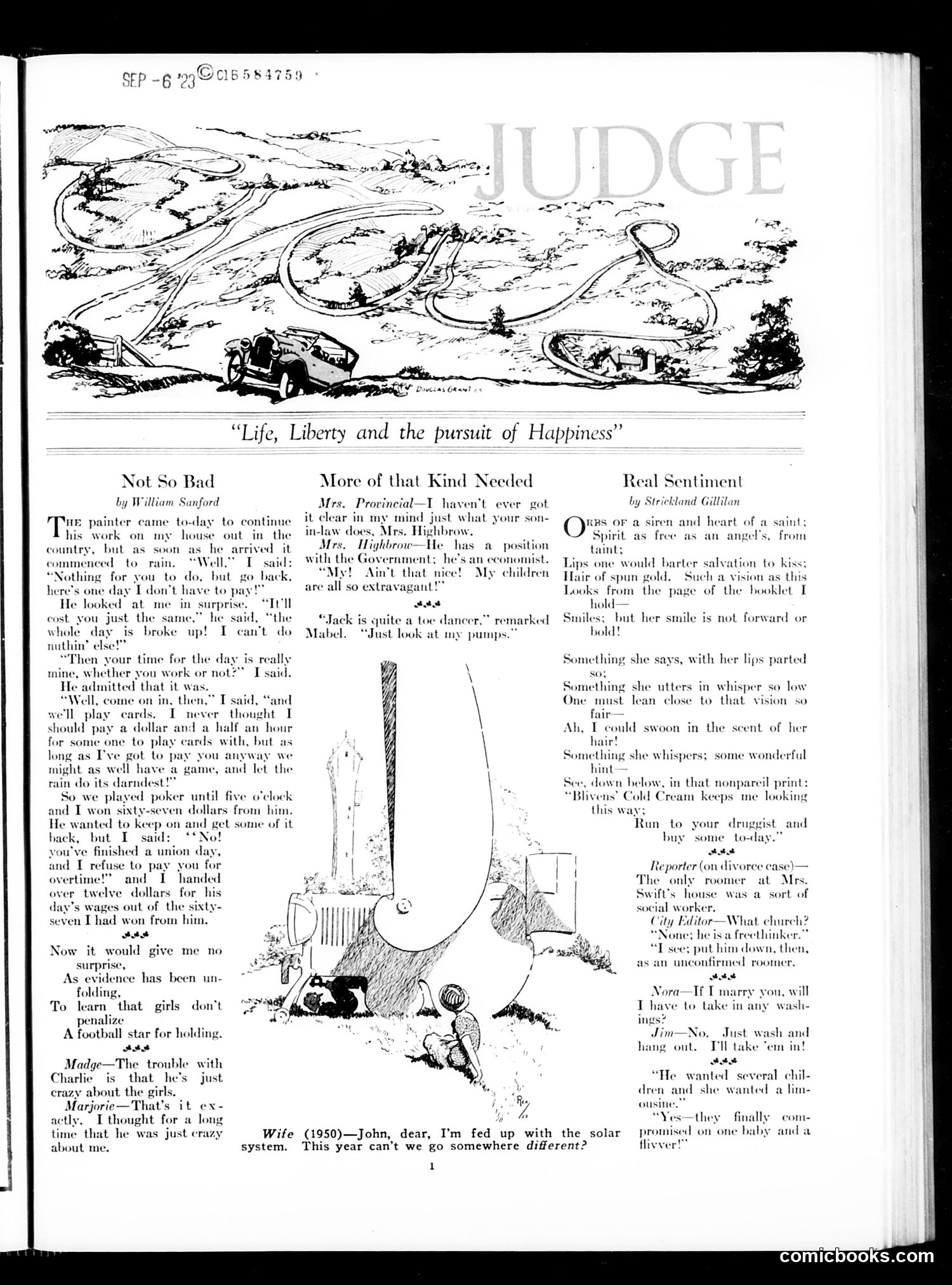
This page contains three separate humorous pieces rather than political cartoons. The main illustration shows a surreal landscape with massive curved roads or paths and a small car, accompanying a caption about the "solar system" and travel destinations—likely satirizing 1950 post-war automobile culture and suburban expansion. The three text pieces ("Not So Bad," "More of that Kind Needed," and "Real Sentiment") are light domestic humor columns featuring dialogue between characters like Mrs. Highbrow and Mabel, discussing everyday topics: house painting, children's behavior, and romance. This appears to be general-audience satirical content focused on middle-class American life rather than political commentary. The humor targets social pretension and domestic situations rather than political figures or events.
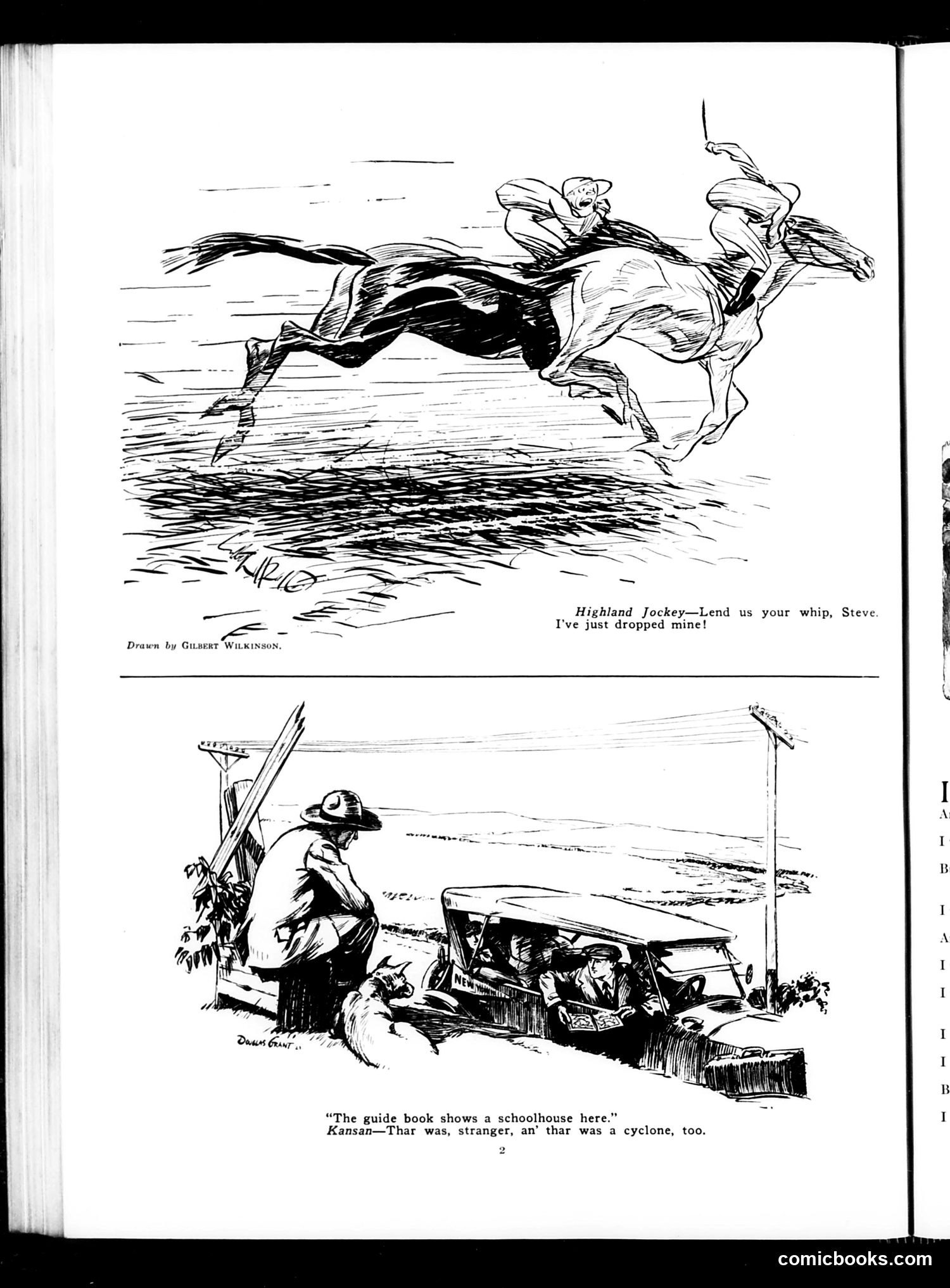
This page contains two unrelated cartoons with captions: **Top cartoon** (drawn by Gilbert Wilkinson): Shows two people on horseback in a steeplechase or racing context. One rider has dropped their whip and asks another named Steve to lend theirs, saying "I've just dropped mine!" This appears to be a straightforward sporting joke about horse racing. **Bottom cartoon** (drawn by Cesare): Shows a car that has crashed into a pole, with a person standing nearby. The caption suggests confusion about directions: "The guide book shows a schoolhouse here. Kansas—That was, stranger, an' that was a cyclone, too." This jokes about a tornado destroying a Kansas schoolhouse, playing on the region's notorious severe weather.
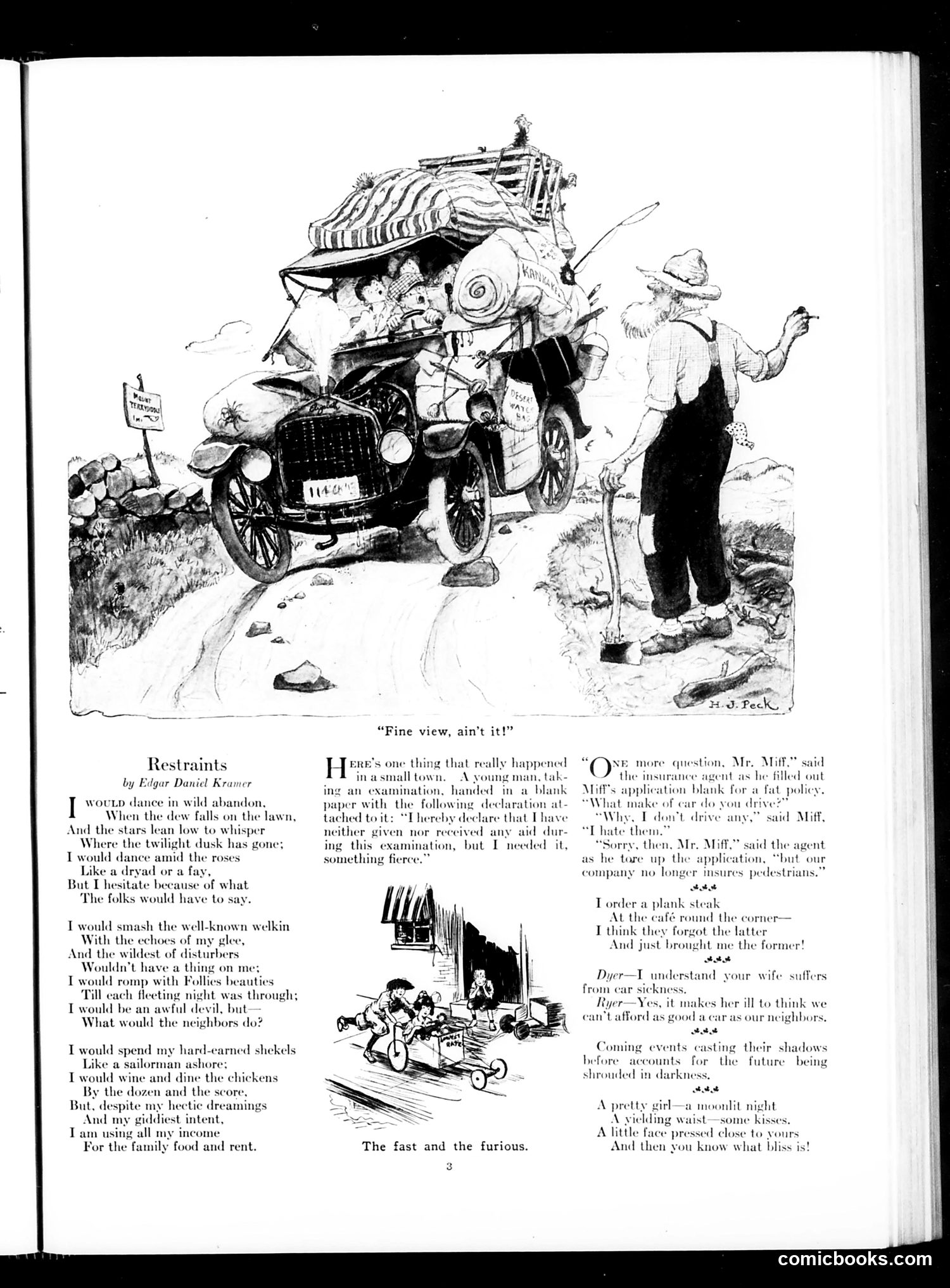
This page contains two separate pieces from *Judge* magazine: **Top cartoon ("Fine view, ain't it!"):** Shows an overloaded early automobile (circa 1900s-1910s) piled with household goods, breaking down on a rural road. A man gestures while explaining to a passing pedestrian. The satire targets the unreliability of early automobiles and their tendency to fail during travel, contrasting the promise of modern motoring with reality. The enormous load suggests people attempting cross-country moves or vacations in vehicles not equipped for such journeys. **Bottom section:** "Restraints" is a poem by Edgar Daniel Kraemer about frustrated desires for adventure and escape from domestic life. "The fast and the furious" is an unrelated humorous sketch about an accident, playing on automotive mishaps of the era. The page satirizes early-automobile culture and its frequent mechanical failures.
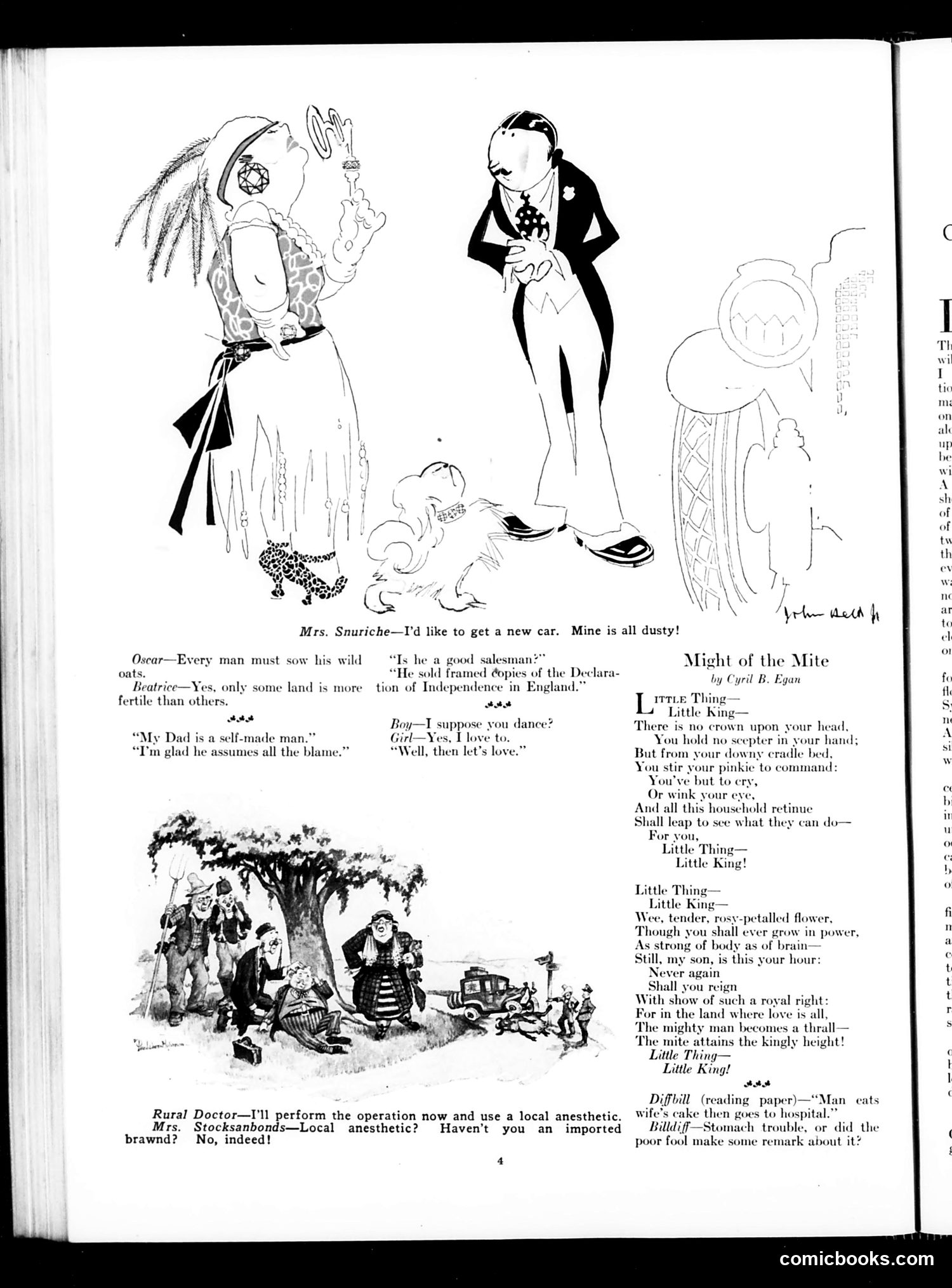
This page contains two main sections: **Top cartoon** depicts a wealthy woman (Mrs. Smuriche) complaining about her dusty car to what appears to be a car salesman. The satire targets wealthy consumers' complaints and consumption habits during an era of automotive expansion. **Middle section** contains brief comedic dialogue about self-made men and class assumptions—typical early-20th-century social commentary about American entrepreneurship and inherited versus earned wealth. **"Might of the Mite"** by Cyril B. Egan is a poem celebrating humility and moral authority over physical power or royal status—reflecting Progressive Era values emphasizing character over aristocratic privilege. **Bottom cartoon** shows a rural doctor scene with comedic dialogue about anesthetics, satirizing rural/urban medical practice differences and class distinctions in healthcare access. The overall page reflects common Judge magazine themes: wealth, class pretension, and social contradictions of the period.
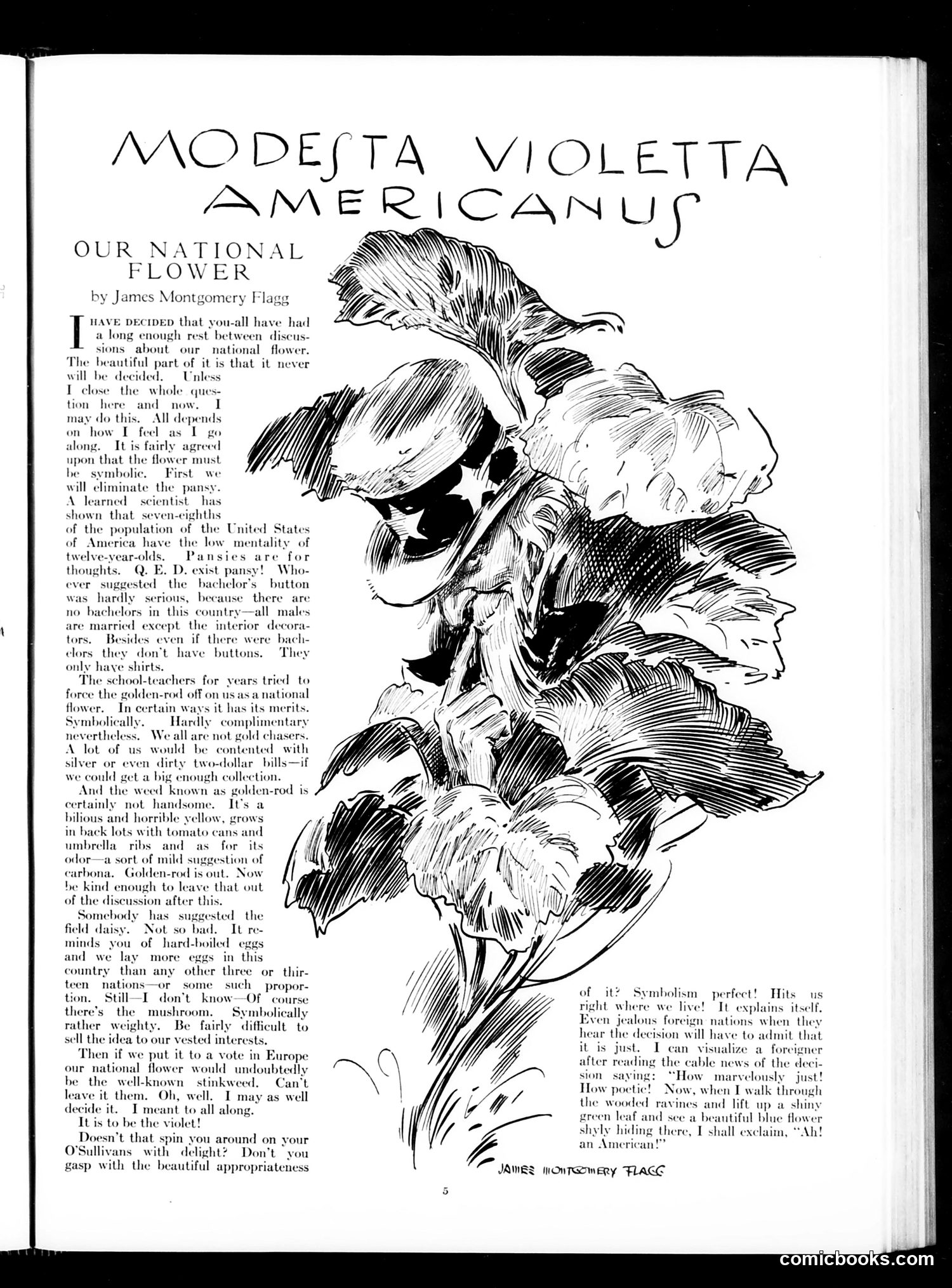
This is satirical commentary on the decades-long debate over America's national flower. Flagg humorously eliminates candidates: - **Pansy**: Dismissed because statistics supposedly show 7/8 of Americans have twelve-year-old mentality ("pansies are for thoughts") - **Bachelor's button**: Rejected since all unmarried men have married off - **Golden-rod**: Mocked as an ugly, bilious weed - **Field daisy**: Associated with hard-boiled eggs - **Mushroom**: Too "weighty" for vested interests **The conclusion**: The violet wins by default—not through logical argument but exhaustion. Flagg's final mockery suggests the violet's only virtue is being "modest" (modesta), making it symbolically "perfect" for America through sheer mediocrity rather than genuine merit. The satire targets both the endless national debate itself and American pretension about finding deep symbolic meaning in arbitrary choices.
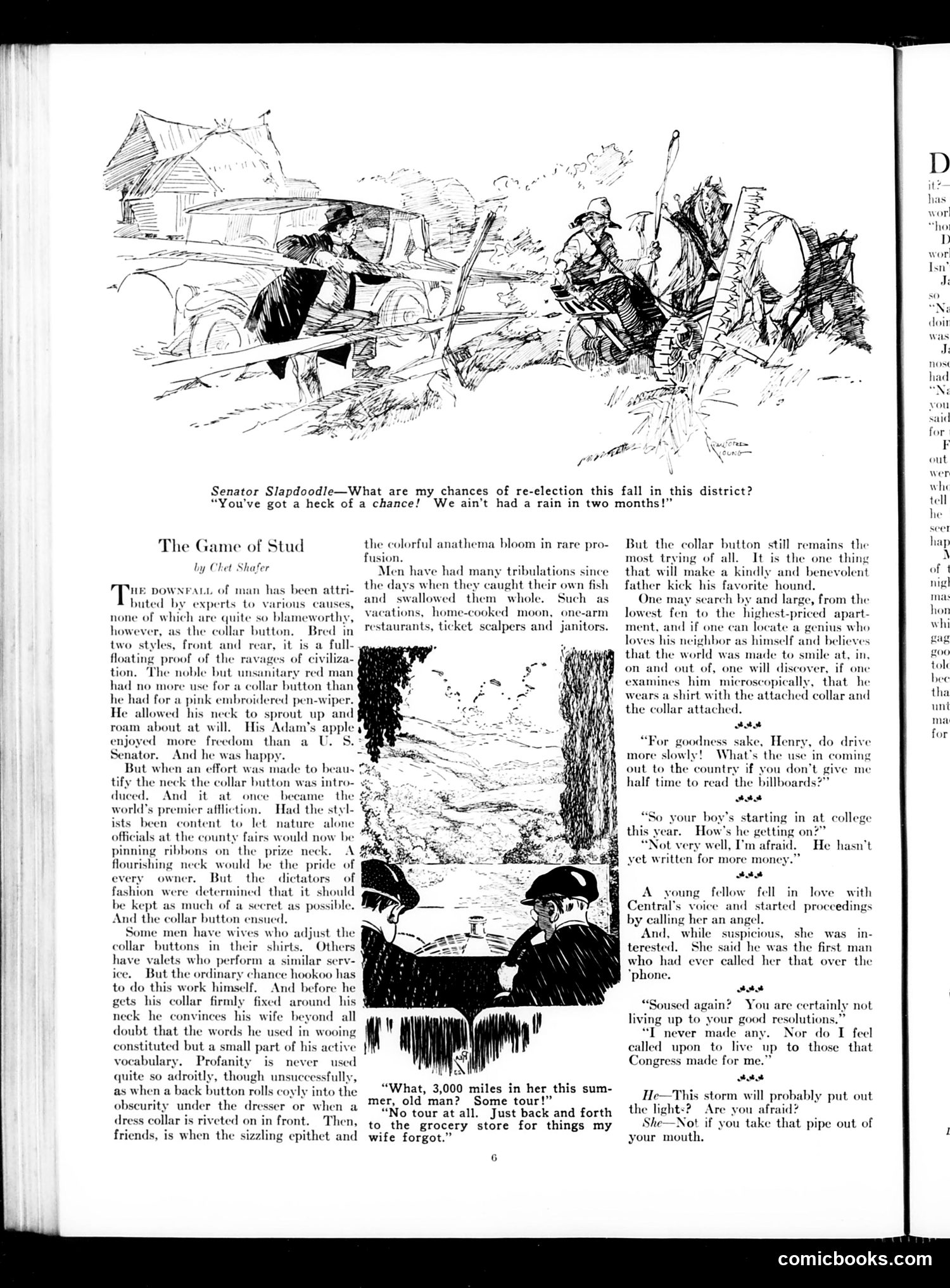
**Top Cartoon**: "Senator Slapdoodle" seeks re-election advice from a farmer. The joke plays on rural hardship—the farmer says the Senator has "a heck of a chance" to lose because there's been no rain in two months, implying drought-devastated constituents won't vote for him. This satirizes politicians' disconnect from voters' real problems. **"The Game of Stud" Article**: Shafer's humorous essay tackles the collar button as civilization's worst invention. He contrasts the "noble" Native American, free from this constraint, with modern men driven to profanity trying to fasten them. The satire mocks Victorian refinement's impracticality and the absurd tyranny of fashion dictates over genuine comfort. **Scattered Dialogue Snippets**: These brief comic exchanges mock various social types—henpecked husbands, college-age sons asking for money, and politicians making hollow promises—typical Judge satirical fare targeting American middle-class foibles.
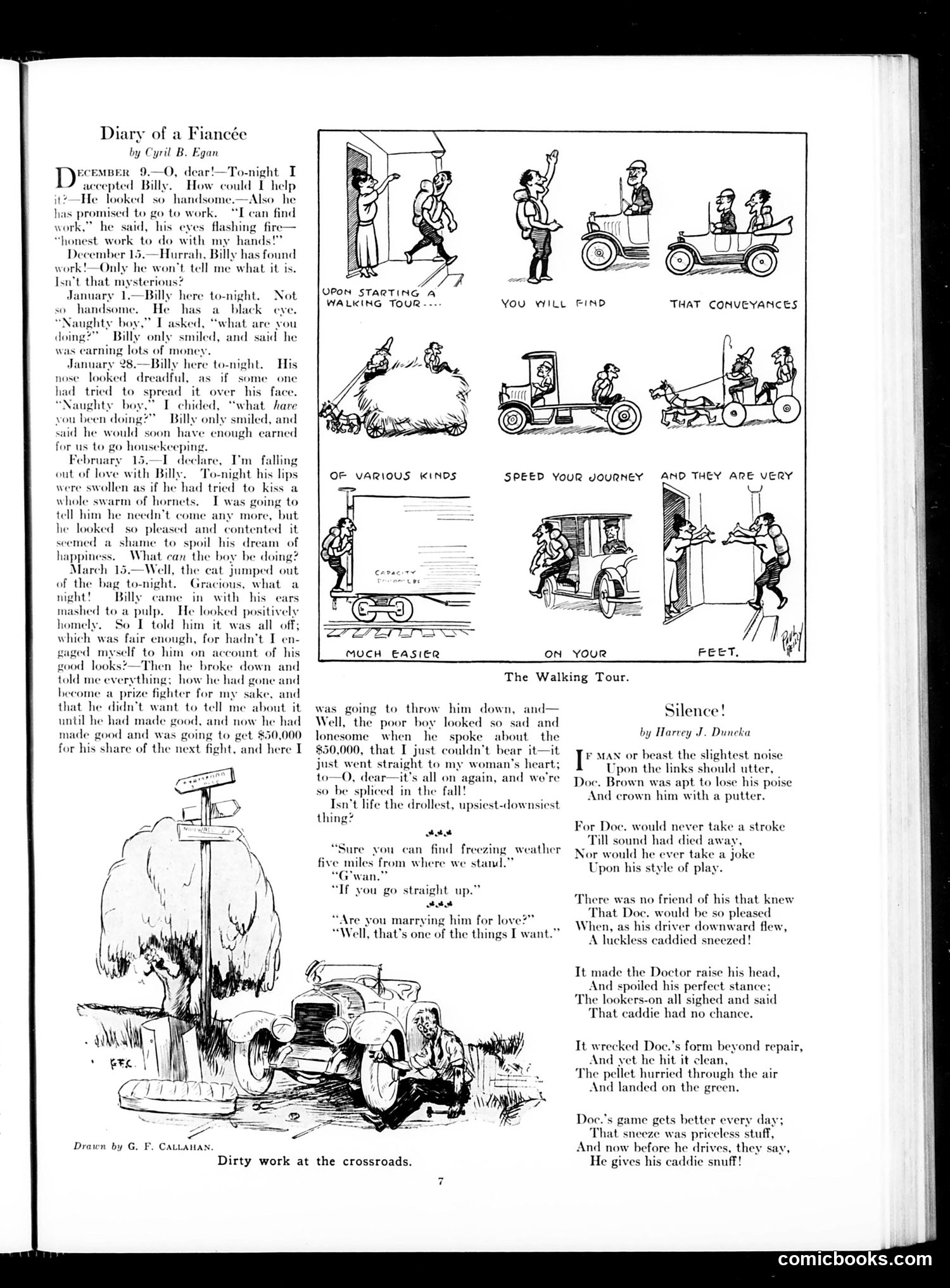
**Left column:** A humorous serial diary where a woman accepts a suitor named Billy based on his handsome appearance. She grows increasingly puzzled by his battered face—black eyes, swollen lips, mashed ears—until he confesses he's become a prize fighter to earn $50,000 for their future. Though initially rejecting him for his ruined looks, she reconciles when moved by his financial prospects, planning a fall wedding. **Top right cartoon:** "The Walking Tour" depicts various modes of transportation (cars, motorcycles, carriages) contradicting the concept of a "walking tour"—satirizing how modern vehicles have made actual walking obsolete. **Bottom right:** "Silence!" is a golf humor poem about Doc. Brown, a golfer so obsessed with noise control that he actually *improves* when a caddie sneezes during his swing—inverting the expected outcome. The joke: his superstition backfires beneficially. **Era context:** These pieces reflect early 20th-century anxieties about automobiles replacing traditional travel and the gentleman's game of golf.
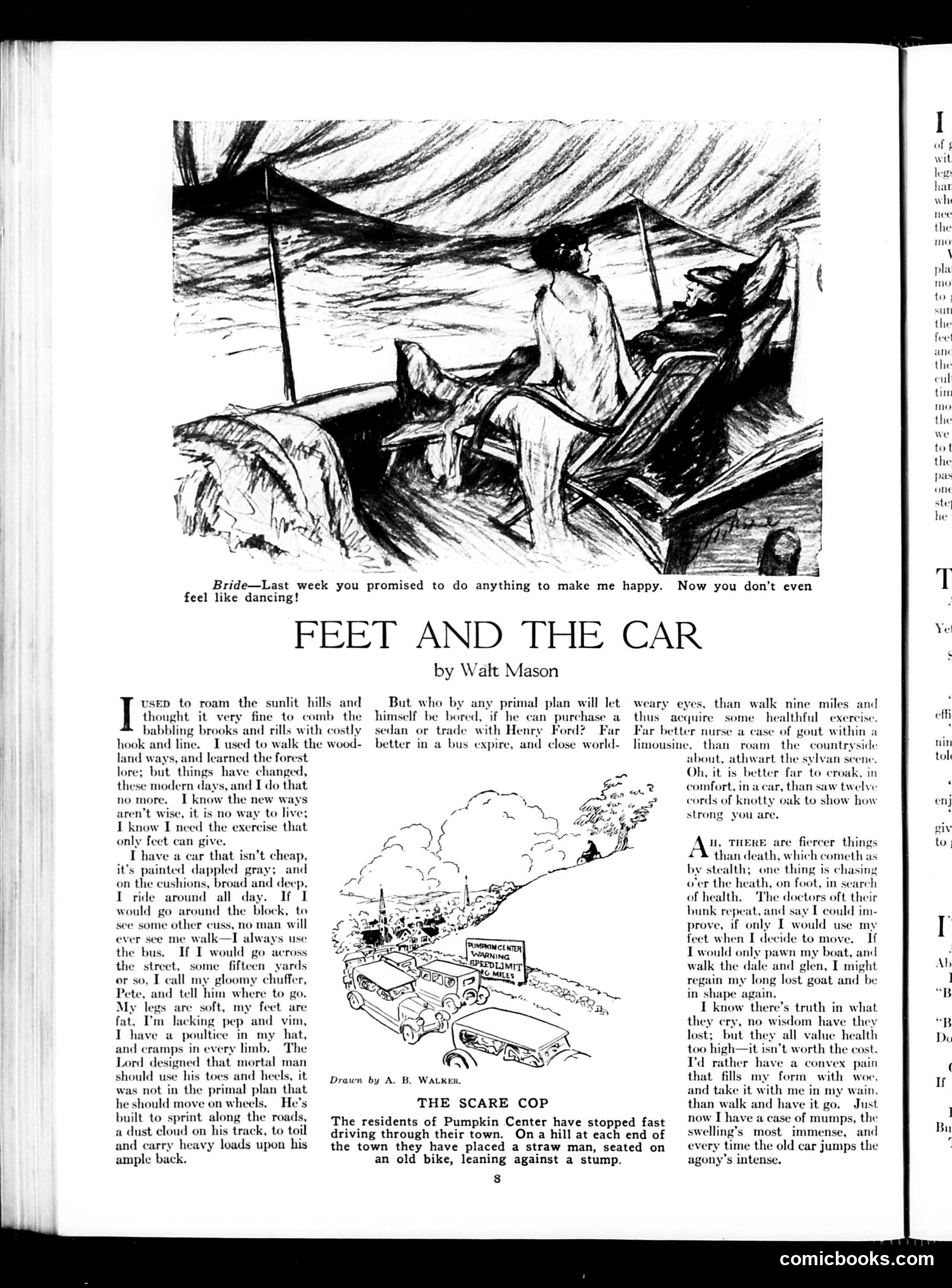
This page satirizes modern American automobile culture and the sedentary lifestyle it enabled in the early 20th century. **The Main Cartoon (top):** A newlywed bride complains to her husband that he promised to make her happy but won't even dance with her—establishing that cars have made people lazy and romance-averse. **Mason's Poem "Feet and the Car":** The narrator confesses he's become soft and immobilized by car ownership. He once loved hiking and walking, but now rides his "dappled gray" automobile for even short distances, calling his driver "Pete" rather than exert himself. Doctors urge him to walk for health, but he refuses, preferring comfort to fitness—even accepting gout and mumps rather than abandoning his vehicle. **"The Scare Cop" (bottom):** Pumpkin Center residents have placed straw dummies on bicycles at town entrances to deter speeding drivers, suggesting cars and reckless driving were already seen as social problems. The satire critiques how automobile convenience was making Americans physically weak and disconnected from natural, healthier living—a common Progressive-era concern.
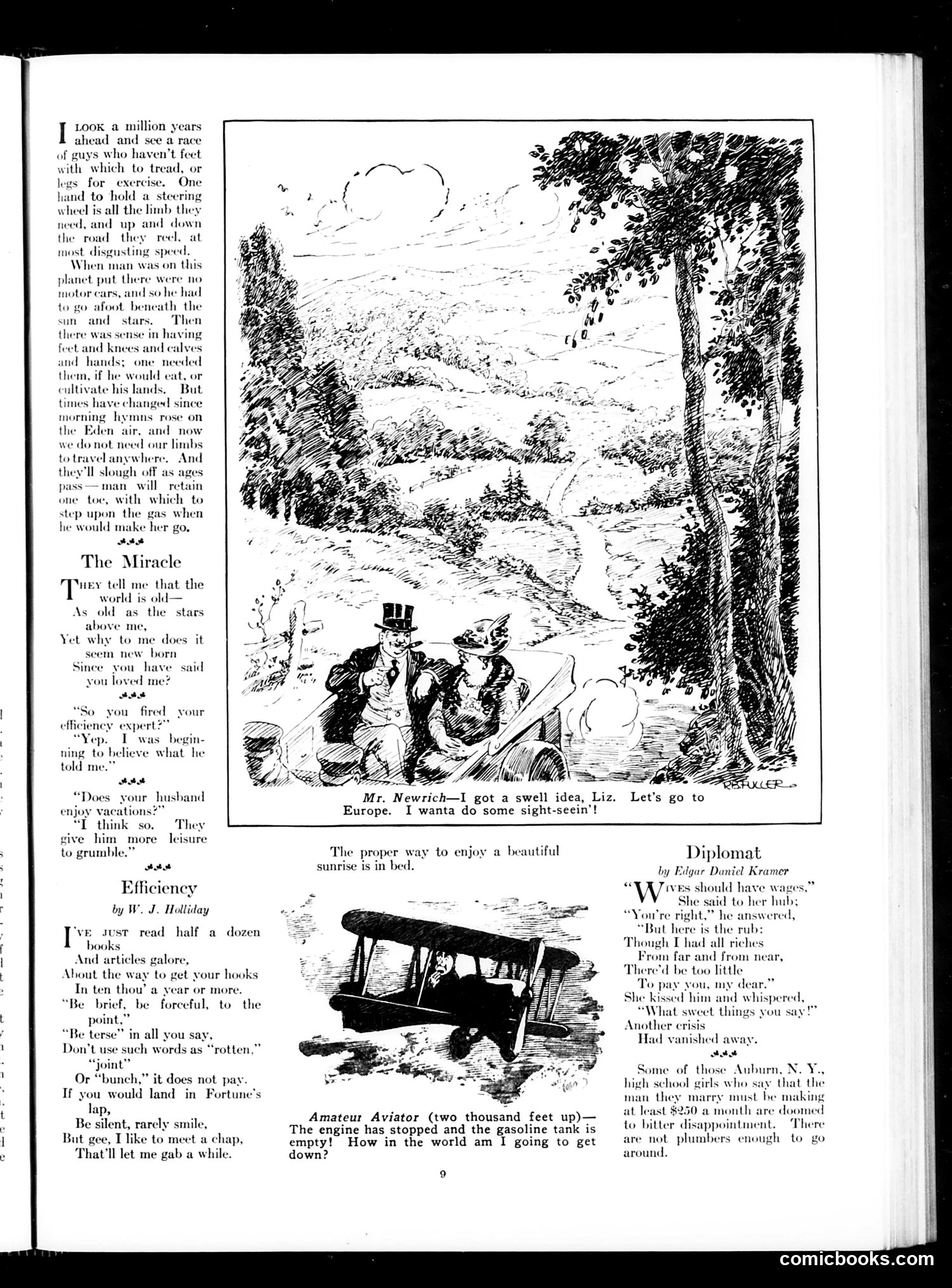
This page contains three main satirical pieces: **"The Miracle"** - A sentimental poem mocking romantic clichés about love making the world seem "new born." **"Efficiency"** - W.J. Holliday's poem satirizes business advice about brevity and professionalism, contrasting it with the author's preference for genuine human conversation. The joke: following rules for success requires suppressing one's natural personality. **Top cartoon** - "Mr. Newrich" (a caricatured wealthy person, "newrich" suggesting nouveau riche) wants European sightseeing. The satire targets wealthy Americans' tourist obsession. **"Diplomat"** - Kramer's poem satirizes diplomatic language and marital negotiation, showing a husband using flattery to avoid discussing his wife's wage demands. **Bottom cartoon** - An amateur aviator's predicament (engine failure, empty fuel tank) illustrates the era's aviation dangers and incompetence among amateur fliers. The page overall mocks American social pretensions, business culture, and new technologies while maintaining light, humorous tones typical of 1910s-1920s satire.
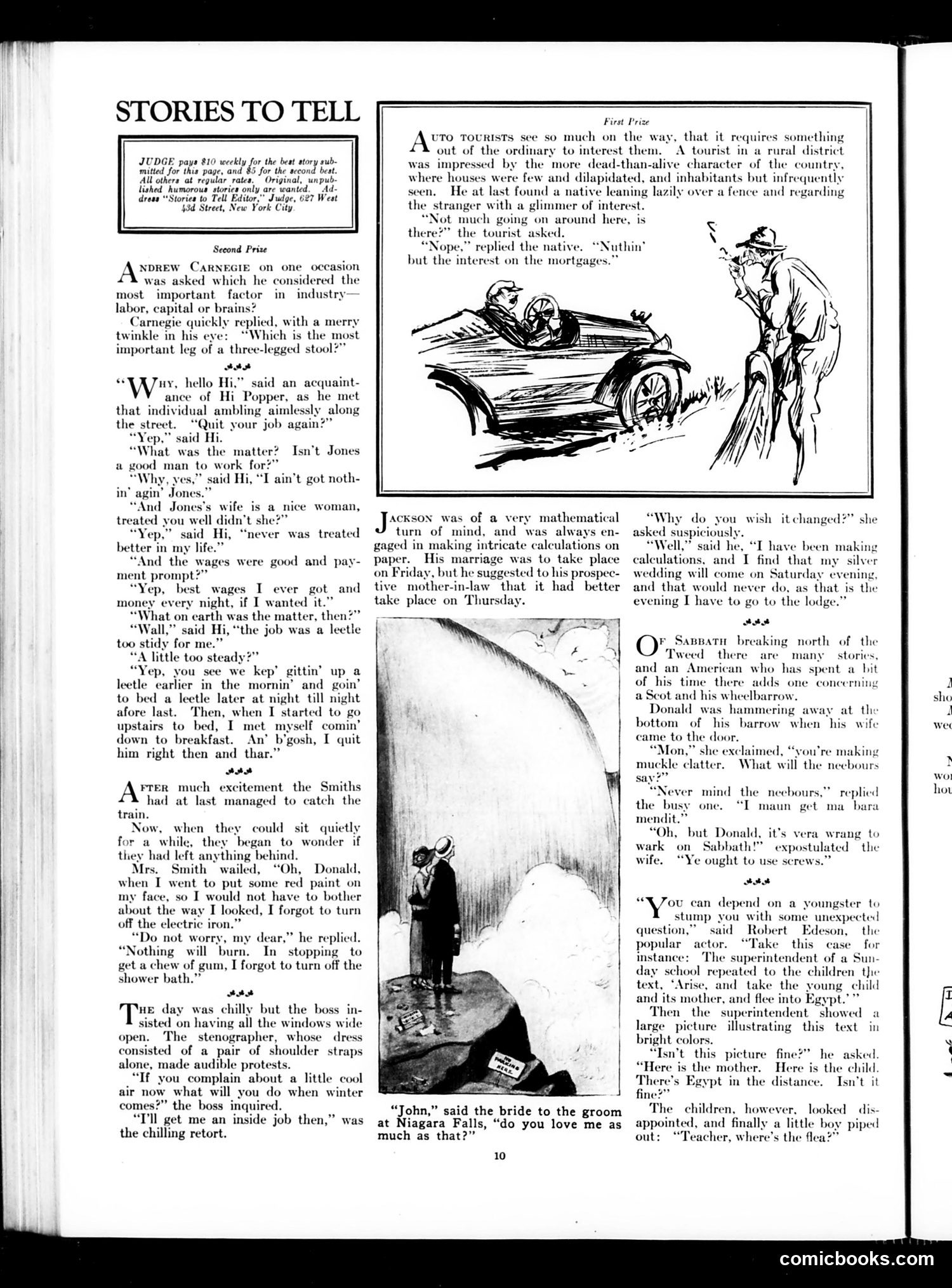
This page from Judge presents humorous short stories submitted by readers, with prizes offered ($10 for first place, $5 for second). The cartoons illustrate several stories: **Top right:** A tourist in a rural area asks a native what's happening locally. The native replies there's "nothin' but the interest on the mortgages"—satirizing rural poverty and debt during the agricultural depression era. **Middle:** A story about Andrew Carnegie answering which matters most in industry (labor, capital, or brains) by asking which leg of a three-legged stool is most important—a clever deflection suggesting all three are equally necessary. **Bottom stories** include domestic humor: a man who quit a good job because he was getting up earlier and going to bed later until he "met himself coming down to breakfast"; a couple who forgot to turn off an electric iron and shower; and a groom who wants to postpone his wedding from Friday to Thursday because his lodge meets Saturday evening. The humor reflects early-20th-century working-class concerns: steady employment, domestic life, and social obligations.
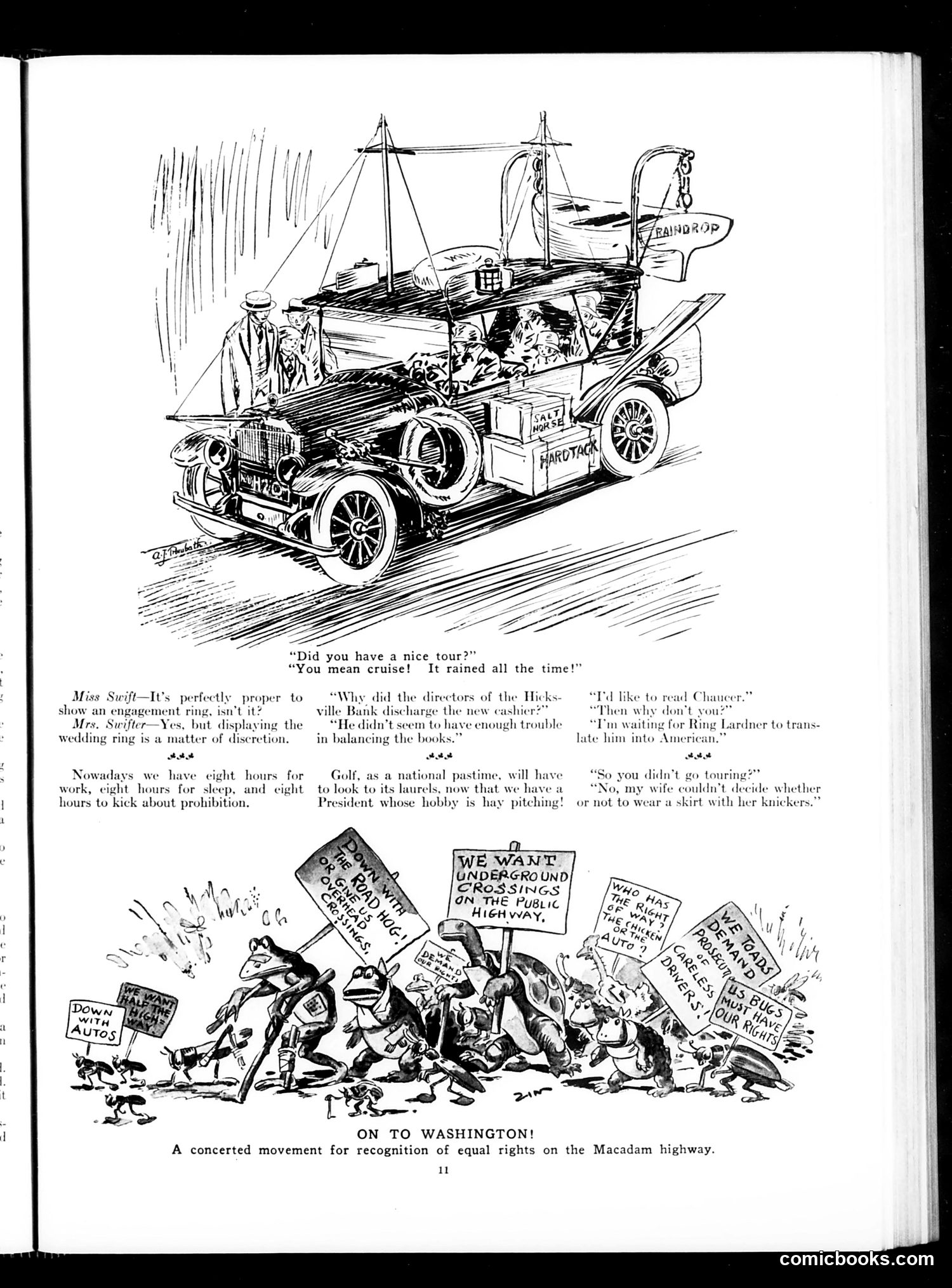
This page from *Judge* magazine contains early 20th-century humor mocking automobiles and road safety concerns. **Top cartoon**: Shows an absurdly overloaded vehicle (resembling a ship on wheels) carrying multiple passengers and cargo. The joke plays on the novelty and chaos of early motoring—a "cruise" that rained constantly, punning on automobile terminology. **Middle jokes**: Brief quips about engagement rings, bank cashiers, golf, and prohibition (illegal alcohol). These reference contemporary concerns: President Coolidge's hobby was apparently hay pitching, not golf. **Bottom cartoon**: Depicts animals (appears to be representing motorists) protesting with signs demanding "underground crossings" and "equal rights on the Macadam highway." This satirizes a "concerted movement" by those opposing automobiles—likely pedestrians and horse-drawn-vehicle advocates demanding safety measures against the new threat of motor vehicles. The overall message: Early automobiles were chaotic, dangerous nuisances to traditional road users seeking protection through government intervention.
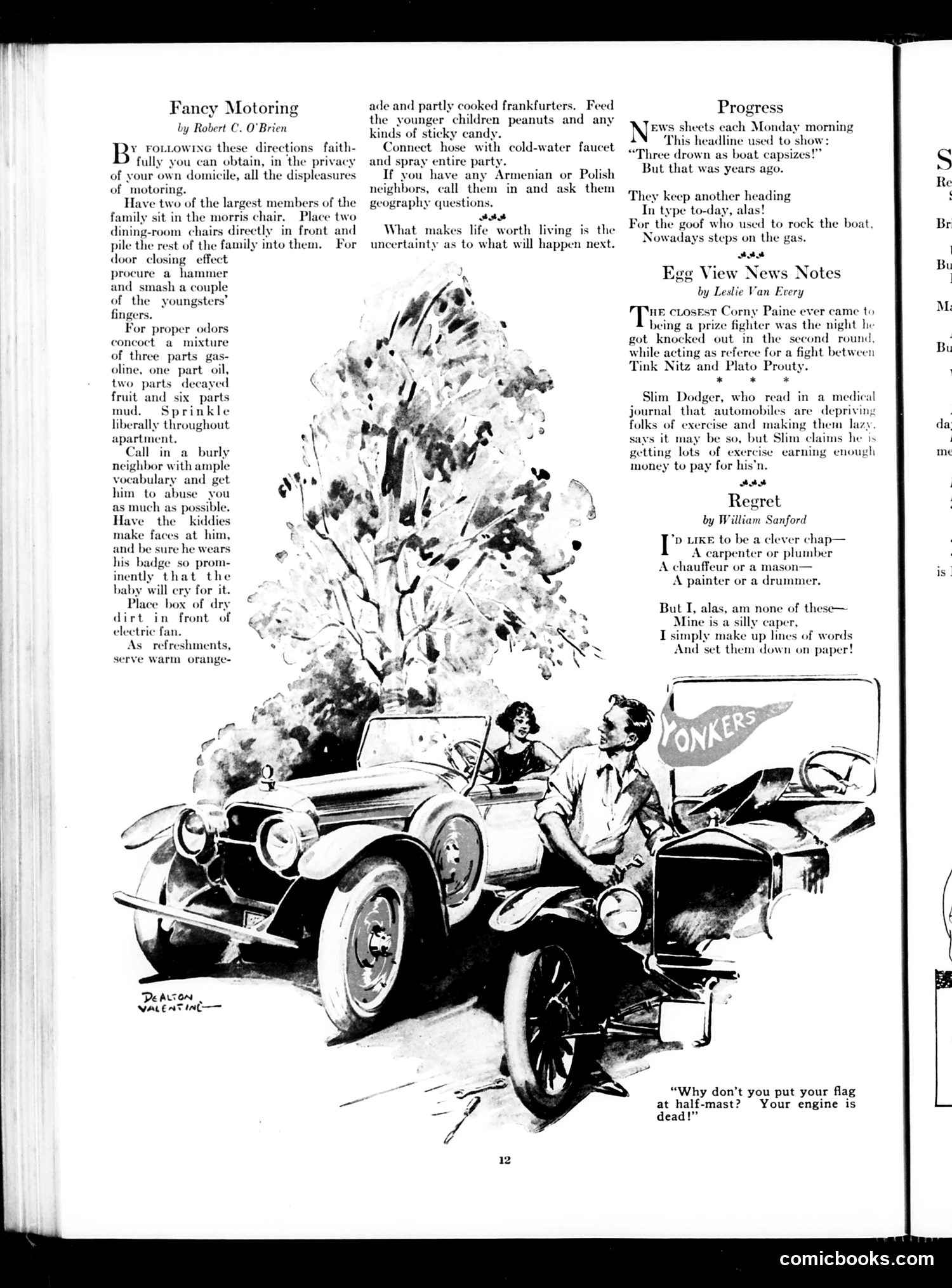
This page from *Judge* magazine contains satirical humor about early automobiles and related topics. **"Fancy Motoring"** is a humorous essay mocking the unpleasant realities of car ownership in the early automotive era. Rather than praising motoring, it sarcastically provides instructions for simulating the miserable experience at home: cramped seating, noxious fumes, loud abuse, mechanical failures, and ethnic stereotypes (the "Armenian or Polish neighbors" reference reflects period prejudices). The cartoon below illustrates this—showing two cars colliding, with one driver sarcastically suggesting the other raise their flag "at half-mast" because their engine is "dead." The page also contains lighter pieces: "Egg View News Notes" offers small-town gossip, while "Progress" and "Regret" are brief poems. "Progress" contrasts modern car culture (where reckless drivers "step on the gas") with older boating mishaps. "Regret" humorously laments the speaker's career as a writer rather than a skilled tradesman. The satire assumes readers familiar with cars as new, unreliable, and socially disruptive technology.
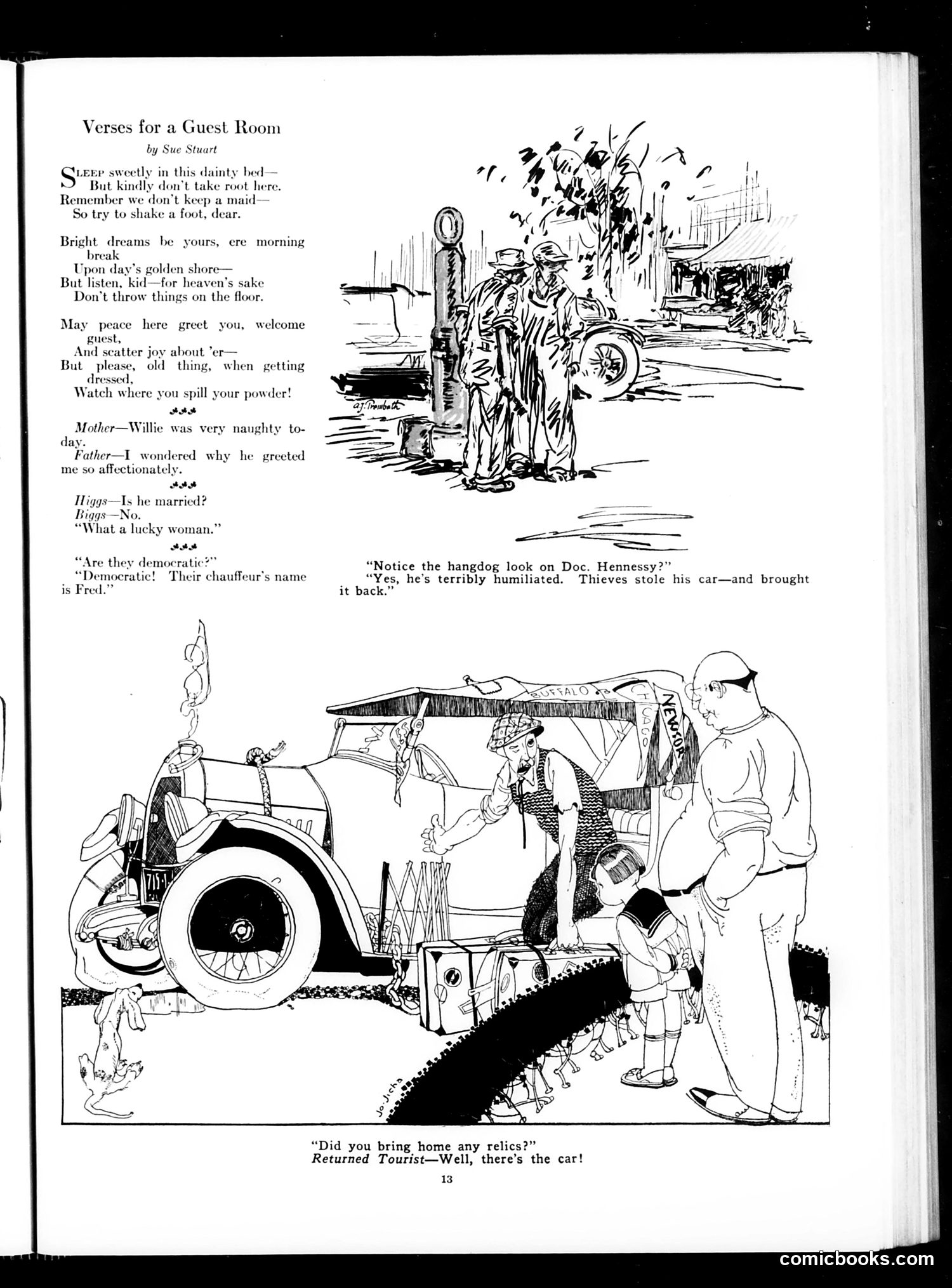
This page from *Judge* magazine contains period humor spanning several social contexts: **"Verses for a Guest Room"** is lighthearted domestic satire—a hostess's humorous complaints about houseguest behavior (not shaking out dirt, spilling powder, throwing things). Nothing politically significant. **The brief jokes** include: - A father amused that his son greeted him affectionately (implying the boy was punished for misbehavior) - A backhanded comment about unmarried men ("What a lucky woman") - A joke about "democratic" people whose chauffeur is named "Fred"—satirizing wealthy people claiming democratic values while employing servants **The bottom cartoon**: Shows a tourist's car that was stolen by thieves, then recovered and returned—the joke being the dilapidated state of the returned vehicle. The caption "Did you bring home any relics?" treats the ruined car as an archaeological artifact. The overall tone reflects 1920s-era middle/upper-class anxiety about servants, wealth display, and automobile ownership.
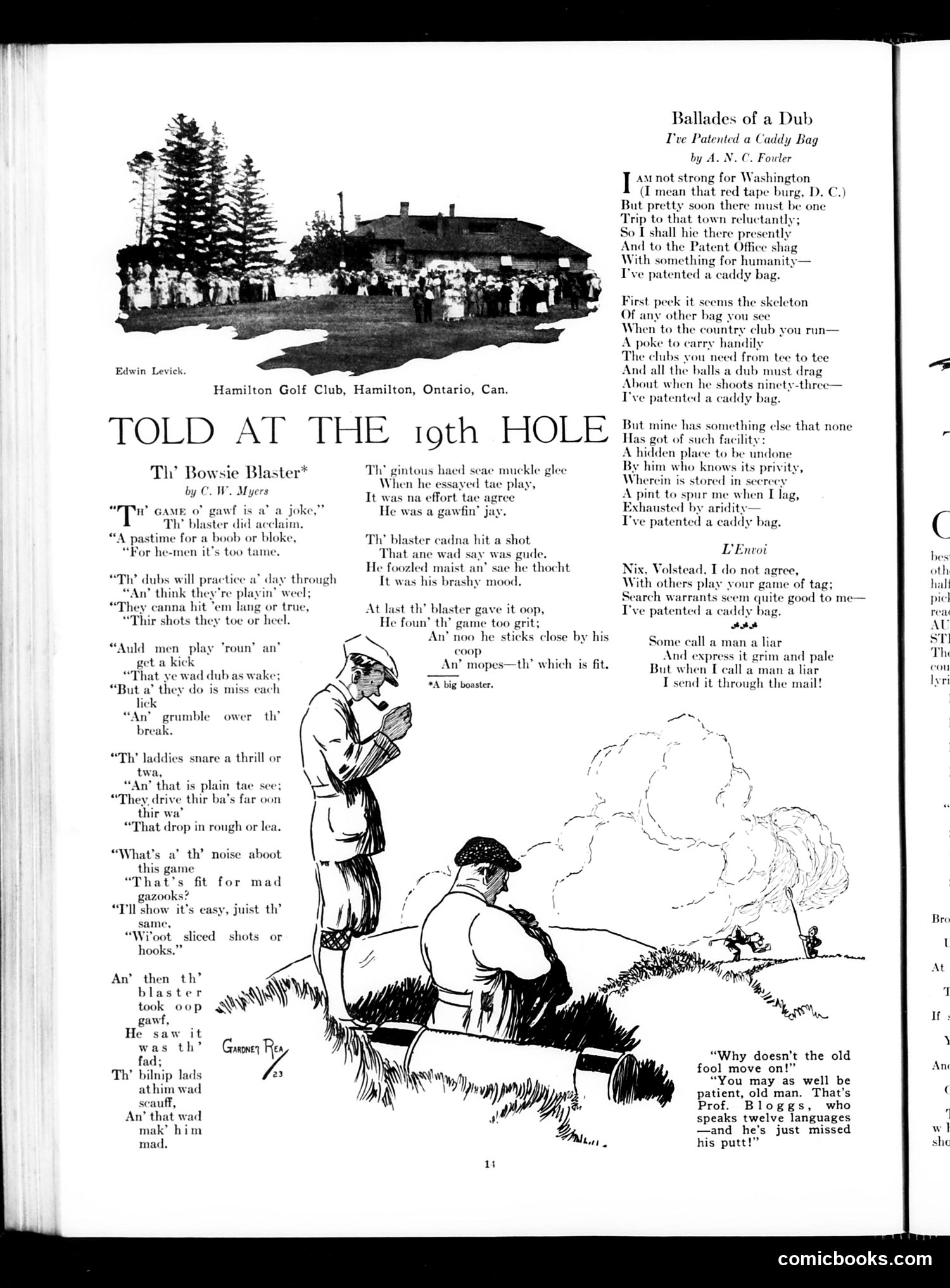
This page contains golf-themed humor from an early 20th-century *Judge* magazine. The main cartoon shows two golfers on a course—one appears frustrated or stuck while the other watches. The accompanying text mocks poor golfers ("dubs"), establishing the page's running joke: incompetent players who struggle with basic technique. The poems use Scottish dialect to satirize golf culture. "Tli' Bowsie Blaster" describes a terrible golfer who repeatedly foozles (mishits) shots and eventually gives up the game. The humor targets amateur golfers who take the sport too seriously despite lacking skill. The separate poem "I've Patented a Caddy Bag" satirizes frivolous patent applications—a common *Judge* target—by describing a supposedly revolutionary golf bag design that's merely functional. The "L'Envoi" section references Prohibition-era concerns (Volstead Act) through golf terminology. The bottom caption mocks an impatient golfer frustrated with slow play, suggesting even modest competence requires patience.
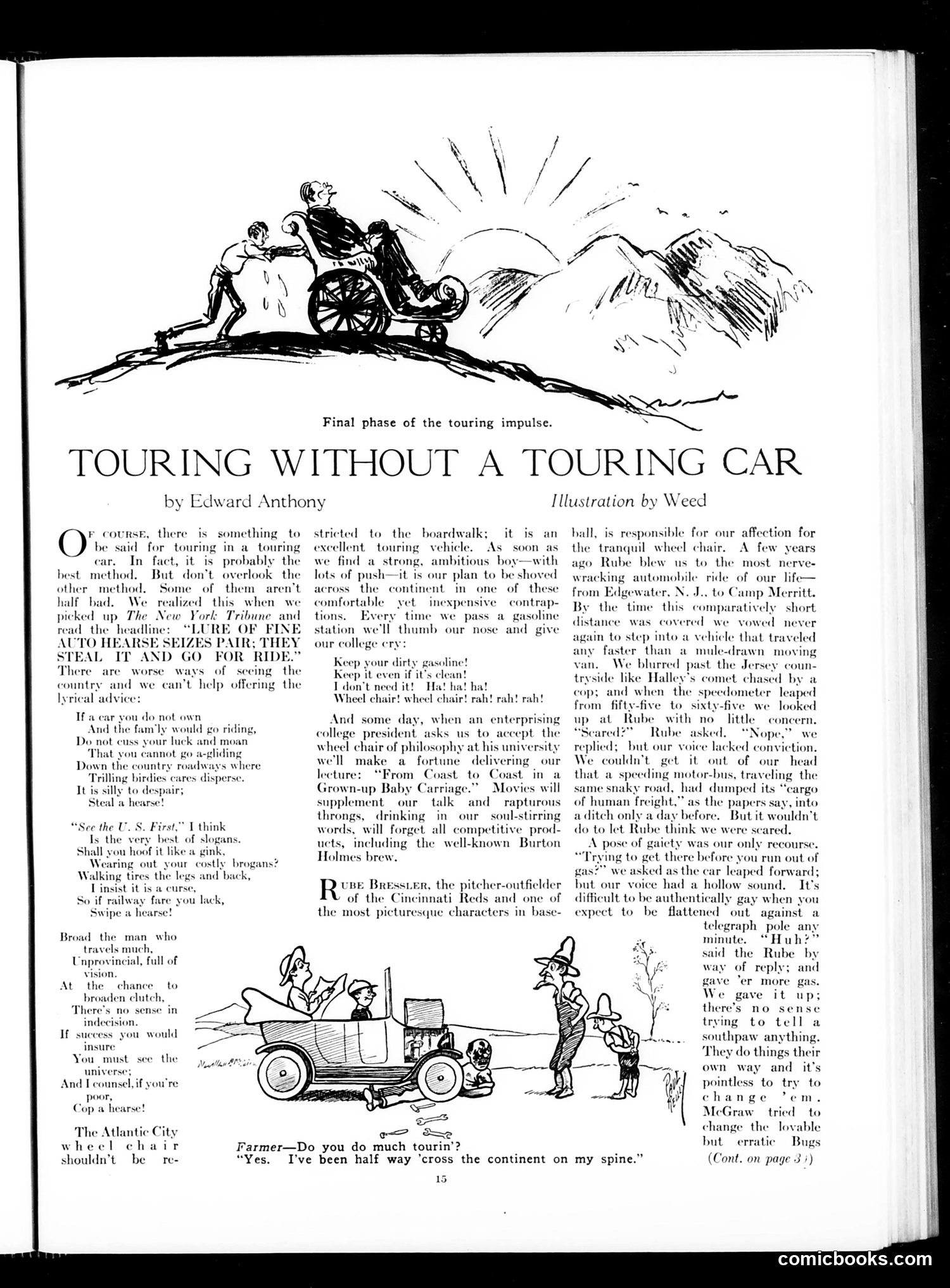
This article satirizes the American automobile craze of the early 20th century by ironically promoting alternatives to owning a car. Edward Anthony humorously suggests that those unable to afford or obtain a touring car should steal a hearse instead—presenting theft as practical advice for seeing the country. The satire works on multiple levels: it mocks both the obsession with automobile touring and the class inequality it represents. The accompanying illustrations show a family in a stolen hearse and a farmer commenting on cross-country travel via his spine, reinforcing the joke. The article also includes a humorous anecdote about baseball player Rube Bressler's reckless driving, which terrified the author. This adds social commentary about dangerous driving practices of the era while maintaining the comedic tone. The overall message critiques how automobile mania had become so central to American life that stealing a vehicle seemed preferable to conventional travel methods.
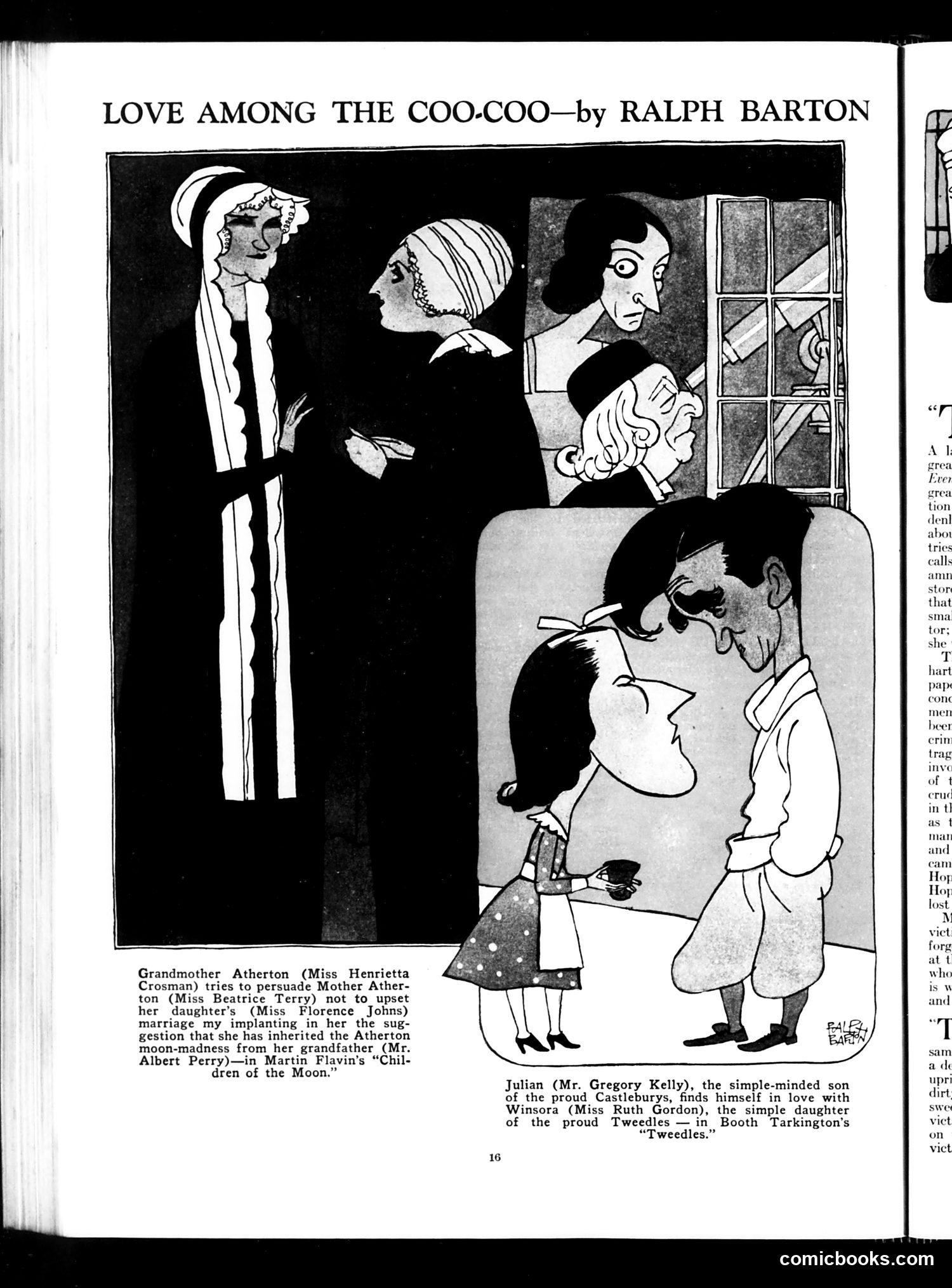
This page features illustrations from two theatrical productions of the 1920s era. The top scene depicts "Children of the Moon," where a grandmother attempts to convince a mother not to tell her daughter about inherited family "moon-madness" (mental illness/eccentricity) that runs in their lineage. The lower scene illustrates Booth Tarkington's "Tweedles," showing two "simple-minded" young people—Julian of the Castlebury family and Winsora of the Tweedle family—falling in love despite their families' pride and social pretensions. The satirical humor relies on the contrast between the characters' intellectual limitations and their families' social pretensions. The title "Coo-Coo" (slang for crazy/foolish) mocks both the characters' mental limitations and the absurdity of class-conscious families. Ralph Barton's caricatural style emphasizes exaggerated facial features to comedically convey the characters' simplicity.
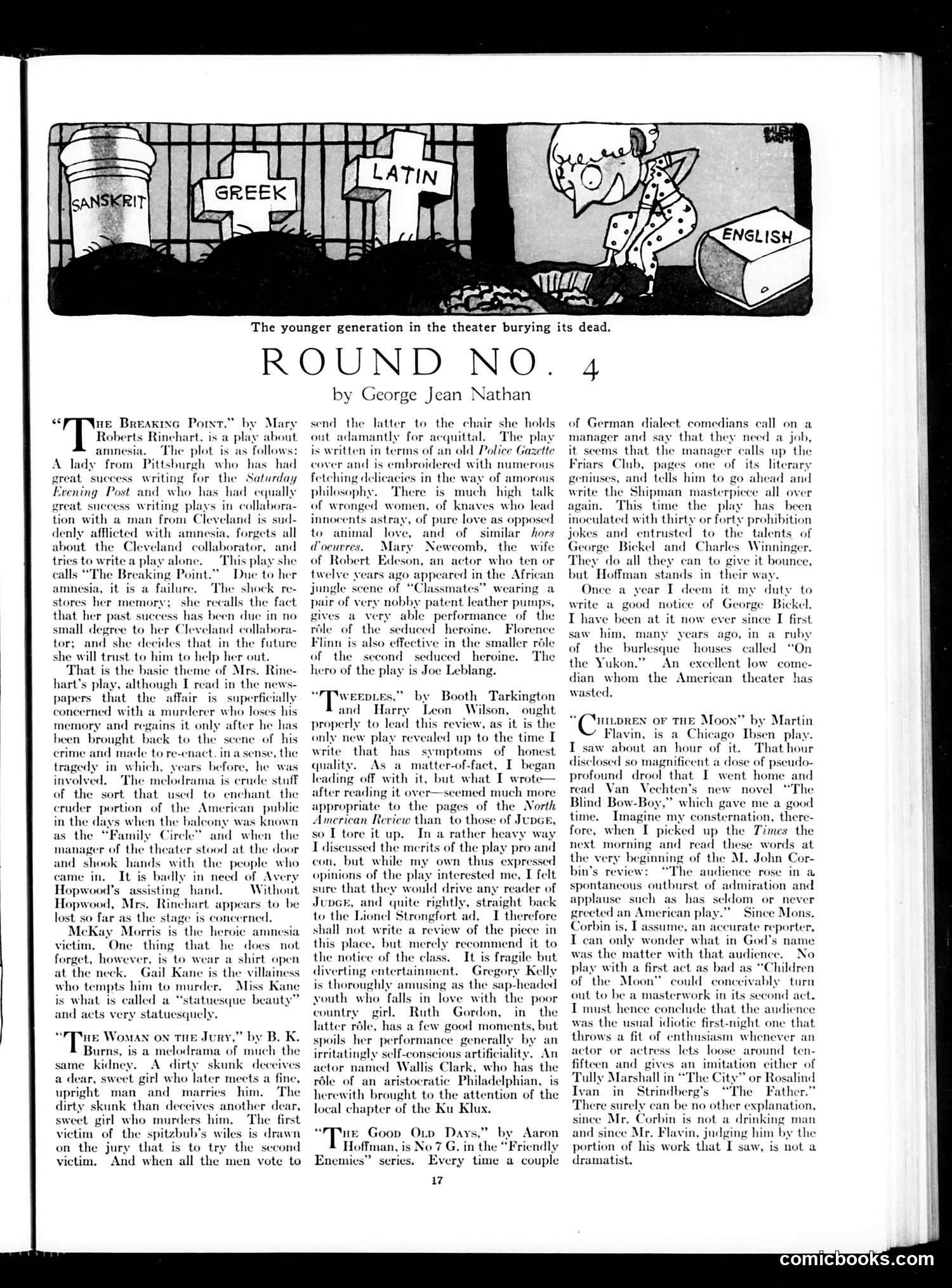
This page contains theater reviews by George Jean Nathan critiquing contemporary plays. The cartoon at top depicts "the younger generation in the theater burying its dead"—a satirical jab at old-fashioned melodrama giving way to modern theater. Nathan reviews three plays with harsh dismissal: 1. **"The Breaking Point"** by Mary Roberts Rinehart—he mocks its crude melodramatic plot about amnesia, suggesting Rinehart's success depends on her collaborator (implying women need male assistance). 2. **"The Woman on the Jury"** by B.K. Burns—he attacks its sensationalism, comparing it to lurid "Police Gazette" covers, though he praises actress Mary Newcomb's performance. 3. An unnamed Booth Tarkington play—Nathan admits finding it quality work but deemed his own review too serious for Judge's audience, claiming readers would prefer advertisements. The satire targets both the plays themselves and Nathan's own cynicism about popular taste and magazine editorial constraints.
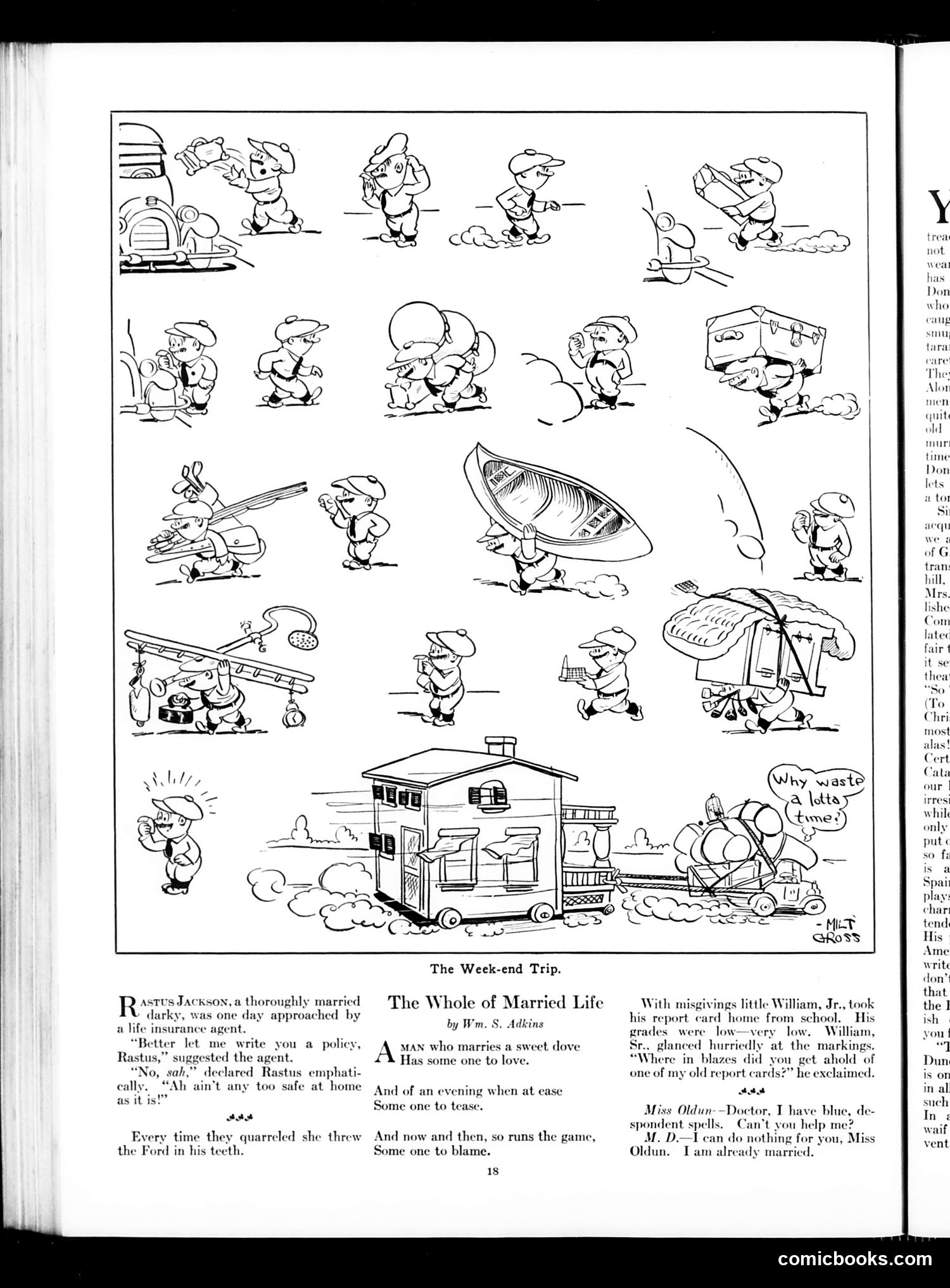
This page collects cartoons mocking married life circa early 20th century. The top panel shows a couple's chaotic weekend trip in a mobile home, depicting domestic discord through slapstick scenarios—arguments, mishaps, and general marital strife. The text jokes center on marriage's contradictions: a man won't buy insurance because home is already unsafe, a wife uses throwing "the Ford in his teeth" (holding past failures over him) during arguments, and a young boy's poor report card matches his father's old grades—suggesting inherited mediocrity. The final joke presents a doctor already married, therefore unable to help a woman's depression, implying matrimony itself causes despair. These cartoons reflect period anxieties about modern marriage (the automobile age), domestic conflict, and the tension between romantic idealism and marital reality—humor aimed at middle-class readers recognizing their own situations.
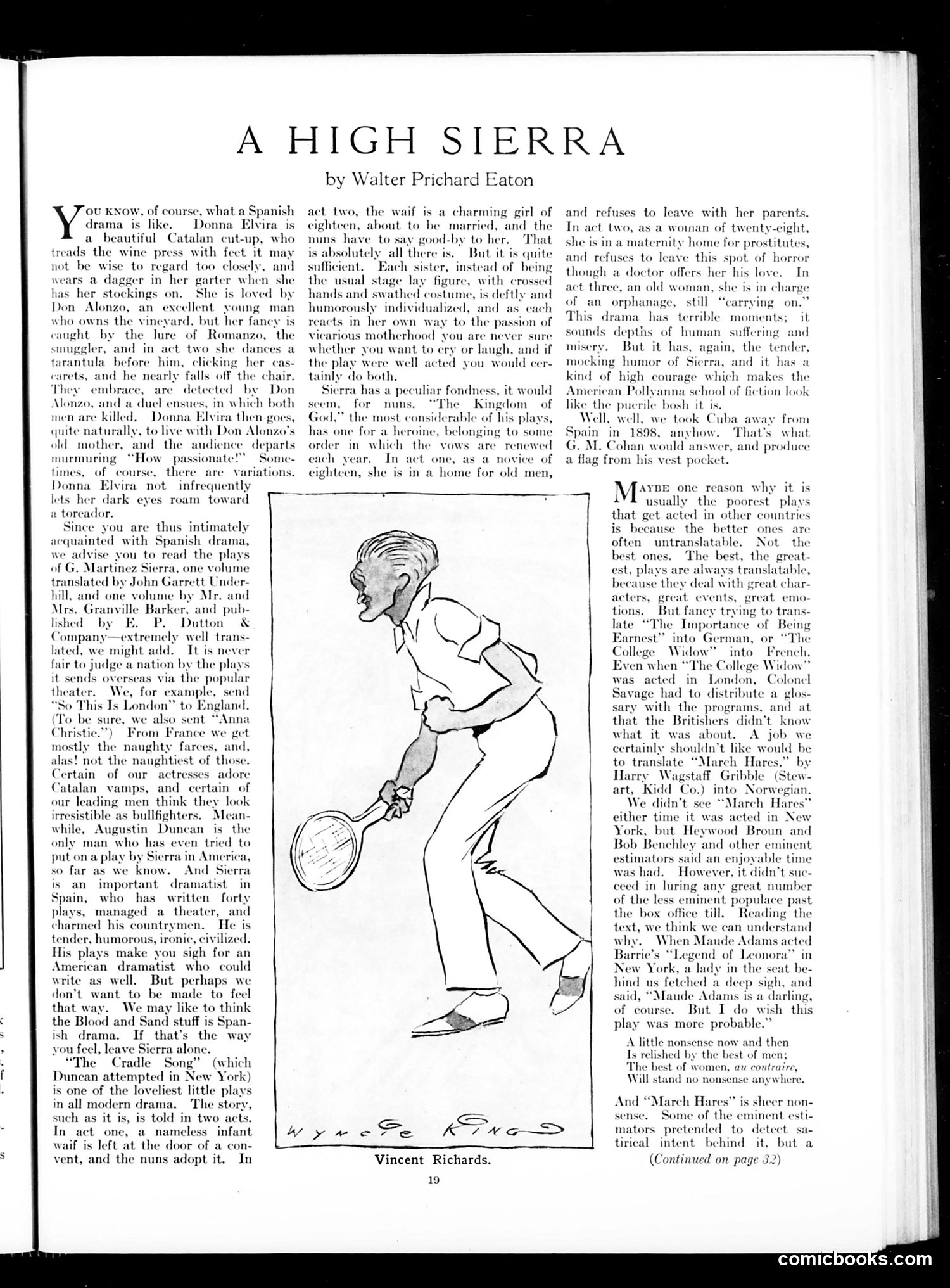
This page from *Judge* magazine features art critic Walter Prichard Eaton's essay introducing Spanish dramatist G. Martinez Sierra to American readers. **The Content:** Eaton opens with a humorous stereotype of Spanish drama—passionate heroines, smugglers, duels, and melodrama—to establish context. He argues that American audiences receive distorted impressions of foreign cultures through popular theater exports. He cites examples: America sends "So This Is London" to England; France exports naughty farces. **The Main Point:** Eaton advocates for Sierra's actual work, particularly *"The Cradle Song,"* which he praises as sophisticated, tender, and psychologically nuanced—unlike the blood-and-sand clichés Americans associate with Spanish drama. He notes Augustin Duncan attempted staging Sierra in America but largely failed. **The Illustration:** The sketch shows a tennis player (likely Vincent Richards, a famous American player of the era), appearing unrelated to the article—typical of *Judge's* layout mixing editorial content with sports commentary. **The Satire:** The essay gently mocks both American preconceptions about Spanish theater and American theater's low reputation abroad.
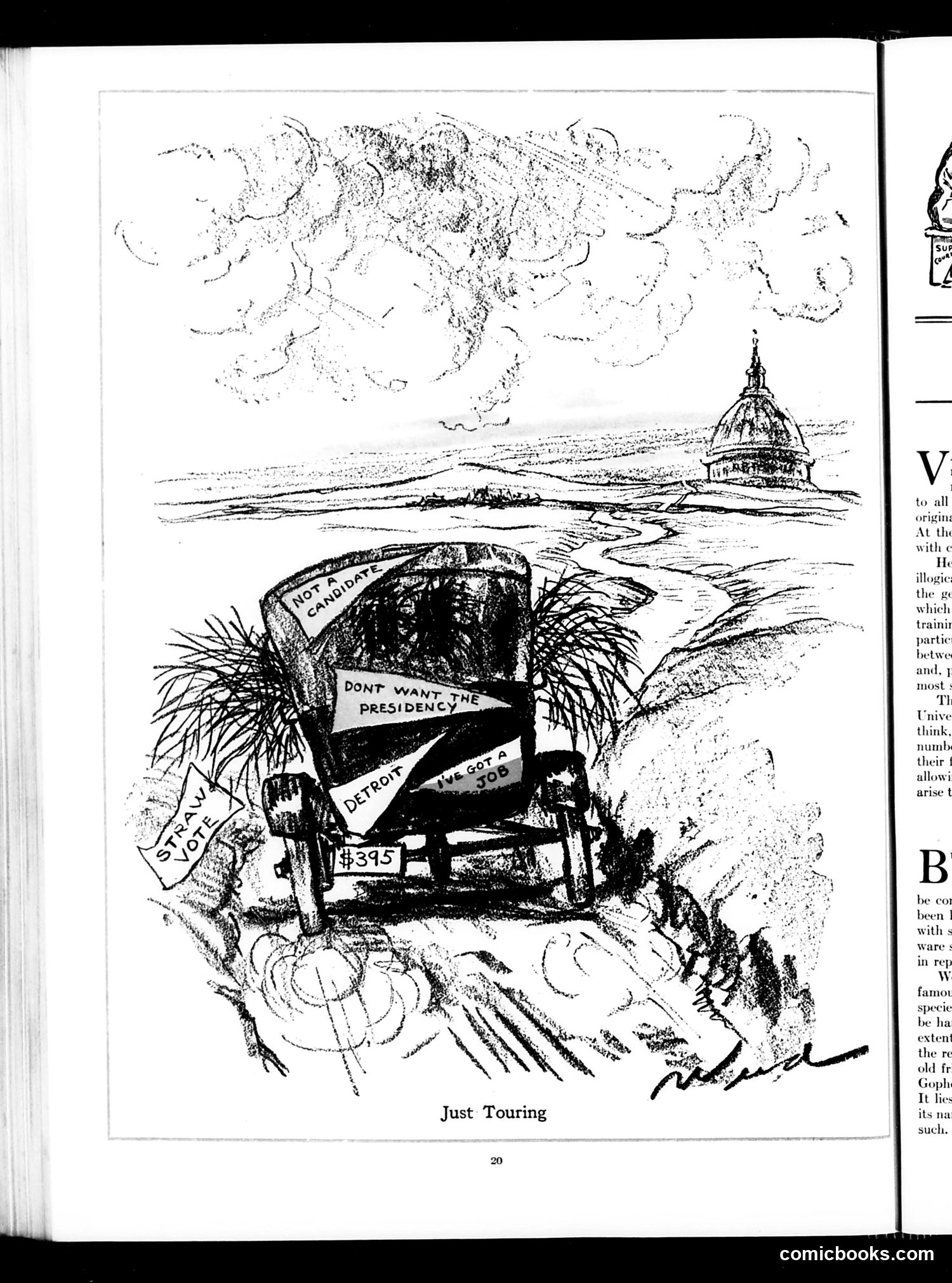
This cartoon satirizes political tourism and campaign rhetoric, likely from the early 20th century. The central image shows a chair—labeled with various slogans including "DON'T WANT THE PRESIDENCY," "NOTROGATE," and "$395"—planted in a barren landscape with a Capitol dome visible in the background. The satire appears to mock a political figure engaged in a speaking tour (hence "Just Touring") who publicly disavows presidential ambitions while touring the country. The numbered price tag ($395) and conflicting messages on the chair suggest hypocrisy or the commercialization of politics. The desolate setting with sprouting weeds implies the empty or sterile nature of such campaigns. Without identifying the specific figure or exact date, the cartoon criticizes the contradiction between stated disinterest in high office and active political campaigning—a timeless theme in American political satire.
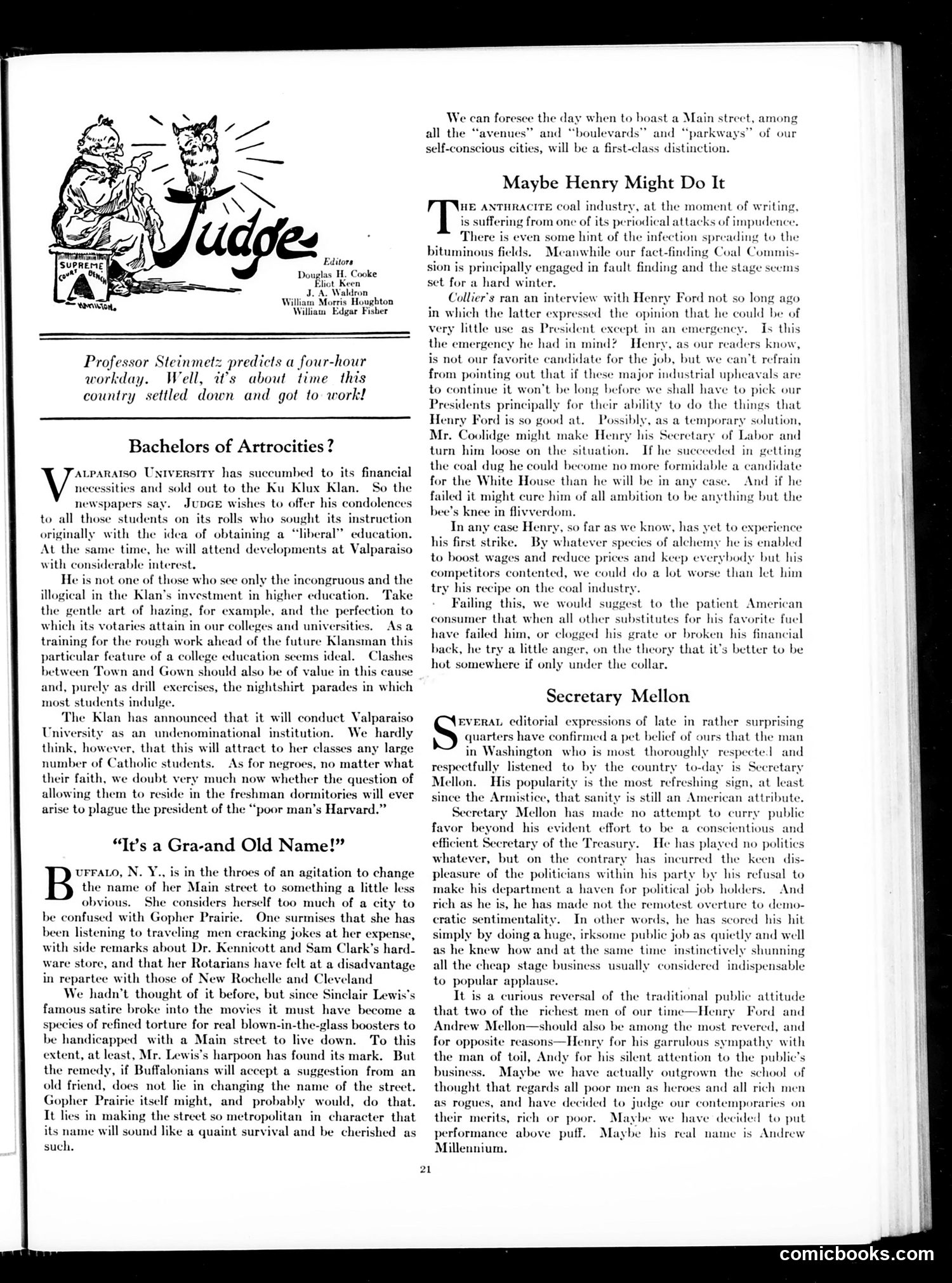
**The Cartoon (top left):** Shows a judge figure confronting what appears to be a menacing owl or cat-like creature labeled "Judge"—likely representing satirical commentary itself striking back. **Main Articles:** 1. **"Bachelors of Artrocities?"** - Satirizes Valparaiso University's reported financial ties to the KKK (a contemporary scandal). Judge sarcastically notes the Klan's college involvement aligns with existing hazing traditions and "nightshirt parades" (KKK's robes), while pointedly questioning whether Catholic and Black students will actually be welcomed despite claims of being "undenominational." 2. **"It's a Gra-and Old Name!"** - Mocks Buffalo's attempt to rename Main Street to sound more cosmopolitan, referencing Sinclair Lewis's *Main Street* satire of small-town America. Judge argues the solution isn't renaming but making the street itself genuinely metropolitan. 3. **"Maybe Henry Might Do It"** - Discusses Henry Ford as potential presidential material during coal industry labor unrest, suggesting he might resolve the crisis. The page reflects 1920s anxieties about the KKK, small-town identity, and industrial labor disputes.
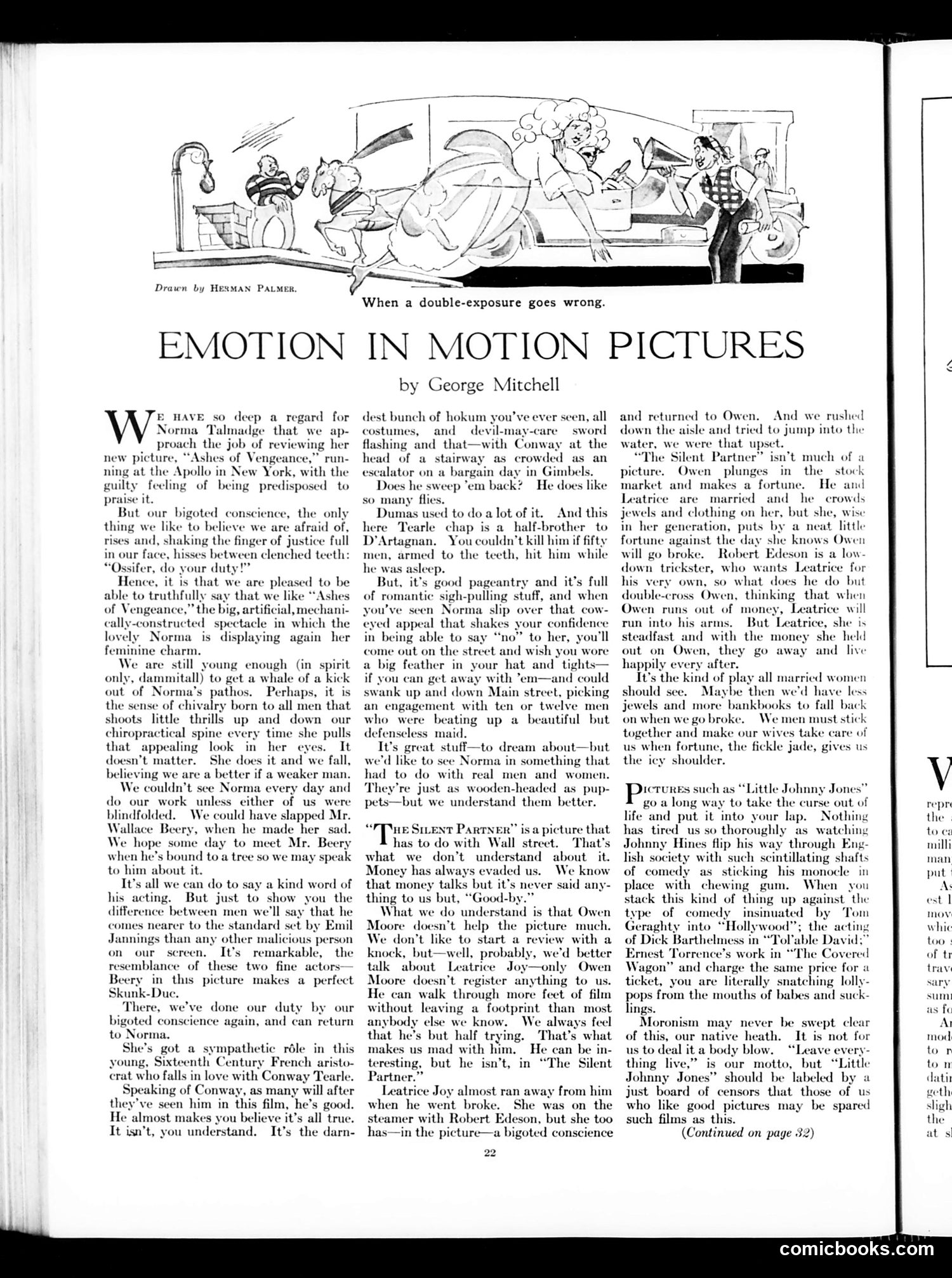
This page reviews two silent films for *Judge* magazine (a satirical publication). The cartoon at top satirizes double-exposure photography mishaps in filmmaking. The main article critiques "Ashes of Vengeance" starring Norma Talmadge and "The Silent Partner" with Owen Moore. The reviewer admits bias toward Talmadge but praises her emotional performance anyway. He harshly dismisses Wallace Beery's acting while praising Jack Haines and Jack Conway's swashbuckling pageantry. For "The Silent Partner," the reviewer admits confusion about Wall Street finance but criticizes Owen Moore for being wooden and forgettable—he literally leaves no impression on film. The satire mocks both the overwrought melodrama of silent cinema and actors who fail to create memorable screen presence. The tone is arch and witty, typical of *Judge's* entertainment criticism.
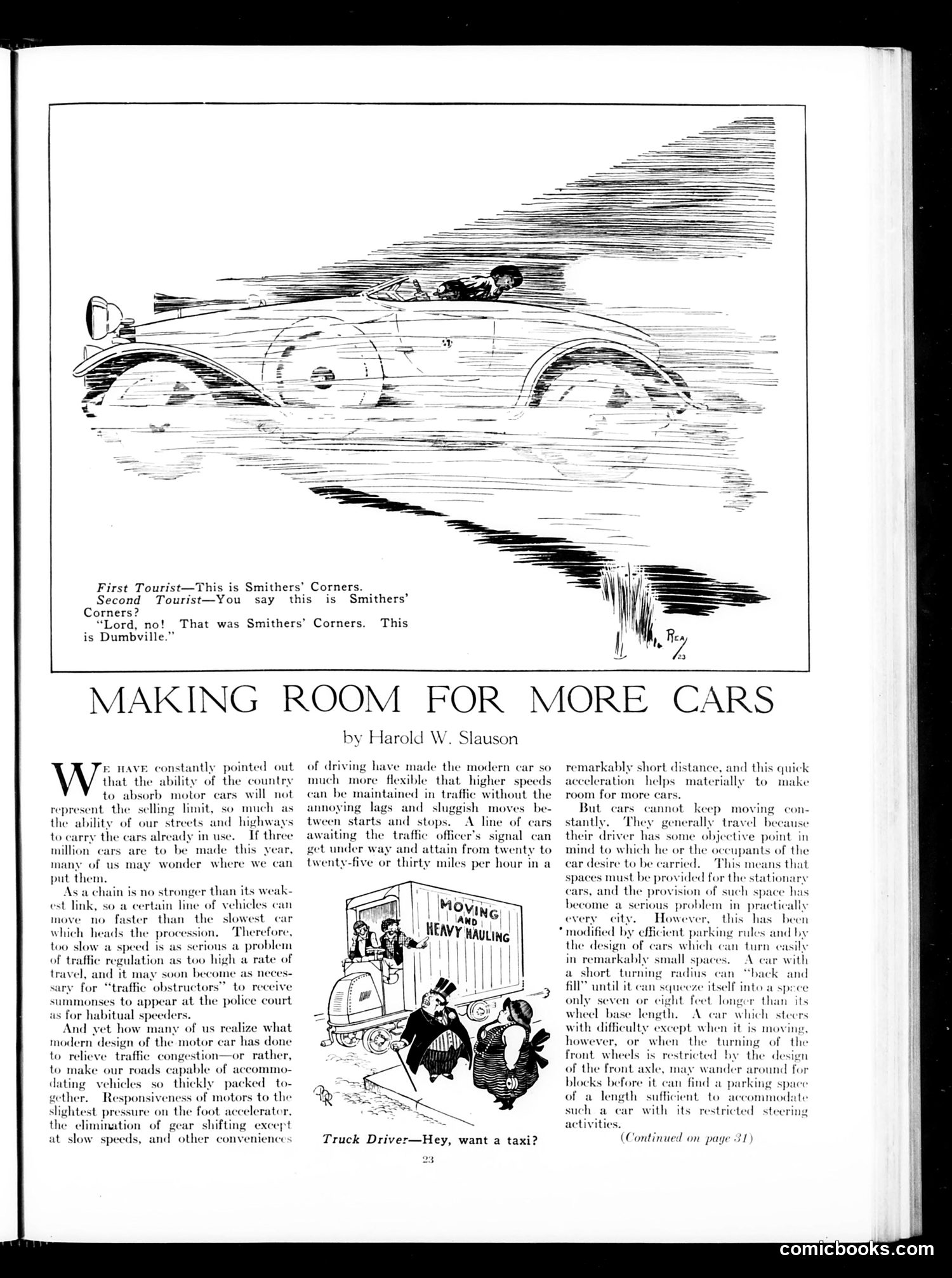
This article and cartoon satirize the practical chaos of rapidly expanding automobile use in 1920s America. The top cartoon depicts two tourists arguing over location names—a joke about how speeding cars blur landmarks into indistinguishability, making "Smithers' Corners" and "Dumbville" visually identical. The main article by Harold W. Slauson addresses a genuine urban problem: while factories can produce millions of cars annually, cities lack parking and road capacity. The satire lies in the article's earnest celebration of modern car design features (responsive engines, quick acceleration, tight turning radii) as *solutions* to congestion, when these features merely enable more cars to pack into already-overwhelmed streets. The cartoon at bottom shows a truck driver sarcastically offering a taxi—suggesting traffic is so gridlocked that motorized transport has become absurd. The piece captures early automotive-era anxiety: technological progress was outpacing urban infrastructure, and no one had answers.
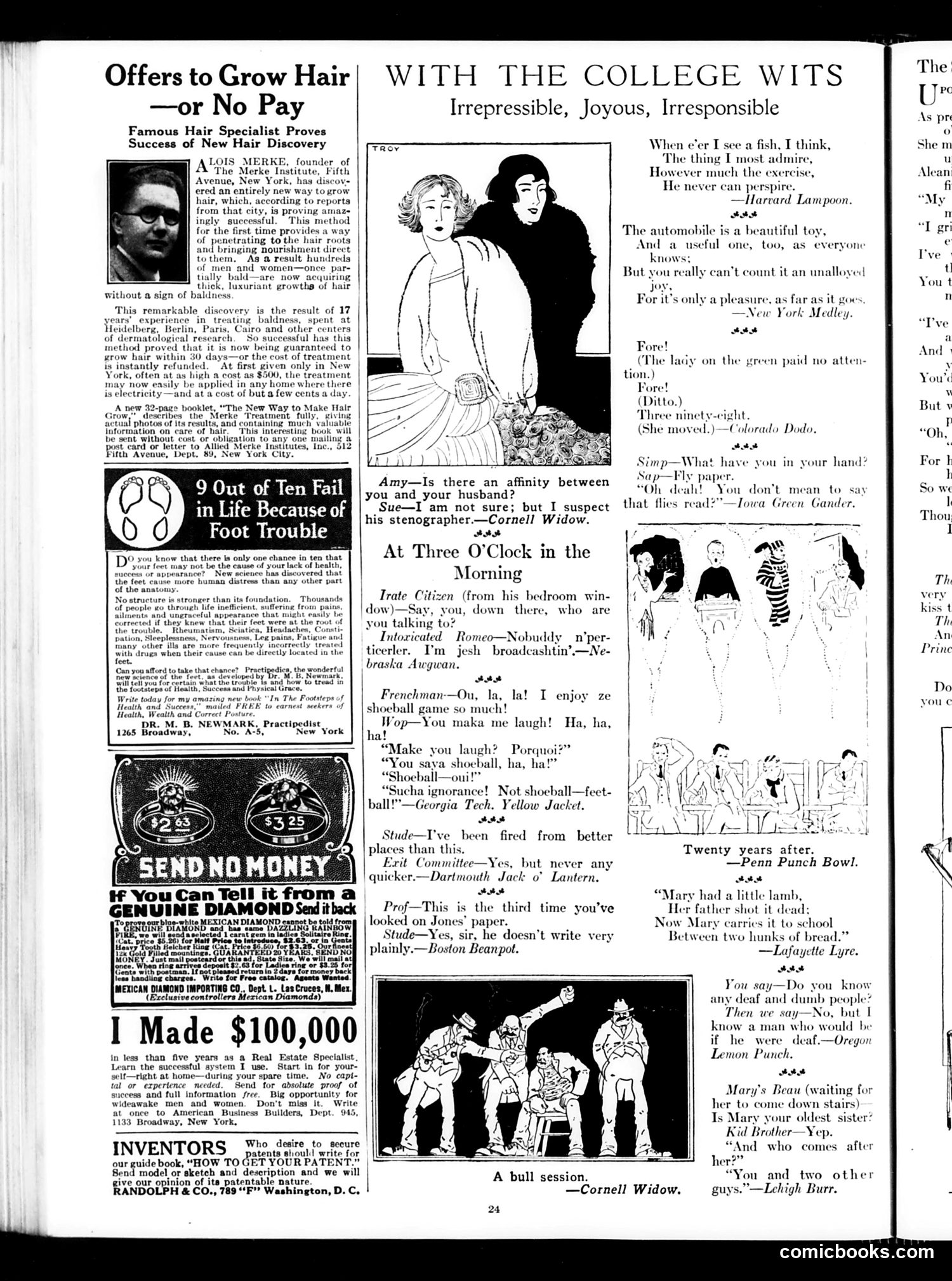
This page from *Judge* magazine contains mostly **advertisements and college humor** rather than political satire. The top half features ads for dubious products typical of early 20th-century magazines: hair growth treatments, foot trouble cures, "Mexican diamonds," real estate schemes, and patent services—all promising quick success with minimal effort. The right column, titled "With the College Wits," collects humorous quips and jokes from college humor magazines (Harvard Lampoon, Cornell Widow, etc.). These are lighthearted, absurdist jokes about fish that can't perspire, automobiles, golf, marital relations, and a student copying homework. The humor is juvenile and relies on wordplay and non-sequiturs rather than social commentary. The cartoon "A Bull Session" (bottom) shows college students in casual conversation—the title itself is the joke, playing on the phrase's double meaning. Overall, this page reflects *Judge*'s content mix: mostly commercial advertising alongside mild collegiate humor, with little political or satirical edge.
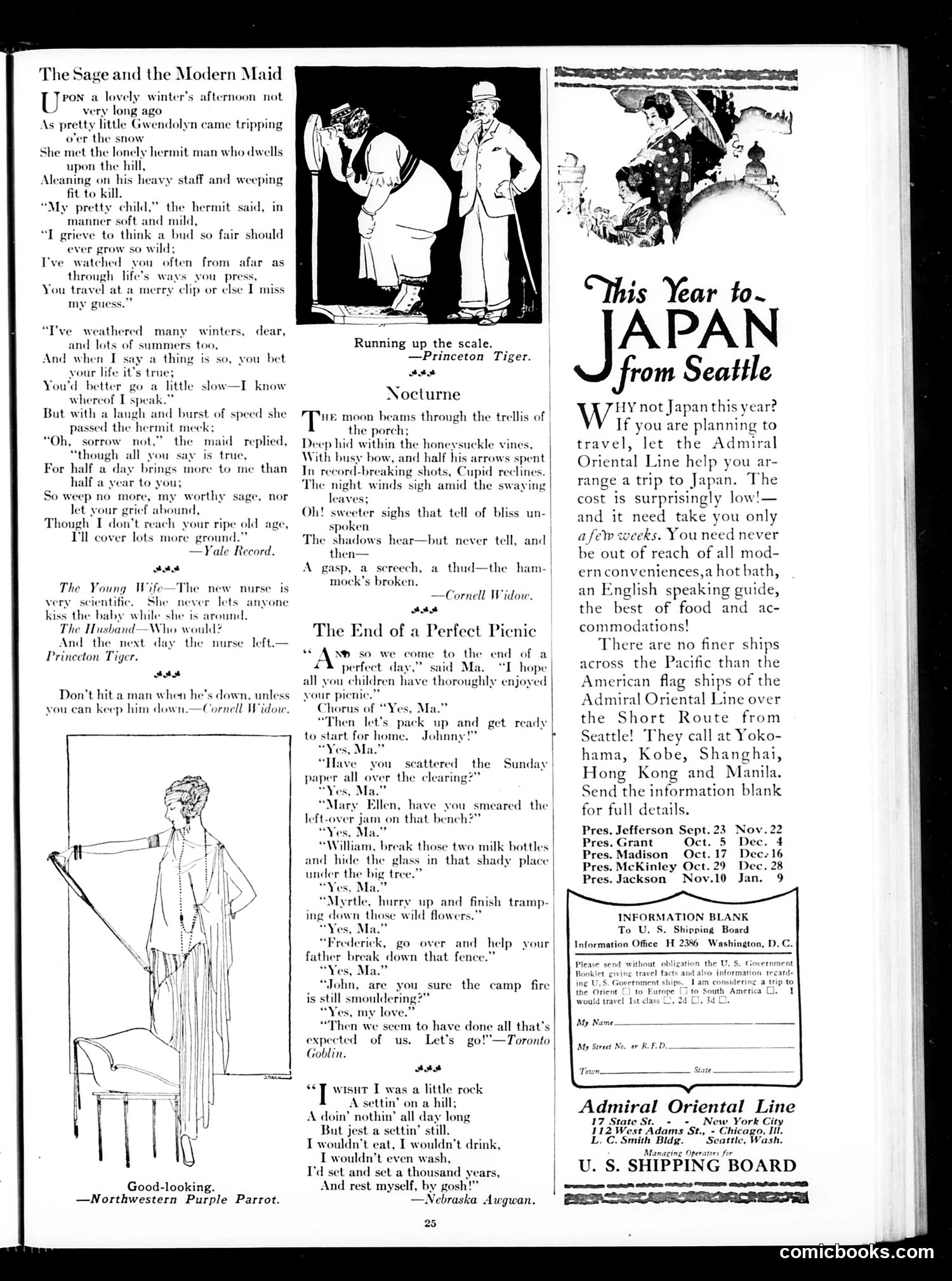
This page from *Judge* contains several satirical pieces and an advertisement: **"The Sage and the Modern Maid"** mocks the Victorian "proper young lady" ideal. An elderly hermit lectures a young woman about wild behavior and frivolous living, but she dismisses his moralizing, insisting she'll "cover lots more ground" despite her youth. The satire targets outdated patriarchal advice and the generational disconnect—the maid represents the modern, independent woman rejecting elderly male authority. **"The End of a Perfect Picnic"** uses ironic dialogue where a mother asks children about their outing. Their "perfect day" involved scattering papers, breaking bottles, spilling jam, trampling flowers, and leaving a smoldering fire—depicting children as destructive and careless, satirizing the nostalgic ideal of wholesome family outings. The remaining items are brief college humor jokes and illustrations. **The advertisement** promotes Admiral Oriental Line steamship travel to Japan from Seattle, targeting affluent readers with appeals to luxury and convenience.
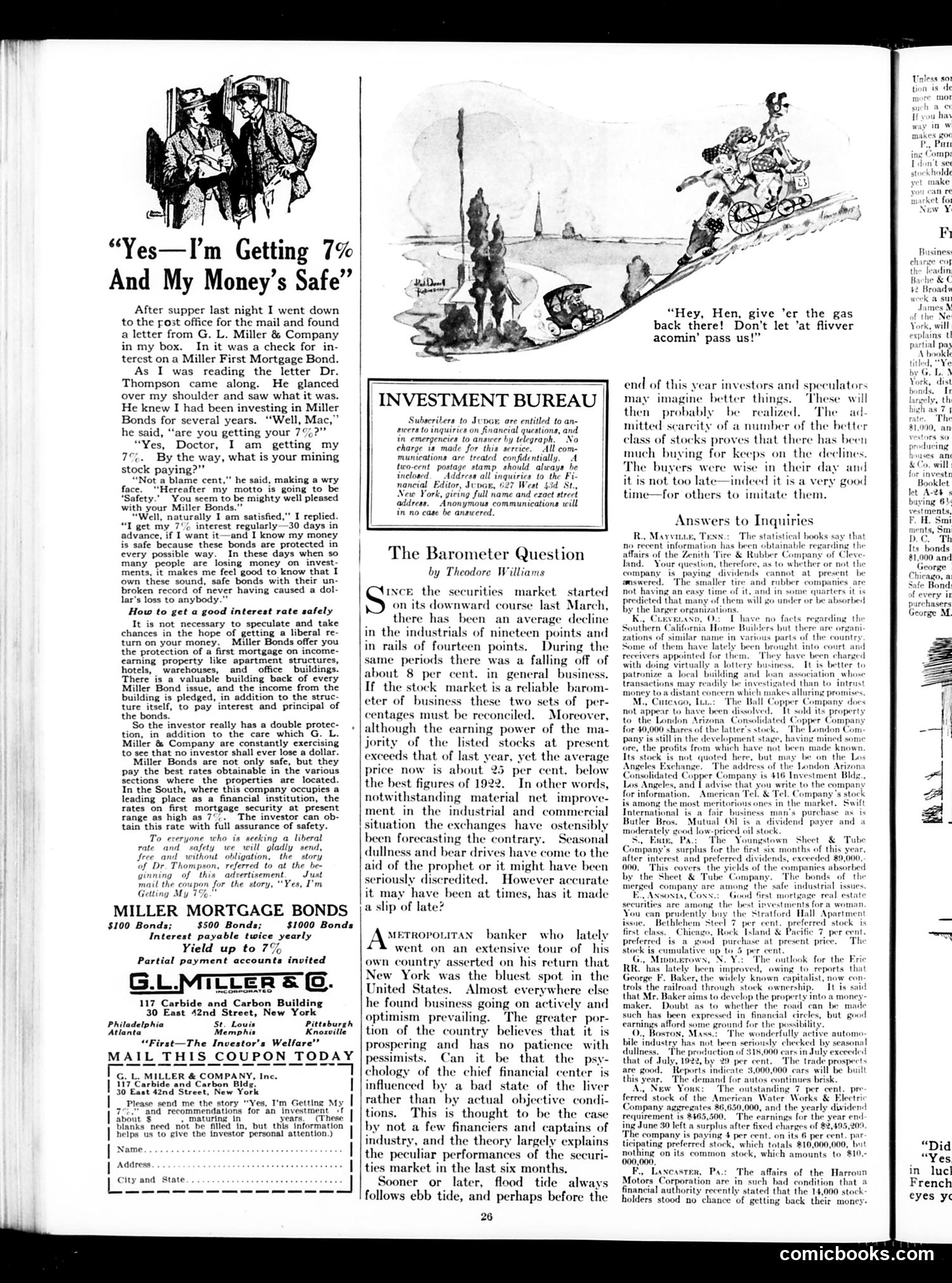
**MAIN CONTENT: ADVERTISEMENT** This page is primarily a G.L. Miller & Company advertisement for mortgage bonds, framed as a satirical story. The narrative depicts a satisfied bond investor named "Mac" who consistently receives 7% interest, contrasted with Dr. Thompson, who owns speculative mining stock paying nothing. **THE SATIRE:** The joke targets investors who chase risky speculative investments. During the 1920s stock boom, mining stocks were popular gambling vehicles. The ad weaponizes this comparison—the safe, steady bond investor is wise and content, while the speculative investor faces losses. **CARTOONS VISIBLE:** Two small sketches appear: one showing two men in conversation (likely the dialogue subjects), another depicting reckless drivers in a car, illustrating the dangers of risky financial behavior. **HISTORICAL CONTEXT:** This advertisement predates the 1929 crash. It ironically emphasizes "safety" and "never having caused a dollar's loss," claims that would soon become tragically obsolete for many financial institutions.
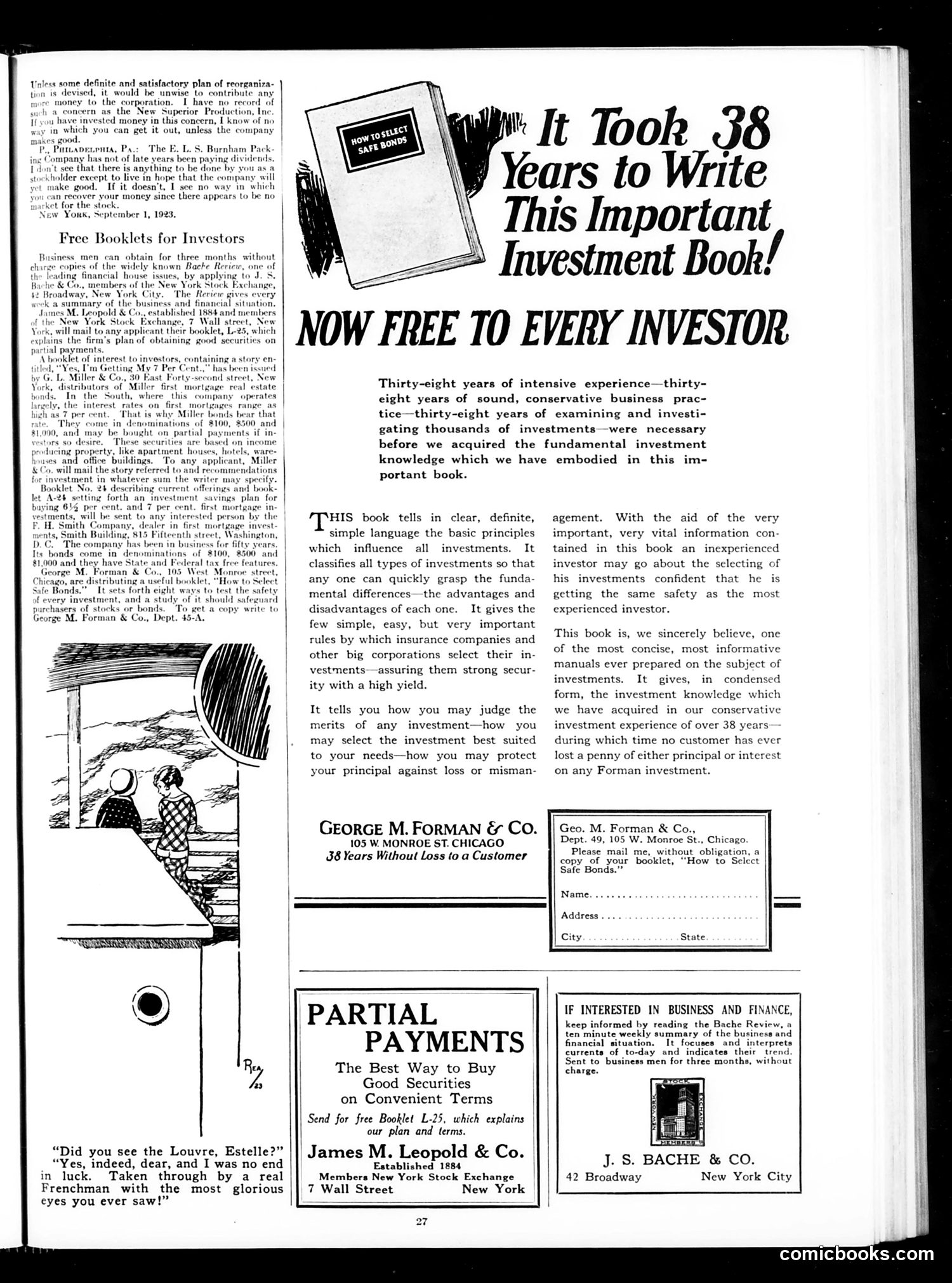
This page is primarily **advertising and investment advice**, not satire. The main content consists of: 1. **Investment advice column** (top left): Readers write to "Judge" asking about failed stock investments. The responses are cautionary—one company shows no dividends, another appears defunct with no recovery path for investors. 2. **Free booklet advertisements**: Multiple investment firms (George M. Forman & Co., James M. Leopold & Co., J.S. Bache & Co.) offer free guides to selecting securities and bonds. The emphasis on "38 years without loss to a customer" suggests trust-building after widespread investment losses. 3. **"Partial Payments" ad**: Promotes buying securities on installment plans. 4. **Bottom cartoon**: A humorous anecdote about a woman visiting the Louvre museum, unrelated to finance—possibly filler content. **Historical context**: This 1923 page reflects post-WWI economic uncertainty and investor caution before the 1929 crash. The repeated warnings about failed investments suggest genuine financial distress among readers.
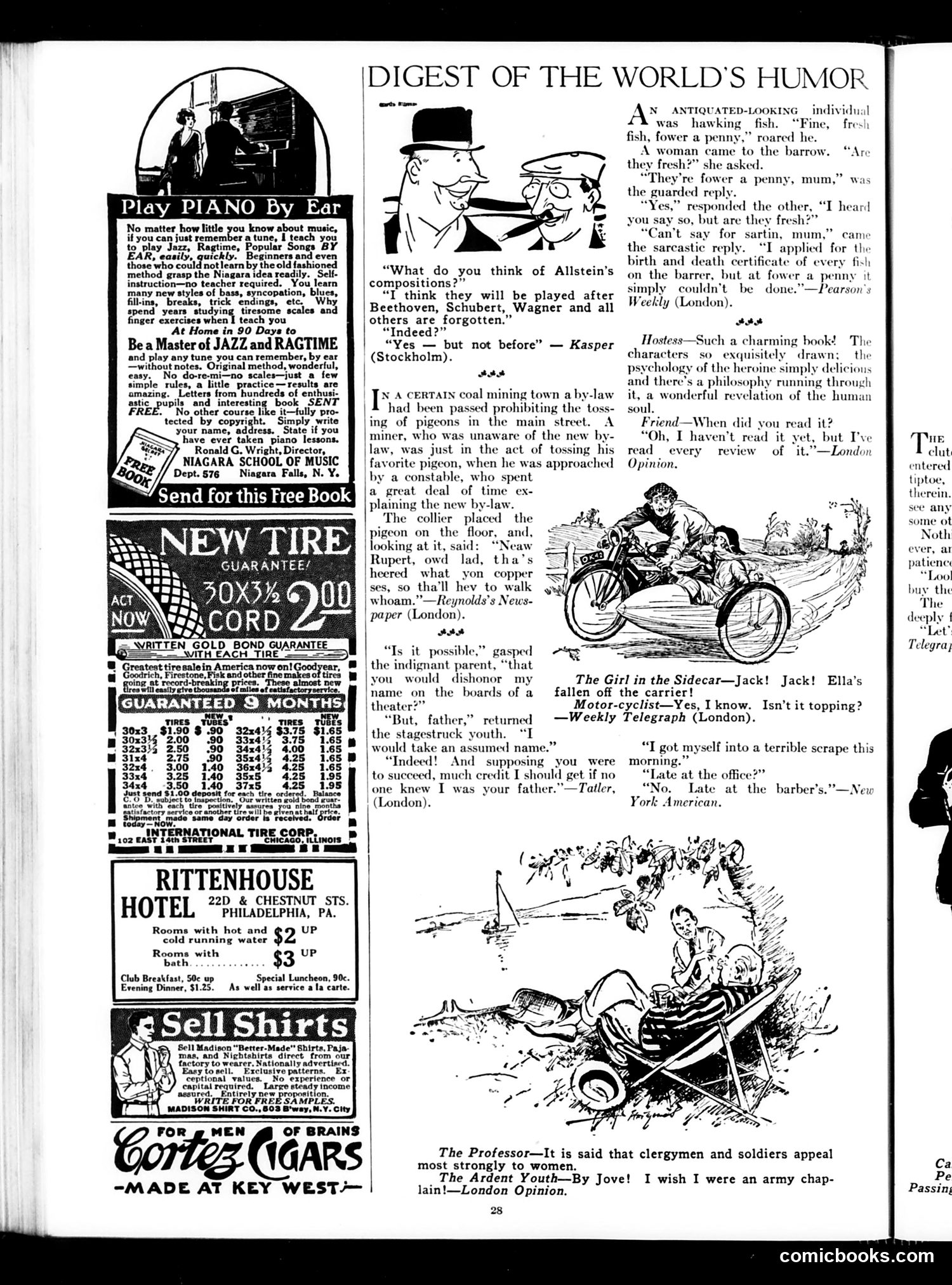
This page is primarily a **humor column** collecting brief jokes and anecdotes from various international sources, rather than political cartooning. The content consists of short comic exchanges and observations, mostly reprinted from European publications (Stockholm, London, etc.). The jokes touch on mundane social situations: a woman questioning a fishmonger about freshness; a miner confused by new bylaws prohibiting pigeon-tossing; a young man defending his theatrical ambitions to his skeptical father; and a hostess admitting she hasn't actually read the "charming book" she's praising. The accompanying illustrations show lighthearted domestic scenes—a motorcycle sidecar accident, sledding mishaps—matching the gentle, everyday humor of the text. The **advertisements** dominate the left margin, hawking piano lessons, tires, hotel rooms, and cigars—typical early 20th-century periodical filler. There is **no significant political content** on this page.
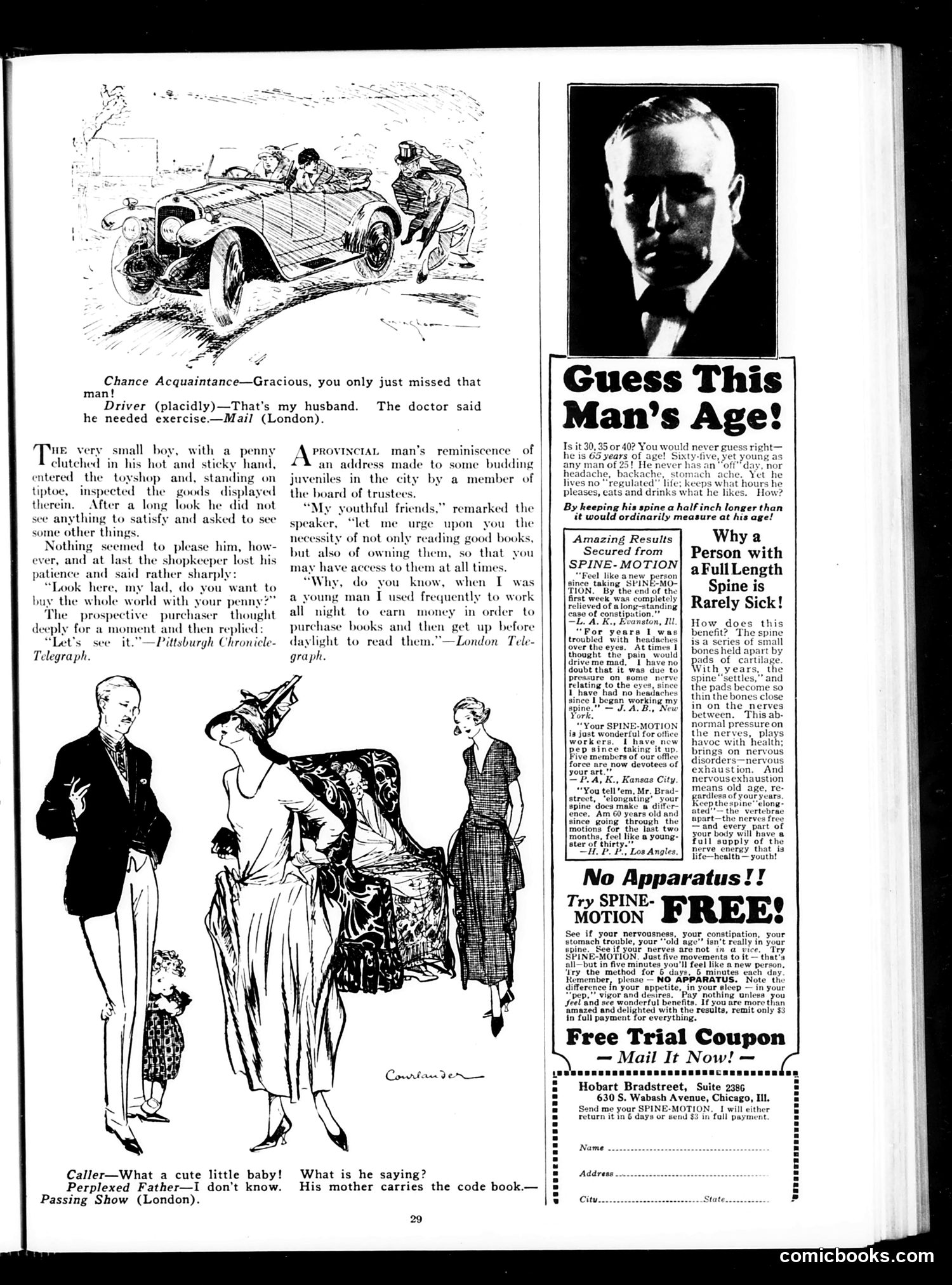
This page mixes short humor pieces with a prominent medical advertisement. The cartoons are brief jokes: a driver explains his speeding by noting it's exercise for his husband; a boy with a penny wants to "buy the whole world"; a father can't guess his own baby's parentage. The dominant content is a "Guess This Man's Age" advertisement for **Spine-Motion**, a mail-order device claiming spinal manipulation prevents aging and cures various ailments (headaches, constipation, nervousness). The testimonials promise remarkable health improvements through maintaining spinal length. This reflects early 20th-century pseudoscience marketing—the page exploits period anxiety about aging and health while making unfounded medical claims. The "free trial coupon" model (with $3 payment required) was typical of dubious mail-order remedies common in this era before FDA regulations.
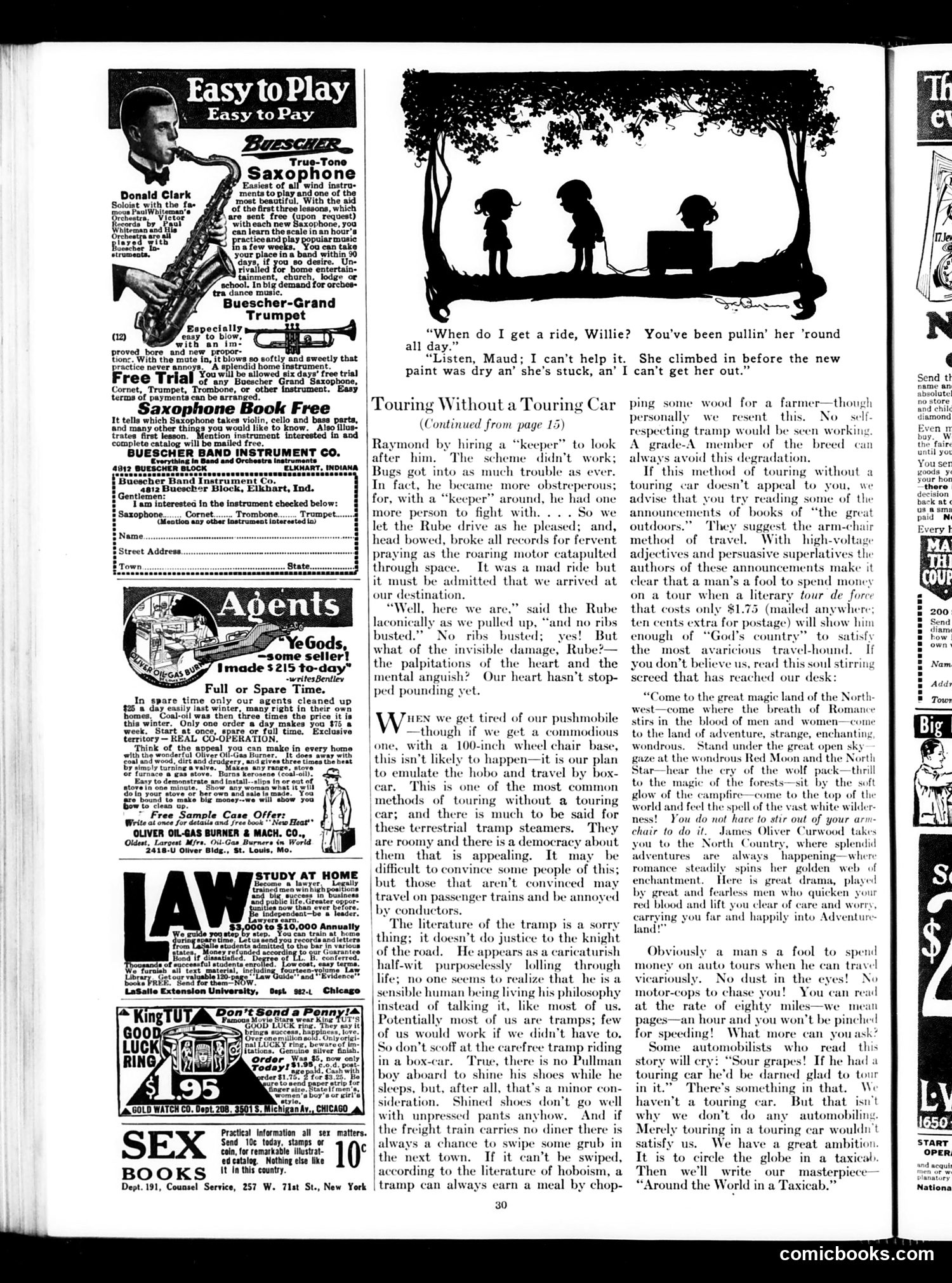
This page is primarily **advertising**, not political satire. The main content consists of product advertisements for musical instruments (Buescher saxophones and trumpets), oil burners, correspondence law school, and sex education books—typical of early 20th-century magazines. The small silhouette cartoon at top shows children asking "When do I get a ride, Willie?"—a simple domestic humor piece with no political meaning. The substantive text article, "Touring Without a Touring Car," discusses unconventional travel methods during an era when automobiles were still novel luxuries. It humorously recounts hiring an unreliable driver ("the Rube") and advocates for alternative travel via boxcars or trains as democratic, affordable options. The page reflects **early automotive-era attitudes**: cars as expensive novelties, railways as common transportation, and humor about the challenges of motorized travel. There are no identifiable political figures or satirical commentary—this is simply a period commercial and lifestyle magazine page.
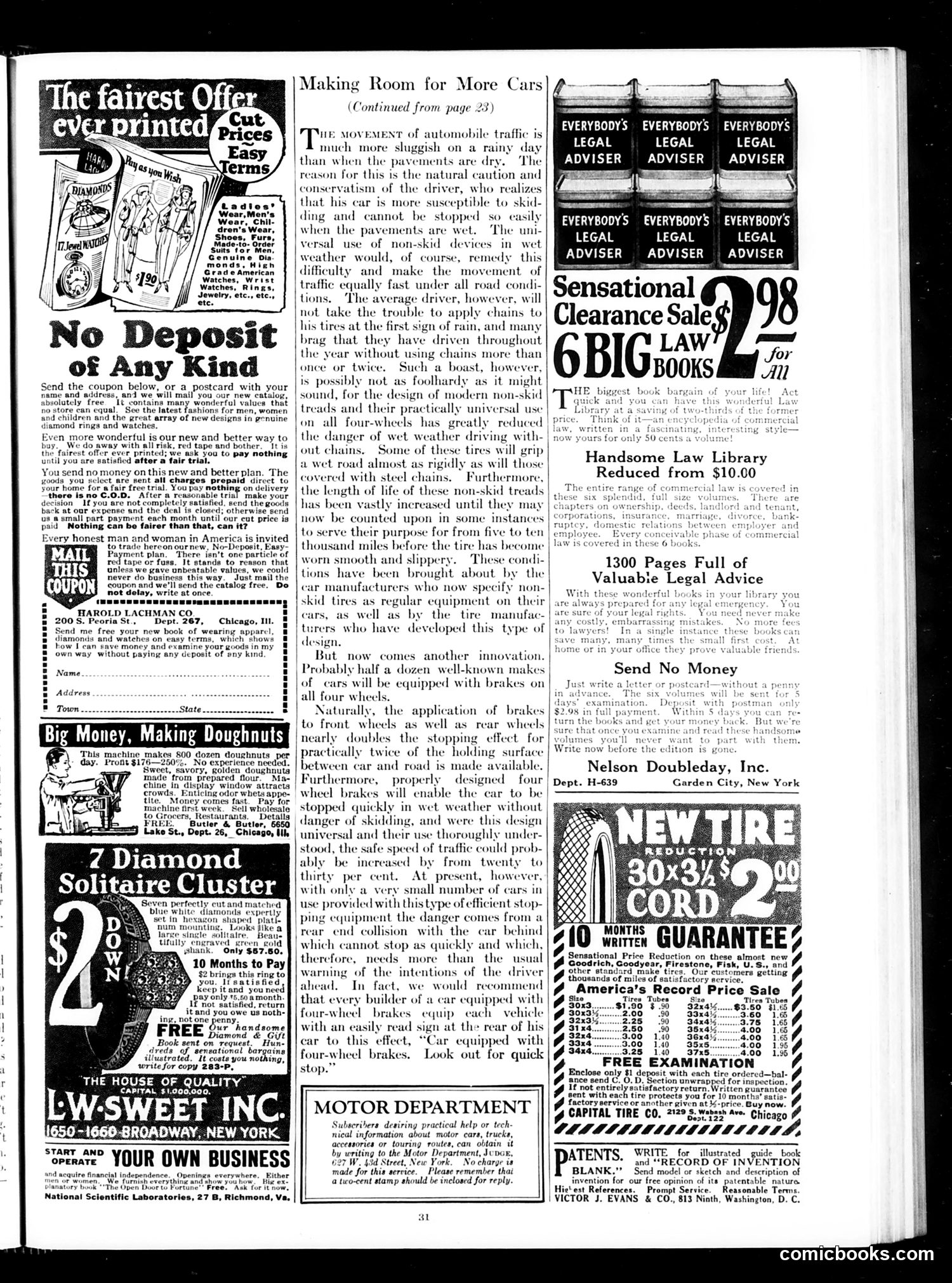
This is primarily an **advertising page** with a secondary article about automobile safety innovations. The main content is commercial: multiple ads for jewelry (diamond rings via mail-order), doughnuts-making machines, tire sales, and law books—typical early-20th-century classified advertising offering "easy payment" schemes with "no deposit." The editorial article, "Making Room for More Cars," discusses practical automobile safety during wet weather. It explains that modern non-skid tires have reduced the need for chains, and promotes the emerging innovation of **four-wheel brakes**—then a new technology that would "nearly double" stopping power compared to rear-wheel brakes alone. The article presents this as a progressive development by manufacturers improving road safety. The tone is informational rather than satirical. No specific political figures or cartoons appear on this page. It represents typical 1920s consumer culture: mail-order buying, automotive technology advancement, and marketing techniques emphasizing convenience and risk-free transactions to appeal to working-class readers.
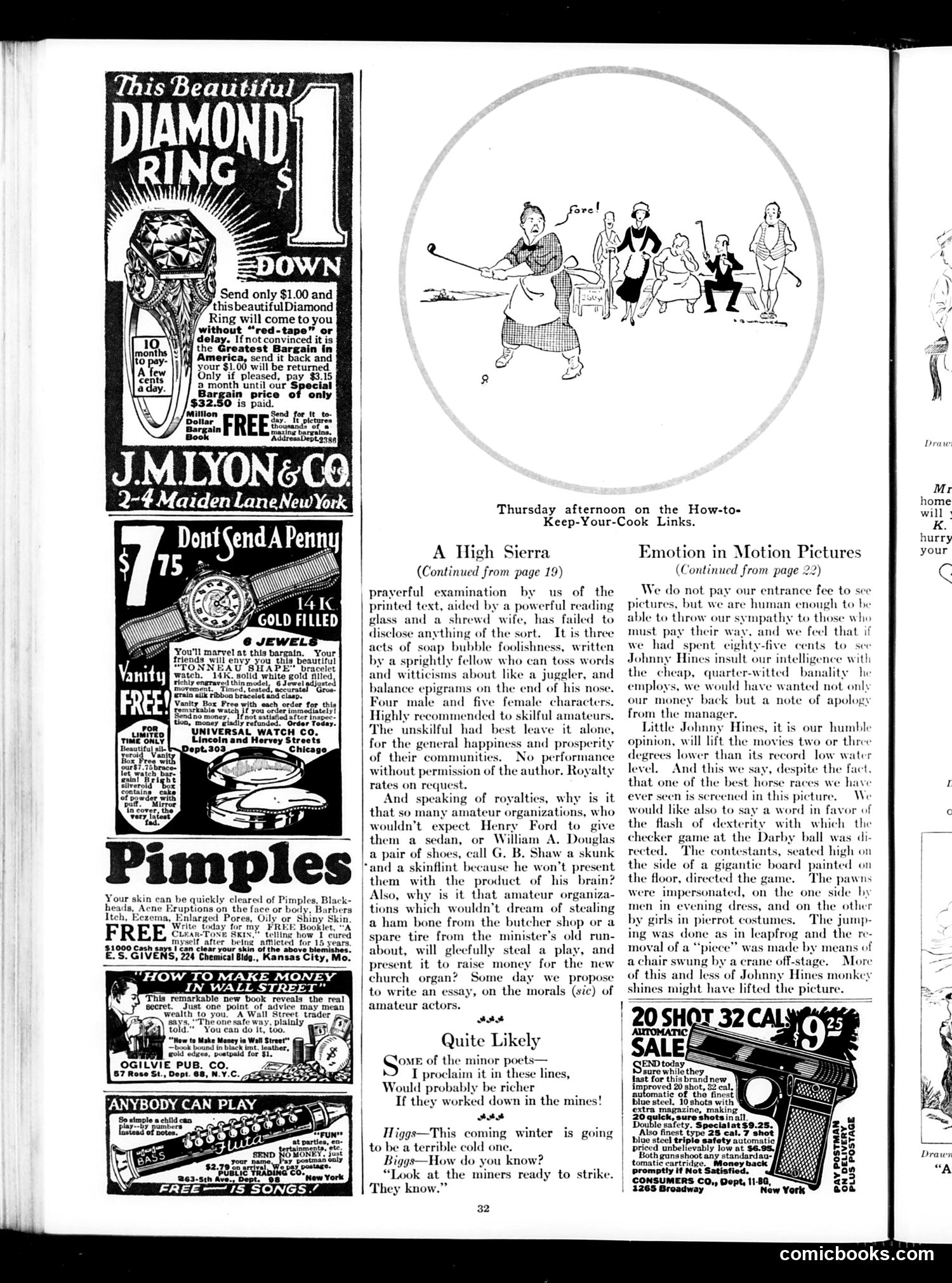
This page is primarily **advertising**, with minimal cartoon content. The visible cartoon appears in the center: a simple sketch titled "Thursday afternoon on the How-to-Keep-Your-Cook Links," showing people golfing—likely satirizing domestic servants' leisure time or class dynamics. The page features period advertisements (diamond rings, watches, pimple treatments, Wall Street investment guides) typical of early 20th-century magazines. The substantial text includes two theater reviews: "A High Sierra" criticizes an amateurish three-act play as "soap bubble foolishness," and "Emotion in Motion Pictures" harshly reviews actor Johnny Hines's film, arguing it insults audience intelligence despite featuring an impressive horse-racing sequence and creative checkers scene. A brief satirical poem titled "Quite Likely" jokes that minor poets would be richer working in mines, with miners' strike-readiness implying economic hardship. The page reflects Judge's mix of advertising revenue and theatrical criticism/light satire.
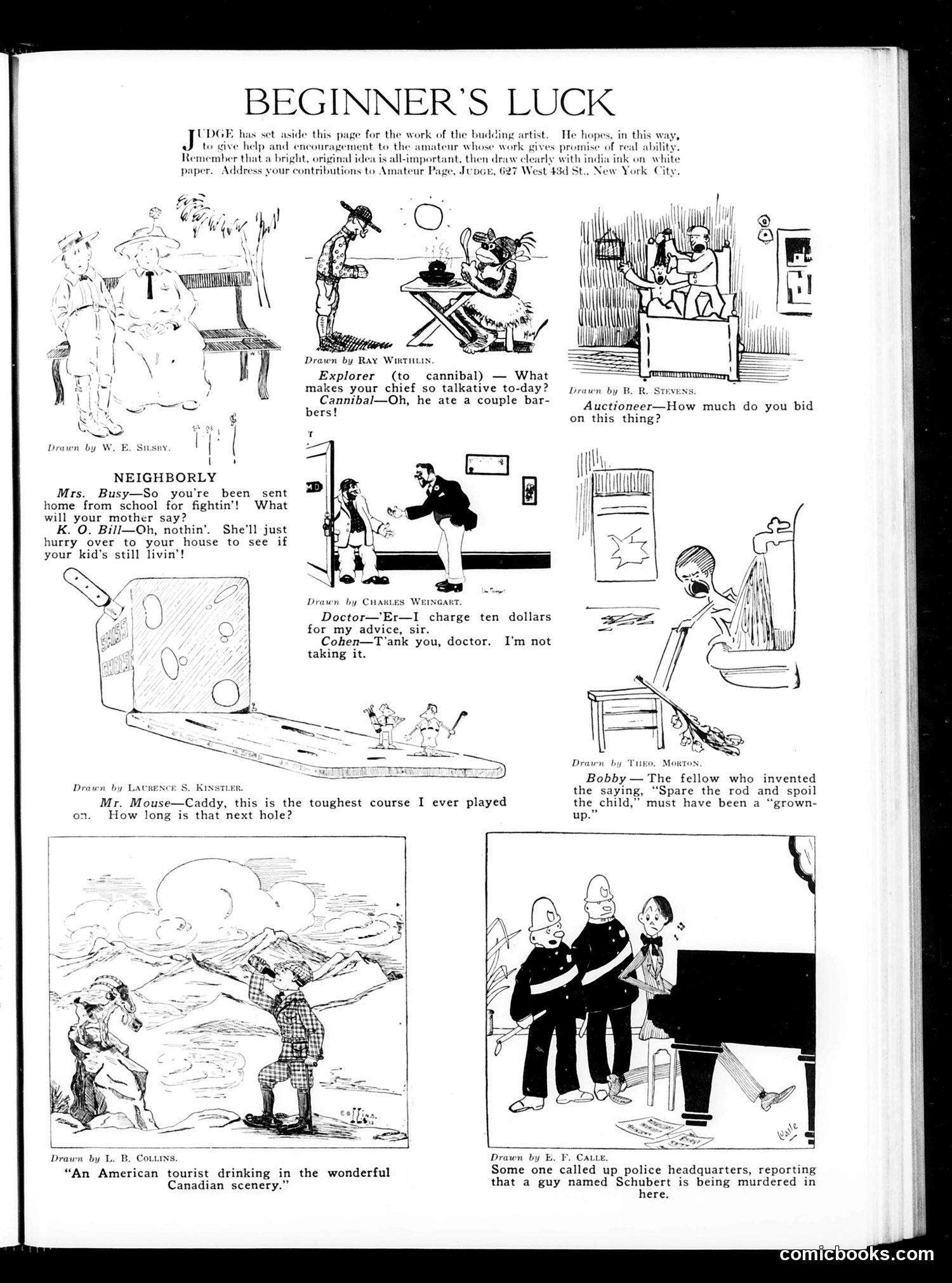
This is an editorial page encouraging amateur cartoonists to submit work. It displays several short comic strips by aspiring artists, each featuring a brief humorous exchange: The jokes rely on simple, often crude humor: a cannibal's chief talks excessively because he ate "a couple bartenders"; a schoolboy threatens to visit his neighbor's house after a fight; a doctor charges ten dollars for advice a patient refuses; a golfer complains about a difficult golf course; and police respond to a report of "Schubert being murdered" (likely a musical pun). Most humor stems from wordplay, physical violence treated casually (schoolyard fighting), or ethnic stereotypes (the "Cohen" character with exaggerated Yiddish speech; the cannibal trope). The page itself is essentially a submission showcase—not satirizing specific political figures or events, but rather demonstrating what amateur cartooning looked like in this era.
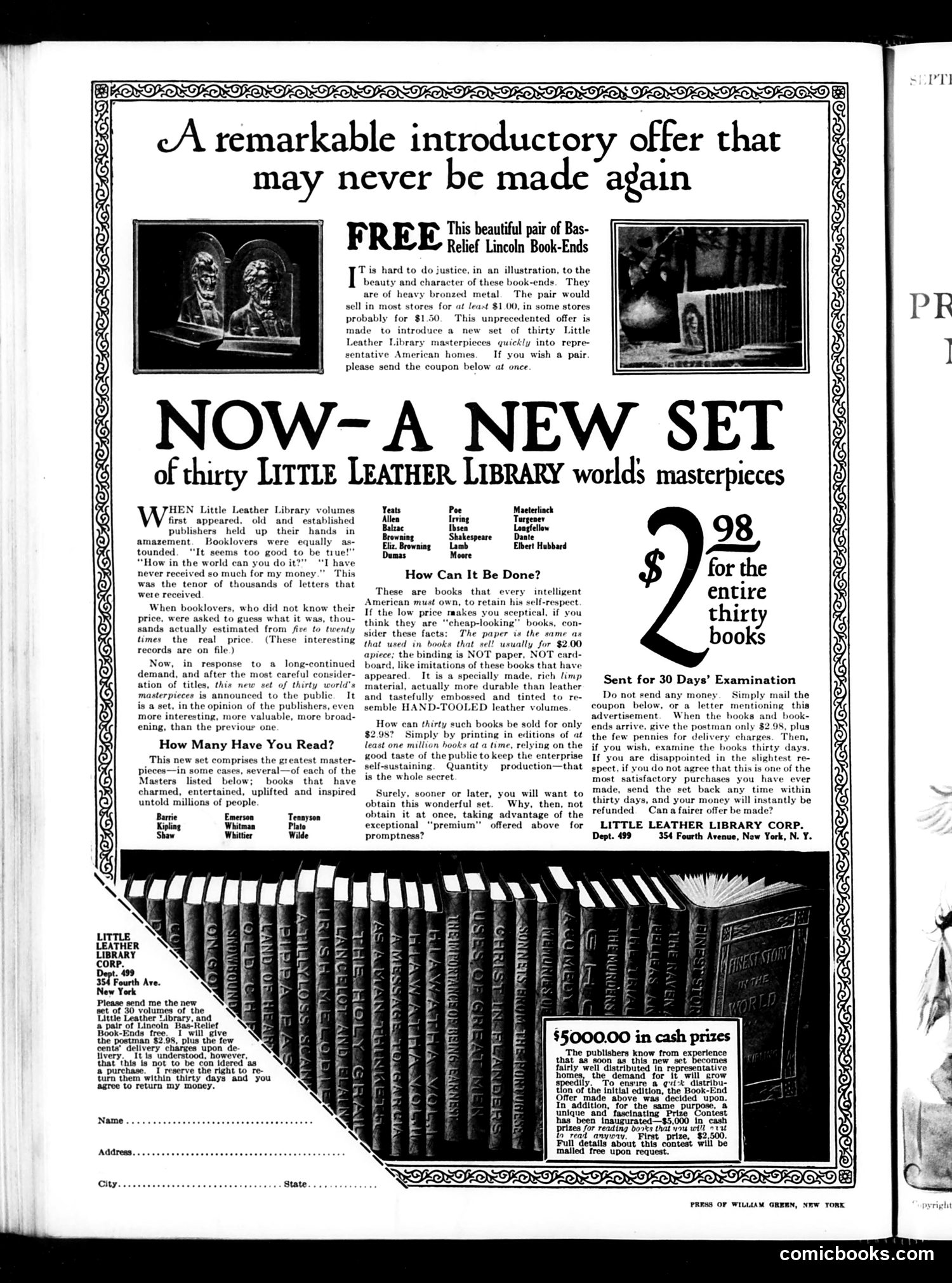
This is primarily a **mail-order advertisement**, not a political cartoon. It promotes the "Little Leather Library"—a set of 30 classic books bound in leather for $2.98, with free Abraham Lincoln bronze bookends as an introductory offer. The appeal targets educated middle-class Americans concerned with self-improvement and cultural refinement. The ad emphasizes quality ("hand-tooled leather," durable materials) while explaining how low pricing is possible through mass production ("one million books at a time"). References to classic authors (Shakespeare, Dickens, Tennyson, Kipling) signal cultural legitimacy. The mention of a 30-day examination period and money-back guarantee addresses purchase hesitation. The Lincoln bookends likely invoke patriotic American values, though no specific political message is evident. This appears to be a standard early-20th-century consumer appeal combining aspirational culture with accessible pricing.