
Judge, 1923-09-08 · page 25 of 36
Judge — September 8, 1923 — page 25: what you’re looking at
What you’re looking at
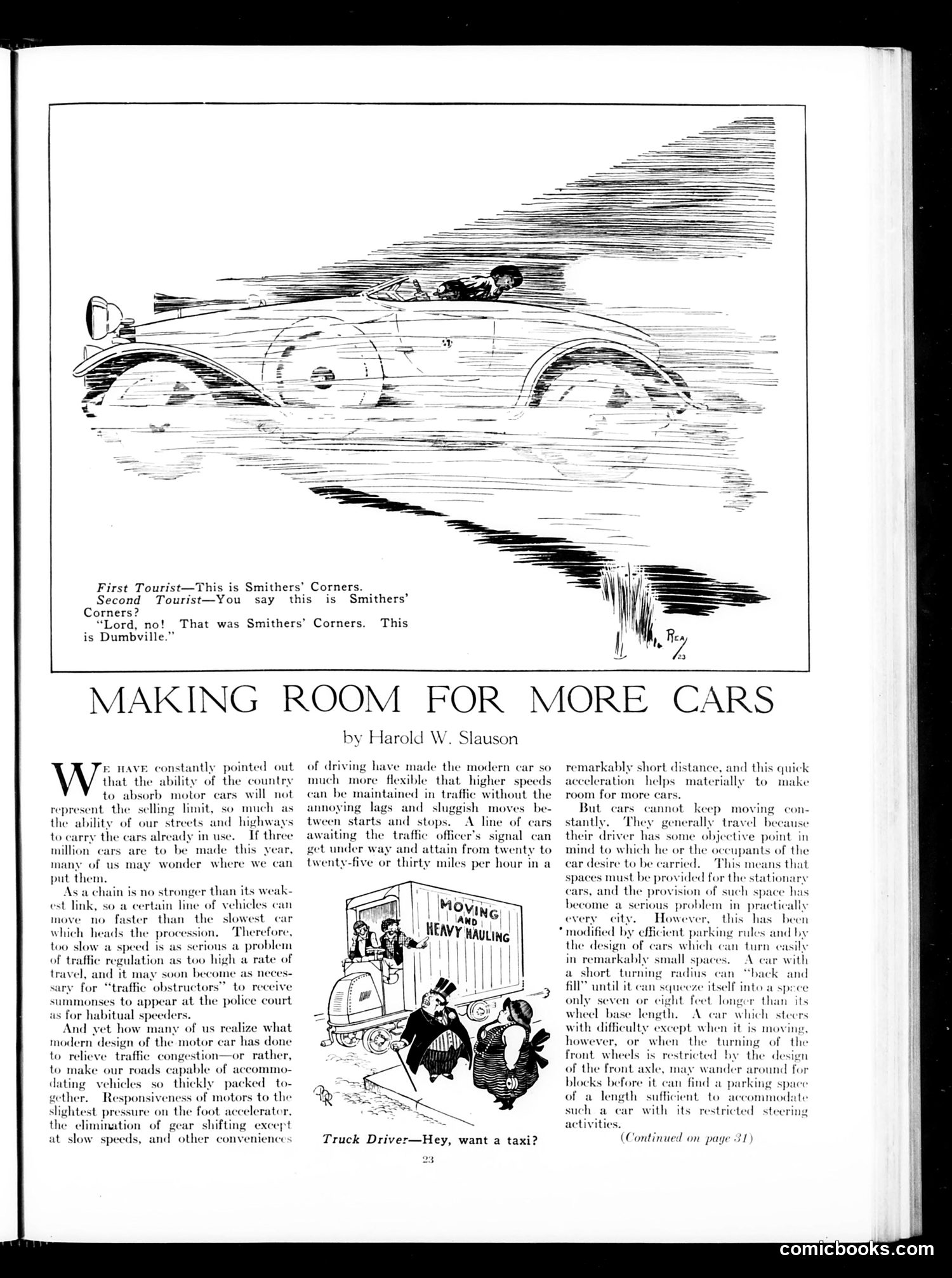
This article and cartoon satirize the practical chaos of rapidly expanding automobile use in 1920s America. The top cartoon depicts two tourists arguing over location names—a joke about how speeding cars blur landmarks into indistinguishability, making "Smithers' Corners" and "Dumbville" visually identical. The main article by Harold W. Slauson addresses a genuine urban problem: while factories can produce millions of cars annually, cities lack parking and road capacity. The satire lies in the article's earnest celebration of modern car design features (responsive engines, quick acceleration, tight turning radii) as *solutions* to congestion, when these features merely enable more cars to pack into already-overwhelmed streets. The cartoon at bottom shows a truck driver sarcastically offering a taxi—suggesting traffic is so gridlocked that motorized transport has become absurd. The piece captures early automotive-era anxiety: technological progress was outpacing urban infrastructure, and no one had answers.
📄 Transcribed text from this page (OCR, searchable)
Machine-transcribed from the original scan — historical spelling and the odd misread are preserved.
Second Tourist—You Corners? “Lord, no! is Dumbville.” say That was Smithers’ Corners. First Tourist—This is Smithers’ Corners. this is Smithers’ This MAKING ROOM FOR MORE CARS FE HAVE constantly pointed out that the ability of the country to absorb motor cars will not represent the selling limit, so much as the ability of our streets and highways to carry the cars already in use. If three muillion ears are to be made this year, many of us may wonder where we can put them. Asa chain is no stronger than its we est link, so a certain line of vehicles move no faster than the slowest car which heads the procession, ‘Therefore, too slow a speed is as serious a problem of traffic regulation as too high a rate of and it may soon become as ne to receive trave sary for “traffic obstructors” summonses to appear at the police court as for habitual speeders. And yet how many of us realize what modern design of the motor car has done to relieve traffic congestion—or rather, to make our roads capable of accommo- dating vehicles so thickly packed. to- gether. Responsiveness of motors to the slightest. pressure on the foot accelerator, the elimination of g at slow speeds, and other conveniences by Harold W. Slauson of driving have made the modern car so much more flexible that higher speeds can be maintained in traffic without the annoying lags and sluggish moves | tween starts and stops. A line of awaiting the traffic officer's. signal get under way and attain from twenty to twenty-five or thirty miles per hour in a | Moy | wwe a Truck Driver—Hey, want a taxi? 23 remarkably short distance, and this quick acceleration helps materially to. make room for more cars. But cars cannot keep moving con- stantly. They generally. travel because their driver has some objective point in mind to which he or the occupants of the car desire to be carried. This means that spaces must be provided for the stationary cars, and the provision of such spac become a serious problem in practically every city. However, this has been * modified by efficient parking rules and by the design of cars which can turn easily in remarkably small spaces. A ear with a short turning radius can “hack and fill” until it can squeeze itself into a sprce only seven or eight fect longer than its wheel base length. A car which steers with difficulty except when it is moving, however, or when the turning of the front wheels is restricted by the design of the front axle, may wander around for blocks before it can find a parking space of a length sufficient to accommodate such a car with its restricted steering (Continued on page 31) comicbooks.com