
Judge, 1923-09-08 · page 19 of 36
Judge — September 8, 1923 — page 19: what you’re looking at
What you’re looking at
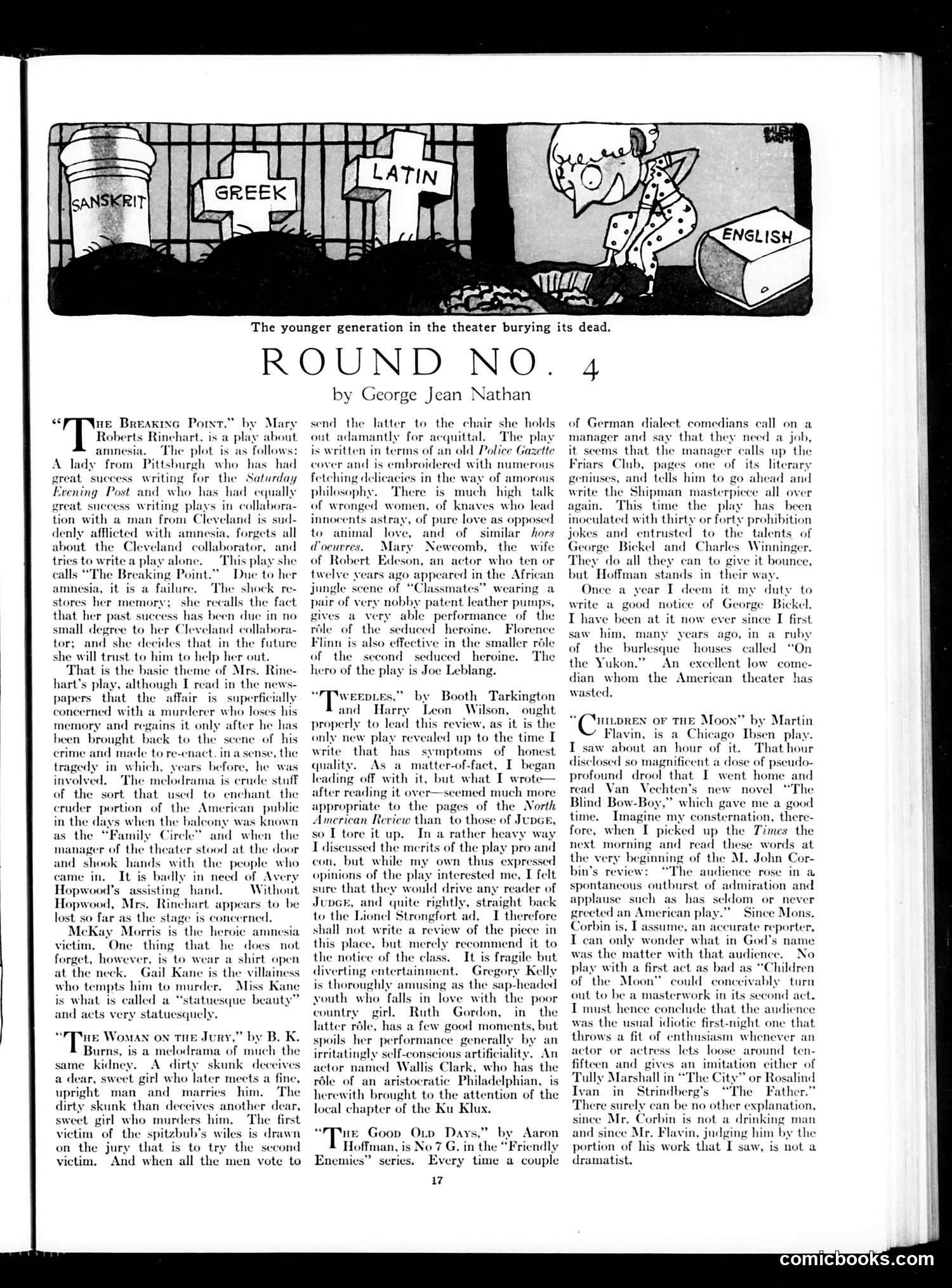
This page contains theater reviews by George Jean Nathan critiquing contemporary plays. The cartoon at top depicts "the younger generation in the theater burying its dead"—a satirical jab at old-fashioned melodrama giving way to modern theater. Nathan reviews three plays with harsh dismissal: 1. **"The Breaking Point"** by Mary Roberts Rinehart—he mocks its crude melodramatic plot about amnesia, suggesting Rinehart's success depends on her collaborator (implying women need male assistance). 2. **"The Woman on the Jury"** by B.K. Burns—he attacks its sensationalism, comparing it to lurid "Police Gazette" covers, though he praises actress Mary Newcomb's performance. 3. An unnamed Booth Tarkington play—Nathan admits finding it quality work but deemed his own review too serious for Judge's audience, claiming readers would prefer advertisements. The satire targets both the plays themselves and Nathan's own cynicism about popular taste and magazine editorial constraints.
📄 Transcribed text from this page (OCR, searchable)
Machine-transcribed from the original scan — historical spelling and the odd misread are preserved.
The younger generation in the theater burying its dead. ROUND NO. a I Nue Breaktna Pornt,” by Mary Roberts Rinehart. is a play about amnesia. ‘The plot is as follows: A lady from Pittsburgh who has had great success writing for the Saturday ening Post and who has had equally great success writing plays in collabora- tion with a man from Cleveland is sud- denly afflicted with amnesia, forgets all about the Cleveland collaborator, and tries to write a play alone, ‘This play she calls “The Breaking Point.” Due to her amune it is a failure. The shock re- stores her memory; she recalls the fact that her past success has been due in no small degree to her Cleveland collabora- tor; and she decides that in the future she will trust to him to help her out. That is the basic theme of Mrs. Rine- hart’s play, although I read in the news- papers that the affair is superficially concerned with a murderer who loses his memory and regains it only after he has been brought back to the scene of his crime and made to re-enact. in a sense, the tragedy in which, years before, he was involved. The melodrama is crude stuff of the sort that used to enchant the cruder portion of the American public in the days when the baleony was known as the amily Cire and when the manager of the theater stood at the door and shook hands with the people who came in. It is badly in need of Avery Hopwood’s assisting hand. Without Hopwood, Mrs. Rinchart appears to be lost so far as the stage is concerned. McKay Morris is the heroic amnesia victim. One thing that he does not forget, how is to wear a shirt open at the neck. ail Kane is the villainess who tempts him to murder. Miss Kane is what is called a “statuesque beauty” and acts very statuesquely. “Mie Woman on THE Jury,” by B. K. Burns, is a melodrama of much the same kidney. A dirty skunk dece a dear, swect girl who later meets a fine, upright man and marries him. The dirty nk than deceives another dear, sweet girl who murders him. The first victim of the spitzbub’s wiles is drawn on the jury that is to try the second victim. And when all the men vote to by George Jean Nathan send the latter to the chair she holds out adamantly for acquittal. The play is written in terms of an old Police Gazette cover and is embroidered with numerous fetching delicacies in the way of amorous. philosophy. ‘There is much high talk of wronged women, of knaves who lead innocents astray, of pure love as opposed to animal love, and of similar hors Coeurres. Mary Newcomb, the wife of Robert Edeson, an actor who ten or twelve years ago appeared in the African jungle scene of “Classmates” wearing a pair of very nobby patent leather pumps, gives a very able performance of the role of the seduced heroine. Florence Flinn is also effective in the smaller réle of the second seduced heroine. The hero of the play is Joe Leblang. ” by Booth Tarkington Leon Wilson, ought 1 this review, as it is the only new play revealed up to the time I write that has symptoms of honest quality, As a matter-of-fact, I began leading off with it, but what I wro' ter reading it over—seemed much more propriate to the pages of the North American Review than to those of JuncE, so I tore it up. In a rather heavy way I discussed the merits of the play pro and con, but while my own thus expressed opinions of the play interested me, I felt sure that they would drive any reader of JupGr, and quite rightly, straight back to the Lionel Strongfort ad. I therefore shall not write a review of the piece in this pla but merely recommend it to the notice of the class. It is fragile but diverting entertainment. Gregory Kelly is thoroughly amusing as the sap-headed youth who falls in love with the poor country girl Ruth Gordon, in the latter réle, has a few good moments, but spoils her performance generally by an irritatingly self-conscious artificiality. An actor named Wallis Clark, who has the role of an aristocratic Philadelphian, is herewith brought to the attention of the local chapter of the Ku Klux. Days,” by Aaron Hoffman, is No 7 G. in the “Friendly Enemies” series. Every time a couple 17 prope! “MPur Goon OLp 4 of German dialect comedians call on a manager and say that they need a job, it seems that the manager ealls up the Friars Club, pages one of its literary geniuses, and tells him to go ahead and write the Shipman masterpiece all over again. This time the play has been inoculated with thirty or forty prohibition jokes and entrusted to the talents. of xeorge Bickel and Charles Winninge They do all they can to give it bounce, but Hoffman stands in their way. Once a year I deem it my duty to write a good notice of George Bickel. I have been at it now ever since I first saw him, many years ago, in a ruby of the burlesque houses called “On the Yukon.” An_ excellent low come- dian whom the American theater has wasted. “iILDREN OF THE Moon” by Martin Flavin, is a Chicago Ibsen play. I saw about an hour of it. That hour disclosed so magnificent a dose of pseudo- profound drool that I went home and read Van Vechten’s new novel “The Blind Bow-Boy,” which gave me a good time. Imagine my consternation, there- fore, when I picked up the Times the next morning and read these words at the very beginning of the M. John Cor- bin’s review: “The audience rose in a spontaneous outburst of admiration and applause such as has seldom or never greeted an American play.” Since Mons. Corbin is, I assume, an accurate reporte T can only wonder what in God’s was the matter with that audienc play with a first act as b: “Children of the Moon” could conceivably turn out to be a masterwork in its second act. I must hence conclude that the audience was the usual idiotic first-night one that throws a fit of enthusiasm whenever an actor or actress lets loose around ten- fifteen and gives an imitation either of Tully Marshall in “The City” or Rosalind Ivan in Strindberg’s “The Father.” There surely can be no other explanation, since Mr. Corbin is not a drinking man and since Mr. Flavin, judging him by the portion of his work that I saw, is not a dramatist. comicbooks.com