
Judge, 1923-09-08 · page 12 of 36
Judge — September 8, 1923 — page 12: what you’re looking at
What you’re looking at
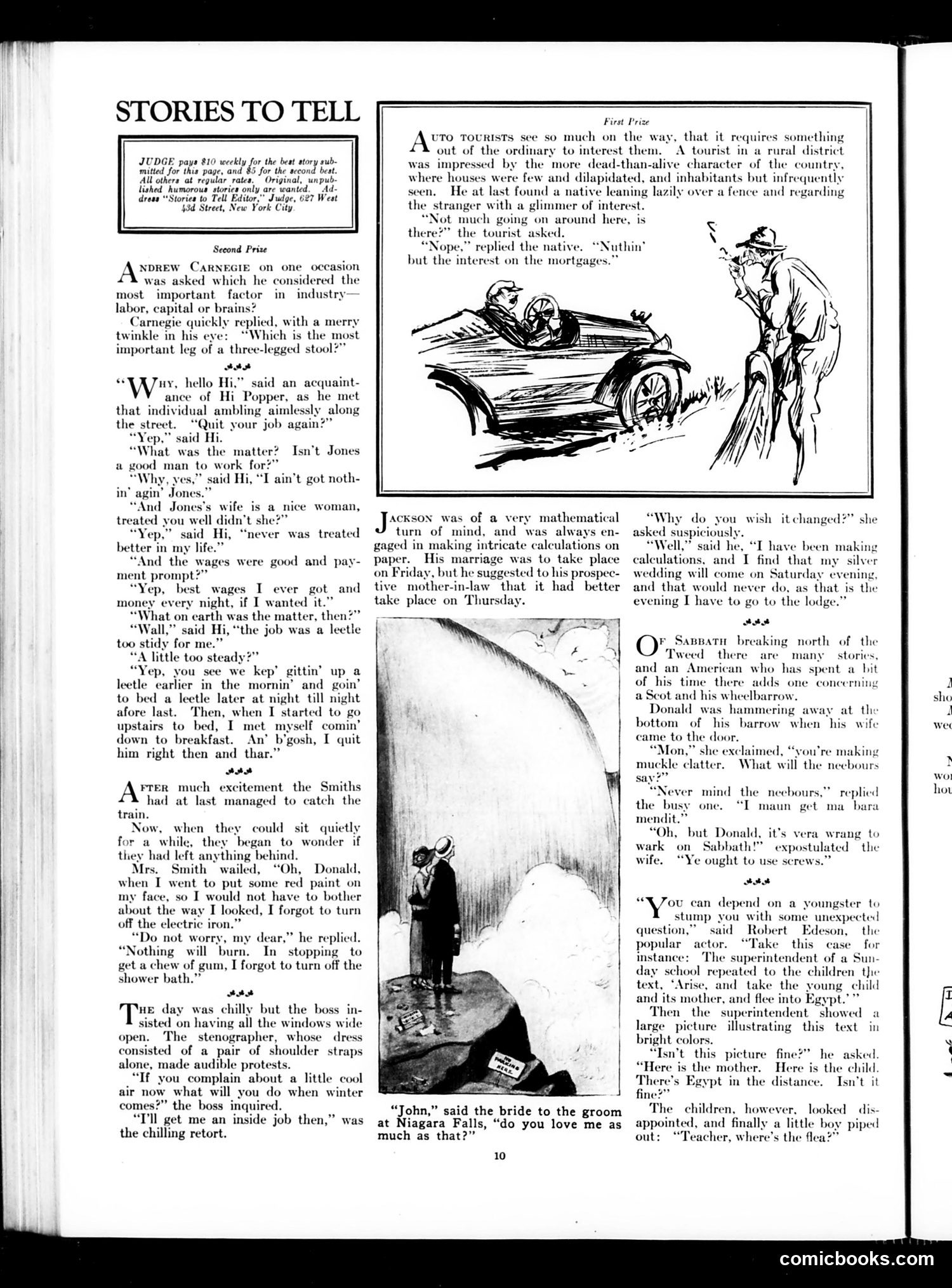
This page from Judge presents humorous short stories submitted by readers, with prizes offered ($10 for first place, $5 for second). The cartoons illustrate several stories: **Top right:** A tourist in a rural area asks a native what's happening locally. The native replies there's "nothin' but the interest on the mortgages"—satirizing rural poverty and debt during the agricultural depression era. **Middle:** A story about Andrew Carnegie answering which matters most in industry (labor, capital, or brains) by asking which leg of a three-legged stool is most important—a clever deflection suggesting all three are equally necessary. **Bottom stories** include domestic humor: a man who quit a good job because he was getting up earlier and going to bed later until he "met himself coming down to breakfast"; a couple who forgot to turn off an electric iron and shower; and a groom who wants to postpone his wedding from Friday to Thursday because his lodge meets Saturday evening. The humor reflects early-20th-century working-class concerns: steady employment, domestic life, and social obligations.
📄 Transcribed text from this page (OCR, searchable)
Machine-transcribed from the original scan — historical spelling and the odd misread are preserved.
STORIES TO TELL JUDGE pays $10 weekly for the beat atory sub- mitted for this page, and 85 for the accond beat. All others at regular rates,” Original, unpu lished humorous stories only are wanted. —Ad- dress “Stories to Tell Editor,” Judge, 627 Weat 43d Street, New York City Second Prize ANDREW CARNEGIE on one occasion was asked which he considered the most important factor in industry labor, capital or brain: Carnegie quickly replied, with a merry twinkle in his eye: “Which is the important leg of a three-legged stoc tae “Ww hello Hi,” said an acquaint- ance of Hi Popper, as he met that individual ambling aimlessly along the street. “Quit your job again?” “Yep,” said Hi. “What was the matter? a good man to work f “Why, * said Hi, in’ agin’ Jone “And Jones's wife is treated you well didn’t she rep,” said Hi, “never was treated better in my life.” “And the wages were good and pay- ment prompt?” “Yep, best wages I ever got, and money ev night, if I wanted it. hat on earth was the matter, then?” said Hi, “the job was a icette ly for me.” ittle too steady?” Yep, you see we kep’ gittin’ up a leetle earlier in the mornin’ and goin’ to bed a leetle later at night till night afore last. Then, when I started to go upstairs to bed, I met myself comin’ down to breakfast. An’ b’gosh, I quit him right then and thar.” tae ATTER much excitement the Smiths had at last managed to catch the train. Now, when they could sit quietly while, they began to wonder if y had left anything behind. nith wailed, “Oh, Donald, when I went to put some red paint on my face, so I would not have to bother about the way I looked, I forgot to turn off the electric iron.” “Do not worry, my dear,” he replied. “Nothing will ‘burn. In stopping to get a chew of gum, I forgot to turn off the shower bath.” Isn't Jones “T ain't got noth- nice woman, “Wall,” ey T day was chilly but the boss in- isted on having all the windows wide open. The stenographer, whose dress consisted of a pair of shoulder straps alone, made audible protests. “If you complain about a little cool air now what will you do when winter comes?” the boss inquired. “T'll get me an inside job then,” was the chilling retort. * the tourist asked. ope,” replied the nati First Prize Av™ TOURISTS see so much on the way, out of the ordinary to interest them: was impressed by the more dead-than-alive character of the country, where houses were few and dilapidated, and inhabitants but infrequently seen. He at last found a native leaning lazily over a fence and the stranger with a glimmer of interest. Sot much going on around here, that it requires something ‘A tourist in a rural district J .CKSON was of a very math turn of mind, and was al gaged in making intricate calculations on paper. His marriage was to take place on Friday, but he suggested to his prospec- tive mother-i law that it had better take place on Thursday. “John,” at Niagara Falls, “do you love me as much as that?” said the bride to the groom 10 “Why do you wish itchanged?” she asked suspiciously. “Well,” said he, calculations, and T find that m wedding will come on Saturd: and that would never do, as t evening I have to go to the lodge.” “T have been making silver ery r Sappatu breaking north of the Tweed there are” many and an American who has spent a bit of his time there adds one concerning a Scot and his wheelbarrow. Donald was hammering away bottom of his barrow came to the door. “Mon,” she muckle clatter. W stories, th when his wife imed, “you're making ut will the necbours Ne the bus) mendit.” “Oh, but Donald, it’s vera wrang to wark on Sabbath!” expostulated the wife. “Ye ought to use screws.” mind the neebours,” replied one, “To maun get ma bara oy Jou can depend on a youngster to stump you with some unexpected question,” said Robert ~Edeson, the popular actor. “Take this case for instance: The superintendent of a Sun- y school repeated to the children the ext, ‘Arise, and take the young child and its mother, and flee into Egypt.’ ’ Then the superintendent. showed a large picture illustrating this text in bright colors. “Isn't this picture fine?” he asked. “Here is the mother. Here is the child. pt in the distance. Isn't it There's F fine? The children, however, looked — dis- appointed and finally a little boy piped out: “Teacher, where's the flea?” comicbooks.com Pn Cee =]