
Judge, 1923-09-08 · page 21 of 36
Judge — September 8, 1923 — page 21: what you’re looking at
What you’re looking at
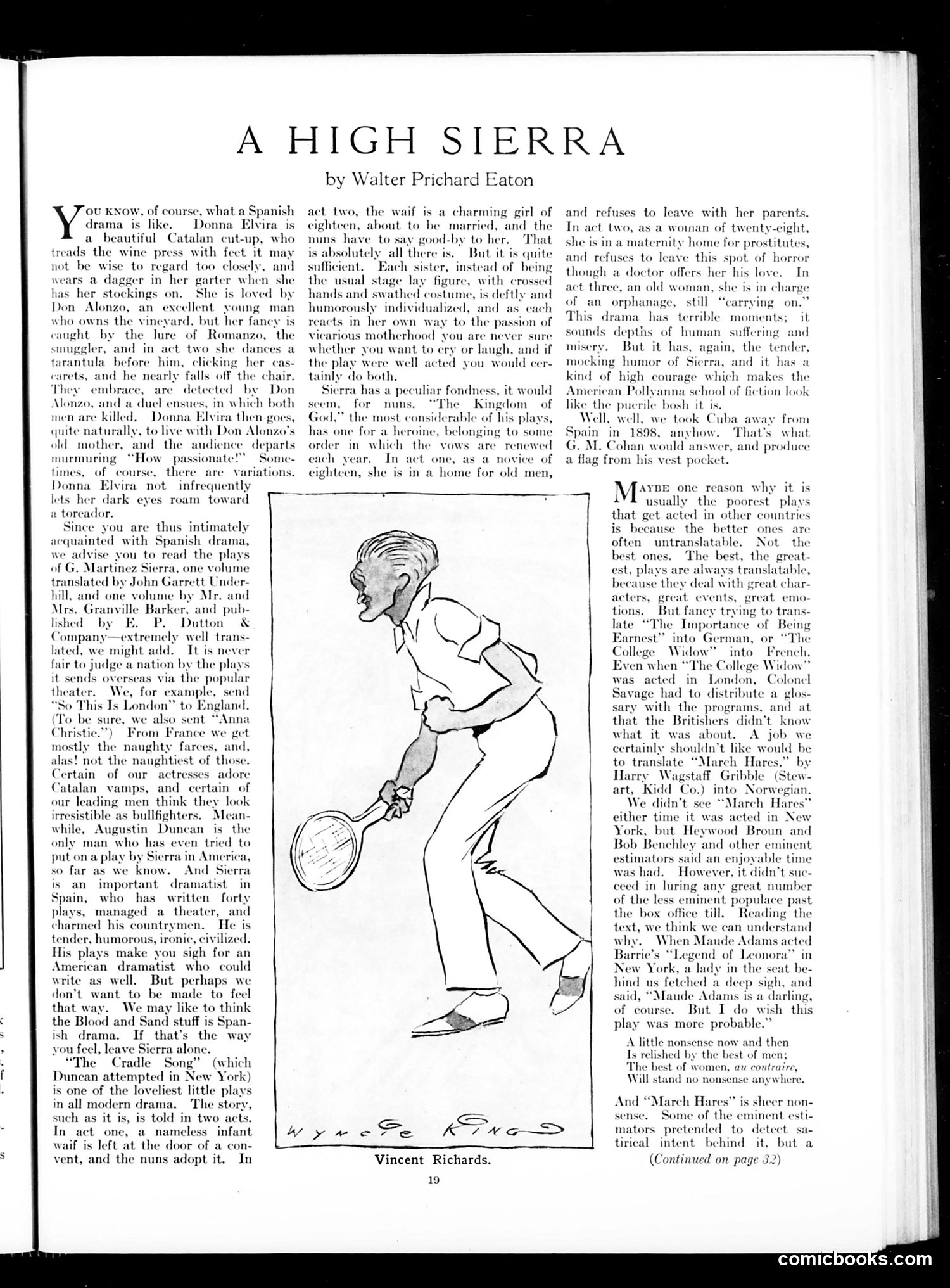
This page from *Judge* magazine features art critic Walter Prichard Eaton's essay introducing Spanish dramatist G. Martinez Sierra to American readers. **The Content:** Eaton opens with a humorous stereotype of Spanish drama—passionate heroines, smugglers, duels, and melodrama—to establish context. He argues that American audiences receive distorted impressions of foreign cultures through popular theater exports. He cites examples: America sends "So This Is London" to England; France exports naughty farces. **The Main Point:** Eaton advocates for Sierra's actual work, particularly *"The Cradle Song,"* which he praises as sophisticated, tender, and psychologically nuanced—unlike the blood-and-sand clichés Americans associate with Spanish drama. He notes Augustin Duncan attempted staging Sierra in America but largely failed. **The Illustration:** The sketch shows a tennis player (likely Vincent Richards, a famous American player of the era), appearing unrelated to the article—typical of *Judge's* layout mixing editorial content with sports commentary. **The Satire:** The essay gently mocks both American preconceptions about Spanish theater and American theater's low reputation abroad.
📄 Transcribed text from this page (OCR, searchable)
Machine-transcribed from the original scan — historical spelling and the odd misread are preserved.
A HIGH SIERRA ‘ou KNow, of course, what a Spanish Y drama is like. Donna Elvira is a beautiful Catalan cut-up, who treads the wine press with fect. it: may not be wise to regard too closely, and wears a dagger in her garter when she has her stockings on. She is loved by Don Alonzo, an excellent. young man who owns the vineyard, but her fancy is caught by the lure of Romanzo, ‘the smuggler, and in act two she dances tarantula before him, clicking her cas- carets, and he nearly falls off the chair. They embrace, are detected by Don Alonzo, and a duel ensues, in which both men are killed. Donna Elvira then goes, quite naturally, to live with Don Alonzo's old) mother, and the audience departs murmuring “How passionate!” Some- times, of course, there variations. Donna Elvira not infrequently lets her dark eyes roam toward a toreador. Since you are thus intimately acquainted with Spanish drama, we advise you to read the plays of G. Martinez Sierra, one volume translated by John Garrett Under- hill, and one volume by Mr. and Mrs. Granville Barker, and pub- lished by E. P. Dutton & Company—extremely well trans- lated, we might add. It is never fair to judge a nation by the plays it sends overseas via the popular theater. We, for example, send “So This Is London” to England. (To be sure, we also sent “Anna Christie.”) From France we get mostly the naughty farces, and, alas! not the naughtiest of those. Certain of our actresses adore Catalan. vamps, and certain of our leading men think they look irresistible as bullfighters. Mean- while, Augustin Duncan is. the only man who has even tried to put ona play by Sierra in America, so far as we know. And Sierra is an important dramatist in Spain, who has written forty plays, managed a theater, and charmed his countryn He is tender, humorous, ironic, civilized. is plays make you sigh for an n dramatist who could write as well. But perhaps we don’t want to be made to feel that w: We may like to think the Blood and Sand stuff is Span- ish drar If that’s the way you feel, leave Sierra alone. “The Cradle Song” (which Duncan attempted in New York) is one of the loveliest little plays in all modern drama. The story, such as it is, is told in two acts. In act one, a nameless infant waif is left at the door of a con- vent, and the nuns adopt it. In are by Walter Prichard Eaton act two, the waif is a charming girl of eighteen, about to be married, and the mins have to say good-by to her. That is absolutely all there is. But it is quite sufficient. Each sister, instead of being the usual stage lay figure, with crossed hands and swathed costume, is deftly and humorously individualized, and as each s in her own way to the passion of rious motherhood you are never sure whether you want to cry or laugh, and if - were well acted you would cer- tainly do both. Sierra has a peculiar fondness, it would for muns. he Kingdom — of God,” the most considerable of his plays, has one for a heroine, belonging to some order in which the vows are renewed each year. In act one, as a novice of eighteen, she is in a home for old men, rs am Kx oc—=> Vincent Richards. 19 and refuses to leave with her parents. In act two, as a woinan of twenty-eight, she is in a maternity home for prostitutes, and refuses to leave this spot of horror In act three, an old woman, she is in charge of an orphanage, still. “carrying This drama terrible sounds depths of human suffering and But it has, again, the tender, mocking humor of Sierra, and it has a kind of high courage which makes the American Pollyanna school of fiction look like the puerile bosh it is. Well, well, we took Cuba away from Spain in 1898, anyhow. ‘That's what G. M. Cohan would answer, and produce a flag from his vest pocket. M8 one reason why it is pe usually the poorest. plays at get acted in other countries is b the better ones are often untranslatable. Not the best ones. The best, the great- est, plays are always translatable, because they deal with great char. acters, great events, great emo- tions. But fancy trying to trans- late “The Importance of Being Earnest” into German, or “The College Widow” into French. Even when “The College Widow” was acted in London, Colonel Savage had to distribute a glos- sary with the programs, and at that the Britishers didn’t know what it was about. A job we certainly shouldn’t like would be to translate “March Hares,” by Harry Wagstaff Gribble (Stew- art, Kidd Co.) into Norwegian. We didn’t see “March Hares” either time it was acted in New York, but Heywood Broun and Bob Benchley and other eminent estimators said an enjoyable time was had. However, it didn’t sue- ceed in luring any great number of the less eminent populace past the box office till. Reading the text, we think we can understand why. When Maude Adams acted ie snd of Leonora” in in the seat be- deep sigh, and though a doctor offers her his love. on. has moments; — it misery. Toy Ise hind us fetched a said, “Maude Adams is a darling, of course. But I do wish this play was more probable.” A little nonsense now and then Is relished by the best of men: The best of women, au contraire, Will stand no nonsense anywhere. And “March Hares” is sheer non- sense. Some of the eminent esti- mators pretended to detect. sa- tirical intent behind it, but a (Continued on page 3.2) comicbooks.com