
Judge, 1923-09-08 · page 23 of 36
Judge — September 8, 1923 — page 23: what you’re looking at
What you’re looking at
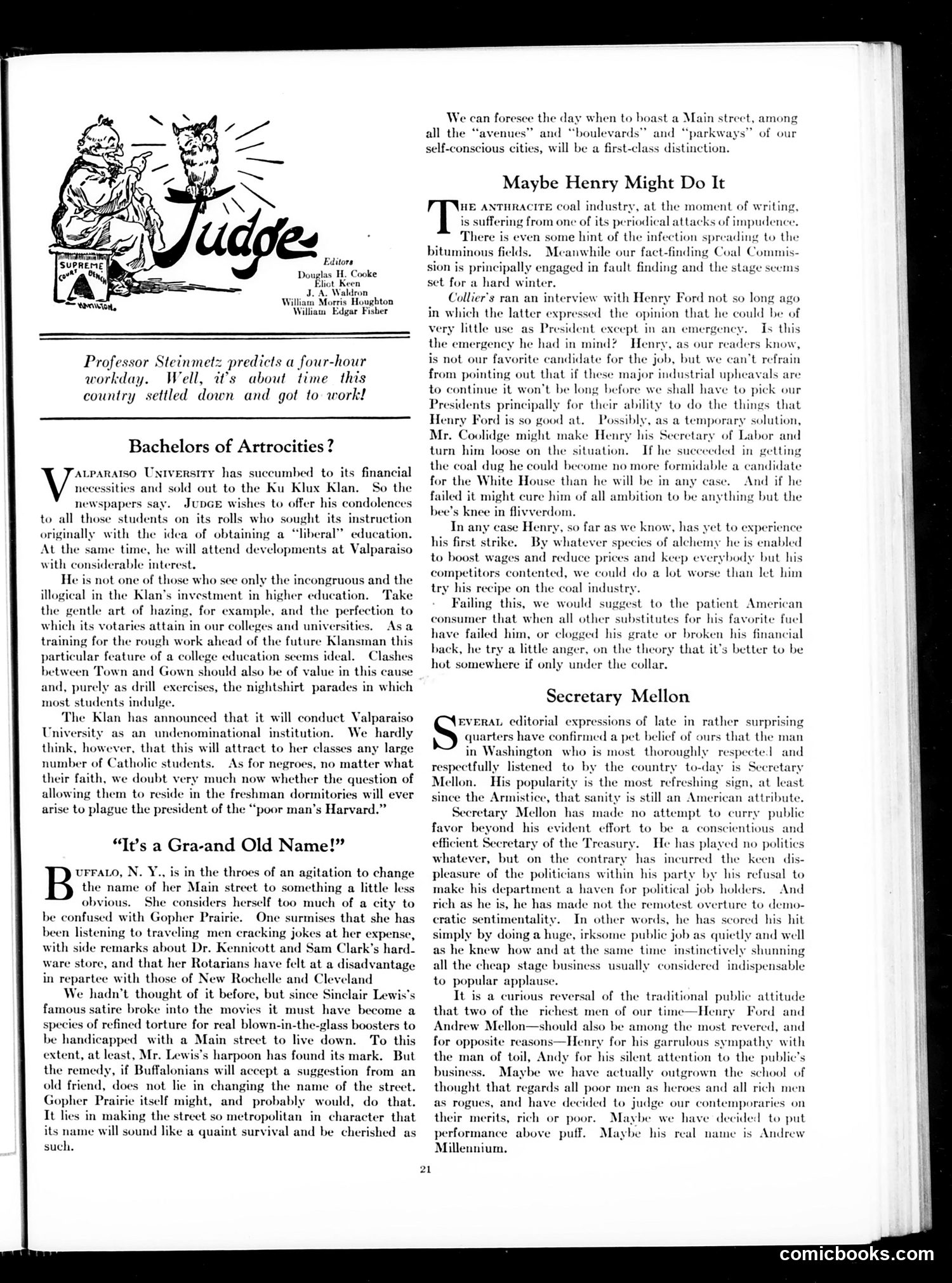
**The Cartoon (top left):** Shows a judge figure confronting what appears to be a menacing owl or cat-like creature labeled "Judge"—likely representing satirical commentary itself striking back. **Main Articles:** 1. **"Bachelors of Artrocities?"** - Satirizes Valparaiso University's reported financial ties to the KKK (a contemporary scandal). Judge sarcastically notes the Klan's college involvement aligns with existing hazing traditions and "nightshirt parades" (KKK's robes), while pointedly questioning whether Catholic and Black students will actually be welcomed despite claims of being "undenominational." 2. **"It's a Gra-and Old Name!"** - Mocks Buffalo's attempt to rename Main Street to sound more cosmopolitan, referencing Sinclair Lewis's *Main Street* satire of small-town America. Judge argues the solution isn't renaming but making the street itself genuinely metropolitan. 3. **"Maybe Henry Might Do It"** - Discusses Henry Ford as potential presidential material during coal industry labor unrest, suggesting he might resolve the crisis. The page reflects 1920s anxieties about the KKK, small-town identity, and industrial labor disputes.
📄 Transcribed text from this page (OCR, searchable)
Machine-transcribed from the original scan — historical spelling and the odd misread are preserved.
tore H. Cooke Keen J. A, Waldron William Morris Houghton William Edgar Fisher Professor Steinmetz predicts a four-hour workday. Well, it’s about time this country settled down and got to work! Bachelors of Artrocities? ALPARAISO University has succumbed to its financial necessities and sold out to the Ku Klux Klan. So the newspapers say. JUDGE wishes to offer his condolences to all those students on its rolls who sought its instruction originally with the idea of obtaining a “liberal” education. At the same time, he will attend developments at Valparaiso with considerable interest. He is not one of those who see only the incongruous and the illogical in the Klan’s investment in higher education. Take the gentle art of hazing, for example, and the perfection to which its votaries attain in our colleges and universities. As a training for the rough work ahead of the future Klansman this particular feature of a college education seems ideal. Clashes between Town and Gown should also be of value in this cause and, purely as drill exercises, the nightshirt parades in which most students indulge. The Klan has announced that it will conduct Valparaiso University as an undenominational institution. We hardly think, however, that this will attract to her cla any large number of Catholic students. As for negroes, no matter what their faith, we doubt very much now whether the question of allowing them to reside in the fre: arise to plague the president of th shman dormitories will ever ‘poor man’s Harvard.” “It’s a Gra-and Old Name!” uFFALO, N. Y., is in the throes of an agitation to change the name of her Main street to something a little less obvious. She considers herself too much of a city to be confused with Gopher Prairie. One surmises that she has been listening to traveling men cracking jokes at her expense, with side remarks about Dr. Kennicott and Sam Clark’s hard- ware store, and that her Rotarians have felt at a disadvantage in repartee with those of New Rochelle and Cleveland We hadn't thought of it before, but since Sinclair Lewis's famous satire broke into the movies it must have become a species of refined torture for real blown-in-the-glass boosters to be handicapped with a Main street to live down. To this extent, at least, Mr. Lewis’s harpoon has found its mark. But the remedy, if Buffalonians will accept a suggestion from an old friend, does not lie in changing the name of the street. Gopher Prairie itself might, and probably would, do that. It lies in making the street so metropolitan in character that its name will sound like a quaint survival and be cherished as such. We can foresee the day when to boast a Main street, among all the “avenues” and “boulevards” and “parkway’ self-conscious cities, will be a first-class distinction. of our Maybe Henry Might Do It E ANTHRACITE Coal industry, at the moment of writing, suffering from one of its periodical attacks of impudence. There is even some hint of the infection spreading to the bituminous fields. Meanwhile our fact-finding Coal Commis- sion is principally engaged in fault finding and the stage seems set for a hard winter. Collier's ran an interview with Henry Ford not so long ago in which the latter expressed the opinion that he could be of very little use as President exes Is this the emergency he in mind? Henry, as our readers know, is not our favorite candidate for the job, but we can’t ‘ain from pointing out that if these major industrial upheavals are to continue it won't be long before we shall have to pick our Presidents principally for their ability to do the things that Henry Ford is so good at. Possibly, as a temporary solution, Mr. Coolidge might make Henry his Secretary of Labor and turn him loose on the situation. If he succeeded in getting the coal dug he could become no more formidable a candidate for the White House than he will be in any And if he failed it might cure him of all ambition to be anything but the bee’s knee in flivverdom. | ot in an emergency. In any case Henry, so far as we know, has yet to experience his first strike. By whatever spe to boost wages and reduce pri comy ies of alchemy he is enabled 's and keep everybody but his ptitors contented, we could do a lot worse than let him try his recipe on the coal industry. Failing this, we would suggest to the patient American consumer that when all other substitutes for his favorite fuel » failed him, or clogged his grate or broken his financial . he try a little anger, on the theory that it’s better to be hot somewhere if only under the collar. Secretary Mellon EVERAL editorial expressions of late in rather surprising S quarters have confirmed a pet belief of ours that the man in Washington who is most thoroughly respecte and respectfully listened to by the country to-day is Se Mellon. His popularity is the most refreshing sign, at least since the Armistice, that sanity is still an American attribute. Secretary Mellon has made no attempt to curry public favor beyond his evident effort to be a conscientious and efficient Secretary of the Treasury. He has played no polities whatever, but on the contrary has incurred the keen dis- pleasure of the politicians within his party by his refusal to make his department a haven for political job holders. And i he is, he has made not the remotest overture to demo- cratic sentimentality. In other words, he has scored his hit simply by doing a huge, irksome public job as quietly and well as he knew how and at the all the cheap stage business to popular applause. It is a curious reversal of the traditional public attitude that two of the richest men of our time—Henry Ford and Andrew Mellon—should also be among the most revered, and for opposite reasons—Henry for his garrulous sympathy with the man of toil, Andy for his silent attention to the public’s Maybe we have actually outgrown the school of thought that regards all poor men as heroes and all rich men as rogues, and have decided to judge our contemporaries on their merits, rich or poor. Maybe we ha performance above puff. Maybe his real name is Andrew Millennium. ame time instinctively shunning usually considered indispensable business. ve decided to put comicbooks.com