
A complete issue · 36 pages · 1923
Judge — August 11, 1923
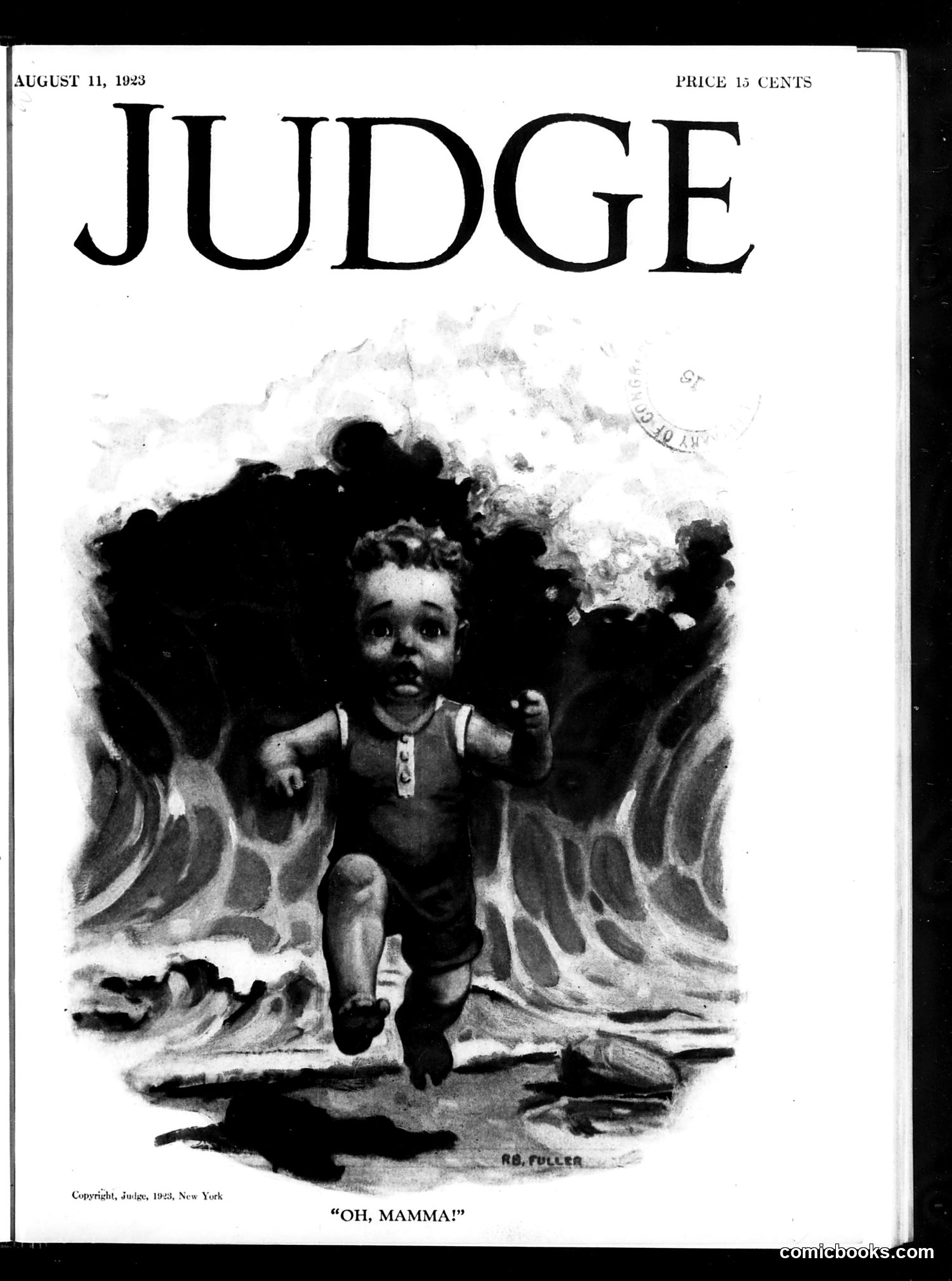
This cover illustration by R.B. Fuller depicts a toddler running through flames toward an adult figure (presumably the mother), with angels or protective spirits hovering above in the smoke. The image likely satirizes parental anxiety or child safety concerns of the 1920s era. The title "Oh, Mama!" suggests the child's cry for rescue or comfort amid danger. The composition—with the child in peril reaching toward maternal protection while celestial figures watch—appears to comment on either the vulnerability of children in modern urban environments or perhaps the perceived inadequacy of maternal protection against contemporary hazards (industrial accidents, traffic, or other urban dangers were growing concerns in this period). Without additional context or caption text, the specific satirical target remains somewhat unclear.
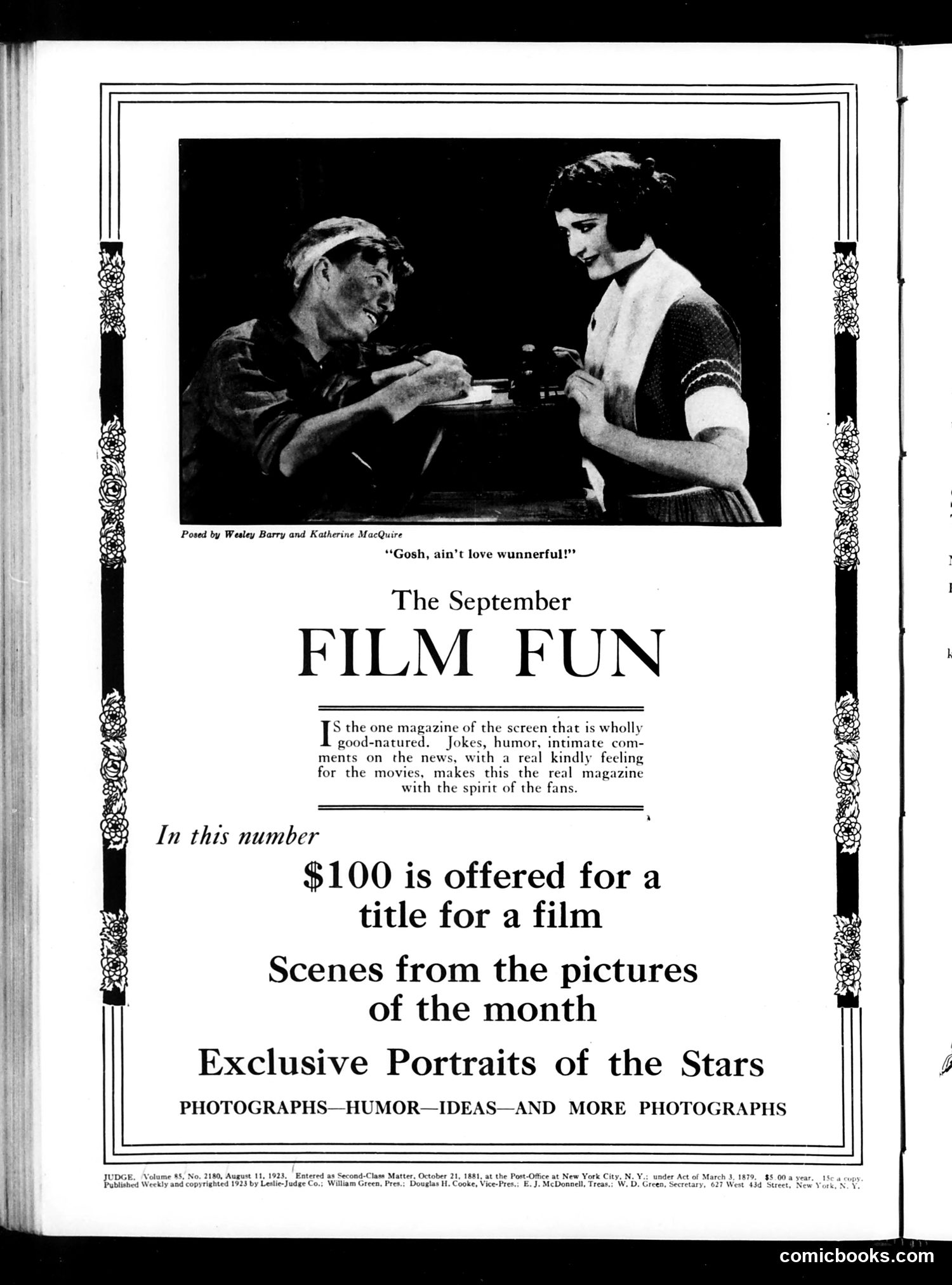
This page is primarily an **advertisement for "Film Fun," a sister magazine** rather than satirical content. The black-and-white photograph shows two people in what appears to be a scene from a silent film, with the caption "Gosh, ain't love vunnerful!" The ad promotes Film Fun's September issue, emphasizing its appeal to movie fans through jokes, humor, and intimate commentary on films. It advertises a $100 prize for film title suggestions, scenes from current movies, and exclusive star portraits. The humorous dialect spelling ("vunnerful" for "wonderful") in the caption likely reflects early 20th-century comedy conventions, though the specific actors and film are not identified in the visible text. This is primarily **commercial promotion rather than political satire**.
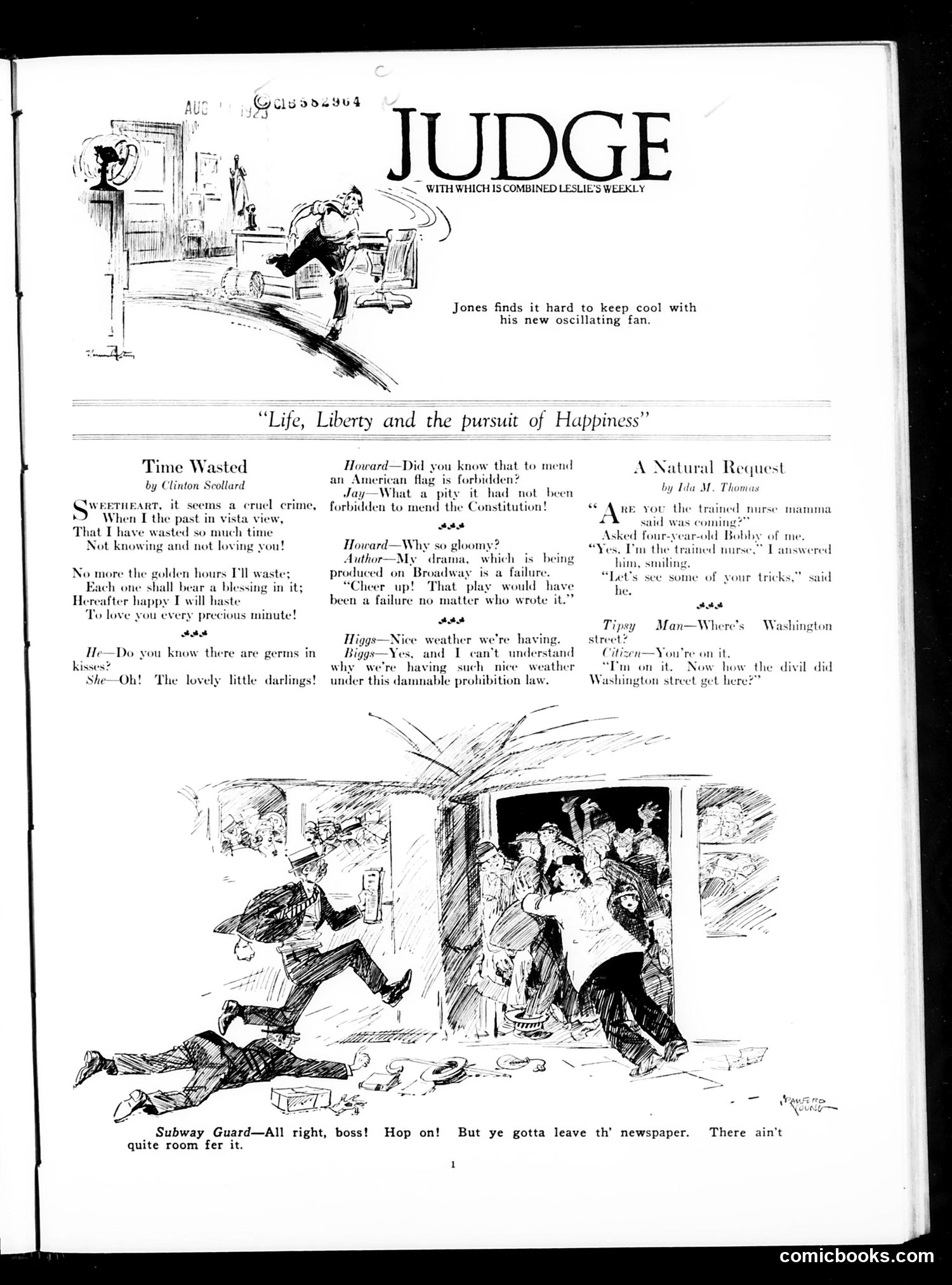
This page from **Judge** magazine contains several short humorous pieces and cartoons typical of early 20th-century American satire. The main cartoon depicts a crowded subway car with a guard trying to manage passengers. The joke references New York City's overcrowded public transit—a recurring social complaint of the era. The text pieces are light domestic humor: "Time Wasted" mocks wasting hours; dialogue snippets joke about flag-mending laws, germs in kisses, and an oscillating fan keeping someone cool. "A Natural Request" features a trained nurse and child—likely poking fun at contemporary nanny culture. The humor is largely non-political—focused on everyday urban life, prohibition-era references ("damnnable prohibition law"), and domestic situations rather than specific political figures or events. The satire targets general social absurdities rather than particular controversies.
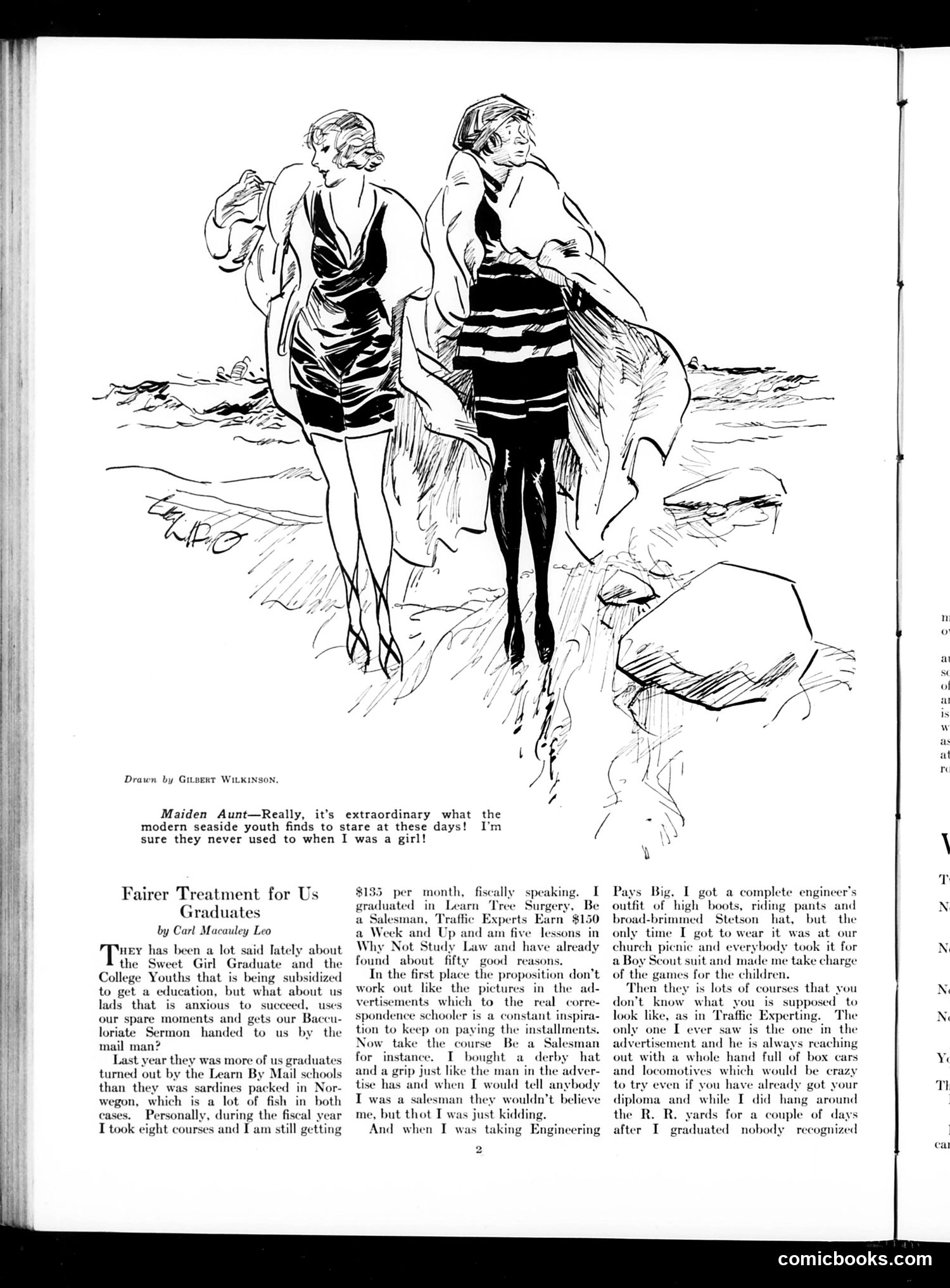
The illustration by Gilbert Wilkinson depicts two women in 1920s beach attire walking together. The caption quotes "Maiden Aunt" remarking on how modern youth stare at women in contemporary swimwear, contrasting this with her girlhood era. Below is an article titled "Fairer Treatment for Us Graduates" by Carl Moseley Lea, discussing employment opportunities for recent graduates. The author lists various salesmen positions and engineering roles paying $150-$183 monthly, noting the competitive job market and that employers often prefer experienced workers. **The satire**: The juxtaposition suggests commentary on changing social attitudes—the illustration addresses shifting fashion and morality regarding women's bodies, while the article addresses economic realities facing young job-seekers in what appears to be the early 1920s. The contrast implies tension between social modernization and practical economic concerns.
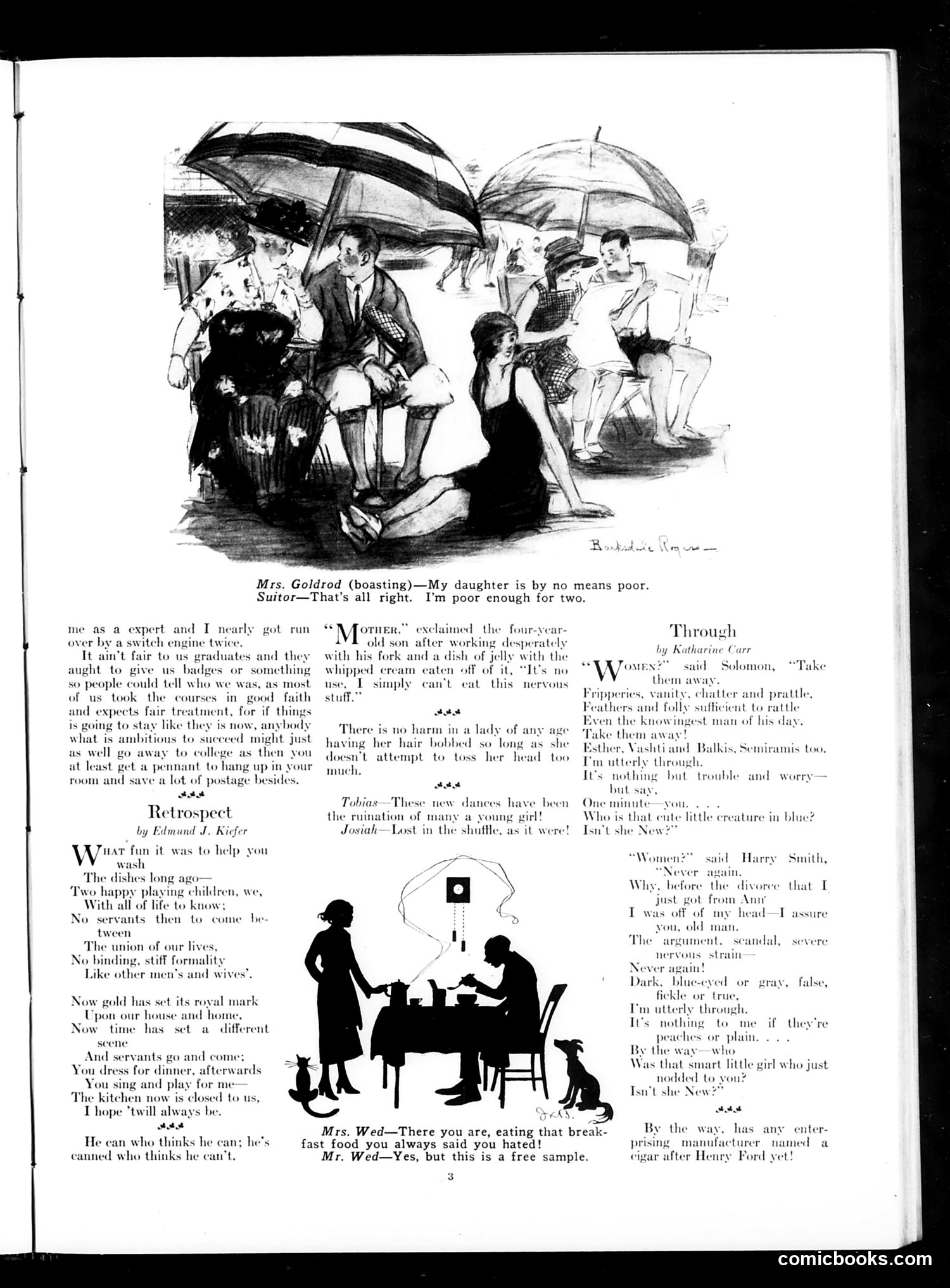
This page contains three distinct satirical pieces from an early 20th-century American magazine. **Top cartoon**: Shows people with umbrellas in rain. The caption depicts class commentary—Mrs. Goldrod boasts her daughter isn't poor, while the Suitor responds he's "poor enough for two," suggesting fortune-hunting or ironic commentary on class pretensions during courtship. **"Retrospect" poem**: Appears nostalgic, reflecting on domestic life changes—servants departing, formality replacing intimacy, and financial shifts ("gold has set its royal mark / Upon our house"). **Bottom cartoon**: Domestic scene where Mr. and Mrs. Wed discuss breakfast. He claims to hate the food; she reveals it's a free sample, suggesting commentary on consumer culture or marital economics. The page satirizes early 20th-century social anxieties around class, marriage, and changing domestic customs.
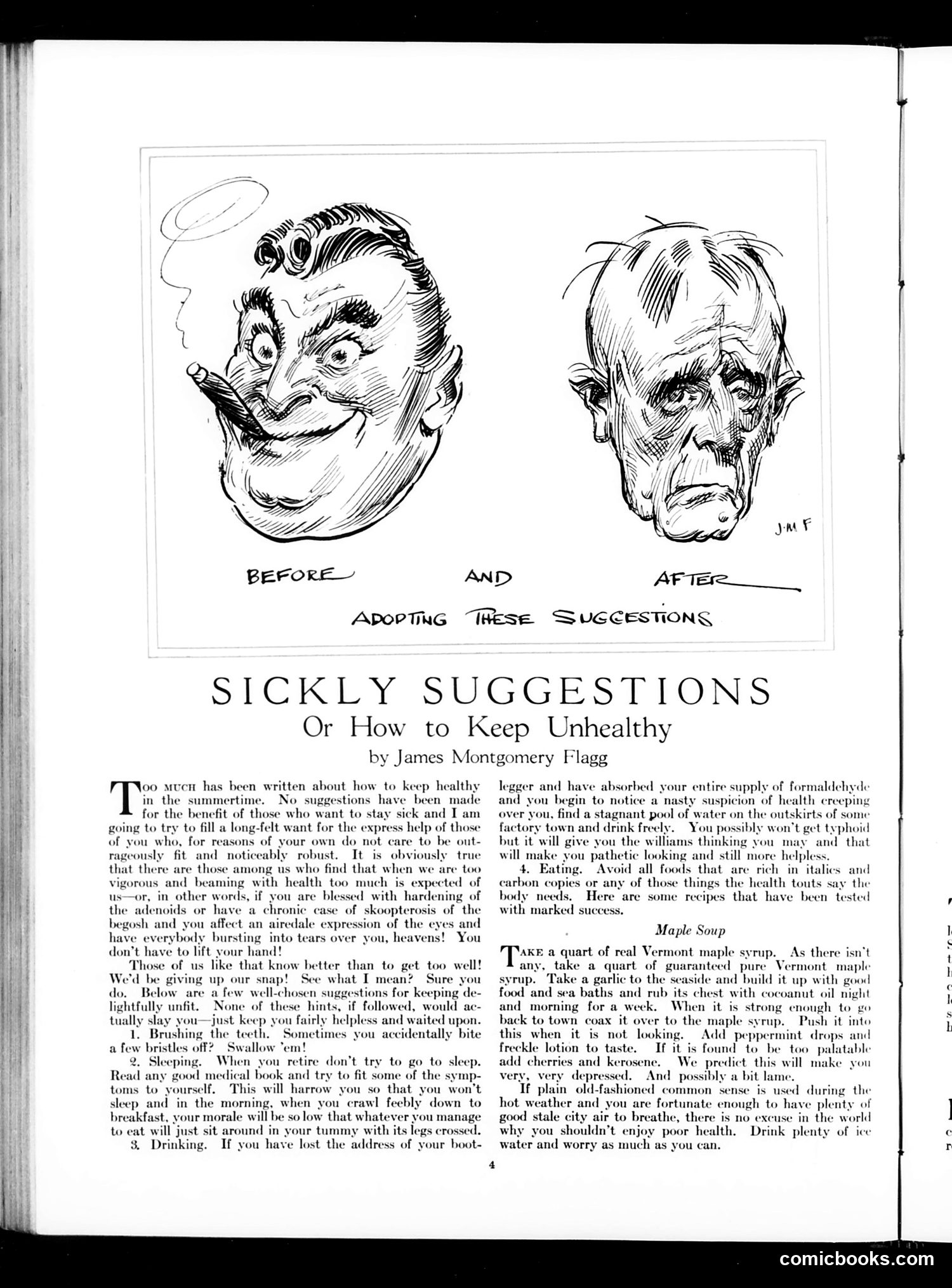
This page from *Judge* magazine features a satirical article titled "Sickly Suggestions: Or How to Keep Unhealthy" by James Montgomery Flagg. The cartoon at top shows a "before and after" comparison of a man's face—left side showing an exaggerated, grotesque expression with a monocle and cigar; right side depicting a gaunt, aged appearance. The satire mocks wellness advice by presenting deliberately harmful "suggestions" as health tips: brushing teeth with foot soap, intentional sleep deprivation, crawling on hands and knees, and drinking excessive water. The cartoon contrasts the man's initially vigorous (if crude) demeanor with his withered state after following these "recommendations." The humor operates through ironic reversal—presenting obviously destructive behaviors as health guidance, poking fun at the era's proliferation of dubious wellness fads and pseudo-scientific health crazes.
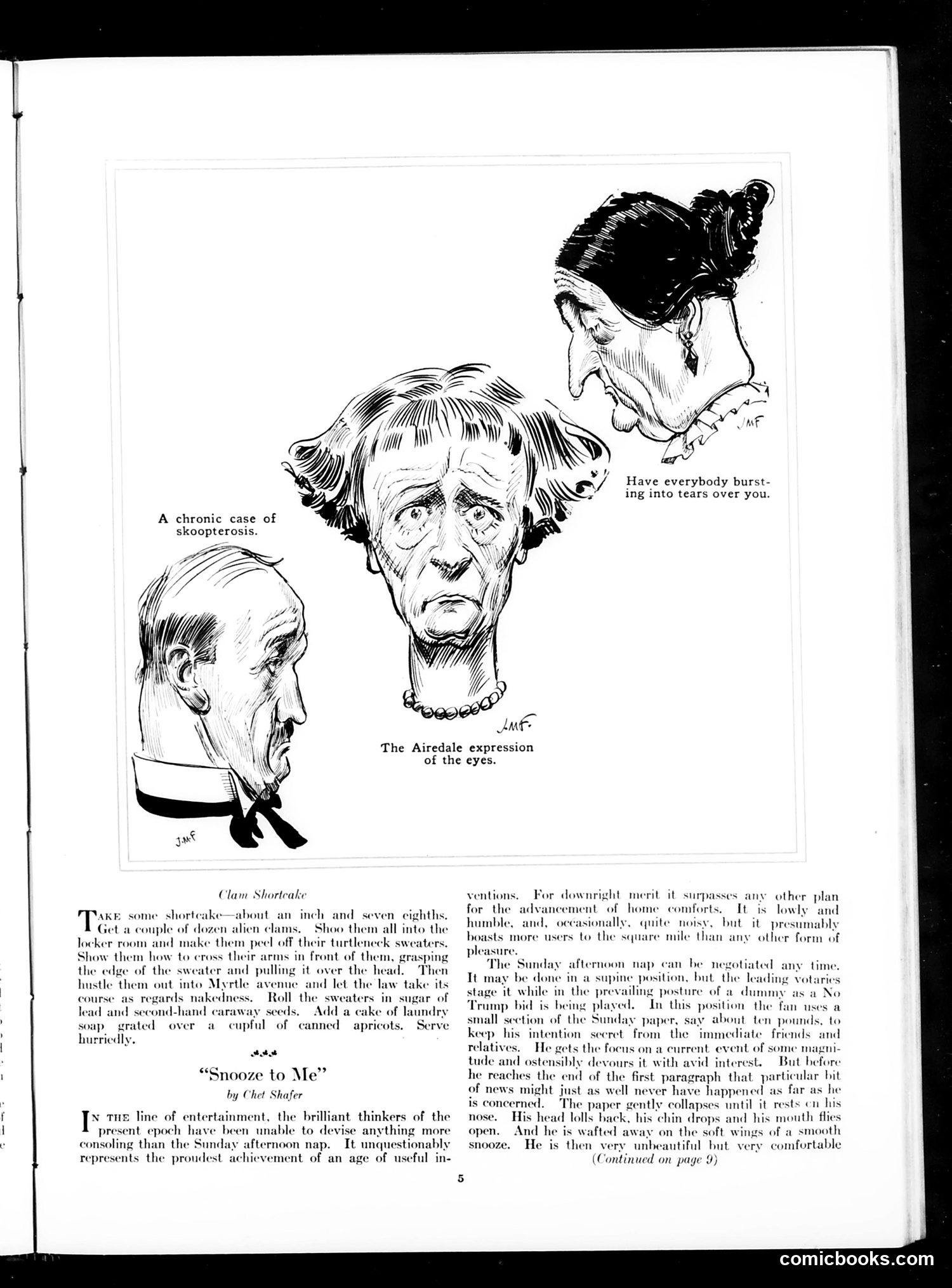
This page contains three unrelated satirical pieces typical of early 20th-century Judge magazine humor: **Top cartoons**: Three caricatured faces illustrate exaggerated facial expressions—"skoopterosis" (chronic drooping), "Airedale expression of the eyes" (a dog-like stare), and crying. The humor relies on physiognomy, a popular (if pseudoscientific) form of period satire. **"Clam Shortcake"**: A absurdist recipe satirizing pretentious food culture. The joke involves the absurd difficulty of preparing clams, creating a nonsensical dish. **"Snooze to Me"**: A humorous essay celebrating the Sunday afternoon nap as modern life's greatest achievement, mocking both leisure culture and newspaper reading. The satire suggests people pretend to read newspapers while napping to hide laziness from family. The page represents Judge's accessible, everyday humor rather than pointed political satire, focused on domestic life and social manners.
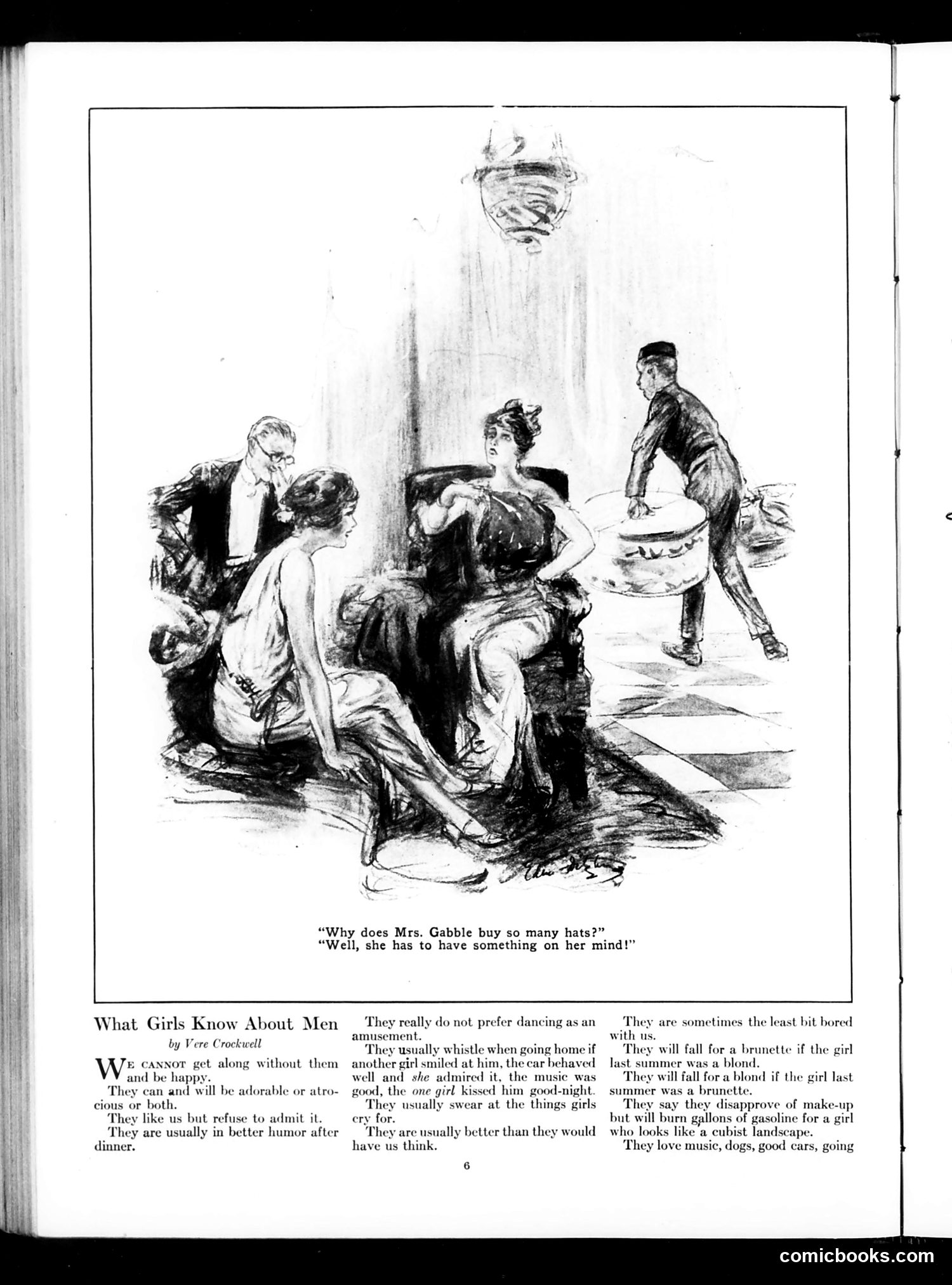
This is a satirical article by Vere Crockwell offering tongue-in-cheek observations about male behavior from a female perspective. The accompanying cartoon depicts a social gathering where a man presents a dish to seated women while others observe — illustrating the article's theme of analyzing male conduct. The humor targets gender stereotypes of the era. The article lists contradictions in men's behavior: they claim indifference to women while seeking their approval; they're moody until fed; they judge women's appearance inconsistently (preferring brunettes or blondes depending on recent history); they disapprove of makeup yet are attracted to made-up women. The opening joke about Mrs. Gabble buying hats—needing "something on her mind"—plays on period stereotypes of women's frivolous shopping. Overall, the piece uses exaggerated generalizations about male hypocrisy and inconsistency as comedy, reflecting early 20th-century gender dynamics and the era's approach to marital/romantic satire.
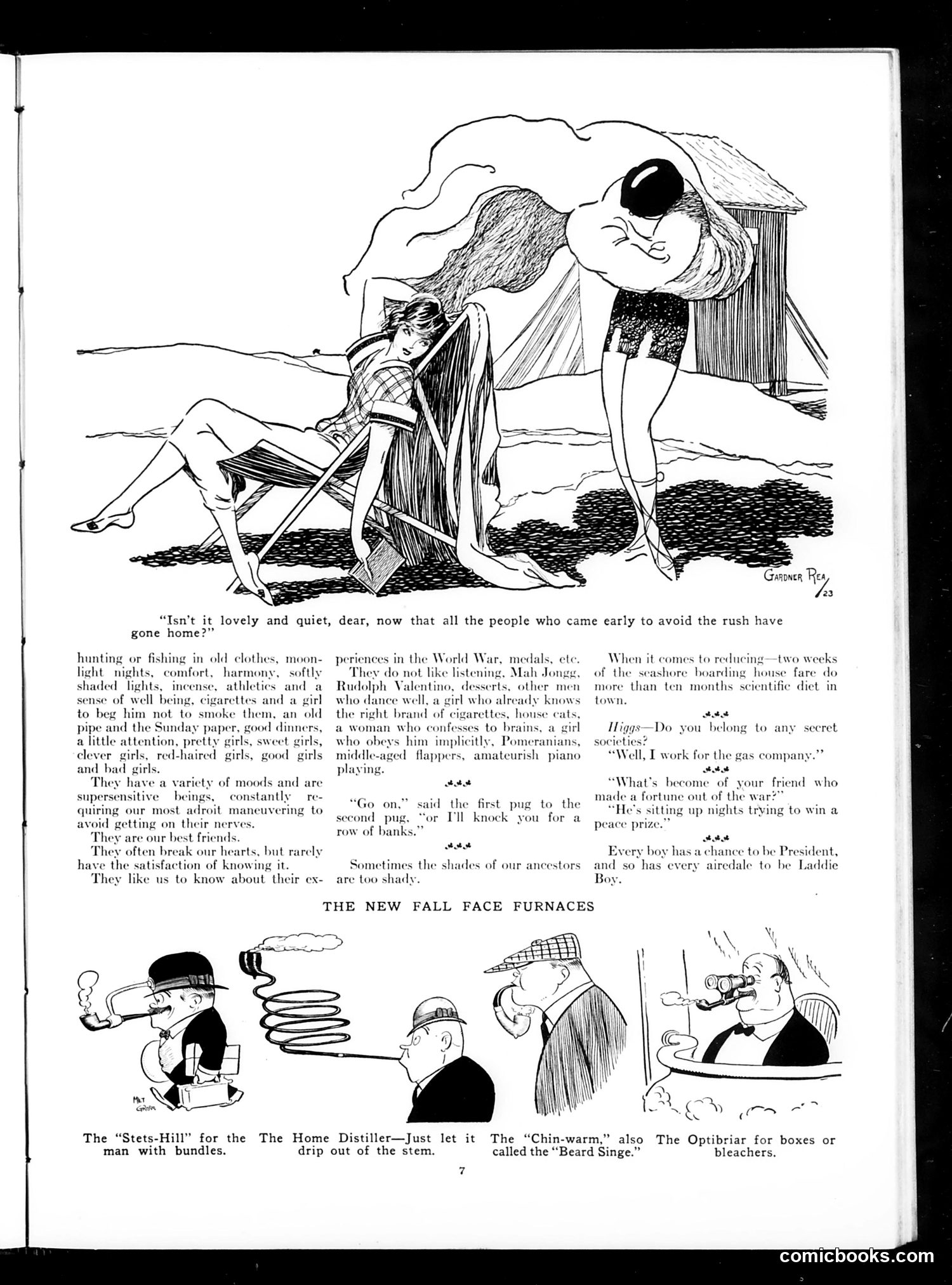
This page contains two distinct sections: a beach scene cartoon and humorous "fall face furnaces" (satirical grooming devices). **Top Cartoon:** A couple at the beach exemplifies post-WWI leisure culture. The wife's comment—that it's peaceful now that early arrivals have left—satirizes the emerging American vacation phenomenon and crowded resort culture of the 1920s. **Text Snippets:** Scattered commentary mocks contemporary social attitudes: women's fickle preferences (Valentino, dancing), post-war mentality (medals, war stories), and period obsessions (Mah-jongg, cigarettes, flappers). References to "Rudolph Valentino" and "Mah Jongg" confirm 1920s setting. **Bottom Section:** Four humorous fake "furnaces" parody men's grooming and appearance-consciousness: - "Sets-Hill" (bundles/shopping) - "Home Distiller" (drinking) - "Chin-warm/Beard Singe" (facial hair) - "Optibriar" (spectacles) The satire mocks masculine vanity and modern consumer culture during the Jazz Age, suggesting men are as concerned with appearance and gadgets as contemporary society implies.
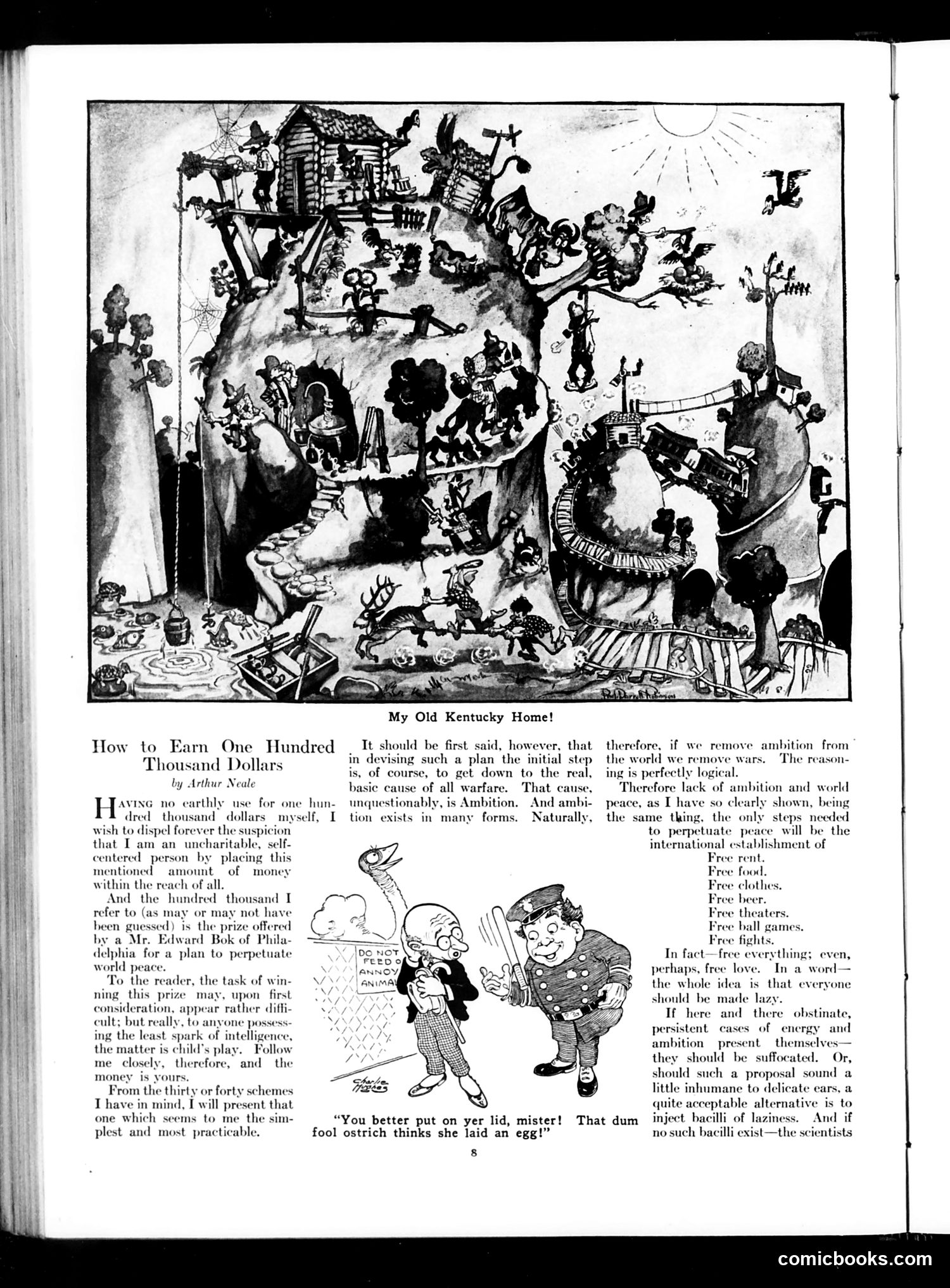
This satirical article mocks Edward Bok's real prize offer for a world peace plan. Arthur Neale sarcastically proposes eliminating ambition as the solution—arguing that since ambition causes war, removing it would bring peace. His scheme: make everything free (food, clothes, love, entertainment) to render humanity lazy and passive. The joke targets the naïveté of peace proposals of the era. The cartoon above shows a chaotic, fantastical scene labeled "My Old Kentucky Home," likely illustrating the absurd consequences of such a utopian (or dystopian) scheme. The bottom illustration shows two figures with a caption about an "ostrich" laying an egg—crude humor emphasizing the foolishness of the proposal. The satire critiques both idealistic peace reformers and suggests their solutions are impractically disconnected from human nature. The tone is darkly comedic, suggesting that inducing mass laziness is neither achievable nor desirable, despite being logically absurd.
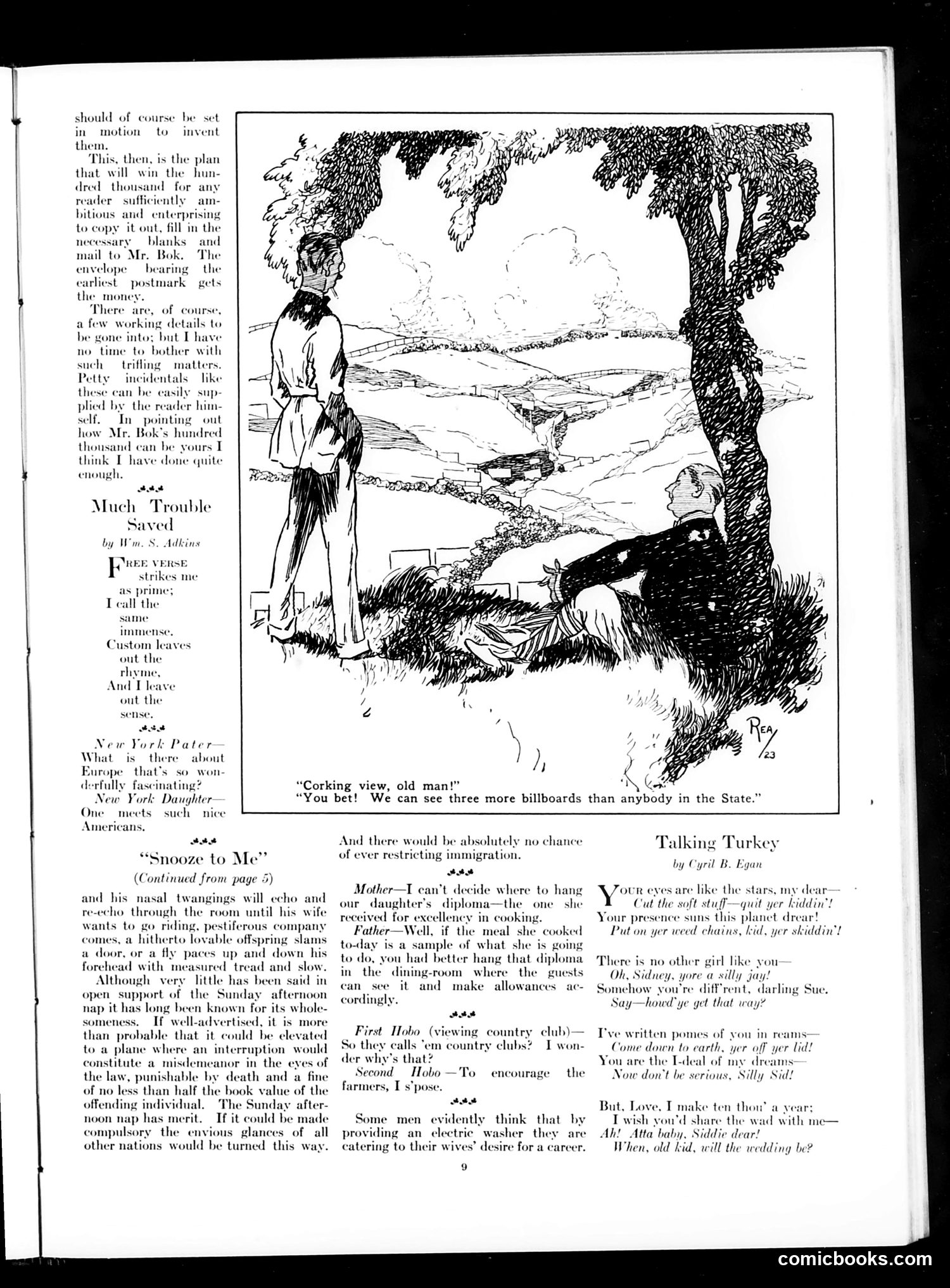
This page contains multiple satirical pieces typical of early-20th-century Judge magazine: **Main Cartoon**: Shows a well-dressed man and working-class figure beneath a tree overlooking farmland. The caption mocks advertising excess: "You bet! We can see three more billboards than anybody in the State." The satire targets the intrusive proliferation of commercial billboards in the American countryside. **"Much Trouble Saved"**: Mocks the contemporary trend of "free verse" poetry by claiming it requires no skill—readers can compose it themselves without understanding rhyme or meter. **"Snooze to Me"**: Defends the Sunday afternoon nap as a wholesome American custom worth protecting and promoting. **"Talking Turkey"**: A humorous poem dialogue between a romantic suitor and his sardonic girlfriend, satirizing flowery romantic language. She repeatedly deflates his poetic declarations with practical comebacks. **"Country Clubs"**: Brief joke suggesting such clubs exist mainly to encourage struggling farmers—implying their actual purpose is pretentious leisure rather than genuine rural support. The overall tone reflects Judge's characteristic mockery of American commercialism, social pretension, and changing cultural values.
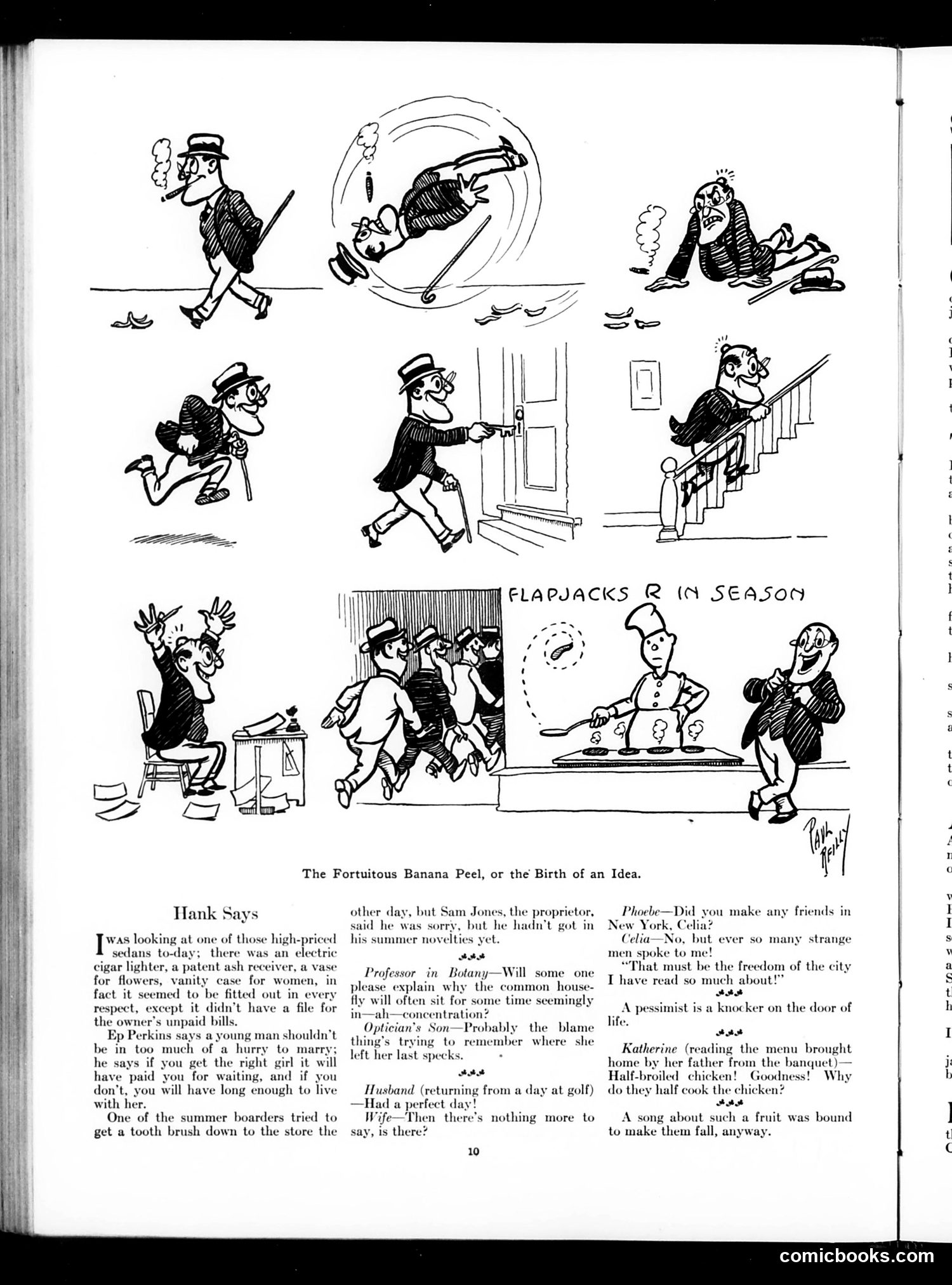
This comic strip satirizes the commonplace origin of creative inspiration. The sequential panels show a man slipping on a banana peel—a slapstick accident—which triggers ideas (depicted by the spinning motion and light bulb imagery). The title suggests that mundane, ridiculous mishaps can accidentally spark inventions or solutions. The surrounding "Hank Says" section offers brief, disconnected jokes typical of Judge magazine's humor: complaints about fancy car features, marriage advice, complaints about summer stores lacking novelties, and wordplay (a fly "concentrating" is actually searching for lost spectacles). The content reflects early 20th-century American middle-class concerns and casual social commentary—nothing particularly political. It's genteel domestic humor targeting educated readers, relying on observational comedy about everyday life rather than satirizing specific events or figures.
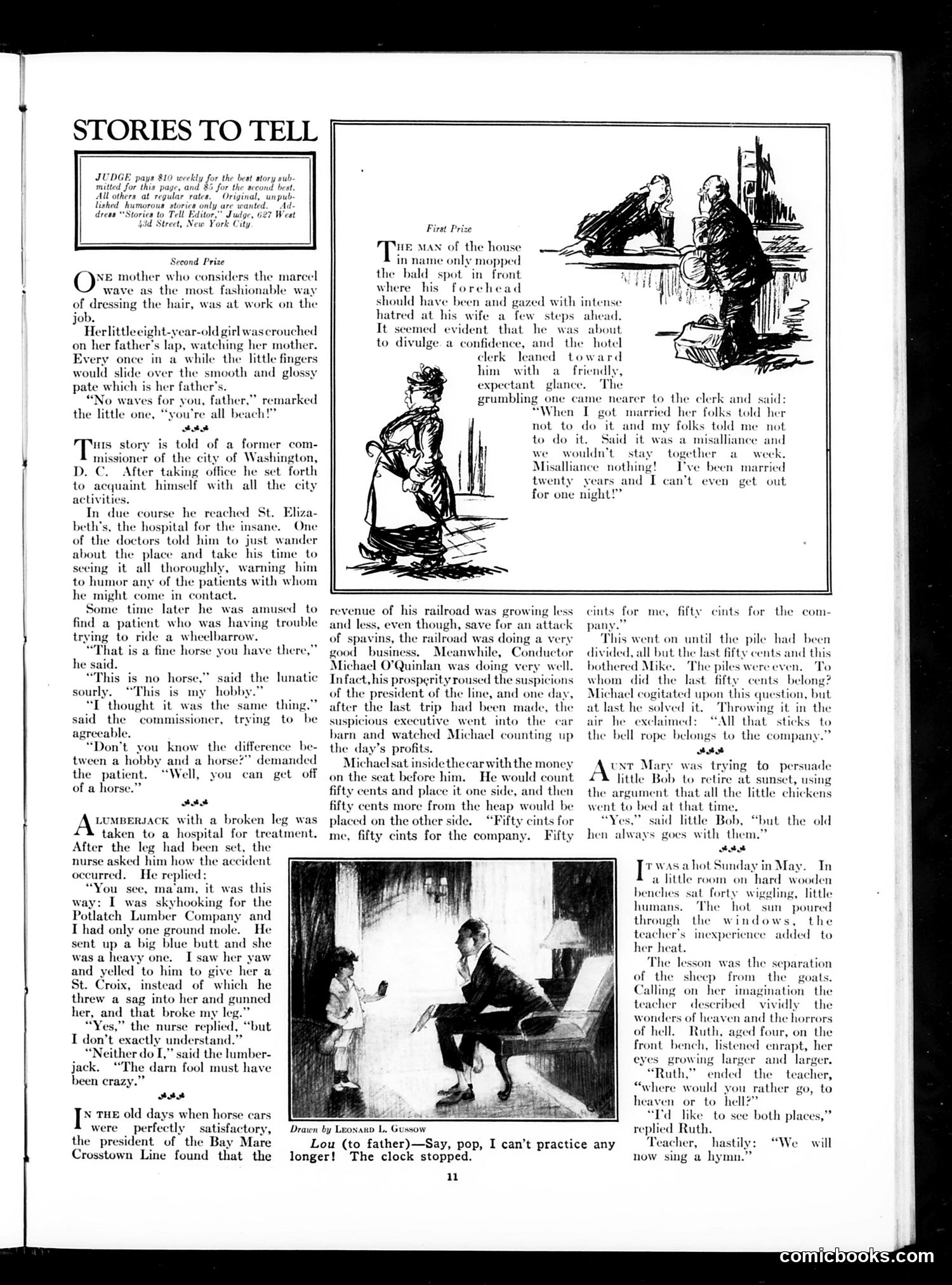
This page from Judge presents several humorous short stories submitted by readers. The main cartoons illustrate: **"The Man of the House"** (First Prize): A bald man complains to a hotel clerk that despite a family prediction his marriage would fail due to his wife's parents' disapproval, he's been stuck with her for twenty years—he can't even get a single night away. The joke satirizes unhappy marriages and marital entrapment. **The Marcel Wave Story** (Second Prize): A child observes her father's bald head and remarks he needs no "waves," making a pun on the fashionable "marcel wave" hairstyle. **Other Stories**: Brief anecdotes about a Washington D.C. official's visit to an insane asylum, a lumberjack's accident, and a railroad conductor's accounting confusion over dividing money. The page emphasizes Judge's call for reader submissions ($10 first prize), positioning itself as a humor magazine dependent on public participation.
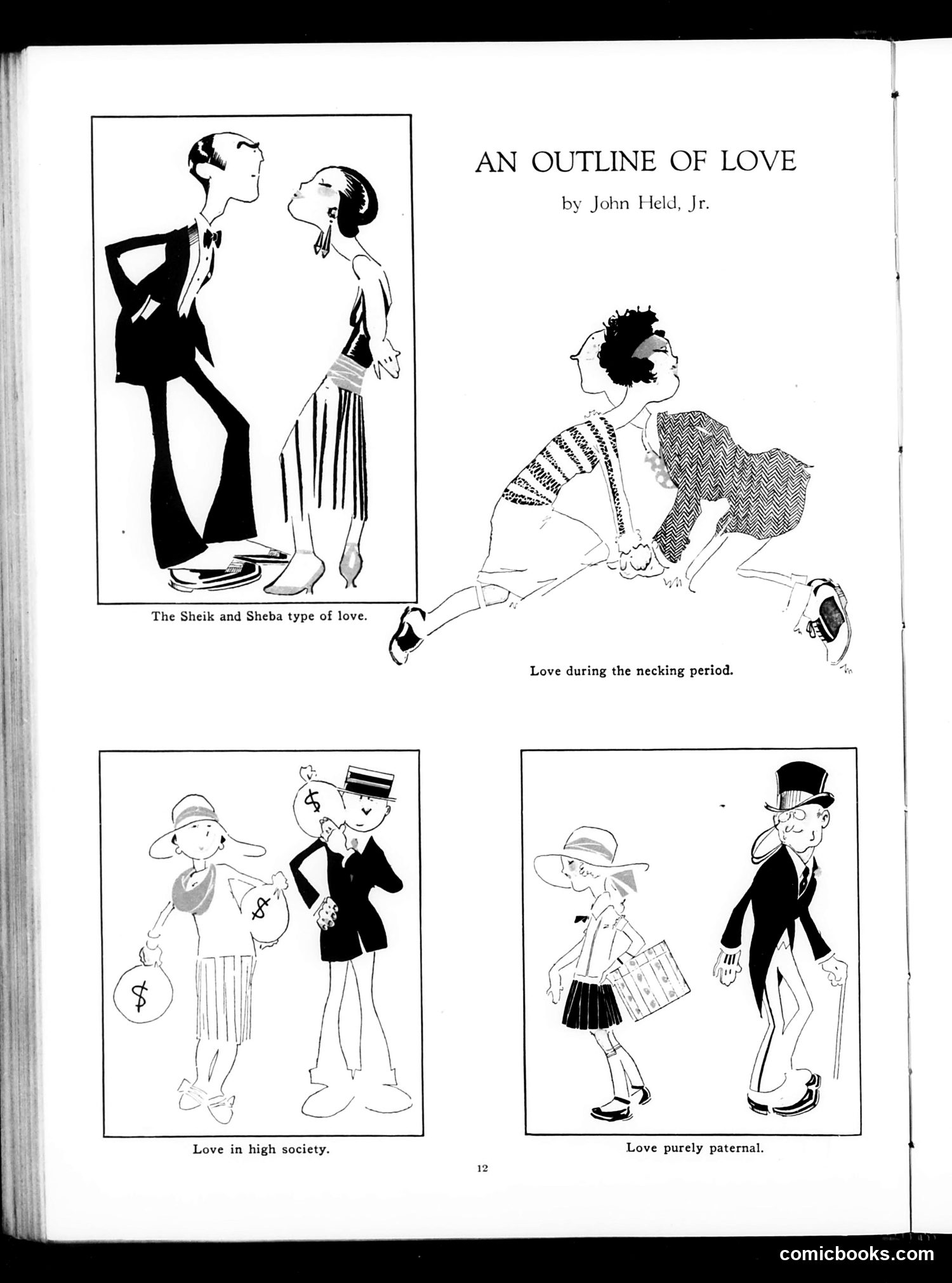
This page presents four satirical vignettes about different types of romantic love, drawn in the distinctive style of John Held Jr., a famous Jazz Age illustrator. The sketches mock various social classes and behaviors: 1. **"The Sheik and Sheba type"** references 1920s popular culture—the exotic, passionate romance style 2. **"Love during the necking period"** satirizes modern youth behavior (necking was contemporary slang for kissing/petting) 3. **"Love in high society"** ridicules wealthy couples where money/materialism drives the relationship (shown via dollar signs) 4. **"Love purely paternal"** depicts an older man with a young woman, suggesting transactional rather than romantic love The humor derives from reducing different romantic scenarios to crude stereotypes and exposing their artificiality or mercenary nature. Held captures 1920s social anxieties about changing courtship norms and class-based hypocrisy.
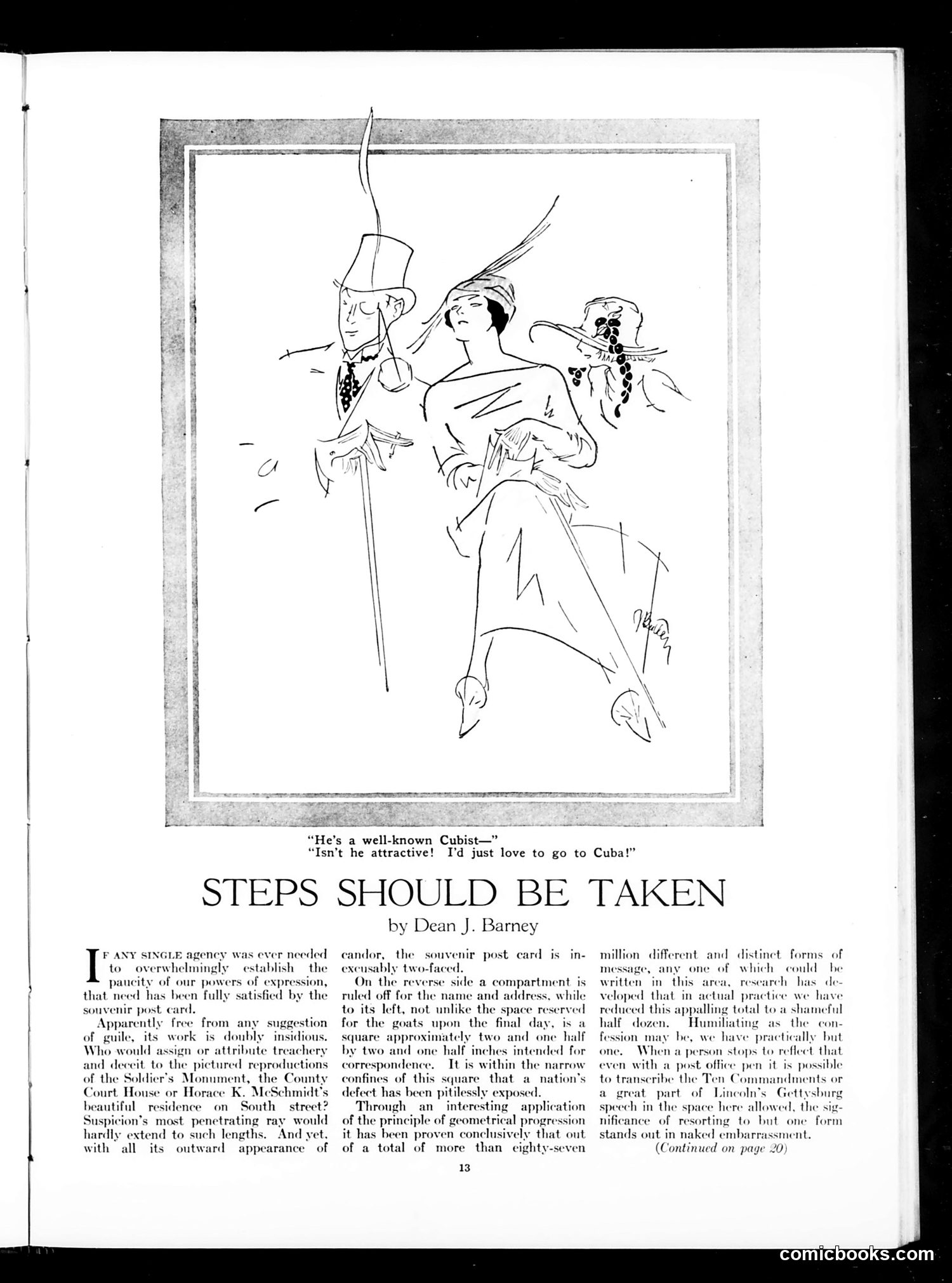
This is a humorous essay by Dean J. Barney satirizing the banality of souvenir postcards. The cartoon illustrates the essay's point through a dialogue joke: two fashionable women discuss a man as a "well-known Cubist" (referencing the modern art movement), with one declaring she'd "love to go to Cuba"—a pun suggesting tourists confuse artistic movements with travel destinations. The essay proper mocks postcards' hypocrisy: their "candid" appearance masks their actual function as bland, formulaic messages. Barney's real complaint is that postcards claim to celebrate local landmarks (monuments, courthouses, residences) yet people always write the same generic messages on them. He sardonically argues that despite having space for the Ten Commandments or Lincoln's Gettysburg Address, people resort to the same tired phrases—a commentary on conformity and unoriginality in American tourism and communication. The satire targets mass culture's superficiality.
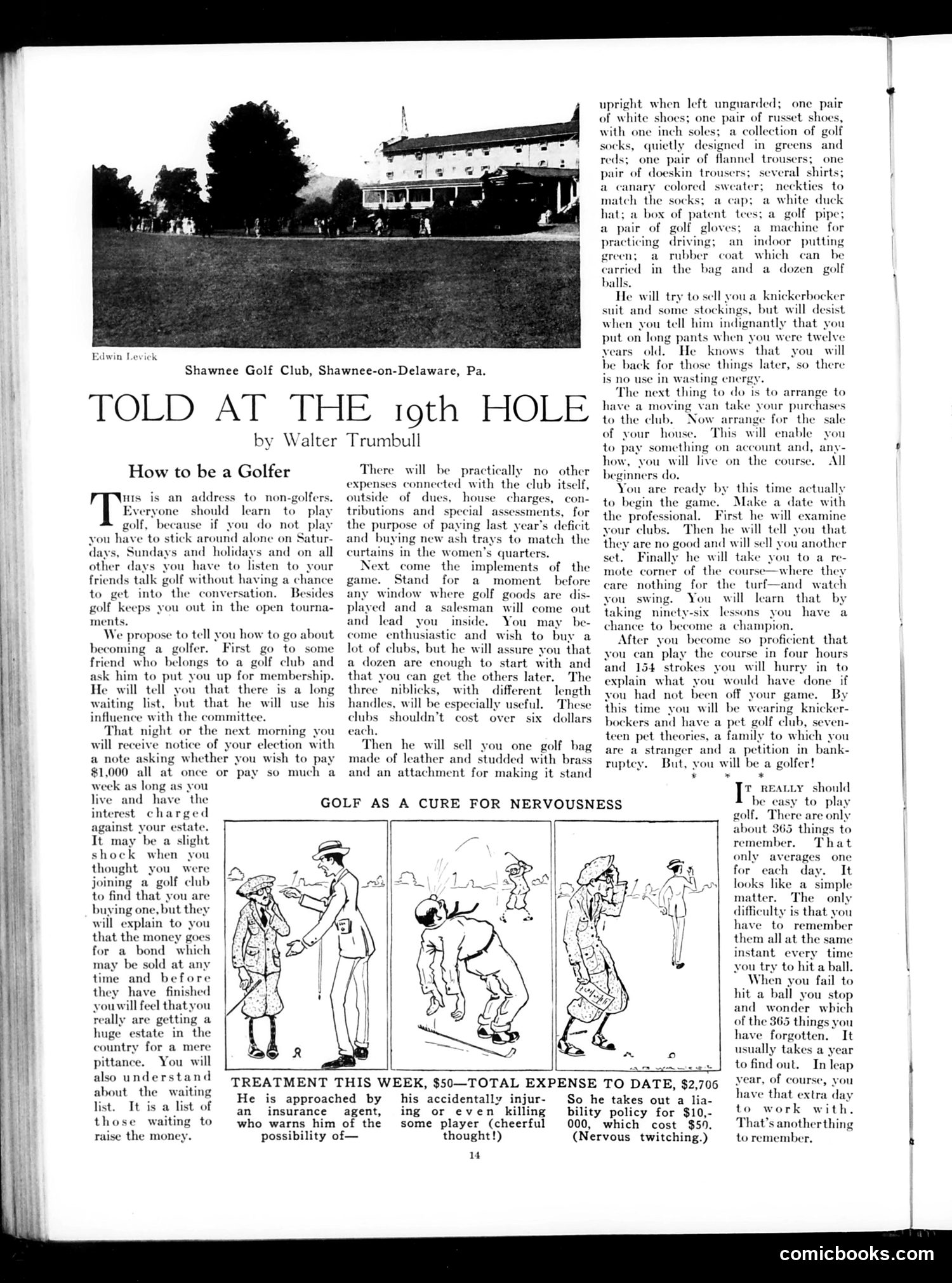
This humorous article by Walter Trumbull satirizes golf's explosive costs and social pressures in the early 20th century. The piece mocks how golf clubs exploit new members through hidden expenses: membership fees ($1,000), dues, assessments, and an endless cascade of required equipment (multiple clubs, specialized shoes, socks, trousers, sweaters—each costing money). The salesman deliberately undersells initial needs, knowing members will return repeatedly. The satire peaks in the financial reckoning: a golfer must eventually sell his house to afford the sport, ends up bankrupt with a "petition in bankruptcy," yet acquires only "a family to which you are a stranger" and "seventeen pet theories." The accompanying cartoon strip titled "Golf as a Cure for Nervousness" ironically depicts golf causing increasingly frantic behavior rather than calmness, visually reinforcing the article's satirical message that golf is an expensive, obsession-inducing trap disguised as leisurely recreation.
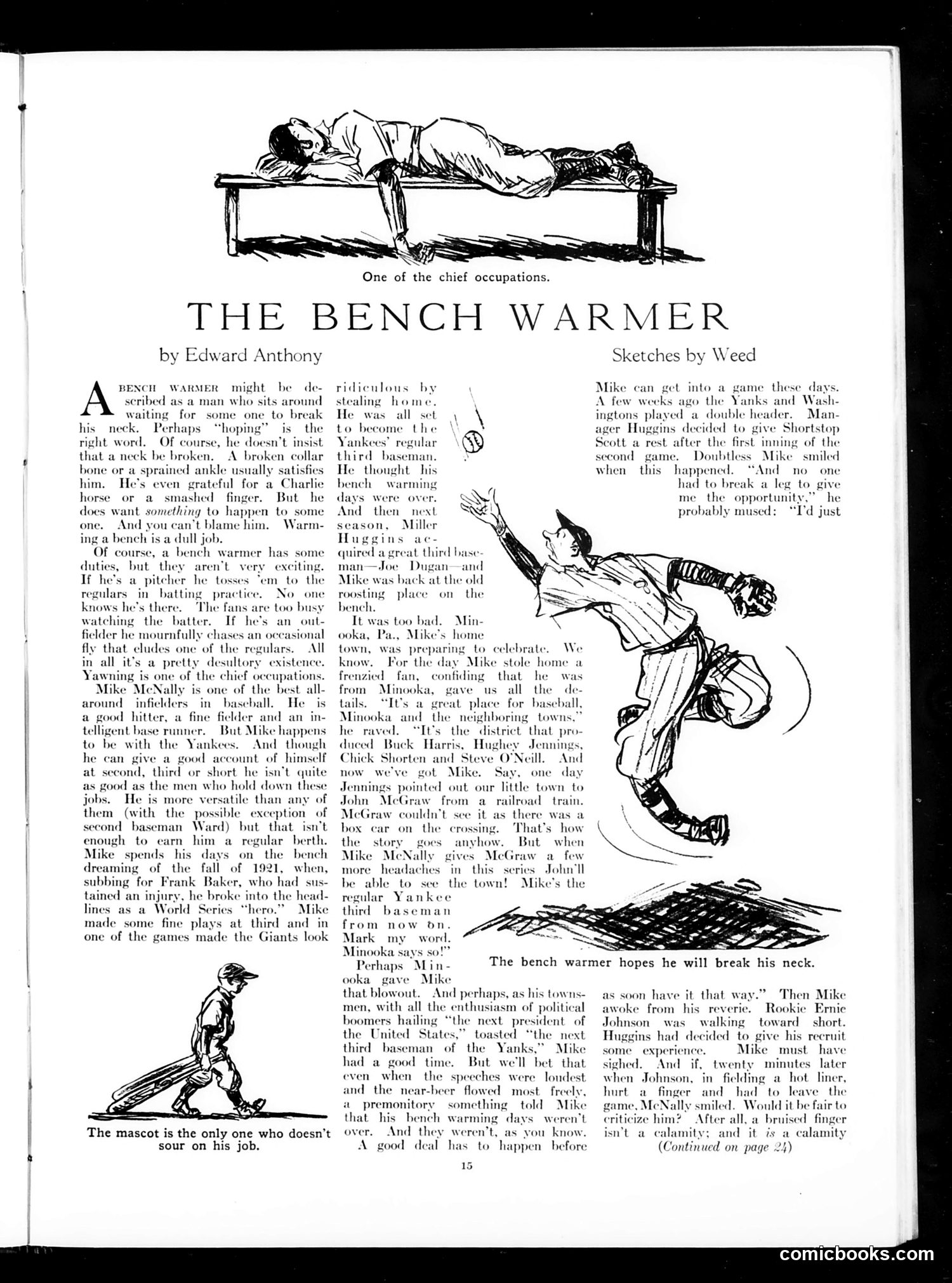
This article satirizes the frustration of backup baseball players, specifically Mike McNally of the New York Yankees. McNally was a skilled utility infielder who had a brief moment of glory in the 1921 World Series—when substituting for injured Frank Baker, he made spectacular plays including stealing home. His hometown of Minooka, Pennsylvania celebrated him as their baseball hero. However, when the Yankees acquired star third baseman Joe Dugan, McNally returned to "bench warming"—sitting unused on the sidelines. The article humorously notes that bench warmers are so desperate for action that they practically *hope* someone gets injured so they can play. McNally's situation exemplifies the cruel irony: a genuinely talented player reduced to irrelevance by roster depth. The cartoon mocks how thankless and dull this role is, despite McNally's evident skills.
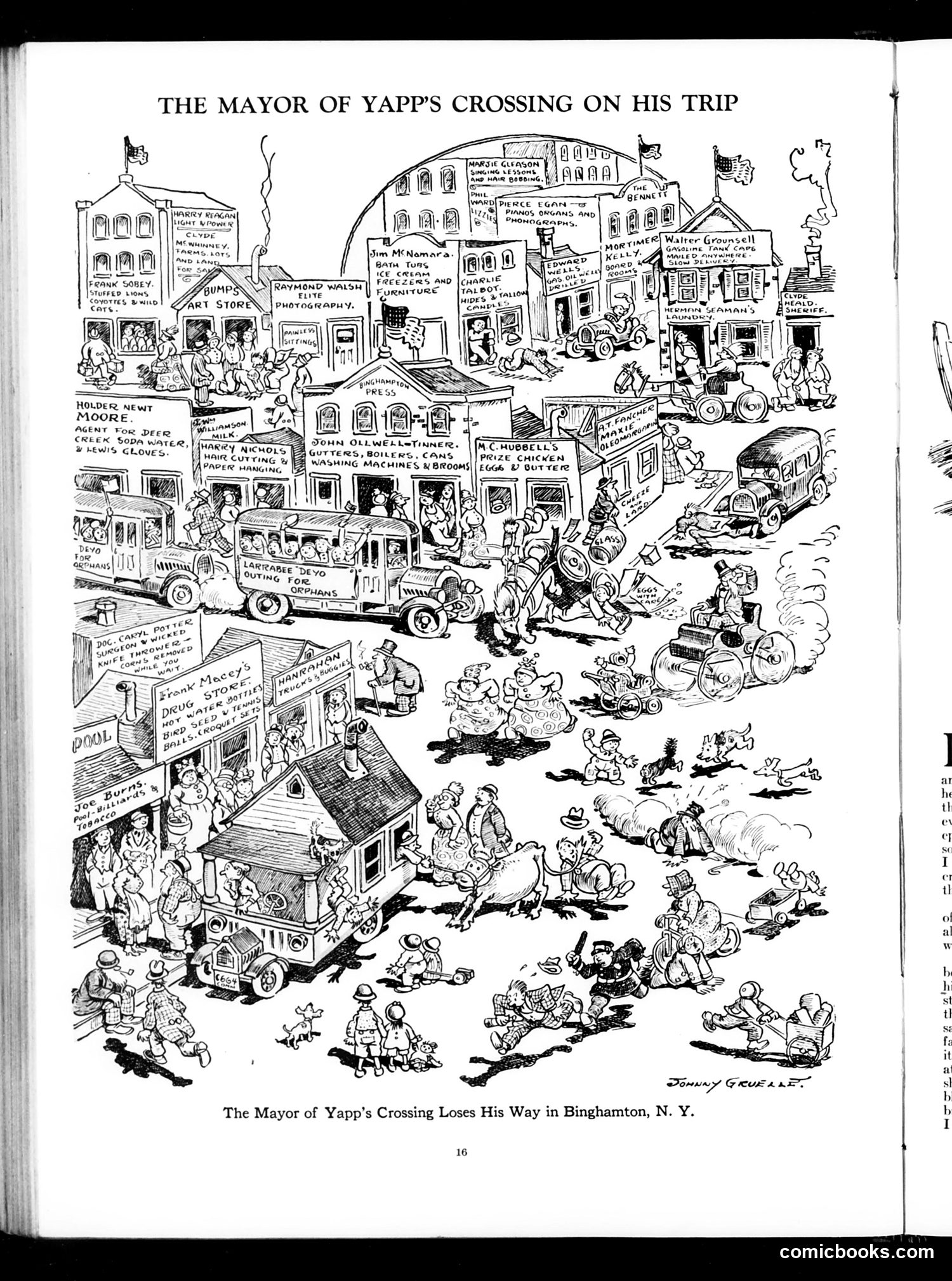
This is a humorous single-panel cartoon depicting a mayor from a small town ("Yapp's Crossing") getting comically lost in the larger city of Binghamton, New York. The joke centers on the contrast between small-town simplicity and urban complexity. The cartoon shows the mayor's entourage—including local business owners and merchants (whose names and shops are labeled throughout)—arriving in the city in an old-fashioned vehicle. They appear bewildered amid the bustling urban chaos: multiple vehicles, crowds of people, and commercial activity. The cluttered, overwhelming scene humorously suggests that the small-town delegation cannot navigate or comprehend the city's sophistication. This is gentle satire on rural vs. urban culture—a common Judge magazine theme mocking small-town parochialism and the culture shock of encountering modern city life. The numerous labeled local businesses emphasize how the mayor brought his entire provincial community with him.
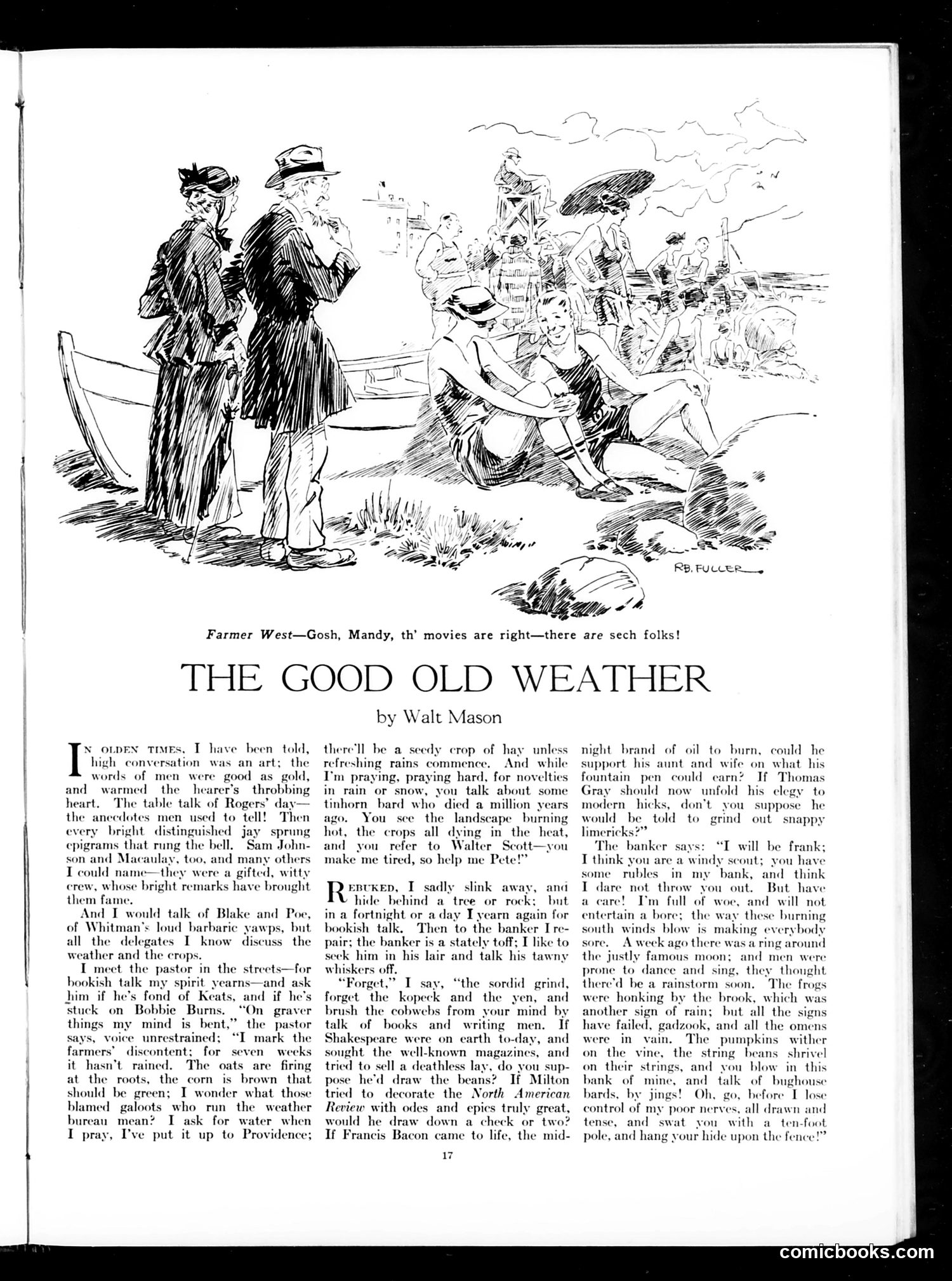
This is a humorous essay-cartoon lamenting the decline of meaningful conversation. The narrator, a bookish man, repeatedly attempts to engage others—a pastor, a banker—in sophisticated literary discussion about Shakespeare, Milton, and other great writers. Each time, his conversation partners dismiss his intellectual pursuits, redirecting him to discuss practical concerns: the weather, crops, and drought. The cartoon's opening caption shows a farmer and his wife observing people at a movie theater, commenting that "movies are right—there are such folks!" This frames the entire piece as social satire: modern Americans have become so focused on entertainment and practical worries that they've abandoned the "art" of intellectual conversation that supposedly defined earlier generations. The joke is that the narrator's pretentious literary aspirations repeatedly meet frustration from ordinary working men concerned with real agricultural problems. Mason gently mocks both the narrator's snobbish assumptions and his inability to connect meaningfully with anyone.
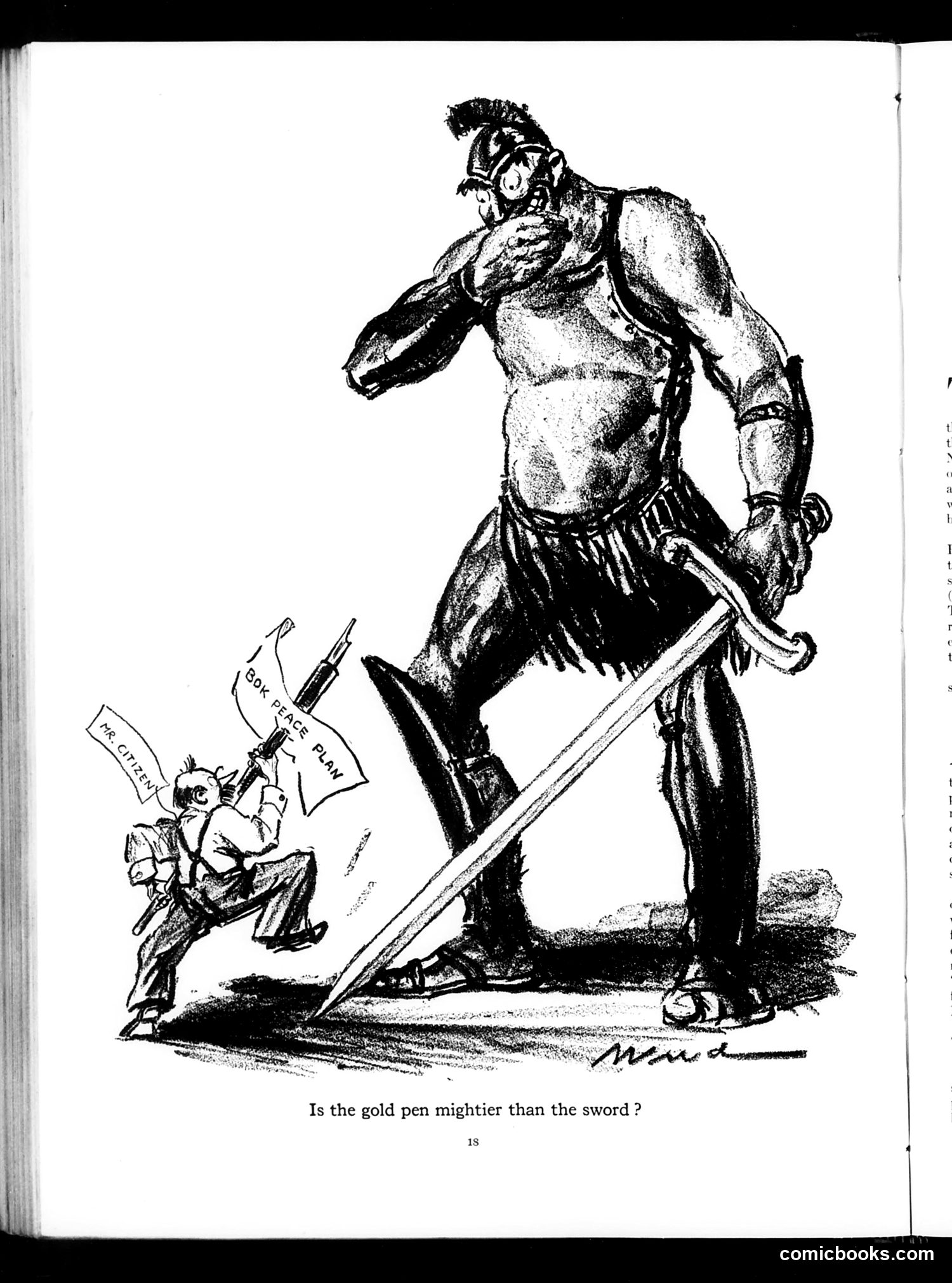
This cartoon depicts a confrontation between a small, armed military figure (labeled "MR. GLITCH") and a large, muscular warrior wielding a sword. The tiny soldier holds what appears to be a pen or writing instrument marked "BOX FOR PLAY." The caption asks: "Is the gold pen mightier than the sword?" This satirizes the tension between **military power and press/political influence**. The small figure represents journalism, writing, or political discourse attempting to challenge or restrain actual military force (the large warrior). The cartoon suggests skepticism about whether words and writing can truly overcome physical military might—or conversely, questions whether they can. Without knowing the specific date and historical context of this Judge magazine issue, the exact political situation referenced remains unclear, though it likely comments on contemporary military or political conflicts.
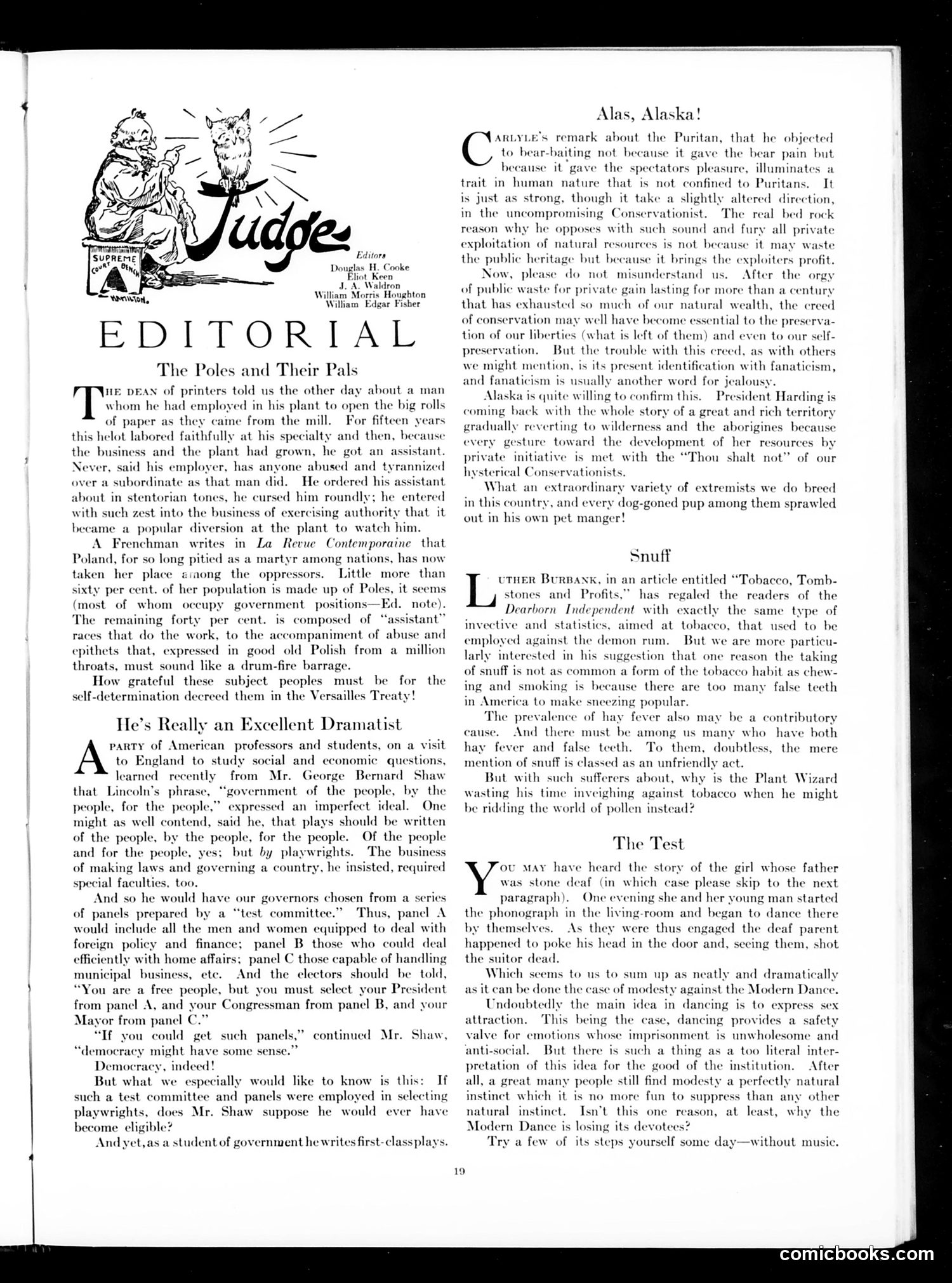
This editorial page contains three satirical pieces targeting different subjects: **"The Poles and Their Pals"** critiques Poland's treatment of its non-Polish minorities after gaining independence via the Versailles Treaty (post-WWI). The anecdote about a mill worker becoming tyrannical toward his assistant serves as an allegory: Poland, newly liberated, is now oppressing its own "assistant races"—the 40% non-Polish population—with verbal abuse. The satire suggests that self-determination promised by Versailles rings hollow when applied to minorities within newly independent nations. **"He's Really an Excellent Dramatist"** mocks George Bernard Shaw's proposal for governance by expert panels. Shaw argues that while plays needn't be written *by* the people, government should be. Judge's retort is witty: if such qualification panels existed for playwrights, Shaw himself—despite being an excellent playwright—would be disqualified. The joke exposes the impracticality of Shaw's meritocratic system. **"Alas, Alaska!"** defends private resource exploitation against conservationist opposition, arguing conservationists' real objection is profit-making, not environmental concern—a critique of performative progressivism.
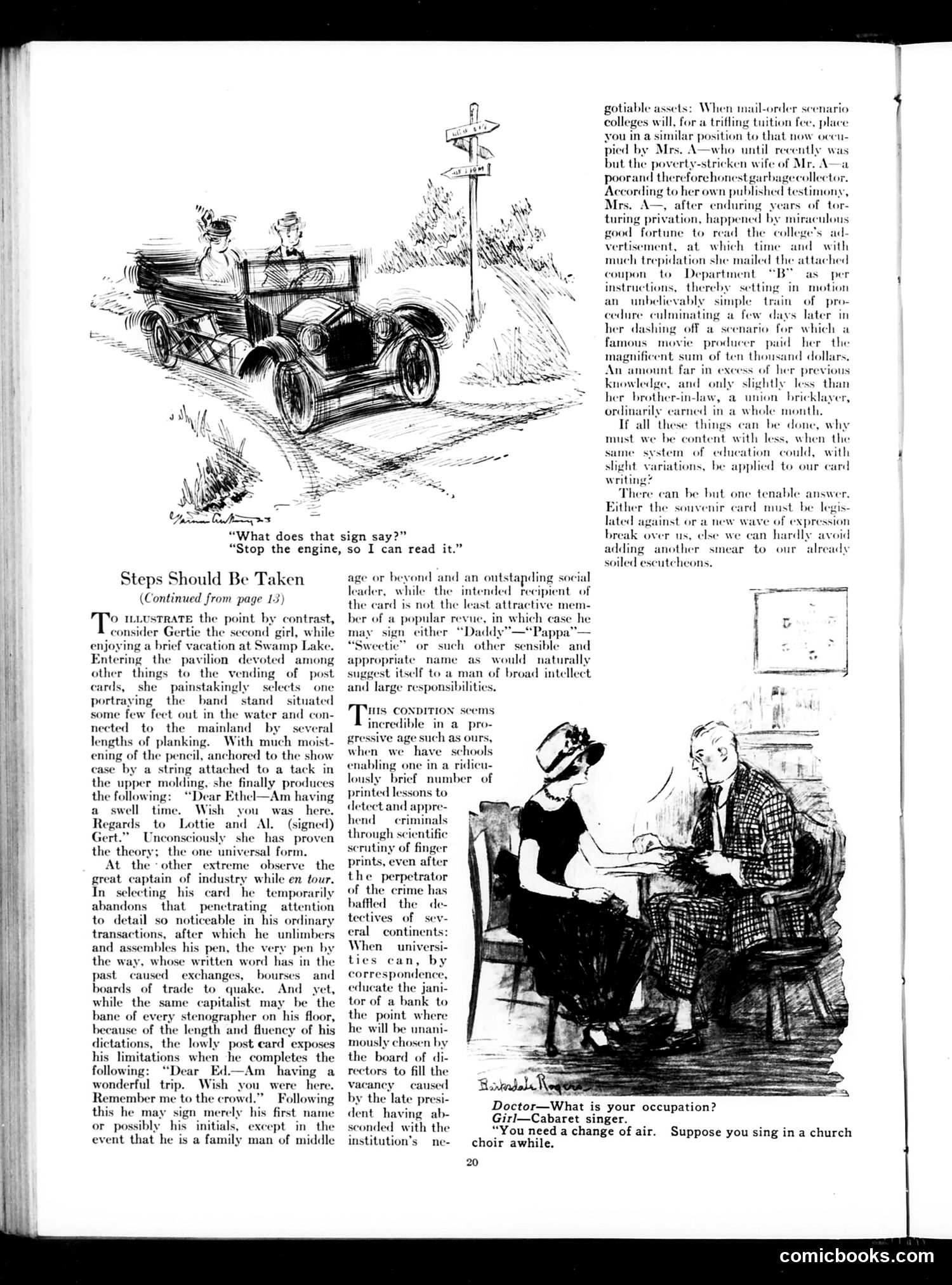
This page satirizes the standardization and democratization of American life through mail-order education and mass culture. **The cartoon** at top mocks motorists' inability to read roadside signs while driving—a contemporary frustration as automobiles proliferated. **The main article** critiques mail-order colleges and correspondence education. It uses contrasting examples: "Gertie," an ordinary girl, writes a generic postcard; an industrial magnate does the same despite his intellect and influence. The text then sarcastically catalogs improbable mail-order achievements—fingerprint criminology training, bank management education, and notably, a poor woman (Mrs. A) who allegedly earned $10,000 writing movie scenarios after taking a correspondence course. **The satire's point**: If mail-order education can supposedly produce criminals' fingerprint analysis, train bank executives, and turn poverty-stricken housewives into successful screenwriters, why not apply it to teaching better postcard writing? The absurdity mocks both the inflated promises of correspondence schools and America's faith in quick educational shortcuts during this era. **The small cartoon** at bottom (doctor/singer) is a separate joke about air quality.
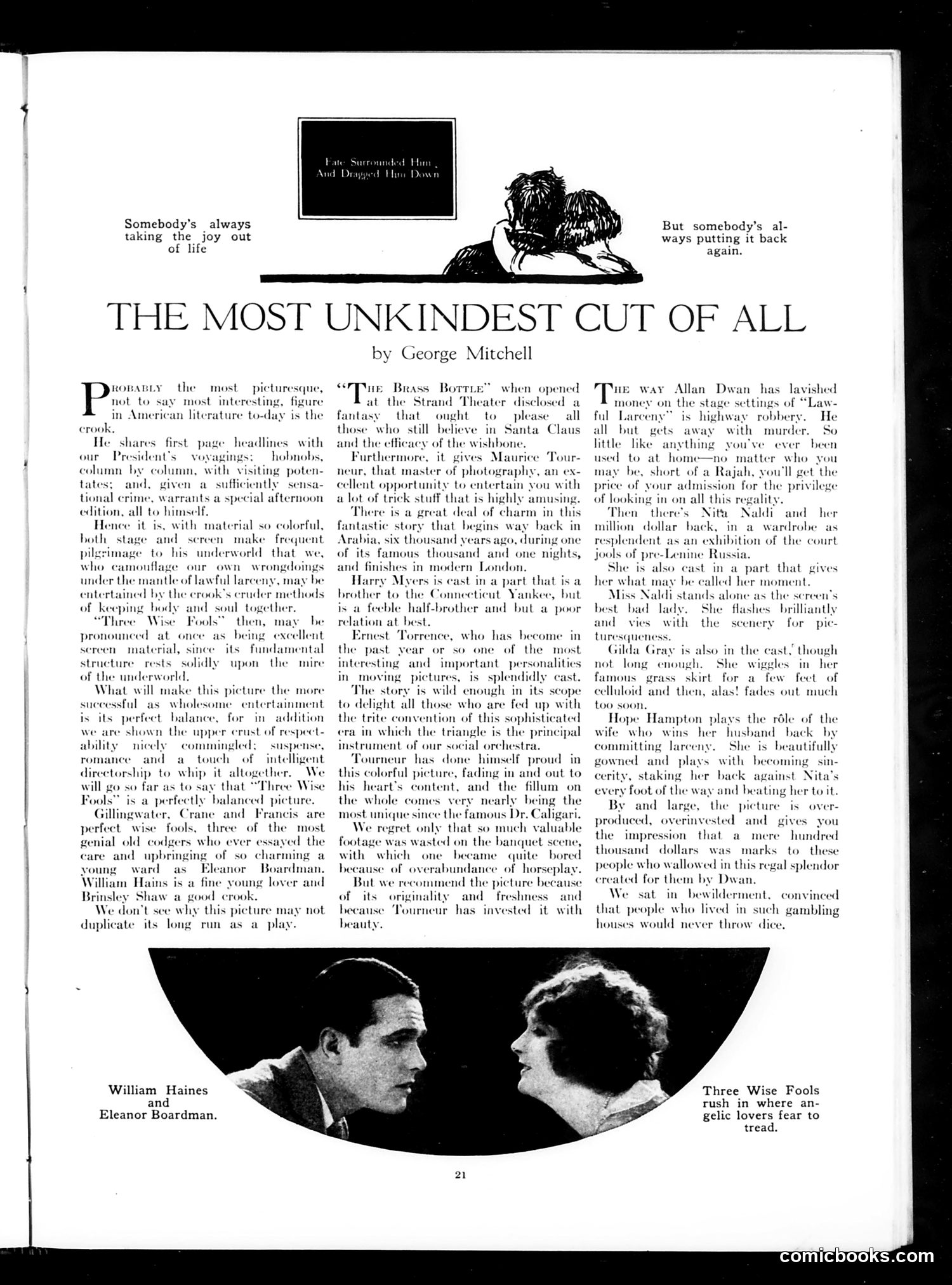
This page reviews three films: "The Brass Bottle," "Three Wise Fools," and "Lawful Larceny." The critic George Mitchell praises entertainment that balances escapism with respectability. **Key figures mentioned:** - William Haines and Eleanor Boardman star in "Three Wise Fools" - Ernest Torrence appears in "The Brass Bottle" - Nita Naldi features in "Lawful Larceny" **The satire's point:** The opening illustration and text joke that someone is always "taking the joy out of life" while "somebody's always putting it back again"—likely a gentle jab at life's hardships versus entertainment's role in providing relief. **Context for modern readers:** This reflects 1920s enthusiasm for cinema as escapism during Prohibition and post-WWI adjustment. The reviews celebrate films offering fantasy, humor, and glamorous settings as antidotes to mundane existence. The mention of "crooks" as "picturesque" characters reflects period fascination with morally ambiguous antiheroes in silent film.
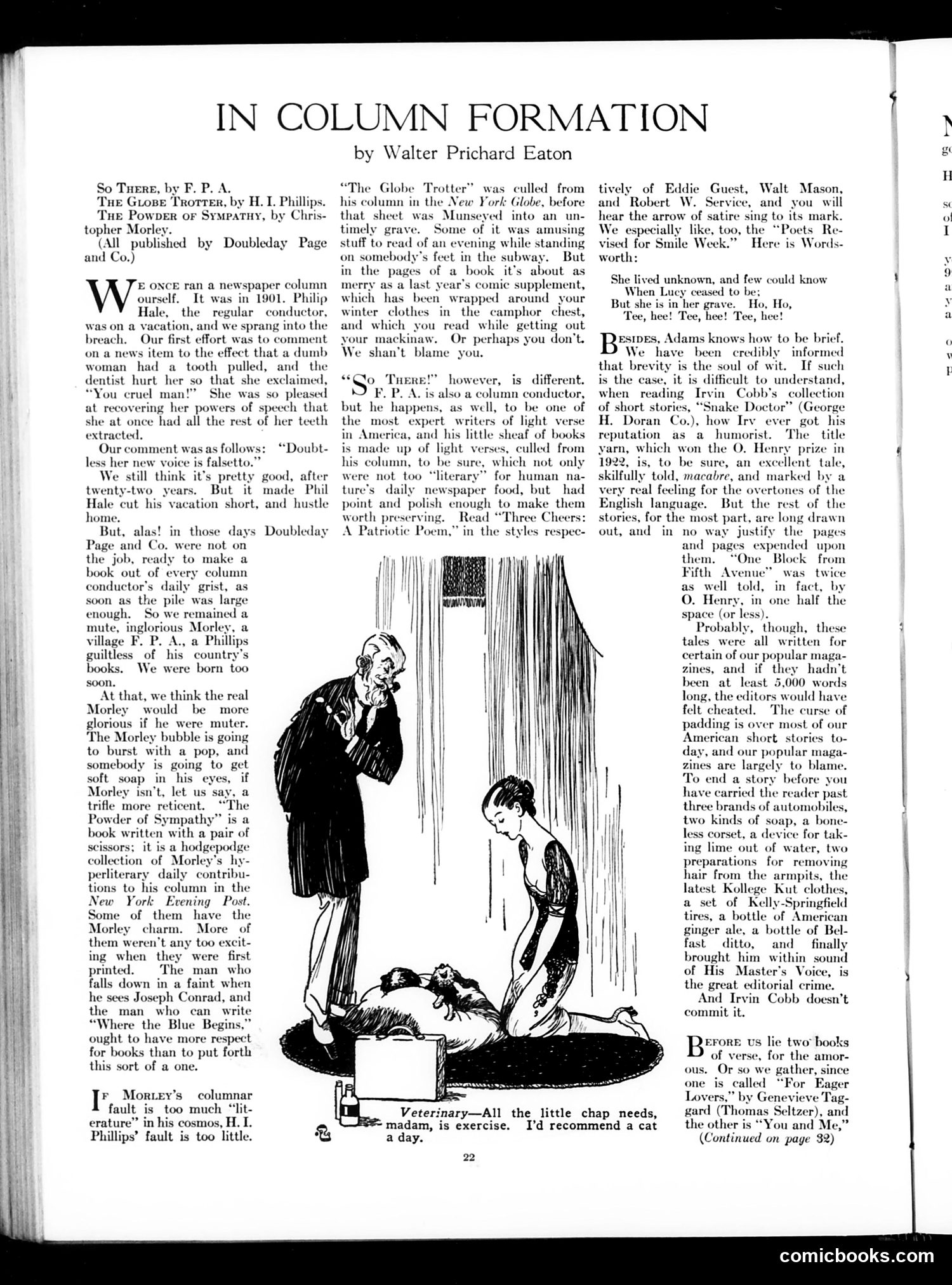
This page reviews three new books of newspaper column collections. The critic praises **F.P.A.'s "So There!"**—light verse culled from his New York newspaper column—as genuinely witty, citing examples like parodies of Wordsworth written in the styles of popular humorists (Eddie Guest, Walt Mason, Robert W. Service). He criticizes **Christopher Morley's "Powder of Sympathy"** as overly "literary" and pretentious for what should be accessible daily newspaper content, though acknowledging Morley's charm. He dismisses **"The Globe Trotter"** (from the now-defunct New York Globe) as depressing when collected in book form—newspaper humor loses its ephemeral appeal on the page. The accompanying cartoon (captioned "Veterinary") shows a doctor observing a boy exercising a small dog, joking that the boy needs exercise, not the dog. The satire targets how newspaper columnists' daily output doesn't always translate successfully to bound books—different mediums require different approaches.
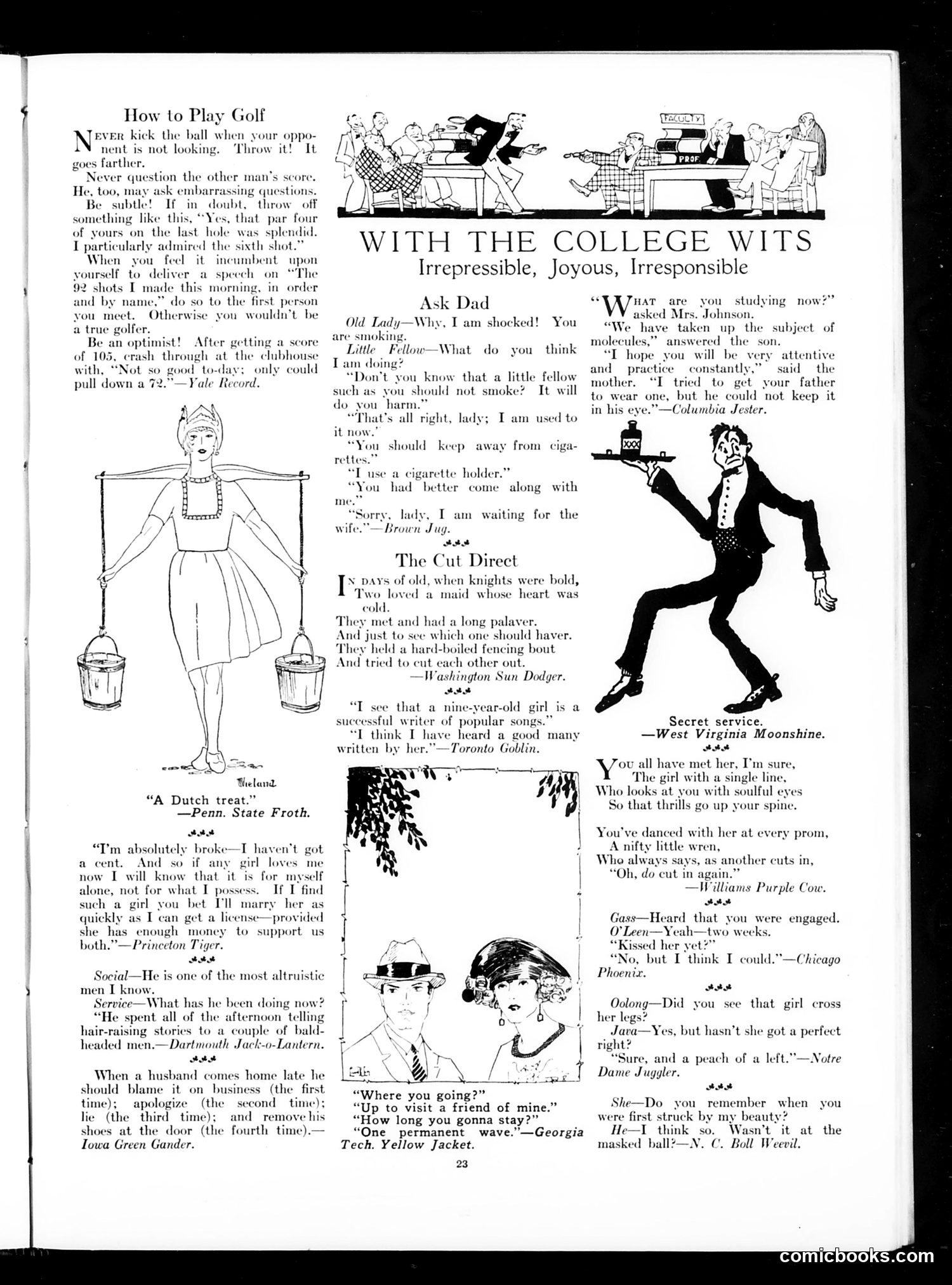
This page from *Judge* magazine contains humorous college humor and social satire typical of early 20th-century American publications. **"How to Play Golf"** mocks golf etiquette by sarcastically advising cheating and poor sportsmanship—throwing the ball when unobserved, disputing scores, and boring others with inflated shot counts. **"With the College Wits"** is a collection of jokes from college humor magazines (Penn State, Princeton, Dartmouth, etc.). These include: - A child smoking cigarettes, defended by claiming habituation - A cynical broke young man hoping poverty proves a girl loves him for himself (while needing her money to support them) - Flirting exchanges and dating jokes about "cutting in" at dances - Wordplay on "molecules" misheard as "monocles" The satire targets college social pretension, male romantic cynicism, and courtship rituals. The cartoons show exaggerated figures embodying these stereotypes. Overall, the page reflects 1920s-era college culture's emphasis on wit, social climbing, and romantic conquest.
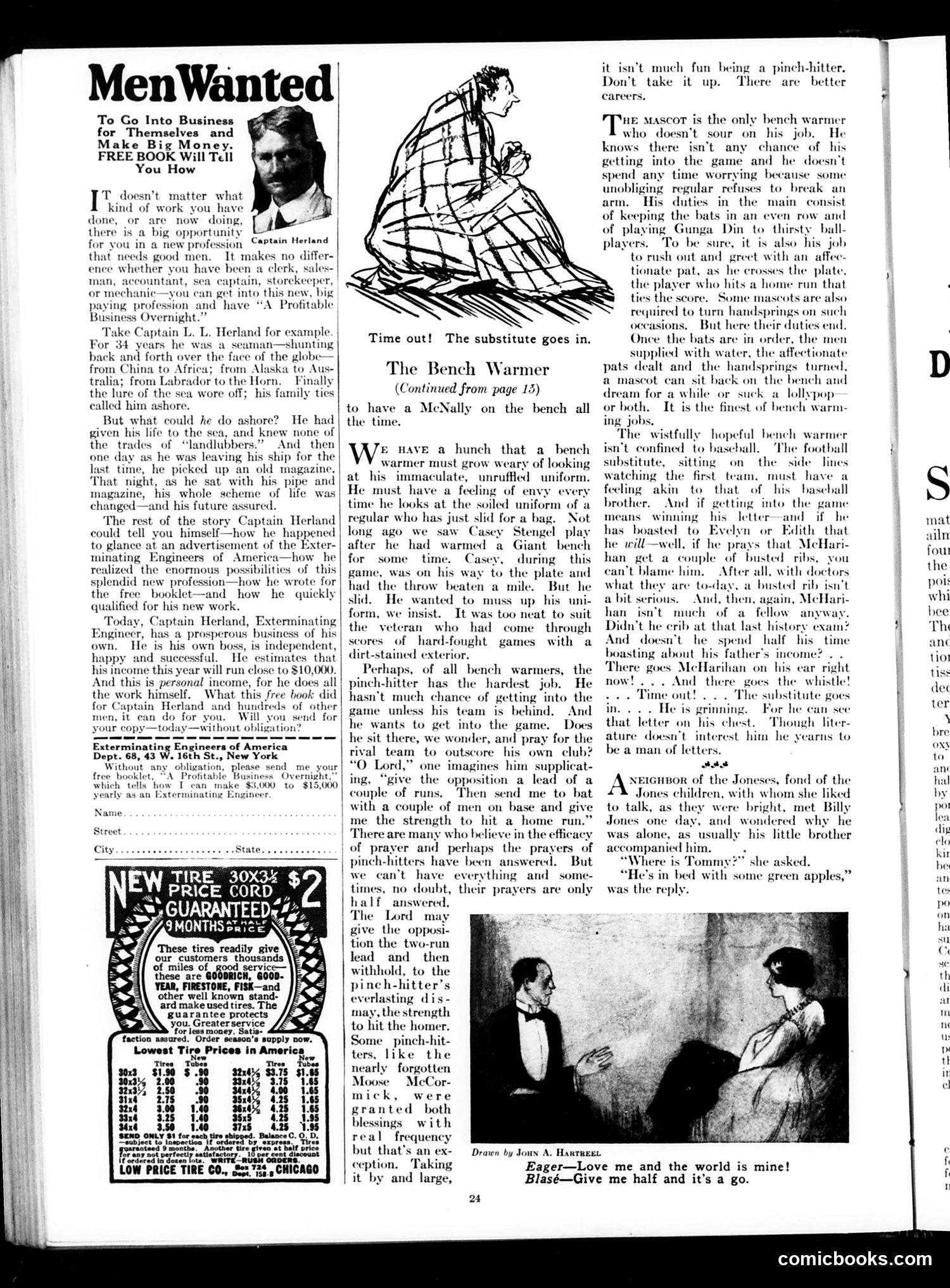
This page primarily contains a satirical article about baseball's "bench warmer"—the substitute player who sits unused during games. The accompanying cartoon illustrates the physical and psychological strain of this role. The satire mocks the bench warmer's predicament: he must remain in pristine, unsoiled uniform while watching regular players get dirty sliding into bases, creating envy and frustration. The article humorously describes the bench warmer's desperate prayers for opportunity—hoping the opposing team scores enough runs that he'll finally be called to pinch-hit and prove himself. The cartoon shows a bench warmer being told "Time out! The substitute goes in," visualizing his moment of nervous anticipation. The satire captures the psychological torture of athletic readiness without opportunity—the tension between preparation and helplessness that defines this unglamorous baseball role. The page also includes unrelated period advertising (exterminating services, tires) typical of *Judge* magazine's format.
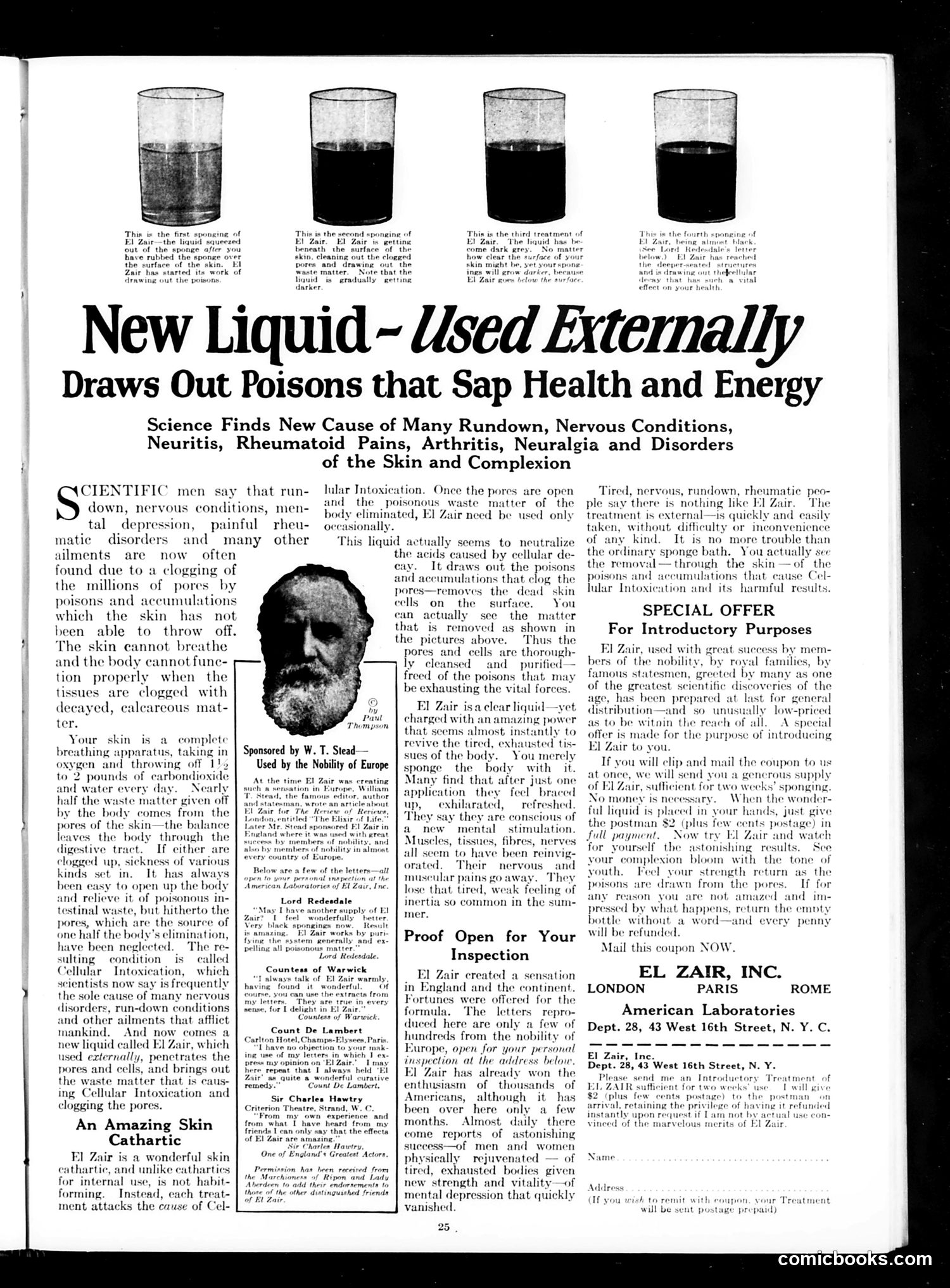
This is not a political cartoon or satire—it's a **full-page advertisement** for a patent medicine called "El Zair," a liquid claimed to cure various ailments by drawing "poisons" from skin pores. ## The Content The ad presents four photographs showing a glass of liquid becoming progressively darker across treatments, claiming this demonstrates toxins being "drawn out." The text promotes El Zair as a cure for nervousness, rheumatism, arthritis, and fatigue by addressing "Cellular Intoxication"—a pseudoscientific theory that blocked pores cause illness. The ad includes endorsements attributed to European nobility and references W. T. Stead (a real British editor), lending false credibility. It offers a coupon for readers to request the product. ## Historical Context This represents **early-20th-century medical fraud**—typical of the era before FDA regulation. Such "miracle cure" advertisements exploited genuine health concerns with no scientific basis. The darkening liquid likely resulted from simple chemical reactions, not actual toxin extraction.
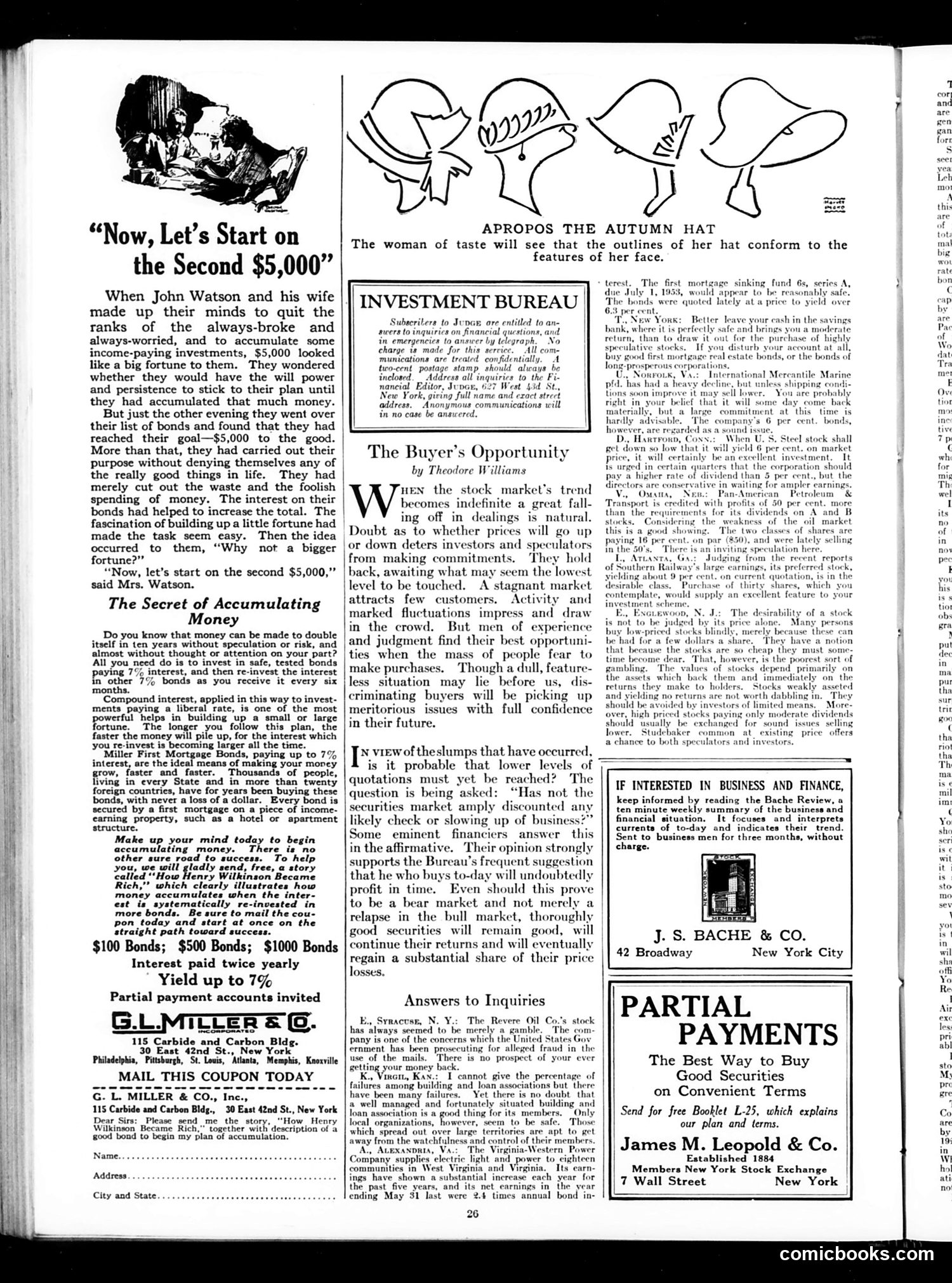
This page is primarily **financial advertising** for G.L. Miller & Co. bonds, not political satire. The opening cartoon shows John Watson and his wife—ordinary middle-class Americans—celebrating reaching their first $5,000 savings goal through disciplined investing in bonds, then deciding to pursue a second $5,000. The satire is subtle and **economic rather than political**: it gently mocks the aspirational middle class by presenting their modest financial achievement as heroic. The couple's excitement over slow, methodical bond-accumulation via "compound interest" is presented as romantic and thrilling—though to modern readers, it reads as earnest rather than ironic. The accompanying article encourages readers that steady investment (not speculation) in safe mortgage bonds paying 7% interest creates wealth automatically. This reflects **1920s optimism** about financial markets before the 1929 crash. The page reflects period attitudes about thrift, delayed gratification, and trust in financial institutions now historically ironic.
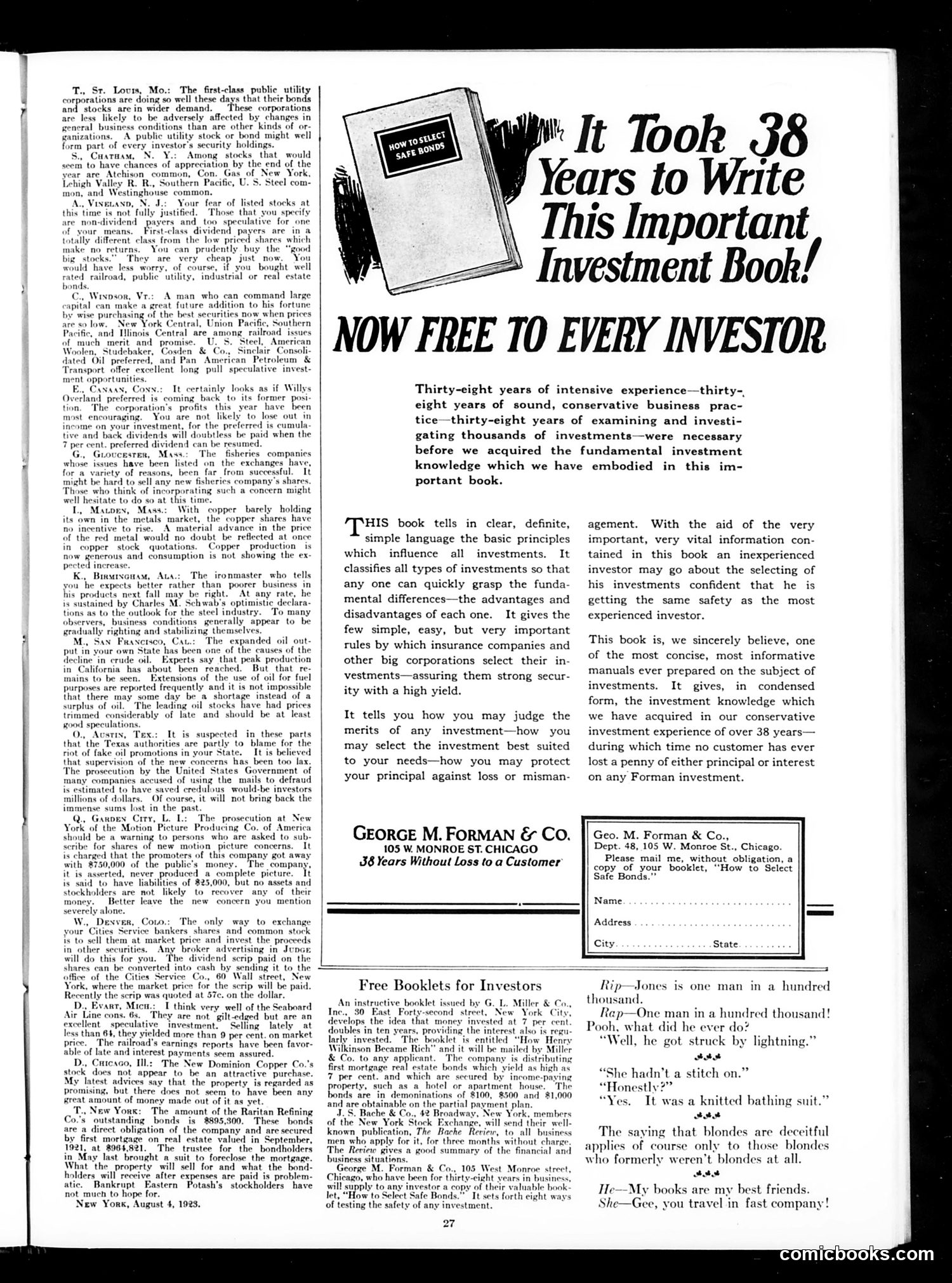
This page is primarily **advertising, not editorial content or political cartoons**. It's a full-page advertisement for George M. Forman & Co.'s investment guide, "How to Select Safe Bonds." The upper portion contains a Q&A investment advice column addressing readers' stock market concerns—typical Judge magazine content from the early 20th century. Topics include railroad stocks, utility bonds, and copper market speculation. The large advertisement claims the investment book took 38 years to develop and promises to teach readers how to identify safe investments. It emphasizes the company's long experience and conservative approach, positioning itself as protecting amateur investors from fraud. The lower section references contemporary investment scams, including fake oil promotions and a motion picture company fraud—real concerns in this pre-SEC regulatory era. The satire is subtle: the irony that *after* describing various investment schemes, they're selling their own guide as the solution. The page reflects genuine 1920s investor anxiety about market volatility and widespread financial fraud before modern securities regulation.
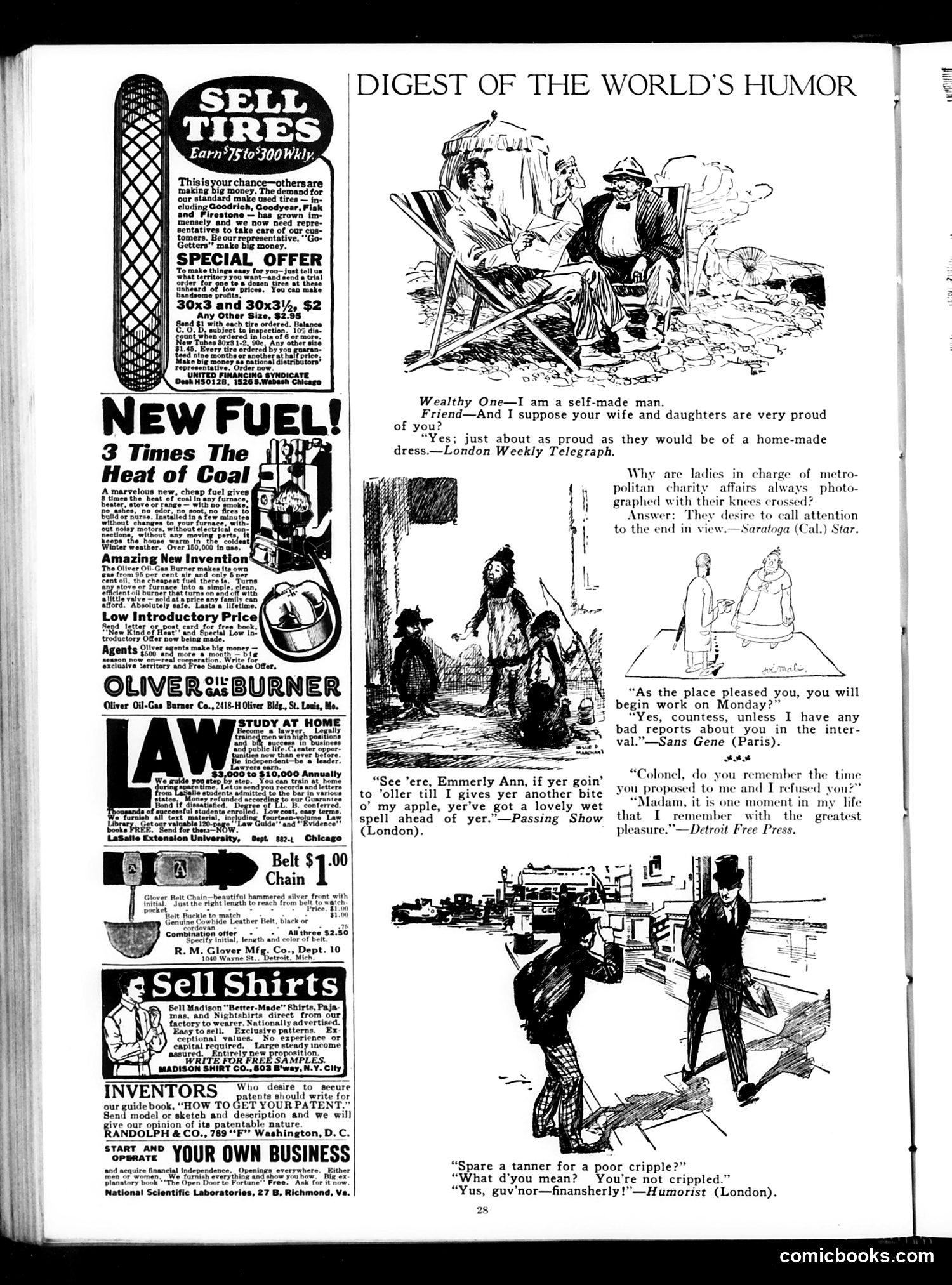
This page is primarily **advertisements** (tires, oil burners, shirts, patents) with a secondary "humor digest" section featuring reprinted jokes from international newspapers and magazines. The humor section collects brief satirical quips about **class and social pretense**: - A wealthy "self-made man" whose family feels as embarrassed by him as by a homemade dress - Society ladies photographed with crossed knees to appear modest - A countess warning a servant she'll check references about *their* conduct - A colonel rejecting a woman's proposal years ago, now claiming to treasure the memory The final joke uses British dialect ("guv'nor," "finansherly") to depict a beggar claiming poverty not from physical disability but from poor finances—a wordplay joke about economic versus physical hardship. **Context for modern readers**: These snippets represent *Judge* magazine's international humor exchange, showcasing period attitudes about class anxiety, female propriety, and working-class wit.
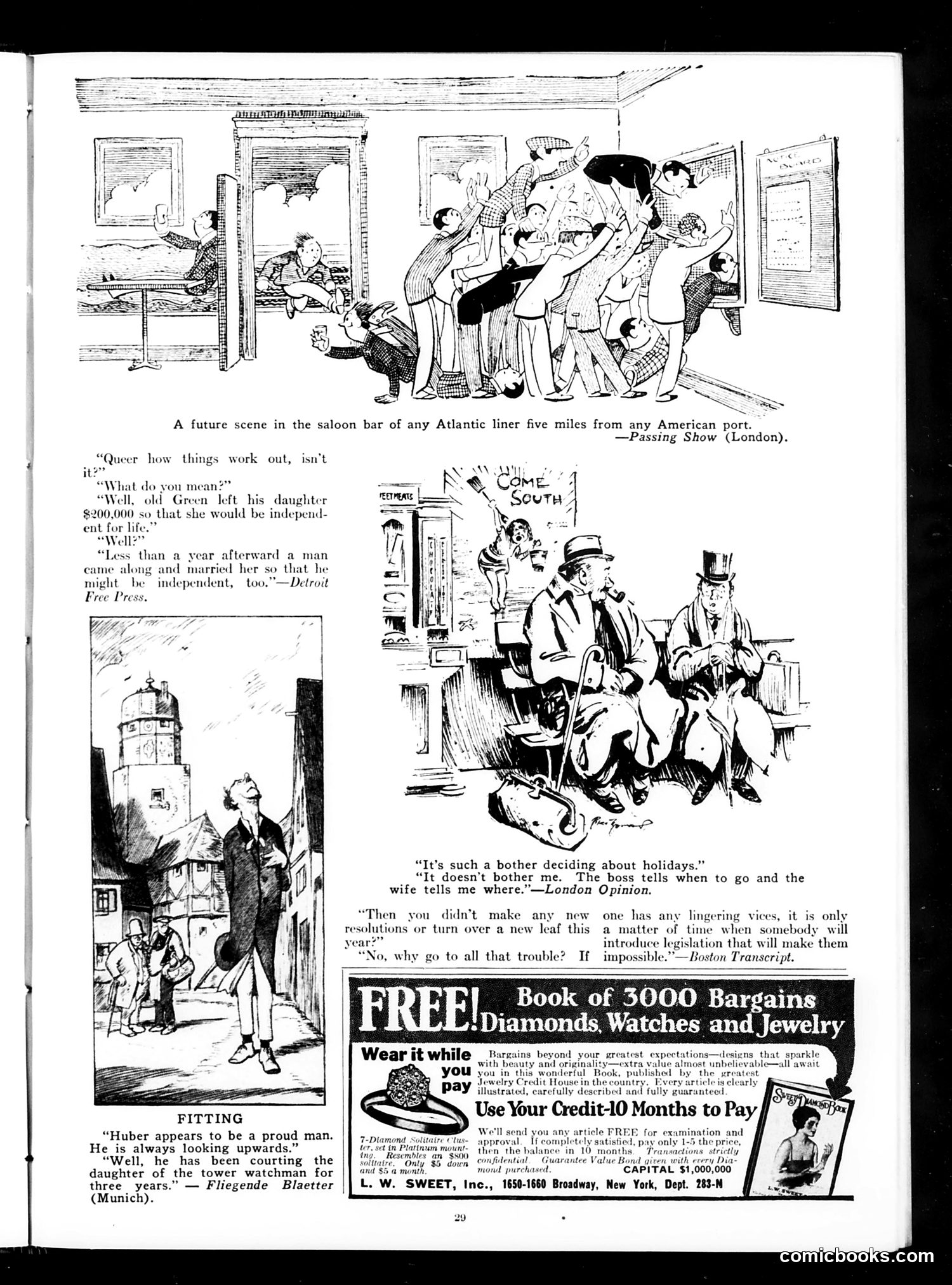
This page from Judge magazine contains several brief satirical jokes about gender relations and marriage, plus an advertisement. The top cartoon depicts a ship's saloon, satirizing how quickly women's financial independence disappears after marriage. The joke: a woman inherits $200,000 to be "independent," but a man marries her within a year so *he* becomes independent instead—mocking men who marry for money. Below are three additional short jokes: - "Fitting": A man constantly looks upward because he's been courting a tower watchman's daughter for three years—the humor lies in the double meaning of "fitting" (appropriate/suitable). - Two brief quips about holidays and New Year's resolutions, satirizing how wives control husbands' leisure time and how people never actually reform. The page primarily showcases advertising for a jewelry credit company offering a "Book of 3000 Bargains" with payment plans. The satire reflects early 20th-century anxieties about marriage, women's property rights, and masculine autonomy—common Judge magazine themes.
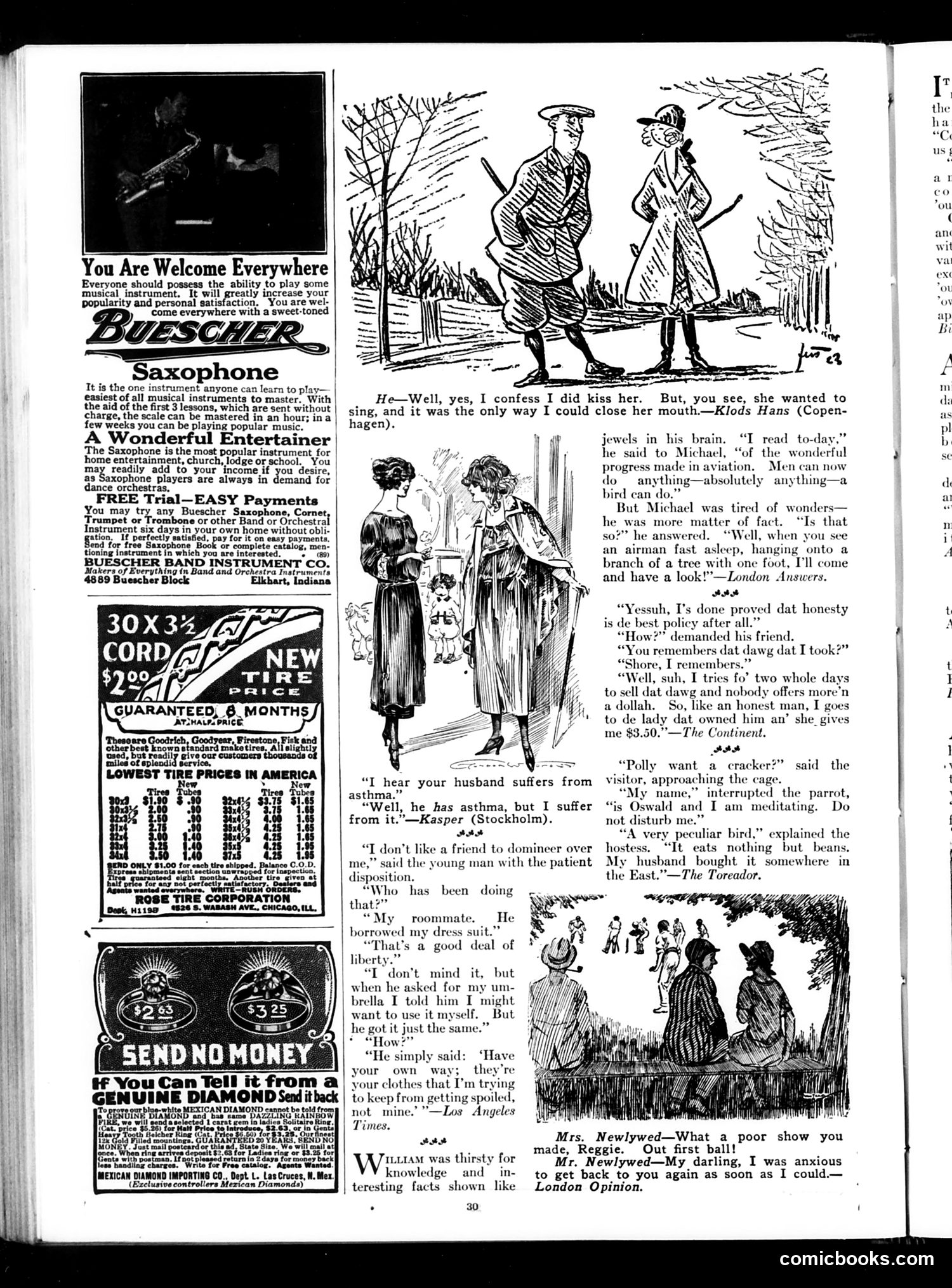
This page consists primarily of **advertisements** (saxophone lessons, tires, diamonds) interspersed with **humor comics** typical of Judge magazine's satirical content. The cartoons are brief, unmarked jokes rather than political satire: - A husband explains kissing a woman as the only way to stop her singing - Two roommates argue over borrowed clothing—the borrower claims she's *protecting* the clothes from damage - A man boasts about proving honesty pays after a dog he tried to sell fetched $3.50 when he returned it to the owner - A parrot refuses to acknowledge visitors, saying it's "meditating" - A newlywed couple joke about leaving their ball early These are **domestic humor** pieces mocking everyday social situations—marital friction, roommate conflicts, petty deceptions, and social awkwardness. There is no identifiable political content or caricature. The satire targets universal human foibles rather than specific events or figures.
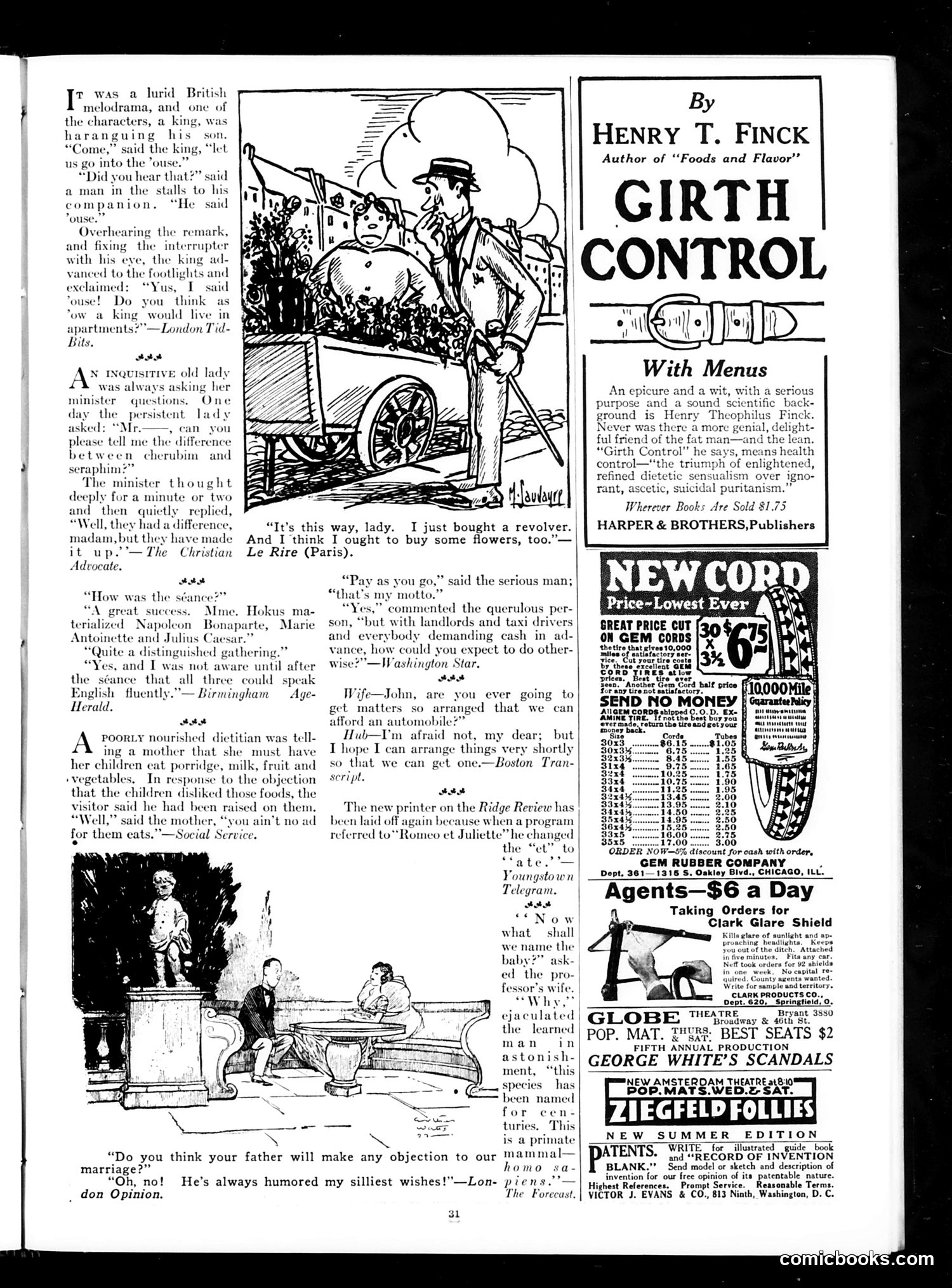
This is primarily an advertising and humor page from *Judge* magazine. The main content consists of several short humorous anecdotes: 1. **"Ouse" joke**: A British melodrama where an actor playing a king says "ouse" instead of "house," and when challenged, defends it by asking if a king would live in apartments—mocking British working-class accent and class pretensions. 2. **Cherubim/Seraphim**: A minister's evasive joke about theological terms, implying church figures had resolved past differences. 3. **Séance**: A spiritualist medium conjures famous historical figures who conveniently speak English—satirizing spiritualism fraud. 4. **Dietitian joke**: A poorly-nourished nutritionist recommends foods he was raised on, leading to the mother's dismissive comment. Other brief jokes mock marriage approval, purchasing revolvers, automobile expenses, and academic naming conventions. The page is dominated by **advertisements** for books (*Girth Control*), car parts (NewCord), rubber products, theater shows (*George White's Scandals*), and patent services. This is typical *Judge* magazine content from the early 20th century.
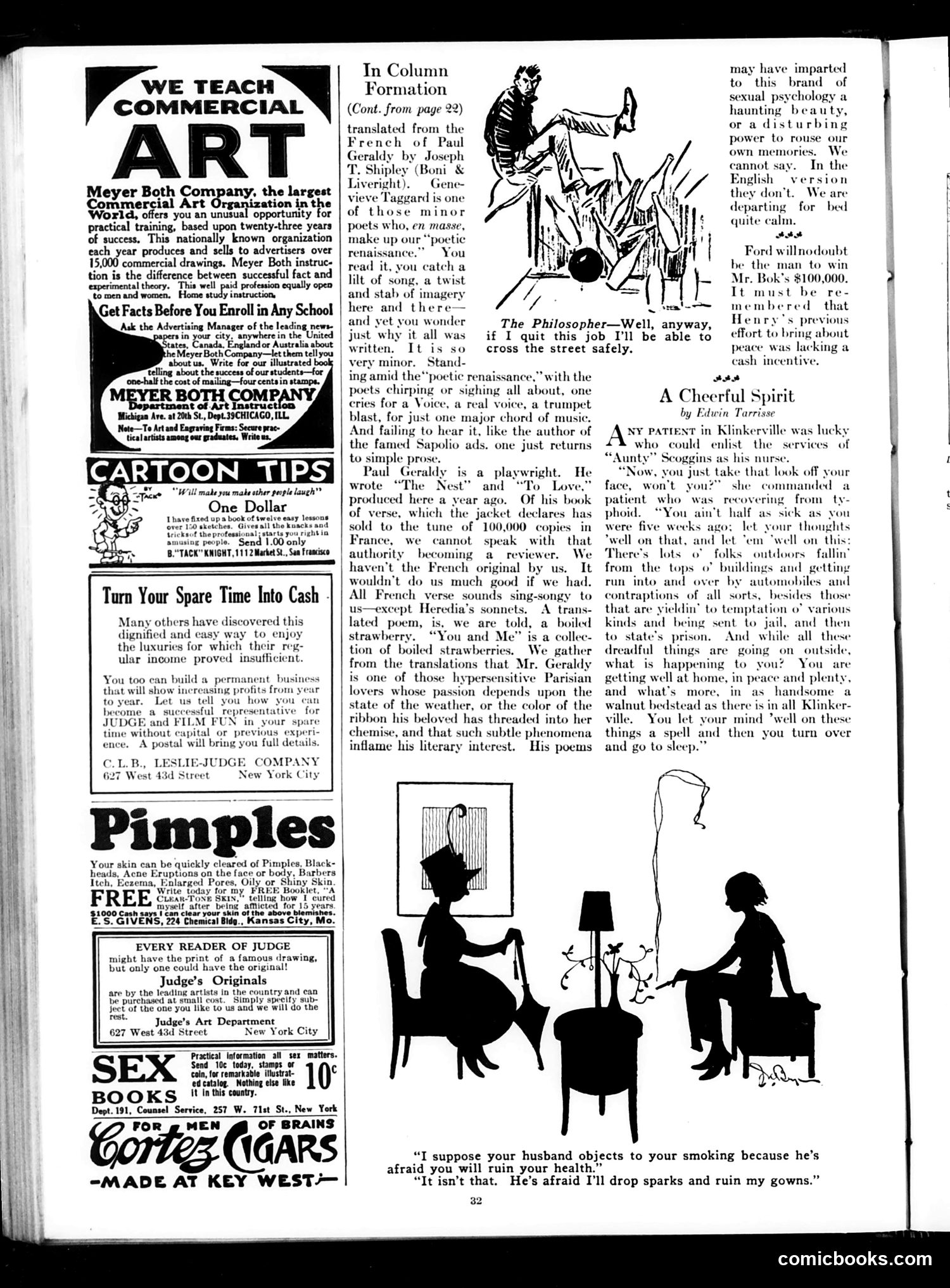
This page is primarily **advertisements and filler content** typical of Judge magazine's back pages. Key elements: **Cartoons:** The main cartoon (bottom) depicts a domestic scene where a woman smokes while sitting with a lamp, disturbing her husband. The joke is the reversal of typical anti-smoking arguments: she fears *her* smoking will ruin *his* health by causing him to drop sparks that damage his clothes—playing on vanity rather than genuine health concerns. **"In Column Formation" section:** A literary discussion of French poet Paul Geraldy's translated poetry collection "You and Me." The critic dismisses it as emotionally overwrought and hypersensitive—typical satirical critique suggesting French Romantic verse seems ridiculous to American readers. **Advertisements:** Numerous ads for commercial art schools, sex education books, pimple remedies, and cigars—typical early-20th-century magazine content. The cartoon represents common domestic satire about gender relations and smoking habits popular in this era.
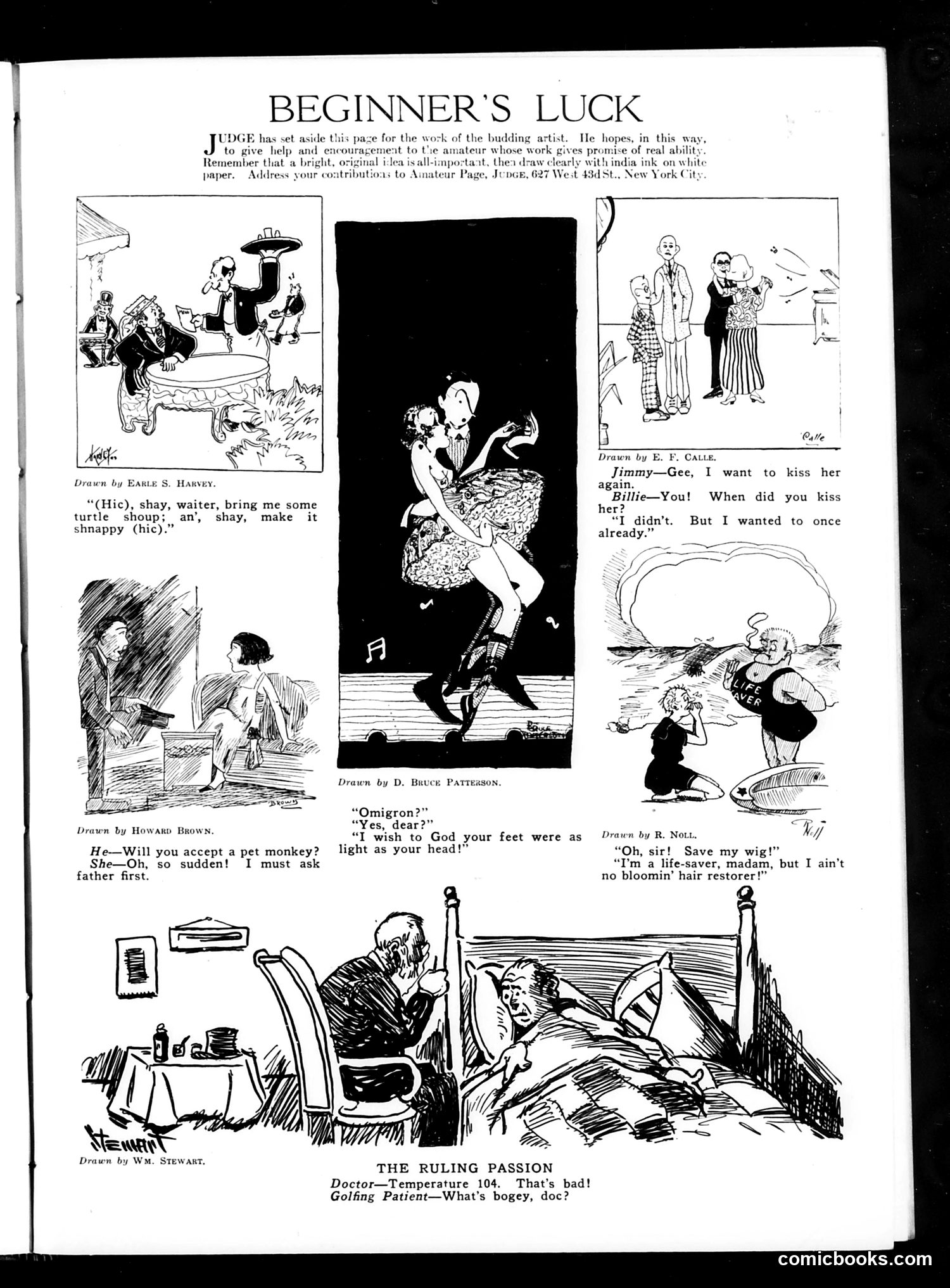
This is a collection of short comic gags drawn by different artists for *Judge* magazine's "Beginner's Luck" feature, which showcased amateur cartoonists' work. The jokes reflect early 20th-century humor: a drunk man slurring drink orders; a woman seeking parental permission before accepting a marriage proposal; a husband wishing his wife were less intellectually light-headed; young men competing over who kissed a girl first; a drowning woman more concerned with her wig than rescue; and a golf-obsessed patient asking about golf scores while running a 104-degree fever. These gags rely on period stereotypes: drunkenness, female dependence on fathers, anti-intellectualism toward women, casual romance, vanity, and obsessive hobbies. The humor is largely domestic and slapstick, typical of 1920s magazine comedy before television made visual gags less novel.
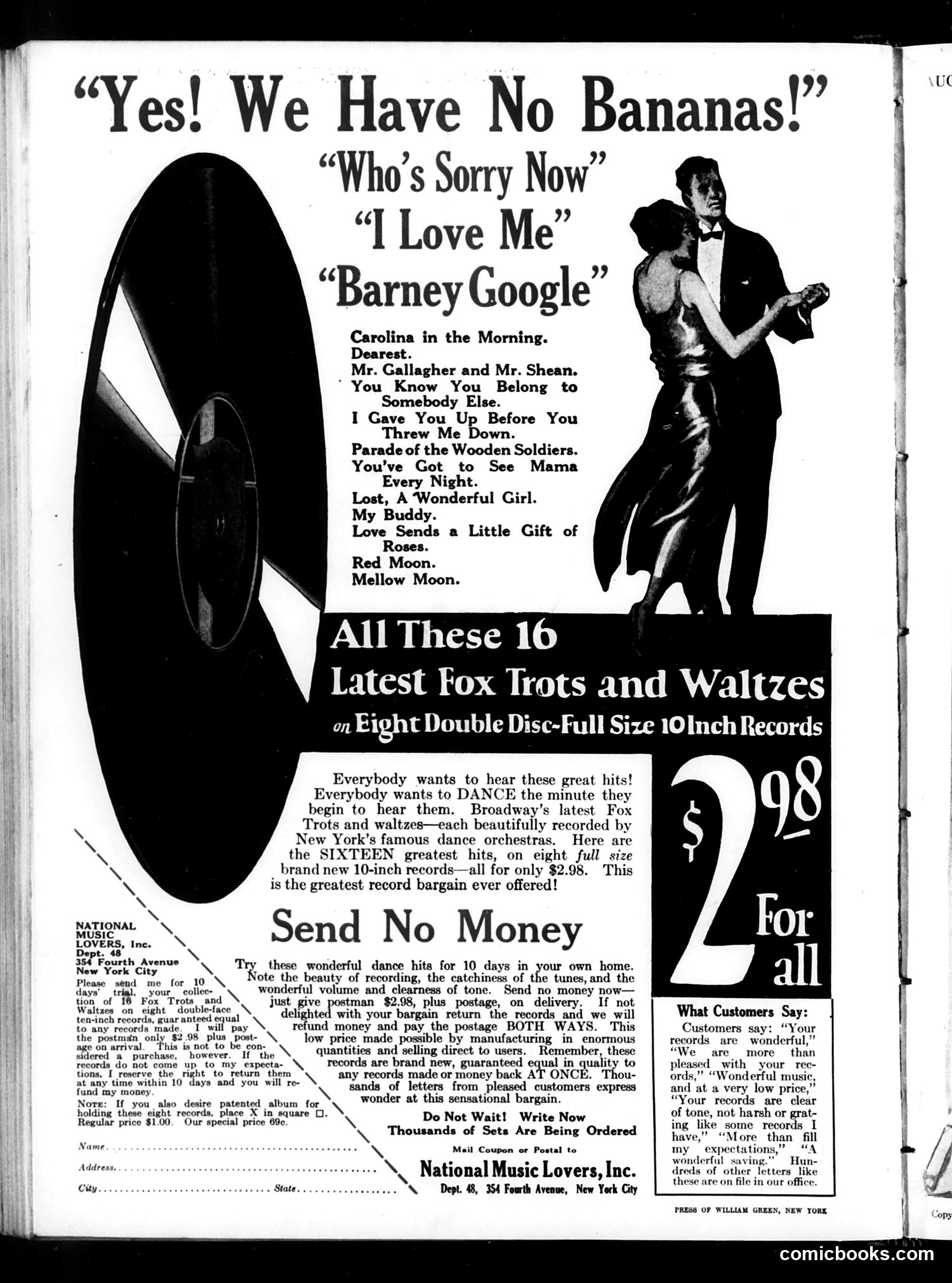
This page is primarily a **record advertisement**, not political satire. It promotes 16 popular dance songs from the early 1920s on eight 10-inch records for $2.98—a major bargain claimed as a "send no money" trial offer. The title song, "Yes! We Have No Bananas!" (1923), was a genuine hit novelty song that became a cultural phenomenon. The other titles are authentic Broadway standards and fox trots of the era, including "Barney Google" (another popular song) and "Mr. Gallagher and Mr. Shean" (a famous comedy duo). The small illustrations show a couple in 1920s formal dance attire—typical imagery for marketing dance records during the Jazz Age. This reflects how **direct-mail record sales** functioned in the 1920s, before mass retail distribution. The "trial at home" method was innovative marketing for its time. There is no political cartoon or satire present—this is straightforward consumer advertising from Judge magazine.