
Judge, 1923-08-11 · page 13 of 36
Judge — August 11, 1923 — page 13: what you’re looking at
What you’re looking at
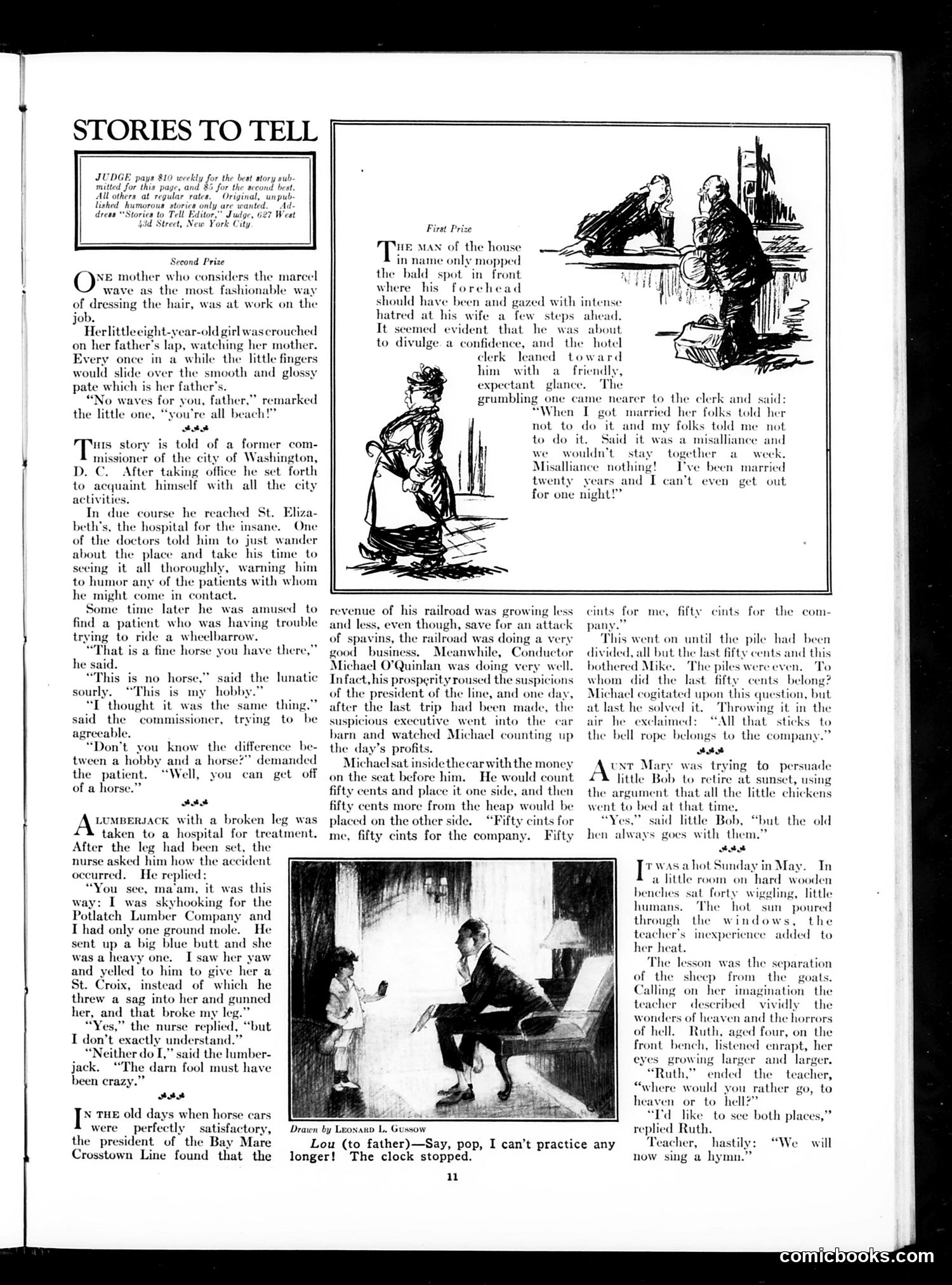
This page from Judge presents several humorous short stories submitted by readers. The main cartoons illustrate: **"The Man of the House"** (First Prize): A bald man complains to a hotel clerk that despite a family prediction his marriage would fail due to his wife's parents' disapproval, he's been stuck with her for twenty years—he can't even get a single night away. The joke satirizes unhappy marriages and marital entrapment. **The Marcel Wave Story** (Second Prize): A child observes her father's bald head and remarks he needs no "waves," making a pun on the fashionable "marcel wave" hairstyle. **Other Stories**: Brief anecdotes about a Washington D.C. official's visit to an insane asylum, a lumberjack's accident, and a railroad conductor's accounting confusion over dividing money. The page emphasizes Judge's call for reader submissions ($10 first prize), positioning itself as a humor magazine dependent on public participation.
📄 Transcribed text from this page (OCR, searchable)
Machine-transcribed from the original scan — historical spelling and the odd misread are preserved.
JUDGE pays 810 weekly for the beat atory sub: mitted for this page the second best. All others at re rates.“ Original, unpub: lished humorous storice only are wanted. Ad- dreas “Stories to Tell Editor,” Judge, 627 Weat jd Strect, New York City and 85 fo Second Prize Ove mother who considers the marcel wave as the most fashionable way on her father’s lap, watching her mother. Every once in a while the little fingers would slide over the smooth and glossy pate which is her father’s. “No waves for you, father,” remarked the little one, “you're all beach!” tot Tons story is told of a former com- missioner of the city of Washington, D.C. After taking office he set forth to acquaint himself with all the city activities, In due course he reached St. Eliza- beth’s, the hospital for the insane. One of the doctors told him to just wander about the place and take his time to seeing it all thoroughly, warning him to humor any of the patients with whom he might come in contact. Some time later he find a patient who was having trying to ride a wheelbarrow “That is a fine horse you have there,” he said. “This is no horse,” said the sourly. “This is my hobby.” “I thought it was the same said the commissioner, trying agreeable. “Don’t you know the difference be- amused to trouble lunatic thing,” to be tween a hobby and a horse?” demanded the patient. “Well, you can get off of a horse.” woe A tmmBeniace with a broken leg was taken to a hospital for treatment. After the leg had been set, the nurse asked him how the accident occurred. He replied: “You see, ma’am, it was this way: I was skyhooking for the Potlatch Lumber Company and He I had only one ground mole. sent up a big blue butt and s was a heavy one. I saw her y: and yelled to him to give her a St. € instead of which he threw a sag into her and gunned her, and that broke my leg.” * the nurse replied, “but I don’t exactly understand.” “Neither do I,” said the lumber- jack. “The darn fool must have been crazy.” tot Iv tHE old days when horse cars were _ perfectly _ satisfactory, the president of the Bay Mare Crosstown Line found that the Drawn by Lee Lou (to father)—Say, pop, I can’t practice any longer! First Prize T= MAN of the house in name only mopped the bald spot in front where his forehead should have been and hatred at his wife a f steps ahead. It seemed evident that he was about to divulge. a confidence, and the hotel clerk leaned toward him with a friendly, expectant glance. The grumbling one came nearer to the clerk and said: “When I got married her folks told her not to do it and my folks told me not to do it. Said it was a misalliance and zed with intense we wouldn't together a week. 1 Misalliance nothir I've been married twenty years and I can’t even get out a ght!” for one night! l revenue of his railroad was growing less and less, even though, save for an attack of spavins, the railroad was doing a very EEE} cints for me, fifty cints for the com- pany.” This went on until the pile had been good business. Meanwhile, Conductor divided, all but the last fifty cents and this Michael O'Quinlan was doing very well. bothered Mike. ‘The piles were even. 'To Infact, his prosperity roused the suspicions whom did the last fifty cents belong? of the president of the line. M after the last trip had been made, the suspicious executive went into the car tched Michael counting up profits. Isat insidethecarwith the money on the seat before him. He would count fifty cents and place it one side, and then fifty cents more from the heap would be placed on the other side. “Fifty cints for me, fifty cints for the company. Fifty and one day shael cogitated upon this question, but t he solved it. Throwing it in the r he exclaimed: “All that sticks to the bell rope belongs to the company.” tat unt Mary was trying to persuade little Bob to retire at sunset, using the argument that all the little chickens went to bed at that time. “Yes,” said little Bob, “but hen always goes with them.” ttt I was ahot Sunday in May. In a little room on hard wooden benches sat forty wiggling, little humans. ‘The hot sun poured through the windows, the teacher's inexperience added to her heat. The lesson was the sepa of the sheep from the goats. Calling on her imagination the teacher described vividly — the wonders of heaven and the horrors. of hell. Ruth, aged four, on the front. bench, listened enrapt, her eyes growing larger and_ larger. “Ruth,” ended the — teacher, “where would you rather go, to heaven or to hell?” 'd_ like to see both places,” replied Ruth. Teacher, hastily: how sing a hymn. the old anv L, Gussow “We will The clock stopped. 1