
Judge, 1923-08-11 · page 23 of 36
Judge — August 11, 1923 — page 23: what you’re looking at
What you’re looking at
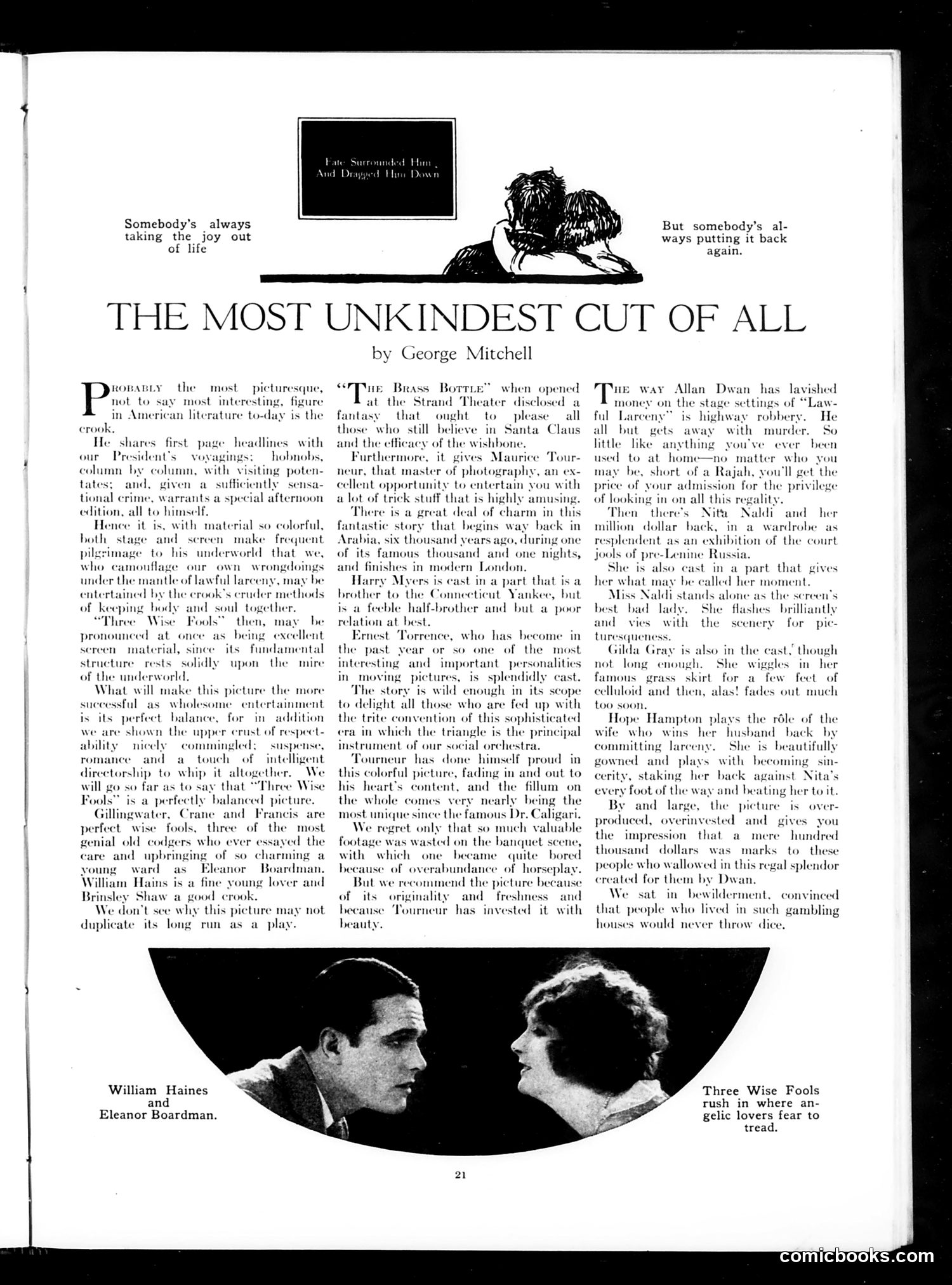
This page reviews three films: "The Brass Bottle," "Three Wise Fools," and "Lawful Larceny." The critic George Mitchell praises entertainment that balances escapism with respectability. **Key figures mentioned:** - William Haines and Eleanor Boardman star in "Three Wise Fools" - Ernest Torrence appears in "The Brass Bottle" - Nita Naldi features in "Lawful Larceny" **The satire's point:** The opening illustration and text joke that someone is always "taking the joy out of life" while "somebody's always putting it back again"—likely a gentle jab at life's hardships versus entertainment's role in providing relief. **Context for modern readers:** This reflects 1920s enthusiasm for cinema as escapism during Prohibition and post-WWI adjustment. The reviews celebrate films offering fantasy, humor, and glamorous settings as antidotes to mundane existence. The mention of "crooks" as "picturesque" characters reflects period fascination with morally ambiguous antiheroes in silent film.
📄 Transcribed text from this page (OCR, searchable)
Machine-transcribed from the original scan — historical spelling and the odd misread are preserved.
Somebody's always taking the joy out of life Fate Surrounded Hin, And Drayyed Hine Down But somebody’s al- ways putting it back again. THE MOST UNKINDEST CUT OF ALL ROBABLY the most — picturesque, Px to say most interesting, figure in American literature to-day is the crook, He shares first 4 our President's ve headlines with rings: — hobnobs, column by column, with visiting poten- nd, given a. sufliciently tional crime, Warrants a special afternoon edition, all to himself. Hence it is, with material so colorful, both stage and screen) make frequent pilgrimage to his underworld that we, who camouflage our own wrongdoings under the mantle of lawful larceny, may be entertained by the erook’s cruder methods of keeping body and soul together. “Three Wise then, may pronounced at once as being exce sereen structure rests solidly of the underworld What will 1 this picture the more successful) as) wholesome entertainment is its perfect balance, for in addition we are shown the upper crust of respect- ability nicely comming romance and a touch of directorship to whip it altogether. We will go so far as to say that “Three Wise Fools” is a perfectly balanced picture. Gillingwater, Crane and Francis are perfect fools, three of the most genial old codgers who ever essayed the care and upbringing of so charming a young anor Boardman. William Hains is a fine young lover and Brinsley Shaw a good crook. We don’t see why this picture may not duplicate its long run as a_ play. tates; sensa- fundamental upon the mire material, since its suspense, intelligent Wise William Haines and Eleanor Boardman. by George Mitchell “fue Brass Bort t the Strand Theater disclosed a fantasy that ought to please — all those who still believe in Santa Claus and the efficacy of the wishbone. Furthermore, it gives Maurice ‘1 neur, that master of photography, an e cellent opportunity to entertain you with a lot of trick stuff that is highly amusing. tere is a great deal of charm in this fantastic ‘y that begins way back in Arabia, six thousand years ago, during one of its famous thousand and one nights, and finishes in modern London. Harry Myers is cast in a part that is a brother to the Connecticut: Yankee, but i feeble half-brother and but a poor ition at best. Ernest Torrence, who has become in the past r or so one of the most interesting and important personalities in ing pictures, is splendidly cast. is wild enough in its scope to delight all those who are fed up with the trite convention of this sophisticated era in which the triangle is the principal instrument of our social orchestra. ‘Tourneur has done himself proud in this colorful picture, fading in and out to his heart’s content, and the fillum on the whole comes very nearly being the most unique since the famous Dr. Caligari. We regret only that so much valuable footage was wasted on the banquet scene, with which one became quite bored because of overabundance of horseplay. But we recommend the picture because lity and freshness and ieur has invested it’ with when opened yur- of ne way Allan Dwan has lavished money on the stage settings of “Law- ful Larceny” is highway robl He all but gets away with murder, So little like anything you've ever been used to at home—no matter who you may be, short of a Rajah, you'll get the price of your admission for the privilege of looking in on all this regality. Then there's Nit Naldi and her million dollar back, in a wardrobe as resplendent as an exhibition of the court jools of pre-I is She is also ci part that gives her what may be called her moment Miss Naldi stands alone as the screen's best bad lady. She flashes brilliantly and vies with the scenery for pic- turesqueness. Gilda Gray is also in the cast, though not long enough. She wiggles in’ her famous grass skirt for a few feet of celluloid and then, alas! fades out: much too soon, Hope Hampton plays the réle of the wife who wins her husband back by committing larceny. She is beautifully gowned and plays with becoming. sin- cerity, staking her back against Nita’s every foot of the way and beating her to it. By and large, the over- produced, overinvested and gives you picture is the impression that a mere hundred marks to these people who wallowed in this regal splendor created for them by Diwan. We sat in bewilderment. convinced that people who lived in such gambling houses would never throw dice. thousand dollars) was Three Wise Fools rush in where an- gelic lovers fear to tread.