
Judge, 1923-08-11 · page 24 of 36
Judge — August 11, 1923 — page 24: what you’re looking at
What you’re looking at
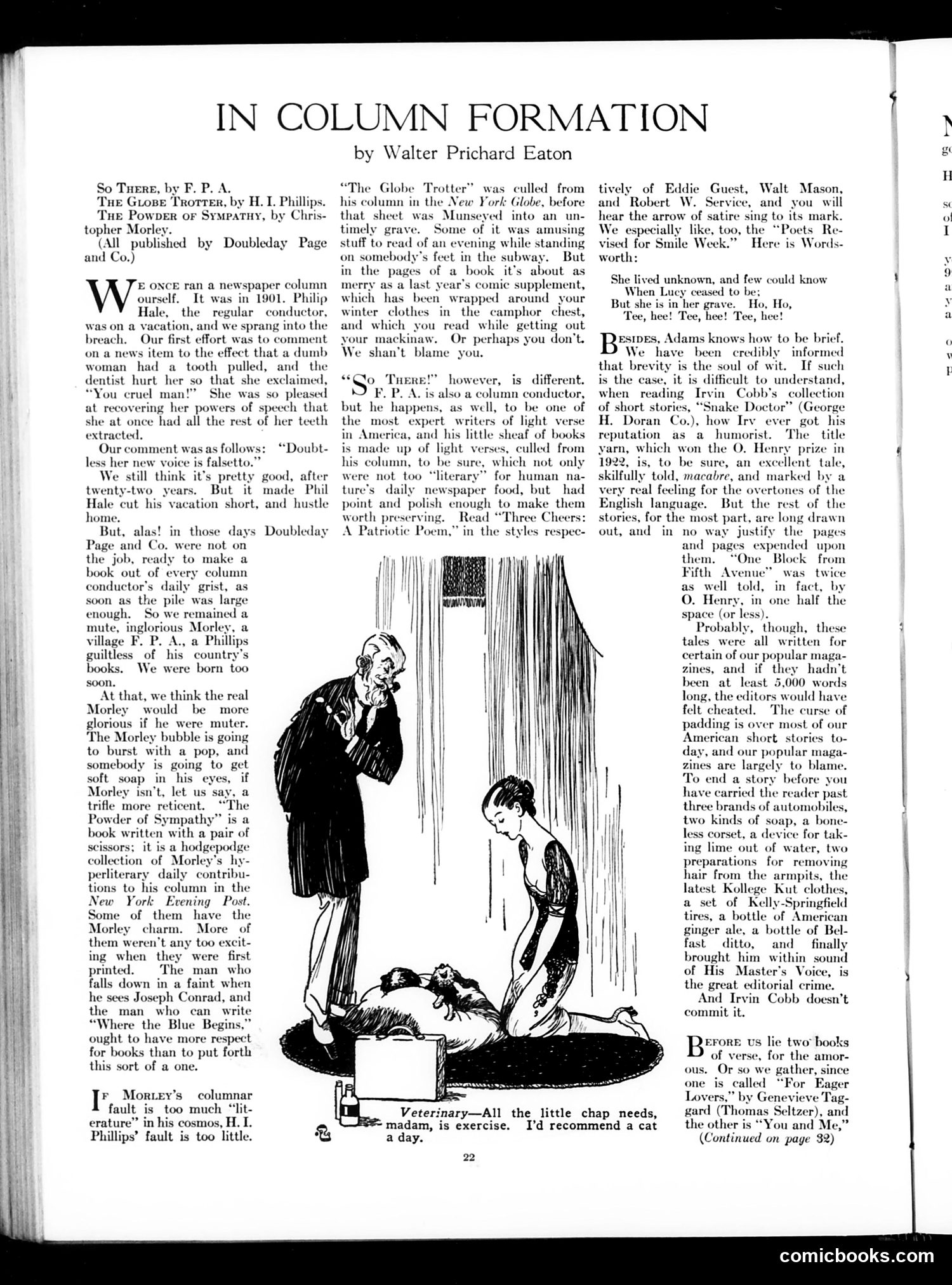
This page reviews three new books of newspaper column collections. The critic praises **F.P.A.'s "So There!"**—light verse culled from his New York newspaper column—as genuinely witty, citing examples like parodies of Wordsworth written in the styles of popular humorists (Eddie Guest, Walt Mason, Robert W. Service). He criticizes **Christopher Morley's "Powder of Sympathy"** as overly "literary" and pretentious for what should be accessible daily newspaper content, though acknowledging Morley's charm. He dismisses **"The Globe Trotter"** (from the now-defunct New York Globe) as depressing when collected in book form—newspaper humor loses its ephemeral appeal on the page. The accompanying cartoon (captioned "Veterinary") shows a doctor observing a boy exercising a small dog, joking that the boy needs exercise, not the dog. The satire targets how newspaper columnists' daily output doesn't always translate successfully to bound books—different mediums require different approaches.
📄 Transcribed text from this page (OCR, searchable)
Machine-transcribed from the original scan — historical spelling and the odd misread are preserved.
IN COLUMN FORMATION So Tuere, by F. P. Tue Grose Trorrer, by H. 1. Phillips. Tue Powpber or Sympatuy, by Chris- topher Morl (All published by Doubleday Page and Co.) E ONCE ran a newspaper column W ourself. It was in 1901. Philip Hale, the regular conductor, was on a vacation, and we sprang into the breach. Our first effort was to comment on a news item to the effect that a dumb woman had a tooth pulled, and the dentist hurt her so that she exclaimed, ou cruel man!” She was so pleased at recovering her powers of speech that she at once had all the rest of her teeth extracted, Our comment was as follow: less her new voice is falsetto. We still think it’s pretty good, after twenty-two years. But it made Phil Hale cut his vacation short, and hustle home. But, alas! in those days Doubleday Page and Co. were not on the job, ready to make a book out of every column conductor's daily grist, as soon as the pile large enough. So we remained a mute, inglorious Morley, a village F. P. A., a Phillips guiltless of his country’s books. We were born too soon. At that, we think the real Morley would be more glorious if he were muter. The Morley bubble is going to burst with a pop, and somebody is going to get soft soap in his Morley isn’t, let us s trifle more ret Powder of S, book written with a pair of scissors; it is a hodgepodge collection of Morley’s hy: perliterary daily contribu- tions to his column in the New York Evening Post. Some of them have the Morley charm. More of them weren't any too excit- ing when they’ were first printed, ‘The man who falls down in a faint when he sees Joseph Conrad, and the man who can write “Where the Blue Begins,” ought to have more respect for books than to put forth this sort of a one. “Doubt- I; Mortey’s columnar fault is too much “lit- erature” in his cosmos, H. I. Phillips’ fault is too little. by Walter Prichard Eaton “The Globe Trotter” was culled from his column in the New York Globe, before that sheet was Munseyed into an un- timely grave. Some of it was amusing stuff to read of an evening while standing on somebody's feet in the subway. But in the pages of a book it’s about as merry as a last year's comic supplement, which has been wrapped around your winter clothes in the camphor chest, and which you read while getting out your mackinaw. Or perhaps you don’t. We shan’t blame you. “a " o 6 Tuere!” however, is different. F. P. A. is also a column conductor, but he happens, as well, to be one of the most expert writers of light verse in America, and his little sheaf of books is made up of light verses, culled from his column, to be sure, which not only were not too “literary” for human na- ture’s daily newspaper food, but had point and polish enough to make them worth preserving. Read “Three Cheers: A Patriotic Poem,” in the styles respec- madam, is exercise. I’d recommend a cat a day. 22 tively of Eddie st, Walt Mason, and Robert W. and you will hear the arrow of satire sing to its mark. We especially like, too, the “Poets Re- vised for Smile Week.” Here is Words- worth: She lived unknown, and few could know When Lucy ceased to be: But she is inher grave. Ho, Ho, Tee, hee! Tee, hee! Tee, hee! EsipEs, Adams knows how to be brief. We have been credibly informed that brevi the soul of wit. If such is the case, it is difficult to understand, when reading Irvin Cobb’s collection of short stories, “Snake Doctor” (George H. Doran Co.), how Irv ever got his reputation as a humorist. The title yarn, which won the O. Henry prize in 1922, is, to be sure, an excellent tale, skilfully told, macabre, and marked by a very real feeling for the overtones of the English language. But the rest of the stories, for the most part, are long drawn out, and in no way justify the pages and pages expended upon them. “One Block from Fifth Avenue” was twice as well told, in fact, by O. Henry, in one half the space (or less). Probably, though, these tales were all written for certain of our popular maga- zines, and if they hadn't been at least 5,000 words long, the editors would have felt cheated. The curse of padding is over most of our American short stories to- day, and our popular maga- zines are largely to blame. To end a story before you have carried the reader past three brands of automobiles, two kinds of soap, a bone- less corset, a device for tak- ing lime out of water, two preparations for removing hair from the armpits, the latest Kollege Kut clothes, a set of Kelly-Springfield tires, a bottle of American ginger ale, a bottle of Bel- fast. ditto, and finally brought him within sound of His Master's Voice, is the great editorial crime. And Irvin Cobb doesn’t commit it. B SFORE US lie two" books of verse, for the amor- ous. Or so we gather, since alled “For Eager ” by Genevieve Tag- gard (Thomas Seltzer), and the other is “You and Me,” (Continued on paye $2) comicbooks.com