
Judge, 1923-08-11 · page 15 of 36
Judge — August 11, 1923 — page 15: what you’re looking at
What you’re looking at
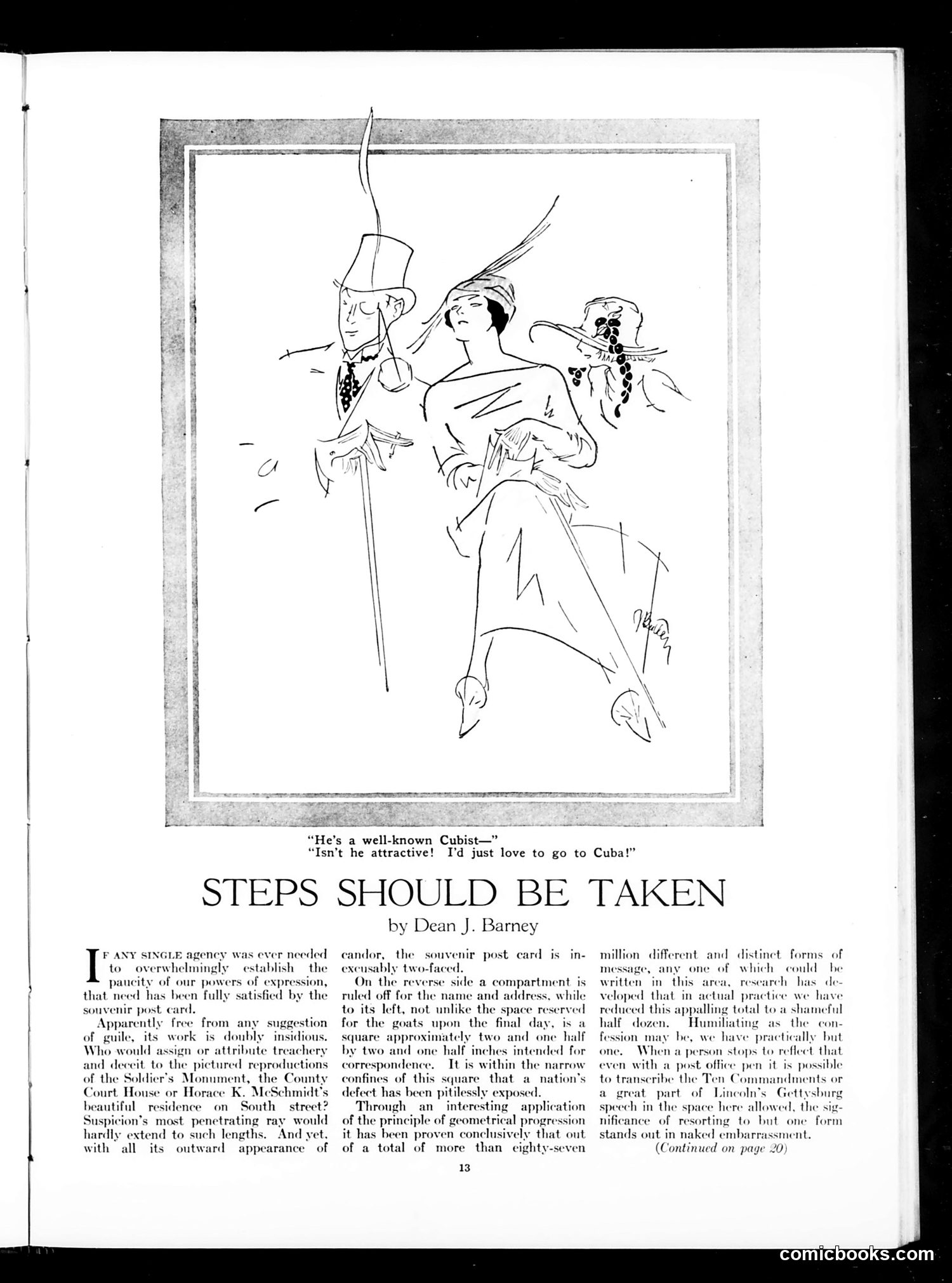
This is a humorous essay by Dean J. Barney satirizing the banality of souvenir postcards. The cartoon illustrates the essay's point through a dialogue joke: two fashionable women discuss a man as a "well-known Cubist" (referencing the modern art movement), with one declaring she'd "love to go to Cuba"—a pun suggesting tourists confuse artistic movements with travel destinations. The essay proper mocks postcards' hypocrisy: their "candid" appearance masks their actual function as bland, formulaic messages. Barney's real complaint is that postcards claim to celebrate local landmarks (monuments, courthouses, residences) yet people always write the same generic messages on them. He sardonically argues that despite having space for the Ten Commandments or Lincoln's Gettysburg Address, people resort to the same tired phrases—a commentary on conformity and unoriginality in American tourism and communication. The satire targets mass culture's superficiality.
📄 Transcribed text from this page (OCR, searchable)
Machine-transcribed from the original scan — historical spelling and the odd misread are preserved.
He’s a well-known Cubist—” “Isn’t he attractive! I'd just love to go to Cuba!” STEPS SHOULD BE TAKEN F ANY SINGLE agency was ever needed I to. overwhelmingly establish the city of our powers xpression, that need has been fully satisfied by the souvenir post card. Apparently free from any suggestion of guile, its work is doubly insidious. Who would assign or attribute treachery and deceit to the pictured reproductions of the Soldier's Monument, the County Court House or Horace K. McSchmidt's beautiful residence on South — street? Suspicion’s most penetrating ray would hardly extend to such lengths. And yet, with all its outward appearance of by Dean J. Barney candor, the souvenir post card is in- excusably two-faced. On the reverse side a compartment is ruled off for the name and address, while to its left, not unlike the space reserved for the goats upon the final day, is a square approximately two and one half by two and one half inches intended for correspondence. It is within the narrow confines of this square that a nation’s defect has been pitilessly exposed. Through an_ interesting application of the principle of geometrical progression it has been proven conclusively t of a total of more than cight 13 million different. and. distinct forms of message, any one of which could be written in. this area, research veloped that in actual 7 reduced this appalling total to a shameful half dozen. Humiliating asthe fession may be, we have practically: but When a person stops to reflect that even with a post office pen it is possible has de. tice we have one. to transeribe the Ten Commandments or a great part of Lincoln's Gettysburg speech in the space here allowed, the sig- nificance of resorting to but one form stands out in naked embarrassment. (Continued on page 20, comicbooks.com