
A complete issue · 36 pages · 1922
Judge — December 23, 1922
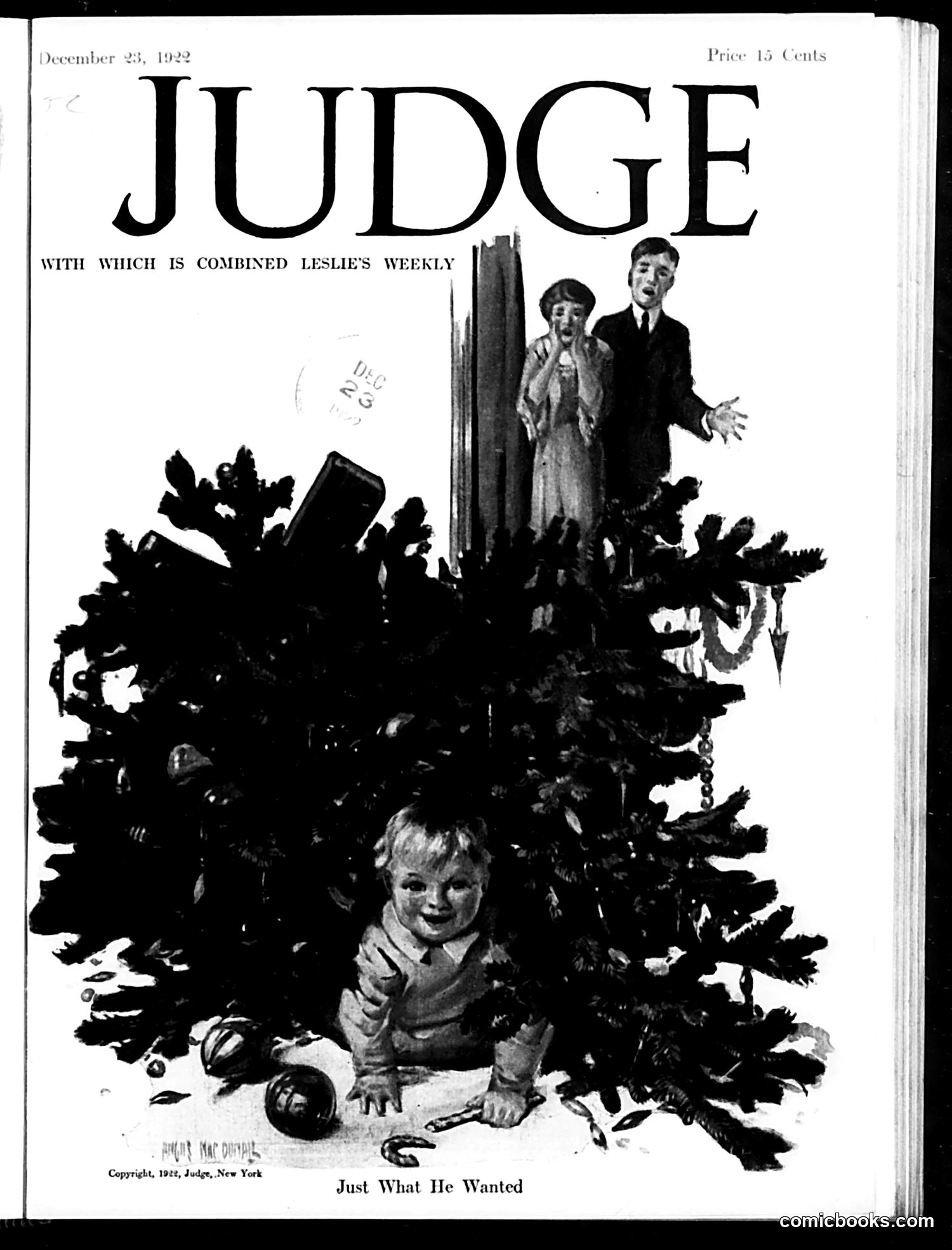
This Christmas-themed cover depicts a young child playing with an evergreen tree decorated with ornaments, while a well-dressed couple (appearing to be parents) stand behind it, gesturing in satisfaction or exasperation. The satire likely plays on 1920s holiday consumerism and parental expectations. The title "Just What He Wanted" suggests irony—the elaborate decorated tree with toys and ornaments represents commercial excess, yet the child seems most entertained by the actual tree itself rather than expensive gifts. This commentary reflects post-WWI anxieties about materialism and changing childhood experiences during the prosperous but culturally turbulent 1920s. The humor targets adults' assumptions about children's desires versus what actually brings them joy.
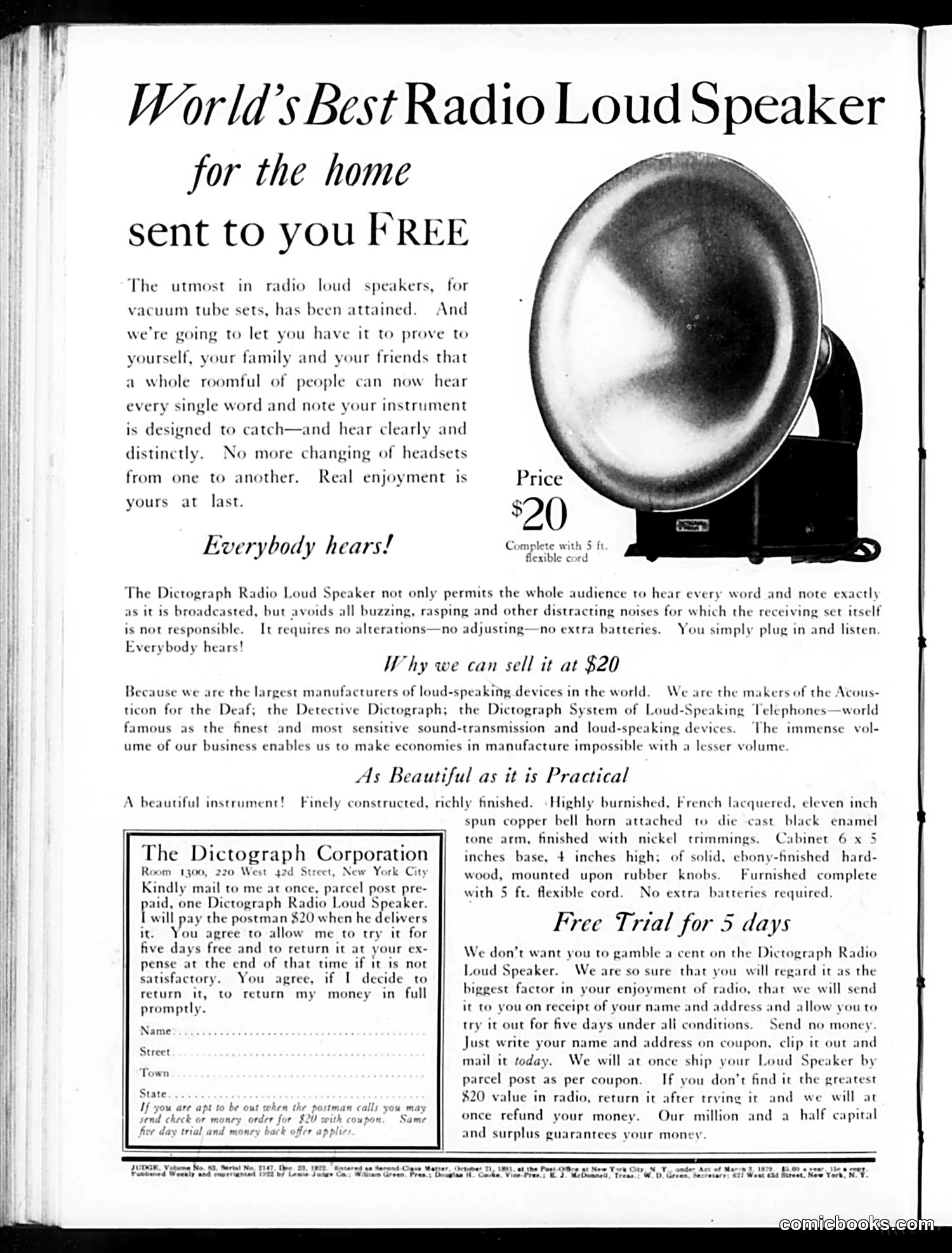
This page is **primarily a product advertisement**, not political satire or editorial cartoon content. It advertises the "Dictograph Radio Loud Speaker" from the Dictograph Corporation of New York City, priced at $20 with a 5-day free trial offer. The ad emphasizes the speaker's technical superiority for home radio use, highlighting its clear sound quality and ease of use ("no adjusting—no extra batteries"). The company claims to be "the largest manufacturers of loud-speaking devices in the world," referencing their established products like the Acousticon for the Deaf and Detective Dictograph telephone systems. **No political commentary or satire is evident here.** This is straightforward early-20th-century consumer advertising, likely from *Judge* magazine's revenue-generating advertisement section rather than editorial content.
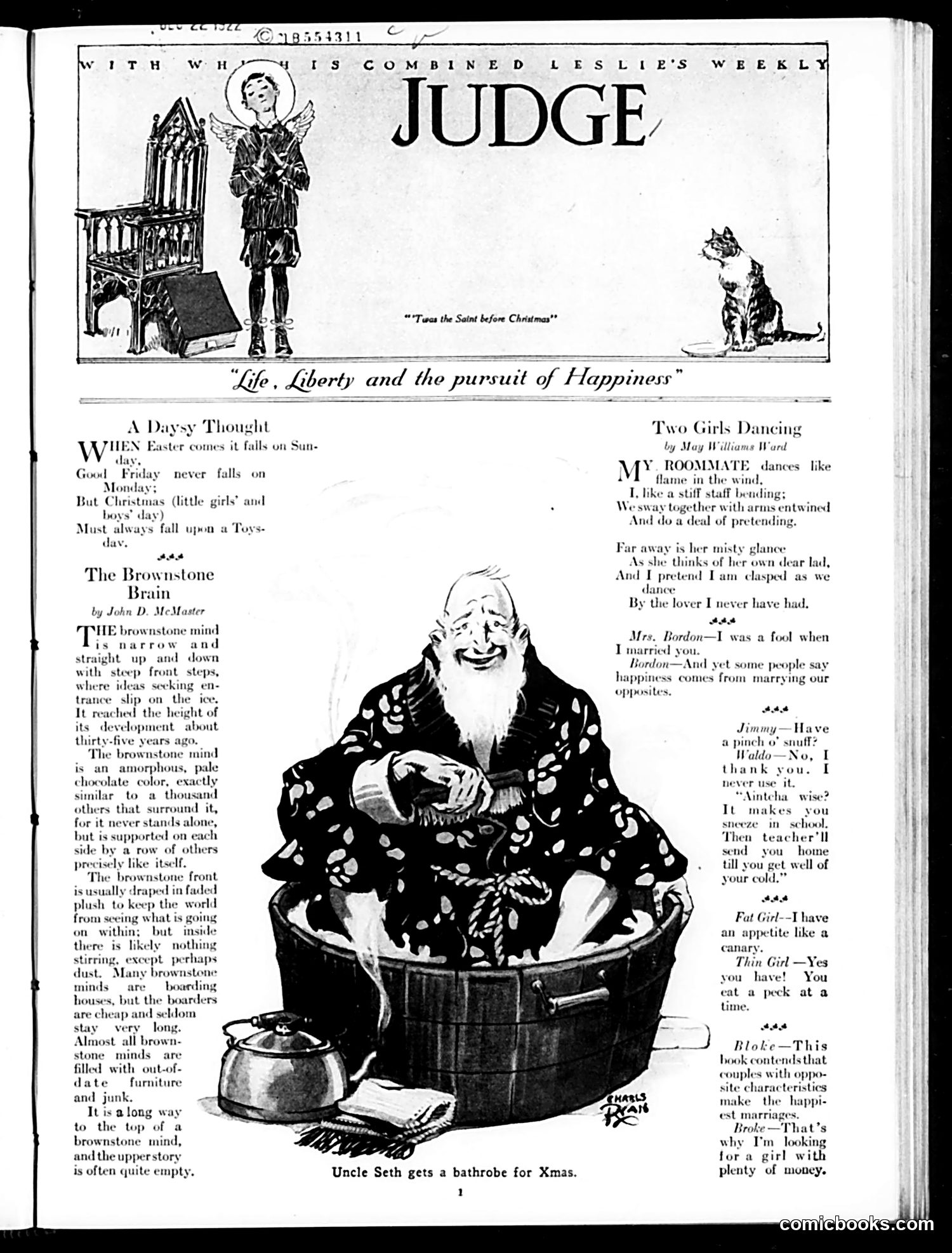
This page combines humor and advice content typical of early Judge issues. The central illustration shows "Uncle Seth gets a bathrobe for Xmas"—a jolly, rotund elderly man in a patterned robe, likely a recurring character providing folksy wisdom. The left column features "The Brownstone Brain" by John D. McCallister, satirizing narrow-minded wealthy people living in fashionable brownstone townhouses. It mocks their pretentiousness and suggests such minds are filled with "out-of-date furniture and junk." The right side includes light poetry and a advice column ("Two Girls Dancing") with humorous exchanges about romance and marriage. The overall tone is genteel satire directed at upper-class affectations and domestic relations—typical Judge content mixing social commentary with entertainment for an educated, affluent readership.
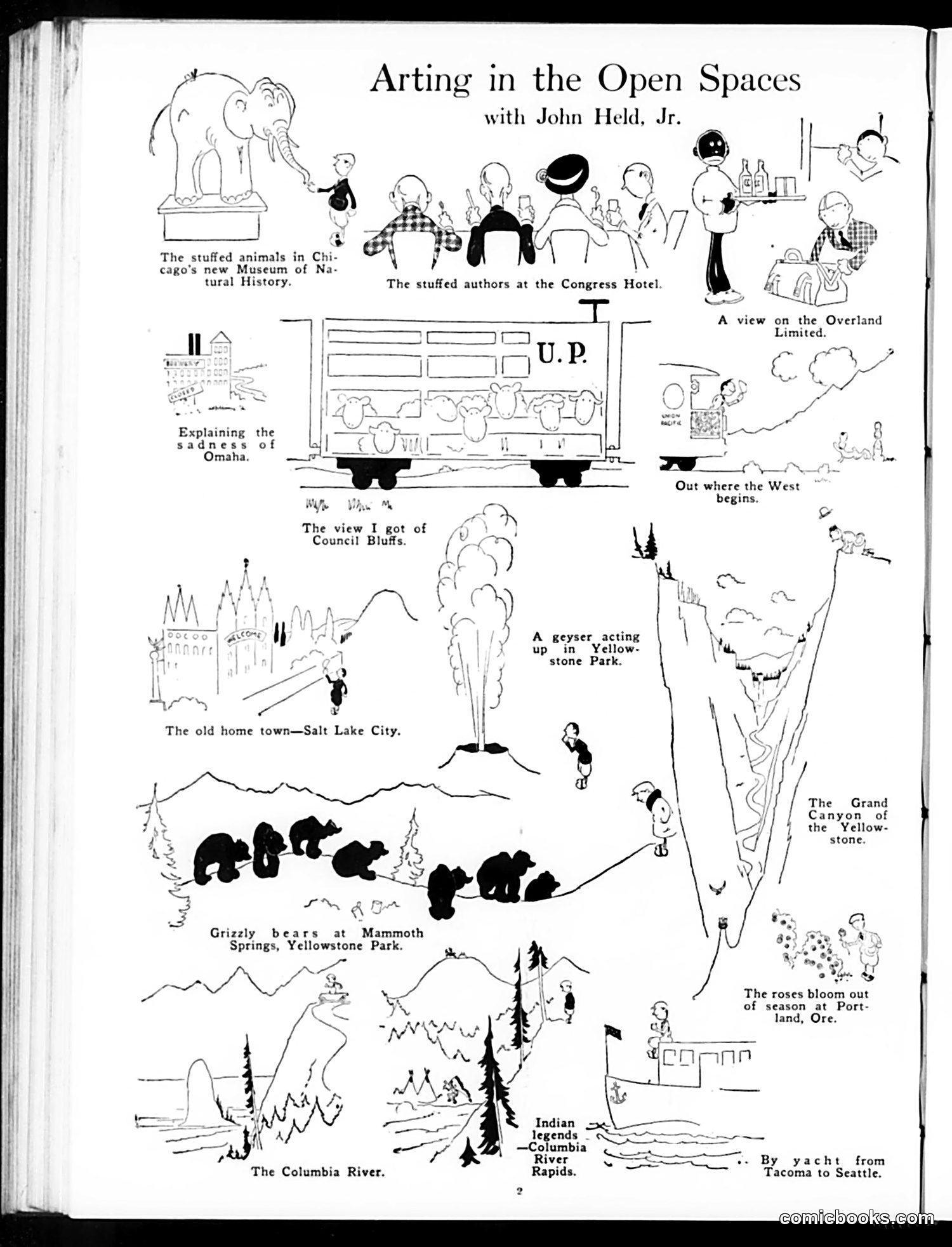
This is a humorous illustrated travel feature by renowned cartoonist John Held Jr., showcasing various American locations and attractions. Rather than political satire, it's light social comedy depicting tourist experiences across the country. The sketches humorously illustrate destinations including Chicago's Natural History Museum, Omaha, Salt Lake City, Yellowstone Park (with geysers and grizzly bears), the Grand Canyon, the Columbia River, and Pacific Northwest locations. Each vignette captures tourists encountering local attractions—from stuffed museum animals to natural wonders. The title's pun on "artinG" (acting/performing) suggests tourists playfully "performing" or posing at famous sites. This reflects early 20th-century travel culture, when visiting major American landmarks was becoming popular leisure activity for middle-class Americans.
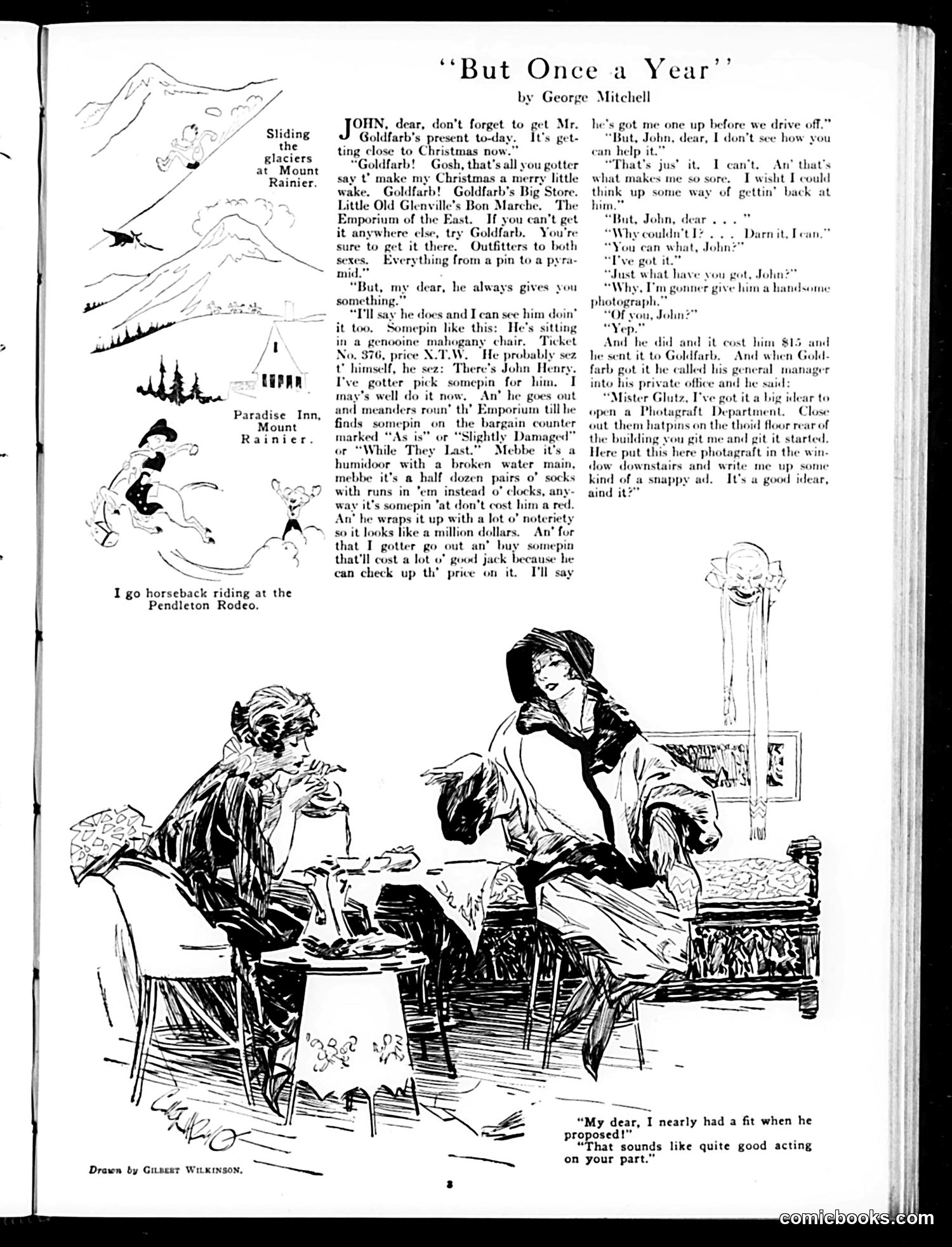
This is a domestic comedy story rather than political satire. The narrative depicts a husband (John) seeking Christmas gift advice from his wife. She suggests expensive items from upscale retailers like Goldfarb's and the Emporium, while the husband resists the cost. He ultimately buys an inexpensive photograph for $15, presents it to Goldfarb's manager as if it's from their store, and claims it cost more—attempting to deceive his wife about the expense. The satire targets matrimonial dynamics and consumer culture: husbands' reluctance to spend on wives' Christmas wishes, wives' material expectations, and marital dishonesty. The cartoon's humor derives from the husband's transparent deception and the gap between conjugal expectations and reality—themes relatable to Judge's early-20th-century middle-class audience.
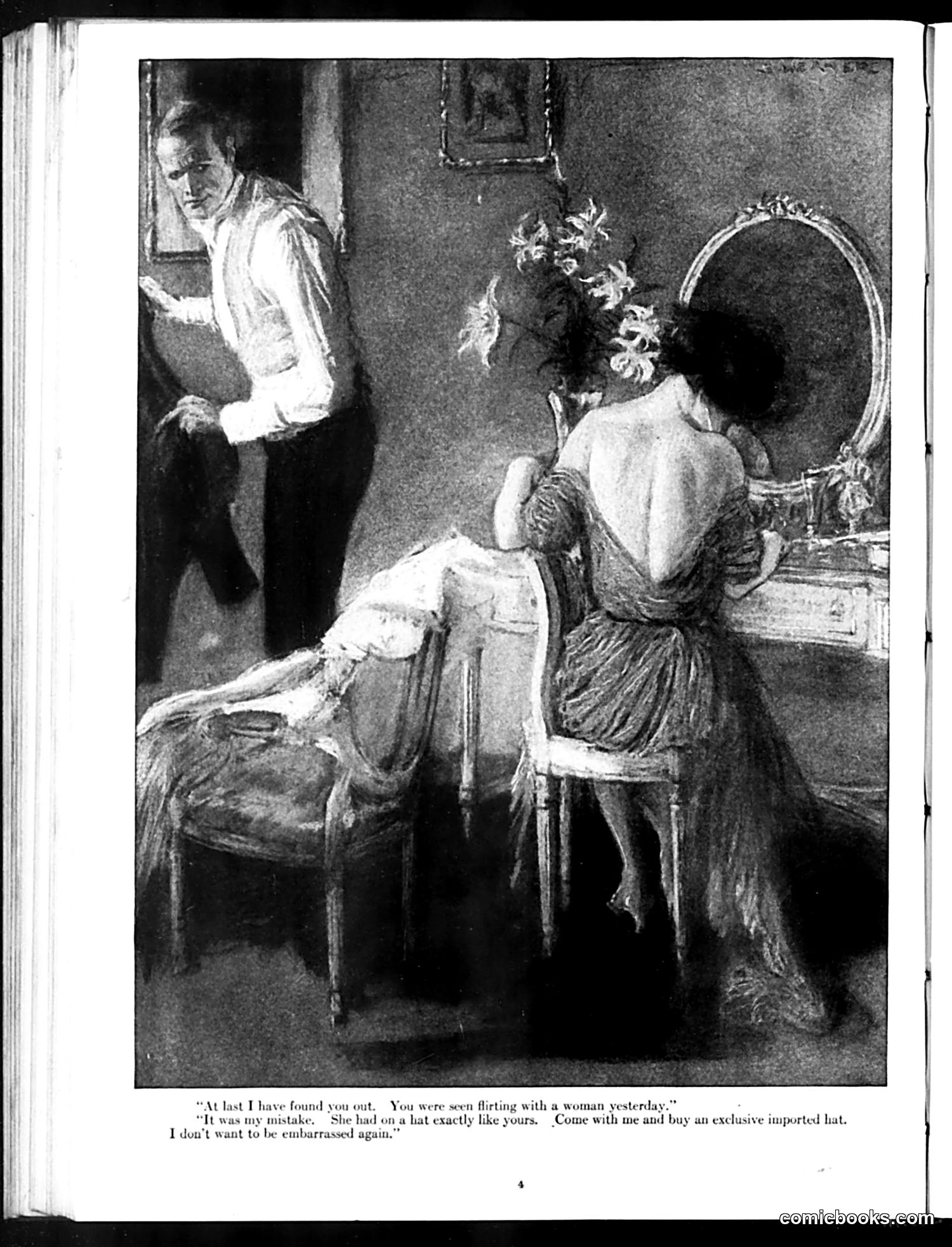
This appears to be a domestic comedy scene from an early 20th-century satirical magazine. The caption depicts a husband confronting his wife about being seen flirting with another woman. The wife's excuse—that the other woman wore a hat identical to hers, causing mistaken identity—plays on contemporary anxieties about fashion conformity and women's indistinguishability. The satire targets both marital jealousy and the emerging consumer culture around women's fashion. The husband's proposed "solution" (buying an expensive imported hat) mocks masculine attempts to manage wives through conspicuous consumption rather than trust. The scene reflects Judge's typical focus on middle-class domestic life and gender relations, using fashion as a proxy for discussing women's autonomy and consumer culture.
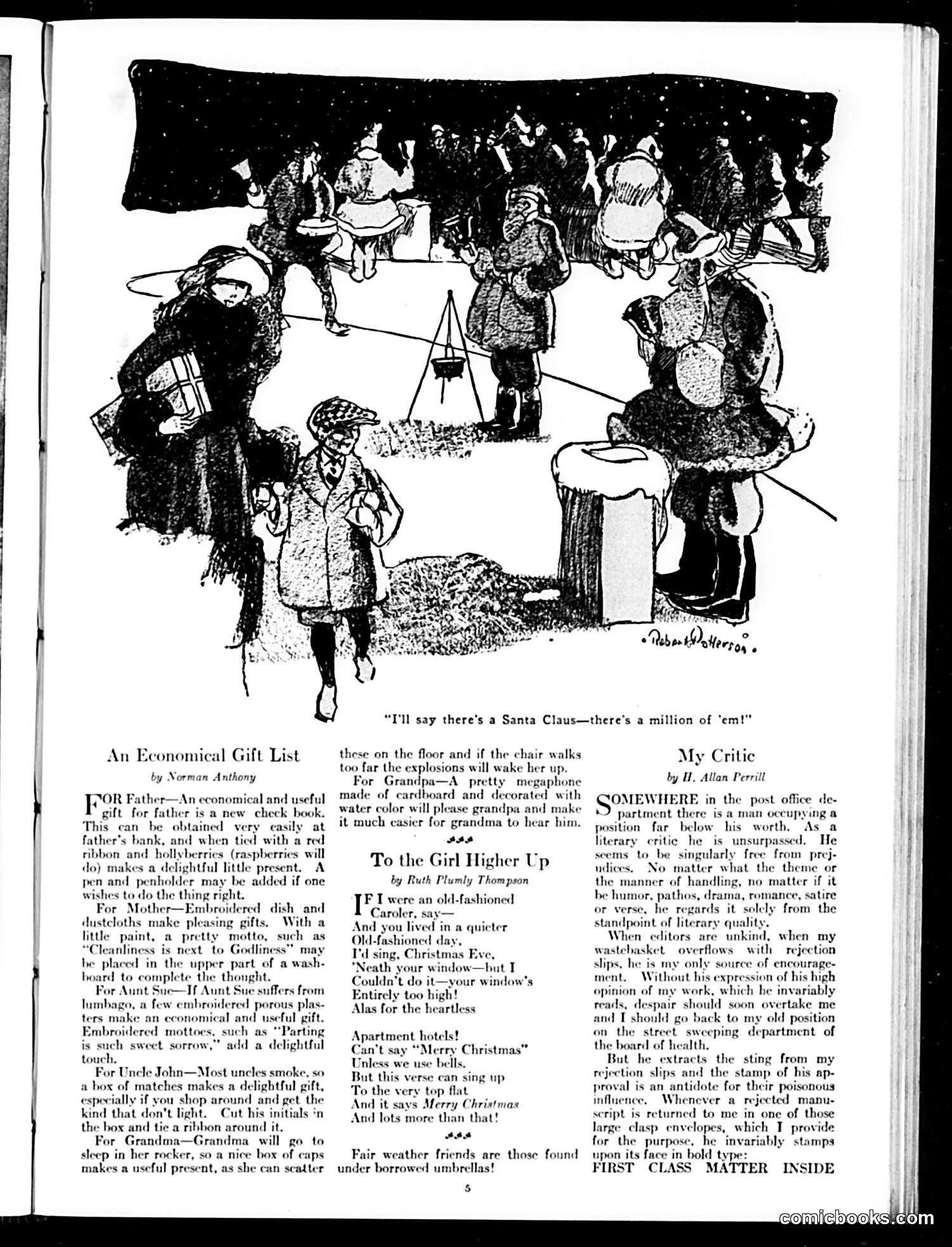
This page from *Judge* (a satirical American magazine) contains three pieces of holiday-themed humor: **"An Economical Gift List"** satirizes Depression-era frugality by suggesting absurdly cheap or useless presents: a check book for Father, dish towels for Mother, matches for Uncle John, and—most darkly comic—a box of firecracker caps for Grandma so explosions will jolt her awake in her rocker. **"To the Girl Higher Up"** laments modern apartment living, contrasting old-fashioned caroling at ground-level windows with the frustration of singing Christmas carols to someone in a high apartment building who cannot hear you. **"My Critic"** is autobiographical commentary: a post office employee provides encouragement to rejected writers by stamping rejected manuscripts "FIRST CLASS MATTER INSIDE," offering psychological solace despite rejection slips. It's gentle satire about artistic validation and self-delusion. The cartoon at top depicts a crowded urban Christmas scene with the caption mocking commercialization: "I'll say there's a Santa Claus—there's a million of 'em!"
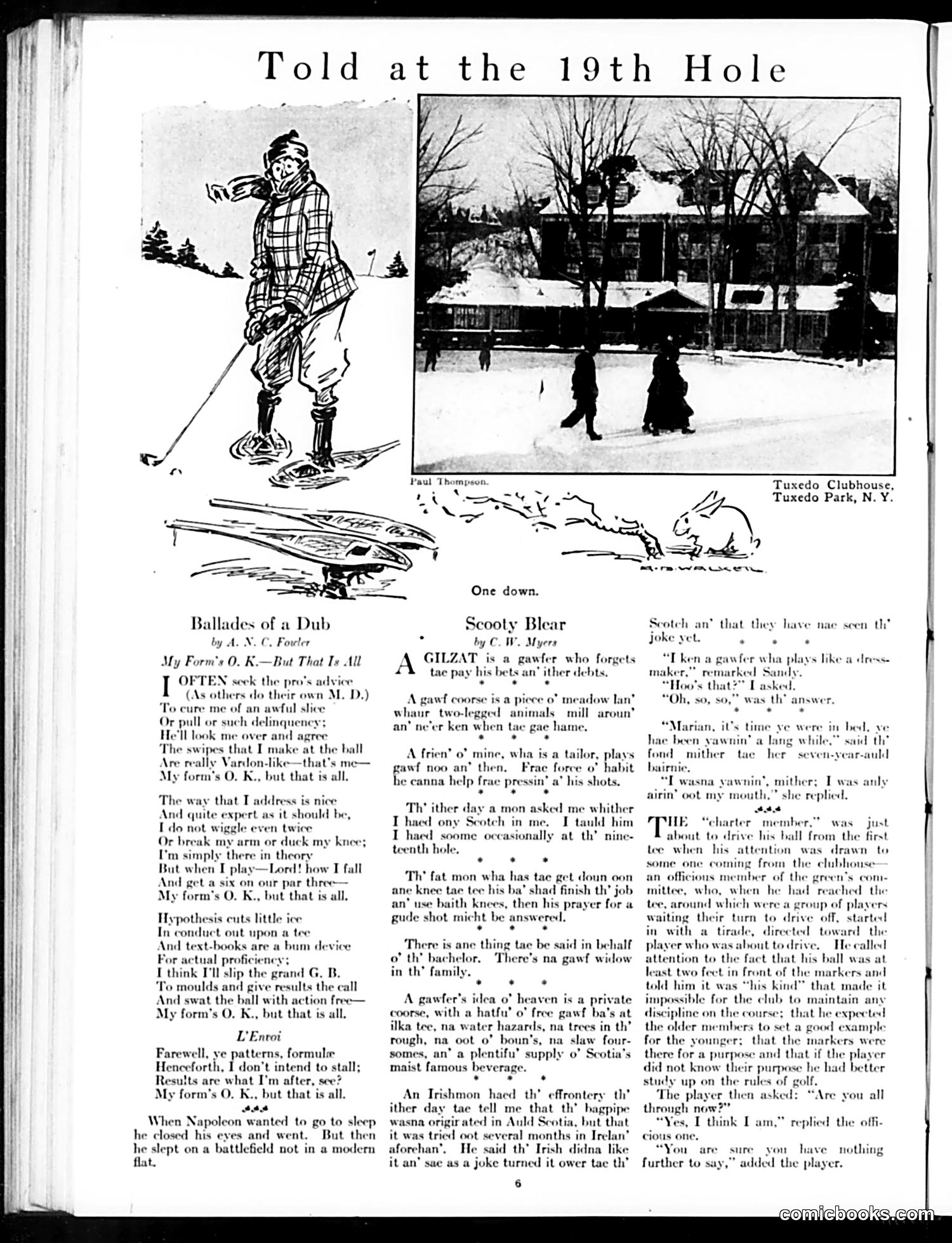
This page collects golf-themed humor pieces—the "19th hole" being a bar where golfers gather after playing 18 holes. **"Ballades of a Dub"** satirizes a golfer whose *technique* is perfect ("My form's O.K.") but whose *actual performance* is terrible—he slices, pulls shots, scores poorly. The joke mocks golfers who blame external factors or theory rather than accepting their own incompetence. **"Scooty Blear"** and the anecdotes use Scottish dialect to tell brief golf jokes: a tailor who presses his shots like fabric; a fat golfer needing both knees to tee off; the false origin story of bagpipes (allegedly a failed Irish instrument the Scots adopted). These are ethnic/regional humor stereotypes common to the era. **The clubhouse story** satirizes an officious club member who lectures another player about proper golf etiquette mid-round, only to be dismissively shut down—mocking social climbers and busybodies who enforce arbitrary rules. The page reflects early 20th-century American golf culture: a leisure activity for the wealthy, ripe for self-mockery about incompetence and social pretension.
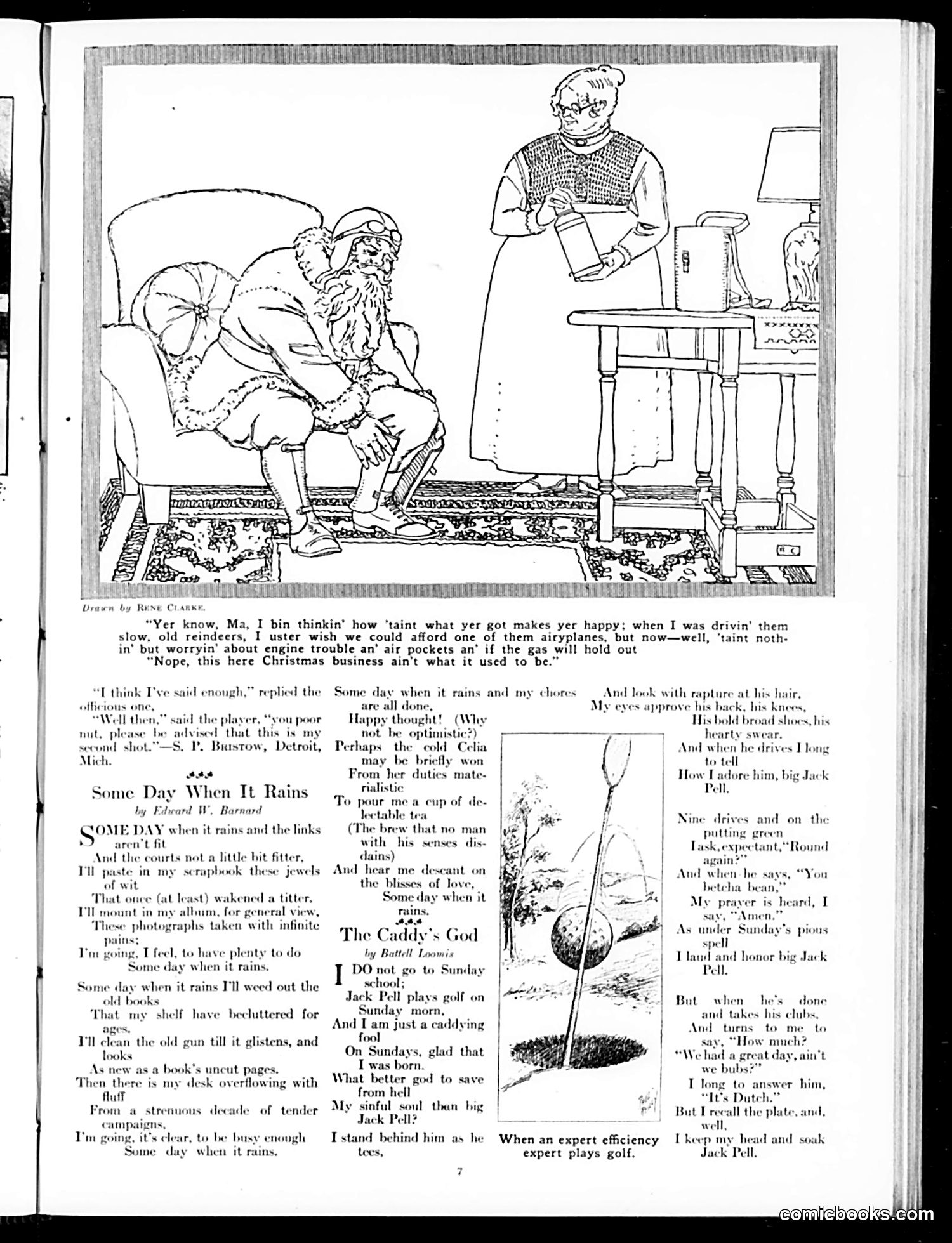
The main cartoon, drawn by René Clarke, depicts a rural father and son discussing modern conveniences. The boy reflects that owning a car (referenced as "airyplanes"—likely meaning automobiles) once seemed desirable, but now he only worries about mechanical troubles, gas supplies, and engine problems. His conclusion: "this here Christmas business ain't what it used to be." **The satire targets:** Post-WWI disillusionment with consumer culture and technological progress. The cartoon mocks how rapid mechanization, while promised to improve life, instead created new anxieties and maintenance headaches. The accompanying poems celebrate rural simplicity and satirize modern leisure pursuits (golf obsession, scrapbooking). "The Caddy's God" ironically treats a golfer like a deity—commenting on the absurd reverence Americans devoted to golf during the 1920s-30s era. **Overall theme:** Nostalgic critique of modernity's false promises and the unexpected burdens of "progress."
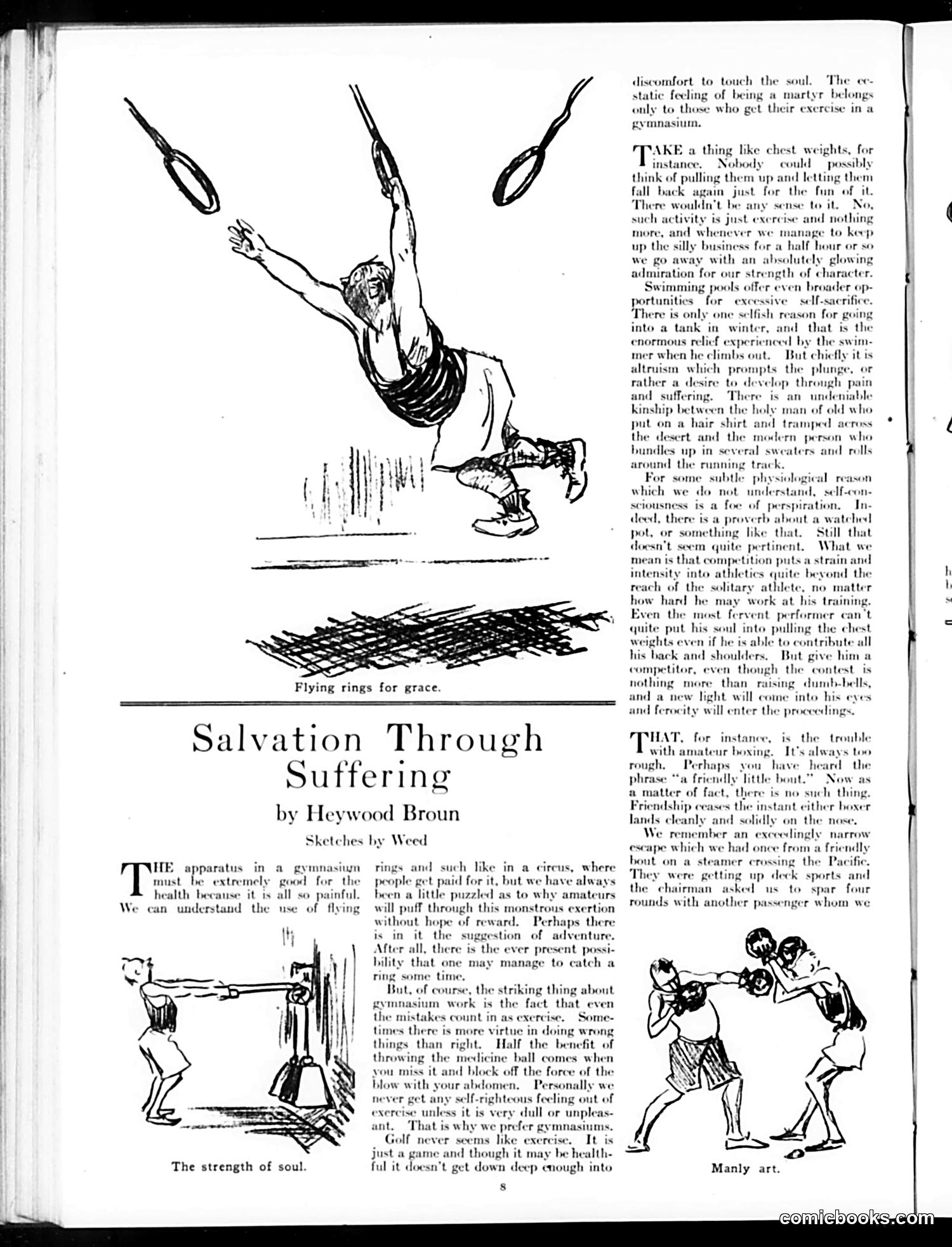
This satirical essay mocks the American obsession with painful exercise as moral virtue. Broun argues that gymnasium-goers endure discomfort—flying rings, chest weights, winter swimming—not for genuine health but to achieve a quasi-religious sense of self-sacrifice and character-building. The cartoons illustrate this absurdity: men performing difficult gymnastics exercises ("The strength of soul," "Flying rings for grace," "Manly art") that serve no practical purpose beyond the pain itself. Broun's joke targets middle-class American attitudes circa the early 20th century that conflated physical suffering with spiritual worth. He suggests this mirrors religious hair-shirt asceticism. He also notes that competition transforms exercise: friendly amateur boxing instantly becomes hostile once someone lands a solid punch, revealing that the supposed noble character-building is actually just ego and aggression in disguise. The satire cuts at American self-righteousness about fitness and masculinity.
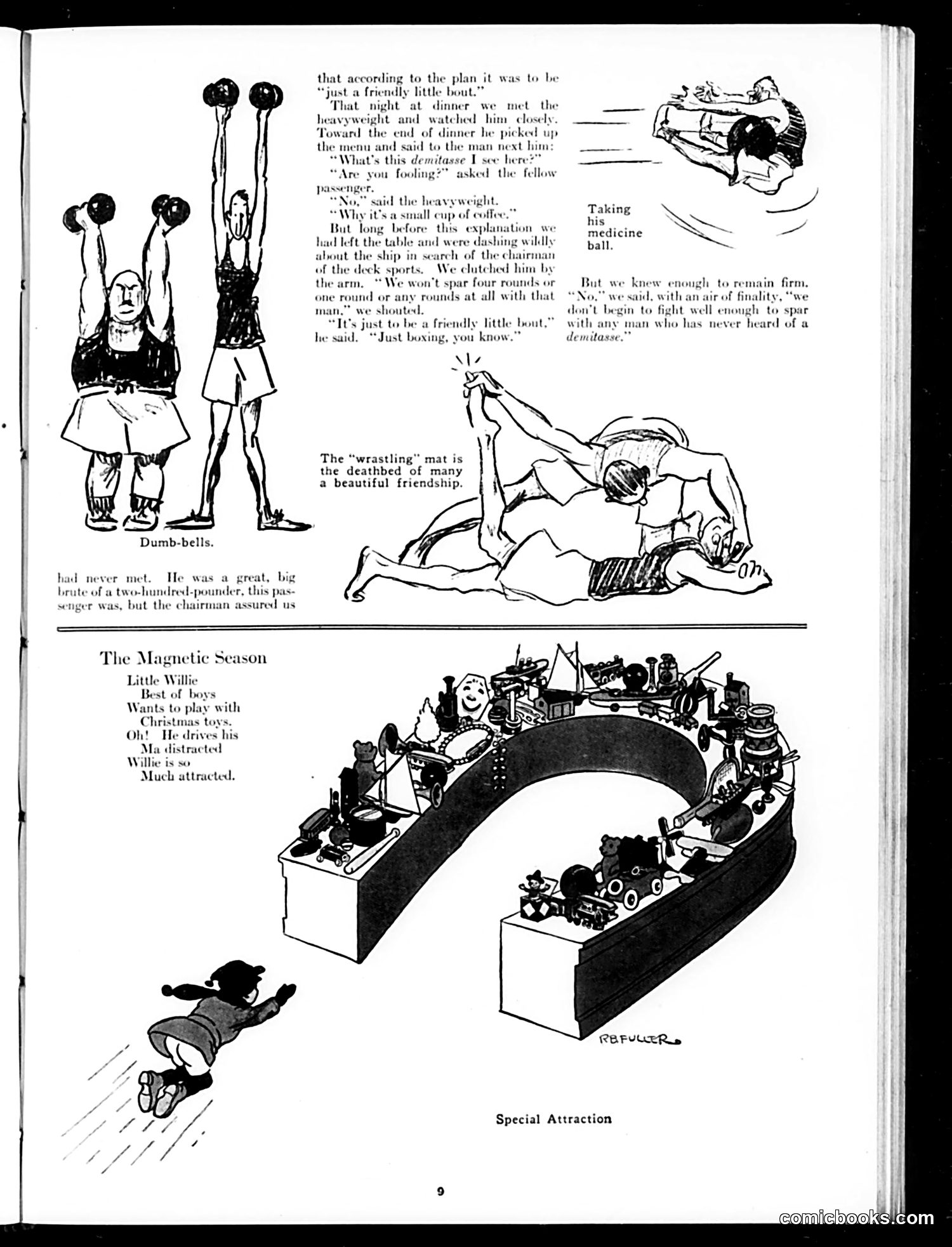
This page contains two distinct pieces of humor: **Upper section**: A anecdote about a dinner with a heavyweight boxer who mistakes "demitasse" (a small coffee cup) for something else. The joke satirizes the boxer's pretended ignorance—he feigns not understanding the French term to seem tough and unrefined, but his companions see through the act. The accompanying text mocks the "wrestling mat" as destructive to friendships, with illustrations of exercise equipment (dumb-bells). **Lower section**: "The Magnetic Season" is a children's verse about "Little Willie" being distracted by Christmas toys, paired with an illustration titled "Special Attraction" showing a small boy drawn toward a large horseshoe magnet holding toys and machinery. The cartoon is a visual pun: Willie is literally "attracted" (magnetically) to the toys, illustrating the poem's point about childhood distraction. Both pieces target familiar turn-of-century themes: masculine pretense and childhood behavior.
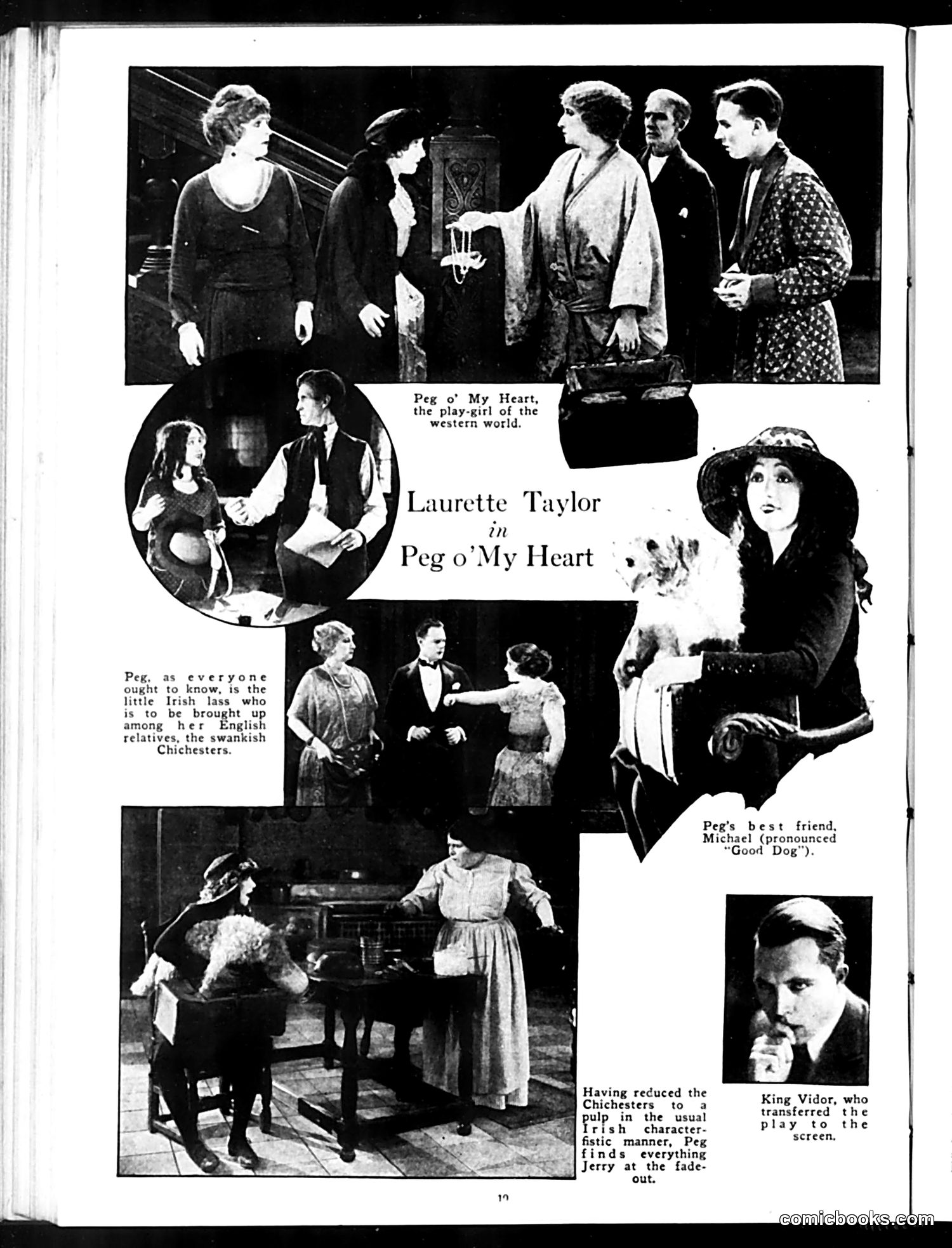
This page promotes the film adaptation of the popular stage play *Peg o' My Heart*, starring Laurette Taylor. The play concerns an Irish girl ("Peg") raised among wealthy, pretentious English relatives called the Chichesters. The satire is gentle: the text humorously describes how Peg, through her Irish charm and forthright manner, reduces the snobbish Chichesters to submission, then finds happiness with her Irish friend Michael. Director King Vidor adapted the theatrical success to film. The cartoon mocks upper-class English affectation ("swankish") through the clash between Peg's earthy Irish character and her relatives' social pretensions. The humor lies in the triumph of authentic Irish character over British class snobbery—a common early-20th-century theatrical theme celebrating Irish identity against stereotypes of English superiority.
This is a film criticism column by Ruth Hale comparing filmmaking approaches. Hale critiques William Fox's "The Town That God Forgot," which featured an elaborate storm scene built with a full-scale town set (50+ buildings, 140,000 feet of lumber, 210,000 shingles). However, Hale argues the result relied too heavily on orchestra sound effects—essentially a "storm orchestra"—rather than visual storytelling. Hale praises D.W. Griffith's opposite approach for "Way Down East," where he used actual locations (Farmington) and real ice floes with actress Lillian Gish, rather than constructed replicas. Though this required costly logistics (cooling Gish with ice cream between takes), the authentic danger and realism translated better to screen. The satire critiques Hollywood's extravagant spending on sets that don't necessarily improve the final product—suggesting "pictures" should tell stories visually, not rely on theatrical sound effects or expensive props that appear unconvincing on film.
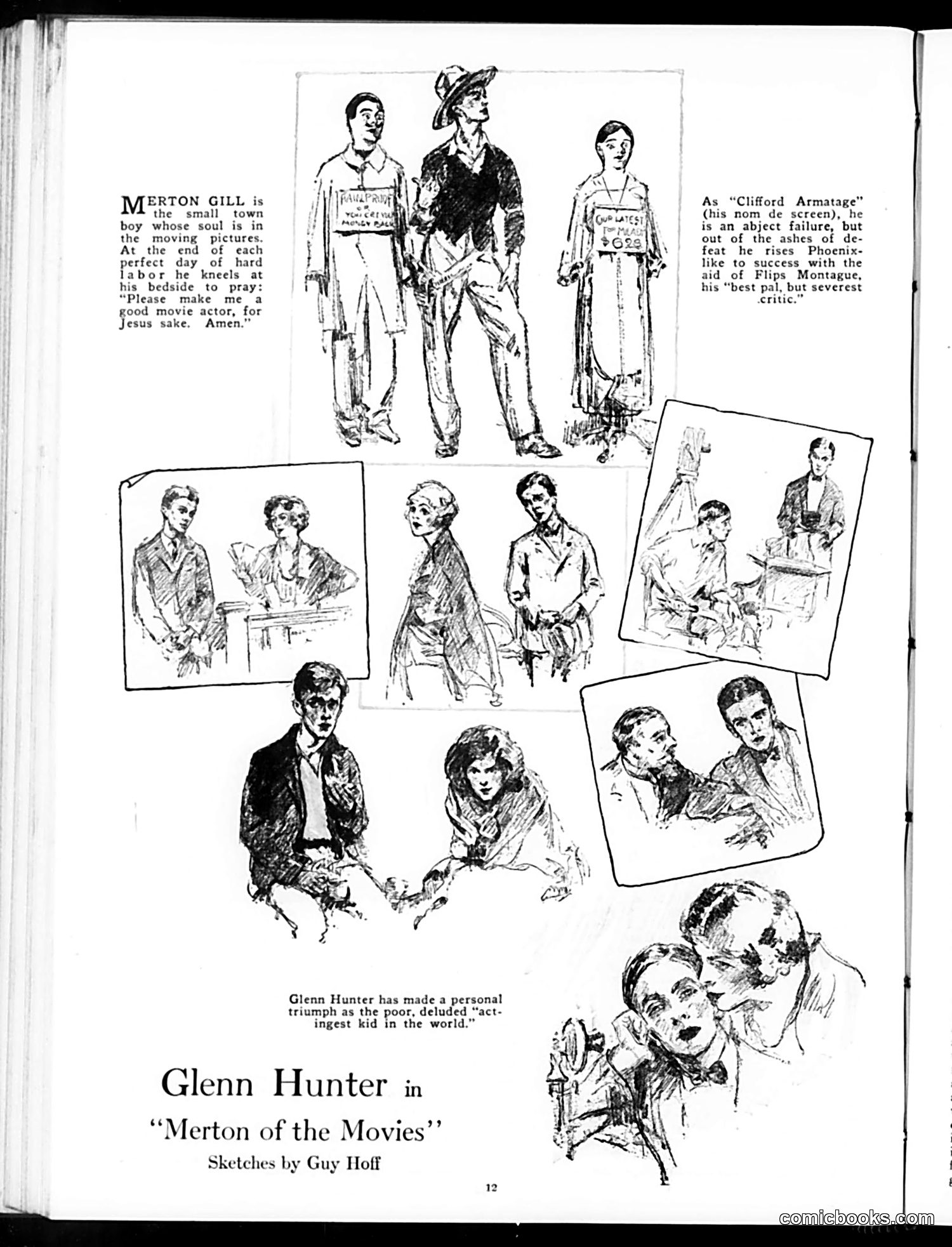
This page promotes the film "Merton of the Movies" starring Glenn Hunter, sketched by artist Guy Hoff. The feature satirizes small-town naïveté and show-business dreams. **The character Merton Gill** is a earnest but delusional young man from a small town whose only aspiration is becoming a movie actor. He prays nightly for success, imagining himself as screen character "Clifford Armatage"—despite being a complete failure at acting. The satire targets his blind ambition and the gap between his sincere aspirations and his actual talentless incompetence. **The joke:** Hunter's character succeeds not through talent but through a friend named "Flips Montague," who serves as both "best pal" and "severest critic." The page celebrates Hunter's performance as the "actingest kid in the world"—mockingly praising his commitment to an impossible dream. The various sketches show different scenes, illustrating this central irony of naive rural ambition meeting theatrical reality.
This is George Jean Nathan's theater criticism column from Judge magazine. Nathan was a prominent drama critic who used his platform for social commentary. The main satire targets **Professor Page** (likely a fictional character representing a Prohibition advocate), who Nathan mocks for inconsistently enforcing the 18th Amendment while ignoring other constitutional violations. Nathan ridicules Page's selective moralism by sarcastically asking why he doesn't also enforce amendments about equality, gun rights, and privacy. The second section reviews a **Black musical theater production**, using the period's offensive racial language ("coon show"). Nathan paradoxically praises the Black performers' talent and entertainment value while using contemporary racist terminology—a contradiction reflecting Judge magazine's era and biases. The cartoons above depict stylized performers with props, illustrating the theatrical subject matter. The satire's core: Nathan exposes hypocrisy in selective moral enforcement and class prejudice in entertainment criticism.
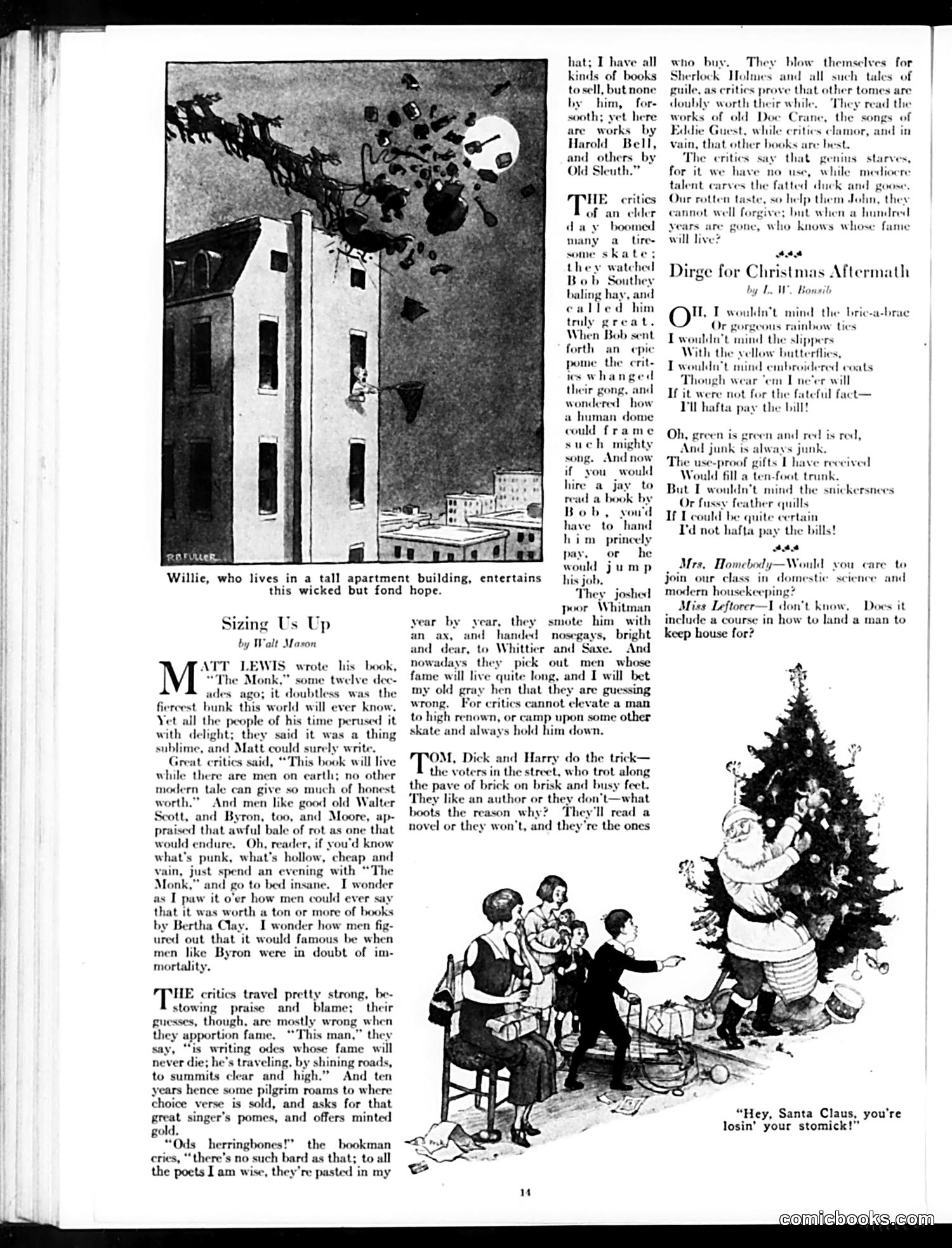
This page contains three distinct pieces satirizing American literary criticism and cultural taste: **"Sizing Us Up" by Walt Mason** critiques how critics misjudge literature's lasting value. Mason argues that 19th-century critics praised works like M.G. Lewis's *The Monk* (1796) as masterpieces, yet these are now forgotten trash, while they initially dismissed writers like Whitman. The satire's point: ordinary readers ("Tom, Dick and Harry") ultimately determine what survives, not critical establishments. Critics cannot elevate mediocre work or suppress genius—public taste does. **The apartment building illustration** shows "Willie" entertained by watching someone fall, representing schadenfreude or dark humor as a "wicked but fond hope." **"Dirge for Christmas Aftermath"** by L.W. Bonsall is humorous verse about unwanted Christmas gifts—the "useless" items received (decorative ties, embroidered coats) that seem worthless but must be kept because one will receive the bill. It's a lighthearted complaint about obligatory gift-giving and its financial consequences. The page overall reflects early-20th-century debates about aesthetic versus popular judgment.
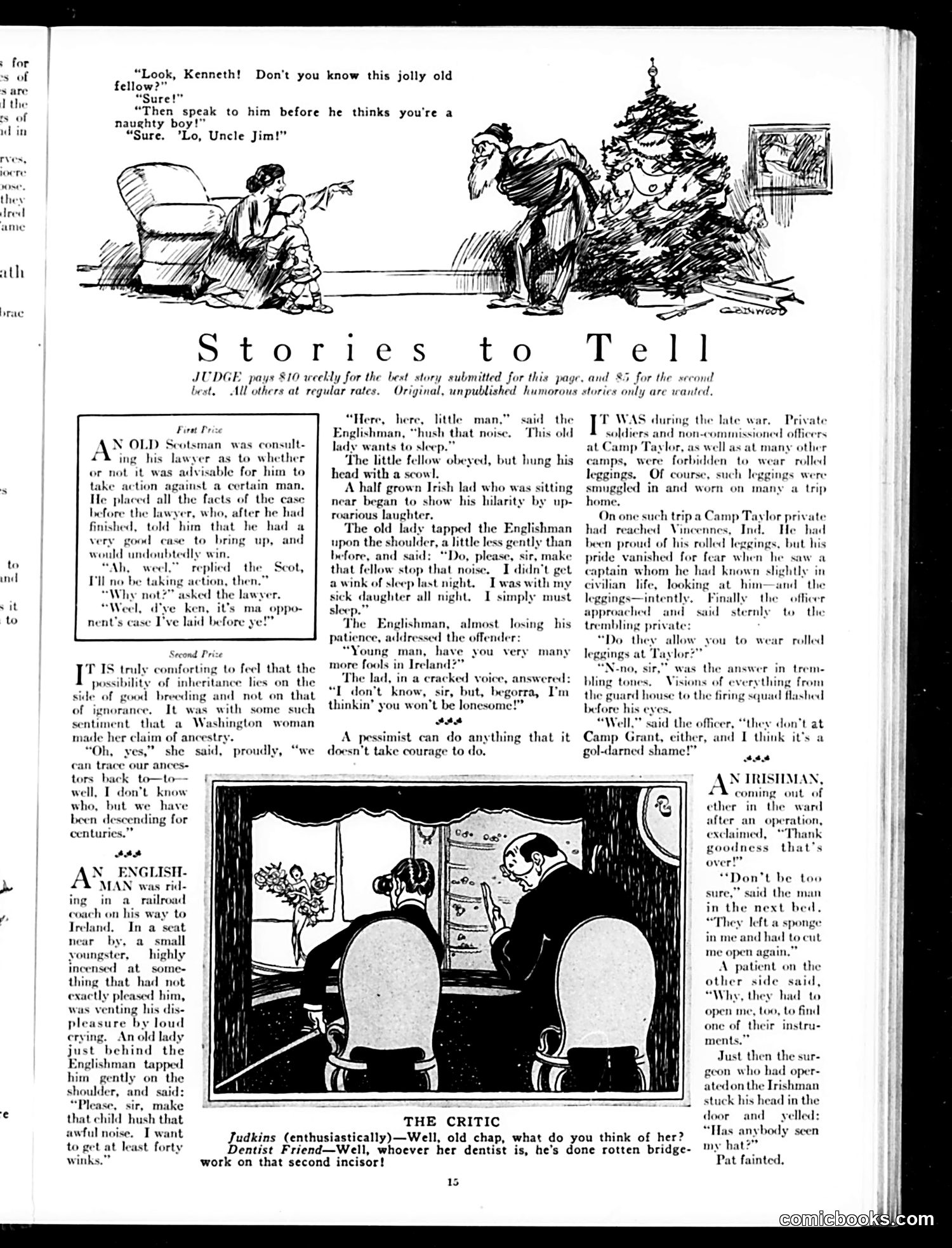
This is a humor story submission page from Judge magazine, featuring several short comedic anecdotes meant for general entertainment rather than political satire. The top cartoon depicts a child being instructed to greet "Uncle Jim" before the boy misbehaves—typical early 20th-century domestic humor about child behavior and adult management. The text stories below include: a Scottish lawyer's refusal to sue (playing on Scottish penny-pinching stereotypes); an Englishman annoyed by a crying Irish child on a train (reinforcing Anglo-Irish cultural tensions); and a WWI-era anecdote about a soldier wearing forbidden rolled leggings at Camp Taylor, nearly court-martialed until an officer admits he doesn't enforce that rule either. The final item, "The Critic," jokes about poor dental bridgework. The humor relies on period-specific social hierarchies, national stereotypes, and military regulations rather than political commentary—typical of Judge's lighter content aimed at middle-class American readers of the era.
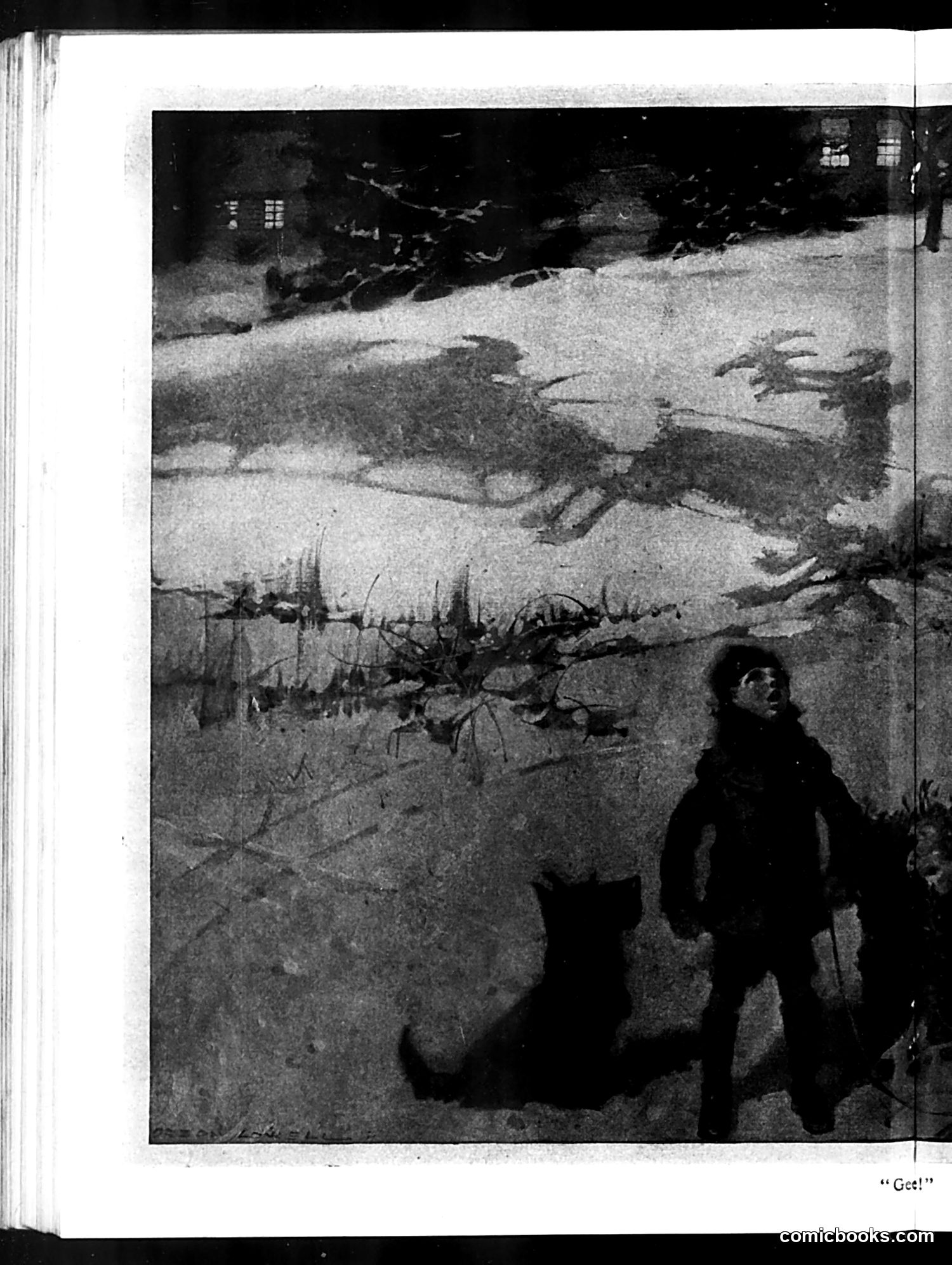
This black-and-white cartoon depicts a nighttime scene where a figure in dark clothing reacts with alarm ("Gee!") upon encountering what appears to be large, menacing creatures or dinosaurs on a path near buildings. The creatures have distinctive spiky features and threatening postures. The satire likely uses these fantastical monsters as metaphorical representations of contemporary threats or anxieties—possibly social problems, political opponents, or foreign dangers relevant to Judge's era. The ordinary person's startled exclamation suggests the unexpected intrusion of these "monsters" into everyday life. Without additional context about Judge's publication date or surrounding articles, the specific political or social reference remains unclear, though the juxtaposition of mundane reality with surreal threat is characteristic of Judge's satirical style.
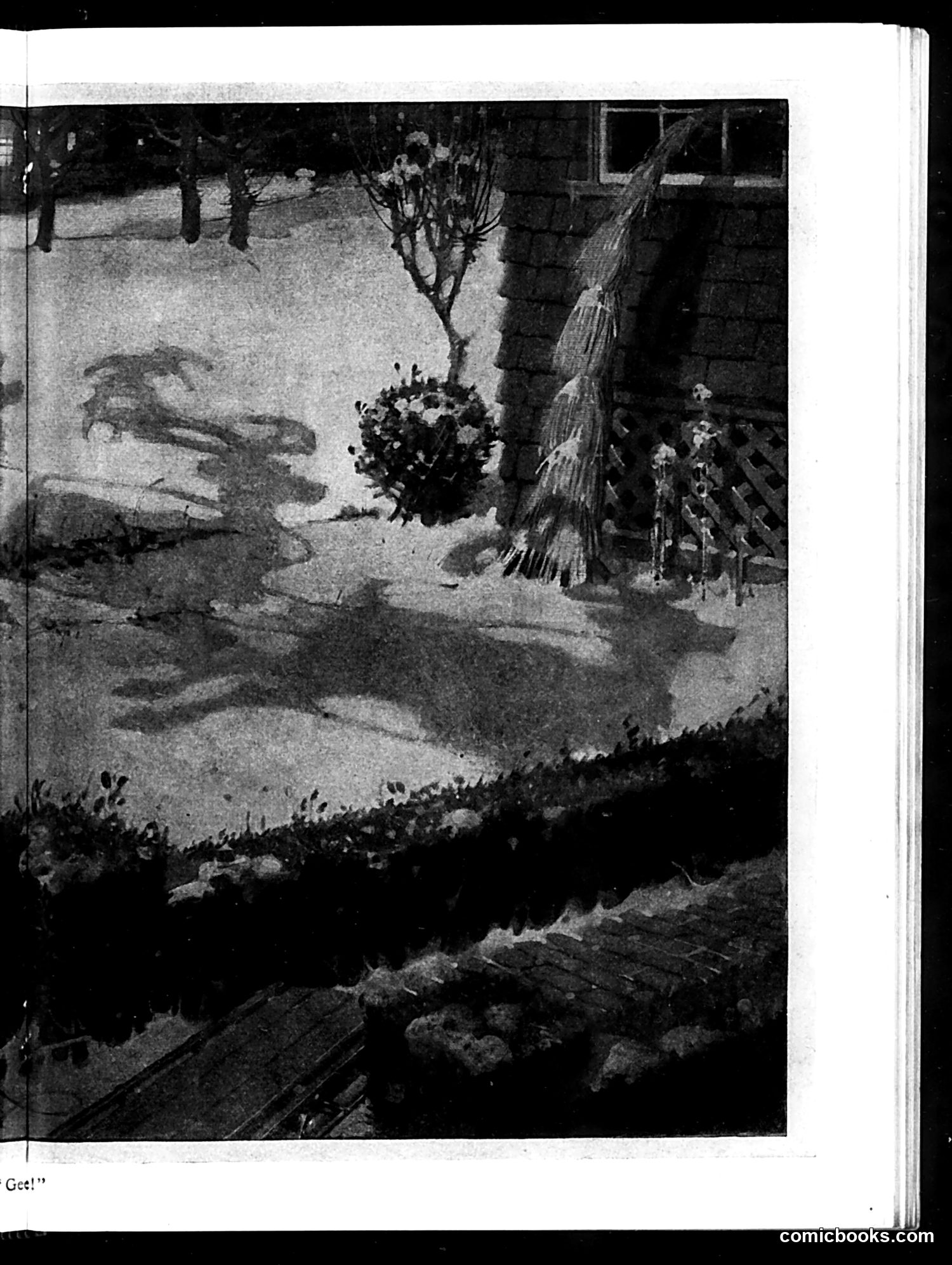
I can see this is a black and white photograph or illustration from Judge magazine showing a garden scene. There's a potted topiary or flowering plant in the center, bare branches above it, what appears to be a brick building or wall structure on the right, and various garden elements in the foreground and background. However, the OCR text provided is essentially illegible—just fragments like ";" "t" "tery" and "comicbooks.com"—making it impossible to identify the specific cartoon's subject, figures, or satirical intent. Without readable text or clear caption information, I cannot reliably explain what political or social commentary this image conveys or who might be depicted. To properly analyze this as satire, I would need legible accompanying text or a visible caption.
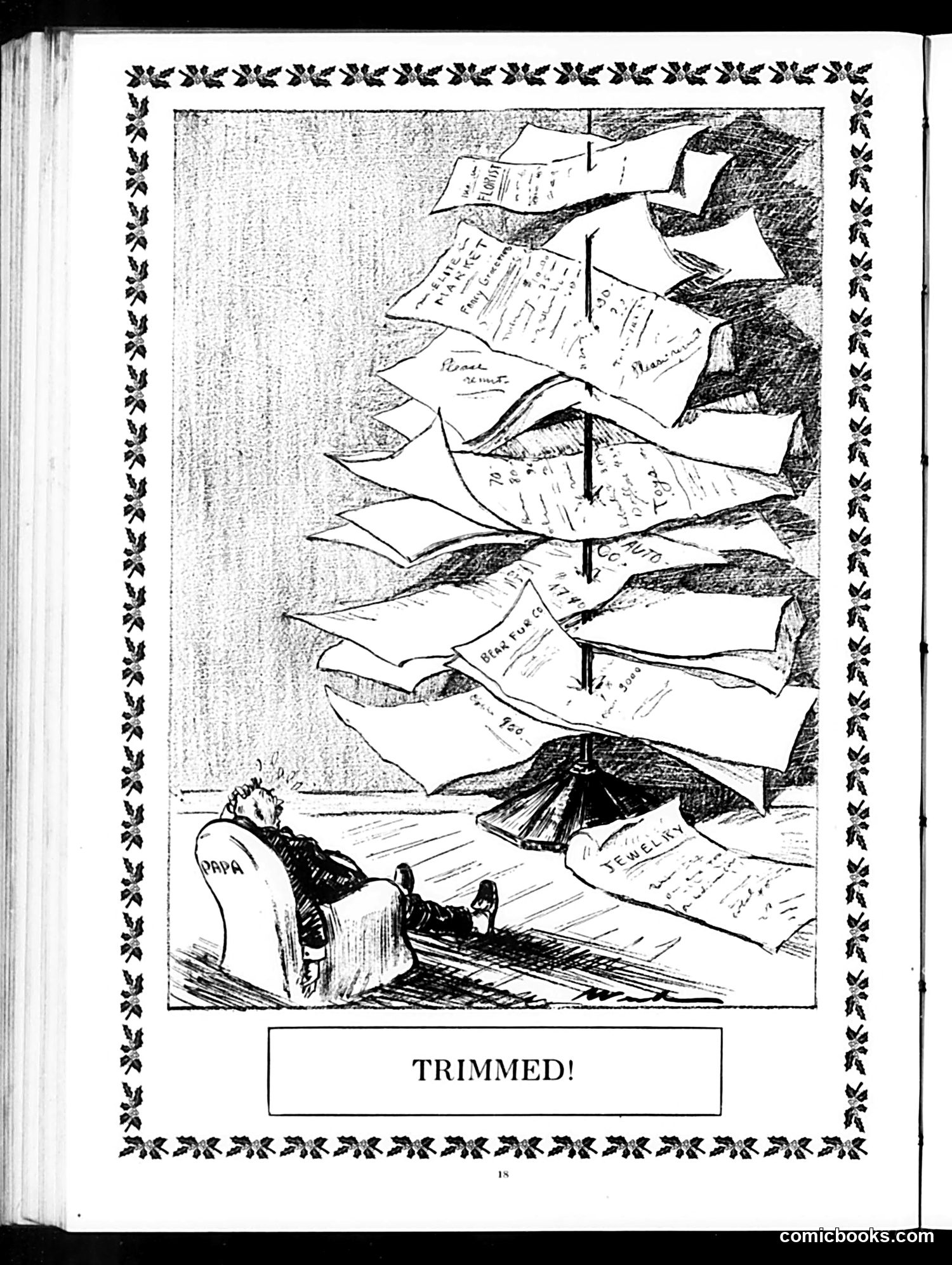
This satirical cartoon depicts a figure labeled "PAPA" sitting in a chair, surrounded by falling papers and documents representing various scandals, exposés, or controversies. The umbrella he holds suggests attempted protection from the "rain" of damaging information. The title "TRIMMED!" indicates he has been defeated or humiliated—his defenses have failed. The scattered papers likely reference specific political or financial scandals of the era, though without clearer legibility of individual labels, the exact controversies remain unclear. The cartoon appears to satirize a prominent political figure's downfall through public exposure or investigation. The visual metaphor of being overwhelmed by falling documents suggests the power of press scrutiny or public revelation to bring down authority figures—a common Judge magazine theme criticizing corruption or misconduct.
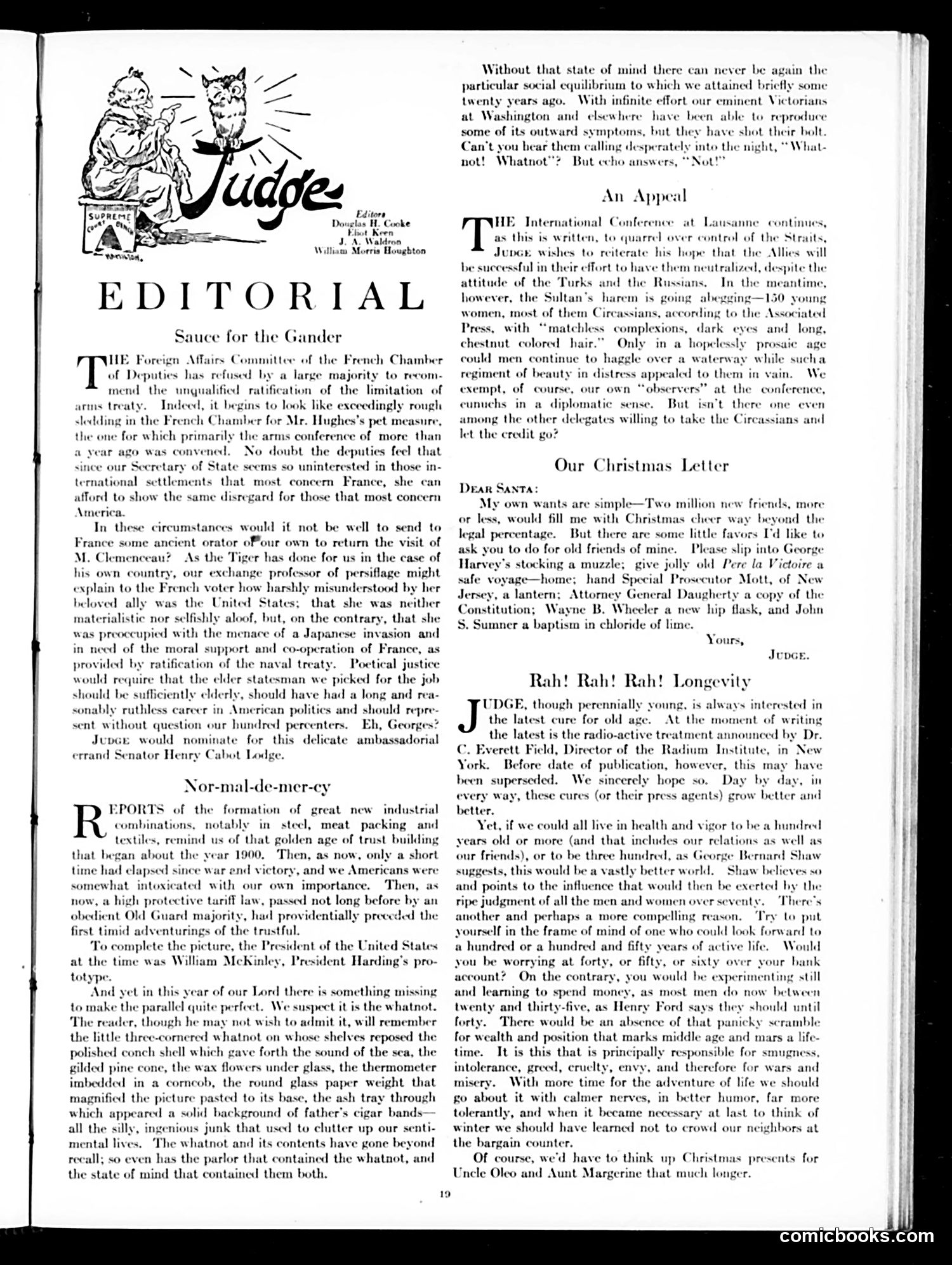
**The "Judge" Masthead Cartoon:** The illustration shows a figure (Judge personified) wielding a large pen as a sword or club, striking at an owl—a traditional symbol of wisdom. This visualizes the magazine's satirical mission: attacking establishment figures and pretense with sharp wit. **"Sauce for the Gander":** This editorial mocks the French Chamber of Deputies for rejecting Secretary of State Hughes's arms-limitation treaty while expecting American cooperation on matters France cares about. The satire suggests the U.S. should send an experienced diplomat (humorously nominating Senator Henry Cabot Lodge, a known isolationist) to lecture the French the way French orator Clemenceau advised America—turning the tables with equal disdain. **"Nor-mal-de-mer-cy":** Comparing the Harding era to McKinley's post-1900 boom (trust-building, protective tariffs, industrial combinations), the piece nostalgically laments the disappearance of the Victorian "whatnot"—those cluttered parlor shelves with decorative trinkets. It suggests America has lost the genteel worldview that once held society together, making today's attempts to recreate prosperity hollow.
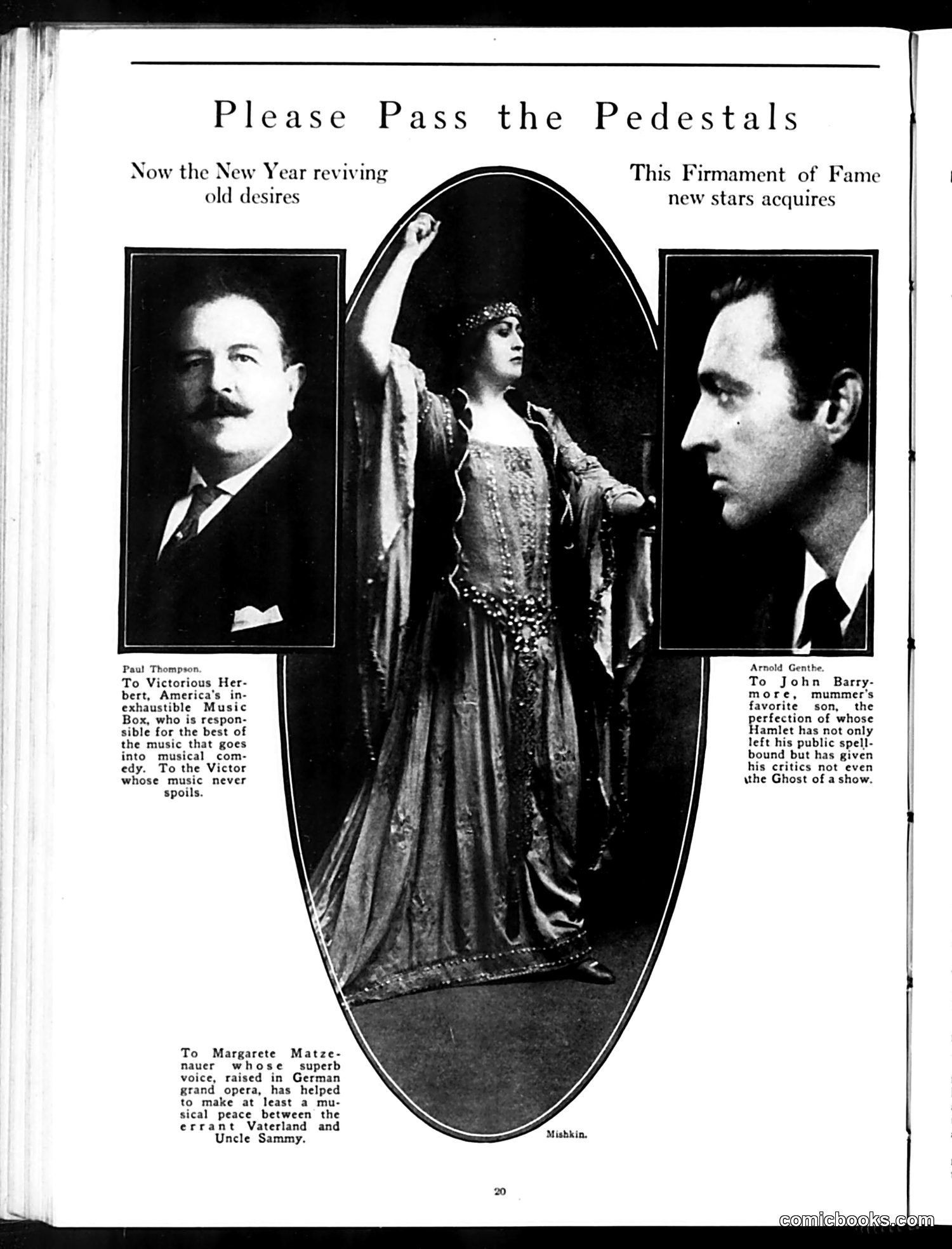
This is a New Year's tribute page from *Judge* magazine celebrating theatrical talent. The title "Please Pass the Pedestals" humorously suggests these figures deserve elevated status. **The figures honored:** - **Paul Thompson** — credited as composer/music director ("America's inexhaustible Music Box") for musical comedies - **Margarete Matzenauer** — soprano who performed in grand opera, here praised for creating cultural goodwill between Germany and America (the "Vaterland" reference) - **John Barrymore** — actor whose *Hamlet* performance was so acclaimed that even critics found no fault ("not even...the Ghost of a show" — a pun on *Hamlet's* ghost) **The satire:** The page gently mocks the theatrical world's tendency to elevate performers to "pedestals." By framing these as New Year resolutions to honor talent, it both celebrates genuine artistic achievement and satirizes the hyperbolic praise theater culture bestows on its stars. The formal portrait layout mimics monument dedication styles, amplifying the mockery of their near-deity status.
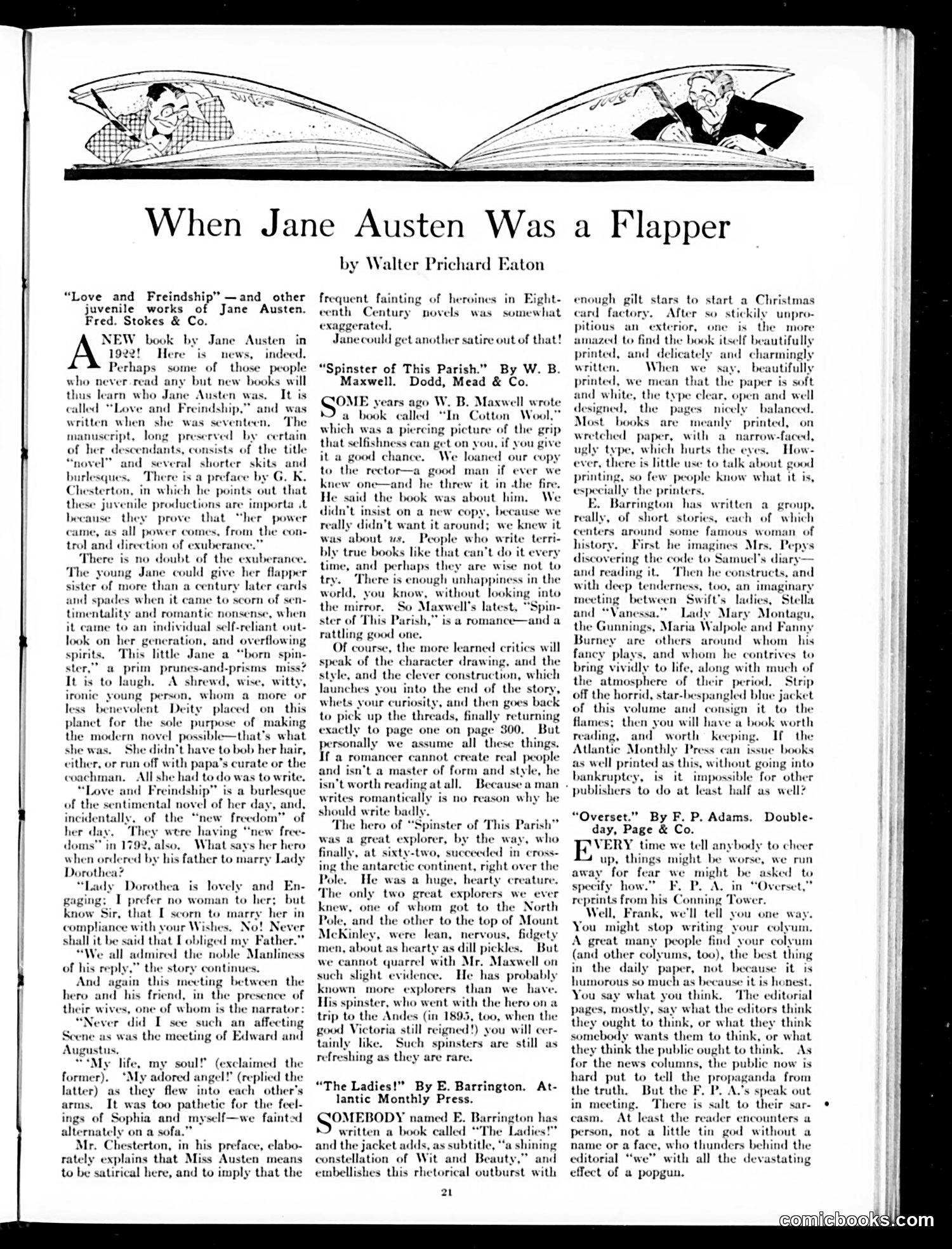
This article by Walter Prichard Eaton reviews newly published juvenile works by Jane Austen, drawing a witty parallel between her youthful writing and 1920s "flapper" culture. The cartoon at the top depicts an open book with two figures—likely representing young Jane Austen (left) and an elderly figure (possibly an editor or critic, right)—suggesting the bridge between past and present. The satire's point: Eaton argues that Austen's teenage writings, particularly "Love and Freindship," were already mocking the excessive sentimentality and romantic nonsense of 18th-century novels. Young Jane's sharp wit and irreverent spirit make her a proto-"flapper"—a modern, independent-minded woman rejecting conventional sentimentality. The piece celebrates how Austen's youthful satire proves she possessed the sensible, self-reliant outlook characteristic of 1920s modernity, suggesting that "new freedom" wasn't invented in the Jazz Age but existed in 1792.
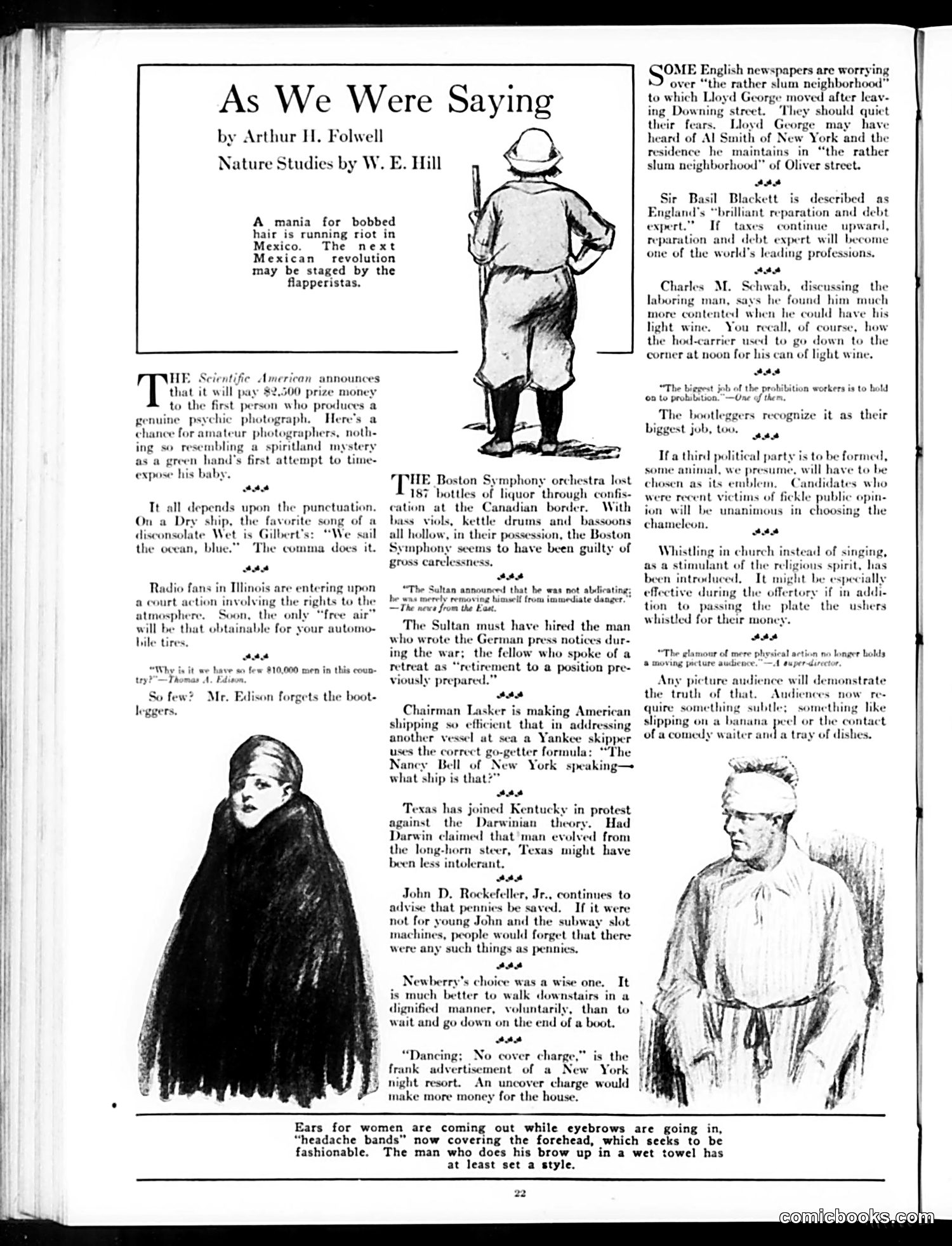
This page collects brief satirical commentary on contemporary events, likely from the Prohibition era (1920s). Key targets include: **Political figures**: Lloyd George (British PM) moving to a modest neighborhood; references to Al Smith (New York politician); John D. Rockefeller Jr.'s penny-pinching advice. **Prohibition enforcement**: The Boston Symphony losing liquor at the Canadian border (mocking Prohibition's absurdity); bootleggers as "$10,000 men"; jokes about "light wine." **Social movements**: Mexico's bobbed-hair trend; Texas and Kentucky rejecting Darwinian theory; a "third political party" forming (likely the Progressive Party). **Media/advertising**: Psychic photography contests; a nightclub advertising "no cover charge" (ironically unprofitable). The humor is cynical—mocking government ineffectiveness, hypocrisy around alcohol, and public gullibility. The illustrations (two portraits) appear decorative rather than specific caricatures. Overall, it's satirical commentary on 1920s American politics and society.
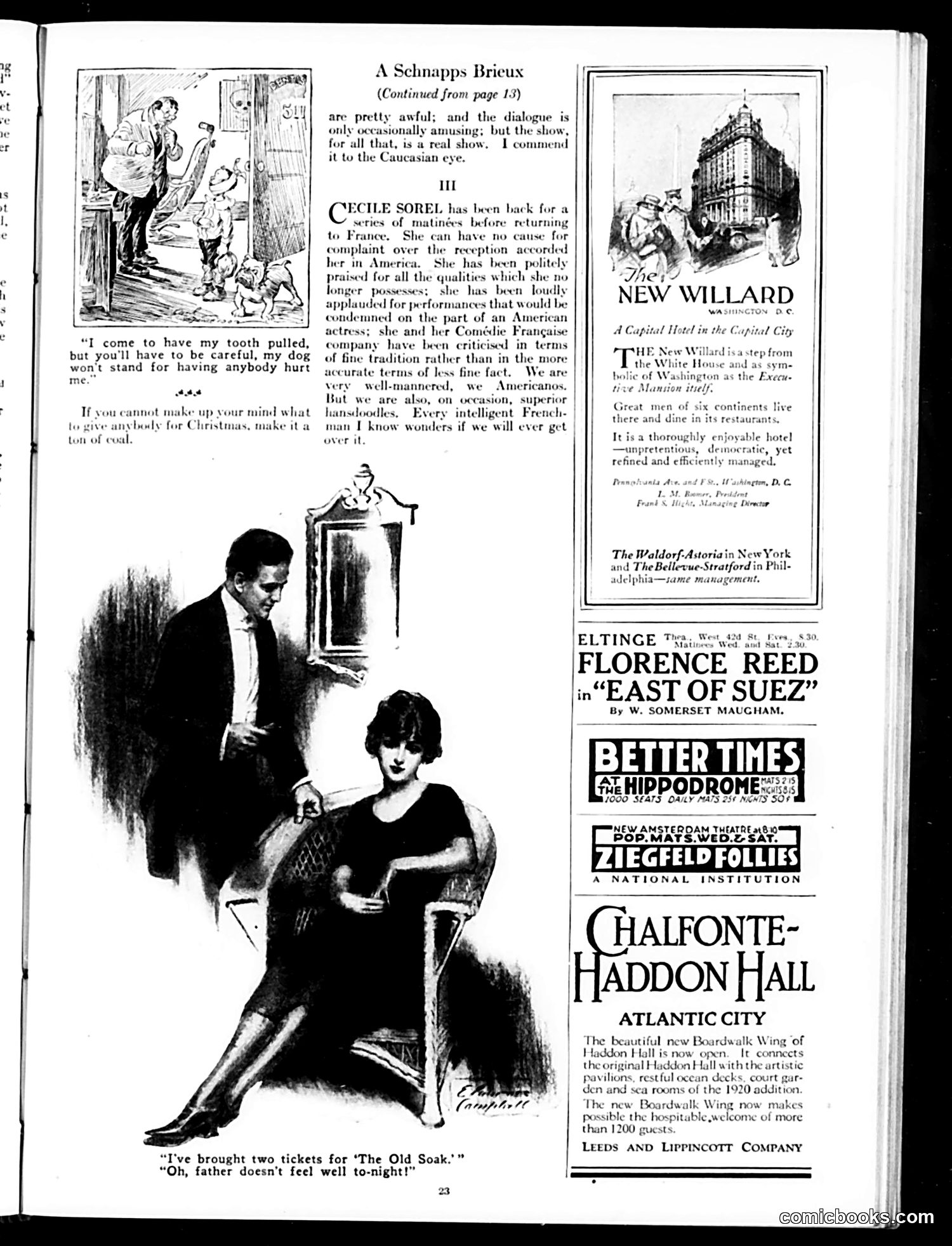
This page contains two distinct cartoons and substantial advertising. **The main cartoon** (center-left) depicts a domestic scene with a dentist preparing to extract a tooth from a woman patient while a man stands nearby. The caption reads: "I've brought two tickets for 'The Old Soak.' / 'Oh, father doesn't feel well to-night!'" The joke relies on the double meaning of "the Old Soak"—likely a theatrical production about a drunkard—while the woman uses her dental appointment as an excuse to avoid attending with her inebriated husband. It's a gentle satire on marriage dynamics and social obligation. **Upper left** shows a separate cartoon about tooth-pulling with a man and boy, accompanied by dialogue about a protective dog—a simpler sight-gag cartoon. **The text section** critiques French actress Cecile Sorel's American reception, arguing that audiences praised her overgenerously out of politeness rather than honest assessment. The remainder comprises advertisements for hotels, theaters, and entertainment venues typical of early 20th-century Judge magazine.
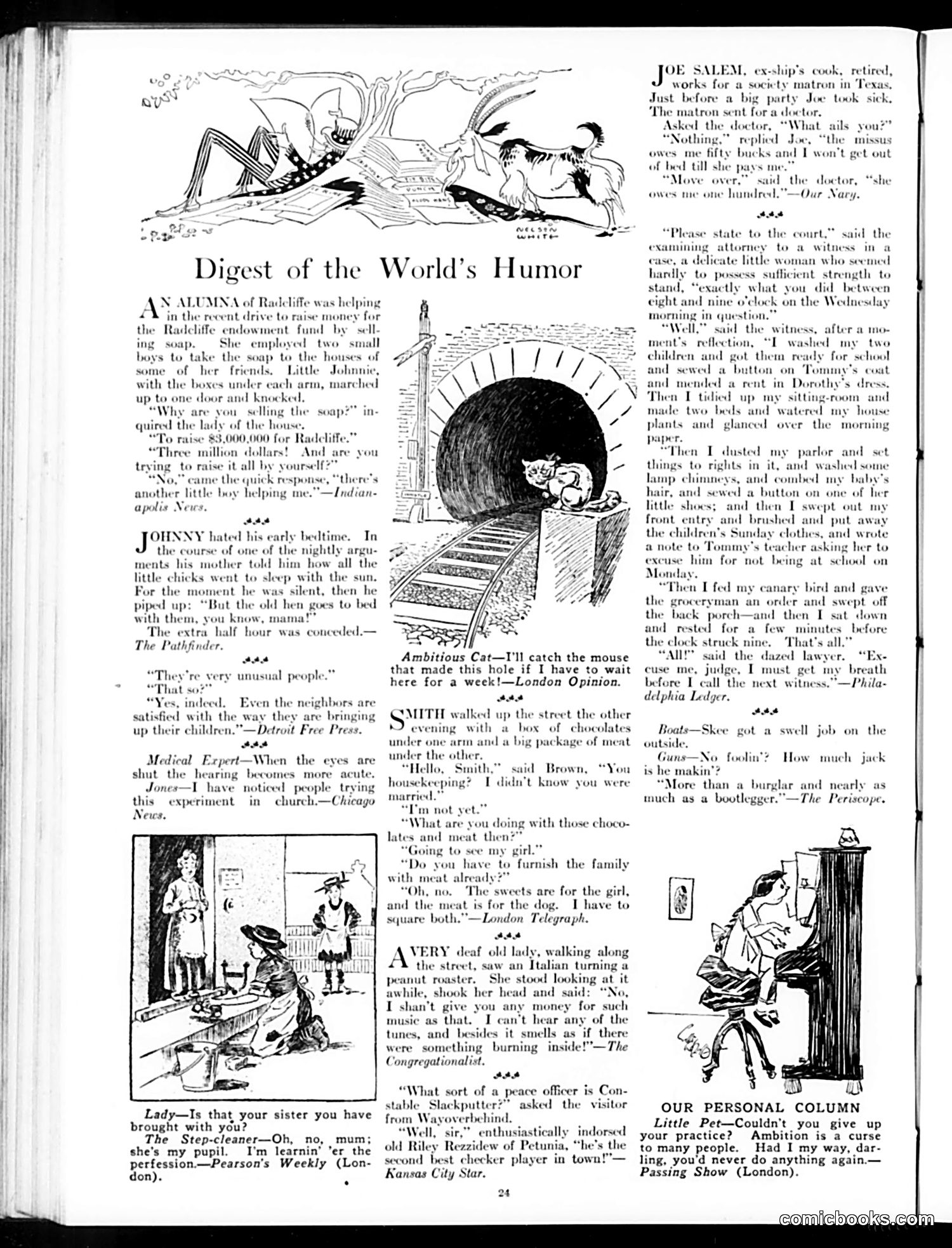
This page collects brief humorous anecdotes rather than political cartoons. The jokes satirize early 20th-century social situations: **Key themes:** - **Class and gender**: A Radcliffe alumna's soap-selling fundraiser; a working-class step-cleaner; a society matron's treatment of servants - **Gender roles**: A woman witness describing her exhausting domestic routine (washing children, mending, dusting, cooking) to illustrate how busy she was - **Economic struggles**: References to unpaid debts, people working multiple jobs, the contrast between "burglars" and "bootleggers" making more money than honest work **The humor targets:** - Absurdities of daily life (a cat waiting a week to catch a mouse) - Miscommunications (a deaf woman misinterpreting a peanut roaster's sound) - Social pretense (bringing chocolates and meat—one for the girl, one for the dog—to "square" both) The overall tone mocks modern urban life, worker struggles, and domestic drudgery through gentle, observational comedy rather than sharp political satire.
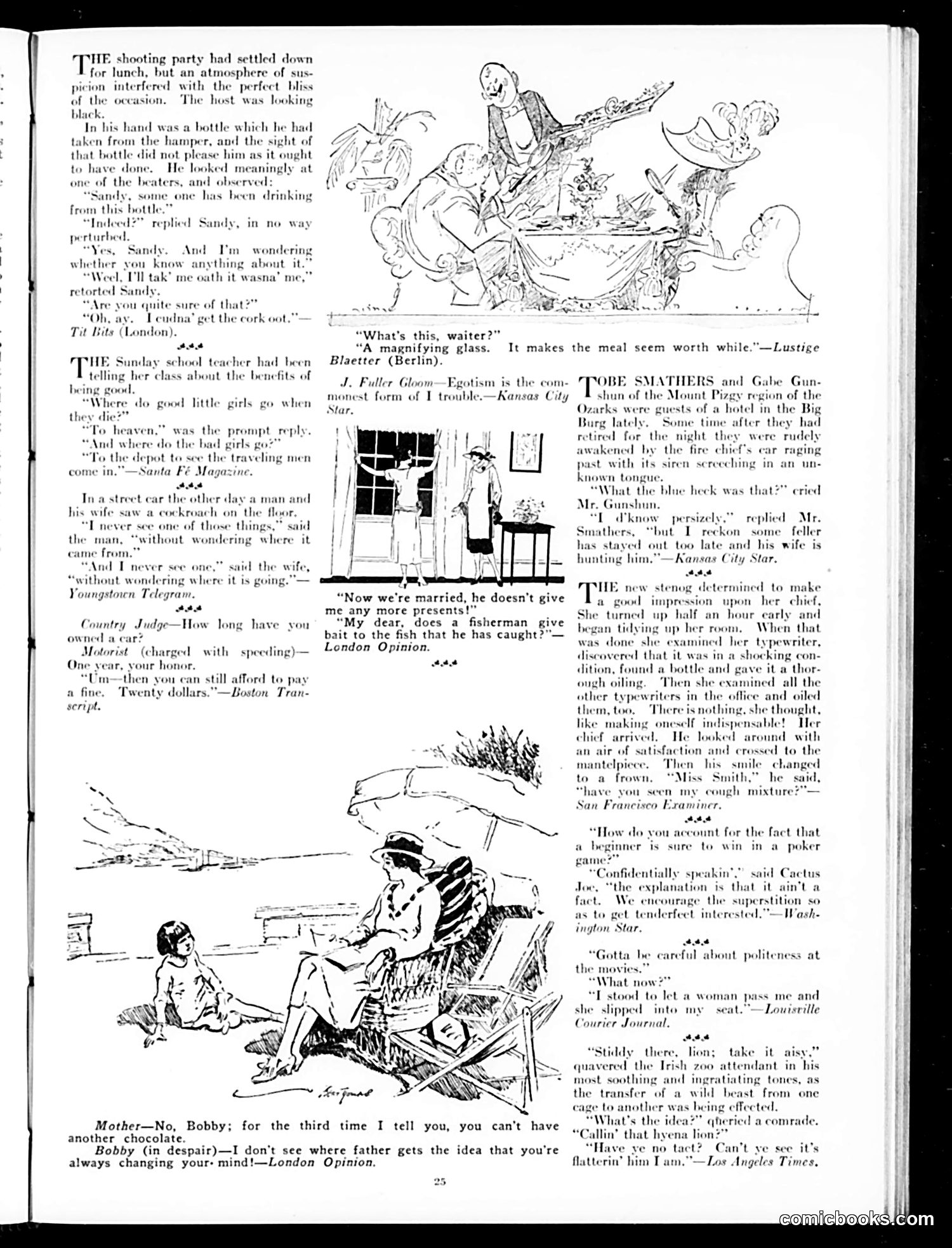
This page contains multiple short humorous anecdotes typical of Judge's satirical format, rather than political cartoons. The jokes target various social types and domestic situations: **Key humor targets:** - **Gender/marriage dynamics**: A new bride's attempts to impress her boss by oiling typewriters; a husband who "always changes his mind"; a wife questioning where a fisherman's gifts go after marriage. - **Social pretension**: A Sunday school teacher's euphemistic answer about where "good little girls" go (heaven); bourgeois dining etiquette (a magnifying glass to examine food). - **Class and authority**: A motorist still affording speeding fines; an Irish zoo attendant's malapropisms regarding animal transfers. - **Superstition/folk wisdom**: Rural characters discussing unexplained noises; poker players exploiting beginner's luck superstitions. The illustrations show domestic and workplace scenes rendered in period sketch style. The satire reflects early 20th-century American attitudes toward marriage, class distinctions, and rural/urban cultural differences—gentle mockery rather than sharp political critique.
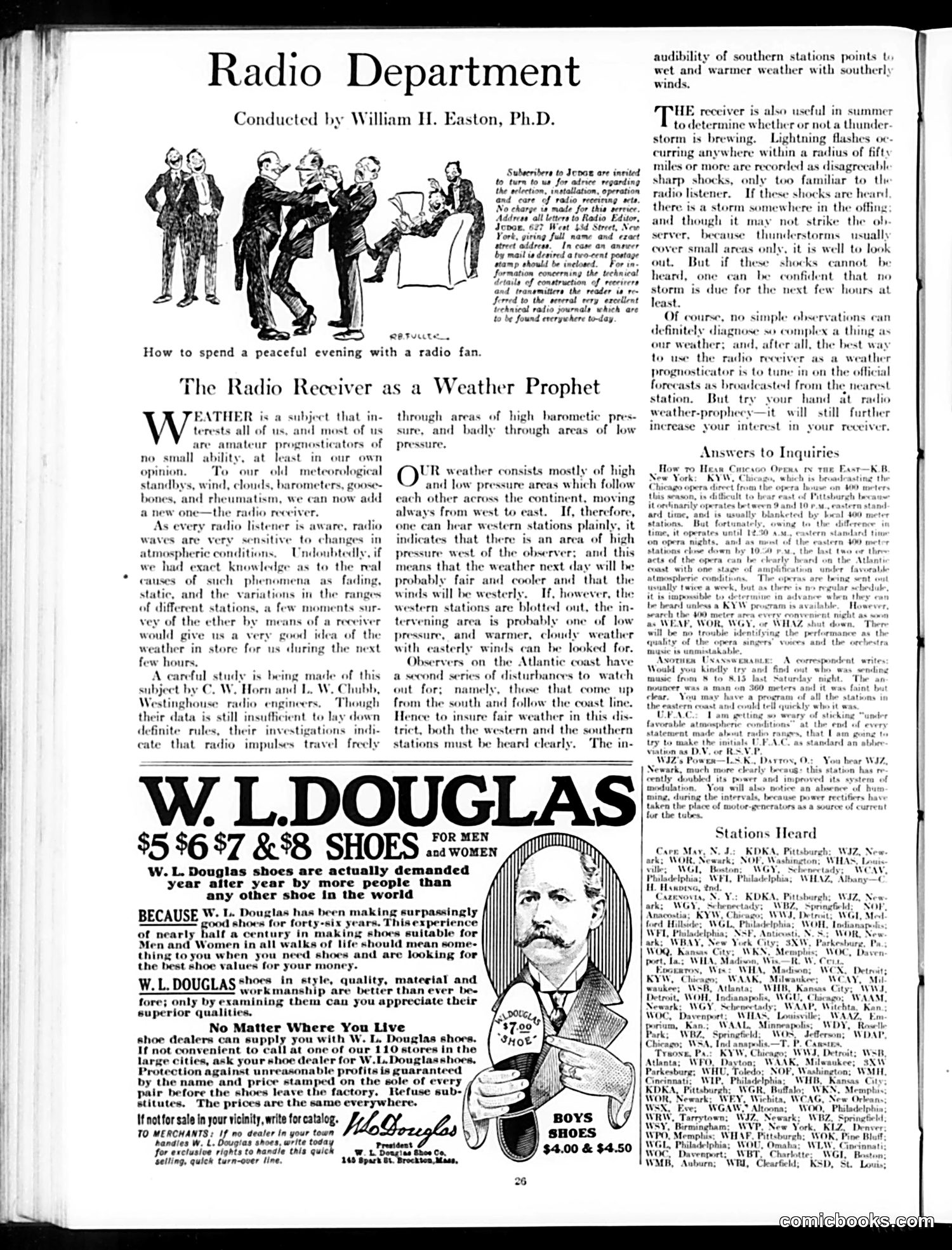
This page combines a legitimate **Radio Department** article with advertising. The main cartoon illustrates the contemporary novelty of radio technology around the 1920s: four men in formal dress gather around a radio receiver with expressions of intense concentration, captioned "How to spend a peaceful evening with a radio fan." The satire gently mocks radio enthusiasts' solemnity and the device's status as a fascinating but somewhat mysterious new technology requiring rapt attention. The article itself—"The Radio Receiver as a Weather Prophet"—describes using radio signal reception patterns to predict weather by detecting atmospheric pressure changes. This reflects genuine early scientific interest in radio's meteorological applications. The W.L. Douglas shoe advertisement occupies the lower half, typical of Judge's commercial content. No political figures or events are referenced; instead, the page captures the cultural moment when radio represented cutting-edge technology worthy of both serious scientific study and gentle mockery.
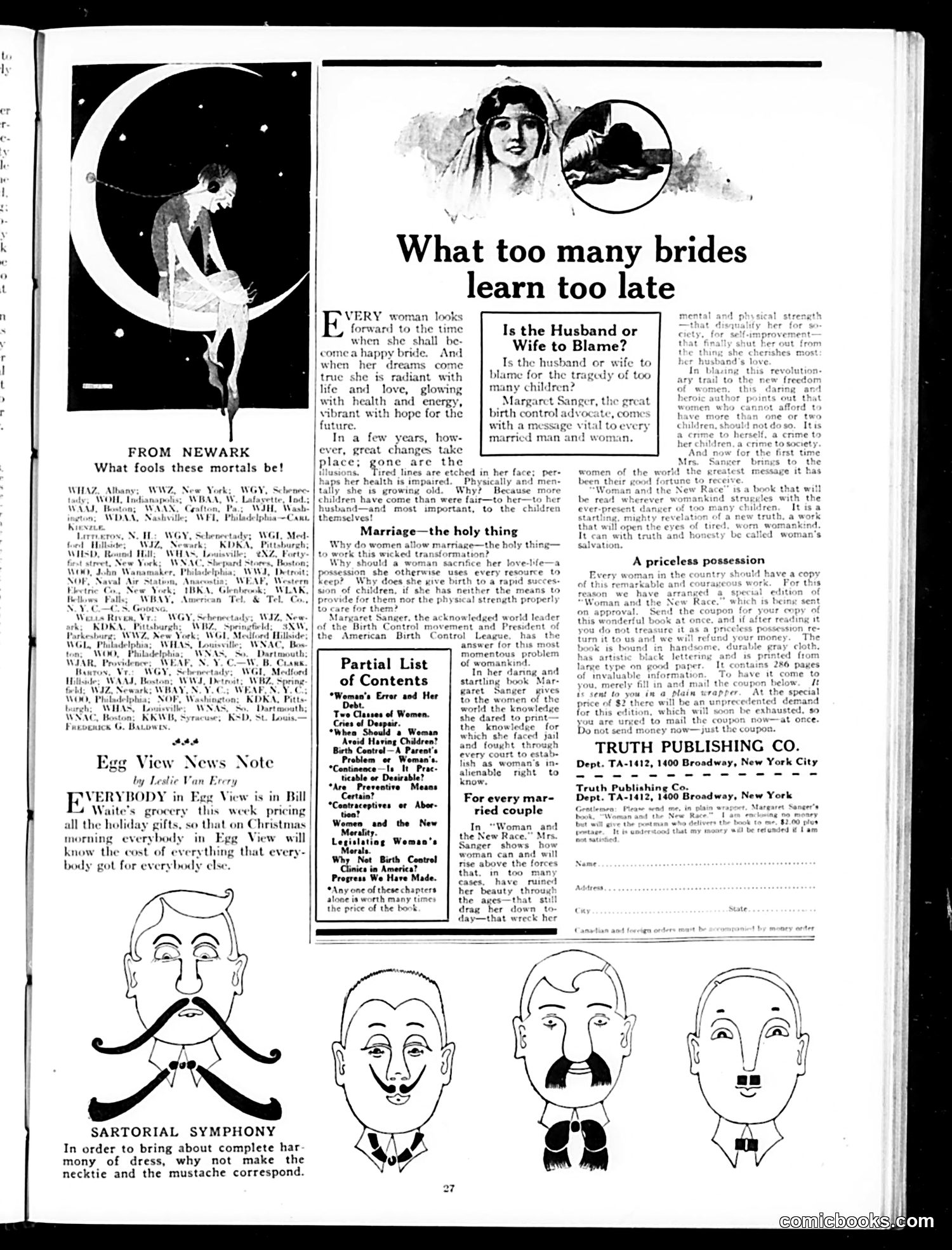
This page from Judge magazine addresses **early 20th-century anxieties about marriage and motherhood**. The main article, "What too many brides learn too late," argues that women sacrifice their health and beauty through excessive childbearing, explicitly referencing **Margaret Sanger's birth control advocacy**. The text frames the question "Is the Husband or Wife to Blame?" for having too many children, ultimately suggesting women need control over reproduction to preserve themselves. This was **radical content** for the era—Sanger was imprisoned for her birth control activism. The "Egg View News Note" and "Sartorial Symphony" are lighter, humorous filler content typical of Judge's mix of social commentary and comic relief. The page advertises a book addressing "Woman's Error and Her Redemption," promoting the then-controversial idea that women should limit family size for their own wellbeing—a **progressive stance** for early 20th-century American magazines.
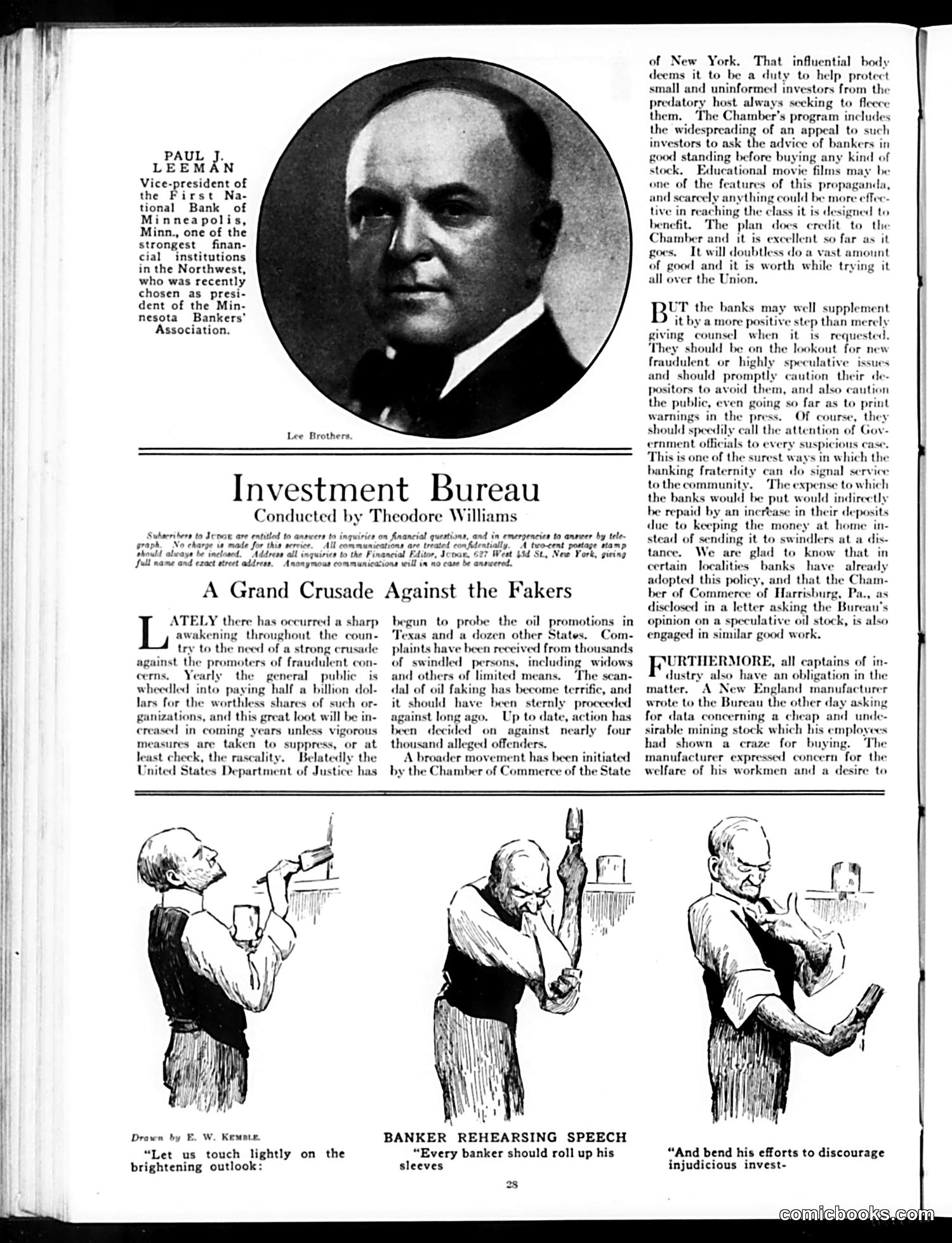
This page addresses early-20th-century financial fraud. The article "A Grand Crusade Against the Fakers" describes widespread investment scams—particularly oil stock promotions in Texas—defrauding thousands, especially widows and people of modest means. The Chamber of Commerce of New York launched an educational campaign encouraging investors to consult bankers before buying stocks. The page features Paul J. Leeman, vice-president of Minneapolis's First National Bank and newly elected president of the Minnesota Bankers' Association, as an example of banking leadership. The three cartoons at bottom (drawn by E.W. Kemble) show a banker rehearsing his speech about combating fraud, depicted in three stages: "touching lightly on the brightening outlook," "rolling up his sleeves," and bending efforts "to discourage injudicious invest[ment]." The satire suggests bankers must move beyond mere rhetoric to active fraud prevention.
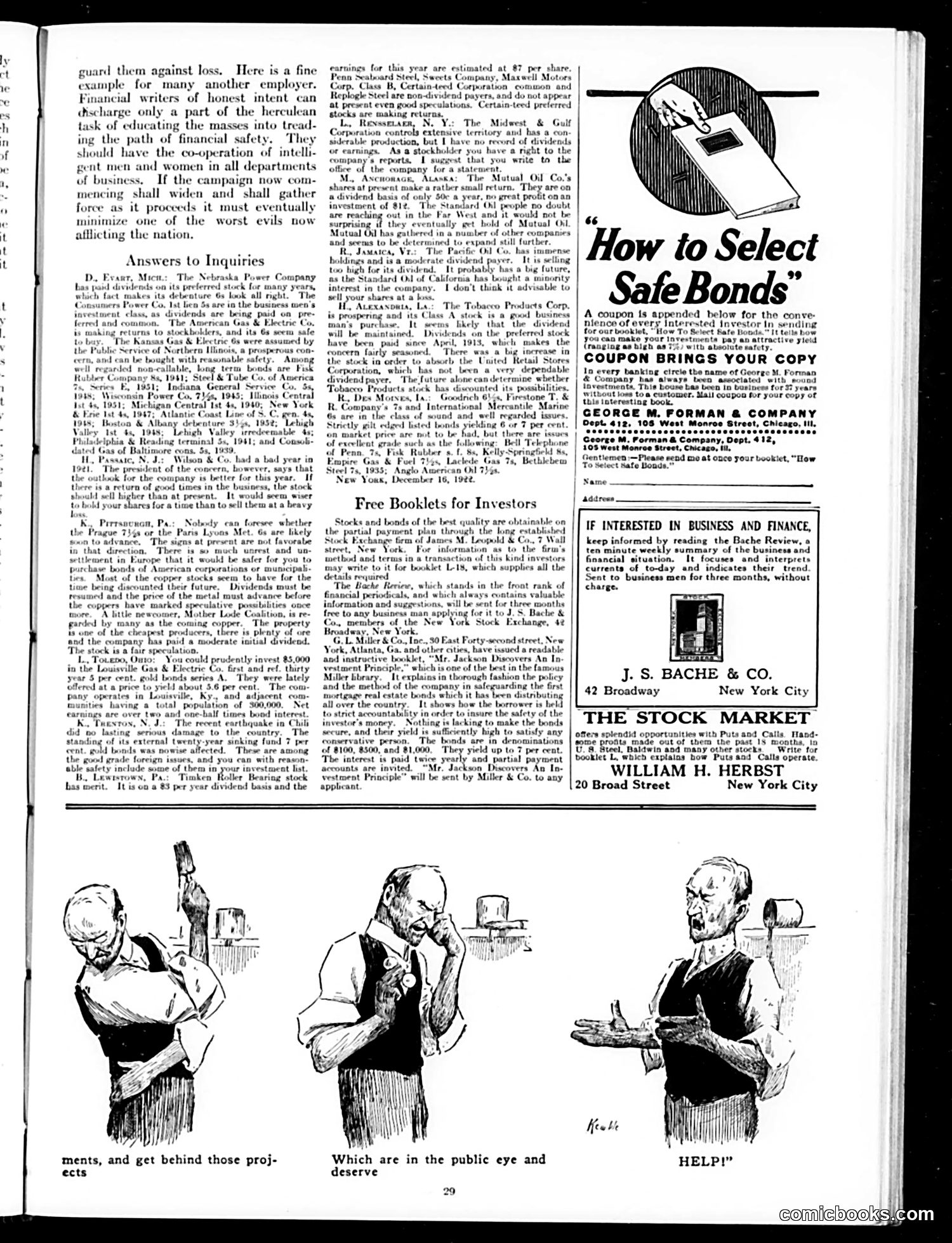
This page comprises mostly financial advice columns and advertisements, with minimal editorial cartooning. The three cartoons at the bottom appear to be generic workplace humor—depicting men in various states of distress or complaint ("HELP!" caption visible)—rather than specific political satire. Without clear labels or identifying details, their specific subjects remain unclear. The dominant content is "Answers to Inquiries," a financial advice column addressing reader questions about bonds, stocks, and investment safety. The date appears to be December 1944 (visible in one advertisement), placing this during World War II. The column promotes conservative investment strategies—recommending established utility companies and railroad bonds while cautioning against speculation. The overall tone reflects Judge's role during this period: mixing light humor with earnest financial education for middle-class readers concerned about protecting their wartime savings and postwar economic security.
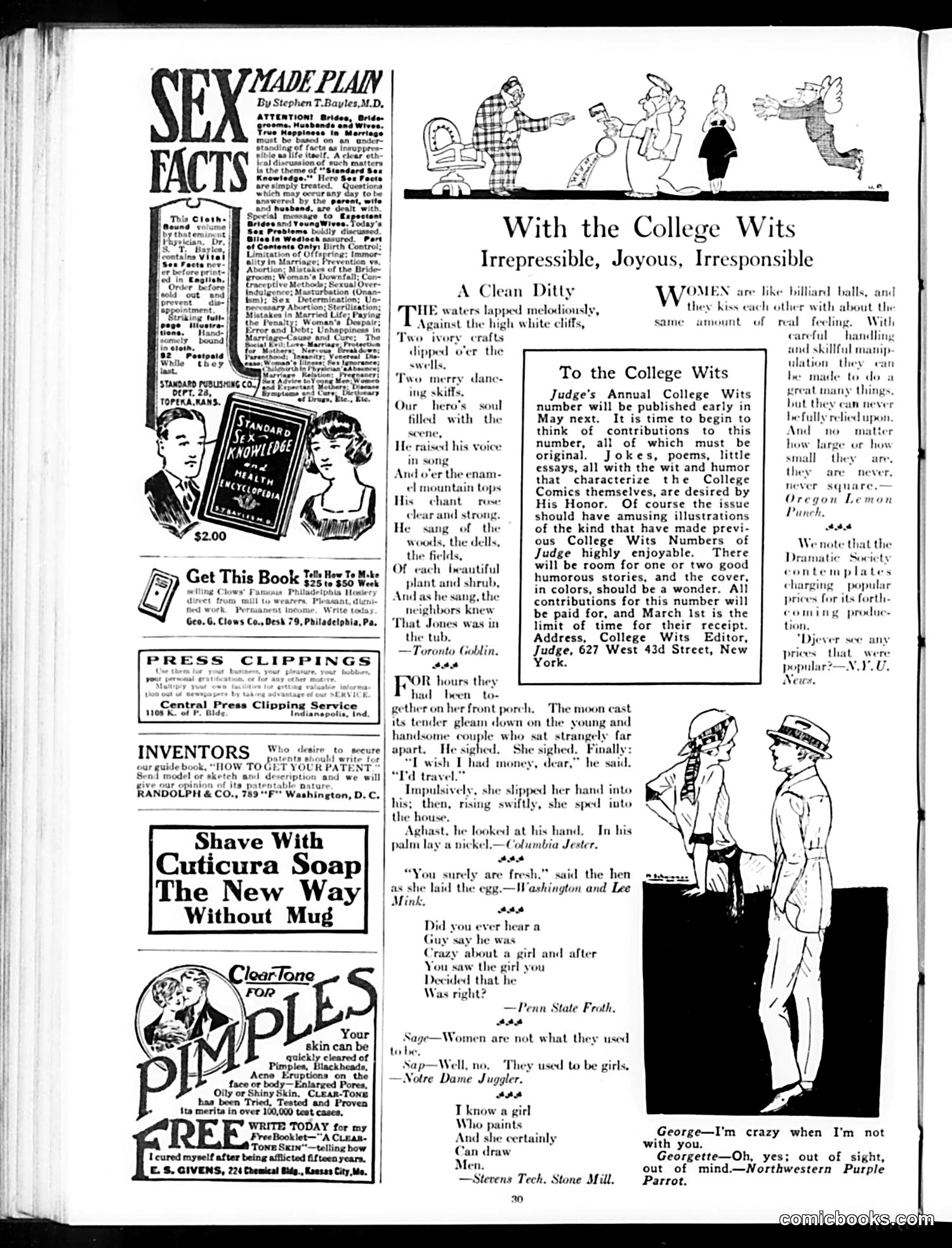
This page from Judge magazine (circa 1920s) features college humor content and advertisements typical of that era. The main satirical element is "With the College Wits," a section soliciting humorous submissions from college publications. The humor relies on early-20th-century tropes: a romantic couple where the man wishes for money to travel, and the woman impulsively gives him a nickel from her pocket—a joke about women's limited finances and agency. Another quip compares women to "billiard balls," suggesting they're manipulable objects. The advertisements (Cuticura Soap, patent services, "Standard Knowledge" encyclopedia) reflect period concerns: skin blemishes, inventors seeking patents, and self-improvement through books. The various college publication jokes use wordplay and mild romantic/social scenarios considered risqué for conservative audiences. Most humor is gentle rather than sharp satire—reflecting Judge's role as mainstream family entertainment rather than hard political commentary.
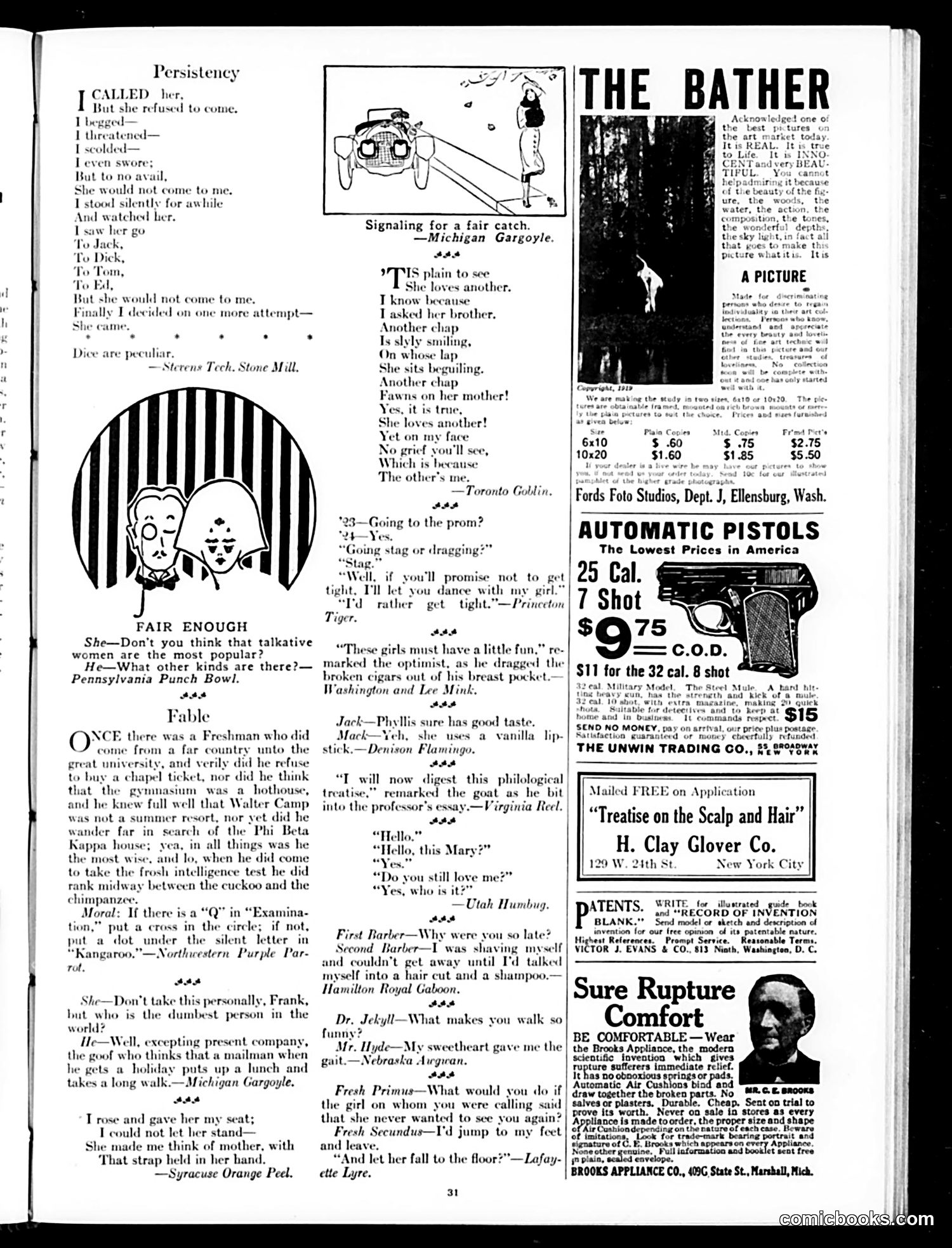
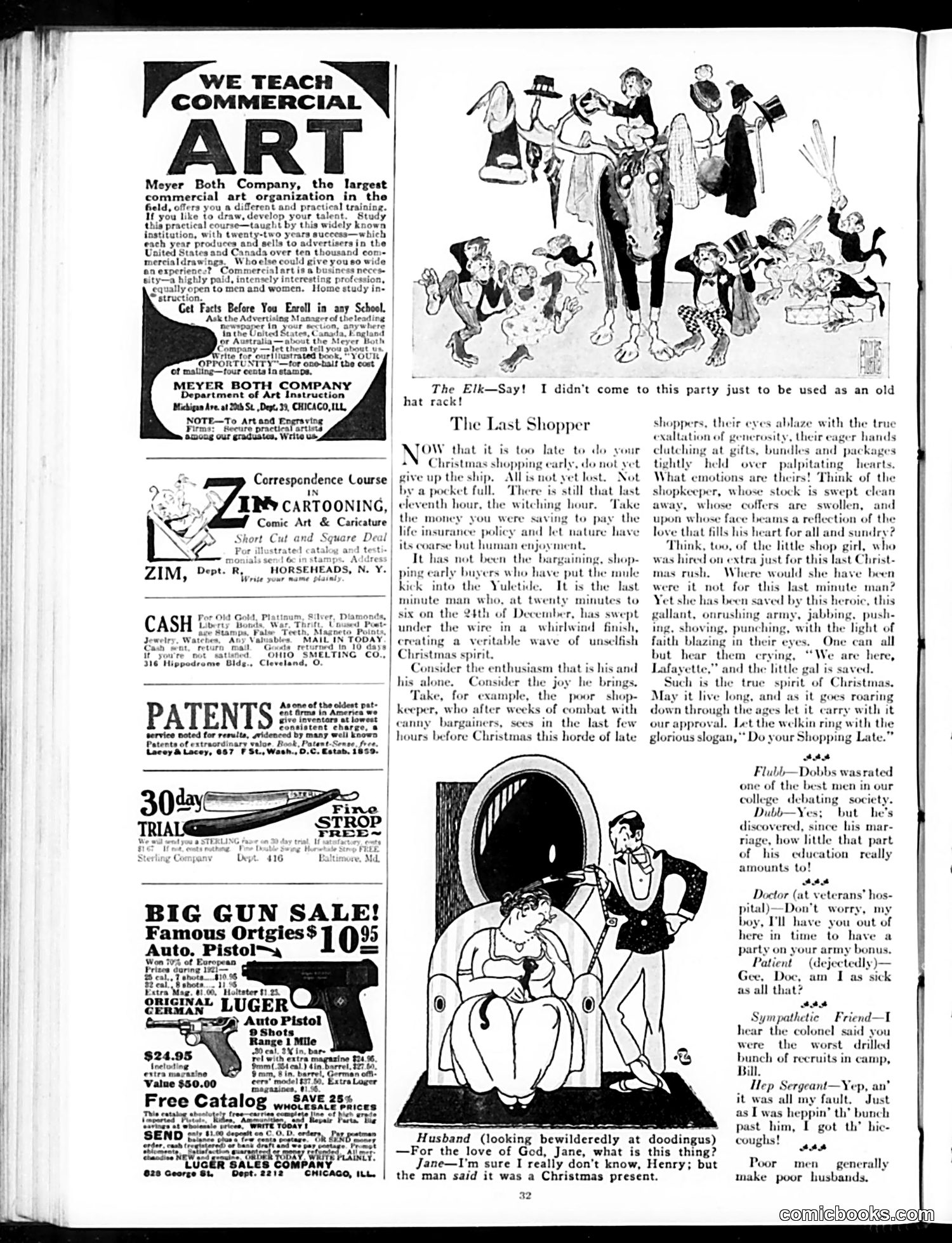
This page is primarily **advertising and humor** rather than political satire. The main content includes: **"The Last Shopper"** is a humorous essay praising last-minute Christmas shoppers (those buying on December 24th). It ironically celebrates them as heroic figures—comparing their frantic shopping to military valor—who rescue exhausted shop girls and fill merchants' coffers with holiday spirit. The satire mocks Americans' procrastination while portraying it as noble. **The bottom cartoon** shows a bewildered husband confronting a large, absurd object his wife received as a Christmas gift. His exasperated "For the love of God, Jane, what is this thing?" suggests satirizing both thoughtless gift-giving and marital confusion over impractical presents. **Small joke snippets** below mock education's practical limits in marriage and veterans' post-war financial prospects. The **left side** contains commercial advertisements for art instruction, cartooning courses, patents, and firearms—typical Judge magazine revenue sources. No specific political figures or events are referenced; the humor is domestic and consumer-focused.
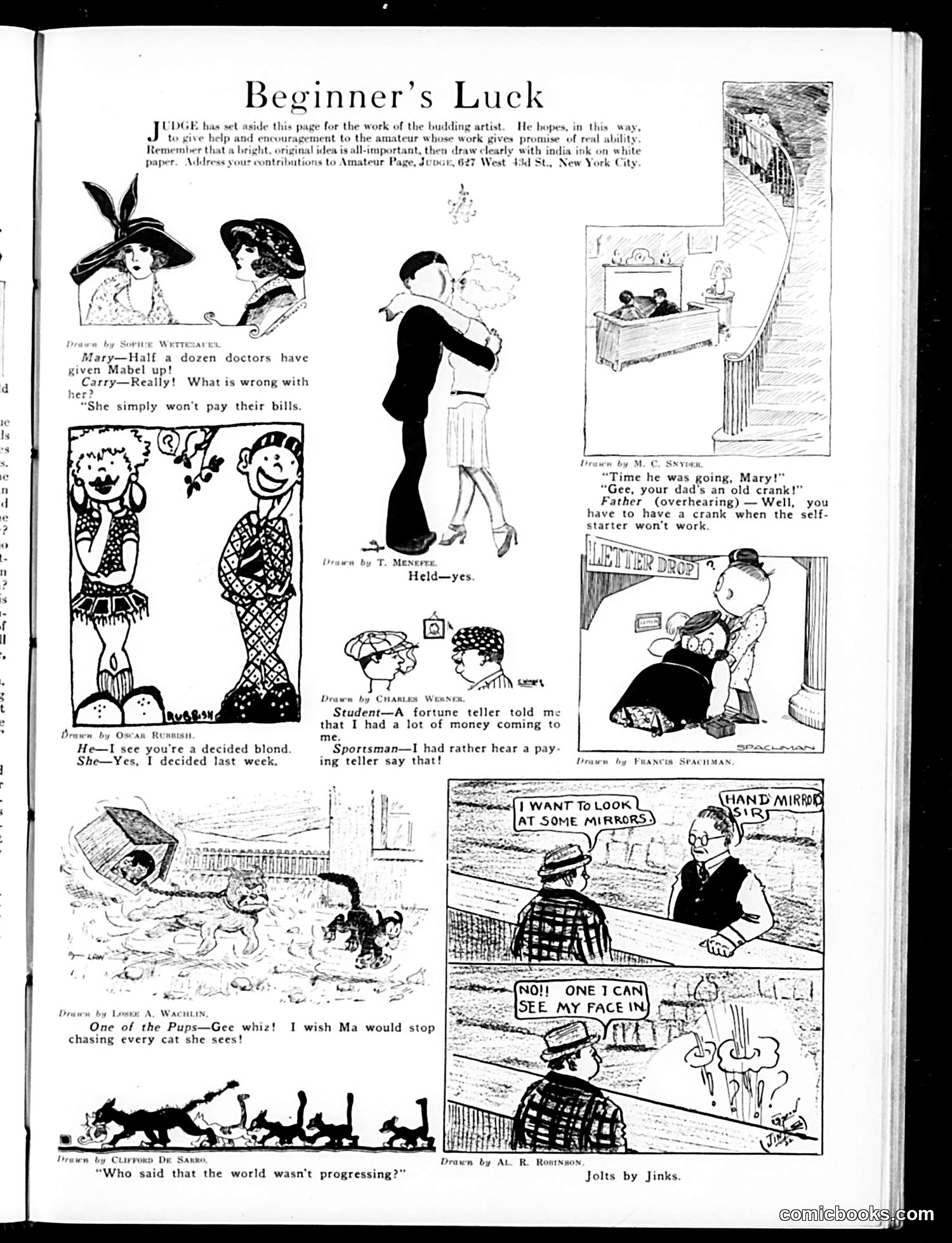
This Judge magazine page features a collection of short comics and jokes showcasing amateur cartoonists. The header explains Judge is accepting submissions from aspiring artists, encouraging "bright, original ideas." The individual cartoons present social satire typical of the era: - **Doctors/Bills**: A woman won't recover because she refuses to pay medical bills—satirizing both patient stubbornness and healthcare costs. - **Hair/Blond**: A woman admits to artificially bleaching her hair, mocking the era's beauty standards and cosmetic fakery. - **Fortune Teller**: A student prefers hearing money predictions from a "paying teller" (banker) over a fortune teller—satirizing get-rich-quick schemes. - **Car Starter**: A father explains needing manual "crank" starting when the car's self-starter fails—referencing early automotive technology. - **Dogs/Cats**: Visual humor about a dog's natural hunting instincts. - **Mirror/Face**: A character avoids mirrors, suggesting self-consciousness or ugliness. The final cartoon mocks progress ironically, showing livestock chaos.
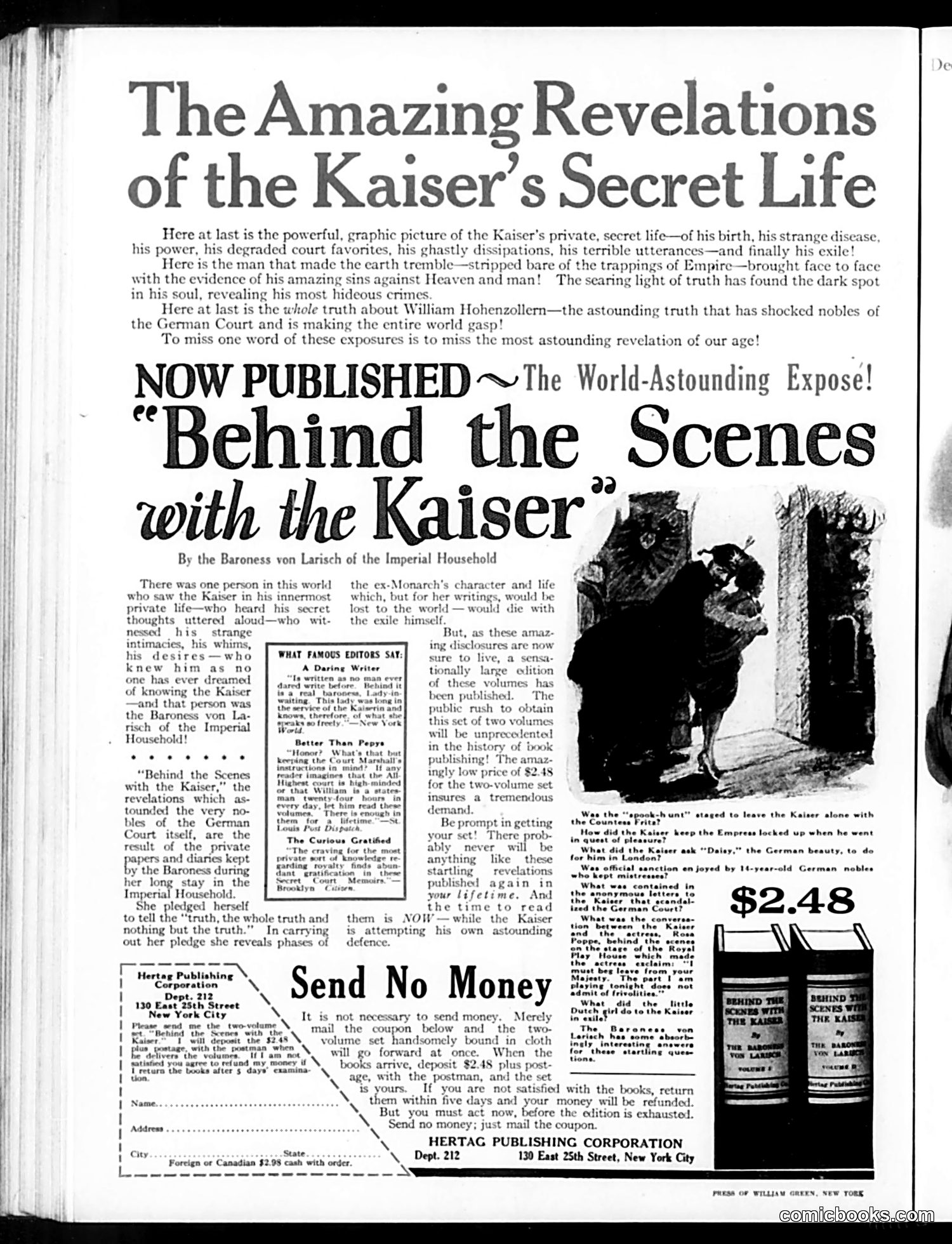
This is primarily a **book advertisement**, not a satirical cartoon. It promotes "Behind the Scenes with the Kaiser," a purported exposé memoir by Baroness von Larisch about Kaiser Wilhelm II's private life. The advertisement exploits post-WWI anti-German sentiment. The Kaiser (Wilhelm Hohenzollern) had abdicated and fled to exile in 1918, making him a freshly disgraced figure. The ad sensationalizes lurid claims about his "secret life," "strange disease," "degraded court," and unnamed scandals involving underage German nobles and a woman named "Daisy." The copy employs hyperbolic language ("world-astounding," "scaring light of truth") typical of early 20th-century pulp marketing. It positions the Baroness as an intimate insider credible enough to reveal royal secrets, comparing her to the famous diarist Samuel Pepys. The price ($2.48 for two volumes) and "send no money" pitch were common mail-order tactics of the era. This reflects Judge magazine's dual function: satirical commentary plus commercial advertising space.