
Judge, 1922-12-23 · page 21 of 36
Judge — December 23, 1922 — page 21: what you’re looking at
What you’re looking at
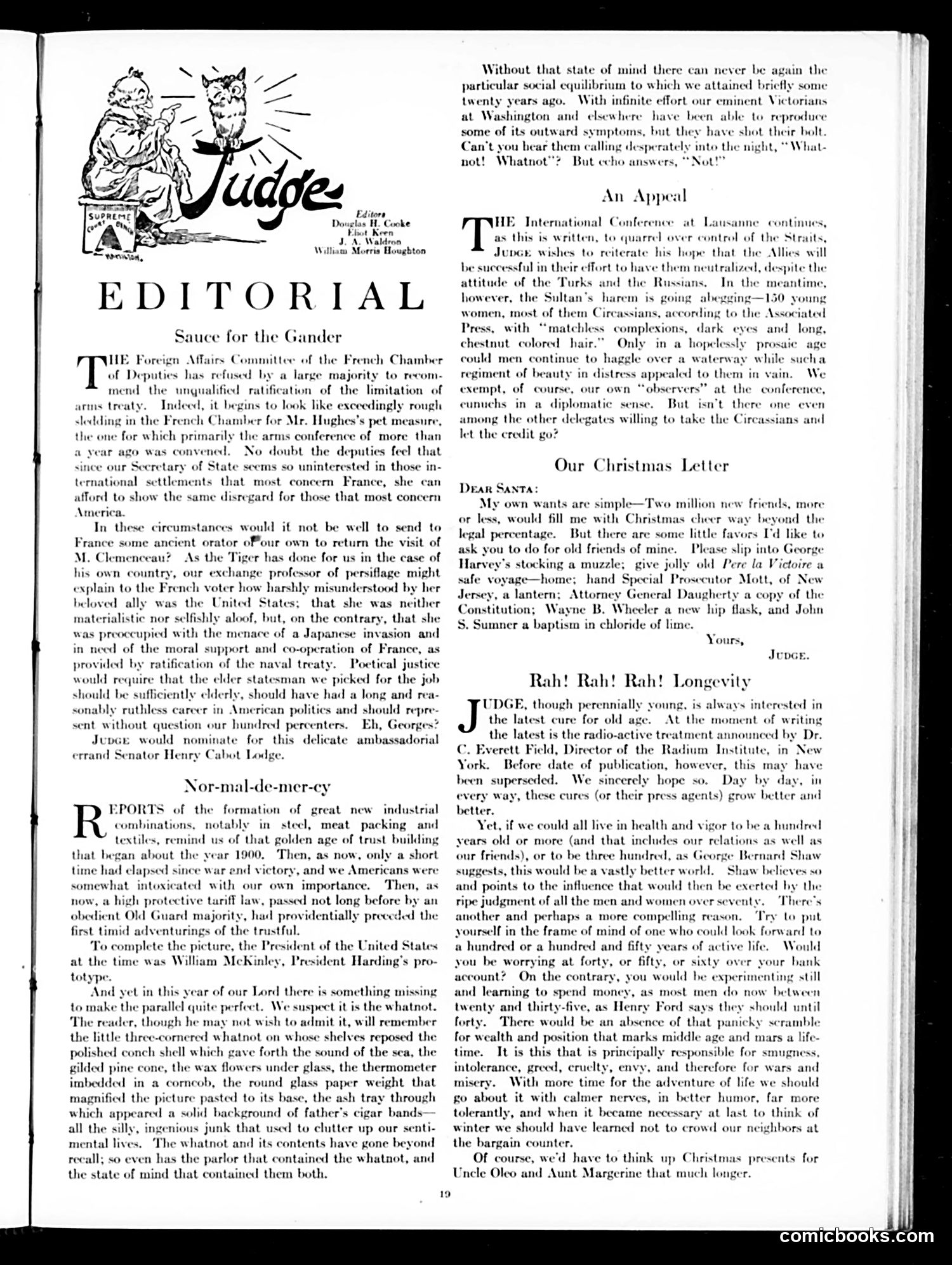
**The "Judge" Masthead Cartoon:** The illustration shows a figure (Judge personified) wielding a large pen as a sword or club, striking at an owl—a traditional symbol of wisdom. This visualizes the magazine's satirical mission: attacking establishment figures and pretense with sharp wit. **"Sauce for the Gander":** This editorial mocks the French Chamber of Deputies for rejecting Secretary of State Hughes's arms-limitation treaty while expecting American cooperation on matters France cares about. The satire suggests the U.S. should send an experienced diplomat (humorously nominating Senator Henry Cabot Lodge, a known isolationist) to lecture the French the way French orator Clemenceau advised America—turning the tables with equal disdain. **"Nor-mal-de-mer-cy":** Comparing the Harding era to McKinley's post-1900 boom (trust-building, protective tariffs, industrial combinations), the piece nostalgically laments the disappearance of the Victorian "whatnot"—those cluttered parlor shelves with decorative trinkets. It suggests America has lost the genteel worldview that once held society together, making today's attempts to recreate prosperity hollow.
📄 Transcribed text from this page (OCR, searchable)
Machine-transcribed from the original scan — historical spelling and the odd misread are preserved.
Editor Douglas Hl. Cooke Hot t Keen ‘aldron 4 Wittists Storr Houghton EDITORIAL Sauce for the Gander HE Foreign Affairs Committee of the of Deputies has refused by a large majority the unqualificd ratification of the limitation of arms treaty. Indeed, it begins to look like exceedingly rough sledding in the French Chamber for Mr. Hughes's pet measure, the one for which primarily the arms conference of more than a year ago was convened. No doubt the deputies feel that since our Secretary of State scems so uninterested in those in- ternational settlements that most concern France, she can afford to show the same disregard for those that most concern French Cha to ree mend America. In these circumstances would it not be France some ancient orator ofour own to return the vis M. Clemenceau? As the Tiger has done for us in the case of his own country, our exchange professor of persiflage might explain to the French voter how harshly misunderstood by her ed ally was the United States; that she was ni terialistic nor selfishly aloof, but, on the contrary, that she was preoccupied with the menace of a Japanese invasion and I support and co-operation of France, as provided by ratification of the naval treaty. Poetical justice would require that the elder statesman we picked for the job should be sufficiently elderly, should have had a long and rea- sonably ruthless career in American polities and should rep sent without question our hundred percenters. Eh, Georg Jvuvce would nominate for this delicate ambassadorial errand Senator Henry Cabot Lodge. well to se in need of the m Nor-mal-de-mer-cy EPORTS of the formation of great’ new industrial R combinations, notably in. stecl, meat packing and textiles, remind us of that golden age of trust building that beg: rout the year 1900, Then, as now, only a saat time had elapsed since war end victory, and we Americans we! somewhat intoxicated with our own importance. Then, as now, a high protective tariff law, passed not long before by an obedient Old Guard majority, had providentially preceded the first timid adventurings of the trustful. ‘To complete the picture, the President of the United States at the time was William McKinley, President Harding's pro- totype. And yet in this r of our Lord there is something missing to make the parallel quite perfect. We suspect it is the whatnot. The reader, though he may not wish to admit it, will remem! the little three-cornered whatnot on whose shelves reposed the polished conch shell which gave forth the sound of the sea, the gilded pine cone, the wax flowers under glass, the thermometer imbedded in a corncob, the round glass paper weight that magnified the picture pasted to its base, the ash tray through which appeared a solid background of father’s cigar bands all the silly, ingenious junk that used to clutter up our senti- mental lives. The whatnot and its contents have gone beyond recall; so even has the parlor that contained the whatnot, and the state of mind that contained them both, Without that state of mind there can never be again the particular social equilibrium to which we attained briefly some twenty years ago. With infinite effort our eminent Victorians at Washington and elsewhere have been able to reproduce some of its outward symptoms, but they have shot their bolt Can't you bear them calling desperately into the night, “* What- not! Whatnot"? But echo answers, “°N An Appeal HE International Conference at Lausanne continues, | as this is written, to quarrel over control of the Straits, Jupce wishes to reiterate his hope that the Allies will he successful in their effort to have them neutralized, despite the attitude of the Turks and the In the meantime, however, the Sultan’s harem is going abegging—150 young women, most of them Circassians, according to the Associated Press, with “matchless complexions, dark ss and long, chestnut oped hair.” Only in could men continue to hagg! iment of beauty in distress appealed to them in vain. We exempt, of “observers” at the eunuchs in a diplomatic But isn’t there one among the other delegates willing to take the Cires let the credit go? Russians. aterway while sucha course, our own conference, ans and Our Christmas Letter Dear Santa: My own wants are simy would fill me with Christmas cheer way | legal percentage. But there are some little fav like ask you to do for old friends of mine. Please slip into Harvey's stocking a muzzle: e jolly old Pere la Victoire a safe voyage—home; hand 1 Prosecutor Mott, of New Jersey, a lantern; Attorney General Daugherty a copy of the Constitution; Wayne B. Wheeler a new hip flask, and John S. Sumner a baptism in chloride of lime. Two million new friends, m or less, yond the Yours, Ju Rah! Rah! Rah! UDGE, though perennially young, is always interested in the latest cure for old age. At the moment of writing the latest is the radio-active treatment announced by Dr. . rett Field, Director of the Radium Institute, in N York. Before date of publication, however, this may h been superseded. We sincerely hope so. Day by day, in every way, these cures (or their press agents) grow better and better. Yet, if we could all live ii years old or more (and that includes our relations our friends), or to be three hundred, as George Berr suggests, this would be a vastly better world. and points to the influence that would then be ripe judgment of all the men and women over seventy. nother and perhaps a more compelling reason. ‘Try yourself in the frame of mind of one who could look forward to a hundred or a hundred and fifty years of active life. Would you be worrying at forty, or fifty, or sixty over your bank account? On the contrary, you would be experimenting still and learning to spe n do now b twenty and thirty as Henry Ford says they should until forty. There would be an absence of that panicky scramble for wealth and position that marks middle age and mars a life- time. It is this that is principally responsible for smugness, intolerance, greed, cruelty, envy, and therefore misery. With more time for the adventure of life we should go about it with calmer nerves, in better humor, far more tolerantly, and when it became necessary at last to think of winter we should have learned not to crowd our neighbors at the bargain counter. Of course, we'd have to think up C Uncle Oleo and Aunt Margerine that much longer. Longevity health and vigor to be a hundred Shaw believes so xerted hy the There's lo put for wars and ristmas presents for ‘ a) comicbooks.com