
Judge, 1922-12-23 · page 23 of 36
Judge — December 23, 1922 — page 23: what you’re looking at
What you’re looking at
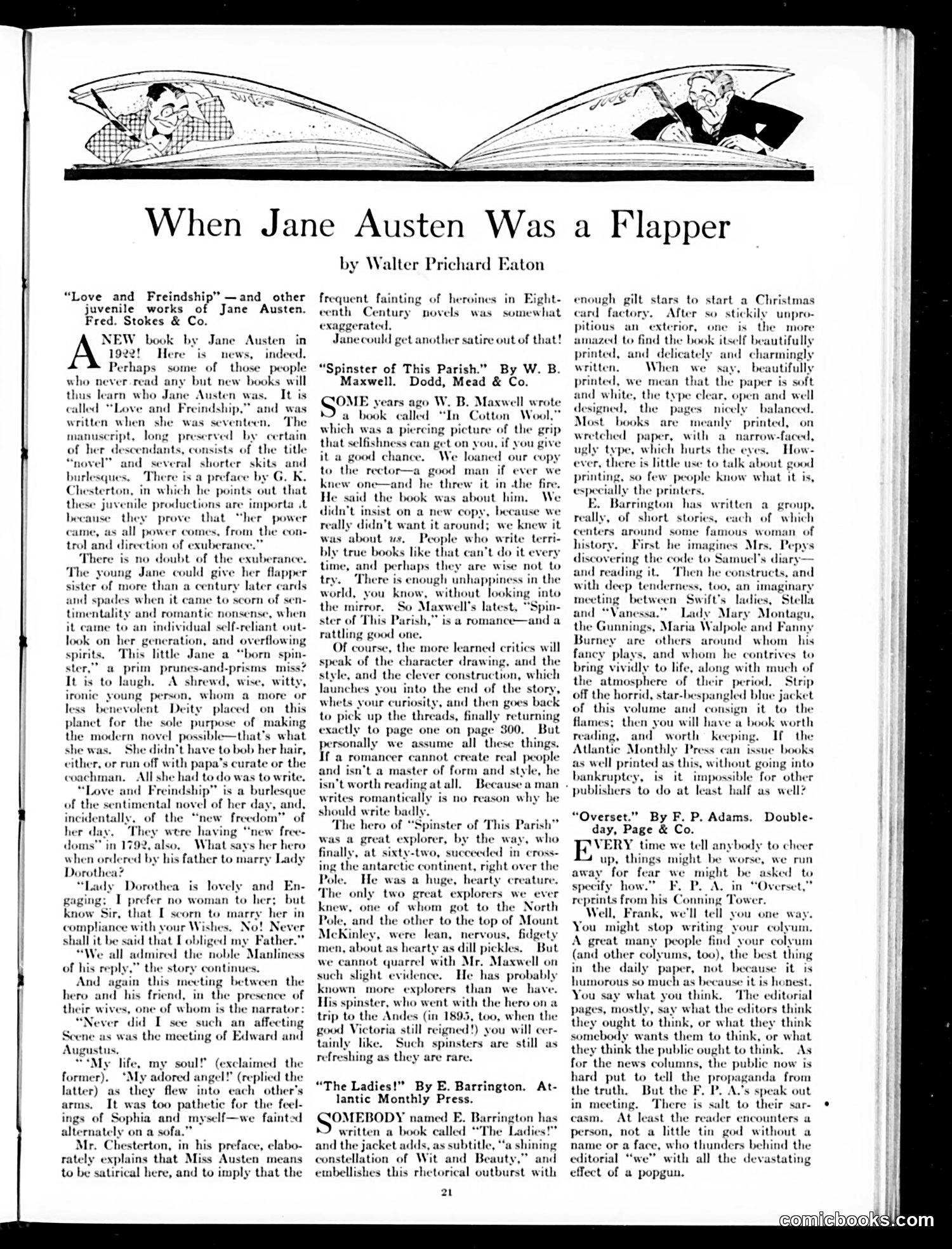
This article by Walter Prichard Eaton reviews newly published juvenile works by Jane Austen, drawing a witty parallel between her youthful writing and 1920s "flapper" culture. The cartoon at the top depicts an open book with two figures—likely representing young Jane Austen (left) and an elderly figure (possibly an editor or critic, right)—suggesting the bridge between past and present. The satire's point: Eaton argues that Austen's teenage writings, particularly "Love and Freindship," were already mocking the excessive sentimentality and romantic nonsense of 18th-century novels. Young Jane's sharp wit and irreverent spirit make her a proto-"flapper"—a modern, independent-minded woman rejecting conventional sentimentality. The piece celebrates how Austen's youthful satire proves she possessed the sensible, self-reliant outlook characteristic of 1920s modernity, suggesting that "new freedom" wasn't invented in the Jazz Age but existed in 1792.
📄 Transcribed text from this page (OCR, searchable)
Machine-transcribed from the original scan — historical spelling and the odd misread are preserved.
When Jane Austen Was “Love and Freindship” —and_ other juvenile works of Jane Austen. Fred. Stokes & Co. NEW book by Jane Austen in 1922! Here is news, indeed. Perhaps some of those people who never read any but new books will thus learn who Jane Austen was, It is called “Love and Freindship,” and was written when she was sevente The manuscript, long preserved by certain of her descendants, consists of the title “novel” and several shorter skits and burlesques. ‘There is a preface by G. K. Chesterton, in which he points out that these juvenile productions are importa st they prove that “her power s all power comes, from the con- trol and direction of exuberanc There is no doubt of the exuberance. The young Jane could give her flapper sister of more than a century later cards and spades when it came to scorn of sen- timentality and romantic nonsense, w it came to an individual self-reliant out- look on her generation, and overflowing spirits. This little Jane a “born spin- ster,” a prim) prunes-and-prisms mis It is to la A shrewd, wise, witty, ironic young person, whom a more or less I t Deity placed on this planet for the sole purpose of making the modern novel possible——that’s what she was. She didn’t have to bob her hair, either, or run off with papa’s curate or th coachman, All she had to do was to writ “Love and Freindship” is a burlesque of the sentimental novel of her day, and, incidentally, of the “new freedom” of her day. They were having “new free- doms” in 1792, also, What says her hero when ordered by his father to marry Lady Dorothea? “Lady Dorothea is lovely and En- gaging: I prefer no woman to her; but know Sir, that [I scorn to marry her in compliance with your Wis shall it be said that [ oblig “We all admired the noble Manlines ess of his reply,” the story continues. And again this mecting between the hero and his friend, in the presence of their wives, one of whom is the narrator: ver did I see such an affecting Scene as was the meeting of Edward « Augustus. “ "My because life, my soul!” (exclaimed the former), ‘My adored angel!’ (replied the latter) as they flew into cach other's arms. It was too pathetic for the feel- ings of Sophia and myself—we fainted alterna’ on a sofa.” n means to be satirical here, and to imply that the by Walter Prichard Eaton frequent fainting of heroines in Eight- centh Century novels was somewhat aggerated. Jane could get another satire out of that! “Spinster of This Parish.” By W. B. Maxwell. Dodd, Mead & Co. OME years ago W. B. Maxwell wrote LS book called “In ton Wool,” which was a piercing picture of the grip selfishness ean get on you, if you give it a good chance. We loaned our copy to the rector—a good n if ever we knew one—and he threw it in the fi He said the book was about him. We didn’t insist on a new copy, because we really didn’t want it around; we knew it was about us. People who write te rri- bly true books like that ¢ . time, and perhaps they are wise not to try. There is enough unhappiness in the world, you know, without looking into the mirror. So X y ster of This Parish, rattling good one, Of course, the more learned critics will speak of the character drawing, and the is a romance—and a sity, and then goes b to pick up the threads, finally returning exactly to page one on page 300. But personally we assume all these things. If a romancer cannot create real people and isn’t a master of form and style, he isn’t worth reading at all. writes romantically is no reason why he should write L . The hero of “Spinster of This Parish” was a great explorer, by the way, who at sixty- -two, succeeded in cross- nly two peat Spleen we € knew, one of whom got to the North Pole, and the other to the top of Mount Mckinley, were lean, nervous, fidgety men, about as hearty as dill pickles. But we cannot quarrel with Mr. Maxwell on such slight evidence. He has probably known more explorers than we have. His spinster, who went with the hero on a trip to the Andes (in 1895, too, when the good Victoria still reigned!) you will cer- tainly like. Such spinsters are still as refreshing as they are rare. “The Ladies!” By E. Barrington. At- lantic Monthly Press. OMEBODY named E. Barrington 1 \ written a book called “The Ladic and the jacket adds, as subtitle, “a shining nd Beauty,” and embellishes this rhetorical outburst with 21 Because aman - a Flapper enough gilt stars to start a Christmas card factory. After so. stickily unpro- pitious an exterior, one is the more amazed to find the book itself beautifully printed, and delicately and charmingly written, When we say, beautifully printed, we mean that the paper is soft and white, the type clear, open and we signed, the pages nicely balanced. Most books are meanly printed, on wretched paper, with a narrow-faced, . there is little use to talk 8 printing, so few people know what it is, especially the printers. Barrington has writte ly, of short stories, each of which centers around some famous woman of history. First he imagines Mrs, Pepys discovering the code to Samuel's diary— and reading it. Then I with deep tenderness, t meet between and “Vanessa. the Gunnings, Maria Walpole a nd F nny y are others around whom his fancy plays, and whom he contrives to bring vividly to life, along with much of the atmosphere of their period, Strip off the horrid, star-bespangled blue ket of this volume and consign it to the flames; then you will have a book worth reading, and worth keeping. If the Atlantic Monthly Press can issue books as well printed as this, without going into bankruptcy, is it impossible for other publishers to do at least half as well? a group, Lady “Overset.” By F. P. Adams. day, Page & Co. VERY time we tell anybody to cheer up, things might be worse, we run away for fear we might be asked to specify how F. P. A. in “Overset,” reprints from his Conning Tower. Well, Frank, we'll tell you one way. You might stop writing your colyum. A great many people find’ your colyum (and other colyums, too), the best thing in the daily paper, not because it is humorous so much as because it is honest. You say what you think. The editorial pages, mostly, say what the editors think they ought to think, or what they think somebody wants them to think, or what they think the public ought to think. As for the news columns, the public now is hard put to tell the propaganda from the truth. But the F, P. A.’s speak out in meeting. There is salt to their sar- m. At least the reader encounters a person, not a little tin god without a name or a fa who thunders behind the editorial “we with all the devastating effect of a popgun. Double-