
A complete issue · 36 pages · 1922
Judge — December 16, 1922
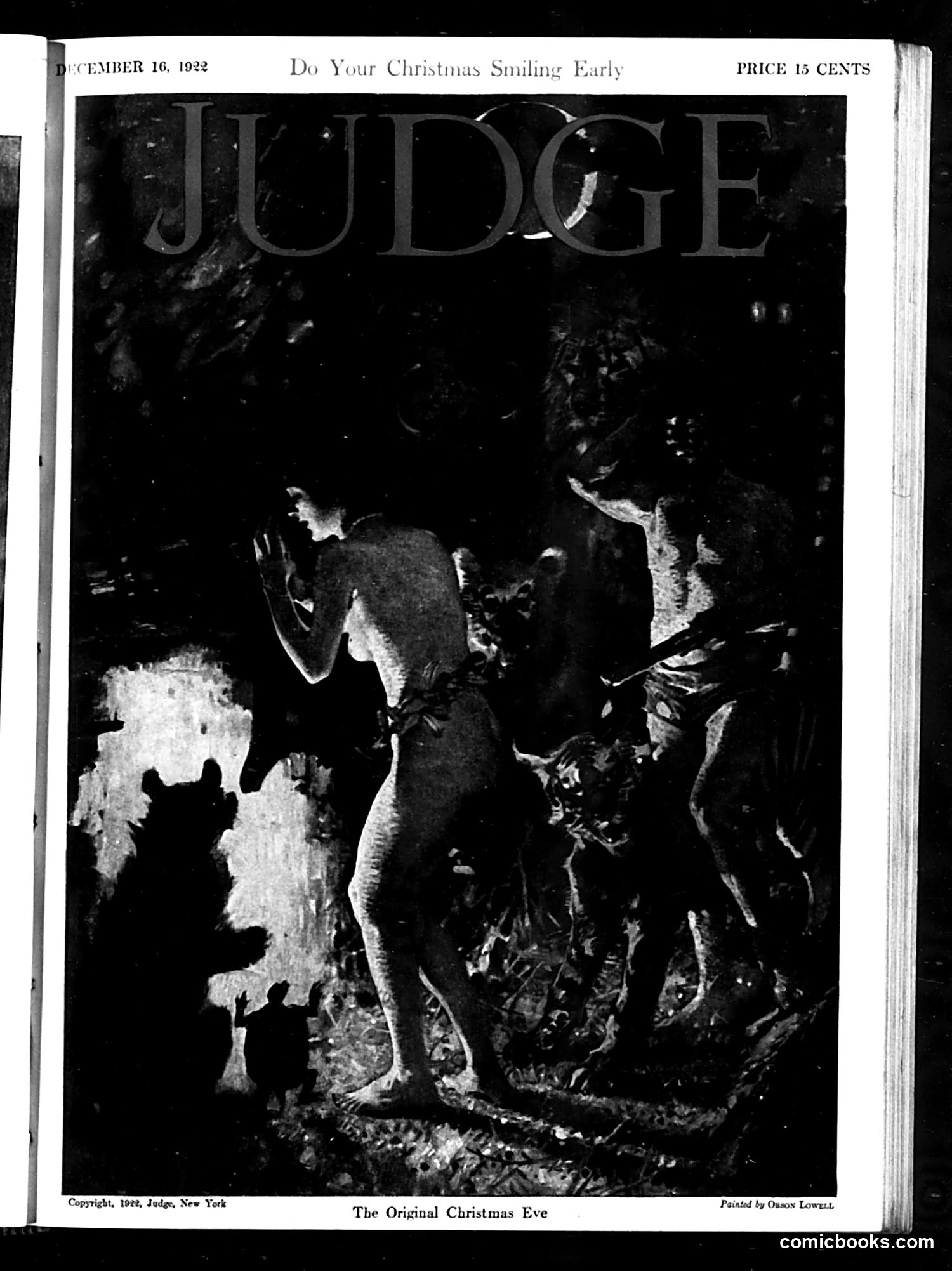
This Judge magazine cover from December 16, 1922, titled "The Original Christmas Eve" and credited to artist Ossos Lowell, appears to depict a nativity or religious scene. The image shows figures in robes gathered around what seems to be a manger scene, rendered in dramatic black and white photography or illustration. The caption's reference to "The Original Christmas Eve" suggests this is a straightforward religious illustration rather than political satire—depicting the birth of Christ. Given the date and Judge's typical satirical nature, the piece may ironically present this sacred scene, though without additional context, the specific satirical point remains unclear. The image quality and dramatic lighting emphasize the spiritual subject matter.
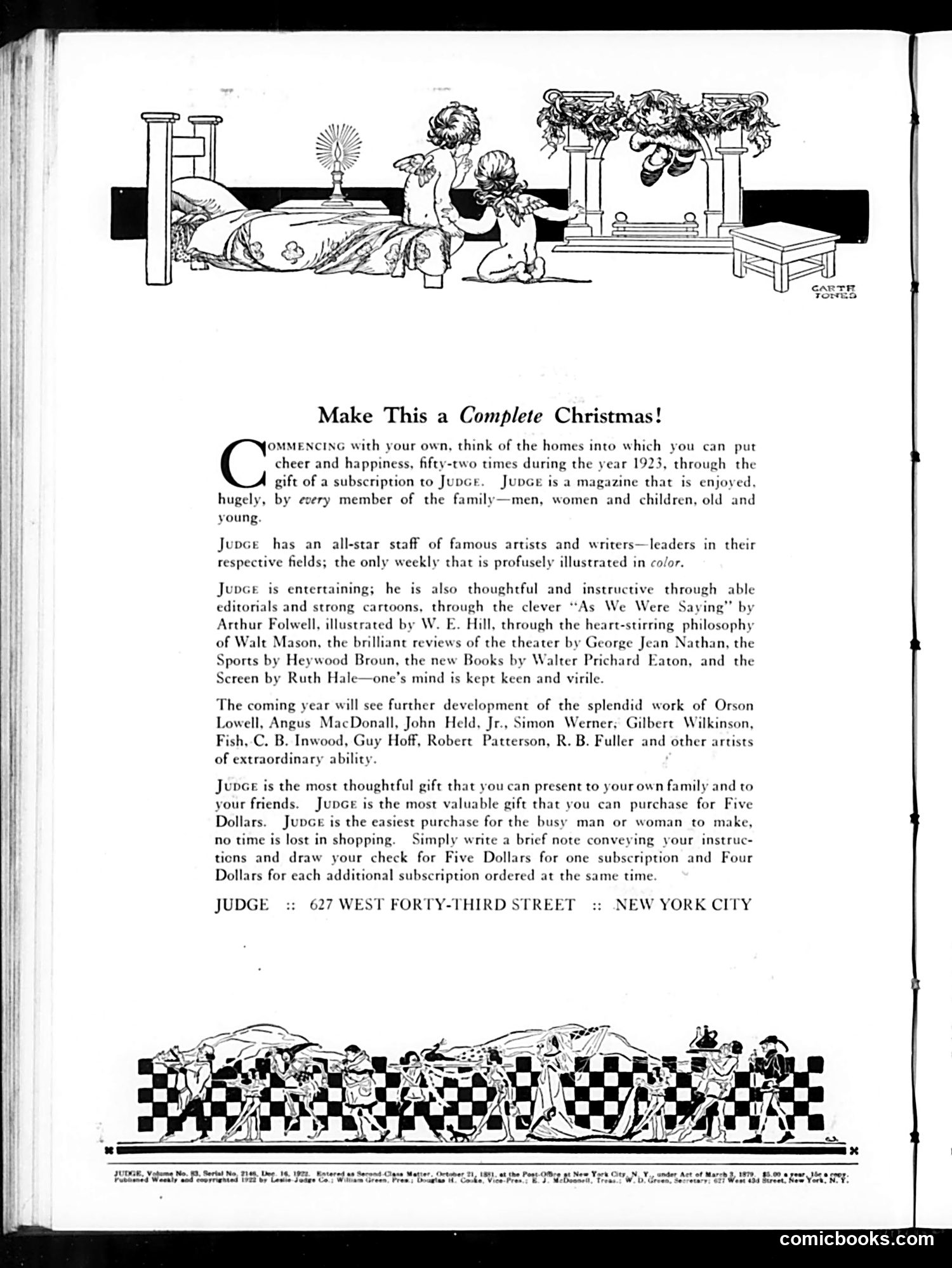
This page is primarily **advertising for Judge magazine itself**, not political satire. The top illustration shows children discovering Christmas gifts, while the text promotes a 1923 subscription campaign. The ad emphasizes Judge's appeal to "every member of the family" and lists notable contributors: cartoonists W.E. Hill and Ruth Hale, theater critic George Jean Nathan, and writers Arthur Folwell and Walt Mason. It also promises future work from artists like Orson Lowell and John Held Jr. The subscription costs five dollars for one year, four dollars for additional subscriptions ordered simultaneously. The address given is 627 West 43rd Street, New York City. The bottom illustration appears decorative, showing figures in a checkered pattern—likely part of the magazine's visual branding rather than commentary on current events.
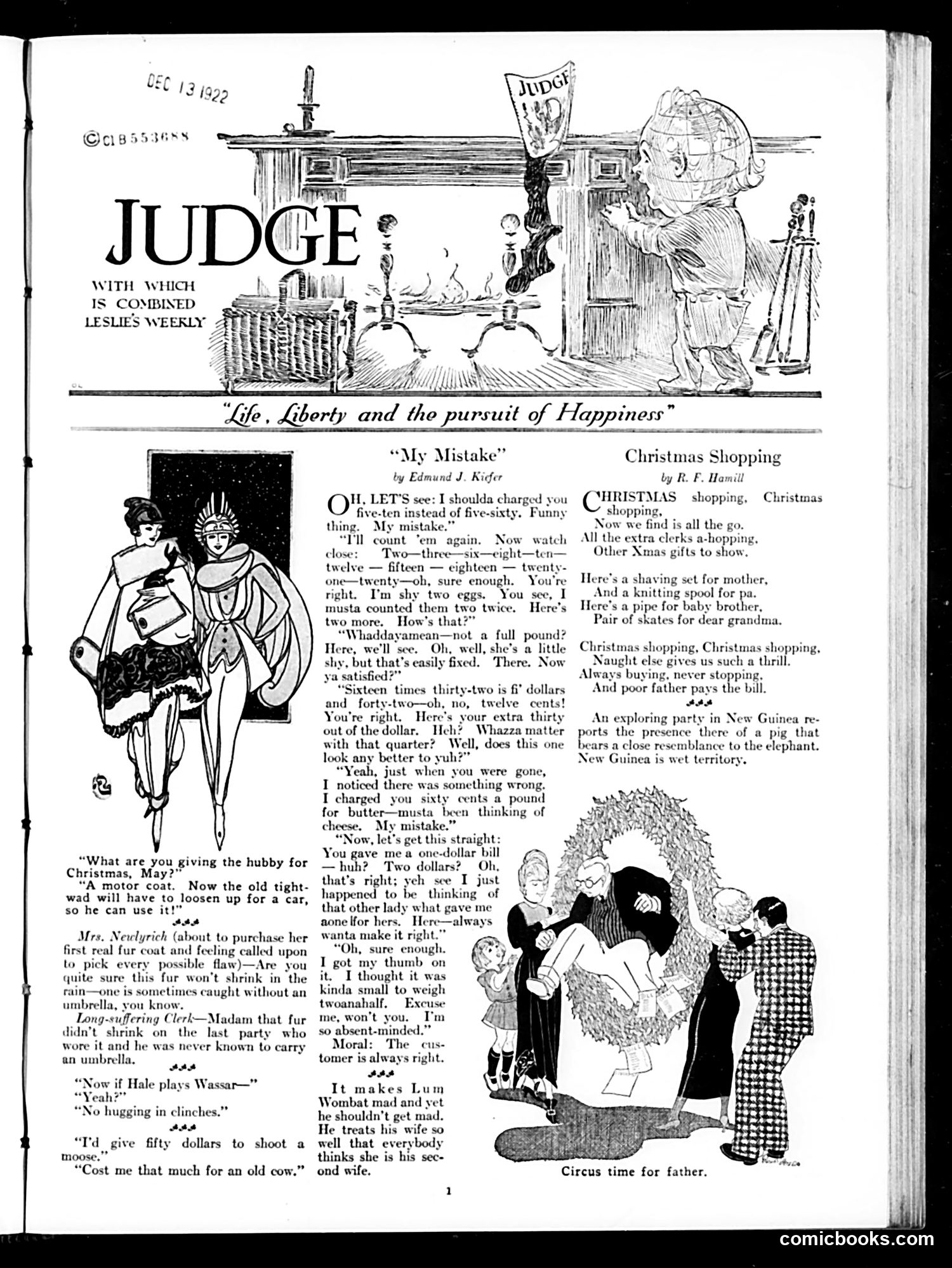
This December 13, 1922 page from Judge magazine contains humorous short pieces and illustrations rather than political cartoons. The content includes: **"My Mistake"** by Edmund J. Kiefer: A comedy piece about miscounting eggs—the narrator counted fifty-eight instead of sixty, creating an embarrassing arithmetic error when served. **"Christmas Shopping"** by R.F. Hamil: Satirizes the exhausting commercial frenzy of holiday shopping, with clerks overwhelmed and prices inflated ("all poor father pays the bill"). The illustrations show domestic scenes: a husband-and-wife couple in classical dress (top left), and a family gathering around a Christmas wreath (bottom right). This page represents Judge's lighter satirical humor—social observation of everyday middle-class life rather than political commentary. The satire targets consumer culture and family dynamics rather than politicians or current events.
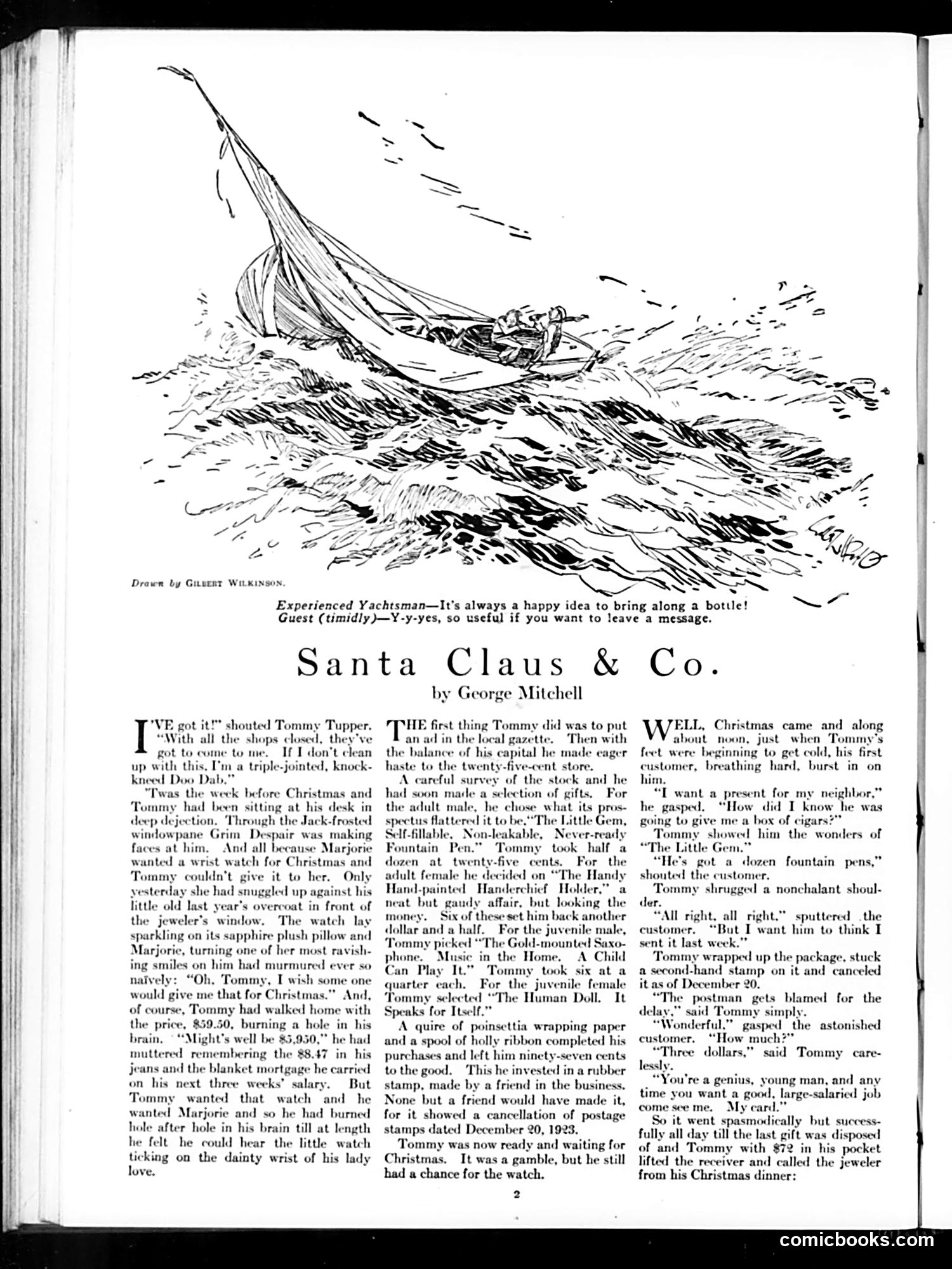
This page is primarily **not political satire** but rather a **short story with illustration**. The drawing by Gilbert Wilkinson depicts a small sailboat on rough seas—illustrating the narrative "Santa Claus & Co." by George Mitchell below. The story concerns Tommy, a poor boy shopping for Christmas gifts with limited money ($8.30). The tale humorously describes his gift selections for family members, including a "Little Gem" fountain pen and other modest items, culminating in his purchase of a watch he cannot afford. The only satirical element is the caption's mild joke about an "Experienced Yachtsman" and "Guest," using maritime humor. This is essentially **humorous fiction**, not political commentary—typical filler entertainment for Judge magazine's holiday issue.
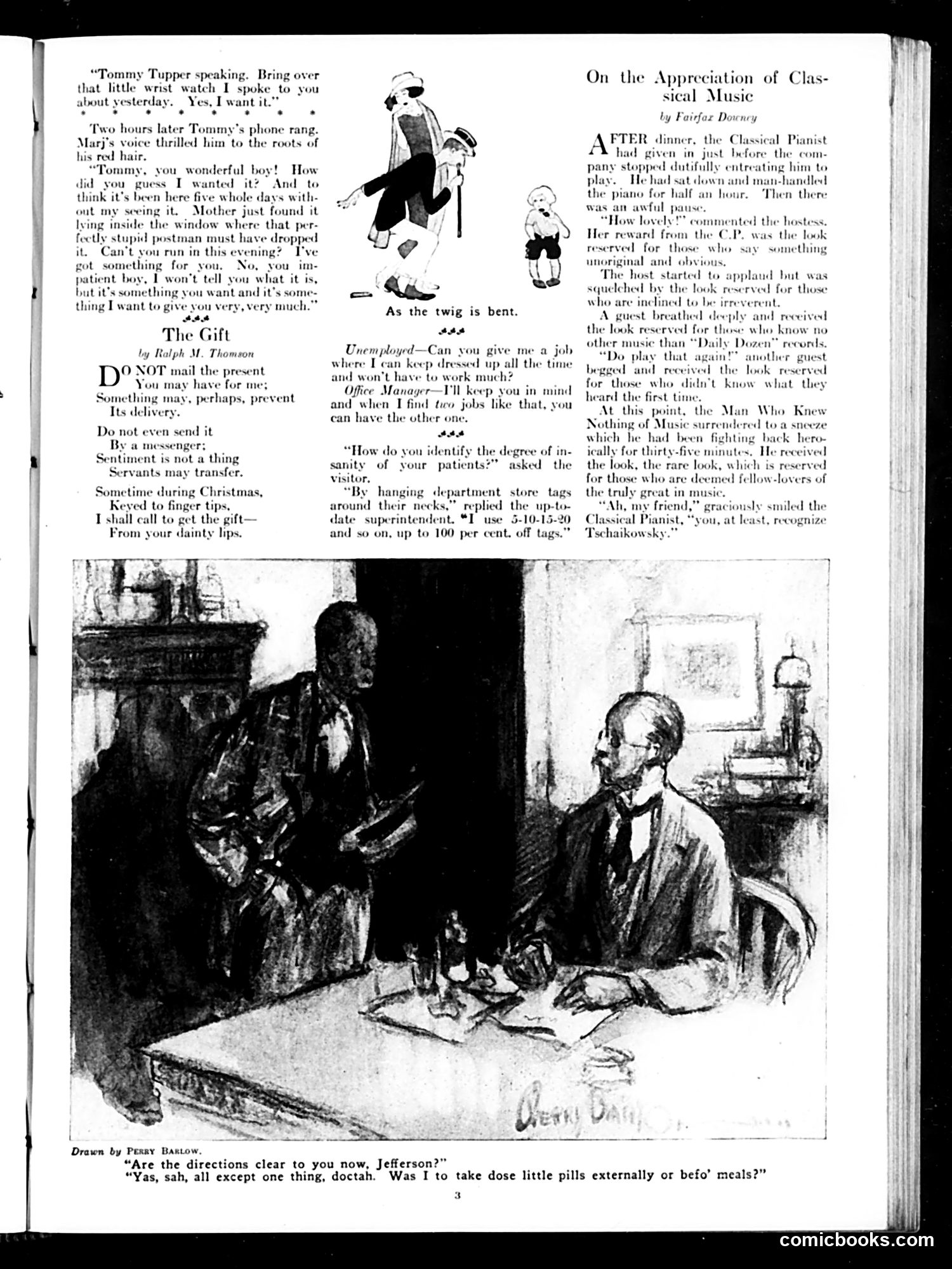
This page contains three distinct pieces: 1. **"The Gift"** (poem by Ralph H. Thomson): A satirical poem advising against giving practical gifts, preferring sentimental ones instead. 2. **"Tommy Tupper" dialogue**: A humorous exchange about a lost wrist watch, establishing a comedic domestic scenario. 3. **Bottom cartoon** (drawn by Perry Barlow): Shows a doctor and patient discussing medication instructions. The joke hinges on the patient's confusion about whether pills should be taken "externally or befo' meals"—a play on mispronunciation of "before." This satirizes both medical jargon's complexity and patients' difficulty understanding dosage instructions. The page primarily offers light humor rather than political satire, reflecting Judge's mix of domestic comedy and gentle social observation typical of early 20th-century American humor magazines.
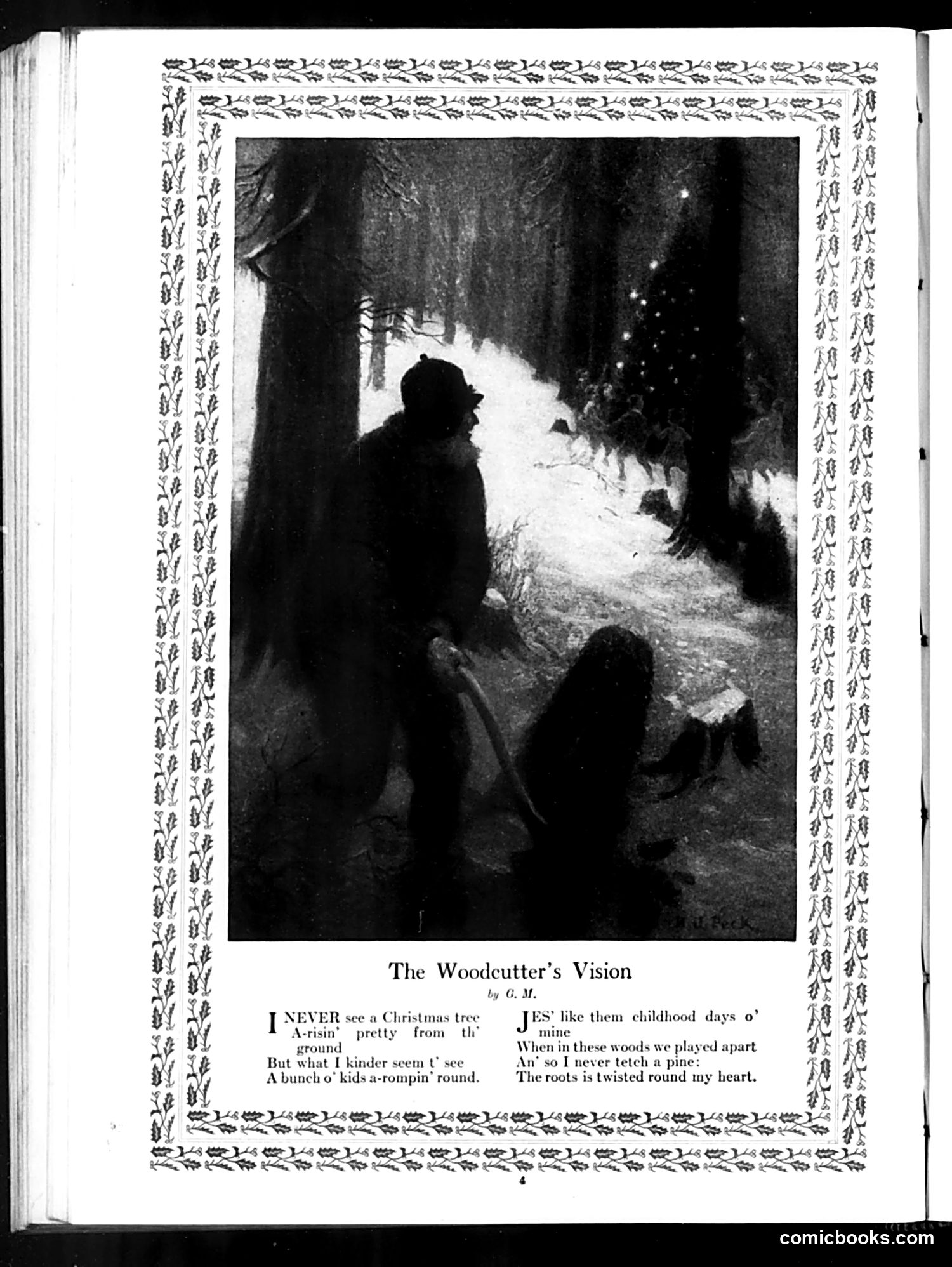
This appears to be a sentimental poem rather than political satire, illustrated with a moody winter forest scene. A solitary woodcutter gazes at snow-laden evergreen trees, apparently experiencing a nostalgic vision. The poem contrasts two perspectives: the woodcutter notes that Christmas trees never look as pretty growing naturally as when decorated, yet he remembers childhood days playing in these same woods without harming the trees—"the roots is twisted round my heart." The piece seems to advocate environmental sentiment or restraint in harvesting trees, using the woodcutter's emotional connection to nature as its moral argument. This reflects early 20th-century romantic attitudes toward wilderness and childhood innocence rather than contemporary political commentary.
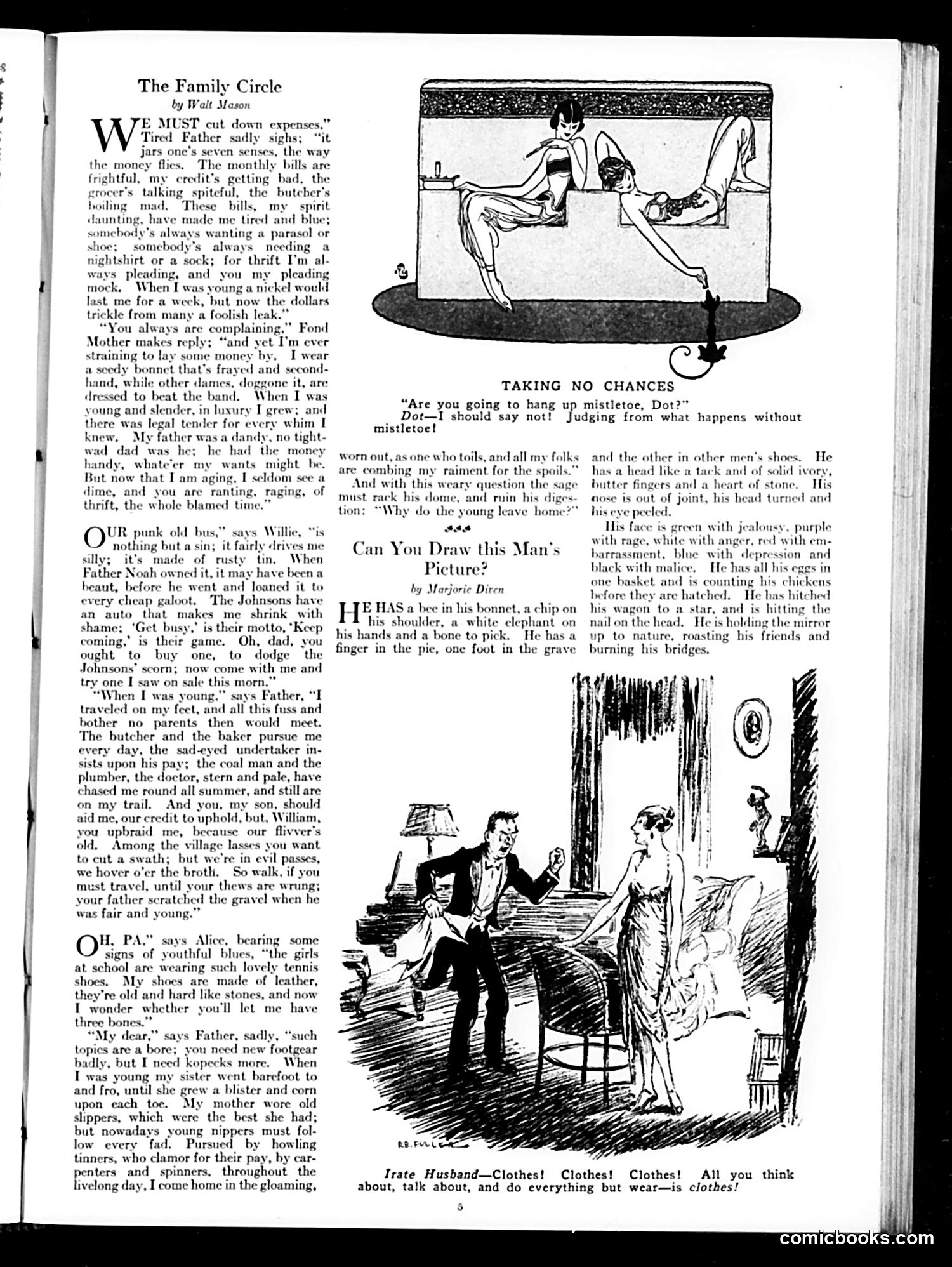
This page from *Judge* contains two separate satirical pieces about early 20th-century American family life: **"The Family Circle"** (left) is a humorous poem by Walt Mason depicting a common domestic conflict: an exasperated father demanding the family cut expenses while various family members (mother, Willie, Alice) justify their spending needs—new clothes, shoes, a car. The satire mocks both the father's futile complaints and the family's endless material desires, capturing post-WWI middle-class financial anxiety. **"Taking No Chances"** (top right) is a brief joke about a couple avoiding mistletoe during Christmas, with the woman joking that based on how the man behaves, she won't risk kissing him. It's lighthearted domestic humor. **"Can You Draw This Man's Picture?"** (bottom right) is a visual riddle where readers must identify a man described through contradictory metaphors—he has characteristics of various emotions and animals simultaneously. It's a parlor-game style puzzle typical of period magazines. The overall page reflects anxieties about consumerism, marriage dynamics, and modern life in the 1920s-1930s.
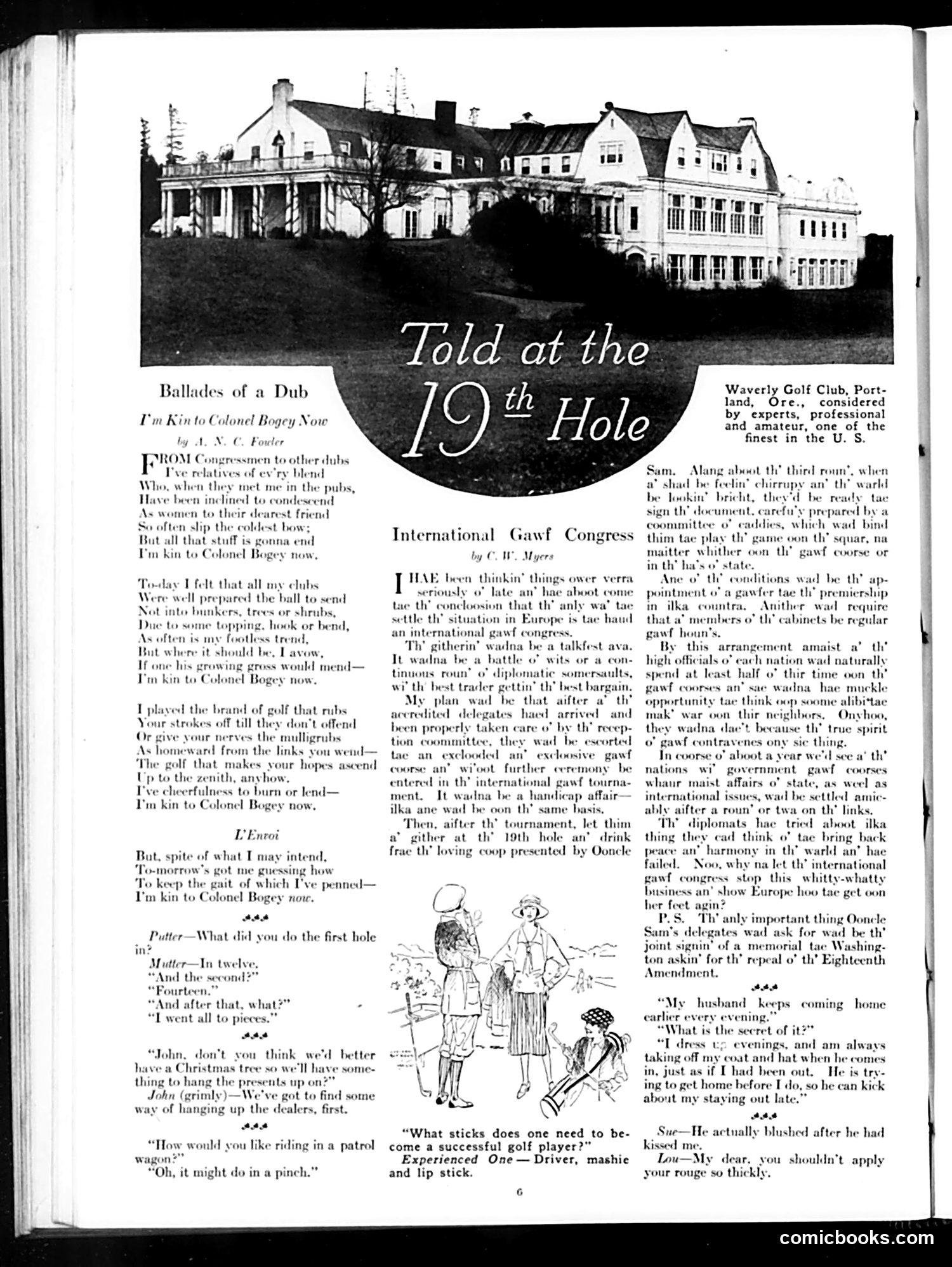
This page contains golf-themed humor typical of Judge magazine's satirical approach. The content includes: **Main Features:** 1. **"Ballades of a Dub"** — A humorous poem by AL N.C. Fouter about a mediocre golfer who suddenly plays well and feels elevated socially ("I'm kin to Colonel Bogey now"). Colonel Bogey is a standard par reference in golf, suggesting the narrator has finally achieved respectable play. 2. **"International Gawf Congress"** — A Scottish-dialect piece proposing that international diplomacy be settled through golf tournaments at the 19th hole (the bar), treating serious political matters frivolously. 3. **Bar jokes** about golf and marriage, playing on the social aspect of golf clubs as gathering places. **The Satire:** The humor mocks both amateur golfers' pretensions and, in the Congress piece, the era's political conflicts (likely post-WWI Europe). Golf is treated as simultaneously trivial and absurdly capable of solving world problems — a gentle jab at both the sport's social importance and political leadership's ineffectiveness.
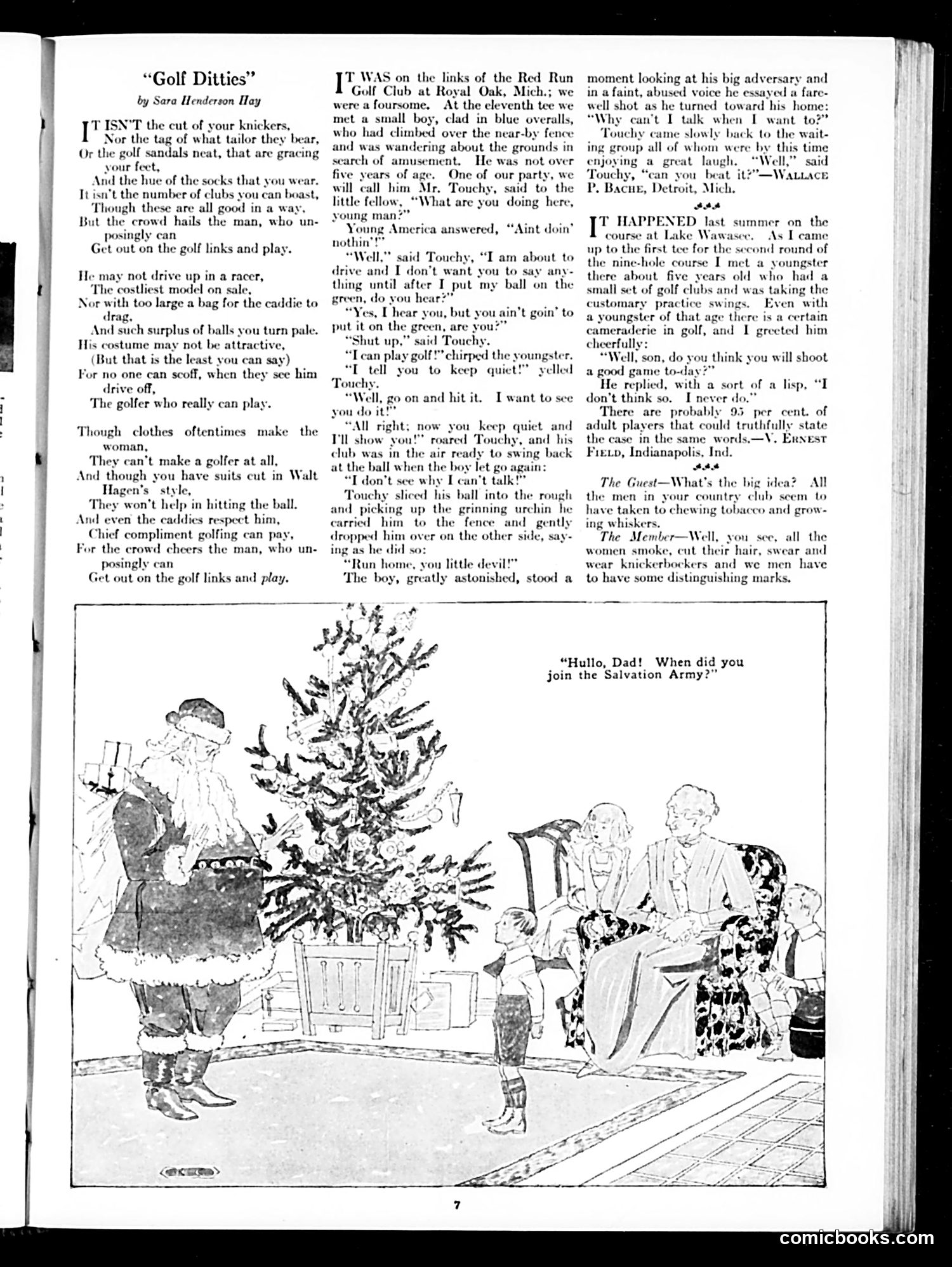
This page contains two pieces of golf humor from an early-20th-century American magazine. **The Poem** ("Golf Ditties" by Sara Henderson Hay) satirizes golf culture's pretensions. It argues that what matters isn't expensive equipment, fancy clothing, or a prestigious club—only actual skill on the links. The repeated refrain celebrates "the man, who unposingly can / Get out on the golf links and play," mocking wealthy golfers who use status symbols to compensate for poor play. **The Two Anecdotes** humorously depict young boys encountering pompous adult golfers: - A boy interrupts a man's swing repeatedly; when finally asked to be quiet, he asks why he can't talk when he wants to, then heckles the man's poor shot - Another boy admits he won't shoot well that day—the author notes 95% of adult golfers share this pessimism **The Cartoon** shows a Salvation Army soldier arriving home, greeting his family with the caption "Hello, Dad! When did you join the Salvation Army?"—likely suggesting he's dressed in cheap, shabby clothes. The overall message critiques golf's class pretensions and human vanity.
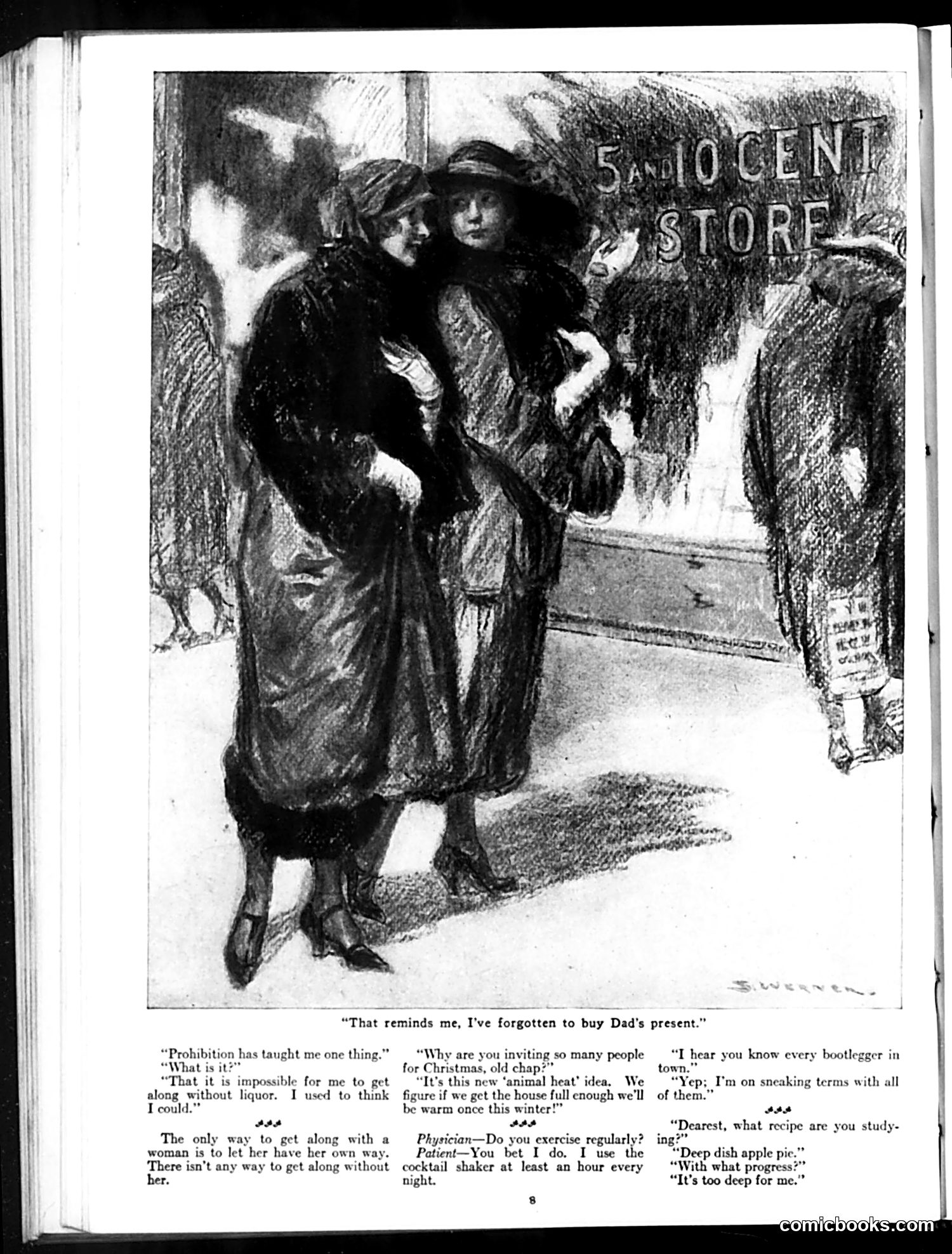
This page collects several jokes satirizing **Prohibition-era American life** (likely 1920s). The main cartoon depicts two women outside a "5 and 10 cent store," with one realizing she forgot to buy her father a gift—a setup for alcohol-related humor. The surrounding text jokes mock: 1. **Prohibition's failure**: A man admits liquor is now essential to him, despite previously thinking otherwise—satire on how the alcohol ban backfired psychologically. 2. **Bootlegging culture**: References to knowing "every bootlegger in town" and being "on sneaking terms" mock the widespread illegal alcohol networks that replaced legal sales. 3. **Substitutes for banned liquor**: A "cocktail shaker" joke implies people use non-alcoholic methods to appear sophisticated or busy. 4. **Marital dynamics and heating fuel**: Unrelated period humor about women's independence and using party guests as "animal heat" during winter. The satire targets Prohibition as unenforceable and socially counterproductive—a common Judge editorial stance of the era.
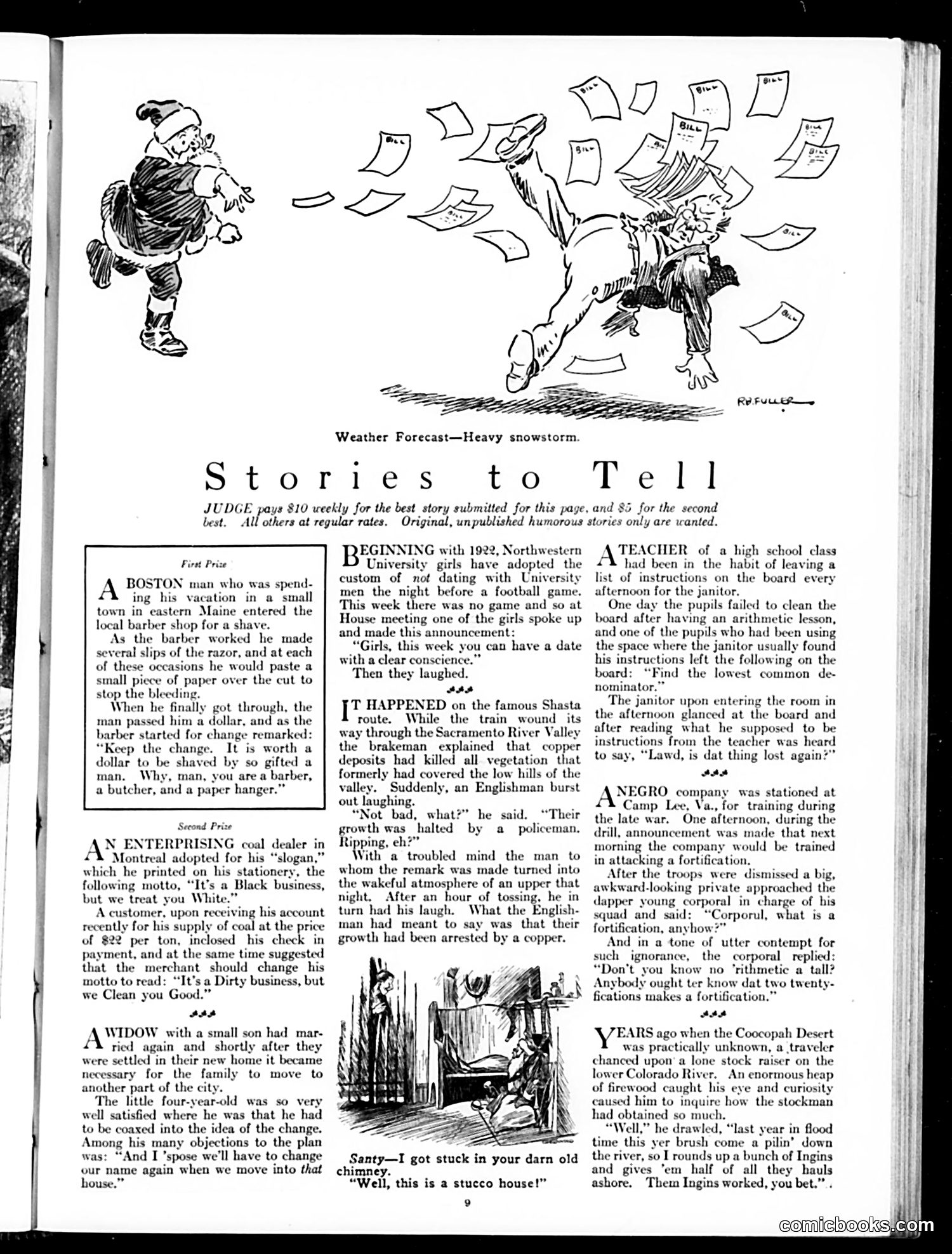
The cartoon at the top satirizes weather unpredictability through a "Heavy snowstorm" caption showing two figures tumbling amid scattered bills—likely referencing financial instability or economic concerns of the era alongside literal weather chaos. Below are four humorous short stories, prize-winning submissions: 1. **"Boston Man's Shave"**: A tourist mocks a clumsy barber's incompetence by praising him as "barber, butcher, and paper hanger" (the paper being bandages for cuts). 2. **"Coal Dealer's Slogan"**: A merchant's virtuous motto ("It's a Black business, but we treat you White") gets mocked when a customer suggests "It's a Dirty business, but we Clean you Good"—a racial pun on coal trading. 3. **"The Move"**: A child's innocent confusion about repeatedly changing surnames upon moves. 4. **"Railroad Anecdote"**: A wordplay misunderstanding where an Englishman's comment about copper deposits "arresting" growth gets misheard as "a policeman...arresting," confusing an American brakeman. The remaining stories focus on school romance rules and military training anecdotes. This is primarily a humor/fiction submission page, not political satire.
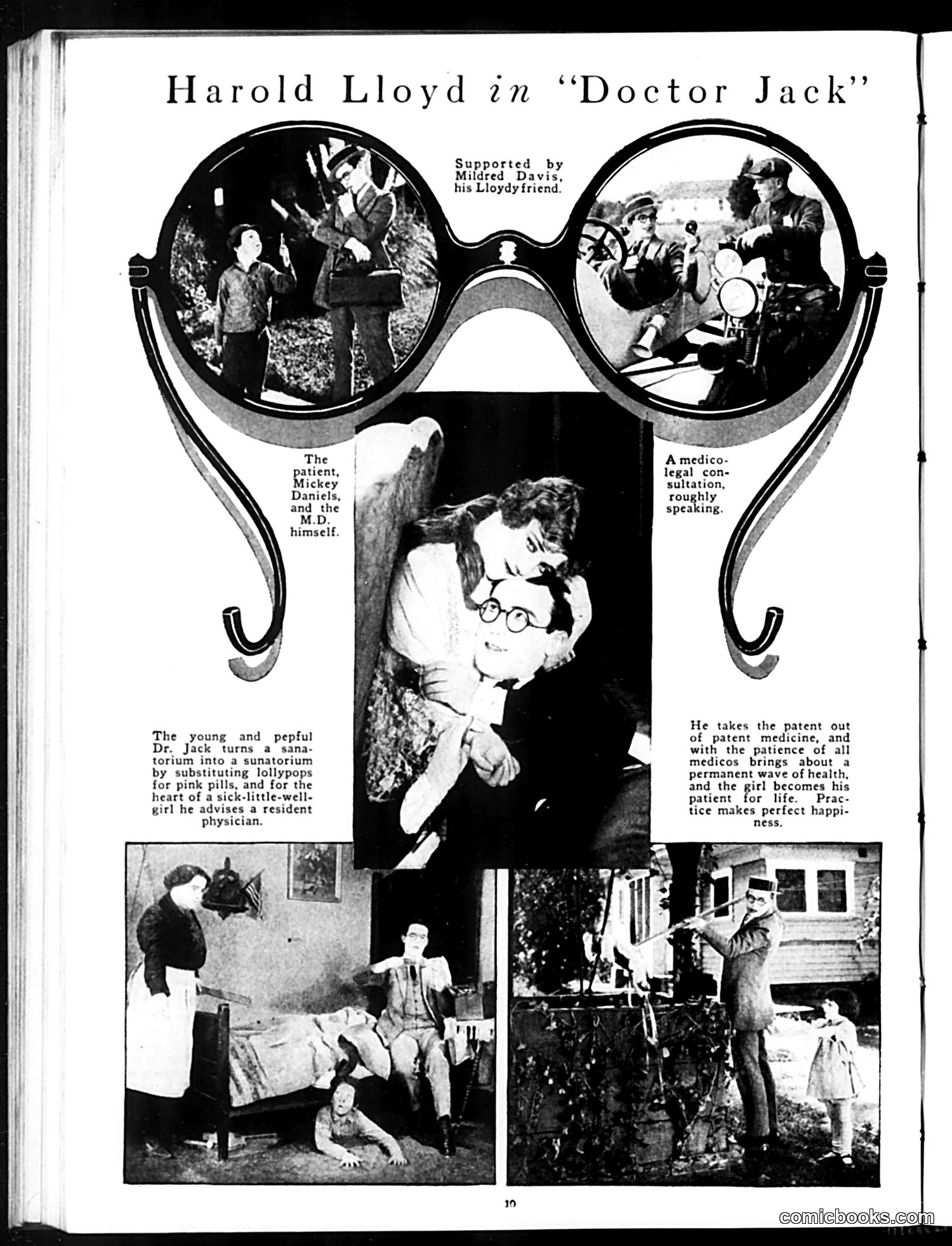
This is a promotional page for a Harold Lloyd silent comedy film. Lloyd, a major silent-film star, plays "Dr. Jack," a young, resourceful physician who transforms a sanatorium by replacing medical treatments (pills) with more wholesome remedies like lollypops. The plot involves treating a sickly girl: rather than relying on conventional medicine, he uses unconventional methods that restore her health. The girl becomes devoted to him ("his patient for life"), suggesting a romantic outcome where "practice makes perfect happiness." Mildred Davis, credited as Lloyd's "Lloydy friend," co-stars. The page uses illustrated vignettes and close-ups to showcase scenes from the film. This appears to be entertainment publicity rather than political satire—typical Judge magazine content promoting popular movies to readers.
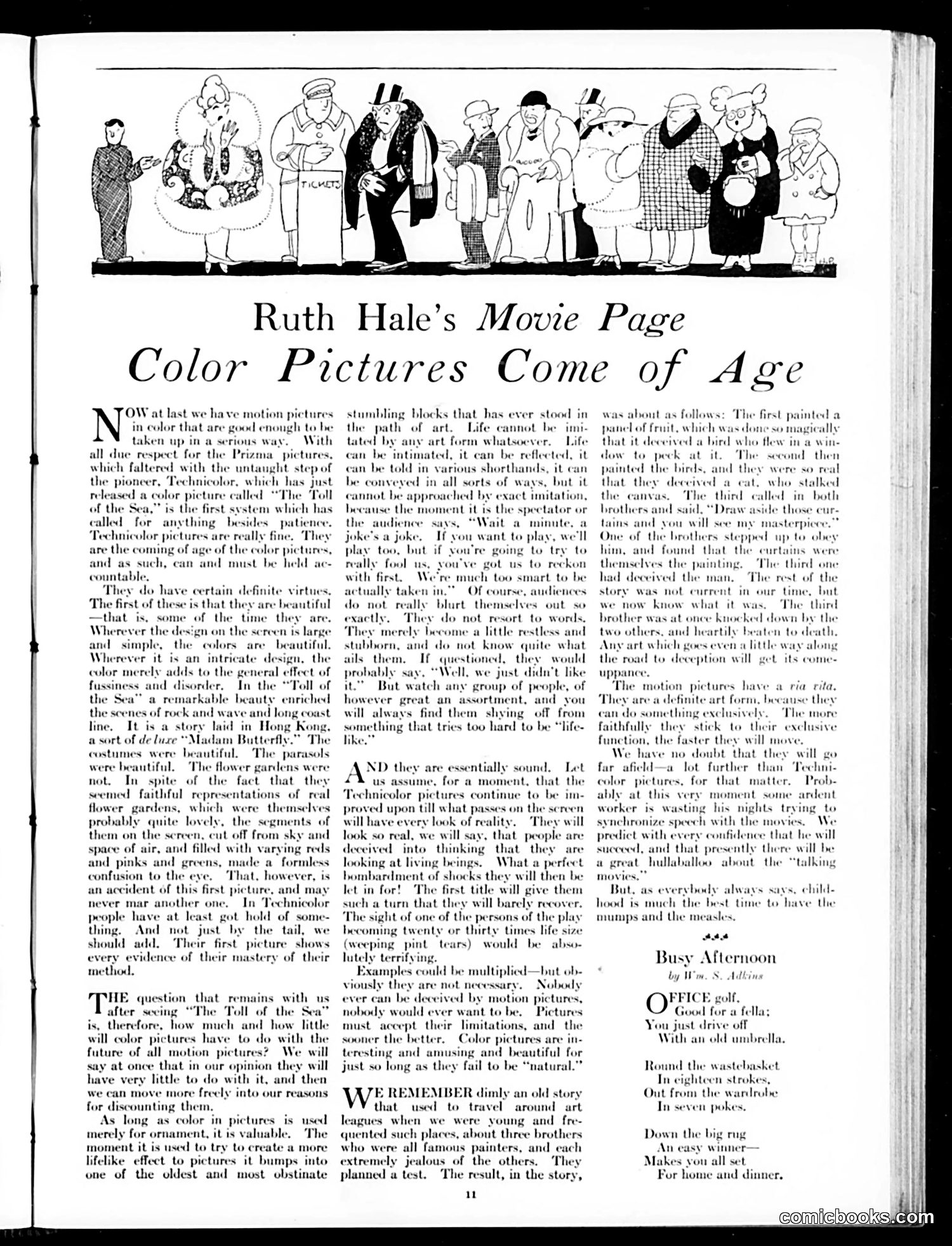
This is a film criticism column by Ruth Hale addressing the newly-arrived **Technicolor** technology in motion pictures. The headline illustration shows a diverse crowd of characters, likely representing different audience types or social classes attending movies. Hale praises Technicolor's technical achievement while arguing against using color to create "lifelike" realism in film. She contends that audiences don't want perfect imitation of life—they want art that *suggests* reality through selective technique. The core argument: if movies became too photorealistic (actors appearing 30 times life-size, weeping actual-sized tears), audiences would find it disturbing rather than immersive. She insists audiences **know** they're watching an artifice and *want* to maintain that awareness. This reflects 1920s debates about cinema's artistic purpose and the uncanny valley problem—decades before that term existed—questioning whether technological advancement always serves storytelling better.
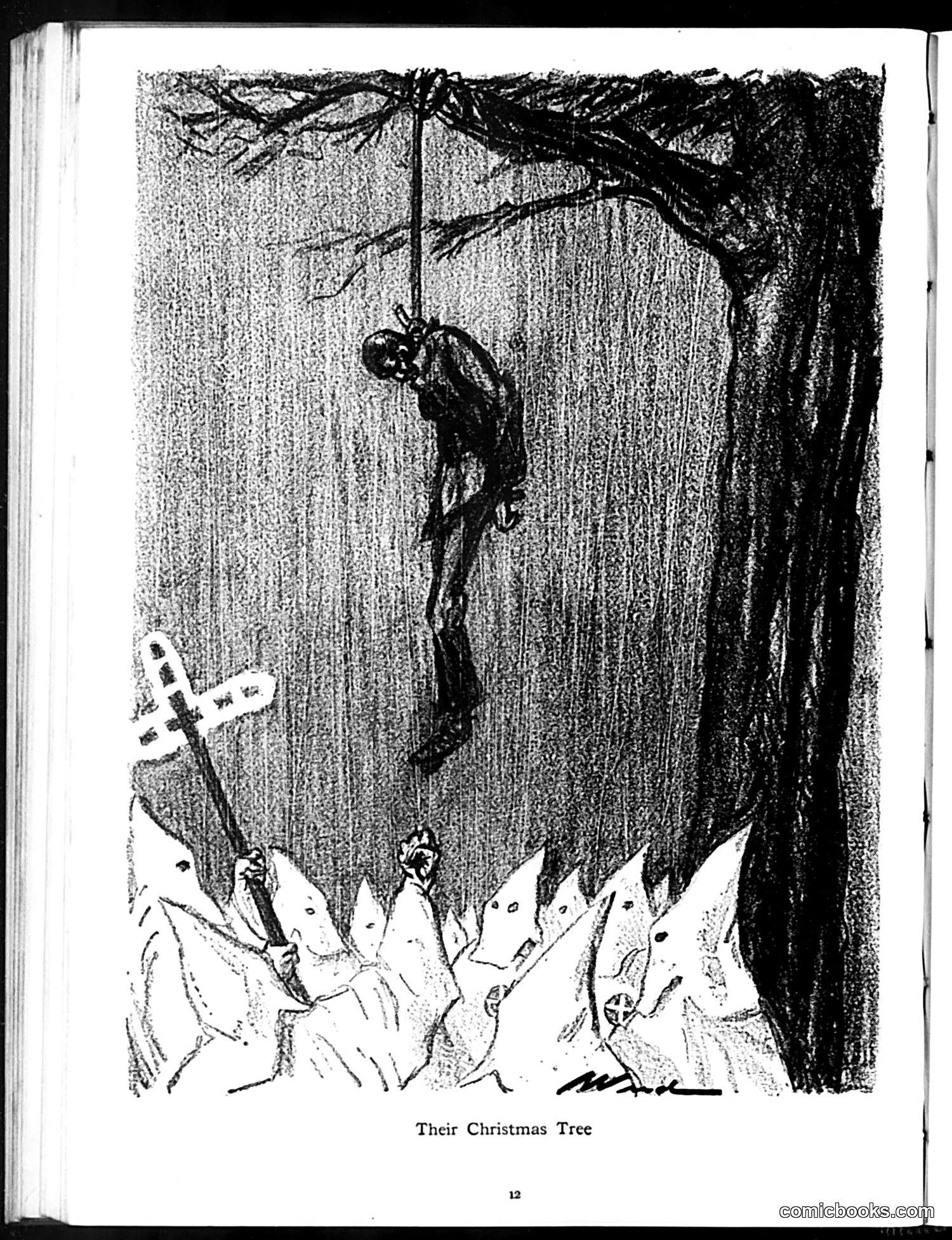
This cartoon depicts a lynching scene, with a hanged figure suspended from a bare tree branch while hooded figures (clearly members of the Ku Klux Klan, identifiable by their pointed hoods) stand below holding a cross. The title "Their Christmas Tree" uses bitter irony—treating a lynching as a grotesque holiday celebration. This is satirical commentary on Klan violence, presenting their murders as a macabre "festivity." Judge magazine, though satirical, used this image to condemn racial violence and the KKK's terrorism. The cartoon critiques the normalization of lynching in American society by framing it as a perverted "Christmas" observance, exposing the horrific brutality behind the Klan's actions. The date and specific context remain unclear from this page alone, but this reflects Judge's anti-racist editorial stance during periods of intense Klan activity.
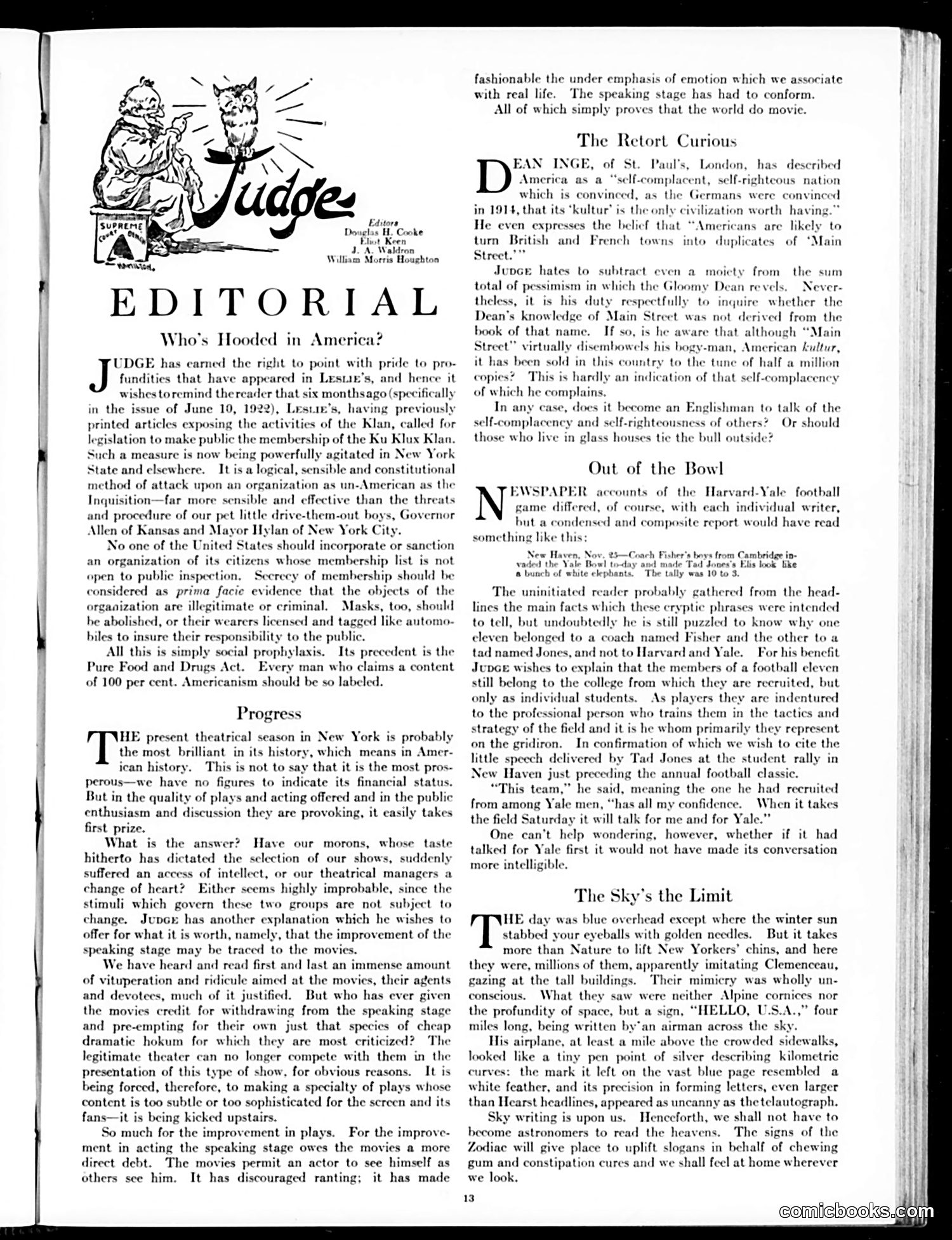
**The Editorial Cartoon:** A figure labeled "Judge" (the magazine personified as a wise authority) confronts a hooded Klan member—the hood itself is the visual punchline. Judge satirizes the Klan's secrecy by depicting them literally masked, driving home the editorial's argument that secret membership lists are un-American and suspicious. **The Content:** The page attacks the Ku Klux Klan's resurgence in 1920s America. Judge advocates for mandatory public disclosure of Klan membership, arguing that secrecy is evidence of illegitimate aims. The editorial references Kansas Governor Allen and NYC Mayor Hylan as ineffective "drive-them-out boys," suggesting Judge favors legal transparency over vigilante action. **Context:** This reflects the real 1920s Klan revival. Judge positions itself as defending American values against what it frames as un-American secrecy—a direct counter to the Klan's claims to represent "true Americanism." The remaining articles on theater and culture appear unrelated to the Klan critique.
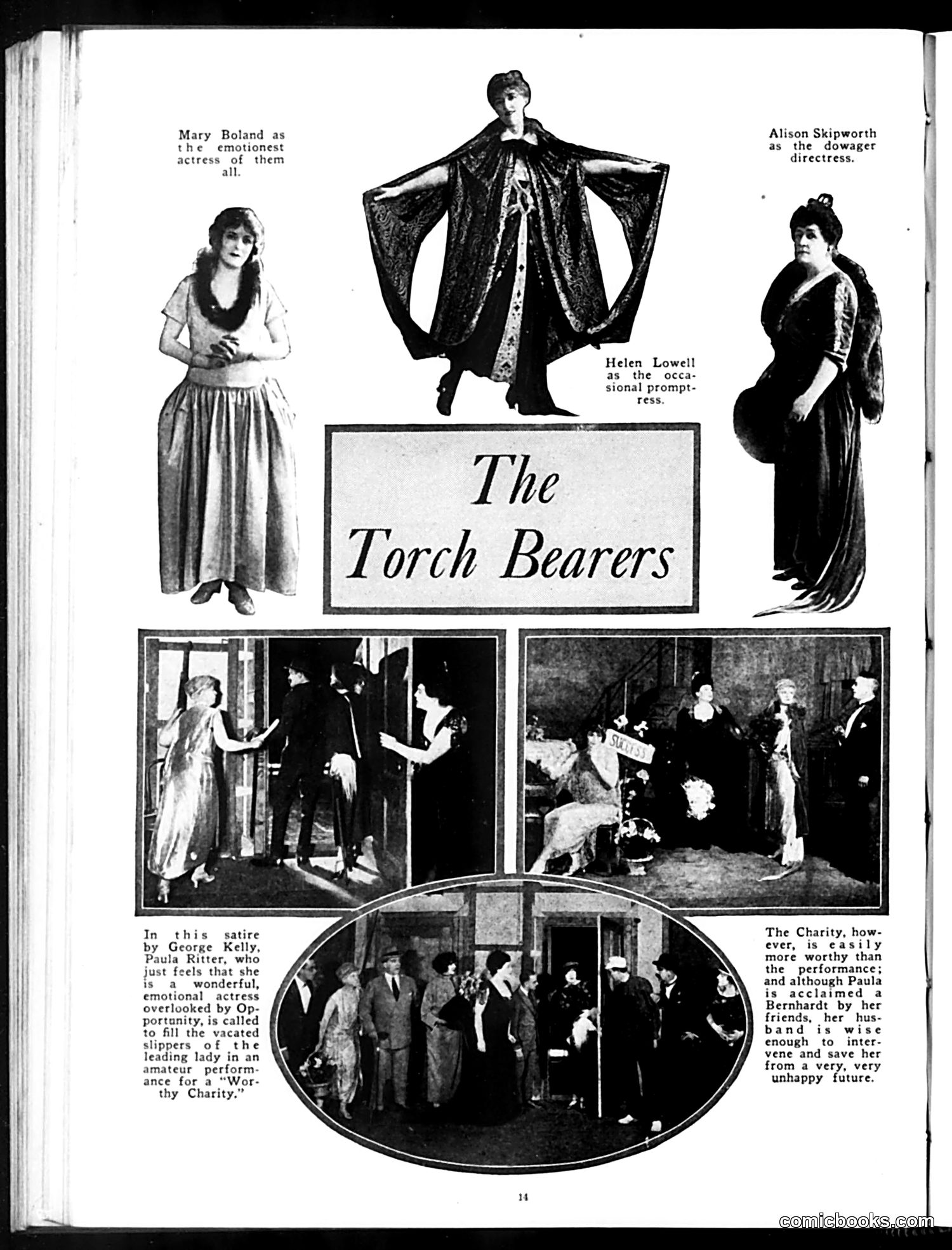
This page covers George Kelly's play satirizing community theater's vanity. The plot follows Paula Ritter (Mary Boland), a woman delusional about her acting talent who eagerly accepts a lead role in a charity performance. Though her friends flatter her as a "Bernhardt" (comparing her to famous actress Sarah Bernhardt), the play mocks her overwrought emotionalism and self-importance. The satire targets the gap between amateur performers' self-perception and reality—Paula genuinely believes she's a great actress despite being mediocre. Her husband wisely intervenes to prevent her humiliation. The supporting cast includes a dowager directress (Alison Skipworth) and prompter (Helen Lowell), typical figures in amateur productions. The joke: pretentious amateurs mistake community theater for legitimate art.
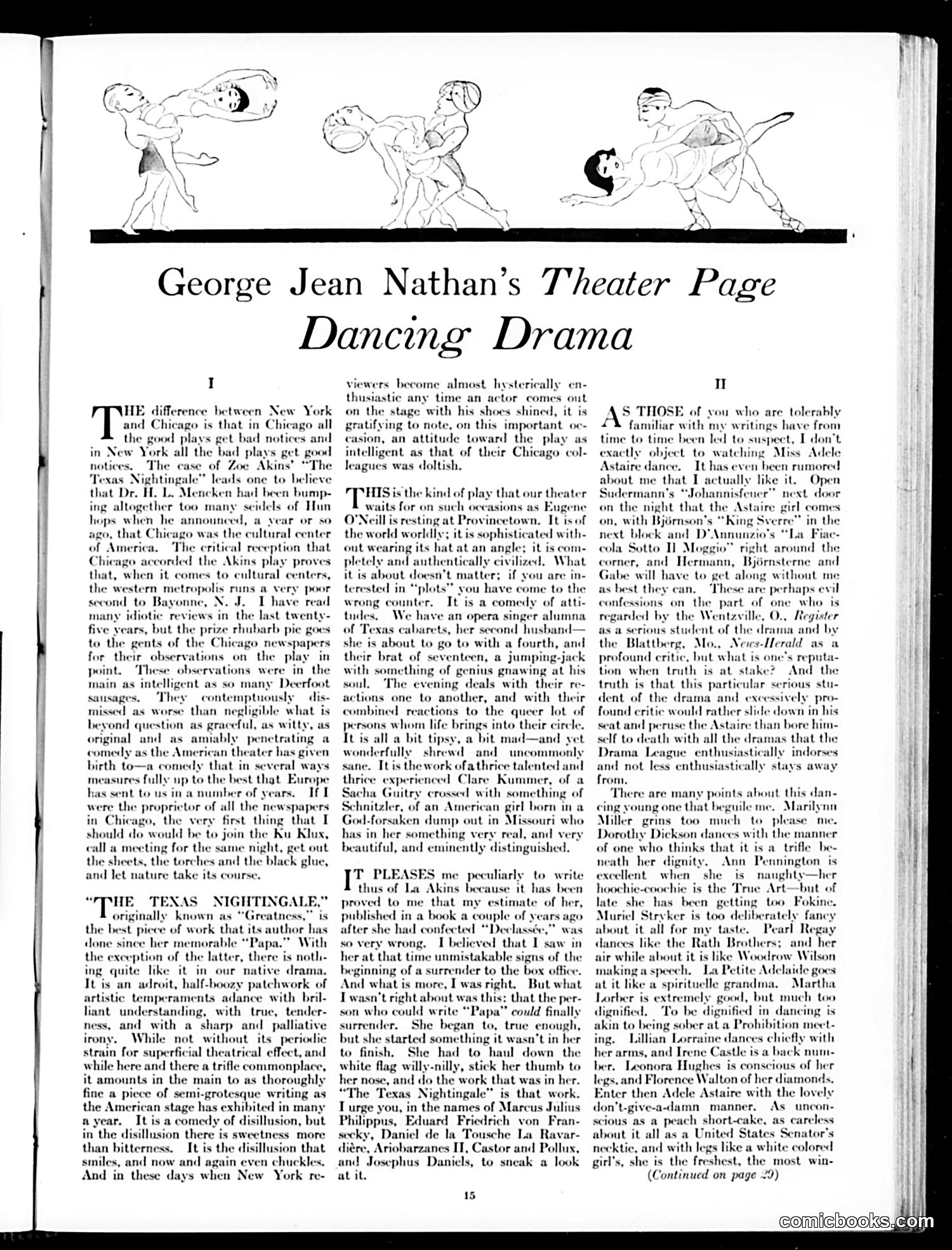
This is theater critic George Jean Nathan's column reviewing "The Texas Nightingale," a play by Zoë Akins. The illustrated header shows stylized dancers in theatrical poses. Nathan **savagely criticizes Chicago newspaper critics** for dismissing what he considers an excellent play. He compares New York and Chicago cultural standards, mockingly suggesting Chicago reviewers are so incompetent he'd prefer to join the Ku Klux Klan rather than own their papers—a shocking hyperbolic insult indicating contempt for their judgment. The play itself concerns a cabaret singer, her multiple husbands, and their teenage son navigating romantic entanglements. Nathan praises it as sophisticated comedy-of-disillusion in the European tradition (Schnitzler, Sacha Guitry), crediting playwright Akins' previous success with "Declassée." The satire targets **provincial critical blindness**: Nathan mocks how Chicago reviewers become "hysterically enthusiastic" over minor theatrical flourishes while missing genuine artistic merit. The piece exemplifies Judge's urbane, metropolitan sensibility dismissing Midwestern cultural pretensions.
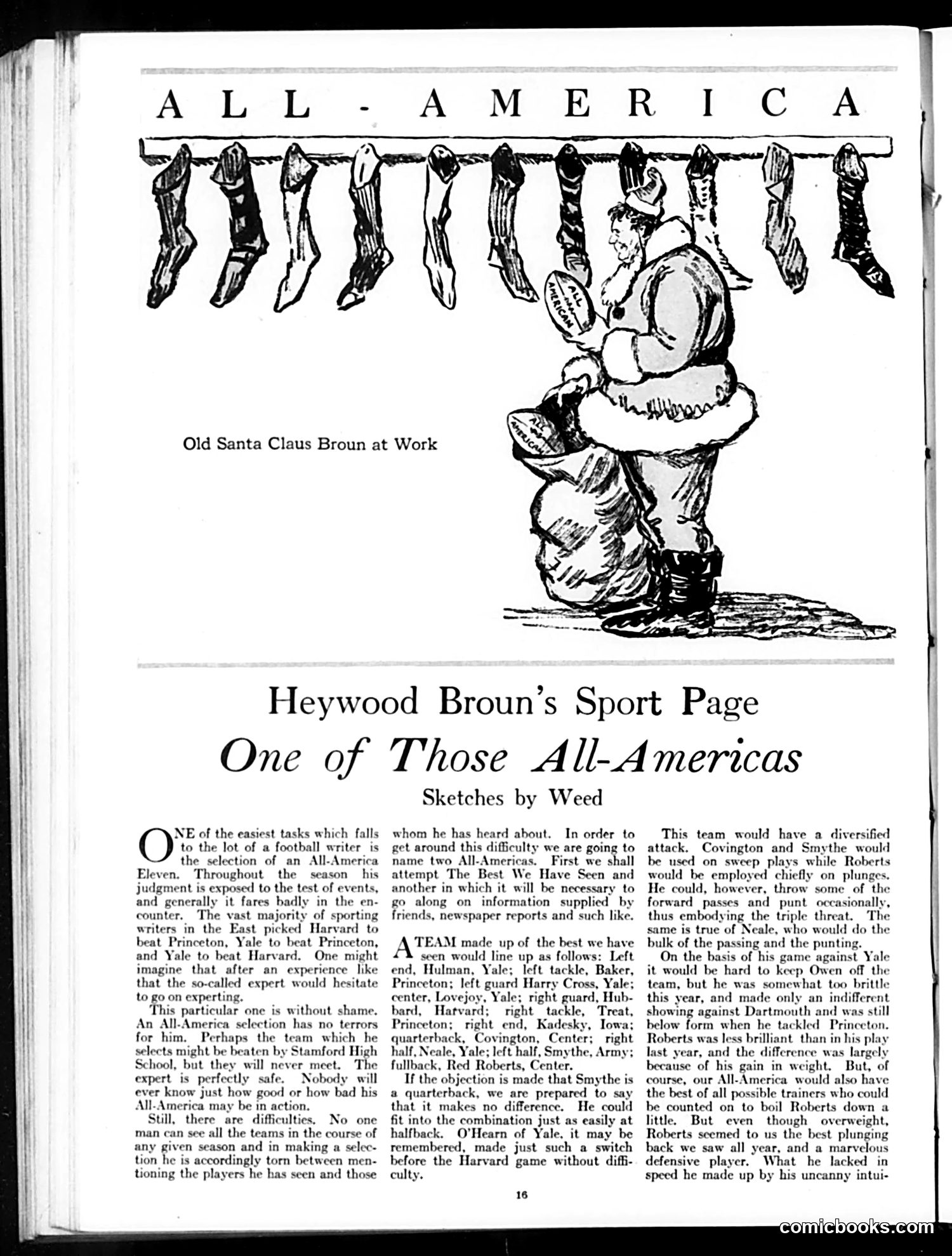
This is Heywood Broun's sports column featuring a satirical cartoon by Weed. The top illustration shows "Old Santa Claus Broun at Work"—a play on Broun's name ("Broun" sounds like "Brown"), depicting Santa hanging dressed meats, mocking the absurdity of selecting an "All-America" football team. Broun's essay critiques sportswriters' pretense of expertise. He notes Eastern writers confidently predicted Harvard would beat Princeton, Yale would beat Princeton, and Yale would beat Harvard—logically impossible predictions that all proved wrong. Yet these same "experts" continue selecting All-America teams without consequence, since their predictions face no real-world test. Broun then creates two hypothetical All-America elevens: one based on games he personally witnessed, another based on hearsay. The satire targets the arbitrary nature of sports journalism and expert commentary—how writers gain credibility through confident assertions about events most cannot fully observe, facing no accountability for errors.
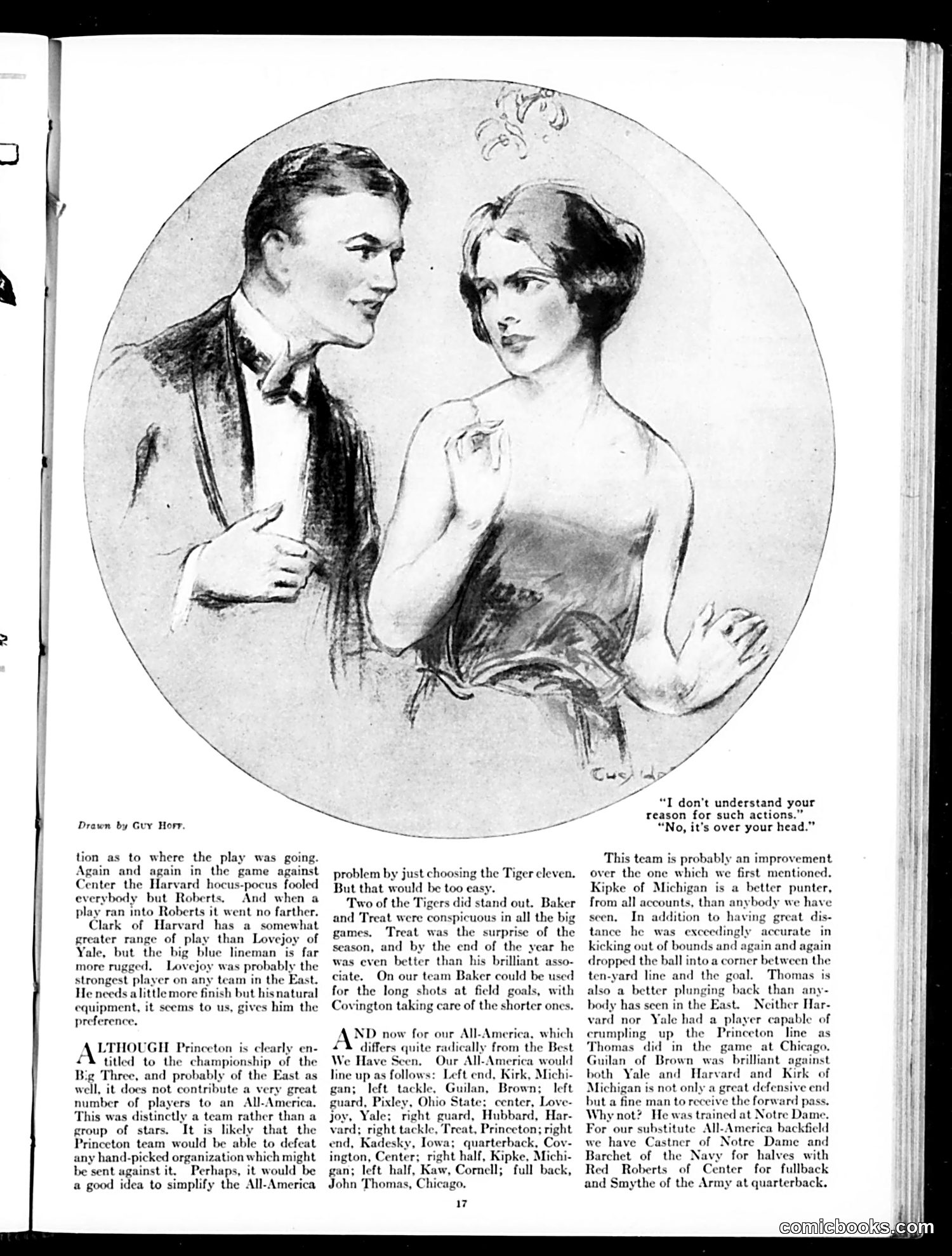
This page from *Judge* magazine discusses college football's "All-America" team selection—a prestigious annual honor. The accompanying cartoon by Guy Hort illustrates the debate humorously with a dialogue between two figures, likely representing different perspectives on team selection. The text reviews performances by players from Princeton, Harvard, Yale, and other universities in their games against each other. It argues that Princeton deserves the "Big Three" championship and proposes an alternative All-America roster featuring standout players like Kipke (Michigan), Lovejoy (Yale), and Thomas (Chicago). The cartoon's caption—"I don't understand your reason for such actions"/"No, it's over your head"—satirizes the often opaque, subjective nature of All-America selections. The satire mocks how different institutions and observers championed conflicting rosters based on regional bias rather than objective merit, a perennial source of college sports controversy in the early 20th century.
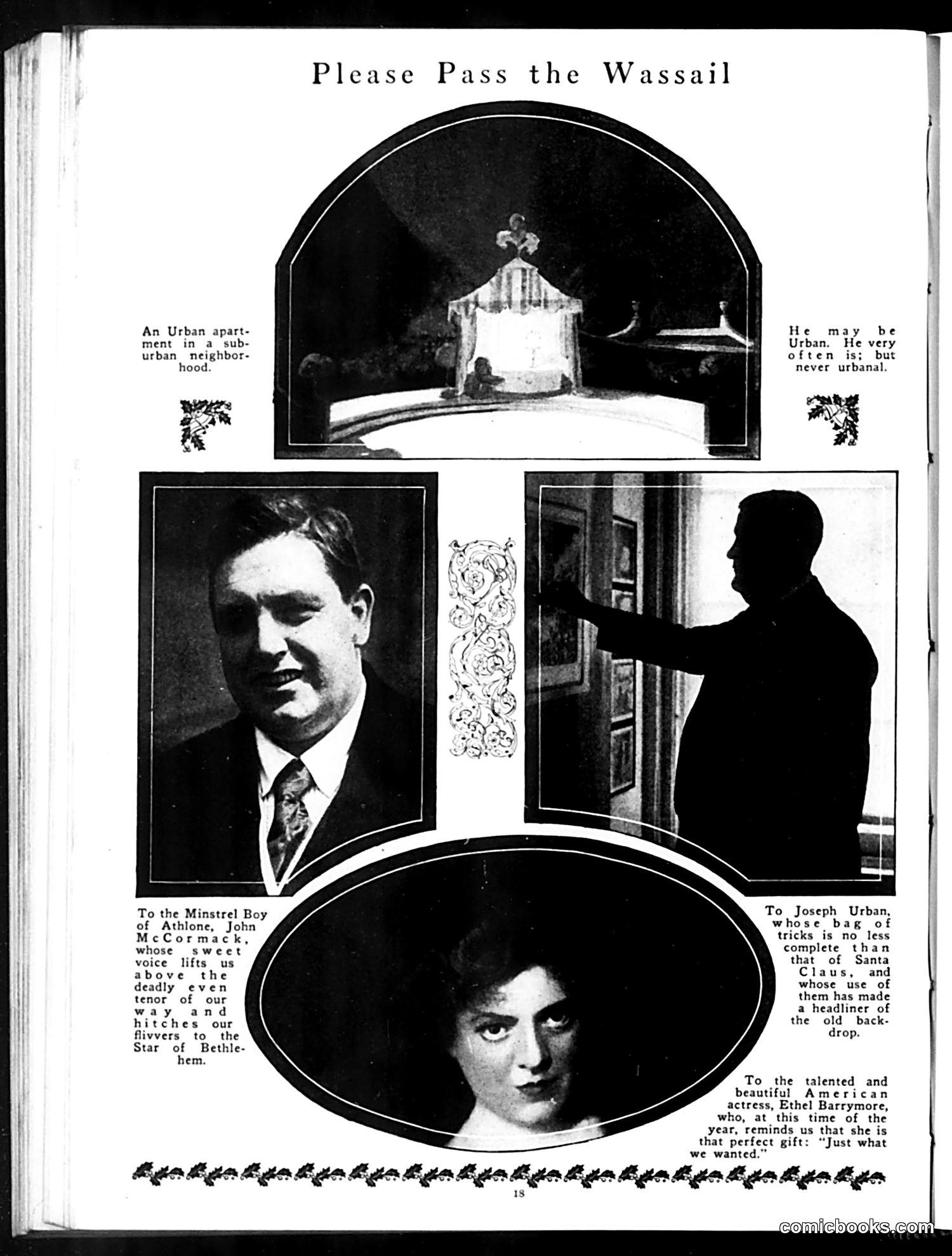
This page from *Judge* magazine presents theatrical tributes disguised as holiday greetings. The central image shows an elegant stage set—likely designed by **Joseph Urban**, a renowned set designer of the era, referenced for his innovative "bag of tricks" and backdrop work. The page honors three performers: **John McCormack**, an Irish tenor praised for his "sweet voice"; **Ethel Barrymore**, celebrated as the ideal gift actress; and implicitly Urban himself for creating the theatrical environment. The opening text jokes that Urban may be "urban" in lifestyle but never truly "urbanal" (a play on words). The phrase "Please Pass the Wassail" sets a festive, theatrical tone—wassail being a traditional holiday drink. The satire is gentle holiday praise for theater world figures, typical of *Judge*'s sophisticated entertainment coverage during this period.
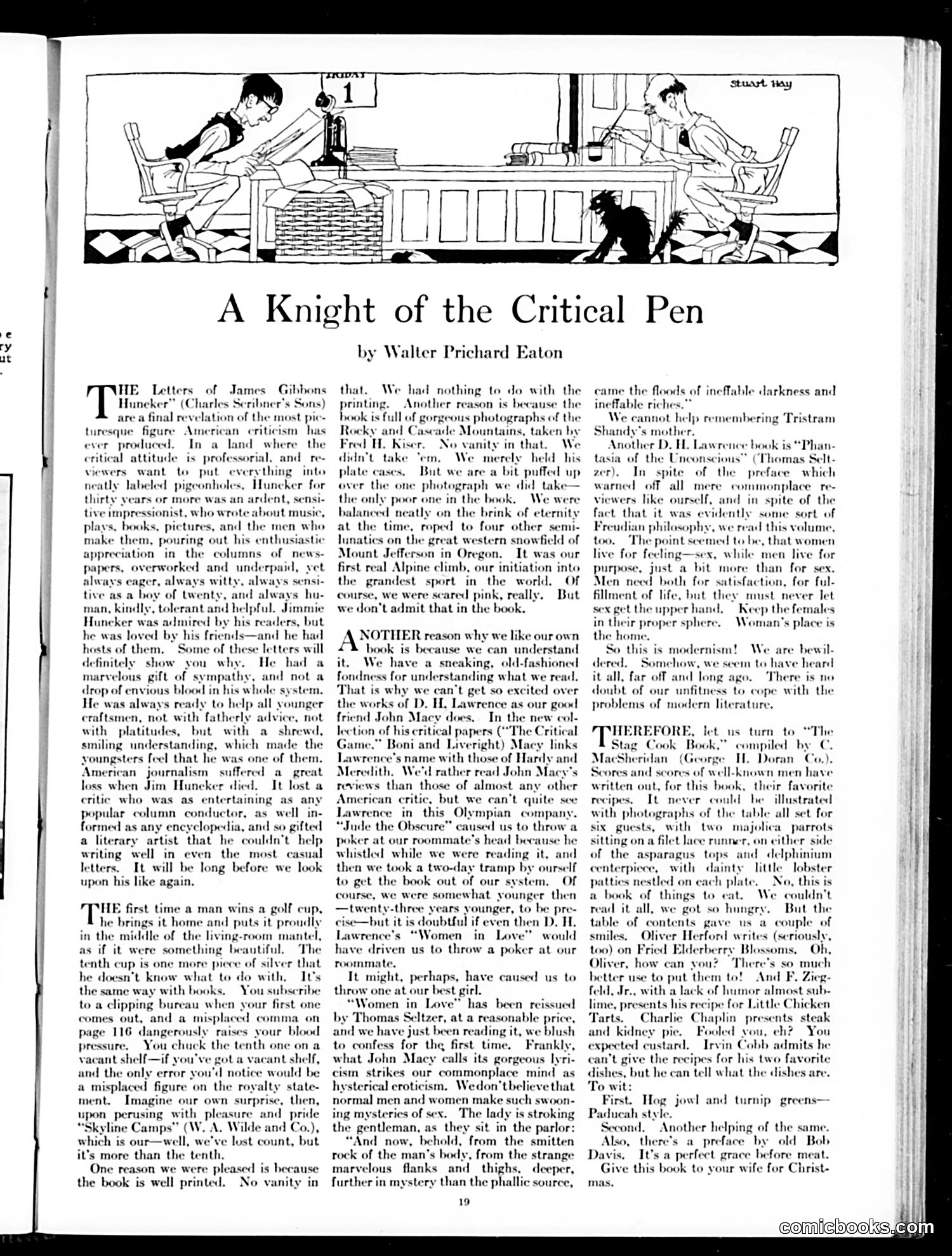
This page features an article by Walter Prichard Eaton celebrating **James Gibbons Huneker**, a prominent American music and literary critic who died recently. The cartoon header shows two figures at desks in what appears to be a newspaper office, likely representing critics at work. Huneker was known for his impressionistic, passionate writing style—the opposite of the dry, academic criticism typical of his era. Eaton praises him as a rare figure who combined genuine enthusiasm for art with accessible prose. The article discusses Huneker's recently published letters and notes his generosity toward younger writers. The piece also reviews other contemporary books, including works by D.H. Lawrence, which Eaton finds overly obscure compared to Huneker's clear critical approach. The final section promotes a cookbook featuring recipes from famous literary figures. The "modernism" reference critiques contemporary experimental literature as needlessly obtuse, contrasting it with Huneker's readable style.
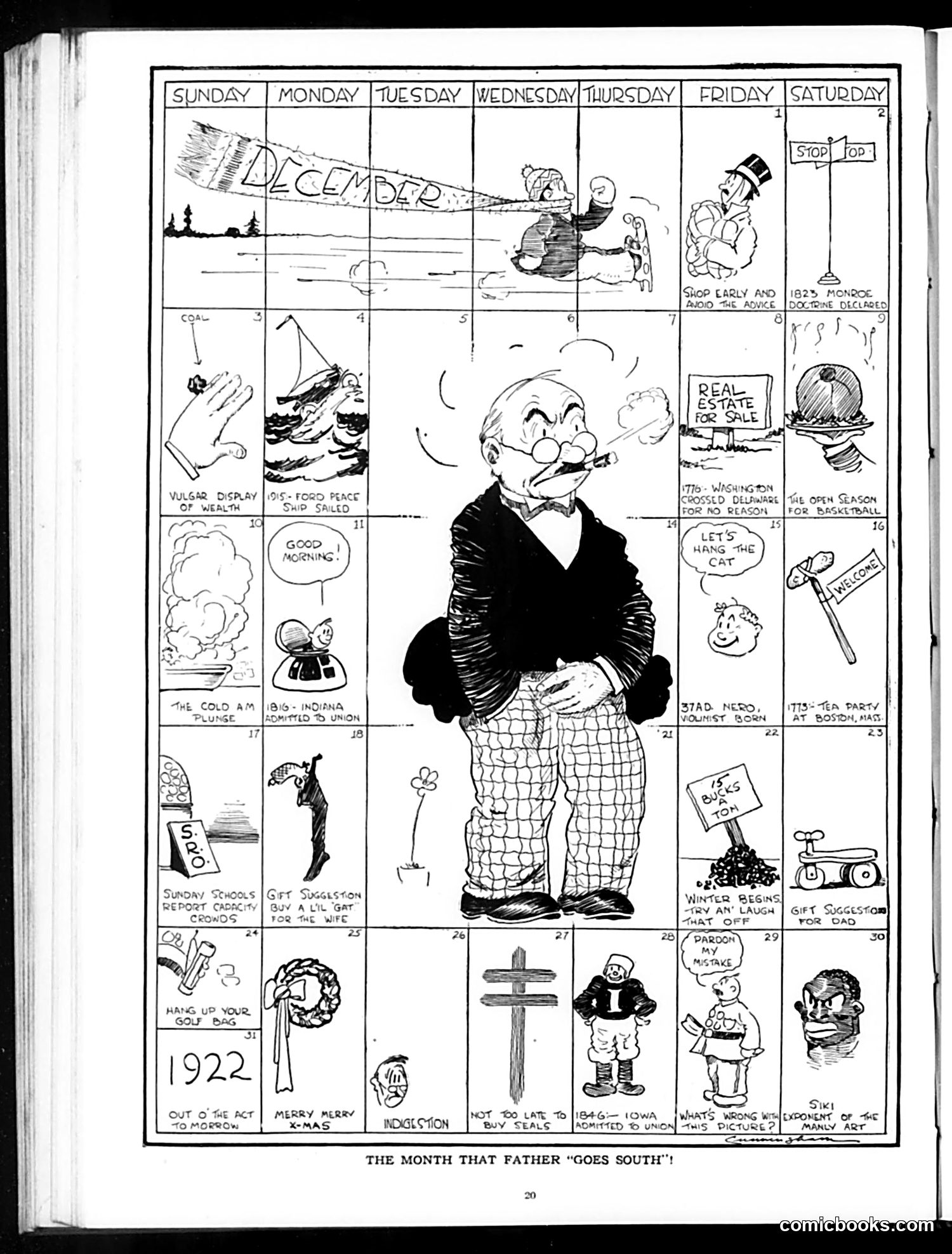
This 1922 calendar page satirizes wealthy American men's winter habits. The central figure—a rotund, cigar-smoking gentleman in formal wear—represents the affluent patriarch who abandons his family for warm-weather vacations. The vignettes mock various leisure pursuits and conspicuous consumption: "vulgar display of wealth," yacht sailing, real estate speculation, and golf. References include Washington's naval preparedness debates and Indiana's admission to the Union (unclear context). The satire targets the disconnect between fathers' extravagant southern escapes and domestic responsibilities—note "Merry Merry X-Mas" and holiday imagery appearing while dad is absent. The phrase "goes south" carries double meaning: literal travel and the condition of family finances or morality during his absence. Judge magazine uses this calendar format to chronicle upper-class hypocrisy and self-indulgence during the prosperous 1920s.
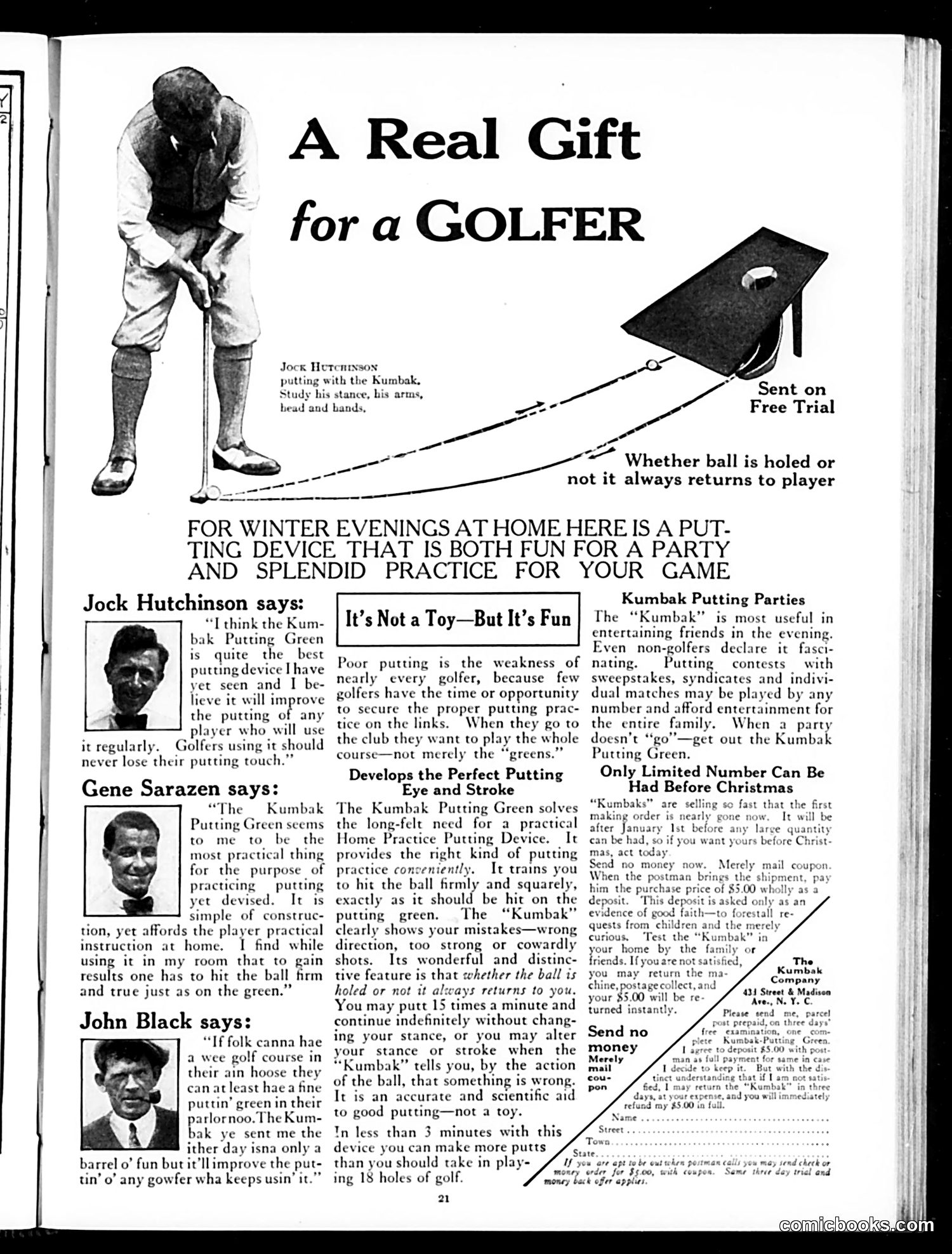
This is primarily a **product advertisement** for the "Kumbak" putting green—an indoor practice device for golfers. The page features endorsements from three famous golfers of the era: Jock Hutchinson, Gene Sarazen, and John Black. The device was a small putting green that returned the ball to the player automatically, allowing golfers to practice at home during winter evenings. The advertisement emphasizes it's "not a toy" but legitimate practice equipment, addressing the common weakness of poor putting among golfers who lacked time for green practice. The page includes testimonials praising the device's practicality, a sales pitch highlighting its training benefits, and order information offering a free trial. The marketing angle combines the product's utility with entertainment value for social "Putting Parties." No satire or political commentary is evident—this is straightforward early-20th-century sporting goods marketing aimed at affluent golfers.
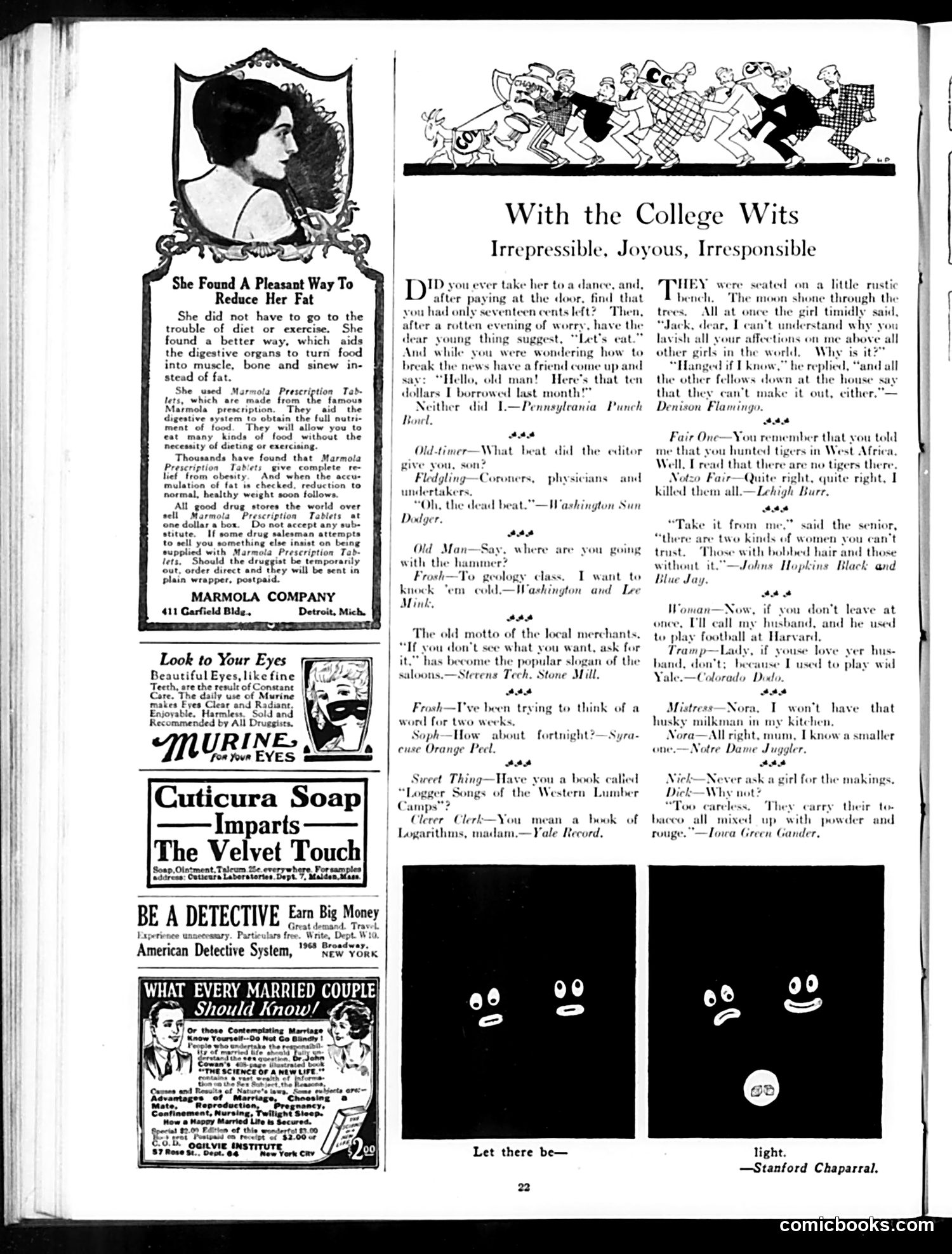
This is primarily a **humor/joke column** rather than political satire, featuring witty exchanges supposedly from college students—a popular magazine format of the era. The jokes mock college life stereotypes: broke students ("seventeen cents left"), romantic mishaps, academic absurdities (confusing "Logarithms" with "Logger Songs"), and gender dynamics. One recurring theme is **female materialism** (the girl asking about affections while mentioning borrowed money; the wife threatening to call her husband over a milkman). The page also includes vintage **patent medicine advertisements** (Marmola weight-loss tablets, Murine eye drops, Cuticura soap)—typical for period magazines—and a suspicious ad for a detective correspondence course. At bottom are two **Stanford Chaparral cartoon panels** showing simple emotional faces with the caption "Let there be—light," likely a visual pun on biblical language versus mundane meaning. The humor reflects 1920s social attitudes: flapper independence mixed with assumptions about women's superficiality, and generational ribbing of college youth as irresponsible.
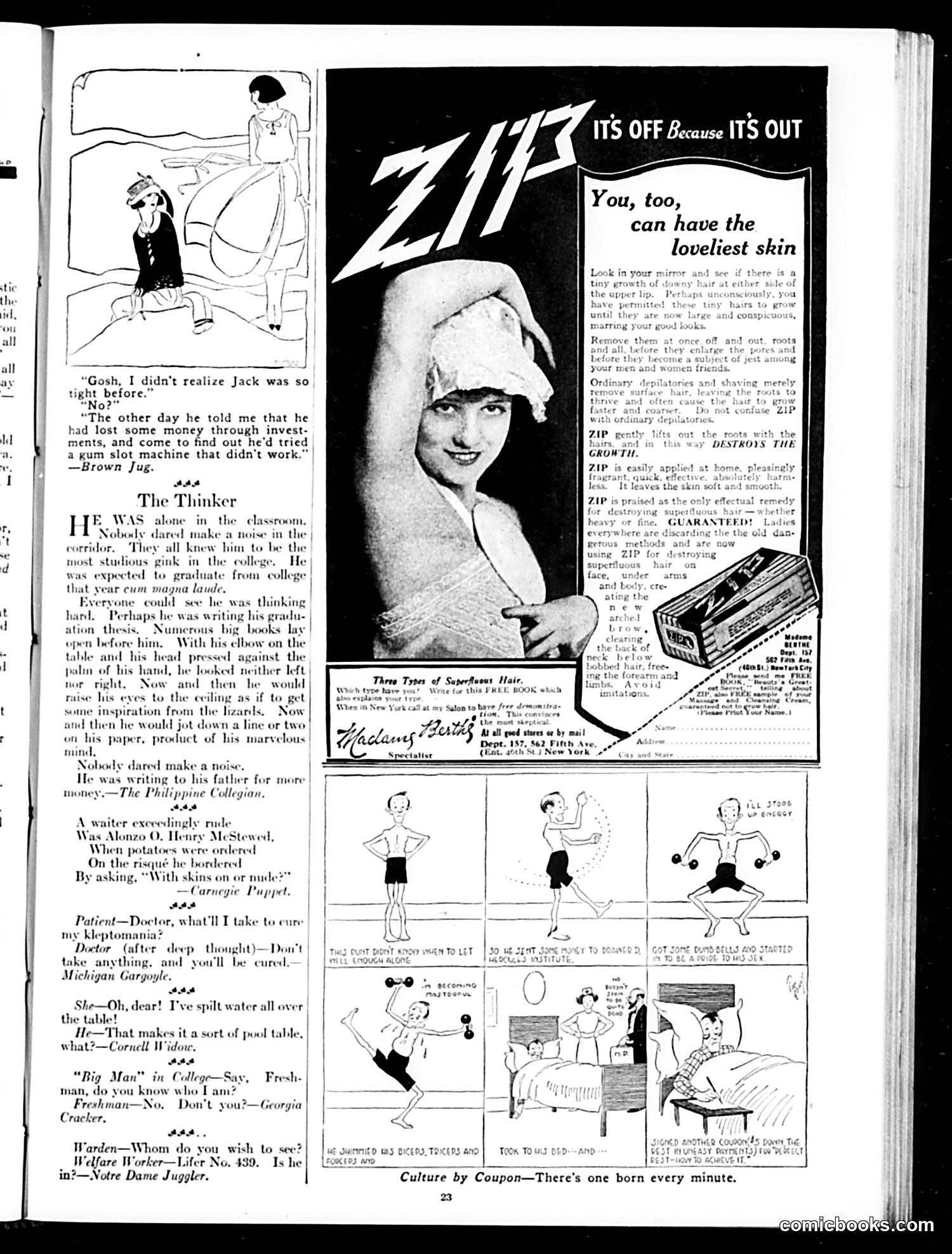
This page contains several brief humorous anecdotes and one advertisement, typical of Judge magazine's satirical content. **The jokes** mock college life and social pretense: "The Thinker" ridicules a studious student who appears intellectually engaged but is actually just writing home asking his father for money—satirizing performative intellectualism. Other short pieces joke about rudeness, theft addiction, and prison visits. **The main advertisement** promotes "ZIP," a depilatory product for removing unwanted facial and body hair. It features a woman and emphasizes that the product destroys hair growth, promises lovely skin, and is available at stores or by mail. This reflects 1920s beauty standards emphasizing hairlessness. **The bottom cartoon strip** titled "Culture by Coupon" appears to show exercise or physical culture routines, likely satirizing the commercialization of health and fitness marketed through mail-order coupons. The page primarily reflects early 20th-century college humor and beauty product marketing rather than political satire.
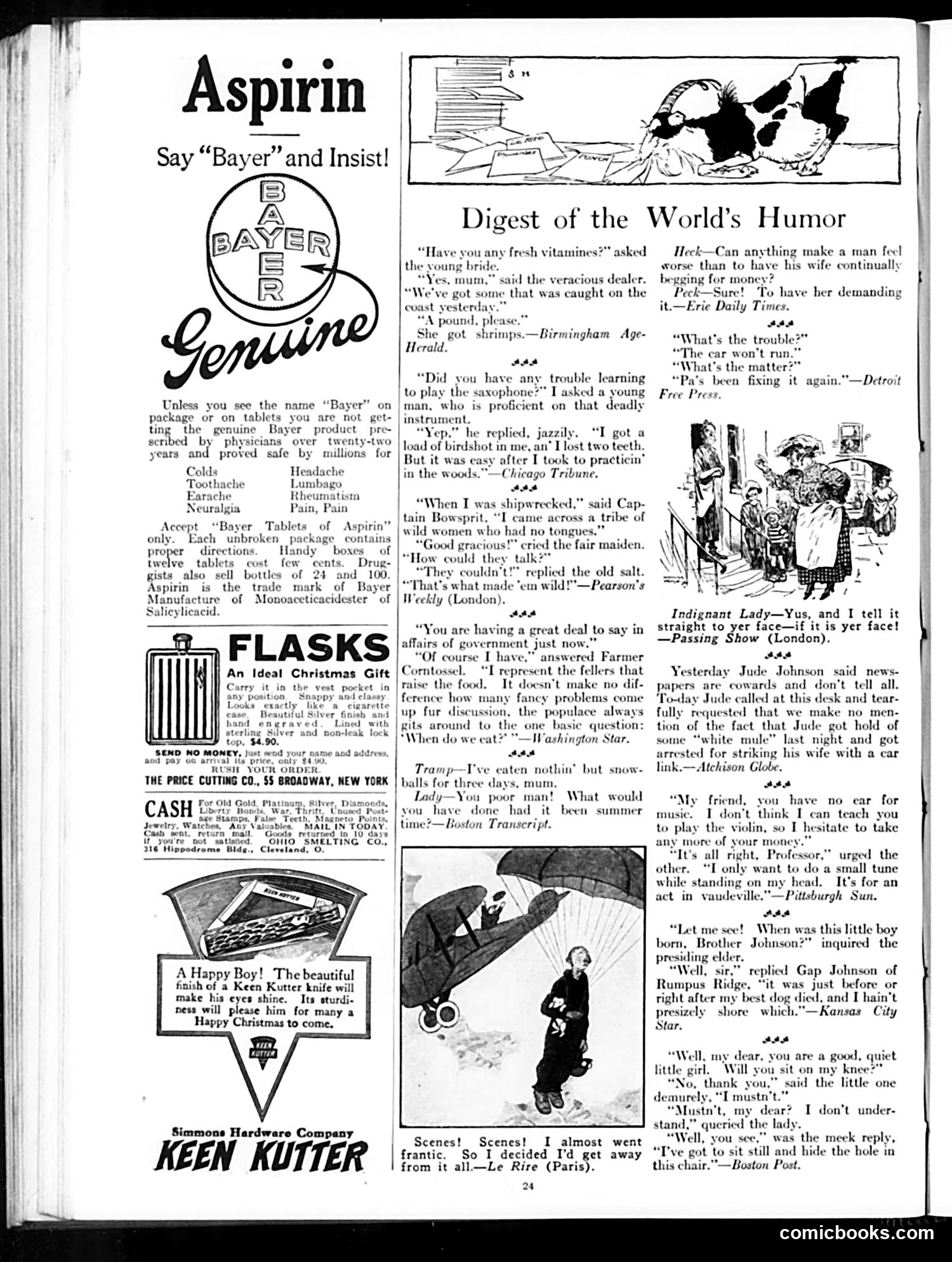
This page consists primarily of **period advertisements** (Bayer Aspirin, flasks, Keen Kutter knives) alongside a humor digest—essentially a reprint collection of jokes from various newspapers and magazines. The jokes reflect early 20th-century social attitudes: they mock women (the "wild" women with "no tongues"), rural/working-class characters ("Farmer Corntossel"), and domestic conflict. One joke references a man arrested for striking his wife, treated as comedic material rather than serious domestic violence. The saxophone joke alludes to early jazz's association with rowdy, working-class culture. Another references "white mule" (homemade whiskey), suggesting Prohibition-era humor. The page's main purpose is **commercial**—showcasing branded products—with humor as filler content. The jokes are syndicated from international papers (London, Paris), indicating Judge's reach and editorial practice of reprinting global humor.
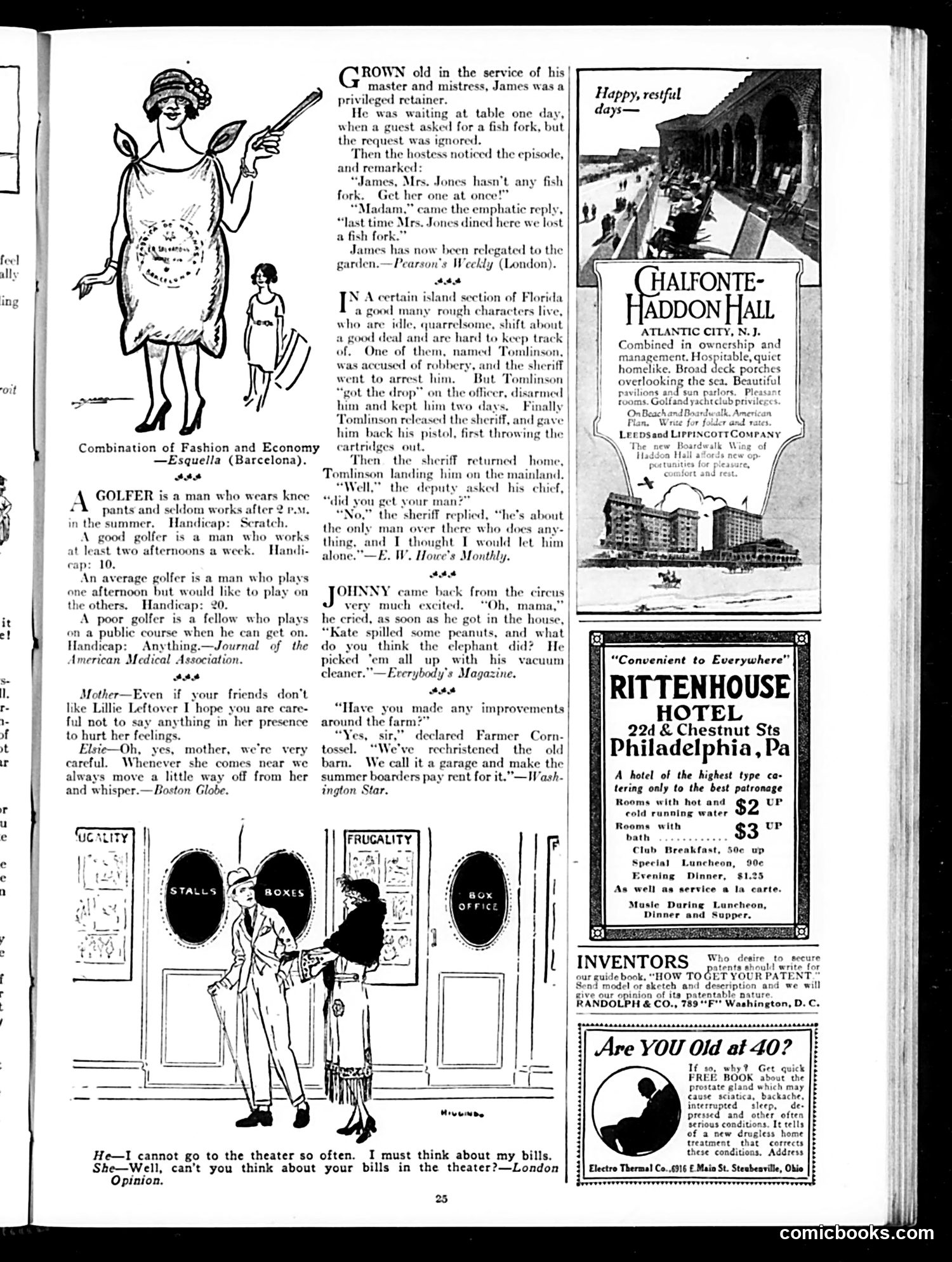
This page contains multiple satirical pieces typical of early 20th-century Judge: **Main Cartoons:** 1. **"Combination of Fashion and Economy"** (top left): A woman in a dress with a large circular hole/patch illustrates the satirical juxtaposition of maintaining fashionable appearance while practicing frugality—a commentary on post-WWI economic constraints. 2. **Humorous definitions of golfers**: Classifies golfers by economic status and leisure time—a dig at the wealthy leisure class and their varying commitment levels. The "poor golfer" plays on public courses (implying less affluent), while "good golfers" work only half the week. 3. **The servant James anecdote**: Mocks rigid class hierarchies and servants' petty grievances; James refuses service to a guest because she previously lost a fork at the house. 4. **Theater/Bills dialogue**: Final joke satirizes middle-class financial anxiety—unable to afford theater, the man resorts to worrying about unpaid bills everywhere, even in escapist spaces. The page is primarily **humorous social commentary** on class distinctions, fashion, golf culture, and economic insecurity.
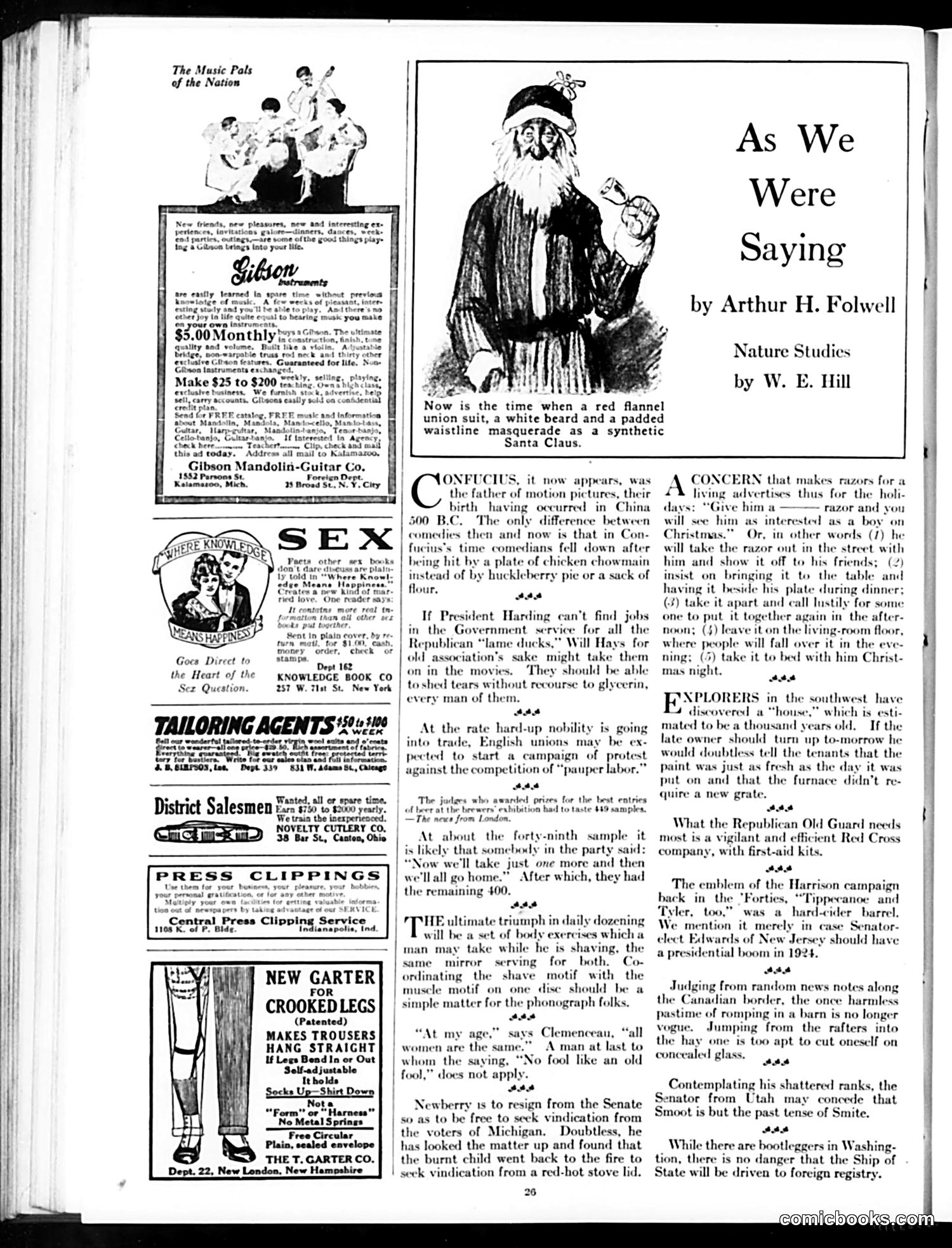
This page from the satirical magazine *Judge* contains several brief comedic commentaries on contemporary politics and social issues, likely from the early 1920s based on references to President Harding. **Key satirical items:** 1. **Confucius/Motion Pictures**: A joke that Confucius invented motion pictures in 500 B.C., with the only difference between ancient and modern comedies being that ancient comedians were hit with chicken chowmain instead of huckleberry pie—absurdist humor mocking lowbrow slapstick comedy. 2. **Harding's "Lame Ducks"**: References President Harding's inability to find government jobs for unemployed Republicans, suggesting Will Hays (movie industry figure) hire them instead. 3. **Santa Claus**: Social commentary on synthetic Christmas—a red flannel union suit, false beard, and padding masquerading as authentic holiday spirit. 4. **Republican Old Guard**: Critiques their lack of organization, comparing them to a Red Cross unit needing first-aid kits. The page is primarily advertising with scattered satirical commentary typical of *Judge*'s format.
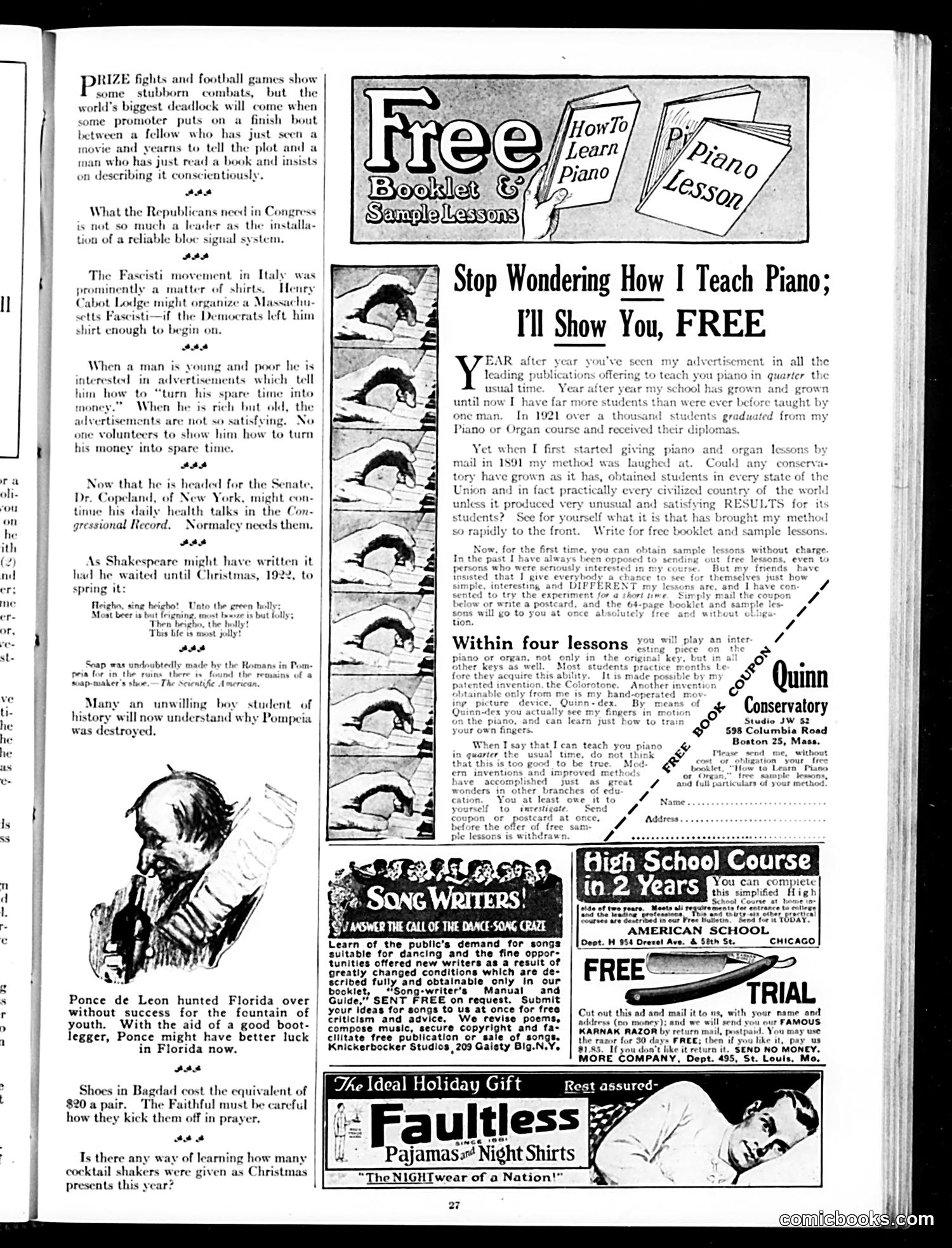
This page contains multiple brief satirical commentaries typical of Judge's format: **Political Content:** - A jab at Republicans needing a "reliable bloc signal system" in Congress—mocking their inability to coordinate politically - A joke about Fascism in Italy (referencing Mussolini's "Blackshirts") suggesting Massachusetts Republicans could form their own fascist movement if Democrats hadn't already taken all the shirts **Social Satire:** - Opening joke contrasts movie-goers and book readers who both compulsively describe plots—both are equally annoying - Commentary on advertising: young poor men are sold "turn spare time into money" schemes; rich old men aren't interested in turning money into spare time - A joke about Pompeii's destruction, implying students would understand if they knew Romans invented soap (dark humor about cleanliness) - Reference to Ponce de Leon searching for the Fountain of Youth; bootleggers in Florida offer better luck (Prohibition-era joke) **Context:** These are disconnected one-liners reflecting 1920s American concerns: politics, advertising culture, and Prohibition.
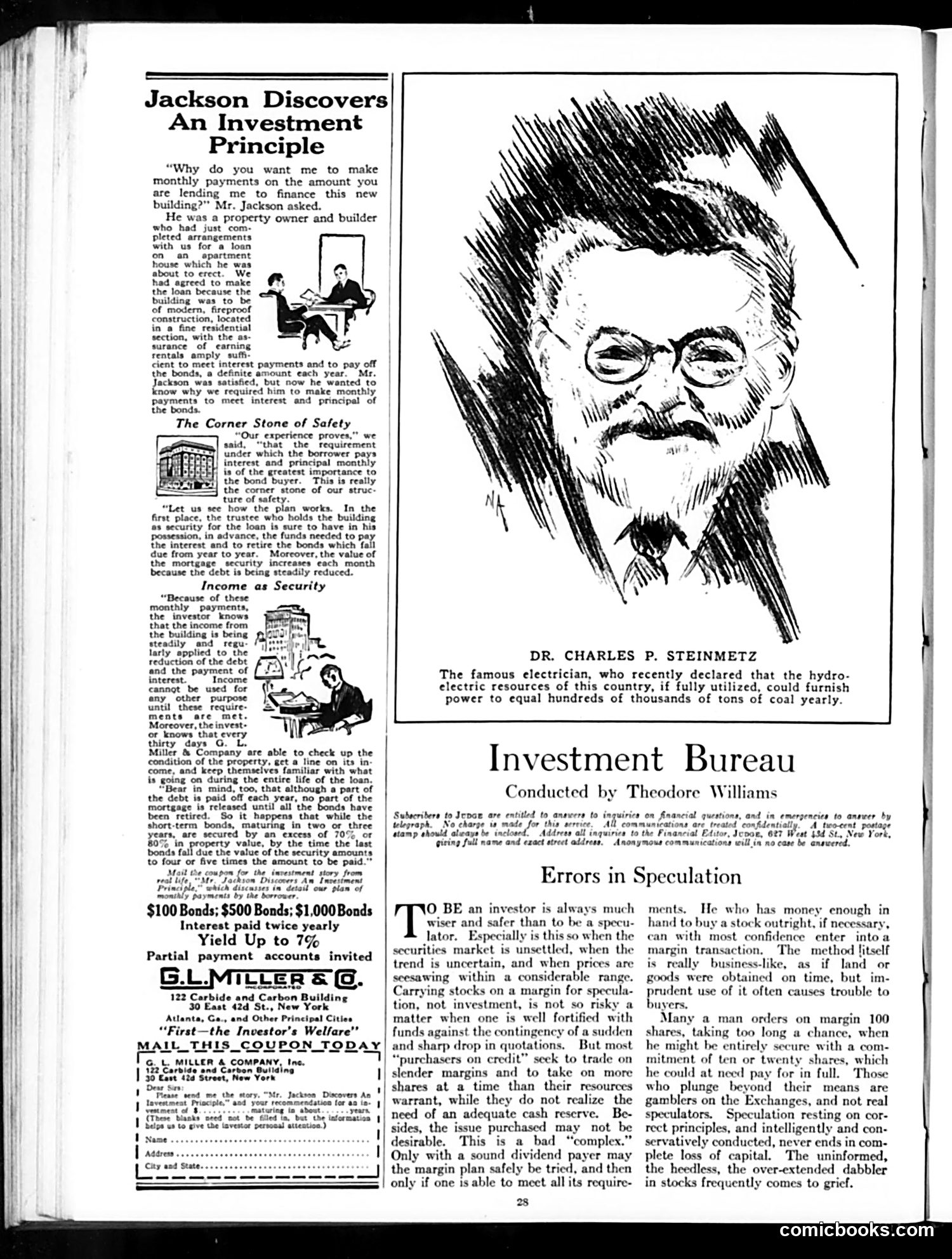
This page is primarily **advertising for G.L. Miller & Company**, an investment firm, disguised as financial education content. The narrative "Jackson Discovers An Investment Principle" presents a dialogue between a property developer and a loan officer explaining why monthly bond payments protect investors—essentially a sales pitch for the firm's bond offerings ($100-$1,000 denominations, yielding up to 7%). The portrait of **Dr. Charles P. Steinmetz**, a famous electrician, appears as a celebrity endorsement of hydroelectric power investment potential, lending prestige to the financial products being promoted. The "Investment Bureau" section titled "Errors in Speculation" warns against margin trading and risky stock practices—a conservative pitch positioning Miller & Company's bonds as the safer alternative to stock market gambling. This represents early-20th-century **advertorial content**: educational framing to market financial products, using credible experts and cautionary tales to build investor confidence during an era of stock market volatility and speculation.
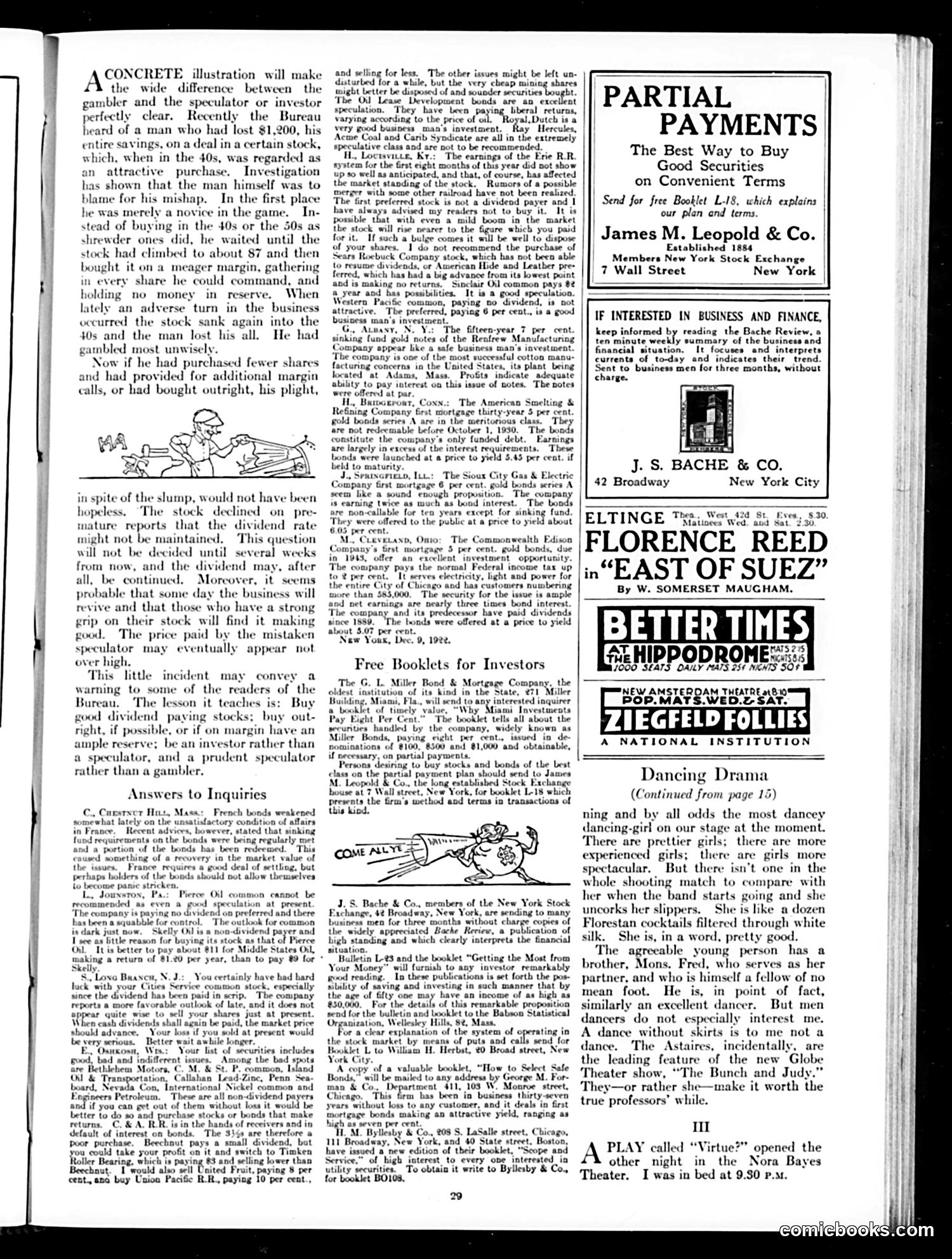
This page is primarily **financial advice and investment advertising**, not political satire. The main editorial content ("A Concrete Illustration") warns readers against stock speculation versus prudent investing. The key lesson illustrated concerns a man who lost his entire $1,200 savings by buying stock at inflated prices (87) on thin margin, rather than purchasing outright or maintaining reserves for margin calls. The editorial distinguishes between reckless "gamblers" and prudent "investors"—a distinction relevant to 1920s-era stock market culture when retail speculation was common and risky. The small cartoon (labeled "Come Alye") appears to show a figure being pulled or dragged, likely reinforcing the cautionary theme about financial ruin from poor investment decisions. The rest of the page comprises advertisements for investment services and financial publications, reflecting Judge's reader demographic of middle and upper-class investors navigating post-WWI American markets.
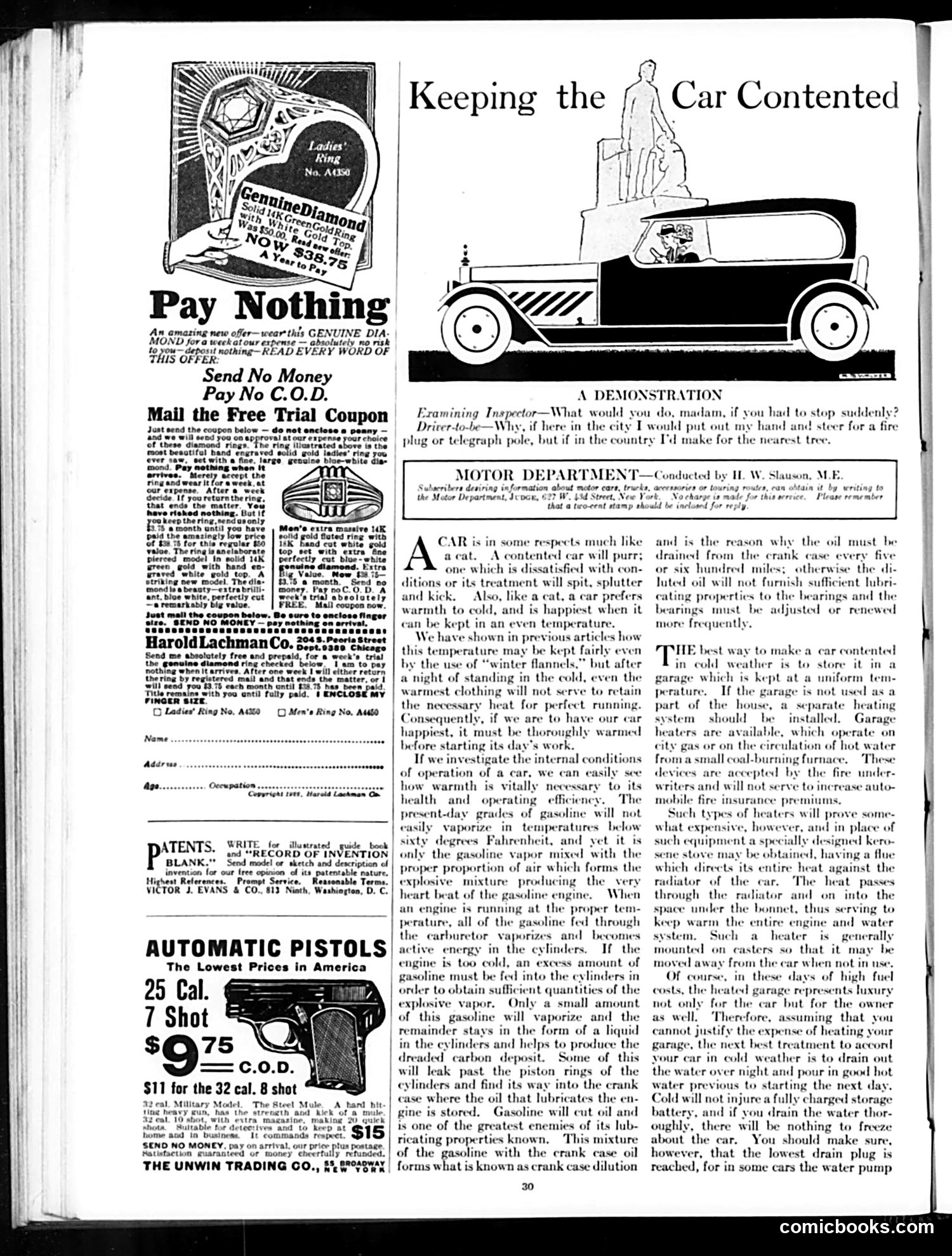
This page combines advertisements with motoring advice. The main cartoon, titled "Keeping the Car Contented," depicts a driving instructor examining a novice female driver. The joke concerns her dangerous answer to an emergency-stop scenario: in the city she'd steer toward fire hydrants or telegraph poles; in the country, toward trees. The satire mocks both her incompetence and the absurdity of early automobile safety—suggesting that new drivers had no concept of proper braking or collision avoidance. The accompanying "Motor Department" article treats cars anthropomorphically ("like a cat"), comparing a contented car to a purring feline. It addresses practical concerns for 1920s car owners: maintaining proper engine temperature for fuel vaporization and oil quality, problems modern readers wouldn't face with contemporary engines. The advertisements—for diamond rings, patents, and pistols—are typical period commercials using aggressive sales tactics ("Pay Nothing," "Send No Money").
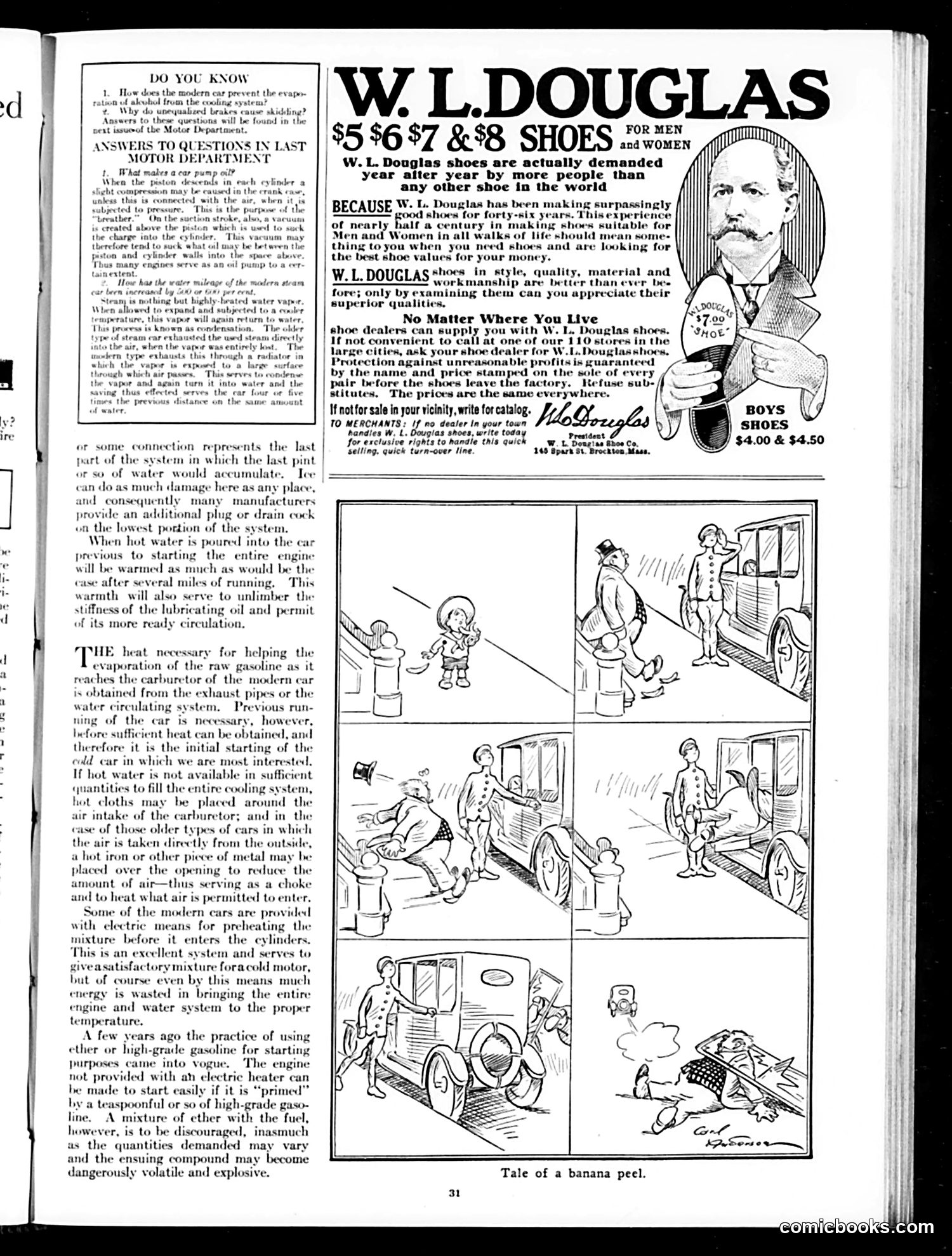
This page is primarily **advertising and technical content**, not political satire. The top half features a **W.L. Douglas shoe advertisement**—a major brand of the era claiming 46 years of shoe-making and nationwide distribution. The illustration shows W.L. Douglas himself (identifiable by the caption). The bottom half contains a **comic strip titled "Tale of a Banana Peel,"** depicting slapstick humor: a sequence showing someone slipping on a banana peel near a car, with escalating physical comedy—the figure falls, gets kicked, and ends up crashing into what appears to be a vehicle or obstacle. This is classic early-20th-century comic trope (no political meaning). The left column discusses **automobile mechanics**—cooling systems, engine starting procedures, and heating methods for cold-weather operation. This is technical automotive information for readers, not satire. **No political figures or satire are present on this page.** It's primarily a commercial and informational page typical of Judge's mixed content model.
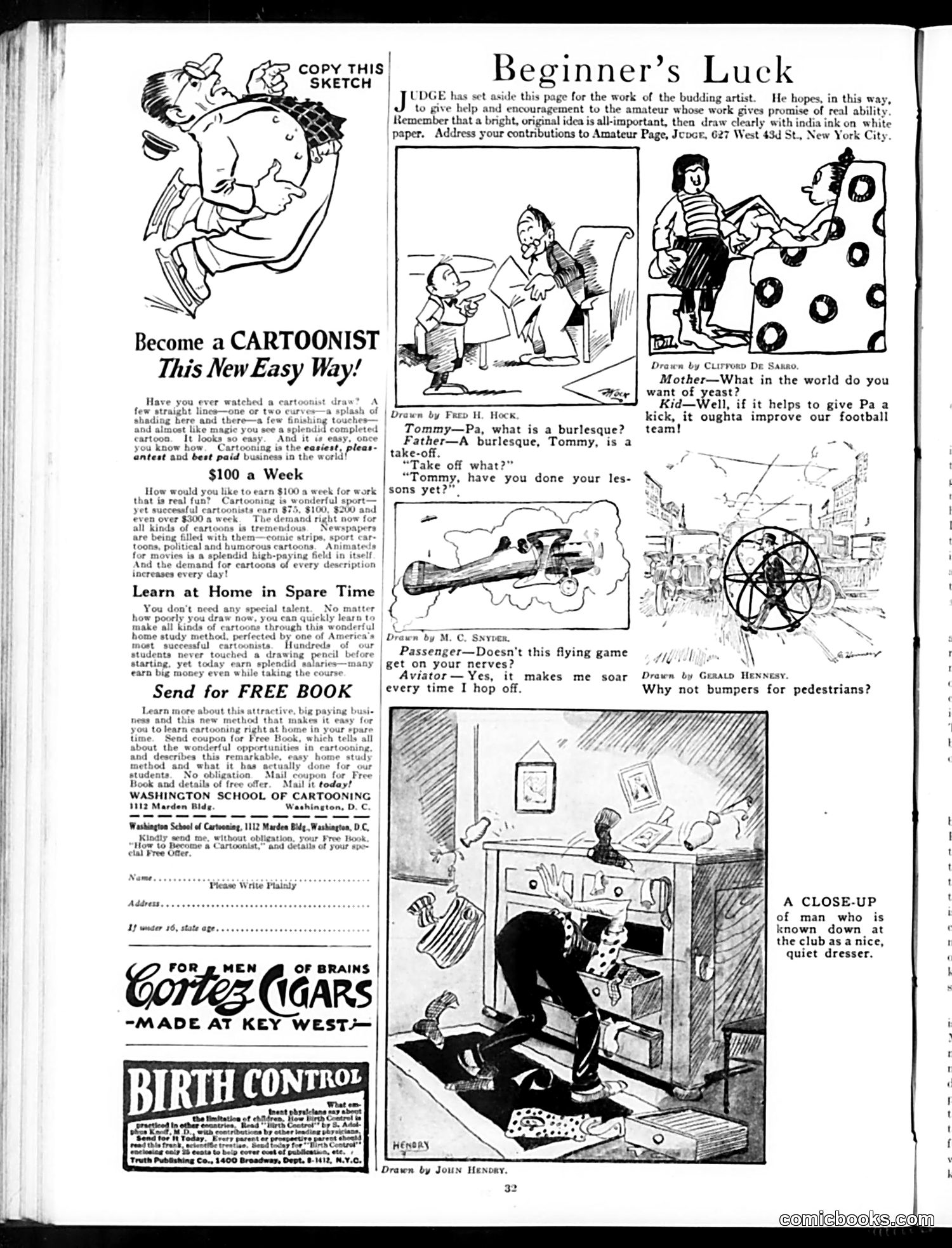
This page showcases amateur cartoons submitted to Judge's "Beginner's Luck" feature, where aspiring artists contributed work. The cartoons use simple, domestic humor: **The sketches depict:** - A child asking his father what "burlesque" means, receiving the answer "a take-off"—then the kid hopes improving Pa's football team constitutes "improvement" - A plane passenger asking an aviator if flying makes him nervous; he responds it makes him "soar" each time he "hops off"—wordplay on aviation terminology - A final cartoon showing a man at a dresser, captioned as "known down at the club as a nice, quiet dresser" **The satire:** These represent typical amateur efforts—relying on puns, obvious jokes, and genteel domestic scenarios rather than sophisticated political commentary. The page also advertises the "Washington School of Cartooning," offering correspondence courses promising $100 weekly income, reflecting early 20th-century vocational training marketing. The humor is gentle and accessible, targeting middle-class readers unfamiliar with cartooning as a profession.
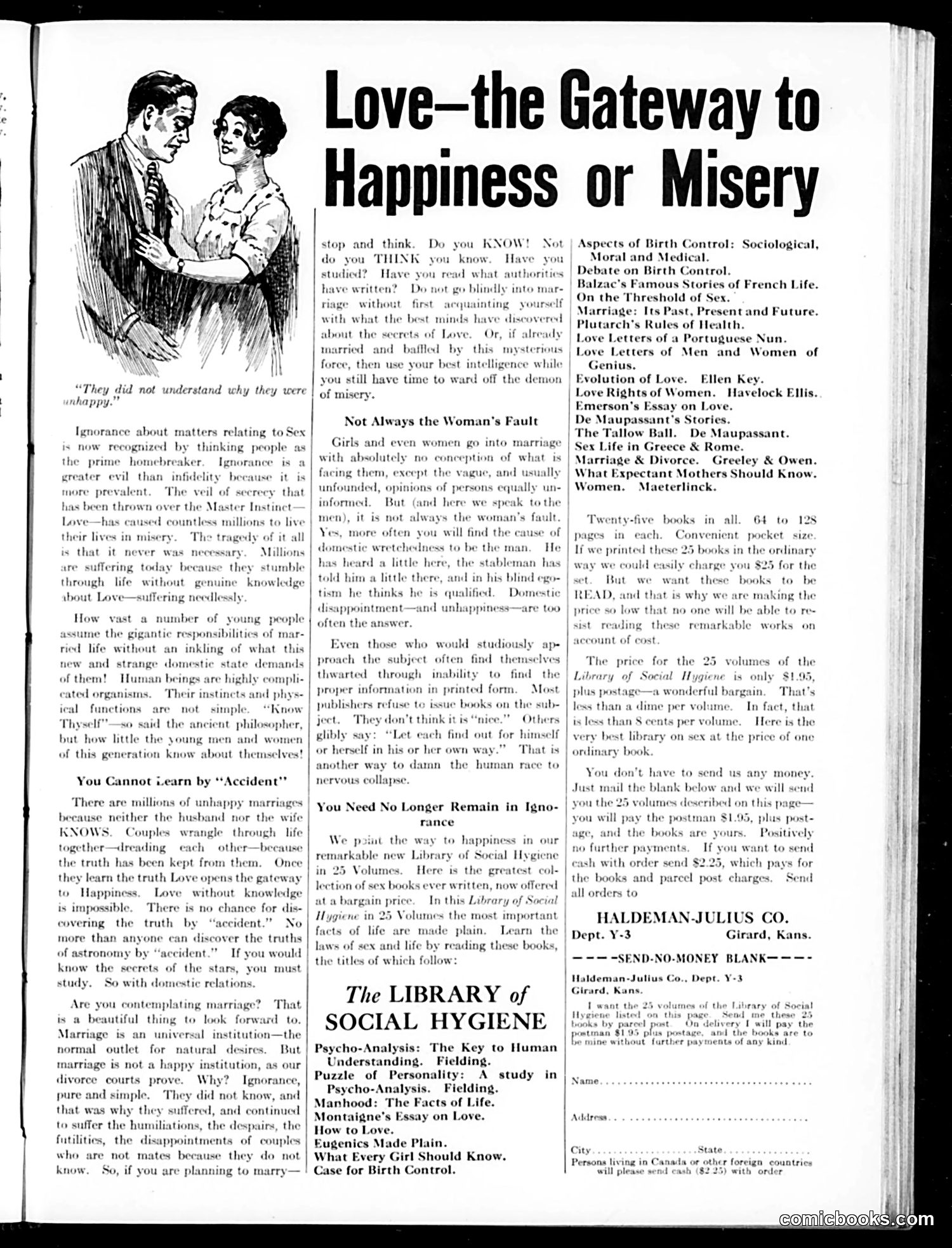
This page combines editorial content with advertising. The cartoon depicts a couple in conversation, illustrating the article's central argument: marriages fail due to **ignorance about sex and relationships**, not lack of love. The editorial argues that young people enter marriage without proper knowledge—relying on accident or incomplete information from unreliable sources (stablemen, rumor). It blames this ignorance for divorce, infidelity, and domestic misery. The piece challenges the cultural taboo preventing frank discussion of sexual matters. The **Library of Social Hygiene** advertisement below capitalizes on this argument, offering 25 books promising to provide the scientific knowledge couples supposedly need. This is vintage early-20th-century **sex education marketing**—selling respectability and scientific authority to overcome Victorian prudishness about discussing sexuality. For modern readers: this reflects a pre-1920s moment when progressive reformers used "science" and "education" to break silence around sex, while publishers profited from newly marketable anxiety about marital happiness.
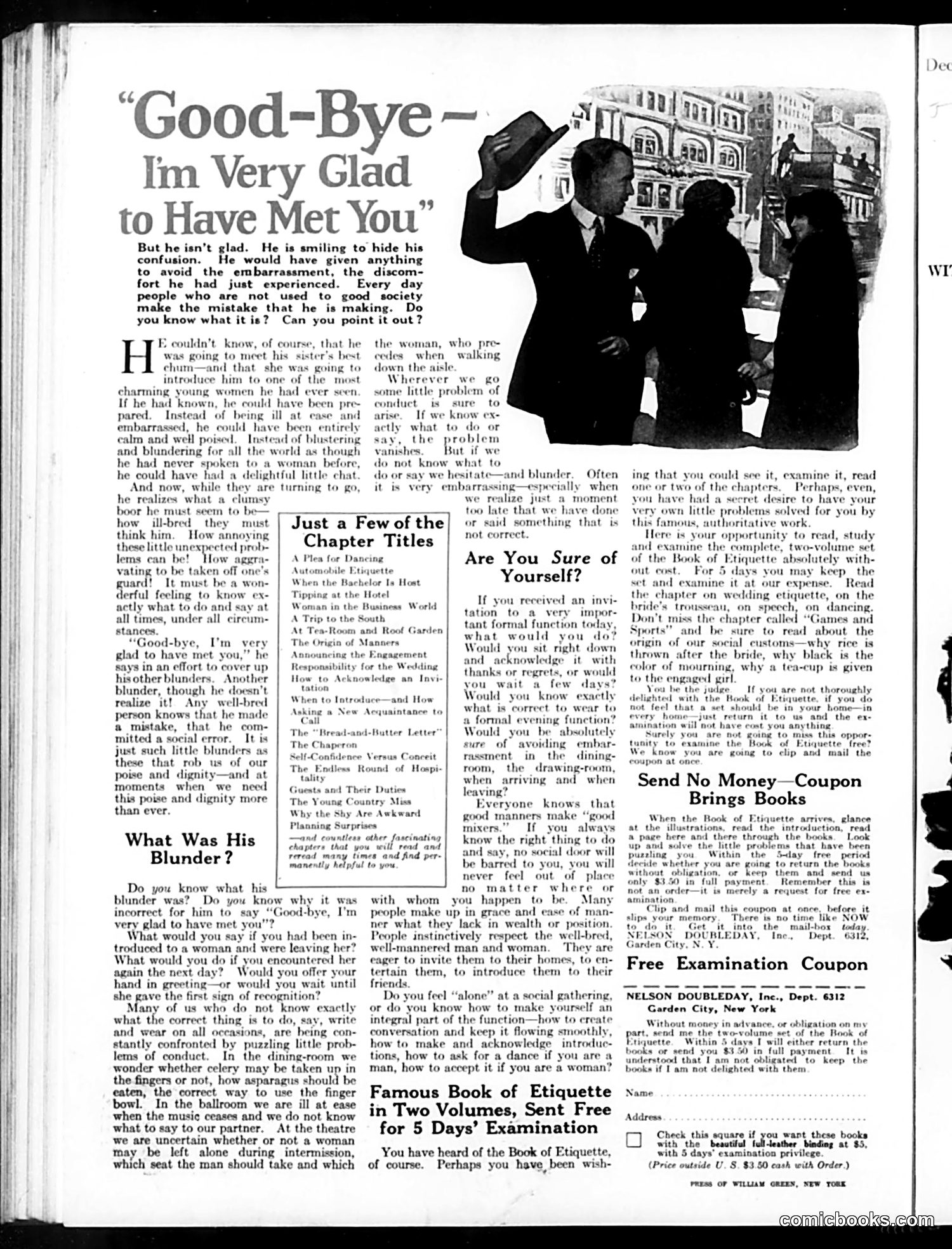
This page from Judge magazine presents an **etiquette advice article** disguised as social satire. The central illustration shows a man awkwardly saying goodbye to a woman after being introduced—he's visibly uncomfortable, hat in hand, clearly regretting his clumsy behavior during their interaction. The satire targets the **anxiety of social climbing** in early 20th-century American society. The article ironically sympathizes with people unfamiliar with "good society" who constantly commit small social errors—not knowing proper dining etiquette, how to acknowledge introductions, what to wear, or how to make conversation. The humor lies in portraying these minor missteps as catastrophic embarrassments. Judge mocks both the rigid social codes of the era *and* the desperate desire of ordinary people to master them. The accompanying advertisement sells an "Etiquette" book promising to eliminate exactly these anxieties—making the satire also a gentle jab at commercialized self-improvement culture. The underlying joke: social success depends on arbitrary, learnable rules that separate the "refined" from the "boorish."