
Judge, 1922-12-16 · page 13 of 36
Judge — December 16, 1922 — page 13: what you’re looking at
What you’re looking at
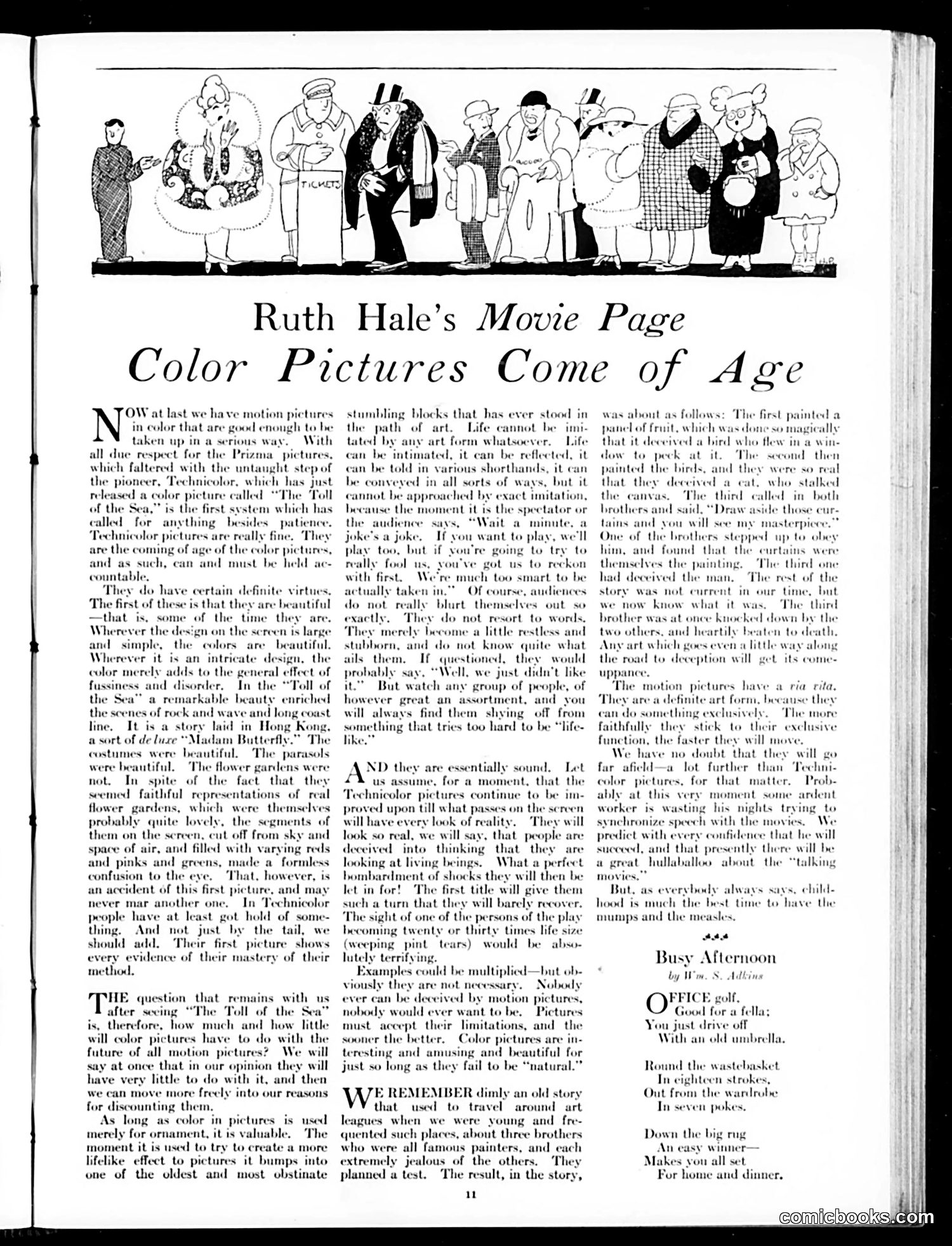
This is a film criticism column by Ruth Hale addressing the newly-arrived **Technicolor** technology in motion pictures. The headline illustration shows a diverse crowd of characters, likely representing different audience types or social classes attending movies. Hale praises Technicolor's technical achievement while arguing against using color to create "lifelike" realism in film. She contends that audiences don't want perfect imitation of life—they want art that *suggests* reality through selective technique. The core argument: if movies became too photorealistic (actors appearing 30 times life-size, weeping actual-sized tears), audiences would find it disturbing rather than immersive. She insists audiences **know** they're watching an artifice and *want* to maintain that awareness. This reflects 1920s debates about cinema's artistic purpose and the uncanny valley problem—decades before that term existed—questioning whether technological advancement always serves storytelling better.
📄 Transcribed text from this page (OCR, searchable)
Machine-transcribed from the original scan — historical spelling and the odd misread are preserved.
Ruth Hale’s Movie Page Color Pictures Come of Age OW at last we have motion pictures in color that are good en to be taken up in a serious way. With all due respect for the Prizma pictures. which faltered with the untaught step of the pioneer, Technicolor, which has just released a or picture called "1 Toll of the Se is the first system which has for anything patience. Technicolor pictures are really fine, They are the coming of age of the color pictures, and as such, can and must be held ac- countable. They do have certain definite virtues. The first of these —that is, some of the WI rth and simple, tars the « Wherever it is an intric: ign, the dds to the g fect of In the AL of the s * beauty enriched the scenes of rock and wave and long coast line. It is a story laid in Hong Kong, a sort of deluxe “Madam Butterfly.” The costumes were beautiful. The parasols were beautiful. The flower gardens were not. In spite of the fact that they seemed faithful representations of real flower gardens, which were themselves probably quite lovely, the segments of them on the sereen, cut off from sky and space of air, and filled with varying reds and pinks and greens, m a formless ‘ howe nt of this first picture, and may never mar another one. In ‘Technicolor people have at least got hold of some- thing. And not just by the tail, we should add, Their first’ picture shows every evidence of their mastery of their method. color merely fussir HE question that remains with us after secing “The Toll of the Sea’ is, therefore, how much and how little will color pictures have do with the future of all motion pictures? We will say at once that in our opinion they will very little to do with it, and then we can move more freely into our reasons for discounting them, As long as in pictures is used merely for ornament, it is valuable. The moment it is used to try to create a more lifelike effect to pictures it bumps into. one of the oldest and most obstinate stumbling blocks that has ever stood in the path of art. Life cannot be imi- tated by any art form whatsoever. Life can be intimated, it can be reflected, it can be told in various shorthands, it can he conveyed in all sorts of ways, but it cannot be approached by exact imitation, ause the moment it is the spectator or s says, “Wait a minute, ¢ If you want to play, w but if you're going to try really fool us gol us with first. We mueh t actually taken in.” Of cours do not really blurt themselves out so exactly, They do not resort to we They merely become a little stubborn, and do not know qui ails them. If questioned, they would probably say. “Well, we just didn’t like it.” But watch any group of people, of however great an assortment, and you will always find them shying off from something that tries too hard to be “life- like, audiences ND they are essentially sound. Let us assume, for a moment, that the Technicolor pictures continue to be im- proved upon till what passes on the sereen will have every look of They will look so real, we will say, that people are deceived into thinking that looking at living beings. What a bombardment of shocks they will then be let in for! The first title will give them such a turn that they will barely recover. ‘The sight of one of the persons of the play becoming twenty or thirty times life size (weeping pint tears) would be » lutely terrifying. Examples could be multiplicd—but ob- viously th st necessary. Nobody ev 1 be deceived by motion pictures, nobody would ever want to be. Pictures must accept their limitations, and the sooner the better. Color pictures are in- teresting and amusing and beautiful for just so long as they fail to be “natural.” Wii REMEMBER dimly an old story used to travel around art wes when we were young and fre- bine ented such places, about three brothers who were all famous painters, and each extremely jealous of the others. They planned a test. The result, in the story, * first painted a eso magically w ina wine then was about as fo panel of fruit, which was that it deceived a bird who f dow to peck at it. The painted the birds, and they were so real that they deceived a cat, who stalked the canvas. The third called in’ both brothers and said, “Draw aside those cur, tains and you | will see my masterpi One of the brothers stepped upt V him, and found that the curtains were themselves the painting, ‘The third one had deceived the man. The rest of the story was not current in our time, but we now know what it was. The third brother was knocked down by the rtily en to death, en alittle way along eception will get its come. uppance. The motion pictures have a ria rita, Th efinite art form, because they rething exclusively, “The more faithfully they stick to their exclusive function, the faster they will move. We have no doubt that they far afield lot further than color pictures, for that matter. Prob- ably at this very moment some ardent worker is wasting his nights trying to synchronize speech with the movies, We predict with every confidence that he will succeed, and that presently there will be hullaballoo about) the “talking will go ‘Techni- ag movies.” But. as everybody always says, child- hood is much the best time to have the mumps and the measles. Aas Busy Afternoon by Wm. S. Adkins FFICE golf, Good for a fella; wi just drive off With an old umbrella. Round the wastebasket In cightoon strokes, Out from the wardrobe In seven pokes. Down the big rug An easy winner: Ma you all set For home and dinner,