
Judge, 1922-12-16 · page 18 of 36
Judge — December 16, 1922 — page 18: what you’re looking at
What you’re looking at
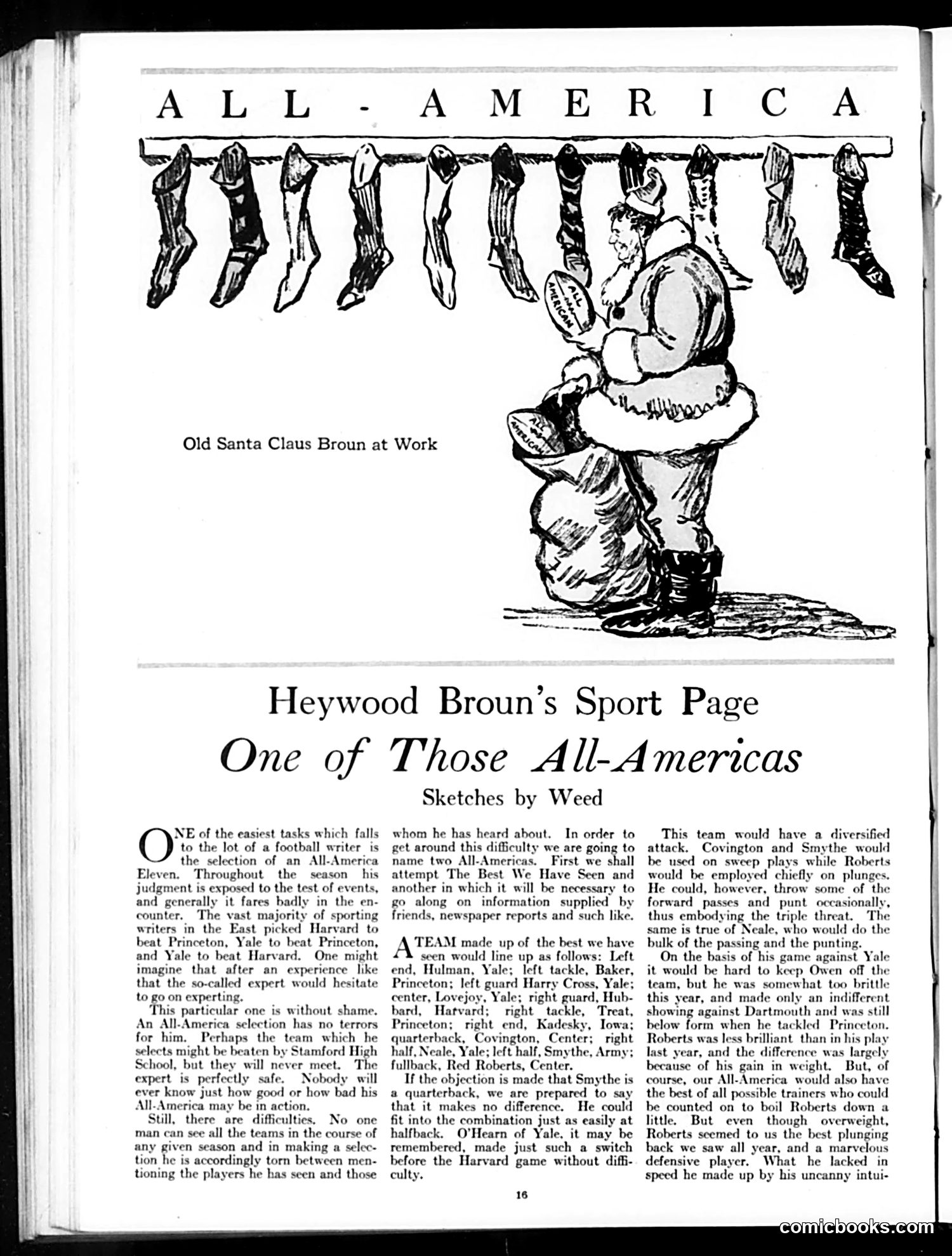
This is Heywood Broun's sports column featuring a satirical cartoon by Weed. The top illustration shows "Old Santa Claus Broun at Work"—a play on Broun's name ("Broun" sounds like "Brown"), depicting Santa hanging dressed meats, mocking the absurdity of selecting an "All-America" football team. Broun's essay critiques sportswriters' pretense of expertise. He notes Eastern writers confidently predicted Harvard would beat Princeton, Yale would beat Princeton, and Yale would beat Harvard—logically impossible predictions that all proved wrong. Yet these same "experts" continue selecting All-America teams without consequence, since their predictions face no real-world test. Broun then creates two hypothetical All-America elevens: one based on games he personally witnessed, another based on hearsay. The satire targets the arbitrary nature of sports journalism and expert commentary—how writers gain credibility through confident assertions about events most cannot fully observe, facing no accountability for errors.
📄 Transcribed text from this page (OCR, searchable)
Machine-transcribed from the original scan — historical spelling and the odd misread are preserved.
Old Santa Claus Broun at Work Heywood Broun’s Sport Page One of Those All-Americas NE of the easiest tasks which falls O to the lot of a football writer is the selection of an All-America Eleven. Throughout the season his judgment is exposed to the test of events, and generally it fares badly in the ¢ counter. The vast majority of sporting writers in the East picked Harvard to beat Princeton, Yale to beat Princeton, and Yale to beat Harvard. One might imagine that after an experience like that the so-called expert would hesitate to go on experting. This particular one is without shame. An All-America selection has no terrors for Perhaps the n which he selects might be beaten by § i School, but they will never meet. The expert is perfectly safe. Nobody will ever know just how good or how bad his All-America may be in action. Still, there are difficulties. No one man see all the teams in the course of any given season and in making a selec- tion he is accordingly torn between men- tioning the players he has seen and those Sketches by Weed whom he has heard about. In order to get around this difficulty we are going to name two All-Americas. First we shall attempt The Best We Have Seen and another in which it will be necessary to go along on information supplied by friends, newspaper reports and such like. TEAM made up of the best we have seen would line up as follows: Left end, Hulman, Yale; left tackle, Baker, Princeton; left guard Harry Cross, Yale; center, Lovejoy, Yale; right guard, Hub- bard, Hatvard; right tackle, Treat, Princeton; right end, Kadesky, Iowa; quarterback, Covington, Center; right half, Neale, Yale; left half, Smythe, Army; fullback, Red Roberts, Center. If the objection is made that Smythe is a quarterback, we are prepared to say that it makes no difference. He could fit into the combination just as easily at halfback. O’Hearn of Yale, it may be remembered, made just such a switch hoe the Harvard game without diffi- culty. 16 This team would have a diversified attack. Covington and Smythe would be used on sweep plays while Roberts would be employed chiefly on plunges. He could, however, throw some of the forward passes and punt occasionally, thus embodying the triple threat. The same is true of Neale, who would do the bulk of the passing and the punting. On the basis of his game against Yale it would be hard to keep Owen off the team, but he was somewhat too brittle this year, and made only an indifferent showing against Dartmouth and was still below form when he tackled Princeton. Roberts was less brilliant than in his play last year, and the difference was largely because of his gain in weight. But, of course, our All-America would also have the best of all possible trainers who could be counted on to boil Roberts down a little. But even though overweight, Roberts scemed to us the best plunging back we saw all year, and a marvelous defensive player. What he lacked in speed he made up by his uncanny intui-