
Judge, 1922-12-16 · page 30 of 36
Judge — December 16, 1922 — page 30: what you’re looking at
What you’re looking at
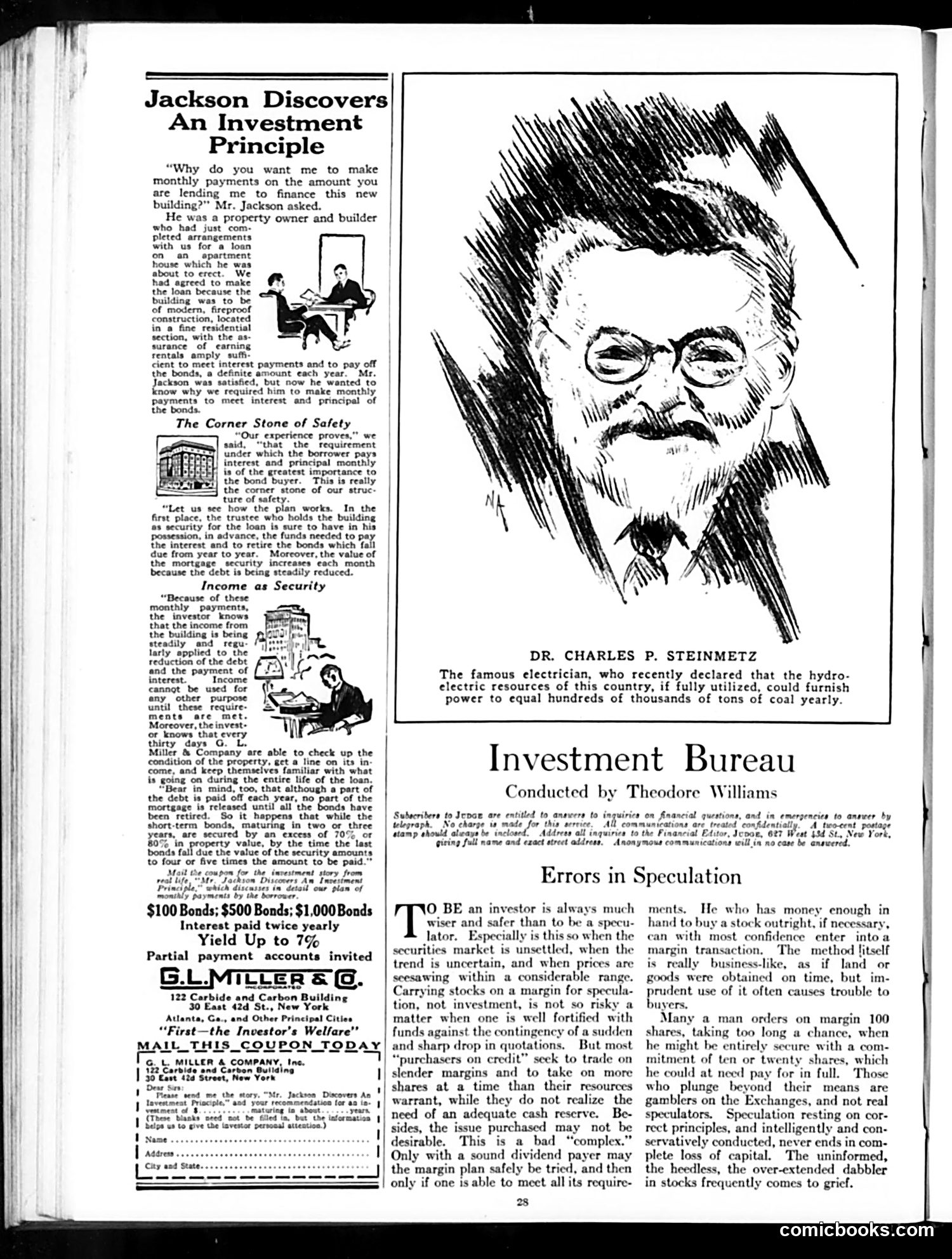
This page is primarily **advertising for G.L. Miller & Company**, an investment firm, disguised as financial education content. The narrative "Jackson Discovers An Investment Principle" presents a dialogue between a property developer and a loan officer explaining why monthly bond payments protect investors—essentially a sales pitch for the firm's bond offerings ($100-$1,000 denominations, yielding up to 7%). The portrait of **Dr. Charles P. Steinmetz**, a famous electrician, appears as a celebrity endorsement of hydroelectric power investment potential, lending prestige to the financial products being promoted. The "Investment Bureau" section titled "Errors in Speculation" warns against margin trading and risky stock practices—a conservative pitch positioning Miller & Company's bonds as the safer alternative to stock market gambling. This represents early-20th-century **advertorial content**: educational framing to market financial products, using credible experts and cautionary tales to build investor confidence during an era of stock market volatility and speculation.
📄 Transcribed text from this page (OCR, searchable)
Machine-transcribed from the original scan — historical spelling and the odd misread are preserved.
—_—————EEEEEEEeEE ss Jackson Discovers An Investment Principle “Why do you want me to make monthly payments on the amount you are lending me to finance this new building?” Mr. Jackson asked. He was a property owner and builder who had just com- pleted arrangements with us for a loan on an apartment house which he was about to erect. We had agreed to make the loan because the building was to be of modern, fireproof construction, located in a fine residential section, with the as- surance of earning rentals amply suffi- cient to meet interest payments and to pay off the bonds, a definite amount each year. Mr. Jackson was satisfied, but now he wanted to know why we required him to make monthly payments to meet interest and principal of the bonds. The Corner Stone of Safety “Our experience proves,” we said, “that the requirement under which the borrower pays interest and principal monthly | is of the greatest importance to the bond buyer. This is really the corner stone of our struc- ture of safety. “Let us see how the plan works. In the first place, the trustee who holds the building as security for the loan is sure to have in his possession, in advance, the funds needed to pa the interest and to retire the bonds which fall due from year to year. Moreover, the mortgage security increases because the debt is being steadily reduced. Income as Security “Because of these monthly payments, the investor knows that the income from the building is being steadily and regu- larly applied to the reduction of the debt and the payment of interest. Income cannot be used for any other purpose until these require- ments are met Moreover, the inves or knows thirty day Miller & Company are able to check up the condition of the property, get a line on its in. come, and keep themselves familiar with what is going on during the entire life of the loan. at in mind, too, that although a part of the debt is paid off each year, no part of the mortgage is released until all ‘the is have been retired. So it happens that while the short: term bonds, maturing in two or three are secured by an excess of 70° of oo" in Pe erty value, by the time the last bonds fall due the value of the security amoun to four of five times the amount to be paid.” M ve imvestment story from $100 Bonds; $500 Bonds: $1,000Bonds Interest paid twice yearly Yield Up to 7% Partial payment accounts invited G.L.MIccER & G. 122 Carbide and Carbon Building 30 East 42d St., New York Atlanta, Ge., and Other Principal Citi “‘First—the Investor's Welfare’ MAILL_THIS_ COUPON TODAY G, kL MILLER, & COMPANY, Ine. 122 Cardia Carton Building 30 East (2d Street, New York Dear Sur 1 Feber end me the story, “Me. Jackson Discovers As J leyerineat riacole” asd year recommendation for aa in yeumest of 8 maturing (a yearn 1 fines, bits ‘seed! ait bees fa. vet ts tafertsons Nige us to wive the lavestor pervosal attestion) 4 Name | Aceress 4 State, fea eer erga pay | ' | DR. CHARLES P. STEINMETZ The famous electrician, who recently declared that the hydro- electric resources of this country, if fully utilized, could furnish power to equal hundreds of thousands of tons of coal yearly. Investment Bureau Conducted by Theodore Williams Subscribers to Jepae are entitled to answers to inguirice on financial questions, and in emergencies to answer by Lelegraph. No charge ts made for this service. All communications are treated confide stamp should always be inclosed. Address all inquiries to the Financial Et A teo-cent pos Icooe, OFT West $3 St, New York, giring full name and exact etrect address. Anonymous communications will,in no case be answered. Errors in Speculation O BE an investor is always much I wiser and safer than to be a specu- lator. Especially is this so when the securities market is unsettled, when the trend is uncertain, and when prices are seesawing within a considerable range. Carrying stocks on a margin for patie tion, not investment, is not so risk matter when one is well fortified with funds against the contingency of a sudden and sharp drop in quotations. But most “purchasers on credit” seek to trade on slender margins and to take on more shares at a time than their resources warrant, while they do not realize the | need of an adequate cash reserve. Be- sides, the issue purchased may not be desirable. This is a bad “complex.” | Only with a sound dividend payer may the margin plan safely be tried, and then only if one is able to meet all its require- 238 ments. He who has money enough in nd to buy a stock outright, if necessary, an with most confidence enter into a margin transaction. The method litself is really business-like, as_ if dor goods were obtained on time, but im- prudent use of it often causes trouble to buyers. Many a man orders on margin 100 shares, taking too long a chance, when he might be entirely secure with a com- mitment of ten or twenty shares, which he could at need pay for in full. Those who plunge beyond their means are gamblers on the Exchanges, and not real speculators. Speculation resting on cor- rect principles, and intelligently and con- servatively conducted, never ends in com- plete loss of capital. The uninformed, the heedless, the over-extended dabbler in stocks frequently comes to grief. comicbooks.com