
Judge, 1922-12-16 · page 7 of 36
Judge — December 16, 1922 — page 7: what you’re looking at
What you’re looking at
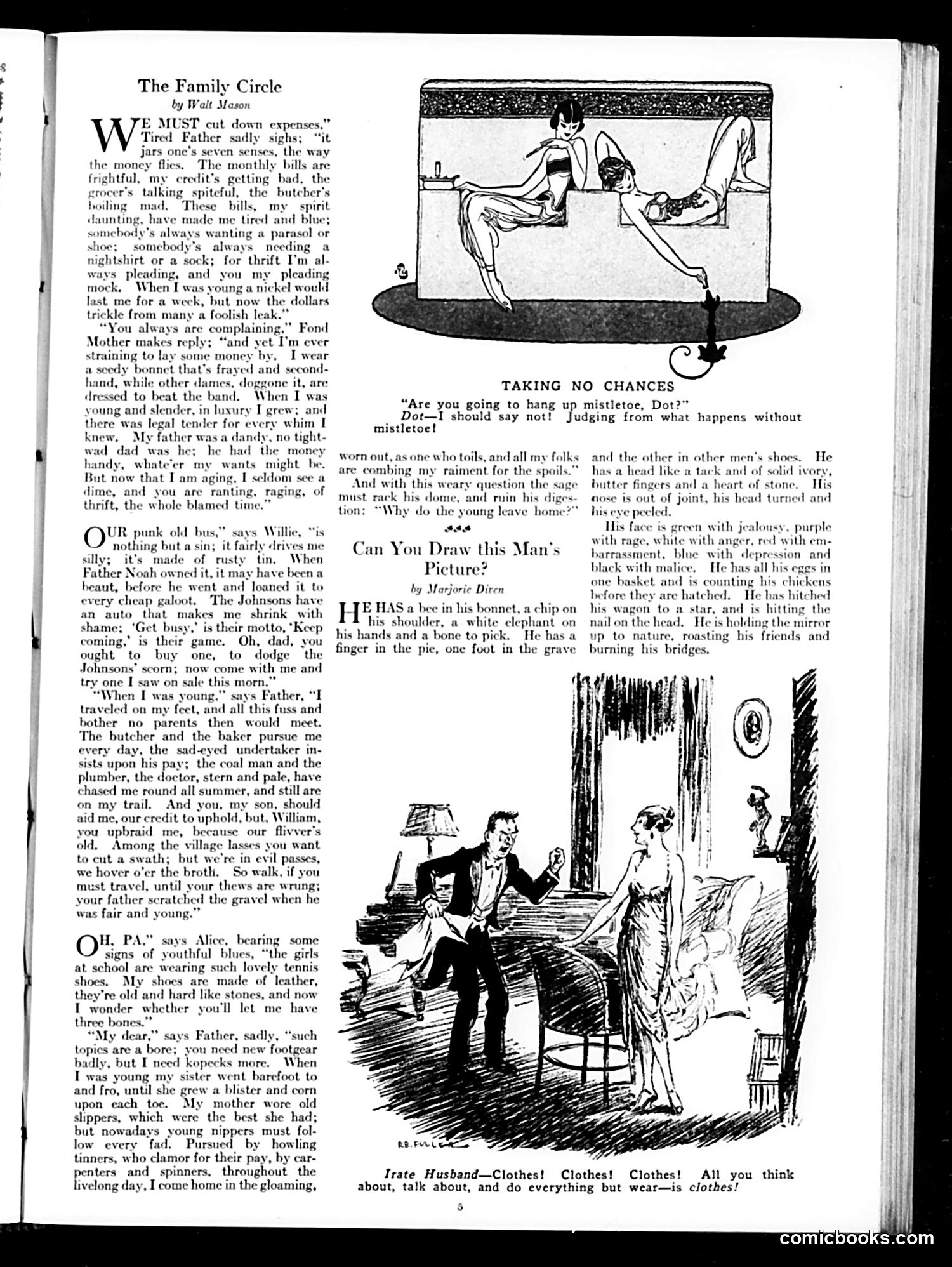
This page from *Judge* contains two separate satirical pieces about early 20th-century American family life: **"The Family Circle"** (left) is a humorous poem by Walt Mason depicting a common domestic conflict: an exasperated father demanding the family cut expenses while various family members (mother, Willie, Alice) justify their spending needs—new clothes, shoes, a car. The satire mocks both the father's futile complaints and the family's endless material desires, capturing post-WWI middle-class financial anxiety. **"Taking No Chances"** (top right) is a brief joke about a couple avoiding mistletoe during Christmas, with the woman joking that based on how the man behaves, she won't risk kissing him. It's lighthearted domestic humor. **"Can You Draw This Man's Picture?"** (bottom right) is a visual riddle where readers must identify a man described through contradictory metaphors—he has characteristics of various emotions and animals simultaneously. It's a parlor-game style puzzle typical of period magazines. The overall page reflects anxieties about consumerism, marriage dynamics, and modern life in the 1920s-1930s.
📄 Transcribed text from this page (OCR, searchable)
Machine-transcribed from the original scan — historical spelling and the odd misread are preserved.
er ME The Family Circle by Walt Mason E MUST cut down expenses,” Tired Father sadly sighs; “it rs one’s seven senses, the way y flies. The monthly bills are htful, my credit’s getting bad, the r's talking spiteful, the butche boiling mad. These bills, my spi daunting, have made me tired and blue; somebody's alwa shoc; somebody needing a nightshirt or a sock; for thrift I’m al- ways pleading, and you my pleading mock. When I was young a nickel would last me for a week, but now the dollars trickle from many a foolish leak. “You always are complaining,” Fond Mother makes reply; “and yet I’m ever straining to |. y. [wear a seedy bonn and second- hand, while other dames, doggone it, are TAKING NO CHANCES dressed to beat the band. When I was “Are you golag to hang up mistletoe, Dot?” young and slender, in luxury I grew: and e f there was legal tender for every whim I waite should say not!’ Judging from what happens without knew. My father was a dandy, no tight- wad dad was he; he had the money handy, whate’er my wants might But now that I am aging, I dime, and you are ranting, thrift, the whole blamed time. worn out, as one who toils, and all my folks and the other in other men’s shoes, He Went 2 are combing my raiment for the spoils.” has a head like a tack and of solid ivory, _e t And with this weary question the sage butter fingers and a heart of ste His ing. OF must rack his dome, and ruin his diges- nose is out of joint, his head turned and tion: “Why do the young leave home?” his eye peeled. UR punk old bus,” says Willie, “is “ee with rages white wilh anger el sith ce nothing but a sin; it fairly drives m Can You Draw this Man's — jyarrassment, blue with depression and it’s made of rusty tin. When ° p Father Noah owned it, it may have been a Picture? black mith malice: He has “ his eggs in hea 7 » went and loa st te shaets | one basket and is counting his chickens veaut, before he went and loaned it to by Marjorie Diren before theyiare hatched: He haa hitched is their motto, ‘Keep; - his shoulder, a white elephant on nailon the head. He is holding the mirror coming,’ is their game. Oh, dad, you his hands and a bone to pick. He has a up to nature, roasting his friends and ought to buy one, to dodge’ ‘the finger in the pie, one foot in the grave burning his bridges. Johnsons’ scorn; now come with me and try one I saw on sale this morn.” “When I was young,” says Father, “I traveled on my feet, and all this fuss and bother no parents then would meet. The butcher and the baker pursue me every day, the sad-eyed undertaker in- sists upon his pay; the coal man and the plumber, the doctor, stern and pale, have chased me round all summer, and still are on my trail. And you, my son, should aid me, our credit to uphold, but, William, you upbraid me, because our flivver's old. Among the village lasses you want to cut a swath; but we're in evil passes, we hover o'er the broth. So walk, if you must travel, until your thews are wrung; your father scratched the gravel when he ‘air and young.” H, PA,” says Alice, bearing some signs of youthful blues, “the girls hool are wearing such lovely tennis shoes. My shoes are made of leather, they’re old and hard like stones, and now I wonder whether you'll let me have three bones.” “My dear,” says Father, sadly, “such topics are a bore; you need new footgear badly, but I need kopecks more. When I young my sister went barefoot to and fro, until she grew a blister and corn upon each toc. My mother wore old slippers, which were the best she had; but nowadays young nippers must fol- FZ low every fad. Pursued by howling ReFAL tinners, who clamor for their pay, by car- ‘ penters and spinners, throughout the Irate Husband—Clothes! Clothes! Clothes! All you think livelong day, I come home in the gloaming, about, talk about, and do everything but wear—is clothes!