
A complete issue · 36 pages · 1922
Judge — November 4, 1922
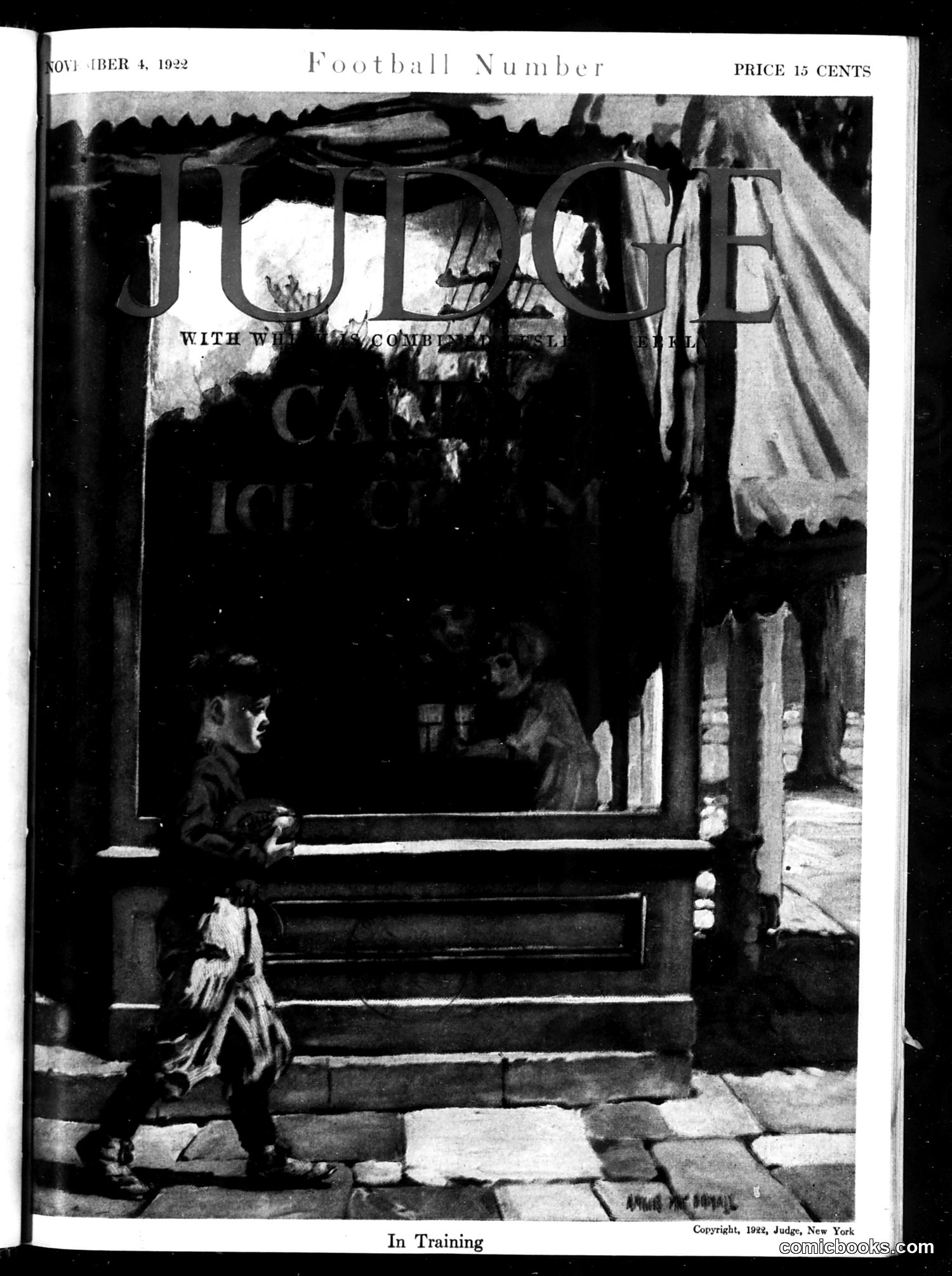
This page from Judge magazine features a photograph titled "In Training" rather than a traditional political cartoon. The image shows what appears to be a storefront or window display with figures visible inside and outside. The large "JUDGE" masthead overlays the photograph, and partial text reads "WITH WELL...COMBED...IST" and "CA..." below, though the complete captions are obscured or unclear in this reproduction. Without legible contextual text, the specific satirical subject cannot be definitively identified. The photograph's purpose—whether documenting actual street scenes, social commentary, or staged humor—remains ambiguous from the image alone. This appears to be photojournalism rather than editorial cartooning, reflecting Judge's occasional use of actual photographs for satirical commentary during this period.
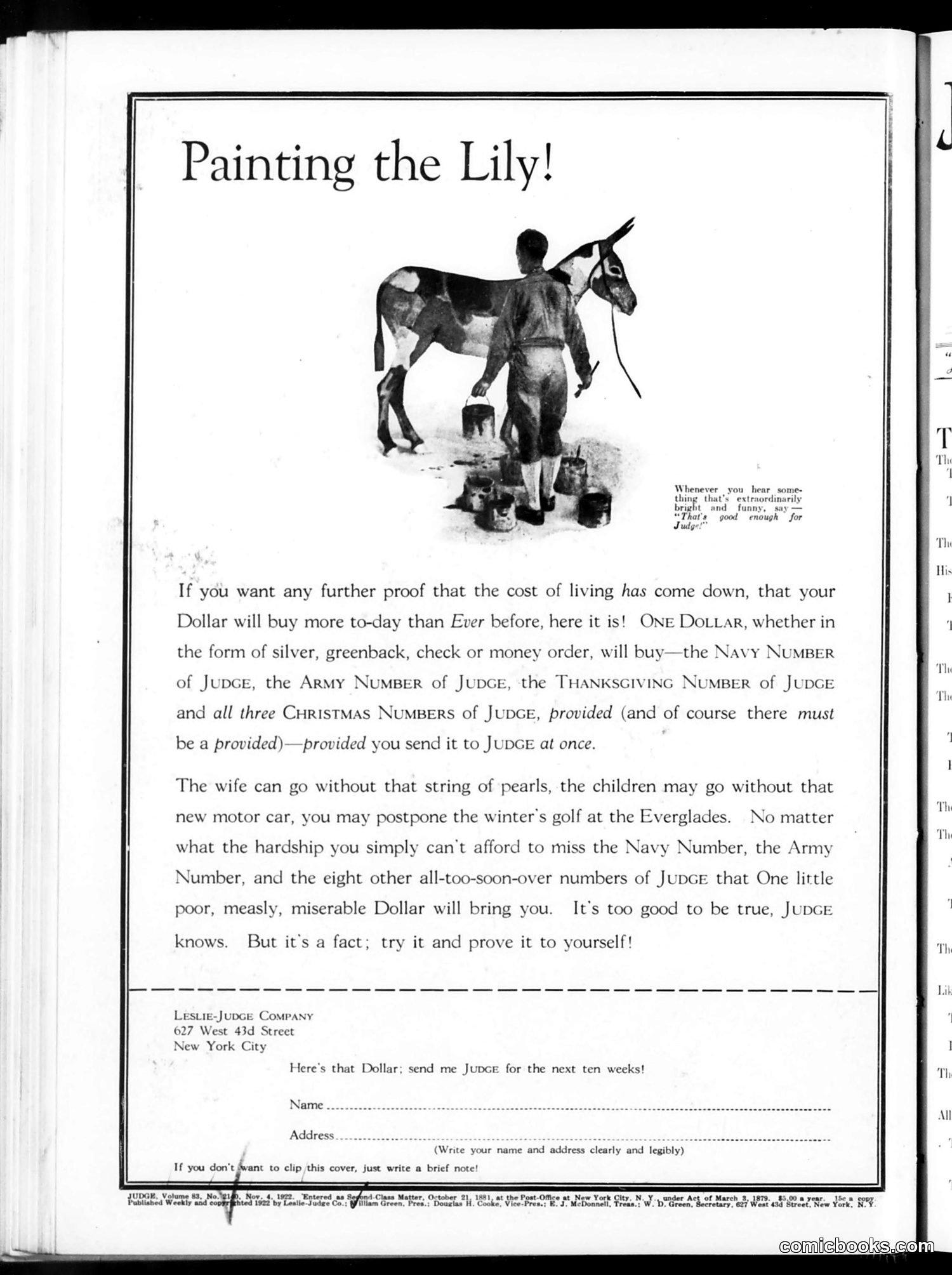
This is primarily an **advertisement for Judge magazine subscriptions**, not a political cartoon. The title "Painting the Lily" is a phrase meaning to gild or embellish something already perfect—here used ironically. The image shows a figure painting a donkey, satirizing the magazine's claims about its value. The text argues that one dollar spent on Judge subscriptions (Navy Number, Army Number, Thanksgiving Number, Christmas Numbers) provides better value than money spent on luxuries like pearls, motor cars, or golf trips. The satire targets readers' priorities, suggesting they should sacrifice personal luxuries to subscribe to Judge. The "painted lily" reference mocks the exaggerated claims—implying Judge adds unnecessary embellishment to ordinary life. This is essentially a humorous sales pitch wrapped in self-aware satire typical of Judge's promotional style.
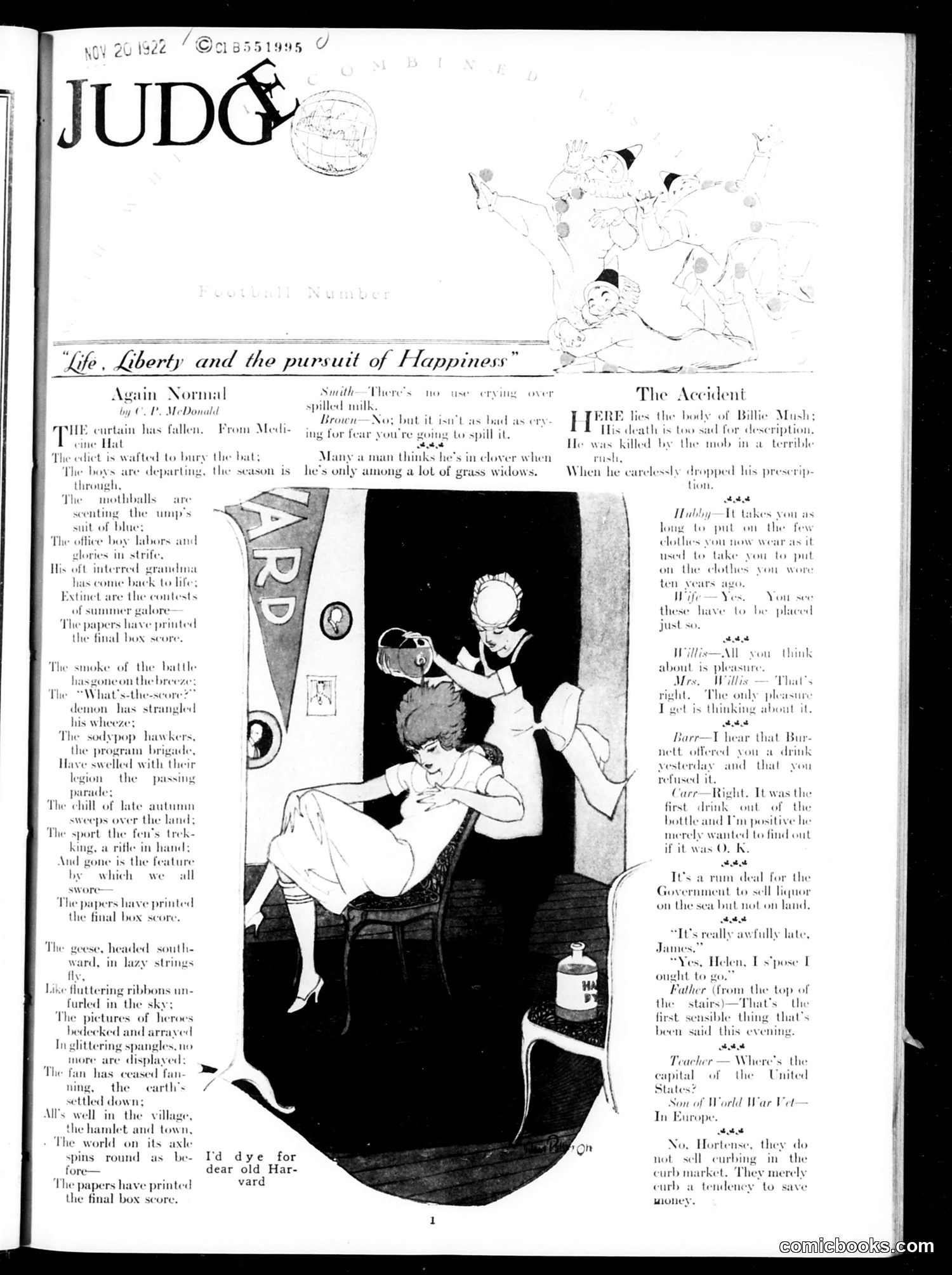
This page combines poetry and domestic humor typical of Judge magazine's satirical content. "Again Normal" is a nostalgic poem about autumn and returning to peacetime routines after World War I, with lines like "The papers have printed the final box score." The central illustration and accompanying dialogue piece titled "The Accident" depicts a slapstick domestic scene where a woman has apparently spilled something on a man's clothing. The conversation reveals she's ruined clothes he'd been saving, and they discuss whether to report it to insurance. The humor is gentle, domestic satire about post-war normalcy and middle-class anxieties—insurance claims, clothing care, marital relations—rather than sharp political commentary. This reflects Judge's shift toward lighter material in the early 1920s.
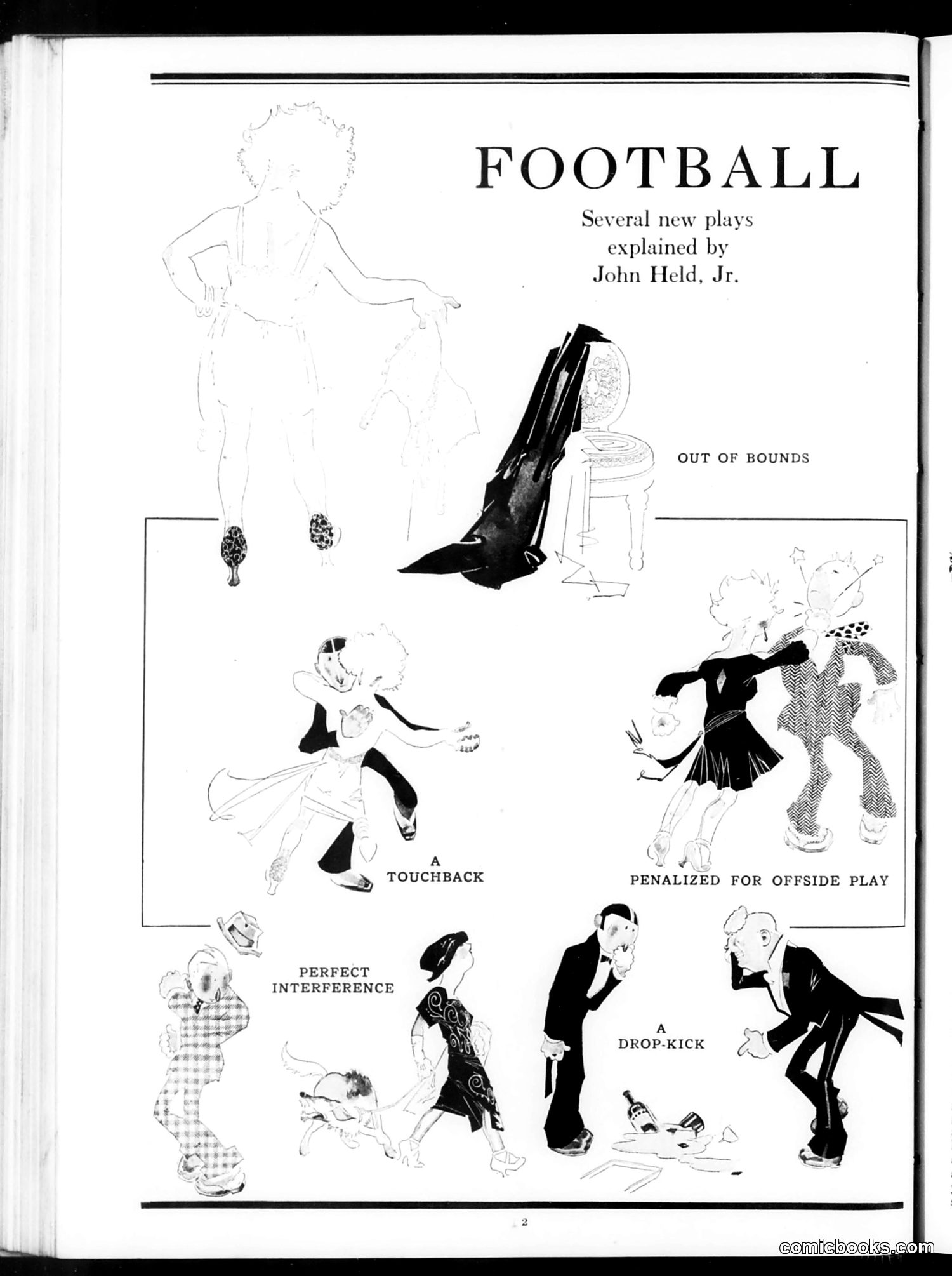
This is a humorous instructional page about football rules, explained by John Held, Jr., a prominent cartoonist known for satirizing 1920s society. Rather than political satire, the page uses comedic illustrations to explain various football plays and penalties through exaggerated physical comedy. The vignettes show: - **"A Touchback"** and **"Out of Bounds"**: Players in awkward positions - **"Perfect Interference"** and **"Penalized for Offside Play"**: Bodies tangled or colliding - **"A Drop-Kick"**: Demonstrated with physical humor Held employs his signature style—elongated figures, flapper-era clothing, and slapstick poses—to make abstract football rules accessible and entertaining to readers. This reflects 1920s sports popularization and Held's role as a cultural commentator who made modern leisure activities humorous for mainstream audiences.
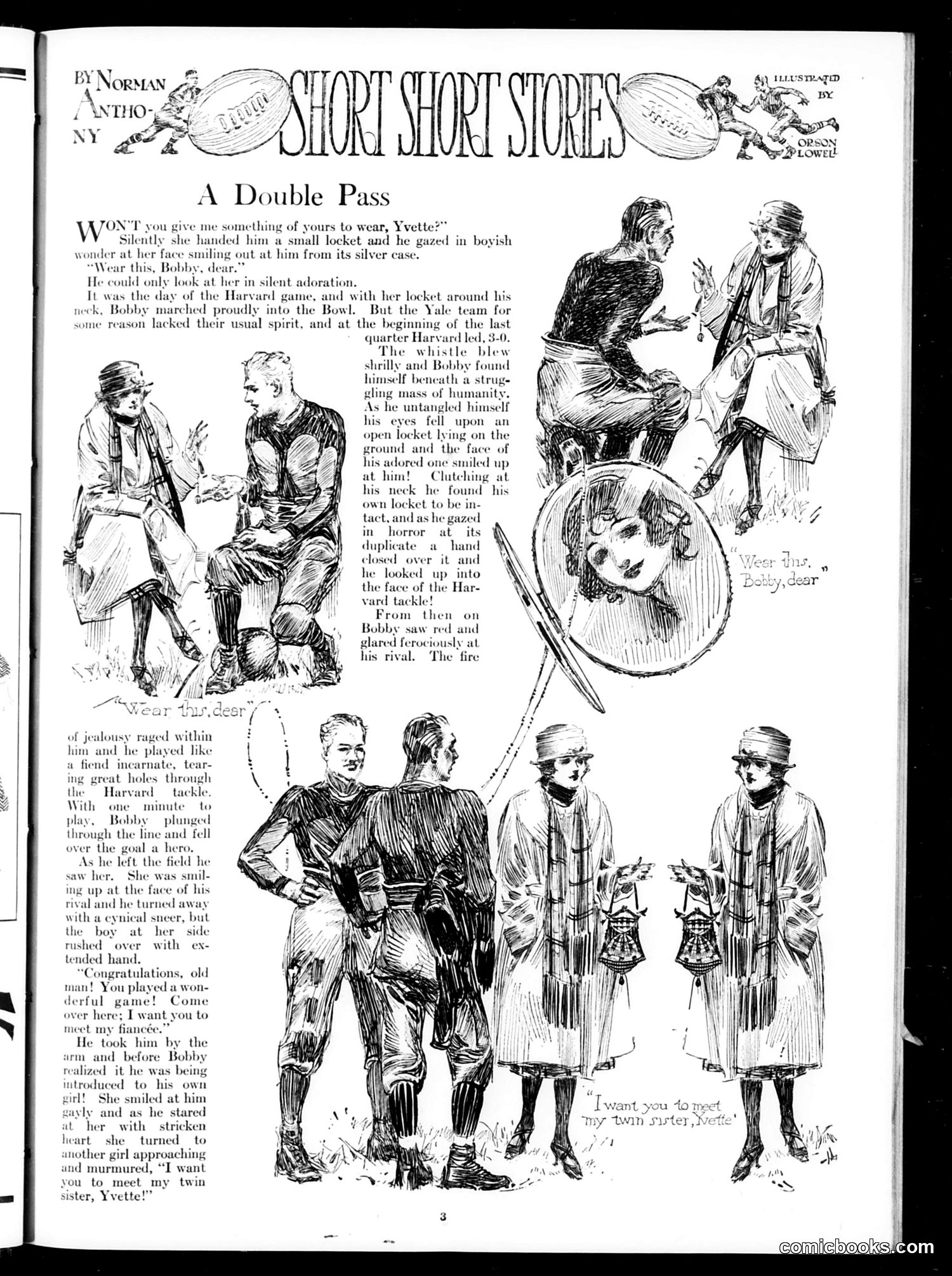
This is a short story illustrated by Norman Anthony, not political satire. The narrative concerns a young man named Bobby who attends a Harvard-Yale football game and becomes jealous when his girlfriend Yvette receives attention from a rival suitor. The plot hinges on a locket—Bobby gives Yvette a locket to wear, then discovers his rival has an identical one. The story climaxes when Bobby, playing football, deliberately injures his rival on the field. Yvette ultimately chooses Bobby, though he must apologize for his unsportsmanlike behavior. The "double pass" refers both to football plays and the romantic rivalry. This is entertainment fiction aimed at Judge's readers, reflecting early 20th-century attitudes about competitive masculinity and college sports romance.
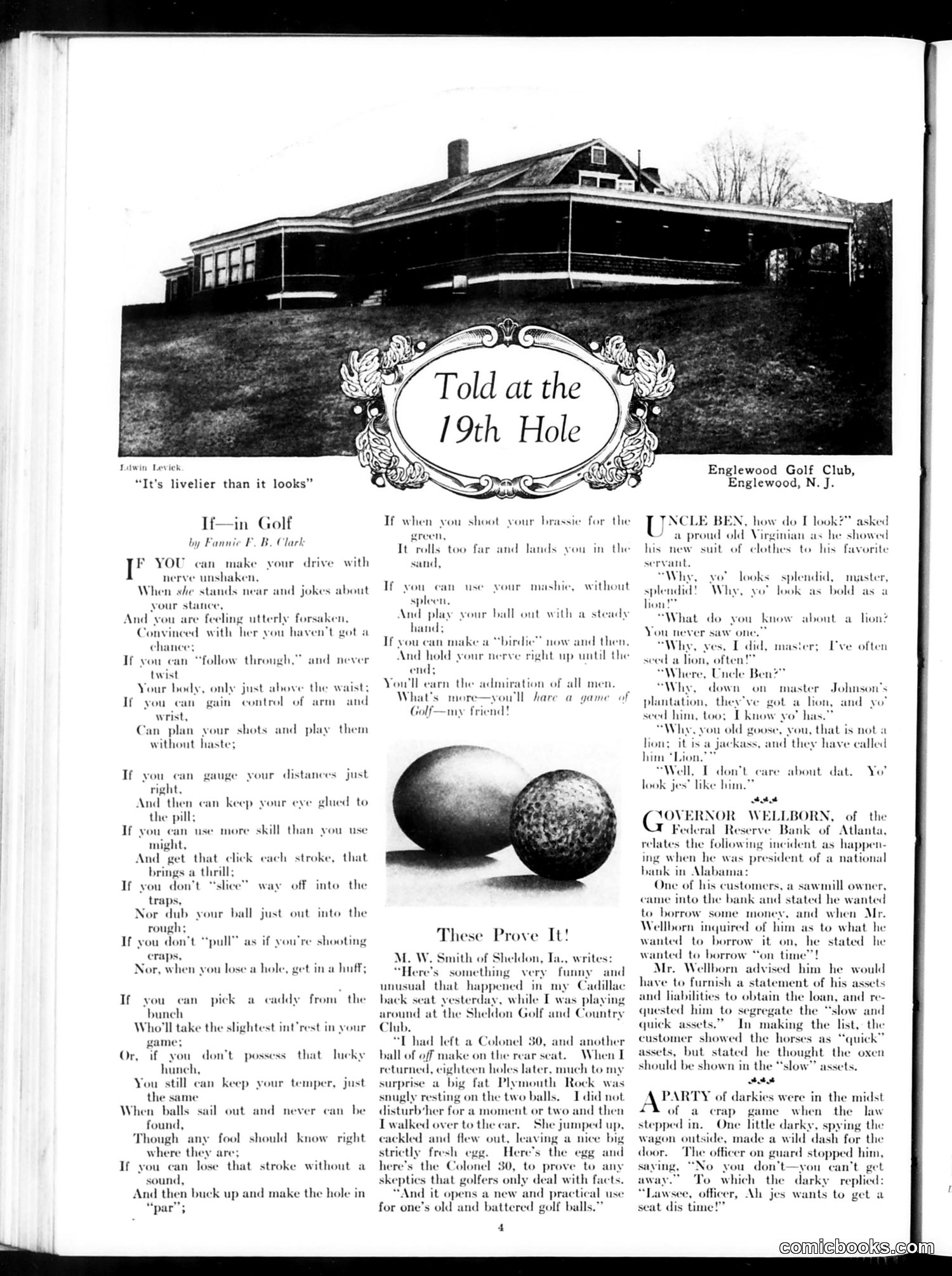
This page from Judge magazine features golf-themed humor rather than political satire. The main content includes: **"If—in Golf"** (left): A humorous poem by Fannie F. B. Clark offering golfing advice in mock-serious tone, suggesting that mastering golf requires composure, skill, and psychological control. **"These Prove It!"** (center): Three anecdotes from golfers describing funny incidents at golf clubs, including a story about a Colonel's car being hit by a golf ball, and tales of unusual animal encounters during games. **Header Image**: Shows Englewood Golf Club in New Jersey, establishing the genteel, upper-class sporting context. The humor relies on golf's popularity among the American leisure class in this era, poking gentle fun at golfers' pretensions and the sport's unexpected mishaps rather than commenting on contemporary politics or social issues.
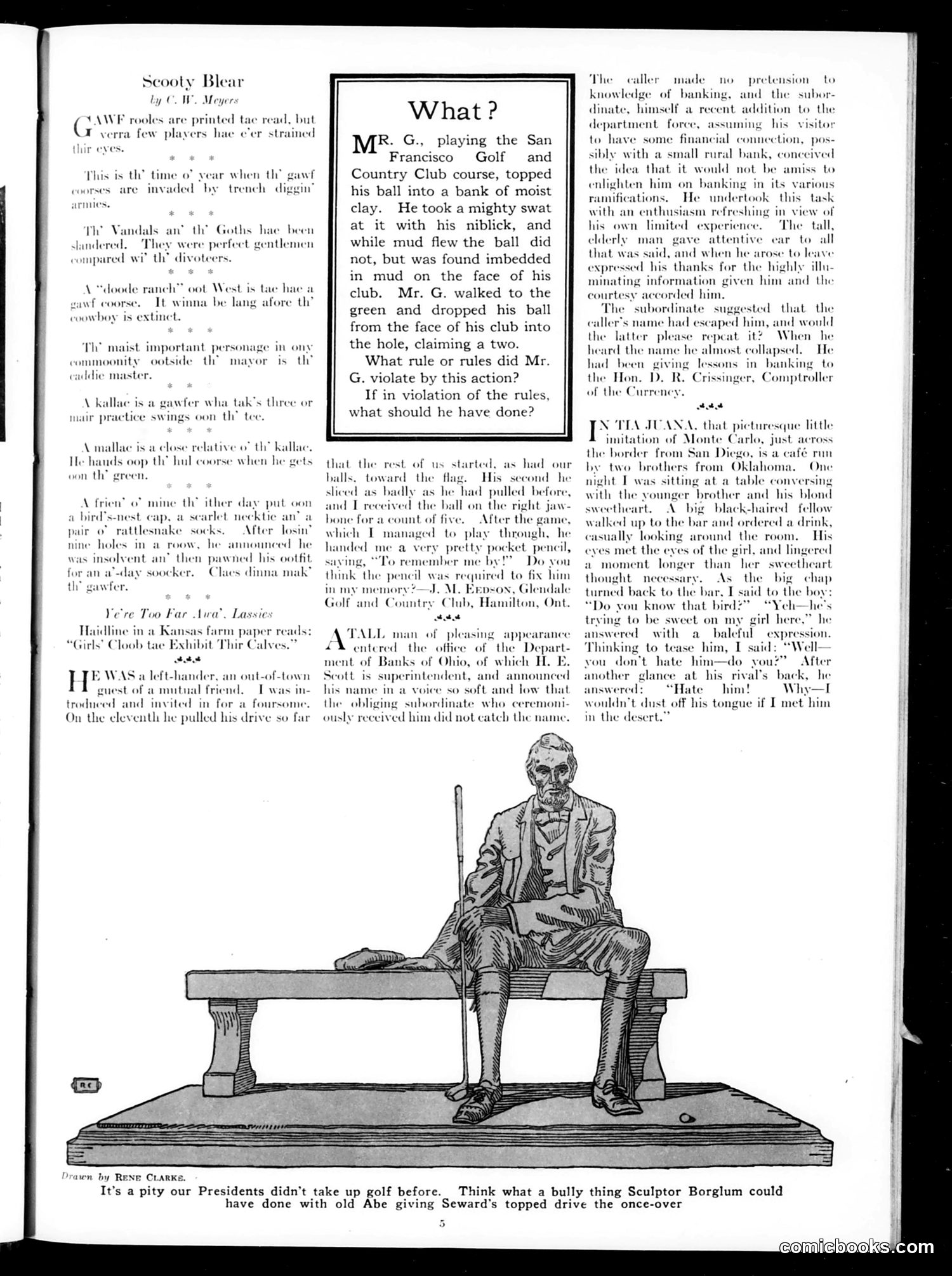
This page contains three separate humorous pieces: **"Scooty Bleat"** presents Scottish dialect golf observations—essentially jokes about golfers' behavior and golf course etiquette, with no specific political content. **"What?"** is a golf rules dispute: Mr. G. hits his ball into mud, extracts it caked with clay on his club face, then drops it in the hole claiming a score of two. The piece asks readers what rule he violated and what he should have done—a reader participation puzzle about golf ethics. **The Rene Clarke cartoon** depicts an elderly man sitting on a bench holding a golf club. The caption reads: "It's a pity our Presidents didn't take up golf before. Think what a bully thing Sculptor Borglum could have done with old Abe giving Seward's topped drive the once-over." This references Mount Rushmore sculptor Gutzon Borglum and humorously suggests if Presidents had golfed earlier, Borglum could have immortalized them in embarrassing golf moments—specifically Abraham Lincoln reacting to a poor golf shot by Secretary of State William Seward. The page is primarily recreational golf humor with mild political satire.
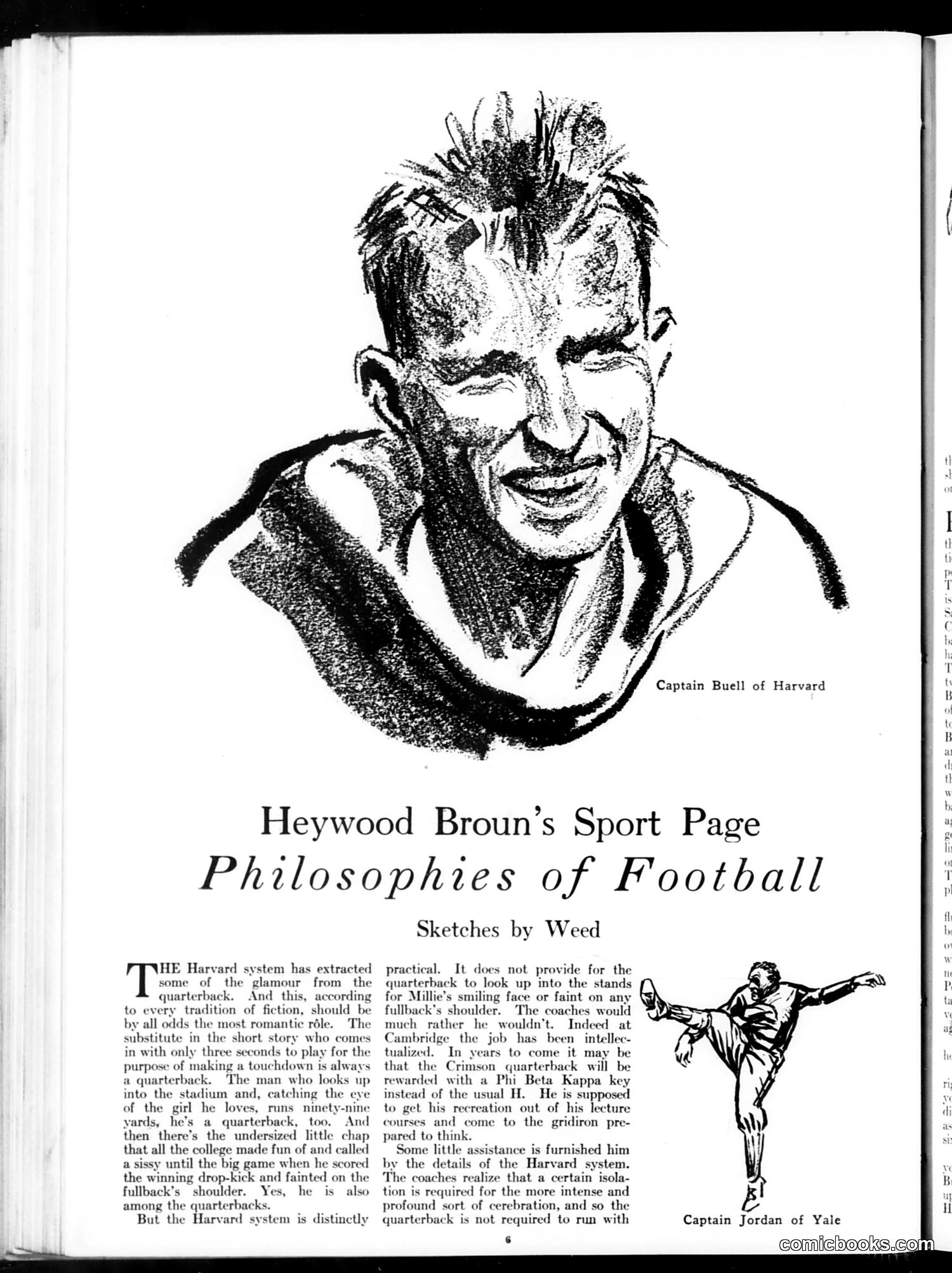
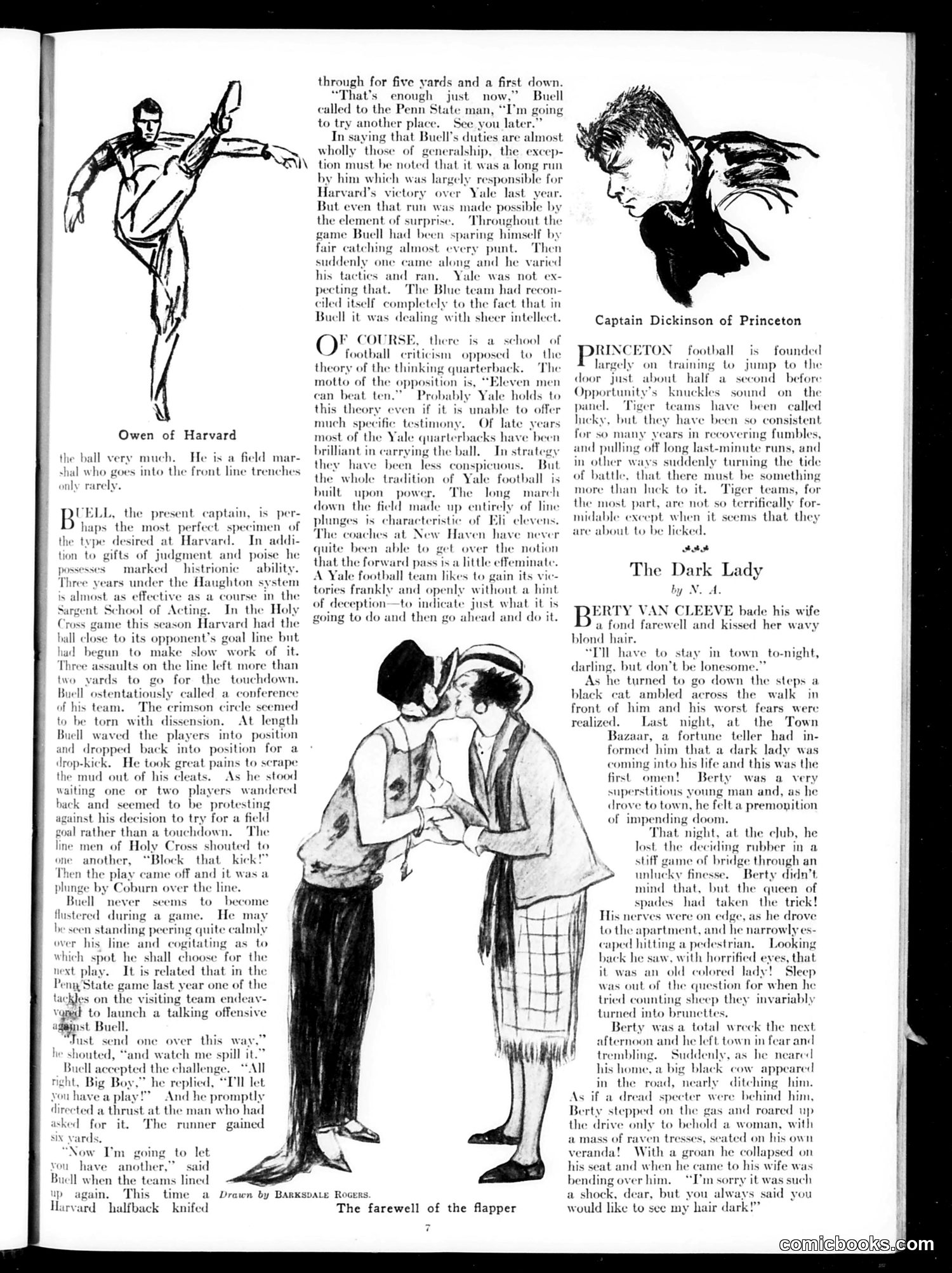
This is a sports column by Heywood Broun critiquing Harvard's football approach versus romantic football tradition. The sketches show two captains: Captain Buell of Harvard and Captain Jordan of Yale. Broun satirizes Harvard's "system" as overly intellectual and practical—stripping football of its glamour and narrative drama. Traditional college football stories featured quarterbacks as heroes: the undersized underdog, the romantic lead catching his sweetheart's eye in the stands, the player who faints dramatically after scoring. Harvard's system, Broun argues, eliminates this romance. Their quarterback isn't allowed to look at girls or indulge in emotion; he must "think" and prepare cerebrally like an academic rather than perform as a romantic hero. The joke targets Harvard's reputation for intellectualism taken to absurd extremes—even replacing the athletic "H" award with an academic "Phi Beta Kappa key." The contrast with Yale's more traditionally glamorous approach is implicit through the paired illustrations.
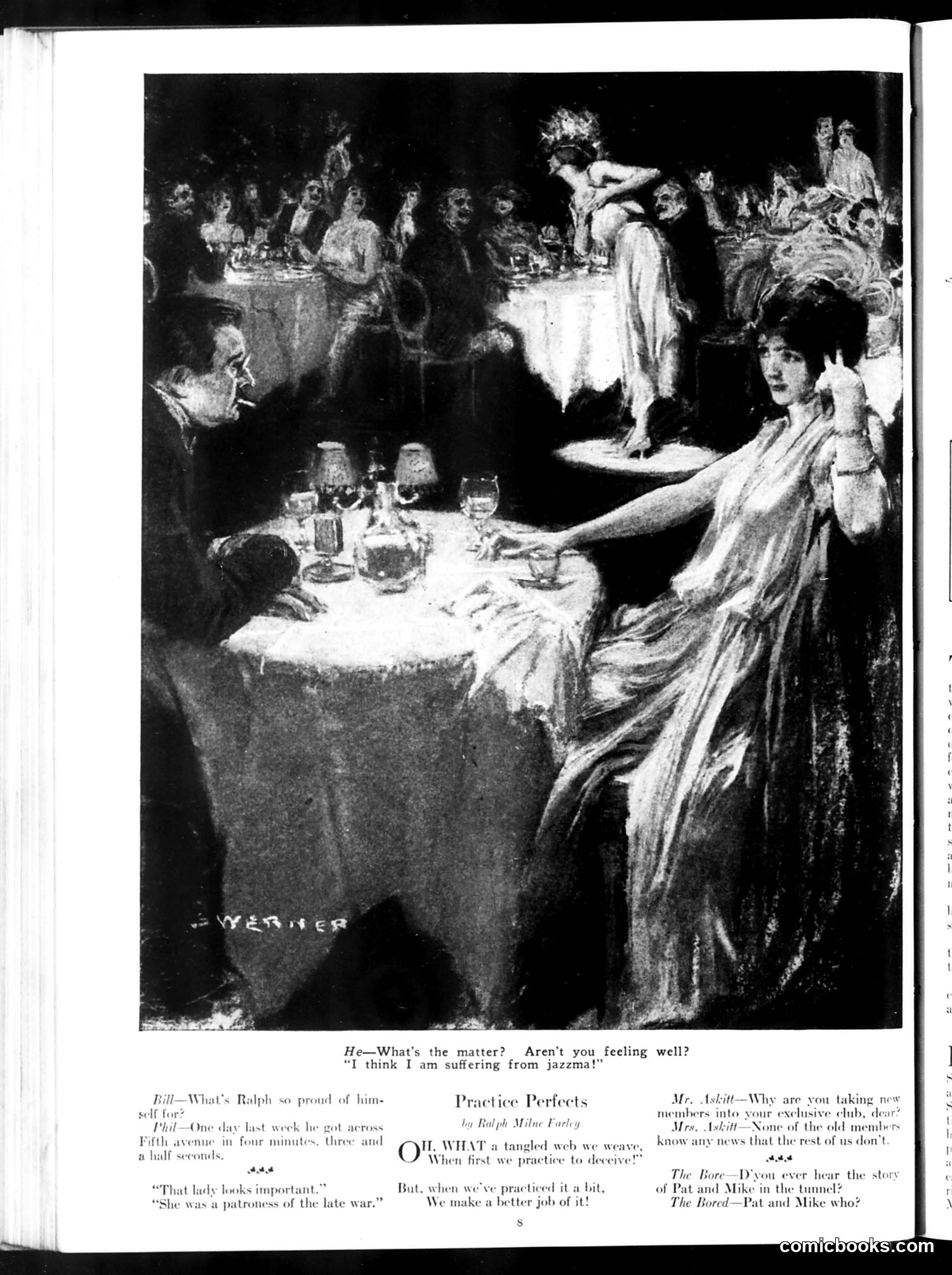
This page from *Judge* magazine contains a humorous cartoon and comedic dialogue pieces satirizing early 1920s social life. **The main cartoon** depicts an elegant dinner party where a woman complains of suffering from "jazzma"—a satirical invented ailment combining "jazz" with "asthma." This mocks the then-controversial jazz craze sweeping America, portraying it as something people could humorously "suffer from" like a disease. The Jazz Age was seen by older, conservative Americans as morally suspect and physically overstimulating. **The text pieces** include brief jokes about social climbing (Ralph's pride in crossing Fifth Avenue quickly), pretentious club membership, and a reference to an unclear joke about "Pat and Mike in the tunnel"—likely playing on Irish stereotypes common in era humor. The overall message satirizes both the anxieties older society had about modern jazz culture and the pretensions of the social elite trying to maintain exclusive clubs despite changing times.
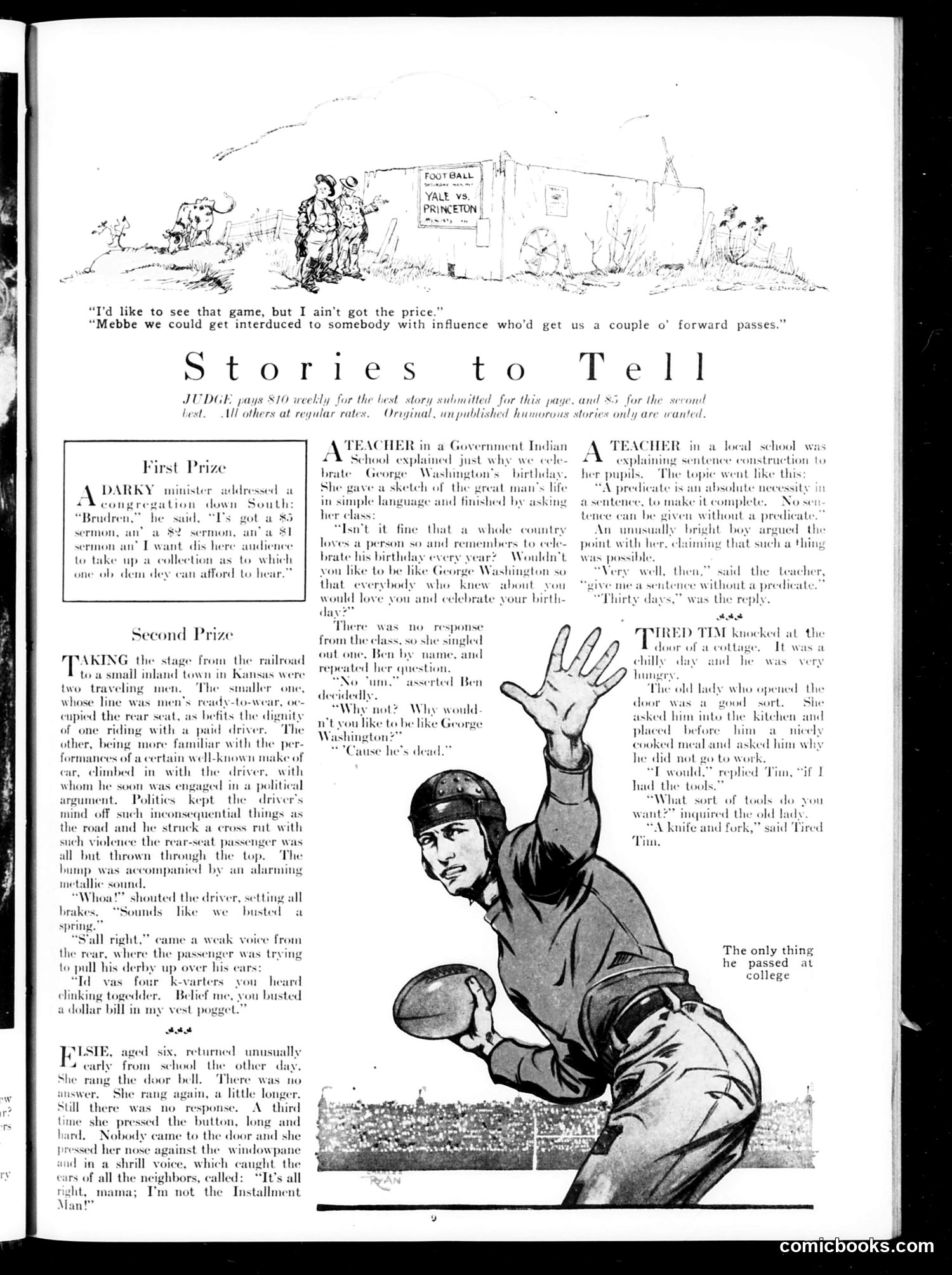
This page from *Judge* contains short humorous stories competing for prize money ($10 for first place, $5 for second). The content reflects early 20th-century American attitudes and stereotypes. **First Prize** features a racist caricature of a Black minister in the South using dialect, asking his congregation to choose between three sermon lengths to fund. **Second Prize** depicts two traveling salesmen; the humor derives from a Jewish character (identified by dialect and financial obsession) claiming he broke a dollar bill rather than admitting a collision damaged his belongings. **Other stories** include: a Native American student rejecting George Washington as a role model because "he's dead"; a bright student arguing grammar rules with a teacher; and "Tired Tim," seemingly a tramp character, requesting only basic utensils at a cottage. The cartoon header shows boys discussing the Yale-Princeton football game as too expensive, hoping for connections to get free tickets. Overall, the page reflects period attitudes toward race, ethnicity, and class through ostensibly humorous anecdotes.
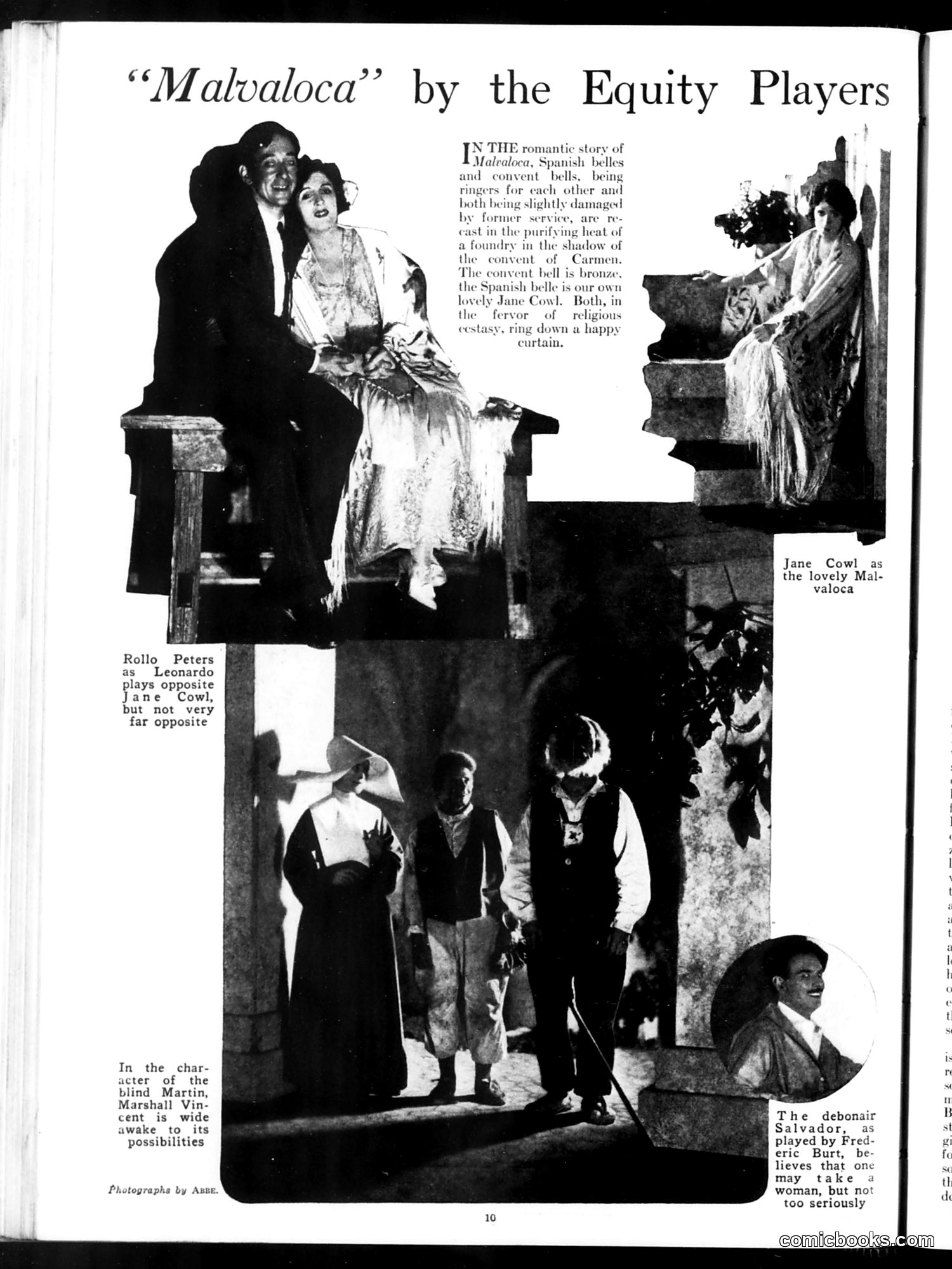
This page reviews a theatrical production of the play *Malvaloca* by the Equity Players company. The text describes a Spanish romantic story involving church bells and a foundry, featuring actress Jane Cowl in the title role alongside actor Rollo Peters. The "satire" here is gentle theatrical criticism embedded in witty captions. The reviewer jokes that Peters plays opposite Cowl "but not very far opposite"—likely a suggestive comment about their on-stage proximity or romantic chemistry. The blind character Martin (played by Marshall Vincent) receives praise for understanding his role's potential. The final caption mocks the character Salvador (Frederic Burt) for believing "one may take a woman, but not too seriously"—satirizing the play's casual treatment of seduction or the character's dismissive attitude toward women. This reflects period attitudes about romance and gender that modern readers would recognize as dated. The photographs show scenes from the production.
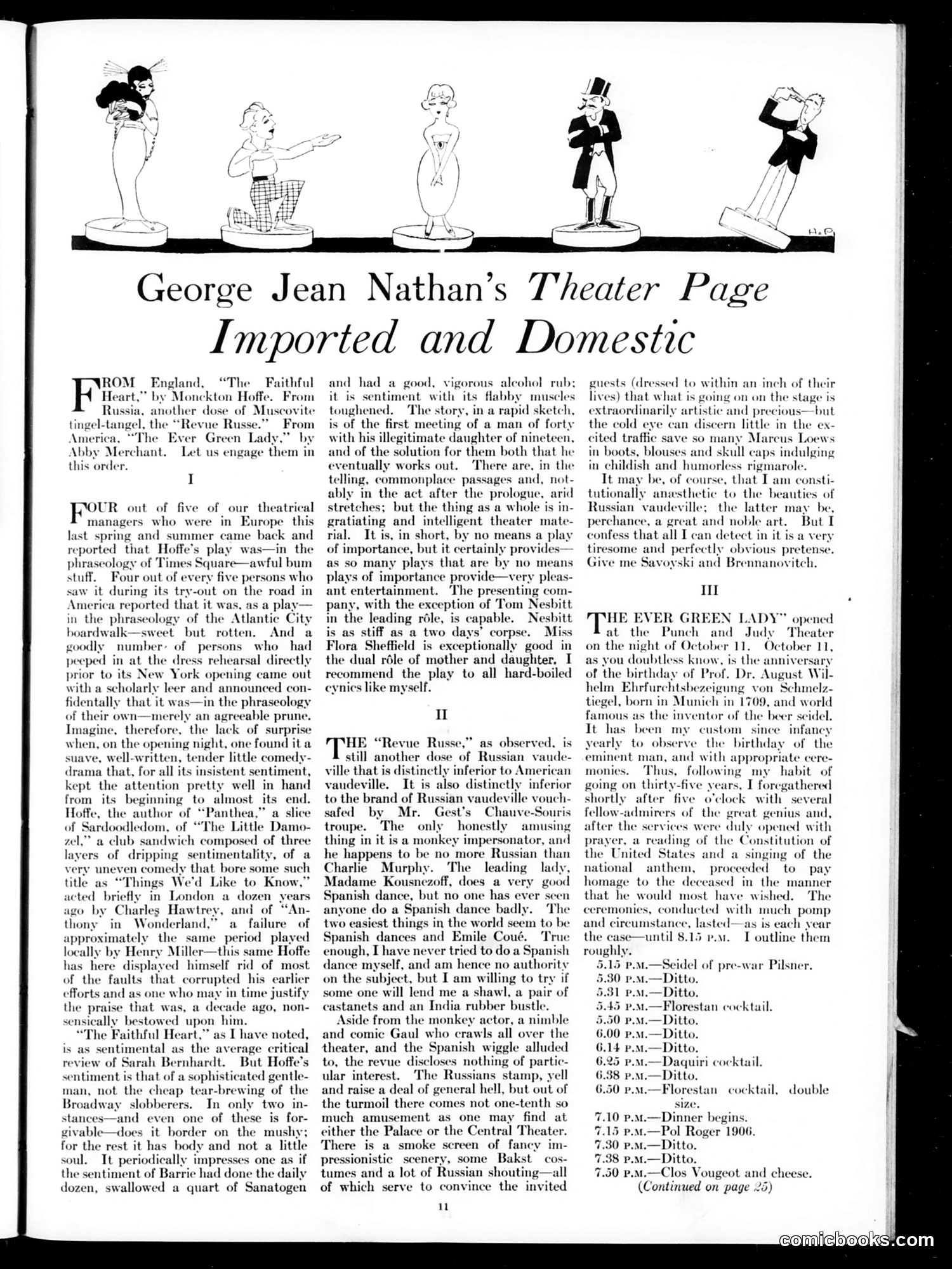
This is theater criticism by George Jean Nathan reviewing three Broadway productions: an English play ("The Faithful Heart"), a Russian vaudeville revue ("Revue Russe"), and an American comedy ("The Ever Green Lady"). The cartoon header shows five stylized theatrical character types standing on pedestals, illustrating the variety of stage entertainment. Nathan's tone is characteristic of early 20th-century theatrical criticism—witty, sophisticated, and somewhat dismissive of middlebrow sentimentality. He praises Hoffe's play as "suave, well-written" despite its sentiment, contrasting it with Broadway's typical "cheap tear-brewing." He's notably snobbish about Russian vaudeville, calling it inferior to both American vaudeville and the previously-seen Chauve-Souris troupe. The reference to "hard-boiled cynics like myself" suggests Nathan's persona as a urbane, slightly jaded critic who tolerates entertainment only when executed with intelligence and restraint rather than cheap emotion.
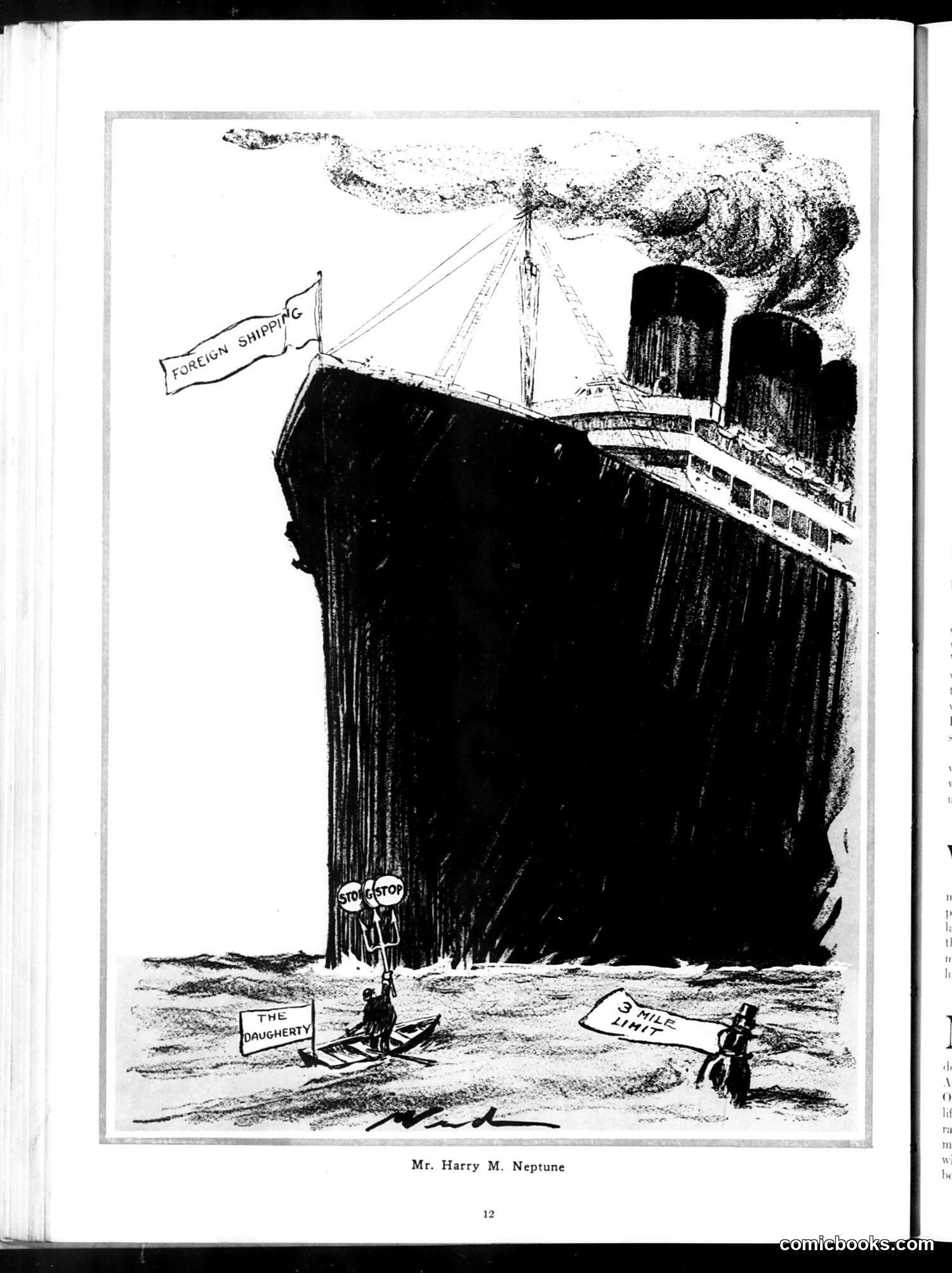
This cartoon by Mr. Harry M. Neptune uses a sinking ship as metaphor for American foreign shipping interests. The massive vessel labeled "Foreign Shipping" flies a flag and displays two prominent smokestacks, appearing to founder or capsize. At its base, small figures hold signs reading "The Daugherty" and "Smile Uncle," while a "Stop Gap" sign appears nearby. The satire likely critiques failures in shipping policy or maritime regulation during the early 1920s, possibly referencing Secretary of the Interior Albert B. Fall or Attorney General Harry Daugherty (both involved in the Teapot Dome scandal). The "smile" reference suggests ironic advice to accept deteriorating conditions. The cartoon portrays American commercial shipping as imperiled by incompetent or corrupt governance.
This page contains three editorials with political commentary from the 1920s: **"Needed: A Major Operation"** critiques the current Republican-controlled Congress as ineffective, controlled by special interests (Anti-Saloon League, Tariff Lobby). Judge advocates reducing Republican majorities in the upcoming election—not to install Democrats, but to create a more balanced, moderate Congress. **"The Most Unkindest Cut of All"** attacks Henry Ford's hypocrisy: he reduced car prices (appearing sympathetic to workers) while exploiting his own employees and showing no genuine concern for "the submerged majority." **"Lenin"** offers surprisingly respectful assessment of Lenin's leadership five years after the Russian Revolution. Despite acknowledging his bloodstained record, the author credits Lenin with remarkable achievement: consolidating and controlling the Soviet state through chaos. The piece compares him favorably to Lloyd George as a "miracle man of politics," suggesting even ideological opponents recognized Lenin's political competence. The tone reflects 1920s American political discourse—skeptical of radicalism but grudgingly acknowledging capability.
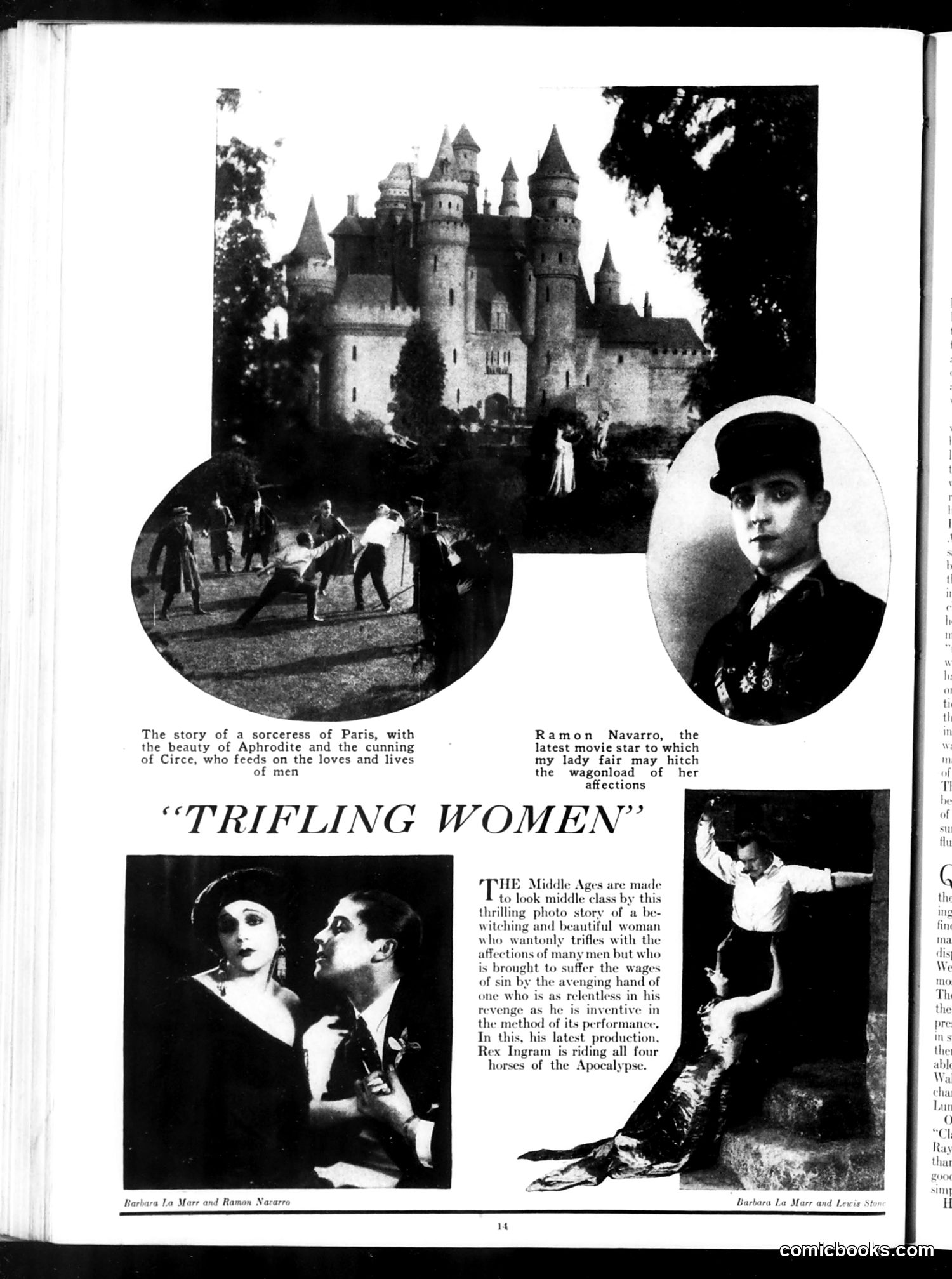
This page promotes a Rex Ingram silent film starring Ramon Navarro and Barbara La Marr. The "satire" here is genteel rather than political—*Judge* is advertising and mocking the film's melodramatic plot simultaneously. The film tells of a Parisian seductress (echoing classical mythology: Aphrodite, Circe) who manipulates multiple men's affections. She faces divine punishment—"the wages of sin"—from a vengeful man. The copy sarcastically describes this as medieval morality theater made "middle class," with director Ingram deploying apocalyptic drama. The humor targets both the film's overwrought moralizing and 1920s silent cinema conventions: the beautiful woman as temptress, seduction as tragedy, retribution as spectacle. Navarro's status as a contemporary "movie star" is gently mocked for audiences reading about his fictional romantic entanglements.
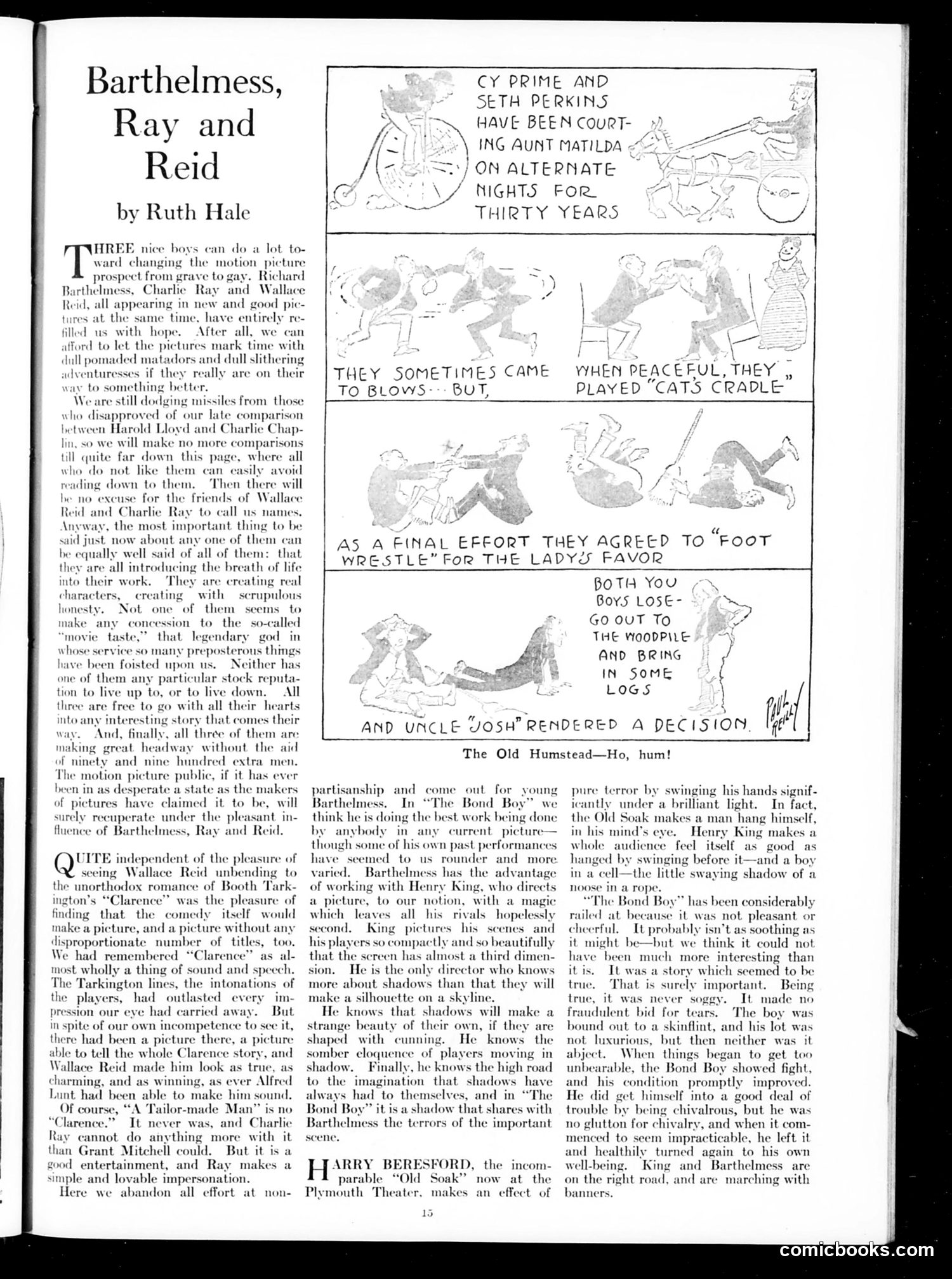
This is a film criticism piece by Ruth Hale praising three young silent film actors: Richard Barthelmess, Charlie Ray, and Wallace Reid. Rather than political satire, it's entertainment commentary—assessing their work in contemporary films like "The Bond Boy" and "Clarence." The accompanying comic strip (bottom half) is unrelated: a humorous rural sketch about two men, Cy Prime and Seth Perkins, courting Aunt Matilda for thirty years, occasionally fighting but peacefully playing "cats cradle," until Uncle Josh settles their rivalry by declaring both losers—they must fetch firewood instead. The page reflects 1920s film industry discourse, celebrating these actors' naturalistic performances and "scrupulous honesty" as alternatives to melodramatic "movie taste," while the comic provides lighthearted backwoods humor typical of Judge's offerings.
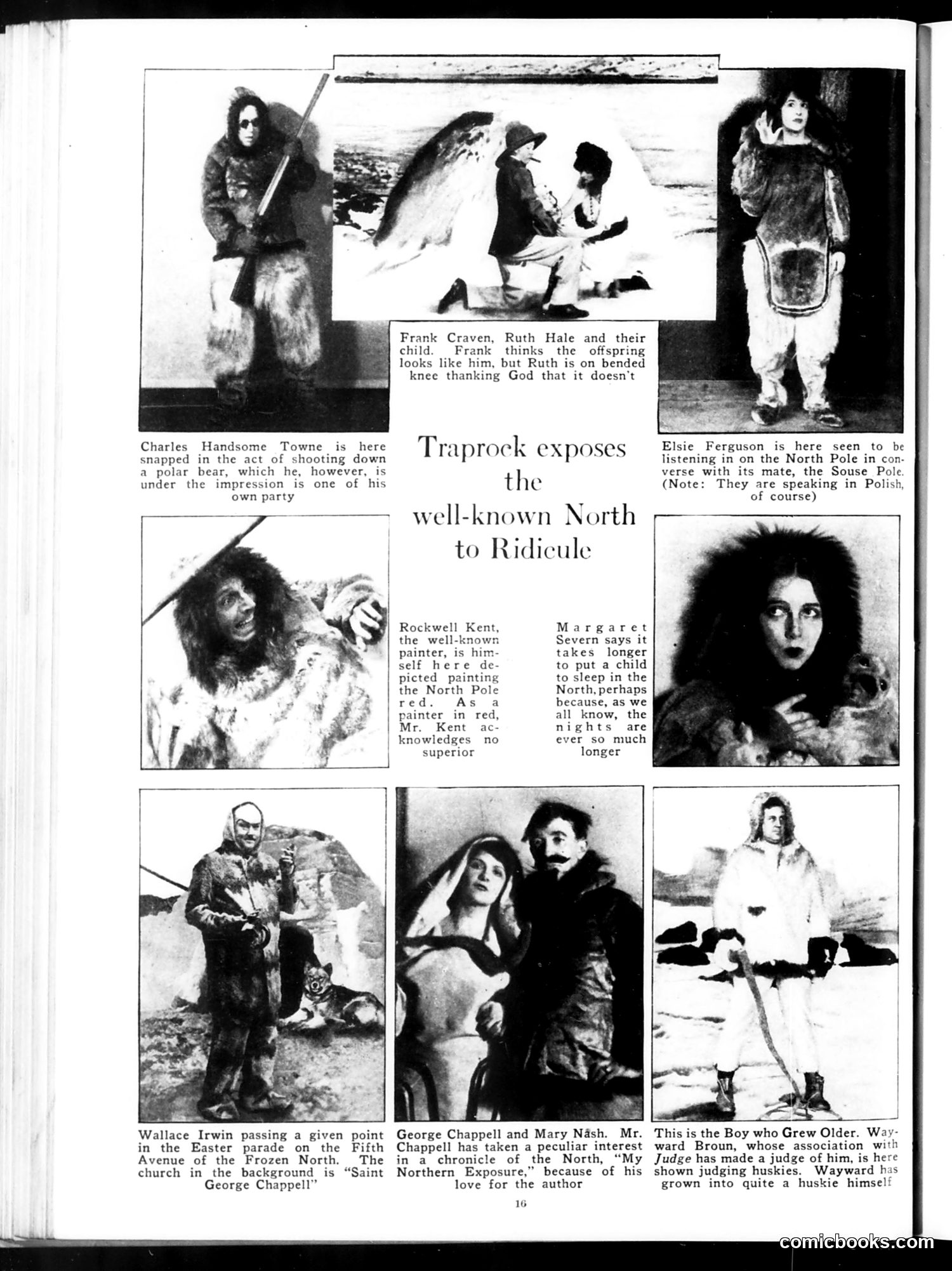
This page lampoons *Traprock's* popular book series about Arctic exploration—likely "Eifelfel" or similar works that presented themselves as serious polar documentation. Judge magazine exposes the absurdity by depicting recognizable public figures (Charles Handsome Towne, Wallace Irwin, Rockwell Kent, George Chappell, Wayward Broun, and others) allegedly appearing in Traprock's supposedly factual North Pole accounts. The joke: these celebrities' presence at the Pole is obviously ridiculous, revealing Traprock's narratives as fabrication or exaggeration. Visual gags reinforce the mockery—a painter claiming superiority while painting the North Pole red; Broun "judging huskies" (pun on his journalistic role); children somehow present in Arctic conditions. The satire targets both Traprock's credibility and the gullible public appetite for sensationalized polar adventure narratives popular in the 1920s.
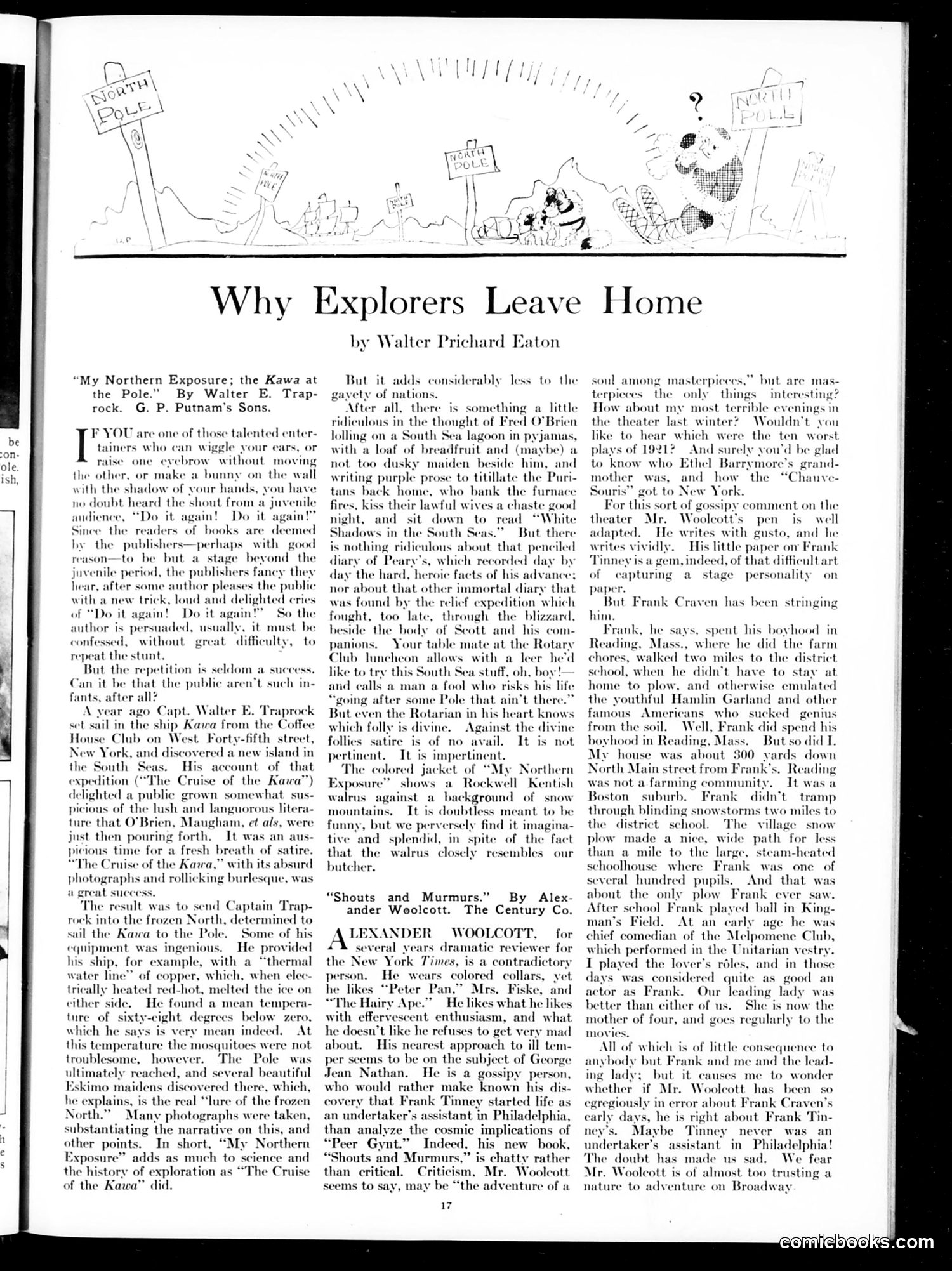
This is a book review by Walter Prichard Eaton discussing Captain Walter E. Traprock's sequel, "My Northern Exposure." **The Satire:** Eaton critiques Traprock for repeating his successful formula. Traprock's first book, "The Cruise of the Kawa," was a humorous, absurd travel narrative that succeeded because it provided satirical relief from the earnest exploration literature then popular (works by O'Brien, Maugham, etc.). His new polar expedition book attempts the same comedic approach but, Eaton argues, fails—the joke has worn thin. **The Point:** Eaton suggests that while divine follies (genuine exploration, like Scott's Antarctic expedition) deserve respect and are beyond satire's reach, manufactured repeat stunts for commercial purposes don't merit the same reverence. The "Do it again!" impulse—both publishers' and audiences'—produces diminishing returns. The cartoon's figures likely represent Traprock and his various improbable Arctic inventions, reflecting the book's absurdist humor.
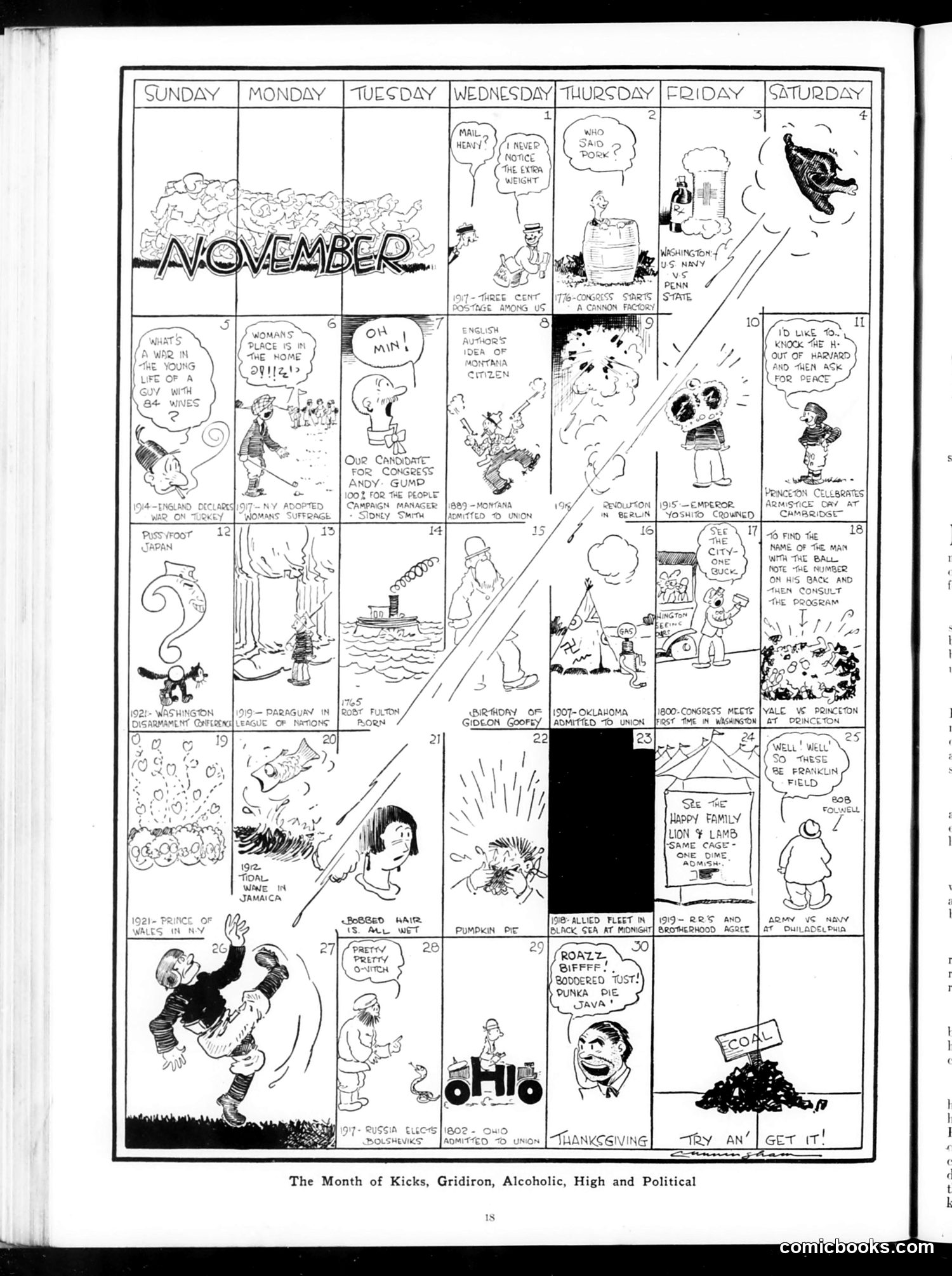
This is a satirical calendar page from Judge magazine depicting November 1907 as "The Month of Kicks, Gridiron, Alcoholic, High and Political." Each daily panel contains separate gags referencing: **Political/Historical Events:** - Oklahoma's admission to the Union (November 16) - The Allied Fleet in the Black Sea - Various political figures and campaigns **Social Commentary:** The "kicks" theme references contemporary scandals and controversies. The "gridiron" references American football. "Alcoholic" likely references Prohibition-era debates. **Specific References:** The calendar mixes mundane jokes (people falling, getting drunk, domestic mishaps) with topical political humor. Without clearer OCR, specific caricatured figures remain uncertain, but the format was typical Judge satire—combining low comedy with commentary on current events to mock both popular culture and political figures of the day. The subtitle explicitly labels this satirical approach: kicks (slapstick humor), gridiron (sports), alcohol (social vice), high (possibly society/upper class), and political content combined.
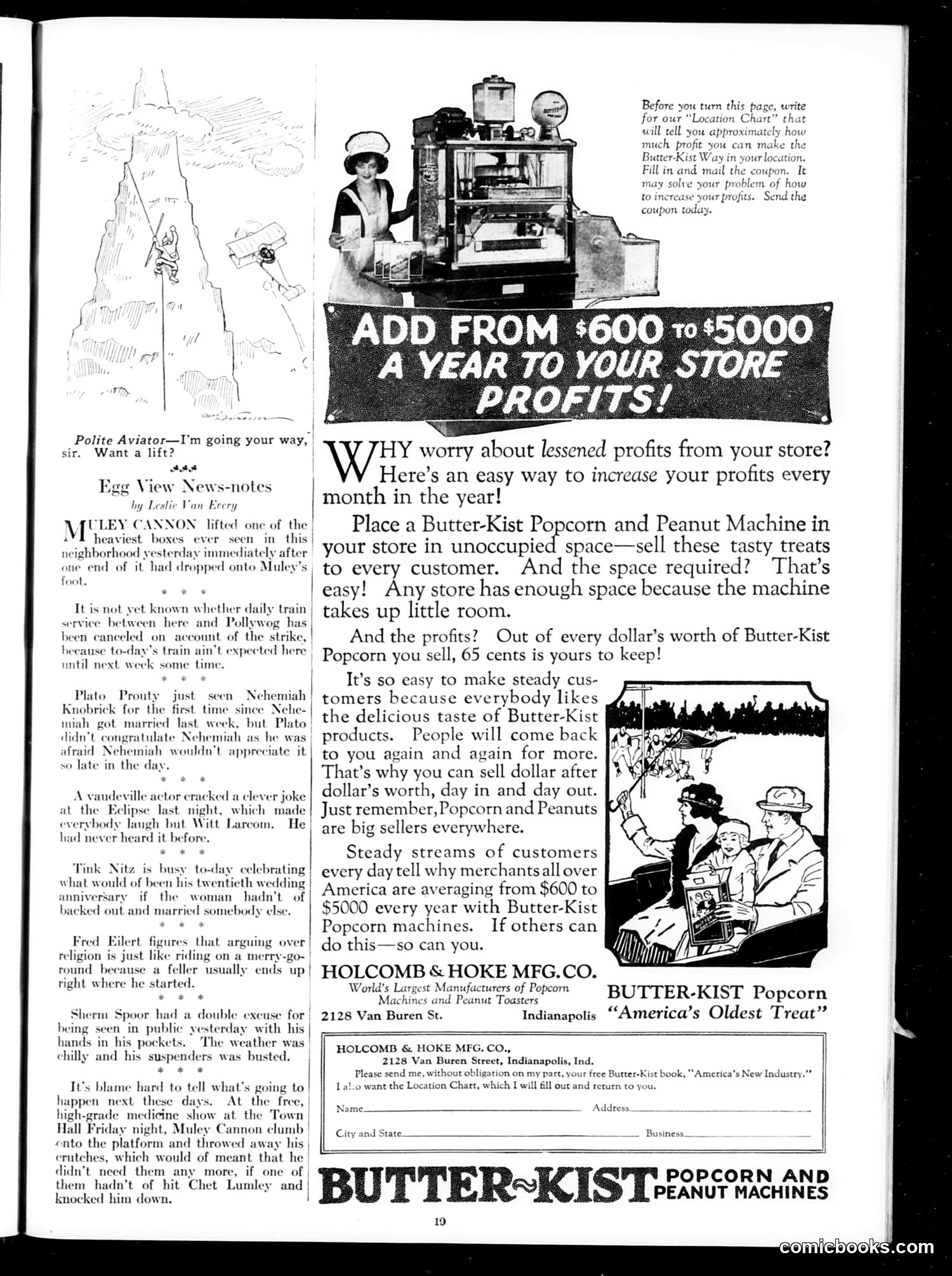
This page contains **local humor column** and **advertising**, not political satire. The "Egg View News-notes" column presents absurdist small-town jokes—deliberately anti-humorous observations where the punchline subverts expectation. Examples: a man celebrates a wedding anniversary that never happened; someone arguing about religion "ends up where he started"; a crutch-throwing act goes wrong when it hits someone. The dominant content is a **Butter-Kist Popcorn machine advertisement** targeting store owners. It promises $600-$5,000 annual profit with 65-cent margins per dollar of sales, requiring minimal space. The ad includes testimonials and a coupon. The small cartoon shows an aviator offering a lift, captioned "Polite Aviator—I'm going your way, sir. Want a lift?" This appears to be gentle observational humor rather than satire. **Context**: This reflects 1920s-era vending machine entrepreneurship and small-town American consumer culture, with no apparent political commentary.
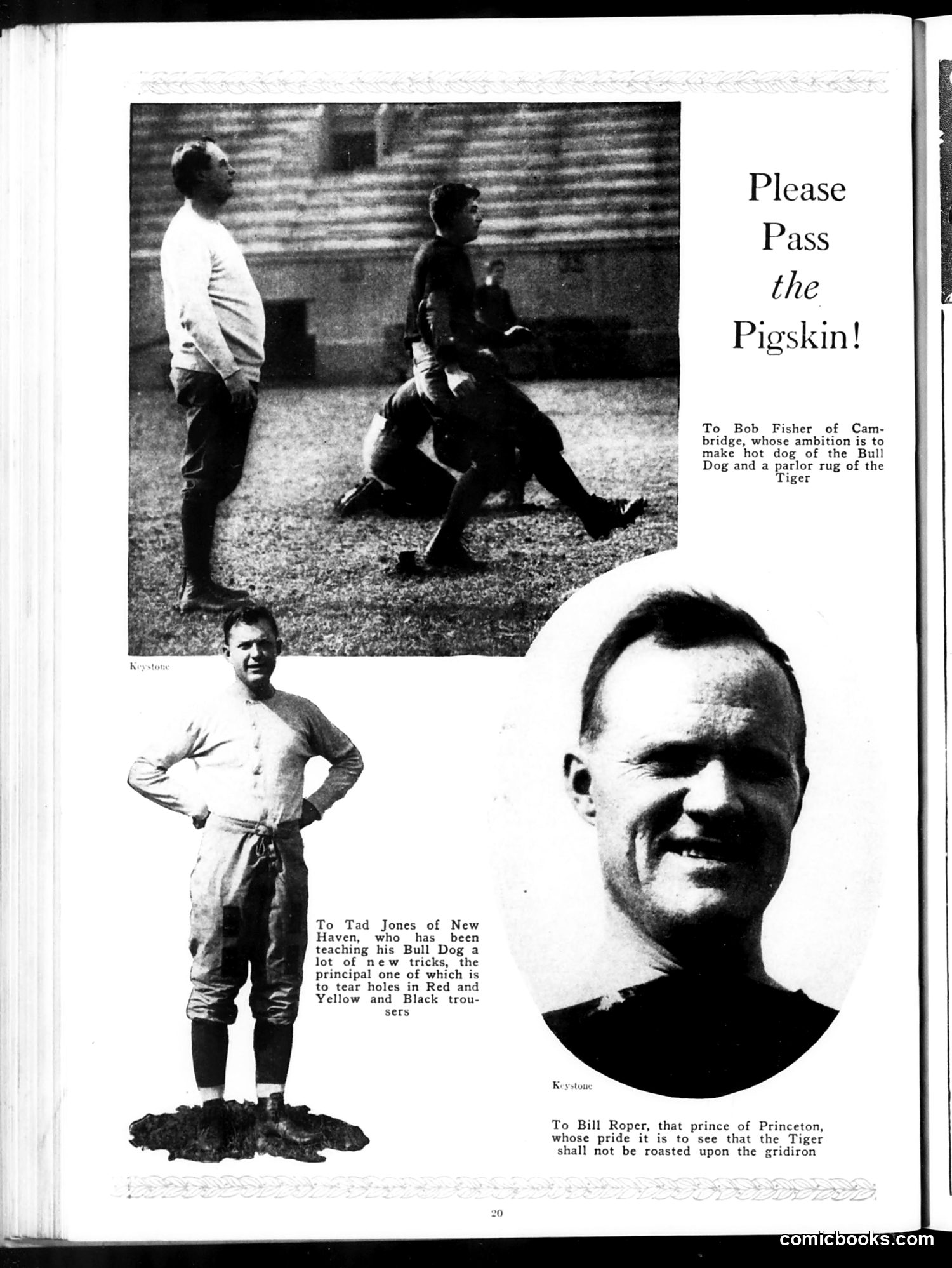
This is a satirical page from *Judge* magazine dedicating a football-themed jab to three college coaches/figures associated with rival universities: 1. **Tad Jones** (Yale) - shown training a bulldog with tricks involving tearing holes in colored trousers, likely mocking his coaching methods as crude or destructive. 2. **Bob Fisher** (Harvard) - joked about wanting to turn Yale's bulldog into a "hot dog" (destroyed) and Princeton's tiger into a "parlor rug" (defeated/humiliated). 3. **Bill Roper** (Princeton) - humorously portrayed as determined to prevent the tiger from being "roasted" on the gridiron—meaning he'll protect Princeton's football team from defeat. The satire targets college football rivalries of the era, mocking coaches' methods and competitive pride through animal mascot wordplay. The "pigskin" reference is football itself.
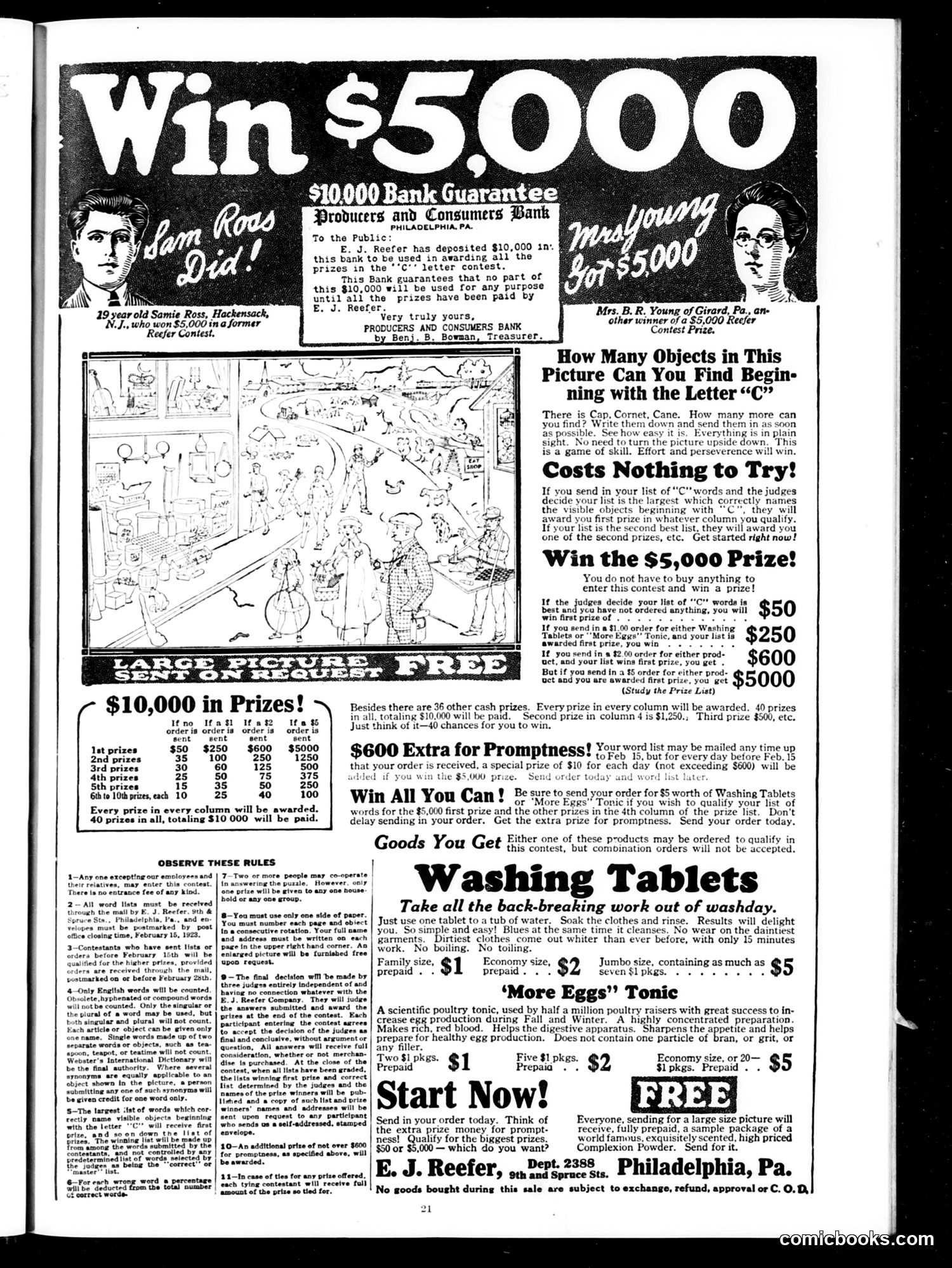
This page is primarily **advertising and contest promotion**, not political satire. It promotes an "E. J. Reefer" contest—a word-finding game where readers identify objects beginning with "C" in a picture, competing for cash prizes totaling $10,000 (guaranteed by Producers and Consumers Bank). The page also advertises household products: washing tablets, "More Eggs" Tonic (a poultry supplement), and complexion powder. Two photographs show previous contest winners—a 19-year-old and a woman from Girard, Pennsylvania—who won $5,000 each, serving as testimonials. **The "satire"** (if any) appears minimal—the contest itself is presented straightforwardly. There are no identifiable political figures or social commentary visible. This is simply a commercial promotion typical of early 1920s magazine advertising, designed to drive customer engagement and product sales through prize incentives.
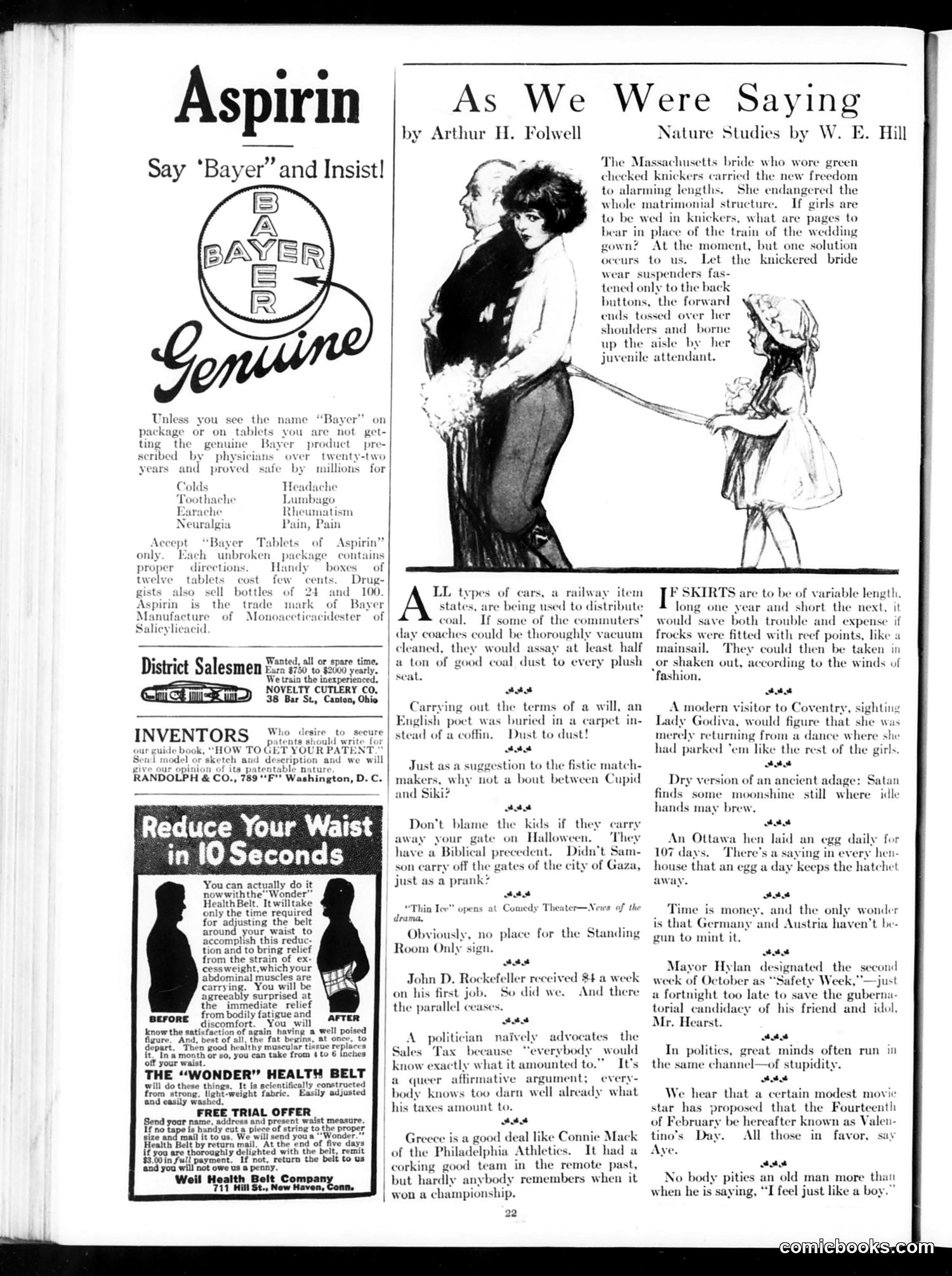
This page from **Judge** magazine (a satirical publication) contains primarily **advertisements** rather than editorial cartoons, though it includes brief humorous commentary. The main content includes: - **Bayer Aspirin ad**: A straightforward product advertisement emphasizing brand authenticity—"Say 'Bayer' and Insist!"—reflecting early 20th-century concerns about generic imitations. - **"As We Were Saying"** by Arthur H. Folwell: A column of short, disconnected satirical observations about contemporary life (coal distribution by rail cars, eccentric burial practices, gate-stealing pranks, etc.). These are mild social commentaries typical of Judge's humor. - **Nature Studies** by W.E. Hill: A cartoon mocking modern brides wearing "knickers" (pants) instead of traditional wedding gowns, with concern about what bridesmaids should wear—poking fun at changing women's fashion and etiquette. The page is dominated by commercial ads for corsets, health belts, and patent services. The satire is light and focused on contemporary social changes rather than serious political commentary.
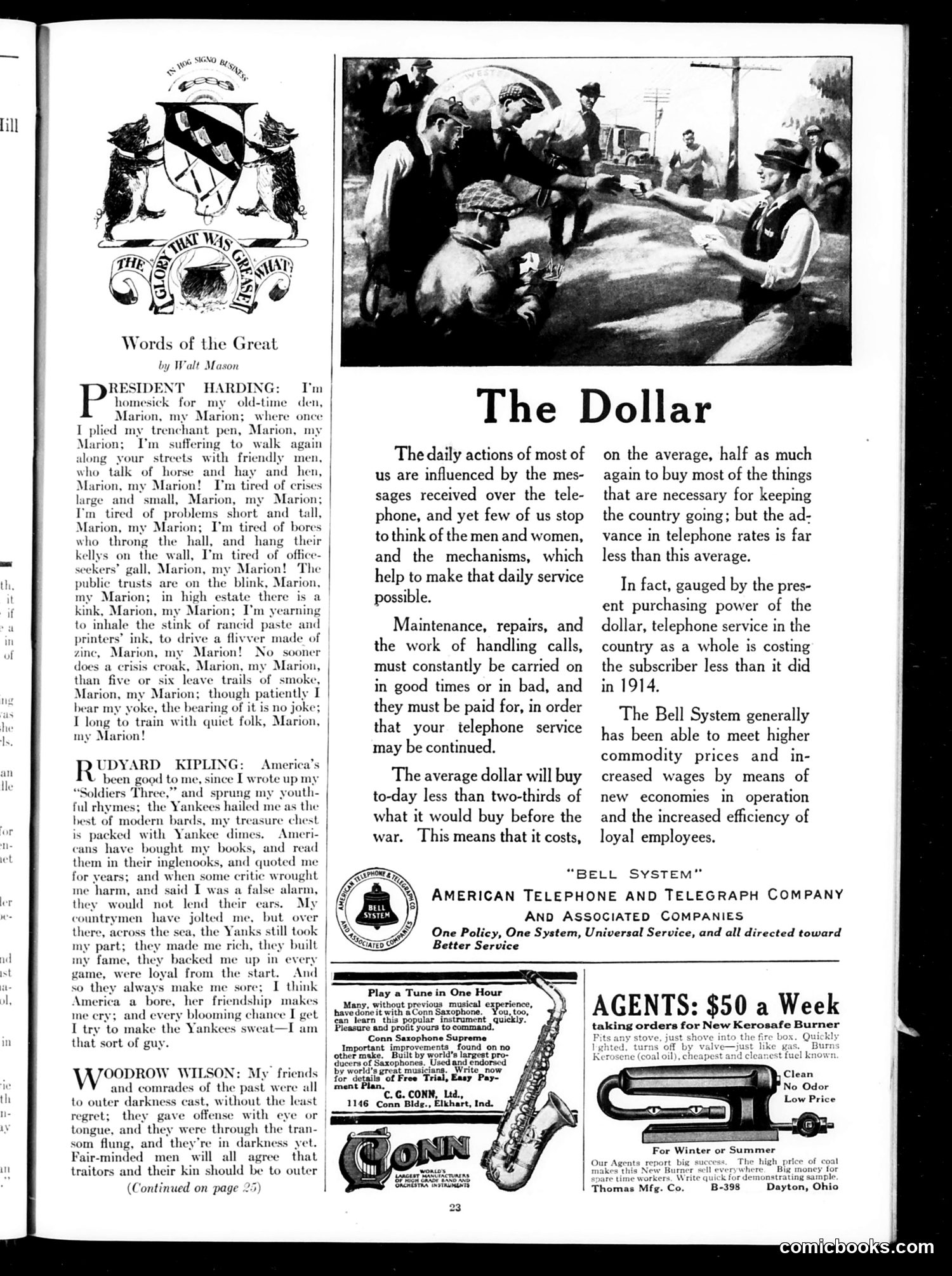
This page contains **satirical "Words of the Great"** — poems purporting to be from famous figures of the era (President Harding, Rudyard Kipling, and Woodrow Wilson) expressing their homesickness, gratitude, and vindictiveness respectively. The satire mocks these public figures' perceived character flaws: Harding's yearning for small-town simplicity despite his presidency; Kipling's mercenary relationship with American audiences; and Wilson's vengeful attitude toward political opponents. The **right-side article "The Dollar"** is a **Bell Telephone advertisement disguised as editorial content**—common in the era. It argues that despite postwar inflation making dollars worth less, telephone service costs have *increased less* than inflation warrants, positioning the Bell System as consumer-friendly. This is corporate PR rhetoric defending against rate-increase criticism during the post-WWI economic adjustment period. The page reflects 1920s concerns: presidential fatigue, wartime economic disruption, and corporate messaging during labor/rate disputes.
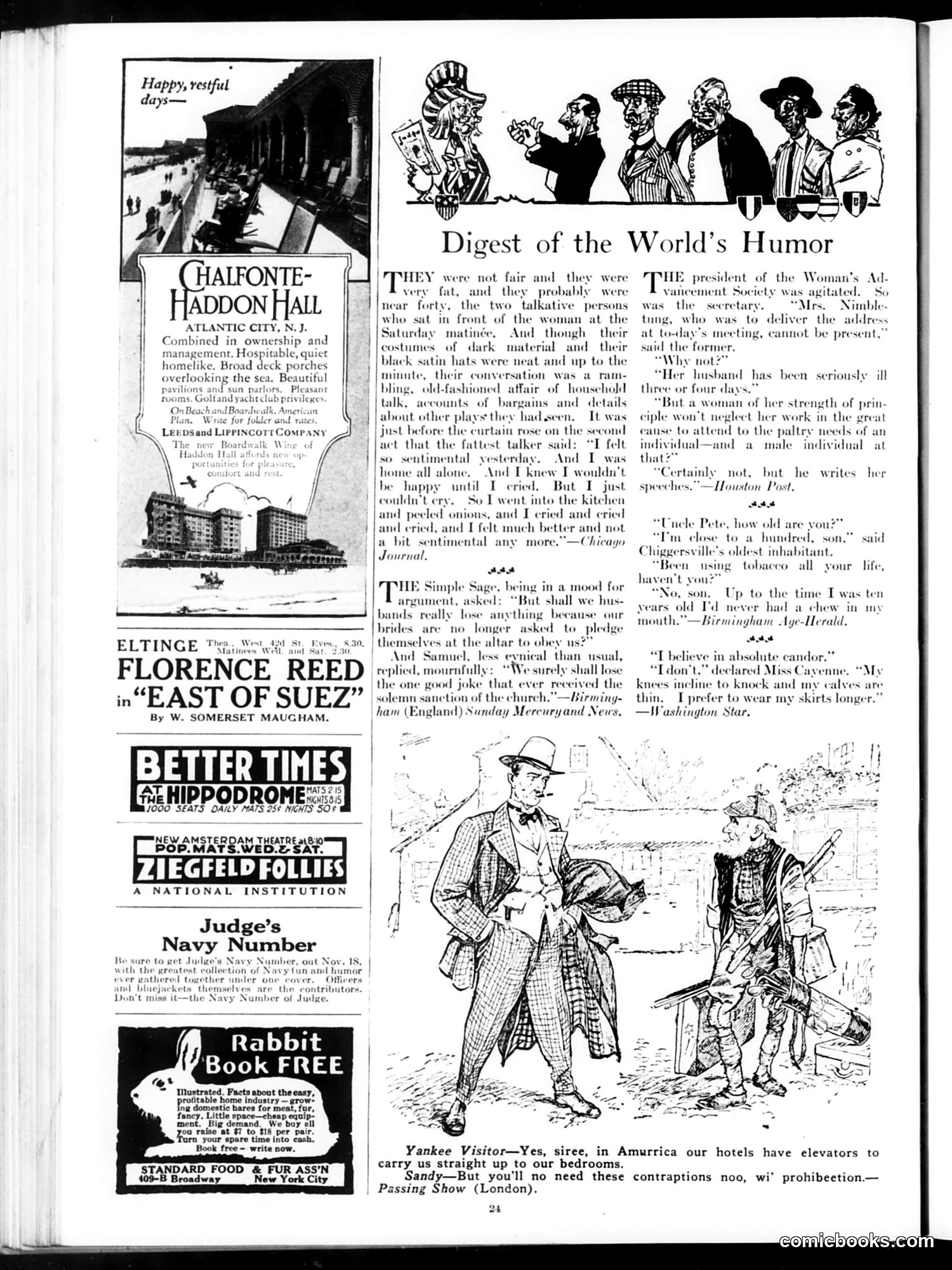
This page from Judge magazine (a prominent American satirical publication) contains multiple humor pieces and advertisements typical of the publication's format. **Main Content:** The "Digest of the World's Humor" section collects brief anecdotes and jokes from various sources. Notable among these is a domestic humor piece about a woman who cried while peeling onions, and a satirical exchange between a minister and "Samuel" about whether brides still promise to obey husbands—implying changing marriage customs and women's independence. **Bottom Cartoon:** A sketch shows a Scottish visitor and American tourist discussing hotel elevators. The joke references Prohibition's recent passage: an American boasts of American hotels' modernity (elevators), while a Scotsman notes they won't need such luxuries under Prohibition—likely a jab at how alcohol availability made America attractive to visitors. **Advertisements:** The page includes typical period ads for hotels, theaters, and a "Rabbit Book" promoting rabbit farming as a home industry—reflecting post-WWI economic interests. The overall tone is light domestic and social satire aimed at middle-class readers.
This page is primarily **advertising** rather than political content. However, the opening section contains satirical "Words of the Great"—presumably celebrities responding to scandals. **Roscoe "Fatty" Arbuckle's section** references his recent acquittal in a highly publicized trial (likely the 1922 Virginia Rappe death case). Despite being cleared by jury, Arbuckle remained unemployable due to public moral disapproval. The satire mocks how a legal verdict couldn't restore his reputation—that "the people sure are batty" for ignoring the jury's decision. **Uncle Joe's section** (appears to reference a former Congressional figure) nostalgically questions whether he's missed in politics or forgotten in modern times. The remainder of the page consists of period advertisements for silk shirts, dancing lessons (Arthur Murray), patent medicine, wine, and jewelry—typical Judge magazine content from the early 1920s. The satire's point: legal vindication means nothing against public sentiment and moral panic.
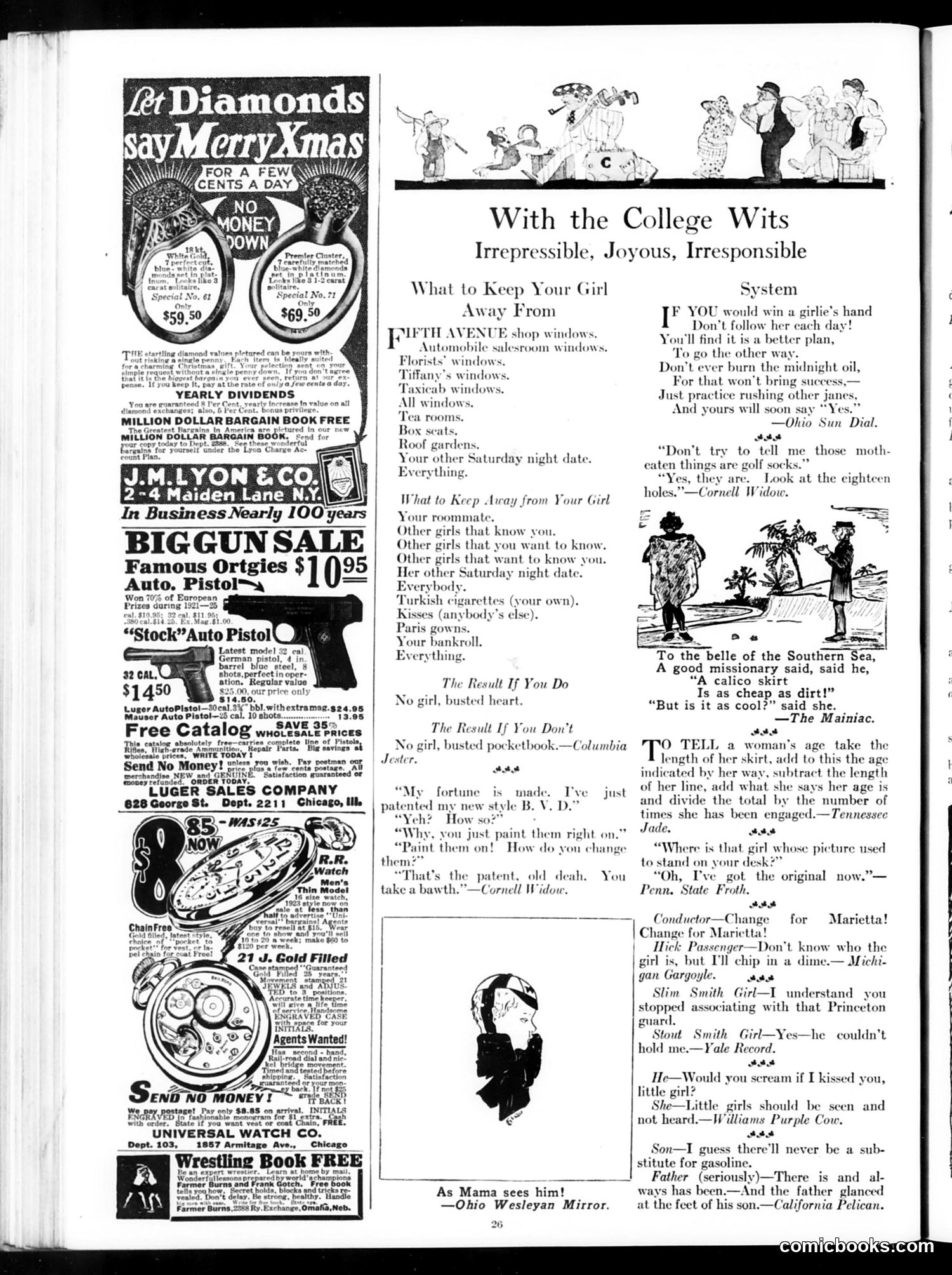
This page features humorous advice and jokes from college newspapers, a popular Judge magazine section. The main content is satirical guidance for college men courting women during the 1920s era. The central humor mocks dating advice by presenting contradictory rules: the piece lists absurd things to keep girls away from (shop windows, florists, taxi cabs—essentially anywhere they might be tempted by purchases), then lists what to keep away from girls (other romantic rivals, expensive venues). The punchline: follow these rules, you'll have "a busted heart"; ignore them, you'll have a "busted pocketbook"—satirizing how dating costs money while isolation costs romance. The scattered jokes beneath mock courtship customs, women's fashion (skirt length as age indicator), and college social dynamics. References to specific college papers (Cornell Widow, Yale Record) suggest this collected humor from contemporary university publications, targeting readers familiar with campus romance stereotypes and the economic tensions of courting during this period.
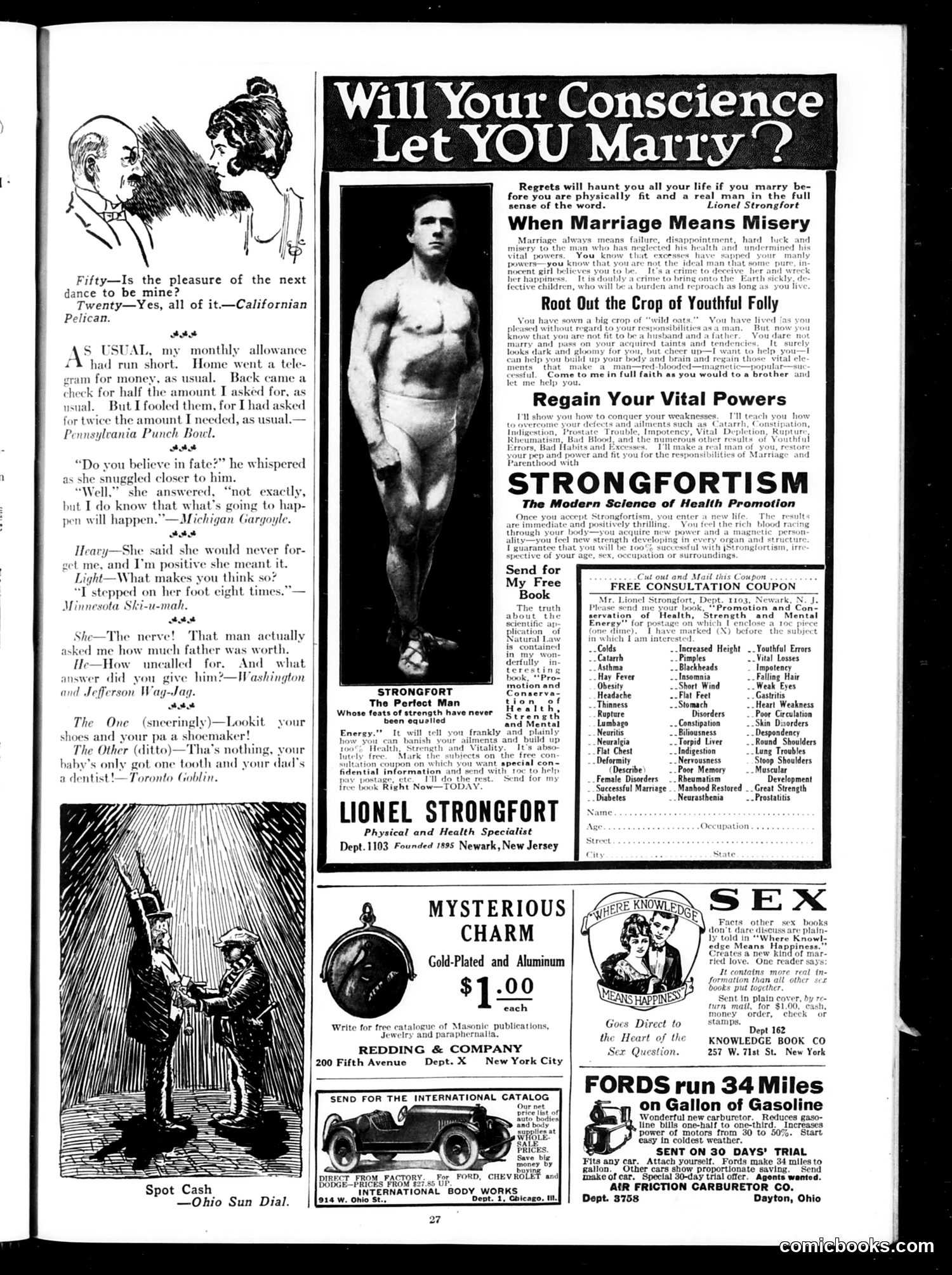
This page combines short humorous anecdotes with period advertisements, primarily targeting male readers around 1915-1920. **The Cartoons/Jokes:** The left column contains brief, cynical observations about courtship and marriage. One notable exchange concerns a man asking a woman about "fate"—she responds that regrets will haunt him if he marries before being "physically fit and a real man." Another joke mocks a suitor's financial dependence ("stepped on her foot eight times" to make an impression). These reflect early 20th-century anxieties about male adequacy and economic responsibility. **The Advertisements:** The page is dominated by "Strongfortism," a mail-order physical fitness and "vitality restoration" scheme. Lionel Strongfort promises to cure "youthful errors," impotence, weakness, and various ailments—clearly exploiting male insecurities about sexual performance and marriageability. Additional ads for "mysterious charms," sex education books, and fuel-efficient carburetors follow the same pattern: selling solutions to anxiety. **The Context:** This reflects early advertising's shameless exploitation of masculine self-doubt through pseudoscientific promises.
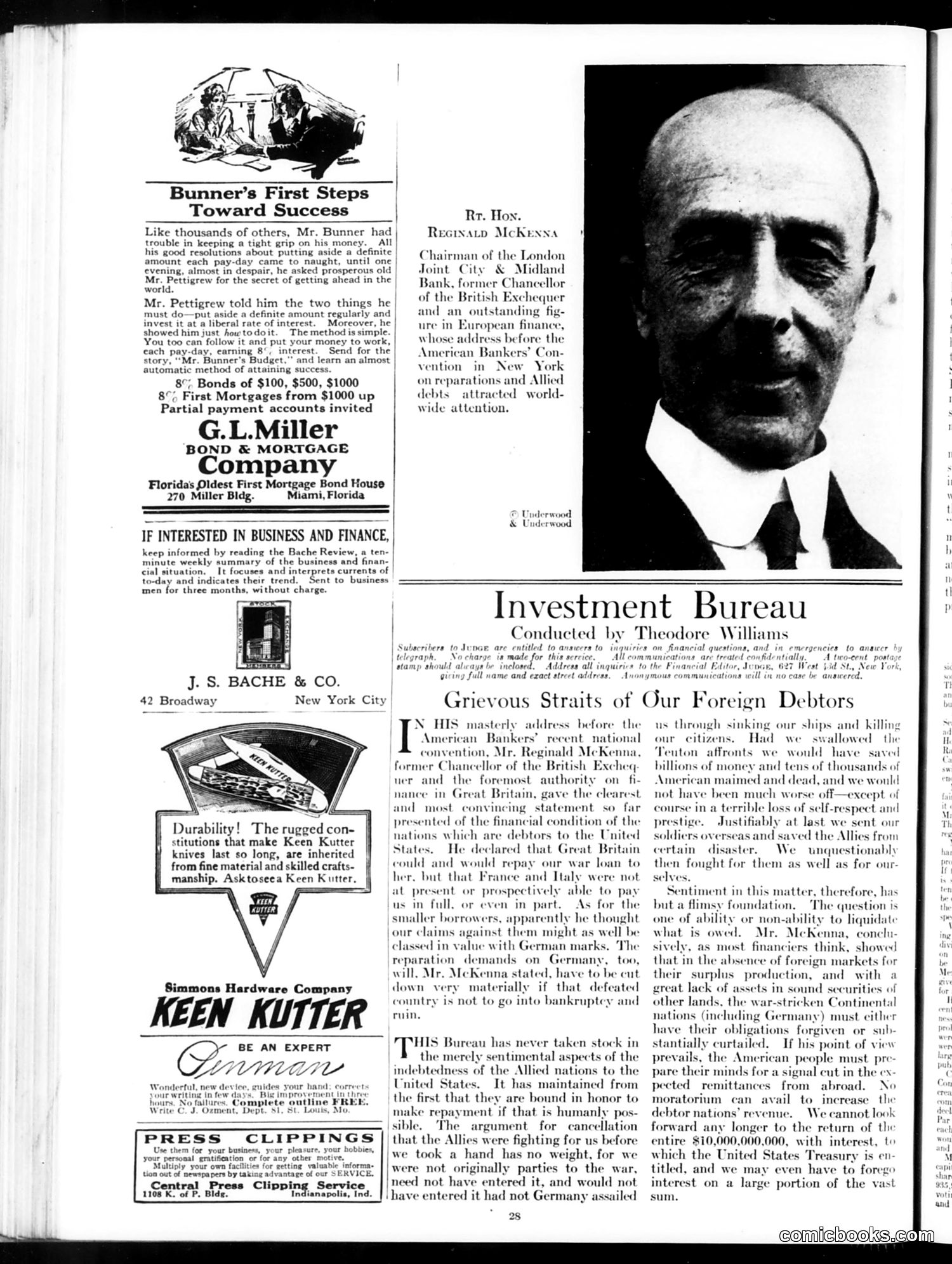
This page contains the "Investment Bureau" column addressing post-World War I international debt repayment—a major political issue of the 1920s. The featured figure is **Reginald McKenna**, former British Chancellor of the Exchequer, photographed prominently to establish authority. **The Main Argument:** McKenna's recent speech to American bankers claimed that while Britain could repay U.S. war loans, France and Italy could not—and reparation demands on Germany should be reduced to prevent bankruptcy. The Investment Bureau agrees Britain *should* repay (rejecting sentimental arguments about "fighting for us"), but acknowledges France and Italy face genuine hardship. **Historical Context:** This reflects 1920s debates over Allied war debt to America and German reparations imposed by the Treaty of Versailles. The piece critiques both blind Allied nationalism and naive expectations that devastated nations could simply repay enormous sums. The surrounding advertisements (bonds, mortgages, financial services) reinforce the financial theme while the "Bunner's First Steps" comic strip illustrates personal savings discipline—a satirical contrast to nations unable to balance their budgets.
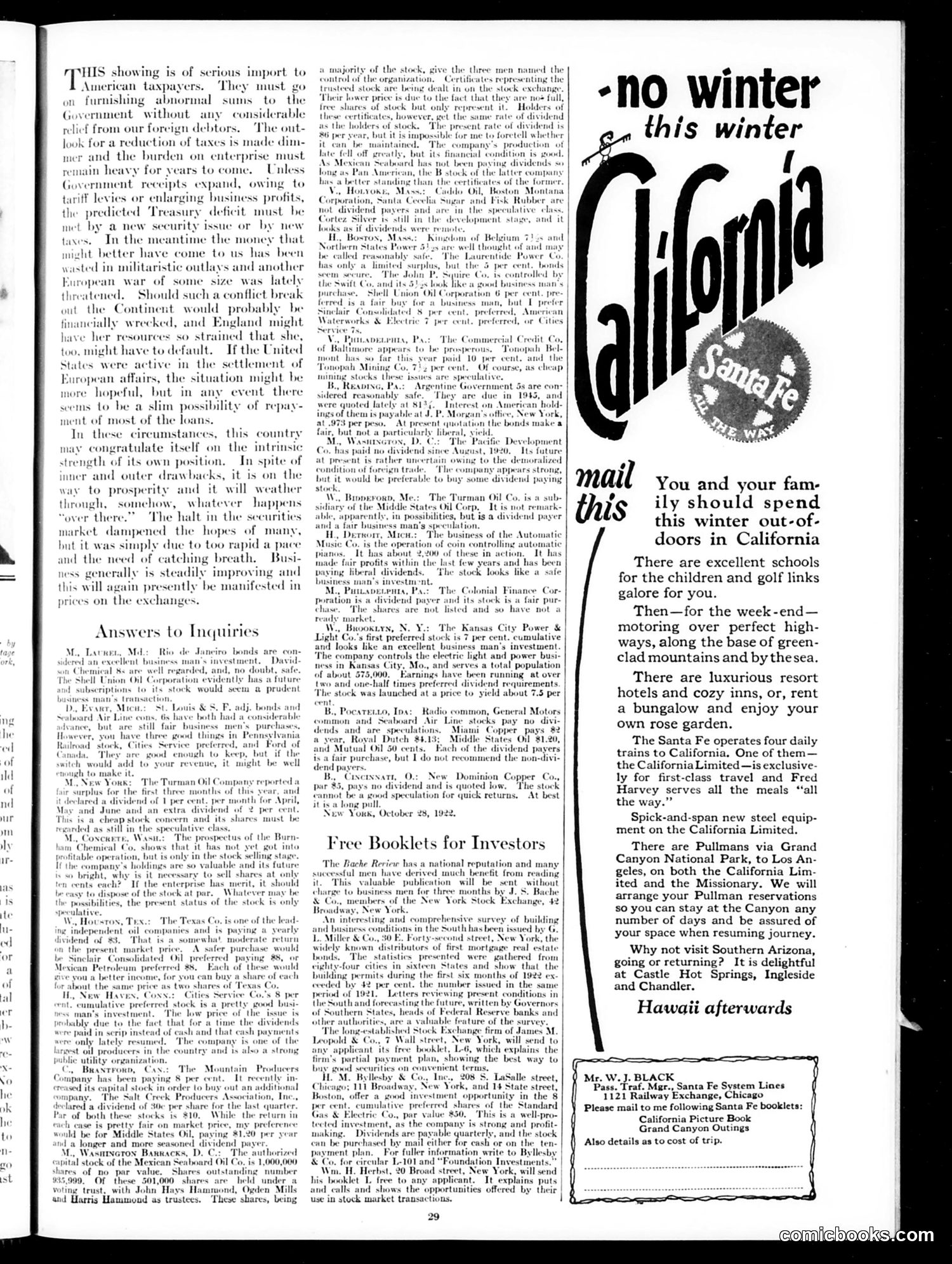
This page combines serious financial commentary with advertising. The main editorial text discusses America's post-war financial burden—taxpayers funding government spending without relief from foreign debtors, with dim prospects for tax reduction unless business profits expand. The author warns that unless the U.S. actively settles European affairs, repayment of war debts seems unlikely. The prominent advertisement ("no winter...this winter") promotes California travel, urging readers to escape winter by visiting the state's schools, resorts, and railways—a leisure-focused pitch contrasting sharply with the serious debt discussion above. The "Answers to Inquiries" section provides investment advice on various stocks and bonds, typical of Judge's service to readers during this economically volatile period (appears to be early 1920s based on post-WWI references). Overall, the page reflects American anxiety about postwar finances alongside attempts to promote optimism through consumption and leisure.
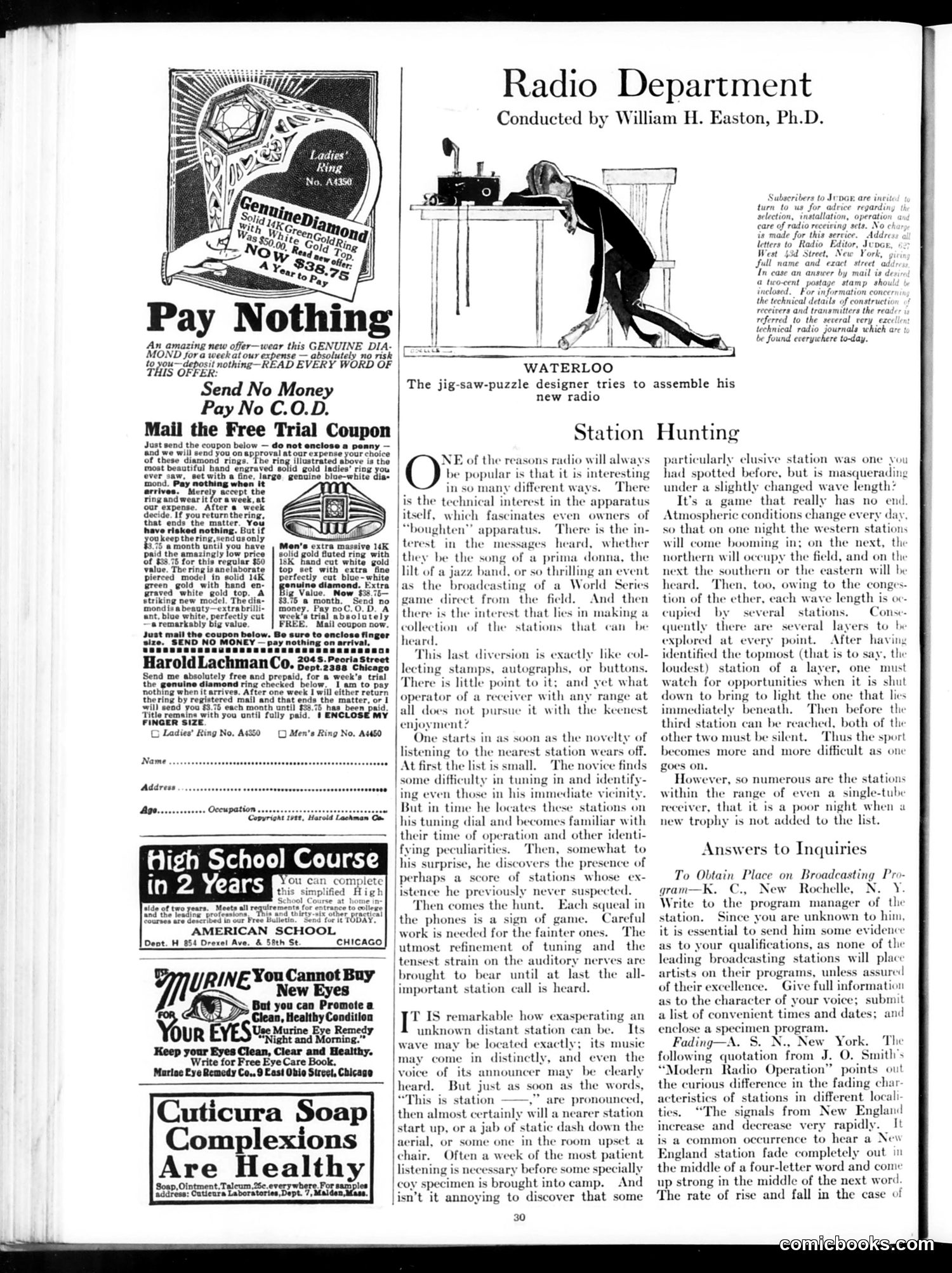
This page is primarily **educational and advertising content**, not political satire. The main feature is William H. Easton's "Radio Department" column discussing "Station Hunting"—the hobby of tuning radio receivers to locate and identify distant broadcasting stations. The article explains that radio enthusiasts enjoy collecting stations like stamp collectors pursue stamps, describing the satisfaction of discovering new signals and building lists of identified stations. It's presented as an accessible, engaging hobby requiring patience and technical skill. The page is dominated by period **advertisements** (diamond rings, high school courses, eye remedies, soap) typical of 1920s magazines. There is **no visible political cartoon or satire** on this page—it's a straightforward educational feature with surrounding commercial content, reflecting early radio's cultural significance as an emerging consumer technology and hobby.
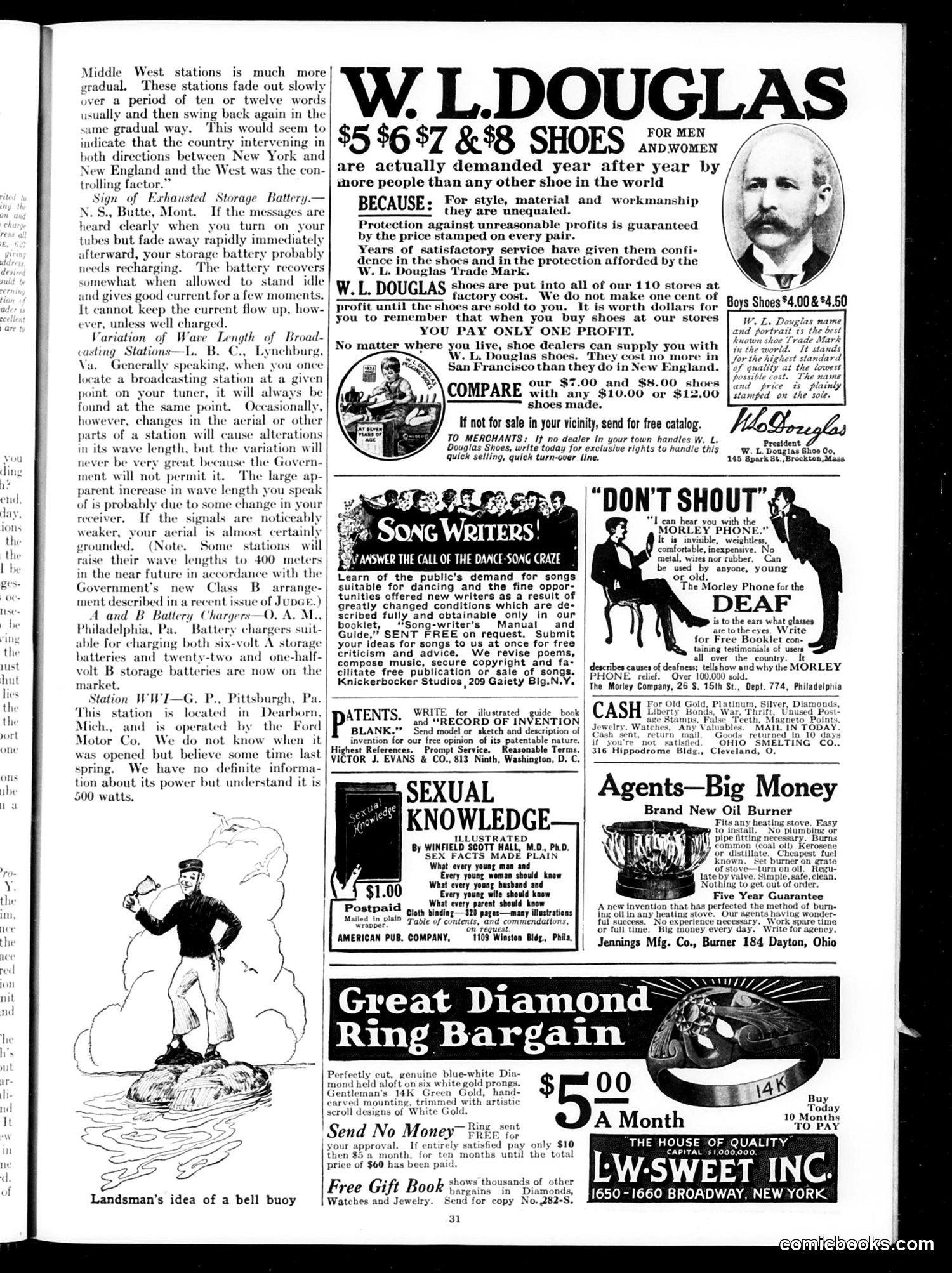
This page is primarily **advertising**, not political satire or comics. It contains several commercial advertisements from the early 20th century: The dominant ad promotes **W.L. Douglas shoes** ($5-$8), emphasizing quality, style, and fair pricing through their "trade mark" guarantee. This reflects the era's concern about protecting consumers from fraud through brand reputation. Other notable ads include: - A **"Song Writers!" recruitment** ad seeking amateur composers, reflecting 1920s dance-music popularity - A **"Sexual Knowledge" book** ad (medical/educational genre common in this period) - **Patent/invention services** - A **diamond ring** payment plan ($5/month) - A **Morley phone** ad for the deaf The small cartoon labeled "Landsman's idea of a bell buoy" appears to be a humorous illustration about maritime safety, though the joke is unclear without additional context. The page also contains technical Q&A about early **radio broadcasting** and battery chargers—reflecting Judge's mixed content of satire, humor, and practical information for readers interested in emerging technology.
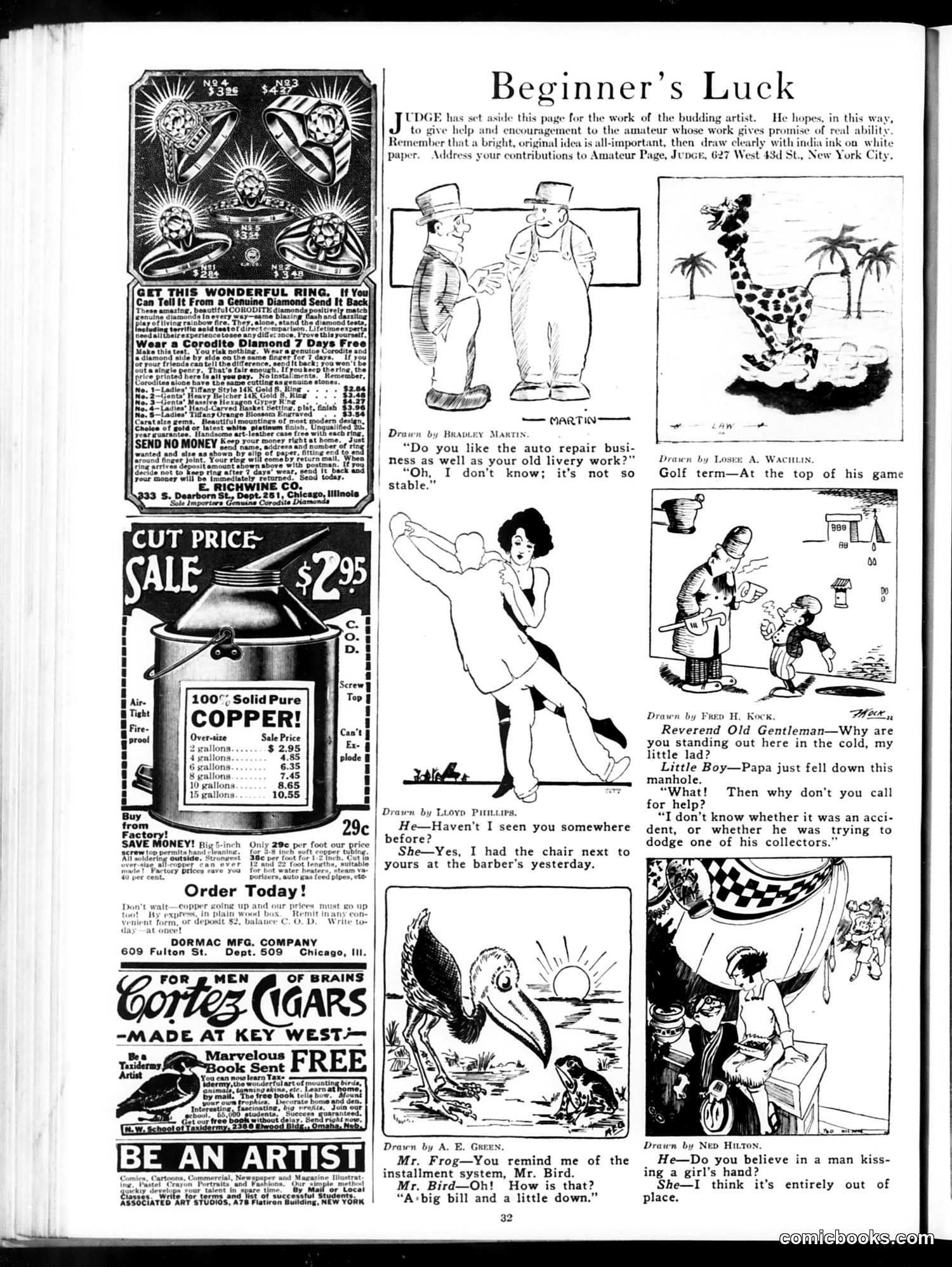
This is a collection of single-panel joke cartoons by amateur artists, published in *Judge* magazine's feature encouraging aspiring cartoonists. The page contains six unrelated gag comics: 1. **"Stable" pun**: A livery worker jokes that auto repair work is "not so stable"—wordplay on the instability of the new automobile industry versus traditional horse stables. 2. **Barber shop recognition**: A man encounters a woman who sat next to him at a barber shop. 3. **Frog and bird joke**: A frog compares a bird to the installment plan system because of "a big bill and a little down"—satirizing the then-novel consumer credit system. 4. **Golf term**: Visual pun on "at the top of his game." 5. **Child in manhole**: Dark humor—a boy's father fell into a manhole, but the child won't call for help because dad might be dodging bill collectors. 6. **Hand-kissing debate**: A woman objects to hand-kissing as improper. These represent typical early-20th-century American humor: wordplay, social observations, and mild cynicism about modern life.
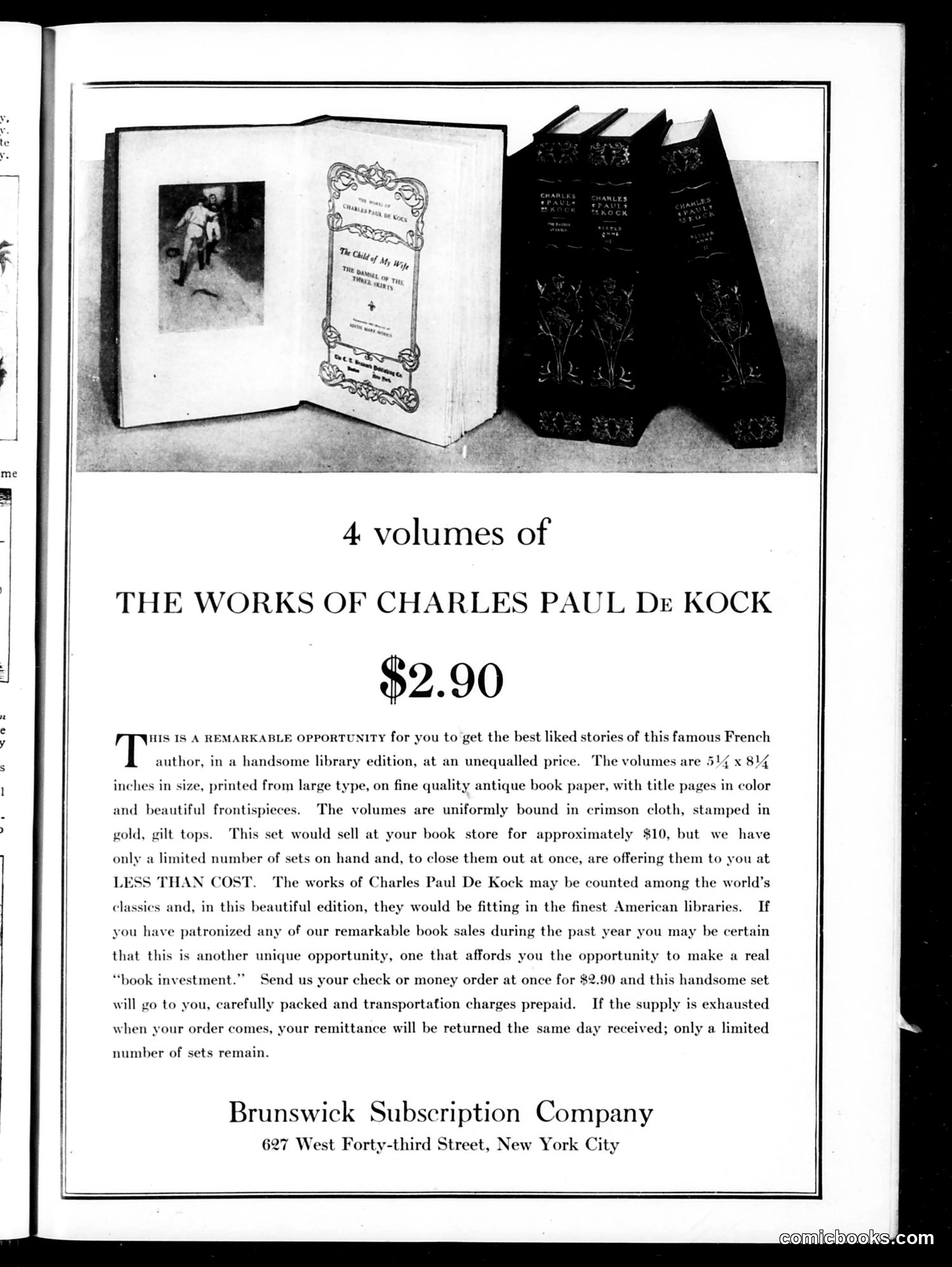
This is **not a cartoon or satirical content**—it's a **full-page advertisement** for a book subscription service. The page promotes a 4-volume set of works by Charles Paul de Kock, a 19th-century French author, being sold by the Brunswick Subscription Company at the bargain price of $2.90 (advertised as below cost). The image shows the actual books: an open volume displaying a frontispiece illustration and decorative title page, alongside three closed volumes with dark spines. The ad uses classic early-20th-century marketing language—emphasizing scarcity ("limited number of sets"), value ("approximately $10" retail), and quality ("finest American libraries")—to encourage immediate purchase. This type of direct-mail book promotion was common in Judge magazine, which mixed editorial content with advertisements.
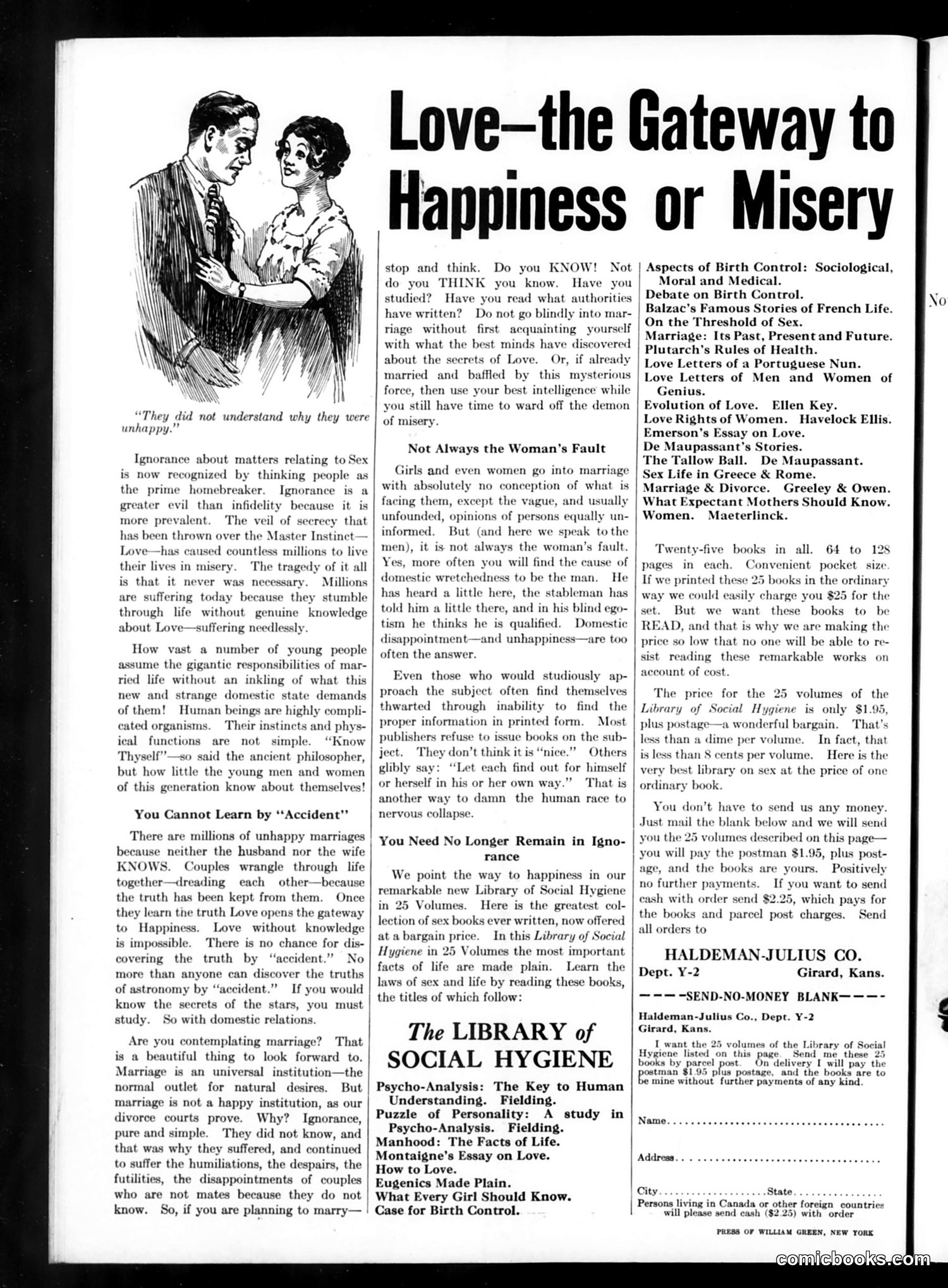
This page combines editorial advocacy with advertising. The **cartoon** (top left) shows a couple with the caption "They did not understand why they were unhappy"—illustrating the article's central argument. **The Social Message:** The text is a earnest early-20th-century argument that **marital unhappiness stems from sexual ignorance**. It claims couples suffer because society suppresses information about sex and relationships. The author blames both partners but notes men often wrongly assume competence without education. **The Satire/Point:** This appears less satirical than reformist—Judge is advocating for sex education and relationship knowledge as social goods. The "ignorance causes misery" framework was progressive for its era, challenging Victorian prudishness. **The Advertising Angle:** The page pivots to selling the "Library of Social Hygiene"—25 volumes claiming to provide this forbidden knowledge at low cost. This is the actual purpose: positioning sex-education books as remedies for widespread marital dysfunction. **Historical Context:** This reflects 1910s-20s debates about modernization, women's rights, and whether scientific knowledge about sexuality should be publicly available.