
Judge, 1922-11-04 · page 9 of 36
Judge — November 4, 1922 — page 9: what you’re looking at
A restored page from Judge, 1922-11-04. Page through the whole issue in the reader above.
📄 Transcribed text from this page (OCR, searchable)
Machine-transcribed from the original scan — historical spelling and the odd misread are preserved.
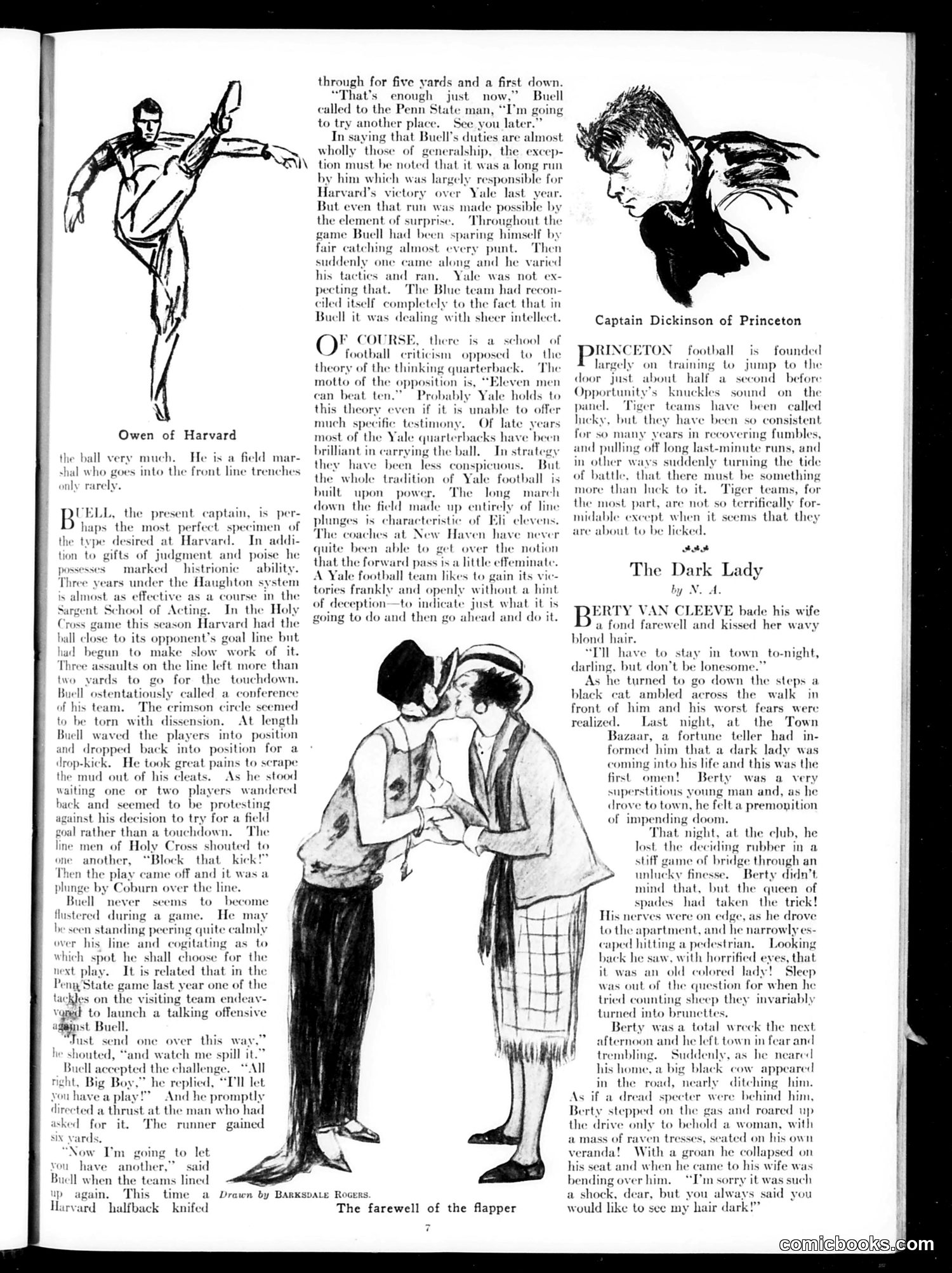
Owen of Harvard the ball very much. He is a field mar- ] who goes into the front line trenches only rarely. I VELL, the is per- haps the present captain, most perfect: specimen of the type desired at Harvard. In addi- udgment and poise he ss marked _ histrionic ity. Three years under the Haughton system is almost as effective as a course in_the Sargent School of Acting. In the Holy Cross game this season Harvard had the ball close to its opponent's goal line but ad begun to make slow work of it. Three assaults on the line left more than two yards to go for the touchdown. Buell ostentatiously called a conference of his team. The crimson circle seemed to be torn with dissension, At length Buell waved the players into position and dropped back into position for a drop-kick. He took great pains to scrape the mud out of his cleats. As he stood waiting one or two players wandered back and seemed to be protesting igainst his decision to try for a field wil rather than a touchdown. The ne men of Holy Cross shouted to 1e another, “Block that kick!” nen the play came off and it was a plunge by Coburn over the line. Buell never become flustered during a game. He may he seen standing peering quite calmly over his line and ¢ ting which spot he shall choose next play. It is related that in the Peng State game last year one of the tackles on the visiting team endeav- vara to Iaunch a talking offensive gust Buell. “Just send one over this way.” I ot watch me spill it.” 1 the chall “All he replied, “Ml let , thats And he promptly directed a thrust at the man who had asked for it. The runner gained Now I'm going to let you have another,” said Buell when the teams lined x) again. This time a Harvard halfback knifed seems to through for five yards and a first down. “That’s enough just now,” Buell called to the Penn State man, “I’m going to try another place. ‘ou later.” In saying that Buell’s duties are almost wholly those of generalship, the e tion must be noted that it was a long run by him which was largely responsible for Harvard's victory over Yale last’ year. But even that run was made possible by the element of surp' Throughout the game Buell had been ing himse fait catching aliost every punt. suddenly one came along and he varied his tactics and ran. Yale was not ex- pecting that. The Blue team had recon- ciled itself completely to the fact that in Buell it was dealing with sheer intellect. COURSE, there F O wotball criticism theory of the thinking qu yack. The motto of the opposition is, “Eleven men can beat ten.” Probably Yale holds to this theory even if it is unable to offer much specific testimony. Of late ye: most of the Yale quarterbacks hav brilliant in carrying the ball. In strategy they have been less conspicuous. But the whole tradition of Yale football is built’ upon power, The long march down the field made up entirely of line plunges is characteristic of Eli’ elevens. The coaches at New Haven have never quite been able to get over the notion that the forward pass isa little effeminate. A Yale football team likes to gain its vic- tories frankly and openly without a hint of deception—to indicate just what it is going to do and then go ahead and do it. is a school of ysed to the heen Mie? Drawn by BARKSDALE Rocers. The farewell of the flapper Captain Dickinson of Princeton football is founded on training to jump to the about half a second before Opportunity’s knuckles sound on the panel. Tiger teams have been called hicky, but they have been so consistent for so many years in recovering fumbles, and pulling off long last-minute runs, and in other ways suddenly turning the tide of battle, that there must be something more than Inck to it. Tiger teams, for the most part, are not so terrifically for- midable exeept when it scems that they are about to be licke The Dark Lady by 3 ERTY VAN CI E bade his wife a fond farewell and kissed her wavy blond hair. “TIL have in town darling, but don’t be lonesome.” As he turned to go down the steps a black cat ambled across the walk in front of him and his worst fears were realized. Last night, at the Town ar, a fortune teller had in- formed him that a dark lady was coming into his life and this was the first omen! — Berty a very superstitious young man and, as he drove to town, he felt a premonition of impending doom. That night, at the club, he lost. the deciding rubber in a stiff game of bridge through an unlucky finesse. Berty didn’t mind that, but the queen of spades had taken the trick! His nerves were on edge, as he drove to the apartment, and he narrow! caped hitting a pedestrian. Looking back he saw, with horrified eyes, that it was an old colored lady! Sleep was out of the question for when he tried counting sheep they invariably turned into brunettes. Berty was a total wreck the next afternoon and he left town in fe trembling. Suddenly, as he ne his home, a big black cow appc in the r rly ditching him. As if a dread sy were behind him, Berty stepped on the gas and roared up the drive only to behold a woman, with a mass of raven tresses, seated on his own veranda! With a groan he collapsed on his seat and when he came to his wife was bending over him. “I’m sorry it was such a shock, dear, but you always said you would like to see my hair dark!” to stay to-night, comichooks elu)