
Judge, 1922-11-04 · page 13 of 36
Judge — November 4, 1922 — page 13: what you’re looking at
What you’re looking at
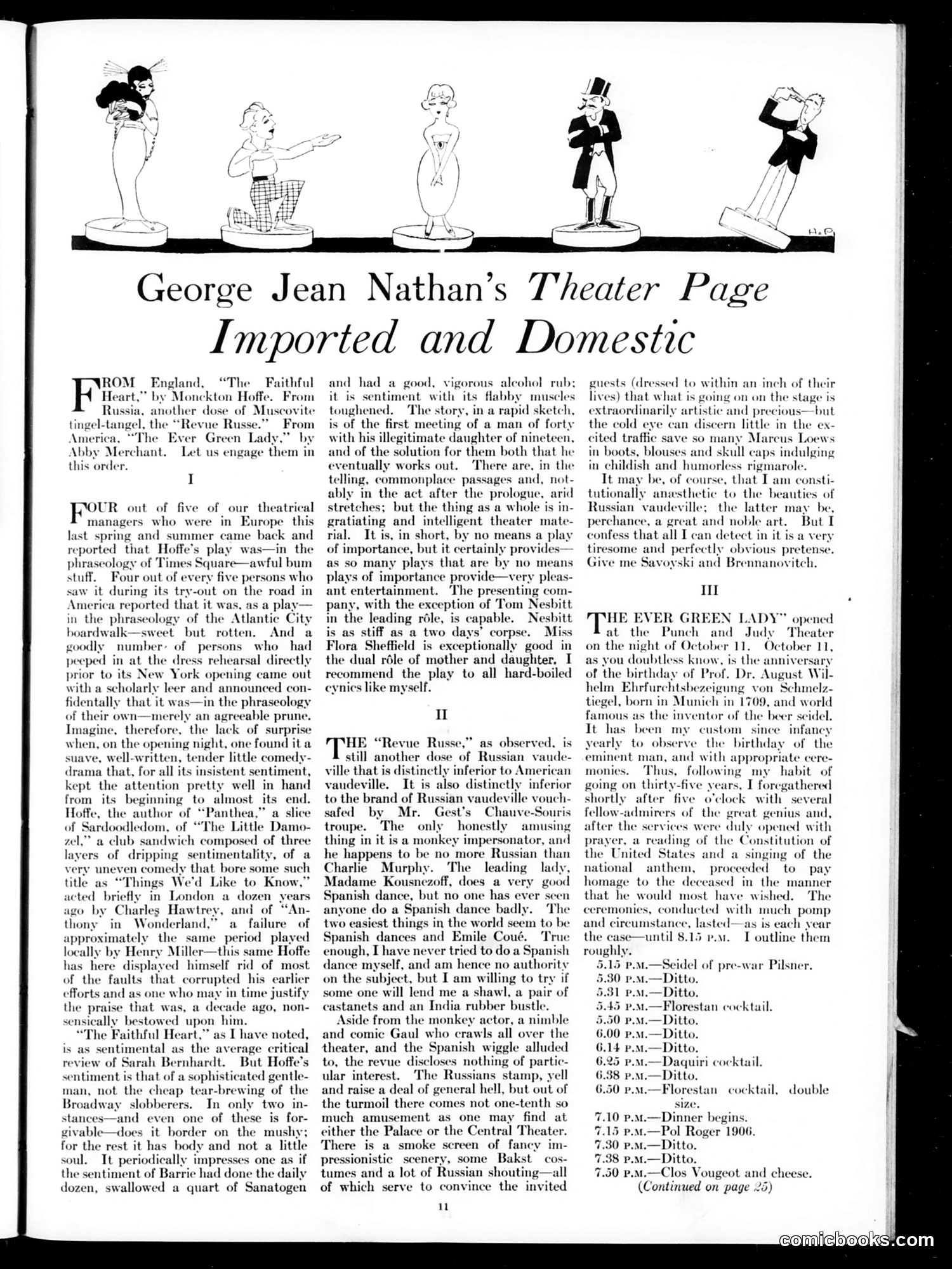
This is theater criticism by George Jean Nathan reviewing three Broadway productions: an English play ("The Faithful Heart"), a Russian vaudeville revue ("Revue Russe"), and an American comedy ("The Ever Green Lady"). The cartoon header shows five stylized theatrical character types standing on pedestals, illustrating the variety of stage entertainment. Nathan's tone is characteristic of early 20th-century theatrical criticism—witty, sophisticated, and somewhat dismissive of middlebrow sentimentality. He praises Hoffe's play as "suave, well-written" despite its sentiment, contrasting it with Broadway's typical "cheap tear-brewing." He's notably snobbish about Russian vaudeville, calling it inferior to both American vaudeville and the previously-seen Chauve-Souris troupe. The reference to "hard-boiled cynics like myself" suggests Nathan's persona as a urbane, slightly jaded critic who tolerates entertainment only when executed with intelligence and restraint rather than cheap emotion.
📄 Transcribed text from this page (OCR, searchable)
Machine-transcribed from the original scan — historical spelling and the odd misread are preserved.
George Jean Nathan’s Theater Page Imported and Domestic ROM England, “The Faithful Heart,” by Monckton Hoffe. From Ru: another dose of Muscovite tingel-tangel, the “Revue Russe.” From America, “The Ever Green Lady.” by Abby Merchant. Let us engage them in this order. I OUR out of five of our theatrical managers who were in Europe this last spring and summer came back and reported that Hoffe’s play was—in the phraseology of Times Square—awful bum stuff. Four out of every five persons who saw it during its try-out on the road in America reported that it was, as a ph in the phraseology of the Atlantic boardwalk—sweet but rotten. goodly number’ of persons who had peeped in at the dress rehearsal directly prior to its New York opening came out with a scholarly leer and announced con- fidentally that it was—in the phraseology of their own—merely an agreeable prune. Imagine, therefore, the lack of surprise when, on the opening night, one found it a suave, well-written, tender little comedy- drama that, for all its insistent sentiment, kept the attention pretty well in hand from its beginning to almost its end. Hoffe, the author of “Panthea,” a slice of Sardoodledom, of 1e Little Damo- zel,”” a club sandwich composed of three layers of dripping sentimentality, of a Y uneven comedy that bore some such title as “Things We'd Like to Know,” acted briefly in London a dozen years ago by Charles Hawtrey, and of “An- thony in Wonderland,” a failure of approximately the same period played locally by Henry Miller—this same Hoffe has here displayed himself rid of most of the faults that corrupted his earlier efforts and as one who may in time justify the praise that was, a decade ago, non- sensically bestowed upon him. “The Faithful Heart,” as I have noted, is as sentimental as the average critical arah Bernhardt. But Hoffe’s sentiment is that of a sophisticated gentle- man, not the cheap tear-brewing of the Broadway slobberers. In only two in- stances—and even one of these is for- givable—does it border on the mushy; for the rest it has body and not a little soul. It periodically impresses one as if the sentiment of Barrie had done the daily dozen, swallowed a quart of Sanatogen ity And a and had a good, vigorous alcohol rub; it is sentiment with its flabby muscles toughened. The story, in a rapid sketch, is of the first meeting of a man of forty with his illegitimate daughter of nineteen, and of the solution for them both that he eventually works out. There are, in the telling, commonplace passages and, not- ably in the act after the prologue, arid stretches; but the thing as a whole is in- gratiating and intelligent theater mate- rial. It is, in short, by no means a play of importance, but it certainly provides as so many plays that are by no means plays of importance provide—very pleas- ant entertainment. The presenting com- pany, with the exception of Tom Nesbi in the leading réle, is capable. is as stiff as a two days’ corpse. Flora Sheffield is exceptionally good in the dual réle of mother and daughter, I recommend the play to all hard-boiled cynics like myself. II HE “Revue Russe,” as observed, is still another dose of Russian vaude- ville that is distinctly inferior to American vaudeville. It is also distinctly inferior to the brand of Russian vaudeville vouch- safed by Mr. Gest’s Chauve-Souris troupe. The only honestly amusing thing in it is a monkey impersonator, and pens to be no ‘more Russi Charlie Murphy. The leading Madame Kousnezoff, does a very good Spanish dance, but no one has ever seen anyone do a Spanish dance badly. The two easiest things in the world seem to be Spanish dances and Emile Coué. True enough, I have never tried to do a Spanish dance myself, and am hence authority on the subject, but I am willing to try if some one will lend me a shawl, a pair of castanets and an India rubber bus Aside from the monkey actor, a nimble and comic Gaul who crawls all over the theater, and the Spanish wiggle alluded to, the revue discloses nothing of partic- ular interest. The Russians stamp, yell and raise a deal of general hell, but out of the turmoil there comes not one-tenth so much amusement as one may find at either the Palace or the Central Theater. ‘There is a smoke screen of fancy im- pressionistic scenery, some Bakst tum ssian shouting—all of which serve to convince the invited iL cos- guests (dressed to within an inch of their lives) that what i ig on on the stage is extraordinarily artistic and precious—but the cold eye can discern little in the ex- cited traffic save so many Marcus Loews in boots, blouses and skull caps indulging in childish and humorless rigmarole. thetic to the beauties of the latter may be, a great and noble art. But I confess that all I can detect in it is a very tiresome and pe ly obvious pretense. Give me Savoyski and Brennanovitch. III HE EVER GREEN LADY” opened at the Punch and Judy Theater on the night of October 11. October 11 as you doubtless know, is the annivers: of the birthday of Prof. Dr. August W helm Ehrfurchtsbezeigung von Schmelz- tiegel, born in Munich in 17 nd we famous as the inventor of the beer seidel. It has been my custom since infancy rly to observe the birthday of the eminent man, and with appropri monies. Thus, following my habit. of going on thirty-five years. I foregathered shortly after five o'clock with several fellow-admirers of the great genius and, after the services were duly opened with reading of the Constitution of United States and a singing of the national anthem, proceeded to pay © cere- ut he would most have wished. ‘The emonies, conducted with much pomp and circumstance, lasted—as is each year —until 8.15 pv. T outline them idel of pre-war Pilsner. p.M.—Ditto. Ditto. 1.—Florestan cocktail. -M.—Ditto. p.M.—Ditto. p.M.—Ditto. p.M.—Daquiri cocktail. P.M.—Ditto. p.M.—Florestan cocktail, double p.M.—Dinner begins. 7.15 p.a.—Pol Roger 1906. 30 p.M.—Ditto. -38 p.m.—Ditto. 7.50 p.m.—Clos Vougeot and cheese. (Continued on page 25)