
Judge, 1922-11-04 · page 17 of 36
Judge — November 4, 1922 — page 17: what you’re looking at
What you’re looking at
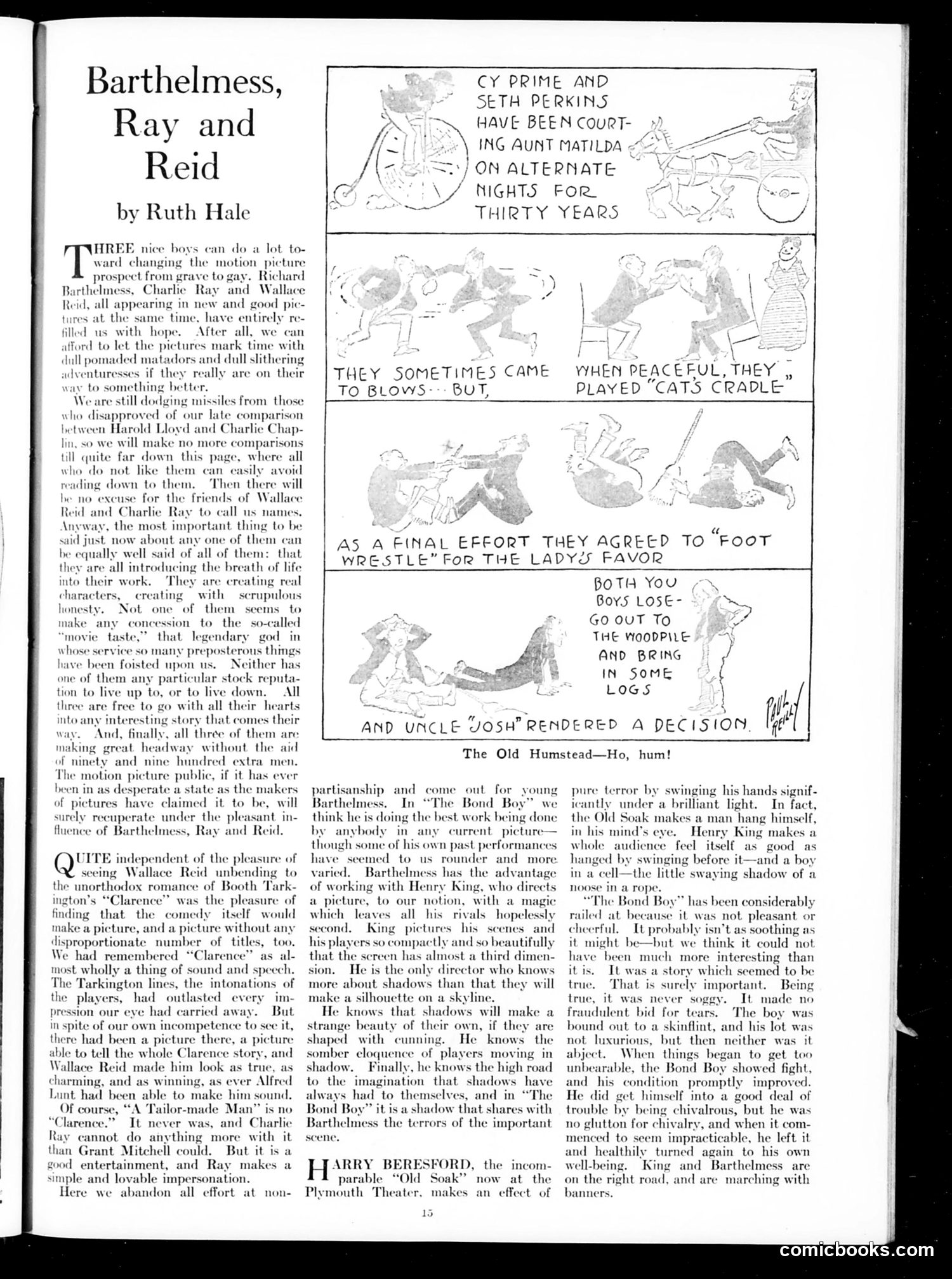
This is a film criticism piece by Ruth Hale praising three young silent film actors: Richard Barthelmess, Charlie Ray, and Wallace Reid. Rather than political satire, it's entertainment commentary—assessing their work in contemporary films like "The Bond Boy" and "Clarence." The accompanying comic strip (bottom half) is unrelated: a humorous rural sketch about two men, Cy Prime and Seth Perkins, courting Aunt Matilda for thirty years, occasionally fighting but peacefully playing "cats cradle," until Uncle Josh settles their rivalry by declaring both losers—they must fetch firewood instead. The page reflects 1920s film industry discourse, celebrating these actors' naturalistic performances and "scrupulous honesty" as alternatives to melodramatic "movie taste," while the comic provides lighthearted backwoods humor typical of Judge's offerings.
📄 Transcribed text from this page (OCR, searchable)
Machine-transcribed from the original scan — historical spelling and the odd misread are preserved.
Barthelmess, Ray and Reid by Ruth Hale HREE nice boys can do a lot to- ward changing the motion picture prospect from grave to gay. Ric’ Barthelmess, Charlie Ray and We all appearing in new and good y sat the same time, have entirely re- filled us with hope. After all, we can atford to let the pictures mark time with dull pomaded matadors and dull slithering adventuresses if they ly are on their vay to something better. We are still doc nissiles from those who disapproved of our late comparison between Harold Lloyd and Charlie Chap- lin, so we will make no more comparisons till quite far down. this p: where all » do not like them can easily avoid ling down to them. Then there will he no excuse for the friends of Wallace Reid and Charlie Ray to call us names, Anyway, the most important thing to be said just now about any one of them can be equally well said of all of them: that all introducing the breath of life They are creating real scrupulous seems to so-called they are into their work. characters, creating — with hone Not one them make any concession to the “movie taste,’ that legendary god in whose service so many preposterous things have been foisted upon us. Neither has one of them any particular stock reputa- tion to live up to, or to live down. All three are free to go with all their hearts any interesting story that comes their Wit And, finally, all three of them are making great headway without the aid of ninety and nine hundred extra men. The motion picture public, if it has ever been in as desperate a state as the makers of pictures have claimed it to be, will surely recuperate under the pleasant in- fluence of Barthelmess, Ray and Reid. ndent of the pleasure of Reid unbending to nce of Booth Tark- UITE inde seeing Wallace the unorthodox rom: ington’s “Clarence” was the pleasure of finding that the comedy itself would make a picture, and a picture without any disproportionate number of titles, too. We had remembered “Clarence l- lly a thing of sound and speech. » Tarkington lines, the intonations of players, had outlasted every im- ion our eye had carried away. But in spite of our own incompetence to see it, there had been a picture there, a picture able to tell the whole Clarence story, and Wallace Reid made him look as true, as . and as winning, as ever Alfred Lunt had bee: ¢ him sound. Of course, “A Tailor-made Man” “Clarer It never was, and Charlie Ray cannot do anything more with it than Grant Mitchell could. But it is a ainment, and Ray makes a simple and lovable impersonation. Here we abandon all effort at - non- is no CY PRIME AND SETH PERKINS HAVE BEEN CourT- ING AUNT MATILDA ~ } ON ALTERNATE © / NIGHTS FoR THIRTY YEARS THEY SOMETIMES CAME TO BLOwS--: BUT, WHEN PEACEFUL, THEY | PLAYED “CATS CRADLE” {= | As A FINAL EFFORT THEY AGREED To “FooT WRESTLE” For THE LADY’ FAVOR a P RENDERED (ON f AND UNCLE JOSH RENDERED A DECISIO BOTH YoU Boys LOSE- GO OUT To THE WOODPILE AND BRING IN SOME { LOGS | L ta The Old Humstead—Ho, partisanship and come out for young Barthelmess. In “The Bond Boy” we think he is doing the best work being done anybody in any current picture— th some of his own past performances seemed to us rounder and more varied. Barthelmess has the advantage of working with Henry King, who directs a picture, to our notion, with a magic which leaves all his rivals hopelessly second. King pictures his scenes and his players so compactly and so beautifully that the screen Imost a third dimen- sion. He is the only director who knows more about shadows than that they will make a silhouette on a skyline. He knows that shadows will make a strange beauty of their own, if they are shaped with cunning. He knows the somber eloquence of players moving in inally, he knows the high road to the imagination that shadows have always had to themselves, and in “The Bond Boy” it is a shadow that shares with Barthelmess the terrors of the important scene. shadow. BERESFORD, the incom- “Old Soak” now at the makes an effect. of 15 ARRY parabl Plymouth Theater, hum! pure terror by swinging his hands signif- icantly under a brilliant light. In fact, the Old Soak makes a man hang himself, in his mind’s eye. Henry King makes a whole audier feel itself as good as hanged by swinging before it—and a boy in a cell—the little swaying shadow of a noose in rope. “The Bond Boy” has been considerably railed at because it was not pleasant or cheerful. [t probably isn’t as soothing as it might be—but we think it could not have been much more interesting than itis. It was a story which seemed to be That is surely important. Being it was never s¢ It’ made no fraudulent bid for te: The boy was bound out to a skinflint, and his lot was not luxurious, but then neither was. it abject. When things began to get too unbearable, the Bond Boy showed fight, and his condition promptly improved. He did ge! ‘If into a good deal of trouble by being chivalrous, but he was no ghitton for chivalry, and when it com- menced to seem imp cable, he left it and healthily turned again to his own well-bei King and Barthelmess are on the right road, and are marching with banners. comicbooks.com