
Judge, 1922-11-04 · page 19 of 36
Judge — November 4, 1922 — page 19: what you’re looking at
What you’re looking at
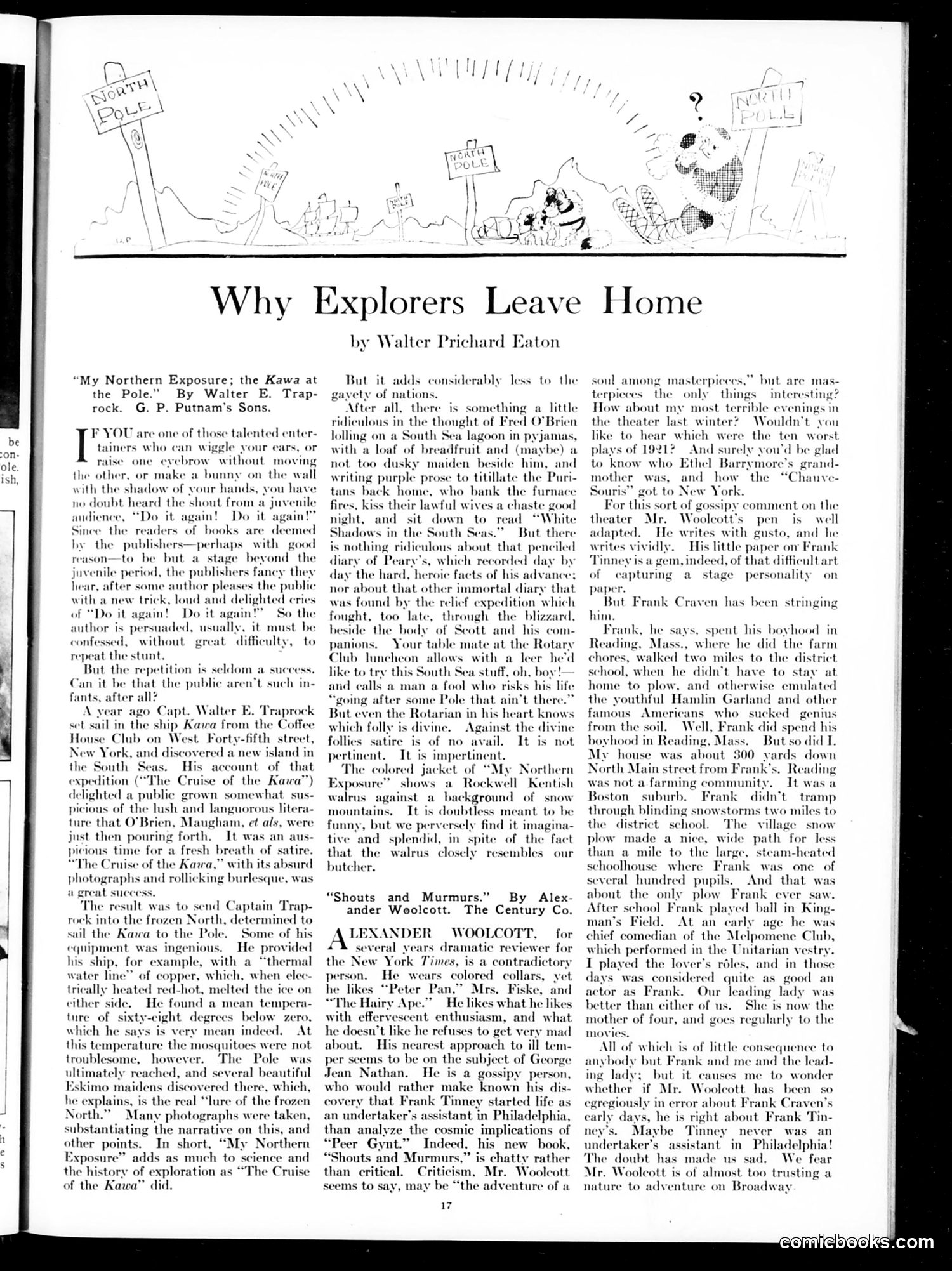
This is a book review by Walter Prichard Eaton discussing Captain Walter E. Traprock's sequel, "My Northern Exposure." **The Satire:** Eaton critiques Traprock for repeating his successful formula. Traprock's first book, "The Cruise of the Kawa," was a humorous, absurd travel narrative that succeeded because it provided satirical relief from the earnest exploration literature then popular (works by O'Brien, Maugham, etc.). His new polar expedition book attempts the same comedic approach but, Eaton argues, fails—the joke has worn thin. **The Point:** Eaton suggests that while divine follies (genuine exploration, like Scott's Antarctic expedition) deserve respect and are beyond satire's reach, manufactured repeat stunts for commercial purposes don't merit the same reverence. The "Do it again!" impulse—both publishers' and audiences'—produces diminishing returns. The cartoon's figures likely represent Traprock and his various improbable Arctic inventions, reflecting the book's absurdist humor.
📄 Transcribed text from this page (OCR, searchable)
Machine-transcribed from the original scan — historical spelling and the odd misread are preserved.
Why Explorers Leave Home by Walter Prichard Faton “My Northern Exposure; the Kawa at the Pole.” By Walter E. Trap- rock. G. P. Putnam's Sons. iners who can wiggle your ears, or raise one eyebrow without moving the other, or make a bunny on the wall with the shadow of your hands, you have no doubt heard the shout from a juven audien Do it again! Do it again!” Since the readers of books are deemed by the publishers—perhaps with good reason—to be but a stage beyond the juvenile period, the publishers fancy they hear, after some author pleases the public with a new trick, loud and delighted cries of “Do it again! Do it So the author is persuaded, usually, it must be confessed, without great difficulty, to repeat the stunt. But the repetition is seldom a success. Can it be that the public aren't such in- i a ull? 10 Capt. Walter E. Traprock 1il in the ship Kawa from the Coffee use Club on West Forty-fifth street, New York, and discovered a new island in the South » His account of that expedition (“The Cruise of the Kawa”) I * YOU are one of those talented enter- pic’ of the lush and Janguorous liter: ture that O'Brien, Maugham, et als, v just then pouring forth. It was picious time for a fresh breath of satire. “The Cruise of the Kawa,” with its absurd photographs and rollicking burlesque, was a great success, The result was to send Captain Trap- rock into the frozen North, determined to sail the Kawa to the Pole. Some of his equipment. was ingenious. He provided his ship, for example, with a “thermal water line” of copper, which, when elee- trically heated red-hot, melted the ice on cither side. He found a mean tempera- ture of ght degrees below zero. which he si is very mean indec At this temperature the mosquitoes were not troublesome, howe The Pole was ultimately reached, and several beautiful Eskimo maidens discovered there, which, ns, is the real “lure of the frozen Many photographs were taken, ing the narrative on this, and In short, “My Northern dds as much to science and “The Cruise substan: other poi Exposure’ the history of exploration as * of the Kawa” did. But it adds considerably less to the gayety of nations. ter all, there is something a little ridiculous in the thought of Fred O'Brien lolling on a South Sea lagoon in py with a loaf of breadfruit and (maybe not too dusky maiden beside him, and writing purple prose to titillate the Puri- tans back home, who bank the furnace fires, kiss their lawful wives a chaste good night, and sit down to read “White Shadows in the South Seas.” But the is nothing ridic rulous about that penciled ‘v's, which recorded day by d, heroic facts of his advance: about that other immortal diary that was found by the relief expedition which fought, too late, through the blizzard, beside the body of Scott and his com- ions. Your table mate at the Rotary Club luncheon allows with a leer he'd like to try this South Sea stuff, oh, boy! man a fool who risks his life some Pole th in’t there.” n the Rotarian in his heart knows which folly is divine. Against the divine follies satire is of no avail. It is not pertinent. It is impertinent. The colored jacket of “My Northern Exposure” shows a Rockwell Kentish walrus against a background of snow mountains. It is doubtless meant to be funny, but we perversely find it tive and splendid, in. spite of the that the walrus closely resembles butcher. our “Shouts and Murmurs.” By Alex- ander Woolcott. The Century Co. ANDER = WOOLCOTT, _ for al years dramatic reviewer for the New York Times, is a contradictory person. He wears colored collars, yet he likes “Peter Pan,” Mrs, Fiske, and “The Hairy Ape.” He likes what he likes with effervescent enthusiasm, and what he doesn’t like he refuses to get very mad about. His nearest. approach to ill tem- per seems to be on the subject of George Jean Nathan. He is a gossipy person, who would rather make known his dis- covery that Frank Tinney started life an under! sistant in Philadelp! than analyze the cosmic implications of ”” Indeed, his new book, is chatty rather Mr. Woolcott venture of a 17 soul among masterpieces,” but are mas- terpieces the only things interesting? How about my most terrible evenings in the theater last winter? Wouldn't you like to hear which were the ten worst plays of 19217 And surely you'd be glad to know who Ethel Barrymore's grand- mother was, and how the “Chauve- Souris” got to New York. For this sort of gossipy comment on th theater Mr. Woolcott’s pen is well adapted. He writes with gusto, and he writes vividly. His little paper ow Frank . m, indeed, of that difficult art ipturing a stage personality on paper. But Frank Craven has been stringing him. Frank, he says, spent his boyhood in Mass., where he did the farm ked two miles to the district school, when he didn’t have to s' at home to plow, and otherwise emulated the youthful Hamlin Garland and other famous Americans who sucked genius from the soil. Well, Frank did spend his boyhood in Reading, But so did I. My house was about 300 yards down North Main street from Frank's. Reading was not a farming community. It was a Boston suburb. Frank didn’t tramp through blinding snowstorms two miles to the district school. The village plow made a nice, wide path for less than a mile to the large, steam-heated schoolhouse where Frank was one of several hundred pupils. And that was about the only plow Frank ever. saw. After school Frank played ball in King- man’s Field. At an carly age he was chief comedian of the Melpomene Club, which performed in the Unitarian vestry. javed the lover's réles, and in those idered quite as good an actor as Frank. Our leading lady was better than either of us. She is now the mother of four, and goes regularly to the movies. All of which is of little consequence to anybody but Frank and me and the lead- ing | but it causes me to wonder if Mr. Woolcott has been so egregiously in error about Frank Craven's carly d: he is right about Frank ‘Tin- vybe Tinney never was a undertaker’s assistant in Philadelphia! The doubt has made us sad. We fear Mr. Woolcott is of almost too trusting a nature to adventure on Broadway chores, snow