
A complete issue · 36 pages · 1922
Judge — October 28, 1922
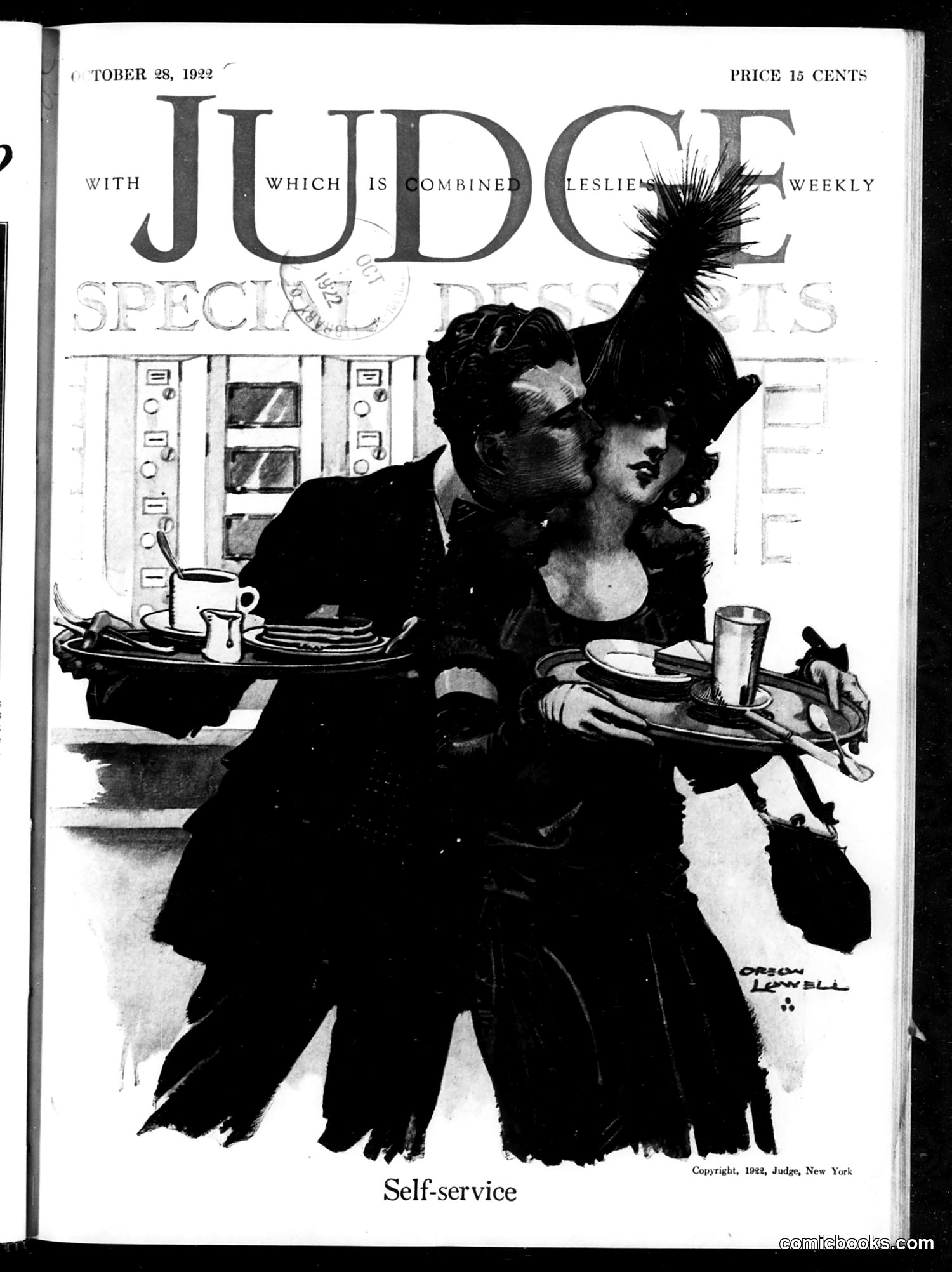
This cover illustrates "Self-service," a dining concept gaining popularity in the 1920s. The cartoon shows a couple at what appears to be a self-service restaurant, where patrons collected their own meals rather than being waited upon. The satire likely critiques the modern efficiency movement and changing social customs. The woman's elaborate hat with feathers and the couple's formal attire contrast with the humble self-service setting, suggesting discomfort with this democratization of dining. The title references how diners now serve themselves, possibly implying a loss of traditional service standards or decorum. The humor centers on class tension: elegant people now performing working-class tasks themselves—a commentary on post-WWI social shifts and the rise of middle-class automation.
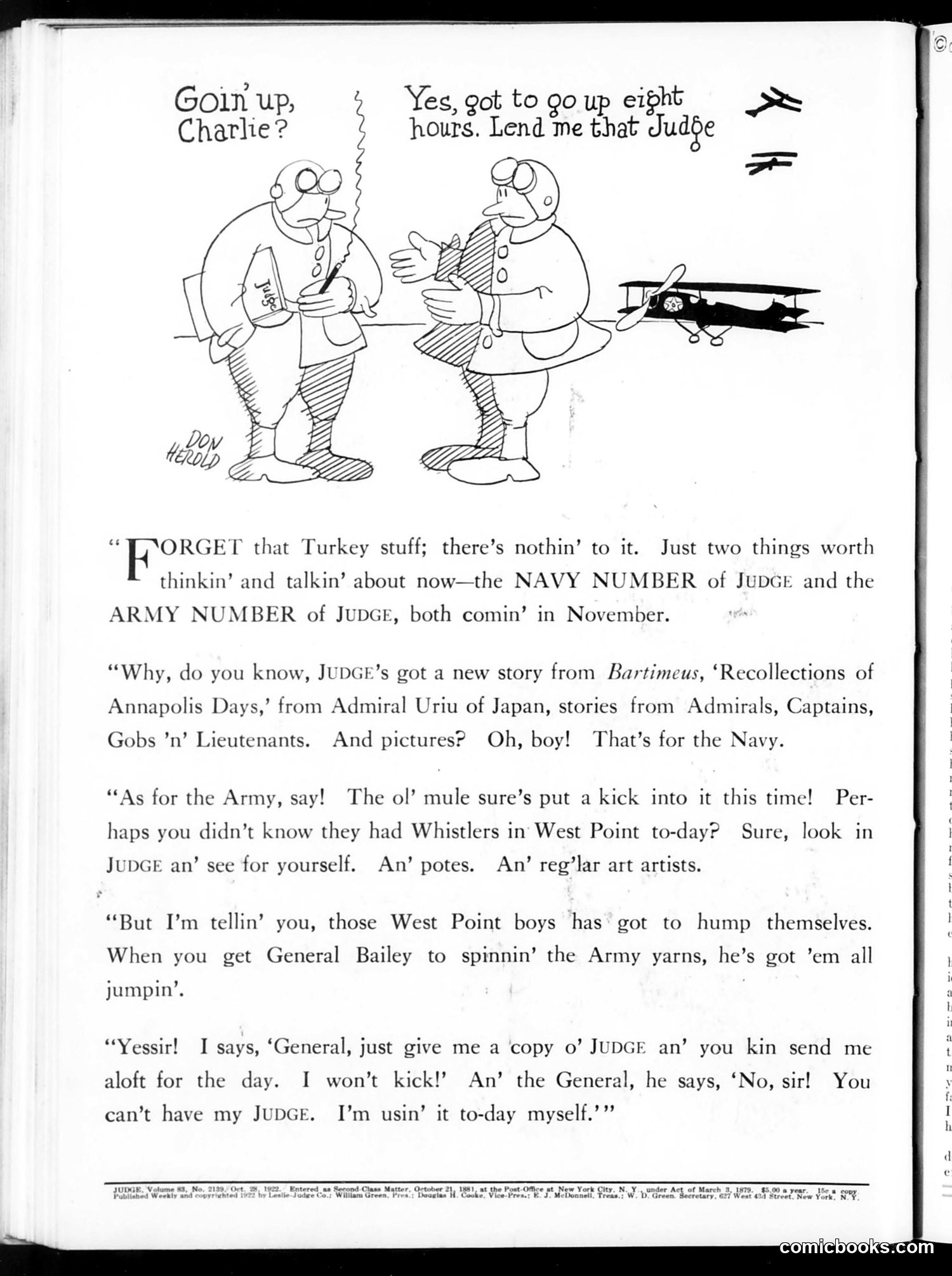
This 1922 *Judge* cartoon humorously compares two military publications—the Navy's *Judge* magazine and the Army's forthcoming publication—by having two soldiers debate their merits. The joke centers on rivalry between the services. The Navy representative boasts that their *Judge* contains exotic material: stories from Admiral Uriu of Japan and naval officers' accounts. The Army representative counters that their version will feature West Point cadets ("Whistlers") and claims General Bailey is so enthusiastic he wants to enlist soldiers specifically to publicize their publication. The humor culminates when a General refuses to lend *Judge* to someone going aloft, saying he's using it himself—suggesting the magazine is so valuable (and entertaining) that even high-ranking officers won't share copies. It's essentially inter-service friendly competition presented as boastful salesmanship.
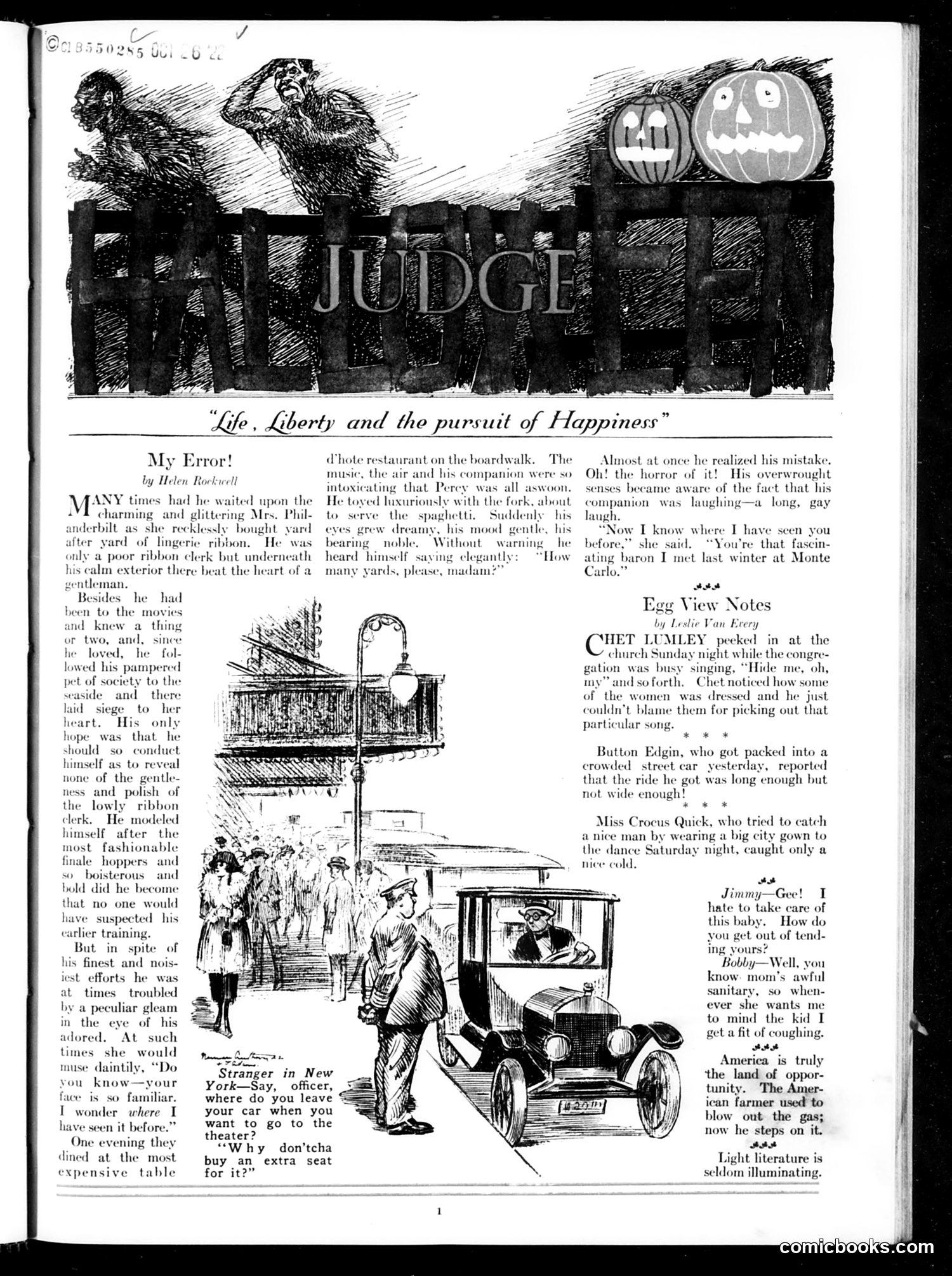
The top illustration shows two grotesque figures perched on a fence labeled "JUDGE," with jack-o'-lanterns behind them. This appears to be the magazine's masthead or seasonal Halloween artwork rather than political commentary. The main content comprises three separate pieces: "My Error!" (a short story by Helen Rockwell about an awkward social encounter), "Egg View Notes" (brief humorous observations by Leslie Van Every about church singing, street cars, and other daily incidents), and "Stranger in New York" (a dialogue about theater etiquette). These are lighthearted, domestic humor pieces typical of Judge's satirical approach to American social life, rather than political cartoons. The page reflects early 20th-century urban American manners and social conventions.
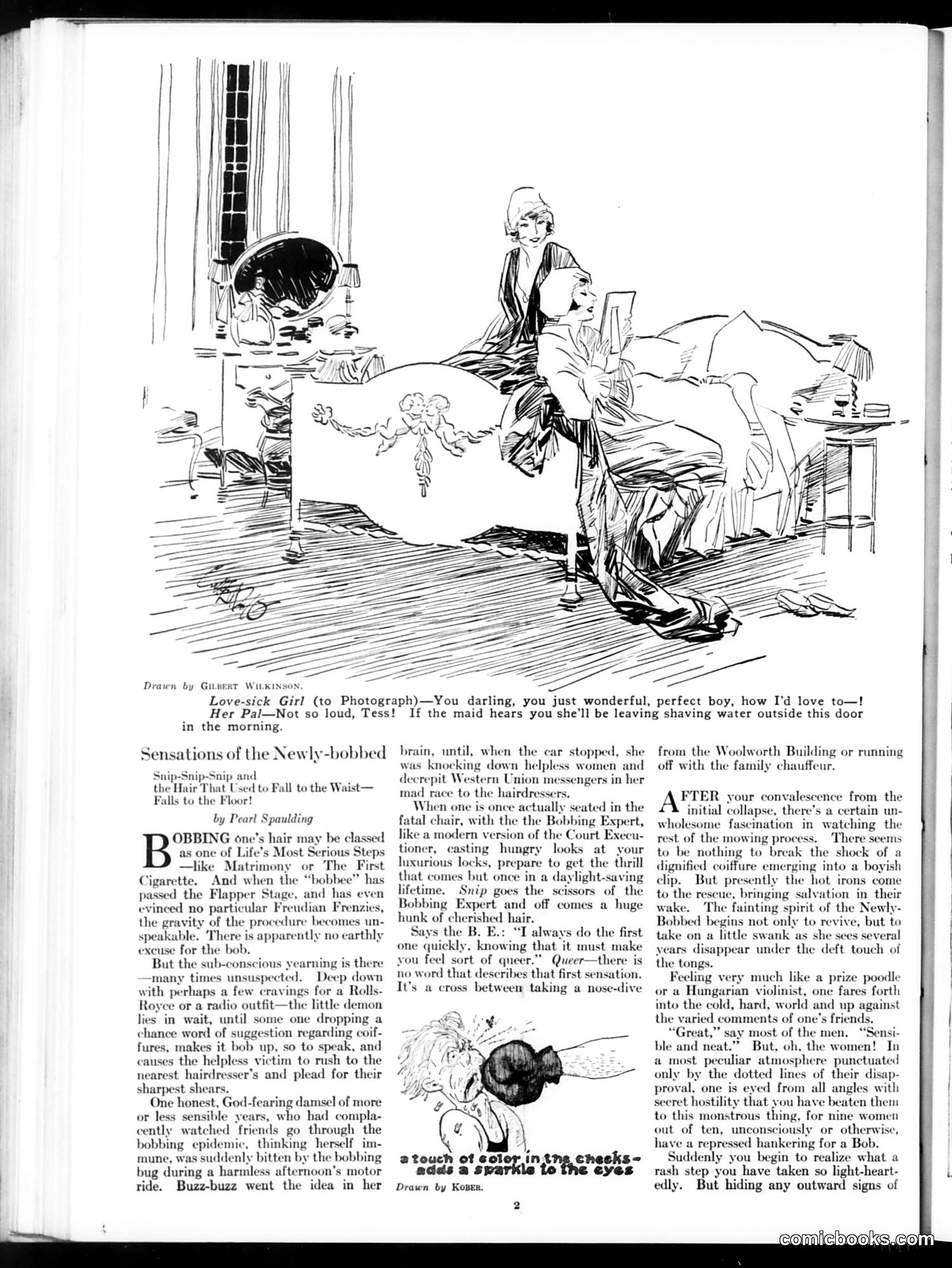
This page contains two separate pieces of social satire from the 1920s era (based on the "bobbed hair" references and style). **Top cartoon** by Gilbert Wilkinson depicts a young woman trying to convince her boyfriend she's leaving for the day, while her maid overhears. The caption satirizes women's deception regarding their activities—she claims she's visiting a female friend but is actually going elsewhere. **Bottom article** "Sensations of the Newly-bobbed" by Paul Spaulding satirizes the bobbed-hair trend among women. It humorously catalogs unexpected consequences of short hair: being mistaken for men, uncomfortable reactions from strangers, and social friction. The accompanying small cartoon by Kober shows a bobbed woman startling an observer. Both pieces mock 1920s women's changing social roles and appearance, reflecting conservative anxiety about "modern" women.
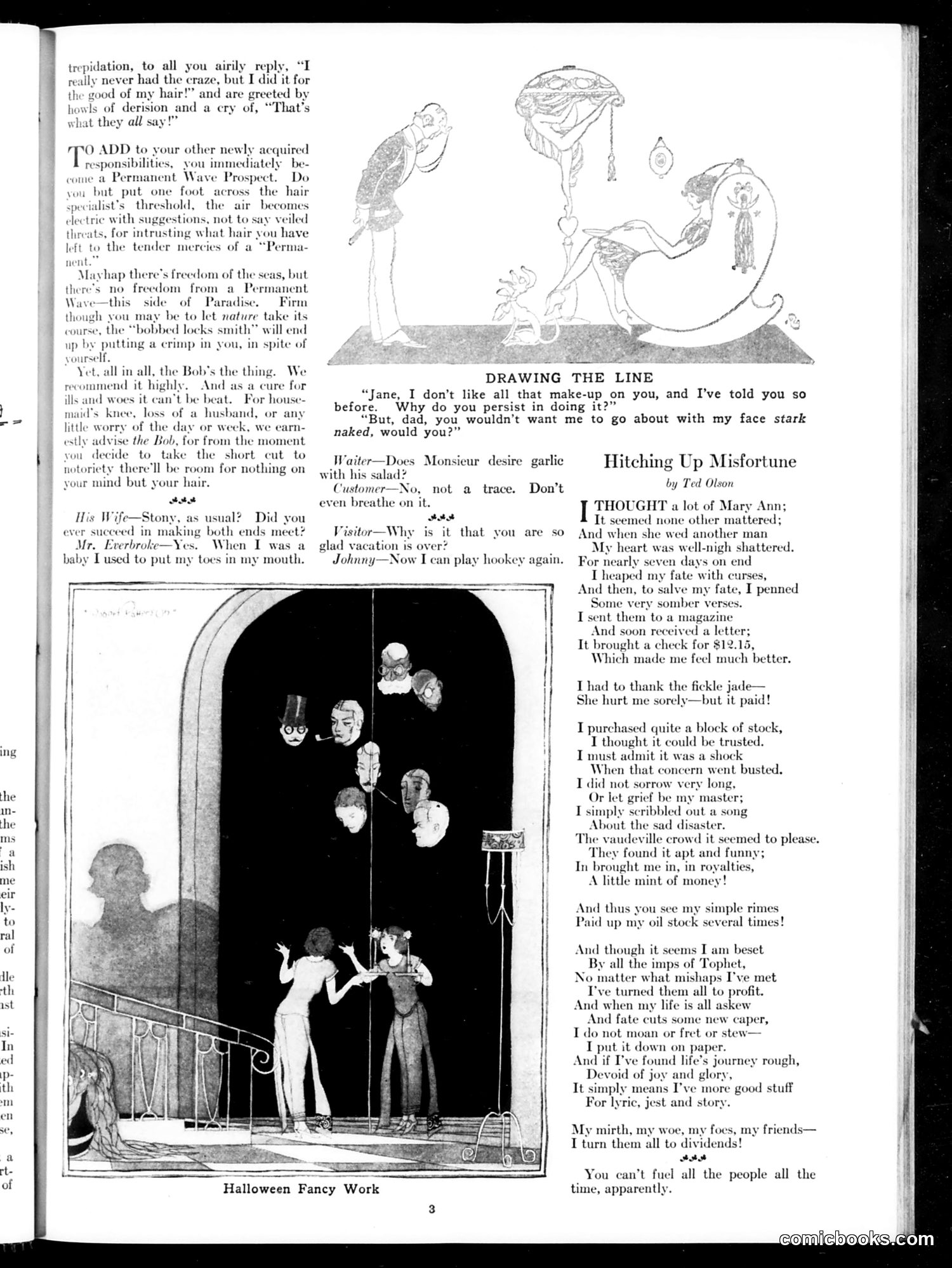
This page contains two distinct pieces: **"Drawing the Line"** (top): A humorous domestic dialogue where a daughter questions her father's hypocrisy—he objects to her makeup and wants her to go about with a "stark naked" face, yet he himself uses grooming products. The satire mocks Victorian/early 20th-century parental double standards about cosmetics and appearance. **"Hitching Up Misfortune"** (right): A poem by Ted Olson about financial misfortune. The speaker describes losing money on bad investments and stock speculation, attempting to recoup losses through verse published in magazines. It satirizes both the economic precarity of the era and the desperation of amateur writers seeking income. **"Halloween Fancy Work"** (bottom): An illustration of costumed party-goers in theatrical Halloween attire, accompanying the lighter domestic humor above.
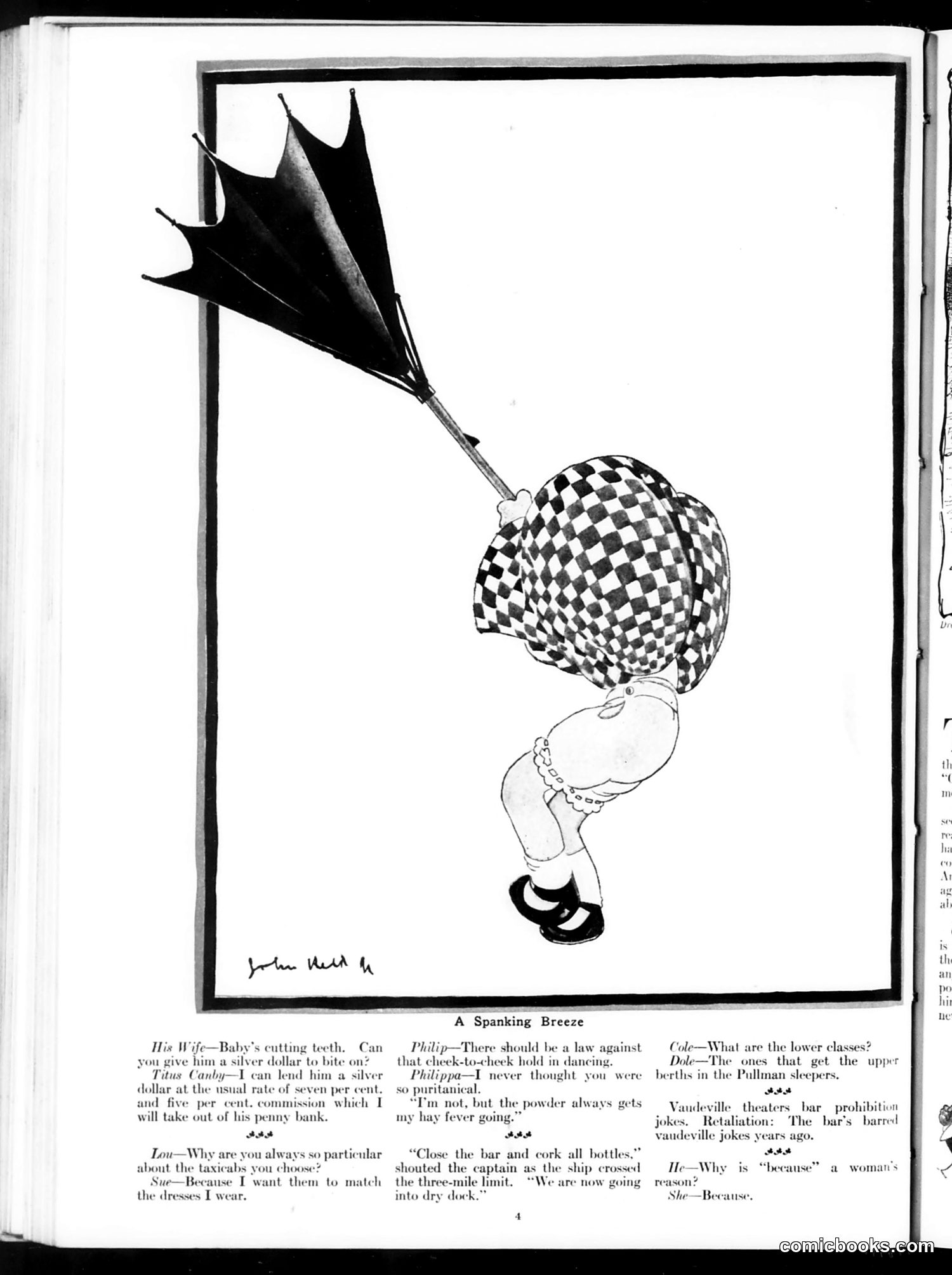
This cartoon depicts a woman holding a large checkered parasol/umbrella being blown by wind, her skirts lifted. The title "A Spanking Breeze" is a pun—the wind literally appears to "spank" her by exposing her undergarments. Below are domestic humor jokes about marriage and gender relations. Topics include: wives' dental expenses, taxicab preferences, dancing etiquette, and a reference to Vaudeville theaters. The humor relies on stereotypes about women's spending habits and marital discord. The overall page satirizes early 20th-century social customs and gender dynamics through lighthearted domestic comedy. The cartoon's physical humor was typical of Judge magazine's approach to lampooning contemporary social situations and relationships.
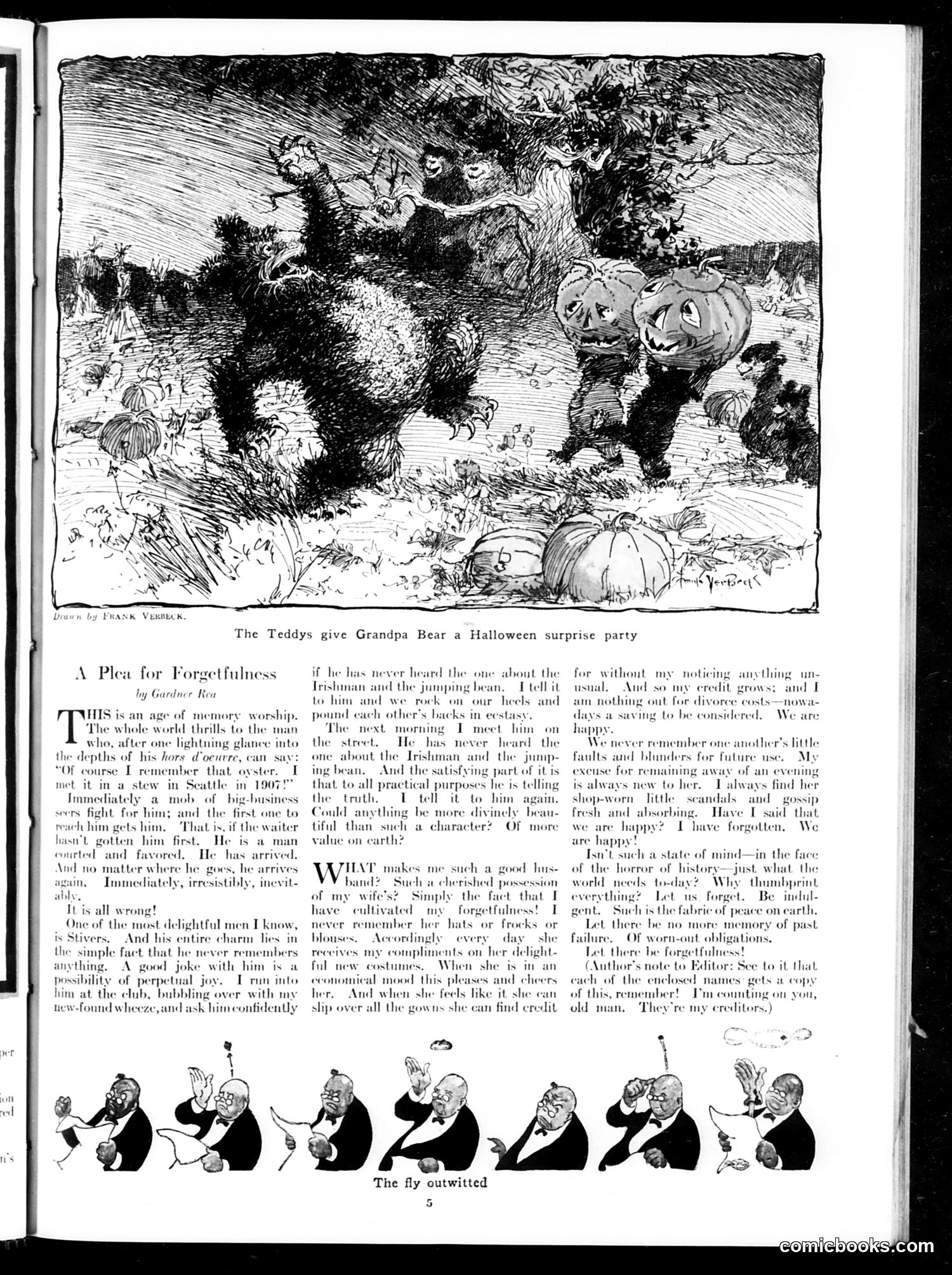
**Main Cartoon (top):** Frank Verbeck's illustration shows bears—likely Theodore Roosevelt's "Teddy Bears" (a popular toy phenomenon of the early 1900s)—surprising "Grandpa Bear" at a Halloween party. This is a whimsical domestic scene with jack-o'-lanterns, likely playing on the Roosevelt family's cultural prominence and the Teddy Bear craze that swept America after Roosevelt's hunting expeditions. **Text Article:** "A Plea for Forgetfulness" by Gardner Rea is a humorous essay praising the value of forgetfulness in modern life. It argues that constant memory-worship and obsessive recollection of details damages happiness. The author celebrates a friend named Stivers who remembers nothing, and claims his own marriage thrives because he "forgets" his wife's wardrobe repetitions and past arguments. **Bottom Illustration:** "The Fly Outwitted" shows a sequence of a man attempting to swat a fly—a visual punchline to the forgetfulness theme. The satire targets the Edwardian era's cult of memorability and self-improvement while celebrating selective amnesia as superior to exhausting memory-worship.
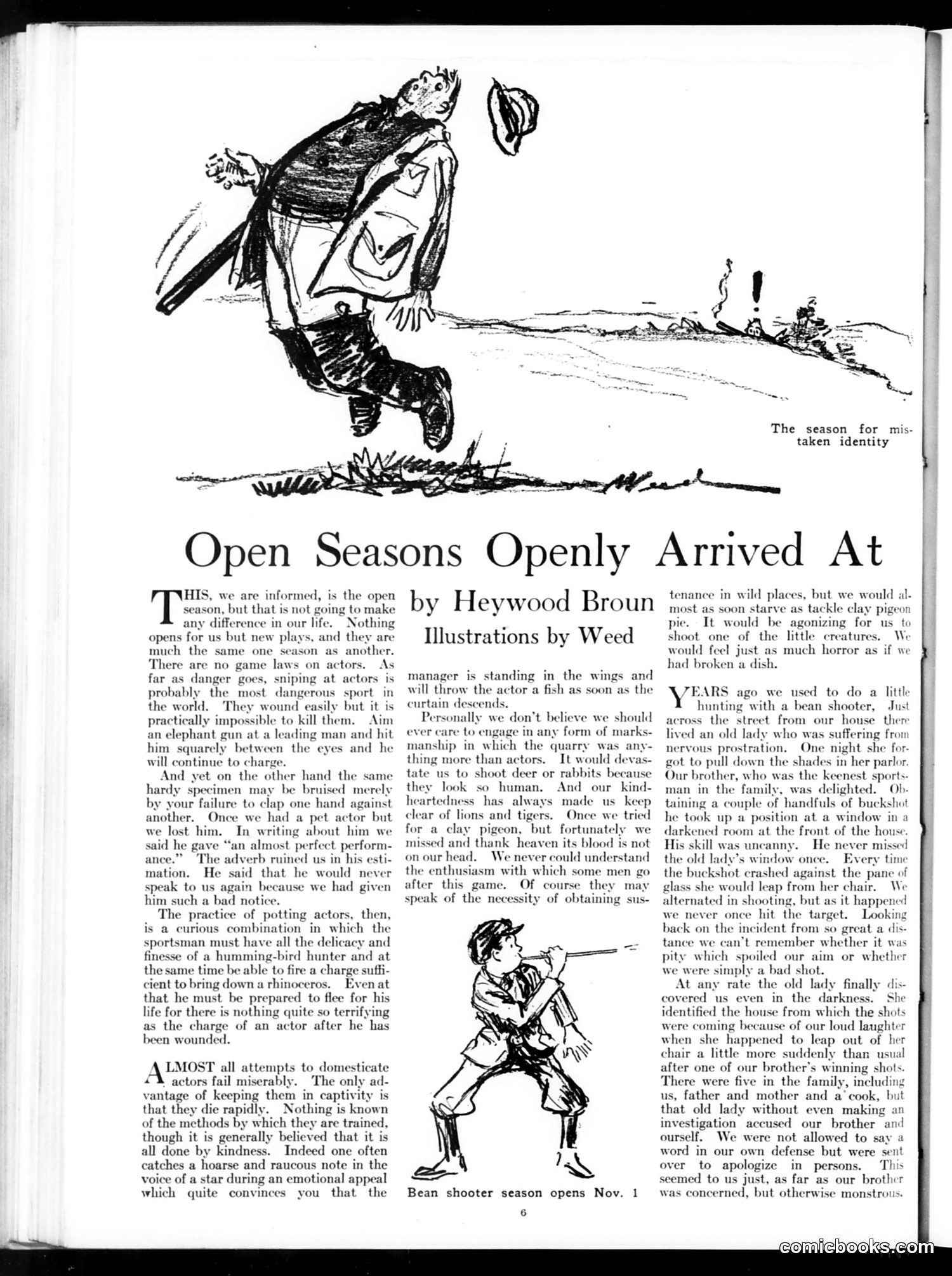
This is satirical social commentary by Heywood Broun about actors and hunting, using extended metaphor. The piece compares "shooting" or criticizing actors to hunting wild game—arguing both are morally problematic and practically absurd. **The satire:** Broun mocks actors' extreme sensitivity to criticism (they're "easily wounded" but "practically impossible to kill"), their tendency to take umbrage at minor slights, and their general unsuitability as targets for honest critique. He frames criticism as a dangerous sport requiring the "delicacy" of bird-hunting combined with rhino-stopping firepower. **The anecdote:** A personal story about shooting a bean shooter at an elderly neighbor's window to disturb her nervous condition illustrates casual cruelty. The humor relies on the teller's obliviousness to his own nastiness. **The point:** Broun suggests both hunting animals and attacking actors/performers are ethically questionable pursuits that reveal something unflattering about the pursuer.
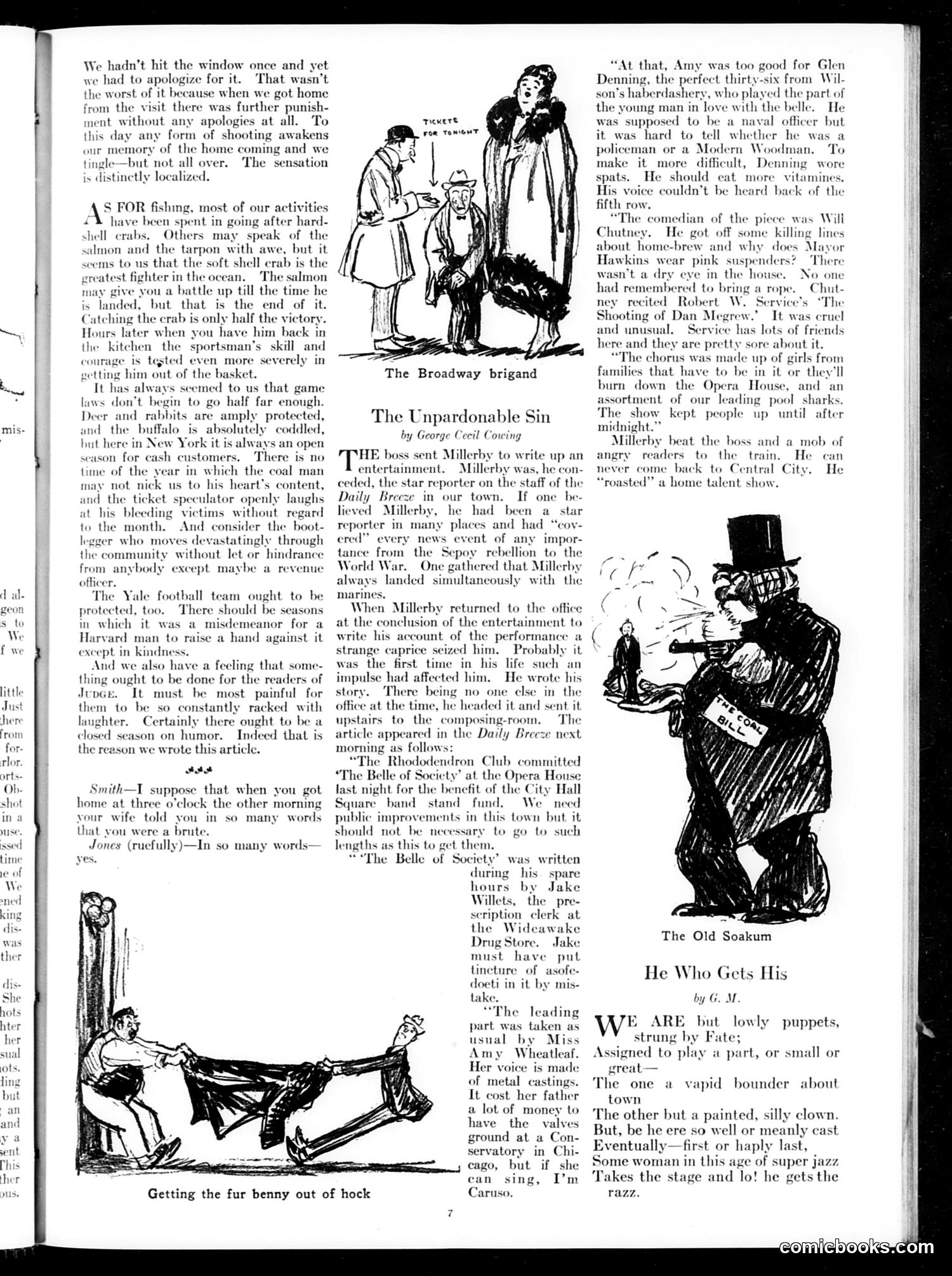
This story mocks a star reporter named Millerby at the *Daily Breeze* newspaper. After covering an amateur theatrical production ("The Belle of Society"), Millerby—who constantly boasts of covering major events from the Sepoy Rebellion to World War I—commits an unforgivable journalistic sin: he *tells the truth*. His published review savagely criticizes the performance. He notes the lead actress (Miss Amy Wheatleaf) has a voice "made of metal castings," dismisses the show as unnecessary, and questions why the town needs such public fundraising. The satire targets two things: newspaper vanity (Millerby's exaggerated war-correspondent credentials) and journalistic cowardice (the expectation that critics suppress honest opinions to avoid offending local amateur productions and their backers). By framing honest criticism as "unpardonable," Judge skewers how small-town publications prioritized social harmony over truthful reporting.
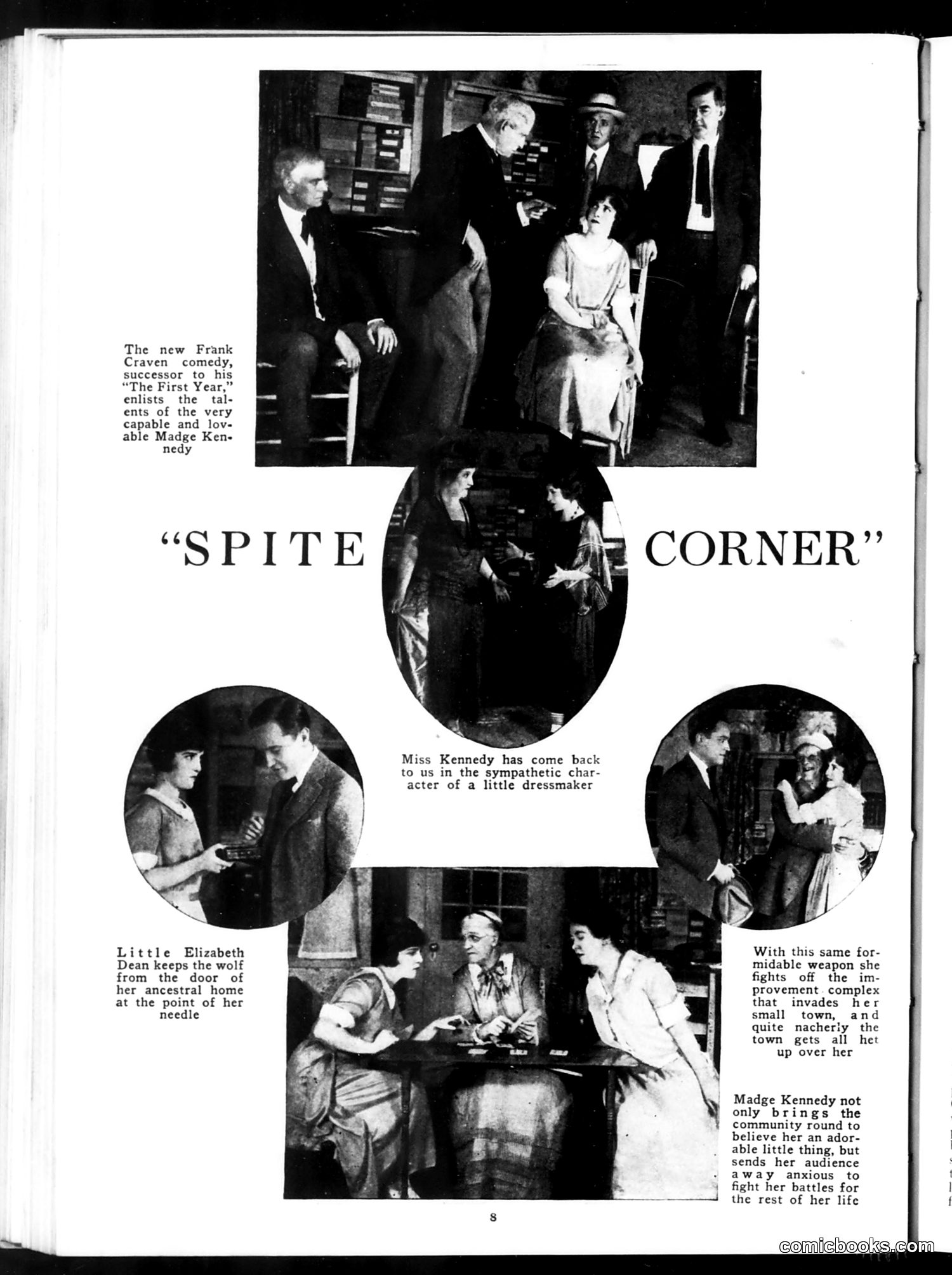
This page reviews a theatrical production called "Spite Corner," presented as the successor to Frank Craven's earlier hit "The First Year." The piece celebrates actress Madge Kennedy's performance as a sympathetic dressmaker character in a small town. The plot involves Kennedy's character using her sewing skills to support herself while resisting the town's "improvement complex"—suggesting resistance to modernization or unwanted social reforms. The accompanying photographs show scenes from the play, including one labeled "Little Elizabeth Dean" keeping poverty at bay "at the point of her needle." The satire appears gentle: it praises Kennedy's ability to win over audiences and make them emotionally invested in her character's struggles against small-town resistance and economic hardship. This reflects early 1920s theater criticism, where earnest, sympathetic working-class female characters were popular dramatic vehicles.
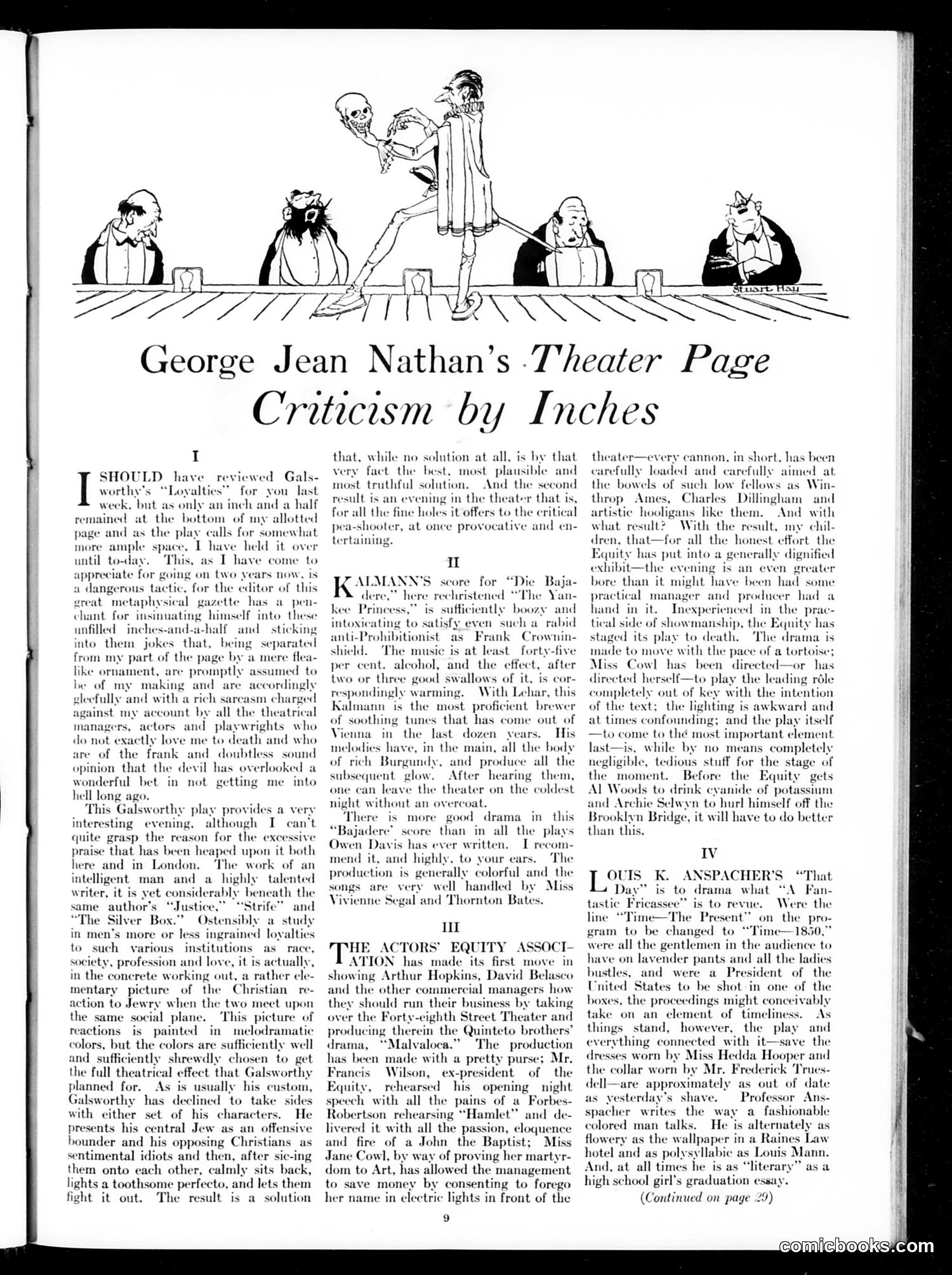
This page is from George Jean Nathan's theater criticism column in Judge magazine. The header illustration depicts Nathan as a tall figure standing over seated theater critics or managers, suggesting his dominance in theater criticism. The article critiques three theatrical works: Galsworthy's "Loyalties" (a play examining Christian-Jewish social relations), "The Yankee Prince" (a musical by Kalmann with alcohol-themed humor—relevant given Prohibition-era debates), and "Malvaloca" (produced by Actors' Equity Association). Nathan's complaints are witty but technical: he criticizes the editor for inserting jokes into his column space, praises plays for theatrical effect while questioning their depth, and comments on specific productions' colorfulness and casting choices. The satire targets theater managers, producers, and Nathan's critics among theatrical professionals, whom he notes dislike him. The tone is sophisticated insider criticism aimed at Judge's educated readership interested in theater gossip and analysis.
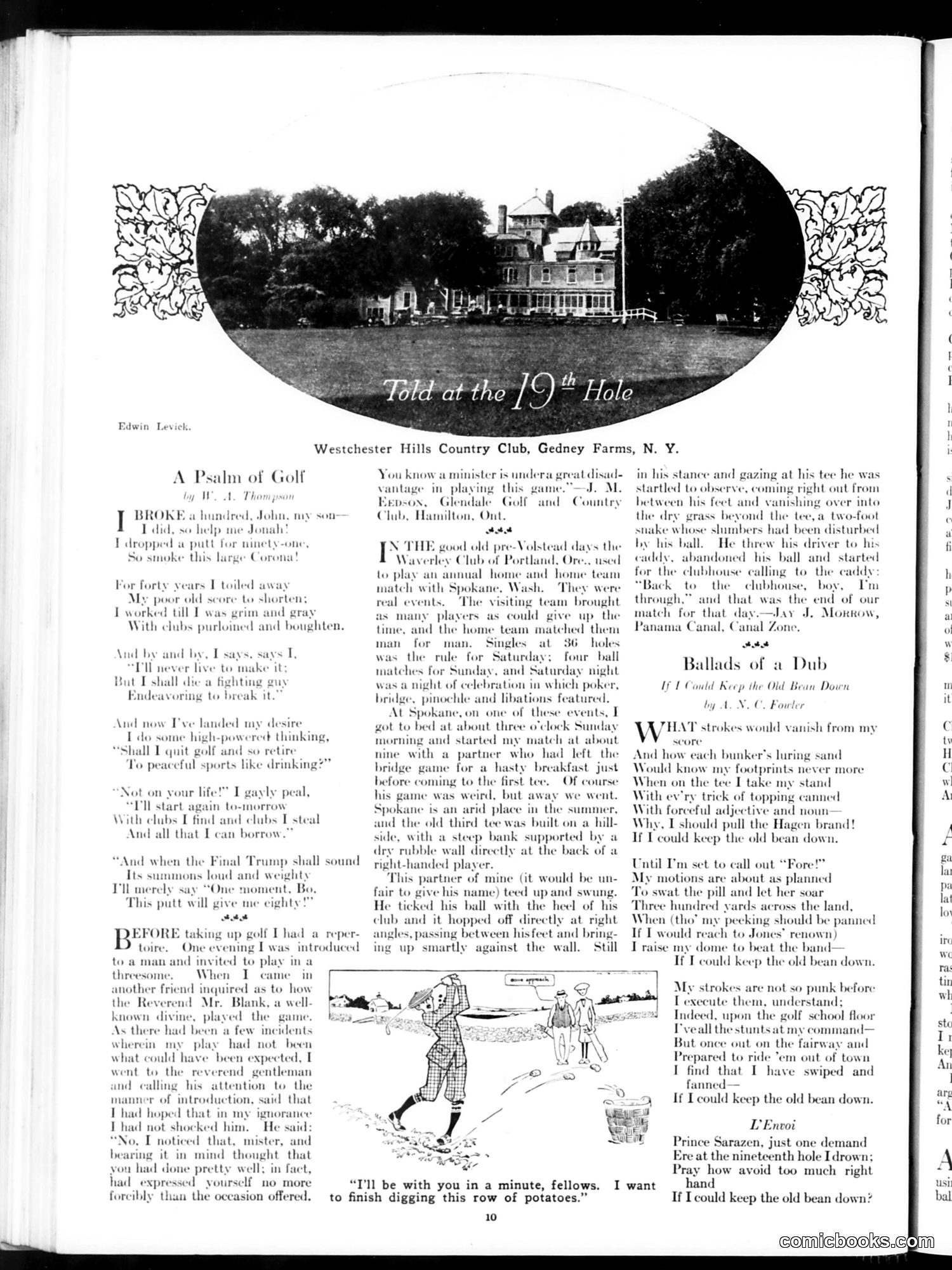
This page from *Judge* magazine contains golf humor—not political satire. It features three pieces celebrating golf as an obsession: **"A Psalm of Golf"** is a humorous poem by WAL Enerson about a man who finally broke 100 strokes after 40 years, treating this modest achievement as life's greatest victory. The joke is the exaggeration of golf's hold on players. **The middle anecdote** describes a comic incident at the Waverley Club (Portland, Oregon) where a hungover golfer's poorly-hit ball startles a snake, causing him to abandon the match entirely—illustrating how golf brings out both comedy and chaos. **"Ballads of a Dub"** is another poem lamenting the speaker's inability to improve his golf game despite best intentions. The cartoon at bottom shows a golfer telling his caddy he needs to finish digging potatoes—a rural farmer interrupting his game for farm work, contrasting working-class labor with leisure-class golfing. The satire targets golf's addictive nature and players' perpetual hope for improvement despite repeated failure.
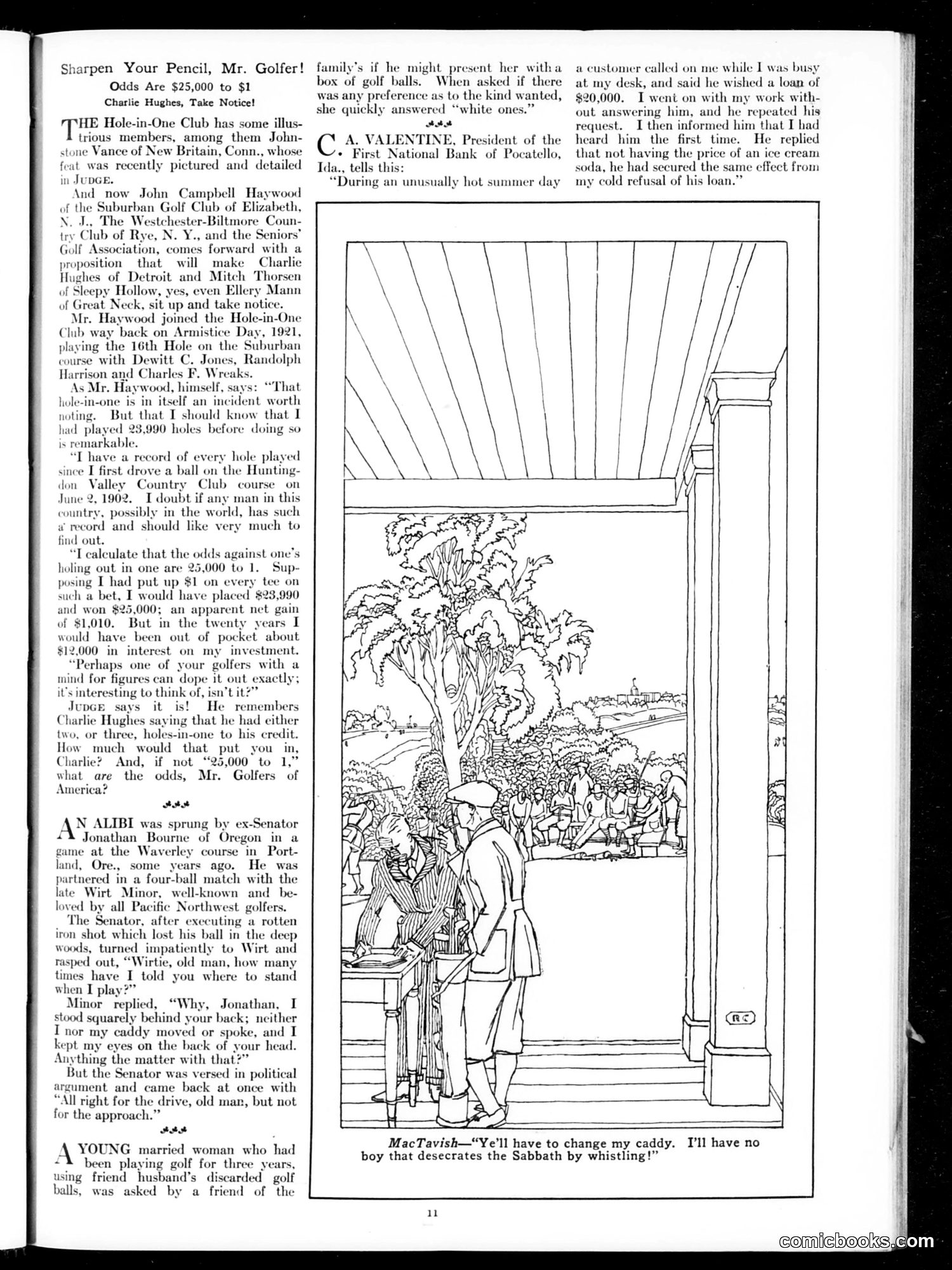
This page from *Judge* magazine contains golf-themed humor and anecdotes. The main cartoon depicts a Scottish golfer (MacTavish) firing his caddy for whistling on the Sabbath—satirizing strict religious observance and the clash between modern leisure and traditional piety. The text stories mock golf culture's absurdities: one calculates the mathematical odds of a hole-in-one (25,000 to 1) as investment advice; another features ex-Senator Jonathan Bourne blaming his caddy for a bad shot, exemplifying how golfers deflect responsibility. A third joke mocks a woman unfamiliar with golf ball quality. The satire targets golf's growing popularity among the wealthy and prominent (senators, bank presidents), portraying golfers as self-important, financially calculating, and prone to excuse-making. The religious angle in the cartoon adds class commentary—working-class caddies must conform to bourgeois moral expectations. Overall, the page ridicules both golf obsession and genteel hypocrisy.
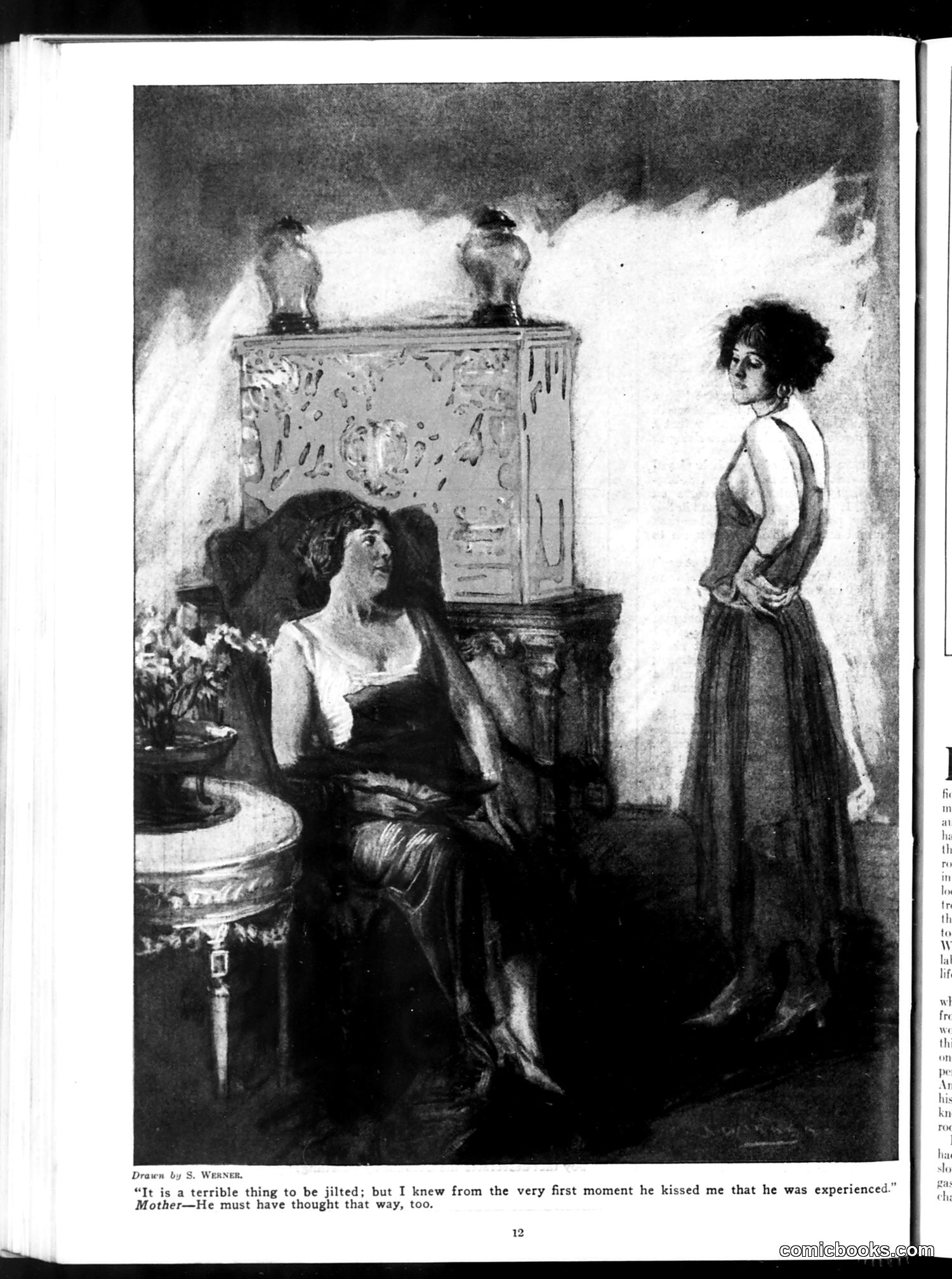
This is a domestic comedy scene drawn by S. Werner. Two women—likely a daughter (seated) and mother (standing)—discuss the daughter's romantic disappointment. The daughter remarks that being "jilted" (abandoned by a romantic partner) was terrible, but she recognized his experience from their first kiss. The mother's witty response—"He must have thought that way, too"—delivers the satirical punch: she implies the man's "experience" with women (his skill at seduction) was precisely *why* he abandoned this particular woman. The humor relies on the mother's sardonic observation that a man practiced at romance would naturally move on to other conquests. The ornate interior setting with decorative urns suggests genteel, middle-class domesticity, making the frank discussion of romantic experience notably candid for the era.
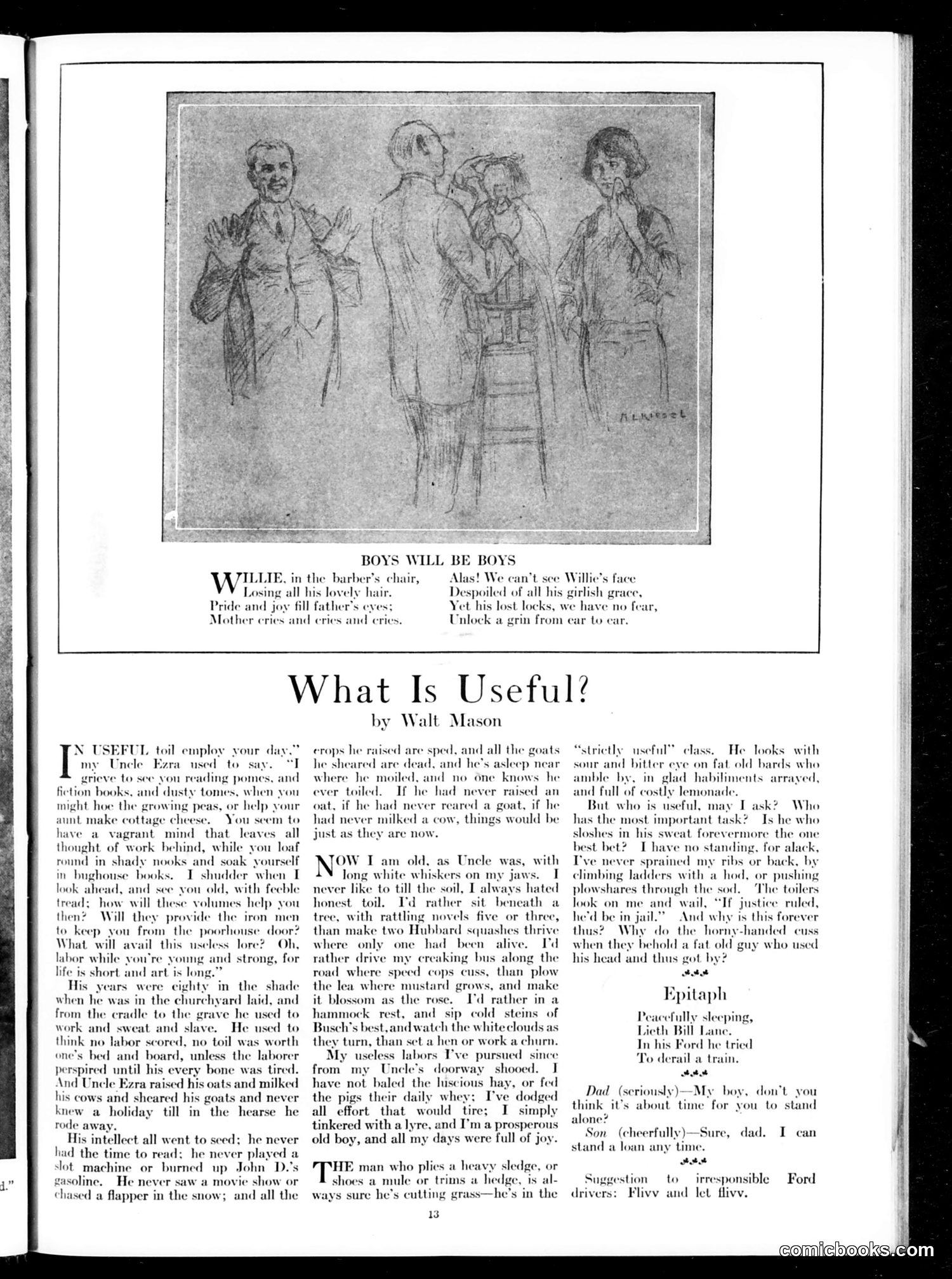
The top cartoon depicts a boy getting his hair cut at a barber shop, with family members reacting emotionally to his lost locks. The verse treats this as a minor rite of passage with gentle humor about parental anxiety. Below, Walt Mason's essay "What Is Useful?" satirizes the tension between honest labor and leisure pursuits. Mason contrasts his late Uncle Ezra—who labored exhaustingly his whole life (plowing, milking cows, shearing goats) only to die with nothing to show for it—against Mason himself, who avoided hard work, pursued "useless" pleasures (reading novels, playing music), and became prosperous anyway. The satire's point: conventional wisdom about the moral necessity of grueling toil is exposed as false. The hardworking achieve nothing; the lazy artist thrives. This mocks both Puritanical work ethic ideology and the resentment working people direct at affluent idlers—suggesting merit and reward are disconnected.
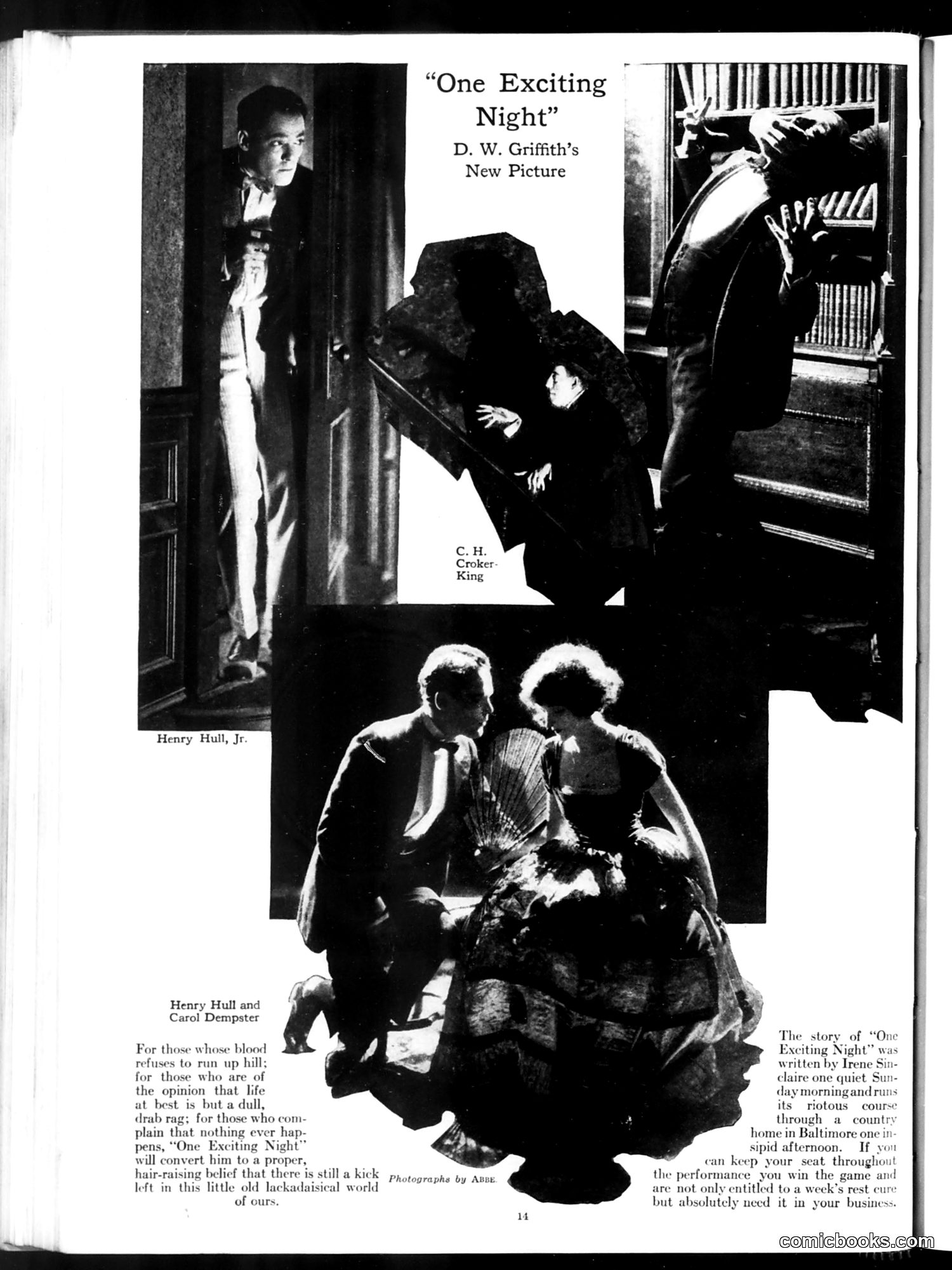
This page promotes a new motion picture by acclaimed director D.W. Griffith, featuring actors Henry Hull Jr. and Carol Dempster. The film is presented as entertainment for cynical audiences—those whose "blood refuses to run up hill" and who believe life is dull. The advertisement's tone is tongue-in-cheek: it promises the film will convert skeptics into believers "that there is still a kick left in this little old lackadaisical world." The story, written by Irene Sinclair, follows a Baltimore home during an afternoon transformed by "riotous" events. The final sales pitch is characteristically early-1920s hyperbole—claiming the film's excitement is so intense viewers "absolutely need it in your business." This is a promotional piece, not satire, though the overwrought language itself invites mild mockery of film industry marketing tactics of the era.
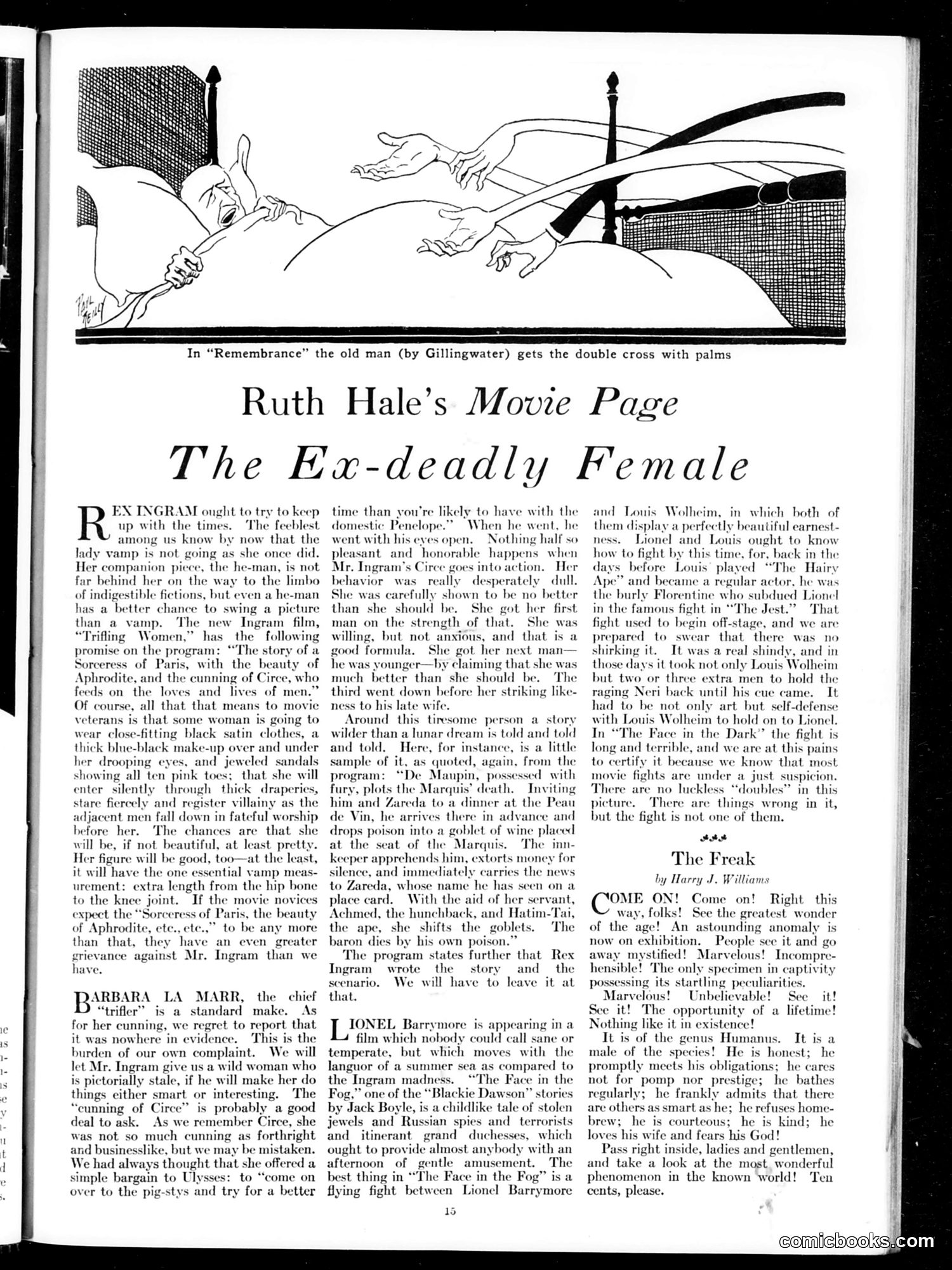
This page from *Judge* magazine reviews two silent films, focusing on outdated movie tropes. The cartoon at top (by Gillingwater) depicts an elderly man being "double-crossed" — likely satirizing melodramatic plot devices in contemporary cinema. Ruth Hale's movie column critiques Rex Ingram's "Trifling Women" (starring Barbara La Marr), arguing the "femme fatale" archetype is dying out. She mocks the film's clichéd "vamp" character — the seductive woman in black satin who manipulates men — as predictable and uninteresting. Hale contrasts this with the mythological Circe, suggesting Ingram's version lacks genuine cunning, just dull immorality. The review also briefly covers Lionel Barrymore's film "The Face in the Fog," criticizing its convoluted spy-thriller plot as absurd compared to Ingram's work. The satire targets both silent film's reliance on tired stereotypes and the absurdity of their melodramatic narratives.
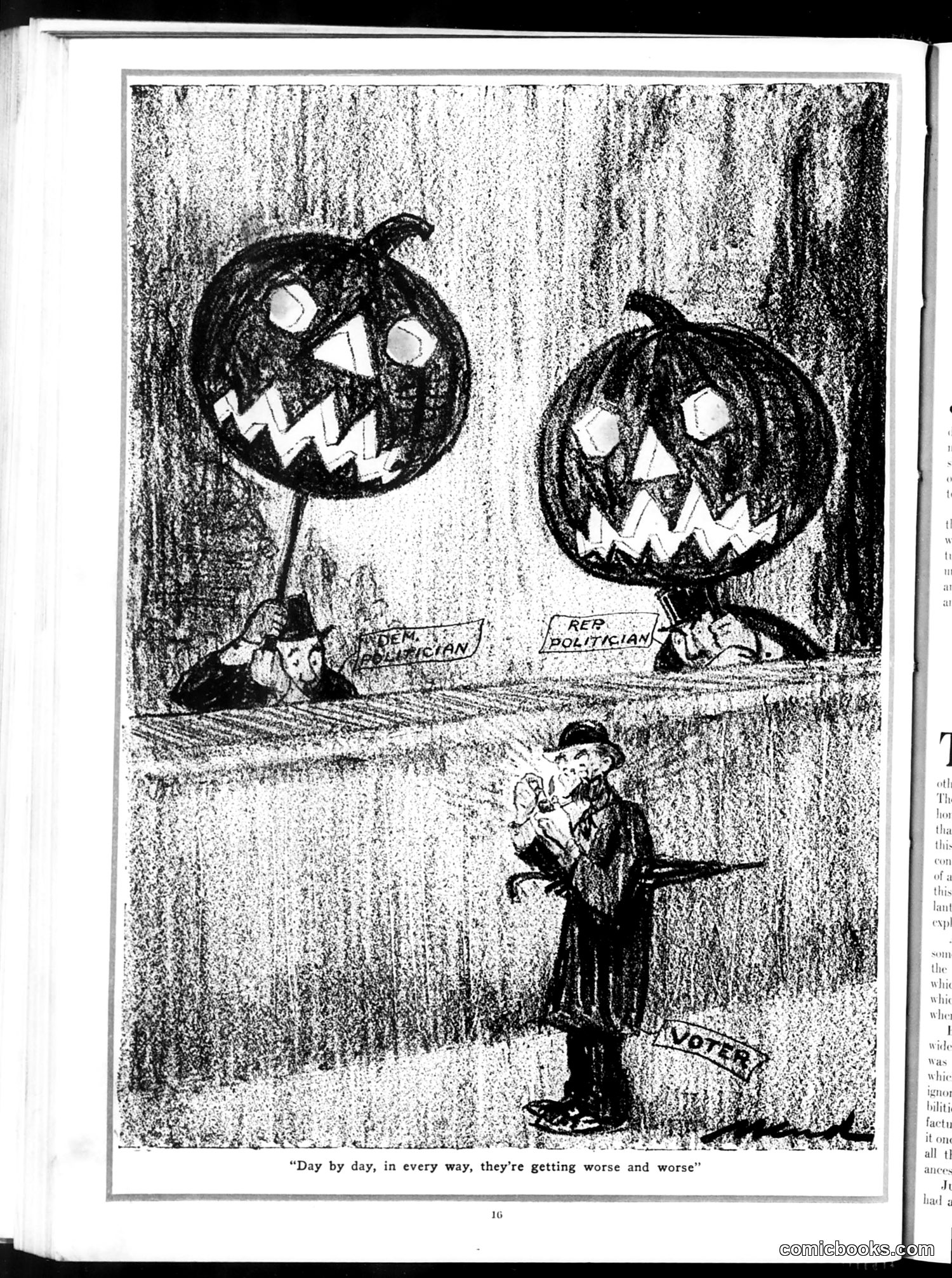
This Judge magazine cartoon uses Halloween jack-o'-lanterns as political symbols. Two large pumpkins are labeled "DEM. POLITICIAN" and "REP. POLITICIAN," suggesting both major parties are equally grotesque and menacing. A small figure labeled "VOTER" stands below, appearing frightened or trapped between them. The caption—"Day by day, in every way, they're getting worse and worse"—expresses voter despair about political deterioration. The cartoon satirizes the perception that both Democrats and Republicans have become increasingly corrupt, incompetent, or threatening to ordinary citizens. The jack-o'-lantern imagery suggests politicians are hollow, artificial, and designed to frighten rather than serve the public. This reflects cynicism about partisan politics and suggests the magazine (and presumably its readers) viewed both major parties with deep skepticism.
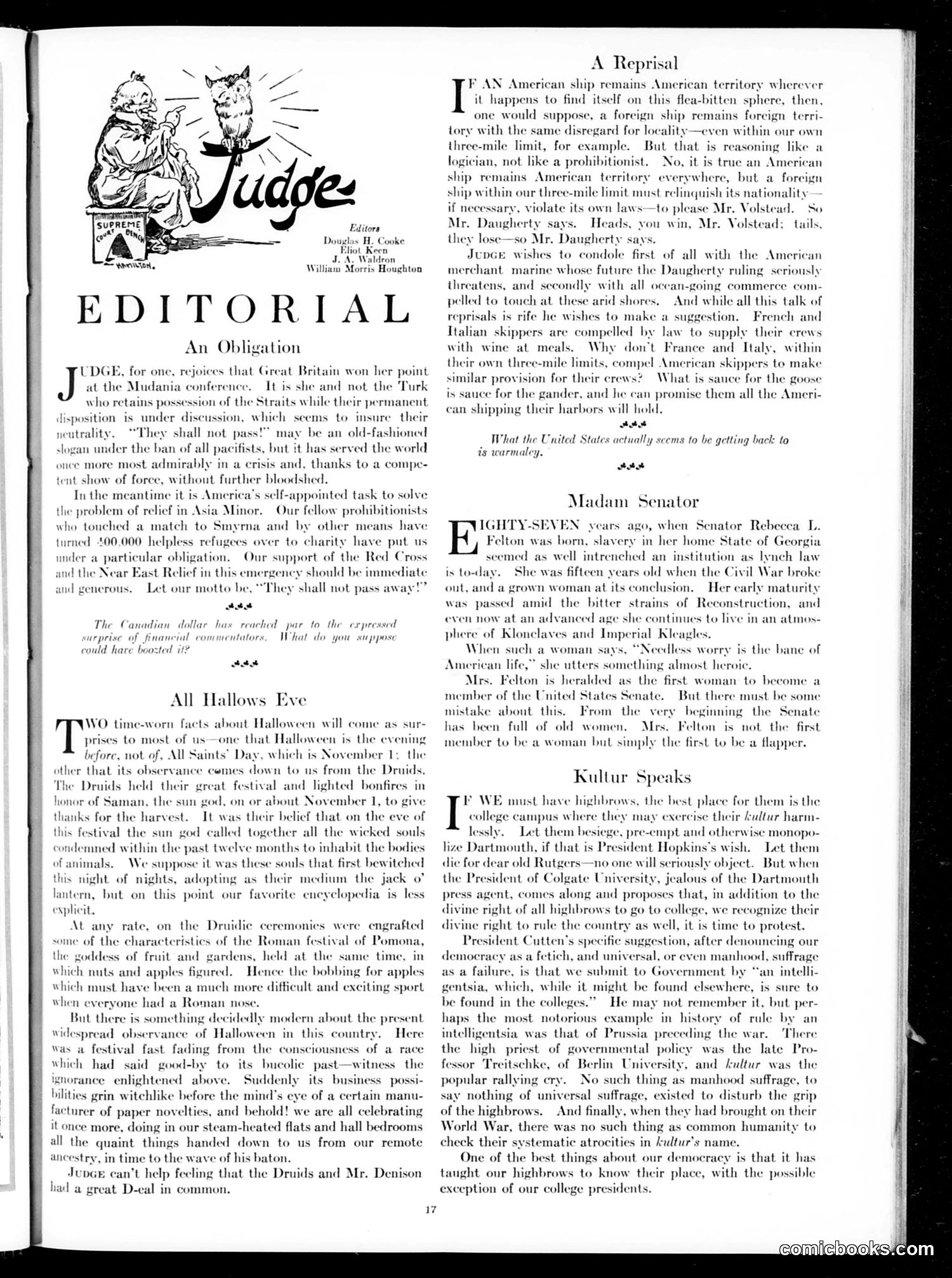
The main cartoon depicts two anthropomorphized animals (likely a donkey and elephant, representing political parties) in conflict, labeled "Judge." The accompanying editorials address contemporary 1920s American issues. **Key Content:** 1. **"An Obligation"** discusses the Mudania Conference, where Britain secured the Turkish Straits. Judge argues America must now aid Asia Minor relief efforts, particularly for Smyrna refugees—implying American prohibitionists bear responsibility for the destruction. 2. **"All Hallows Eve"** critiques commercialization of Halloween. It traces the holiday's ancient Druidic origins, then satirizes how modern manufacturers (specifically "Mr. Denison," likely a novelty producer) have commodified the tradition into mass-market decorations for urban apartments. 3. **"Kulter Speaks"** (partial) appears to discuss highbrow culture on college campuses. The page reflects Judge's satirical stance: supporting Britain's diplomacy while questioning American Prohibition's humanitarian costs, and mocking the commercialization of traditional customs.
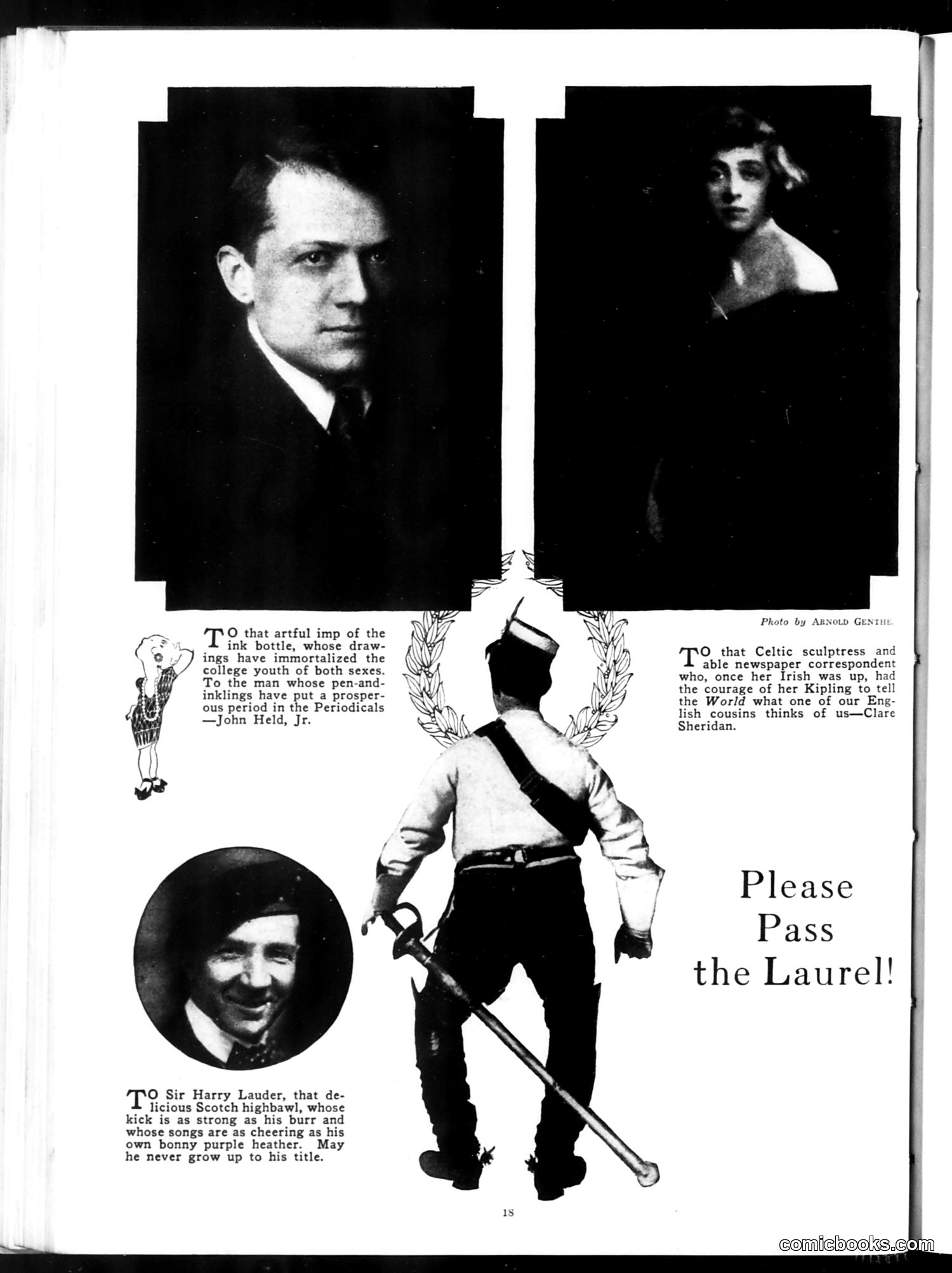
This page honors notable figures with tongue-in-cheek toasts. The main subjects are: **Sir Harry Lauder** (bottom left, circular photo): A Scottish entertainer famous for songs and accent. The joke mocks his celebrity status, calling him a "delicious Scotch highball" whose "kick" (strength/impact) matches his burr (accent). "May he never grow up to his title" suggests his popularity despite lacking gravitas. **John Held, Jr.** (left portrait): An illustrator celebrated for drawings of "college youth of both sexes"—likely flapper-era imagery. Judge credits him with revitalizing magazine publishing through his popular artistic contributions. **Clare Sheridan** (right portrait): Described as a "Celtic sculptress" and newspaper correspondent. The satire references her Irish heritage and her courage in writing critical commentary about the English for *The World* publication, suggesting she embodied Irish pride and journalistic boldness. The central figure with laurel wreath represents artistic merit. The page playfully awards recognition to contemporary cultural figures.
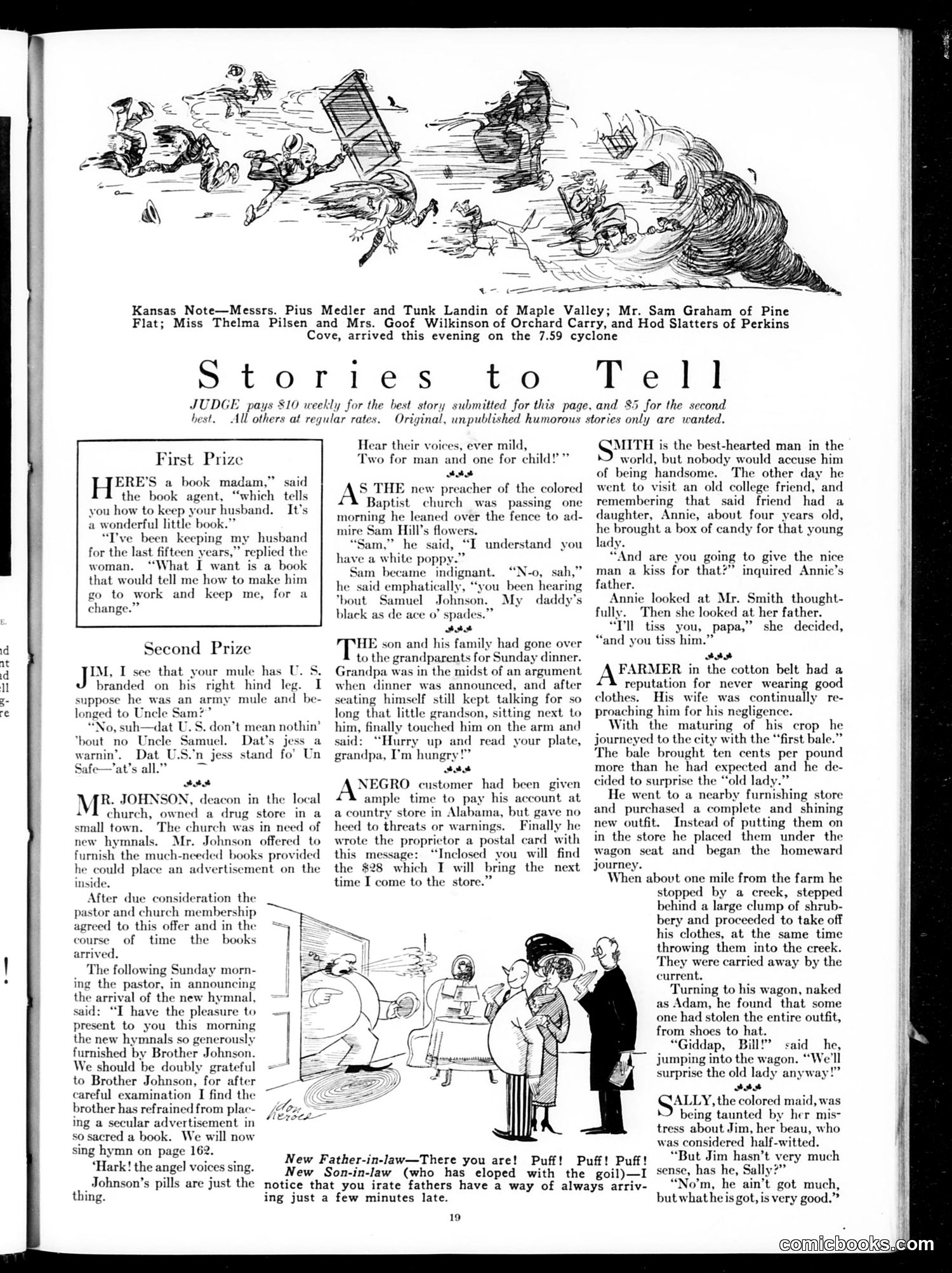
This page from Judge presents humorous short stories submitted by readers, with editorial judges awarding prizes ($10 for best, $5 for second). **The cartoons and jokes reflect early 20th-century American social attitudes:** The "First Prize" story mocks wives seeking independence—a woman wants a book teaching her husband to work rather than one about keeping him, inverting contemporary domestic expectations. The "Second Prize" joke uses racist dialect humor, depicting a Black man misunderstanding "U.S." branding on a mule as relating to "Uncle Sam"—common in period humor that minstrelized African American speech patterns. Other jokes target advertising (a deacon sneaking pill ads into hymnals), extended family dynamics (an impatient grandson), and debt collection. A cartoon shows a new son-in-law joking that "irate fathers" always arrive late to stop elopements—humor about parental authority and courtship conventions. The overall tone reflects mainstream American humor of the era: domestic friction, racial caricature, and gentle mockery of commercial and social pretense.
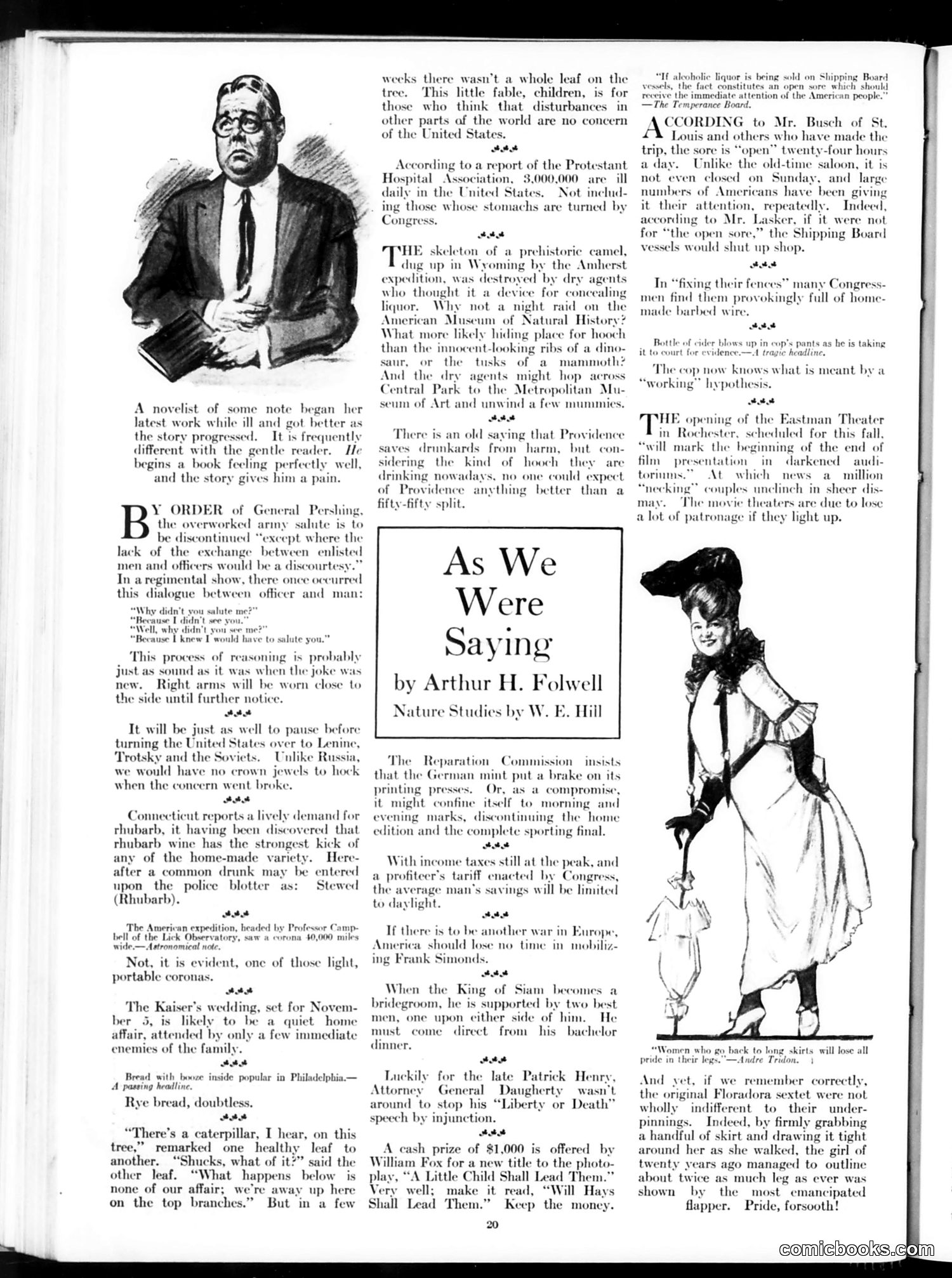
This page contains multiple short satirical commentaries on current events, circa early 1920s (post-WWI). Key targets: **General Pershing's Army Salute Order**: Satirizes an official decree discontinuing military salutes unless necessary for courtesy—the "joke" being that officers rationalize avoiding salutes as not discourteous. **Prohibition/Bootleggers**: Multiple items mock alcohol enforcement. Dry agents allegedly destroyed a prehistoric camel skeleton, mistaking it for a liquor hideout. Rhubarb wine "kicks" and bread-with-booze are popular. The satire mocks Prohibition's absurdities and ineffectiveness. **Russian Revolution Fears**: References to "Lenine, Trotsky and the Soviets" reflect American anxiety about communism; the quip about Russia having "crown jewels to hock" mocks both Russian and U.S. concerns. **Isolationism**: The caterpillar fable warns Americans not to ignore world "disturbances"—likely criticizing isolationist sentiment regarding European affairs. **Congressional Incompetence**: Jokes about Congress-induced stomachaches and profiteering tariffs. The drawings appear decorative rather than specifically tied to individual articles.
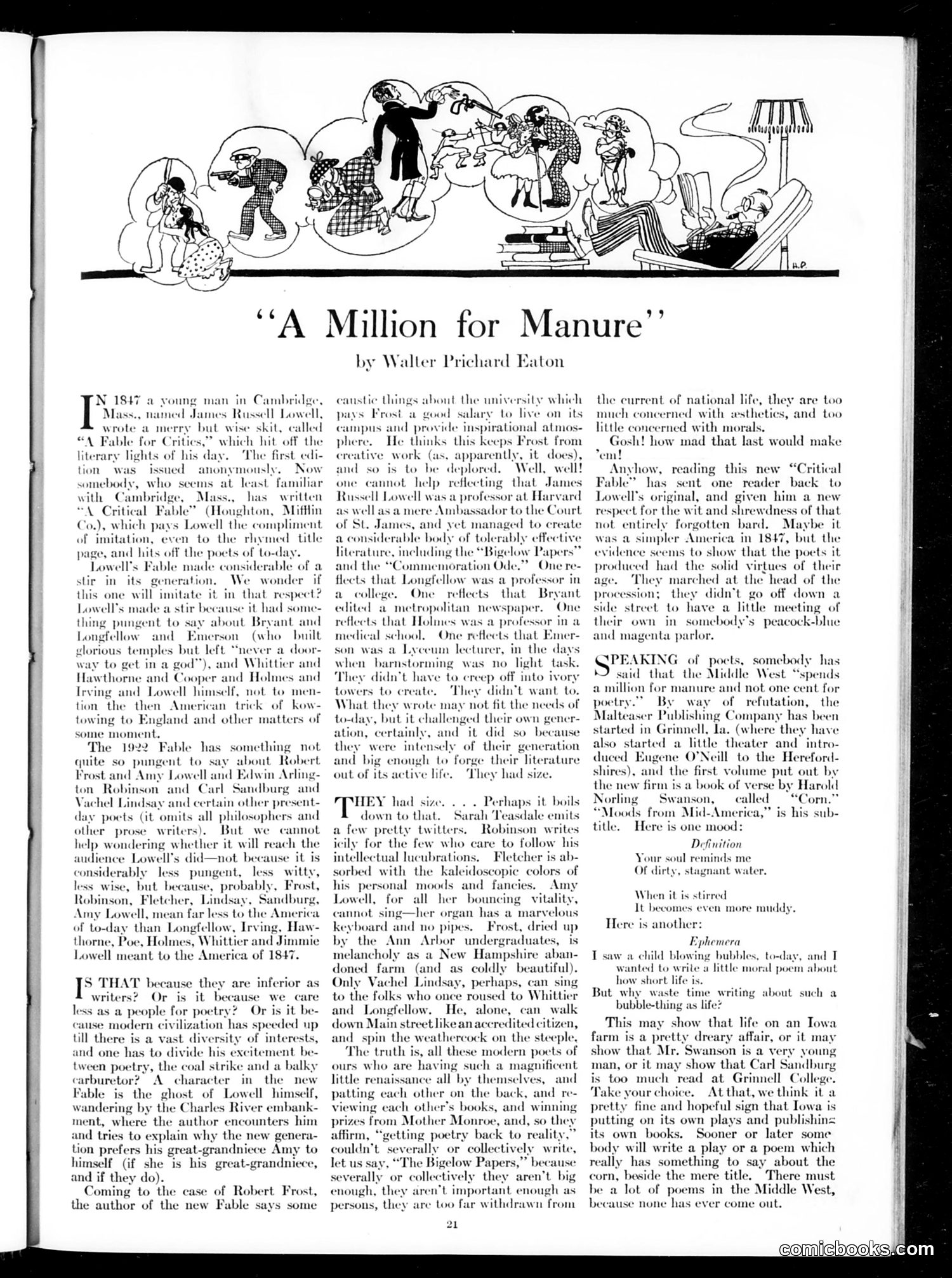
This page reviews a 1922 poem called "A Critical Fable" by an unnamed author (the header illustration shows figures in thought bubbles—likely representing poets under discussion). The piece is a modern imitation of James Russell Lowell's 1847 satirical poem "A Fable for Critics," which critiqued major American literary figures. The review argues that while the new Fable critiques contemporary poets (Robert Frost, Amy Lowell, Edwin Arlington Robinson, Carl Sandburg, Vachel Lindsay), it lacks the cultural impact of Lowell's original. Eaton suggests this is because modern readers care less about poetry—they're distracted by "coal strikes" and "balky carburetors" (cars). The article also critiques the new Fable's complaint that university employment prevents creative work, noting that major 19th-century poets like Lowell himself held academic and diplomatic positions while still producing significant literature. The implication: modern poets lack the intellectual "size" of their predecessors.
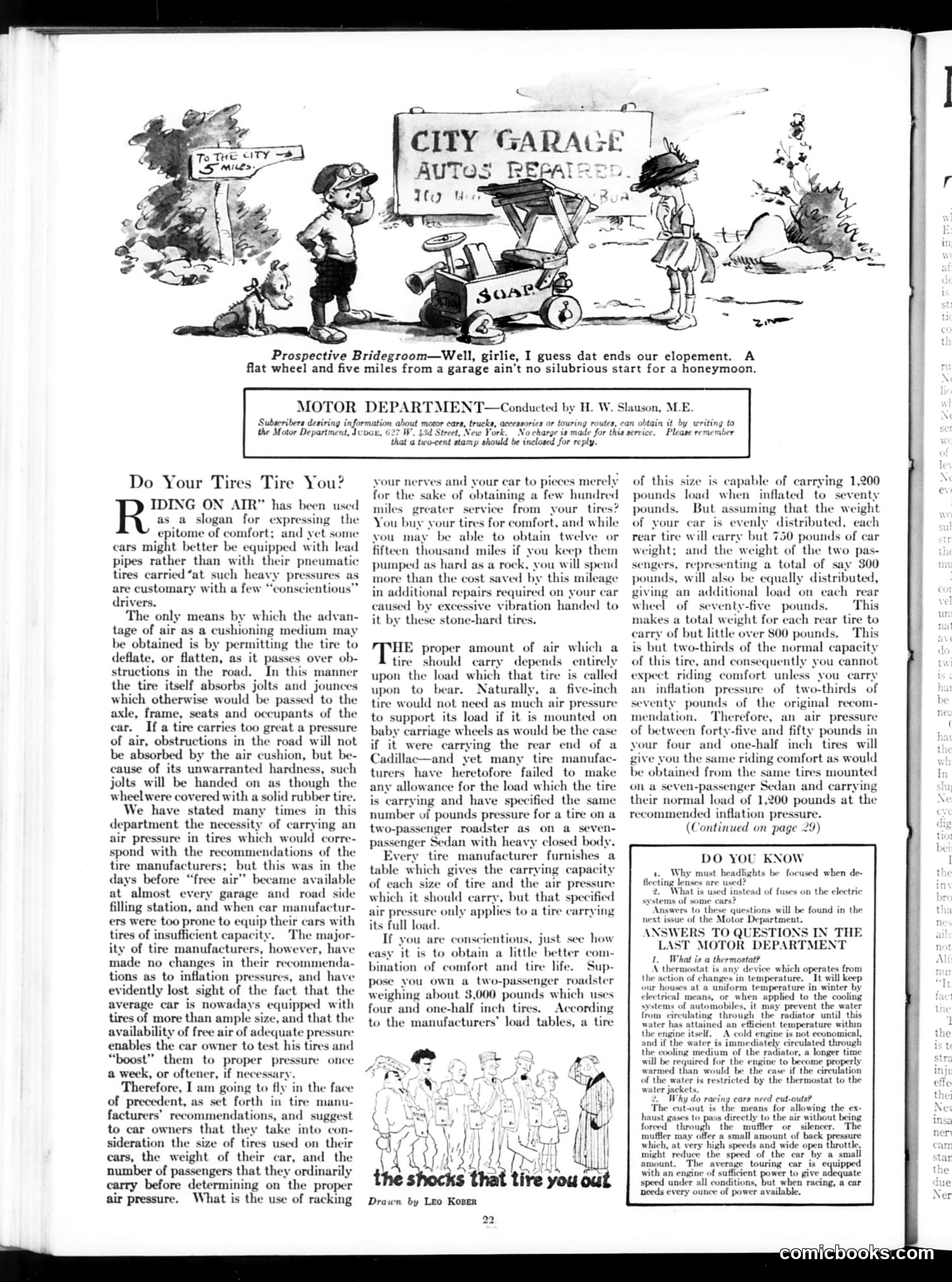
The cartoon depicts a young couple at a broken-down car near a "City Garage" sign, with the groom saying their elopement is ruined—a flat tire five miles from help makes for a poor honeymoon start. The humor relies on early 1920s automobile culture anxiety: cars were still relatively new and unreliable, with frequent breakdowns that stranded travelers. The joke satirizes romantic notions of eloping "in style" with a motor car, which the reality of mechanical failure instantly deflates. The accompanying article by H.W. Slauson addresses tire pressure concerns—a genuine automotive issue of the era. The satire's point: modern motorists romanticize automobile travel while remaining ignorant about proper tire maintenance. The elopement scenario exemplifies this gap between automotive dreams and mechanical reality, mocking both young lovers and the broader American infatuation with automobiles as symbols of freedom and romance.
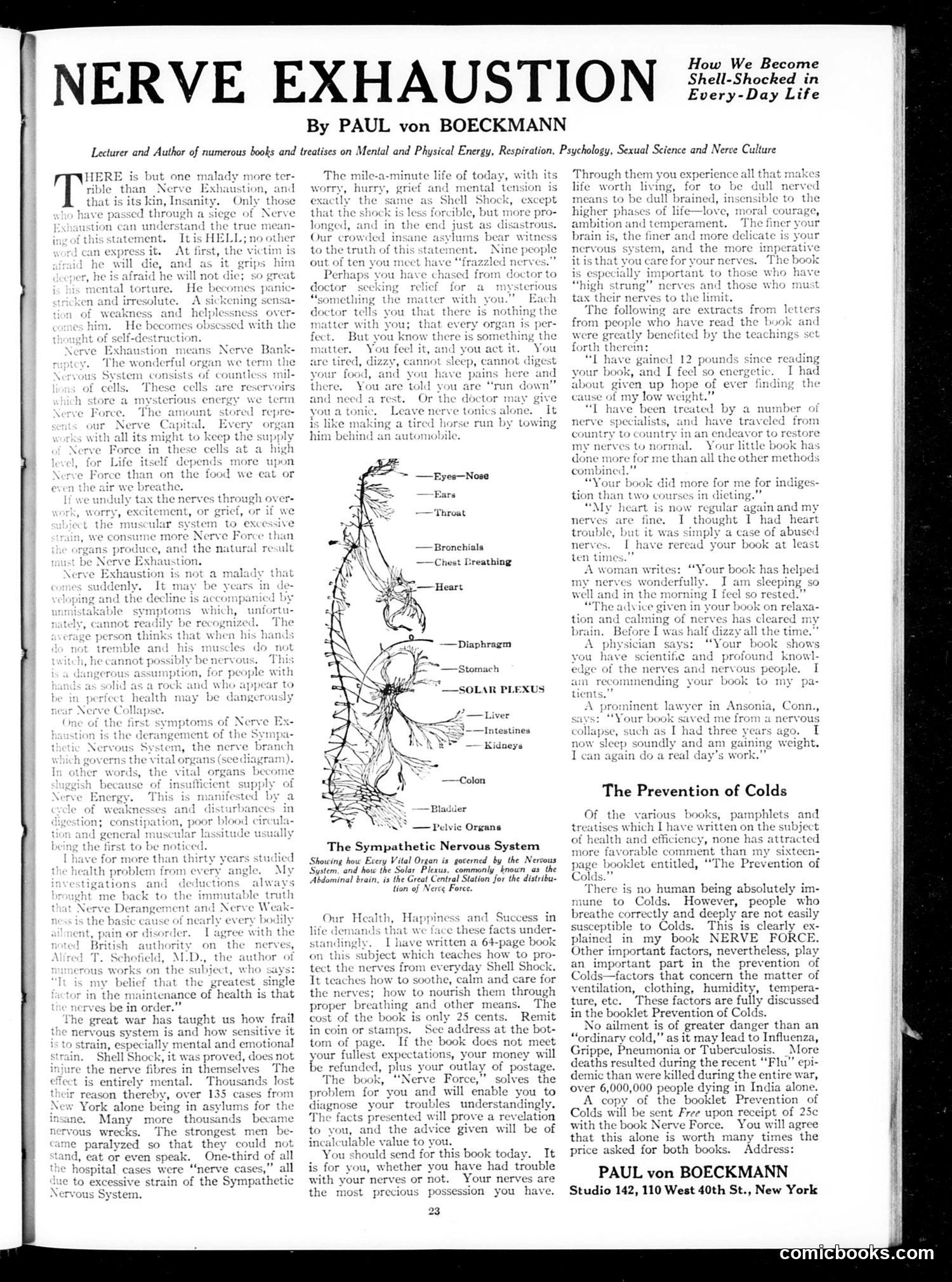
This is an advertisement/article by Paul von Boeckmann promoting his books on nerve health and exhaustion. The central image is a anatomical diagram of the sympathetic nervous system, labeled with major organs and the "Solar Plexus" (presented as the "abdominal brain"). The text draws explicit parallels between "Shell Shock" (combat trauma from World War I) and everyday modern stress. Boeckmann argues that contemporary life—with its hurry, grief, and mental tension—produces the same nervous system damage as warfare, causing "nerve exhaustion." He cites hospital cases where soldiers became paralyzed or unable to speak from psychological strain. The article then pivots to selling solutions: his 64-page book "Nerve Force" (25 cents) and a booklet on "Prevention of Colds," both promising to teach readers how to soothe, nourish, and protect their nerves through proper breathing and care. Customer testimonials claim weight gain, regularized heartbeat, and restored energy. This reflects 1920s concerns about modern life's psychological toll and the era's fascination with pseudoscientific wellness cures.
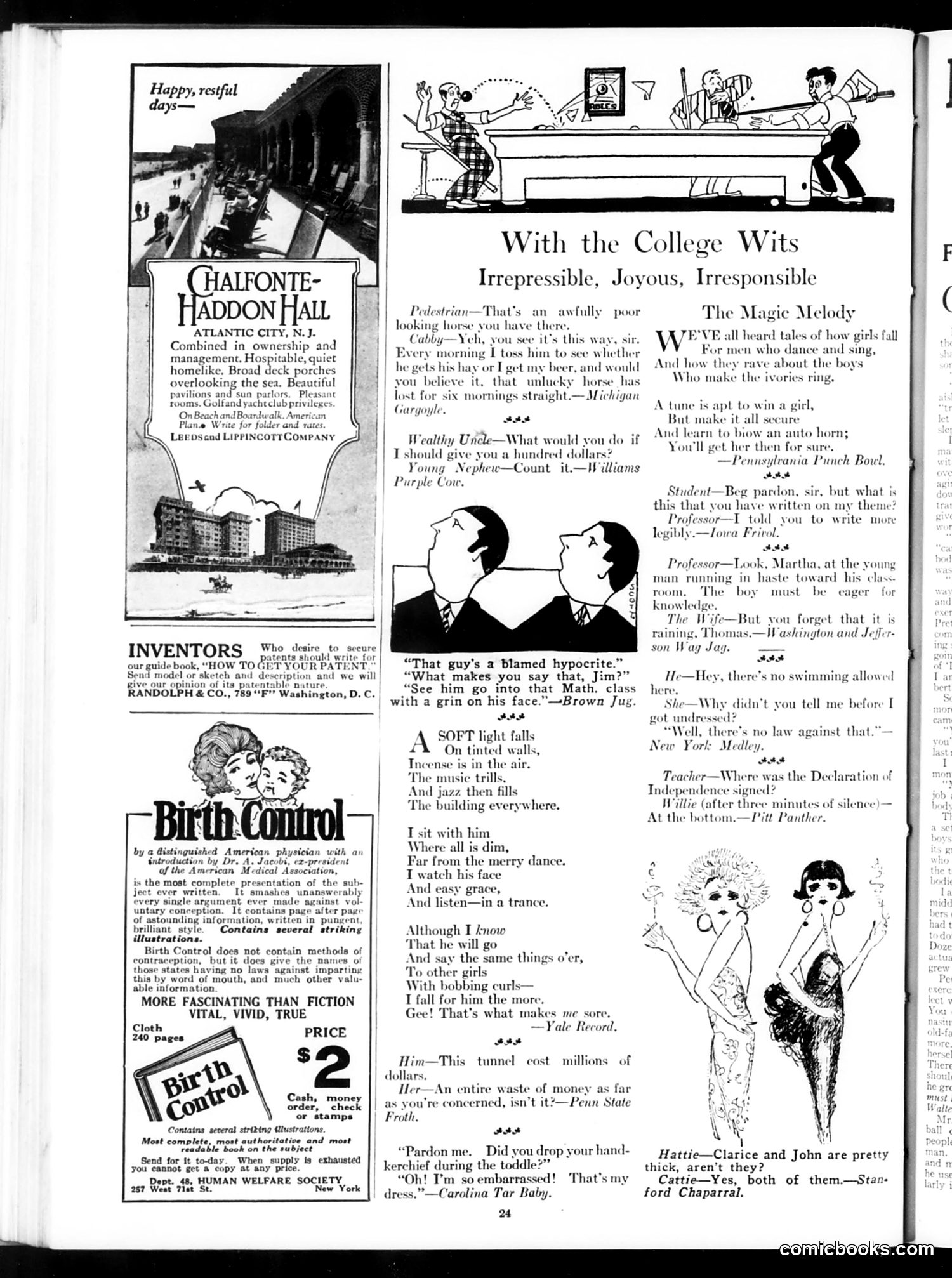
This is primarily a **humor and advertising page** from Judge magazine, mixing college jokes, advertisements, and satirical commentary typical of the 1920s era. **Main Content:** The "College Wits" section features short jokes from various college publications, representing campus humor of the period. These jokes mock common student types: the hypocritical student, the careless professor, the confused classroom participant, and romantic entanglements. The satire gently ridicules academic pretension and youthful behavior. **Notable Advertisement:** The prominent "Birth Control" book advertisement reflects 1920s social controversy—this was a contentious topic when advocating contraception access. The ad emphasizes the book's scientific credibility through medical association endorsements, suggesting birth control remained socially fraught. **Satire & Context:** The overall page satirizes college culture and youth behavior through gentle mockery rather than sharp political critique. References to "bobbing curls" and jazz reflect 1920s modernity anxieties about changing youth culture and "flapper" morality—concerns that resonated with Judge's largely adult, established readership.
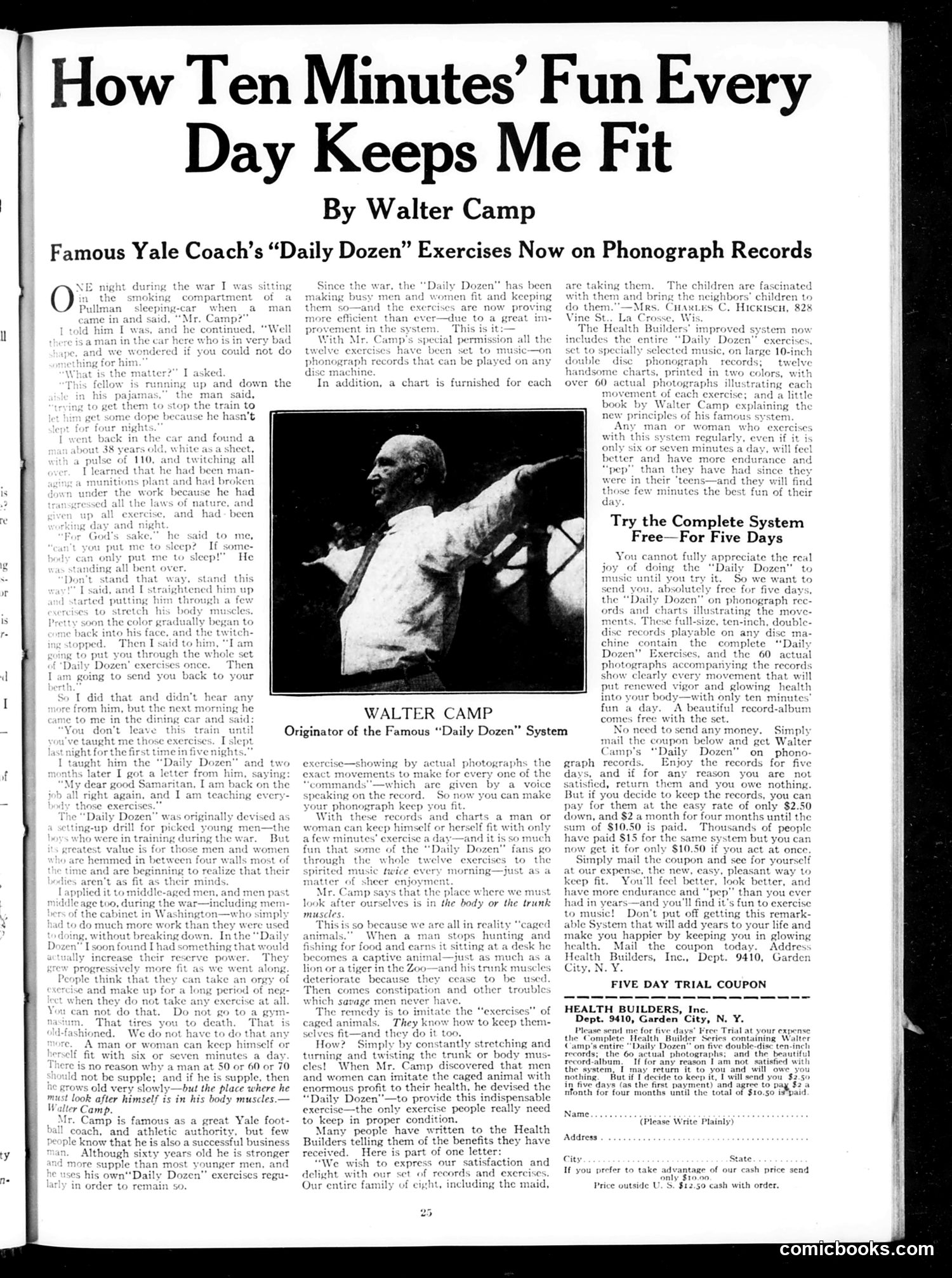
This is **not a cartoon or satire**, but rather a **legitimate advertisement** for Walter Camp's "Daily Dozen" exercise system. Walter Camp was a real, famous Yale football coach who genuinely developed a series of twelve simple exercises called the "Daily Dozen" in the early 1920s. This page promotes a new commercial product: phonograph records featuring Camp's voice guiding users through the exercises, accompanied by charts and instructional booklets. The photograph shows Camp demonstrating an exercise position. The "Try the Complete System Free—For Five Days" coupon is a standard direct-mail marketing pitch allowing customers to test the records before committing to the full $10.50 purchase price. The context for modern readers: this represents an early attempt at mass-media fitness instruction, predating modern workout videos by decades. Camp's "Daily Dozen" was genuinely popular during this era as a time-efficient exercise routine.
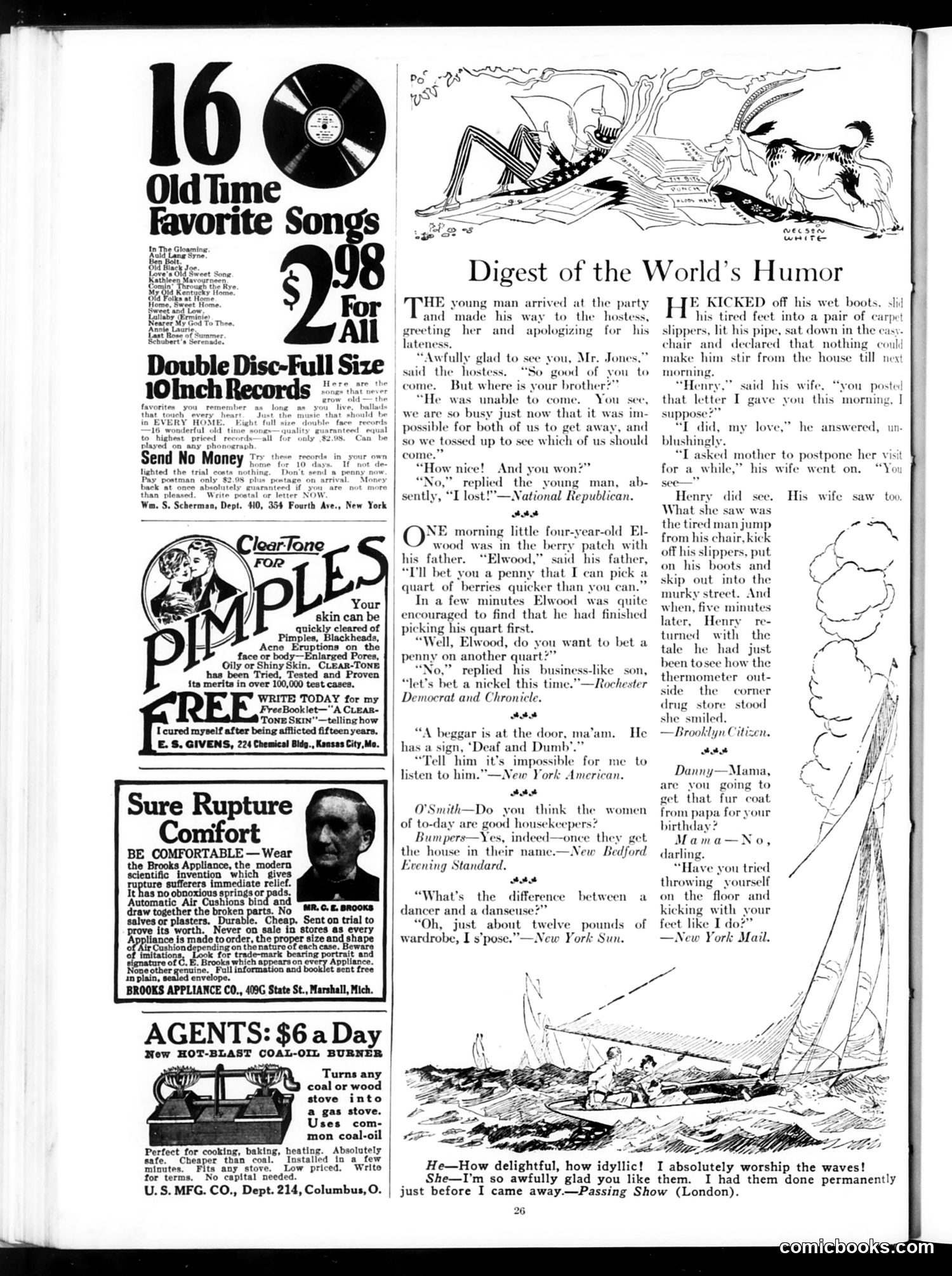
This page is primarily **advertising**, not political cartoons. The left side features vintage mail-order ads (record albums, skin treatments, rupture support devices, coal-oil burners) typical of early 20th-century magazines seeking revenue. The right side contains **"Digest of the World's Humor"**—a humor column collecting jokes from various publications. The jokes are genteel domestic humor: a young man loses a coin toss to attend a party, a child negotiates penny bets while picking berries, a tired husband avoids leaving home until realizing his mother-in-law is visiting. **No political satire is present.** The illustrations are generic line drawings depicting the anecdotes. The humor reflects period attitudes about marriage, business, and propriety—relying on gentle irony rather than sharp commentary. This represents Judge's shift toward lighter entertainment and commercial content, moving away from its traditionally sharp satirical focus. The page demonstrates how magazines balanced editorial content with lucrative advertising to survive financially.
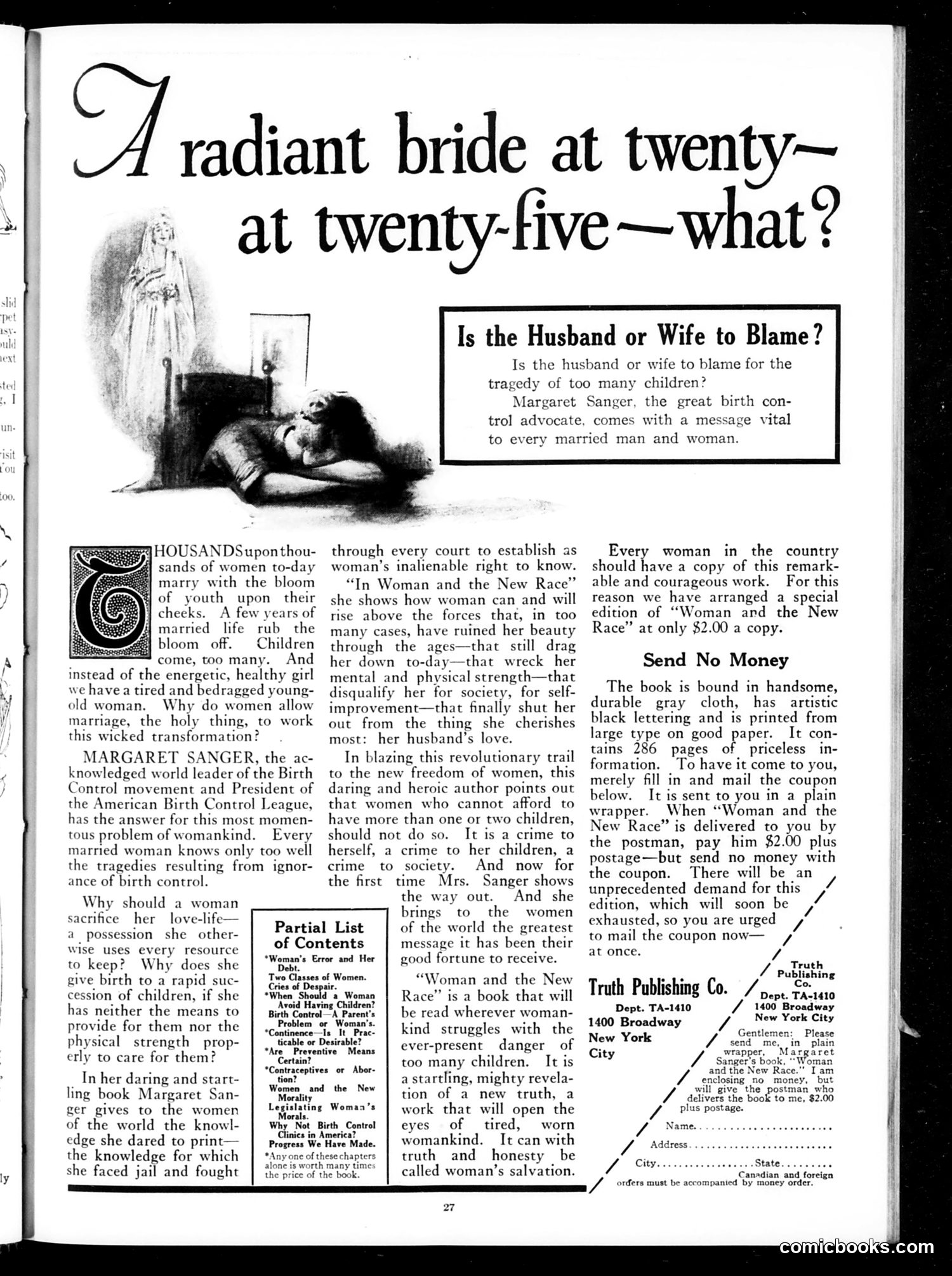
This page is primarily an advertisement promoting Margaret Sanger's book *"Woman and the New Race,"* disguised as editorial content. The accompanying illustration depicts a exhausted young woman, contrasting the "radiant bride at twenty" with her depleted state at twenty-five. The satire targets the physical and emotional toll of uncontrolled childbearing on women. The text argues that repeated pregnancies drain women's beauty, health, and mental strength—transforming vibrant girls into "tired and bedragged young-old women." Margaret Sanger, the real birth control advocate, is presented here as offering revolutionary knowledge: women should have the right to limit family size based on economic means. The page frames this as addressing a crisis affecting married couples and society itself. This reflects 1920s debates over reproductive rights, with Sanger's advocacy positioned as radical yet compassionate—framed as protecting women's health and marriages, not opposing them.
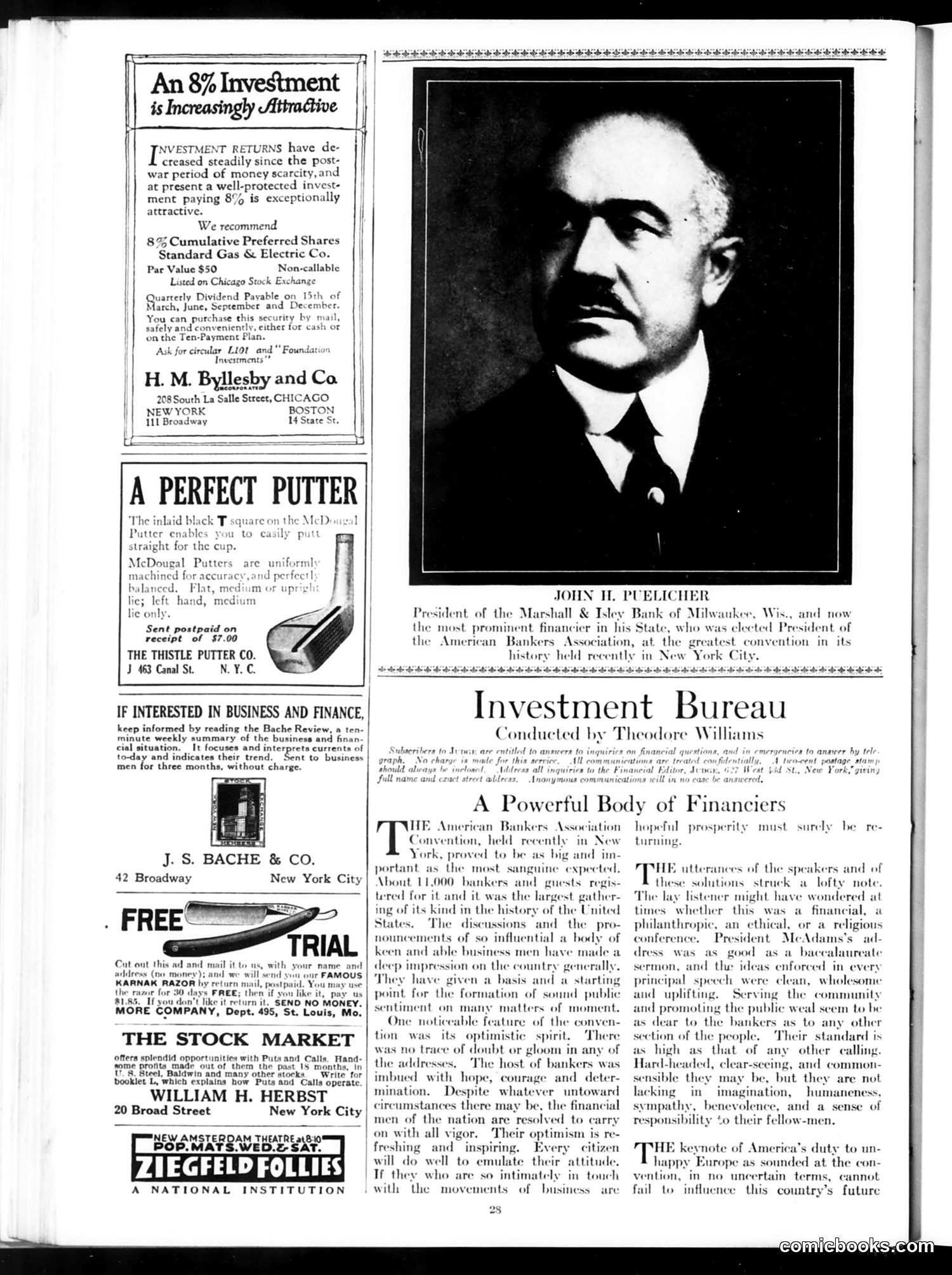
This page is primarily **financial advertising** from Judge magazine, circa 1920s. The main editorial content is an "Investment Bureau" article praising the American Bankers Association Convention held in New York. The featured portrait is **John H. Puelicher**, president of Milwaukee's Marshall & Isley Bank and newly elected president of the American Bankers Association. The article celebrates the convention as a major gathering (11,000 attendees) that generated optimistic sentiment about the economy and business. It praises bankers' confidence and their influence on public opinion regarding financial matters. **Context for modern readers**: This reflects post-WWI economic optimism before the 1929 stock market crash. The tone—treating bankers as moral leaders shaping national sentiment—reveals how differently finance was perceived then. The page's numerous investment pitches (preferred shares, stock options, investment services) show Judge's dual role as satirical magazine and advertising vehicle for wealthy readers.
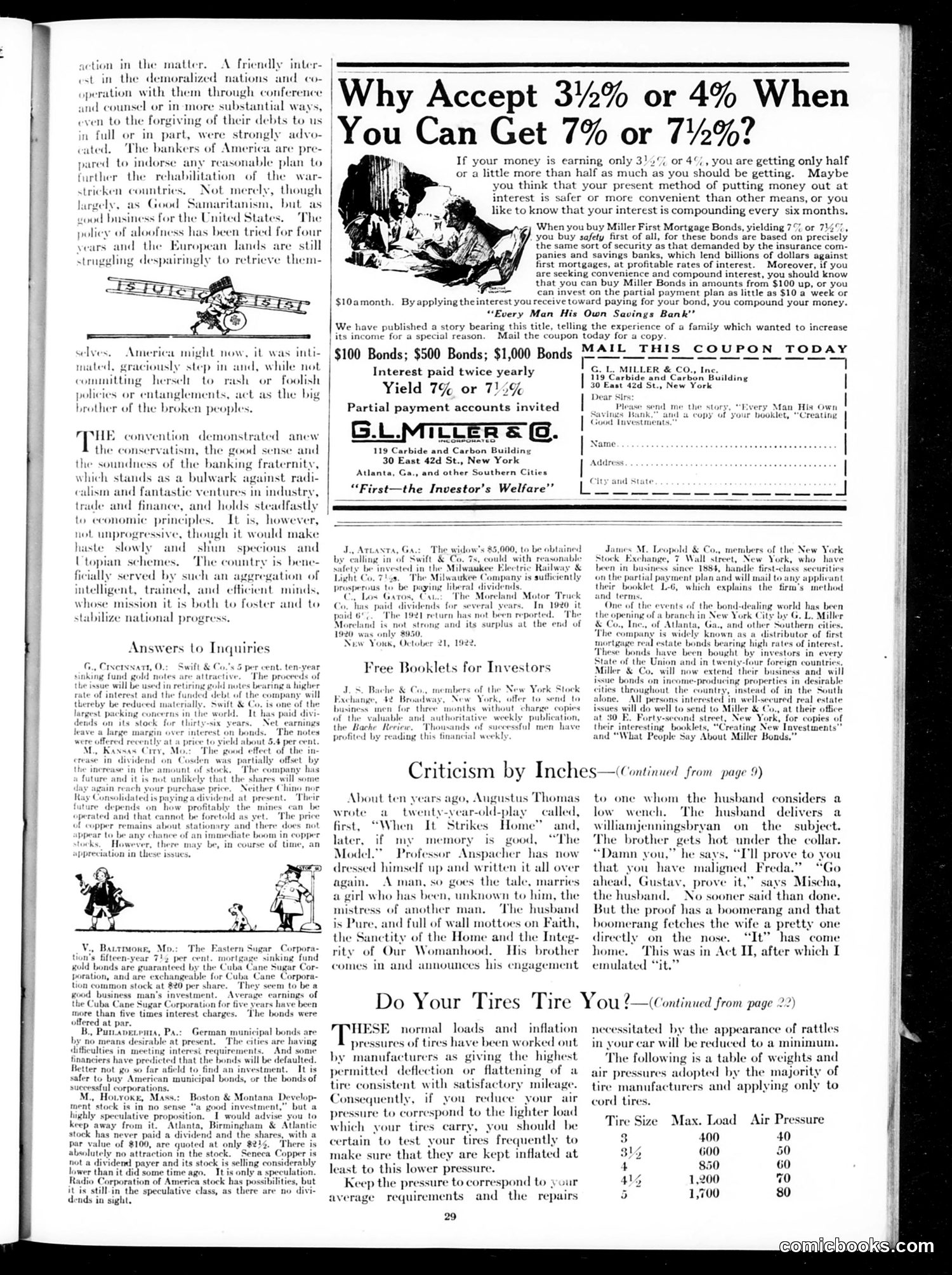
This page is primarily **financial advertising** for Miller & Co.'s investment bonds, with supporting editorial content about banking and economy. The main cartoon (top left) appears to show a figure examining financial documents—likely representing the investor considering safe but low-return investments versus higher-yield bonds. The advertisement's central argument: investors accepting 3.5-4% returns are "leaving money on the table" when Miller & Co. offers 7-7.5% yields on their bonds. This was pitched as financially rational self-interest, not gambling. The surrounding editorial discusses post-WWI economic recovery, positioning American bankers as prudent yet progressive—willing to help rebuild Europe while maintaining sound business practices. The page reflects early 1920s concerns: post-war economic instability, questions about foreign investment safety, and debates over conservative versus speculative finance. The tone suggests confidence in American banking institutions as stabilizing forces. The "Answers to Inquiries" section confirms this was an era when investors sought guidance on bond selection amid economic uncertainty.
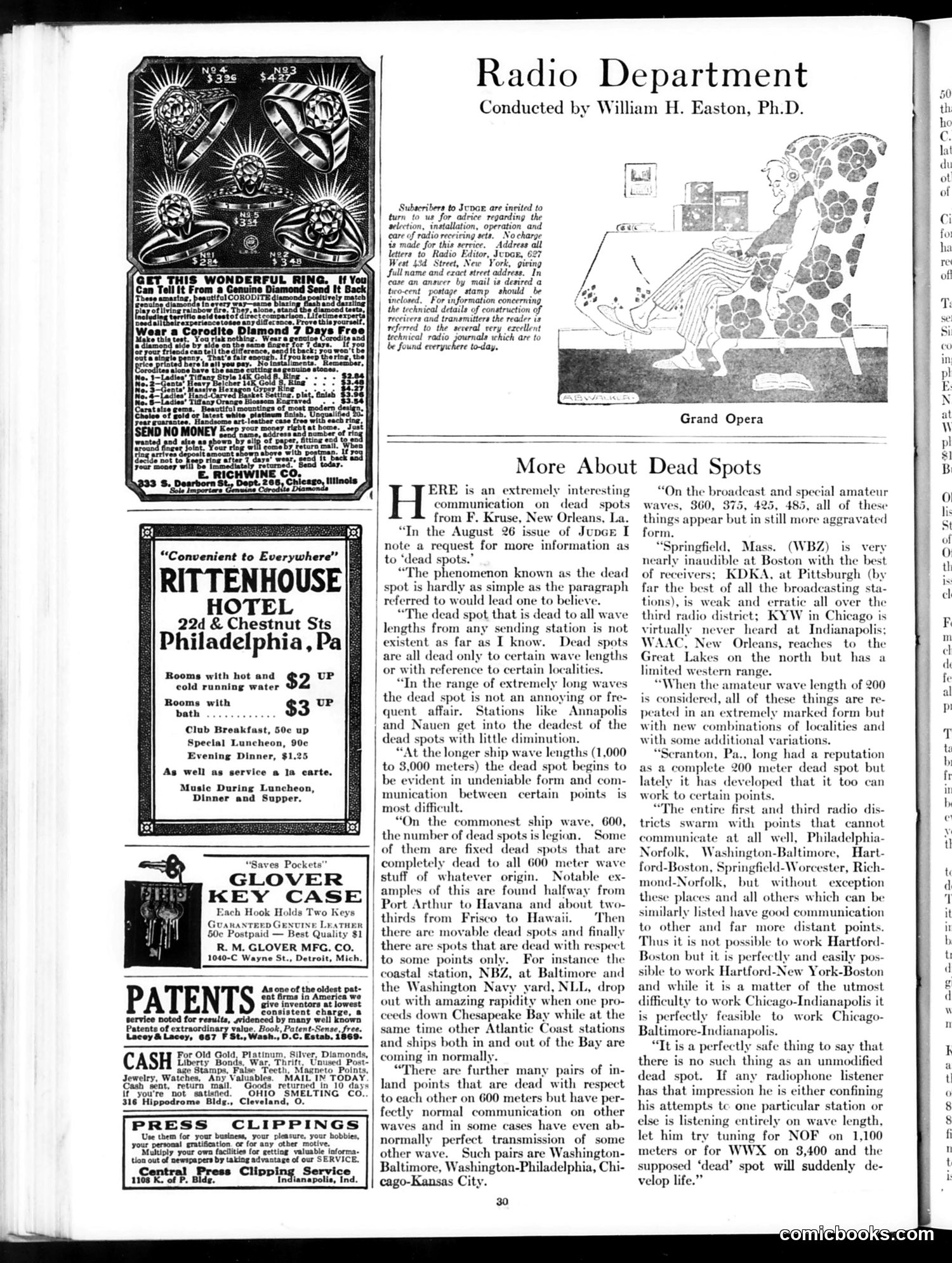
This page is primarily **advertising and technical content**, not political satire. The main feature is a "Radio Department" advice column conducted by William H. Easton, Ph.D., addressing reader questions about "dead spots"—areas where radio signals fail to transmit properly. The article by F. Kruse from New Orleans explains that dead spots vary by wavelength and location, affecting ship-wave communications (600 meters) more noticeably than longer waves. Examples include areas between Port Arthur and Havana, and Chesapeake Bay near Baltimore. The surrounding content consists entirely of **period advertisements**: the Rittenhouse Hotel (Philadelphia), Glover Key Case, patent services, cash-for-valuables services, and press clipping services. **There is no political cartoon or satire on this page**—it's a technical/informational issue from what appears to be a 1920s radio enthusiast magazine section.
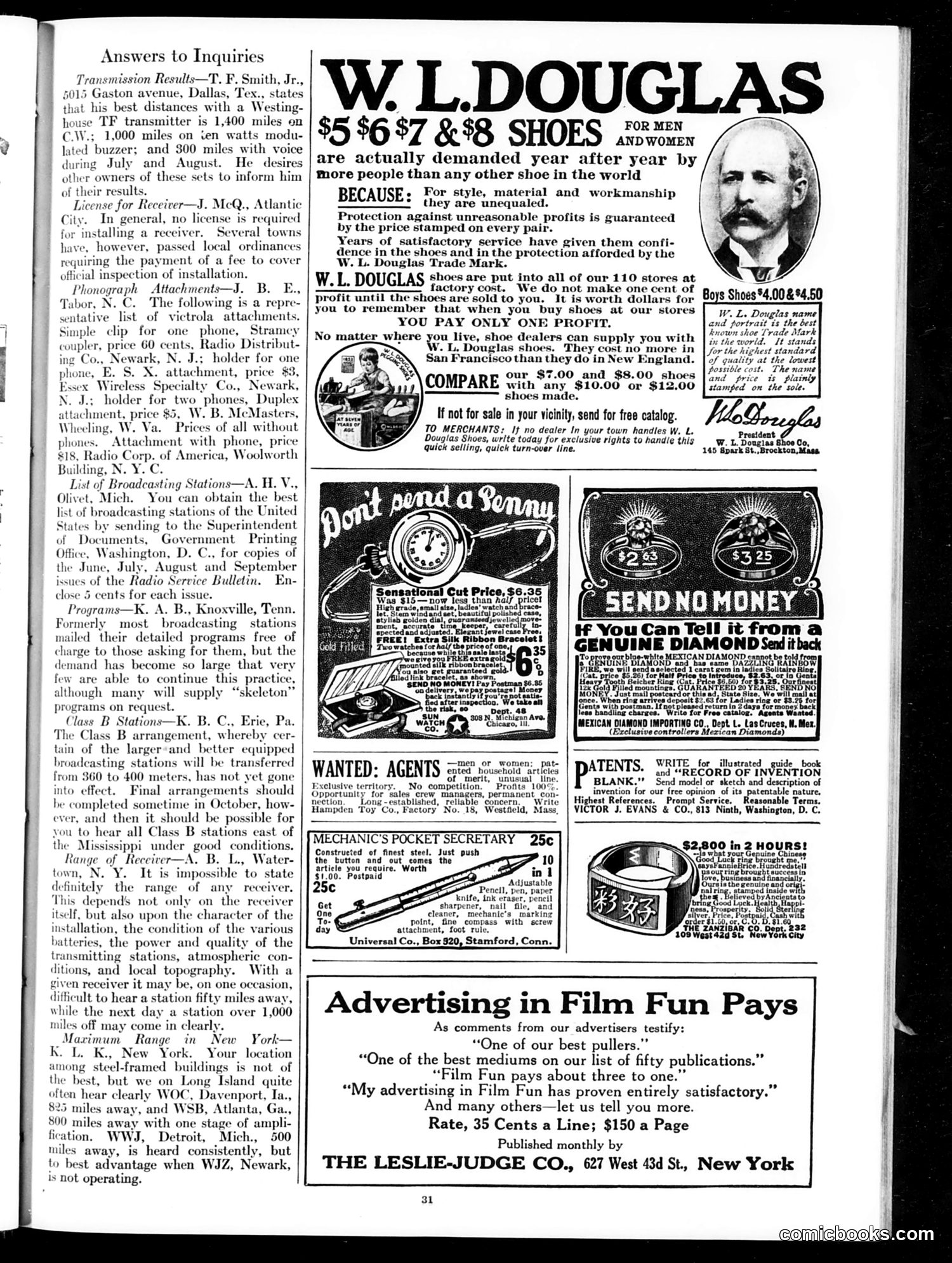
This page is primarily **advertising and advice columns**, not political satire. The main content includes: **Major Advertisements:** - **W.L. Douglas Shoes**: A large ad featuring a mustachioed man (W.L. Douglas himself) promoting his $5-8 shoes as superior quality. The appeal emphasizes transparent pricing and protection against "unreasonable profits"—a consumer-protection pitch common in early 20th-century advertising. - Additional ads for diamonds, mechanical pocket secretaries, and other products typical of 1920s consumer goods. **"Answers to Inquiries" Section:** Technical Q&A about early radio transmission, receivers, and broadcasting stations—reflecting the era's fascination with this emerging technology. **Social Context:** The shoe ad's emphasis on stamped prices and fair dealing reflects Progressive Era concerns about consumer protection and corporate transparency. The radio advice indicates this magazine served technically-minded readers interested in the new medium. This page contains **no political cartoons or satire**—it's a straightforward magazine page mixing reader advice with period advertising.
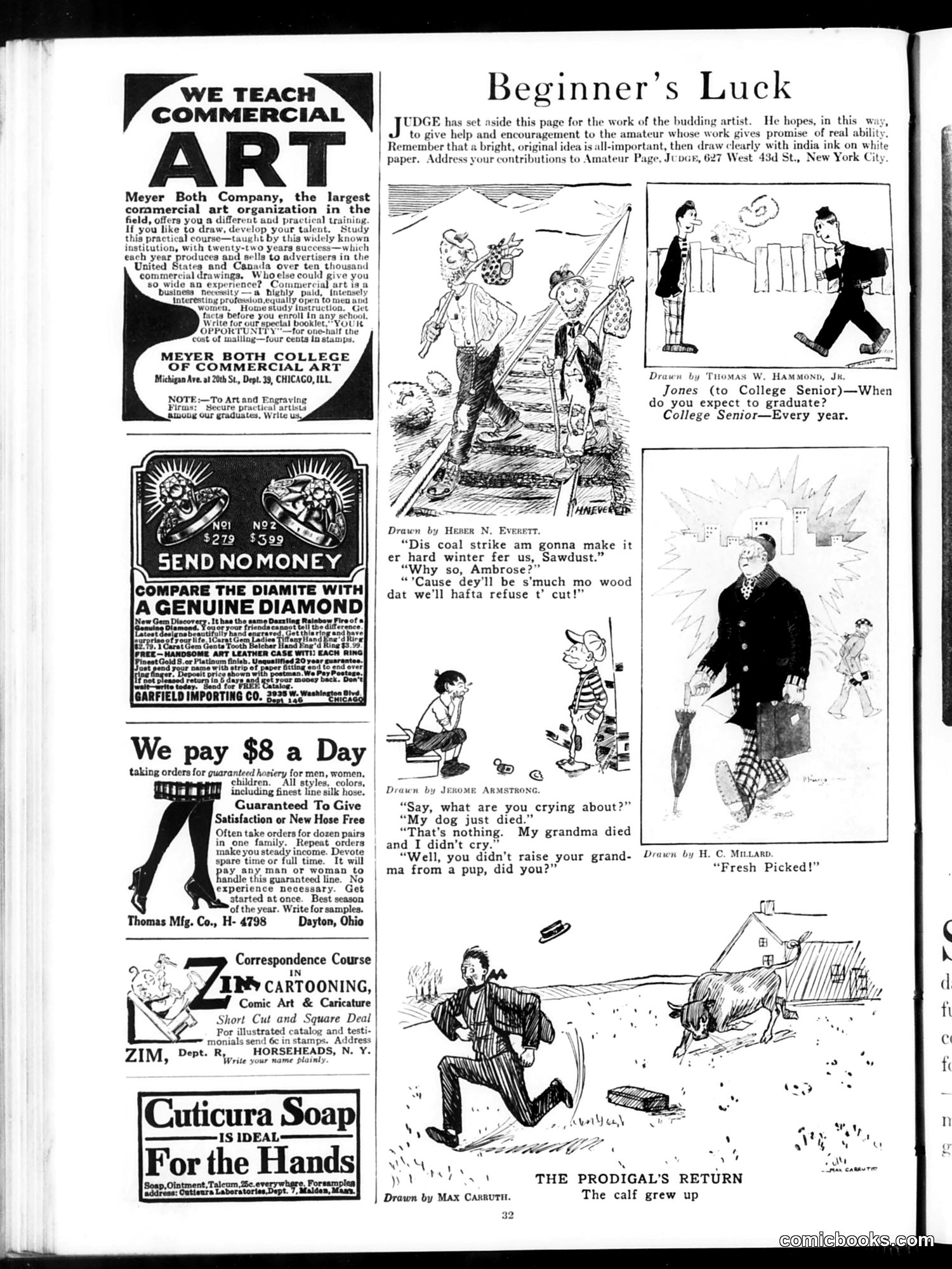
This is a humor and cartooning showcase page featuring four separate comic strips by different artists, plus surrounding advertisements. The cartoons depict everyday life situations with gentle humor: 1. **Hammond's college senior**: A joke about perpetual studenthood—the senior claims he graduates "every year," suggesting he keeps repeating the grade. 2. **Everett's coal strike dialogue**: Two working-class characters discuss hard times during a coal strike. Their dialect humor ("Dis," "dey'll," "hafta") was common period comedy, reflecting the speaker's working-class status. The joke is that refusing wood fuel during coal shortage makes no sense. 3. **Armstrong's pet grief**: A child's misplaced perspective—he won't cry over a dog's death like his friend, only because he raised the dog himself rather than inheriting a grandmother. 4. **Millard's farm scene** and **Carruth's prodigal calf**: Rural/farm-life vignettes. The page emphasizes that Judge welcomes amateur cartoonist submissions with "bright, original ideas," positioning itself as a platform for emerging talent alongside its established contributors.
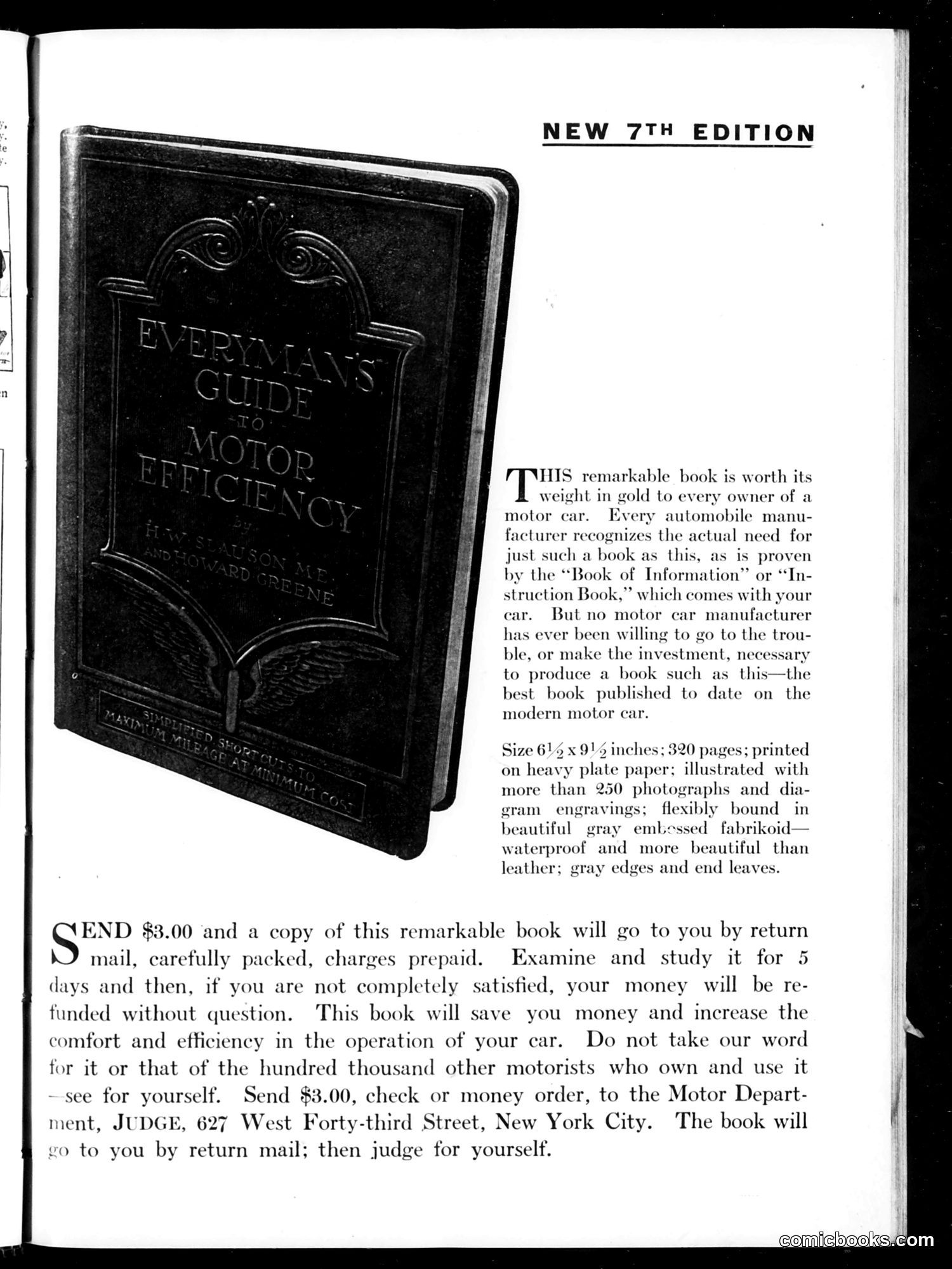
This is **not a cartoon or satirical content**—it's a straightforward advertisement for "Everyman's Guide to Motor Efficiency," the 7th edition. The page shows the book's cover (embossed with decorative flourishes) and promotional text. Judge magazine is advertising this instructional manual for automobile owners, emphasizing its comprehensive nature (320 pages, 250+ photographs) and practical value. The pitch targets early 20th-century car owners with a money-back guarantee and claims the book surpasses manufacturers' own instruction manuals. The ad stresses durability (waterproof binding) and utility—that it will "save you money and increase comfort and efficiency." This represents Judge functioning as a publisher/retailer, not as satire. The only mild wordplay appears in the closing: "then judge for yourself"—a pun on the magazine's name.
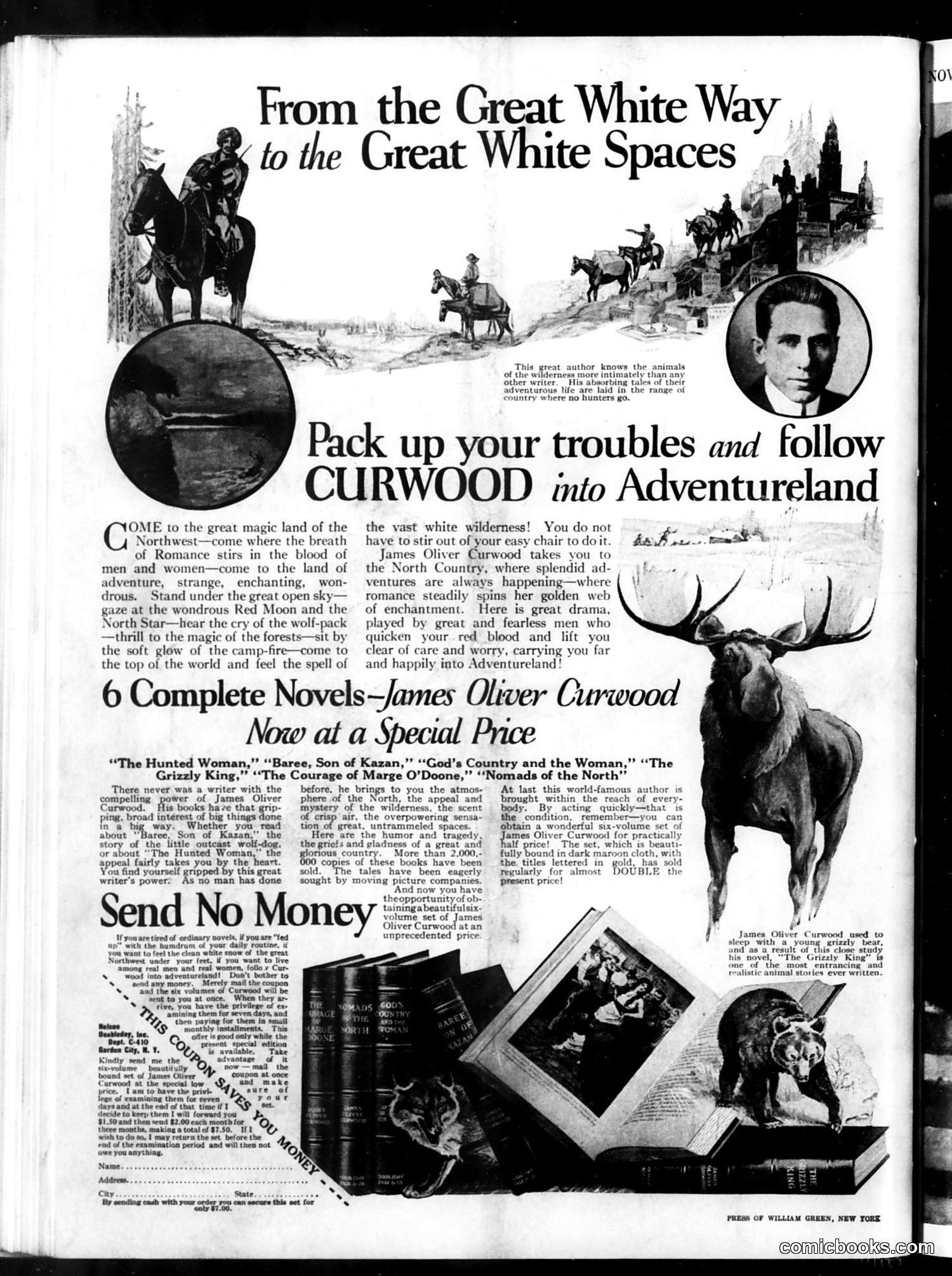
This is a **book advertisement**, not political satire. It promotes a six-volume collection of adventure novels by James Oliver Curwood, a popular early-20th-century author known for wilderness fiction set in the North American frontier. The ad uses romantic, escapist language ("Pack up your troubles and follow CURWOOD into Adventureland") to appeal to readers seeking adventure stories featuring wild landscapes, danger, and romance. Images of wolves, bears, mounted trappers, and northern wilderness reinforce this appeal. The marketing hook is the "special price"—readers can examine the beautifully bound set free for seven days before paying in installments, with no money required upfront. This was a common mail-order sales tactic of the era. The page reflects early 1900s consumer culture and the popularity of frontier/wilderness adventure fiction as escapism from urban industrial life.