
Judge, 1922-10-28 · page 11 of 36
Judge — October 28, 1922 — page 11: what you’re looking at
What you’re looking at
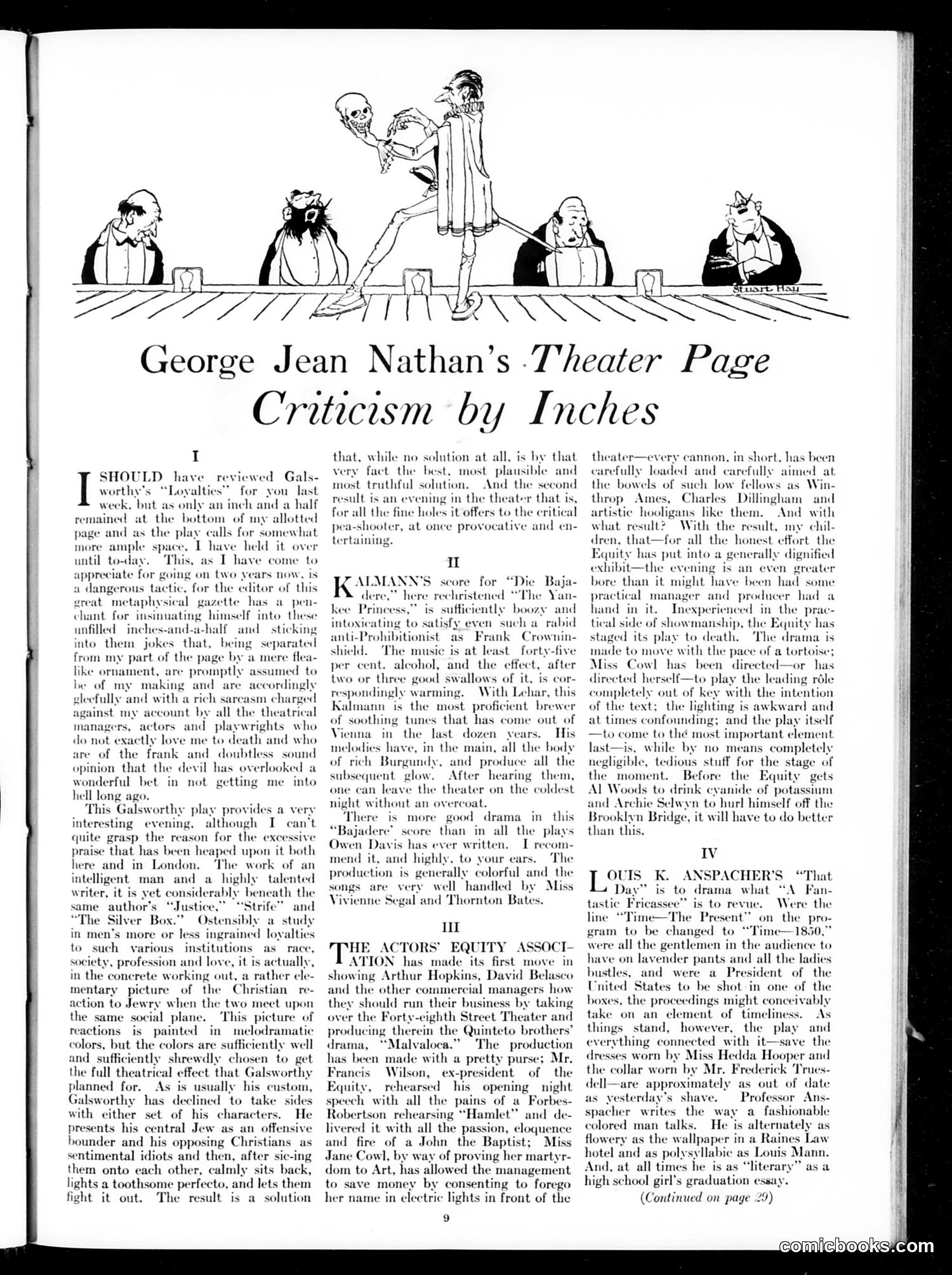
This page is from George Jean Nathan's theater criticism column in Judge magazine. The header illustration depicts Nathan as a tall figure standing over seated theater critics or managers, suggesting his dominance in theater criticism. The article critiques three theatrical works: Galsworthy's "Loyalties" (a play examining Christian-Jewish social relations), "The Yankee Prince" (a musical by Kalmann with alcohol-themed humor—relevant given Prohibition-era debates), and "Malvaloca" (produced by Actors' Equity Association). Nathan's complaints are witty but technical: he criticizes the editor for inserting jokes into his column space, praises plays for theatrical effect while questioning their depth, and comments on specific productions' colorfulness and casting choices. The satire targets theater managers, producers, and Nathan's critics among theatrical professionals, whom he notes dislike him. The tone is sophisticated insider criticism aimed at Judge's educated readership interested in theater gossip and analysis.
📄 Transcribed text from this page (OCR, searchable)
Machine-transcribed from the original scan — historical spelling and the odd misread are preserved.
George Jean Nathan’s .Theater Page Criticasm by Inches I SHOULD have iewed Gals- I worthy’s “Loyalties” for you last week, but as only an inch and a half remained at the bottom of my allotted page and as the play calls for somewhat more ample spa I have held it over until to-day as IT have come to »preciate for ¢ n two Years now, is angerous tactic, for the editor of this t “metaphysi 1 gazette has a pen- chant for insinua ing himself into these unfilled inches-and-a-half and sticking into them jokes that, being sep: from my part of the page by a mere flea- like ornament, are promptly assumed to be of my making and are accordingly gleefully and with a rich sarcasm ch against my account by all the theatrics managers, actors and playwrights who do not exactly love me to death and who are of the frank and doubtless sound opinion that the devil has overlooked a wonderful bet in not getting me into hell long ago. This Galsworthy play provides a very interesting evening, although I can’t quite grasp the reason for the excessive praise that has been heaped upon it both here and in London. The work of an intelligent man and a highly talented ly beneath the same “Strife” and “The Silver Box.” Ostensibly a study in men’s more or less ingrained loyalties to such various institutions as r. society, profession and love, it is actua in the concrete working out, a rather mentary picture of the Christian 1m action to Jewry when the two meet upon the same social plane. This picture of reactions is painted in melodramatic colors, but the colors are sufficiently well and sufficiently shrewdly chosen to get the full theatrical effect that Galsworthy planned for. As is usually his custom, alsworthy has declined to take sides with either set of his characters. He presents his central Jew as an offensive bounder and his opposing Christians sentimental idiots and then, after sic-ing them onto each other, calmly sits back, lights a toothsome perfecto, and lets them fight it out. The result is a solution that, while no solution at all, is by that very fact the best, most plausible and most truthful solution. And the second result is an evening in the theater that is, for all the fine holes it offers to the critical pea-shooter, at once provocative and en- tertaining. It A score der ened “The Yan- kee Prine is sufficiently boozy and intoxicating to satisfy even such a rabid anti-Prohibitionist. as Frank Crownin- shield. The music is at least forty per cent. alcohol, and the eff two or three good swallows of it, is cor- respondingly warming. With Lehar, this Kalmann is the most proficient: brewer of soothing tunes that has come out of Vienna in the last dozen years. His melodies have, in the main, all the body of rich Burgundy, and produce all the subsequent glow. After hearing them, one can leave the theater on the coldest night Nation an overcoat. is more good drama in this * score than in all the plays Owen Davis has ever writte I recom- mend it, and highly, to your ears. The production is generally colorful and the songs are very well handled by Miss Vivienne Segal and Thornton Bates. Il ACTORS’ EQUITY ASSOCI- IN has made its first move in id Belasco s how for “Die Baja- THe A showing Arthur Hopkins, Da and the other commercial mai they should run their business by taking over the Forty-eighth Street Theater and producing therein the Quinteto brothers’ drama, ‘“Malvaloca.” The production has been made with a pretty purse; Mr. Francis Wilson, ex-president of the Equity, rehearsed his opening night speech ‘with all the pains of a Forbes- Robertson rehearsing “Hamlet” and de- livered it with all the passion, eloquence and fire of a John the Bapti: Miss Jane Cowl, by way of proving her martyr- dom to Art, allowed the management to save money by consenting to forego her name in el ights in front of the 9 theater—every cannon, in short, has been cu Hy loaded and carefully aimed at the bowels of such low fellows as Win- throp Ames, Charles Dillingham and artistic hooligans like them. And with what result? With the result, my chil- dren, that—for all the honest effort the Equity has put into a generally dignified exhibit—the evening is an even greater bore than it might have been had some T manager and producer had a hand in it. Inexperienced in the prac- tical side of showmanship, the Equity has staged its play to death. The drama is made to move with the pace of a tortoise; Miss Cowl has been directed—or has directed herself—to play the leading réle y out of key with the intention the lighting is awkward and at times confounding; and the play itself —to come to thé most important clement last—is, while by no means completely negligible, tedious stuff for the the moment. Before the Equity Al Woods to drink cyanide of po' and Archie Selwyn to hurl himself off "the Brooklyn Bridge, it will have to do better than this. IV OUIS K. ANSPACHER’S “That Day” is to drama what “A Fan- tastic Fricassee” is to revue. Were the line me—The Present’ on the pro- gram to be changed to “Time—1850, were all the gentlemen in the audience to have on lavender pants and all the ladies bustles, and were a President of the United States to be shot in one of the hoxes, the proceedings might conceivably take on an element of timeliness. As things stand, however, the play and everything connected with it—save the dresses worn by Miss Hedda Hooper and the collar worn by Mr. Frederick ‘Trues- dell—are approximately as out of date us yesterday’s shave. Professor Ans- spacher writes the way a fashionable colored man talks. He is alternately flowery as the wallpaper in a Raines Law hotel anc polysyllabic as Louis Mann. And, at al ini he “literary” high school girl’s graduation essay. (Continued on page 29) is as