
Judge, 1922-10-28 · page 13 of 36
Judge — October 28, 1922 — page 13: what you’re looking at
What you’re looking at
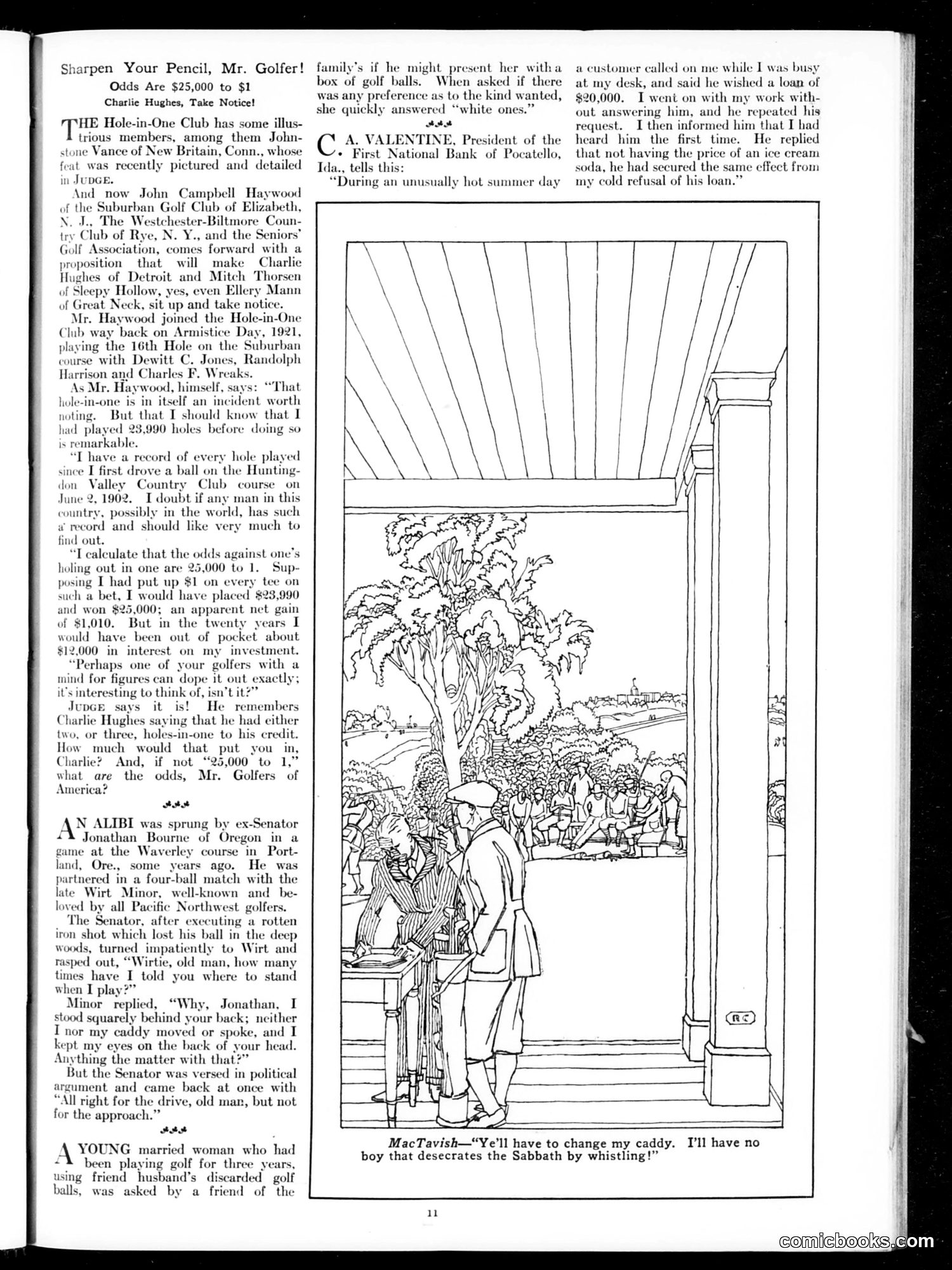
This page from *Judge* magazine contains golf-themed humor and anecdotes. The main cartoon depicts a Scottish golfer (MacTavish) firing his caddy for whistling on the Sabbath—satirizing strict religious observance and the clash between modern leisure and traditional piety. The text stories mock golf culture's absurdities: one calculates the mathematical odds of a hole-in-one (25,000 to 1) as investment advice; another features ex-Senator Jonathan Bourne blaming his caddy for a bad shot, exemplifying how golfers deflect responsibility. A third joke mocks a woman unfamiliar with golf ball quality. The satire targets golf's growing popularity among the wealthy and prominent (senators, bank presidents), portraying golfers as self-important, financially calculating, and prone to excuse-making. The religious angle in the cartoon adds class commentary—working-class caddies must conform to bourgeois moral expectations. Overall, the page ridicules both golf obsession and genteel hypocrisy.
📄 Transcribed text from this page (OCR, searchable)
Machine-transcribed from the original scan — historical spelling and the odd misread are preserved.
Sharpen Your Pencil, Mr. Golfer! Odds Are $25,000 to $1 Charlie Hughes, Take Notice! HE Hole-in-One Club has some illus- trious members, among them John- stone Vance of New Britain, Conn., whose feat was recently pictured and detailed in JupGE. And now John Campbell Haywood of the Suburban Golf Club of Elizabeth, N. J., The Westchester-Biltmore Coun- try Club of Ry ’., and the Seniors” Golf Association, comes forward with a proposition that will make Charlie ghes of Detroit and Mitch Thorsen Hollow, yes, even Ellery Mann i Neck, sit up and take not Mr. Haywood joined the Hole-in-One Club way back on Armistice Day, 1921, playing ihe 16th Hole on the Suburban course with Dewitt C. Jones, Randolph Harrison and Charles F. Wreaks. As Mr. Haywood, himself, says: vle-in-one is in itself an incident worth But that I should know that I 990 holes before doing so a record of every hole played since I first drove a ball on the Huntir don Valley Country Club course on June 2, 1902. I doubt if any man in this country, possibly in the world, has such aw record and should like very much to find out. “T calculate that the odds against one’s holing out in one are 25,000 to 1. Sup- posing I had put up $1 on every tee on such a bet, I would have placed $23,990 d won $25,000; an apparent net gain f $1,010. But in the twenty years I would have been out of pocket about $12,000 in interest on my investment Perhaps one of your golfers with mind for figures can dope it out exactly; it’s interesting to think of, isn’t i Jupce says it is! He remembers Charlie Hughes saying that he had either two, or three, holes-in-one to his credit. How much would that put you in, Charlie? And, if not “25,000 to 1,” what are the odds, Mr. Golfers of America? st N ALIBI was sprung by ex-Senator Jonathan Bourne of Oregon in a game at the Waverley course in Port- land, Ore., some years ago. He was partnered 2 four-ball match with the late Wirt Minor, well-known and be- y all Pacific Northwest golfers. The Senator, after executing a rotten iron shot which lost his ball in the deep woods, turned impatiently to Wirt and rasped out, “Wirtie, old man, how many times have I told you where to stand when I pla Minor replied, “Why, Jonathan, I stood squarely behind your back; neither I nor my caddy moved or spoke, and I kept my on the back of your head. Anything the matter with that?” But the Senator was versed in political argument and came back at once with “All right for the drive, old mar, but not for the approach.” oes A YOUNG married woman who had <\ been playing golf for three years, using friend husband’s discarded golf balls, was asked by a friend of the family’s if he might present her witha box of golf balls. When aske was any preference as to the she quickly answerc 2NTINE, President of the ional Bank of Pocatello, , tells this: “During an unusually hot summer day a customer called on me while I was busy t my desk, and said he wished a loan of ),000. I went on with my work with- out answering him, and he repeated his request. I then informed him that I had heard him the first time. He replied that not having the price of an ice cream soda, he had secured the same effect from my cold refusal of his loan.” MacTavish—“Ye'll have to change my caddy. I’ll have no boy that desecrates the Sabbath by whistling!” comicbooks etn)