
Judge, 1922-10-28 · page 15 of 36
Judge — October 28, 1922 — page 15: what you’re looking at
What you’re looking at
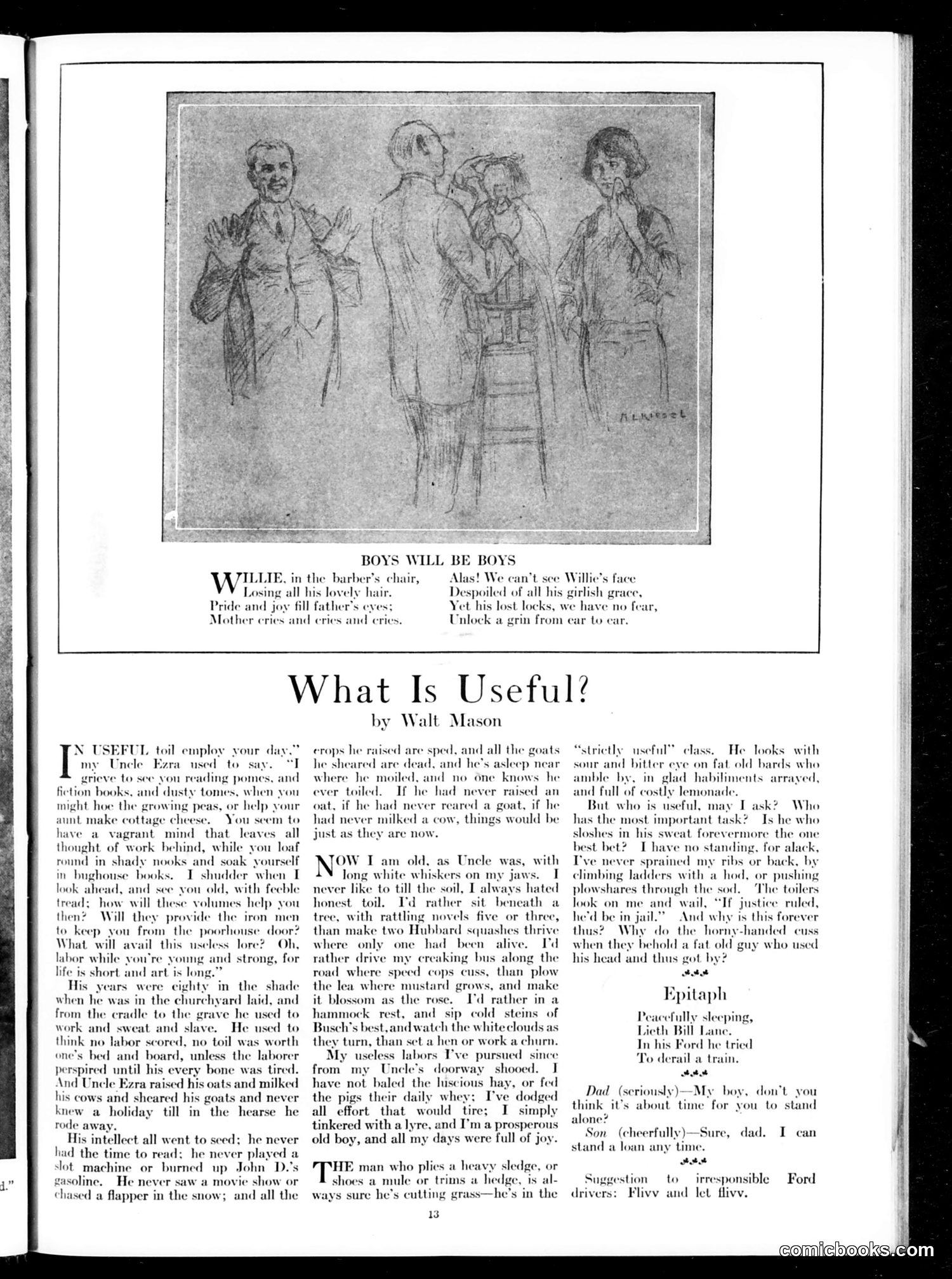
The top cartoon depicts a boy getting his hair cut at a barber shop, with family members reacting emotionally to his lost locks. The verse treats this as a minor rite of passage with gentle humor about parental anxiety. Below, Walt Mason's essay "What Is Useful?" satirizes the tension between honest labor and leisure pursuits. Mason contrasts his late Uncle Ezra—who labored exhaustingly his whole life (plowing, milking cows, shearing goats) only to die with nothing to show for it—against Mason himself, who avoided hard work, pursued "useless" pleasures (reading novels, playing music), and became prosperous anyway. The satire's point: conventional wisdom about the moral necessity of grueling toil is exposed as false. The hardworking achieve nothing; the lazy artist thrives. This mocks both Puritanical work ethic ideology and the resentment working people direct at affluent idlers—suggesting merit and reward are disconnected.
📄 Transcribed text from this page (OCR, searchable)
Machine-transcribed from the original scan — historical spelling and the odd misread are preserved.
JILLIE, in the t Losing all his lovely hair. Pride and joy fill father’s eves Mother cries and cries and cries. BOYS WILL BE BOY: rber’s chair, Unlock Despoiled of all his Yet his lost locks, we have no fear, a grin from ear to car. irlish grace, What Is Useful? Ezra used to. say. grieve to see you reading pomes, and fiction books, and dusty tomes, when you might hoe the growing peas, or help your aunt make cottage cheese. You seem to have a vagrant mind that leaves all thought. of work behind, while you loaf round in shady nooks and soak yourself in bughouse books. I shudder when I look ahead, and see you old, with feeble tread; how will these volumes help you then? Will they provide the iron men ep you from the poorhouse door? What will Oh, labor while you're young and strong, for life is short and art is long.” His years were eighty in when he was in the church) from the cradle to the ve he used to work and sweat and He used to think no labor scored, no toil was worth one’s bed and board, unless the laborer perspired until his every bone was tired. And Uncle Ezra raised his oats and milked his cows and sheared his goats and never knew a_holi till in the hearse he rode away. His intellect all went to seed; he never had the time to read; he never played a slot. machine or burned up John’ D.’s gasoline, He or saw a movie show or chased a flapper in the snow; and all the N USEFUL toil employ your dat my Uncle this useless lore? by Walt Mason crops he raised are sped, and all the goats he sheared are dead, and he’s asleep near where he moiled, and no one knows he ever toiled. If he had never raised an oat, if he had never 1a goat, if he had never milked a cow, things would be just as they are now. OW T am old, as Uncle was, with long white whiskers on my jaws. I never like to till the soil, I always hated honest toil. Td rather sit beneath a tree, with rattling novels five or three, than make two Hubbard squashes thr where only one had been alive. Vd rather drive my creaking bus along the road where speed cops cuss, than plow the lea where mustard grows, and make it blossom as the rose. Vd rather in a hammock rest, and sip cold steins of Busch’s best, and watch the white clouds as they turn, than set a hen or work a churn. My useless labors T’ve pursued since from my Uncle's doorway shooed. I have not baled the hiscious hay, or fed the pigs their daily wh I've dodged all effort that would tire; I simply tinkered with a lyre, and I'm a prosperous old boy, and all my days were full of joy. THe man who plies a heavy sledge, or shoes a mule or trims a hedge, is al- ways sure he’s cutting grass—he’s in the 13 “strictly useful class. He looks with sour and bitter eve on fat old bards who amble by, in glad habiliments arrayed, and full of costly lemonade. But who is useful, may I ask? Who has the most important task? Is he who sloshes in his sweat forevermore the one best bet? [have no standing, for I've never sprained my ribs or climbing ladders with a hod, or pushing plowshares through the sod. The toilers look on me and wail, “If justice ruled, he'd be in jail.” And why is this forever thus? Why do the horny-handed cuss when they behold a fat old guy who used his head and thus got by? tte Epitaph Peacefully sleeping, Lieth Bill Lane. In his Ford he tried To derail a train. ttt Dad (seriously)—My boy, don’t you think it’s about time for you to stand alone? Son (cheerfully)—Sure, stand a loan any time. tot dad. I can Suggestion to — irresponsible — Ford drivers: Flivv and let flivv.