
Judge, 1922-10-28 · page 23 of 36
Judge — October 28, 1922 — page 23: what you’re looking at
What you’re looking at
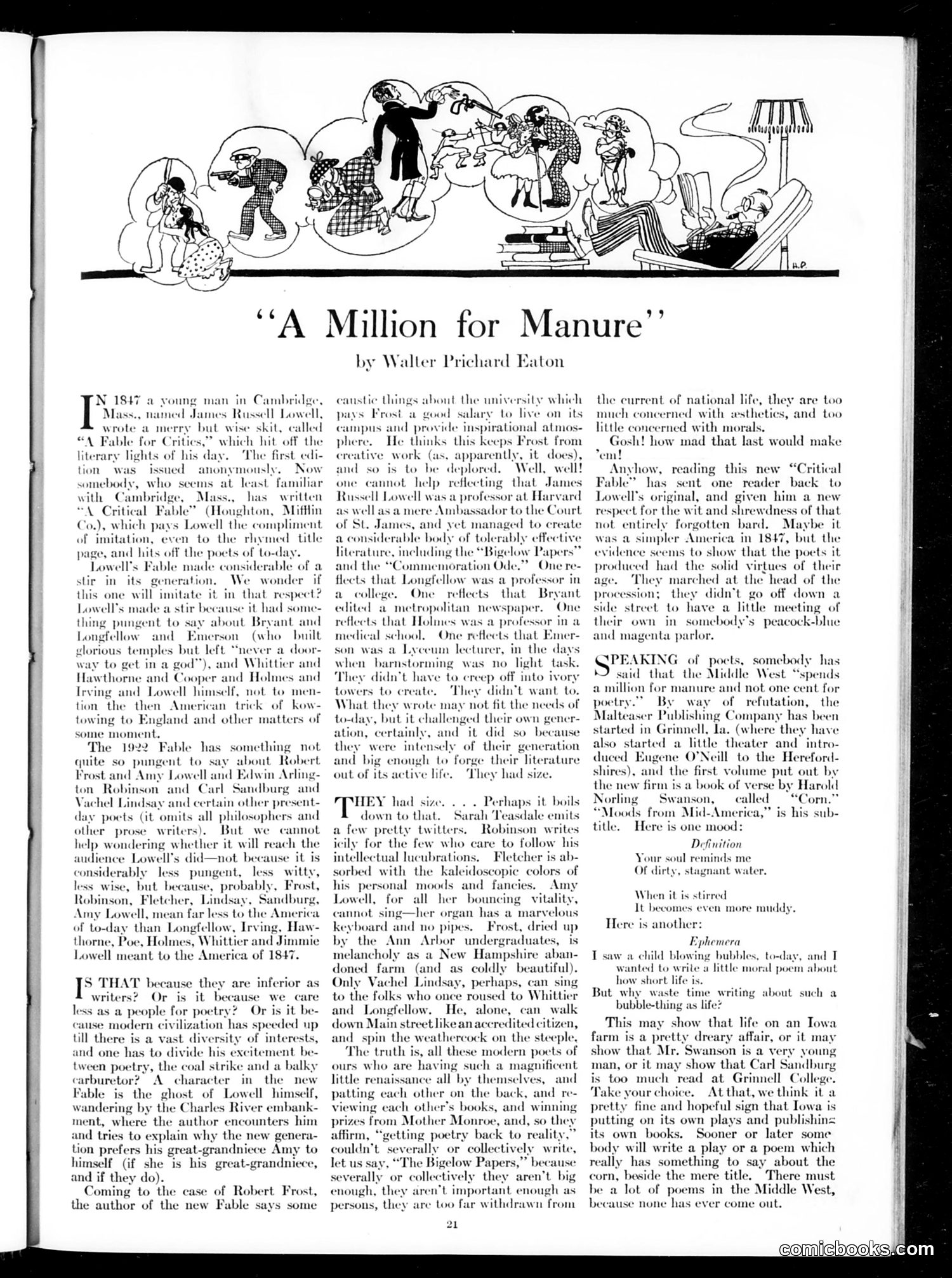
This page reviews a 1922 poem called "A Critical Fable" by an unnamed author (the header illustration shows figures in thought bubbles—likely representing poets under discussion). The piece is a modern imitation of James Russell Lowell's 1847 satirical poem "A Fable for Critics," which critiqued major American literary figures. The review argues that while the new Fable critiques contemporary poets (Robert Frost, Amy Lowell, Edwin Arlington Robinson, Carl Sandburg, Vachel Lindsay), it lacks the cultural impact of Lowell's original. Eaton suggests this is because modern readers care less about poetry—they're distracted by "coal strikes" and "balky carburetors" (cars). The article also critiques the new Fable's complaint that university employment prevents creative work, noting that major 19th-century poets like Lowell himself held academic and diplomatic positions while still producing significant literature. The implication: modern poets lack the intellectual "size" of their predecessors.
📄 Transcribed text from this page (OCR, searchable)
Machine-transcribed from the original scan — historical spelling and the odd misread are preserved.
‘fA Million for Manure’’ by Walter Prichard Eaton N 1847 a young man in Cambridge, I Mass., named James Russell Lowe wrote me but wise skit, Ned which hit off the The first edi- Now Tomiliar “4 Fable for Critics,” literary lights of his day. tion was issued anonyme somebody, who seems at ae with Cambri lass., has written “A. Critical Fable” (Houghton, Mifflin .), which pays Lowell the compliment of imitation, even to the rhymed title page, and hits off the poets « Lowell’s Fable mu CONS stir in its generation. We this one will imitate it in that respect? Lowell’s made a stir because it had some- thing pungent to say about Bryant and low and Emerson (who built us temples but left “never a door- et ina god”), and Whittier and + and Cooper and Holmes and Irving and Lowell himself, not to: men- tion the then American trick of kow- towing to England and other matters of some moment. The 1922 Fable has something not quite so pungent to say about Robert Frost and Amy Lowell and Edwin Arling- ton Robinson and Carl Sandburg and Vachel Lindsay and certain other present- day poets (it omits all philosophers and other prose writers). But we eannot help wondering whether it will reach the audience Lowell's did—not because it is considerably less pungent, witty, less wise, but because, probably, Frost, Robinson, Fletcher, Lindsay, Sandburg, Amy Lowell, mean far less to the America of to-day than Longfellow, Irving, Haw- thorne, Poe, Holmes, Whittier and Jimmie Lowell meant to the America of 1847. wonder if less S THAT because they are inferior as writers? Or is it because we care less as a people for poetry? Or is it be- cause modern civilization has speeded up till there is a vast diversity of interests, and one has to divide his excitement | tween poetry, the coal strike and a balky carburetor? character in the new Fable is the ghost of Lowell himself, wandering by the Charles River embank- ment, where the author encounters him and tries to explain why the new genera- tion prefers his gre idniece Amy to himself (if she is his great-grandniece, and if they do). Coming to the case of Robert Frost, the author of the new Fable says some about the university which vod salary to live on its campus and provide inspirati atmos- phere. He thinks this keeps Frost from creative work (as, apparently, it does), and so is to be dlored. Well, well! one cannot help reflecting that. James Russell Lowell was a professor at F ard as well as a mere Ambassador to the Court of St. James, and yet managed to cre a conside literature and the caustic thing including the “Bigelow Pape ‘ommemoration Ode.” One ut Longfellow was a professor in One reflects that Bryant a metropolitan newspaper. One reflects that Holmes was ap! i medical school, One reflec son was a Lyceum lecturer, in the d when barnstorming was no light task, They didn’t have to creep off into ivory towers to create. They didn’t want to. What they wrote may not fit the needs of but it challenged their own gener- inly, and it did so because intensely of their generation orge their literature They had size. ation, « they ‘wer and big enough t out of its active life, HEY had size. down to that. few pretty twitters. ily for the few who care to follow his intellectual lucubrations. Fletcher is ab- sorbed with the kaleidoscopic colors of his personal moods and fancies. Amy Lowell, for all} cannot sing—her ¢ keyboard and no pipes. st, dried up by the Ann Arbor undergraduates, is melancholy as a New Hampshire aban- doned farm (and coldly beautiful). Only Vachel Lindsay, perhaps, can si to the folks who once roused to Whitt and I fellow. He, alone. alk down Main street like an accredited citizen, and spin the weathercock on the steeple, The truth is, all these modern poets of ours who are having such a magnificent little renaissance all by them patting each other on the back, and viewing each other's books, and winning prizes from Mother Monroe, and, so they affirm, “getting poetry back to couldn't severally or collectively let us say, “The Bigelow Pape: because severally or collectively. th en't big enough, they aren't important enough as persons, they are too far withdrawn from Perhaps it boils ale emits Robinson writes 21 the current of national life, they are too much concerned with esthetics, and too little concerned with morals, Gosh! how mad that last would make em! Anyhow, reading this new “Critical Fable” has sent one reader back to Lowell's original, and given him a new respect for the wit and shrewdness of that not entirely forgotten bard, Maybe it was a simpler America in 1847, but the evidence seems to show that the poets it produced had the solid virtues of their y marched at the head of the gion; they didn’t go off down a » street to have a little meeting of their, own: in, somebody's” peacock: blue and riageita parlor. SPEAKING of poets, somebody: has SS said that the Middle West “spends a million for manure and not one cent for poetry By way of refutation, the Malteaser Publishing Company has been started in Grinnell, Ta. (where they hi also ted a little theat duced Eugene O'Neill to the Hereford- shires), and the first volume put out by the new firm is a book of verse by Harold Norling Swanson, — called “Corn.” “Moods from Mid-America,” is his sub- title. Here is one mood: Definition Your soul reminds me Of dirty, stagnant water, When it is stirred It becomes even more muddy. Tere is another: Ephemera T saw a child blowing bubbles, to- wanted to write a little moral pe how short life is. But why waste tin bubble-thing as lif This may show that life on an Towa farm is a pretty dre: r, or it may show that Mr. Swanson is a ve ry young man, or it may show that Carl Sandburg is too much at Grinnell College. ‘Take your choice. At that, we think it a pretty fine and hopeful sign that Iowa is putting on its own plays and publishinz its own books. Sooner or later some body will write a play or a poem which really has something to say about the corn, beside the mere title. There must be a lot of poems in the Middle West, because none has ever come out. writing about such a