
Judge, 1922-10-28 · page 7 of 36
Judge — October 28, 1922 — page 7: what you’re looking at
What you’re looking at
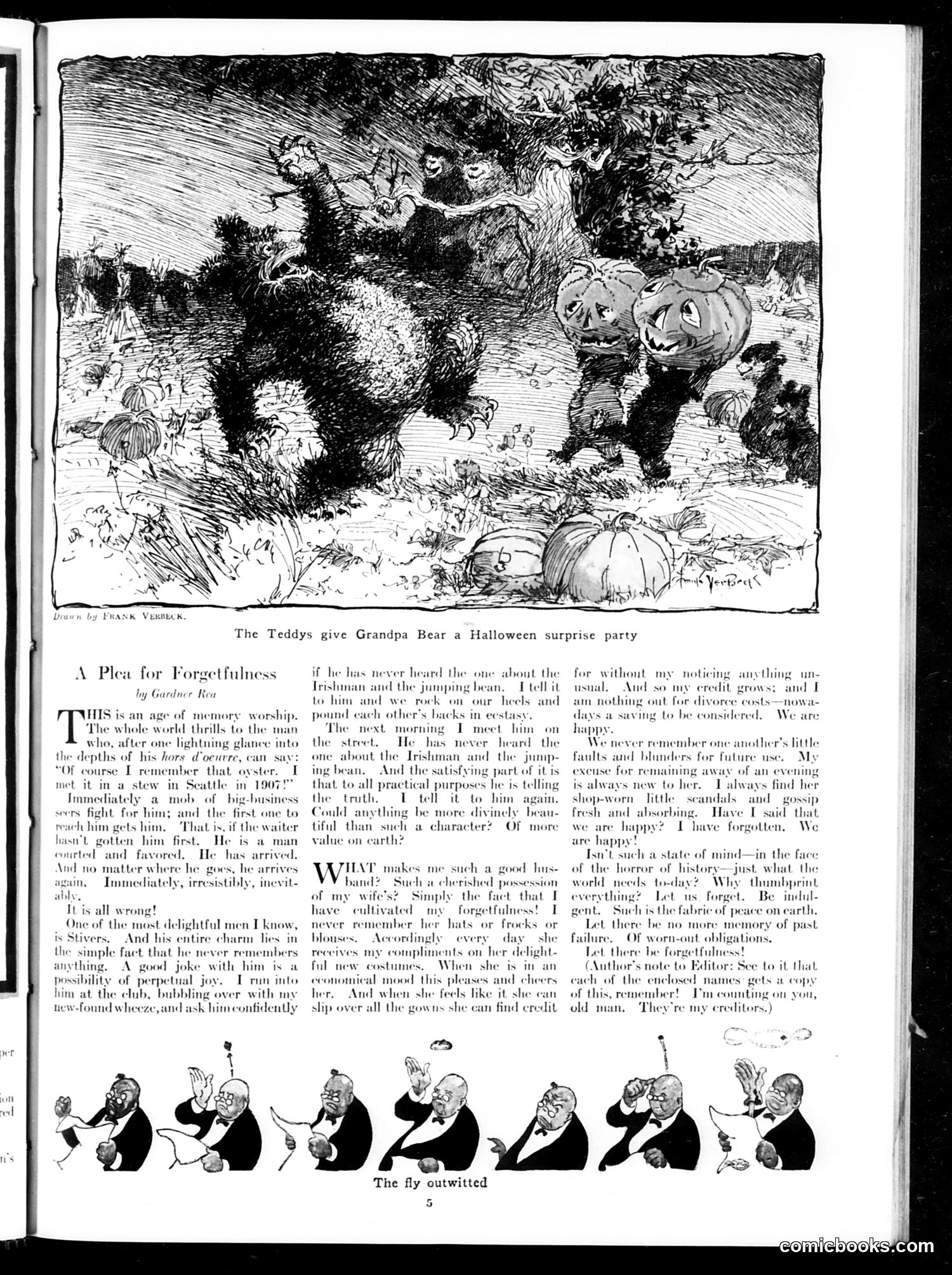
**Main Cartoon (top):** Frank Verbeck's illustration shows bears—likely Theodore Roosevelt's "Teddy Bears" (a popular toy phenomenon of the early 1900s)—surprising "Grandpa Bear" at a Halloween party. This is a whimsical domestic scene with jack-o'-lanterns, likely playing on the Roosevelt family's cultural prominence and the Teddy Bear craze that swept America after Roosevelt's hunting expeditions. **Text Article:** "A Plea for Forgetfulness" by Gardner Rea is a humorous essay praising the value of forgetfulness in modern life. It argues that constant memory-worship and obsessive recollection of details damages happiness. The author celebrates a friend named Stivers who remembers nothing, and claims his own marriage thrives because he "forgets" his wife's wardrobe repetitions and past arguments. **Bottom Illustration:** "The Fly Outwitted" shows a sequence of a man attempting to swat a fly—a visual punchline to the forgetfulness theme. The satire targets the Edwardian era's cult of memorability and self-improvement while celebrating selective amnesia as superior to exhausting memory-worship.
📄 Transcribed text from this page (OCR, searchable)
Machine-transcribed from the original scan — historical spelling and the odd misread are preserved.
y FRANK VEKBECK, The Teddys give Grandpa Bear a Halloween surprise party A Plea for Forgetfulness hy Gardner Rea HIS is an age of memory worship. The whole world thrills to the man who, after one lightning glance into the depths of his hors d’ocurre, can say? “Of course T remember that oyster. I met it in a stew in Seattle in 1907!" Immediately a mob of big-business seers fight for him; and the first one to reach him gets him. That is, if the waiter hasnt gotten him first. He is a courted and favored. He has arri \nd no matter where he goes, he arriv again. Immediately, irresistibly, inevit- It is all wrong! One of the most delightful men I know, is Stivers. And his entire charm lies in the simple fact that he never remembers anything. A good je with him is a possibility of perpetual joy. [run into him at the club, bubbling over with my new-found wheeze, and ask him confidenUy about the I tell it els and if he has never heard the one Irishman and the jumping bean. to him and we reck on our pound each other's backs in ecstasy. The next morning To meet him on the street. He has never heard the one about the Irishman and the jump- ing bean. And the satisfying part of it is that to all practical purposes he is telling the truth. [tell it) to him again. Could anything be more divinely beau- tiful than such a character? Of more value on earth? WWIENT makes ine such a good hus. band? Such a cherished possession of my wif Simply the fact that I have’ cultivated forgetfulness! never demember hier hats or frocks 6F blouses. Accordingly every day receives my compliments on her delight- ful new costumes. When she is in an economical mood this pleases and cheers her. And when she feels like it she ean slip over all the gowns she can find credit my she a> car The fly outwitted 5 noticing anything un- and howa- We are for without my usual, And so my credit am nothing out for div s Sa saving Wst to be considered, * never remember one another's little faults and blunders for future use. My excuse for remaining away of an evening is always new to her. TD always find her shop-worn little seandals and gossip fresh and absorbing. Have [ said’ that we are happy? [have forgotten. We are happy! Isn't such a state of mind—in the face of the horror of history—just. what. the world needs to-day? Why thumbprint everything? Let us. fol Be indul- gent. Such is the fabric of peace on earth. Let there be no more memory of past failure. Of worn-out obligations. Let there be forgetfulness! (Author's note to Editor: $ cach of the enclosed names: gets a copy of this, remember! I'm counting on you, old man, ‘They're my creditors.) ee Lo it that e