
Judge, 1922-10-28 · page 24 of 36
Judge — October 28, 1922 — page 24: what you’re looking at
What you’re looking at
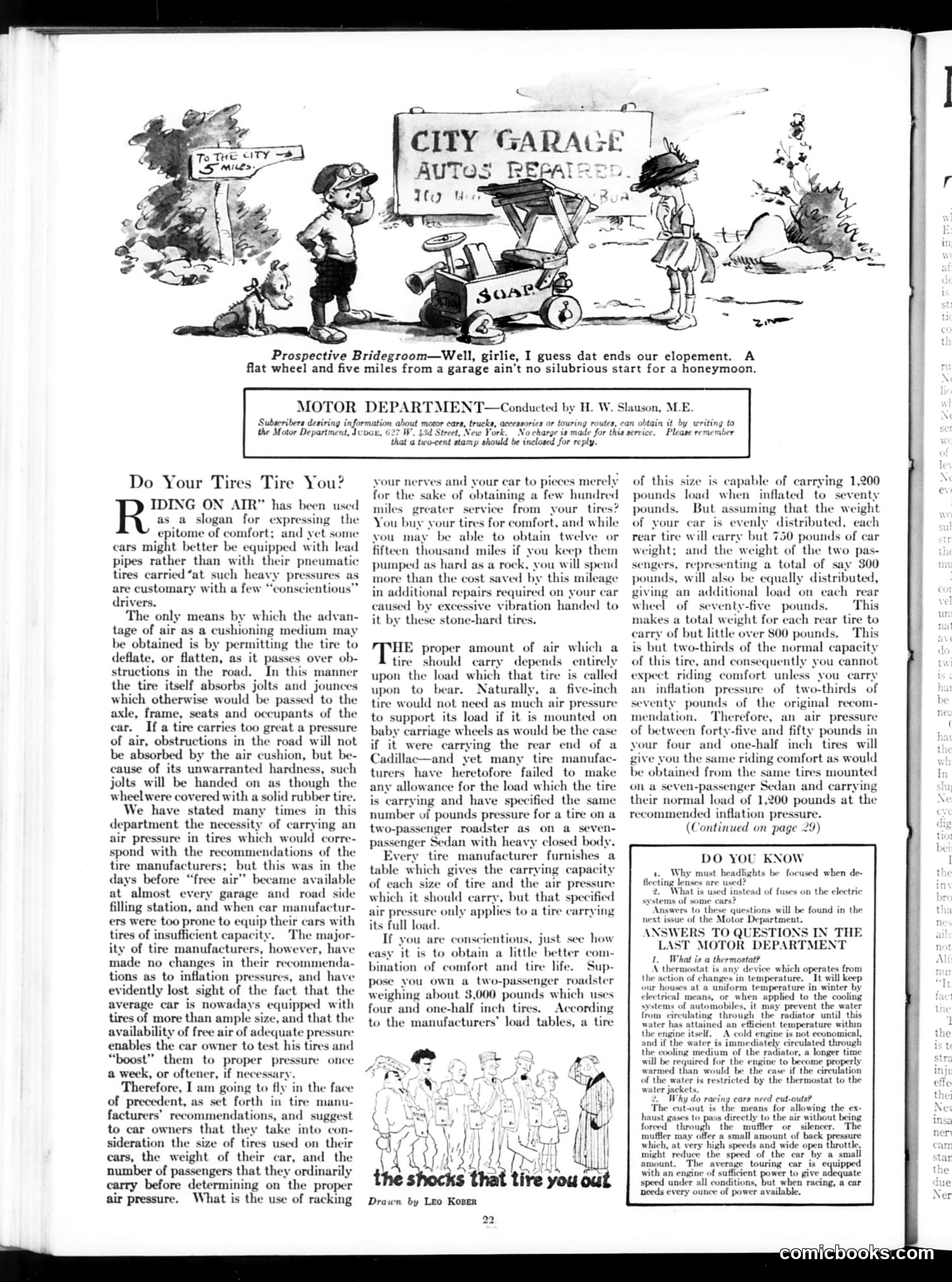
The cartoon depicts a young couple at a broken-down car near a "City Garage" sign, with the groom saying their elopement is ruined—a flat tire five miles from help makes for a poor honeymoon start. The humor relies on early 1920s automobile culture anxiety: cars were still relatively new and unreliable, with frequent breakdowns that stranded travelers. The joke satirizes romantic notions of eloping "in style" with a motor car, which the reality of mechanical failure instantly deflates. The accompanying article by H.W. Slauson addresses tire pressure concerns—a genuine automotive issue of the era. The satire's point: modern motorists romanticize automobile travel while remaining ignorant about proper tire maintenance. The elopement scenario exemplifies this gap between automotive dreams and mechanical reality, mocking both young lovers and the broader American infatuation with automobiles as symbols of freedom and romance.
📄 Transcribed text from this page (OCR, searchable)
Machine-transcribed from the original scan — historical spelling and the odd misread are preserved.
ay ee nti ii 7 ToTne uty 3) SMe Prospective Bridegroom—Well, girlie, I guess dat ends our elopement. A flat wheel and five miles from a garage ain't no silubrious start for a honeymoon. MOTOR DEPARTMENT—Conducted by H. W. Slauson, M.E. Subscribers desiring information about motor care, trucks, accessories or touring routes, can obtain it by writing to the Motor Department, Suoax, 27 W. 43d Street, New York. No charge is made for thie service. Please remember that a tico-cent stamp should be inclosed for reply. Do Your Tires Tire You? — your nerves and your ear to pieces merely of this si ble of carrying 1,200 for the sake of obtaining a few hundred pounds load when inflated to. seventy Re: ON AIR” has been used miles greater service from your tires? pounds. But assuming that the weight asa slogan for expressing the You buy your tires for comfort, and while of your car is evenly distributed, each epitome of comfort; and yetsome you may be able to obtain twelve or rear tire will carry but 750 pounds of car cars might better be equipped with lead fifteen thousand miles if you keep them weight; and the weight of the two pas- pipes rather than with their pneumatic pumped as hard as a rock, you will spend sengers, representing a total of say 300 tires carried “at such heavy pressures a8 more than the cost saved by this mileage pounds, will also be equally distributed, are customary with a few “conscientious” jn additional repairs required on your car giving an additional load on each rear drivers. caused by excessive vibration handed to wheel of seventy-five pounds. This The only means by which the advan- jt by these stone-hard tires. makes a total weight for each rear tire to tage of air as a cushioning medium may arry of but little over 800 pounds. ‘This be obtained is by permitting the tire to THE proper amount of air which a is but two-thirds of the normal capacity deflate, or flatten, as it passes over ob- I tire should carry depends entirely of this tire, and consequently you cannot structions in the road. In this manner ypon the load which that tire is called expect riding comfort unless’ you carry the tire itself absorbs jolts and jounces ypon to bear. Naturally, a five-inch an inflation pressure of two-thirds of which otherwise would be passed to the tire would not need as much air pressure seventy pounds of the original recom- axle, frame, seats and occupants of the 9 support its load if it is mounted on mendation, Therefore, an_air pressure car. If a tire carries too great a pressure aby carriage wheels as would be the case of between forty-five and fifty pounds in of air, obstructions in the road will not jf jt were carrying the rear end of a your four and’ one-half inch. tires will be absorbed by the air cushion, but be- Cadilla-—and yet many tire manufac- give you the same riding comfort as would cause of its unwarranted hardness, such turers have heretofore failed to make be obtained from the same tires mounted jolts will be handed on as though the allowance for the load which the tire on a seven-passenger Sedan and carrying wheel were covered with a solid rubber tire. arrying and have specified the same their normal load of 1,200 pounds at the We have stated many times in this number of pounds pressure for a tire on a recommended inflation pressure. department the necessity of carrying an two-passenger roadster on a seven- (Continued on page 29) air pressure in tires which would corre- passenger Sedan with heavy closed body. spond h the recommendations of the Every tire manufacturer furnishes a DO YOU KNOW tire manufacturers; but this was in the table which gives the carrying capacity svi chan nefits ommsadionae days before “free air” became available of each size of tire and the air pressure | fleciing lenses are used? at almost every garage and road side which it should carry, but that specified | 2.a\ itis used instead of fuses on the electric filling station, and when car manufactur- gir pressure only applies to a tire carrying Answers to these questions will be found in the next issue of the Motor Department. ANSWERS TO QUESTIONS IN THE ST MOTOR DEPARTMENT ers were too prone to equip their cars with its full load. tires of insufficient capacity. T! he j ity of tire manufacturer: If you are conscientious, just see how easy it is to obtain a little better com- cee > 0] rs ji Py |. What is a thermostat? made no changes in their recommenda- ination of comfort and tire life. Sup- dd ryltes silica tna toes tions as to inflation pressures, and have pose you own a two-passenger roadster r 1t will keep average Car 1s nowadays equipped with four and one-half inch tires. According y ay peeve eet tires of more than ample size, and that the {4 the manufacturers’ load tables, a tire | cient temperature within. availability of free air of adequate pressure ie itself, A c is not economical, enables the car owner to test his tires and circulated through « ” the cooling medium of tbe radiator, a longer time boost” them to proper pressure once will be required for the engine to become properly a week, or oftener, if necessi dreulation 5 water is restricted by the thermostat to the Therefore, I am going to fly in the face er jackets. of precedent, as set forth in tire manu- facturers’ recommendations, 4 Why do racing care need cut-outs? ns for allowing the ex- id suggest a EL a ss directly air without being to car owners that they take into con- “ } | } cr tencer. The sideration the size of tires used on their hy I, Ye ve [ | hich, at very high speeds and wide open throttle, cars, the weight of their car, and the Hi '$)) {] Nit} Hi ‘aaehE, reduce the seer ol Se ook 5 fael number of passengers that they ordinarily iy 4 i" ate he it han. ufficient power to give adequate carry before determining on the proper tha’ re YOu Ow 2d under all consitions, but, when racing, & car air pressure. What is the use of racking Drawn by Leo Korer