
A complete issue · 36 pages · 1922
Judge — February 25, 1922
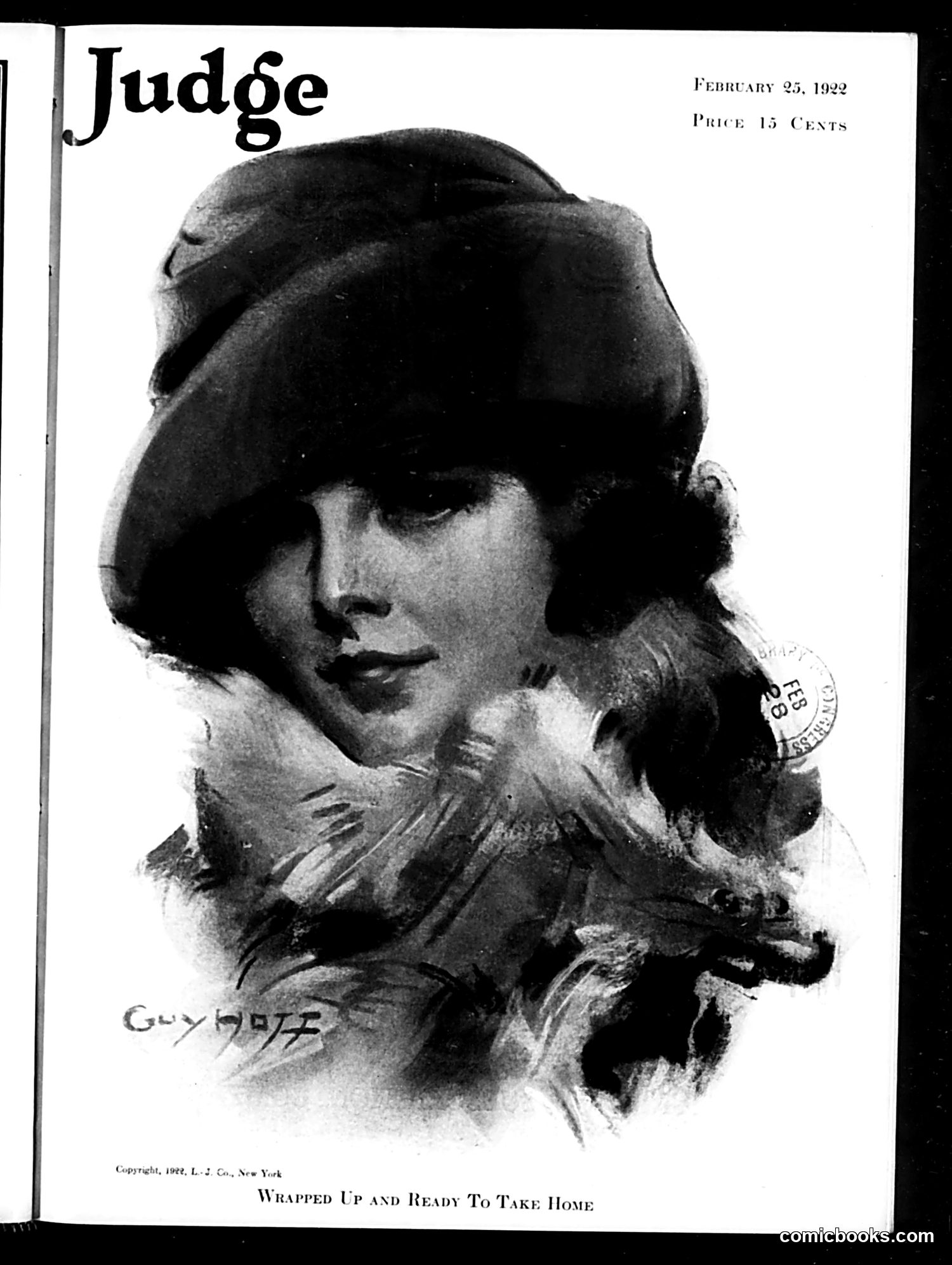
This Judge magazine cover from February 25, 1922 features a portrait illustration signed by artist Guy Rose. The title "Wrapped Up and Ready To Take Home" suggests the image depicts someone prepared for departure or delivery—likely a social or political figure of that moment. However, without additional context clues in the visible text or more identifying details in the portrait itself, I cannot definitively identify who this person is or what specific event or satire this references. The illustration shows a fashionably dressed figure in 1920s style with a hat and fur collar, but the satirical point remains unclear from the image alone. Additional archival information would be needed to fully explain the intended commentary.
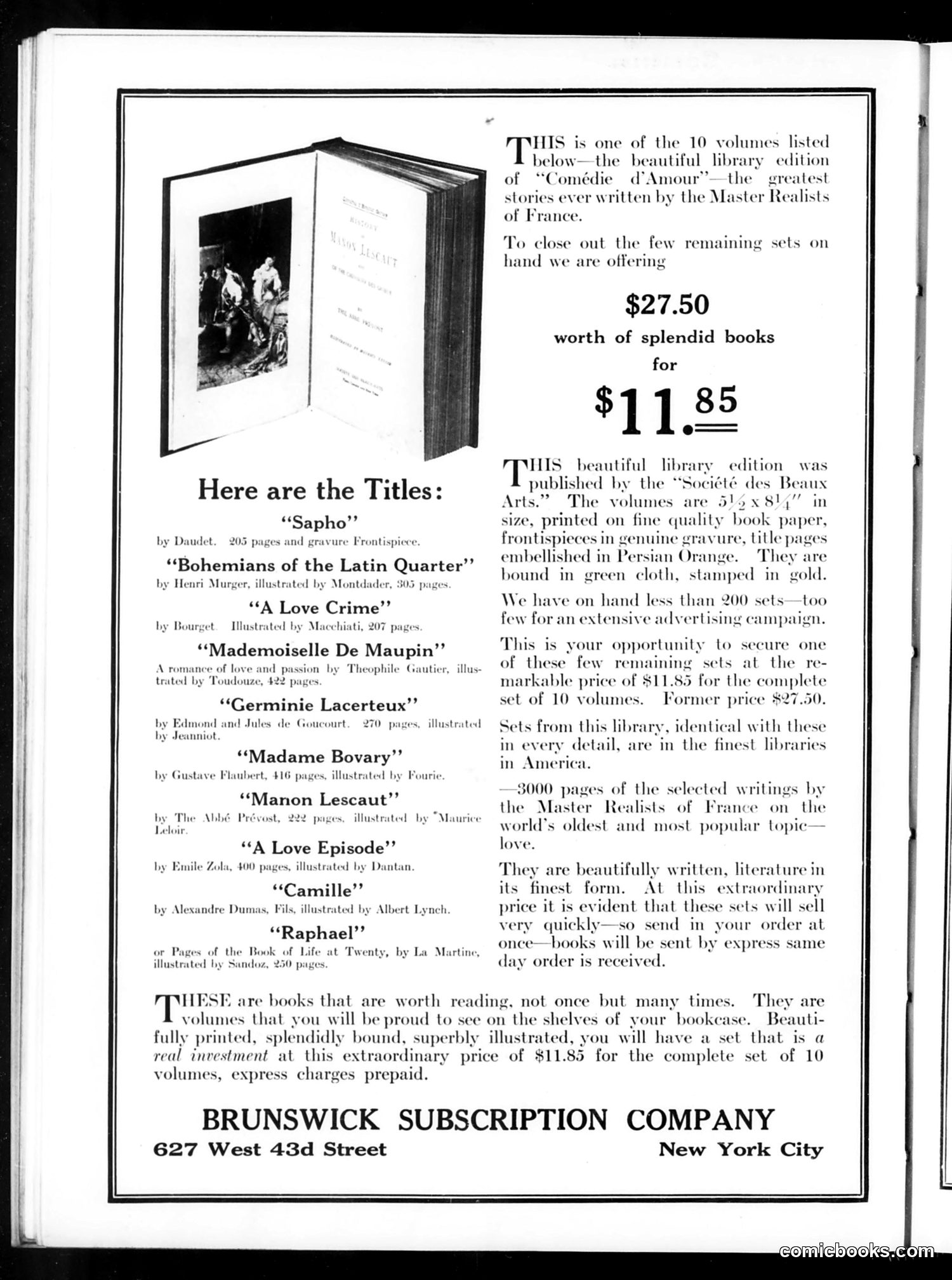
This is **not a cartoon page** but rather a **full-page advertisement** for the Brunswick Subscription Company, located in New York City. The ad promotes a 10-volume library edition of "Comédie d'Amour"—classic French literature stories by Master Realist authors. It lists titles like "Sapho," "Madame Bovary," and works by Balzac, Dumas, and Zola. The marketing pitch emphasizes luxury: beautifully bound books in genuine gravure illustrations, printed on fine paper, with gilt edges. Originally priced at $27.50, the company is clearing remaining stock at $11.85 for the complete set—presenting this as an extraordinary bargain for cultured readers who want impressive library pieces. There is no political satire or social commentary here—purely commercial content targeting affluent Judge magazine readers.
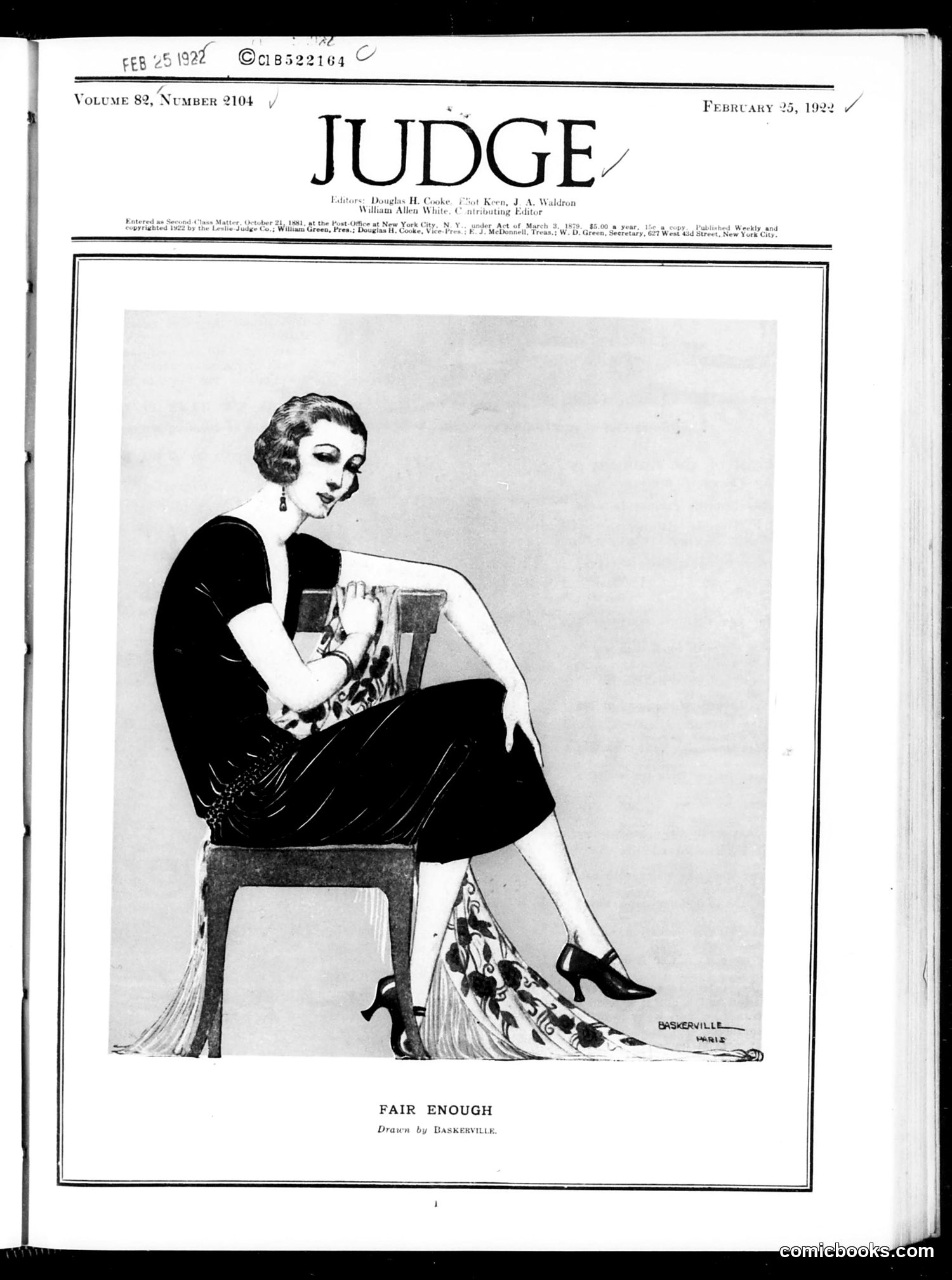
This illustration by Baskerville depicts a fashionable woman seated, holding what appears to be a magazine or publication while reviewing it critically. The title "Fair Enough" suggests the cartoon comments on women's judgmental attitudes or standards—likely toward media, literature, or social matters. The woman's composed, evaluative posture and the elegant 1920s styling (bobbed hair, modern dress) reflect the era's "New Woman"—increasingly educated and opinionated. The satire appears to critique either women's growing critical voice in public discourse or, conversely, to celebrate their newfound ability to judge cultural products as equals. Without additional context from the magazine's text, the precise target remains somewhat unclear, though it clearly engages with evolving gender roles of the Jazz Age.
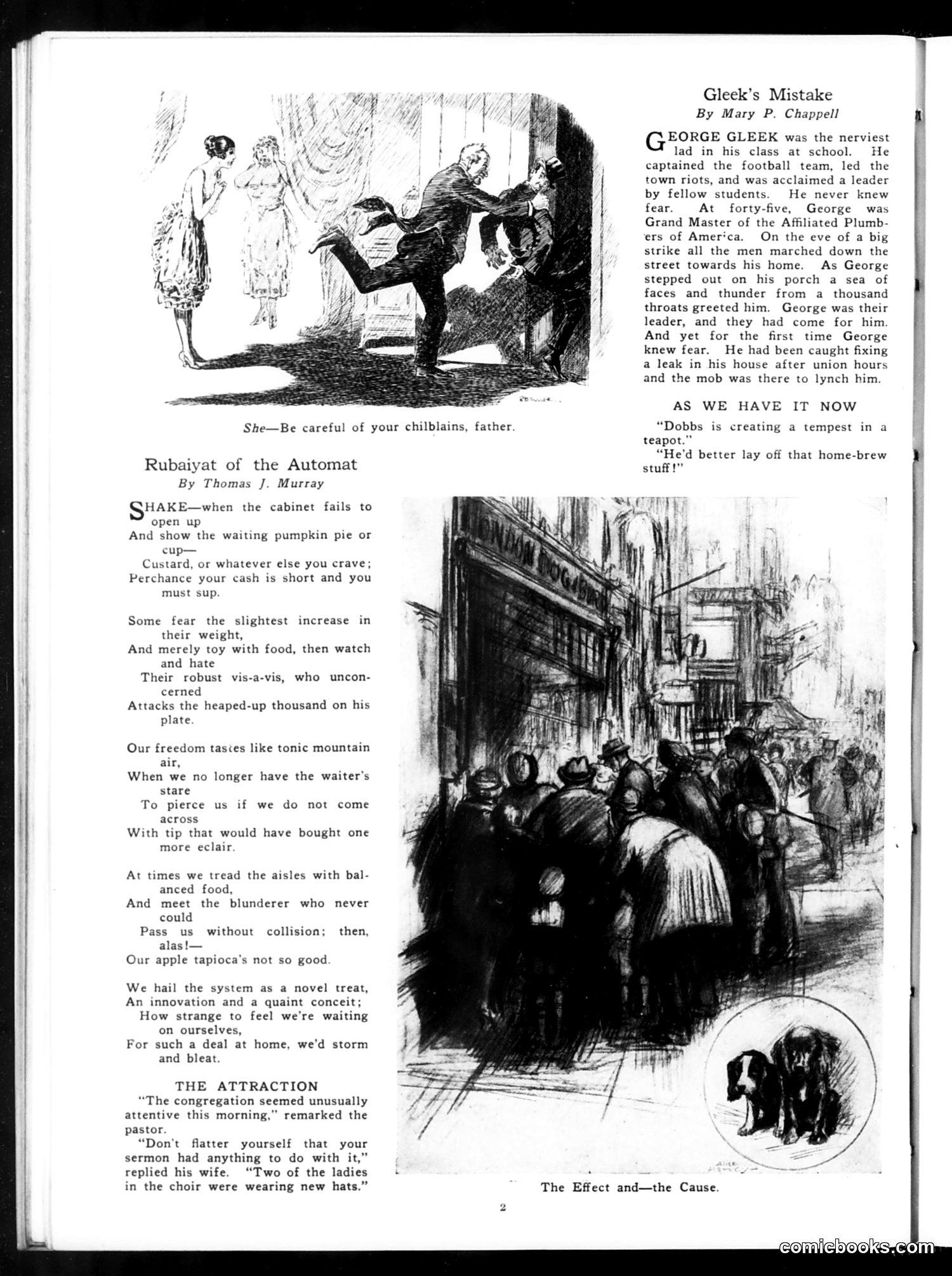
This page contains three distinct pieces: 1. **"Gleek's Mistake"** (top): A sketch showing a man being kicked out a door while women watch. The story describes George, a nervous labor leader and football captain, caught fixing a leak after union hours—and now a mob has come to lynch him. The satire targets union rigidity: even a leader performing necessary home repairs violates union rules, making him a target for mob violence. 2. **"Rubaiyat of the Automaton"** (left): Verse mocking automated restaurant systems that dispense food via cabinet mechanisms. It satirizes the novelty and impersonality of mechanical dining—diners must shake mechanisms to get meals, creating frustration rather than the promised convenience. 3. **"The Attraction"** (bottom right): A brief anecdote about a pastor noting unusual congregation attendance, which his wife attributes to two women wearing new hats—not his sermon.
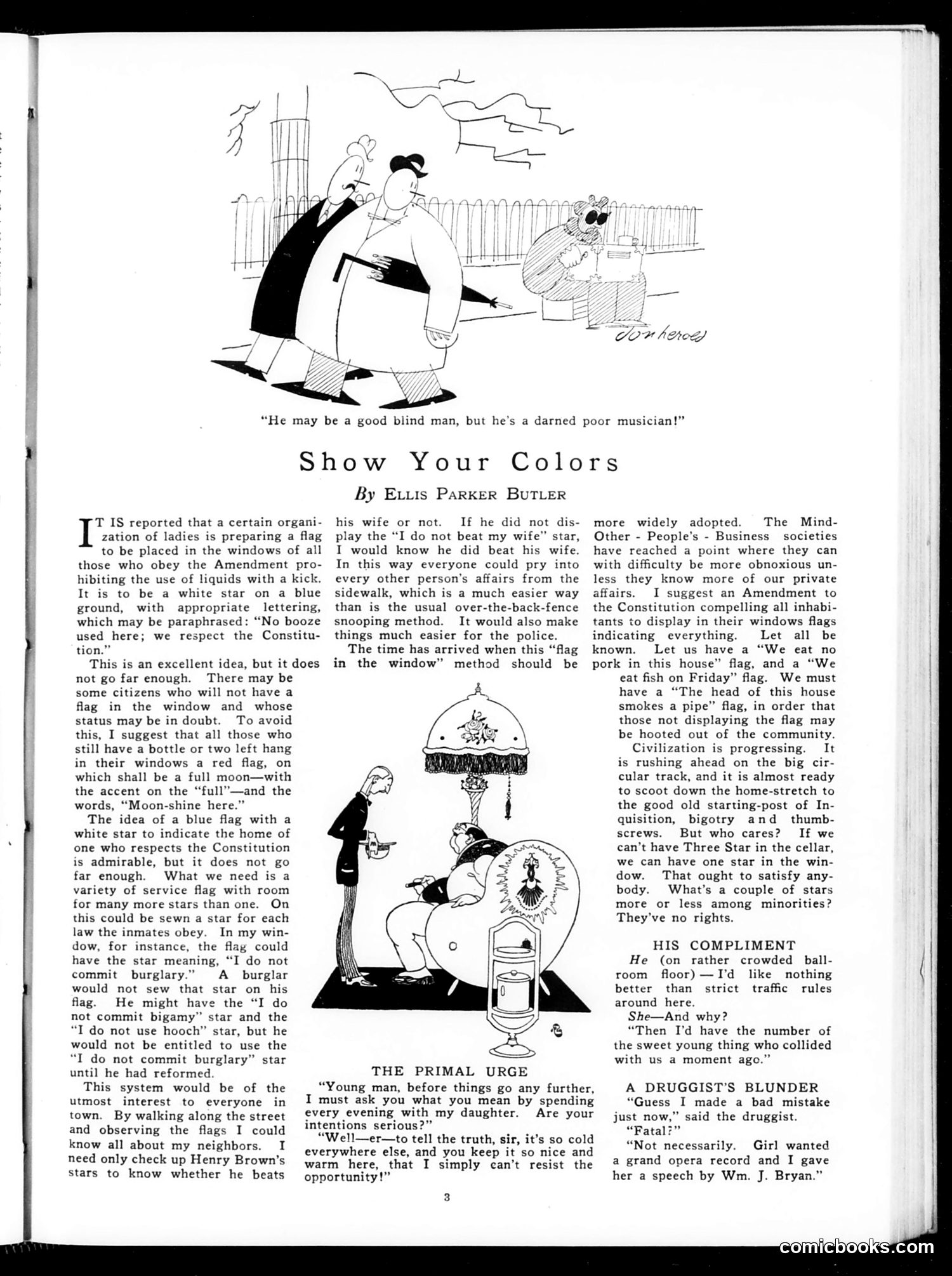
The main cartoon satirizes an early 20th-century proposal for "window flags" displaying citizens' moral character—particularly regarding alcohol prohibition and Constitution-following. The top cartoon mocks a blind musician being criticized as "a darned poor musician," while the middle illustrations show a woman displaying decorative flags in her window indicating household rules (like "no pork on Fridays"). Butler's essay argues this system is absurd: if everyone displayed flags showing their personal habits and moral compliance, it would invade privacy and create ridiculous window-clutter. He sarcastically suggests flags for various violations—"I do not commit bigamy," etc. The satire targets the growing Prohibition movement and busybodies who wanted public moral policing. Butler defends constitutional liberty and privacy against what he sees as intrusive social control disguised as civic virtue.
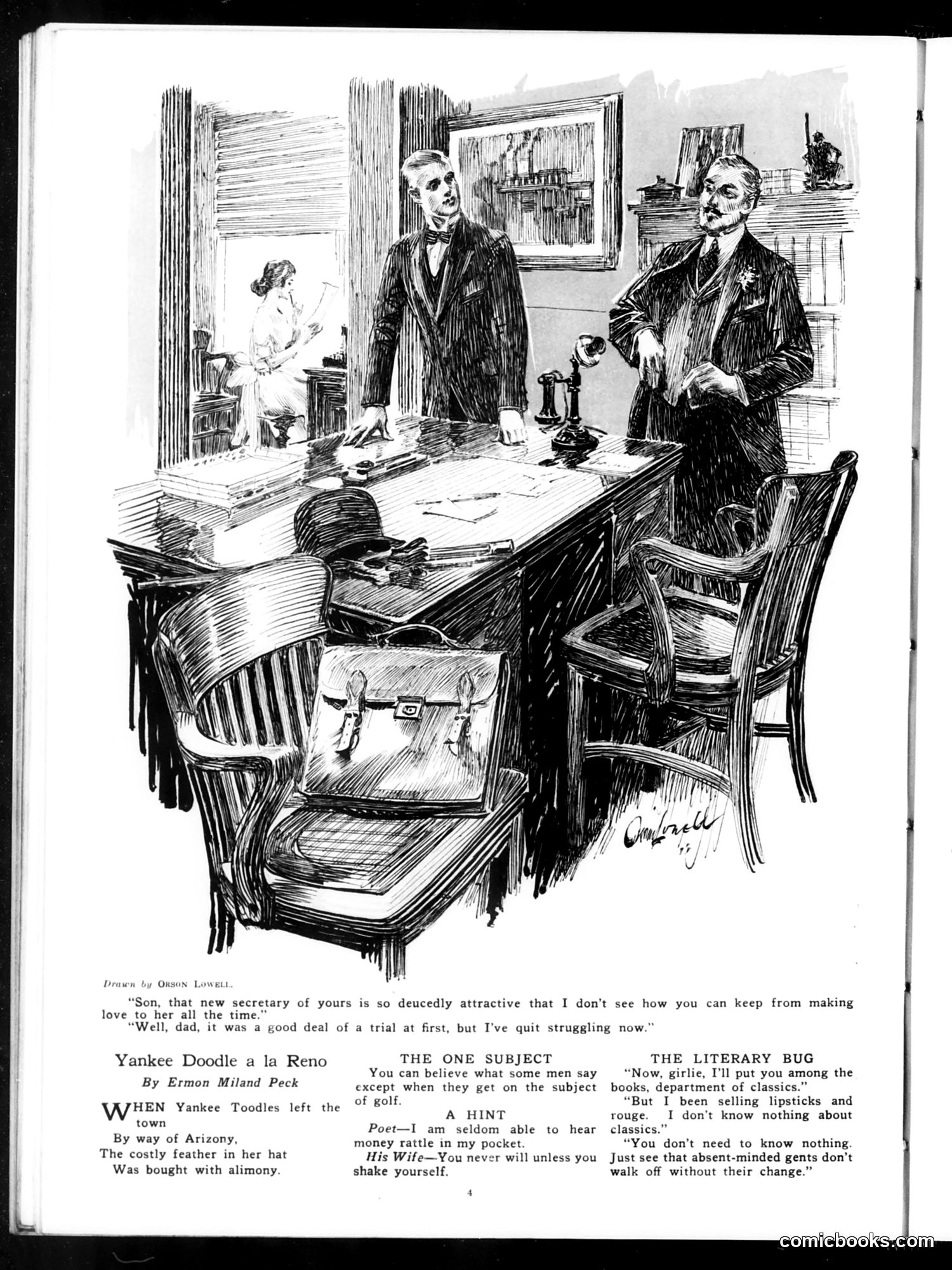
The main cartoon depicts an office scene where a father warns his son about the new secretary's attractiveness, saying he "can't see how you can keep from making love to her all the time." The son responds that it was initially difficult but he's "quit struggling now"—suggesting he's given up resisting temptation. Below are three brief humorous items: "Yankee Doodle à la Reno" jokes about expensive divorce proceedings in Nevada; "The One Subject" presents golf as universally interesting; and "The Literary Bug" satirizes pretentious intellectuals who discuss classics without understanding them. The page reflects early 20th-century concerns: workplace romance, Nevada's liberal divorce laws, and intellectual pretension among the upper classes.
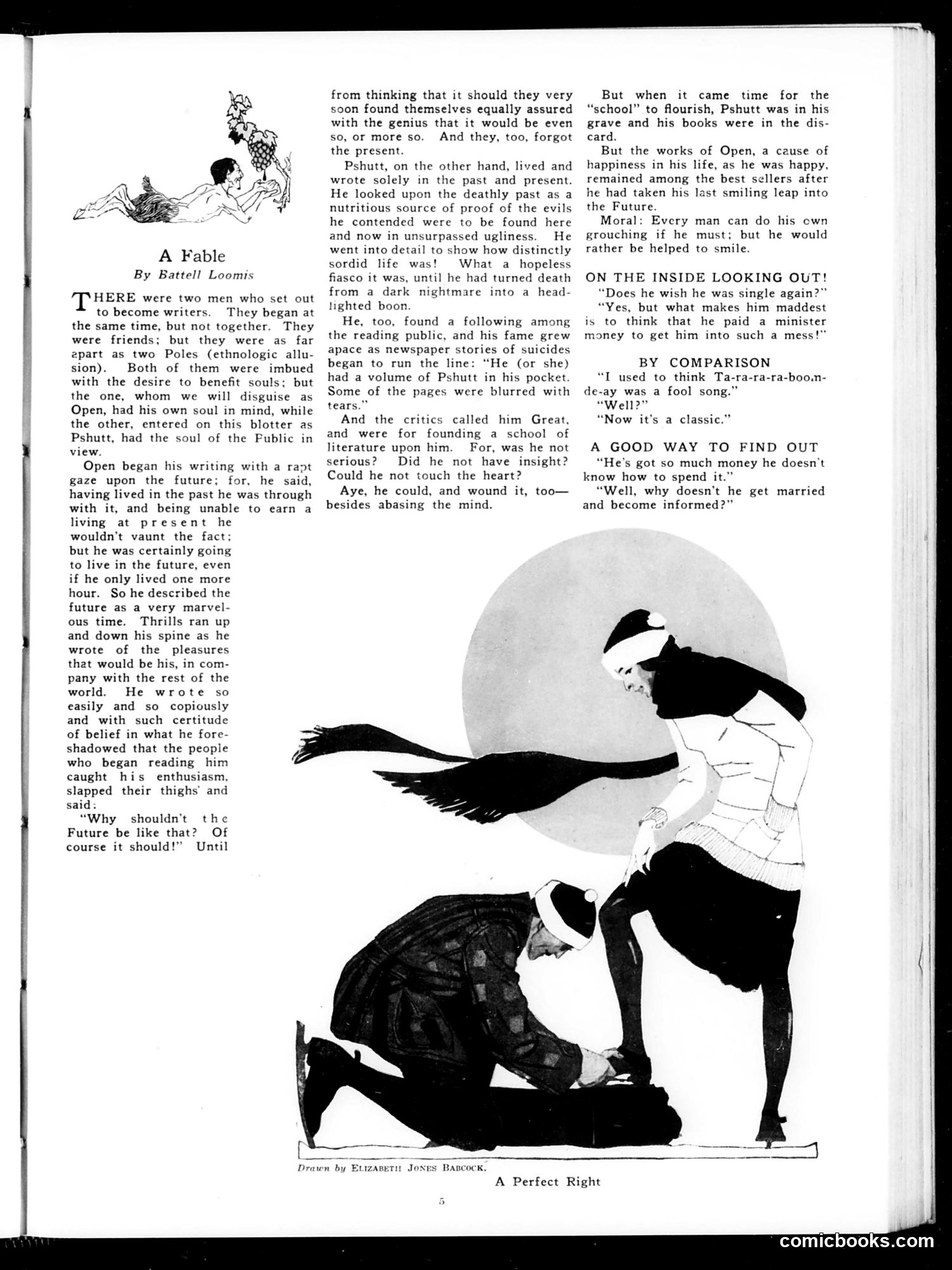
This page presents a fable contrasting two writer archetypes. "Open" writes optimistic futuristic fiction that inspires readers with enthusiasm for an idealized tomorrow, gaining popularity through emotional uplift. "Pshutt" focuses on documenting present and past suffering—depicting life's sordidness until death becomes relief—earning critical acclaim as "serious" and insightful, yet ultimately his work fades after his death. The satire targets opposing literary philosophies popular in early 20th-century America: escapist optimism versus muckraking realism. Judge's verdict favors Open—the "happiness merchant"—arguing that while serious social critique has merit, ultimately readers and society benefit more from uplifting, emotionally sustaining work. The illustration labeled "A Perfect Right" appears to show physical comedy (two figures in an awkward collision), accompanying lighter sidebar jokes about marriage. The fable reflects Judge's general editorial stance: skepticism toward overly grim "realist" literature while celebrating accessible entertainment.
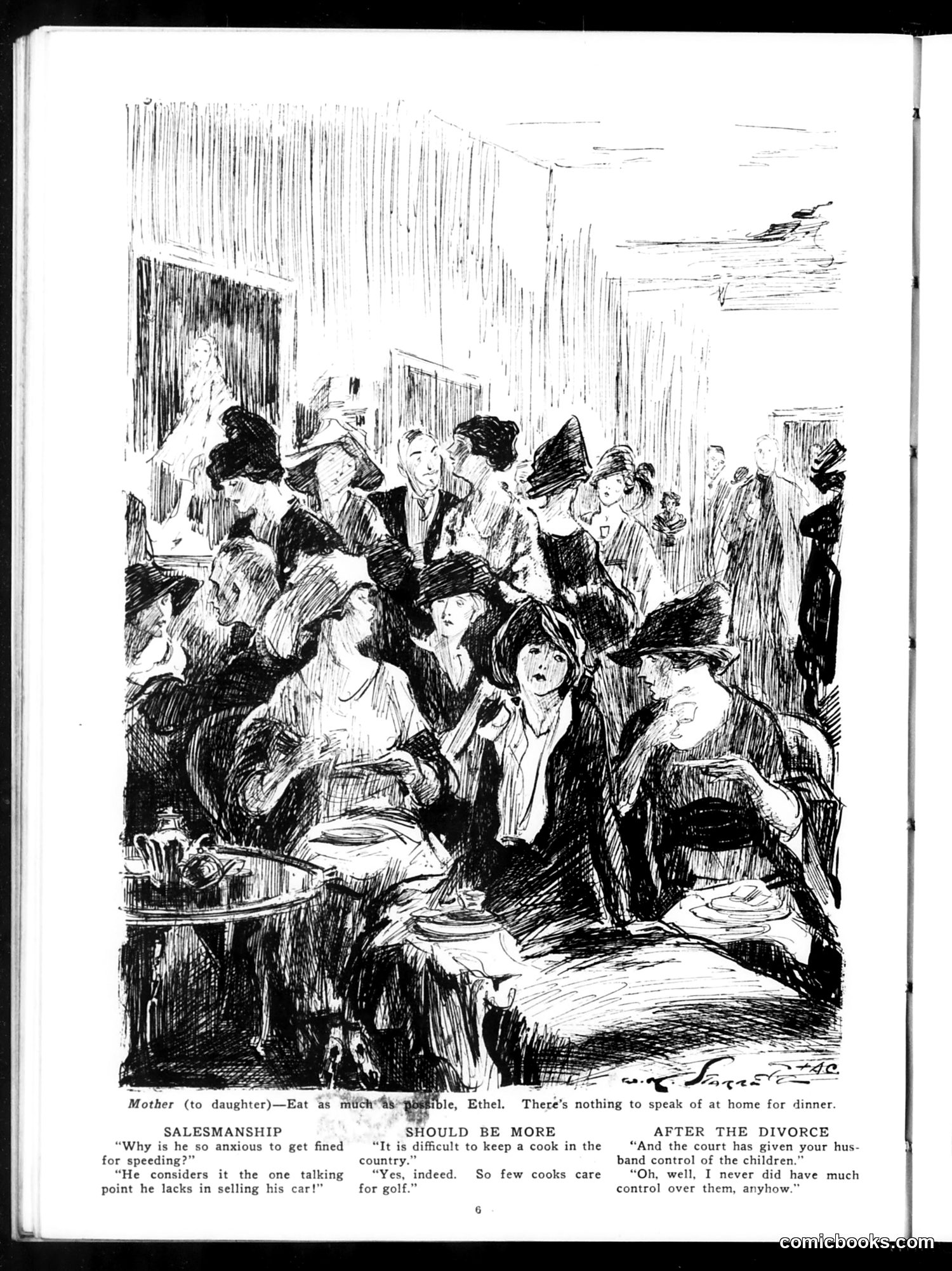
This page contains three separate satirical vignettes mocking early 20th-century domestic and social issues: **Top illustration**: A mother tells her daughter to eat heavily at a restaurant because there's no dinner at home—satirizing either poverty or parental neglect/irresponsibility. **Bottom left ("Salesmanship")**: A man gets traffic tickets intentionally because he lacks conversation skills when selling cars—mocking incompetent salesmen who compensate by creating drama. **Bottom center ("Should Be More")**: Rural domesticity is failing because cooks won't work for employers who prioritize golf over household duties—satirizing the conflict between modern leisure pursuits and traditional domestic labor. **Bottom right ("After the Divorce")**: A divorced woman claims indifference to losing child custody, suggesting she never controlled her children anyway—cynically mocking both parental responsibility and divorce outcomes. The overall tone critiques contemporary American social anxieties: economic instability, shifting gender roles, servant labor shortages, and marital discord.
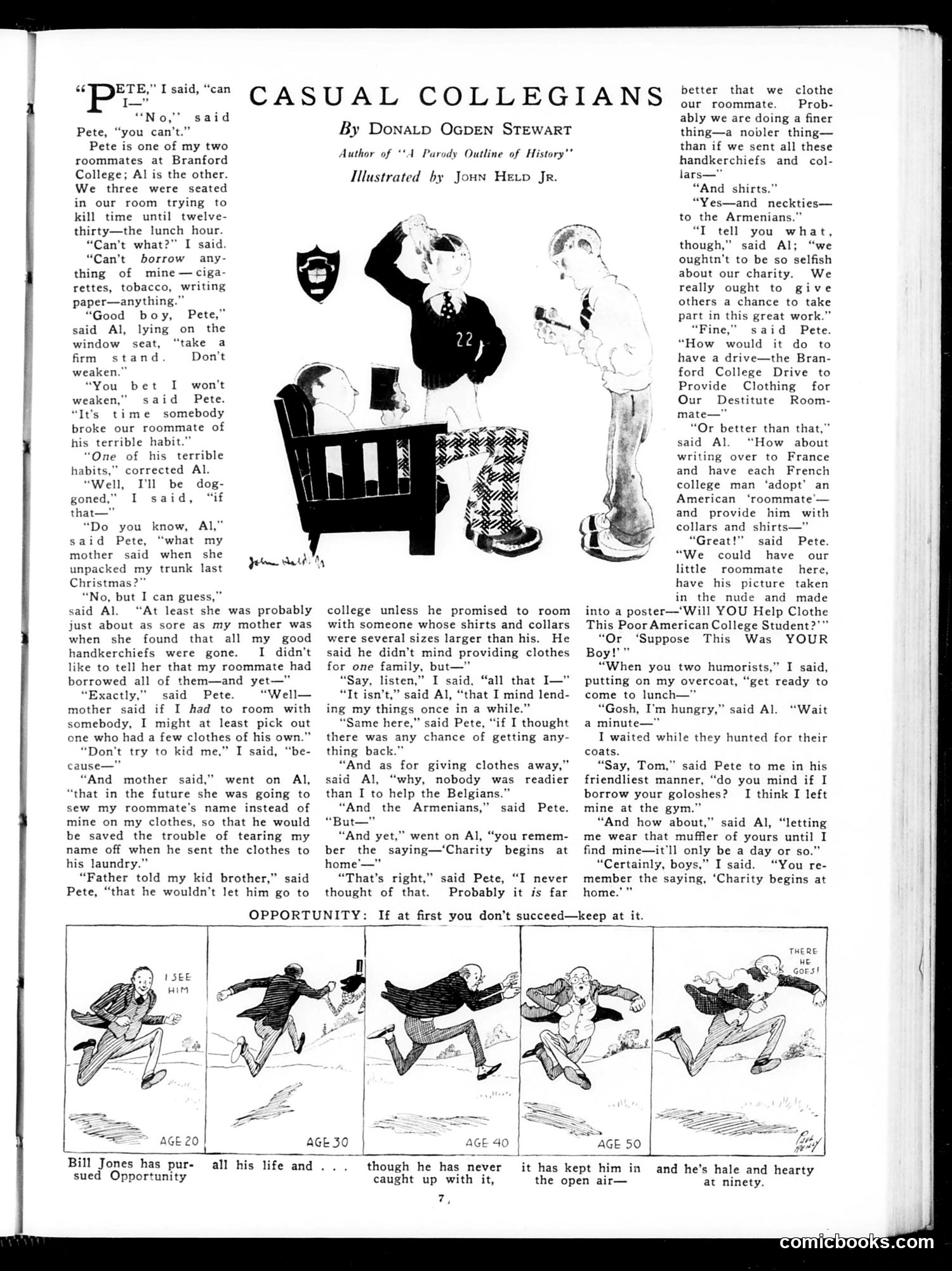
This humorous short story by Donald Ogden Stewart satirizes the petty conflicts between college roommates at Branford College (Yale). Three roommates—the narrator (Tom), Pete, and Al—banter about chronic borrowing of clothes and personal items. The joke pivots on hypocrisy: Pete and Al self-righteously lecture the narrator about his "terrible habit" of borrowing their belongings, even invoking charitable causes (helping Belgians and Armenians). They grandiosely propose a fundraising campaign to clothe their "destitute roommate." The satire's punchline arrives at the end: immediately after their self-righteous sermon, both Pete and Al casually ask to borrow the narrator's goloshes and muffler—proving they're equally guilty of the behavior they condemned. The accompanying comic strip below titled "Opportunity" reinforces the theme: success requires persistent effort, even when pursuing questionable goals. The piece mocks youthful self-deception and moral inconsistency.
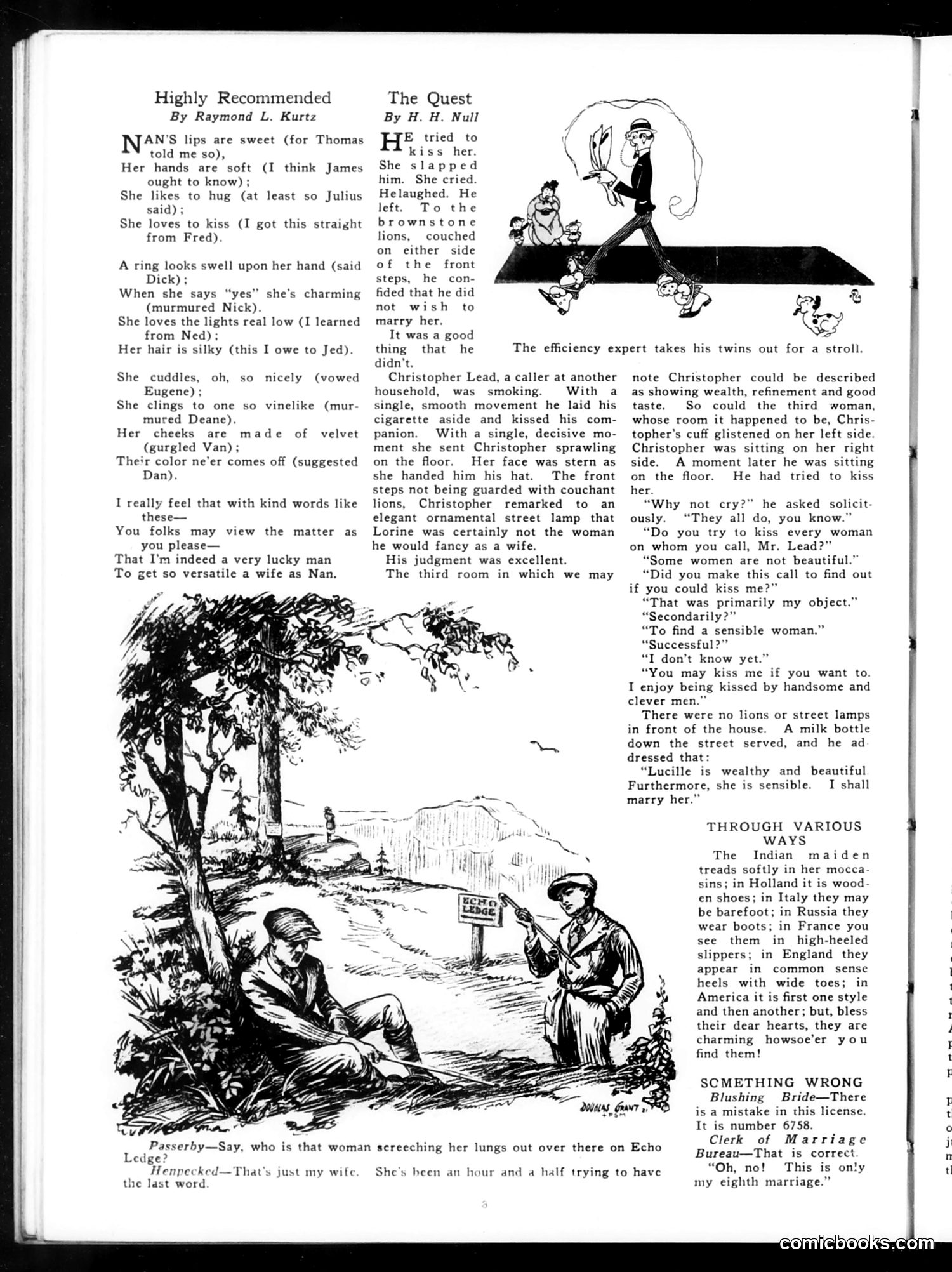
This page contains three satirical pieces mocking courtship and marriage conventions of the era. **"Highly Recommended"** ridicules a man named Nan who boasts of his wife's qualities, each attributed to a different male admirer (Thomas, James, Julius, Fred, etc.). The satire suggests the wife is either promiscuously flirtatious or the husband is naively credulous—likely both, making him "a very lucky man" in his obliviousness. **"The Quest"** follows Christopher Lead attempting to kiss three different women, each rejecting him by hitting him. The joke subverts expectations: rather than learning his lesson, he simply selects the third woman (Lucille) as his future wife because she's "sensible"—meaning she violently refused him, which somehow proves marriage-worthiness. The satire mocks both his persistent, unwanted advances and the logic of courtship. **"Something Wrong"** is a brief joke about a bride correcting her marriage license number, revealing it's her eighth marriage—satirizing either hasty remarriage or serial matrimony. All three pieces cynically comment on marriage as transactional and based on superficial qualities or poor judgment.
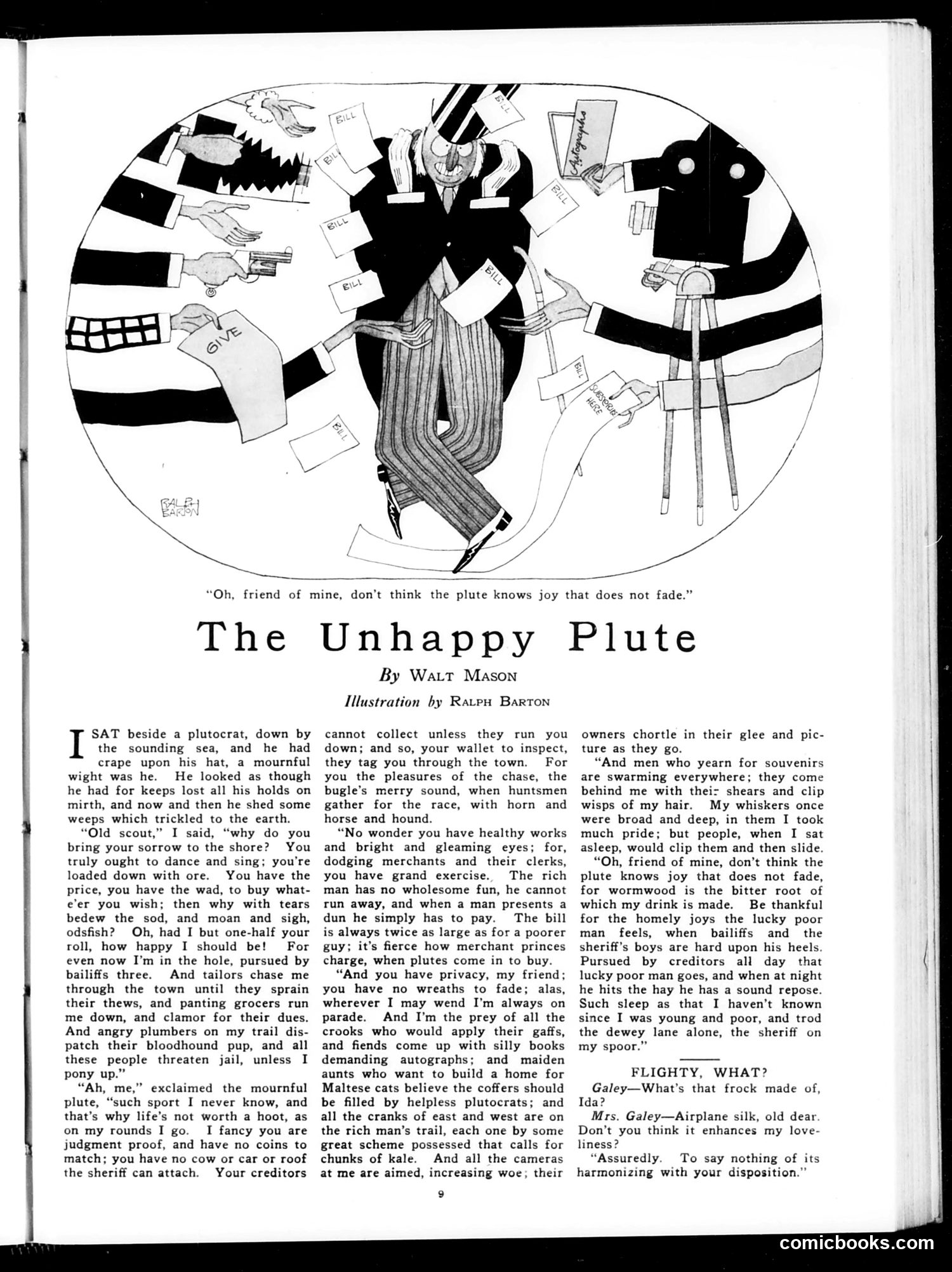
This is a satirical poem by Walt Mason about wealth and unhappiness, illustrated by Ralph Barton. A "plute" (plutocrat—wealthy person) laments his miserable life to a poor man sitting by the sea. The satire inverts expectations: the rich man envies the poor man's freedom. While the poor face creditors and bailiffs, they experience genuine joy and uninterrupted sleep. The wealthy man, by contrast, is constantly pursued by schemers, autograph-seekers, relatives wanting money, and photographers—his every moment is public performance ("always on parade"). His wealth brings only anxiety and parasitic attention. The poem satirizes Gilded Age excess and the hollow nature of plutocratic life, suggesting that material abundance paradoxically prevents authentic happiness. The brief joke at bottom about "airplane silk" fabric suggests modernity and fashionable pretense.
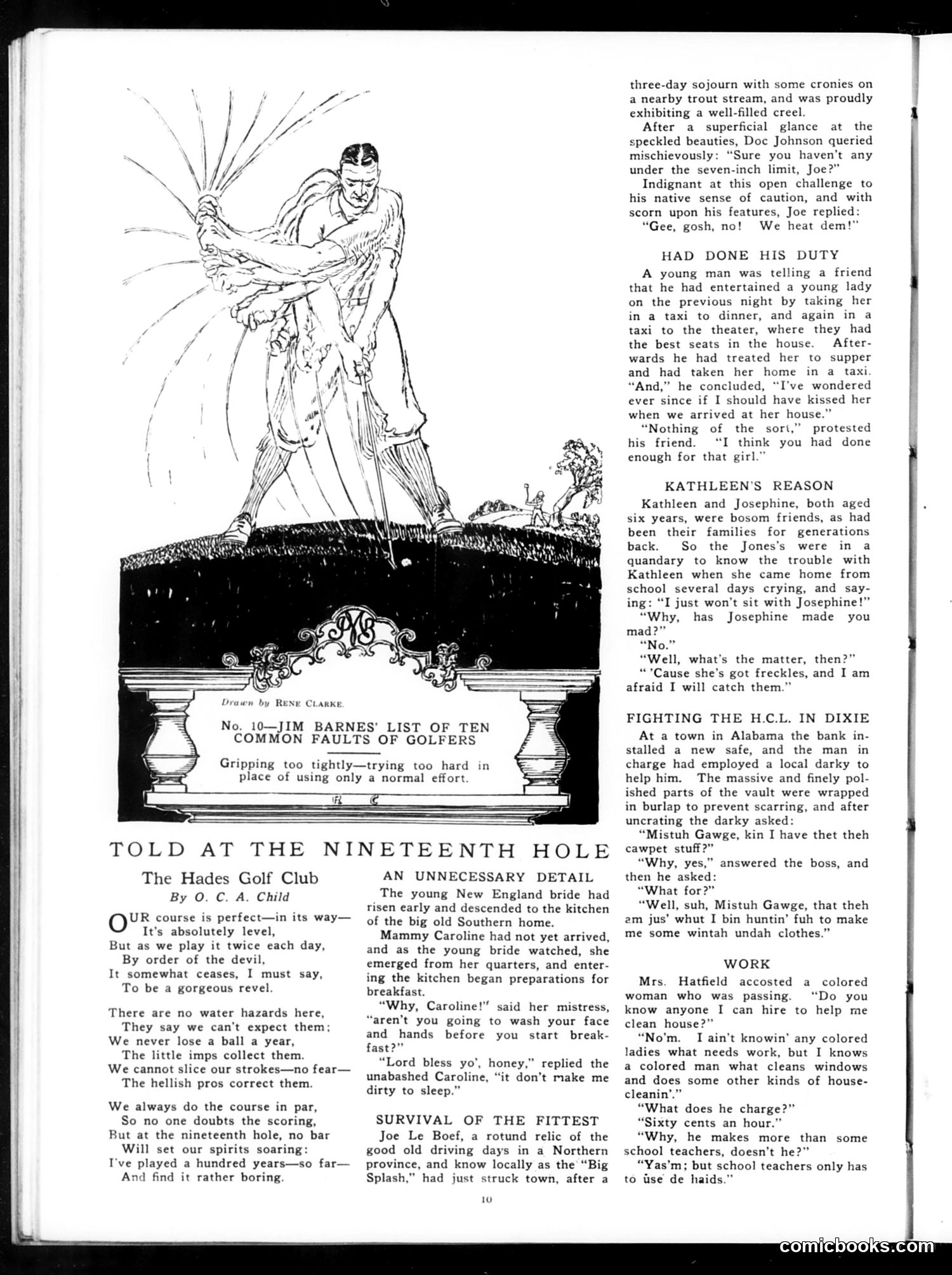
The main cartoon by René Clarke illustrates "Jim Barnes' List of Ten Common Faults of Golfers," specifically the first fault: "Gripping too tightly—trying too hard in place of using only a normal effort." The illustration shows a golfer mid-swing with exaggerated tension, his body contorted and water spraying dramatically from his club. The caption explains the satirical point: proper golf requires relaxed, natural effort rather than excessive force. The page also contains several humorous short stories about everyday social situations—including tales about courtship etiquette, racial attitudes of the era, and household help. These reflect early 20th-century American social anxieties and class dynamics, presented as light satirical humor typical of Judge magazine's content.
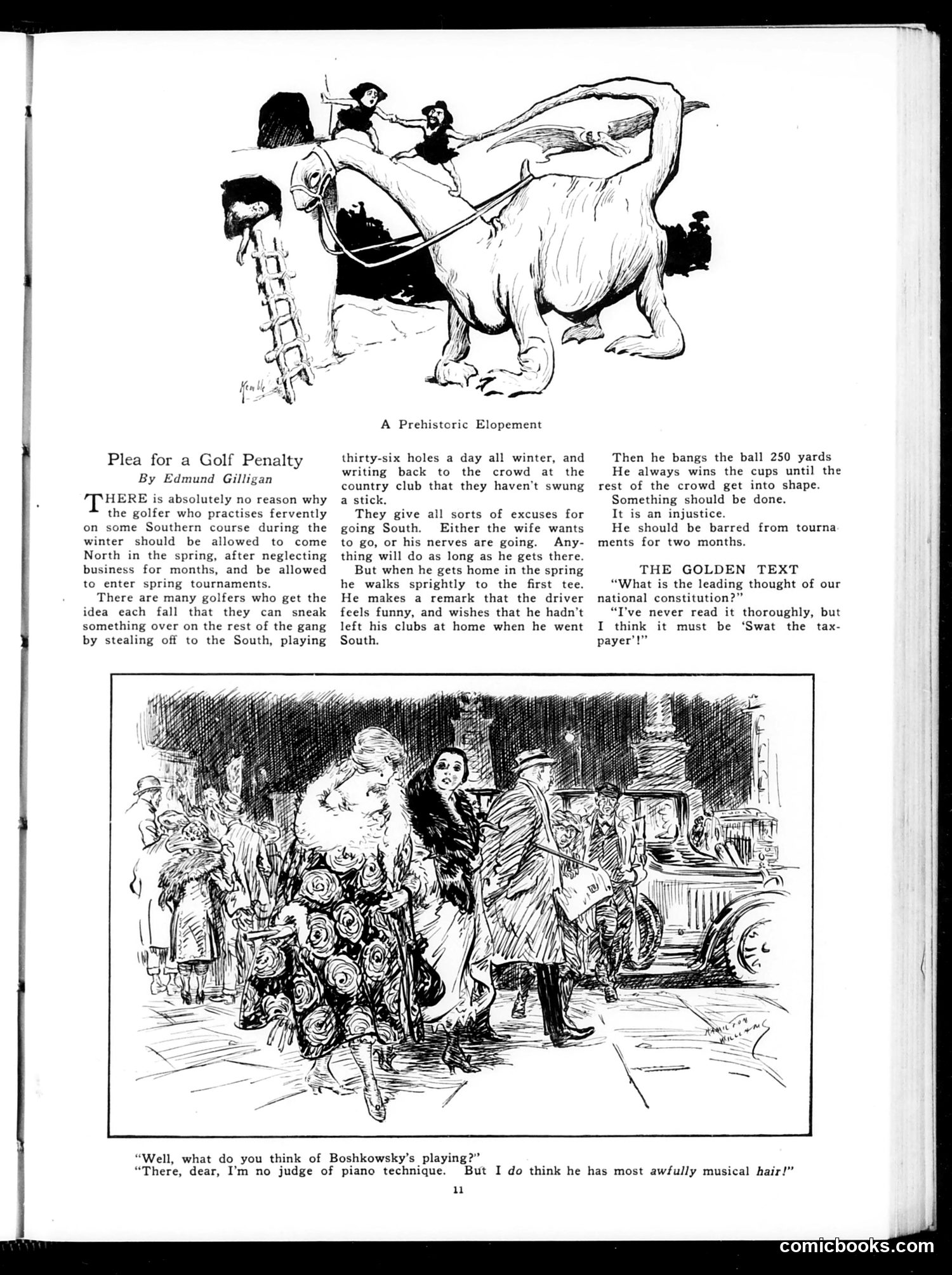
**Top Cartoon ("A Prehistoric Elopement"):** A humorous visual pun depicting an elephant as a "prehistoric" creature carrying away small human figures (suggesting an elopement/abduction). The joke plays on the visual absurdity of the enormous animal and the word "elopement" applied to it. **Middle Article ("Plea for a Golf Penalty"):** A satirical complaint about wealthy golfers who escape to Southern golf courses during winter, claiming business or health reasons, then return North in spring to dominate local tournaments—having practiced extensively while others worked. The author argues these golfers should be banned from competitions for two months as punishment for their deception and neglect of duties. **Bottom Cartoon:** A satire on superficial social commentary. When asked about a pianist's (Boshkowsky's) skill, a woman avoids genuine judgment, instead complimenting his "musical hair"—suggesting people often praise appearance or irrelevant qualities rather than offering honest artistic critique. **Context:** Early 20th-century Judge magazine satirized leisure-class behavior, tax avoidance, and social pretense.
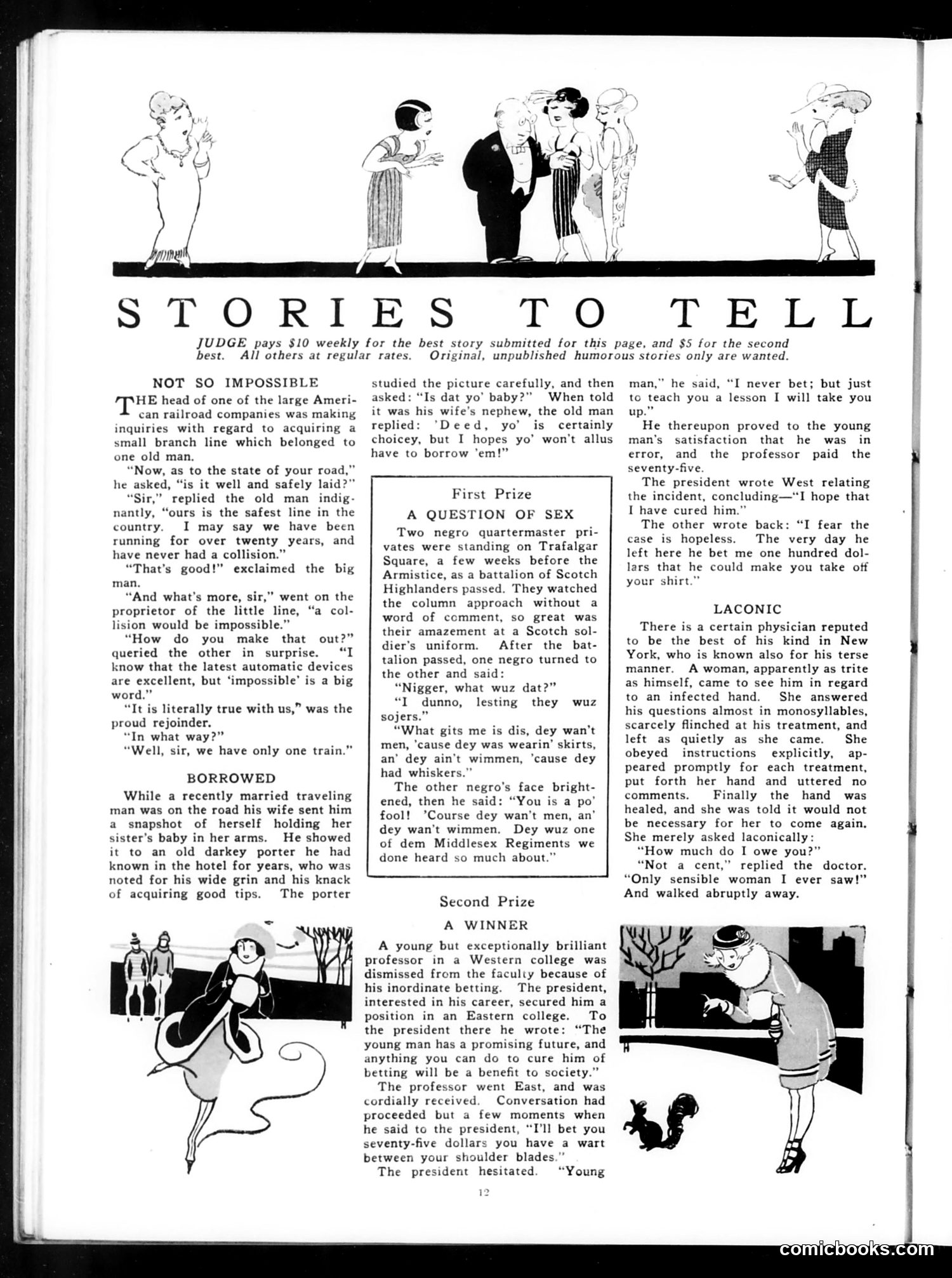
This is a "Stories to Tell" humor submission page from Judge magazine, offering cash prizes ($10 for first place) for humorous anecdotes. **The stories showcase period stereotypes:** 1. **"Not So Impossible"**: A railroad executive learns a small line's safety record is perfect because it operates only one train—clever wordplay humor. 2. **"Borrowed"**: Uses a racist caricature of a Black porter speaking in heavy dialect, making a joke about a man "borrowing" his wife's nephew (implying he and his wife aren't having their own children). 3. **"A Question of Sex"**: Uses racist caricatures of Black soldiers encountering Scottish Highlanders in kilts, with the punchline being confusion over whether the soldiers are men or women because of the skirts and beards. This relies on period minstrelsy-style dialect. 4. **"A Winner"**: A witty story about a compulsive gambler professor who bets a college president about a physical characteristic, then profits by exploiting the president's desire to "cure" him. The racial stereotypes and dialect humor reflect early-20th-century magazine conventions that modern readers would find offensive.
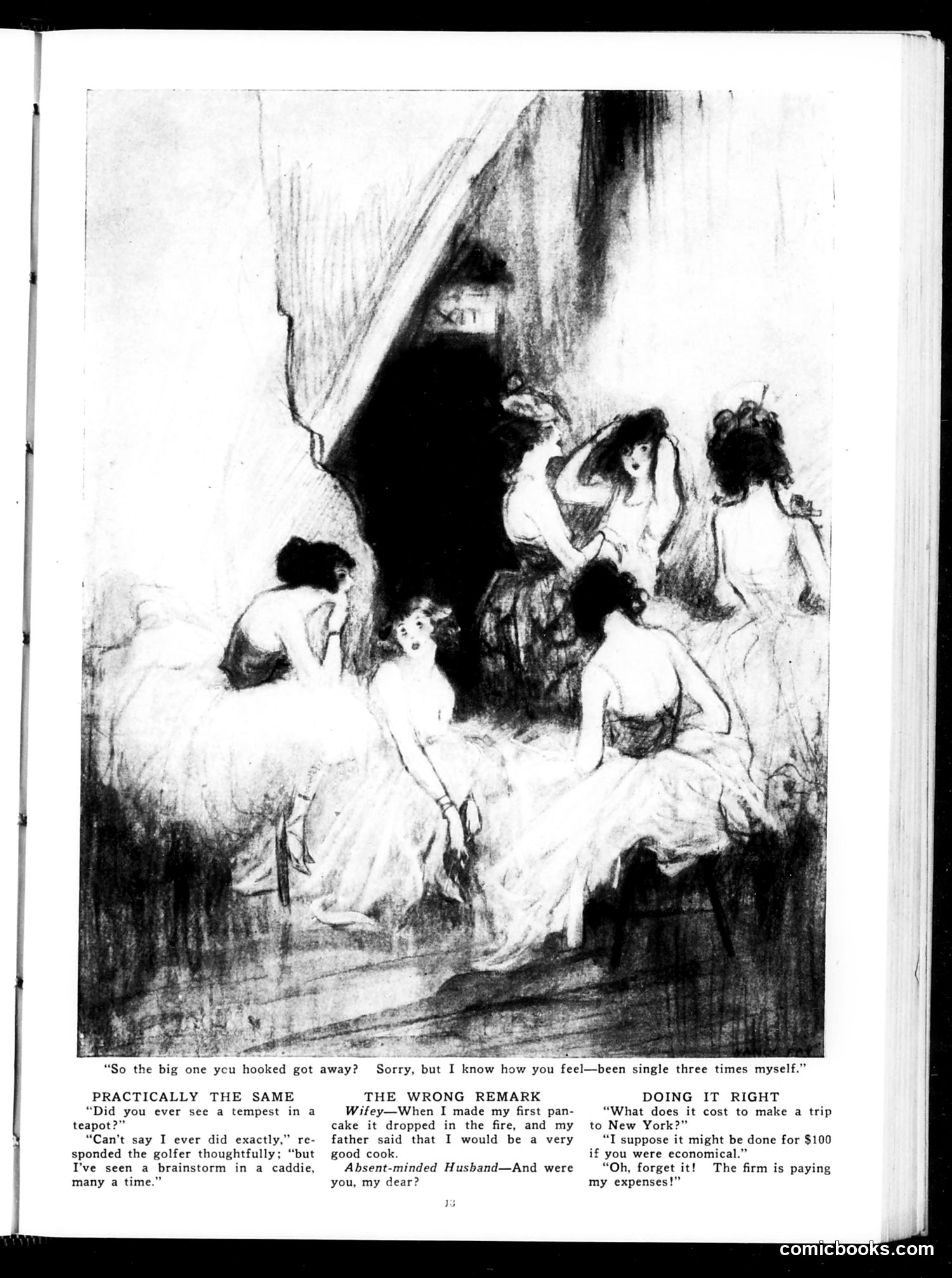
This page contains three brief humorous anecdotes typical of Judge's early 20th-century humor: 1. **"Practically the Same"**: A golfer joke about caddies having emotional outbursts—satirizing both golf culture and working-class servants' perceived volatility. 2. **"The Wrong Remark"**: An absent-minded husband tactlessly compares his wife's failed pancake to his father-in-law's encouraging comment. The humor lies in the husband missing the compliment's intent and inadvertently insulting his wife's cooking. 3. **"Doing It Right"**: A businessman's logic about economical travel—the joke being that he'll spend lavishly since his employer pays, mocking corporate expense account abuse. The illustration above depicts what appears to be a harem or theatrical scene with multiple women in classical dress and a turbaned figure, though its connection to the text below is unclear. These three-line jokes represent Judge's characteristic mild domestic and social satire aimed at middle-class American readers.
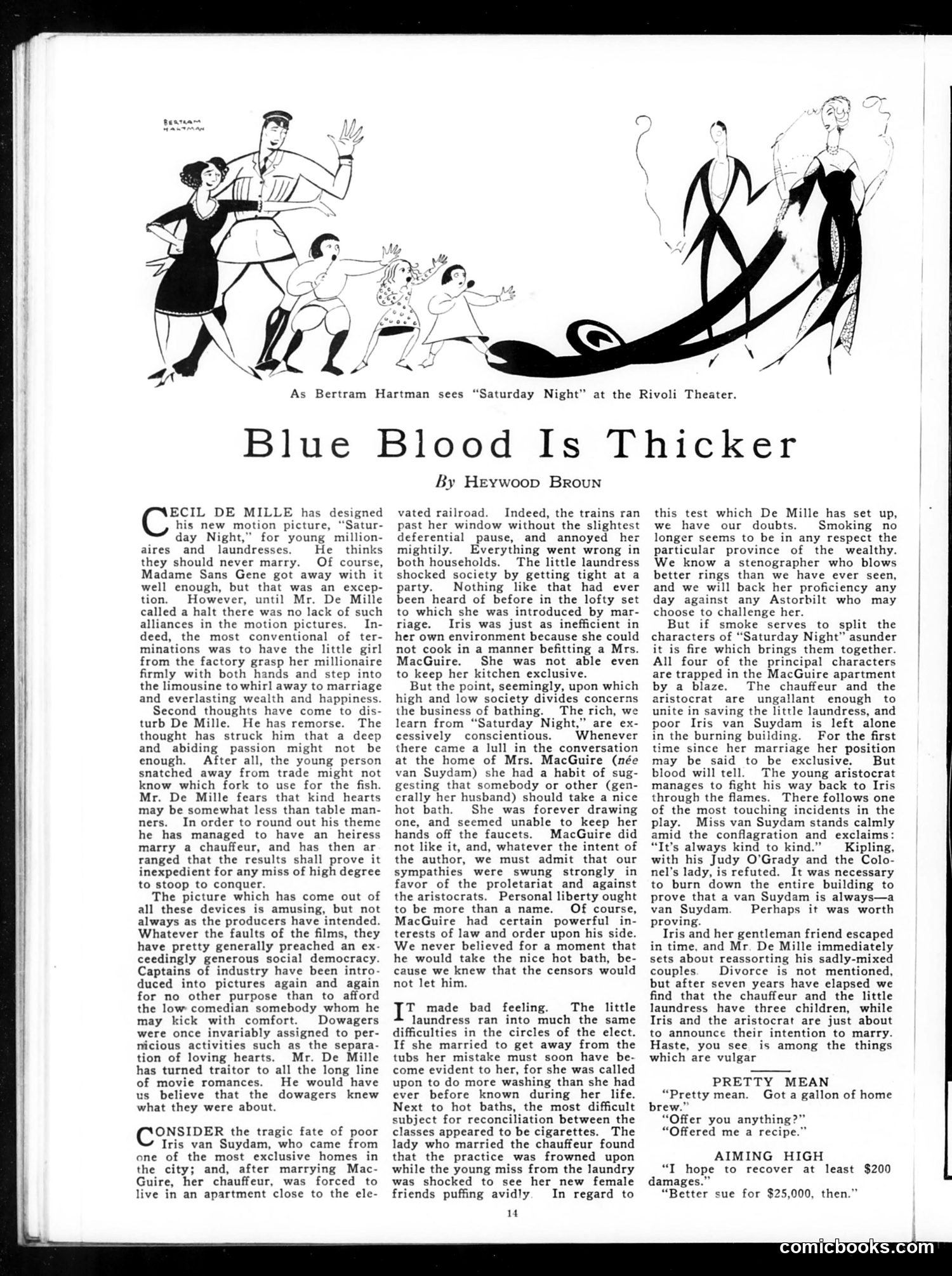
This is a film review-cum-social commentary by Heywood Broun on Cecil B. DeMille's "Saturday Night," showing at the Rivoli Theater. The cartoon illustrates the film's central class-conflict premise. **The satire's target:** DeMille's reversal of typical movie romance tropes. Traditionally, films celebrated cross-class love conquering social barriers. Here, DeMille argues the opposite—that an heiress (Iris van Suydam) and her chauffeur husband are fundamentally incompatible. **Broun's critique:** He finds DeMille's position reactionary and hypocritical. He mocks the film's suggestion that class differences are insurmountable, sarcastically noting the "aristocrats'" obsession with bathing and other trivial distinctions as proof of superiority. Broun champions the working-class perspective, suggesting the censors would prevent any genuine working-class rebellion. **The joke:** DeMille, who'd built his reputation on democratic sentiment, becomes a "traitor" by endorsing class hierarchy—a reversal Broun finds both amusing and troubling.
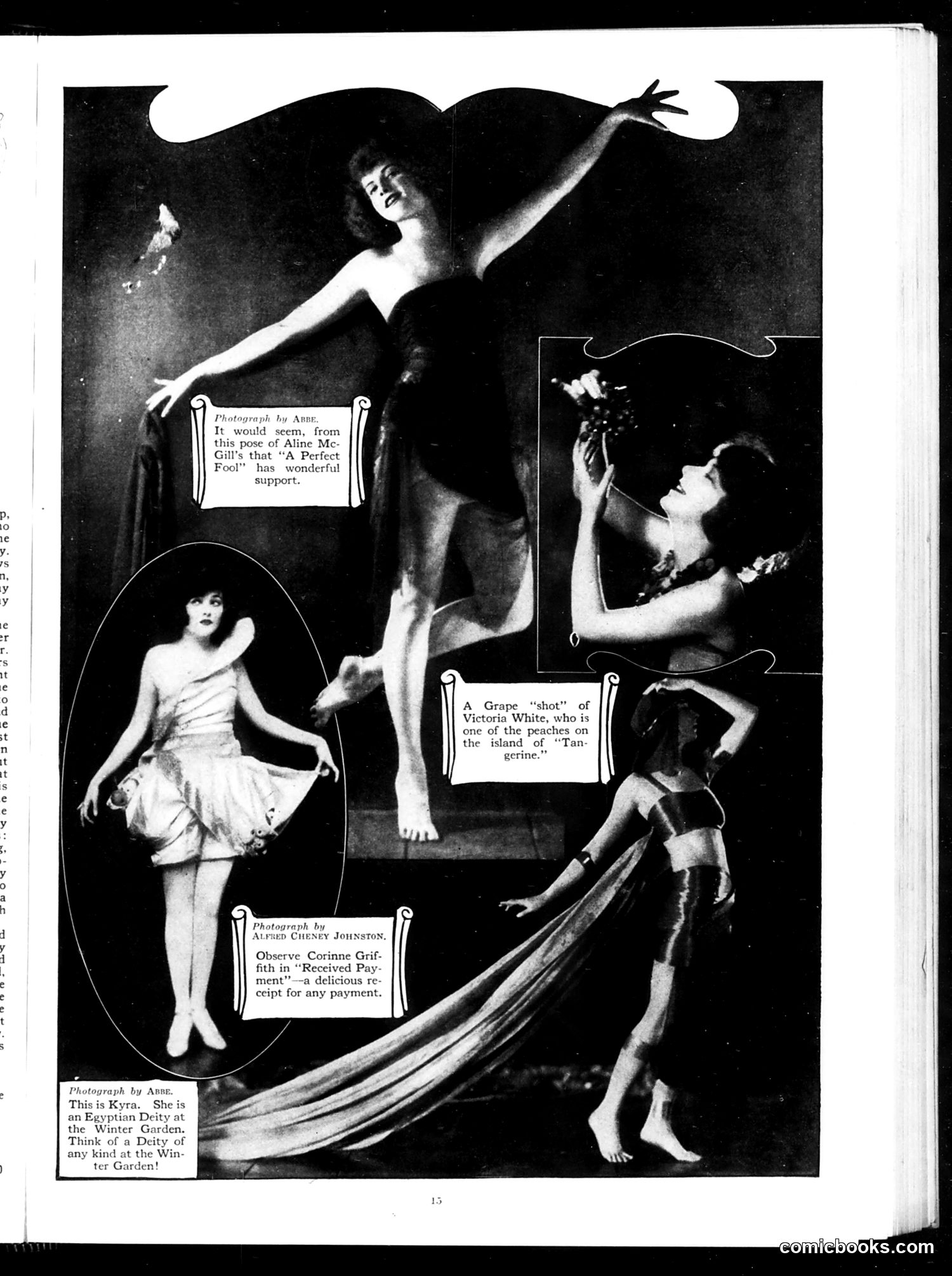
This page features theatrical publicity photographs with humorous captions satirizing Broadway productions and performers, circa 1920s. **The satire works through visual puns:** - **Aline McGill** in "A Perfect Fool" is photographed in an exaggerated pose; the caption jokes that the play has "wonderful support"—a double meaning referencing both the actress's physical pose and the production's backing. - **Victoria White** appears in "Tangerine," captioned as "one of the peaches"—a period slang term for attractive women. - **Corinne Griffith** in "Received Payment" is shown in a suggestive pose; the caption puns on "receipt" as both theatrical and physical "payment." The overall effect mocks both the melodramatic poses of theatrical promotion photos and the suggestive nature of 1920s entertainment marketing. The humor relies on double meanings—treating theatrical terms as innuendo—typical of Judge's risqué but not explicit satirical style.
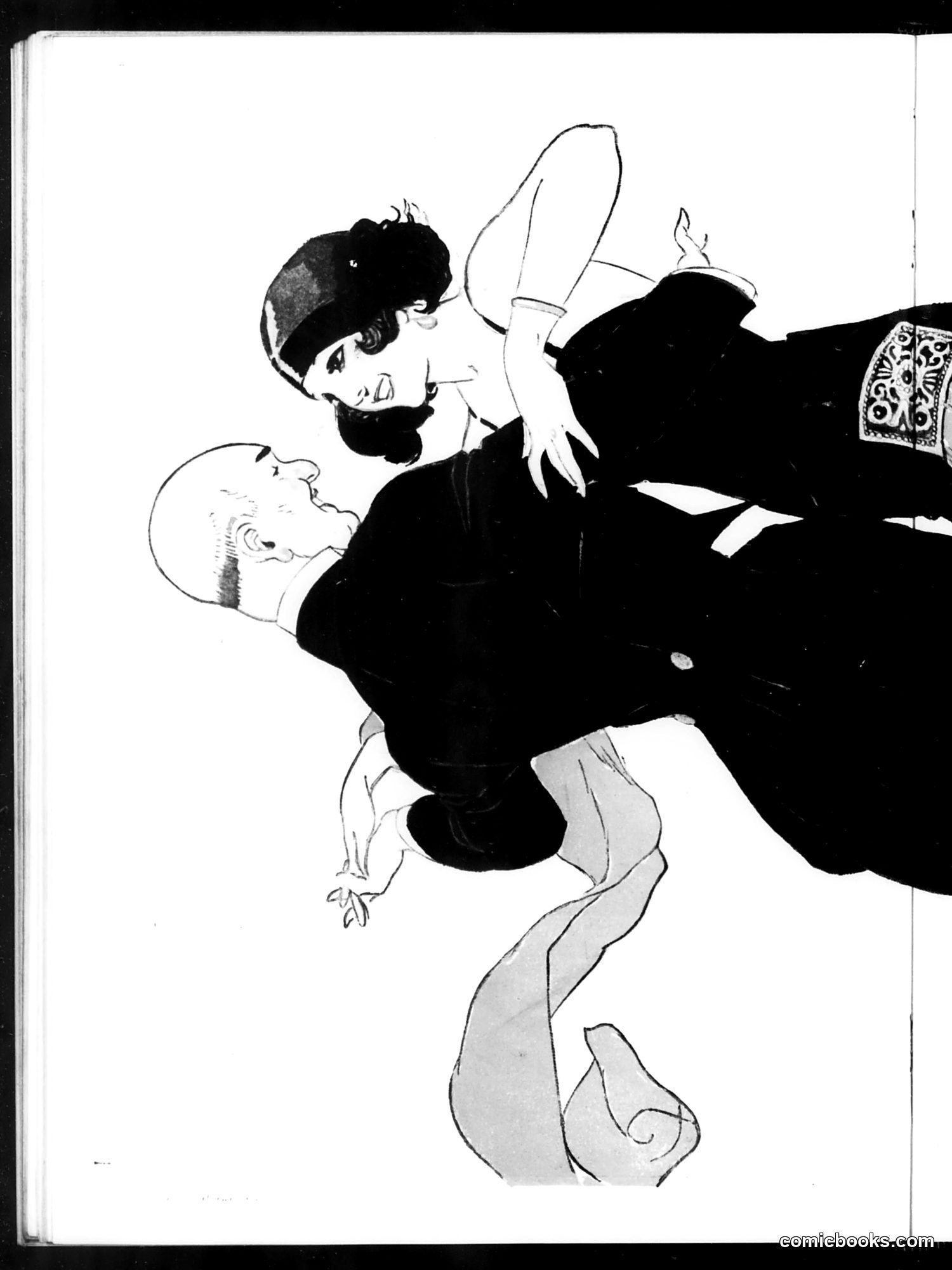
I can see this is a satirical illustration from Judge magazine showing two figures in an exaggerated, comedic pose. The image appears to depict a man in formal attire (dark suit) with an bald head being held or manipulated by a woman with dark hair and distinctive features behind him. The woman's arm is raised dramatically, and there's ornate detailing on her sleeve. However, without accompanying OCR text that's legible or additional context about the publication date, I cannot definitively identify who these figures represent or what specific political or social commentary this cartoon is making. The style and composition suggest social satire typical of Judge magazine's approach, but I cannot accurately explain the particular reference or joke to a modern reader without more certain information about the identities and historical context involved.
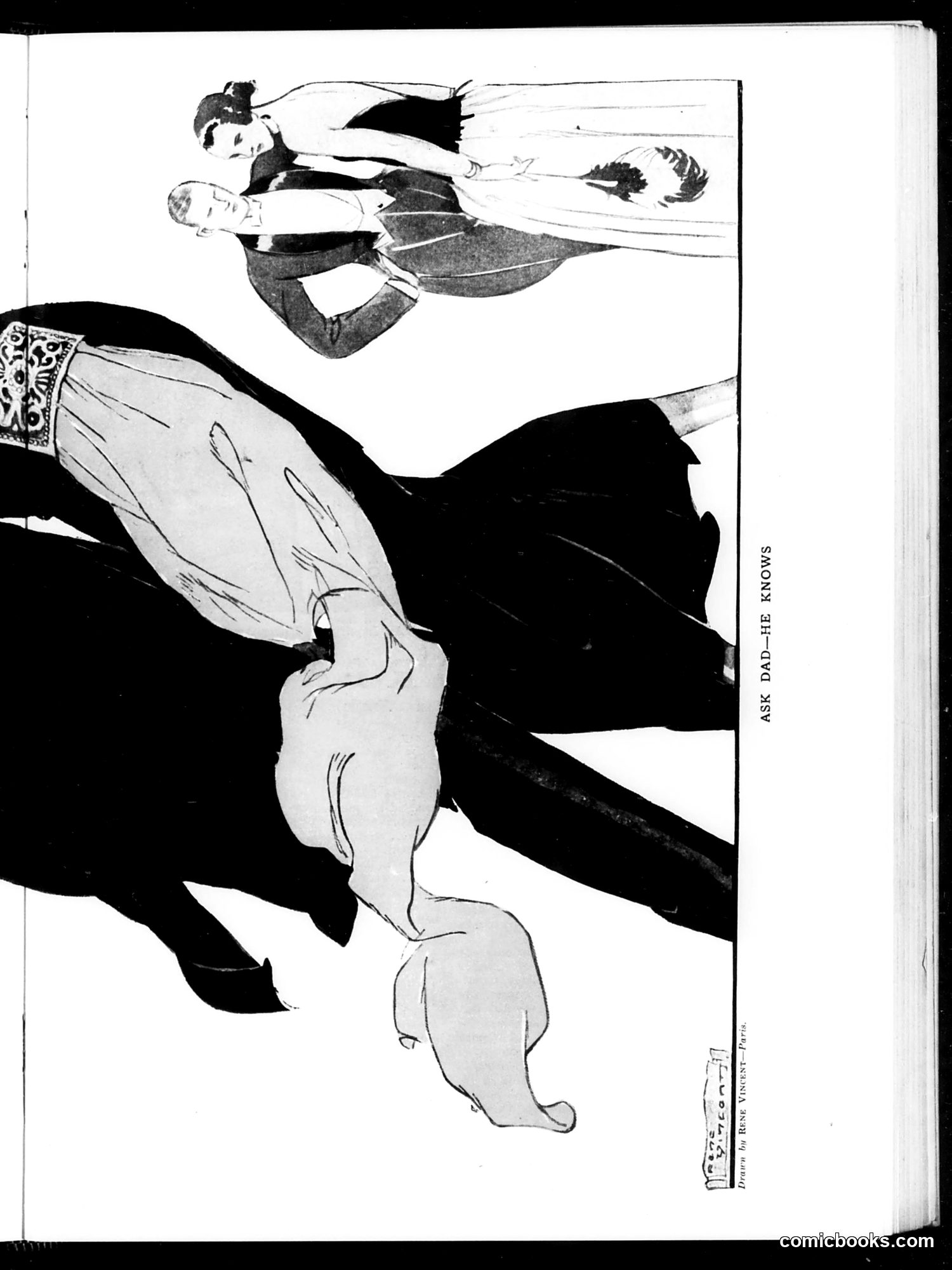
This appears to be a satirical illustration from *Judge* magazine featuring two figures in an intimate or compromising position. The caption reads "ASK DAD—HE KNOWS," suggesting the cartoon is making a joke about asking a father figure for advice or knowledge about romantic/sexual matters. The style and composition suggest this is social satire, likely mocking either: - Parental authority and the awkwardness of sex education discussions - A specific public figure (the caricatured appearance of the "dad" figure might reference someone recognizable to contemporary readers) - Changing social attitudes about discussing intimate topics Without clearer identification of the specific figures or publication date, the precise political or social target remains unclear, though the humor relies on the discomfort of the subject matter.
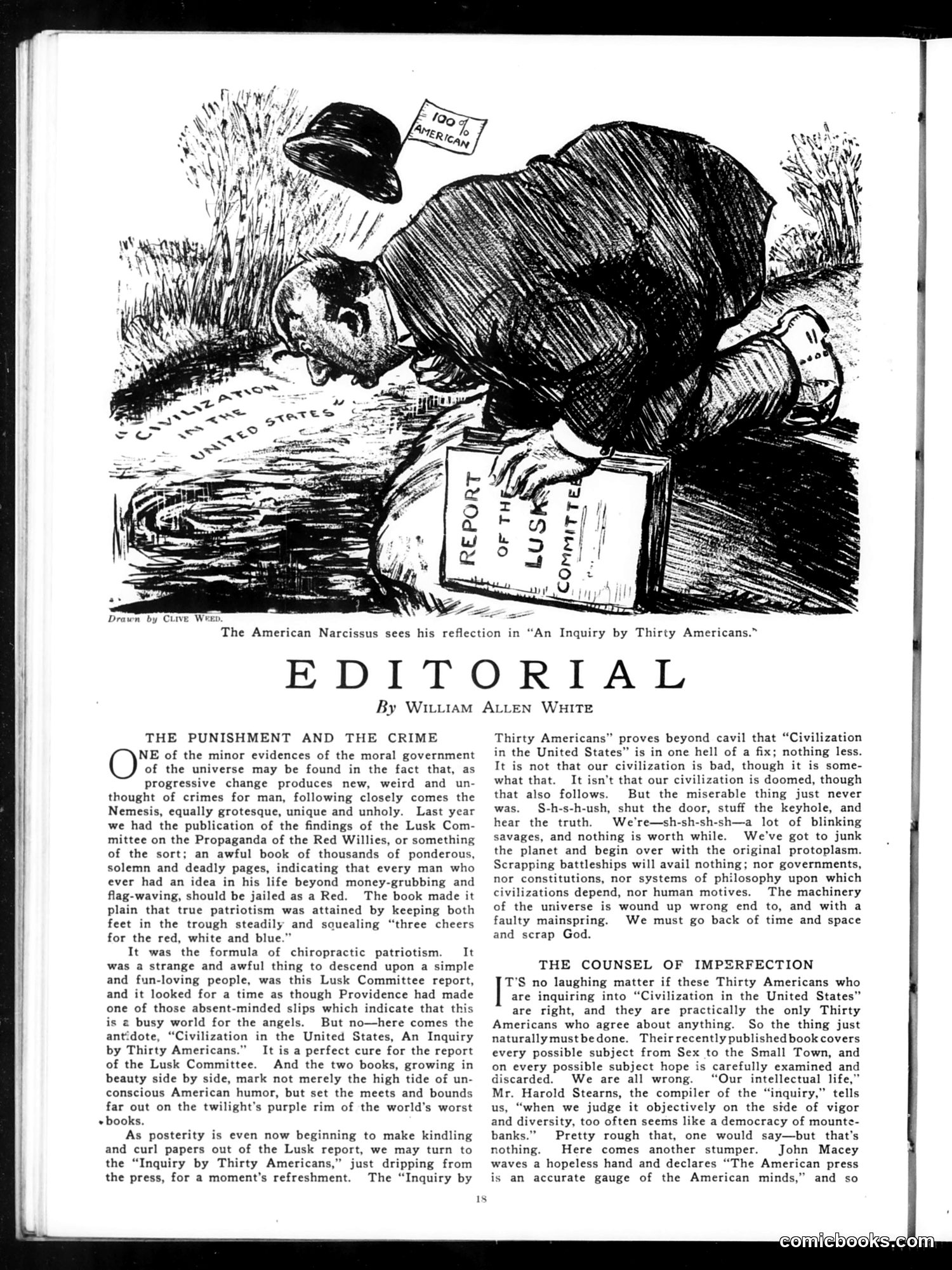
This editorial by William Allen White satirizes two competing books that represent opposite extremes of American self-criticism. The cartoon depicts "American Narcissus" gazing at his reflection in "An Inquiry by Thirty Americans"—a 1922 collection of essays by intellectuals (compiled by Harold Stearns) that declared American civilization fundamentally broken. White argues both books are absurd: the previous year's Lusk Committee report (a Red Scare document attacking radicals) demanded blind patriotism, while the "Inquiry" swings to the opposite extreme, claiming American civilization itself is irredeemable—that even God and the universe are "wound up wrong." White mocks this intellectual pessimism as self-indulgent narcissism. The "Thirty Americans" examining themselves in their own mirror represents the self-absorbed, doom-saying intelligentsia of the Jazz Age, offering counsel of "imperfection"—destructive criticism without solutions. The satire targets both McCarthyite conformity and intellectual defeatism.
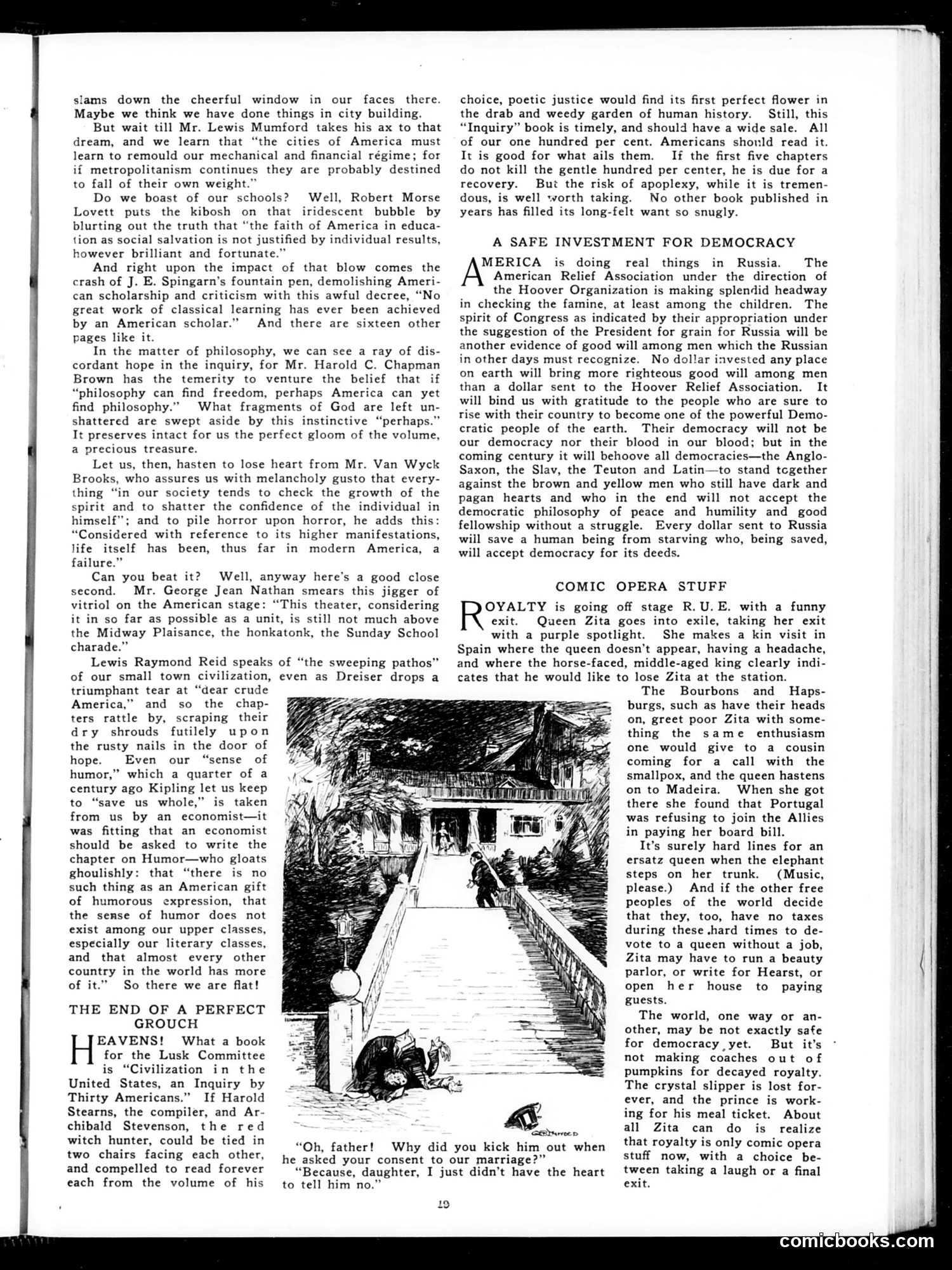
This page satirizes "Civilization in the United States, an Inquiry by Thirty Americans"—a 1922 collection edited by Harold Stearns featuring prominent intellectuals. The cartoon attacks the book's relentlessly pessimistic critique of American culture. The satire quotes contributors (Lewis Mumford on cities, Robert Morse Lovett on education, J.E. Spingarn on scholarship, Van Wyck Brooks on American spirit, George Jean Nathan on theater) systematizing their condemnations into a depressing catalog of national failure. Judge ridicules this "perfect grouch"—the book's comprehensive bleakness. The cartoon below, titled "Comic Opera Stuff," depicts Queen Zita of Austria-Hungary in comic exile, mocking European royalty's pretensions during turbulent postwar politics. Judge's stance: while the book deserves reading as timely critique, its relentless pessimism is exaggerated—even dangerous for vulnerable readers ("gentle hundred per center"). The magazine suggests destructive negativity packaged as intellectual authority.
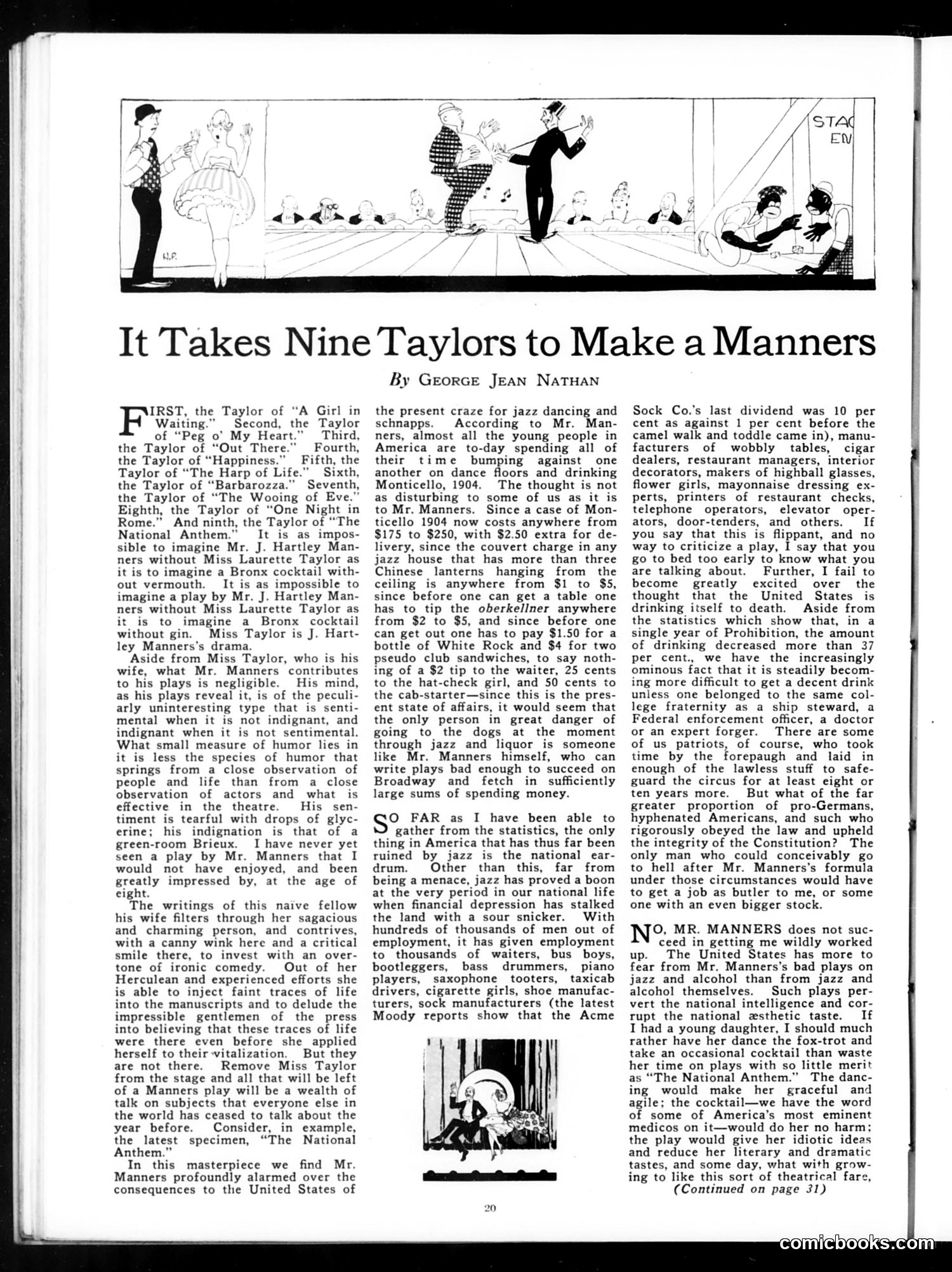
This is a satirical theater review by George Jean Nathan attacking playwright J. Hartley Manners and his wife, actress Laurette Taylor. The cartoon at top depicts a Broadway stage scene. Nathan's core argument: Manners is a mediocre writer whose plays only succeed because Taylor performs in them brilliantly. He lists nine Taylor roles, suggesting she carries every production. Nathan describes Manners as sentimental and indignant in predictable ways—plays he found entertaining at age eight. The satire intensifies when Nathan critiques Manners' latest play, *The National Anthem*, which condemns jazz dancing and drinking as moral threats to America. Nathan sarcastically argues that jazz venues are actually *expensive* (costing $175+ bottles of wine, cover charges, tips), making them accessible only to the wealthy—like Manners himself, who profits from Broadway. The joke: Manners profits from the very system he morally condemns, making his outrage hypocritical and self-serving.
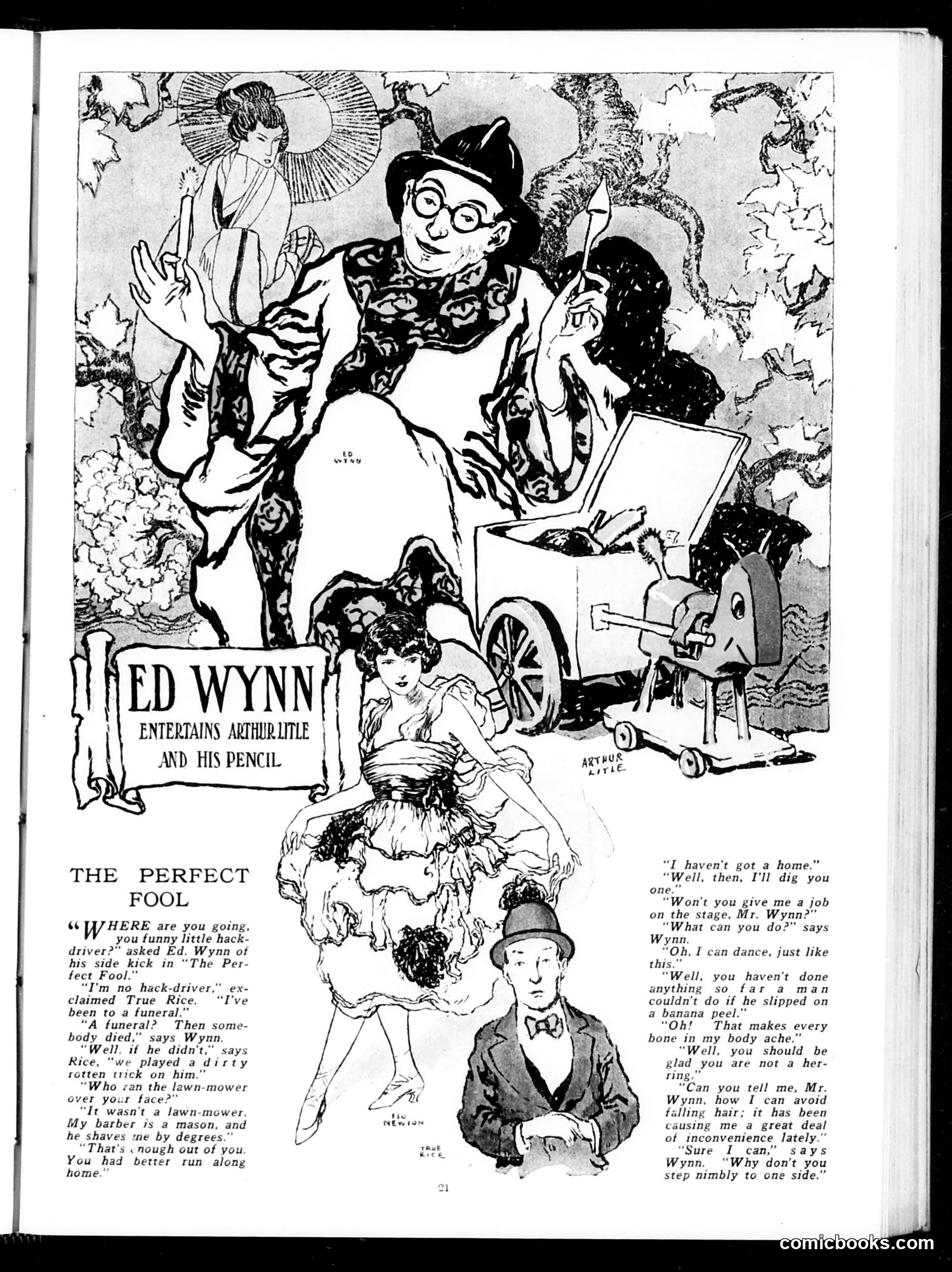
This page promotes Ed Wynn's theatrical production *The Perfect Fool*, featuring Wynn (the famous vaudeville comedian, identifiable by his distinctive glasses and hat in the illustration) entertaining Arthur Little, who appears to be a character or collaborator. The content showcases Wynn's comedy style through a series of rapid-fire joke exchanges with a "side kick" character (True Rice). These are classic vaudeville humor: pun-heavy one-liners and absurdist non-sequiturs about being a hack-driver, funerals, lawn-mowers, barber mishaps, stage jobs, and hair loss. The satire lies in the *concept* of "the perfect fool"—Wynn plays a character who delivers jokes that rely on childish logic and willful misunderstandings, turning mundane complaints into ridiculous punchlines. This mocking of earnest requests through absurdist responses was Wynn's trademark comedic approach. The illustration emphasizes his theatrical costume and animated gestures, advertising his vaudeville performance style to Judge's readers.
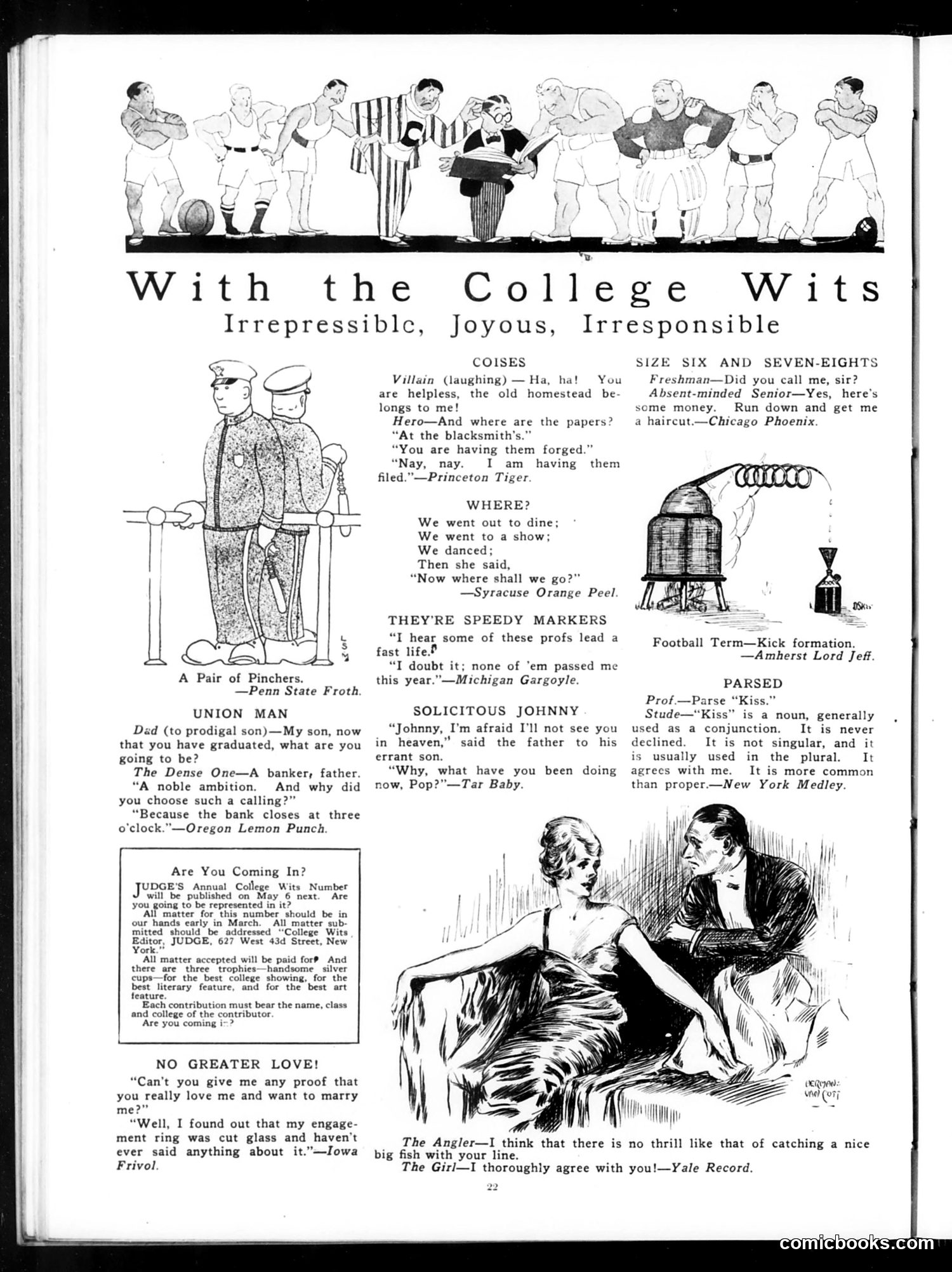
This is a humor compilation page from Judge's college-themed issue, collecting jokes submitted by students from various universities (identified by their campus publications like *Princeton Tiger*, *Michigan Gargoyle*, *Yale Record*). The satire targets college life stereotypes: absent-minded senior professors, students choosing careers for lazy reasons (banking because "it closes at three"), and the performative nature of collegiate romance. One joke mocks engagement ring deception; another satirizes professors' grading leniency. The page header illustration shows college types—athletes, sailors, flappers—representing stereotypical student body diversity of the era. The smaller illustrations (pinchers, the couple) are generic visual gags accompanying jokes. The "Are You Coming In?" box promotes Judge's upcoming college issue, soliciting submissions for three trophy categories. The humor reflects early 20th-century college culture anxieties: work ethic, propriety, and academic standards—filtered through the irreverent lens of student publications competing for wit.
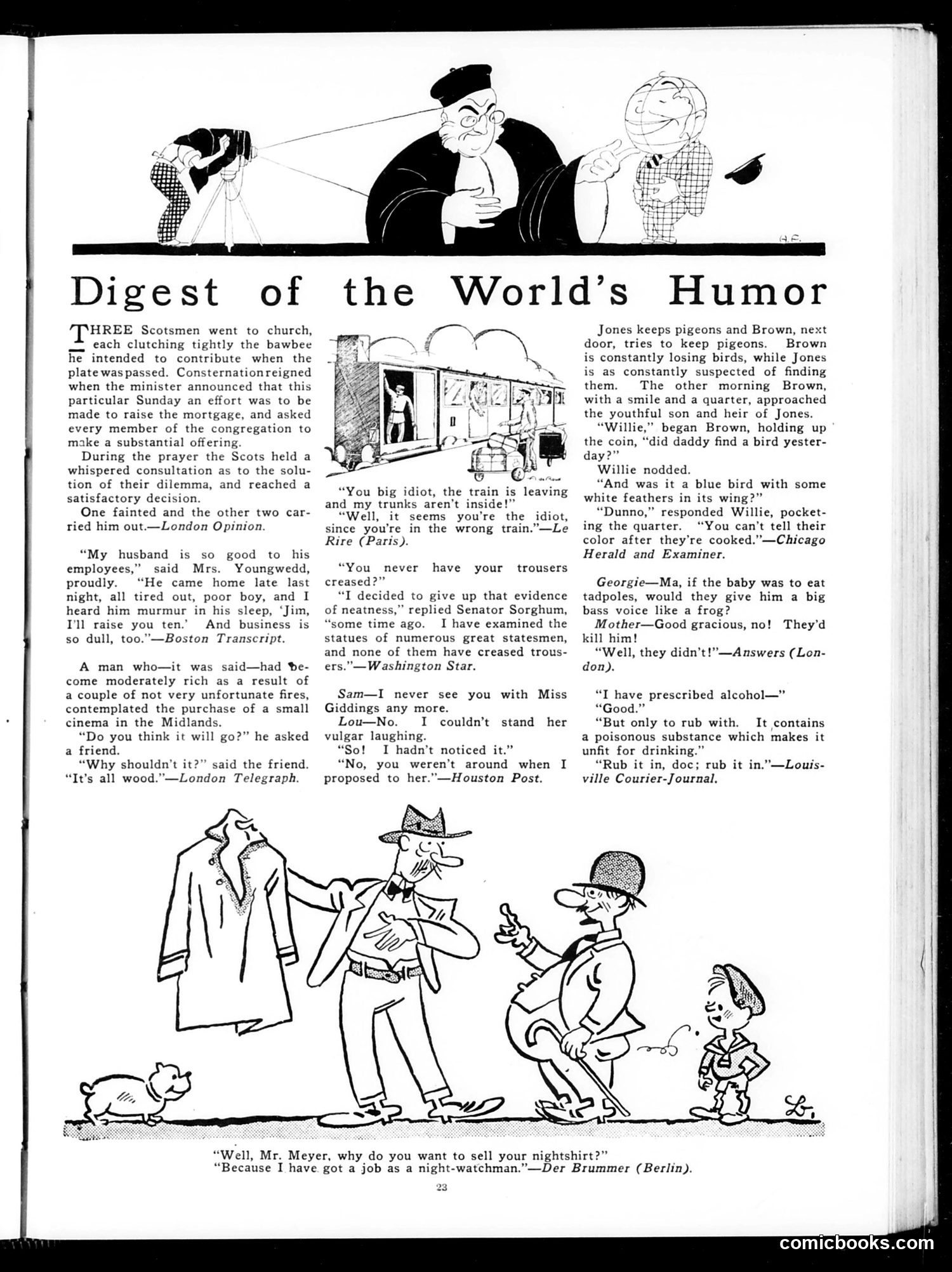
This page collects brief humorous anecdotes from international sources, reflecting early 20th-century satirical sensibilities. The jokes target: **Scottish frugality**: Three Scotsmen fake a fainting spell to avoid contributing substantially to church fundraising—stereotyping Scots as miserly. **Employer exploitation**: A wife misinterprets her husband's sleep-talking ("I'll raise you ten") as generosity toward an employee, when he's actually gambling or negotiating ruthlessly. **Insurance fraud**: A man wealthy from suspicious fires considers buying a wooden cinema—darkly implying arson for profit. **Class/social commentary**: A senator abandons creased trousers after studying statues of great statesmen, mocking pretentious politicians. A child's matter-of-fact response about cooking stolen pigeons satirizes rural/working-class morality. **Comic misunderstandings**: Various jokes about proposals, luggage mixups, and medical advice play on verbal confusion. The cartoons' humor depends on period stereotypes about nationality, class, and gender now considered offensive.
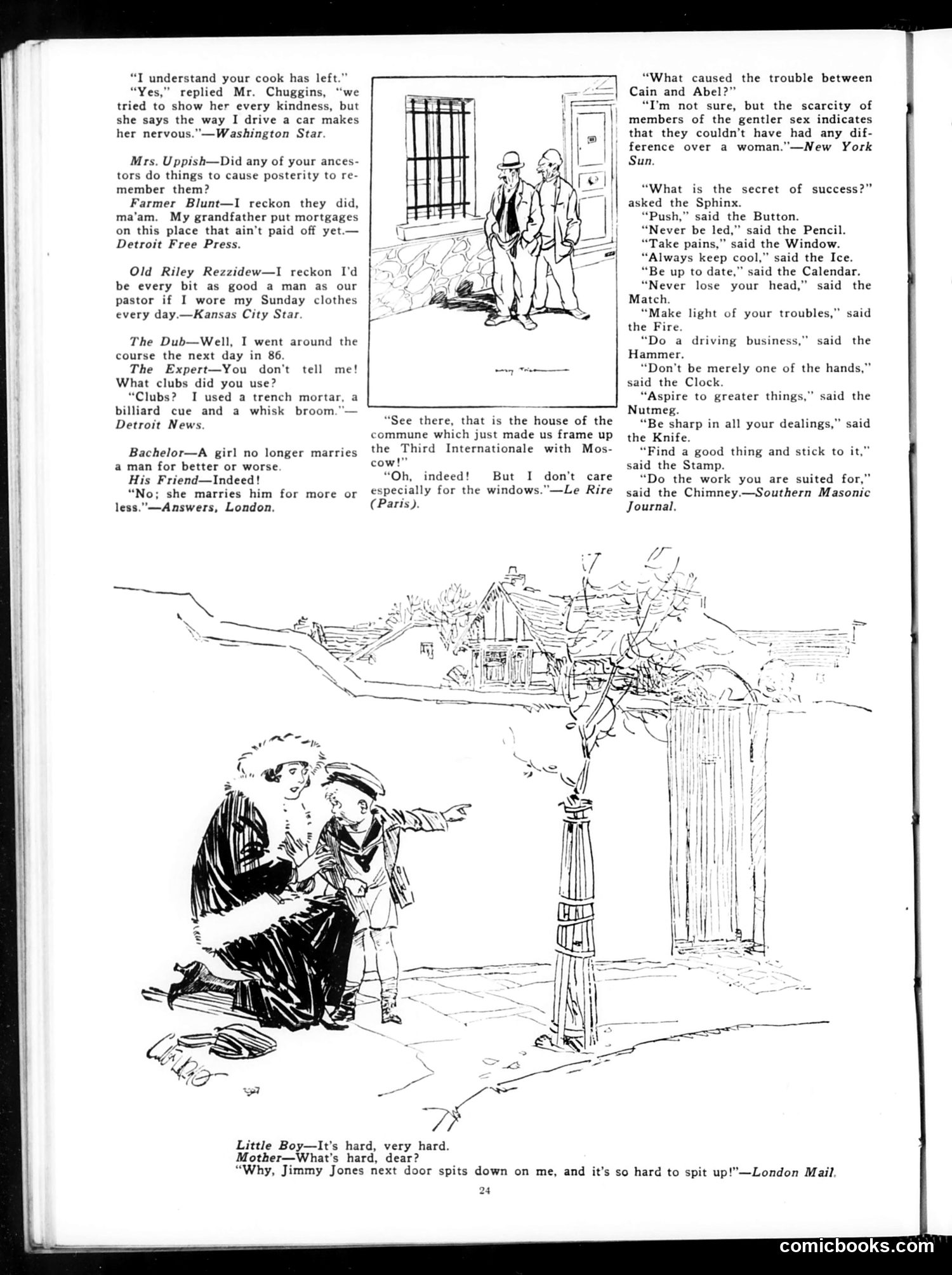
This page contains short humorous anecdotes and jokes typical of early 20th-century American satirical magazines, rather than political cartoons. The content includes: **Social satire:** A joke about a servant leaving because her employer's reckless driving makes her nervous—mocking the nouveau riche showing off automobiles. **Class humor:** "Mrs. Uppish" asking about ancestors, with a farmer's deadpan response about leaving unpaid mortgages—satirizing both social pretension and rural debt. **The "Sphinx" section:** Personified objects offering advice on success (a Button says "Push," a Pencil says "Never be led")—lighthearted wordplay rather than serious commentary. **International reference:** A Paris cartoon about the "Third Internationale with Moscow" and windows—likely referencing post-WWI communist concerns, though the joke's full context is unclear. The page reflects Judge's typical mix of domestic humor, social commentary on American life, and international observations, presented through brief, pun-laden jokes rather than visual satire.
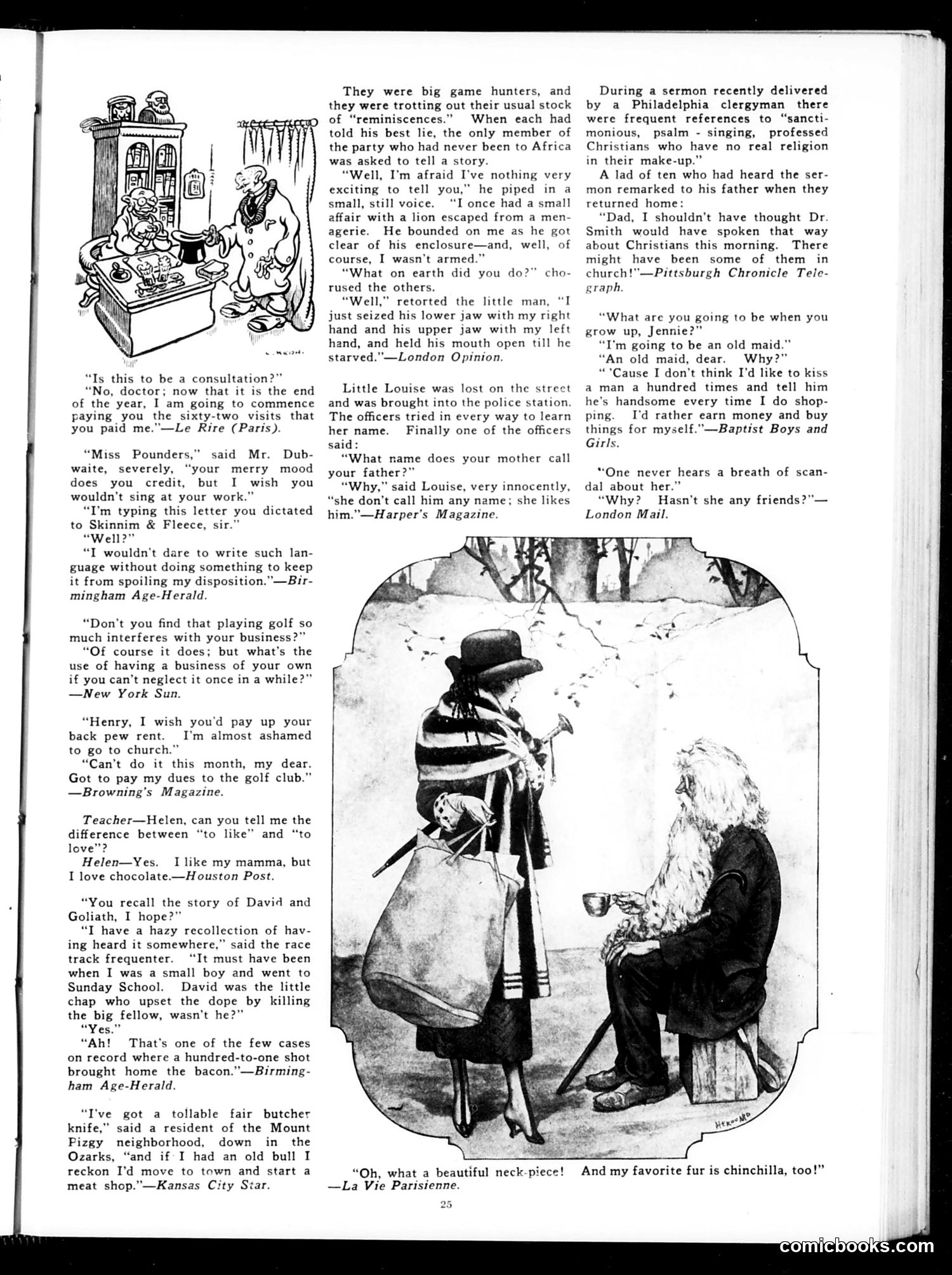
This page collects brief satirical anecdotes from various newspapers, typical of Judge's format. Key targets include: **Social Pretension & Materialism**: Multiple jokes mock the wealthy—a doctor demanding payment after being stiffed, a man neglecting church pew rent for golf club dues, and businessmen prioritizing leisure over responsibility. **Gender Satire**: A young girl's declaration that she won't marry because kissing a man repeatedly while shopping is tiresome, but earning her own money appeals to her—mocking both courtship conventions and emerging female independence. **Male Vanity**: Big game hunters one-upping each other with tall tales, only to be outdone by an unexpected modest listener's outlandish claim (holding a lion's jaws open until it starved)—satirizing masculine boasting. **Hypocrisy**: A child innocently exposes clerical duplicity by noting the preacher shouldn't criticize "Christians" if some are in his congregation. The illustration shows a woman displaying furs, likely satirizing vanity and conspicuous consumption.
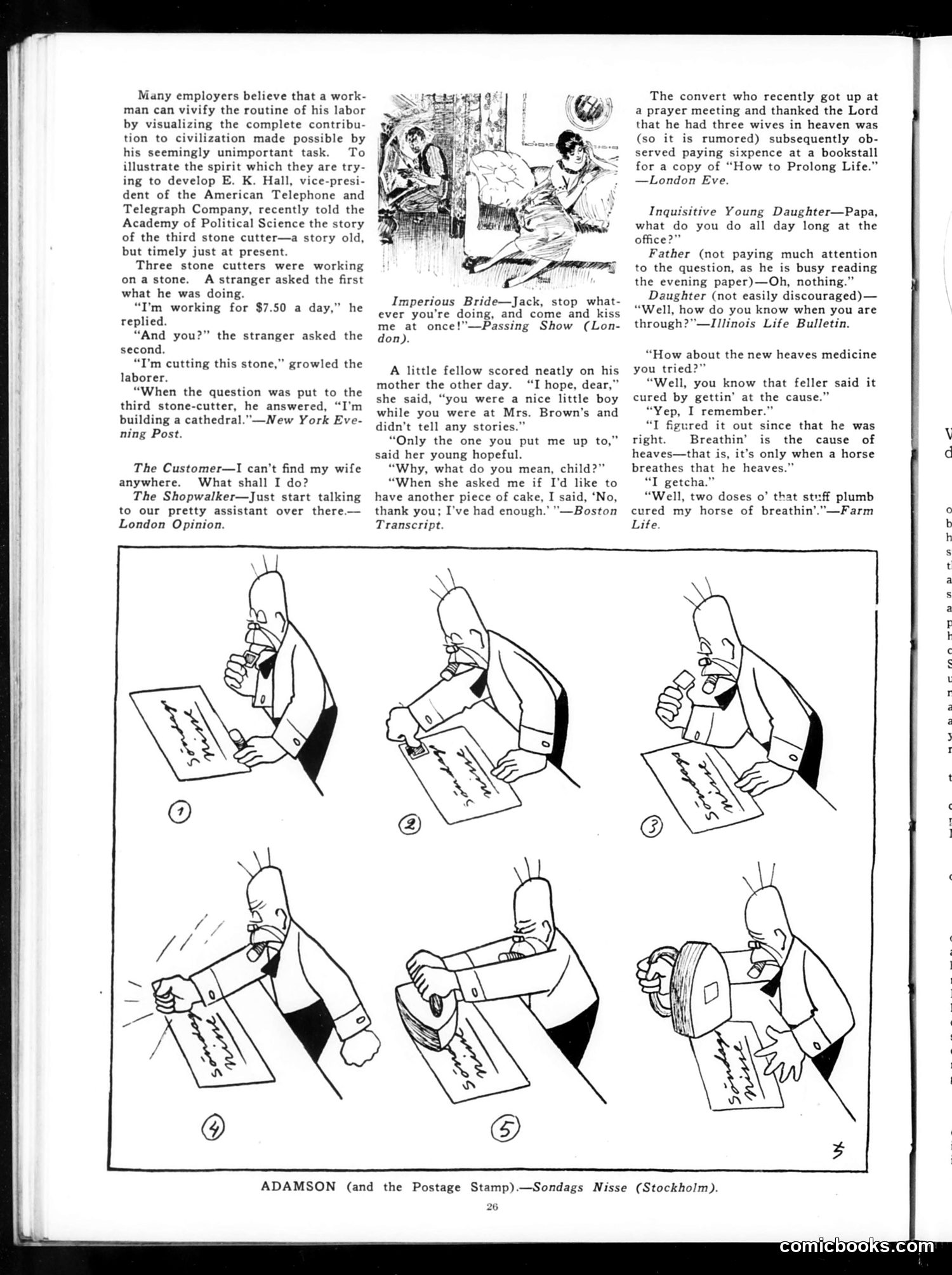
This page from *Judge* magazine contains miscellaneous humorous anecdotes and one comic strip. The main cartoon, "Adamson (and the Postage Stamp)" by Sondags Nisse, depicts a six-panel sequence showing a man progressively destroying or defacing a postage stamp while handling correspondence—apparently illustrating frustration with postal procedures or stamps themselves. The surrounding text presents brief jokes on various topics: workers' motivation (citing AT&T executive E.K. Hall's "cathedral builder" parable about finding meaning in labor), marital dynamics, children's honesty, and folk remedies. One anecdote jokes darkly about a convert with multiple wives seeking life-extension advice. The overall tone reflects early 20th-century middle-class anxieties about work, family, and social pretension. The specific reference to Adamson and postage stamps remains unclear without additional context about contemporary postal issues or a known figure named Adamson.
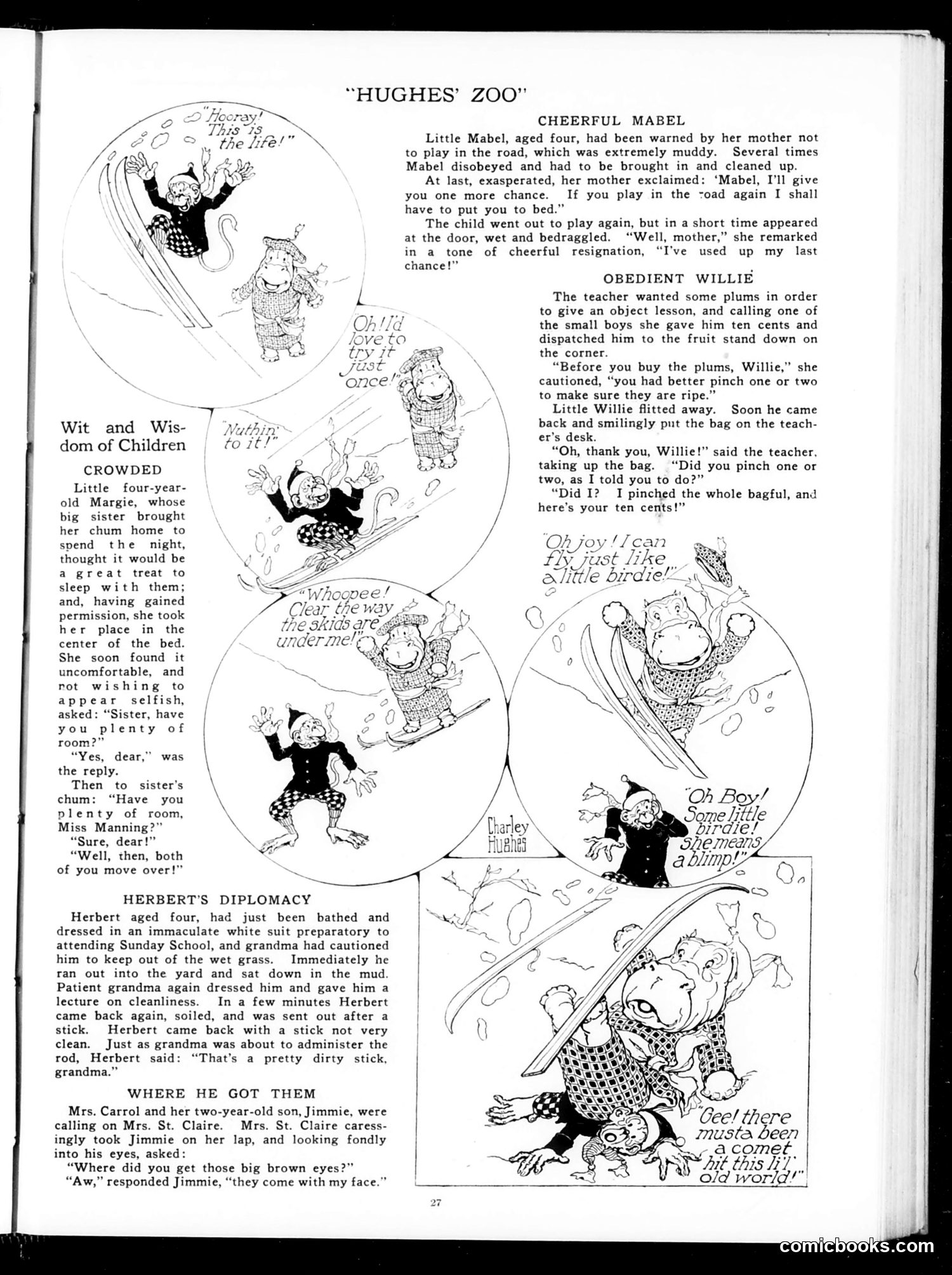
This page from *Judge* magazine contains humorous anecdotes about children's innocent logic and candid remarks—a popular early-20th-century format showcasing "wit and wisdom of children." The stories illustrate children's literal interpretation of adult instructions: Mabel cheerfully accepts punishment after "using up her last chance"; Willie dutifully pinches every plum (not just one or two) to test ripeness; young Jimmie matter-of-factly explains his brown eyes "come with my face"; and little Margie, taking her bedmates at their word about having room, asks *them* to move over. The accompanying illustrations by Harley Hildebrand depict these scenarios with exaggerated expressions and body language typical of early comics. The "Hughes' Zoo" title likely refers to the collection of child characters (the "animals" in this metaphorical zoo), treating their unfiltered perspectives as entertaining specimens of human nature. The humor derives from children's logical but socially awkward responses—they expose adult hypocrisy or imprecision through innocent compliance.
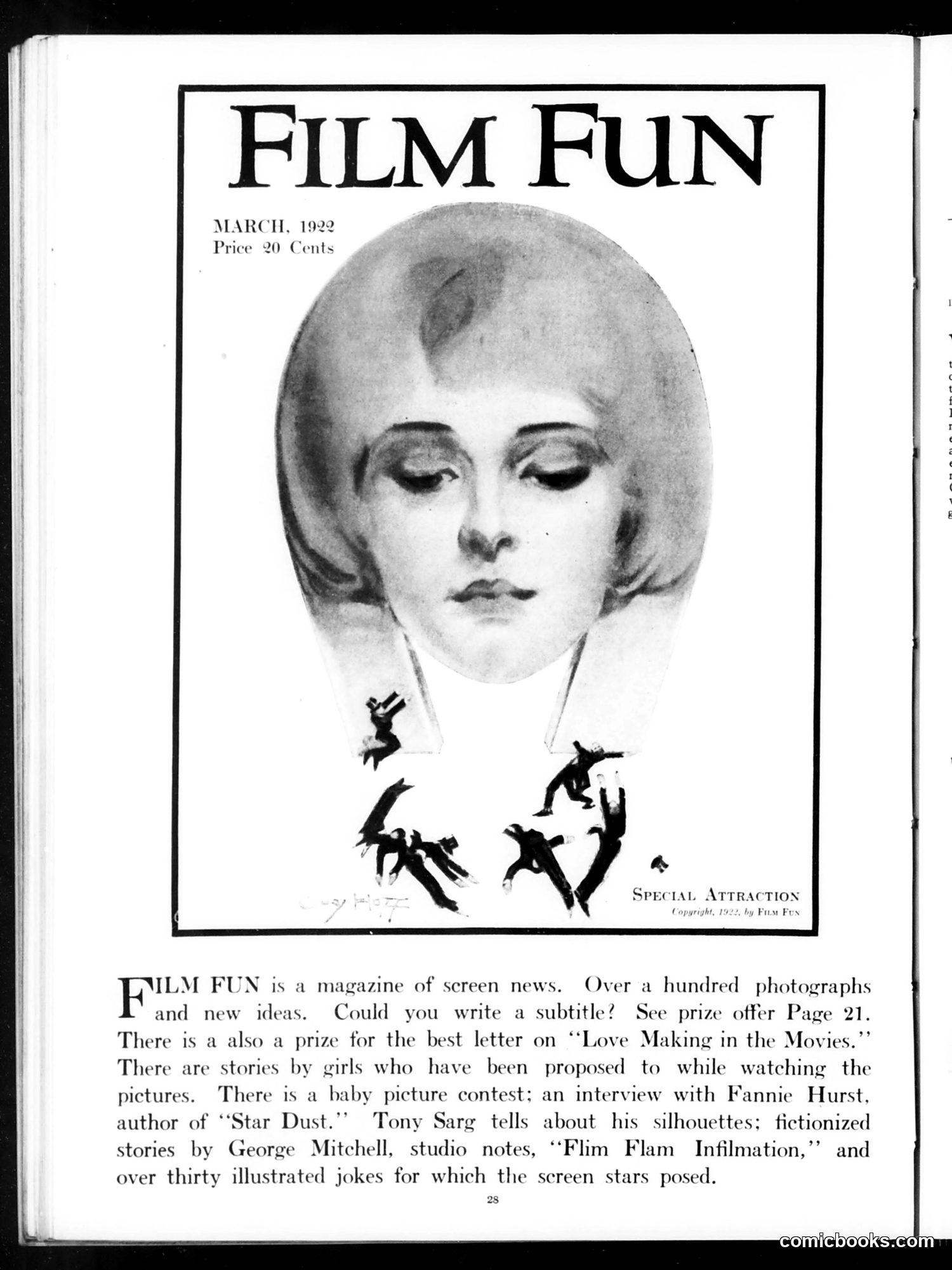
This is a **title page and advertisement** for "Film Fun," a magazine of cinema news and photographs priced at 20 cents. The cover features a stylized portrait of a woman with 1920s bob hairstyle and downcast eyes, with small silhouetted figures of what appear to be cherubs or dancing figures suspended from her ears. The accompanying text describes the magazine's contents: subtitle-writing contests, love-and-movies letters, baby picture contests, an interview with author Fannie Hurst ("Star Dust"), Tony Sarg's silhouettes, George Mitchell's stories, studio notes, and illustrated jokes featuring screen stars. This is primarily a **promotional page** rather than satirical content—it advertises the magazine's entertainment and fan-engagement features typical of 1920s cinema culture.
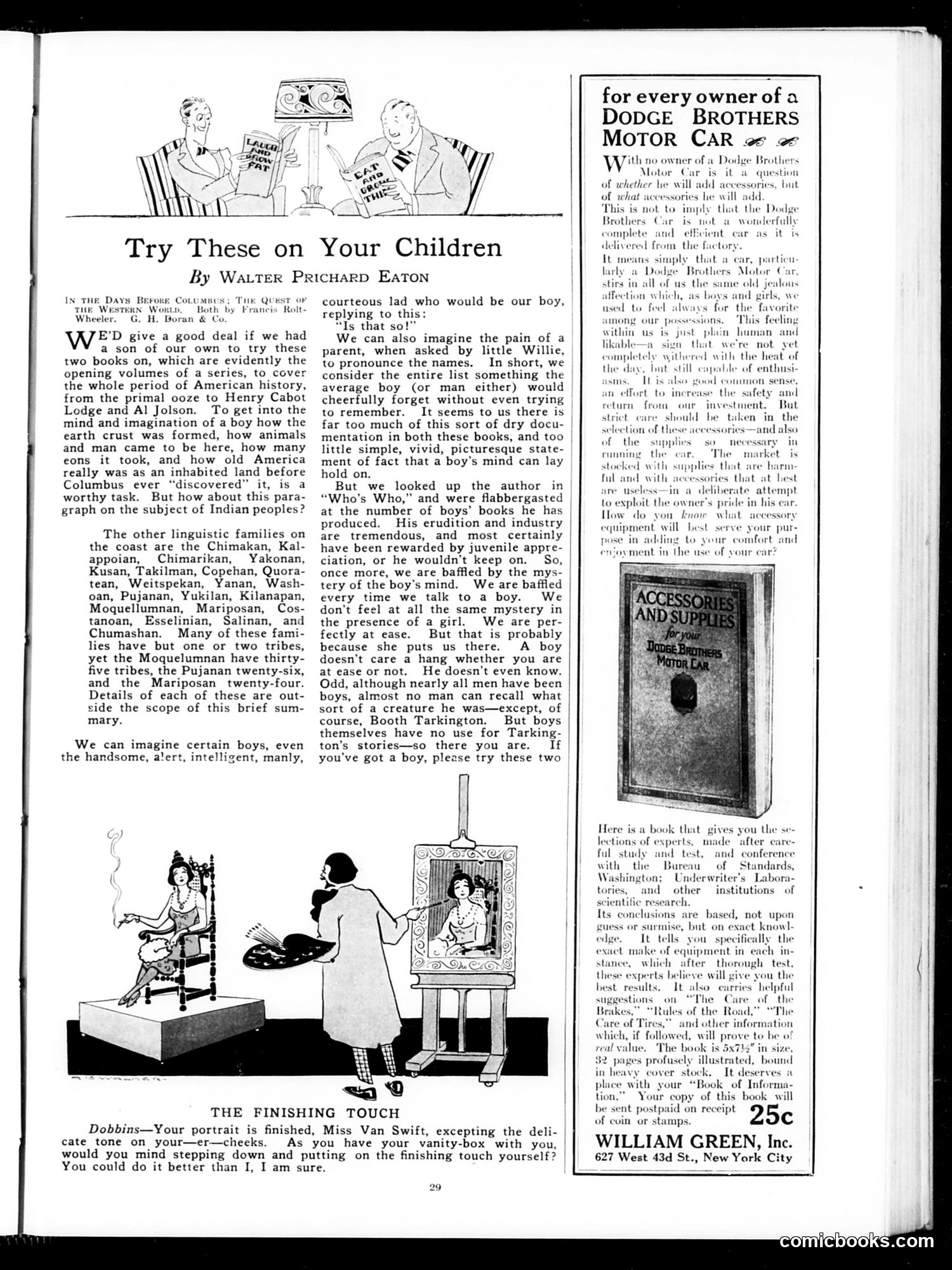
This page contains three distinct elements: **Main Article:** Walter Prichard Eaton reviews two children's history books. He praises their ambitious scope but satirizes their overly academic presentation—particularly a tedious catalog of Native American linguistic families. Eaton humorously imagines a boy's dismissive response ("Is that so!") and a parent's frustration trying to pronounce the names. He notes the paradox that boys' book authors enjoy success despite—or perhaps because of—content that bewilders adults. The article ends by admitting boys' psychology remains mysterious, even referencing Booth Tarkington as the rare adult who understands them. **Cartoon "The Finishing Touch":** A woman applies rouge to her cheeks while a portrait painter flatters her, suggesting she can apply makeup better than he can add the final artistic touches. The joke plays on vanity and makeup application. **Advertisement:** Dodge Brothers Motor Cars advertise customization options, targeting owners' desire to personalize their vehicles.
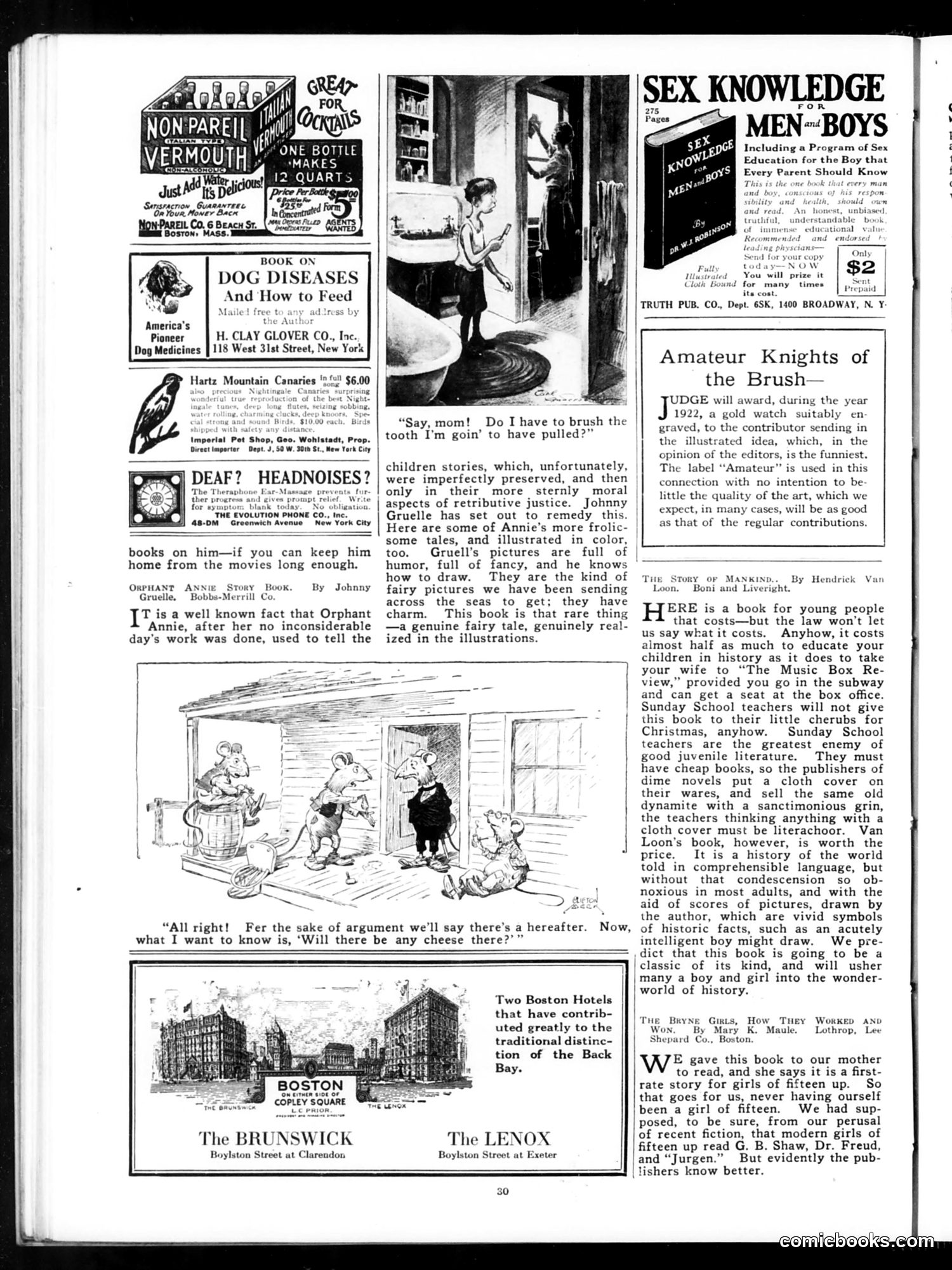
This page is primarily **advertising and book reviews** rather than political satire. The advertisements promote patent medicines, vermouth, and dog treatments typical of 1920s publications. The one cartoon shown depicts a child asking their mother "Do I have to brush the tooth I'm goin' to have pulled?"—a simple domestic humor joke about childhood dental anxiety, with no political content. The substantive text consists of book reviews praising *Orphant Annie* stories by Johnny Gruelle (illustrated fairy tales), Van Loon's *Story of Mankind* (a history book for young people that reviewers defend against Sunday School teachers' censoriousness), and *The Byrne Girls* (a coming-of-age story). Notable is the review's complaint that Sunday School teachers oppose good juvenile literature, preferring cheap moralizing books—this reflects 1920s cultural tensions between religious institutions and modernist children's literature. The page contains no identifiable political cartoons or caricatures of public figures.
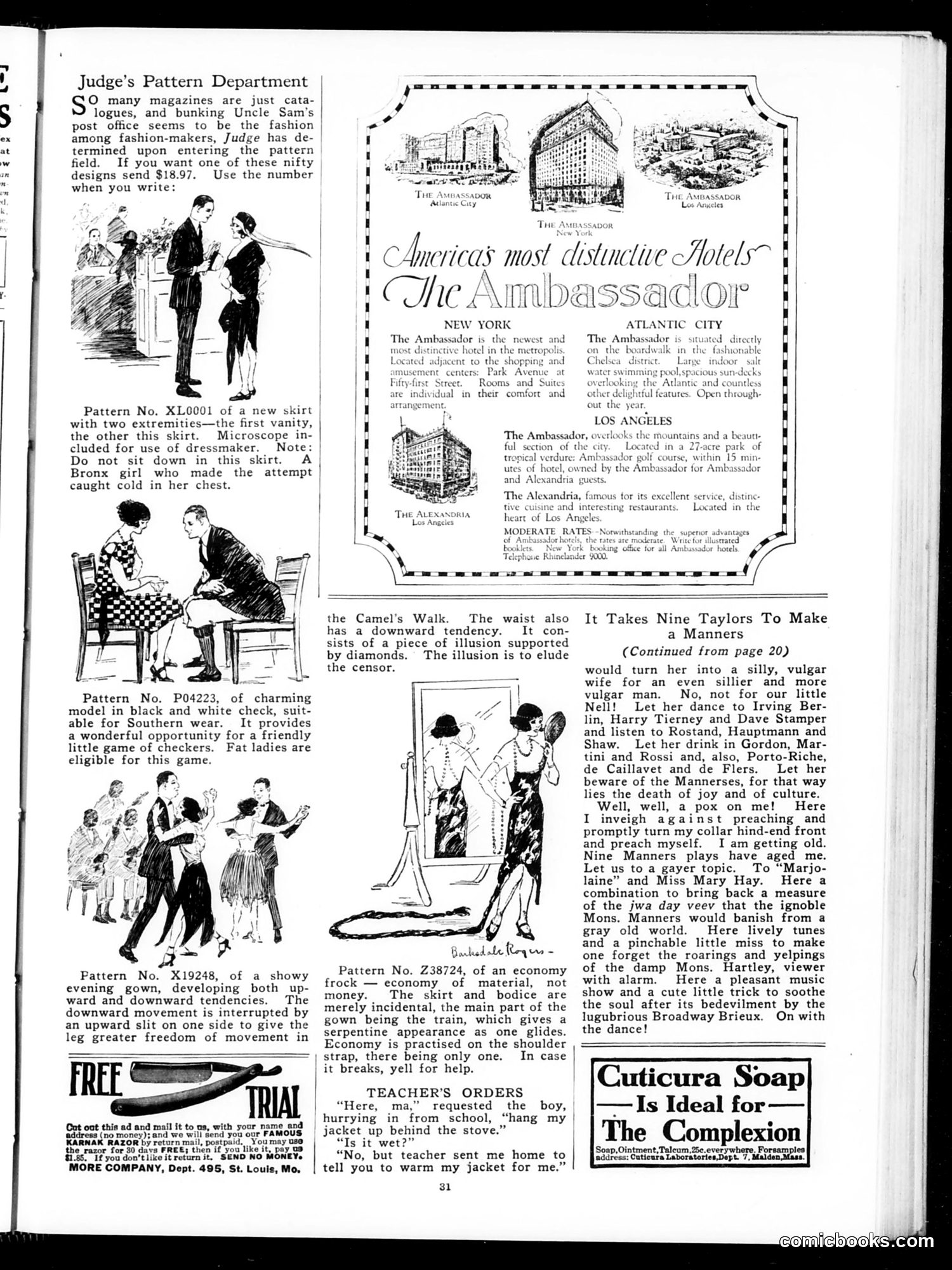
This page is primarily **advertising and fashion content** rather than political satire. The "Judge's Pattern Department" occupies the left side, offering sewing patterns for purchase ($18.97). The pattern descriptions are **humorous commentary on 1920s women's fashion**, using absurdist jokes rather than political satire. Pattern XL0001 mocks excessively short skirts ("two extremities—the first vanity, the other this skirt"), while Pattern X19248 ridicules the era's conflicting silhouettes with extreme downward and upward design tendencies. The "Camel's Walk" pattern jokes about using illusion fabric "to elude the censor"—referencing contemporary censorship concerns about scandalous clothing. The right side features **hotel advertisements** for The Ambassador chain and a continuation of an article titled "It Takes Nine Taylors To Make a Manners" (likely theatrical review), plus a Cuticura Soap ad. The page reflects **1920s fashion satire**, critiquing the rapid, sometimes impractical style changes of the era rather than engaging in overt political commentary.
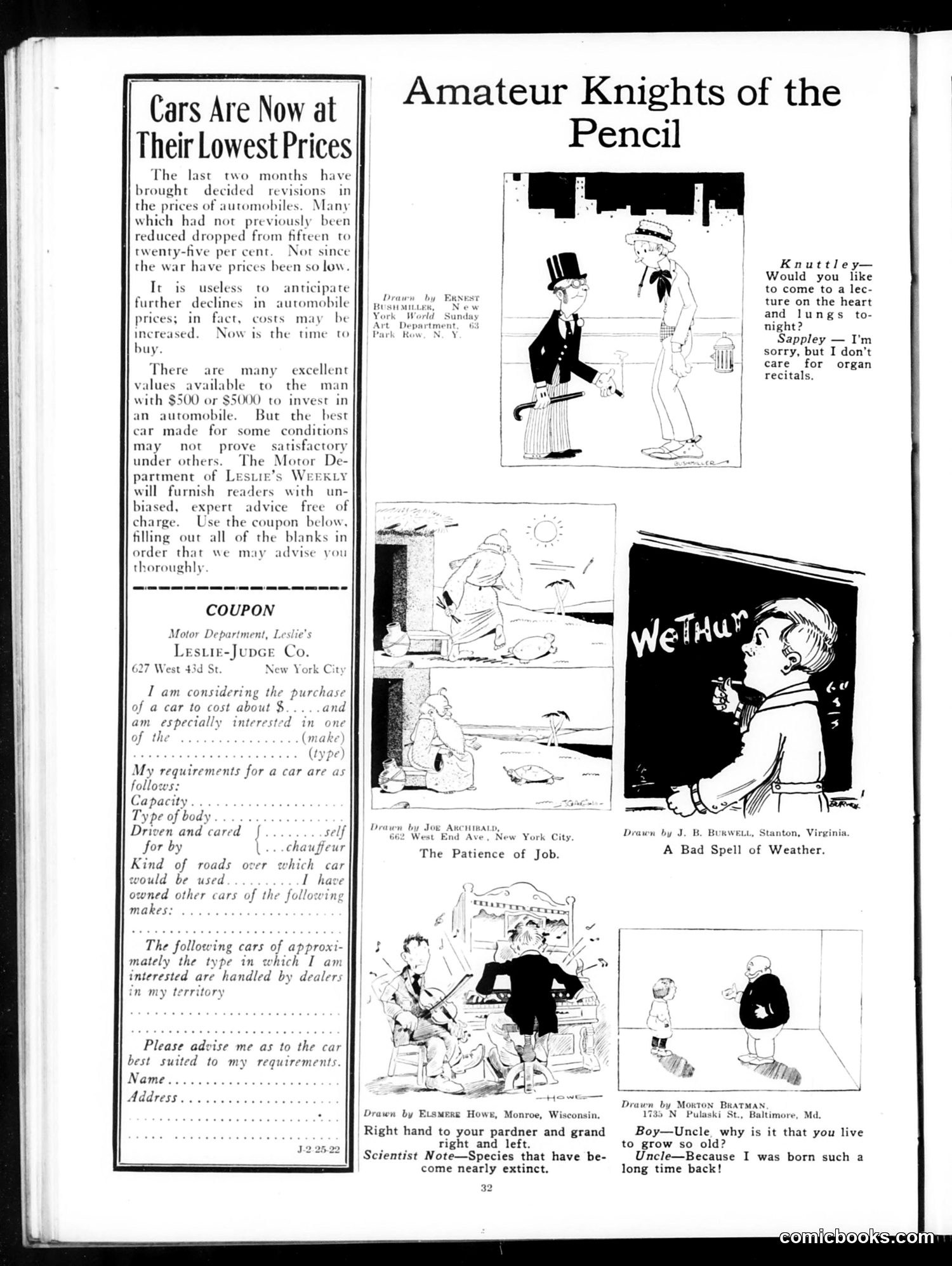
This page combines automobile advertising with four unrelated comic cartoons. **"Cars Are Now at Their Lowest Prices"** is a legitimate ad/editorial piece promoting the Leslie-Judge Company's motor advisory service, noting post-war price declines make it a buyer's market. Readers can submit a coupon for free expert car-buying advice. The four cartoons are brief gag strips with no political content: 1. **"Amateur Knights of the Pencil"**: A man in formal wear declines a lecture invitation because he "doesn't care for organ recitals"—the humor being his misunderstanding of "heart and lungs" as "organ." 2. **"The Patience of Job"**: Appears to show domestic chaos (unclear details). 3. **"A Bad Spell of Weather"**: A child named Wethur looks distressed. 4. **"Boy-Uncle"** dialogue: A boy asks why his uncle lives so old; the uncle jokes he was "born such a long time back"—simple wordplay humor. These are genteel, domestic gags typical of early 20th-century magazines—no satire or political commentary intended.
This is a **Leslie's Weekly advertisement** (not a cartoon) promoting the February 25 issue. The page itself contains no political cartoon or caricature—it's purely promotional copy. The ad addresses a genuine contemporary problem: Broadway's theatrical slump, with over 100 plays produced that season and dozens failing. It frames this crisis through rhetorical questions—whether audiences had less money, better taste, or faced high ticket prices—before promising that Samuel Hopkins Adams's analytical article will explain the situation. The page also promotes two other features: Severance Johnson's series "Is It Chiro-Quack-tic?" (attacking chiropractors as fraudulent) and Scammon Lockwood's serial "The Safety Valve." For modern readers: this reveals early 20th-century concerns about theater's commercial viability, skepticism toward alternative medicine, and Leslie's Weekly's role as an influential satirical magazine offering serious journalism alongside humor.
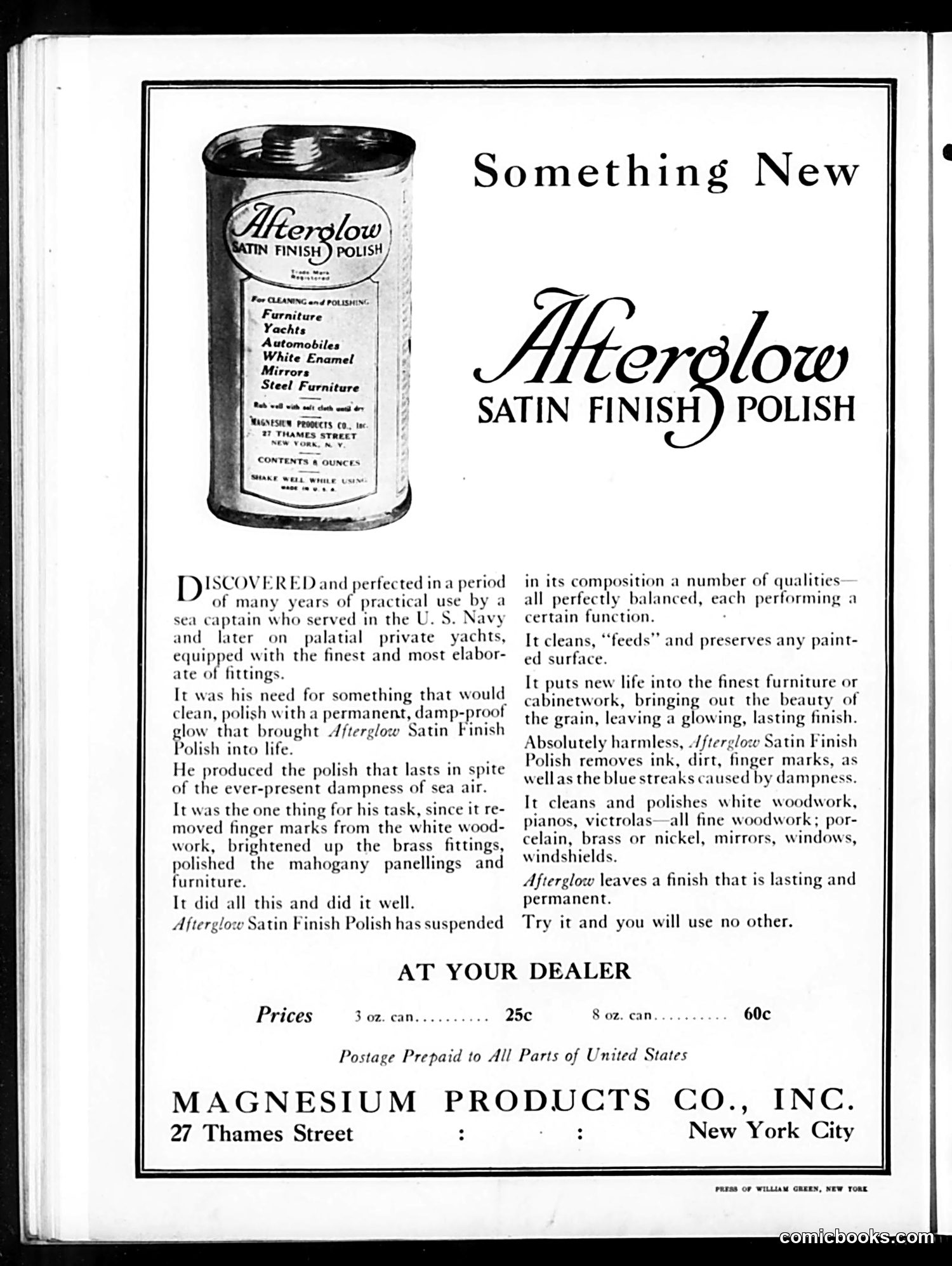
This page is a straightforward **product advertisement** for Afterglow Satin Finish Polish, not political satire or a cartoon. It appears in *Judge* magazine, which while known for satirical content, also carried paid advertisements. The ad markets a furniture and yacht polish invented by a U.S. Navy sea captain. It emphasizes the product's versatility (furniture, automobiles, pianos, brass, mirrors) and durability in damp conditions. The narrative positioning—a practical naval officer developing a superior polish—lends credibility and prestige to the brand. Pricing indicates this is vintage (25¢ for 3 oz., 60¢ for 8 oz.). The manufacturer, Magnesium Products Co., located at 27 Thames Street in New York City, used *Judge's* readership (affluent consumers) as their target market for a premium household product. There is no cartoon or political commentary on this page.