
Judge, 1922-02-25 · page 22 of 36
Judge — February 25, 1922 — page 22: what you’re looking at
What you’re looking at
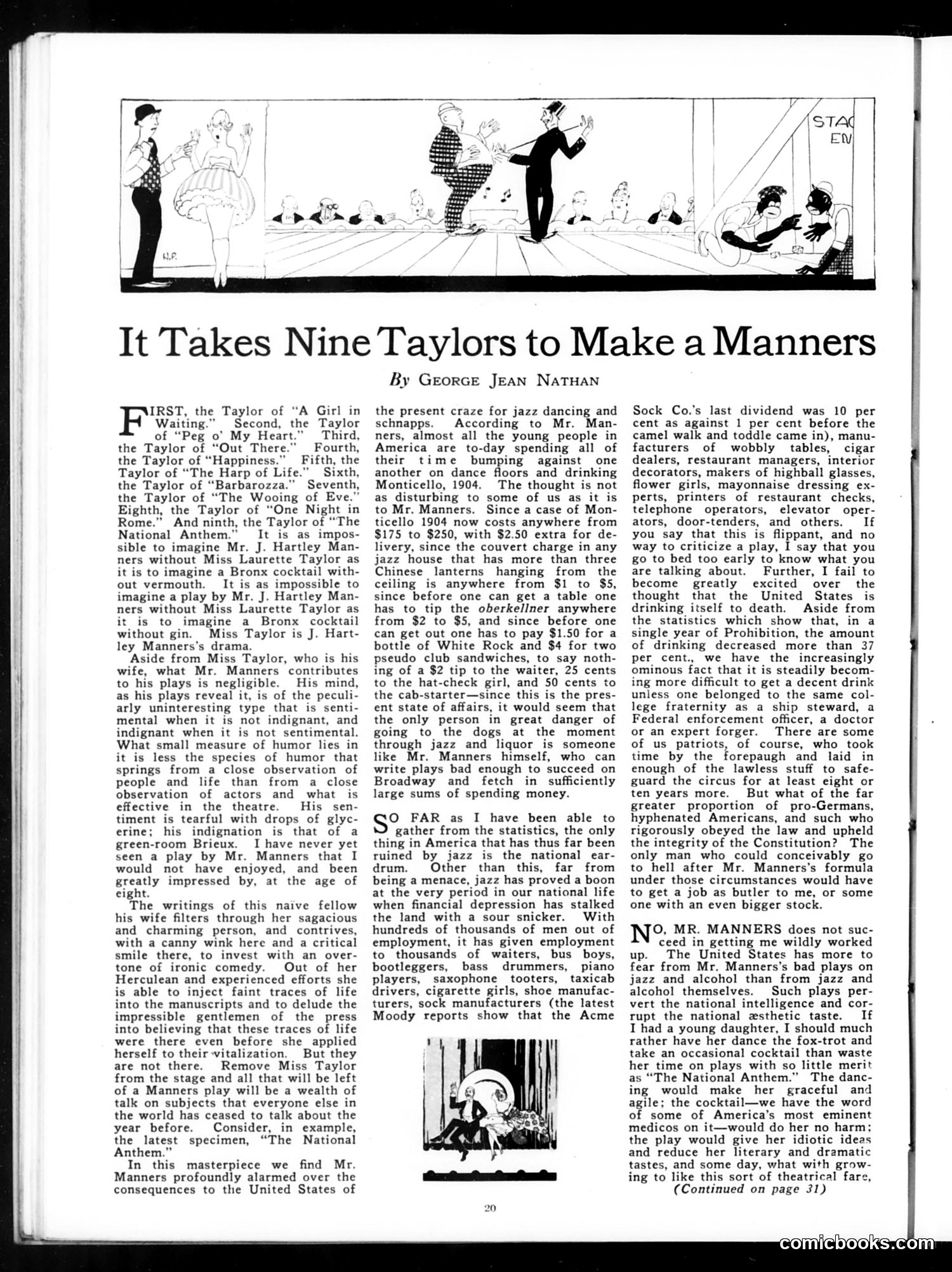
This is a satirical theater review by George Jean Nathan attacking playwright J. Hartley Manners and his wife, actress Laurette Taylor. The cartoon at top depicts a Broadway stage scene. Nathan's core argument: Manners is a mediocre writer whose plays only succeed because Taylor performs in them brilliantly. He lists nine Taylor roles, suggesting she carries every production. Nathan describes Manners as sentimental and indignant in predictable ways—plays he found entertaining at age eight. The satire intensifies when Nathan critiques Manners' latest play, *The National Anthem*, which condemns jazz dancing and drinking as moral threats to America. Nathan sarcastically argues that jazz venues are actually *expensive* (costing $175+ bottles of wine, cover charges, tips), making them accessible only to the wealthy—like Manners himself, who profits from Broadway. The joke: Manners profits from the very system he morally condemns, making his outrage hypocritical and self-serving.
📄 Transcribed text from this page (OCR, searchable)
Machine-transcribed from the original scan — historical spelling and the odd misread are preserved.
It Takes Nine Taylors to Make a Manners By Greorce Jean NaTHAN “A Girl in the Taylor Third, Fourth, Fifth, the IRST, the Taylor of Waiting.” Second, of “Peg o’ My Heart.” the Taylor of “Out There.” the Taylor of “Happiness. Taylor of “The Harp of Li Sixth, the Taylor of “Barbarozza. Seventh, the Taylor of “The Wooing of Eve.” Eighth, the Taylor of “One Night in Rome.” And ninth, the Taylor of “The National Anthem." It is as impos- sible to imagine Mr. J. Hartley Man- ners without Miss Laurette Taylor as it is to imagine a Bronx cocktail with- out vermouth. It is as impossible to imagine a play by Mr. J. Hartley Man- ners without Miss Laurette Taylor as it is to imagine a Bronx cocktail without gin. Miss Taylor is J. Hart- ley Manners’s drama. Aside from Miss Taylor, who is his wife, what Mr. Manners contributes to his plays is negligible. His mind, as his plays reveal it, is of the peculi- arly uninteresting type that is senti- mental when it is not indignant, and indignant when it is not sentimental. What small measure of humor lies in it is less the species of humor that springs from a close observation of people and life than from a close observation of actors and what is effective in the theatre. His sen- timent is tearful with drops of glyc- erine; his indignation is that of a green-room Brieux. I have never yet seen a play by Mr. Manners that I would not have enjoyed, and been greatly impressed by, at the age of eight. The writings of this naive fellow his wife filters through her sagacious and charming person, and contrives, with a canny wink here and a critical smile there, to invest with an over- tone of ironic comedy. Out of her Herculean and experienced efforts she is able to inject faint traces of life into the manuscripts and to delude the impressible gentlemen of the press into believing that these traces of life were there even before she applied herself to their vitalization. But they are not there. Remove Miss Taylor from the stage and all that will be left of a Manners play will be a wealth of talk on subjects that everyone else in the world has ceased to talk about the year before. Consider, in example, the latest specimen, “The National Anthem.” In this masterpiece we find Mr. Manners profoundly alarmed over the consequences to the United States of the present craze for jazz dancing and schnapps. According to Mr. Man- ners, almost all the young people in America are to-day spending all of their time bumping against one another on dance floors and drinking Monticello, 1904. The thought is not as disturbing to some of us as it is to Mr. Manners. Since a case of Mon- ticello 1904 now costs anywhere from $175 to $250, with $2.50 extra for de- livery, since the couvert charge in any jazz house that has more than three Chinese lanterns hanging from the ceiling is anywhere from $1 to $5, since before one can get a table one has to tip the oberkellner anywhere from $2 to $5, and since before one can get out one has to pay $1.50 for a bottle of White Rock and $4 for two pseudo club sandwiches, to say noth- ing of a $2 tip to the waiter, 25 cents to the hat-check girl, and 50 cents to the cab-starter—since this is the pres- ent state of affairs, it would seem that the only person in great danger of going to the dogs at the moment through jazz and liquor is someone like Mr. Manners himself, who can write plays bad enough to succeed on Broadway and fetch in sufficiently large sums of spending money. O FAR as I have been able to gather from the statistics, the only thing in America that has thus far been ruined by jazz is the national ear- drum. Other than this, far from being a menace, jazz has proved a boon at the very period in our national life when financial depression has stalked the land with a sour snicker. With hundreds of thousands of men out of employment, it has given employment to thousands of waiters, bus boys, bootleggers, bass drummers, piano players, saxophone tooters, taxicab drivers, cigarette girls, shoe manufac- turers, sock manufacturers (the latest Moody reports show that the Acme Sock Co.'s last dividend was 10 per cent as against 1 per cent before the camel walk and toddle came in), manu- facturers of wobbly tables, cigar dealers, restaurant managers, interior decorators, makers of highball glasses, flower girls, mayonnaise dressing ex- perts, printers of restaurant checks, telephone operators, elevator oper- ators, door-tenders, and others. If you say that this is flippant, and no way to criticize a play, I say that you go to bed too early to know what you are talking about. Further, I fail to become greatly excited over the thought that the United States is drinking itself to death. Aside from the statistics which show that, in a single year of Prohibition, the amount of drinking decreased more than 37 per cent., we have the increasingly ominous fact that it is steadily becom- ing more difficult to get a decent drink unless one belonged to the same col- lege fraternity as a ship steward, a Federal enforcement officer, a doctor or an expert forger. There are some of us patriots, of course, who took time by the forepaugh and laid in enough of the lawless stuff to safe- guard the circus for at least eight or ten years more. But what of the far greater proportion of pro-Germans, hyphenated Americans, and such who rigorously obeyed the law and upheld the integrity of the Constitution? The only man who could conceivably go to hell after Mr. Manners’s formula under those circumstances would have to get a job as butler to me, or some one with an even bigger stock. O, MR. MANNERS does not suc- ceed in getting me wildly worked up. The United States has more to fear from Mr. Manners’s bad plays on jazz and alcohol than from jazz and alcohol themselves. Such plays per- vert the national intelligence and cor- rupt the national esthetic taste. If I had a young daughter, I should much rather have her dance the fox-trot and take an occasional cocktail than waste her time on plays with so little merit as “The National Anthem.” The danc- ing would make her graceful and agile; the cocktail—we have the word of some of America’s most eminent medicos on it—would do her no harm; the play would give her idiotic ideas and reduce her literary and dramatic tastes, and some day, what with grow- ing to like this sort of theatrical fare, (Continued on page 31)