
Judge, 1922-02-25 · page 25 of 36
Judge — February 25, 1922 — page 25: what you’re looking at
What you’re looking at
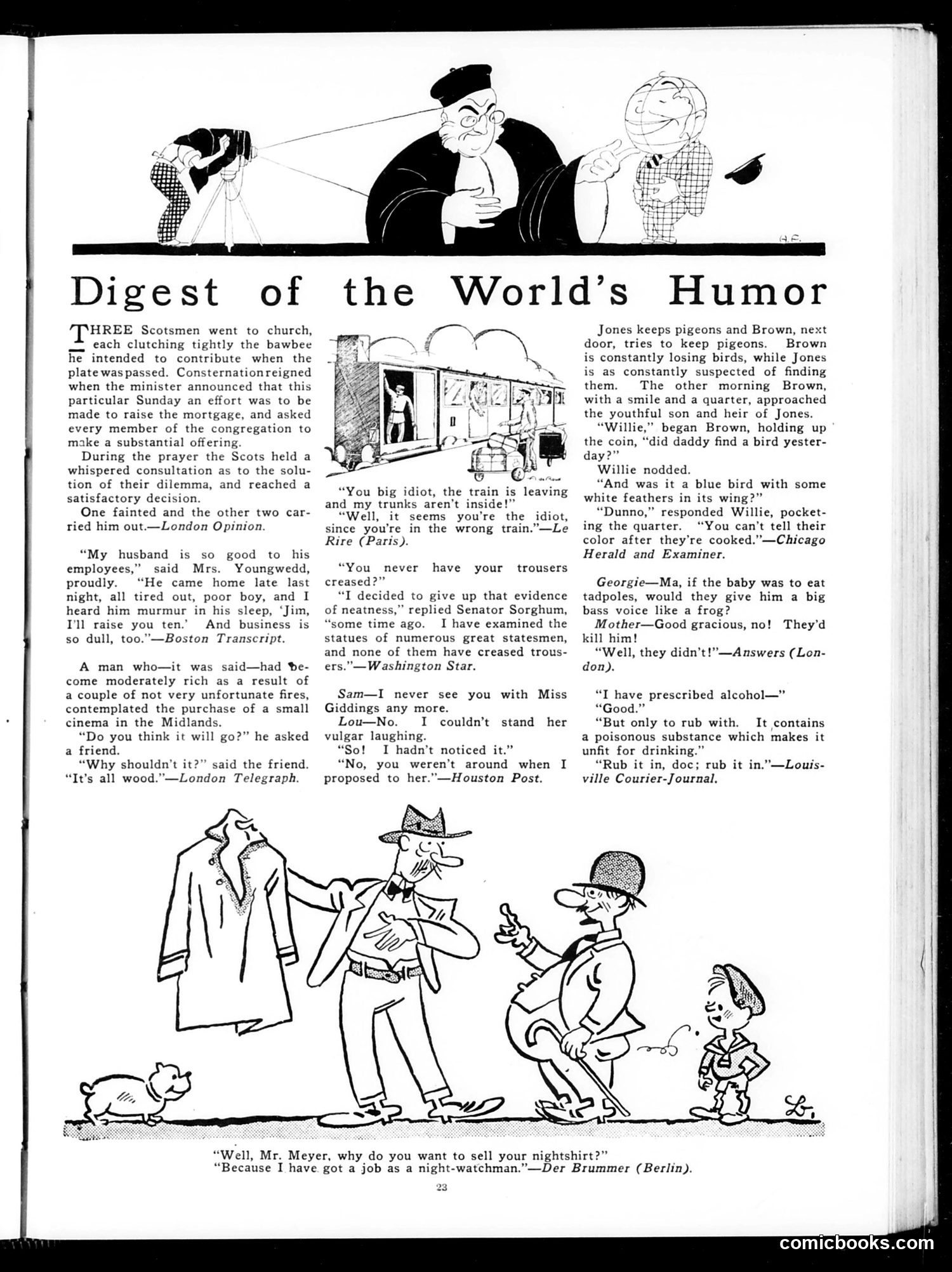
This page collects brief humorous anecdotes from international sources, reflecting early 20th-century satirical sensibilities. The jokes target: **Scottish frugality**: Three Scotsmen fake a fainting spell to avoid contributing substantially to church fundraising—stereotyping Scots as miserly. **Employer exploitation**: A wife misinterprets her husband's sleep-talking ("I'll raise you ten") as generosity toward an employee, when he's actually gambling or negotiating ruthlessly. **Insurance fraud**: A man wealthy from suspicious fires considers buying a wooden cinema—darkly implying arson for profit. **Class/social commentary**: A senator abandons creased trousers after studying statues of great statesmen, mocking pretentious politicians. A child's matter-of-fact response about cooking stolen pigeons satirizes rural/working-class morality. **Comic misunderstandings**: Various jokes about proposals, luggage mixups, and medical advice play on verbal confusion. The cartoons' humor depends on period stereotypes about nationality, class, and gender now considered offensive.
📄 Transcribed text from this page (OCR, searchable)
Machine-transcribed from the original scan — historical spelling and the odd misread are preserved.
HREE Scotsmen went to church, a ¢ach clutching tightly the bawbee he intended to contribute when the plate was passed. Consternationreigned when the minister announced that this particular Sunday an effort was to be made to raise the mortgage, and asked every member of the congregation to make a substantial offering. During the prayer the Scots held a whispered consultation as to the solu- tion of their dilemma, and reached a satisfactory decision. One fainted and the other two car- ried him out.—London Opinion. “My husband is so good to his employee: said Mrs. Youngwedd, proudly. ‘He came home late last night, all tired out, poor boy, and I heard him murmur in his sleep, ‘Jim, I'll raise you ten.’ And business is so dull, too.”"—-Boston Transcript. A man who—it was said—had be- come moderately rich as a result of a couple of not very unfortunate fires, contemplated the purchase of a small cinema in the Midlands. “Do you think it will go?” he asked a friend. “Why shouldn't it?” said the friend. “It’s all wood.”—London Telegraph. “You big idiot, the train is leaving and my trunks aren't inside!” “Well, it seems you're the idiot, since you're in the wrong train.”—Le Rire (Paris). “You never have creased?” “I decided to give up that evidence of neatness,” replied Senator Sorghum, “some time ago. I have examined the statues of numerous great statesmen, and none of them have creased trous- ers.”—Washington Star. your trousers Sam—I never see you with Miss Giddings any more. Lou—No. I couldn't vulgar laughing. “So! I hadn't noticed it.” “No, you weren’t around when I proposed to her.”—Houston Post. stand her Jones keeps pigeons and Brown, next door, tries to keep pigeons. Brown is constantly losing birds, while Jones is as constantly suspected of finding them. The other morning Brown, with a smile and a quarter, approached the youthful son and heir of Jones. “Willie,” began Brown, holding up the coin, “did daddy find a bird yester- day?” Willie nodded. “And was it a blue bird with some white feathers in its wing?” “Dunno,” responded Willie, pocket- ing the quarter. “You can’t tell their color after they’re cooked.”—Chicago Herald and Examiner. Georgie—Ma, if the baby was to eat tadpoles, would they give him a big bass voice like a frog? Mother—Good gracious, no! kill him! “Well, they didn’t!”—Answers (Lon- don). They'd “I have prescribed alcohol—” “Good.” “But only to rub with. It contains a poisonous substance which makes it unfit for drinking.” “Rub it in, doc; rub it in.”—Louis- ville Courier-Journal. “Well, Mr. Meyer, why do you want to sell your nightshirt?” “Because I have got a job as a night-watchman.”—Der Brummer (Berlin). 23 comicbooks.com