
Judge, 1922-02-25 · page 7 of 36
Judge — February 25, 1922 — page 7: what you’re looking at
What you’re looking at
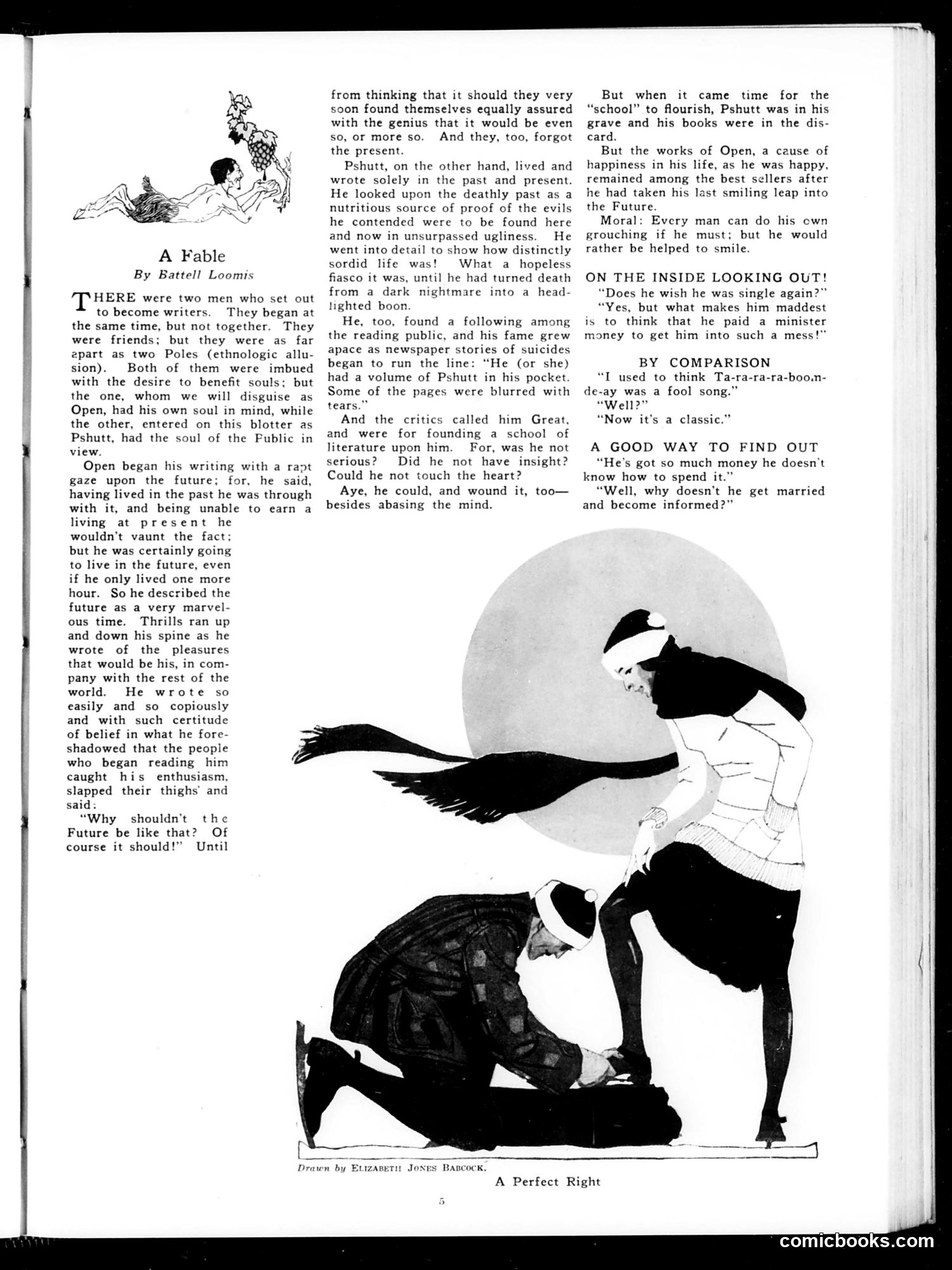
This page presents a fable contrasting two writer archetypes. "Open" writes optimistic futuristic fiction that inspires readers with enthusiasm for an idealized tomorrow, gaining popularity through emotional uplift. "Pshutt" focuses on documenting present and past suffering—depicting life's sordidness until death becomes relief—earning critical acclaim as "serious" and insightful, yet ultimately his work fades after his death. The satire targets opposing literary philosophies popular in early 20th-century America: escapist optimism versus muckraking realism. Judge's verdict favors Open—the "happiness merchant"—arguing that while serious social critique has merit, ultimately readers and society benefit more from uplifting, emotionally sustaining work. The illustration labeled "A Perfect Right" appears to show physical comedy (two figures in an awkward collision), accompanying lighter sidebar jokes about marriage. The fable reflects Judge's general editorial stance: skepticism toward overly grim "realist" literature while celebrating accessible entertainment.
📄 Transcribed text from this page (OCR, searchable)
Machine-transcribed from the original scan — historical spelling and the odd misread are preserved.
A Fable By Battell Loomis HERE were two men who set out to become writers. They began at the same time, but not together. They were friends; but they were as far apart as two Poles (ethnologic allu- sion). Both of them were imbued with the desire to benefit souls; but the one, whom we will disguise as Open, had his own soul in mind, while the other, entered on this blotter as Pshutt, had the soul of the Public in view. Open began his writing with a rapt gaze upon the future; for, he said, having lived in the past he was through with it, and being unable to earn a living at present he wouldn't vaunt the fact; but he was certainly going to live in the future, even if he only lived one more hour. So he described the future as a very marvel- ous time. Thrills ran up and down his spine as he wrote of the pleasures that would be his, in com- pany with the rest of the world. He wrote so easily and so copiously and with such certitude of belief in what he fore- shadowed that the people who began reading him caught his enthusiasm, slapped their thighs’ and said: “Why shouldn't the Future be like that? Of course it should!” Until [ from thinking that it should they very soon found themselves equally assured with the genius that it would be even so, or more so. And they, too, forgot the present. Pshutt, on the other hand, lived and wrote solely in the past and present. He looked upon the deathly past as a nutritious source of proof of the evils he contended were to be found here and now in unsurpassed ugliness. He went into detail to show how distinctly sordid life was! What a hopeless fiasco it was, until he had turned death from a dark nightmare into a head- lighted boon. He, too, found a following among the reading public, and his fame grew apace as newspaper stories of suicides began to run the line: “He (or she) had a volume of Pshutt in his pocket Some of the pages were blurred with tears.” And the critics called him Great, and were for founding a school of literature upon him. For, was he not serious? Did he not have insight? Could he not touch the heart? Aye, he could, and wound it, too— besides abasing the mind. Drawn by Evizanetit JONES BABcock, But when it came time for the “school” to flourish, Pshutt was in his grave and his books were in the dis- card. But the works of Open, a cause of happiness in his life, as he was happy, remained among the best sellers after he had taken his last smiling leap into the Future Moral: Every man can do his cwn grouching if he must; but he would rather be helped to smile. ON THE INSIDE LOOKING OUT! “Does he wish he was single again?” “Yes, but what makes him maddest is to think that he paid a minister money to get him into such a mess!” BY COMPARISON “I used to think Ta-ra-ra-ra-boom- de-ay was a fool song.” “Well?” “Now it’s a classic.” A GOOD WAY TO FIND OUT “He's got so much money he doesn't know how to spend it.” “Well, why doesn’t he get married and become informed?” tA Weg A Perfect Right comicbooks.com