
Judge, 1922-02-25 · page 21 of 36
Judge — February 25, 1922 — page 21: what you’re looking at
What you’re looking at
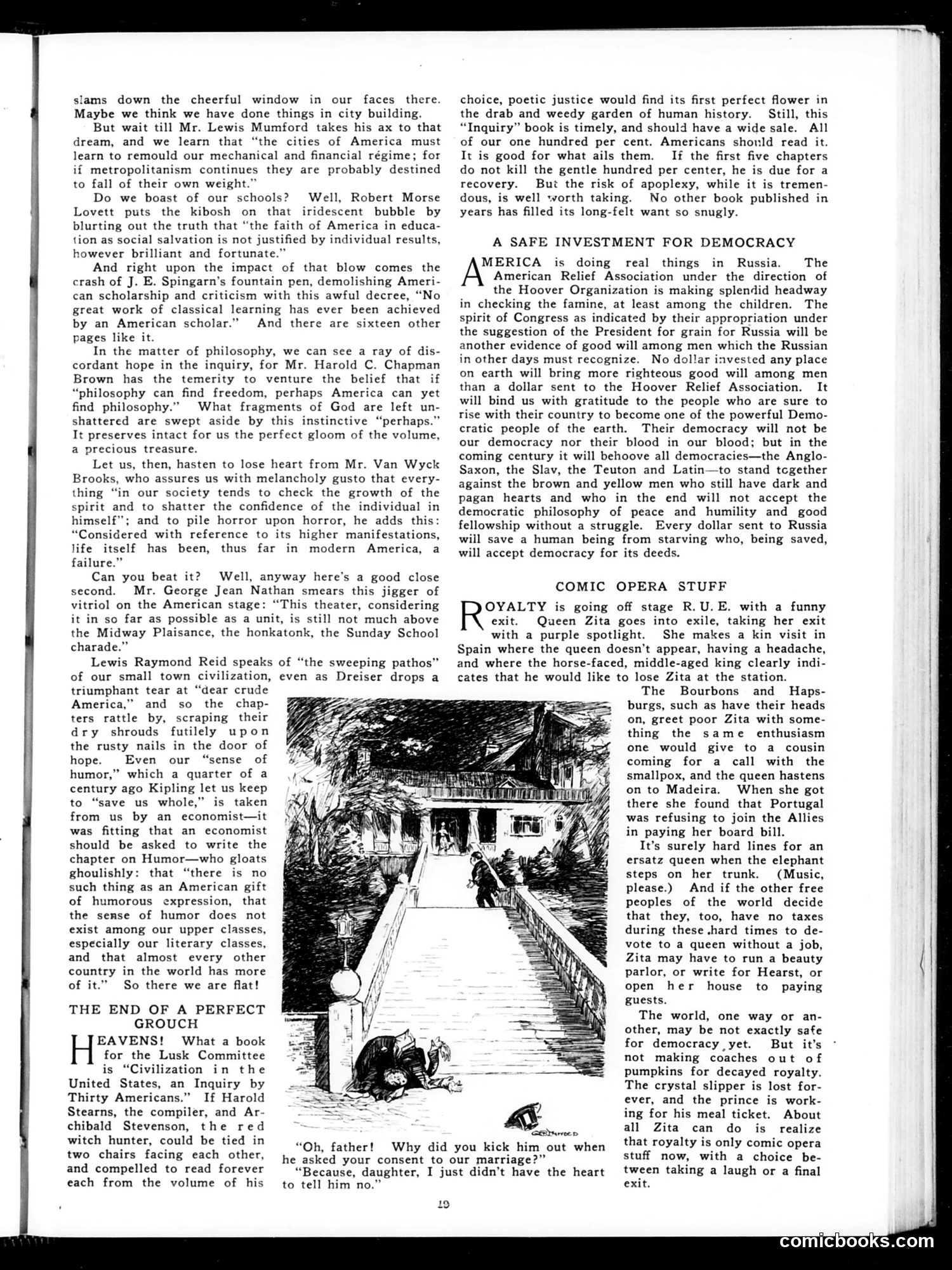
This page satirizes "Civilization in the United States, an Inquiry by Thirty Americans"—a 1922 collection edited by Harold Stearns featuring prominent intellectuals. The cartoon attacks the book's relentlessly pessimistic critique of American culture. The satire quotes contributors (Lewis Mumford on cities, Robert Morse Lovett on education, J.E. Spingarn on scholarship, Van Wyck Brooks on American spirit, George Jean Nathan on theater) systematizing their condemnations into a depressing catalog of national failure. Judge ridicules this "perfect grouch"—the book's comprehensive bleakness. The cartoon below, titled "Comic Opera Stuff," depicts Queen Zita of Austria-Hungary in comic exile, mocking European royalty's pretensions during turbulent postwar politics. Judge's stance: while the book deserves reading as timely critique, its relentless pessimism is exaggerated—even dangerous for vulnerable readers ("gentle hundred per center"). The magazine suggests destructive negativity packaged as intellectual authority.
📄 Transcribed text from this page (OCR, searchable)
Machine-transcribed from the original scan — historical spelling and the odd misread are preserved.
slams down the cheerful window in our faces there. Maybe we think we have done things in city building. But wait till Mr. Lewis Mumford takes his ax to that dream, and we learn that “the cities of America must learn to remould our mechanical and financial régime; for if metropolitanism continues they are probably destined to fall of their own weight.” Do we boast of our schools? Well, Robert Morse Lovett puts the kibosh on that iridescent bubble by blurting out the truth that “the faith of America in educa- tion as social salvation is not justified by individual results, however brilliant and fortunate.” And right upon the impact of that blow comes the crash of J. E. Spingarn’s fountain pen, demolishing Ameri- can scholarship and criticism with this awful decree, “No great work of classical learning has ever been achieved by an American scholar.” And there are sixteen other pages like it. In the matter of philosophy, we can see a ray of dis- cordant hope in the inquiry, for Mr. Harold C. Chapman Brown has the temerity to venture the belief that if “philosophy can find freedom, perhaps America can yet find philosophy.” What fragments of God are left un- shattered are swept aside by this instinctive “perhaps.” It preserves intact for us the perfect gloom of the volume, a precious treasure. Let us, then, hasten to lose heart from Mr. Van Wyck Brooks, who assures us with melancholy gusto that every- thing “in our society tends to check the growth of the spirit and to shatter the confidence of the individual in himself"; and to pile horror upon horror, he adds this: “Considered with reference to its higher manifestations, life itself has been, thus far in modern America, a failure.” Can you beat it? Well, anyway here’s a good close second. Mr. George Jean Nathan smears this jigger of vitriol on the American stage: “This theater, considering it in so far as possible as a unit, is still not much above the Midway Plaisance, the honkatonk, the Sunday School charade.” Lewis Raymond Reid speaks of our small town civilization, triumphant tear at “dear crude America,” and so the chap- ters rattle by, scraping their dry shrouds futilely upon the rusty nails in the door of hope. Even our “sense of humor,” which a quarter of a century ago Kipling let us keep to “save us whole,” is taken from us by an economist—it was fitting that an economist should be asked to write the chapter on Humor—who gloats ghoulishly: that “there is no such thing as an American gift of humorous expression, that the sense of humor does not exist among our upper classes, especially our literary classes, and that almost every other country in the world has more of it.” So there we are flat! THE END OF A PERFECT GROUCH EAVENS! What a book for the Lusk Committee is “Civilization in the United States, an Inquiry by Thirty Americans.” If Harold Stearns, the compiler, and Ar- chibald Stevenson, the red witch hunter, could be tied in two chairs facing each other, and compelled to read forever each from the volume of his of “the sweeping pathos” even as Dreiser drops a “Oh, father! 19 choice, poetic justice would find its first perfect flower in the drab and weedy garden of human history. Still, this “Inquiry” book is timely, and should have a wide sale. All of our one hundred per cent. Americans should read it. It is good for what ails them. If the first five chapters do not kill the gentle hundred per center, he is due for a recovery. But the risk of apoplexy, while it is tremen- dous, is well worth taking. No other book published in years has filled its long-felt want so snugly. A SAFE INVESTMENT FOR DEMOCRACY MERICA is doing real things in Russia. The American Relief Association under the direction of the Hoover Organization is making splendid headway in checking the famine, at least among the children. The spirit of Congress as indicated by their appropriation under the suggestion of the President for grain for Russia will be another evidence of good will among men which the Russian in other days must recognize. No dollar invested any place on earth will bring more righteous good will among men than a dollar sent to the Hoover Relief Association. It will bind us with gratitude to the people who are sure to rise with their country to become one of the powerful Demo- cratic people of the earth. Their democracy will not be our democracy nor their blood in our blood; but in the coming century it will behoove all democracies—the Anglo- Saxon, the Slav, the Teuton and Latin—to stand tcgether against the brown and yellow men who still have dark and pagan hearts and who in the end will not accept the democratic philosophy of peace and humility and good fellowship without a struggle. Every dollar sent to Russia will save a human being from starving who, being saved, will accept democracy for its deeds. COMIC OPERA STUFF OYALTY is going off stage R.U.E. with a funny exit. Queen Zita goes into exile, taking her exit with a purple spotlight. She makes a kin visit in Spain where the queen doesn’t appear, having a headache, and where the horse-faced, middle-aged king clearly indi- cates that he would like to lose Zita at the station. The Bourbons and Haps- burgs, such as have their heads on, greet poor Zita with some- thing the same enthusiasm one would give to a cousin coming for a call with the smallpox, and the queen hastens on to Madeira. When she got there she found that Portugal was refusing to join the Allies in paying her board bill. It’s surely hard lines for an ersatz queen when the elephant steps on her trunk. (Music, please.) And if the other free peoples of the world decide that they, too, have no taxes during these .hard times to de- vote to a queen without a job, Zita may have to run a beauty parlor, or write for Hearst, or open her house to paying guests. The world, one way or an- other, may be not exactly safe for democracy yet. But it’s not making coaches out of pumpkins for decayed royalty. The crystal slipper is lost for- ever, and the prince is work- ing for his meal ticket. About all Zita can do is realize that royalty is only comic opera stuff now, with a choice be- tween taking a laugh or a final exit. &E SEM ree > Why did you kick him out when he asked your consent to our marriage?” “Because, daughter, I just didn’t have the heart to tell him no.” comicbooks.com