
A complete issue · 36 pages · 1921
Judge — September 3, 1921
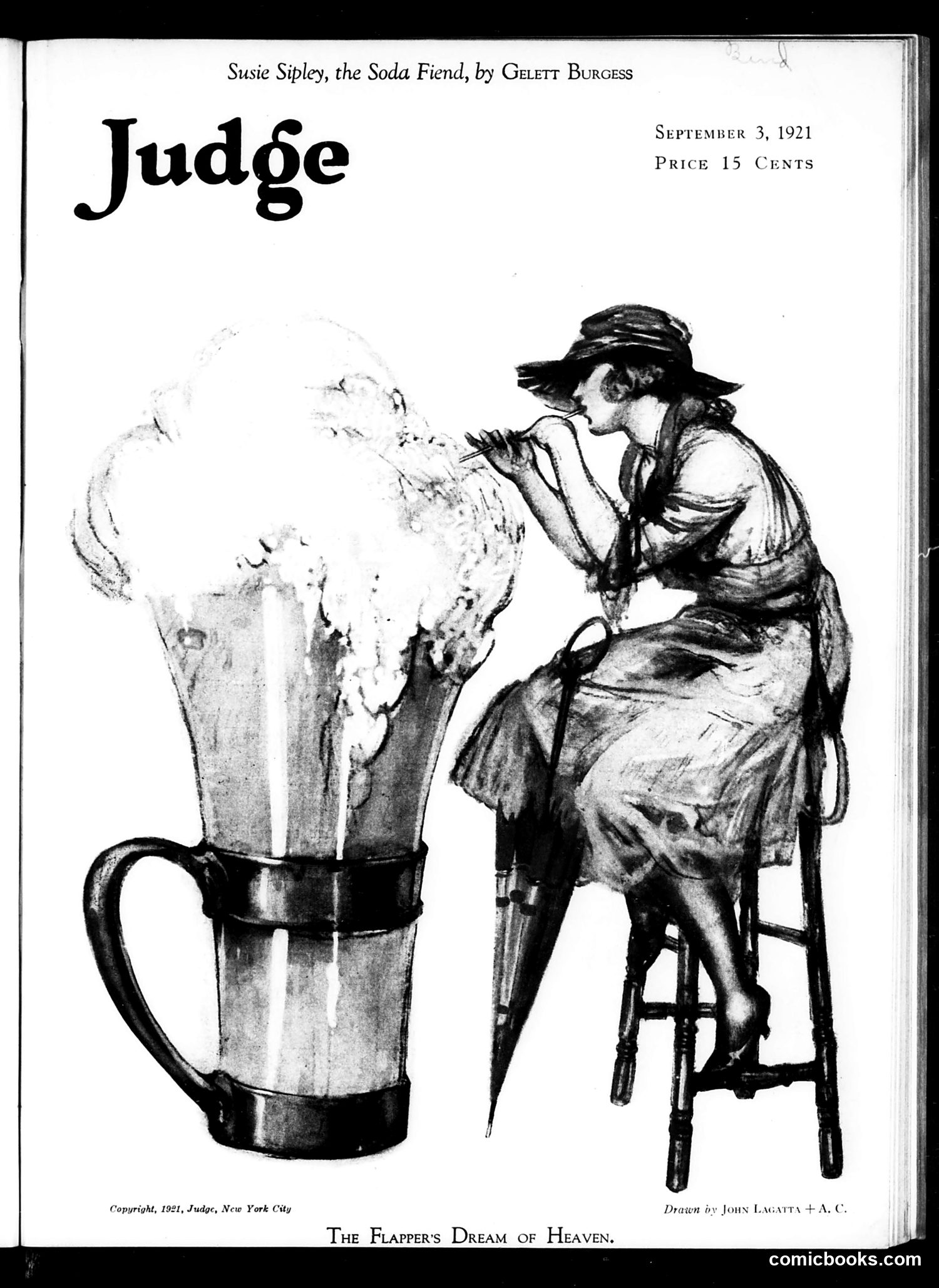
This 1921 cartoon depicts a young woman ("Susie Sipley, the Soda Fiend," per the header) sitting at a soda fountain, gazing dreamily at an enormously tall glass of soda overflowing with whipped cream. The title "The Flapper's Dream of Heaven" satirizes the newly-visible "flapper" subculture—young women of the 1920s known for rejecting Victorian propriety, wearing shorter skirts, and embracing modern freedoms. The joke equates a flapper's idea of paradise with indulging in a massive soda drink, mocking both the consumption habits and the perceived shallow pleasures of this generation. The exaggerated scale of the soda emphasizes the satire. This reflects older generations' disapproval of flapper culture and their tendency to caricature young women's independence through material excess and frivolity.
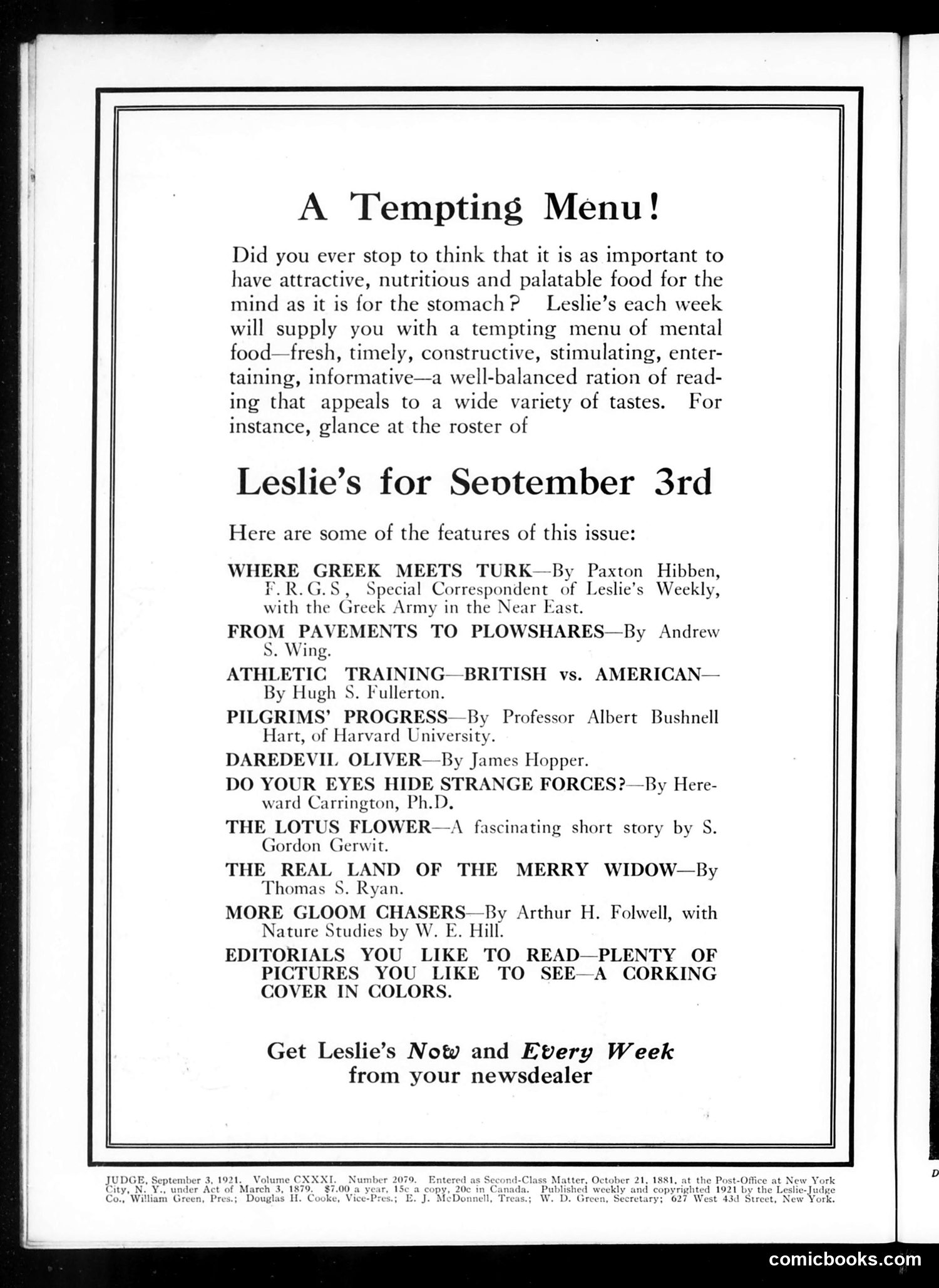
This page is primarily **advertising content**, not a political cartoon. It's a promotional advertisement for *Leslie's* magazine (specifically the September 3rd issue), presented as an editorial feature in *Judge* magazine dated September 3, 1921. The advertisement uses the metaphor of food—a "tempting menu"—to describe the magazine's content offerings. It lists articles on diverse topics: Greek-Turkish military affairs, agricultural economics, athletic training, pilgrims' history, and fiction. The pitch emphasizes variety and broad appeal ("well-balanced ration of reading"). The page contains no political satire or caricatures—it's straightforward magazine promotion designed to encourage newsdealer sales and reader subscriptions through enticing content description.
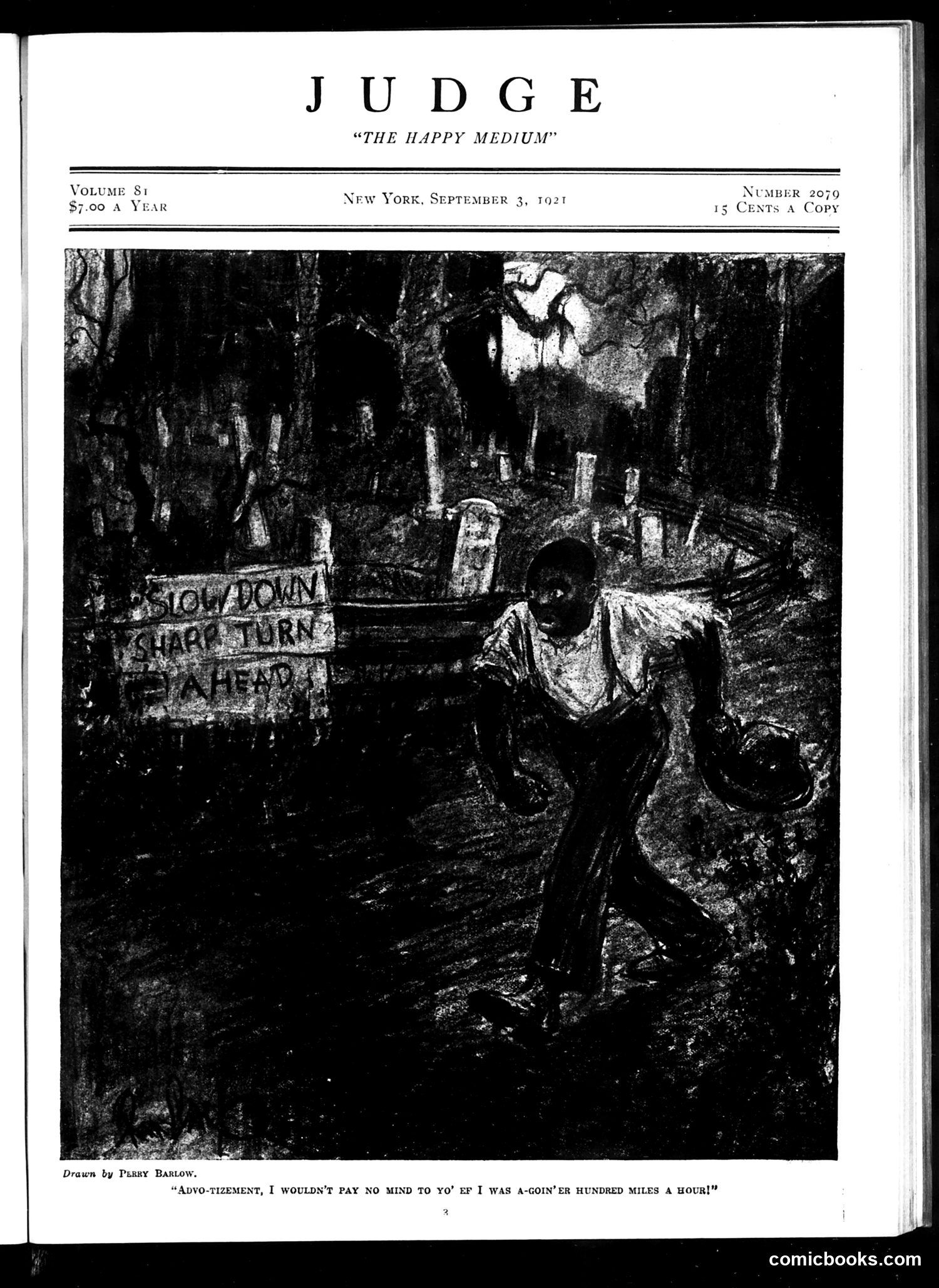
This is a satirical cartoon drawn by Perry Barlow depicting a cemetery scene. A figure (appears to be a gravekeeper or worker) stands among headstones with a sign reading "SLOW DOWN," "SHARP TURN," and "AHEAD." The caption reads: "AUTO-TIZEMENT, I WOULDN'T PAY NO MIND TO YO' EP I WAS A-GOIN' ER HUNDRED MILES A HOUR!" The joke satirizes automobile safety warnings and early traffic signs, suggesting that drivers ignore cautionary road signs, particularly when speeding. The graveyard setting grimly implies that ignoring such warnings leads to fatal accidents. This reflects 1921 concerns about automobile safety, reckless driving, and the emerging infrastructure of road safety systems during the early automotive era.
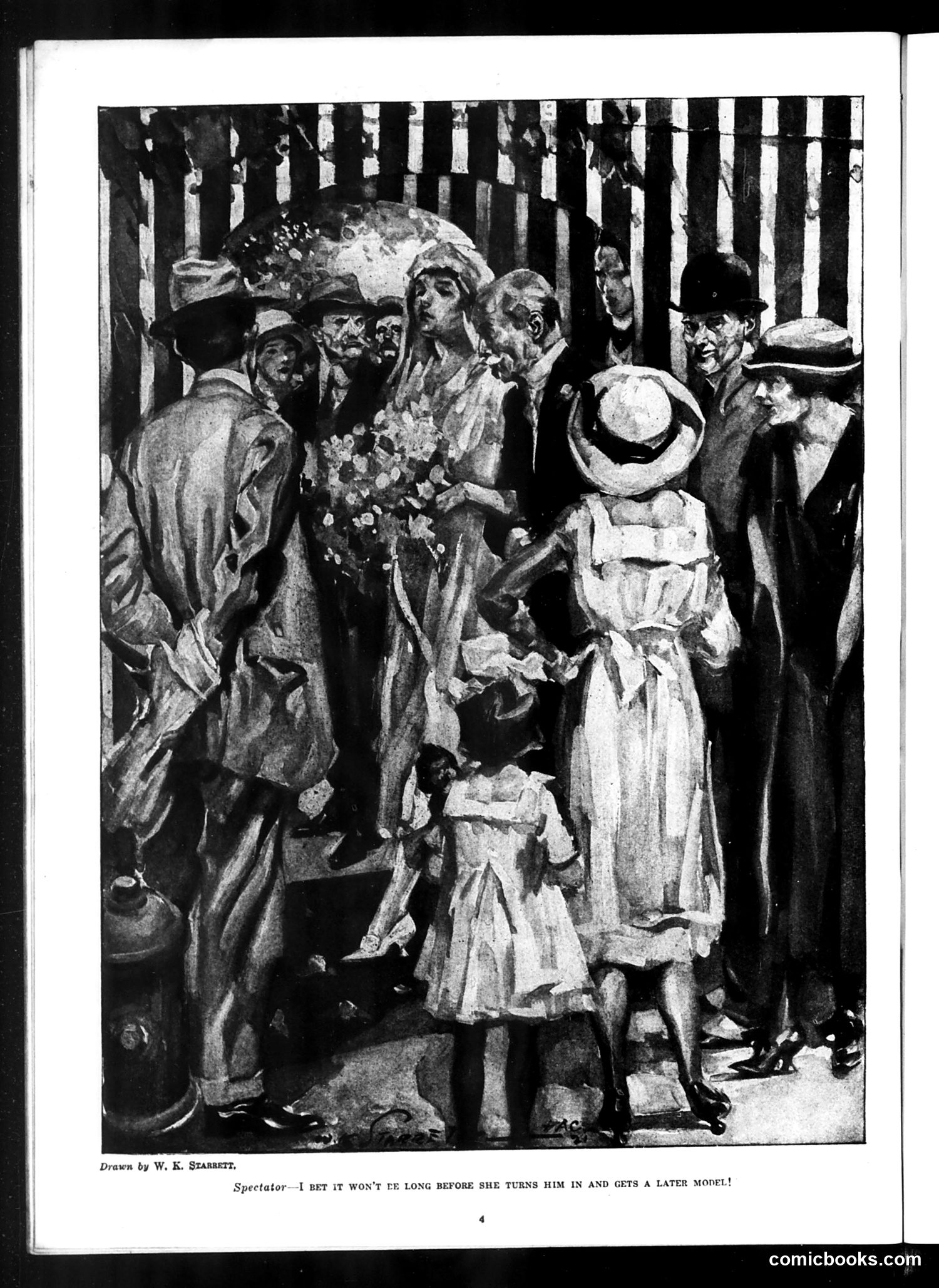
This W. K. Starrett drawing depicts a street scene with well-dressed onlookers gathered around a young woman and child. The caption reads: "Spectator—I BET IT WON'T BE LONG BEFORE SHE TURNS HIM IN AND GETS A LATER MODEL!" The satire appears to address marriage and infidelity culture, likely mocking the disposable attitude some men held toward wives. The "later model" reference suggests comparing women to consumer goods—automobiles particularly—that could be replaced with newer versions. The onlookers' reactions suggest social scandal or gossip. Without additional context about the specific Judge issue date, I cannot identify the particular social figures caricatured or pinpoint the exact contemporary event referenced, though the cartoon clearly critiques marital attitudes and treats women as replaceable commodities.
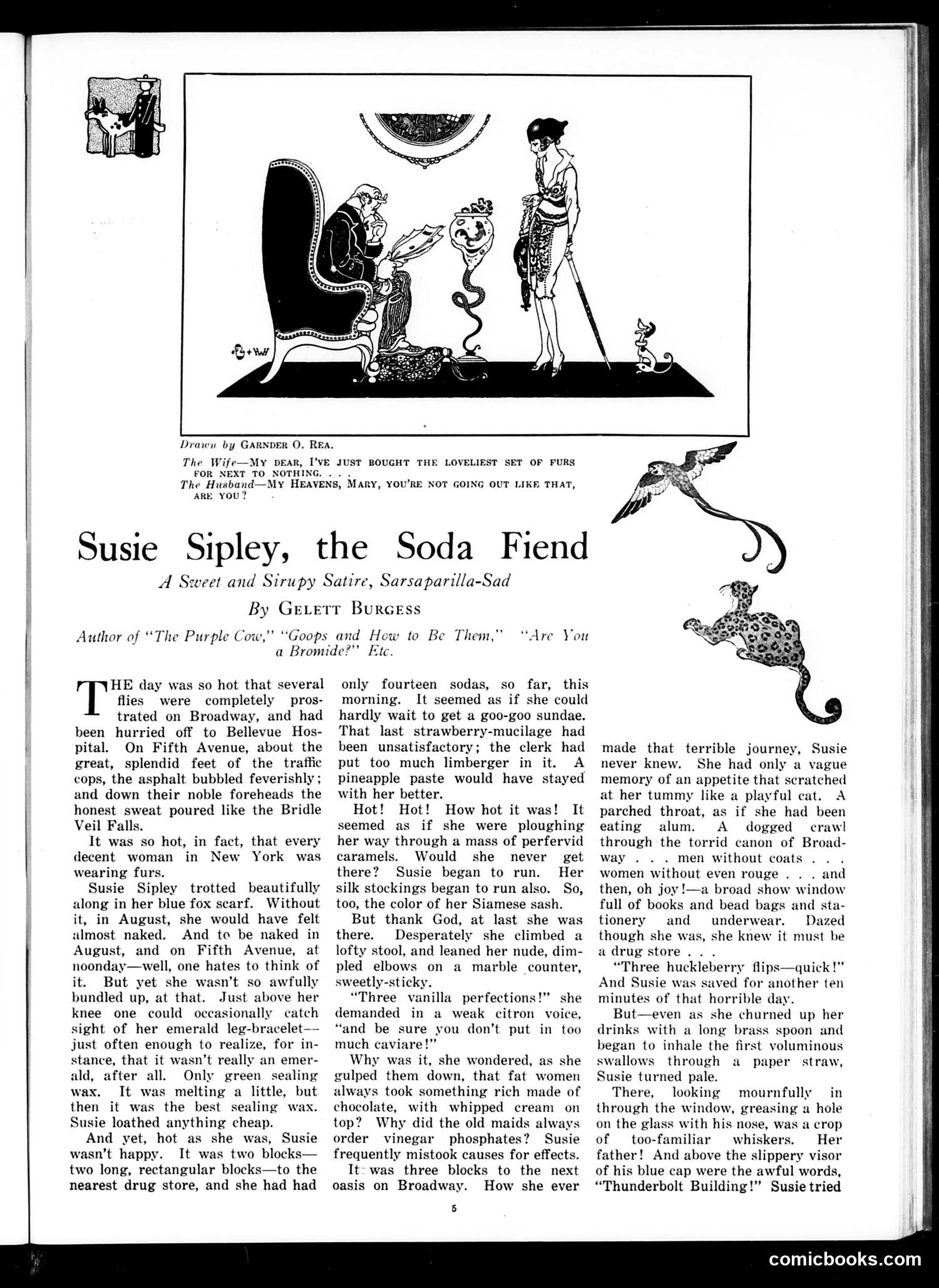
The cartoon at top depicts a domestic dispute about fashion and expense. A woman in an elaborate chair shows her husband a fur purchase, claiming it's "the loveliest set of furs" and cost "nothing." The husband protests she's overdressed for going out, while a fashionable woman stands nearby with a snake and small dog—likely representing contemporary luxury and vanity. The satire targets wealthy women's extravagant spending on furs and fashion during the hot summer season, contrasting the impracticality (furs in heat) with their conspicuous consumption. The cartoon mocks both female materialism and male marital helplessness against wives' shopping habits—a common Judge theme satirizing upper-class excess and changing gender dynamics in the 1920s-30s era.
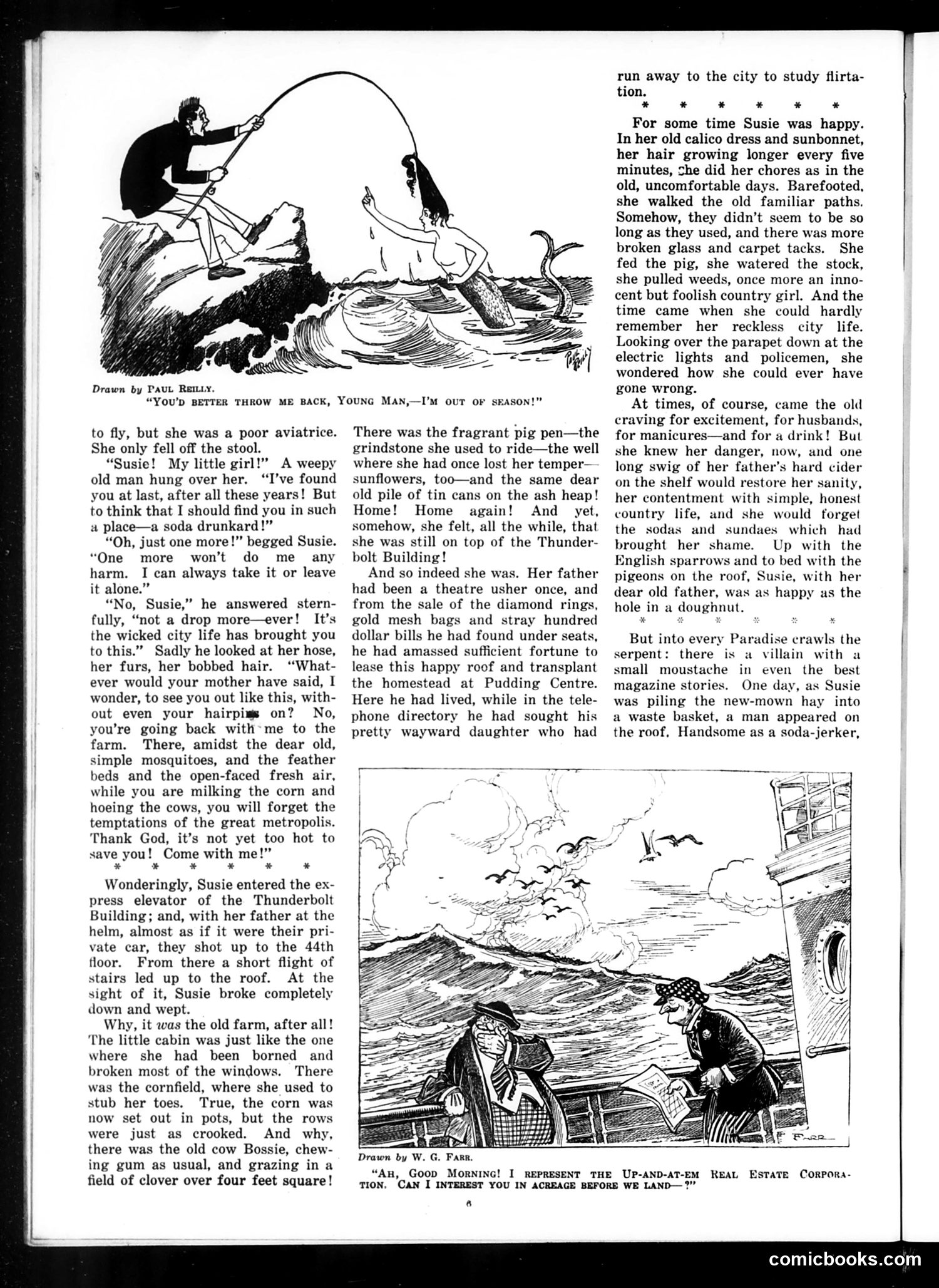
This page contains a serialized story about "Susie," a young woman who abandoned city life and returned to her family's farm. The narrative and illustrations depict her nostalgia and gradual readjustment to rural domesticity. **The two cartoons illustrate:** 1. **Top cartoon**: A fishing scene with the caption "You'd better throw me back, young man—I'm out of season!" - appears to be a flirtation joke about a woman being "out of season" romantically. 2. **Bottom cartoon**: Two women discussing real estate, with text about representing an "up-and-em real estate corporation" - likely satirizing aggressive land development and sales tactics of the era. The overall page reflects early 20th-century American tensions between urban and rural life, with humor centered on gender roles and commercialization.
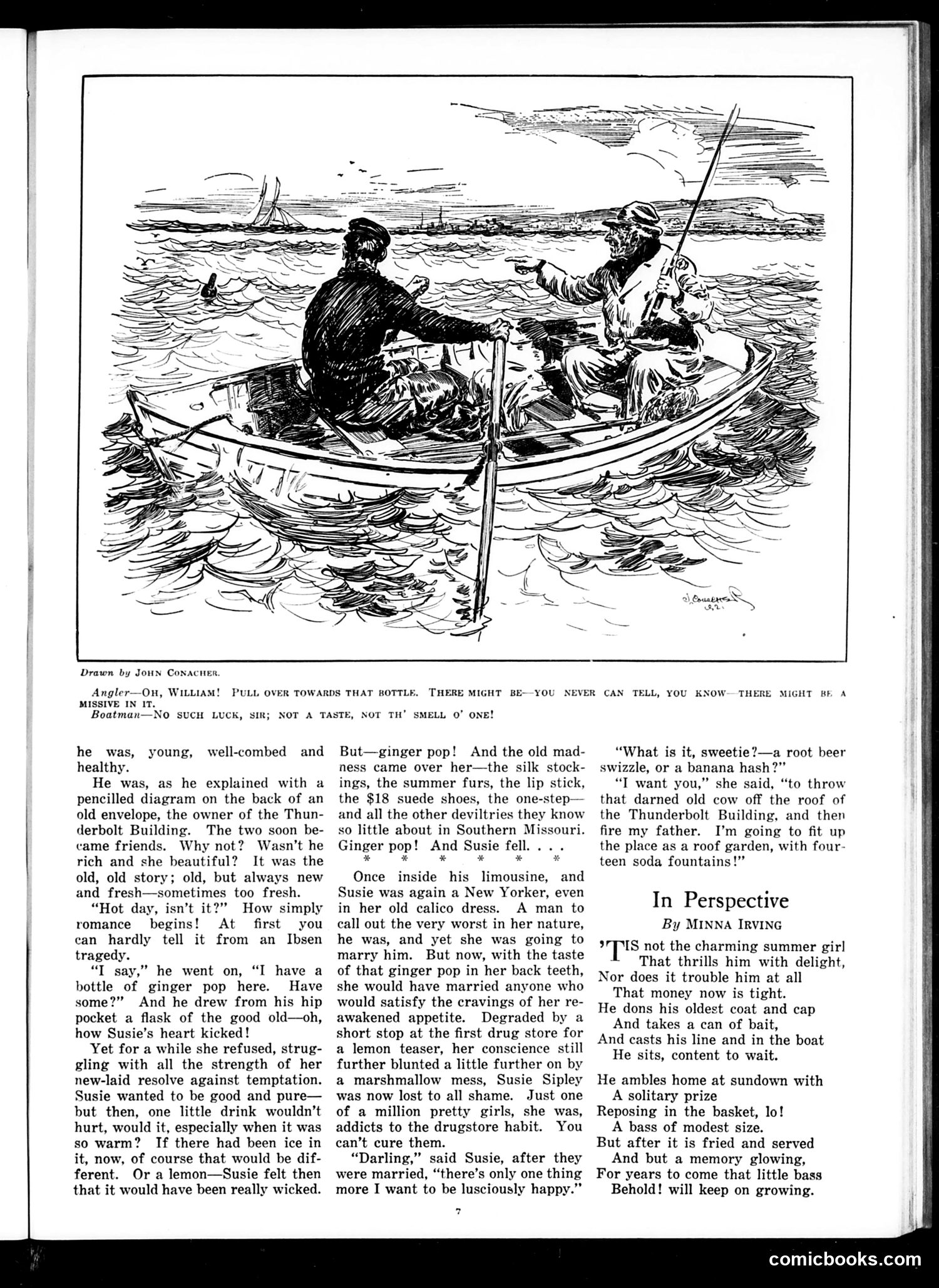
The cartoon satirizes **Prohibition-era drinking culture** and female moral corruption. An angler and boatman discuss finding a "bottle" in the water—likely illicit alcohol. The accompanying story mocks how easily a working-class woman ("Susie") is seduced by wealth and luxury goods (silk stockings, suede shoes), then corrupted by seemingly innocent "ginger pop" (a coded reference to alcoholic beverages disguised as soft drinks during Prohibition). The satire suggests that modern temptations—wealth, fashion, drugstore treats, and hidden alcohol—destroy traditional female virtue. After marriage, Susie becomes morally bankrupt, demanding her husband commit crimes and harm her father for leisure amenities. "In Perspective" appears to be a contrasting poem celebrating simple masculine pleasures (fishing) over material excess, offering Judge's moral commentary on 1920s consumer culture and female independence.
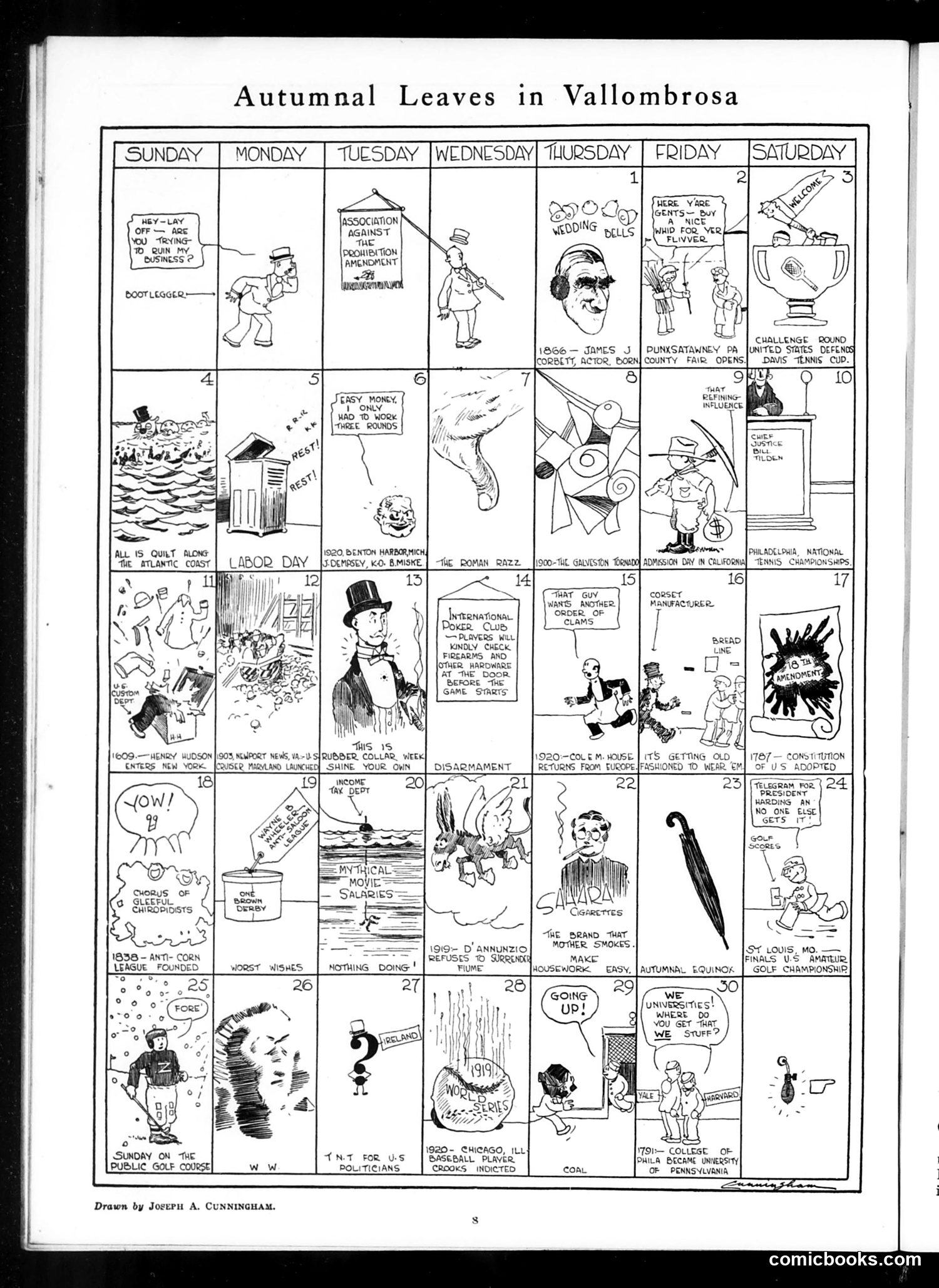
This is a daily calendar comic strip for September-October 1920, satirizing contemporary American events and social issues. Key references include: **Political/Social References:** - **Bootleggers** (top left): Prohibition-era illegal alcohol sellers, a major concern after the 18th Amendment - **Labor Day**: Working-class tensions - **International Order of the Ku Klux Klan**: The KKK's resurgence in the 1920s, depicted checking "firearms at the door" — satirizing the group's violent reputation - **Gabriele D'Annunzio** (Sept 12): Italian nationalist who seized Fiume, reflecting post-WWI tensions - **Prohibition references** throughout (bootleggers, rum, "constitution adopted") - **1920 Chicago baseball scandal**: Likely referencing the Black Sox scandal **The Satire:** The strip mocks contemporary anxieties—organized crime, extremist organizations, labor unrest, and post-war upheaval—through everyday situations. The title "Autumnal Leaves in Vallombrosa" (a literary reference) contrasts poetic sentiment with harsh modern realities.
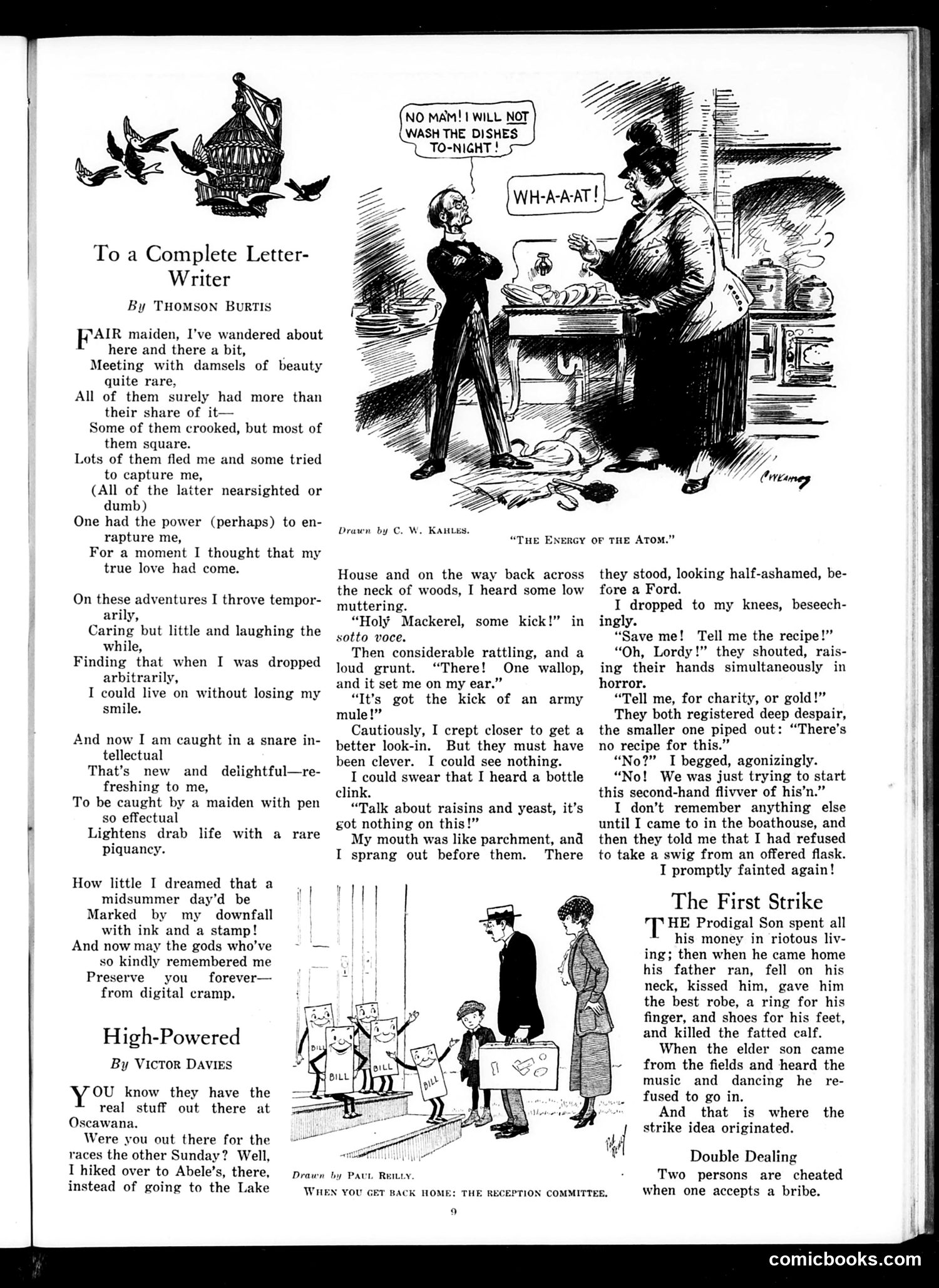
This cartoon satirizes domestic conflict over household chores. A defiant wife refuses to wash dishes, declaring "No Ma'm! I will not wash the dishes to-night!" while her exasperated husband responds with "Wh-a-aat!" The title's reference to atomic energy is the joke: the wife's refusal to perform her expected domestic duties is portrayed as releasing explosive, uncontrollable force—comparable to splitting an atom. The cartoon mocks both the wife's rebellion against traditional gender roles and the husband's shocked reaction to this challenge to domestic hierarchy. This reflects early-20th-century anxieties about changing women's roles and the challenge to Victorian domestic expectations, treating female assertion of independence as dangerously disruptive to the home.
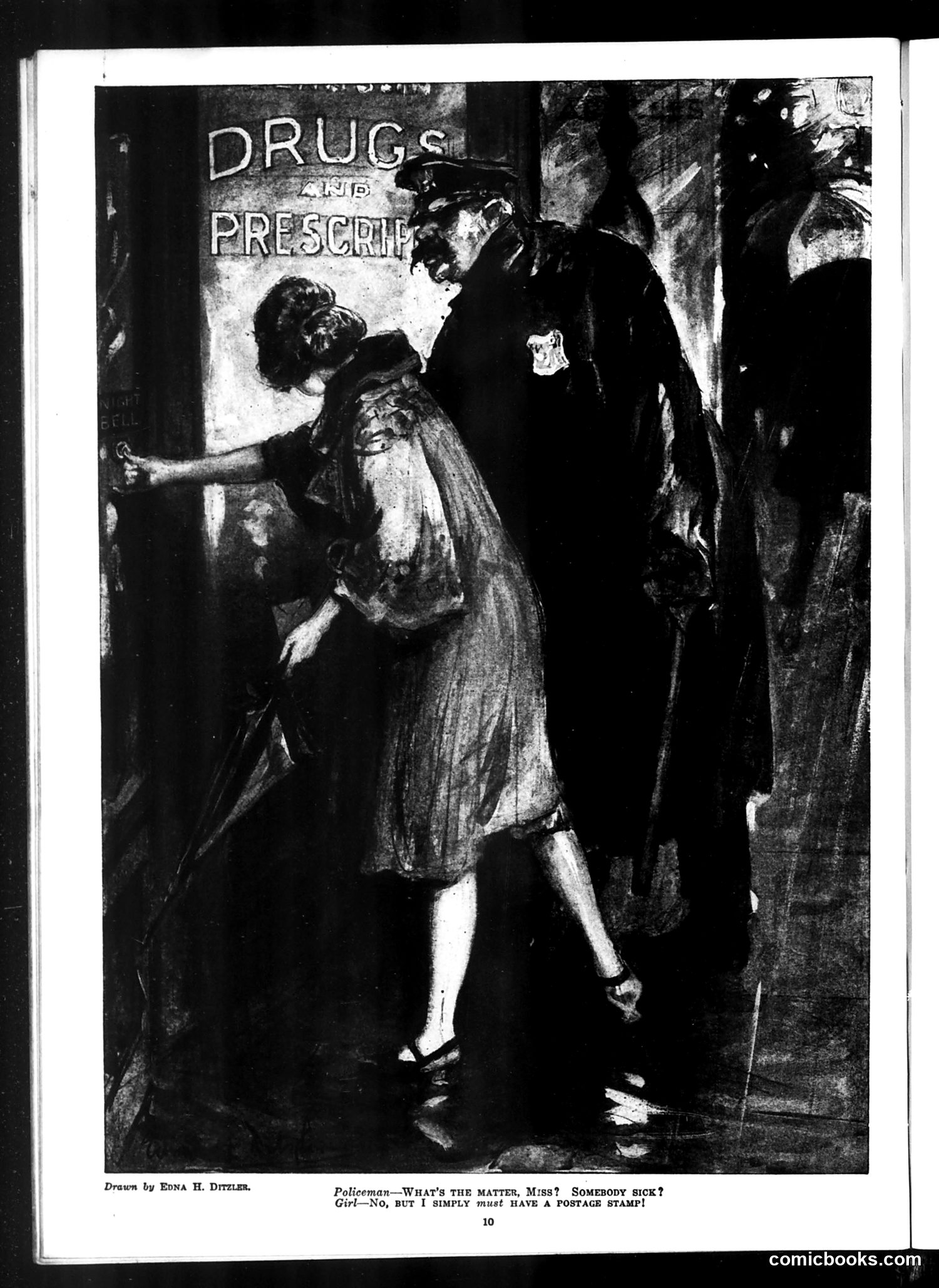
This cartoon by Edna H. Dittler satirizes drug store visits during an era (likely early 20th century) when drugstores functioned as general merchants selling sundries beyond pharmaceuticals. The joke centers on a woman's desperate need for a postage stamp, not medicine. A policeman, encountering her distressed appearance outside a "Drugs and Prescription" storefront, assumes illness. Her response—that she "simply must have a postage stamp"—plays on the absurdity of treating a minor errand as a medical emergency requiring a pharmacy visit. The satire mocks both the woman's dramatic demeanor over a trivial item and the drugstore's role as a catch-all merchant for everyday supplies, making the distinction between "pharmacy" and "general store" humorously blurred.
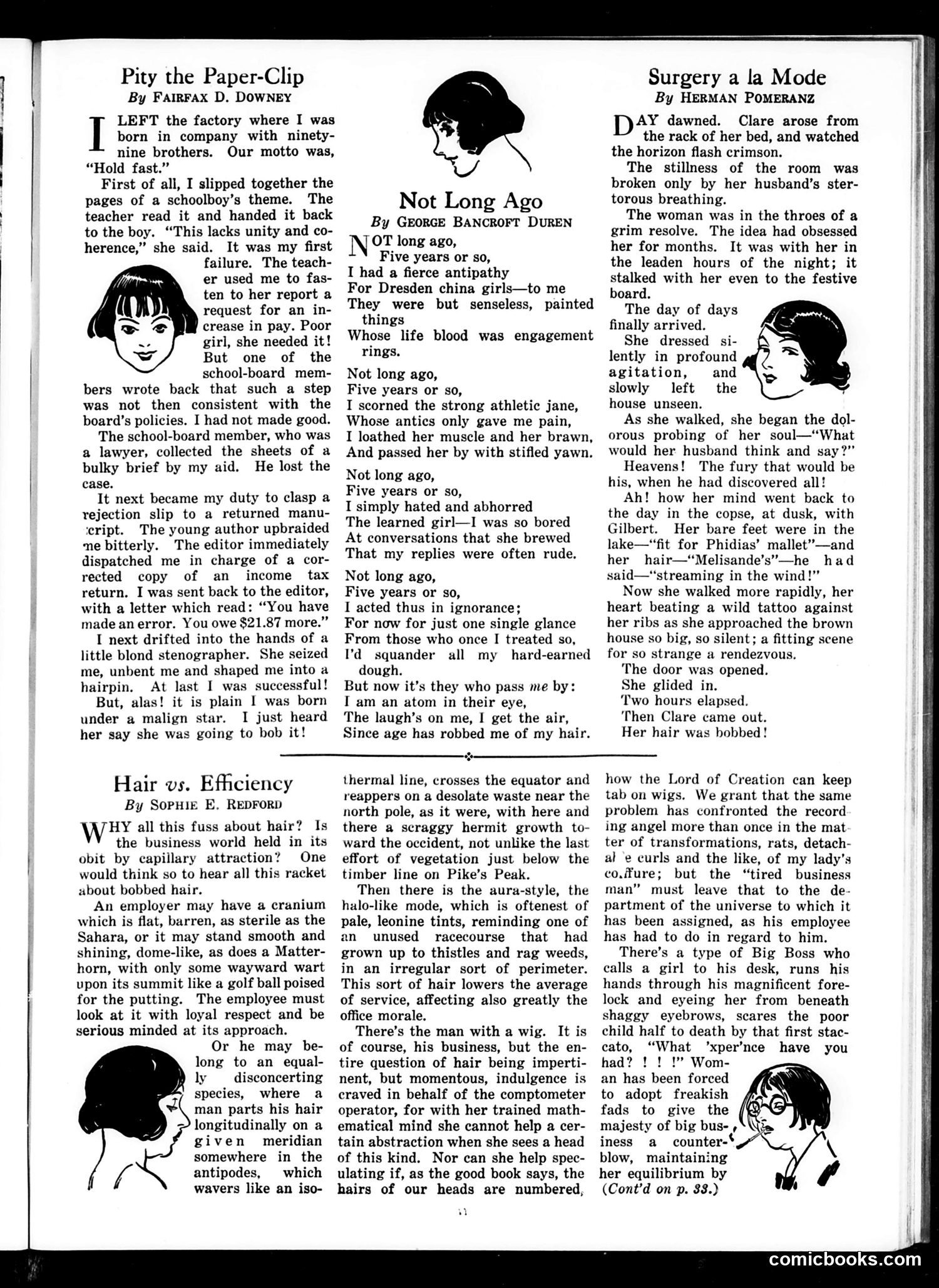
This page contains three satirical pieces reflecting 1920s workplace and social concerns: **"Pity the Paper-Clip"** (Downey): A humorous first-person narrative from a paper-clip's perspective. It's a commentary on bad luck and failure—the clip fails at holding together a school essay, loses a legal case, and only succeeds when repurposed as a hairpin, only to learn the woman plans to cut her hair (bobbing was fashionable then). **"Not Long Ago"** (Duren): A poem lamenting aging and baldness. The speaker once scorned various types of women (vain, athletic, intellectual), but now that he's lost his hair to age, those same women ignore him. It's satire on male vanity and how appearance determines social status. **"Hair vs. Efficiency"** (Redford): Social commentary mocking concerns about employees' hairstyles in business. The author ridicules the obsession with men's hair grooming (parting styles, wigs) in professional settings, arguing it shouldn't affect job performance or employer-employee respect. All three pieces satirize 1920s anxieties about appearance, aging, and changing social norms around grooming.
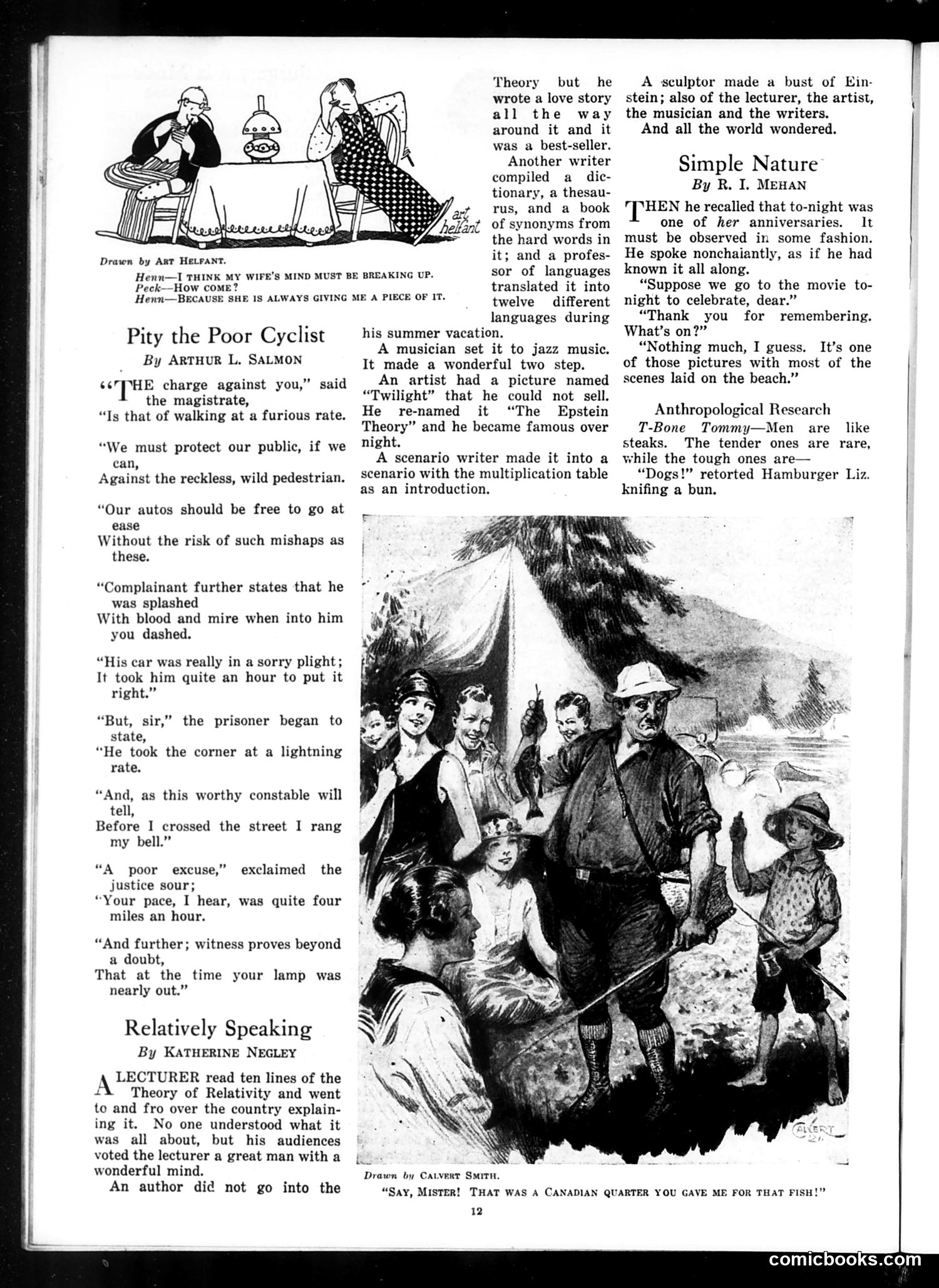
This page contains several short humorous pieces satirizing early 20th-century society: **"Pity the Poor Cyclist"** inverts expectations: a cyclist is prosecuted for traveling at a "furious" four miles per hour and damaging an automobile. The satire targets the car industry's emerging dominance and courts' bias toward motorists over pedestrians—a genuine social concern as automobiles became common. **"Relatively Speaking"** mocks the public's inability to understand Einstein's Theory of Relativity, yet their willingness to celebrate anyone claiming expertise. The piece satirizes how artists, musicians, and writers profit by slapping "Epstein Theory" branding onto existing work, exploiting intellectual prestige without comprehension. **"Simple Nature"** presents a brief domestic comedy about a husband pretending to remember an anniversary while suggesting a generic beach movie. **"Anthropological Research"** offers a quick pun: "T-Bone Tommy" compares men to steaks; "Hamburger Liz" retorts men are "dogs"—crude but period-appropriate wordplay. The cartoons illustrate these pieces with typical Judge-style illustrations reflecting 1920s aesthetics and social anxieties.
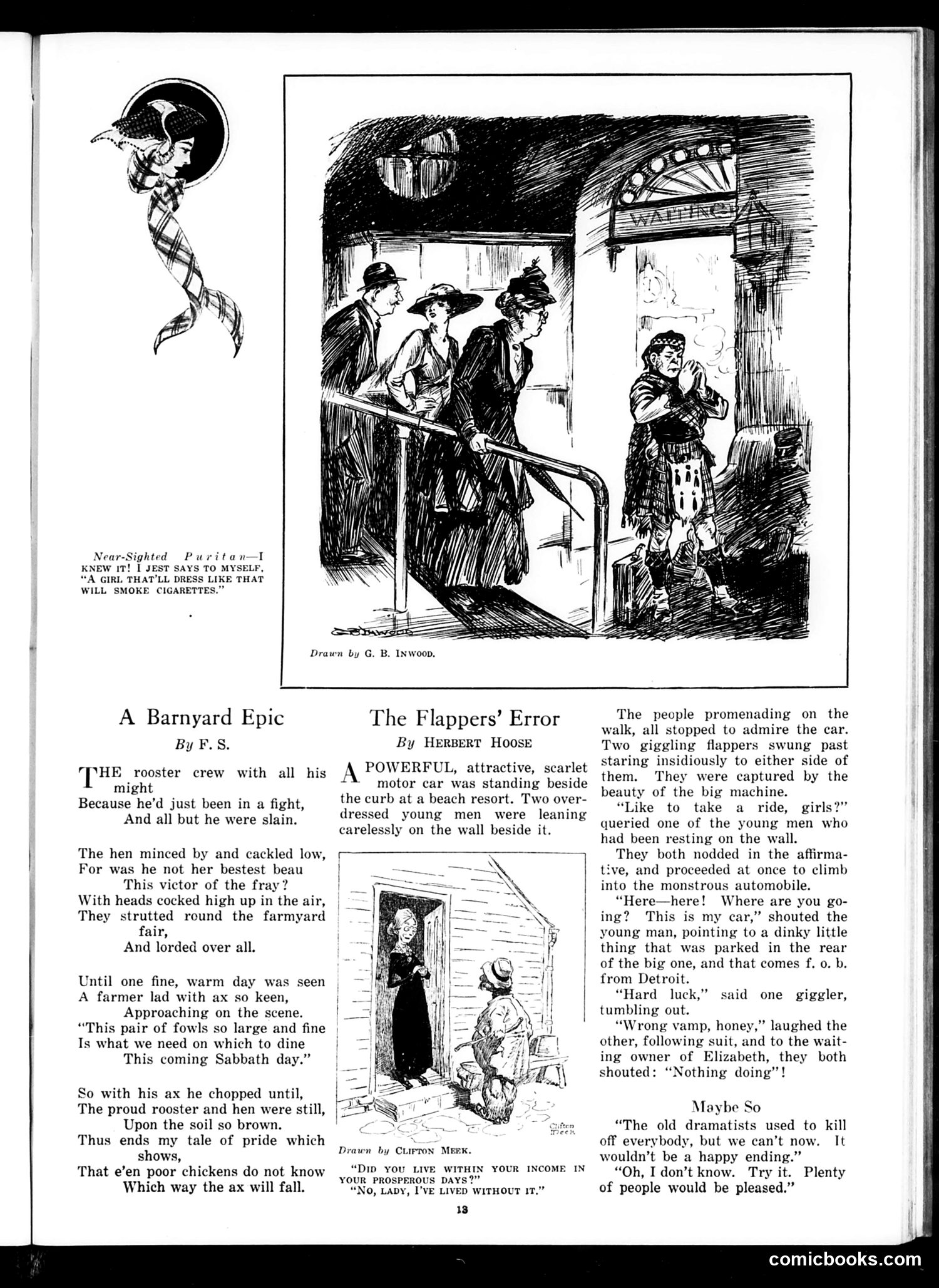
This page contains three separate humorous pieces satirizing early 20th-century social attitudes: **"The Flappers' Error"** (main cartoon): Young women ("flappers"—the modern, liberated women of the 1920s) are tricked by two men at a beach resort. The men invite them into an expensive scarlet motorcar, but it's not theirs—they're conning the girls into the wrong vehicle. The satire targets both the flappers' superficiality (easily distracted by material luxury) and the men's disreputable behavior. "Flapper" was period slang for independent young women who rejected Victorian propriety. **"A Barnyard Epic"**: A mock-heroic poem about a rooster and hen's pride before slaughter, moralizing that even animals don't foresee their doom—commentary on human vanity and fate. **"Maybe So"** (small cartoon): A cynical joke about modern theater being unable to kill off all characters (unlike classical drama) because audiences would enjoy it too much—dark social commentary on contemporary dissatisfaction. The "Near-Sighted Puritan" caption mocks prudish attitudes about women's fashion and smoking.
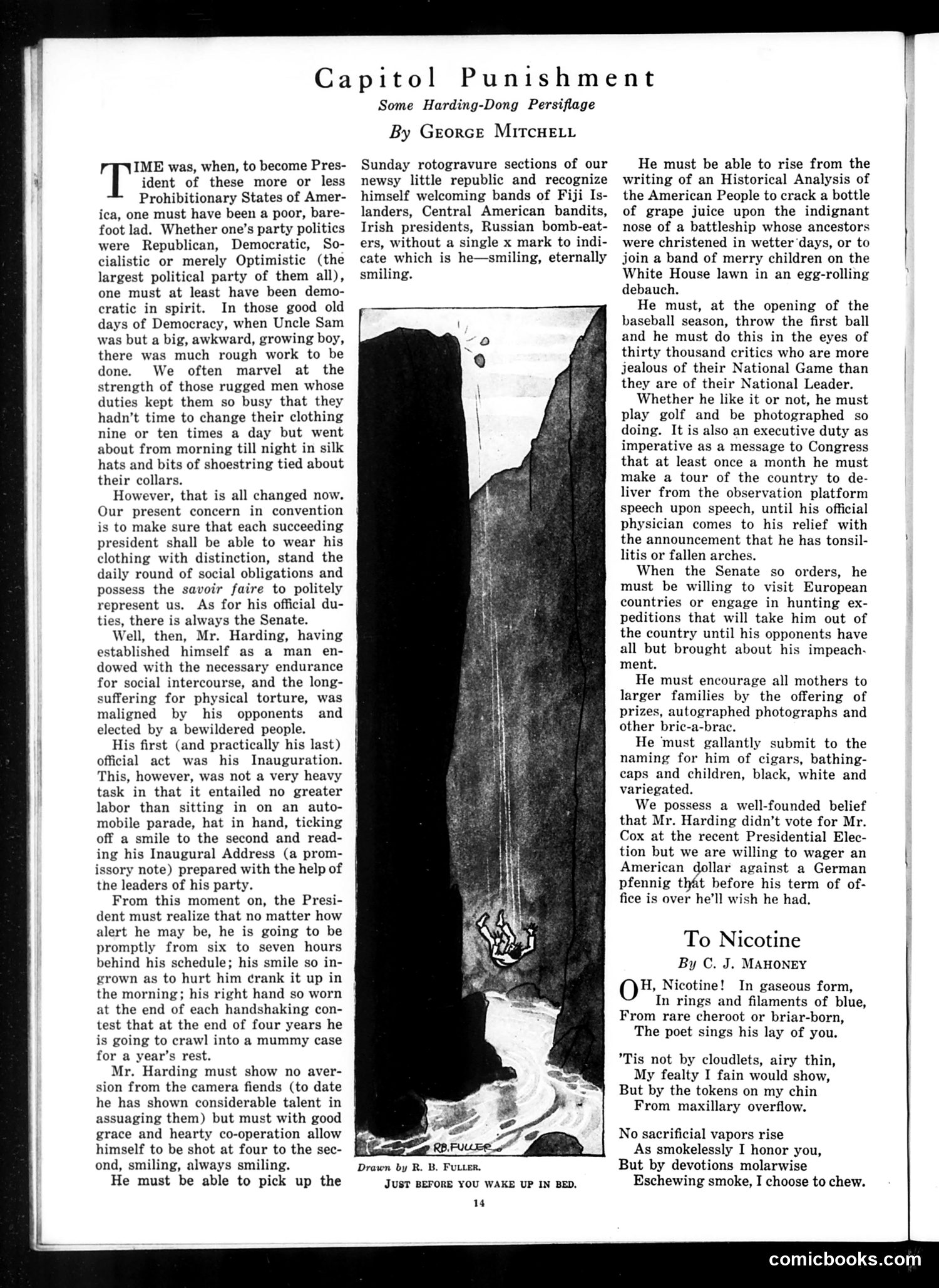
This article by George Mitchell satirizes President Warren G. Harding's inauguration and the exhausting ceremonial demands of the presidency. The cartoon (drawn by R.B. Fuller) depicts Harding appearing haggard, likely showing the physical toll of constant public appearances. Mitchell mocks how modern presidents must prioritize social performance over actual governance—constantly smiling, attending parades, throwing baseballs, playing golf, and being photographed. The article suggests the presidency has become theater: "As for his official duties, there is always the Senate," implying the real work is delegated elsewhere. The satire targets how Harding was elected more for his appearance and affability than competence, and how he must endure exhausting ceremonial obligations—handshaking contests, camera sessions, endless speeches—that will leave him "crawl[ing] into a mummy case for a year's rest" after four years. It's sharp political commentary on style over substance in American leadership.
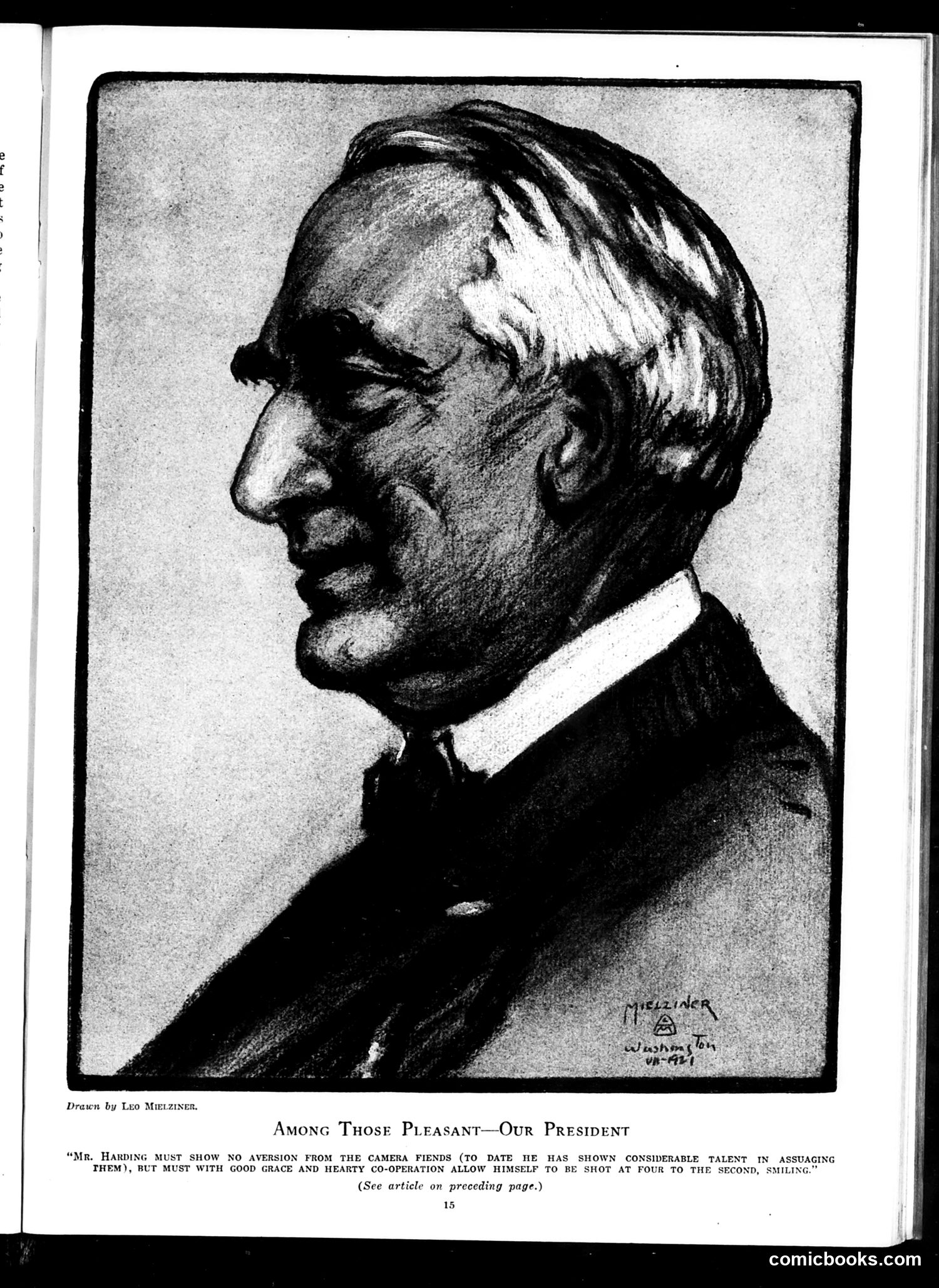
This is a profile portrait caricature of President Warren G. Harding, drawn by Leo Mietzinger. The caption titled "Among Those Pleasant—Our President" accompanies an article (referenced but not shown) discussing Harding's relationship with press photographers. The satire addresses Harding's need to cooperate with "camera fiends"—aggressive newspaper photographers of the era. The quoted text humorously suggests Harding must endure being photographed "four to the second" (extremely frequently) while maintaining composure and a smile, demonstrating good humor despite the invasive demands of press coverage. This reflects early 20th-century tensions between political figures and the emerging modern press apparatus, where photography had become central to public image-making and political communication.
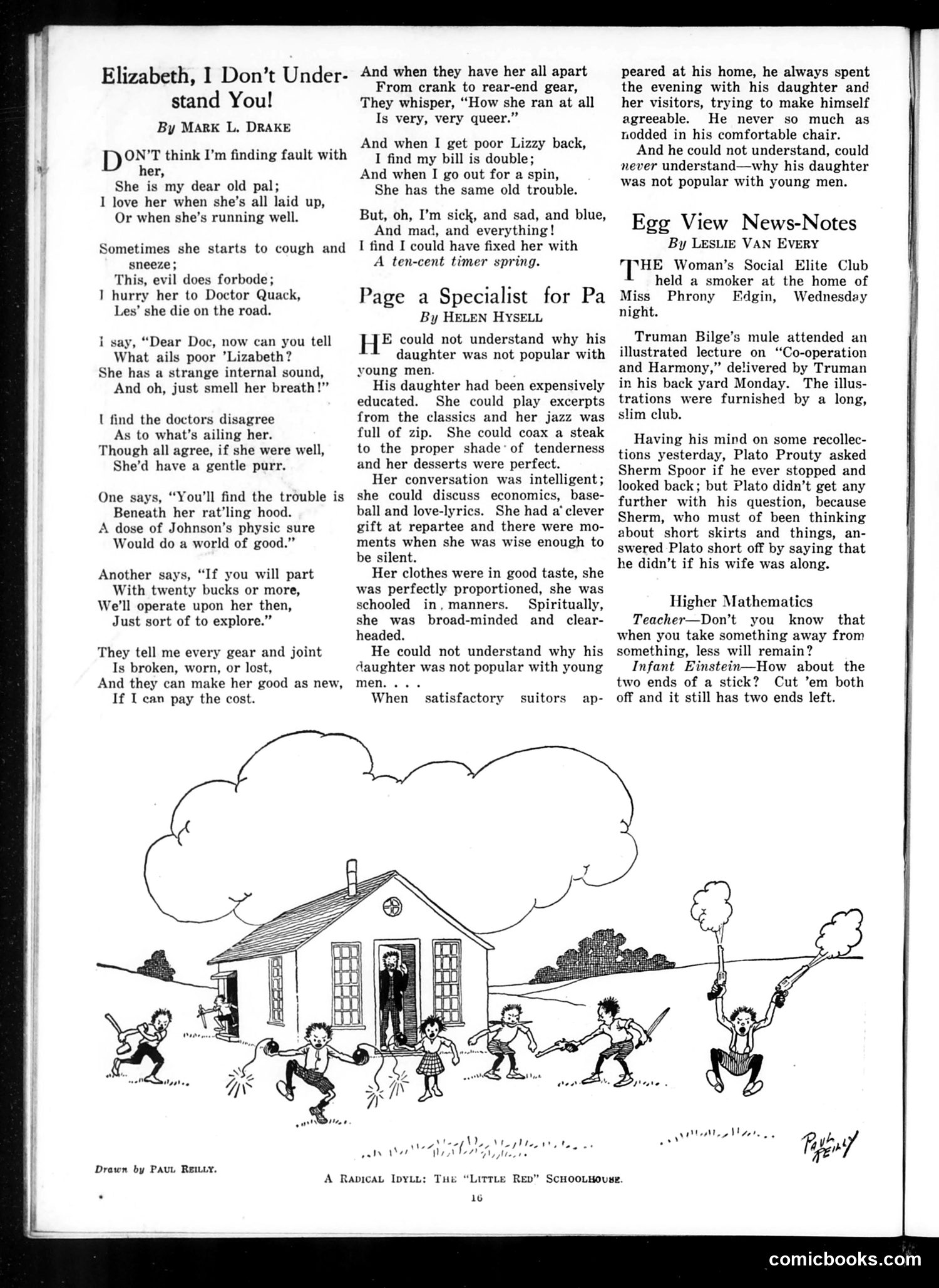
This page contains three satirical pieces typical of early 20th-century Judge magazine: **"Elizabeth, I Don't Understand You!"** mocks automobile ownership. "Lizabeth" is a car (likely a Model T Ford), and the poem satirizes the frustration of car maintenance—mechanics charging exorbitant fees for repairs, only to have the same problems recur. The joke's payoff: the real problem was worth only ten cents. **"Page a Specialist for Pa"** critiques fathers who sabotage their daughters' romantic prospects. An expensively educated, accomplished daughter remains unpopular with suitors because her father constantly inserts himself into her social time, sitting silently in the room—oblivious to why his presence deters young men. **The remaining items** are brief humorous "news notes" and a math joke about children's literal logic. The cartoon below illustrates a "radical" one-room schoolhouse with children playing outside—apparently commenting on progressive education ideas of the era. These pieces reflect common domestic and social frustrations of the period: automotive troubles, courtship rituals, and educational debates.
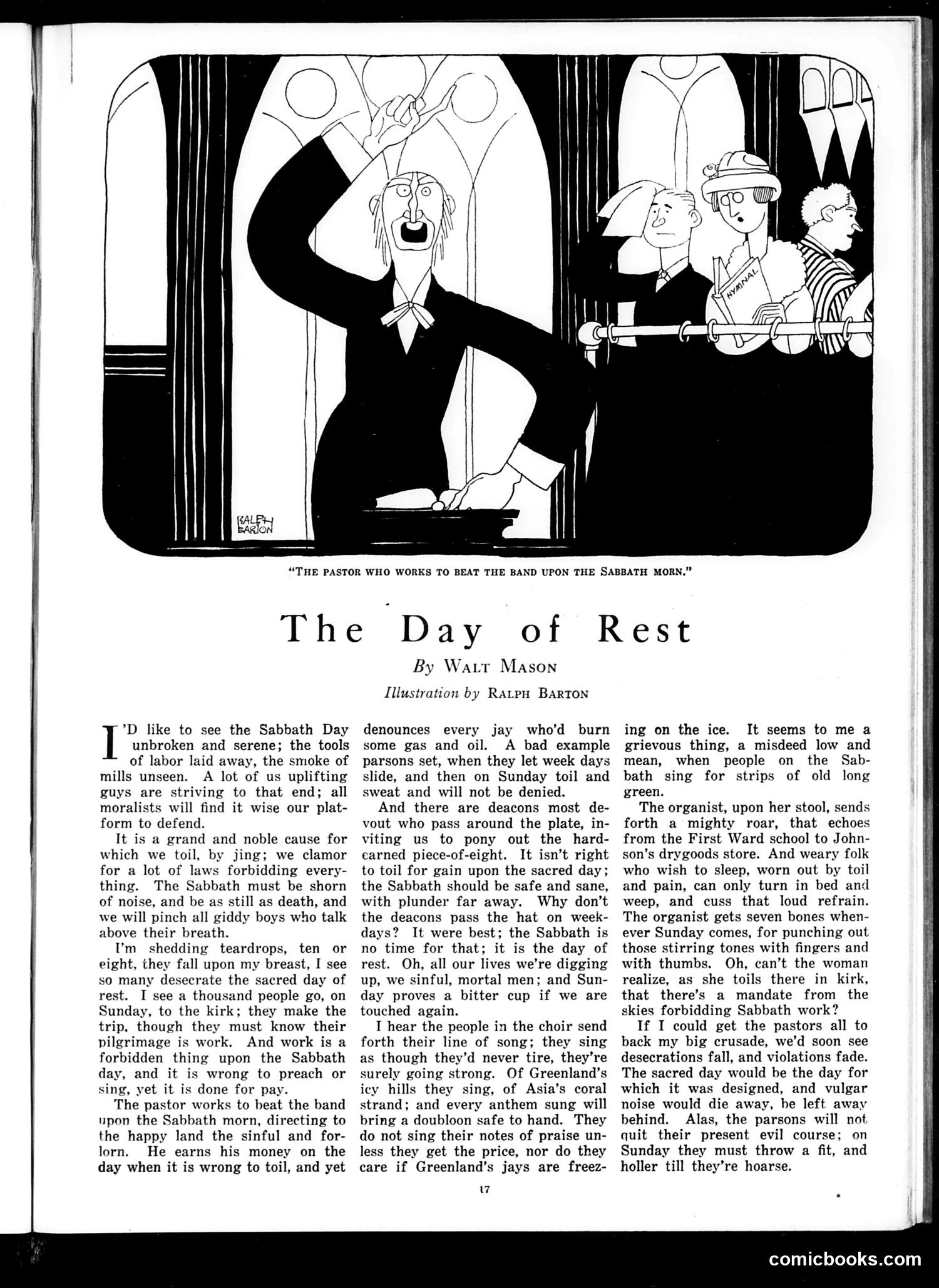
This page satirizes religious reformers who demand strict Sabbath observance while ignoring their own violations. The cartoon's caption shows a pastor energetically conducting music on Sunday morning—the very "work" he likely condemns in others. Writer Watt Mason's poem mocks the contradiction: reformers rail against Sunday labor as sinful, yet pastors, organists, choir members, and deacons all work on the Sabbath—collecting payment ("strips of old long green," meaning money) for their services. The narrator sarcastically supports these reformers' crusade while listing their obvious hypocrisy. The satire targets both the self-righteousness of Sabbath-restriction advocates and the clergy's complicity in violating the very rules they preach. It's a pointed critique of selective morality: condemning ordinary people's Sunday activities while profiting from religious work themselves. Ralph Barton's illustration reinforces this through the pastor's theatrical gesture, suggesting performative piety rather than genuine principle.
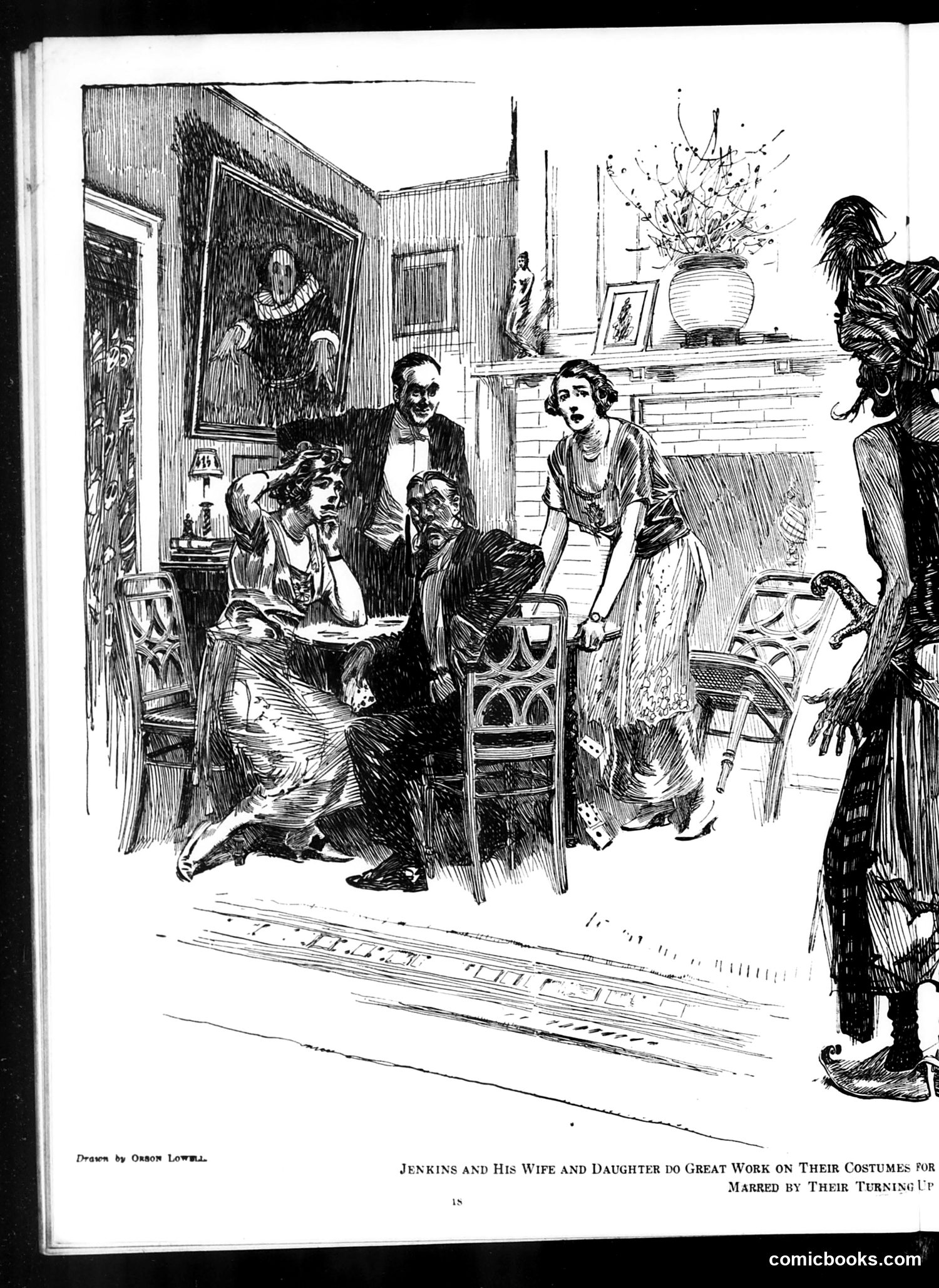
This illustration by Orson Lowell depicts a domestic scene where a man (Jenkins) and two women (presumably his wife and daughter) are working on costumes. The caption suggests they're preparing elaborate outfits for an event, with the phrase "marred by their turning up" implying the humor comes from some mishap or unexpected occurrence related to their costume preparations. The scene shows an upper-class interior with period furnishings, a portrait on the wall, and decorative elements. The figures' expressions and body language suggest comedic tension or embarrassment about their costume project going awry. Without additional context about the specific event or social reference being satirized, the exact satirical point remains unclear—though it likely comments on domestic life, fashion obsession, or social pretension among the leisure class, common Judge magazine targets.
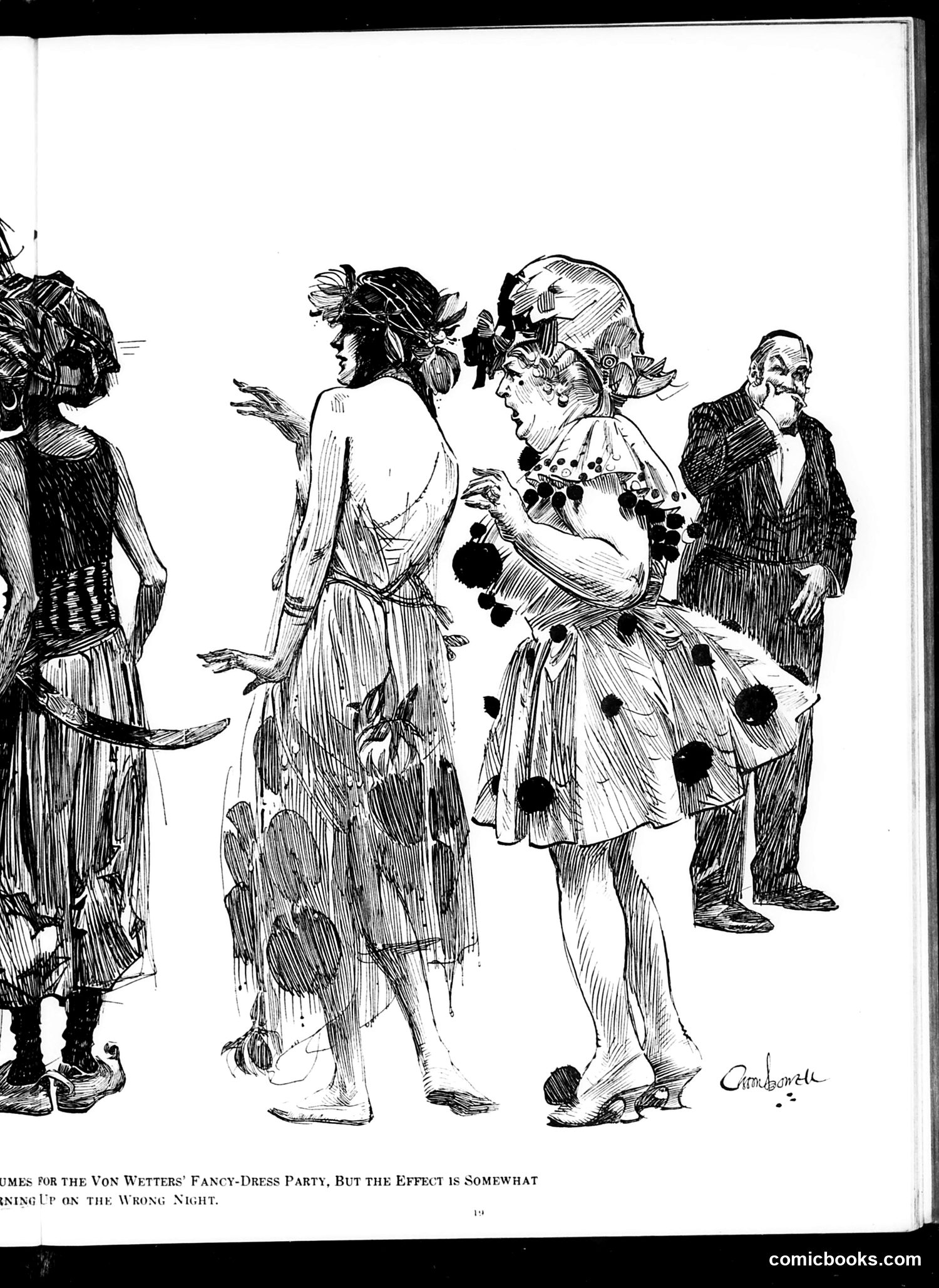
This satirical sketch depicts guests arriving at a formal fancy-dress party in elaborate costumes. The caption indicates the humor: guests wore impressive costumes intending for the Von Wetters' event, but "the effect is somewhat...coming up on the wrong night"—suggesting they arrived at an unintended venue or occasion, making their elaborate disguises absurdly inappropriate or out of place. The drawing shows several figures in period dress (appearing early 20th century), with one woman prominently featured in a polka-dotted costume. The joke targets social embarrassment and the awkwardness of mistiming or misdirection at high-society gatherings. The satire pokes gentle fun at wealthy socialites and their formal entertainment culture.
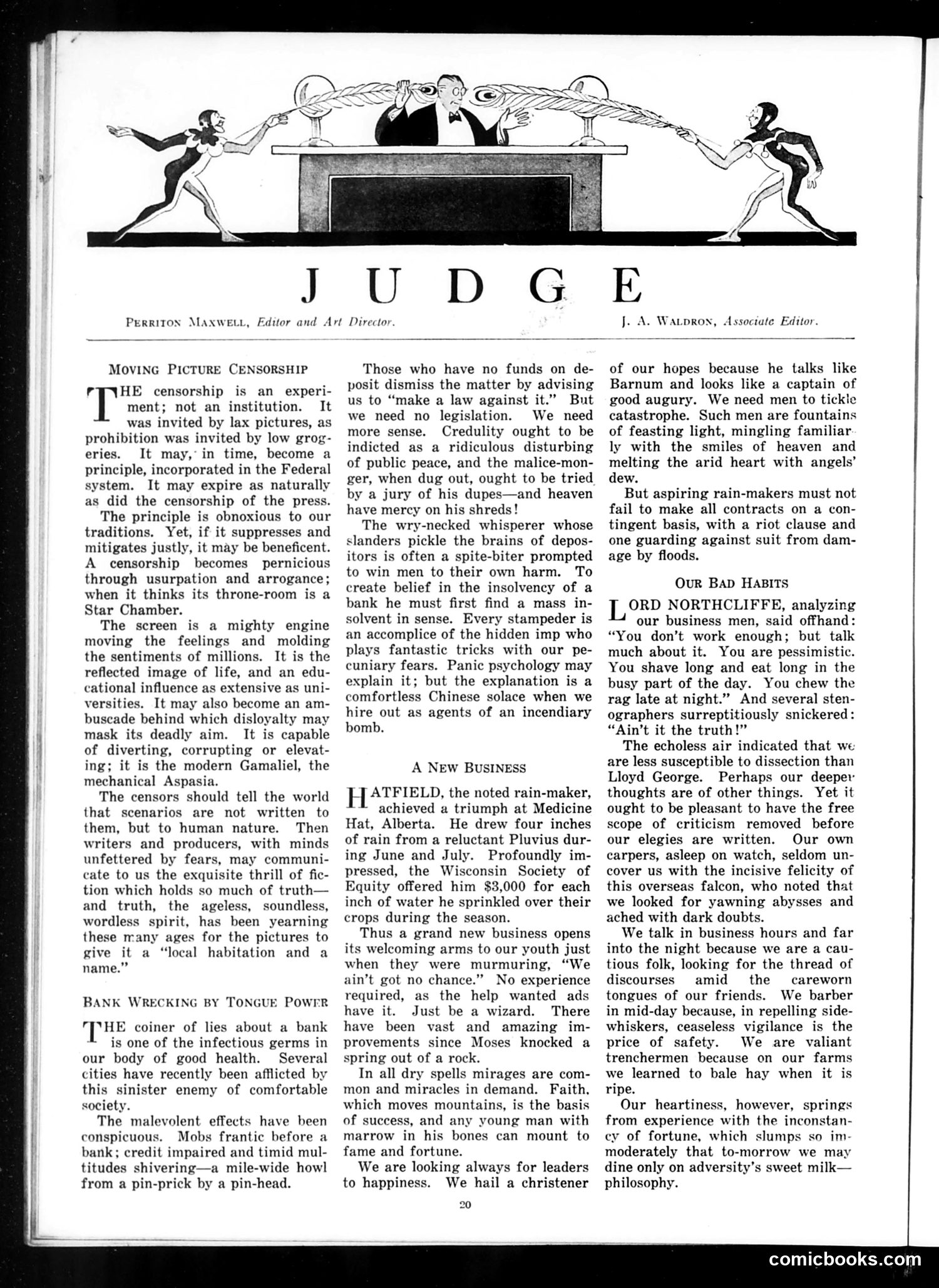
This is an editorial page containing three opinion pieces by Perriton Maxwell and J.A. Waldron, editors of *Judge* magazine. **The masthead illustration** shows two muscular figures flanking three men in formal dress at what appears to be a judge's bench, representing the magazine's satirical commentary role. **Content focus:** 1. **Moving Picture Censorship**: The editors debate film censorship as a new experiment—necessary to control "lax pictures" but potentially dangerous if it becomes tyrannical (comparing it to a "Star Chamber"). They argue the screen is powerful enough to corrupt or elevate society, so censors should consider human nature, not just rules. 2. **Bank Wrecking**: Commentary on how false rumors about banks cause panic runs. The piece mocks both the "malice-monger" spreading lies and the credulous masses who believe them, urging sense over legislation. 3. **A New Business**: Satirical praise for rainmaker "Hatfield," who successfully produced rain in Alberta. The editors mock the absurdity of a new "business" promising easy money to gullible youth, comparing it to faith-based miracles. The tone is moralistic, warning against credulity and manipulation in modern society.
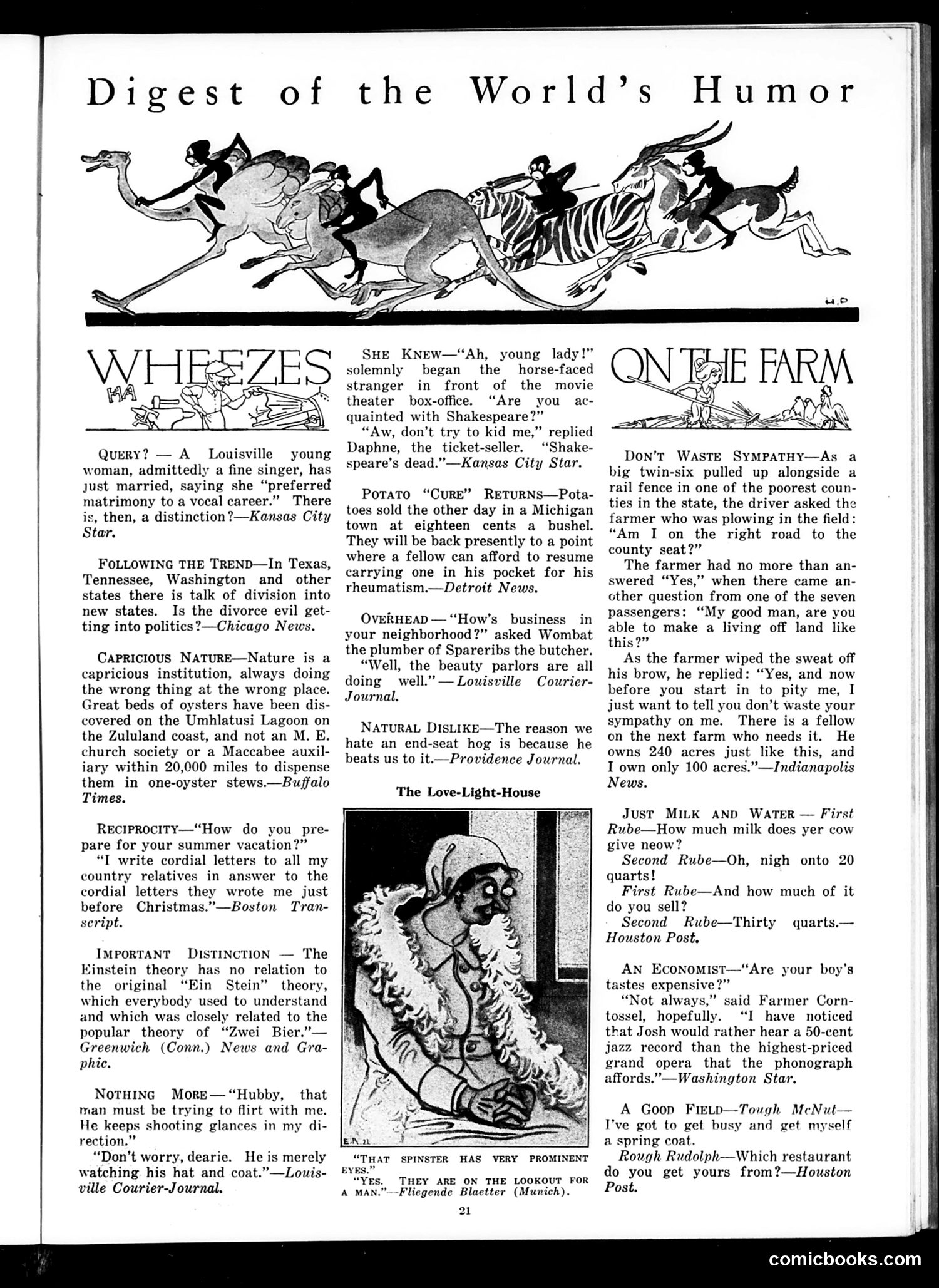
This page contains brief humorous anecdotes and jokes typical of early 20th-century American satirical magazines. The items mock various social pretensions and absurdities: **Key targets include:** - Women sacrificing careers for marriage ("preferred matrimony to a vocal career") - Political division movements in multiple states (treating state fragmentation like divorce) - Nature's ironic placement of oysters far from church societies that would "dispense them" - Summer vacation etiquette and reciprocal letter-writing obligations - Confusion between Einstein's relativity theory and wordplay about "Ein Stein" (beer) - A theater ticket-seller's dismissal of Shakespeare as "dead" (mock ignorance) - Potato price fluctuations affecting folk remedies - Rural poverty contrasted with wealthy landowners - Watered-down milk sales and inflated quart claims - Working-class boys preferring cheap jazz records to expensive opera **The cartoon** (top) depicts people riding exotic animals in chaotic motion, likely satirizing frivolous entertainment or reckless behavior. The humor relies on class commentary, wordplay, and exaggerated rural/urban stereotypes typical of period publications.
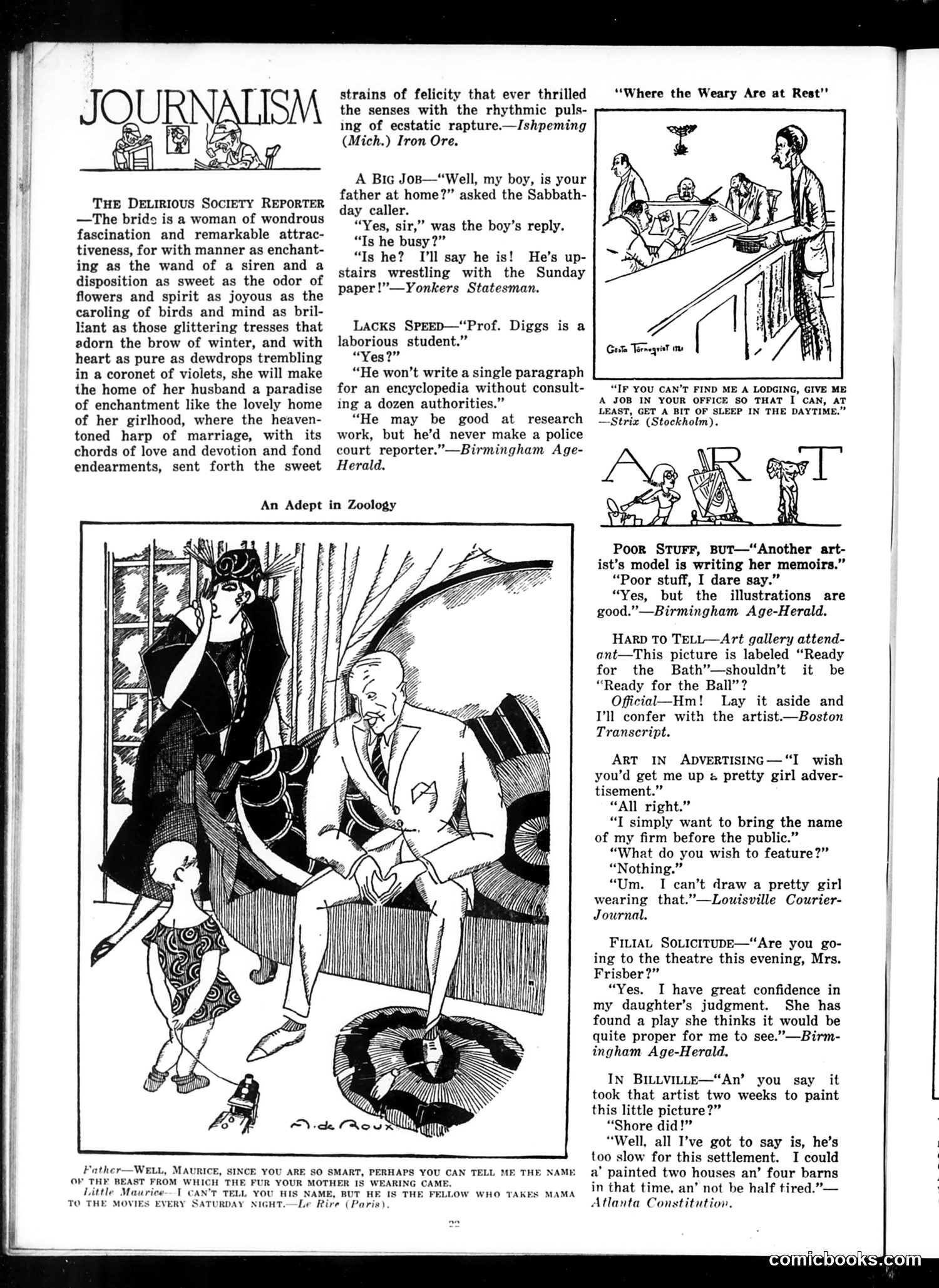
This page comprises humorous short jokes and a cartoon rather than political satire. The content reflects early 20th-century American domestic life and professional concerns. **The main cartoon** ("An Adept in Zoology") shows a father identifying an animal fur. The joke plays on the father's inability to identify the beast—he knows only that it's "the fellow who takes mama to the movies every Saturday night," implying the mother's social activities with another man. **The text jokes** mock various professions and social situations: a boy whose father wrestles with Sunday newspapers (relatable domestic humor); a professor too meticulous for journalism; an artist's model writing memoirs; gallery labeling errors; and advertising that demands pretty girls without substance. The recurring theme is incompetence or absurdity in work and domestic life. The page primarily offers lighthearted entertainment rather than pointed social criticism—typical of Judge's miscellaneous humor sections aimed at middle-class readers.
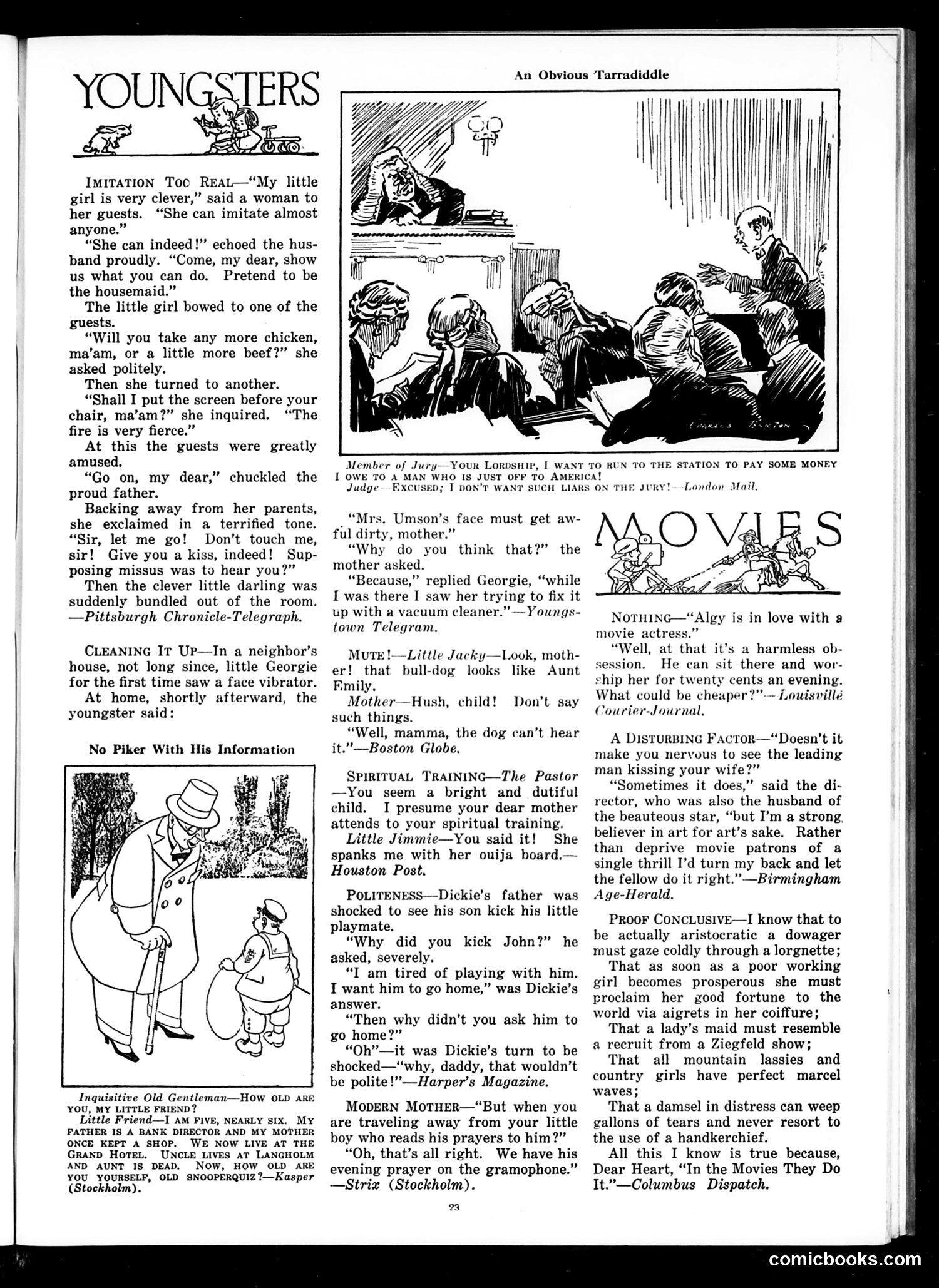
This page collects humorous anecdotes about children's innocent misunderstandings and verbal gaffes, popular filler content in early 20th-century magazines. **Key jokes:** - **"Imitation Toc Real"**: A girl "imitates" the housemaid by mimicking servants' polite speech, then shocks parents by imitating a servant being sexually harassed—exposing the uncomfortable reality of domestic workers' vulnerability. - **"Cleaning It Up"**: A child misinterprets a vibrator (a then-novel beauty device) as a cleaning tool, humorously reflecting confusion over new technology. - **"Spiritual Training"**: A child says his mother teaches him spirituality by spanking with an ouija board—conflating religious instruction with punishment. The humor relies on children's literal interpretations exposing adult hypocrisy, ignorance of modern devices, and social awkwardness. The "Jury" cartoon mocks someone's verbose, self-aggrandizing biography. These represent typical "cute kid" humor of the era, mining children's bluntness for satire of adult pretense.
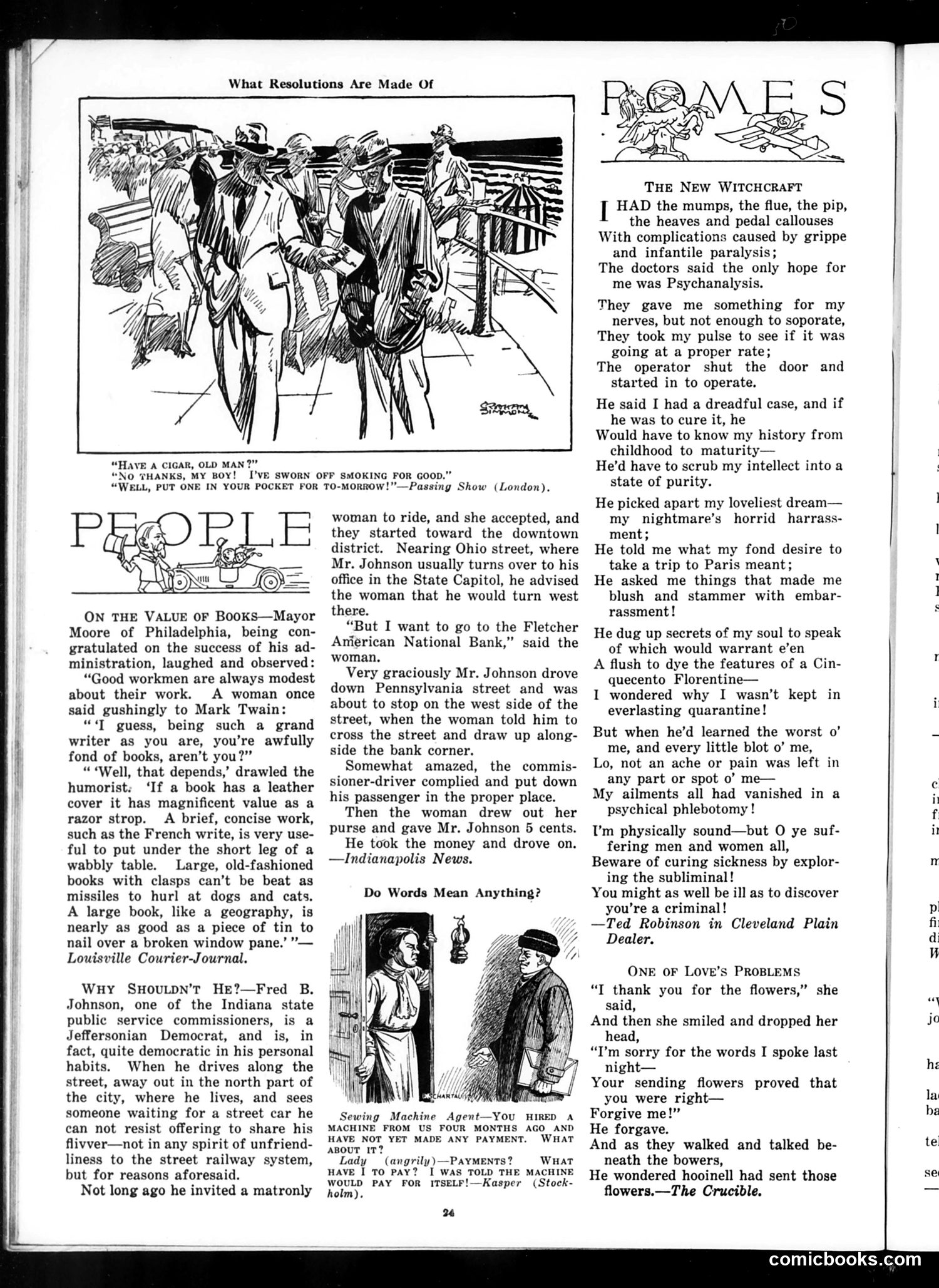
This Judge magazine page mocks psychoanalysis—then a novel and fashionable treatment. The poem "The New Witchcraft" compares Freudian analysis to medieval witchcraft, presenting it as intrusive pseudoscience. The analyst interrogates the patient about embarrassing dreams, desires, and secrets from childhood, ostensibly to cure physical ailments (mumps, flu, paralysis). The joke's punchline: after this humiliating "scrubbing" of the intellect, the patient's symptoms vanish—implying the cure is psychological theater rather than genuine medicine. The other anecdotes mock human nature: a man who quits smoking but keeps cigarettes for tomorrow; a woman who assumes a sewing machine will "pay for itself"; and a bank patron who tips a Democratic official 5 cents for a ride—subverting his charitable gesture. Together, these pieces satirize modern pretension, human inconsistency, and dubious new fads, particularly Freudian psychology's then-controversial prominence.
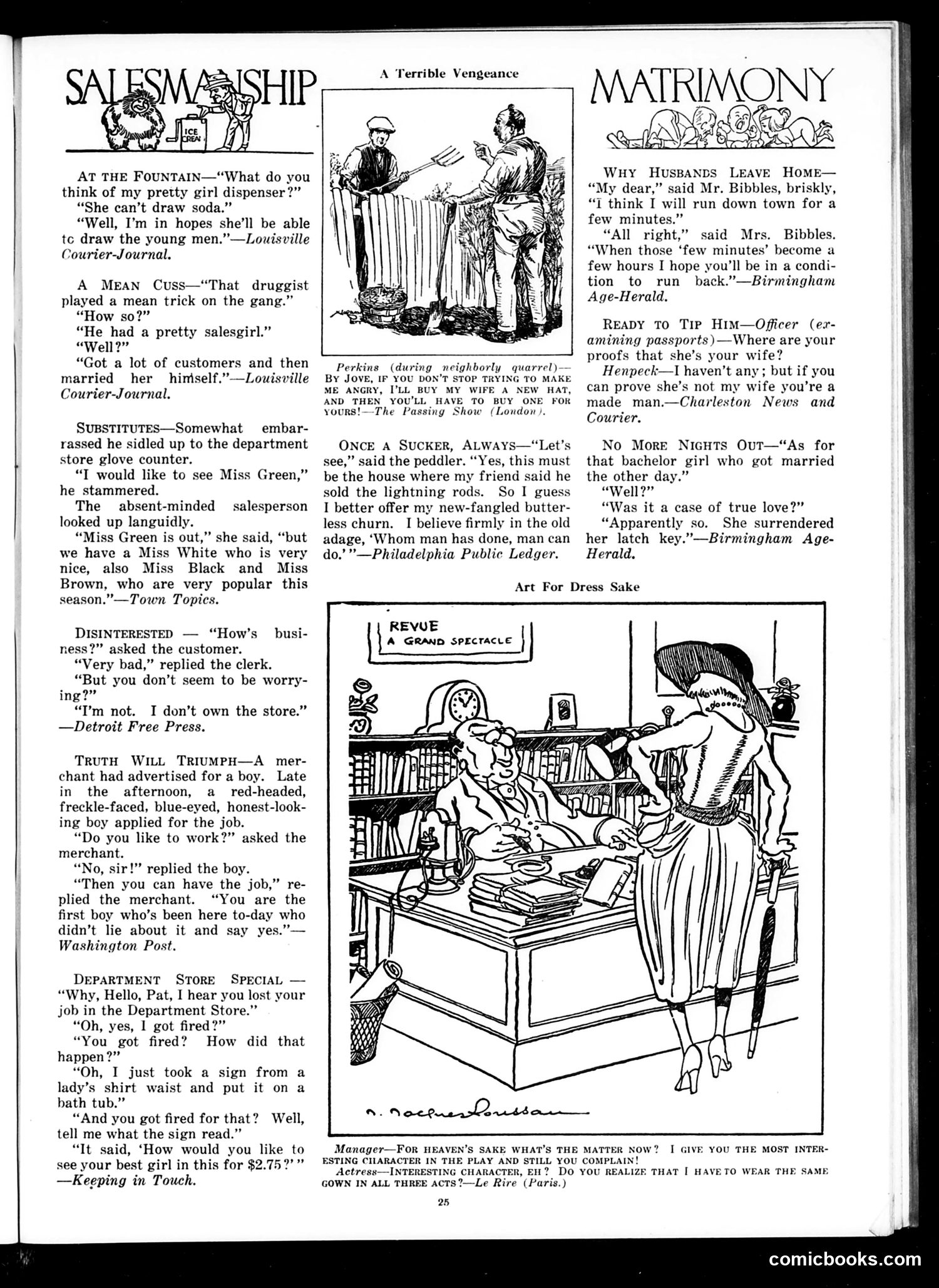
This page from Judge magazine (early 20th century) contains brief humorous anecdotes and one cartoon, organized under three sections: "Salesmanship," "Matrimony," and "Art for Dress Sake." The jokes target common social situations: drug store employees, department store mishaps, and marital dynamics. Most satirize workplace absurdities and gender relations typical of the era—men pursuing salesgirls, wives resenting husbands' excuses to leave home, and the "henpecked husband" trope. The cartoon depicts a theater manager arguing with an actress who complains she must wear the same gown across three acts. Her concern prioritizes fashion over character development, satirizing actresses' vanity and the superficiality of theatrical productions. The humor relies on puns, reversal of expectations, and stereotypes about shopgirls' attractiveness, wives' nagging, and women's frivolousness—typical Judge magazine fare reflecting period attitudes toward gender and commerce.
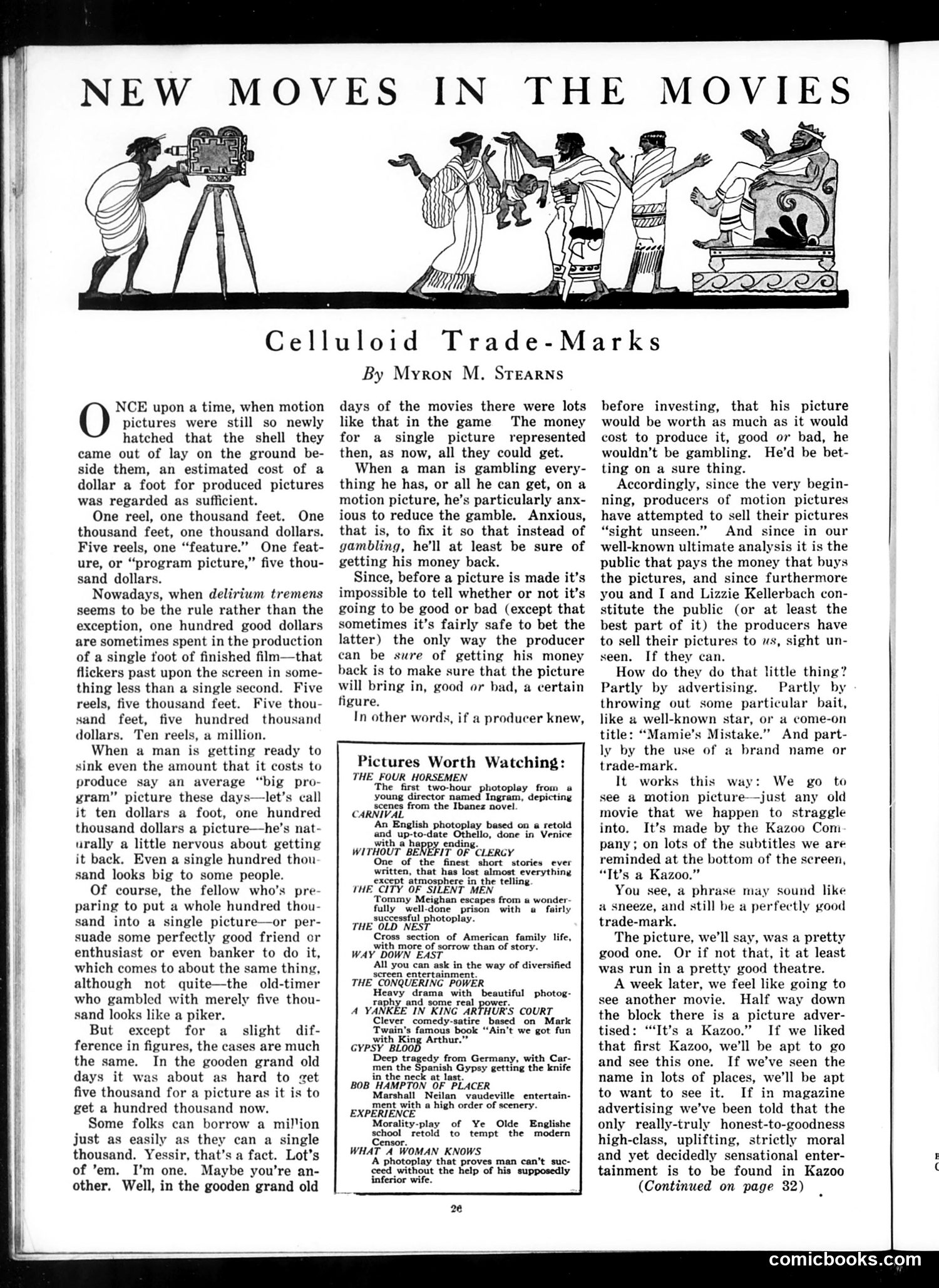
This article by Myron M. Stearns satirizes the film industry's economic anxiety and attempts to manage risk through brand-name recognition and advertising. The piece describes how early cinema operated on minimal budgets (one dollar per foot), but by the 1920s, producers were spending massive sums—up to hundreds of thousands of dollars per picture—making investors extremely nervous about recouping costs. The satire's central point: since producers cannot predict whether a film will be good or bad before production, they resort to using famous actors and recognizable stories as "trade-marks" to guarantee box-office returns. The author illustrates this by noting how films are marketed using brand names and celebrity appeal rather than merit, converting filmmaking from artistic endeavor into calculated financial gambling disguised as certainty. The accompanying "Pictures Worth Watching" box lists contemporary films, exemplifying the trade-mark strategy itself.
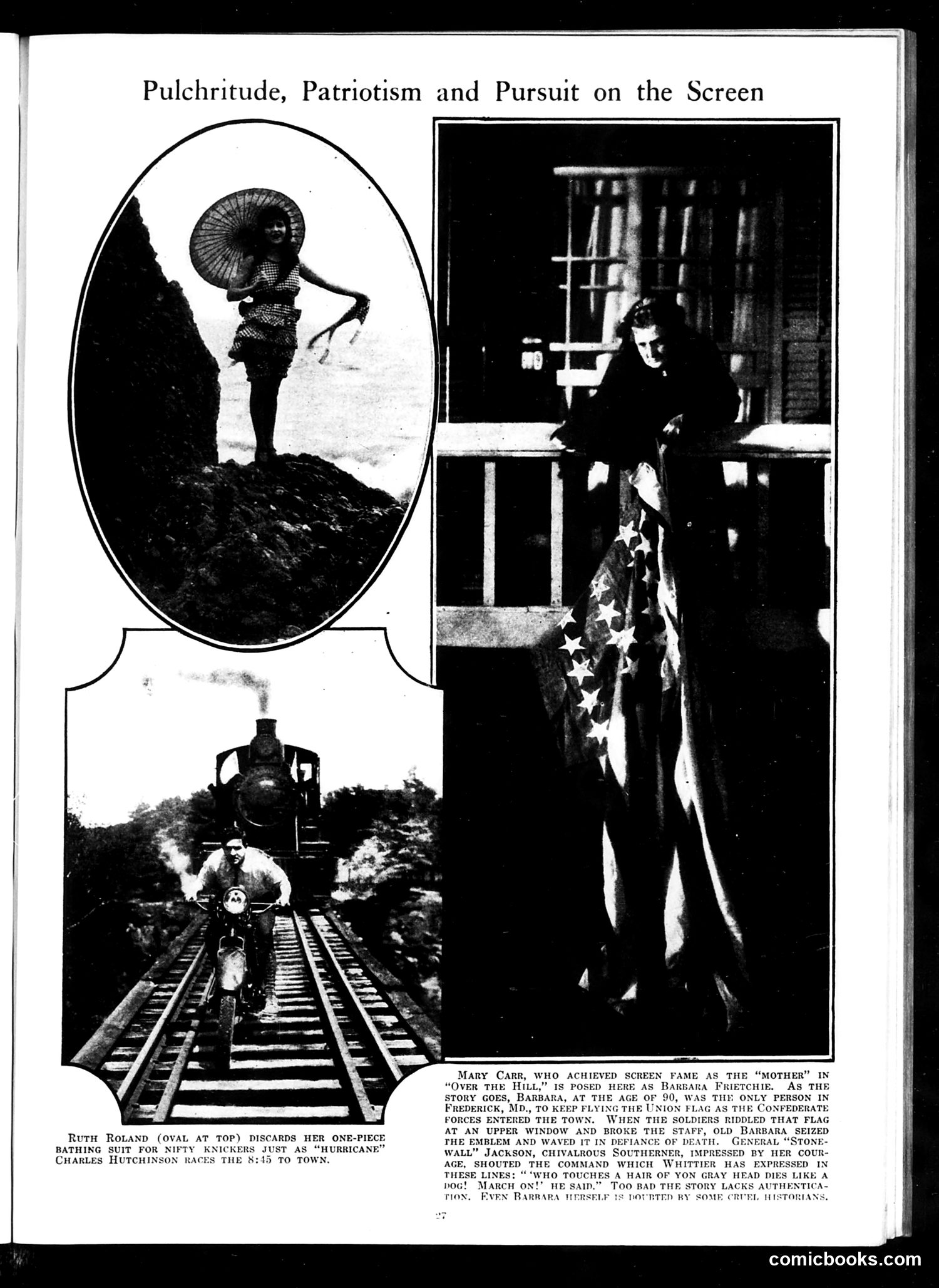
This page showcases early silent film adaptations of American narratives. The three images celebrate actresses in popular movies: **Top left (Ruth Roland)**: Shows an actress in a bathing suit scene from "Hurricane," emphasizing the physical action and costume changes that drew audiences. **Bottom left (Charles Hutchinson)**: Depicts a chase sequence—"races the 8:15 to town"—highlighting the pursuit-based action plots common to early cinema. **Right (Mary Carr as Barbara Fritchie)**: Features the legendary 90-year-old woman who defiantly waved the Union flag at Confederate soldiers during the Civil War. The text notes this patriotic story, immortalized in John Greenleaf Whittier's poem, was adapted for screen, though some historians questioned its authenticity. The page's title—"Pulchritude, Patriotism and Pursuit"—ironically groups these films: emphasizing actresses' beauty, patriotic historical drama, and action-adventure narratives as the era's dominant screen entertainment.
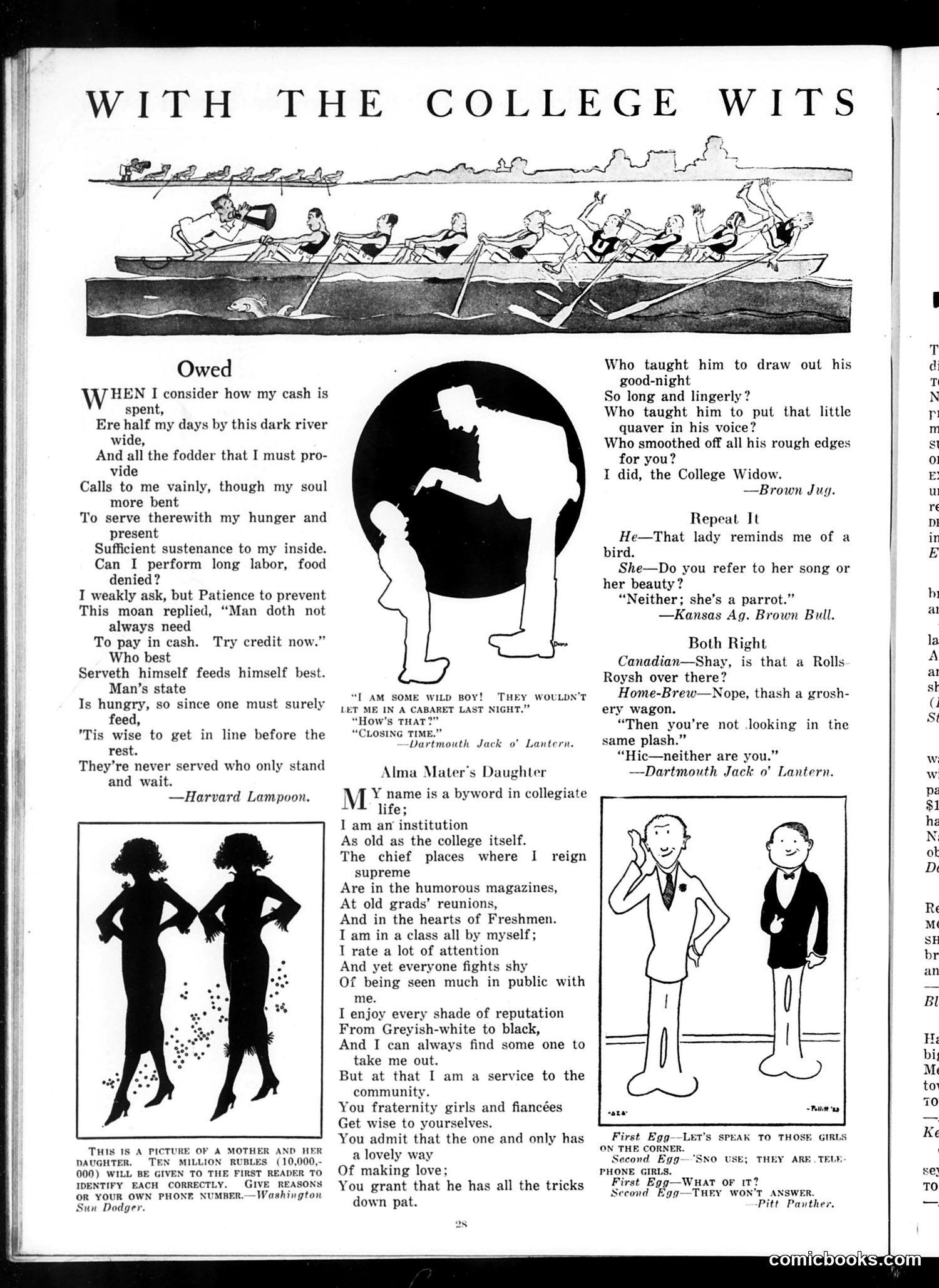
This page collects humorous verse and jokes from college humor magazines (Harvard Lampoon, Brown Jug, Dartmouth Jack o'Lanterns, etc.), showcasing undergraduate wit of the era. **Main satire:** The "Alma Mater's Daughter" poem personifies the "College Widow"—a stock character of early 20th-century college life: a woman (often older, of ambiguous status) who circulates among fraternities, dating freshmen and helping polish their romantic skills. The poem sardonically credits her as an "institution" providing "service to the community" while noting she's simultaneously sought-after and socially stigmatized ("everyone fights shy / Of being seen much in public with me"). **Other jokes** target trivial campus life: credit versus cash, fraternity dating dynamics, and a mild Canadian accent joke. The silhouettes and cartoon drawings are decorative rather than specifically satirical. **Context for moderns:** The "College Widow" reflects anxieties about women's independence and sexual availability in the Jazz Age, treated here with knowing undergraduate irreverence rather than moral outrage.
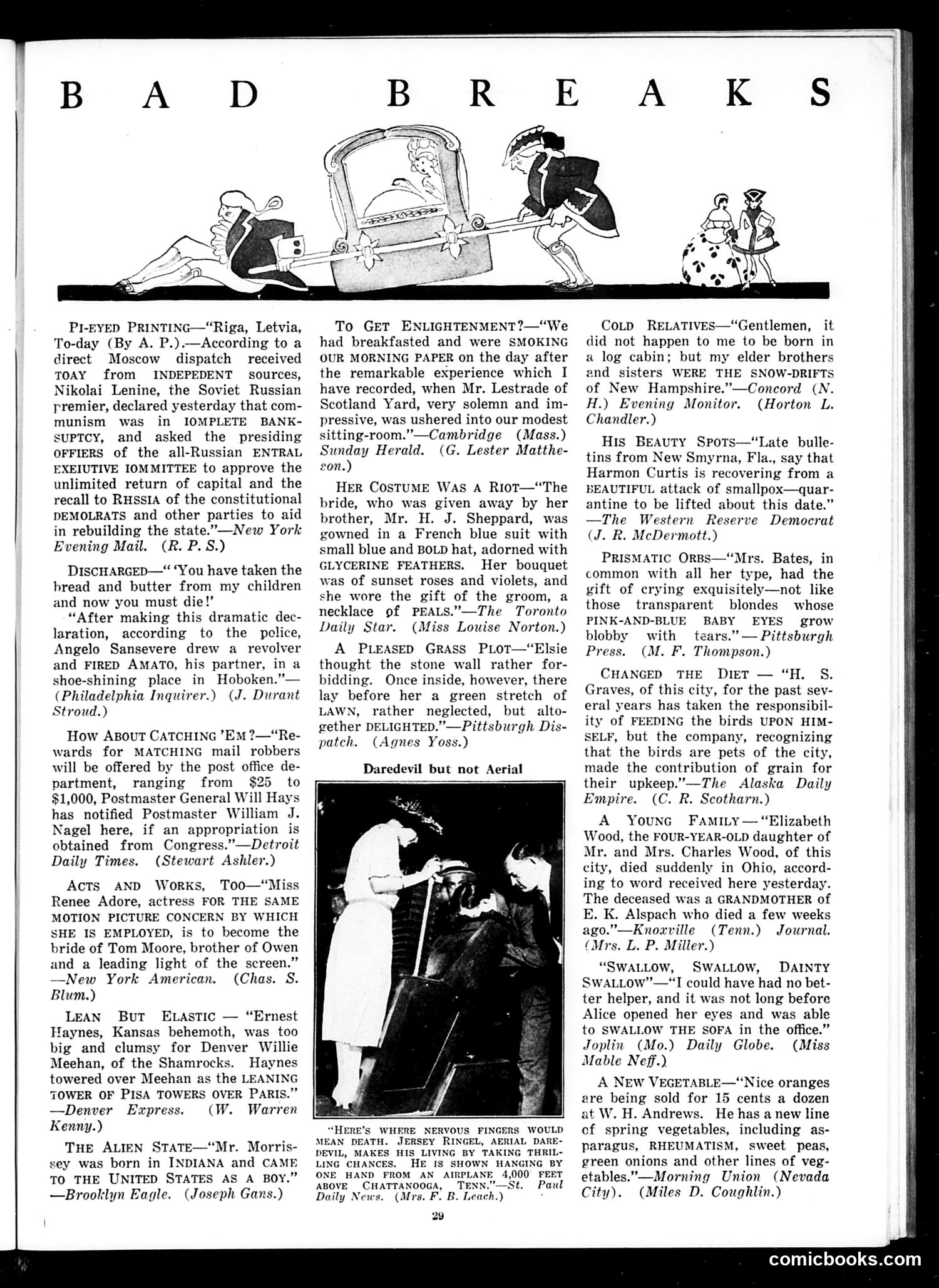
This page from *Judge* magazine is a humor collection based on newspaper **printing errors and garbled prose**. The cartoon at top shows a chaotic printing press accident—the visual joke depicting literal "bad breaks" in typesetting. The text columns collect real newspaper clippings with absurd OCR-style errors or typographical mishaps, which *Judge* highlights in capitals. Examples include: - A Soviet dispatch claiming Lenin admitted communism was in "IOMPLETE BANKRUPTCY" - Reports of people literally "SMOKING OUR MORNING PAPER" - Objects that are "DELIGHTED" (instead of delightful) - Glycerine feathers and pearls that are "PEALS" The humor relies on readers recognizing the garbled text doesn't match reality—mocking both newspaper sloppiness and the emerging unreliability of wire-service reporting (note references to Moscow dispatches during early Soviet period). The photo shows an aerial daredevil stunt, illustrating the page's implicit message: real newspapers contain as much fantastical nonsense as intentional satire.
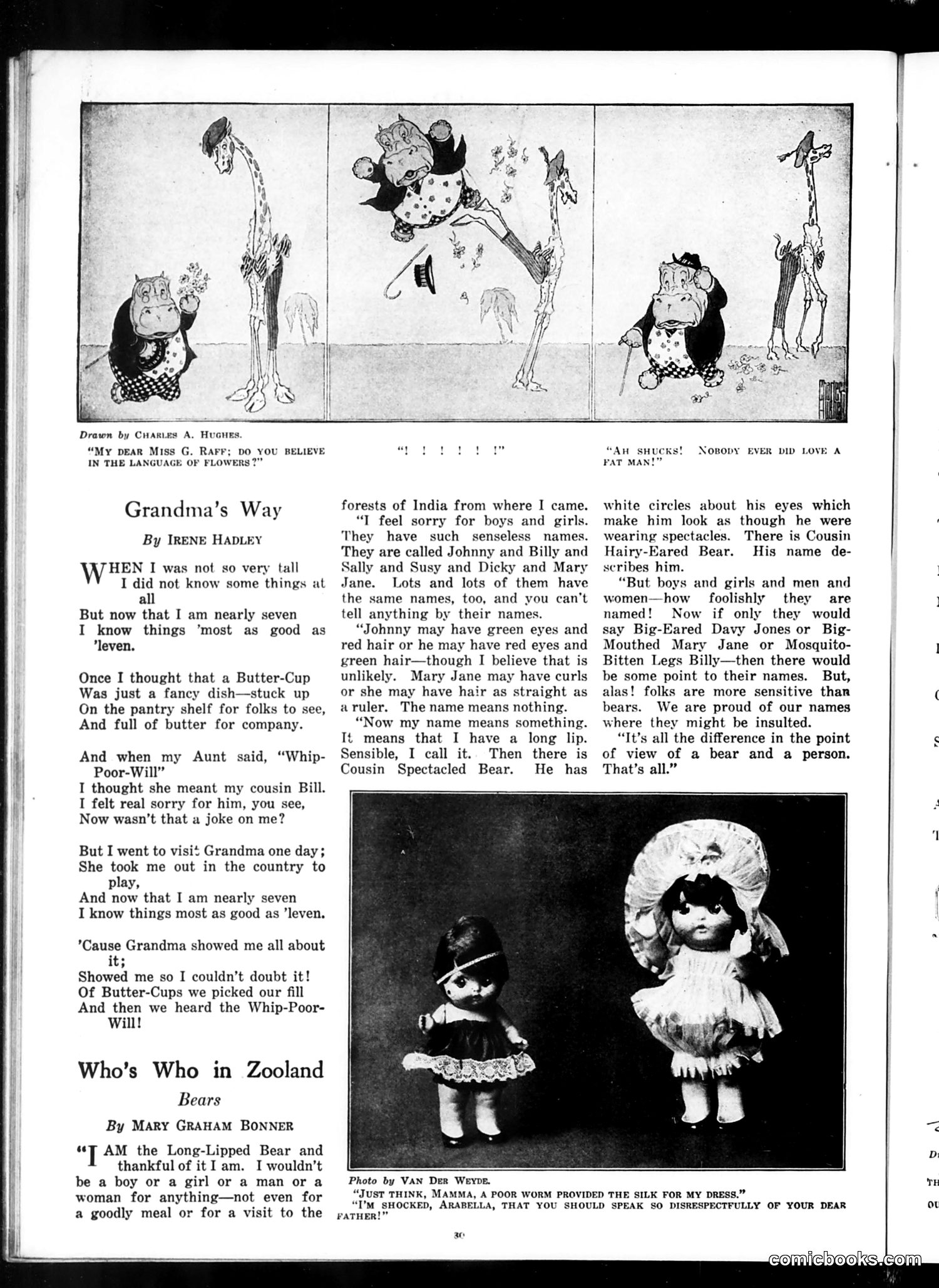
**The Cartoon (top):** Charles A. Hughes's three-panel comic features an anthropomorphic dog character and a tall, thin figure. The joke plays on the phrase "language of flowers"—the dog asks Miss G. Raff if she believes in it, while the tall figure demonstrates by literally throwing flowers. The final panel shows the dog's exasperated reaction ("Nobody ever did love a fat man!"), suggesting romantic disappointment. This is a visual pun satirizing the Victorian custom of communicating romantic sentiments through flower arrangements. **The Stories:** Two children's pieces follow—"Grandma's Way" and "Who's Who in Zooland"—which are sentimental, whimsical tales without obvious satire. They appear designed for younger Judge readers. **The Photo Caption:** The bottom photograph shows dolls wearing fancy dress. The caption satirizes overly sensitive urban mothers who faint at the thought that silk originates from worms, while humorously suggesting the worm is the child's "father"—mocking sentimental Victorian sensibilities about nature.
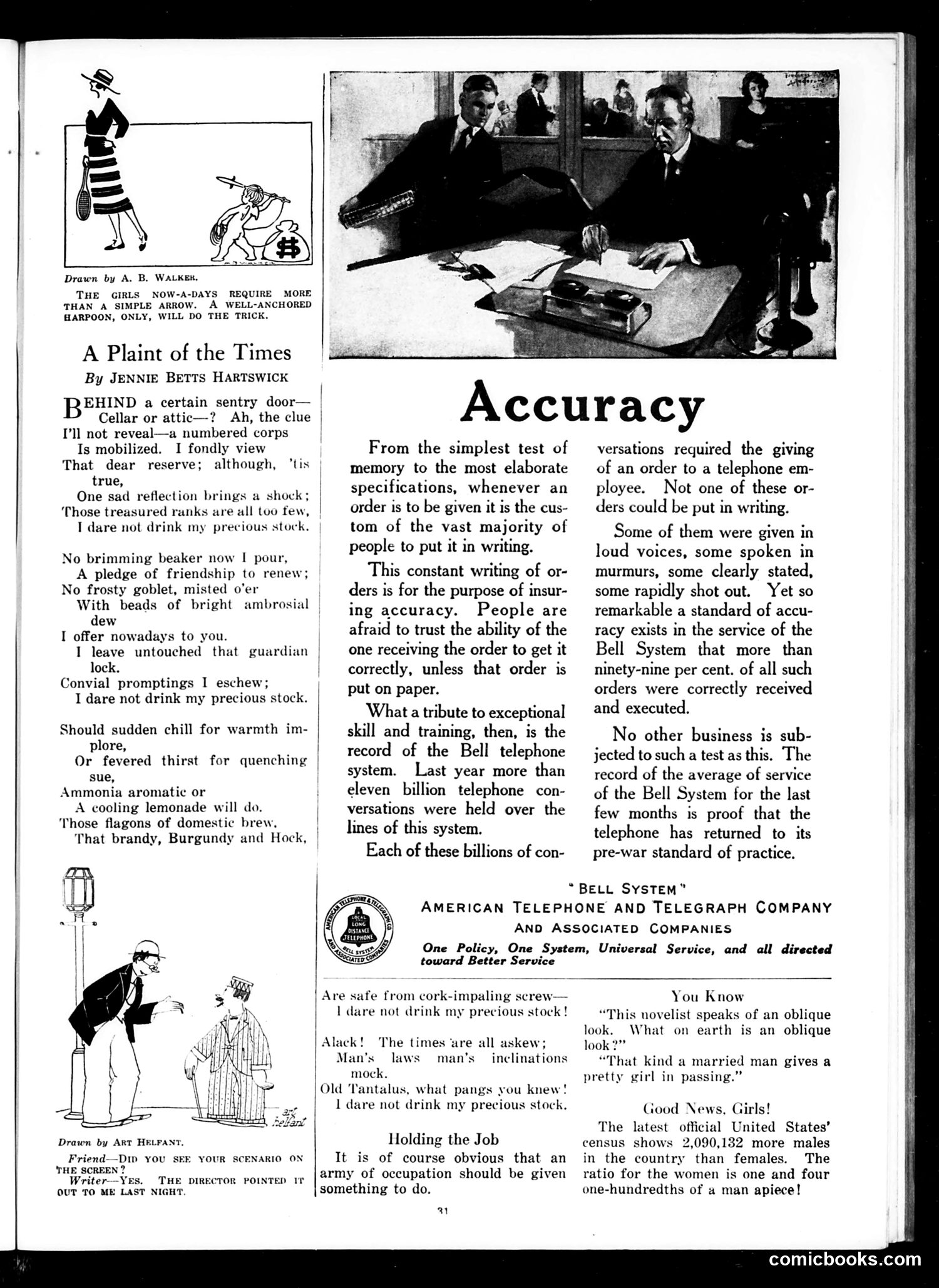
This page contains three distinct elements: **Top cartoon** (by A.B. Walker): A visual joke about modern courtship. The caption satirizes how contemporary women demand more commitment than previous generations—a man can't win their hearts with just "a simple arrow" (Cupid's traditional symbol) but needs "a well-anchored harpoon," suggesting women now require marriage or serious commitment rather than casual romance. **Poem** (by Jennie Betts Hartswick): "A Plaint of the Times" laments Prohibition. The speaker describes a hidden stockpile of alcohol they dare not drink, comparing themselves to Tantalus (mythological figure eternally denied what he desires). This reflects the frustration of Americans during the dry era who hoarded liquor but couldn't use it freely. **Advertisement/Editorial**: Bell System promotes its accuracy during telephone service restoration post-WWI, claiming 99% accuracy despite billions of verbal orders requiring no written confirmation. **Bottom items**: Minor cartoons and census humor about surplus males. The page primarily satirizes Prohibition's constraints on drinking and modern romance's increased demands.
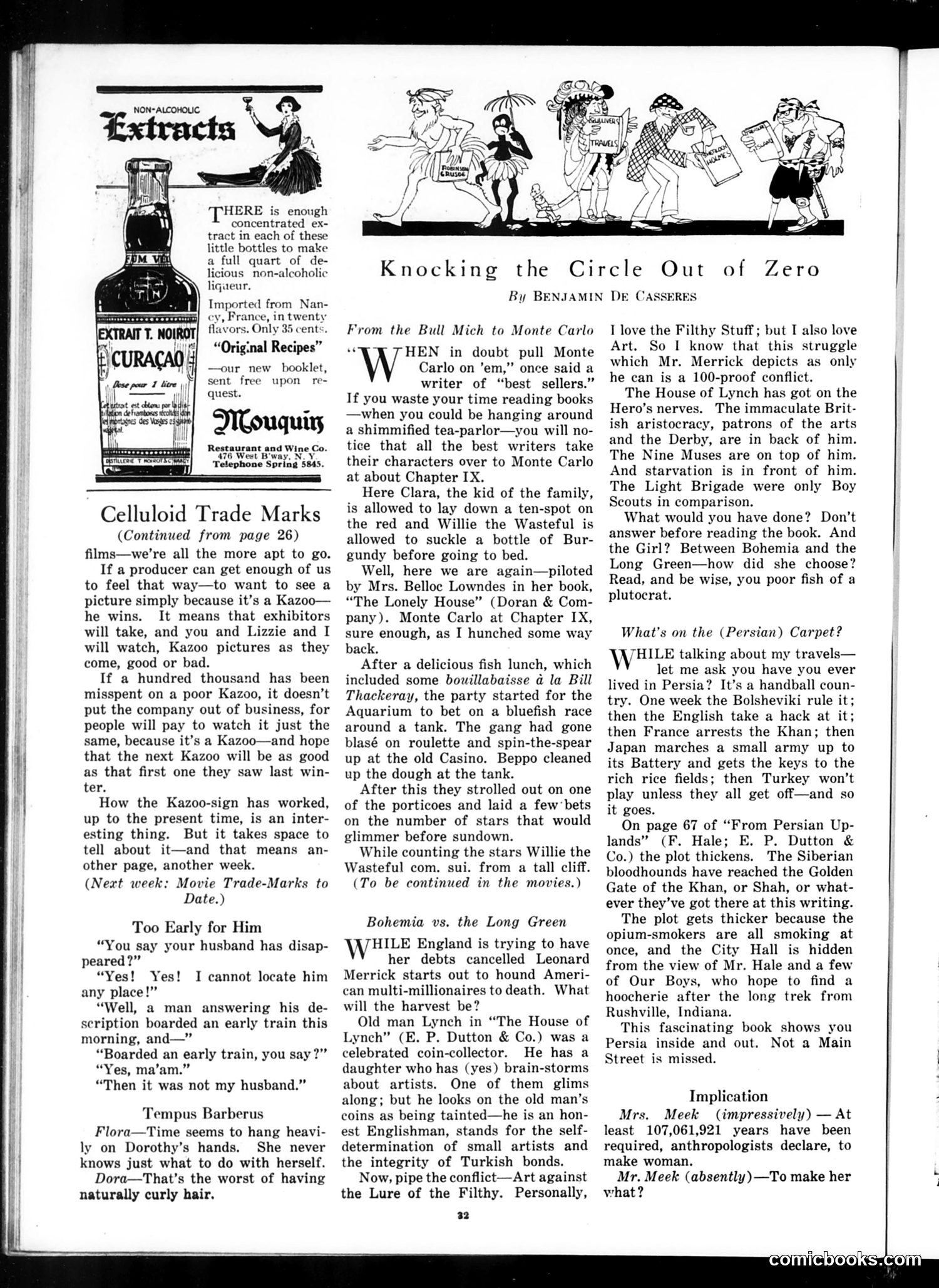
This page from Judge magazine contains literary criticism and social satire rather than political cartoons. The top illustration shows characters at Monte Carlo, accompanying Benjamin De Casseres's essay mocking popular fiction's reliance on clichés—specifically the tired trope of sending characters to the glamorous casino resort by Chapter IX of novels. De Casseres satirizes bestselling authors like Mrs. Belloc Lowndes for formulaic plotting. He ridicules the absurd escalation of Monte Carlo adventures (from roulette to betting on bluefish races and star counts), suggesting writers use exotic locations as narrative shortcuts when plot runs thin. The second essay contrasts "Bohemia vs. the Long Green" (money), discussing Leonard Merrick's novel about tension between artistic integrity and wealth. De Casseres humorously admits he loves "the Filthy Stuff" (money) despite also loving art—a wry acknowledgment of the era's class tensions between bohemian artists and capitalist millionaires. The sidebar jokes and advertisements are typical Judge filler content.
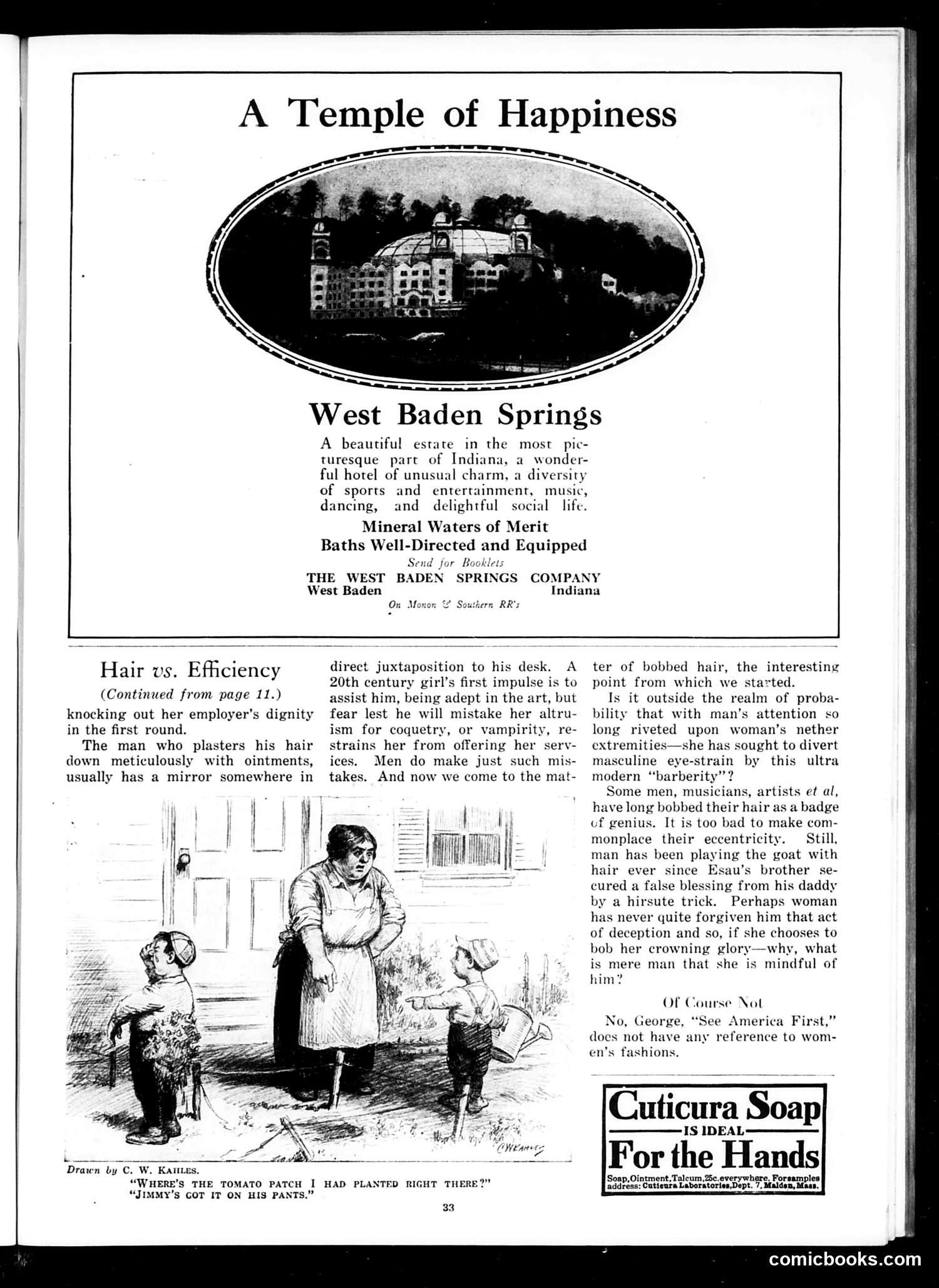
This page contains two distinct elements: **Top Advertisement:** A promotional ad for West Baden Springs, an Indiana resort hotel featuring mineral baths, sports, and entertainment—typical luxury travel advertising of the era. **Main Article & Cartoon:** "Hair vs. Efficiency" is a social commentary on women's bobbed hair—a controversial 1920s fashion. The article argues that women adopted short hair partly as retaliation against men's historical vanity about their own hair and grooming. It references the biblical Jacob/Esau story as ancient precedent for male hair-based deception. The accompanying cartoon by C.W. Kahles shows a woman supervising children in what appears to be a garden or yard, with a child covered in dirt. The caption jokes about a tomato patch being displaced onto the child's pants—a humorous domestic scene illustrating parental chaos. **Context for Modern Readers:** Bobbed hair was genuinely scandalous in the 1920s, seen as unfeminine and rebellious. This piece reframes it as women's witty social commentary rather than mere fashion rebellion—sophisticated satire typical of Judge magazine's educated, urban audience.
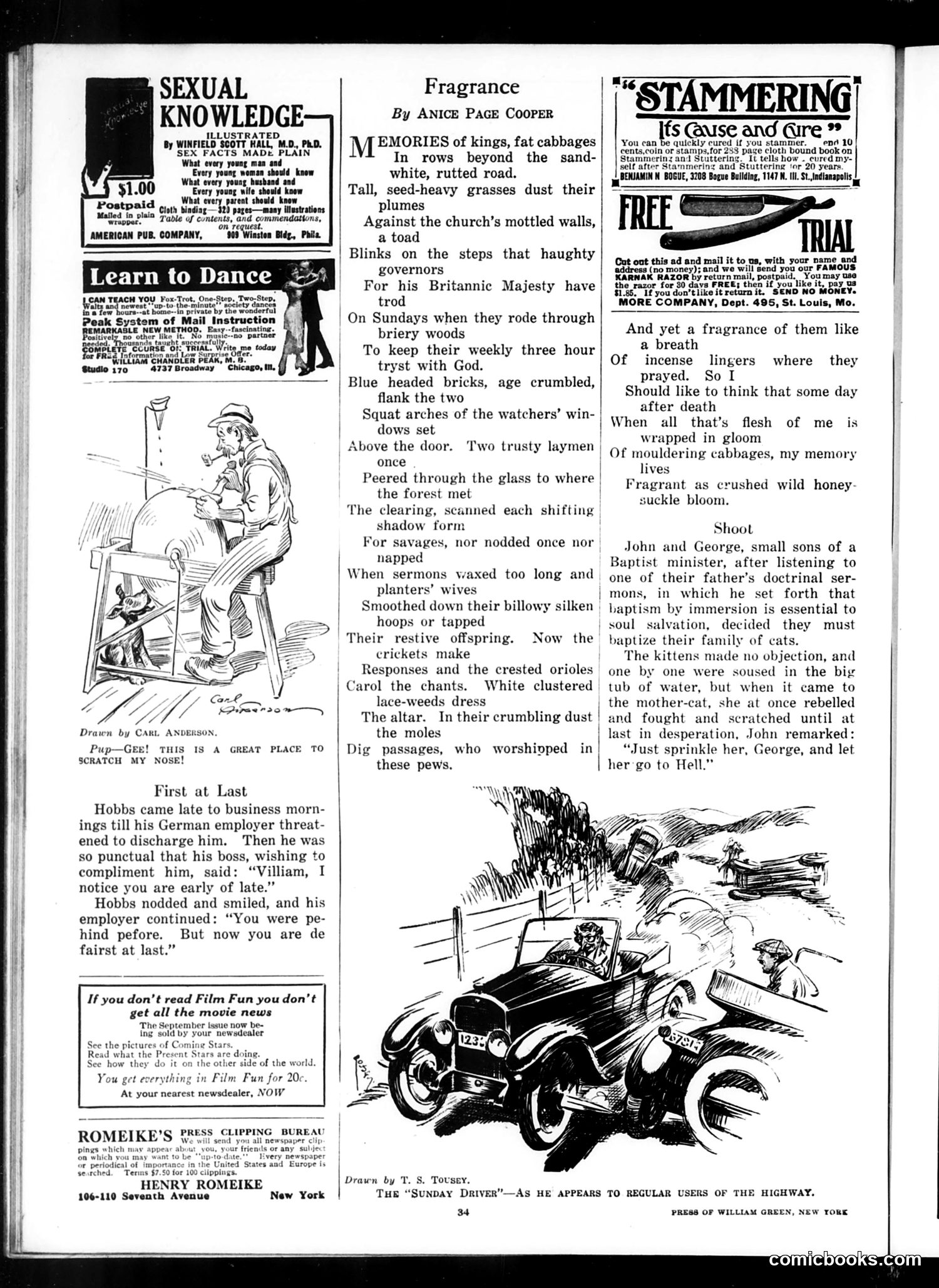
This page contains mixed content: advertisements, a short comic anecdote, poetry, and satire. **The main cartoon** ("Sunday Driver") shows a reckless automobile driver nearly hitting a pedestrian—social commentary on dangerous driving habits of the automobile age, when cars were still novel and many drivers were inexperienced or careless. **The "First at Last" anecdote** satirizes a German employer's fractured English ("fairst" for "first"). This reflects early 20th-century American attitudes toward German immigrants and their accented speech. **"Shoot" anecdote** is a lighthearted joke about children misunderstanding Baptist doctrine on baptism—they attempt to baptize their cats by dunking them, mocking religious literalism. **"Fragrance"** is a serious poem about colonial British India (references to governors, "His Britannic Majesty," colonial churches), depicting nature reclaiming colonial structures while people pray. The page also advertises self-help books on sex education and stammering cures—typical of early 20th-century popular publications.
This is **not a cartoon or satire**, but rather a **straight advertisement/propaganda page** from Judge magazine promoting government savings programs. The content advocates for Treasury Savings Securities and employer-sponsored Government Savings Associations. It uses patriotic rhetoric comparing individual savings to Niagara Falls' power—many small contributions create massive results for "Governmental and industrial needs." The historical context: This appears to be **World War I-era propaganda**, when the U.S. government actively promoted savings programs to finance military expenses and industrial production. The Government Loan Organization (a Federal Reserve entity) positioned savings as a civic duty. For modern readers: This represents wartime financial mobilization through voluntary civilian participation—employers were encouraged to help collect employee savings as a patriotic contribution to national needs. There's no satire here; Judge's pages mixed entertainment with earnest advocacy advertising.
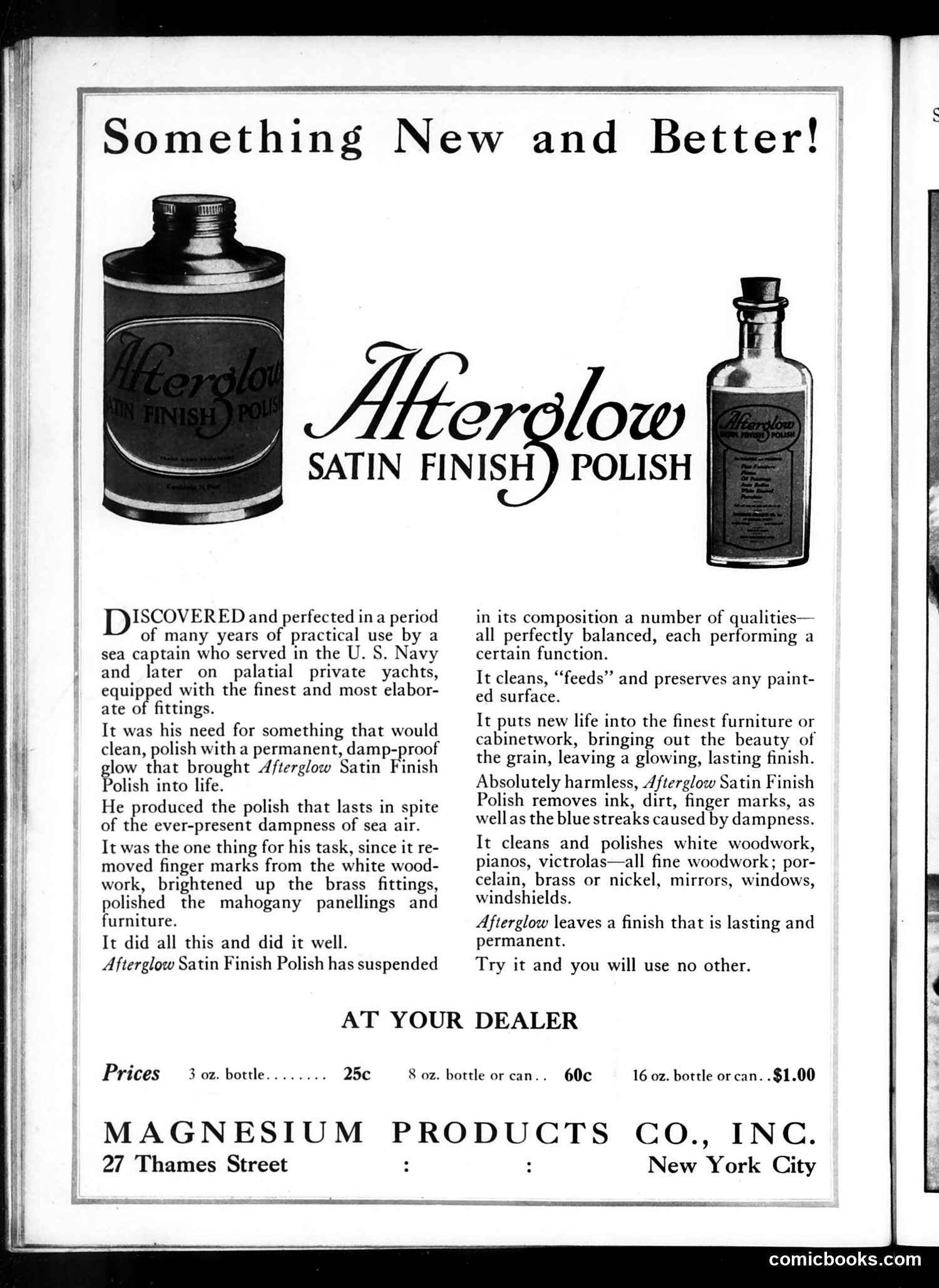
This page is **not a cartoon or satire**—it's a straightforward product advertisement for Afterglow Satin Finish Polish, manufactured by Magnesium Products Co. in New York City. The ad uses a backstory marketing approach: it claims the polish was "discovered and perfected" by a U.S. Navy sea captain who later worked on private yachts. This origin narrative establishes credibility and luxury association. The product supposedly solved his need for a durable polish that withstands sea dampness while cleaning brass, removing fingermarks from woodwork, and polishing mahogany. The ad lists multiple household uses—furniture, pianos, woodwork, brass, nickel, mirrors, and windshields—and emphasizes the polish leaves a "lasting" finish. Pricing ranges from 25¢ to $1.00 depending on bottle size. This represents typical early 20th-century advertising strategy: inventing an authoritative origin story and multiple use-cases to differentiate a product in a crowded market.