
Judge, 1921-09-03 · page 6 of 36
Judge — September 3, 1921 — page 6: what you’re looking at
What you’re looking at
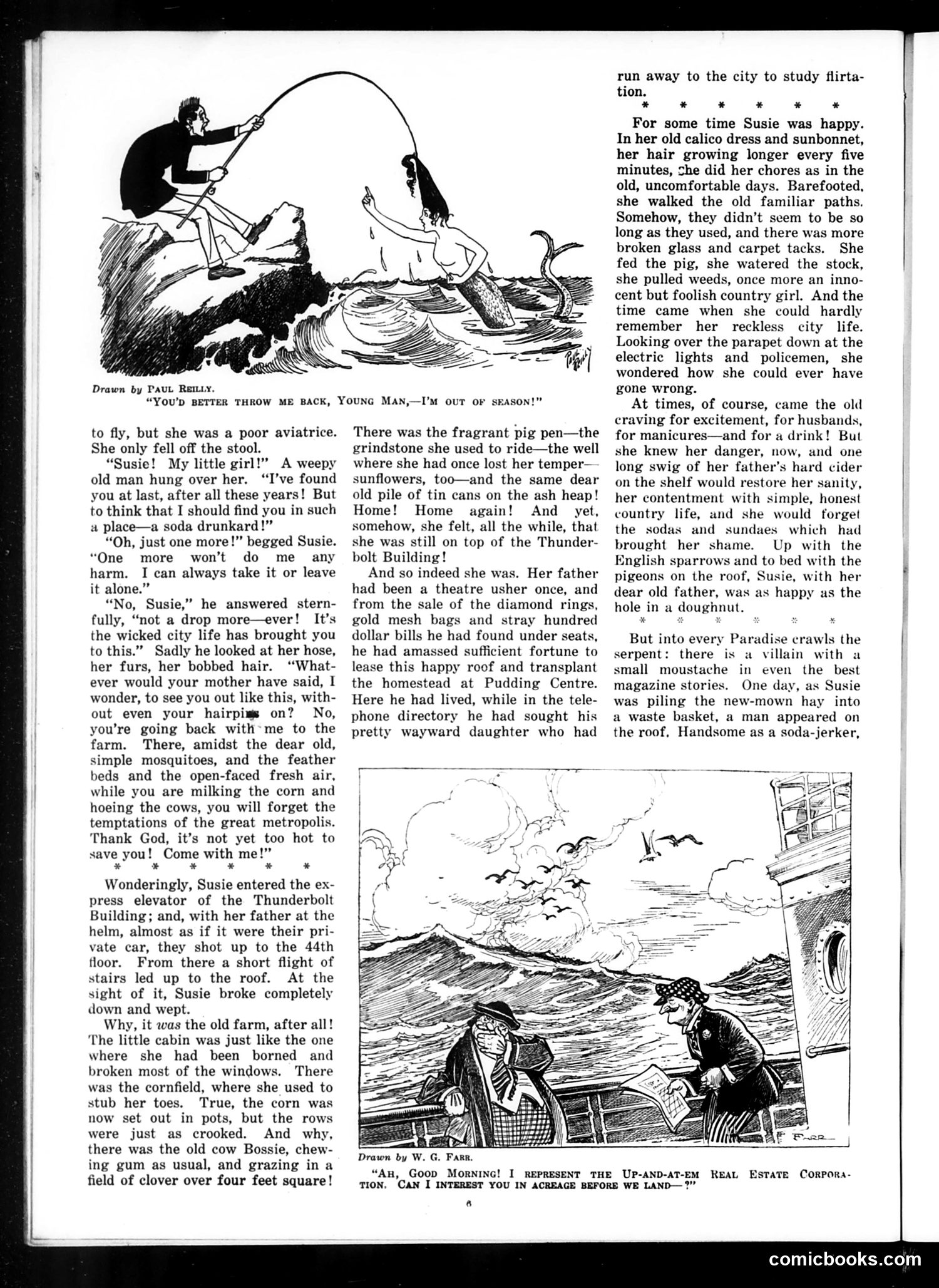
This page contains a serialized story about "Susie," a young woman who abandoned city life and returned to her family's farm. The narrative and illustrations depict her nostalgia and gradual readjustment to rural domesticity. **The two cartoons illustrate:** 1. **Top cartoon**: A fishing scene with the caption "You'd better throw me back, young man—I'm out of season!" - appears to be a flirtation joke about a woman being "out of season" romantically. 2. **Bottom cartoon**: Two women discussing real estate, with text about representing an "up-and-em real estate corporation" - likely satirizing aggressive land development and sales tactics of the era. The overall page reflects early 20th-century American tensions between urban and rural life, with humor centered on gender roles and commercialization.
📄 Transcribed text from this page (OCR, searchable)
Machine-transcribed from the original scan — historical spelling and the odd misread are preserved.
Drawn by Paut REILLY. “You’D BETTER THROW ME BACK, YOUNG MAN,—I’M OUT OF SEASON!” to fly, but she was a poor aviatrice. She only fell off the stool. “Susie! My little girl!” A weepy old man hung over her. “I’ve found you at last, after all these years! But to think that I should find you in such a place—a soda drunkard!” “Oh, just one more!” begged Susie. “One more won’t do me any harm. I can always take it or leave it alone.” “No, Susie,” he answered stern- fully, “not a drop more—ever! It’s the wicked city life has brought you to this.” Sadly he looked at her hose, her furs, her bobbed hair. ‘What- ever would your mother have said, I wonder, to see you out like this, with- out even your hairpims on? No, you’re going back with~me to the farm. There, amidst the dear old, simple mosquitoes, and the feather beds and the open-faced fresh air, while you are milking the corn and hoeing the cows, you will forget the temptations of the great metropolis. Thank God, it’s not yet too hot to save you! Come with me!” * * * * * * Wonderingly, Susie entered the ex- press elevator of the Thunderbolt Building; and, with her father at the helm, almost as if it were their pri- vate car, they shot up to the 44th floor. From there a short flight of stairs led up to the roof. At the sight of it, Susie broke completely down and wept. Why, it was the old farm, after all! The little cabin was just like the one where she had been borned and broken most of the windows. There was the cornfield, where she used to stub her toes. True, the corn was now set out in pots, but the rows were just as crooked. And why, there was the old cow Bossie, chew- ing gum as usual, and grazing in a field of clover over four feet square! There was the fragrant pig pen—the grindstone she used to ride—the well where she had once lost her temper— sunflowers, too—and the same dear old pile of tin cans on the ash heap! Home! Home again! And _ yet, somehow, she felt, all the while, that she was still on top of the Thunder- bolt Building! And so indeed she was. Her father had been a theatre usher once, and from the sale of the diamond rings, gold mesh bags and stray hundred dollar bills he had found under seats, he had amassed sufficient fortune to lease this happy roof and transplant the homestead at Pudding Centre. Here he had lived, while in the tele- phone directory he had sought his pretty wayward daughter who had run away to the city to study flirta- tion. * * * * * * For some time Susie was happy. In her old calico dress and sunbonnet, her hair growing longer every five minutes, che did her chores as in the old, uncomfortable days. Barefooted, she walked the old familiar paths. Somehow, they didn’t seem to be so long as they used, and there was more broken glass and carpet tacks. She fed the pig, she watered the stock, she pulled weeds, once more an inno- cent but foolish country girl. And the time came when she could hardly remember her reckless city life. Looking over the parapet down at the electric lights and policemen, she wondered how she could ever have gone wrong. At times, of course, came the old craving for excitement, for husbands, for manicures—and for a drink! But she knew her danger, now, and one long swig of her father’s hard cider on the shelf would restore her sanity, her contentment with simple, honest country life, and she would forget the sodas and sundaes which had brought her shame. Up with the English sparrows and to bed with the pigeons on the roof, Susie, with her dear old father, was as happy as the hole in a doughnut. But into every Paradise crawls the serpent: there is a villain with a small moustache in even the best magazine stories. One day, as Susie was piling the new-mown hay into a waste basket, a man appeared on the roof, Handsome as a soda-jerker, “AH, TION. CAN I INTEREST YOU IN ACREAGE BEFORE WE LAND—?” 6 Goop Morninc! I REPRESENT THE UP-AND-AT-EM REAL EsTaTE CORPORA- comicbooks.com