
Judge, 1921-09-03 · page 30 of 36
Judge — September 3, 1921 — page 30: what you’re looking at
What you’re looking at
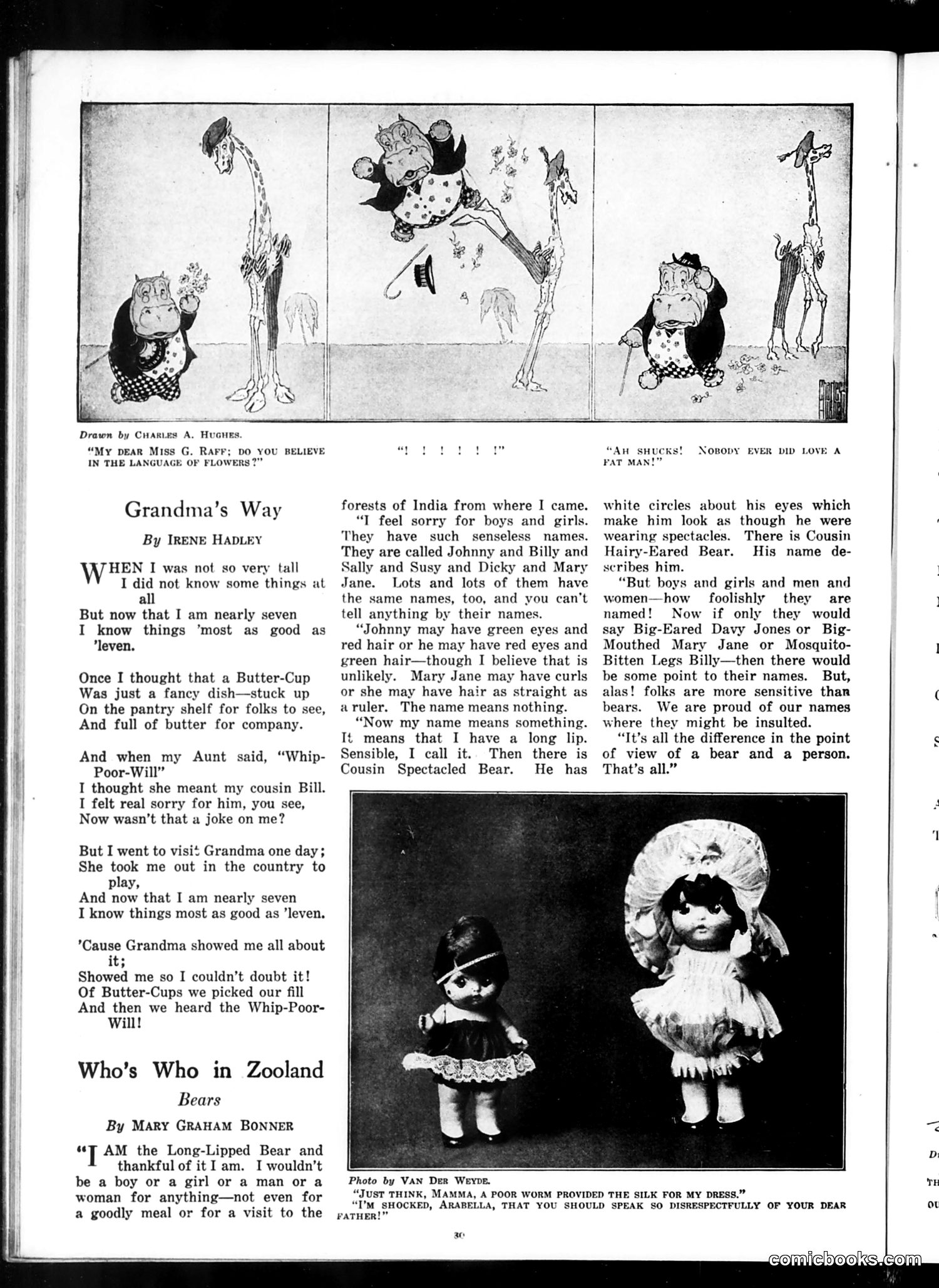
**The Cartoon (top):** Charles A. Hughes's three-panel comic features an anthropomorphic dog character and a tall, thin figure. The joke plays on the phrase "language of flowers"—the dog asks Miss G. Raff if she believes in it, while the tall figure demonstrates by literally throwing flowers. The final panel shows the dog's exasperated reaction ("Nobody ever did love a fat man!"), suggesting romantic disappointment. This is a visual pun satirizing the Victorian custom of communicating romantic sentiments through flower arrangements. **The Stories:** Two children's pieces follow—"Grandma's Way" and "Who's Who in Zooland"—which are sentimental, whimsical tales without obvious satire. They appear designed for younger Judge readers. **The Photo Caption:** The bottom photograph shows dolls wearing fancy dress. The caption satirizes overly sensitive urban mothers who faint at the thought that silk originates from worms, while humorously suggesting the worm is the child's "father"—mocking sentimental Victorian sensibilities about nature.
📄 Transcribed text from this page (OCR, searchable)
Machine-transcribed from the original scan — historical spelling and the odd misread are preserved.
DO YOU BELIEVE IN THE LANG! iad AGE OF FLOWE! Grandma’s Way By IRENE HADLEY HEN I was not so very tall I did not know some things at all But now that I am nearly seven I know things ‘most as good as “leven. Once I thought that a Butter-Cup Was just a fancy dish—stuck up On the pantry shelf for folks to see, And full of butter for company. And when my Aunt said, “Whip- Poor-Will” I thought she meant my cousin Bill. I felt real sorry for him, you see, Now wasn’t that a joke on me? But I went to visit Grandma one day; She took me out in the country to play, And now that I am nearly seven I know things most as good as ’leven. ’Cause Grandma showed me all about it; Showed me so I couldn’t doubt it! Of Butter-Cups we picked our fill And then we heard the Whip-Poor- Will! Who’s Who in Zooland Bears By Mary GRAHAM BONNER “T AM the Long-Lipped Bear and thankful of it I am. I wouldn’t be a boy or a girl or a man or a woman for anything—not even for a goodly meal or for a visit to the forests of India from where I came. “IT feel sorry for boys and girls. They have such senseless names. They are called Johnny and Billy and Sally and Susy and Dicky and Mary Jane. Lots and lots of them have the same names, too, and you can’t tell anything by their names. “Johnny may have green eyes and red hair or he may have red eyes and green hair—though I believe that is unlikely. Mary Jane may have curls or she may have hair as straight as aruler. The name means nothing. “Now my name means something. It means that I have a long lip. Sensible, I call it. Then there is Cousin Spectacled Bear. He has “AH SHUCKS! NOBODY EVER DID LOVE A FAT MA white circles about his eyes which make him look as though he were wearing spectacles. There is Cousin Hairy-Eared Bear. His name de- scribes him. “But boys and girls and men and women—how foolishly they are named! Now if only they would say Big-Eared Davy Jones or Big- Mouthed Mary Jane or Mosquito- Bitten Legs Billy—then there would be some point to their names. But, alas! folks are more sensitive than bears. We are proud of our names where they might be insulted. “It’s all the difference in the point of view of a bear and a person. That’s all.” Photo by VAN Der WeyveE. “JUST THINK, MAMMA, A POOR WORM PROVIDED THE SILK FOR MY DRESS.” “I'M SHOCKED, ARABELLA, THAT YOU SHOULD SPEAK SO DISRESPECTFULLY OF YOUR DEAR FATHER!” a0 oe Di TH ot