
Judge, 1921-09-03 · page 20 of 36
Judge — September 3, 1921 — page 20: what you’re looking at
What you’re looking at
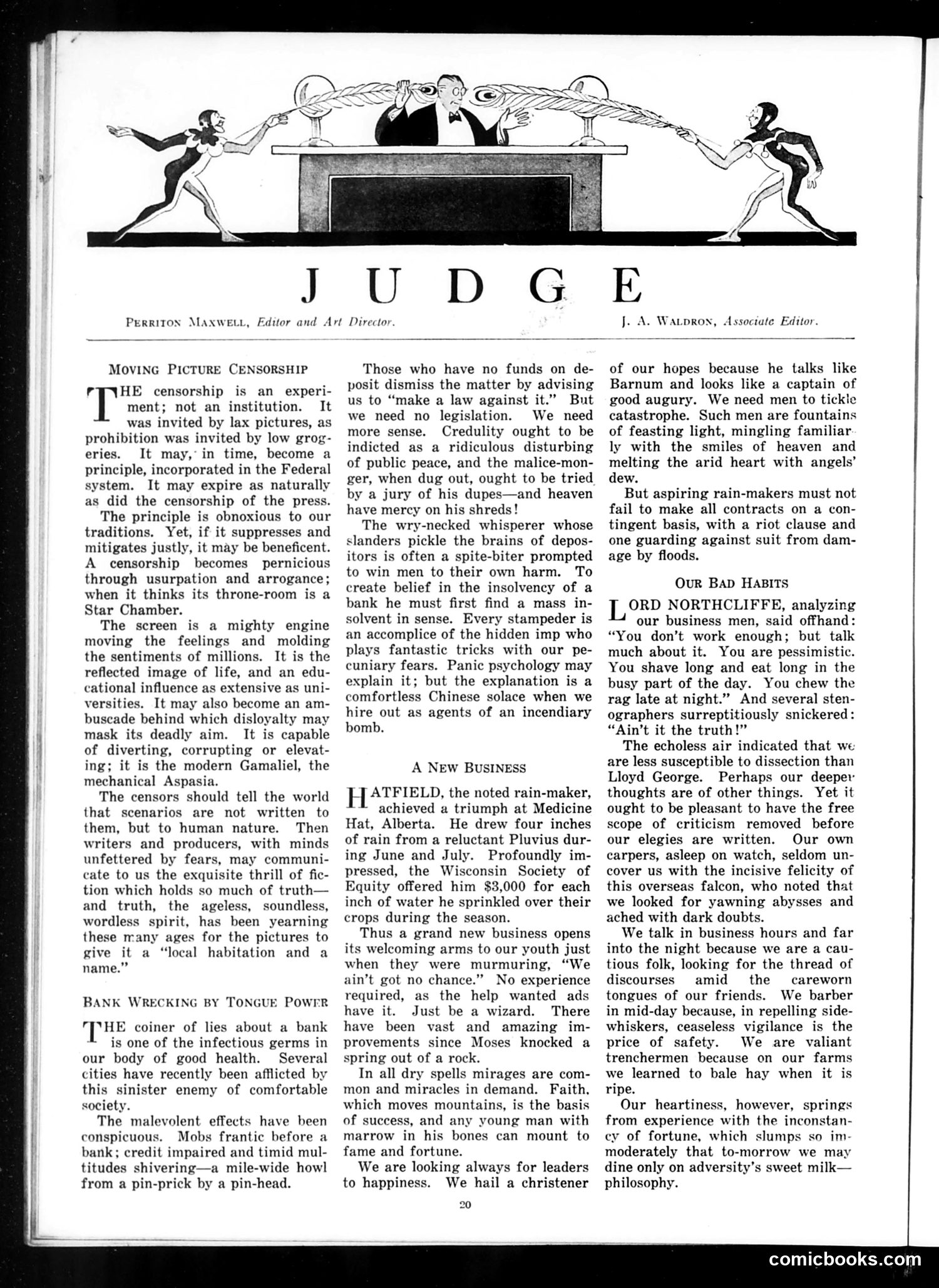
This is an editorial page containing three opinion pieces by Perriton Maxwell and J.A. Waldron, editors of *Judge* magazine. **The masthead illustration** shows two muscular figures flanking three men in formal dress at what appears to be a judge's bench, representing the magazine's satirical commentary role. **Content focus:** 1. **Moving Picture Censorship**: The editors debate film censorship as a new experiment—necessary to control "lax pictures" but potentially dangerous if it becomes tyrannical (comparing it to a "Star Chamber"). They argue the screen is powerful enough to corrupt or elevate society, so censors should consider human nature, not just rules. 2. **Bank Wrecking**: Commentary on how false rumors about banks cause panic runs. The piece mocks both the "malice-monger" spreading lies and the credulous masses who believe them, urging sense over legislation. 3. **A New Business**: Satirical praise for rainmaker "Hatfield," who successfully produced rain in Alberta. The editors mock the absurdity of a new "business" promising easy money to gullible youth, comparing it to faith-based miracles. The tone is moralistic, warning against credulity and manipulation in modern society.
📄 Transcribed text from this page (OCR, searchable)
Machine-transcribed from the original scan — historical spelling and the odd misread are preserved.
PeRRITON MAXWELL, Editor and A MOVING PICTURE CENSORSHIP £ HE censorship is an experi- T ment; not an institution. It was invited by lax pictures, as prohibition was invited by low grog- eries. It may, in time, become a principle, incorporated in the Federal system. It may expire as naturally as did the censorship of the press. The principle is obnoxious to our traditions. Yet, if it suppresses and mitigates justly, it may be beneficent. A censorship becomes pernicious through usurpation and arrogance; when it thinks its throne-room is a Star Chamber. The screen is a mighty engine moving the feelings and molding the sentiments of millions. It is the reflected image of life, and an edu- cational influence as extensive as uni- versities. It may also become an am- buscade behind which disloyalty may mask its deadly aim. It is capable of diverting, corrupting or elevat- ing; it is the modern Gamaliel, the mechanical Aspasia. The censors should tell the world that scenarios are not written to them, but to human nature. Then writers and producers, with minds unfettered by fears, may communi- cate to us the exquisite thrill of fic- tion which holds so much of truth— and truth, the ageless, soundless, wordless spirit, has been yearning these many ages for the pictures to give it a “local habitation and a name.” BANK WRECKING BY TONGUE POWER THE coiner of lies about a bank is one of the infectious germs in Several cities have recently been afflicted by this sinister enemy of comfortable society. The malevolent effects have been our body of good health. conspicuous. Mobs frantic before a bank; credit impaired and timid mul- titudes shivering—a mile-wide howl from a pin-prick by a pin-head. rt Director. Those who have no funds on de- posit dismiss the matter by advising us to “make a law against it.” But we need no legislation. We need more sense. Credulity ought to be indicted as a ridiculous disturbing of public peace, and the malice-mon- ger, when dug out, ought to be tried by a jury of his dupes—and heaven have mercy on his shreds! The wry-necked whisperer whose slanders pickle the brains of depos- itors is often a spite-biter prompted to win men to their own harm. To create belief in the insolvency of a bank he must first find a mass in- solvent in sense. Every stampeder is an accomplice of the hidden imp who plays fantastic tricks with our pe- cuniary fears. Panic psychology may explain it; but the explanation is a comfortless Chinese solace when we hire out as agents of an incendiary bomb. A NEw BUSINESS } ATFIELD, the noted rain-maker, achieved a triumph at Medicine Hat, Alberta. He drew four inches of rain from a reluctant Pluvius dur- ing June and July. Profoundly im- pressed, the Wisconsin Society of Equity offered him $3,000 for each inch of water he sprinkled over their crops during the season. Thus a grand new business opens its welcoming arms to our youth just when they were murmuring, “We ain’t got no chance.” No experience required, as the help wanted ads have it. Just be a wizard. There have been vast and amazing im- provements since Moses knocked a spring out of a rock. In all dry spells mirages are com- mon and miracles in demand. Faith. which moves mountains, is the basis of success, and any young man with marrow in his bones can mount to fame and fortune. We are looking always for leaders to happiness. We hail a christener 20 J. A. Watpron, Assoctate Edttor. of our hopes because he talks like Barnum and looks like a captain of good augury. We need men to tickie catastrophe. Such men are fountains of feasting light, mingling familiar. ly with the smiles of heaven and melting the arid heart with angels’ dew. But aspiring rain-makers must not fail to make all contracts on a con- tingent basis, with a riot clause and one guarding against suit from dam- age by floods. Our Bap HaBITs L°FP NORTHCLIFFE, analyzing our business men, said offhand: “You don’t work enough; but talk much about it. You are pessimistic. You shave long and eat long in the busy part of the day. You chew the rag late at night.” And several sten- ographers surreptitiously snickered: “Ain’t it the truth!” The echoless air indicated that we are less susceptible to dissection than Lloyd George. Perhaps our deeper thoughts are of other things. Yet it ought to be pleasant to have the free scope of criticism removed before our elegies are written. Our own carpers, asleep on watch, seldom un- cover us with the incisive felicity of this overseas falcon, who noted that we looked for yawning abysses and ached with dark doubts. We talk in business hours and far into the night because we are a cau- tious folk, looking for the thread of discourses amid the careworn tongues of our friends. We barber in mid-day because, in repelling side- whiskers, ceaseless vigilance is the price of safety. We are valiant trenchermen because on our farms we learned to bale hay when it is ripe. Our heartiness, however, springs from experience with the inconstan- cy of fortune, which slumps so im- moderately that to-morrow we may dine only on adversity’s sweet milk— philosophy. comicbooks.com