
A complete issue · 32 pages · 1920
Judge — October 23, 1920
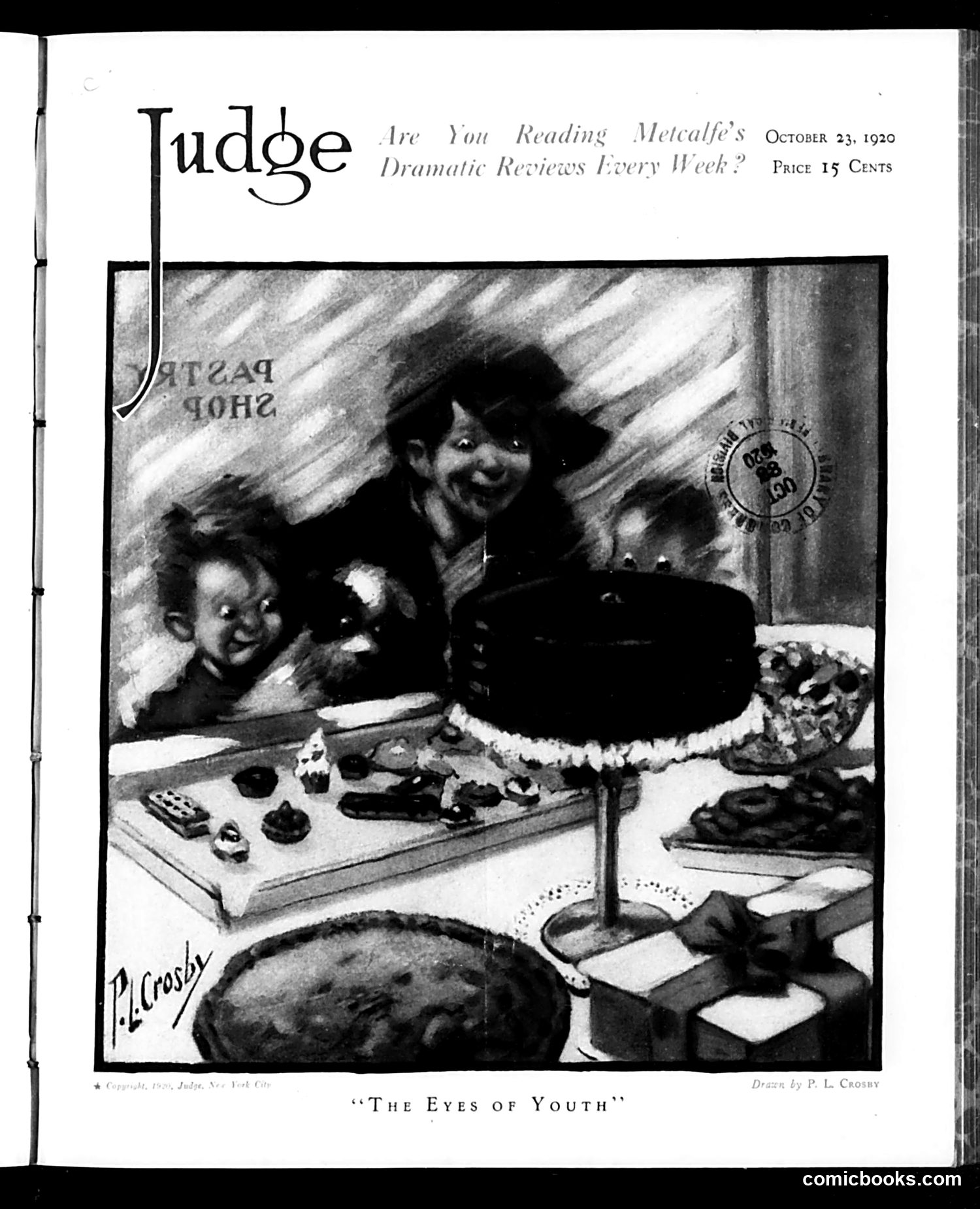
This is a dramatic review illustration by P.L. Crosby for a theatrical production titled "The Eyes of Youth." The image shows a scene at what appears to be an elegant dinner or social gathering, with a woman in dark clothing as the central figure, flanked by two younger people. The table displays fine dining elements—decorative dishes, glasses, and carefully arranged place settings. The caption and framing suggest this is promotional artwork for a stage play rather than political satire. Without additional context about this specific 1920 production, the exact dramatic plot or satirical intent remains unclear. The illustration demonstrates Judge magazine's coverage of contemporary theater and entertainment.
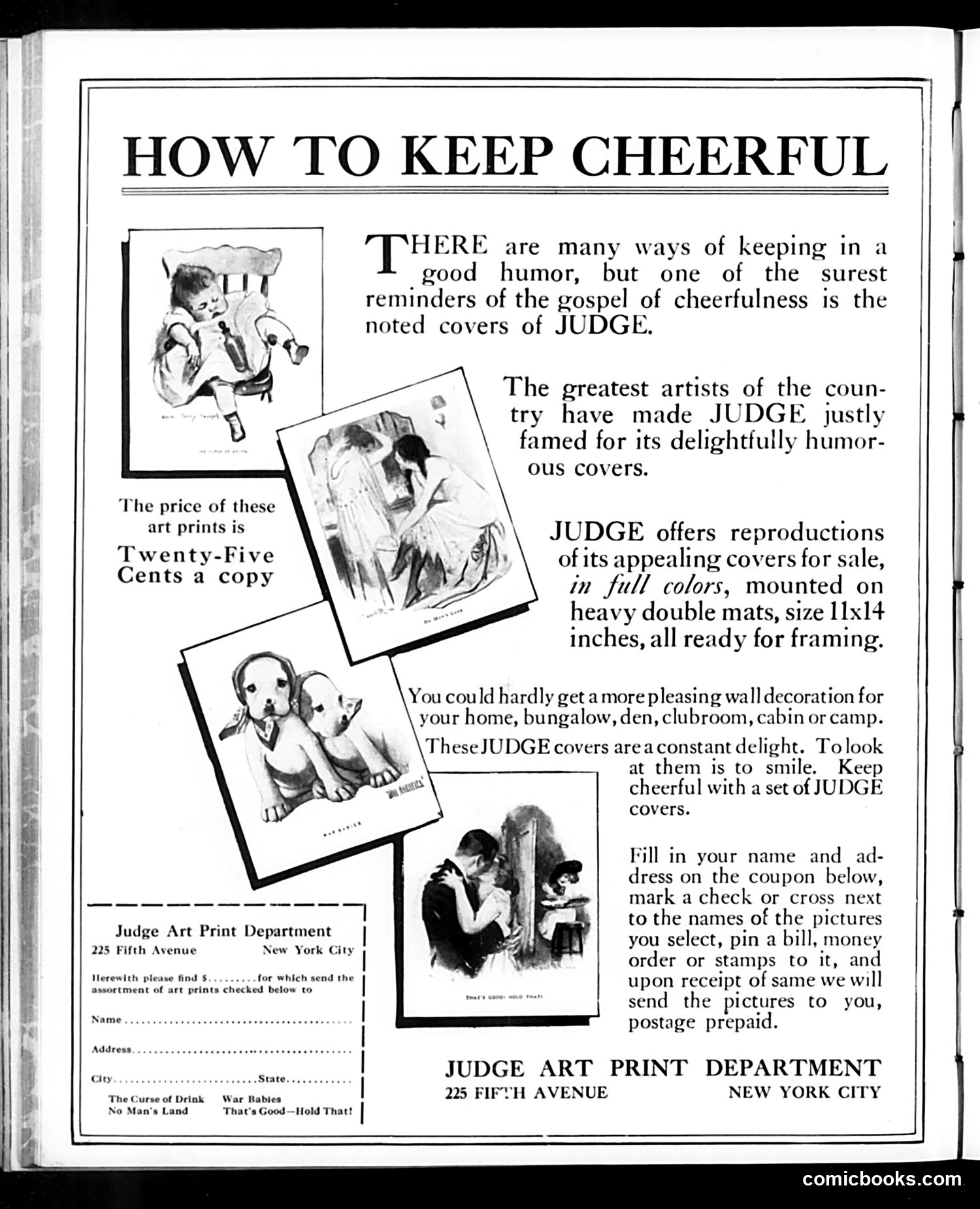
This page is primarily **advertising for Judge magazine's art prints**, not political satire. The content promotes reproductions of Judge's cover illustrations—described as humorous artwork by "the greatest artists of the country"—available for 25 cents each. The four illustrated covers shown feature **domestic humor**: a child in a high chair, a couple in an intimate moment, puppies, and children at play. These represent the magazine's "gospel of cheerfulness." The text emphasizes these prints make ideal wall decorations for homes and leisure spaces. A coupon at bottom allows readers to order prints by mail. **This is vintage advertising**, not political commentary. Judge positioned itself as a purveyor of wholesome, cheerful humor suitable for middle-class households of the early 20th century.
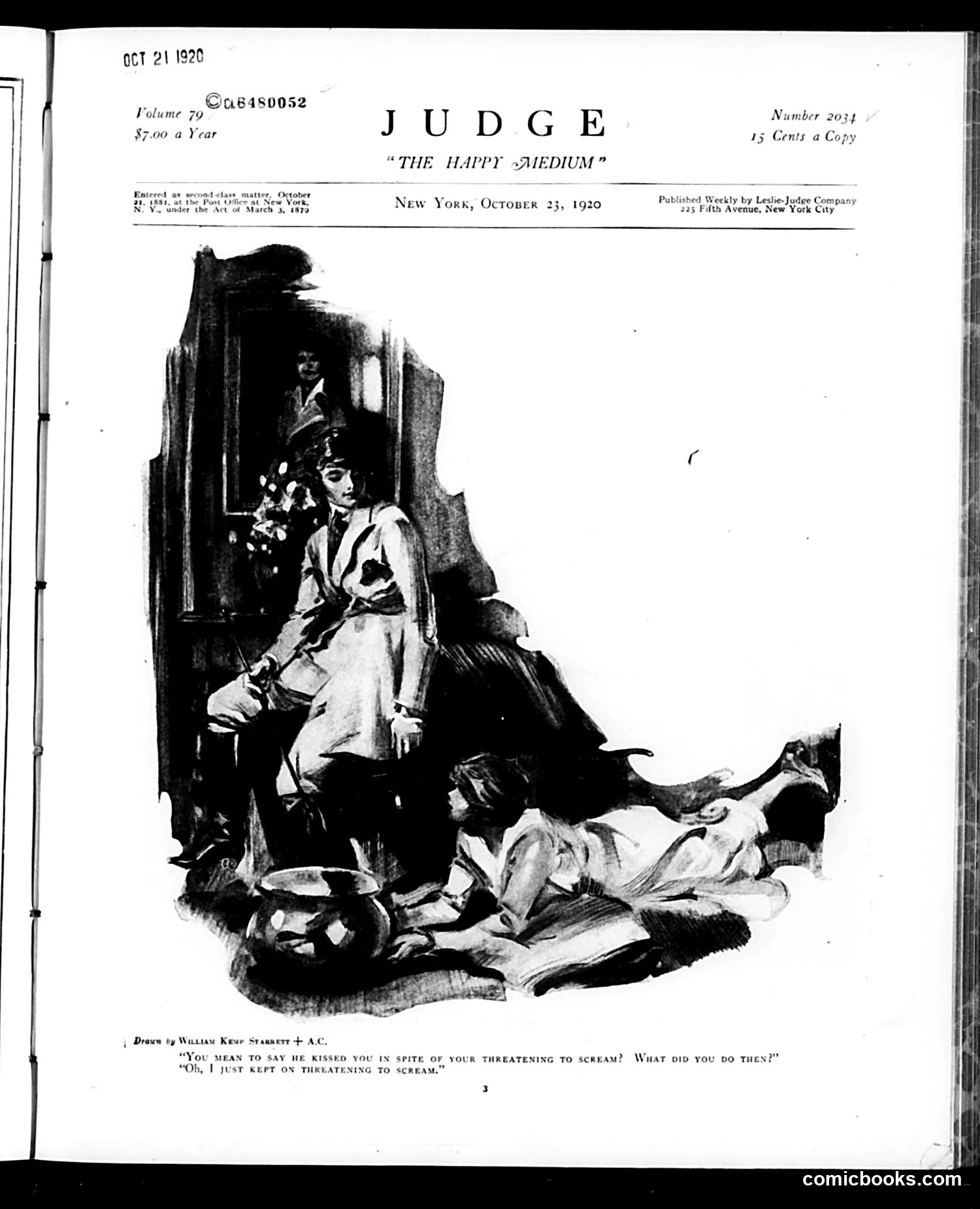
This illustration by William Keep Starrett depicts a domestic scene with a humorous caption about marital conflict. A woman sits calmly in a chair while a man lies on the floor in apparent distress. The dialogue reads: "You mean to say he kissed you in spite of your threatening to scream? What did you do then?" "Oh, I just kept on threatening to scream." The satire targets early 20th-century attitudes about courtship and consent. The joke plays on the era's social convention where women were expected to resist male advances, while the cartoon suggests this woman continued "threatening" despite the man persisting—implying her protests were performative rather than genuine. It reflects period anxieties about changing gender dynamics and dating rituals in the 1920s.
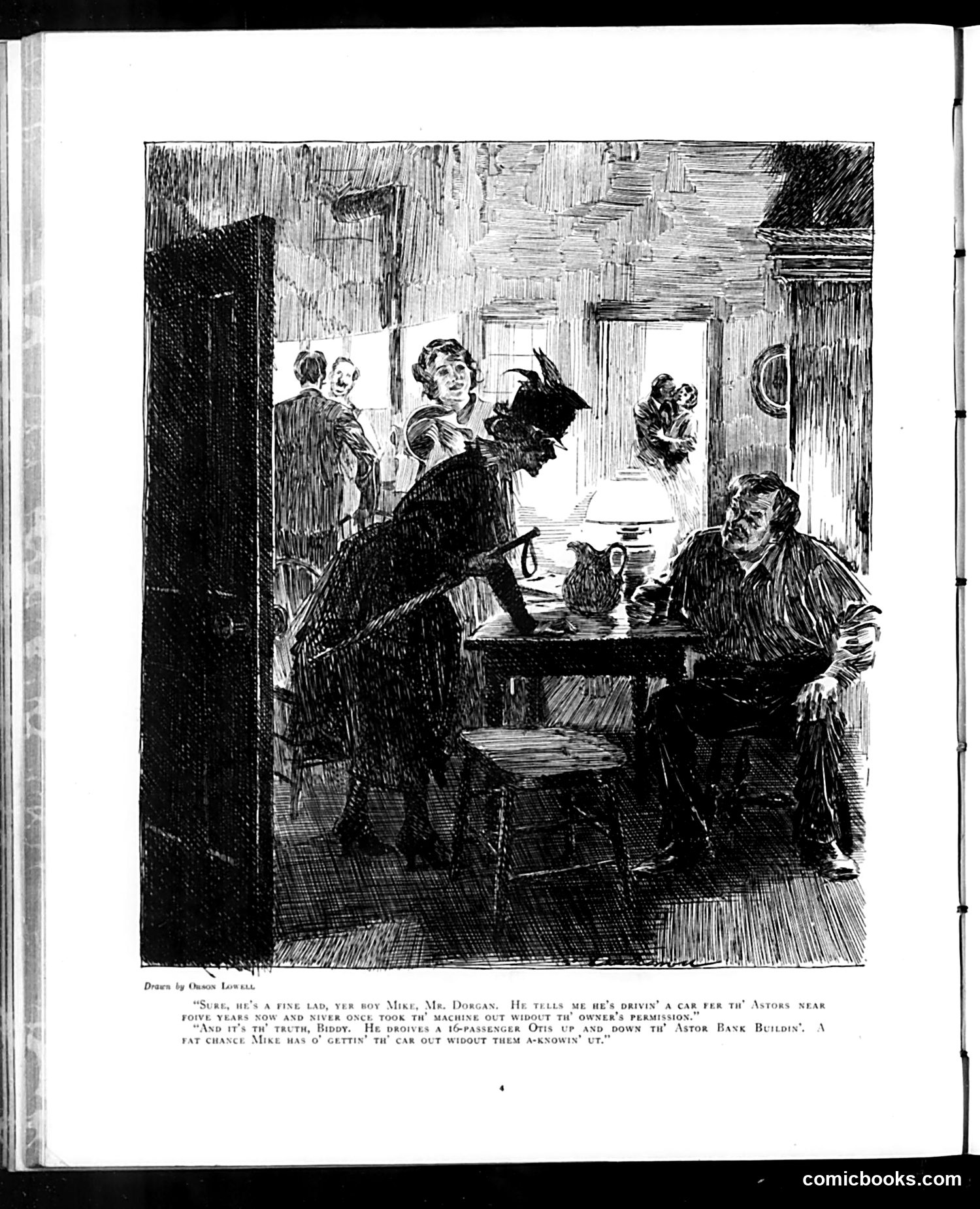
This sketch by Ormal Lovell depicts a scene in what appears to be an auto mechanic's shop or garage. The dialogue references two characters—"Mike" and "Biddy"—discussing an automobile repair situation. The humor centers on Mike's unauthorized use of a customer's car, apparently a regular practice ("foive years now and never once took th' machine out widout th' owner's permission"). The joke plays on working-class Irish dialect and the casual dishonesty of mechanics who operated vehicles without explicit permission, then denied it. The satire targets both the mechanic's brazen dishonesty and the gap between what owners assume and what actually happens to their vehicles in shops—a relatable concern for early automobile owners unfamiliar with repair practices. The heavy dialect humor was typical of Judge's working-class comedy of that era.
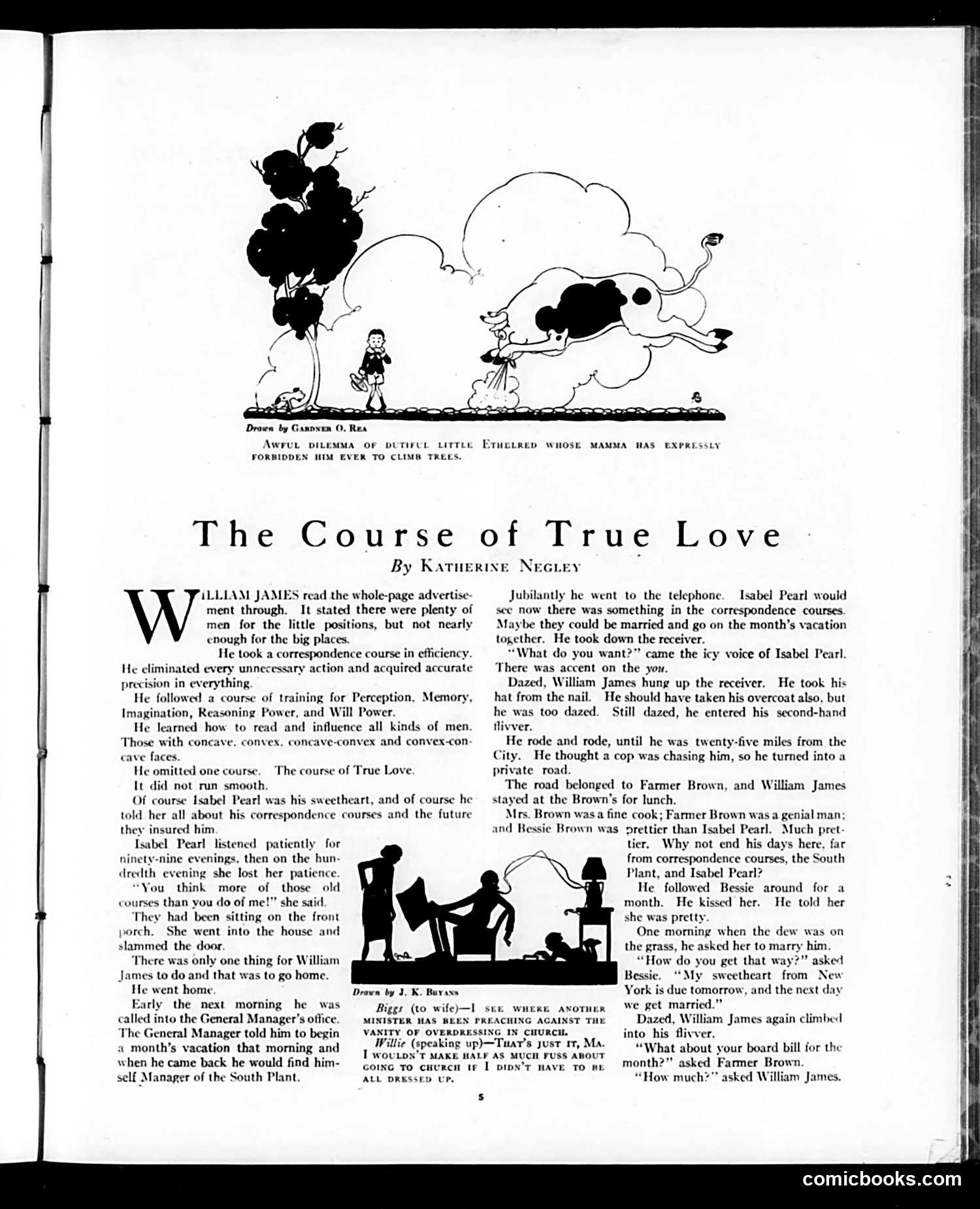
This page contains a short story by Katherine Negley titled "The Course of True Love," illustrated with two cartoons by different artists (Garvey O. Rea and J.K. Baynes). The story satirizes **correspondence courses**—a popular early 20th-century educational phenomenon. William James takes a mail-order efficiency course, hoping to impress his sweetheart Isabel Pearl and secure a promotion. However, his overly rigid, "efficient" approach to romance backfires when Isabel grows impatient with his business-like manner. The satire mocks both the naive faith in self-improvement through mail-order education and how applying mechanical efficiency to human relationships produces absurd, counterproductive results. The cartoons humorously illustrate the tension between modern business methods and traditional courtship.
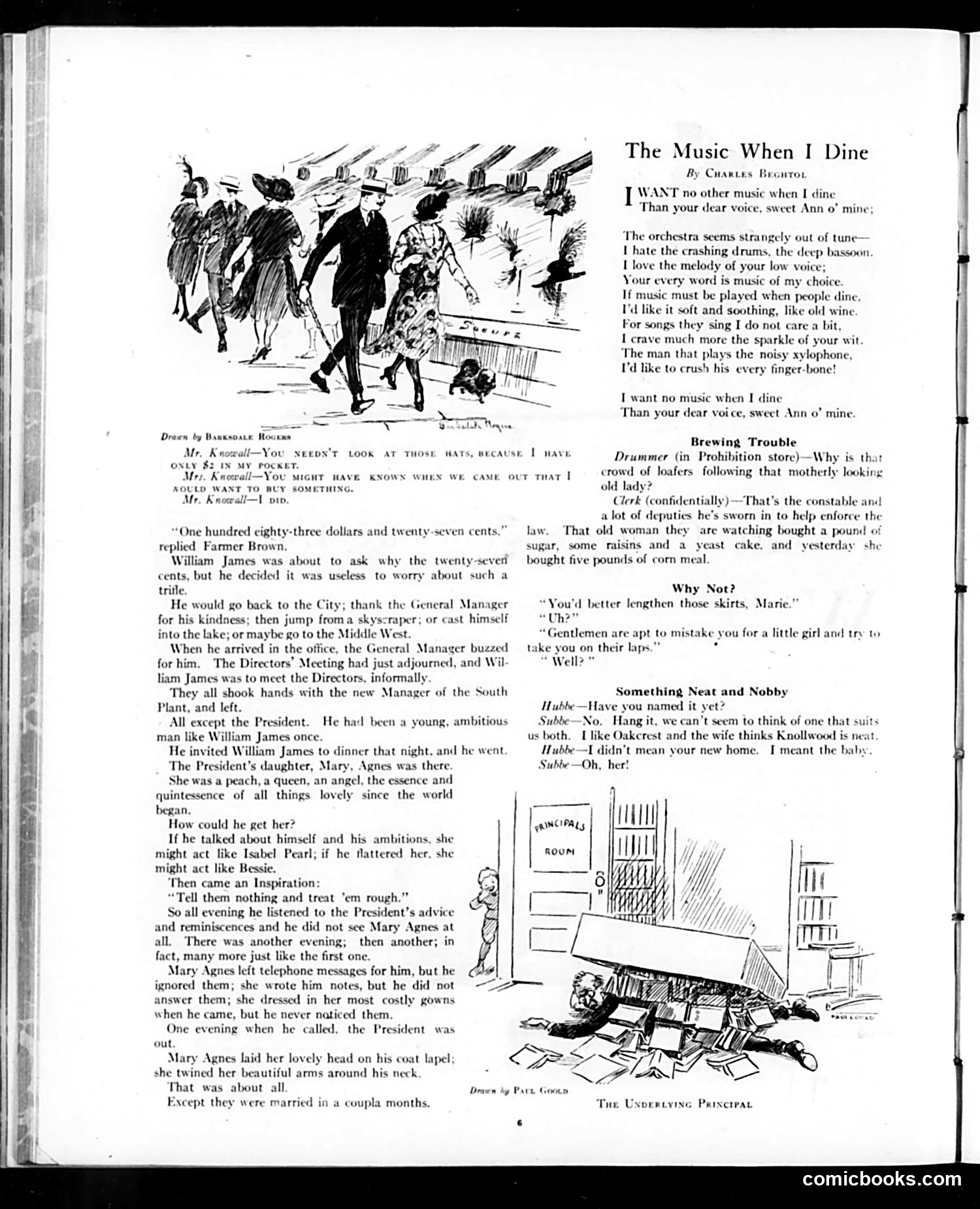
This page contains three separate humor pieces from *Judge* magazine: 1. **"The Music When I Dine"** — A poem by Charles Bechtol satirizing dining preferences, illustrated with a sketch showing well-dressed diners. The humor targets orchestral music at restaurants, with the speaker preferring his companion's conversation to loud instruments. 2. **"Brewing Trouble"** — A brief comedic dialogue about Prohibition enforcement, featuring a drummer in a "Prohibition store" observing suspicious activity (deputies watching a woman buying ingredients for illegal alcohol). This satirizes the absurdity of Prohibition-era policing. 3. **"The Underlying Principal"** — A cartoon showing papers scattered in a principal's office, illustrating a humorous conversation about mistaking a young girl for someone else. The page reflects 1920s social concerns: dining culture, Prohibition enforcement, and school administration.
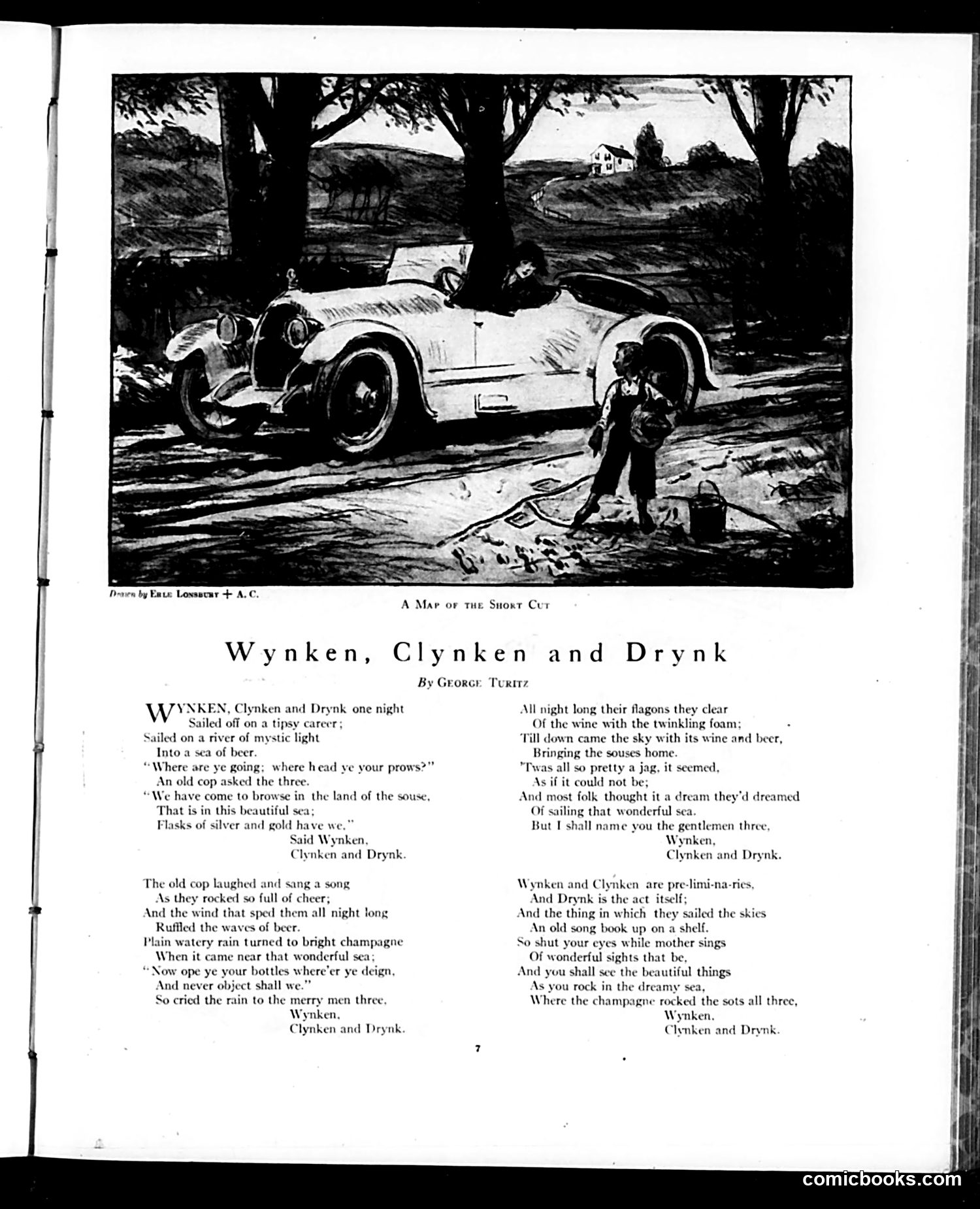
This page parodies the children's nursery rhyme "Wynken, Blynken, and Nod" to satirize alcohol consumption and intoxication. The poem describes three figures sailing into a fantastical "sea of beer" and "champagne," getting progressively drunk while an old cop (likely representing law enforcement turning a blind eye) encourages them. The final stanza reveals the satirical punchline: "Wynken" and "Clynken" represent preliminary drinking stages, while "Drynk" is "the act itself"—the actual intoxication. The entire voyage is reimagined as a drunken fantasy. The accompanying illustration shows a vintage automobile (not a boat), emphasizing the danger of drunk driving—a modern safety concern of the era. This appears to be Judge magazine's commentary on Prohibition-era drinking culture and the social normalization of intoxication, using familiar children's verse to mock both the behavior and society's tolerance of it.
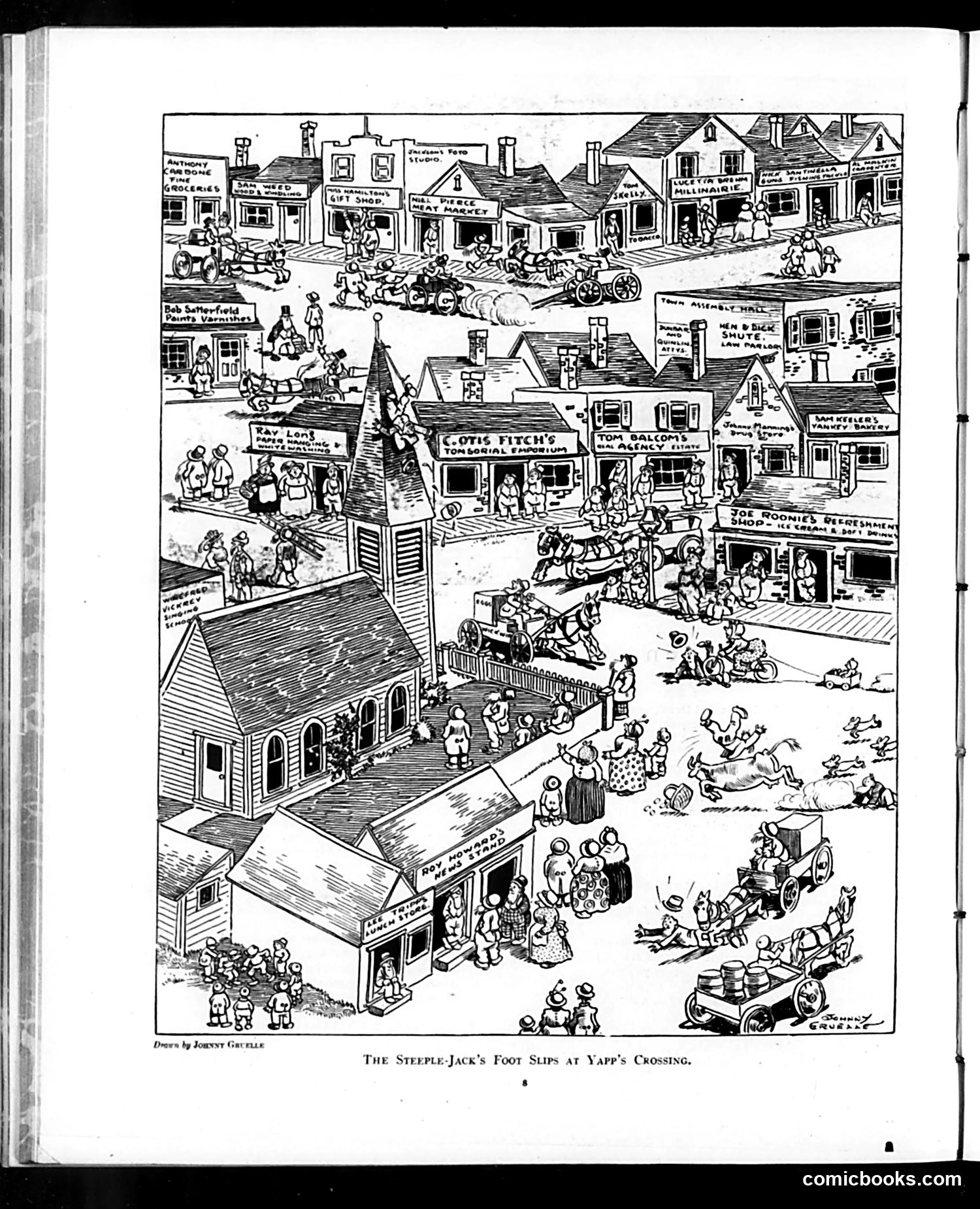
This is a single illustrated cartoon titled "The Steeple-Jack's Foot Slips at Yapp's Crossing." It depicts a bustling village street scene drawn by Johnny Gruelle, showing various shops, buildings, and numerous characters engaged in everyday activities and minor accidents. The cartoon appears to be a humorous depiction of small-town chaos—the "foot slip" of a steeple-jack (a worker who repairs church steeples) at a road crossing triggers a cascade of comedic incidents among villagers. The satire seems to mock the interconnected nature of small-town life, where one person's mishap creates ripple effects affecting everyone nearby. The labeled shops and named characters suggest this may be set in a recurring fictional town, possibly from an ongoing Judge serial or feature. Without additional context about Judge's regular characters or the specific era, the precise satirical targets remain unclear, though the humor centers on small-town accident-prone activity.
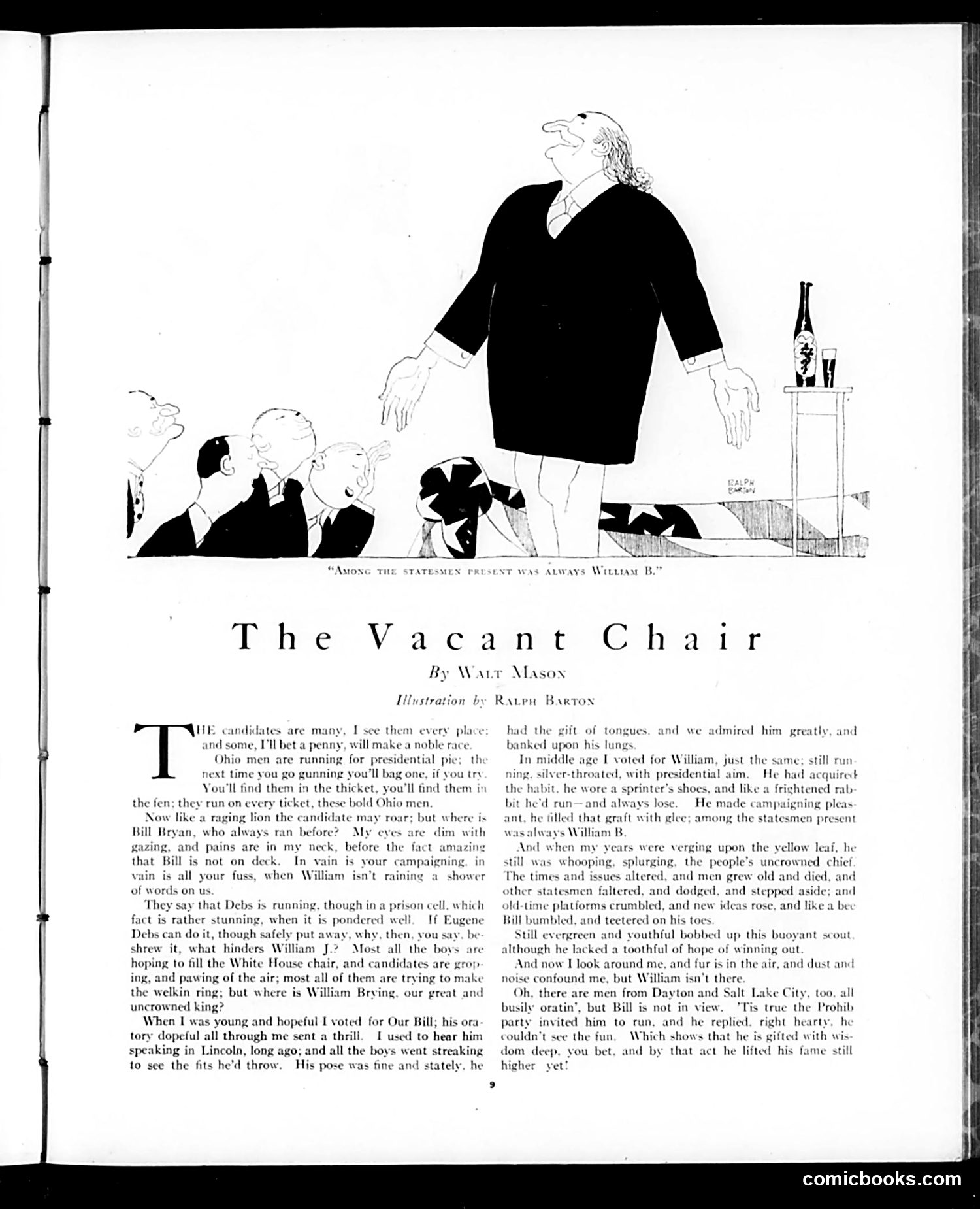
This is a nostalgic political poem lamenting William Jennings Bryan's absence from the 1912 presidential race. The illustration shows a towering figure (likely representing Bryan's political absence or legacy) looming over smaller statesmen. The text expresses the author's long admiration for Bryan—a famous Ohio-born orator known for his passionate speeches and multiple presidential campaigns. The poem recalls Bryan's earlier vitality and "gift of tongues," contrasting it with his current non-candidacy. The satire criticizes the crowded 1912 field: Eugene Debs is running from prison, other candidates are scrambling for the presidency, yet Bryan—the once-dominant "uncrowned king"—is notably absent. The joke's punchline: Bryan's wisdom finally shows when he *declines* the Prohibition Party's invitation to run, having learned restraint at last. This reflects Bryan's genuine withdrawal from politics after three failed presidential bids (1896, 1900, 1908).
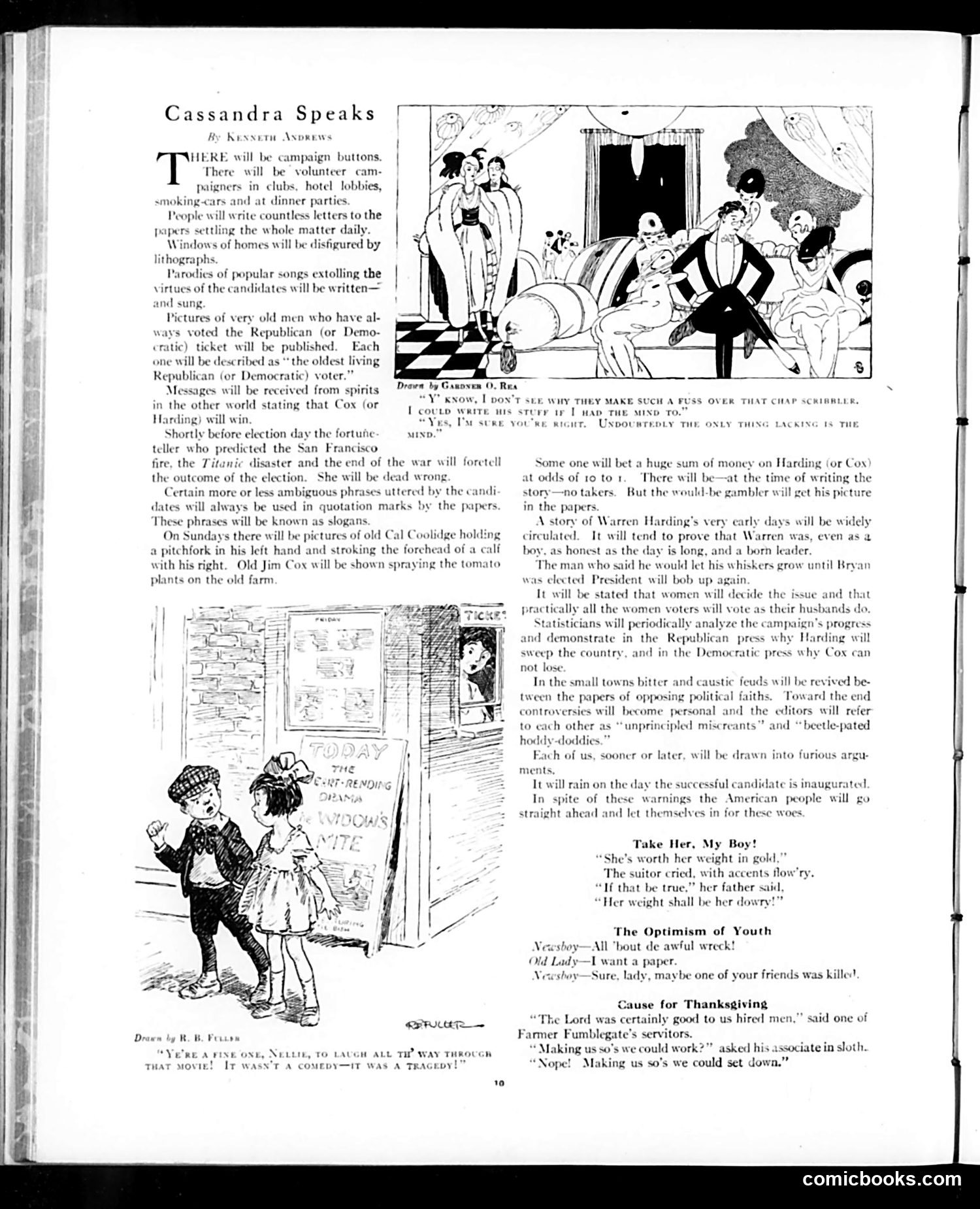
This piece satirizes American presidential campaign practices during the 1920 election (likely Harding vs. Cox, as named). "Cassandra Speaks" adopts the mythological figure who prophesied true events nobody believed—here predicting the inevitable circus of campaigning. The satire catalogs expected absurdities: campaign buttons, amateur songs, dubious "oldest voter" photos, spiritualist predictions, and contradictory newspaper interpretations of vague candidate statements. It mocks Cal Coolidge (Vice President) posed as a farmer and Cox shown gardening—attempts to craft populist images. The accompanying cartoons offer lighter humor: two people debating a tragic film's comedy value, and a domestic scene about a bride's dowry. The "Cause for Thanksgiving" joke cynically presents laborers grateful merely to rest rather than work. Overall, the page ridicules campaign-season absurdity and media manipulation—concerns equally relevant today.
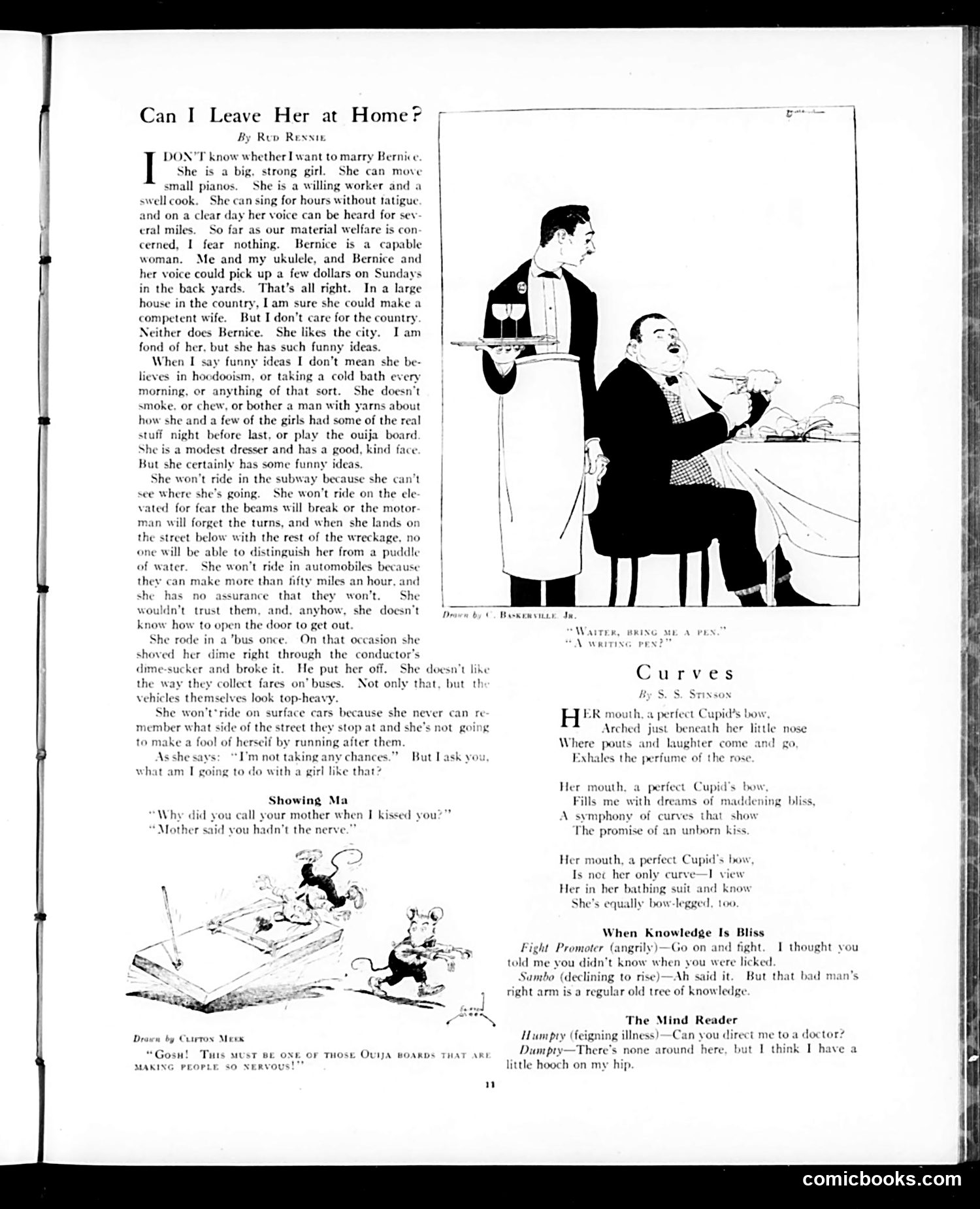
This article by Rup Rennie satirizes modern urban anxieties through a bachelor's ambivalence about marrying Bernice. The humor lies in the disconnect: Bernice is materially excellent—strong, hardworking, a good cook—yet her "funny ideas" make her unsuitable as a city wife. Her irrational fears about transportation reveal period anxieties. She fears subways (can't see), elevated trains (beams breaking), automobiles (speed), buses (can't remember stops), and streetcars (unpredictable). She even broke a bus fare-collector by forcing her dime too hard. The satire targets both female irrationality and urban modernity's genuine dangers. The suitor concludes he can't marry someone so fearful and impractical for city living, despite her domestic competence—implying urban wives needed to overcome anxiety about new technologies or face confinement at home. The accompanying cartoons and poems on the page provide lighter comic relief about courtship and relationships.
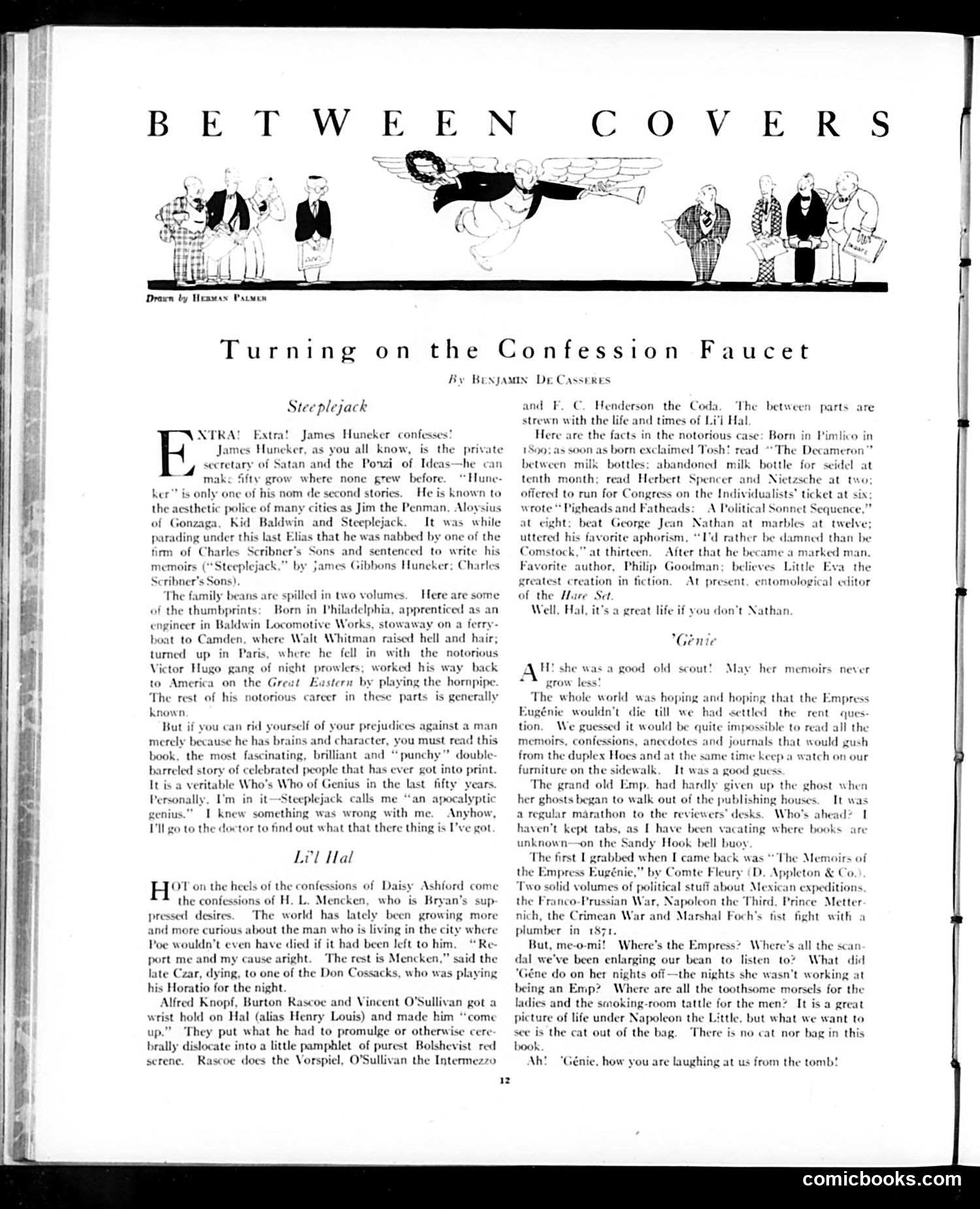
This page satirizes celebrity memoir-writing trends in the 1920s, featuring three prominent cultural figures and their published confessions: **James Huneker** (top section): A real music and drama critic whose memoirs are mocked as sensationalized. The satire exaggerates his colorful past—Paris bohemian circles, associations with Walt Whitman—suggesting his self-promotion as a "man of genius" is inflated. The author De Casseres plays along ironically, calling himself an "apocalyptic genius" in Huneker's book. **H.L. Mencken** ("Li'l Hal"): Described as Bryan's "suppressed desires" (referencing William Jennings Bryan, whom Mencken opposed), his memoir is presented as extracted by publishers Knopf, Rascoe, and O'Sullivan. The satire mocks both Mencken's pretensions and the publishing industry's hunger for celebrity revelations. The cartoon's point: American culture was obsessed with famous people's confessions and autobiographies, treated as entertainment rather than genuine insight. The satire ridicules both the subjects' vanity and readers' appetite for celebrity gossip dressed as literature.
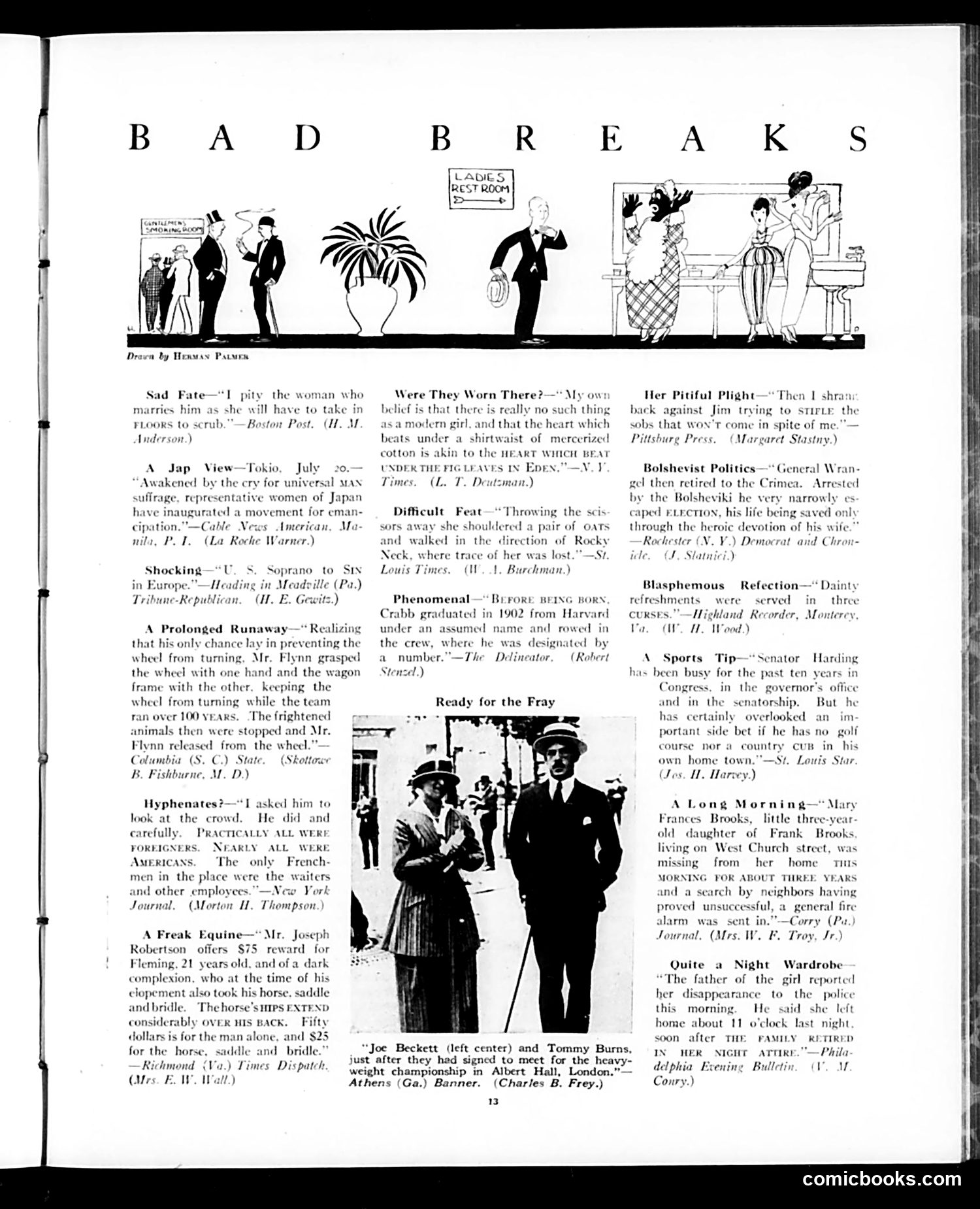
This page from *Judge* magazine features humorous anecdotes clipped from newspapers, organized under satirical headlines that reframe mundane news items as social commentary. **Key themes:** The satire targets early 20th-century social anxieties: women's suffrage (mocking Japanese women's emancipation movements), immigration ("hyphenates"—foreigners and foreign-born Americans), gender roles (the "modern girl" lacking authentic emotion), and class disparities (a reward for a runaway man and horse, a missing child). **Notable items:** "Bolshevist Politics" references post-Russian Revolution fears. "A Sports Tip" jokes about Senator Harding's golf hobby during his political career. The fashion cartoon at top ("Ready for the Fray") shows socialites preparing for some event. The humor relies on readers catching absurdities in reported facts—a woman scrubbing floors after marriage, a horse with extended lips, a three-year-old missing for years. The magazine amplifies these through ironic headlines to mock contemporary news and society.
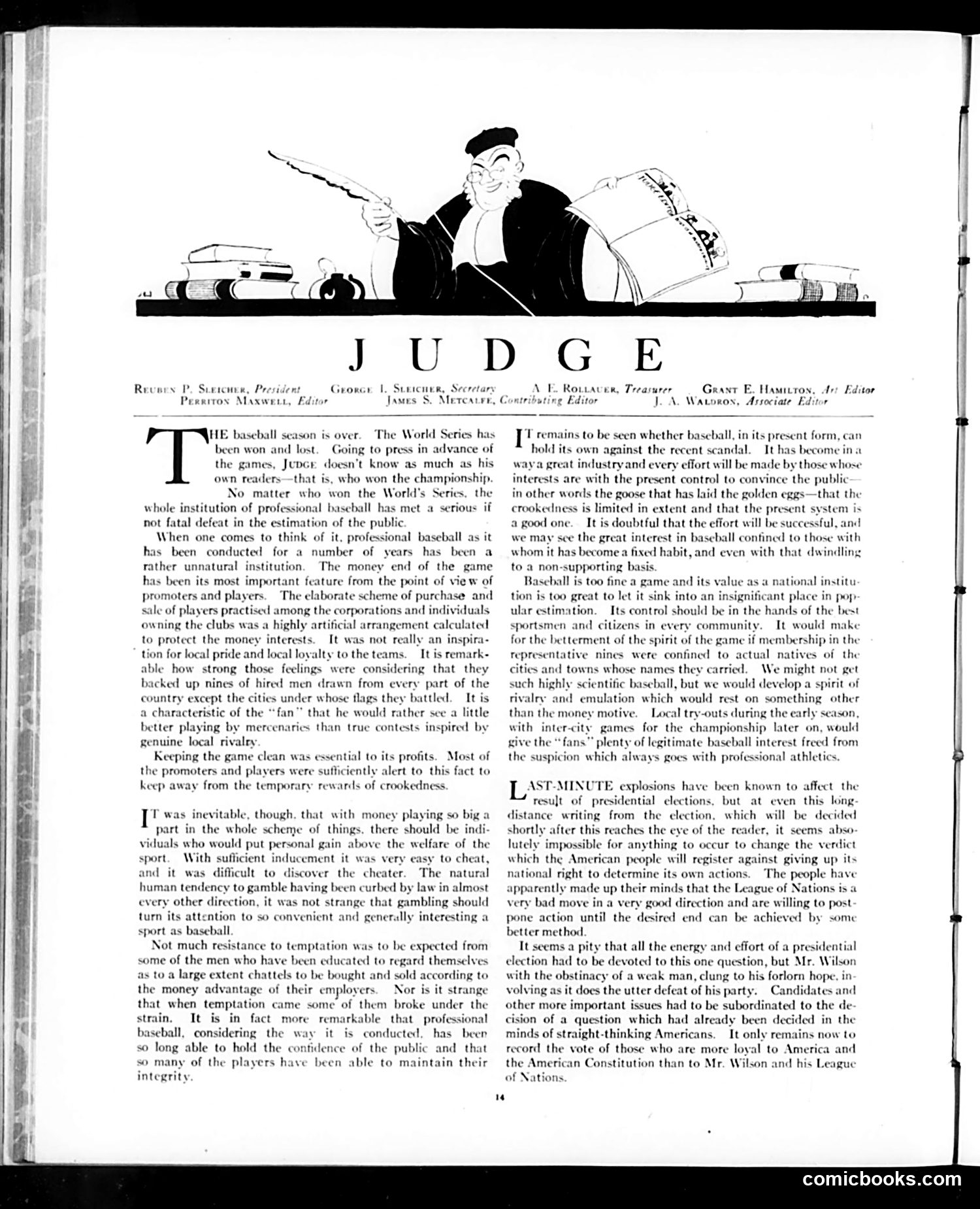
This is the editorial/opinion section of *Judge* magazine responding to a major baseball scandal—likely the 1919 Black Sox scandal, where Chicago White Sox players allegedly threw the World Series. The illustrated header shows a judge figure presiding over scattered baseball equipment, symbolizing the need for moral judgment of the sport's integrity crisis. The text argues that professional baseball's fundamental problem is its **commercialization**: players are "hired men" bought and sold like commodities, creating incentives for corruption. The editorial contends that money-driven competition lacks the genuine civic loyalty that amateur baseball would inspire. It acknowledges that keeping the game "clean" was necessary only for profits, not principle. The scandal reveals this system's weakness: when tempted, men treated as merchandise will cheat. The piece calls for baseball's control to shift from profit-driven promoters to "best sportsmen and citizens," suggesting institutional reform is necessary for the sport's survival and moral standing.
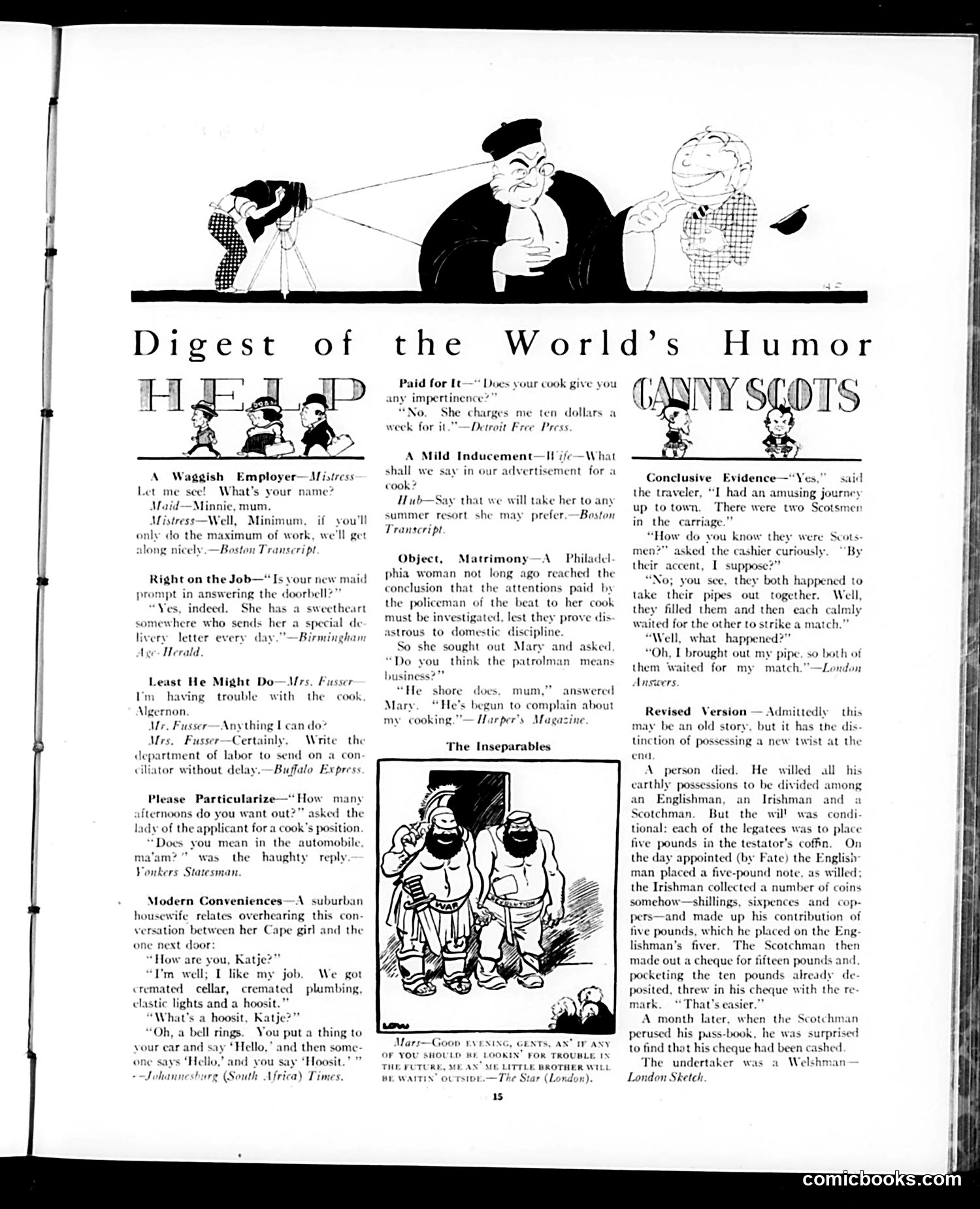
This page collects short humorous anecdotes typical of early 20th-century Judge magazine. The jokes reflect period class dynamics and ethnic stereotyping: **Content includes:** - Workplace humor about domestic servants and employers (maids, cooks) — reflecting a servant-keeping class - A joke about Scottish frugality ("The Inseparables" cartoon): two Scotsmen wait for each other to light their pipes, avoiding the expense of striking a match themselves - Ethnic stereotypes: "Cape girls" (likely South African servants), Irish and Welsh characters portrayed through dialect and supposed national traits - A "revised" joke about a Scottish man's ultimate financial cunning — he cheques the will's money for himself **The satire targets:** Primarily working-class domestic servants and various national/ethnic groups through exaggerated stereotypes — Scots as miserly, Irish as improvident, Welsh as shrewd. The humor relies on readers sharing these prejudices. This represents pre-WWII Anglo-American magazine humor: class-conscious, casually xenophobic, and treating ethnic caricature as entertainment.
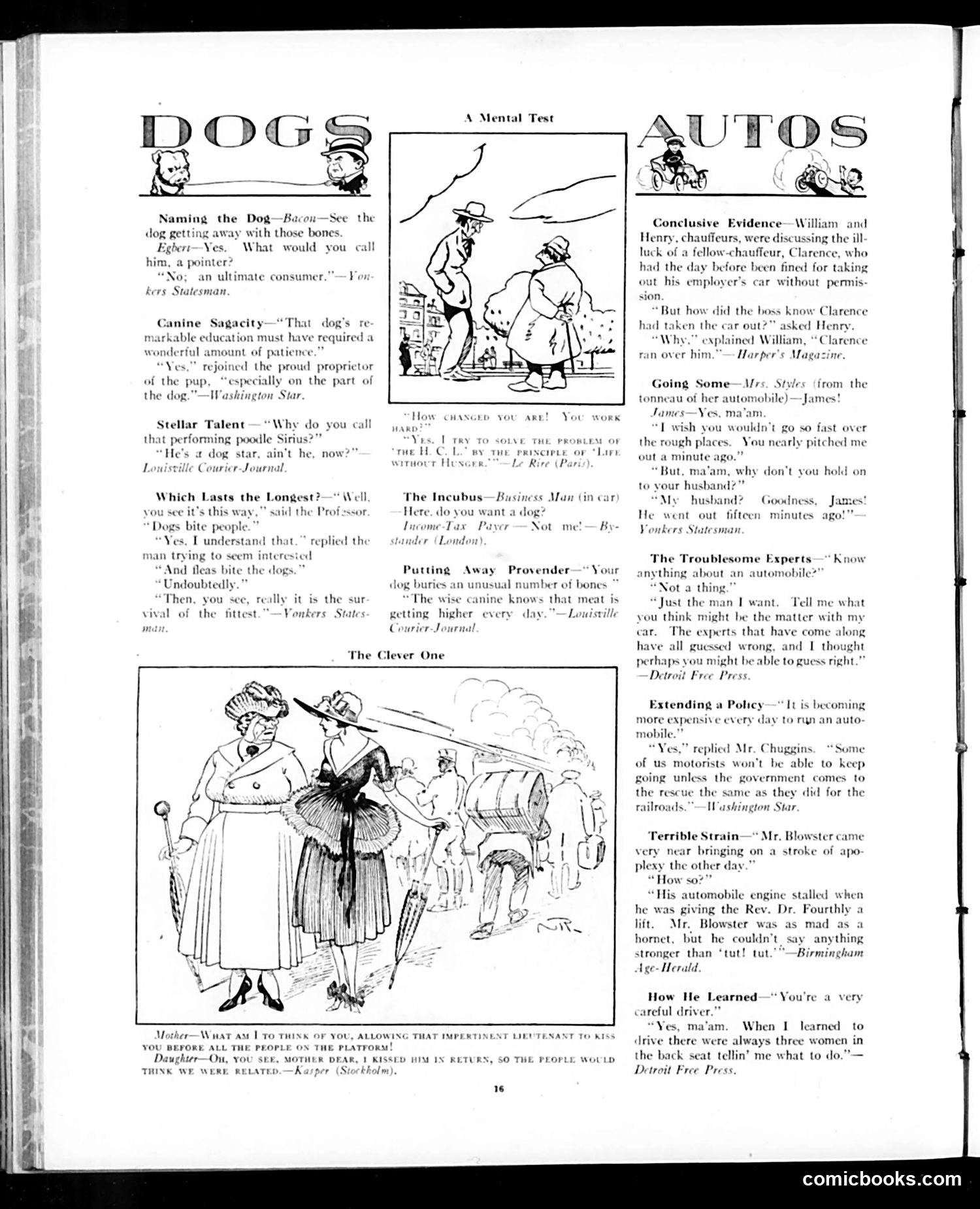
This page from *Judge* magazine collects brief automotive and dog-related jokes typical of early 20th-century American humor. The cartoons mock emerging social anxieties about automobiles and modern life. **Key satirical targets:** - **"Naming the Dog"**: Jokes about consumer culture and economic terminology applied absurdly to pets - **"Going Some"**: Satirizes women drivers as reckless, a common contemporary prejudice - **"Conclusive Evidence"**: Dark humor about a chauffeur killed by his employer's car—suggesting class tensions between employers and servants - **"The Troublesome Experts"**: Mocks automobile repair expertise as unreliable, reflecting public distrust of new technology - **"Terrible Strain"**: Humor about masculinity compromised by polite company (a clergyman) during mechanical failure - **"How He Learned"**: Stereotypes women as backseat drivers offering unsolicited advice The overall tone reflects early automotive-era anxieties: dangerous driving, class conflict, gender roles, and public skepticism about this novel technology.
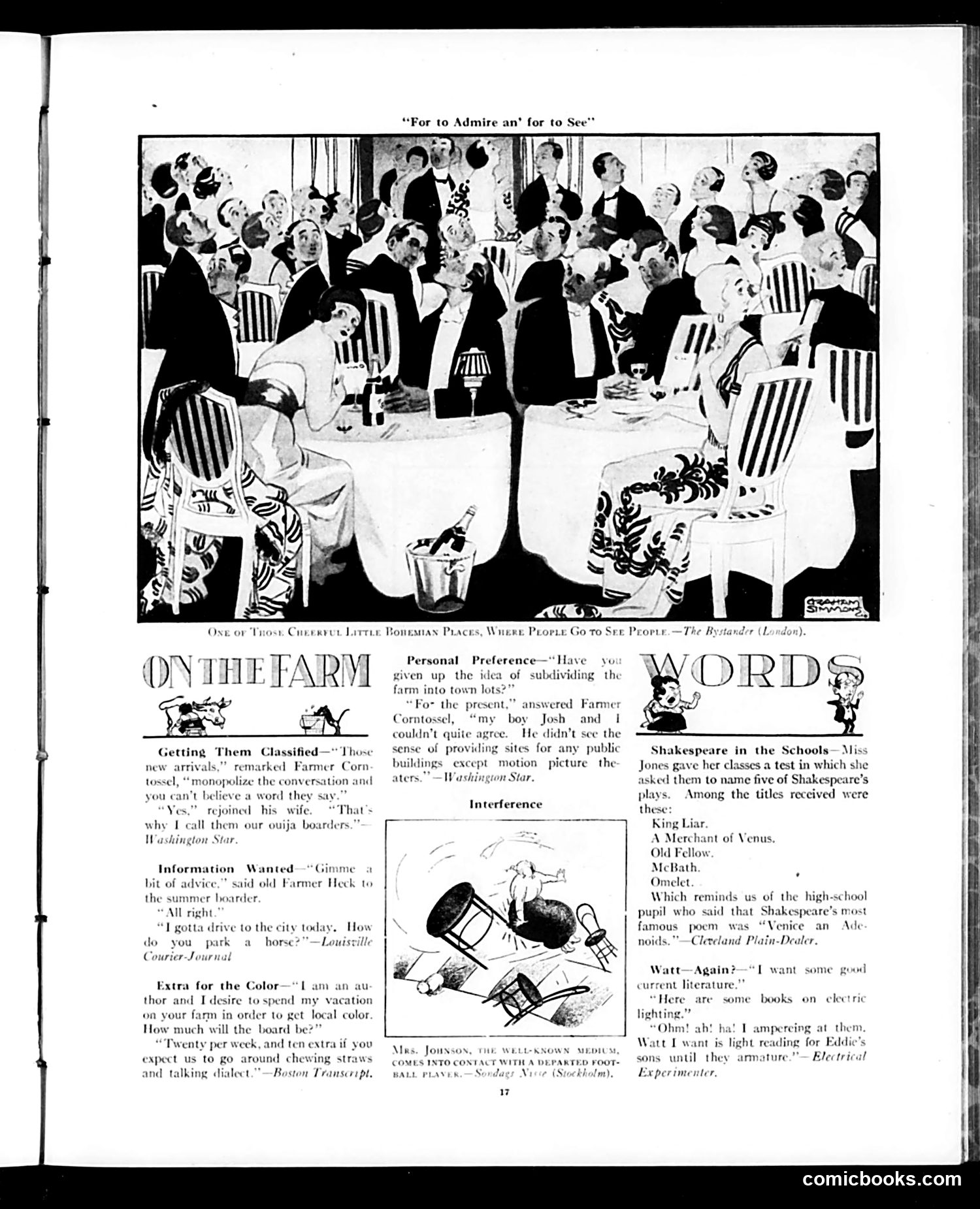
This page from *Judge* magazine contains rural humor and satirical columns typical of early 20th-century American comedy. The main content consists of several short, dialogue-based jokes: **"On the Farm" section** features Farmer Corntossel and his wife mocking summer boarders (city people renting farm accommodations) who tell tall tales and can't be believed—calling them "ouija boarders" as a joke about their unreliability. Other jokes mock city visitors seeking "local color" for writing, asking naive questions about parking horses, or offering payment to experience rural dialect—poking fun at both pretentious urbanites and rural stereotypes. **"Words" section** includes a joke about Shakespeare taught in schools, where high school students humorously misname Shakespeare plays ("King Liar" for King Lear, "A Merchant of Venus" for The Merchant of Venice). **"Watt—Again?"** is a pun-based joke playing on the name "Watt" with electricity terminology ("light reading," "ampereing"). The humor is gentle, focusing on class differences between city and country, and educational gaps rather than serious political satire.
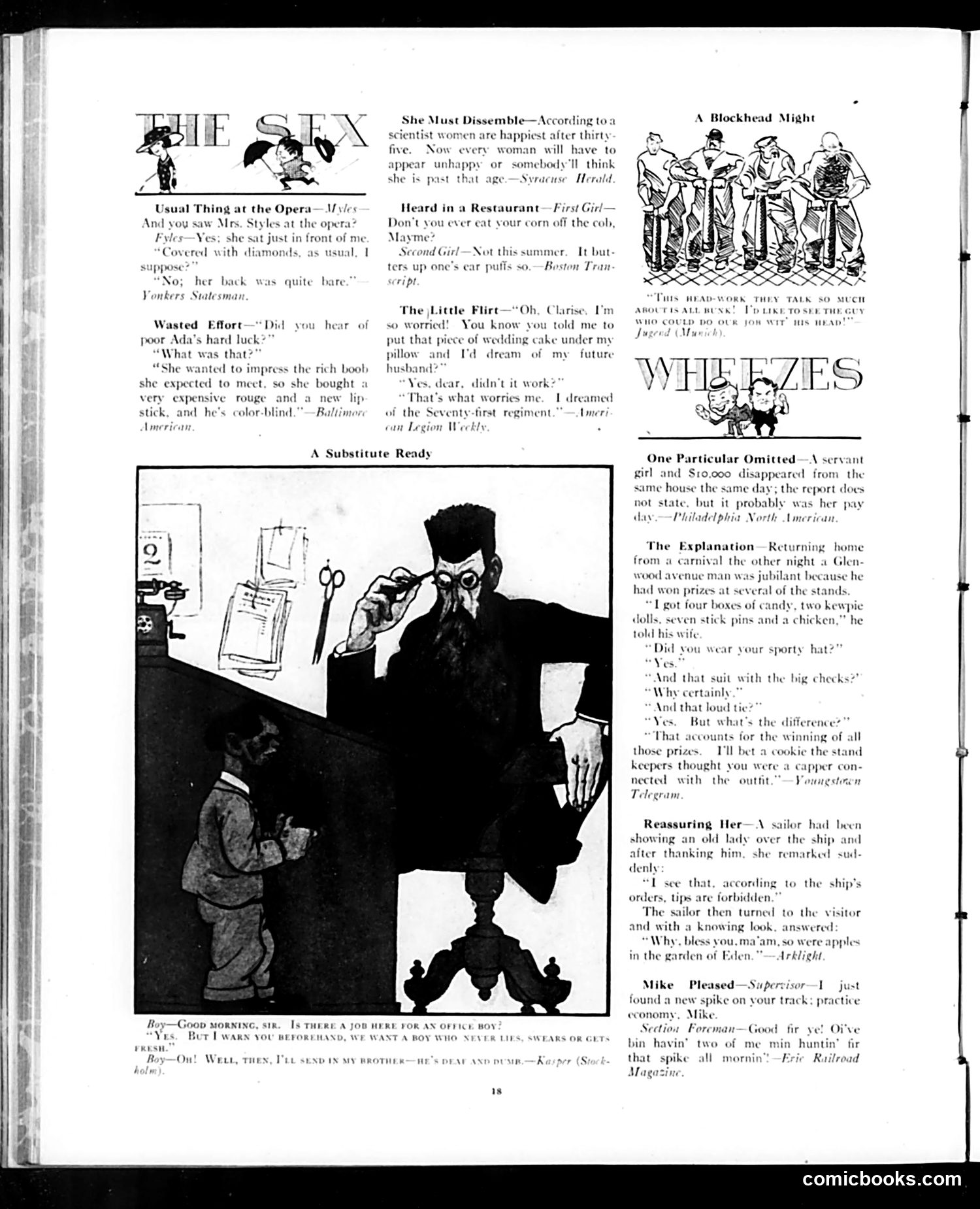
This page collects brief humorous anecdotes and jokes typical of early 20th-century American magazines. Key items: **"She Must Dissemble"** satirizes women's anxieties about aging, referencing a scientific claim that women become happiest after thirty—implying younger women must hide dissatisfaction with their appearance. **"Heard in a Restaurant"** jokes about women's vanity: avoiding corn on the cob because it might disarrange their hairstyles ("ear puffs"). **"The Little Flirt"** humorously depicts a woman's superstitious wedding-cake ritual backfiring—she dreamed of soldiers rather than a husband, reflecting wartime anxieties (reference to "Seventy-first regiment"). **"A Substitute Ready"** cartoon shows a desperate office boy applying for work, promising he won't lie or swear—suggesting young workers were unreliable. The remaining items ("One Particular Omitted," "The Explanation," "Reassuring Her," "Mike Pleased") are brief, genteel humor about servants, carnival prizes, ships, and workers—reflecting period class attitudes and small domestic comedies.
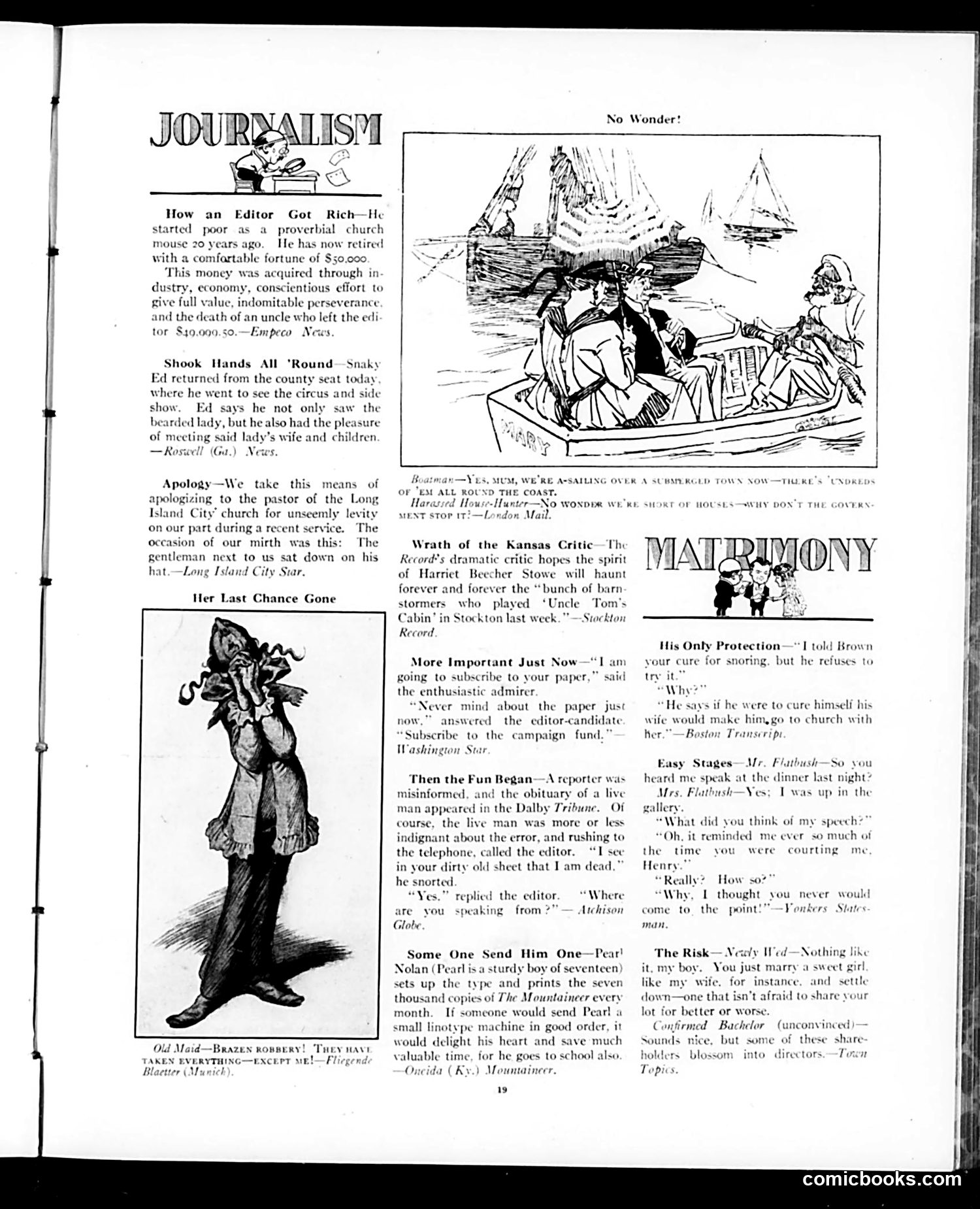
This page collects brief editorial jokes and cartoons mocking journalism, marriage, and social conventions of the era. **"Her Last Chance Gone"** shows an aging unmarried woman lamenting that a bearded lady (a circus performer) is now married, eliminating her last hope of finding a partner—satirizing anxiety about spinsterhood and the desperation it supposedly caused. **The boating cartoon** jokes about a submerged town, with dark humor about disaster. **The journalism section** ridicules newspapers through anecdotes: an editor's wealth came mostly from inheritance, not hard work; reporters spread misinformation; and editors prioritize campaign fundraising over actual journalism. **Marriage jokes** mock both bachelors and wives—one man refuses to cure his snoring because his wife would drag him to church; another warns that marrying means risking your fortune to a woman who might become a director's mistress. The overall tone is cynical about institutions: journalism, marriage, and respectability are all portrayed as fraudulent or foolish.
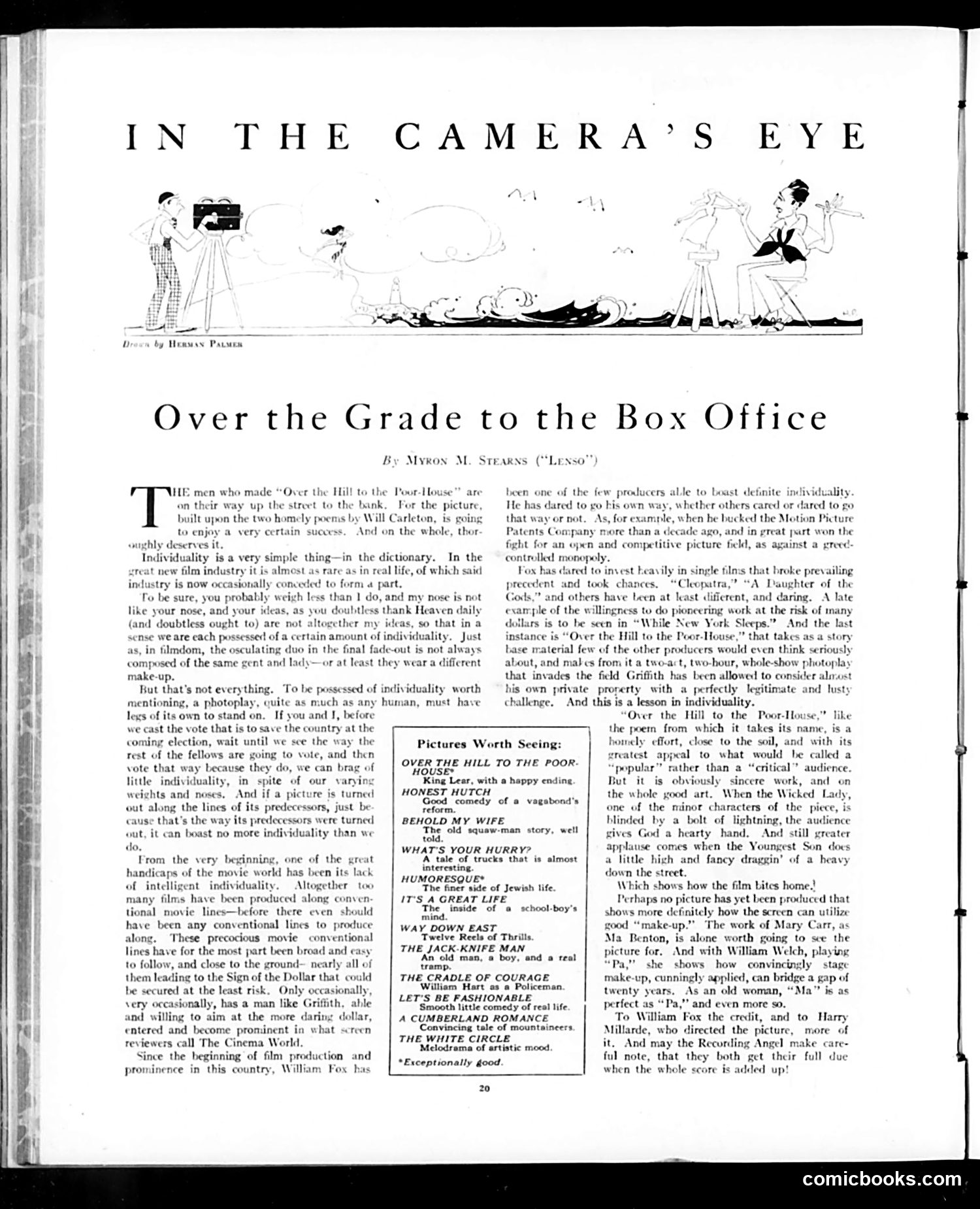
This is not a political cartoon but rather an article by Myron M. Stearns praising William Fox's film production company for demonstrating "individuality" in an industry that typically copies successful formulas. The accompanying illustration (by Herman Palmer) shows a film production in progress—a cameraman, director, and actors on set. **The argument**: Stearns criticizes Hollywood for producing interchangeable films that follow predecessors slavishly, lacking genuine creative courage. He contrasts this with Fox, who has invested in daring, original projects like *Cleopatra* and *While New York Sleeps*, and most recently *Over the Hill to the Poor-House*—adapted from Will Carleton's homely poems rather than conventional material. **The satire**: The piece implicitly mocks the film industry's creative cowardice and profit-driven conformity, using political voting as an analogy: just as voters mindlessly follow others' choices, studios mindlessly copy competitors' successes. Fox is positioned as the rare exception willing to risk money on genuine artistic merit and unconventional stories for working-class audiences.
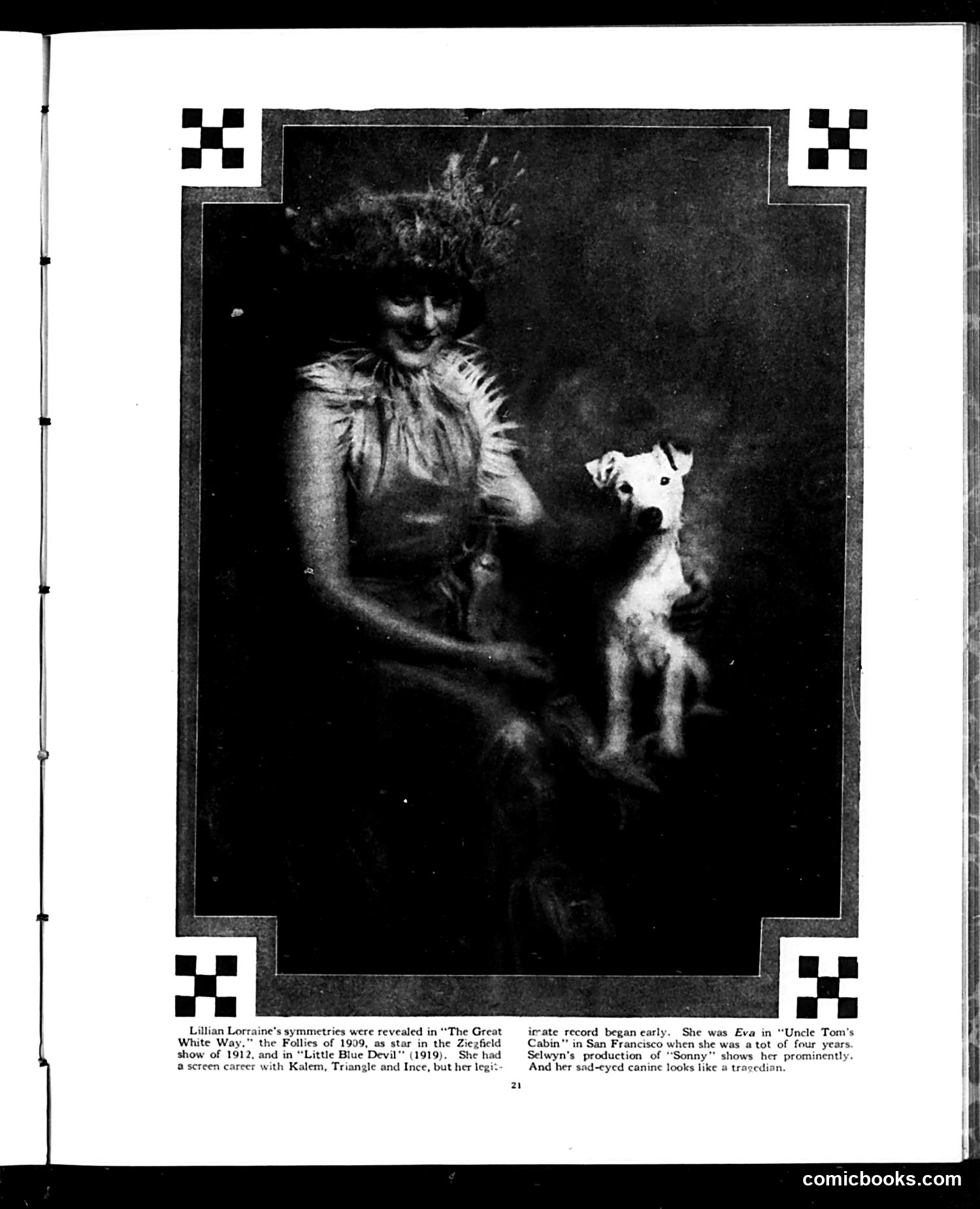
This page features a photograph of actress **Lillian Lorraine** with a small dog, accompanied by career biographical text rather than a political cartoon. The caption documents Lorraine's early theatrical work in major productions: "The Great White Way," the Ziegfeld Follies (1909), "Little Blue Devil" (1919), and early film roles with studios Kalem, Triangle, and Ince. It notes she began her career young, appearing as Eva in "Uncle Tom's Cabin" in San Francisco at age four. The humorous closing observation—that "her sad-eyed canine looks like a tragedian"—is a light joke suggesting the dog's melancholic expression matches theatrical dramatic sensibility. This appears to be an **entertainment/celebrity gossip section** rather than political satire, typical of Judge magazine's mixed content covering theater, film, and vaudeville personalities of the era.
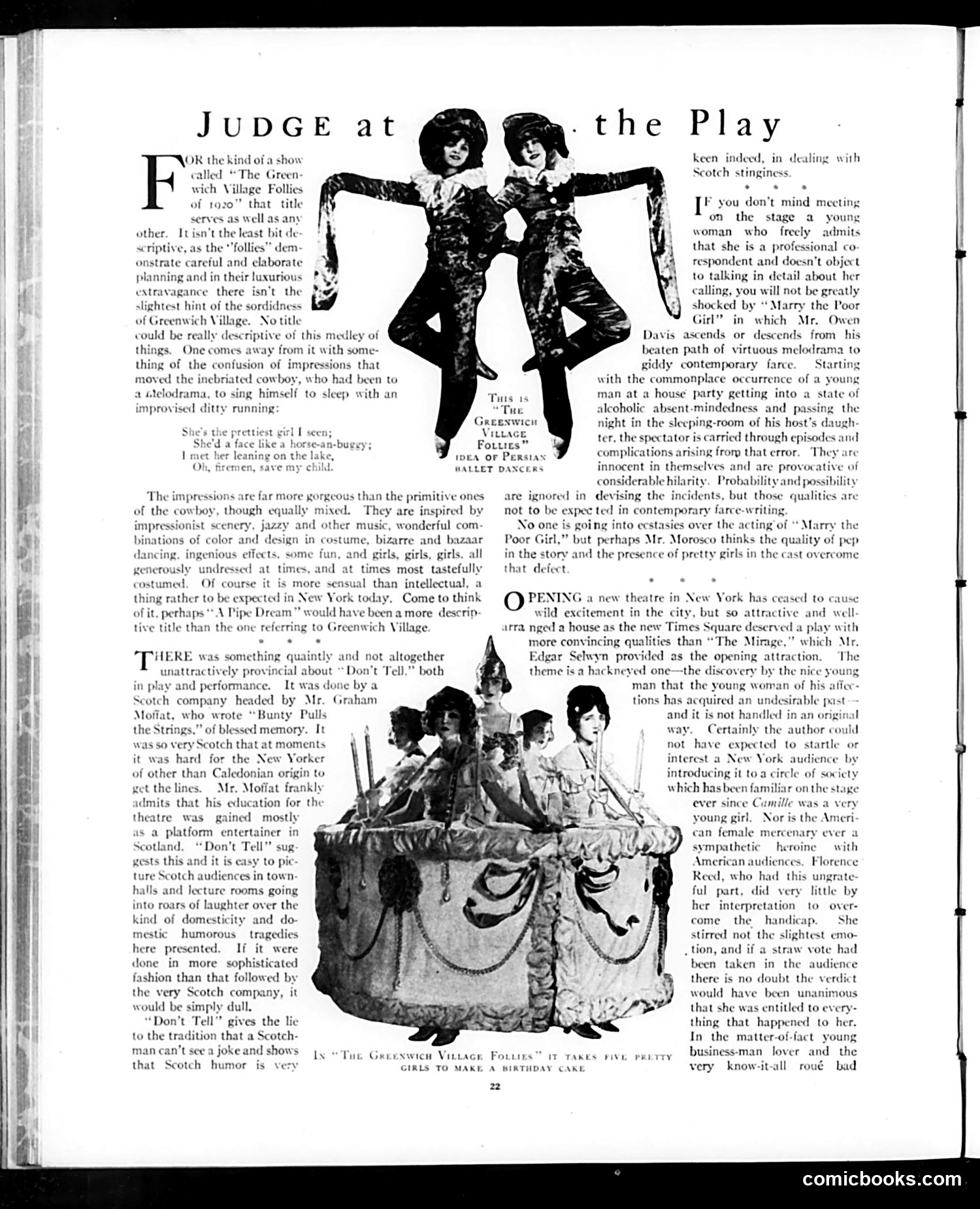
This page reviews three Broadway productions from 1920. The top section critiques "Greenwich Village Follies of 1920," praising its visual extravagance—elaborate costumes, jazzy music, and colorful sets—while acknowledging it lacks coherent plot or intellectual substance. The reviewer notes the show is less about storytelling and more about spectacle typical of New York entertainment. Below, the text discusses "Don't Tell," a Scottish comedy by Graham Moffat, noting its provincial charm works for Scottish audiences but may baffle New Yorkers unfamiliar with Caledonian humor and dialect. The final review covers "Marry the Poor Girl" and "The Mirage," contemporary farces dealing with infidelity and women's pasts—themes the reviewer considers hackneyed. The photographs show elaborately costumed performers in dance numbers and theatrical scenes typical of 1920s Broadway revues.
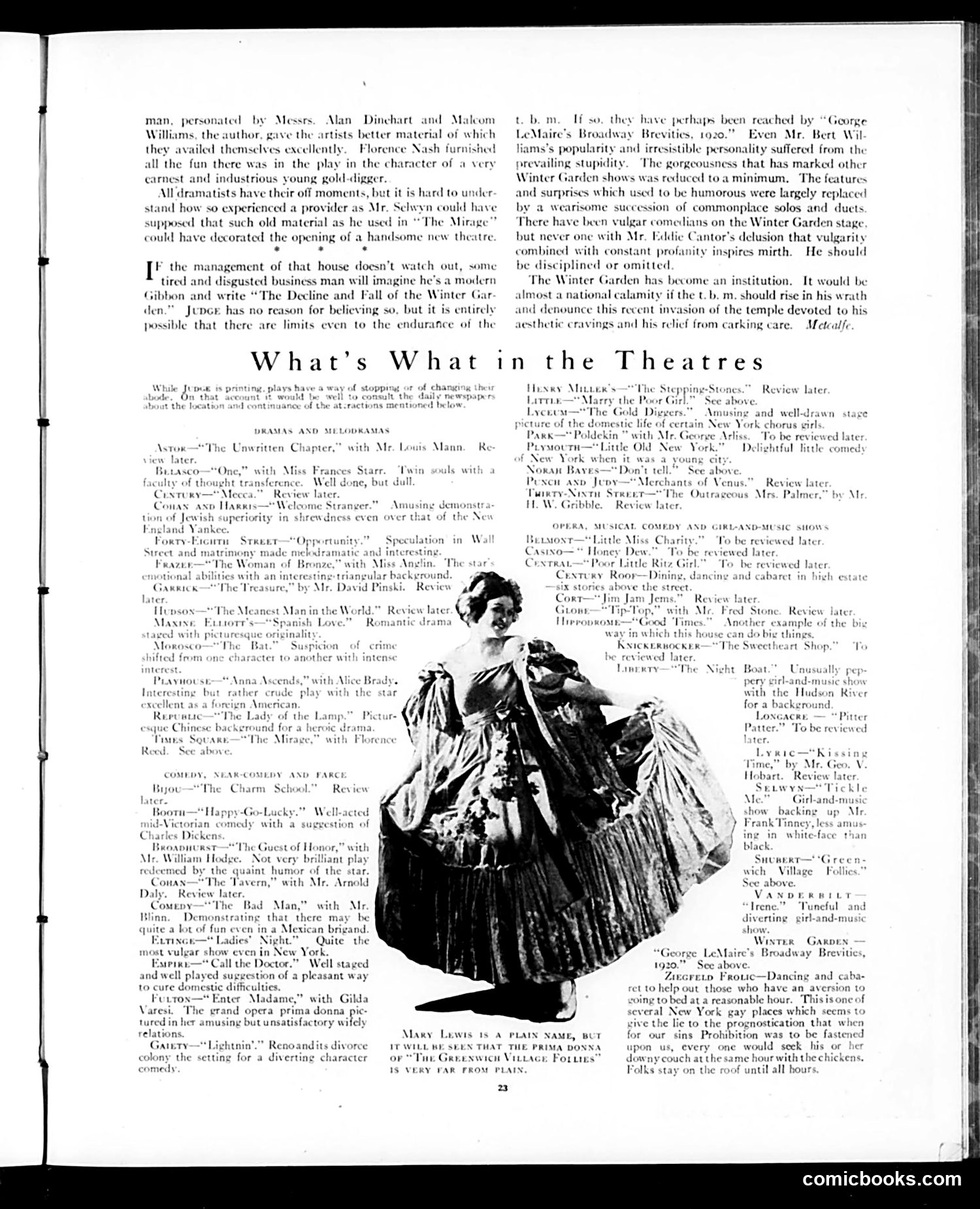
This page from Judge magazine (circa 1920, based on references) contains theatrical reviews and a central illustration of a prima donna in elaborate costume. The image appears to support criticism of performers at the Winter Garden theater. The text criticizes Eddie Cantor's performance there, calling his vulgarity and profanity uninspired—a sharp rebuke suggesting his style doesn't match the venue's aesthetic standards. The article defends the Winter Garden's cultural importance, suggesting it should maintain higher standards or risk decline ("Decline and Fall of the Winter Garden"). The illustration's caption sardonically notes that the prima donna of "Greenwich Village Follies" is "very far from plain"—likely mocking either her appearance or her pretensions to sophistication. The surrounding theater listings and reviews are standard Judge fare, cataloging current Broadway offerings with brief judgments on their merit.
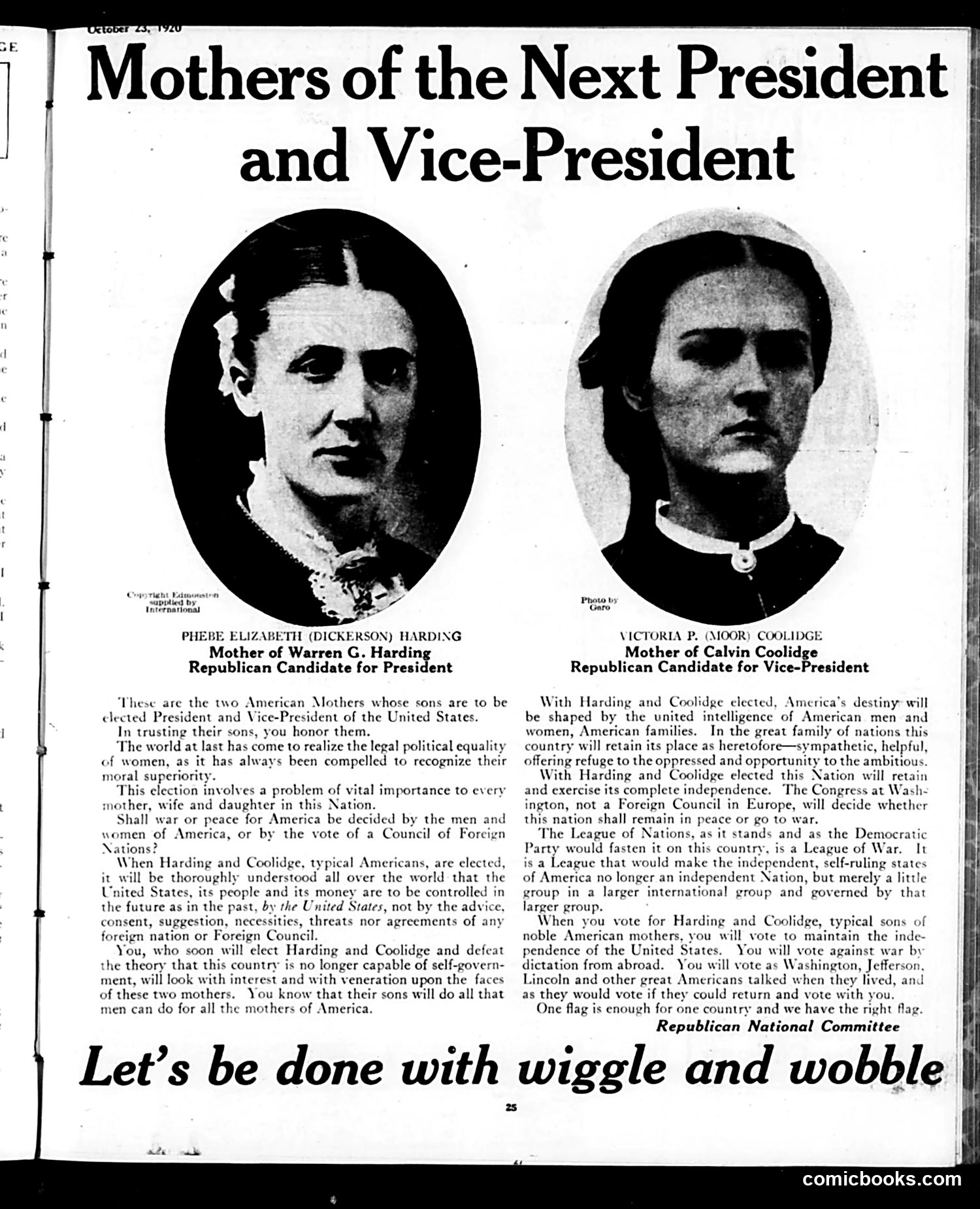
This is a 1920 Republican campaign advertisement featuring photographs of Warren G. Harding's mother (Phebe Elizabeth Dickerson Harding) and Calvin Coolidge's mother (Victoria P. Moore Coolidge), positioned as the "Mothers of the Next President and Vice-President." The appeal targets women voters (newly enfranchised by the 19th Amendment that year) by emphasizing maternal authority and American independence. The central argument opposes U.S. entry into the League of Nations—a key Republican campaign position—characterizing it as foreign control that would compromise American sovereignty. The text contrasts Harding and Coolidge as "typical Americans" who will preserve national independence against Democratic internationalism. The closing slogan "Let's be done with wiggle and wobble" attacks Democratic fence-sitting on League membership. This represents straightforward political messaging rather than satirical cartooning—using motherhood and patriotism to advocate isolationist foreign policy to newly empowered female voters.
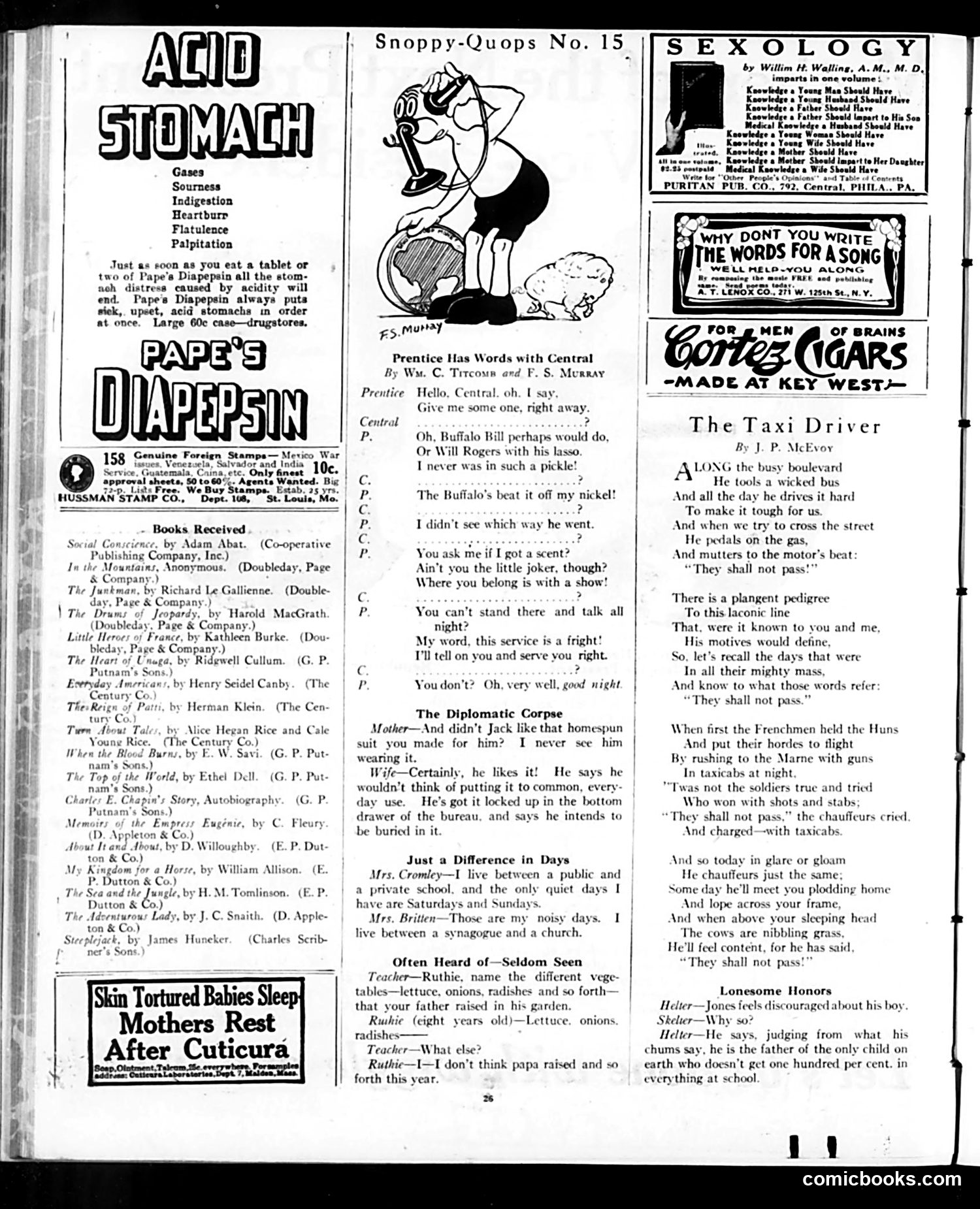
This page contains mixed content: advertisements, book reviews, short humor pieces, and two illustrated items. The main cartoon, "Snoopy-Quops No. 15," depicts a comedic phone conversation between "Prentice" and a telephone operator ("Central"). Prentice frantically requests connection to Buffalo Bill or Will Rogers, revealing he's in some unspecified pickle. The humor relies on the operator's sardonic responses and Prentice's growing frustration with poor telephone service—a relatable complaint for early 20th-century readers when automated switching was still novel. The other illustrated piece, "The Taxi Driver," is a poem contrasting a reckless taxi driver's aggressive motto—"They shall not pass!"—with WWI soldiers' famous defensive stand at the Marne. The satire mocks how taxi drivers recklessly echo wartime heroism while endangering pedestrians. The page also includes humor pieces like "The Diplomatic Corpse" (a wife's joke about her husband preserving an ugly suit for burial) and classroom dialogue exploiting children's literal-mindedness. These represent typical Judge magazine content: topical satire mixed with genteel domestic humor.
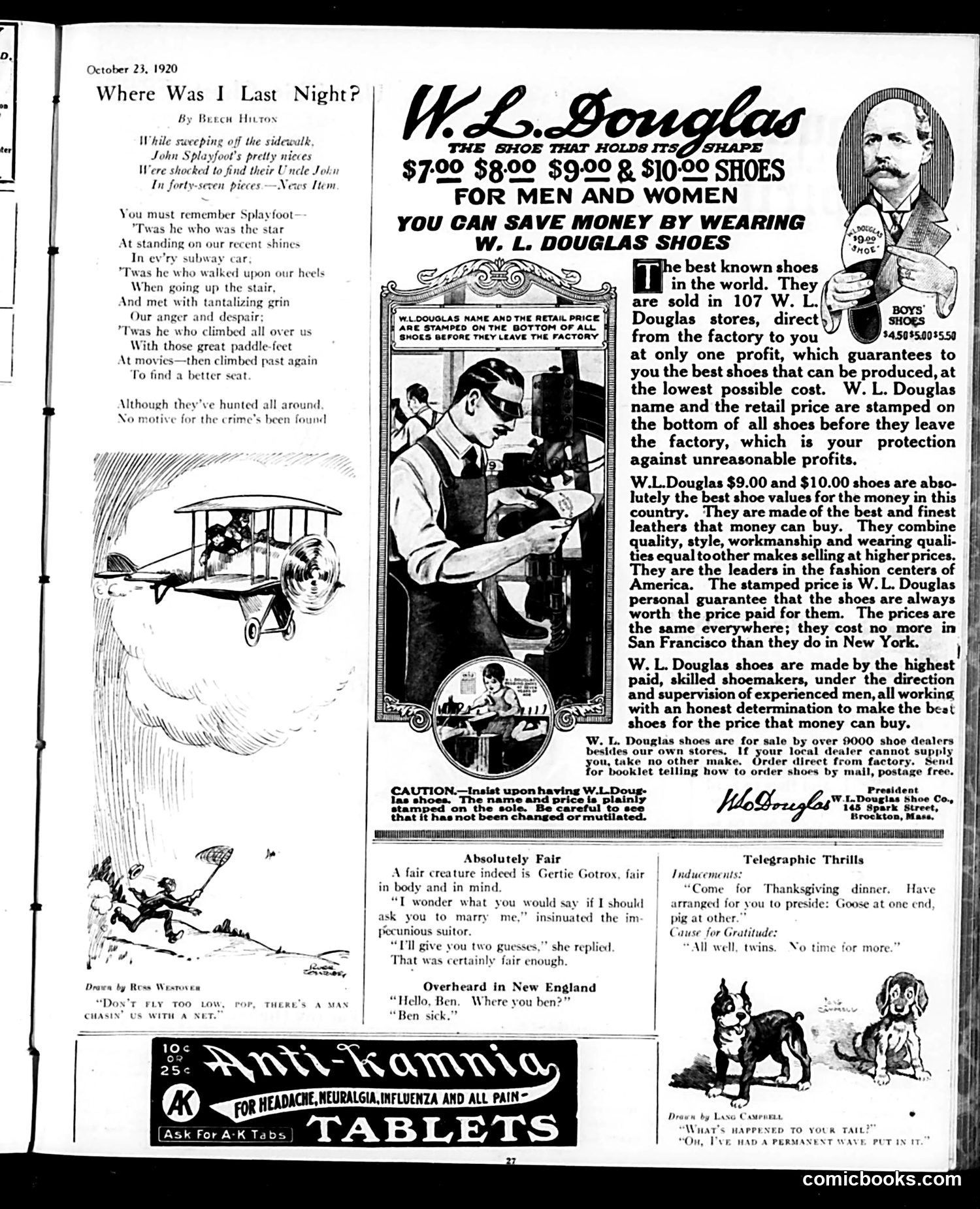
The page features a poem by Byron Hilton titled "Where Was I Last Night?" satirizing an annoying public nuisance named Splayfoot. This character represents a common urban irritant of the 1920s—someone who invades others' personal space on crowded streets and subways, stepping on heels, climbing over people at movie theaters, and generally behaving inconsiderately. The poem's dark humor suggests he's been murdered ("found in forty-seven pieces"), treating his death as a mystery despite his obvious guilt of social annoyance. The satire mocks both the perpetually inconsiderate passenger and the detective-story framing of his demise. The remainder of the page consists largely of **advertising**—primarily a full W.L. Douglas shoe company advertisement emphasizing quality and direct-from-factory pricing—plus smaller advertisements and unrelated comic vignettes about romance and animals.
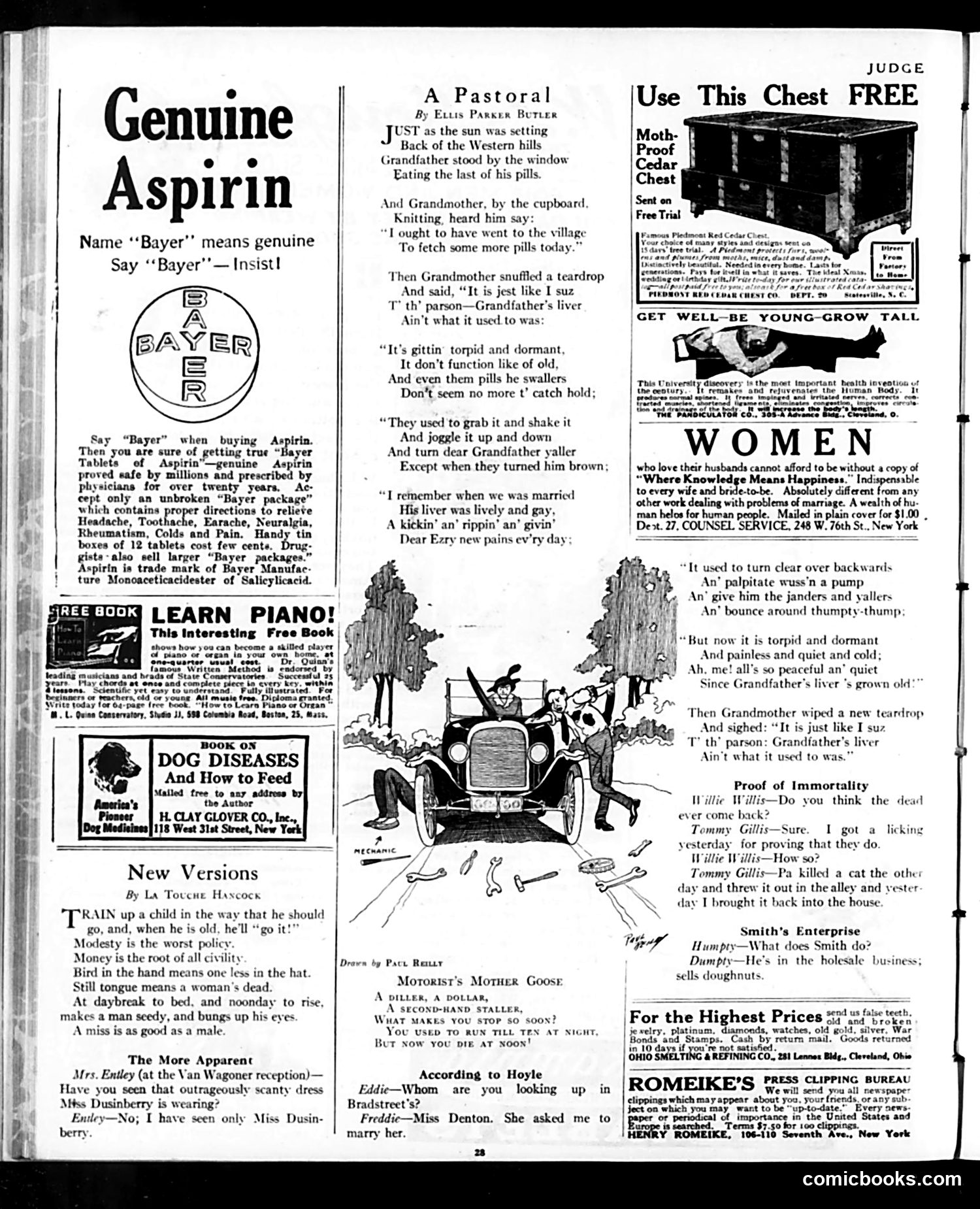
This page mixes advertisements with humorous content typical of early 20th-century satirical magazines. **Main Content:** The centerpiece is "A Pastoral" by Ellis Parker Butler—a sentimental poem about an elderly couple lamenting Grandfather's failing liver. The poem ironically romanticizes his liver's former vigor ("kickin' an' rippin'") while mourning its current dormancy. It's gentle humor about aging and organ failure, illustrated with a rural scene. **Surrounding Material:** The page is dominated by period advertisements: Bayer Aspirin (emphasizing the trademarked name), piano lessons, dog medicine books, and a "Moth-Proof Cedar Chest." There's also "New Versions"—witty reversals of proverbs ("Modesty is the worst policy")—and "According to Hoyle," a brief joke about a man looking up a woman in Bradstreet's (a business directory) after she proposes marriage. **Context for Modern Readers:** The ads reflect pre-FDA regulation marketing. The pastoral poem's focus on pills and organ dysfunction reflects contemporary anxieties about aging and patent medicines as cure-alls—concerns still relevant today, though expressed differently.
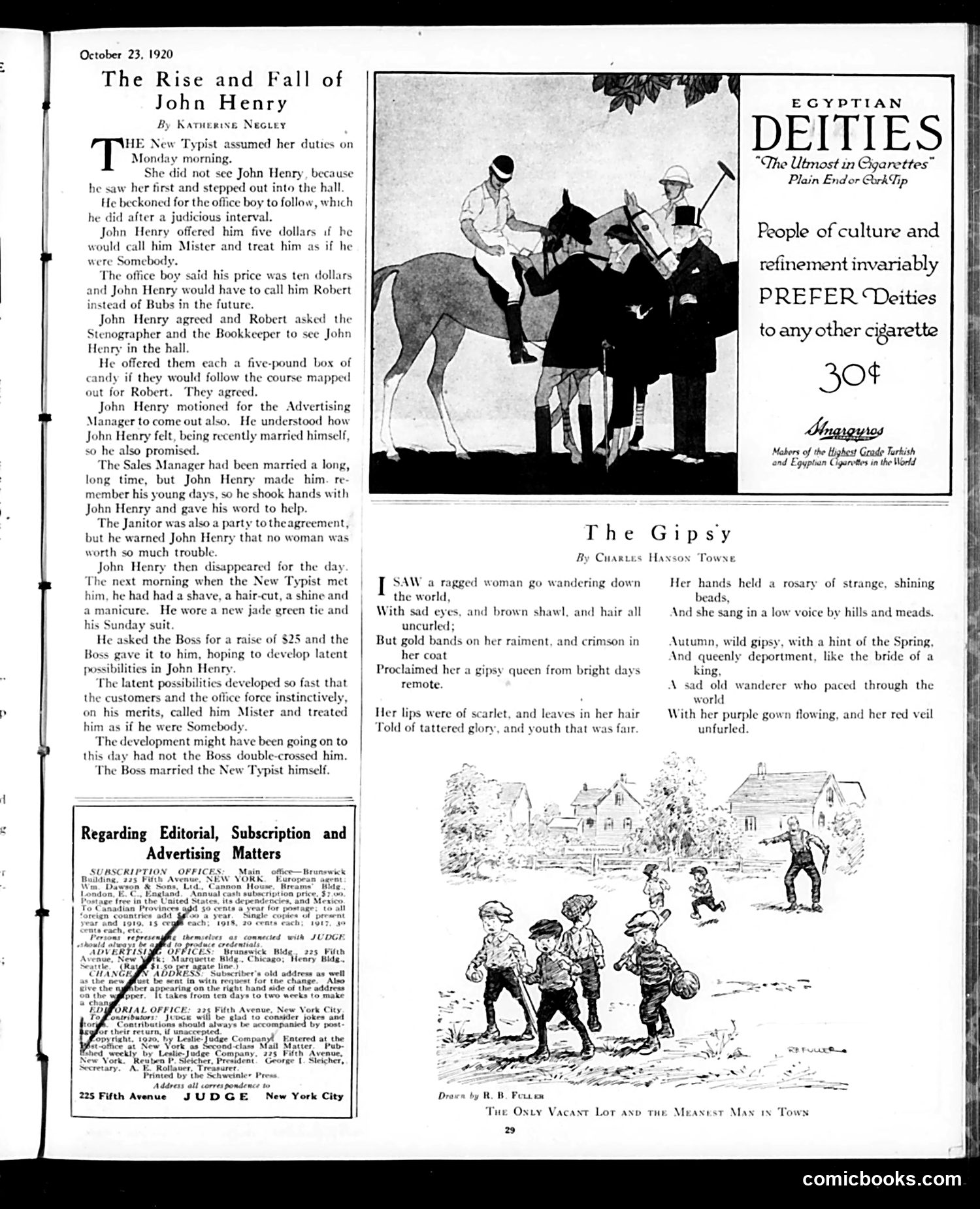
**"The Rise and Fall of John Henry"** is a humorous short story about workplace dynamics and courtship. When a new female typist arrives, the unmarried office worker John Henry—apparently of lower status—makes a pact with coworkers (the office boy, stenographer, bookkeeper, advertising and sales managers, and janitor) to help him appear more respectable and dignified. He bribes them with money and candy to treat him as "Somebody" rather than familiar terms like "Bubs." The scheme works: newly groomed and confident, he requests and receives a raise, and office staff treat him with newfound respect. However, his success is undercut when his boss marries the new typist himself, leaving John Henry's efforts to impress her ultimately futile. The satire mocks both masculine vanity and the powerlessness of lower-ranking men in workplace hierarchies—his self-improvement matters little against his boss's superior position and authority. The page also contains period advertising and a sentimental poem "The Gipsy."
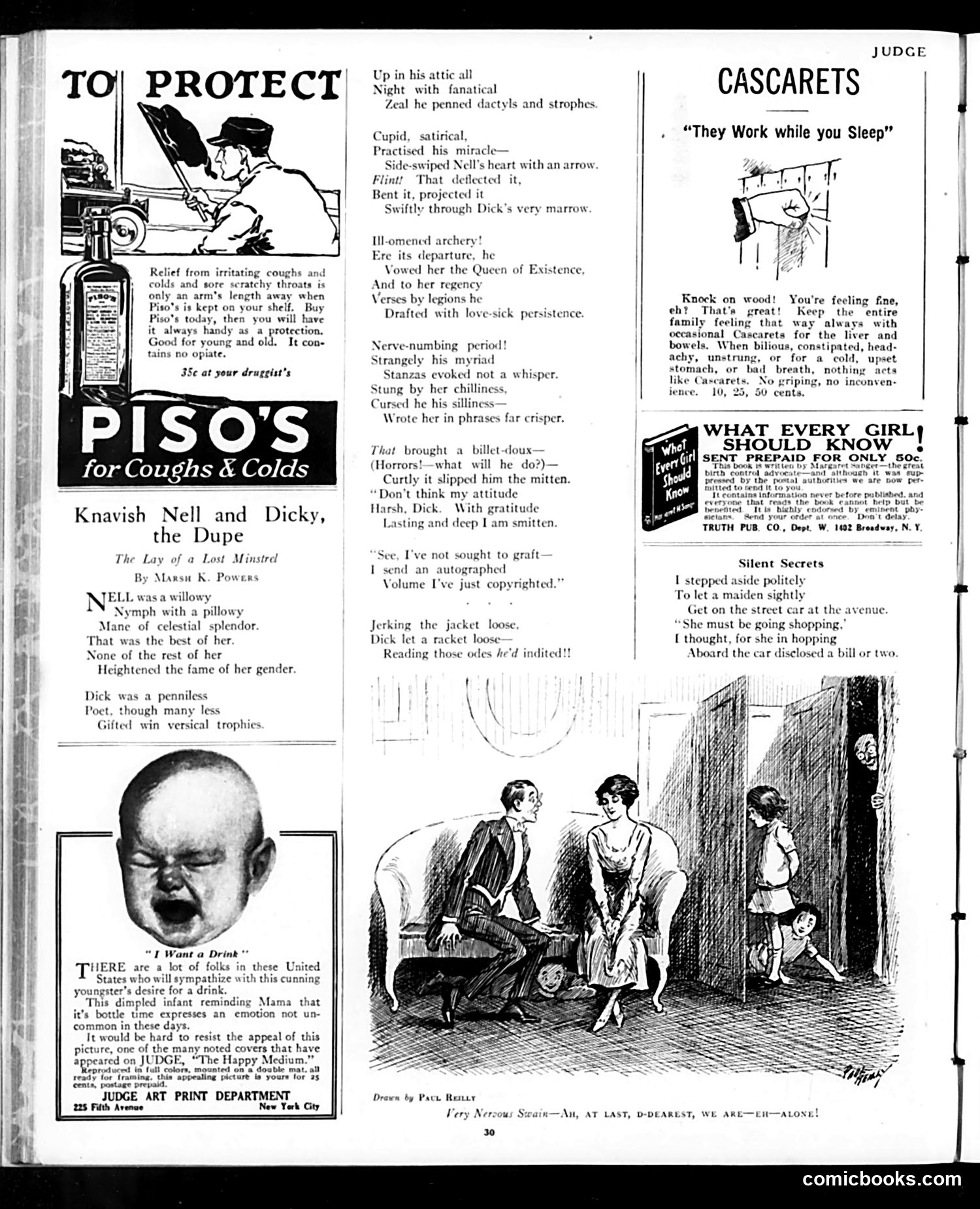
This page primarily contains **advertisements and light satirical poetry** rather than political commentary. The main content includes: 1. **"Knavish Nell and Dicky, the Dupe"** — A humorous poem about a penniless poet who falls for a woman named Nell. She initially rejects him, then sends an ambiguous letter. When Dick reads her enclosed poetry volume, he's apparently horrified by her work ("odes he'd indited!!"). The satire targets romantic delusion and bad poetry. 2. **"I Want a Drink"** — A sentimental illustration of a baby wanting milk, presented as a Judge cover art available for purchase. 3. **"Silent Secrets"** — A brief comic anecdote about a nervous man observing a woman's suspicious behavior on a streetcar. The page is primarily **commercial** — featuring ads for Piso's cough medicine, Cascarets laxatives, and a "What Every Girl Should Know" book. The humor is gentle domestic/romantic comedy rather than political satire.
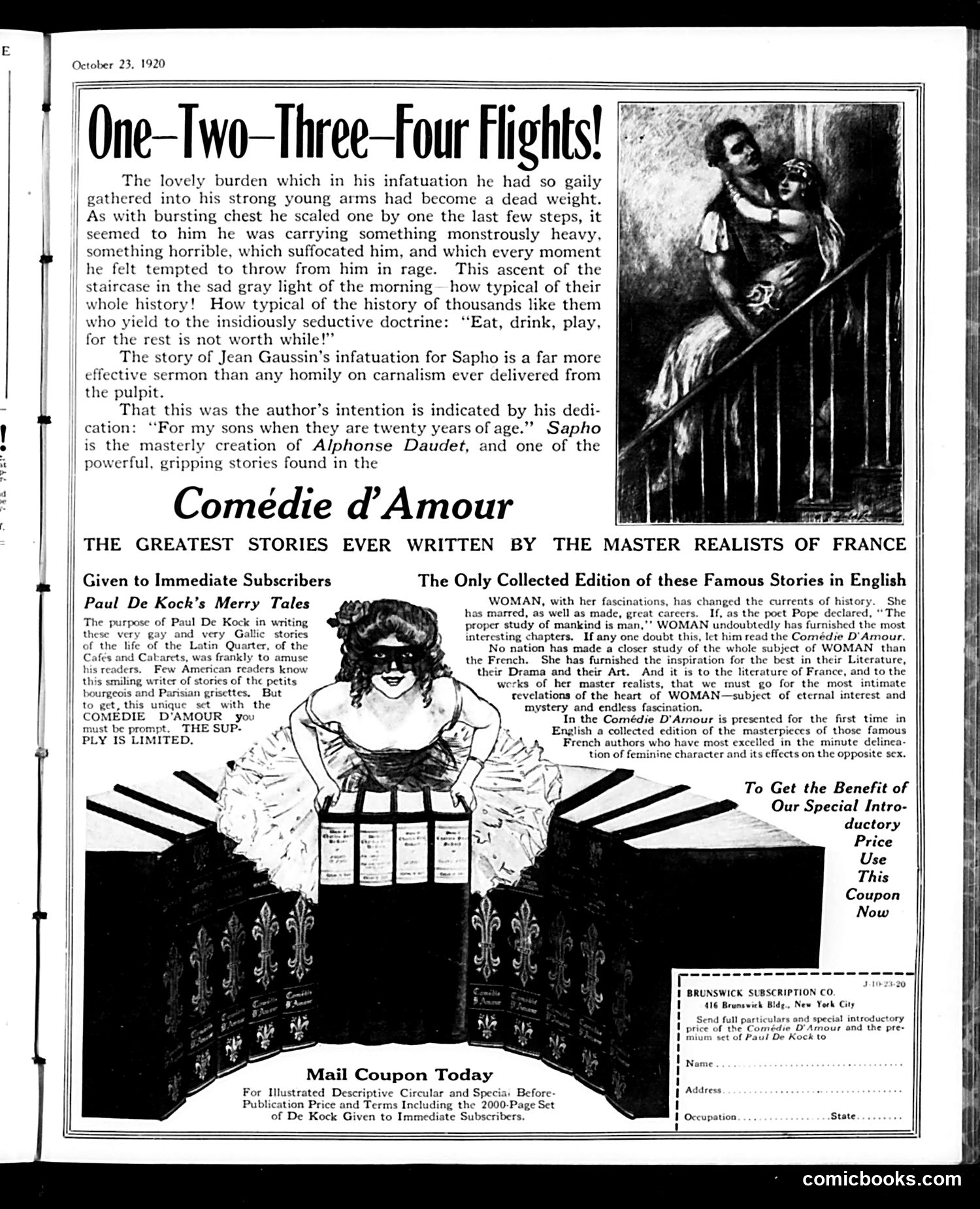
This page is primarily **advertising, not political satire**. It promotes a subscription book series called *Comédie d'Amour*, collecting French realist literature by authors like Alphonse Daudet and Paul De Kock. The illustrated vignette at top depicts a man ascending stairs while carrying a woman—illustrating the plot of Daudet's *Sapho*, about a young man infatuated with a courtesan whose "burden" becomes increasingly oppressive. The text frames this as moral instruction about hedonism's consequences ("Eat, drink, play, for the rest is not worth while"). The lower illustration shows a decorative book set, emphasizing the collection's elegance. The advertisement appeals to middle-class readers by marketing these stories as both literary masterpieces and cautionary tales about women's power to corrupt men—a common early-20th-century anxiety. The subscription pitch emphasizes this is the first English collected edition of these French works on "feminine character." This reflects contemporary attitudes about French literature as simultaneously sophisticated and morally dangerous.
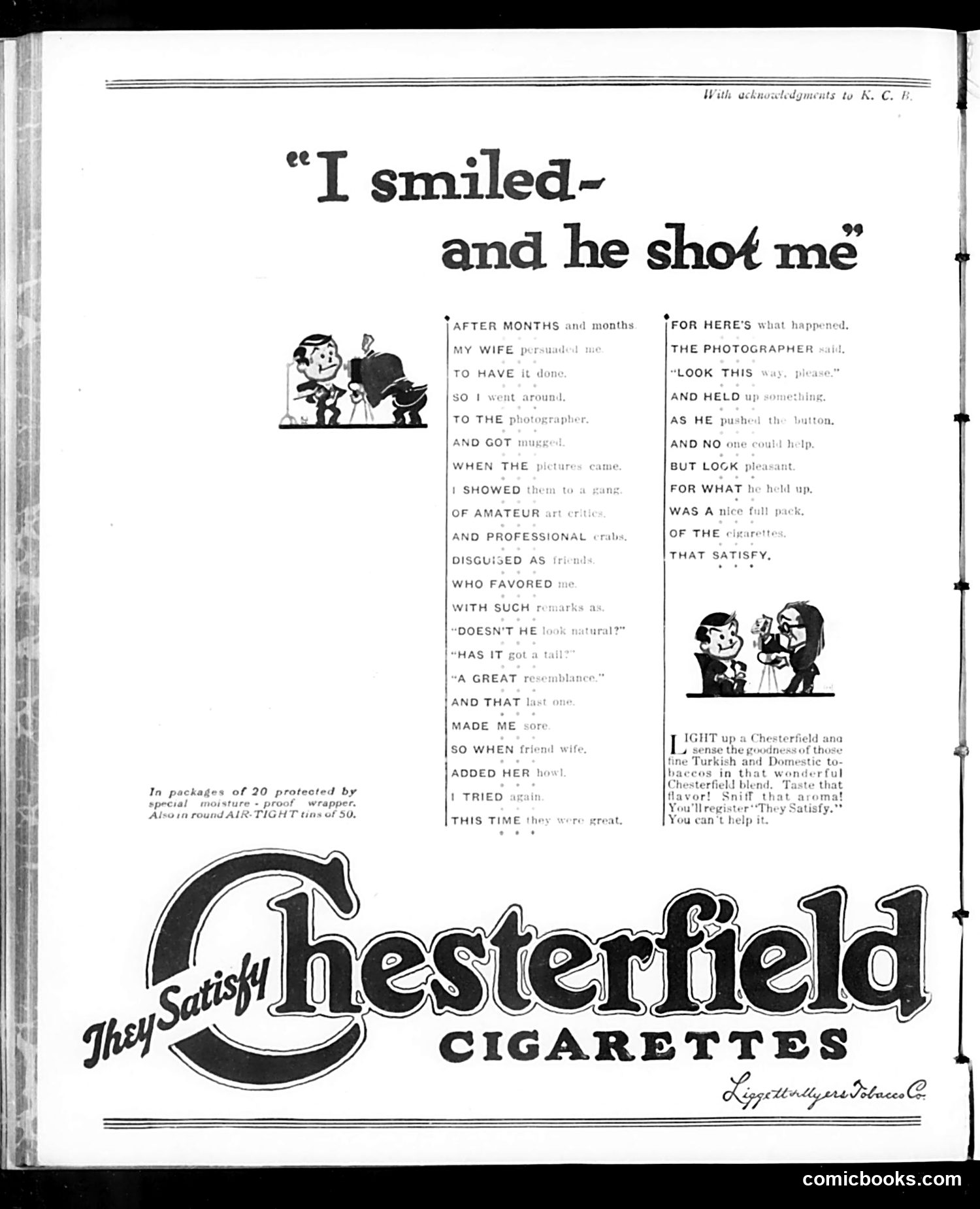
This is primarily a **cigarette advertisement** for Chesterfield, not a political cartoon. The narrative depicts a humorous domestic scene: a man's wife persuades him to get professional portrait photographs taken. When the photographer shows the results to critics (both amateur and professional), they respond with questions suggesting the photos look unnatural ("Doesn't he look natural?" "Has it got a tail?"). The joke plays on the husband's displeasure with the unflattering portraits. His wife's solution is to use Chesterfield cigarettes as a prop—the "nice full pack" visible in the final photo apparently satisfies him enough to approve the pictures. The advertisement suggests that Chesterfield cigarettes improve one's appearance or mood sufficiently to make even bad photographs acceptable. The illustration uses cartoon figures and light satire typical of Judge magazine's advertising style, but the primary purpose is commercial product promotion rather than social or political commentary.